
Obadiah 1:19

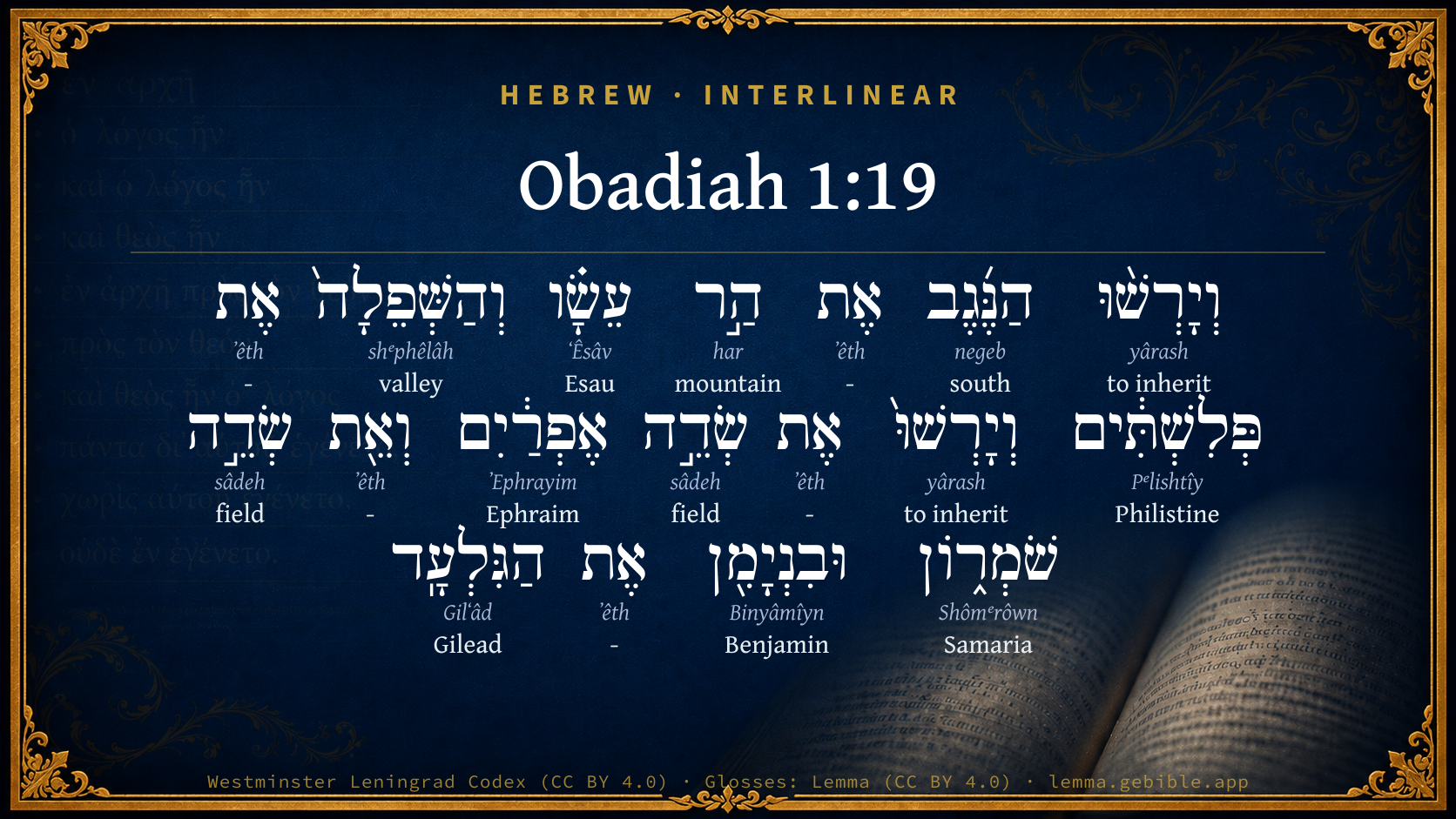
Hebrew (Westminster Leningrad Codex) Obadiah 1:19 appears in the Hebrew Old Testament. The text above is from the Westminster Leningrad Codex. Each word links to its Strong’s number, a concise gloss, and parsing drawn from the Open Scriptures Hebrew Bible morphology. Click any word for its full Brown-Driver-Briggs (BDB) entry.
Download image
Cite this verse

Obadiah 1:19 (World English Bible). Public Domain. Lemma interlinear Bible study tool, https://lemma.gebible.app/v/obadiah/1/19.

Show BibTeX & RIS
BibTeX
RIS
English Translation
Those of the South will possess the mountain of Esau, and those of the lowland, the Philistines. They will possess the field of Ephraim, and the field of Samaria. Benjamin will possess Gilead.
World English Bible · Public Domain
Download a study sheet

One document with this verse’s original text, its word-by-word gloss line, the meaning frame, cross-references with their text, attributed commentary, and full source and license credits — printable, and it pastes into notes with its structure intact.

This verse Autodidact and up

Study sheet (.html) Plain text (.txt)

A passage Seminary Student

Up to 50 verses in one chapter. A passage sheet keeps up to 6 commentary sources and 12 cross-references per verse, in the order this page ranks them, and says so on the sheet whenever that leaves anything out. Ask for a single verse and you get the Autodidact verse sheet above.

Everything on this page stays free to read, with no account — the sheet is a download of what is already on screen, not access to it.

Want to remove ads? Support Godless Engineer
Compare translations 3

The same verse in 3 English versions, stacked beneath the original-language interlinear above. Click any original word for its lexicon entry.

Each is an independent rendering of the whole verse — the interlinear is not word-aligned to these translations.

Highlighted words mark where these versions differ — a whole-verse word diff, not a word-by-word alignment.

  • World English Bible Public Domain
    Those of the South will possess the mountain of Esau, and those of the lowland, the Philistines. They will possess the field of Ephraim, and the field of Samaria. Benjamin will possess Gilead.
  • King James Version Public Domain
    And they of the south shall possess the mount of Esau; and they of the plain the Philistines: and they shall possess the fields of Ephraim, and the fields of Samaria: and Benjamin shall possess Gilead.
  • unfoldingWord Literal Text CC BY-SA 4.0
    And the Negev will possess the mountain of Esau, and the Shephelah, the Philistines. And they will possess the field of Ephraim and the field of Samaria, and Benjamin, Gilead.

unfoldingWord Literal Text — © unfoldingWord, licensed CC BY-SA 4.0. Word-aligned USFM3 via Door43 (git.door43.org/unfoldingWord/en_ult).

Versions to compare (up to 4)

3 of 4 selected

Show all 18 translations

Every available English version of this verse, each an independent rendering of the whole verse.

  • World English Bible Public Domain
    Those of the South will possess the mountain of Esau, and those of the lowland, the Philistines. They will possess the field of Ephraim, and the field of Samaria. Benjamin will possess Gilead.
  • Berean Standard Bible Public Domain
    Those from the Negev will possess the mountains of Esau; those from the foothills will possess the land of the Philistines. They will occupy the fields of Ephraim and Samaria, and Benjamin will possess Gilead.
  • Majority Standard Bible Public Domain
    Those from the Negev will possess the mountains of Esau; those from the foothills will possess the land of the Philistines. They will occupy the fields of Ephraim and Samaria, and Benjamin will possess Gilead.
  • King James Version Public Domain
    And they of the south shall possess the mount of Esau; and they of the plain the Philistines: and they shall possess the fields of Ephraim, and the fields of Samaria: and Benjamin shall possess Gilead.
  • American Standard Version (1901) Public Domain
    And they of the South shall possess the mount of Esau, and they of the lowland the Philistines; and they shall possess the field of Ephraim, and the field of Samaria; and Benjamin `shall possess' Gilead.
  • Revised Version (1885) Public Domain
    And they of the South shall possess the mount of Esau; and they of the lowland the Philistines and they shall possess the field of Ephraim, and the field of Samaria: and Benjamin shall possess Gilead.
  • Geneva Bible (1599) Public Domain
    And they shall possesse the South side of the mount of Esau, and the plaine of the Philistims: and they shall possesse the fieldes of Ephraim, and the fieldes of Samaria, and Beniamin shall haue Gilead.
  • Douay-Rheims (1899) Public Domain
    And they that are toward the south, shall inherit the mount of Esau, and they that are in the plains, the Philistines: and they shall possess the country of Ephraim, and the country of Samaria: and Benjamin shall possess Galaad.
  • Young's Literal Translation Public Domain
    And they have possessed the south with the mount of Esau, And the low country with the Philistines, And they have possessed the field of Ephraim, And the field of Samaria, And Benjamin with Gilead.
  • Literal Standard Version CC BY-SA 4.0
    And they have possessed the south with the mountain of Esau, || And the low country with the Philistines, || And they have possessed the field of Ephraim, || And the field of Samaria, || And Benjamin with Gilead.
  • Unlocked Literal Bible CC BY-SA 4.0
    Those from the Negev will possess the mount of Esau and those of the Shepelah will possess the land of the Philistines. They will possess the land of Ephraim and the land of Samaria; and Benjamin will possess Gilead.
  • unfoldingWord Literal Text CC BY-SA 4.0
    And the Negev will possess the mountain of Esau, and the Shephelah, the Philistines. And they will possess the field of Ephraim and the field of Samaria, and Benjamin, Gilead.
  • Darby Bible Public Domain
    And [they of] the south shall possess the mount of Esau; and they of the lowland the Philistines; yea, they shall possess the field of Ephraim and the field of Samaria; and Benjamin [shall possess] Gilead;
  • World Messianic Bible Public Domain
    Those of the South will possess the mountain of Esau, and those of the lowland, the Philistines. They will possess the field of Ephraim, and the field of Samaria. Benjamin will possess Gilead.
  • Webster's Bible Public Domain
    And they of the south shall possess the mount of Esau; and they of the plain the Philistines: and they shall possess the fields of Ephraim, and the fields of Samaria: and Benjamin shall possess Gilead.
  • Free Bible Version CC BY-SA 4.0
    Those living in the Negev will occupy the mountains of Esau; those from the foothills of Judah will occupy the land of the Philistines, and possess the fields of Ephraim and Samaria; those from the tribe of Benjamin will occupy Gilead.
  • Bible in Basic English Public Domain
    And they will take the South, and the lowland, and the country of Ephraim, and Gilead, as their heritage.
  • JPS Tanakh (1917) Public Domain
    And they of the South shall possess the mount of Esau, and they of the Lowland the Philistines; and they shall possess the field of Ephraim, and the field of Samaria; and Benjamin shall possess Gilead.

Literal Standard Version (2020), Covenant Press — licensed CC BY-SA 4.0. Text via the HelloAO Bible API (eBible.org). Unlocked Literal Bible (unfoldingWord) — licensed CC BY-SA 4.0. Text via the HelloAO Bible API (eBible.org). unfoldingWord Literal Text — © unfoldingWord, licensed CC BY-SA 4.0. Word-aligned USFM3 via Door43 (git.door43.org/unfoldingWord/en_ult). Free Bible Version, Dr. Jonathan Gallagher — licensed CC BY-SA 4.0. Text via the HelloAO Bible API (eBible.org).

Word by word

More ways to search: Search by grammar → Find every occurrence → Compare this word →

Practice this passage: Drill this verse → Learn its vocabulary →

וְהַשְּׁפֵלָה֙
shᵉphêlâh
H8219
“and · the · valley”
Conjunction + Particle, Definite Article + Noun, Common, Feminine, Singular, Absolute
Part of Speech
Conjunction + Particle + Noun
Type
Common
Gender
Feminine
Number
Singular
State
Absolute
Full BDB Definition

Origin: from H8213

TWOT: 2445d

lowland, valley - lowland - strip west of Judean mountains (technical term) - the Shephelah - strip near coast north of Carmel
  1. וְיָרְשׁ֨וּ yârash H3423 “and · to inherit” Conjunction + Verb, Qal, Sequential Perfect, 3rd Person, Common, Plural
  2. הַנֶּ֜גֶב negeb H5045 “the · south” Particle, Definite Article + Noun, Common, Masculine, Singular, Absolute
  3. אֶת ʼêth H853 “-” Particle, Direct Object
  4. הַ֣ר har H2022 “mountain of” Noun, Common, Masculine, Singular, Construct
  5. עֵשָׂ֗ו ʻÊsâv H6215 “Esau” Noun, Proper
  6. אֶת ʼêth H853 “-” Particle, Direct Object
  7. פְּלִשְׁתִּ֔ים Pᵉlishtîy H6430 “Philistines” Noun, Gentilic, Masculine, Plural, Absolute
  8. וְיָרְשׁוּ֙ yârash H3423 “and · to inherit” Conjunction + Verb, Qal, Sequential Perfect, 3rd Person, Common, Plural
  9. אֶת ʼêth H853 “-” Particle, Direct Object
  10. שְׂדֵ֣ה sâdeh H7704 “field of” Noun, Common, Masculine, Singular, Construct
  11. אֶפְרַ֔יִם ʼEphrayim H669 “Ephraim” Noun, Proper
  12. וְאֵ֖ת ʼêth H853 “and · -” Conjunction + Particle, Direct Object
  13. שְׂדֵ֣ה sâdeh H7704 “field of” Noun, Common, Masculine, Singular, Construct
  14. שֹׁמְר֑וֹן Shômᵉrôwn H8111 “Samaria” Noun, Proper
  15. וּבִנְיָמִ֖ן Binyâmîyn H1144 “and · Benjamin” Conjunction + Noun, Proper
  16. אֶת ʼêth H853 “-” Particle, Direct Object
  17. הַגִּלְעָֽד Gilʻâd H1568 “the · Gilead” Particle, Definite Article + Noun, Proper

About this verse

These counts appear in no published source. They are computed here, from the morphology-tagged text and Lemma’s own curated glosses. What Lemma adds →

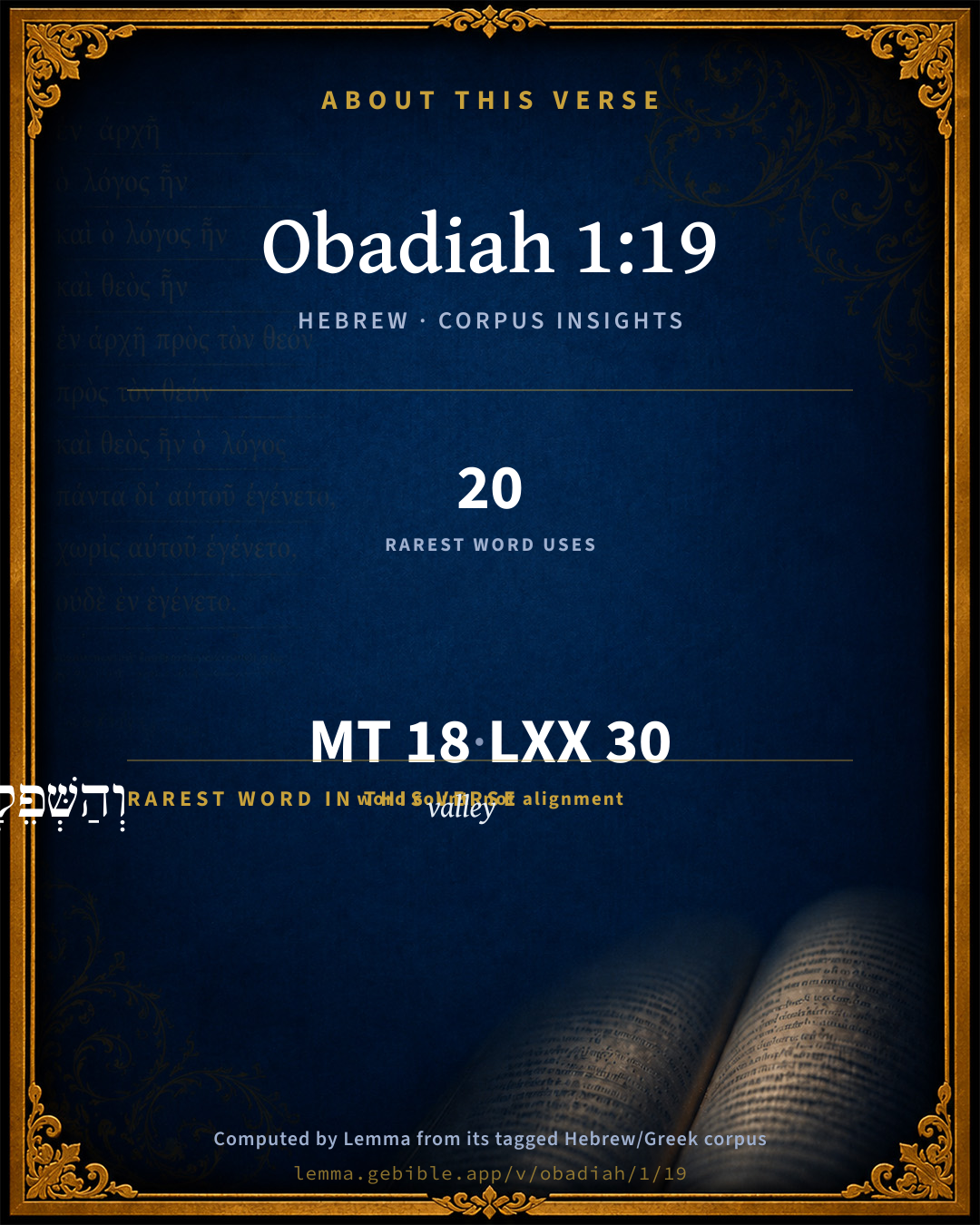
18
words
12
distinct lemmas
Prophets
section

Notable vocabulary

The rarest word here is וְהַשְּׁפֵלָה֙ valley H8219 — appearing just 20 times in the whole Hebrew Bible.

Shared distinctive vocabulary

וְהַשְּׁפֵלָה֙ valley H8219 occurs in 19 verses of the Hebrew Bible. Also found in:

Grammatical profile

  • 2 verbs
  • 11 nouns
  • 5 particles

Verb forms

  • וְיָרְשׁ֨וּ Qal · Sequential Perfect
  • וְיָרְשׁוּ֙ Qal · Sequential Perfect

Repetition

Words recur within this verse — often emphatic in Hebrew:

  • וְיָרְשׁ֨וּ to inherit H3423 ×2
  • שְׂדֵ֣ה field H7704 ×2

Hebrew & Septuagint length

In English translation the verse runs 33 words from the Hebrew and 40 from the Septuagint (LXX English) — closely comparable.

A rough comparison of the two English renderings, which tokenize alike — not a word-level alignment.

Word counts can differ between the Hebrew and the Greek without any difference in meaning — e.g. the Hebrew direct-object marker אֵת has no separate Greek word, and Greek often adds the article ὁ.

In the original languages it is 18 Hebrew tokens and 30 Greek tokens — but the two are counted differently (Hebrew bundles its prefixes and suffixes into one token; the Greek is in lemma form), so that isn’t a like-for-like length.

Cross-references

32

Topical passages linked to Obadiah 1:19 in the Treasury of Scripture Knowledge — connected by theme and wording, ordered by reader-vote popularity; previews shown in the World English Bible.

  • Jeremiah 32:44 Men shall buy fields for money, and subscribe the deeds, and seal them, and call witnesses, in the land of Benjamin, and in the places about Jerusalem, and in the cities of Judah, and in the cities of the hill-country, and in the cities of the lowland, and in the cities of the South: for I will cause their captivity to return, says Yahweh.
  • Amos 9:12 that they may possess the remnant of Edom, and all the nations who are called by my name," says Yahweh who does this.
  • Zephaniah 2:4–7 For Gaza will be forsaken, and Ashkelon a desolation. They will drive out Ashdod at noonday, and Ekron will be rooted up.
  • Jeremiah 31:4–6 Again will I build you, and you shall be built, O virgin of Israel: again shall you be adorned with your tambourines, and shall go forth in the dances of those who make merry.
  • Ezekiel 36:28 You shall dwell in the land that I gave to your fathers; and you shall be my people, and I will be your God.
  • Ezekiel 37:21–25 Say to them, Thus says the Lord Yahweh: Behold, I will take the children of Israel from among the nations, where they are gone, and will gather them on every side, and bring them into their own land:
  • Malachi 1:4–5 Whereas Edom says, "We are beaten down, but we will return and build the waste places;" thus says Yahweh of Hosts, "They shall build, but I will throw down; and men will call them 'The Wicked Land,' even the people against whom Yahweh shows wrath forever."
  • Numbers 24:18–19 Edom shall be a possession, Seir also shall be a possession, [who were] his enemies; While Israel does valiantly.
  • Joshua 13:2–3 This is the land that yet remains: all the regions of the Philistines, and all the Geshurites;
  • Joshua 13:25 Their border was Jazer, and all the cities of Gilead, and half the land of the children of Ammon, to Aroer that is before Rabbah;
  • Joshua 13:31 and half Gilead, and Ashtaroth, and Edrei, the cities of the kingdom of Og in Bashan, were for the children of Machir the son of Manasseh, even for the half of the children of Machir according to their families.
  • Joshua 15:21 The uttermost cities of the tribe of the children of Judah toward the border of Edom in the South were Kabzeel, and Eder, and Jagur,
  • Joshua 15:33 In the lowland, Eshtaol, and Zorah, and Ashnah,
  • Joshua 15:45–46 Ekron, with its towns and its villages;
  • Joshua 18:21–28 Now the cities of the tribe of the children of Benjamin according to their families were Jericho, and Beth Hoglah, and Emek Keziz,
  • Judges 1:18–19 Also Judah took Gaza with the border of it, and Ashkelon with the border of it, and Ekron with the border of it.
  • 2 Kings 17:24 The king of Assyria brought men from Babylon, and from Cuthah, and from Avva, and from Hamath and Sepharvaim, and placed them in the cities of Samaria instead of the children of Israel; and they possessed Samaria, and lived in the cities of it.
  • 1 Chronicles 5:26 The God of Israel stirred up the spirit of Pul king of Assyria, and the spirit of Tilgath Pilneser king of Assyria, and he carried them away, even the Reubenites, and the Gadites, and the half-tribe of Manasseh, and brought them to Halah, and Habor, and Hara, and to the river of Gozan, to this day.
  • Ezra 4:2 then they drew near to Zerubbabel, and to the heads of fathers' [houses], and said to them, Let us build with you; for we seek your God, as you do; and we sacrifice to him since the days of Esar Haddon king of Assyria, who brought us up here.
  • Ezra 4:7–10 In the days of Artaxerxes wrote Bishlam, Mithredath, Tabeel, and the rest of his companions, to Artaxerxes king of Persia; and the writing of the letter was written in the Syrian [character], and set forth in the Syrian [language].
  • Ezra 4:17 [Then] sent the king an answer to Rehum the chancellor, and to Shimshai the scribe, and to the rest of their companions who dwell in Samaria, and in the rest [of the country] beyond the River: Peace, and so forth.
  • Psalms 69:35 For God will save Zion, and build the cities of Judah. They shall settle there, and own it.
  • Isaiah 11:13–14 The envy also of Ephraim shall depart, and those who vex Judah shall be cut off: Ephraim shall not envy Judah, and Judah shall not vex Ephraim.
  • Jeremiah 49:1 Of the children of Ammon. Thus says Yahweh: Has Israel no sons? has he no heir? why then does Malcam possess Gad, and his people well in the cities of it?
  • Ezekiel 25:16 therefore thus says the Lord Yahweh, Behold, I will stretch out my hand on the Philistines, and I will cut off the Cherethites, and destroy the remnant of the sea coast.
  • Ezekiel 36:6–12 Therefore prophesy concerning the land of Israel, and tell the mountains and to the hills, to the watercourses and to the valleys, Thus says the Lord Yahweh: Behold, I have spoken in my jealousy and in my wrath, because you have borne the shame of the nations:
  • Ezekiel 47:13–21 Thus says the Lord Yahweh: This shall be the border, by which you shall divide the land for inheritance according to the twelve tribes of Israel: Joseph [shall have two] portions.
  • Ezekiel 48:1–9 Now these are the names of the tribes: From the north end, beside the way of Hethlon to the entrance of Hamath, Hazar Enan at the border of Damascus, northward beside Hamath, (and they shall have their sides east [and] west), Dan, one [portion].
  • Amos 1:8 I will cut off the inhabitant from Ashdod, And him who holds the scepter from Ashkelon; And I will turn my hand against Ekron; And the remnant of the Philistines will perish," says the Lord Yahweh.
  • Amos 1:13 Thus says Yahweh: "For three transgressions of the children of Ammon, yes, for four, I will not turn away its punishment; Because they have ripped open the pregnant women of Gilead, That they may enlarge their border.
  • Micah 7:14 Shepherd your people with your staff, The flock of your heritage, Who dwell by themselves in a forest, In the midst of fertile pasture land, let them feed; In Bashan and Gilead, as in the days of old.
  • Zechariah 9:5–7 Ashkelon will see it, and fear; Gaza also, and will writhe in agony; As will Ekron, for her expectation will be disappointed; And the king will perish from Gaza, And Ashkelon will not be inhabited.

Cross-references courtesy of OpenBible.info (CC BY 4.0).

Hebrew and Greek witnesses Masoretic Hebrew ↔ Greek Septuagint

The same verse in the two great witnesses to the Old Testament, shown verse-for-verse.

These are two independent witnesses, not word-aligned to each other, and the Septuagint is shown in lemma (dictionary) form.

Hebrew Obadiah 1:19 Masoretic · Westminster Leningrad Codex

וְיָרְשׁ֨וּ הַנֶּ֜גֶב אֶת הַ֣ר עֵשָׂ֗ו וְהַשְּׁפֵלָה֙ אֶת פְּלִשְׁתִּ֔ים וְיָרְשׁוּ֙ אֶת שְׂדֵ֣ה אֶפְרַ֔יִם וְאֵ֖ת שְׂדֵ֣ה שֹׁמְר֑וֹן וּבִנְיָמִ֖ן אֶת הַגִּלְעָֽד

Those of the South will possess the mountain of Esau, and those of the lowland, the Philistines. They will possess the field of Ephraim, and the field of Samaria. Benjamin will possess Gilead.

World English Bible · Public Domain

Greek LXX Obadiah 1:19 Septuagint · lemma form

καί κατακληρονομέω ὁ ἐν ναγεβ ὁ ὄρος ὁ ησαυ καί ὁ ἐν ὁ σεφηλα ὁ ἀλλόφυλος καί κατακληρονομέω ὁ ὄρος ἐφράιμ καί ὁ πεδίον σαμαρεία καί βενιαμίν καί ὁ γαλααδῖτις

And they that dwell in the south shall inherit the mount of Esau, and they in the plain the Philistines: and they shall inherit the mount of Ephraim, and the plain of Samaria, and Benjamin, and the land of Galaad.

LXX2012 (modern English Septuagint) · Public Domain

On this verse, Keil & Delitzsch discusses the Septuagint’s reading. Read the note in Commentary ↓

Hebrew: Westminster Leningrad Codex (CC BY 4.0). Greek: Septuagint (public domain); English from LXX2012 (modern English Septuagint) (Public Domain). How the Septuagint differs from the Hebrew →

Targum (Aramaic paraphrase)

1

The Targum is the ancient Jewish Aramaic paraphrase of the Hebrew Scriptures — an interpretive translation, not the Hebrew text itself. Onkelos (literal) and Pseudo-Jonathan (expansive) render the Torah, and Jonathan the Prophets. Coverage is partial: where no permissively-licensed English translation exists for a verse, only the Aramaic is shown. This is verse-level text, not a word-by-word alignment to the Hebrew.

  1. Targum Jonathan Prophets (Joshua–Malachi)
    וְיַחְסְנוּן יַתְבֵי דָרוֹמָא יַת כְּרַכָּא דְעֵשָׂו וְיַתְבֵי שְׁפֶלְתָּא יַת אַרְעָא דִפְלִשְׁתָּאֵי וְיַחְסְנוּן יַת קִרְוֵי אֶפְרַיִם וְיַת קִרְוֵי שֹׁמְרוֹן וּדְבֵית בִּנְיָמִין יַת יַתְבֵי אַרְעָא דְגִלְעָד:

    (no public-domain English translation for this verse)

    Targum Jonathan — Aramaic: “Mikraot Gedolot” (public domain). English: “Sefaria Community Translation” (CC0 1.0 (public-domain dedication)); “London "Chaldee Paraphrase," 1871” (public domain). Text via Sefaria.

Commentary

Notes on Obadiah 1:19 from classic Christian and Jewish commentators (each source and its license shown beneath its notes). The classic Christian expositions comment on the surrounding passage and are grouped to its opening verse, so a note may address several verses; the Jewish commentaries on the Tanakh (Rashi and others) are per-verse, so they appear only where the commentator wrote on this verse.

Lemma curates 59 commentaries, every one of them public domain or Creative Commons licensed, each selected and text-cleaned for this edition rather than reprinted as found. About our sources →

The Cambridge Bible for Schools and Colleges

gen. ed. J. J. S. Perowne

19. they of the south] lit. the south. This is the first of the three divisions of the tribe of Judah, in the original apportionment of the land by Joshua: “the tribe of the children of Judah, toward the coast of Edom southward” (i.e. in the direction of the “Negeb,” or hot, dry country, which formed the southern frontier. Sinai and Palestine, pp. 159, 160). Jos_15:21. The restored exiles of Judah shall not only possess again this their ancient domain; but whereas it was before “too much for them,” so that “the children of Simeon had their inheritance within the inheritance of them” (Jos_19:9), now they shall not only occupy it, but spreading still further southward shall “possess the mount of Esau.”

they of the plain] Shepçlah: the low-land, R.V. This is the second of the original divisions of Judah. (Jos_15:33, where the same Hebrew word is translated “valley.”) It is the great maritime plain along the western coast of Palestine. See Sinai and Palestine, chap. VI. pp. 255, seq. This again was not only to be repossessed, but its ancient boundaries were to be overpassed, and the entire country of the Philistines, to the shores of the Mediterranean, was to be won for Judah.

and they shall possess] The subject of this clause may of course be the two divisions of Judah, “they of the south,” and “they of the plain,” already mentioned. But it is much better to suppose that the prophet here refers to the remainder of the tribe, who are spoken of as “in the mountains” (Jos_15:48). “And they (the tribe of Judah, i. e. the remaining portion of them) shall possess” the remaining portion of Palestine proper, the country of the ten tribes, “the field of Ephraim and the field of Samaria.”

and Benjamin shall possess Gilead] Judah having thus acquired the whole country on that side Jordan, Benjamin, the only other tribe now under consideration, takes possession of the territory which once belonged to the two tribes and a half on the other side.

19, 20. Restored to their own land, the Jews shall extend their territory in all directions, and shall realise the promise made to their father Jacob, “Thou shalt spread abroad to the west, and to the east, and to the north, and to the south.” Gen_28:14. The two tribes, Judah and Benjamin, as the sole remaining representatives of the people of God in the prophet’s time, are alone directly mentioned by him in the distribution of the land. But the ten tribes are not thereby excluded from a share in the returning prosperity of the nation. See note on Oba_1:18. In Oba_1:19 the exiles who returned from Babylon are provided for. The whole country on the west of the Jordan is assigned to Judah, and Benjamin takes possession of Gilead on the east side. In Oba_1:20, other Jewish exiles in Phœnicia and elsewhere are remembered, and a place found for them in the conquered territory of Esau.

The Cambridge Bible for Schools and Colleges (gen. ed. J. J. S. Perowne; Cambridge University Press, 1878–1918) — public domain. Text from a community e-Sword module.

Trapp's Complete Commentary

John Trapp

Oba 1:19 And [they of] the south shall possess the mount of Esau; and [they of] the plain the Philistines: and they shall possess the fields of Ephraim, and the fields of Samaria: and Benjamin [shall possess] Gilead.

Ver. 19. And they of the south shall possess the mount of Esau] Those of the south, that is, the tribe of Judah. For Judaea was divided into five parts, Jos 15:1-63, whereof one was southward, toward the coast of Edom, Jos 15:21. Another was in the vale or plain, near unto the Philistines, Jos 15:33. Here, then, Obadiah showeth that the Jews shall not only recover their ancient inheritances, but also much enlarge the same; whereby he signifieth that the Church of Christ shall grow so very great, that Jewry shall be too narrow for them, see Zec 10:10; the ancient bounders shall not receive them, see Num 24:17 Isa 40:14. The gospel was soon spread, not only to the neighbouring nations, but to all the ends of the earth: the Edomites, Philistines, &c., are only mentioned, as being better known and more adverse to the Jews than other nations were.

And they of the plain the Philistines] i.e. Those five lordships, Gath, Gaza, Ascalon, Ekron, and Azotus, all which country (called Saron, Act 9:35) Augustus gave to Herod the Ascalonite; and, after his death, to his sons; dividing it into tetrarchies, Luk 3:1.

And they shall possess the fields of Ephraim, and the fields of Samaria] All which Hircanus subdued, and destroyed their temple built in mount Gerizim.

And Benjamin shall possess Gilead] That is shall propagate and extend his habitation beyond Jordan; and in respect of his exceeding great multitude, shall be compelled to hold and possess Gilead, all the country between Jordan and mount Libanus. Thus Jerome with the Hebrew scholiasts and many others; who do also note, that under these earthly felicities heavenly are described; and that all this is chiefly accomplished under Christ, when as the faithful are made heirs and lords of all things by him, who is their head. See Eze 37:16-23.

John Trapp, A Commentary or Exposition upon All the Books of the Old and New Testament (1647–1656) — public domain. Text from a community e-Sword module.

Joseph Benson's Commentary

Oba 1:19. And they of the south shall possess the mount of Esau — The Jews that dwell in the southern parts of Judea, next Idumea, shall, after their return and victories over the Edomites, possess the mountainous part of their country, elsewhere called mount Seir: see Mal 1:3. And they of the plain — The Jews who dwell in the plain country, lying toward that of the Philistines, shall possess their territories together with their own ancient inheritance. The Philistines were likewise ill neighbours to the Jews, who, it is here foretold, should at last conquer them and possess their land. The former part of this prediction was fully accomplished by Hyrcanus. And if this were the time of fulfilling the one, doubtless it was the time of fulfilling the other also. And they shall possess the fields of Ephraim, &c. — All the land which belonged to the ten tribes shall be possessed by the Jews after their restoration to their own country. And Benjamin shall possess Gilead — Benjamin, although one of the smallest tribes, shall enlarge his borders as far as the land of Gilead beyond Jordan. Here a larger possession is promised than ever they had before the captivity. But if Judah be considered as united with Benjamin, which perhaps it is, as those two tribes made but one people, all this was completely fulfilled in the time of Hyrcanus, as appears from Josephus, lib. 12.; 22. But no doubt the great enlargement of the church of Christ, in the times of the gospel, is mystically pointed out in this passage.

Joseph Benson's Commentary on the Old and New Testaments (1811–1818) — public domain. Text from a community e-Sword module.

Keil & Delitzsch

C. F. Keil & F. Delitzsch

After the destruction of its foes the nation of God will take possession of their land, and extend its territory to every region under heaven. Oba 1:19. "And those towards the south will take possession of the mountains of Esau; and those in the lowland, of the Philistines: and they will take possession of the fields of Ephraim, and the fields of Samaria; and Benjamin (will take possession) of Gilead. Oba 1:20. And the captives of this army of the sons of Israel (will take possession) of what Canaanites there are as far as Zarephath; and the prisoners of Jerusalem that are in Sepharad will take possession of the cities of the south." In וירשׁוּ וגו the expression וירשׁוּ בּית י in Oba 1:17 is more precisely defined, and the house of Jacob, i.e., the kingdom of Judah, is divided into the Negeb, the Shephelah, and Benjamin, to each of which a special district is assigned, of which it will take possession, the countries being mentioned in the place of their inhabitants. The negebh, or southern land of Judah (see the comm. on Jos 15:21), i.e., the inhabitants thereof, will take possession of the mountains of Esau, and therefore extend their territory eastwards; whilst those of the lowland (shephēlâh; see at Jos 15:33), on the Mediterranean, will seize upon the Philistines, that is to say, upon their land, and therefore spread out towards the west. The subject to the second וירשׁוּ is not mentioned, and must be determined from the context: viz., the men of Judah, with the exception of the inhabitants of the Negeb and Shephelah already mentioned, that is to say, strictly speaking, those of the mountains of Judah, and original stock of the land of Judah (Jos 15:48-60). Others would leave hannegebh and hasshephēlâh still in force as subjects; so that the thought expressed would be this: The inhabitants of the south land and of the lowland will also take possession in addition to this of the fields of Ephraim and Samaria. But not only is the parallelism of the clauses, according to which one particular portion of territory is assigned to each part, utterly destroyed, but according to this view the principal part of Judah is entirely passed over without any perceptible reason. Sâdeh, fields, used rhetorically for land or territory. Along with Ephraim the land, Samaria the capital is especially mentioned, just as we frequently find Jerusalem along with Judah. In the last clause ירשׁוּ (shall take possession of) is to be repeated after Benjamin. From the taking of the territories of the kingdom of the ten tribes by Judah and Benjamin, we are not to infer that the territory of the ten tribes was either compared to an enemy's land, or thought of as depopulated; but the thought is simply this: Judah and Benjamin, the two tribes, which formed the kingdom of God in the time of Obadiah will extend their territory to all the four quarters of the globe, and take possession of all Canaan beyond its former boundaries. Hengstenberg has rightly shown that we have here simply an individualizing description of the promise in Gen 28:14, "thy seed will be as the dust of the ground; and thou breakest out to the west and to the east, to the north and to the south," etc.; i.e., that on the ground of this promise Obadiah predicts the future restoration of the kingdom of God, and its extension beyond the borders of Canaan. In this he looks away from the ten tribes, because in his esteem the kingdom of Judah alone constituted the kingdom or people of God. But he has shown clearly enough in Oba 1:18 that he does not regard them as enemies of Judah, or as separated from the kingdom of God, but as being once more united to Judah as the people of God. And being thus incorporated again into the people of God, he thinks of them as dwelling with them upon the soil of Judah, so that they are included in the population of the four districts of this kingdom. For this reason, no other places of abode are assigned to the Ephraimites and Gileadites. The idea that they are to be transplanted altogether to heathen territory, rests upon a misapprehension of the true facts of the case, and has no support whatever in Oba 1:20. "The sons of Israel" in Oba 1:20 cannot be the ten tribes, as Hengstenberg supposes, because the other portion of the covenant nation mentioned along with them would in that case be described as Judah, not as Jerusalem. "The sons of Israel" answer to the "Jacob" in Oba 1:10, and the "house of Jacob" in Oba 1:17, in connection with which special prominence is given to Jerusalem in Oba 1:11, and to Mount Zion in Oba 1:17; so that it is the Judaeans who are referred to, - not, however, as distinguished from the ten tribes, but as the people of God, with whom the house of Jacob is once more united. In connection with the gâluth (captivity) of the sons of Israel, the gâluth of Jerusalem is also mentioned, like the sons of Judah and the sons of Jerusalem in Joe 3:6, of whom Joel affirms, with a glance at Obadiah, that the Phoenicians and Philistines have sold them to the sons of Javan. These citizens of Judah and Jerusalem, who have been taken prisoners in war, are called by Obadiah the gâluth of the sons of Israel and Jerusalem, the people of God being here designated by the name of their tribe-father Jacob or Israel. That we should understand by the "sons of Israel" Judah, as the tribe or kernel of the covenant nation, is required by the actual progress apparent in v.20 in relation to Oba 1:19.

After Obadiah had foretold to the house of Jacob in Oba 1:17-19 that it would take possession of the land of their enemies, and spread beyond the borders of Canaan, the question still remained to be answered, What would become of the prisoners, and those who had been carried away captive, according to Oba 1:11 and Oba 1:14? This is explained in Oba 1:20. The carrying away of the sons of Israel is restricted to a portion of the nation by the words, "the captivity of this host" (hachēl-hazzeh); no such carrying away of the nation as such had taken place at that time as that which afterwards occurred at the destruction of the kingdoms of Israel and Judah. The enemies who had conquered Jerusalem had contented themselves with carrying away those who fell into their hands. The expression hachēl-hazzeh points to this host which had been carried away captive. חל, which the lxx and some of the Rabbins have taken as a verbal noun, ἡ ἀρχή, initium, is a defective form of חיל, an army (Kg2 18:7; Isa 36:2), like חק for חיק in Pro 5:20; Pro 17:23; Pro 21:14, and is not to be identified with חל, the trench of a fortification. The two clauses in Oba 1:20 have only one verb, which renders the meaning of צרפת ... אשׁר כ ambiguous. The Chaldee (according to our editions, though not according to Kimchi's account) and the Masoretes (by placing athnach under sephârâd), also Rashi and others, take אשׁר כּנענים as in apposition to the subject: those prisoners of the sons of Israel who are among the Canaanites to Zarephath. And the parallelism to אשׁר בּספרד appears to favour this; but it is decidedly negatived by the absence of ב before כנענים. אשׁר כן can only mean, "who are Canaanites." But this, when taken as in apposition to בּני ישׂ, gives no sustainable meaning. For the sons of Israel could only be called Canaanites when they had adopted the nature of Canaan. And any who had done this could look for no share in the salvation of the Lord, and no return to the land of the Lord. We must therefore take אשׁר כנענים as the object, and supply the verb ירשׁוּ from the first clauses of the preceding verse. Obadiah first of all expresses the verb twice, then omits it in the next two clauses (Oba 1:19 and Oba 1:20), and inserts it again in the last clause (Oba 1:20). The meaning is, that the army of these sons of Israel, who have been carried away captive, will take possession of what Canaanites there are as far as Zarephath, i.e., the Phoenician city of Sarepta, the present Surafend, between Tyre and Sidon on the sea-coast (see comm. on Kg1 17:9). The capture of the land of the enemy presupposes a return to the fatherland. The exiles of Jerusalem shall take possession of the south country, the inhabitants of which have pushed forward into Edom. בּספרד (in Sepharad) is difficult, and has never yet been satisfactorily explained, as the word does not occur again. The rendering Spain, which we find in the Chaldee and Syriac, is probably only an inference drawn from Joe 3:6; and the Jewish rendering Bosphorus, which is cited by Jerome, is simply founded upon the similarity in the name. The supposed connection between this name and the PaRaD, or parda, mentioned in the great arrow-headed inscription of Nakshi Rustam in a list of names of tribes between Katpadhuka (Cappadocia) and Yun (Ionia), in which Sylv. de Sacy imagined that he had found our Sepharad, has apparently more to favour it, since the resemblance is very great. But if parda is the Persian form for Sardis (Σάρδις or Σάρδεις), which was written varda in the native (Lydian) tongue, as Lassen maintains, Sepharad cannot be the same as parda, inasmuch as the Hebrews did not receive the name ספרד through the Persians; and the native varda, apart from the fact that it is merely postulated, would be written סורד in Hebrew. To this we may add, that the impossibility of proving that Sardis was ever used for Lydia, precludes our rendering parda by Sardis. It is much more natural to connect the name with Σπάρτη (Sparta) and Σπαρτιάαι (1 Maccabees 14:16, 20, 23; 12:2, 5, 6), and assume that the Hebrews had heard the name from the Phoenicians in connection with Javan, as the name of a land in the far west.

(Note: The appellative rendering ἐν διασπορᾶ (Hendewerk and Maurer) is certainly to be rejected; and Ewald's conjecture, ספרם, "a place three hours' journey from Acco," in support of which he refers to Niebuhr, R. iii. p. 269, is a very thoughtless one. For Niebuhr there mentions the village of Serfati as the abode of the prophet Elijah, and refers to Maundrell, who calls the village Sarphan, Serephat, and Serepta, in which every thoughtful reader must recognise the biblical Zarephath, and the present village of Surafend.)

The cities of the south country stand in antithesis to the Canaanites as far as Zarephath in the north; and these two regions are mentioned synecdochically for all the countries round about Canaan, like "the breaking forth of Israel on the right hand and on the left, that its seed may inherit the Gentiles," which is promised in Isa 54:3. The description is rounded off by the closing reference to the south country, in which it returns to the point whence it started.

With the taking of the lands of the Gentiles, the full display of salvation begins in Zion. Oba 1:21. "And saviours go up on Mount Zion to judge the mountains of Esau; and the kingdom will be Jehovah's." עלה followed by ב does not mean to go up to a place, but to climb to the top of (Deu 5:5; Psa 24:3; Jer 4:29; Jer 5:10), or into (Jer 9:20). Consequently there is no allusion in ועלוּ to the return from exile. Going up to the top of Mount Zion simply means, that at the time when Israel captures the possessions of the heathen, Mount Zion will receive and have saviours who will judge Edom. And as the mountains of Esau represent the heathen world, so Mount Zion, as the seat of the Old Testament kingdom of God, is the type of the kingdom of God in its fully developed form. מושׁיעים, which is written defectively מושׁעים in some of the ancient mss, and has consequently been rendered incorrectly σεσωσμένοι and ἀνασωζόμενοι by the lxx, Aq., Theod., and the Syriac, signifies salvatores, deliverers, saviours. The expression is selected with an allusion to the olden time, in which Jehovah saved His people by judges out of the power of their enemies (Jdg 2:16; Jdg 3:9, Jdg 3:15, etc.). "מושׁיעים are heroes, resembling the judges, who are to defend and deliver Mount Zion and its inhabitants, when they are threatened and oppressed by enemies" (Caspari). The object of their activity, however, is not Israel, but Edom, the representative of all the enemies of Israel. The mountains of Esau are mentioned instead of the people, partly on account of the antithesis to the mountain of Zion, and partly also to express the thought of supremacy not only over the people, but over the land of the heathen also. Shâphat is not to be restricted in this case to the judging or settling of disputes, but includes the conduct of the government, the exercise of dominion in its fullest extent, so that the "judging of the mountains of Esau" expresses the dominion of the people of God over the heathen world. Under the saviours, as Hengstenberg has correctly observed, the Saviour par excellence is concealed. This is not brought prominently out, nor is it even distinctly affirmed; but it is assumed as self-evident, from the history of the olden time, that the saviours are raised up by Jehovah for His people. The following and concluding thought, that the kingdom will be Jehovah's, i.e., that Jehovah will show Himself to the whole world as King of the world, and Ruler in His kingdom, and will be acknowledged by the nations of the earth, either voluntarily or by constraint, rests upon this assumption. God was indeed Kings already, not as the Almighty Ruler of the universe, for this is not referred to here, but as King in Israel, over which His kingdom did extend. But this His royal sway was not acknowledged by the heathen world, and could not be, more especially when He had to deliver Israel up to the power of its enemies, on account of its sins. This acknowledgment, however, He would secure for Himself, by the destruction of the heathen power in the overthrow of Edom, and by the exaltation of His people to dominion over all nations. Through this mighty saving act He will establish His kingdom over the whole earth (cf. Joe 3:21; Mic 4:7; Isa 24:23). "The coming of this kingdom began with Christ, and looks for its complete fulfilment in Him" (Hengstenberg).

If now, in conclusion, we cast another glance at the fulfilment of our whole prophecy; the fulfilment of that destruction by the nations, with which the Edomites are threatened (Oba 1:1-9), commenced in the Chaldean period. For although no express historical evidence exists as to the subjugation of the Edomites by Nebuchadnezzar, since Josephus (Ant. x. 9, 7) says nothing about the Edomites, who dwelt between the Moabites and Egypt, in the account which he gives of Nebuchadnezzar's expedition against Egypt, five years after the destruction of Jerusalem, in which he subdued the Ammonites and Moabites; the devastation of Edom by the Chaldeans may unquestionably be inferred from Jer 49:7. and Eze 35:1-15, when compared with Jer 25:9, Jer 25:21, and Mal 1:3. In Jer 25:21 the Edomites are mentioned among the nations round about Judah, whom the Lord would deliver up into the hand of His servant Nebuchadnezzar (Jer 25:9), and to whom Jeremiah was to present the cup of the wine of wrath from the hand of Jehovah; and they are placed between the Philistines and the Moabites. And according to Mal 1:3, Jehovah made the mountains of Esau into a wilderness; and this can only refer to the desolation of the land of Edom by the Chaldeans (see at Mal 1:3). It is true, that at that time the Edomites could still think of rebuilding their ruins; but the threat of Malachi, "If they build, I shall pull down, saith the Lord," was subsequently fulfilled, although no accounts have been handed down as to the fate of Edom in the time of Alexander the Great and his successors. The destruction of the Edomites as a nation was commenced by the Maccabees. After Judas Maccabaeus had defeated them several times (1 Maccabees 5:3 and 65; Jos. Ant. xii. 18, 1), John Hyrcanus subdued them entirely about 129 b.c., and compelled them to submit to circumcision, and observe the Mosaic law (Jos. Ant. xiii. 9, 1), whilst Alexander Jannaeus also subjugated the last of the Edomites (xiii. 15, 4). And the loss of their national independence, which they thereby sustained, was followed by utter destruction at the hands of the Romans. To punish them for the cruelties which they had practised in Jerusalem in connection with the Zelots, immediately before the siege of that city by the Romans (Josephus, Wars of the Jews, iv. 5, 1, 2), Simon the Gerasene devastated their land in a fearful manner (Wars of the Jews, iv. 9, 7); whilst the Idumaeans in Jerusalem, who took the side of Simon (v. 6, 1), were slain by the Romans along with the Jews. The few Edomites who still remained were lost among the Arabs; so that the Edomitish people was "cut off for ever" (Oba 1:10) by the Romans, and its very name disappeared from the earth. Passing on to the rest of the prophecy, Edom filled up the measure of its sins against its brother nation Israel, against which Obadiah warns it in Oba 1:12-14, at the taking and destruction of Jerusalem by the Chaldeans (vid., Eze 35:5, Eze 35:10; Psa 137:7; Lam 4:22). The fulfilment of the threat in Oba 1:18 we cannot find, however, in the subjugation of the Edomites by the Maccabeans, and the devastating expedition of Simon the Gerasene, as Caspari and others do, although it is apparently favoured by the statement in Eze 25:14, that Jehovah would fulfil His vengeance upon Edom by the hand of His people Israel. For even if this prophecy of Ezekiel may have been fulfilled in the events just mentioned, we are precluded from understanding Oba 1:18, and the parallel passages, Amo 9:11-12, and Num 24:18, as referring to the same events, by the fact that the destruction of Edom, and the capture of Seir by Israel, are to proceed, according to Num 24:18, from the Ruler to arise out of Jacob (the Messiah), and that they were to take place, according to Amo 9:11-12, in connection with the raising up of the fallen hut of David, and according to Obadiah, in the day of Jehovah, along with and after the judgment upon all nations. Consequently the fulfilment of Oba 1:17-21 can only belong to the Messianic times, and that in such a way that it commenced with the founding of the kingdom of Christ on the earth, advances with its extension among all nations, and will terminate in a complete fulfilment at the second coming of our Lord.

Keil & Delitzsch — Biblical Commentary on the Old Testament (1861–1891) — public domain (CC PDM 1.0). Text via the HelloAO Bible API. (Old Testament only.)

Tyndale Open Study Notes

Tyndale Open Resources

1:19-21 History yields to the day when the entire world will belong to the Lord as his kingdom. This message encourages God’s people and warns the nations that forget God.

1:19-20 God’s people living in the Negev, the foothills of Judah, and Benjamin (three regions of Judah) would possess territories of their neighbors (Edom, the Philistine plains, Gilead). Restored Israel would recover Ephraim and Samaria (territory lost in 722–721 BC to Assyria) and expand its borders to those lands promised in the conquest (the Philistine plains, the land of Gilead, the Phoenician coast). See also Ezek 47:13-23.

Tyndale Open Study Notes — © Tyndale Open Resources, licensed CC BY-SA 4.0. Text via the HelloAO Bible API.

Geneva Bible (1599)

Geneva Bible translators

He describeth how the Church shall be enlarged and have great possessions: but this chiefly is accomplished under Christ, when as the faithful are made heirs and lords of all things by him which is their head.

Geneva Bible (1599) marginal notes — public domain. Text via Bolls.life.

Jamieson, Fausset & Brown

Robert Jamieson, A. R. Fausset & David Brown

they of the south--The Jews who in the coming time are to occupy the south of Judea shall possess, in addition to their own territory, the adjoining mountainous region of Edom.

they of the plain--The Jews who shall occupy the low country along the Mediterranean, south and southwest of Palestine, shall possess, in addition to their own territory, the land of "the Philistines," which runs as a long strip between the hills and the sea.

and they shall possess the fields of Ephraim--that is, the rightful owners shall be restored, the Ephraimites to the fields of Ephraim.

Benjamin shall possess Gilead--that is, the region east of Jordan, occupied formerly by Reuben, Gad, and half Manasseh. Benjamin shall possess besides its own territory the adjoining territory eastward, while the two and a half tribes shall in the redistribution occupy the adjoining territory of Moab and Ammon.

Jamieson, Fausset & Brown — Commentary Critical and Explanatory on the Whole Bible (1871) — public domain (CC PDM 1.0). Text via the HelloAO Bible API.

Adam Clarke's Commentary

Verse 19. They of the south] The Jews who possessed the southern part of Palestine, should render themselves masters of the mountains of Idumea which were contiguous to them.

They of the plain] From Eleutheropolis to the Mediterranean Sea. In this and the following verse the prophet shows the different districts which should be occupied by the Israelites after their return from Babylon.

The fields of Samaria] Alexander the Great gave Samaria to the Jews; and John Hyrcanus subdued the same country after his wars with the Syrians. See Josephus, contra. App. lib, ii., and Antiq. lib. xiii., c. 18.

Benjamin shall possess Gilead.] Edom lay to the south; the Philistines to the west; Ephraim to the north; and Gilead to the east. Those who returned from Babylon were to extend themselves everywhere. See Newcome; and see, for the fulfilment, 1Macc 5:9, 35, 45; 9:35, 36.

Adam Clarke's Commentary on the Bible (1810–1826) — public domain. Text from a community e-Sword/MySword module.

John Calvin's Commentaries

The Prophet proceeds with the same subject, — that God would not only gather the remnants of his people from the Babylonian exile, but would restore the exiles, that they might rule far and wide, and that their condition might be better than it was before: for the Prophet, as I think, directs the attention to the first blessing of God, which had been deposited in the hand of Abraham. God had promised to the posterity of Abraham the whole land from Euphrates to the sea. Now this land had never been possessed by the children of Abraham. This happened, as it is well known, through their sloth and ingratitude. David in his time enlarged the borders; but yet he only made those tributaries whom God had commanded to be destroyed. So this blessing had never been fulfilled, because the people put a hindrance in the way. The Prophet now, speaking of the restoration of the Church, tells the people, who would return from exile, that they were to occupy the country which had been promised to their fathers as though he said, “There will come to you a full and complete inheritance.”

Now it is certain that this prophecy has never been completed: we know that but a small portion of the land was possessed by the Jews. What then are we to understand by this prophecy? It does unquestionably appear that the Prophet speaks here of the kingdom of Christ; and we know that the Church was then really restored, and that the Jews not only recovered their former state from which they had fallen, but that their kingdom was increased: for how great became the splendor of the kingdom and of the temple under Christ? This then is what the Prophet now means, when he promises to the Jews the heritage which they had lost; yea, God then enlarged the borders of Judea. Hence he shows that they should not only be restored to their former condition, but that the kingdom would be increased in splendor and wealth, when Christ should come. Let us now run over the words.

Possess then shall they the south of the mount of Esau. The space was no doubt great: even when David reigned, the Jews did not possess that part or south portion of mount Seir. Then the Prophet, as I have said, shows that the borders of the kingdom would be more extensive than they had been. And the plain, he says, of the Philistines On that side also the Lord would cause that the Jews would extend farther than their kingdom. And possess they shall the fields of Ephraim Here I will not spend much labor in describing the land: but it is enough for us to understand that the design of the Prophet was to show, that the state of the people after their exile would be far more splendid than it had been before, even under the reign of David. What he means by Gilead is not very clear: but it is not probable that mount Gilead is referred to here, which was not far distant from the tribe of Benjamin, but rather that a town or some place distant from that part, and not included in their portion, is pointed out.

John Calvin's Commentaries (1540-1563) — public domain. Text from the Calvin Translation Society English edition (1840s-50s) via the Christian Classics Ethereal Library (ccel.org). Calvin's coverage is partial (roughly two-thirds of the Bible); uncommented books and verses are honest gaps, never fabricated. The 19th-century editor's footnotes and remarks are omitted so the notes are faithfully Calvin's own voice.

John Gill's Exposition

And they of the south shall possess the land of Esau,.... That is, those Jews that shall dwell in the southern part of the land of Judea shall seize upon the country of Idumea, lying contiguous to them; they shall enlarge their border, and take that into their possession:

and they of the plain the Philistines; or of Sephela, they that shall inhabit the plain, or champaign country of Judea, as the parts of Lydda, Emmaus, and Sharon, were; these shall possess the country of the Philistines, lying near unto them, as Azotus, Gaza, Ashkelon, Gath, and Ekron:

and they shall possess the fields of Ephraim, and the fields of Samaria; all the countries that the ten tribes inhabited, in the times of their idolatry, before their captivity, which the Jews shall now be restored unto:

and Benjamin shall possess Gilead; that tribe shall be so enlarged as to take in the country of Gilead, which lay beyond Jordan, formerly possessed by the, half tribe of Manasseh. Some think this was fulfilled in the times of the Maccabees, when several of these places were taken by Judas, in the Apocrypha:

"17. Then said Judas unto Simon his brother, Choose thee out men, and go and deliver thy brethren that are in Galilee, for I and Jonathan my brother will go into the country of Galaad. 36. From thence went he, and took Casphon, Maged, Bosor, and the other cities of the country of Galaad. 38. So Judas sent men to espy the host, who brought him word, saying, All the heathen that be round about us are assembled unto them, even a very great host.'' (1 Maccabees 5)

but since the land of Judea, and the countries adjacent to it, were never as yet inhabited by the Jews in the form and manner here mentioned, it rather respects their settlement in their own land, in the latter day, when their borders will be greatly enlarged; see Eze 48:1; or it may regard the enlargement of the church of Christ, either in the first times of the Gospel, when that was spread in those parts, and met with success; see Act 8:6; or rather in the latter day, when Christ's kingdom will be from sea to sea, and his dominion from the river to the ends of the earth, Psa 72:8; and to which also the following words belong.

John Gill's Exposition of the Whole Bible (1746–1763) — public domain (CC PDM 1.0). Text via the HelloAO Bible API.

Albert Barnes' Notes on the Bible

And they of the South shall possess the mount of Esau - The Church was now hemmed in within Judah and Benjamin. They too were to go into captivity. The prophet looks beyond the captivity and the return, and tells how that original promise to Jacob Gen 28:14 should be fulfilled; “Thy seed shall be as the dust of the earth, and thou shalt break North to the West, and to the East, and to the North, and to the South; and in thee and in thy seed shall all the families of the earth be blessed. Hosea and Amos had, at this time, prophesied the final destruction of the kingdom of Israel. Obadiah describes Judah, as expanded to its former bounds including Edom and Philistia, and occupying the territory of the ten tribes. “The South” , i. e., they of the “hot” and “dry” country to the South of Judah bordering on Edom, “shall possess the mountains of Esau,” i. e., his mountain country, on which they bordered. And “the plain,” they on the West, in the great maritime plain, the “shephelah,” should spread over the country of the Philistines, so that the sea should be their boundary; and on the North, over the country of the ten tribes, “the fields of Ephraim and the fields of Samaria.” The territory of “Benjamin” being thus included in Judah, to it is assigned the country on the other side Jordan; “and Benjamin, Gilead.”

Albert Barnes' Notes on the Bible (1834–1885) — public domain. Text from a community e-Sword/MySword module.

Haydock's Catholic Bible Commentary

Plains. Sephala, Josue x. 40. --- Samaria, which the Cutheans had occupied, till Alexander subjected them to the Jews, and Hircan asserted his authority. (Josephus, Antiquities xiii. 18.) --- Galaad, east of the Jordan. Benjamin alone did not occupy this country.

George Leo Haydock (1774–1849), Haydock's Catholic Family Bible and Commentary, 1859 edition — public domain. Excludes Psalms (Douay-Rheims chapter numbering differs from Protestant) and Deuterocanonical books (Catholic canon only).

Matthew Poole's English Annotations

They of the south; the Jews who lived in the south parts of Canaan, which was next to Idumea, shall, after their return and victories over Edom, possess his country, called here

the Mount of Esau. They of the plain the Philistines; the Jews who dwelt in the plain country, which was next to Palestina, Jos 15:33, shall enlarge their borders, and possess the Philistines’ country, together with their ancient inheritance. Now of the possession of Mount Esau by the Jews, saith Grotius, it was most fully accomplished by Hyrcanus. Josephus, lib. 13. chap; 17, reports the matter thus, that the Idumeans were commanded either to depart their country, or be circumcised. If this were the time of fulfilling the one, it was also the time of fulfilling the other also.

And they shall possess the fields of Ephraim; and all the land which the ten tribes once did possess shall again be possessed by the Jews.

And the fields of Samaria; the fields also about Samaria, how greatly soever wasted, shall be replanted, and that by the Jews too.

Benjamin, either apart, or jointly with Judah, shall possess Gilead; a country beyond Jordan, assigned to the tribes of Reuben, Gad, and half Manasseh, wasted by Hazael and Tiglathpileser some time before Samaria was taken, but should be inhabited by the Benjamites; and probably Gad, Manasseh, and Reuben did enlarge upon the Moabites and Ammonites. Here is promised a larger possession than ever they had before the captivity, and it doth no doubt point out the enlargement of the church of Christ in the times of the gospel, and particularly when antichrist, typified in this prophecy by Edom, shall be destroyed: but we are to give the literal meaning, and think we do not miss of it.

Matthew Poole's English Annotations on the Holy Bible (1683–1685) — public domain. Text from a community e-Sword/MySword module.

The Pulpit Commentary

Judah and Benjamin between them shall possess the whole territory that once belonged to the children of Israel. In Jos_15:21, Jos_15:33, Jos_15:48, the inheritance of Judah is distributed into three portions the south, the plain, and the mountains; the same divisions are noticeable here. (see note on Zec_7:7) They of the south. The inhabitants of the Negeb, "the dry country" the southern part of Judah, shall take possession of Idumea. (Amo_9:12) They of the plain. Of the Shephelah, or "low land the maritime plain and the country held by the Philistines. (2Ch_28:18 Zep_2:7) And they shall possess. The Judaeans not already mentioned, i.e. those of the mountains, shall take the territory of the ten tribes. The fields of Ephraim, and the fields of Samaria. The country, and the capital. Septuagint, to orov Efrai to pedion Samareiav , "the Mount of Ephraim and the Plain of Samaria.

Others translate, "Ephraim shall possess the field of Samaria," considering that otherwise Ephraim would be excluded from the restored kingdom, and Judah would inherit the territory of Ephraim, in violation of the covenant (Briggs, "Messianic" Prophecy," p. 317). But the Israelites proper were merged in the Judaeans at the return; and if Benjamin possesses Gilead, it is not unnatural that Judah should extend northward to Samaria. And Benjamin shall possess Gilead. Benjamin, the other portion of the house of Jacob, whose territory originally reached to the river, shall possess all the territory on the other side of Jordan. Thus the restored people shall, in accordance with the promise in Gen_28:14, "spread abroad to the west, and to the east, and to the north, and to the south". (comp. Isa_54:1-3) Obadiah sees the twelve tribes, once more united, extending their territory on every side; and, to make this evident, he gives certain examples, using Judah and Benjamin as equivalent to "the people of God," and their enlargement as denoting the majestic progress of the kingdom of God.

Vers. 19, 20. "Rehoboth.

"And they of the south shall possess the mount of Esau; and they of the plain the Philistines: and they shall possess the fields of Ephraim, and the fields of Samaria: and Benjamin shall possess Gilead. And the captivity of this host of the children of Israel shall possess that of the Canaanites or rather, "the captivity," etc., "which are among the Canaanites" (Pusey, following the Chaldee, etc.), even unto Zarephath; and the captivity of Jerusalem, which is in Sepharad, shall possess the cities of the south." Here we have wideness at last; Rehoboth after narrowness, strife, contention, and hatred (Genesis 26). The house of Jacob is shown us stretching forth in all directions north, south, east, and west; the promises long looked for fulfilled; Jacob, long pent in, now enjoying a large room. The cries in narrowness have been answered in wideness. Rehoboth is inscribed on Judah"s banner, and little Benjamin shares the plenteousness. They of the south have no Edomite enemy; nay, the mount of Esau is their possession. They of the plain have no Philistine foe; their own borders reach to the coast. Over Philistia they triumph. The giants of Gath lie in the dust. The men of Ashdod and Ekron, who sang the praise of Dagon, are no more. Ashkelon and Gaza are silent in death. They of the plain possess the whole territory of the Philistines, with the sea for their only border. But much more than this. They extend northward. They take in Ephraim. No more shall Ephraim vex Judah. They also take in Samaria. No more shall it be heard that the Samaritans have no part with the Jews. And more still Benjamin shall possess Gilead, thus stretching to the east. It shall have a portion on both sides of Jordan. And, further, Judah shall receive into fellowship those who were carried away captive from them. Some in Zarephath in Zidon, labouring as slaves in the smelting house, and the captivity of Jerusalem shall possess the cities of the south.

Thus the inspired prophet, from the sacred mount of vision, amongst other blessings, notices these five:

(1) liberty after captivity;

(2) peace after war;

(3) wideness after straits;

(4) a portion on both sides of Jordan;

(5) unity after divisions and discord.

With what joy must Obadiah have seen all these rich blessings unfolded before him! Liberty! Oh what a history of captivity and bondage was that of the Jews! Peace! Their national life hitherto had been one of war. Wideness! Up to this they had been sorely straitened and hemmed in varies narrowness. A portion on both sides of Jordan! Hitherto they had had their lot on the western side only. Unity! They had been torn by divisions. They had been weakened, impoverished, and desolated by divisions. How pleasant, therefore, the prospect of Judah receiving into its bosom multitudes of the captivity of Israeli All one at last. One fold under one Shepherd. A delightful prospect. Obadiah, like another Moses, must have viewed the scene with patriotic joy and hallowed fervour and gratitude. And now for the spiritual application of the passage to ourselves.

I GLORIOUS LIBERTY IS PROCLAIMED TO US. Christ sets his people free. He came to lead captivity captive. He opens the prison to those who were bound. His Word is the perfect law of liberty. The Apostle Peter"s deliverance from prison is like a picture of the deliverance wrought for the soul of man. We were in the dark dungeon, fast bound in misery and iron. Light shone in the prison. A friendly hand smote us. A voice bade us arise. The fetters fell off. We were led forth from the darkness of death into the light and liberty of the children of God. Or we may say, in the language of David, (Psa_124:7) "Our soul is escaped as a bird out of the snare of the fowlers: the snare is broken, and we are escaped;" Joyous liberty, blessed liberty, glorious liberty of the children of God.

II PEACE IS OURS. The peace of the very God of peace. Secure tranquillity through the blood of the everlasting covenant. "Comfort ye, comfort ye my people, saith your God. Speak ye comfortably to Jerusalem, and cry unto her, that her warfare is accomplished, that her iniquity is pardoned;" "Peace to him that is far off, and to him that is near." Peace always and by all means.

III WIDENESS IS OURS. "Thou hast known my soul in adversities; ... thou hast set me in a large room." The Lord brings his people into a wealthy place. "Rehoboth" is written on the gospel "Rehoboth" is written on the work of Christ. "Rehoboth" is written on the wells of salvation. On the joys, the glories, the promises of covenant grace, the letters are written as with Calvary"s blood Room enough and to spare. (Job_36:16)

IV A PORTION ON BOTH SIDES OF JORDAN IS OURS. The Christian has the promise of the life that now is as well as that which is to come. All things are ours. The world, life, death, things present, things to come, the blessings of the throne and the blessings of the footstool, the upper springs and the nether springs, all are ours. Oh, let us pity the men who have their portion only in this life! Let us pray for those whose hearts and treasures are where the rust and moth are. Let us seek to influence for good all those who have no portion on both sides of Jordan.

V Finally, THE CHURCH IS CALLED TO UNITY. We are to endeavour to keep the unity of the Spirit. There are many stones, but one temple. There are many children, but one household one family. There are many branches, but one Vine. There are many members, but one body. The Communion feast teaches this oneness. Our Lord"s great intercessorial prayer was that his people all might be one. The Holy Spirit, the Spirit of love and concord, calls us to oneness. The divisions of Christians must grieve the Spirit. "Our little systems have their day; They have their day, and cease to be, They are but broken lights of thee, And thou, O Lord, art more than they. Oh for another Pentecost, that the Church of today might be as the Church of the fruit days; and the Redeemer"s words be exemplified "That they all might be one, that the world may believe that thou hast sent me! A.C.T.

Vers. 19, 20. The true Church; or, the community of the good: 3. An aggressive power.

"And they of the south shall possess the mount of Esau; and they of the plain the Philistines: and they shall possess the fields of Ephraim, and the fields of Samaria: and Benjamin shall possess Gilead," etc. By the "south" or southern part of Palestine is here meant those who should occupy it; and by the "plain," those who should occupy the low country along the shore of the Mediterranean. "According to the relative positions of those who should take possession of the different parts of the Holy Land was to be the enlargement of their territory by the annexation of the adjoining regions which had formerly been occupied by allies or hostile powers. As there is no subject specified before the country of Edom and the country of Samaria, it seems to be intimated that the regions of Ephraim and Samaria were to be occupied by the Jews and the Israelites jointly, without any regard to tribal distinctions; and the reason why the tribe of Benjamin is mentioned is merely on account of the proximity of Gilead to the territory which it originally possessed" (Elzas). "The promise here," says an old expositor, "no doubt has a spiritual signification, and had its accomplishment in the setting up of the Christian Church, the gospel Israel, in the world; and shall have its accomplishment more and more in the enlargement of it, and the additions made to it, till the mystical body is completed. When ministers and Christians prevail with their neighbours to come to Christ, to yield themselves to the Lord, they possess them. The converts that Abraham had made are said to be the souls that he had gotten. (Gen_12:5) The possession is gained, not vi et armis by force and arms; for the weapons of our warfare are not carnal, but spiritual; it is by the preaching of the gospel, and the power of Divine grace going along with it, that this possession is got and kept." That the true Church is an aggressive power will appear from considering the gospel, which is at once its inspiration, its life, and its instrument. Consider, therefore

I THE ELEMENTS OF WHICH THE GOSPEL IS COMPOSED. It is made up of two great elements, "grace and truth," that is, eternal reality and Divine benevolence. Grace and truth came by Jesus Christ." To show the aggressiveness of these two principles, two facts may be stated.

1. That the human soul is made to feel their imperial force. It is true that the soul in its unregenerate state is ruled by directly opposite elements error and selfishness. But even error has power over it only so long as it regards it as reality, and selfishness influences it under the guise of love. It is the truth when made clear to it that comes with a conquering power; it is love or grace that transports its heart. The human soul is made for these two elements.

2. That the human soul is bound to yearn after these elements as its highest good. Its deep hunger is for truth and for reality, for benevolence, or love. It has no natural hunger for error, no natural hunger for selfishness.

3. That the human soul is everywhere restless without these elements. It is only as the soul gets truth and grace into it that it becomes settled, calm; self-united. These are facts connected with the human soul, and these facts show the aggressiveness of the gospel.

II THE PROSELYTIZING SPIRIT WHICH THE GOSPEL ENGENDERS. As soon as ever the gospel takes real possession of a soul, that soul becomes intensely solicitous to spread it abroad. It becomes what Jeremiah describes as a "fire in the bones." Peter said, "We cannot but speak the things which we have seen and heard," Paul said, "The love of Christ constraineth us; because we thus judge," etc. "Necessity is laid upon us" Every genuine recipient, then, of the gospel becomes a missionary, a propagandist, a moral knight, to battle against the mighty hosts of error and selfishness. Each member of the true Church, or godly community, becomes, by a moral necessity, a soldier of the cross.

III THE TRIUMPHS WHICH THE GOSPEL HAS ALREADY ACHIEVED. Compare the influence of the gospel in the world now to what it was when Christ was on earth. It was then confined to one lonely soul, the soul of Jesus of Nazareth; it is now in the possession of millions. The springlet has become an Amazon; the grain has covered islands and continents; the little stone has grown into a mountain that bids fair to fill the earth.

CONCLUSION. Such thoughts as these tend, we think, to demonstrate the essential aggressiveness of the true Church. It will one day take possession of all heathendom, with its "mount of Esau," the "plains of the Philistines," the "fields of Ephraim," and the "fields of Samaria," and what Canaanites there are as far as Zarephath. D.T.

The Pulpit Commentary (1880–1919), ed. H.D.M. Spence-Jones & Joseph S. Exell — public domain. Text from a community e-Sword module.

John Wesley's Explanatory Notes

They - The Jews who live in the south parts of Canaan, next Idumea, shall after their return and victories over Edom, possess his country. Of the plain - The Jews who dwell in the plain country, shall enlarge their borders, possess the Philistines country, together with their ancient inheritance. The former was fully accomplished by Hyrcanus. And if this were the time of fulfilling the one, doubtless it was the time of fulfilling the other also. And all the land which the ten tribes possessed, shall again be possessed by the Jews. Gilead - Here is promised a larger possession than ever they had before the captivity; and it does, no doubt, point out the enlargement of the church of Christ in the times of the gospel.

John Wesley, Explanatory Notes Upon the Whole Bible (1754–1765) — public domain. Text via the GEBible commentary corpus.

unfoldingWord translationNotes

Door43 World Missions Community

General Information:

In verses 16-21, Yahweh speaks through Obadiah to tell the people of Judah that they will possess the land of Edom.

Those from the Negev will possess the mount of Esau

"The Israelites in the Negev will take the land of the Edomites"

those of the Shepelah

This refers to Israelites in the western foothills of Israel who will capture the land of the Philistines in battle.

They will possess

Here "They" appears to refer to the people of Israel in general.

Benjamin will possess

"the tribe of Benjamin will possess" or "the descendants of Benjamin will possess"

translationWords

Negev

possess

Esau

Philistines

Ephraim

Samaria

Benjamin

Gilead

unfoldingWord translationNotes — © Distant Shores Media and the Door43 World Missions Community, licensed CC BY-SA 4.0. Source: git.door43.org/Door43/en_tn.

Rashi

Rabbi Shlomo Yitzchaki (Rashi)

And [the inhabitants of] the southland shall inherit—Israel, who were dwelling in the south of Eretz Israel, shall inherit the mountain of Esau, which is at the southern boundary; and the people of the plain shall inherit the land of the Philistines and Mt. Ephraim and Mt. Shomeron.

and Benjamin with [the inhabitants of] Gilead And the children of Manasseh, whose territory was the land of Gilead, shall spread beyond the borders of Eretz Israel on the east.

Rashi on the Tanakh — English translations: “The Judaica Press complete Tanach with Rashi, translated by A. J. Rosenberg” (CC BY 4.0); “Pentateuch with Rashi's commentary by M. Rosenbaum and A.M. Silbermann, 1929-1934” (public domain); “The Metsudah Tanach series, Lakewood, N.J” (CC BY 4.0); and “The Book of Joshua, Metsudah Publications, 1997” (CC BY 4.0). Text via Sefaria.

Lesson kit

Teaching starters — assembled from the data on this page, not authored interpretation. Every prompt links to the verse data it draws on. Edit before teaching.

Obadiah, in the Prophets, opens this verse with 18 words (12 distinct Hebrew lemmas). Its most distinctive word is shᵉphêlâh (“valley”). A historical commentator’s framing appears above. Read the whole chapter for the surrounding context.

Discussion questions

  1. How does “valley” (shᵉphêlâh) shape what this verse is saying?
  2. How does Deuteronomy 1:7, which shares the word «valley», read alongside this verse?
  3. What does the repetition of “to inherit” (2× in this one verse) do in this verse?
  4. These translations render this verse differently. What is at stake in choosing one wording over another?
  5. «וְיָרְשׁ֨וּ» is a Qal Sequential Perfect verb. How does that grammatical form shape the action described?
  6. Compare how The Cambridge Bible for Schools and Colleges and Trapp's Complete Commentary read this verse. Where do they agree or differ?

Things to notice

Reading settings

Reading text

Shown beneath each verse's original-language words.

Old Testament
Old Testament edition

Read the OT as the Masoretic Hebrew (MT) or the Greek Septuagint (LXX).

English shown for the Greek Septuagint (in the Hebrew ↔ Greek comparison).

Comparing translations? Open the Compare panel on any verse page to stack up to four side by side.