
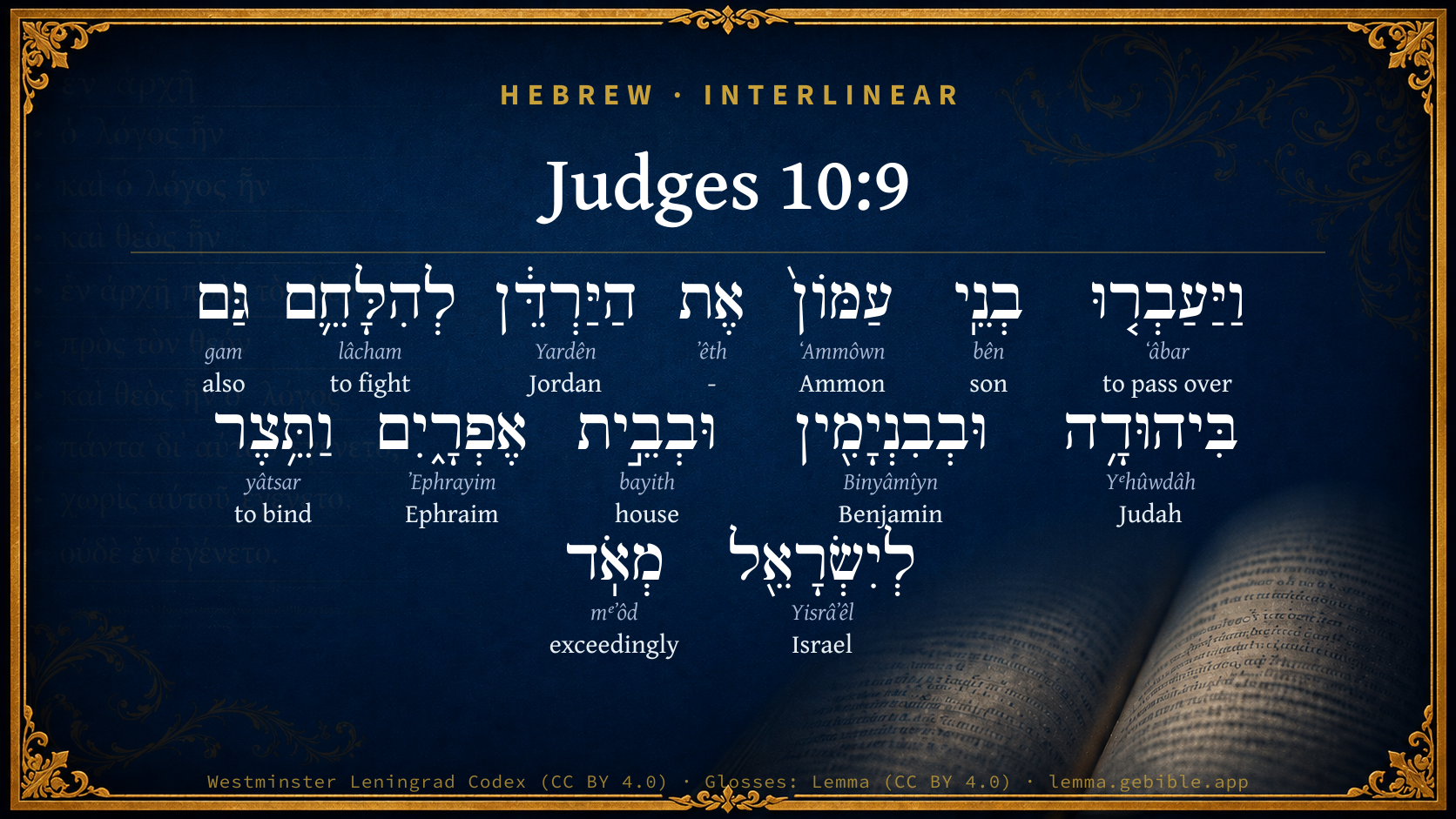
Judges 10:9

Hebrew (Westminster Leningrad Codex) Judges 10:9 appears in the Hebrew Old Testament. The text above is from the Westminster Leningrad Codex. Each word links to its Strong’s number, a concise gloss, and parsing drawn from the Open Scriptures Hebrew Bible morphology. Click any word for its full Brown-Driver-Briggs (BDB) entry.
Download image
Cite this verse

Judges 10:9 (World English Bible). Public Domain. Lemma interlinear Bible study tool, https://lemma.gebible.app/v/judges/10/9.

Show BibTeX & RIS
BibTeX
RIS
English Translation
The children of Ammon passed over the Jordan to fight also against Judah, and against Benjamin, and against the house of Ephraim; so that Israel was sore distressed.
World English Bible · Public Domain
Download a study sheet

One document with this verse’s original text, its word-by-word gloss line, the meaning frame, cross-references with their text, attributed commentary, and full source and license credits — printable, and it pastes into notes with its structure intact.

This verse Autodidact and up

Study sheet (.html) Plain text (.txt)

A passage Seminary Student

Up to 50 verses in one chapter. A passage sheet keeps up to 6 commentary sources and 12 cross-references per verse, in the order this page ranks them, and says so on the sheet whenever that leaves anything out. Ask for a single verse and you get the Autodidact verse sheet above.

Everything on this page stays free to read, with no account — the sheet is a download of what is already on screen, not access to it.

Want to remove ads? Support Godless Engineer
Compare translations 3

The same verse in 3 English versions, stacked beneath the original-language interlinear above. Click any original word for its lexicon entry.

Each is an independent rendering of the whole verse — the interlinear is not word-aligned to these translations.

Highlighted words mark where these versions differ — a whole-verse word diff, not a word-by-word alignment.

  • World English Bible Public Domain
    The children of Ammon passed over the Jordan to fight also against Judah, and against Benjamin, and against the house of Ephraim; so that Israel was sore distressed.
  • King James Version Public Domain
    Moreover the children of Ammon passed over Jordan to fight also against Judah, and against Benjamin, and against the house of Ephraim; so that Israel was sore distressed.
  • unfoldingWord Literal Text CC BY-SA 4.0
    Then the sons of Ammon crossed the Jordan to fight also with Judah and with Benjamin and with the house of Ephraim, and it narrowed to Israel greatly.

unfoldingWord Literal Text — © unfoldingWord, licensed CC BY-SA 4.0. Word-aligned USFM3 via Door43 (git.door43.org/unfoldingWord/en_ult).

Versions to compare (up to 4)

3 of 4 selected

Show all 18 translations

Every available English version of this verse, each an independent rendering of the whole verse.

  • World English Bible Public Domain
    The children of Ammon passed over the Jordan to fight also against Judah, and against Benjamin, and against the house of Ephraim; so that Israel was sore distressed.
  • Berean Standard Bible Public Domain
    The Ammonites also crossed the Jordan to fight against Judah, Benjamin, and the house of Ephraim, and Israel was in deep distress.
  • Majority Standard Bible Public Domain
    The Ammonites also crossed the Jordan to fight against Judah, Benjamin, and the house of Ephraim, and Israel was in deep distress.
  • King James Version Public Domain
    Moreover the children of Ammon passed over Jordan to fight also against Judah, and against Benjamin, and against the house of Ephraim; so that Israel was sore distressed.
  • American Standard Version (1901) Public Domain
    And the children of Ammon passed over the Jordan to fight also against Judah, and against Benjamin, and against the house of Ephraim; so that Israel was sore distressed.
  • Revised Version (1885) Public Domain
    And the children of Ammon passed over Jordan to fight also against Judah, and against Benjamin, and against the house of Ephraim; so that Israel was sore distressed.
  • Geneva Bible (1599) Public Domain
    Moreouer, the children of Ammon went ouer Iorden to fight against Iudah, and against Beniamin, and against the house of Ephraim: so that Israel was sore tormented.
  • Douay-Rheims (1899) Public Domain
    Insomuch that the children of Ammon passing over the Jordan, wasted Juda and Benjamin and Ephraim: and Israel was distressed exceedingly.
  • Young's Literal Translation Public Domain
    And the Bene-Ammon pass over the Jordan to fight also against Judah, and against Benjamin, and against the house of Ephraim, and Israel hath great distress.
  • Literal Standard Version CC BY-SA 4.0
    And the sons of Ammon pass over the Jordan to also fight against Judah, and against Benjamin, and against the house of Ephraim, and Israel has great distress.
  • Unlocked Literal Bible CC BY-SA 4.0
    Then the Ammonites crossed over the Jordan to fight against Judah, against Benjamin, and against the house of Ephraim, so that Israel was greatly distressed.
  • unfoldingWord Literal Text CC BY-SA 4.0
    Then the sons of Ammon crossed the Jordan to fight also with Judah and with Benjamin and with the house of Ephraim, and it narrowed to Israel greatly.
  • Darby Bible Public Domain
    And the Ammonites crossed the Jordan to fight also against Judah and against Benjamin and against the house of E'phraim; so that Israel was sorely distressed.
  • World Messianic Bible Public Domain
    The children of Ammon passed over the Jordan to fight also against Judah, and against Benjamin, and against the house of Ephraim, so that Israel was very distressed.
  • Webster's Bible Public Domain
    Moreover, the children of Ammon passed over Jordan, to fight also against Judah, and against Benjamin, and against the house of Ephraim; so that Israel was greatly distressed.
  • Free Bible Version CC BY-SA 4.0
    The Ammonites also crossed the Jordan to attack Judah, Benjamin, and Ephraim, causing terrible trouble for Israel.
  • Bible in Basic English Public Domain
    And the children of Ammon went over Jordan, to make war against Judah and Benjamin and the house of Ephraim; and Israel was in great trouble.
  • JPS Tanakh (1917) Public Domain
    And the children of Ammon passed over the Jordan to fight also against Judah, and against Benjamin, and against the house of Ephraim, so that Israel was sore distressed.

Literal Standard Version (2020), Covenant Press — licensed CC BY-SA 4.0. Text via the HelloAO Bible API (eBible.org). Unlocked Literal Bible (unfoldingWord) — licensed CC BY-SA 4.0. Text via the HelloAO Bible API (eBible.org). unfoldingWord Literal Text — © unfoldingWord, licensed CC BY-SA 4.0. Word-aligned USFM3 via Door43 (git.door43.org/unfoldingWord/en_ult). Free Bible Version, Dr. Jonathan Gallagher — licensed CC BY-SA 4.0. Text via the HelloAO Bible API (eBible.org).

Word by word

More ways to search: Search by grammar → Find every occurrence → Compare this word →

Practice this passage: Drill this verse → Learn its vocabulary →

וַתֵּ֥צֶר
yâtsar
H3334
“and · to bind”
Conjunction + Verb, Qal, Sequential Imperfect, 3rd Person, Feminine, Singular
Part of Speech
Conjunction + Verb
Stem
Qal
Form
Sequential Imperfect
Person
3rd Person
Gender
Feminine
Number
Singular
Full BDB Definition

Origin: a primitive root

TWOT: 1973

to bind, be distressed, be in distress, be cramped, be narrow, be scant, be in straits, make narrow, cause distress, beseige - (Qal) to suffer distress
  1. וַיַּעַבְר֤וּ ʻâbar H5674 “and · to pass over” Conjunction + Verb, Qal, Sequential Imperfect, 3rd Person, Masculine, Plural
  2. בְנֵֽי bên H1121 “sons of” Noun, Common, Masculine, Plural, Construct
  3. עַמּוֹן֙ ʻAmmôwn H5983 “Ammon” Noun, Proper
  4. אֶת ʼêth H853 “-” Particle, Direct Object
  5. הַיַּרְדֵּ֔ן Yardên H3383 “the · Jordan” Particle, Definite Article + Noun, Proper
  6. לְהִלָּחֵ֛ם lâcham H3898 “to fight” Preposition + Verb, Niphal, Infinitive Construct
  7. גַּם gam H1571 “also” Particle, Accusative
  8. בִּיהוּדָ֥ה Yᵉhûwdâh H3063 “in/at · Judah” Preposition + Noun, Proper
  9. וּבְבִנְיָמִ֖ין Binyâmîyn H1144 “and · in/at · Benjamin” Conjunction + Preposition + Noun, Proper
  10. וּבְבֵ֣ית bayith H1004 “and · in/at · house of” Conjunction + Preposition + Noun, Common, Masculine, Singular, Construct
  11. אֶפְרָ֑יִם ʼEphrayim H669 “Ephraim” Noun, Proper
  12. לְיִשְׂרָאֵ֖ל Yisrâʼêl H3478 “to/for · Israel” Preposition + Noun, Proper
  13. מְאֹֽד mᵉʼôd H3966 “exceedingly” Adverb

About this verse

These counts appear in no published source. They are computed here, from the morphology-tagged text and Lemma’s own curated glosses. What Lemma adds →

14
words
14
distinct lemmas
Historical
section

Notable vocabulary

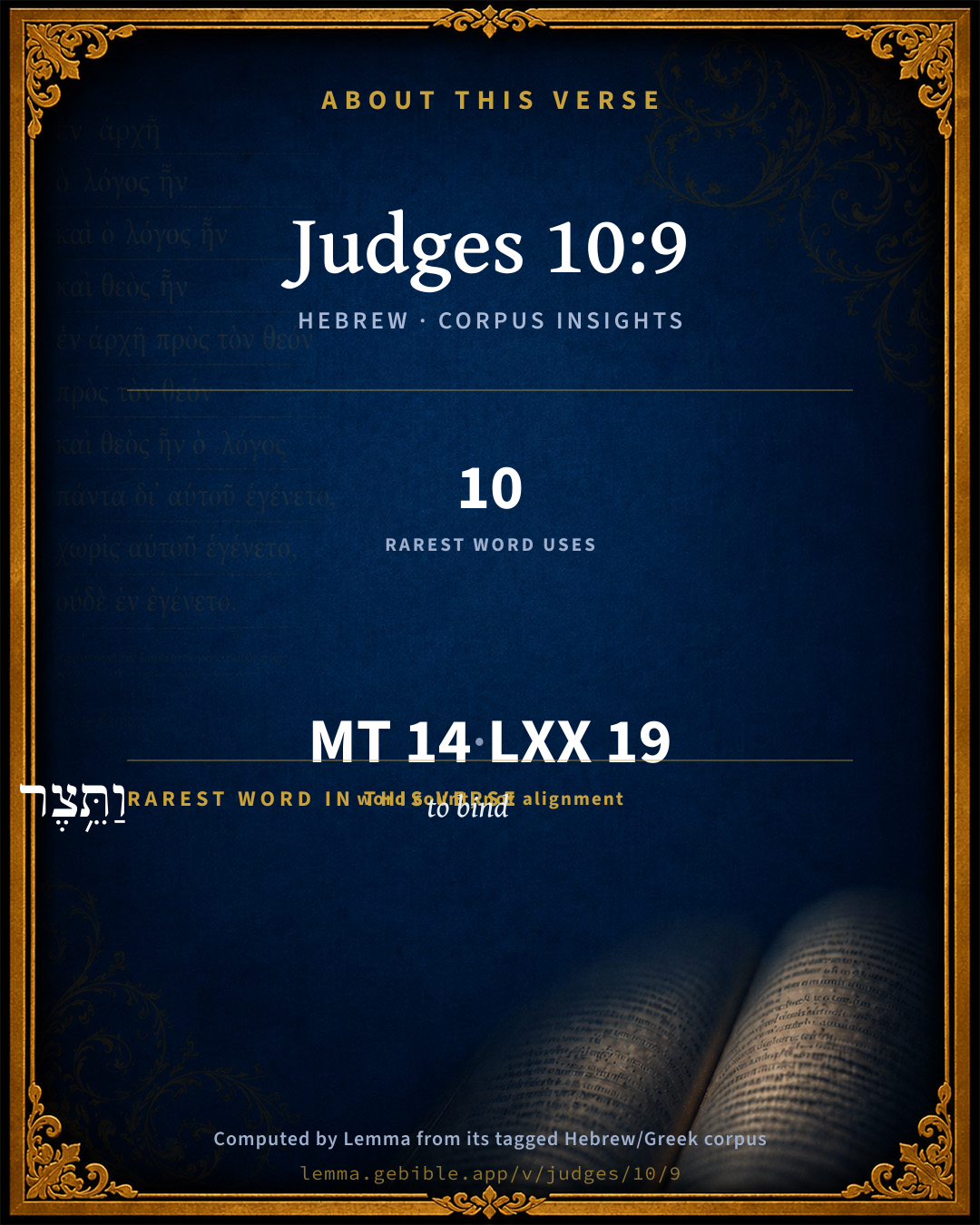
The rarest word here is וַתֵּ֥צֶר to bind H3334 — appearing just 10 times in the whole Hebrew Bible.

Shared distinctive vocabulary

וַתֵּ֥צֶר to bind H3334 occurs in 10 verses of the Hebrew Bible. Also found in:

Grammatical profile

  • 3 verbs
  • 8 nouns
  • 1 adverb
  • 2 particles

Verb forms

  • וַיַּעַבְר֤וּ Qal · Sequential Imperfect
  • לְהִלָּחֵ֛ם Niphal · Infinitive Construct
  • וַתֵּ֥צֶר Qal · Sequential Imperfect

Hebrew & Septuagint length

In English translation the verse runs 28 words from the Hebrew and 25 from the Septuagint (LXX English) — closely comparable.

A rough comparison of the two English renderings, which tokenize alike — not a word-level alignment.

Word counts can differ between the Hebrew and the Greek without any difference in meaning — e.g. the Hebrew direct-object marker אֵת has no separate Greek word, and Greek often adds the article ὁ.

In the original languages it is 14 Hebrew tokens and 19 Greek tokens — but the two are counted differently (Hebrew bundles its prefixes and suffixes into one token; the Greek is in lemma form), so that isn’t a like-for-like length.

Cross-references

7

Topical passages linked to Judges 10:9 in the Treasury of Scripture Knowledge — connected by theme and wording, ordered by reader-vote popularity; previews shown in the World English Bible.

  • Deuteronomy 28:65 Among these nations shall you find no ease, and there shall be no rest for the sole of your foot: but Yahweh will give you there a trembling heart, and failing of eyes, and pining of soul;
  • Judges 3:12–13 The children of Israel again did that which was evil in the sight of Yahweh: and Yahweh strengthened Eglon the king of Moab against Israel, because they had done that which was evil in the sight of Yahweh.
  • Judges 6:3–5 So it was, when Israel had sown, that the Midianites came up, and the Amalekites, and the children of the east; they came up against them;
  • 1 Samuel 28:15 Samuel said to Saul, Why have you disquieted me, to bring me up? Saul answered, I am sore distressed; for the Philistines make war against me, and God is departed from me, and answers me no more, neither by prophets, nor by dreams: therefore I have called you, that you may make known to me what I shall do.
  • 2 Chronicles 14:9 There came out against them Zerah the Ethiopian with an army of a million troops, and three hundred chariots; and he came to Mareshah.
  • 2 Chronicles 15:5 In those times there was no peace to him who went out, nor to him who came in; but great vexations were on all the inhabitants of the lands.
  • 2 Chronicles 20:1–2 It happened after this, that the children of Moab, and the children of Ammon, and with them some of the Ammonites, came against Jehoshaphat to battle.

Cross-references courtesy of OpenBible.info (CC BY 4.0).

Hebrew and Greek witnesses Masoretic Hebrew ↔ Greek Septuagint

The same verse in the two great witnesses to the Old Testament, shown verse-for-verse.

These are two independent witnesses, not word-aligned to each other, and the Septuagint is shown in lemma (dictionary) form.

Hebrew Judges 10:9 Masoretic · Westminster Leningrad Codex

וַיַּעַבְר֤וּ בְנֵֽי עַמּוֹן֙ אֶת הַיַּרְדֵּ֔ן לְהִלָּחֵ֛ם גַּם בִּיהוּדָ֥ה וּבְבִנְיָמִ֖ין וּבְבֵ֣ית אֶפְרָ֑יִם וַתֵּ֥צֶר לְיִשְׂרָאֵ֖ל מְאֹֽד

The children of Ammon passed over the Jordan to fight also against Judah, and against Benjamin, and against the house of Ephraim; so that Israel was sore distressed.

World English Bible · Public Domain

Greek LXX Judges 10:9 Septuagint · lemma form

καί διαβαίνω ὁ υἱός αμμων ὁ ἰορδάνης παρατάσσω πρός ἰούδας καί βενιαμίν καί πρός ἐφράιμ καί θλίβω ἰσραήλ σφόδρα

And the children of Ammon went over Jordan to fight with Juda, and Benjamin, and with Ephraim; and the children of Israel were greatly afflicted.

LXX2012 (modern English Septuagint) · Public Domain

Hebrew: Westminster Leningrad Codex (CC BY 4.0). Greek: Septuagint (public domain); English from LXX2012 (modern English Septuagint) (Public Domain). How the Septuagint differs from the Hebrew →

Targum (Aramaic paraphrase)

1

The Targum is the ancient Jewish Aramaic paraphrase of the Hebrew Scriptures — an interpretive translation, not the Hebrew text itself. Onkelos (literal) and Pseudo-Jonathan (expansive) render the Torah, and Jonathan the Prophets. Coverage is partial: where no permissively-licensed English translation exists for a verse, only the Aramaic is shown. This is verse-level text, not a word-by-word alignment to the Hebrew.

  1. Targum Jonathan Prophets (Joshua–Malachi)
    וַעֲבָרוּ בְנֵי עַמוֹן יַת יַרְדְנָא לְאַגָחָא קְרָבָא אַף בִּיהוּדָה וּבִדְבֵית בִנְיָמִין וּבִדְבֵית אֶפְרַיִם וְעָקַת לְיִשְׂרָאֵל לַחֲדָא:

    (no public-domain English translation for this verse)

    Targum Jonathan — Aramaic: “Mikraot Gedolot” (public domain). English: “Sefaria Community Translation” (CC0 1.0 (public-domain dedication)); “London "Chaldee Paraphrase," 1871” (public domain). Text via Sefaria.

Commentary

Notes on Judges 10:9 from classic Christian and Jewish commentators (each source and its license shown beneath its notes). The classic Christian expositions comment on the surrounding passage and are grouped to its opening verse, so a note may address several verses; the Jewish commentaries on the Tanakh (Rashi and others) are per-verse, so they appear only where the commentator wrote on this verse.

Lemma curates 59 commentaries, every one of them public domain or Creative Commons licensed, each selected and text-cleaned for this edition rather than reprinted as found. About our sources →

Trapp's Complete Commentary

John Trapp

Jdg 10:9 Moreover the children of Ammon passed over Jordan to fight also against Judah, and against Benjamin, and against the house of Ephraim; so that Israel was sore distressed.

Ver. 9. Moreover the children of Ammon.] Now that Jair was dead. Likens after the death of Hunniades, the Turks got further footing, and did great spoil in Christendom.

John Trapp, A Commentary or Exposition upon All the Books of the Old and New Testament (1647–1656) — public domain. Text from a community e-Sword module.

Ellicott's Commentary for English Readers

(9) Moreover.—Rather, and. Eighteen years’ oppression of the Trans-jordanic tribes emboldened them to attack the others.

Was sore distressed.—The same expression is used in Jdg_2:19.

A Bible Commentary for English Readers, edited by Charles John Ellicott (1878–1897) — public domain. Text from a community e-Sword module.

The Cambridge Bible for Schools and Colleges

gen. ed. J. J. S. Perowne

9. was sore distressed] Cf. Jdg_2:15.

The Cambridge Bible for Schools and Colleges (gen. ed. J. J. S. Perowne; Cambridge University Press, 1878–1918) — public domain. Text from a community e-Sword module.

John Gill's Exposition

Moreover, the children of Ammon passed over Jordan,.... Not content with the oppression of the tribes on the other side Jordan, which had continued eighteen years, they came over Jordan into the land of Canaan to ravage that, and bring other of the tribes into subjection to them, particularly the three next mentioned, which lay readiest for them, when they were come over Jordan:

to fight also against Judah, and against Benjamin, and against the house of Ephraim who lay to the south and the southeast of the land of Canaan, and were the first the Ammonites had to fight with and subdue, when they had crossed Jordan to the east of it:

so that Israel was sore distressed; by the Ammonites in the east, threatening those three tribes, mentioned, and the Philistines on the west, who gave disturbance to the tribes that lay nearest them, as Asher, Zebulun, Naphtali, Issachar, and Dan; and this distress was begun the same year in different parts, by different enemies.

John Gill's Exposition of the Whole Bible (1746–1763) — public domain (CC PDM 1.0). Text via the HelloAO Bible API.

Haydock's Catholic Bible Commentary

Exceedingly. Not only those who lived in Galaad, but also three tribes on the west of the Jordan, were treated as the half tribe of Manasses had been, (Calmet) when Gedeon delivered them. (Haydock)

George Leo Haydock (1774–1849), Haydock's Catholic Family Bible and Commentary, 1859 edition — public domain. Excludes Psalms (Douay-Rheims chapter numbering differs from Protestant) and Deuterocanonical books (Catholic canon only).

The Pulpit Commentary

The children of Ammon, etc. It would seem that at this time the king of the children of Ammon was also king of the Moabites, since he laid claim (Jud_1:11:13, 24) to the land which had once belonged to Moab. If we may trust the king of the Ammonites" statement, the object of the war was to recover that land, and he carried the war across the Jordan into the territory of Judah and Ephraim in order to compel the Israelites to give it up.

HOMILIES BY W.F. ADENEY Ver. 10. From God to Baal.

I MAN MUST HAVE SOME RELIGION. If God is forsaken, Baal is followed. The soul cannot endure a void. This temple must always have some deity in it. If the higher religion is rejected, a lower superstition will take the place of it. The decay of the national religion of old Rome was accompanied by the adoption of strange Oriental cults, and by the spread of a religion of magic. Modern scepticism gives birth to extraordinary forms of superstition religions of nature, of humanity, of spiritualism. Accordingly, the effort to attain freedom by escaping from the restraints of Christianity is a delusion, and ends only in the bondage of some lower influence. The soul must have some master, and if it rebels against God it will serve Baal, mammon, the world, the flesh, or the devil. True liberty is only found in willing obedience, in the submission of love, in sympathy with the mind of God, in delighting in his law. Perfect freedom of will arises from perfect harmony between our will and God"s will, so that we gladly desire what he requires. (Psa_40:8)

II SIN HAS TWO LEADING FEATURES, A POSITIVE AND A NEGATIVE. It is forsaking God and serving Baalim; omission and commission. The tendency is to regard one of these two much to the neglect of the other. Over-scrupulous people are very sensitive about the minutest act of positive wrong, but sometimes indifferent in regard to the neglect of duty. Energetic people often make the opposite mistake, and show great anxiety to do good service, while they are not sufficiently careful to avoid hasty acts of a questionable character. These two sides of sin are closely connected. Devotion to God is the great safeguard to purity; when this grows cold the soul is open to the attack of temptation, leading to direct transgression. On the other hand, positive sin is poison to religious faith. The commission of evil deeds inclines us to the omission of duties. Impurity paralyses zeal. We cannot serve God while we are serving Baalim.

III CONDUCT ALWAYS TENDS TO RUN INTO EXTREMES. We serve God or Baalim, light or darkness, good or evil. There is no middle course. There appears to be more variety, gradation, and mixed character in life than is allowed for in Scripture. (e.g. 1Jn_3:8-10) But life is only yet beginning to develop, its true nature will be seen in eternity. Two seeds may look much alike, and the first sprouts from them may not be very dissimilar, yet the gardener who knows the natural history of the plants, judging by their whole growth, may pronounce them to be very different. In this early growth of the soul"s life on earth, the great question is, What tendencies does it show? The twilight of sunrise looks very like the twilight of sunset, yet the one is the prophecy of day and the other the portent of night. Two streams which flow from one watershed are at first near together, yet if one is running east and the other west, they may come at last to be divided by a whole continent, and to end in two separate oceans. We must be moving in one or other of two directions. The question is, Are we going to the light or from the light, to God or from God? The tendency determines the character of the life, and this must be justly estimated by the full issues involved in the tendency, not by the present early stages of it. Thus we are all children of the light or children of the darkness, ripening into saintly servants of God or corrupting into wretched slaves of sin. A.

The Pulpit Commentary (1880–1919), ed. H.D.M. Spence-Jones & Joseph S. Exell — public domain. Text from a community e-Sword module.

Lesson kit

Teaching starters — assembled from the data on this page, not authored interpretation. Every prompt links to the verse data it draws on. Edit before teaching.

Judges, in the Historical, opens this verse with 14 words (14 distinct Hebrew lemmas). Its most distinctive word is yâtsar (“to bind”). A historical commentator’s framing appears above. Read the whole chapter for the surrounding context.

Discussion questions

  1. The word yâtsar carries the sense “to bind.” How does it shape the verse?
  2. Genesis 32:7 shares the word «to bind» with this verse. How do the two illuminate each other?
  3. These translations render this verse differently; the difference is in the English rendering, not the original. What questions does that raise?
  4. The verb «וַיַּעַבְר֤וּ» is Qal Sequential Imperfect. How does its form color the action?
  5. Reading how Trapp's Complete Commentary and Ellicott's Commentary for English Readers read this verse, where do the two commentators agree and where do they part?

Things to notice

Reading settings

Reading text

Shown beneath each verse's original-language words.

Old Testament
Old Testament edition

Read the OT as the Masoretic Hebrew (MT) or the Greek Septuagint (LXX).

English shown for the Greek Septuagint (in the Hebrew ↔ Greek comparison).

Comparing translations? Open the Compare panel on any verse page to stack up to four side by side.