
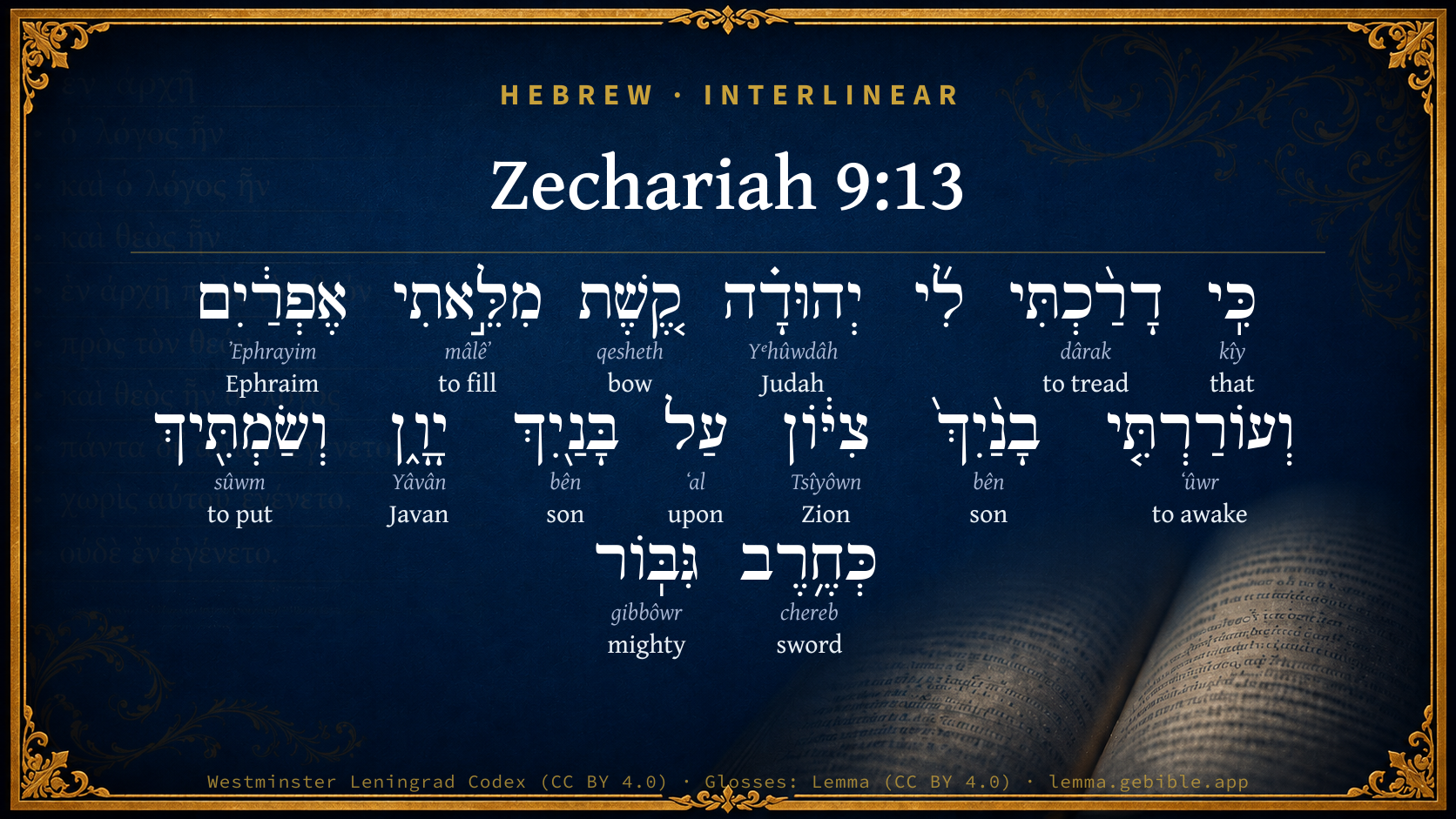
Zechariah 9:13

Hebrew (Westminster Leningrad Codex) Zechariah 9:13 appears in the Hebrew Old Testament. The text above is from the Westminster Leningrad Codex. Each word links to its Strong’s number, a concise gloss, and parsing drawn from the Open Scriptures Hebrew Bible morphology. Click any word for its full Brown-Driver-Briggs (BDB) entry.
Download image
Cite this verse

Zechariah 9:13 (World English Bible). Public Domain. Lemma interlinear Bible study tool, https://lemma.gebible.app/v/zechariah/9/13.

Show BibTeX & RIS
BibTeX
RIS
English Translation
For indeed I bend Judah as a bow for me. I have filled the bow with Ephraim; And I will stir up your sons, Zion, Against your sons, Greece, And will make you like the sword of a mighty man.
World English Bible · Public Domain
Download a study sheet

One document with this verse’s original text, its word-by-word gloss line, the meaning frame, cross-references with their text, attributed commentary, and full source and license credits — printable, and it pastes into notes with its structure intact.

This verse Autodidact and up

Study sheet (.html) Plain text (.txt)

A passage Seminary Student

Up to 50 verses in one chapter. A passage sheet keeps up to 6 commentary sources and 12 cross-references per verse, in the order this page ranks them, and says so on the sheet whenever that leaves anything out. Ask for a single verse and you get the Autodidact verse sheet above.

Everything on this page stays free to read, with no account — the sheet is a download of what is already on screen, not access to it.

Want to remove ads? Support Godless Engineer
Compare translations 3

The same verse in 3 English versions, stacked beneath the original-language interlinear above. Click any original word for its lexicon entry.

Each is an independent rendering of the whole verse — the interlinear is not word-aligned to these translations.

Highlighted words mark where these versions differ — a whole-verse word diff, not a word-by-word alignment.

  • World English Bible Public Domain
    For indeed I bend Judah as a bow for me. I have filled the bow with Ephraim; And I will stir up your sons, Zion, Against your sons, Greece, And will make you like the sword of a mighty man.
  • King James Version Public Domain
    When I have bent Judah for me, filled the bow with Ephraim, and raised up thy sons, O Zion, against thy sons, O Greece, and made thee as the sword of a mighty man.
  • unfoldingWord Literal Text CC BY-SA 4.0
    for I have bent Judah as my bow. I have filled my quiver with Ephraim. I have roused your sons, Zion, against your sons, Greece, and have made you, Zion, like a warrior’s sword!”

unfoldingWord Literal Text — © unfoldingWord, licensed CC BY-SA 4.0. Word-aligned USFM3 via Door43 (git.door43.org/unfoldingWord/en_ult).

Versions to compare (up to 4)

3 of 4 selected

Show all 18 translations

Every available English version of this verse, each an independent rendering of the whole verse.

  • World English Bible Public Domain
    For indeed I bend Judah as a bow for me. I have filled the bow with Ephraim; And I will stir up your sons, Zion, Against your sons, Greece, And will make you like the sword of a mighty man.
  • Berean Standard Bible Public Domain
    For I will bend Judah as My bow and fit it with Ephraim. I will rouse your sons, O Zion, against the sons of Greece. I will make you like the sword of a mighty man.
  • Majority Standard Bible Public Domain
    For I will bend Judah as My bow and fit it with Ephraim. I will rouse your sons, O Zion, against the sons of Greece. I will make you like the sword of a mighty man.
  • King James Version Public Domain
    When I have bent Judah for me, filled the bow with Ephraim, and raised up thy sons, O Zion, against thy sons, O Greece, and made thee as the sword of a mighty man.
  • American Standard Version (1901) Public Domain
    For I have bent Judah for me, I have filled the bow with Ephraim; and I will stir up thy sons, O Zion, against thy sons, O Greece, and will make thee as the sword of a mighty man.
  • Revised Version (1885) Public Domain
    For I have bent Judah for me, I have filled the bow with Ephraim; and I will stir up thy sons, O Zion, against thy sons, O Greece, and will make thee as the sword of a mighty man.
  • Geneva Bible (1599) Public Domain
    For Iudah haue I bent as a bowe for me: Ephraims hand haue I filled, and I haue raised vp thy sonnes, O Zion, against thy sonnes, O Grecia, and haue made thee as a gyants sword.
  • Douay-Rheims (1899) Public Domain
    Because I have bent Juda for me as a bow, I have filled Ephraim: and I will raise up thy sons, O Sion, above thy sons, O Greece, and I will make thee as the sword of the mighty.
  • Young's Literal Translation Public Domain
    For I have trodden for Me Judah, A bow I have filled `with' Ephraim, And I have stirred up thy sons, O Zion, Against thy sons, O Javan, And I have set thee as the sword of a hero.
  • Literal Standard Version CC BY-SA 4.0
    For I have trodden for Myself with Judah, || I have filled a bow [with] Ephraim, || And I have stirred up your sons, O Zion, || Against your sons, O Javan, || And I have set you as the sword of a hero.”
  • Unlocked Literal Bible CC BY-SA 4.0
    for I have bent Judah as my bow. I have filled my quiver with Ephraim. I have roused your sons, Zion, against your sons, Greece, and have made you, Zion, like a warrior's sword!”
  • unfoldingWord Literal Text CC BY-SA 4.0
    for I have bent Judah as my bow. I have filled my quiver with Ephraim. I have roused your sons, Zion, against your sons, Greece, and have made you, Zion, like a warrior’s sword!”
  • Darby Bible Public Domain
    For I have bent Judah for me, I have filled the bow with Ephraim; and I will raise up thy sons, O Zion, against thy sons, O Greece, and make thee like the sword of a mighty man.
  • World Messianic Bible Public Domain
    For indeed I bend Judah as a bow for me. I have loaded the bow with Ephraim. I will stir up your sons, Zion, against your sons, Greece, and will make you like the sword of a mighty man.
  • Webster's Bible Public Domain
    When I have bent Judah for me, filled the bow with Ephraim, and raised up thy sons, O Zion, against thy sons, O Greece, and made thee as the sword of a mighty man.
  • Free Bible Version CC BY-SA 4.0
    I will use Judah as my bow, and I will load it with Ephraim my arrow. I will call up you men of Zion to fight against you men of Greece, wielding you like a warrior's sword.
  • Bible in Basic English Public Domain
    For I have made Judah a bow bent for my use, I have made Ephraim the arrows of the bow; I will make your sons, O Zion, take up arms against your sons, O Greece, and will make you like the sword of a man of war.
  • JPS Tanakh (1917) Public Domain
    For I bend Judah for Me, I fill the bow with Ephraim; and I will stir up thy sons, O Zion, against thy sons, O Javan, and will make thee as the sword of a mighty man.

Literal Standard Version (2020), Covenant Press — licensed CC BY-SA 4.0. Text via the HelloAO Bible API (eBible.org). Unlocked Literal Bible (unfoldingWord) — licensed CC BY-SA 4.0. Text via the HelloAO Bible API (eBible.org). unfoldingWord Literal Text — © unfoldingWord, licensed CC BY-SA 4.0. Word-aligned USFM3 via Door43 (git.door43.org/unfoldingWord/en_ult). Free Bible Version, Dr. Jonathan Gallagher — licensed CC BY-SA 4.0. Text via the HelloAO Bible API (eBible.org).

Word by word

More ways to search: Search by grammar → Find every occurrence → Compare this word →

Practice this passage: Drill this verse → Learn its vocabulary →

יָוָ֑ן
Yâvân
H3120
“Javan”
Noun, Proper
Part of Speech
Noun
Type
Proper
Full BDB Definition

Origin: probably from the same as H3196

TWOT: 855

Javan = "Ionia" or " Greece" - a son of Japheth and grandson of Noah (noun proper masculine) - Greece, Ionia, Ionians (noun proper locative) - location of descendants of Javan
  1. כִּֽי kîy H3588 “that” Conjunction
  2. דָרַ֨כְתִּי dârak H1869 “to tread” Verb, Qal, Perfect, 1st Person, Common, Singular
  3. יְהוּדָ֗ה Yᵉhûwdâh H3063 “Judah” Noun, Proper
  4. קֶ֚שֶׁת qesheth H7198 “bow” Noun, Common, Feminine, Singular, Absolute
  5. מִלֵּ֣אתִי mâlêʼ H4390 “to fill” Verb, Piel, Perfect, 1st Person, Common, Singular
  6. אֶפְרַ֔יִם ʼEphrayim H669 “Ephraim” Noun, Proper
  7. וְעוֹרַרְתִּ֤י ʻûwr H5782 “and · to awake” Conjunction + Verb, Polel, Sequential Perfect, 1st Person, Common, Singular
  8. בָנַ֨יִךְ֙ bên H1121 “sons · your” Noun, Common, Masculine, Plural, Construct + Suffix, Personal, 2nd Person, Feminine, Singular
  9. צִיּ֔וֹן Tsîyôwn H6726 “Zion” Noun, Proper
  10. עַל ʻal H5921 “upon” Preposition
  11. בָּנַ֖יִךְ bên H1121 “sons · your” Noun, Common, Masculine, Plural, Construct + Suffix, Personal, 2nd Person, Feminine, Singular
  12. וְשַׂמְתִּ֖יךְ sûwm H7760 “and · to put · you” Conjunction + Verb, Qal, Perfect, 1st Person, Common, Singular + Suffix, Personal, 2nd Person, Feminine, Singular
  13. כְּחֶ֥רֶב chereb H2719 “like/as · sword of” Preposition + Noun, Common, Feminine, Singular, Construct
  14. גִּבּֽוֹר gibbôwr H1368 “mighty” Adjective, Adjective, Masculine, Singular, Absolute

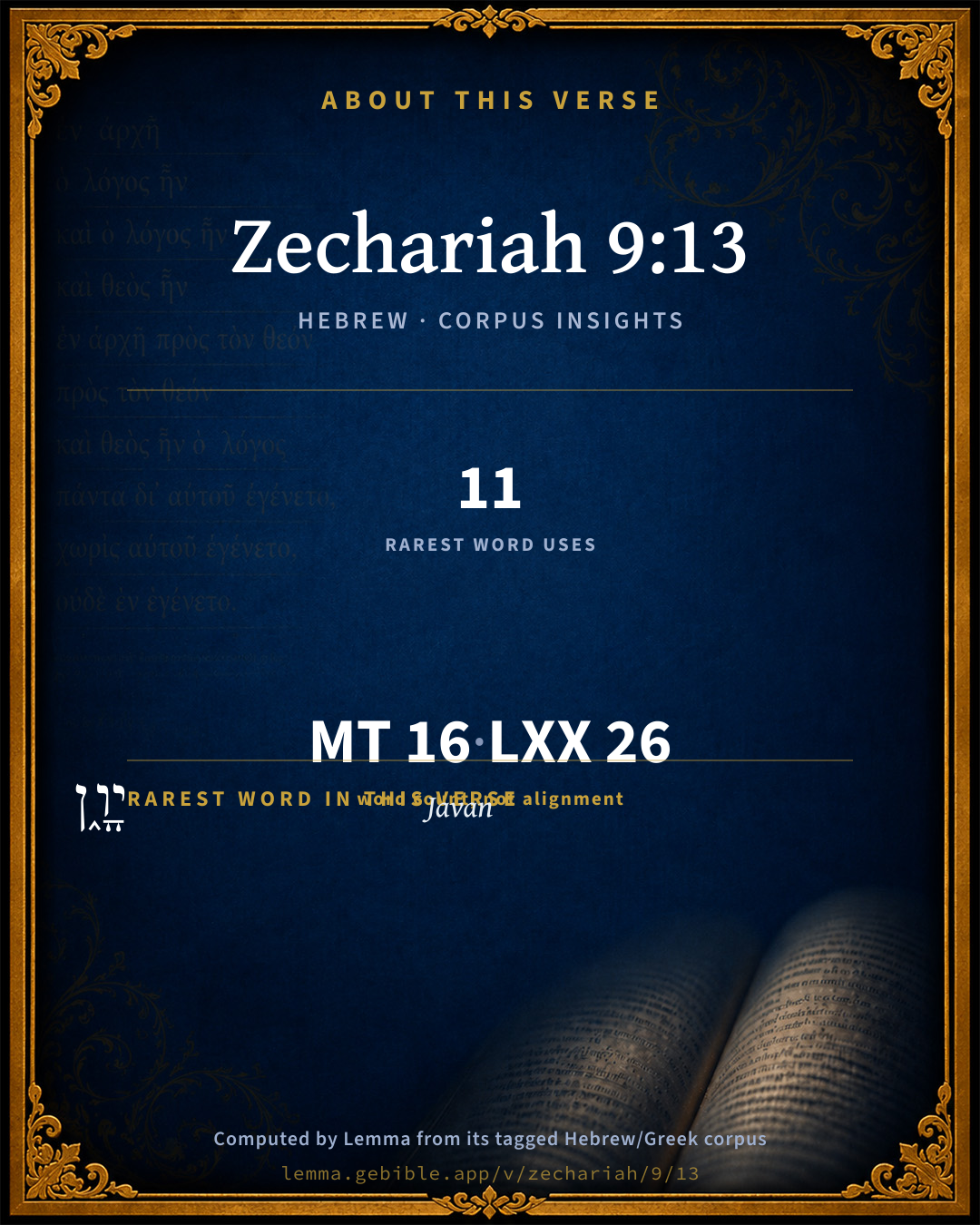
About this verse

These counts appear in no published source. They are computed here, from the morphology-tagged text and Lemma’s own curated glosses. What Lemma adds →

16
words
14
distinct lemmas
Prophets
section

Notable vocabulary

The rarest word here is יָוָ֑ן Javan H3120 — appearing just 11 times in the whole Hebrew Bible.

Shared distinctive vocabulary

יָוָ֑ן Javan H3120 occurs in 11 verses of the Hebrew Bible. Also found in:

Grammatical profile

  • 4 verbs
  • 8 nouns
  • 1 adjective
  • 2 prepositions
  • 1 conjunction

Verb forms

  • דָרַ֨כְתִּי Qal · Perfect
  • מִלֵּ֣אתִי Piel · Perfect
  • וְעוֹרַרְתִּ֤י Polel · Sequential Perfect
  • וְשַׂמְתִּ֖יךְ Qal · Perfect

Repetition

A word recurs within this verse — often emphatic in Hebrew:

  • בָנַ֨יִךְ֙ son H1121 ×2

Hebrew & Septuagint length

In English translation the verse runs 40 words from the Hebrew and 42 from the Septuagint (LXX English) — closely comparable.

A rough comparison of the two English renderings, which tokenize alike — not a word-level alignment.

Word counts can differ between the Hebrew and the Greek without any difference in meaning — e.g. the Hebrew direct-object marker אֵת has no separate Greek word, and Greek often adds the article ὁ.

In the original languages it is 16 Hebrew tokens and 26 Greek tokens — but the two are counted differently (Hebrew bundles its prefixes and suffixes into one token; the Greek is in lemma form), so that isn’t a like-for-like length.

Cross-references

31

Topical passages linked to Zechariah 9:13 in the Treasury of Scripture Knowledge — connected by theme and wording, ordered by reader-vote popularity; previews shown in the World English Bible.

  • Revelation 17:14 These will war against the Lamb, and the Lamb will overcome them, for he is Lord of lords, and King of kings. They also will overcome who are with him, called and chosen and faithful."
  • Isaiah 49:2 and he has made my mouth like a sharp sword; in the shadow of his hand has he hid me: and he has made me a polished shaft; in his quiver has he kept me close:
  • Zechariah 10:3–7 My anger is kindled against the shepherds, And I will punish the male goats; For Yahweh of Hosts has visited his flock, the house of Judah, And will make them as his horse in the battle that he is proud of.
  • Psalms 45:3 Gird your sword on your thigh, mighty one: Your splendor and your majesty.
  • Joel 3:6–8 And have sold the children of Judah and the children of Jerusalem to the sons of the Greeks, That you may remove them far from their border.
  • Zechariah 1:21 Then I asked, "What are these coming to do?" He said, "These are the horns which scattered Judah, so that no man lifted up his head; but these have come to terrify them, to cast down the horns of the nations, which lifted up their horn against the land of Judah to scatter it."
  • Zechariah 12:2–8 "Behold, I will make Jerusalem a cup of reeling to all the surrounding peoples, and on Judah also will it be in the siege against Jerusalem.
  • Revelation 19:15 Out of his mouth proceeds a sharp, double-edged sword, that with it he should strike the nations. He will rule them with a rod of iron. He treads the winepress of the fierceness of the wrath of God, the Almighty.
  • Psalms 18:32–35 The God who arms me with strength, and makes my way perfect?
  • Psalms 144:1 Blessed be Yahweh, my rock, Who teaches my hands to war, And my fingers to battle:
  • Psalms 149:6 May the high praises of God be in their mouths, And a two-edged sword in their hand;
  • Isaiah 41:15–16 Behold, I have made you [to be] a new sharp threshing instrument having teeth; you shall thresh the mountains, and beat them small, and shall make the hills as chaff.
  • Jeremiah 51:20 You are my battle-axe and weapons of war: and with you will I break in pieces the nations; and with you will I destroy kingdoms;
  • Lamentations 4:2 The precious sons of Zion, comparable to fine gold, How are they esteemed as earthen pitchers, the work of the hands of the potter!
  • Daniel 8:21–25 The rough male goat is the king of Greece: and the great horn that is between his eyes is the first king.
  • Daniel 11:32–34 Such as do wickedly against the covenant shall he pervert by flatteries; but the people who know their God shall be strong, and do [exploits].
  • Amos 2:11 I raised up some of your sons for prophets, And some of your young men for Nazirites. Isn't this true, You children of Israel?" says Yahweh.
  • Obadiah 1:21 Saviors will go up on Mount Zion to judge the mountains of Esau, and the kingdom will be Yahweh's.
  • Micah 4:2–3 Many nations will go and say, "Come, and let us go up to the mountain of Yahweh, And to the house of the God of Jacob; And he will teach us of his ways, And we will walk in his paths." For out of Zion will go forth the law, And the word of Yahweh from Jerusalem;
  • Micah 5:4–9 He shall stand, and shall shepherd in the strength of Yahweh, In the majesty of the name of Yahweh his God: And they will live, for then he will be great to the ends of the earth.
  • Mark 16:15–20 He said to them, "Go into all the world, and preach the Gospel to the whole creation.
  • Romans 15:16–20 that I should be a servant of Christ Jesus to the Gentiles, ministering as a priest the Gospel of God, that the offering up of the Gentiles might be made acceptable, sanctified by the Holy Spirit.
  • 1 Corinthians 1:21–28 For seeing that in the wisdom of God, the world through its wisdom didn't know God, it was God's good pleasure through the foolishness of the preaching to save those who believe.
  • 2 Corinthians 10:3–5 For though we walk in the flesh, we don't wage war according to the flesh;
  • Ephesians 6:17 And take the helmet of salvation, and the sword of the Spirit, which is the word of God;
  • 2 Timothy 4:7 I have fought the good fight. I have finished the course. I have kept the faith.
  • Hebrews 4:12 For the word of God is living, and active, and sharper than any two-edged sword, and piercing even to the dividing of soul and spirit, of both joints and marrow, and is able to discern the thoughts and intentions of the heart.
  • Revelation 1:16 He had seven stars in his right hand. Out of his mouth proceeded a sharp two-edged sword. His face was like the sun shining at its brightest.
  • Revelation 2:12 "To the angel of the assembly in Pergamum write: "He who has the sharp two-edged sword says these things:
  • Revelation 19:21 The rest were killed with the sword of him who sat on the horse, the sword which came forth out of his mouth. All the birds were filled with their flesh.
  • Psalms 49:2–9 Both low and high, Rich and poor together.

Cross-references courtesy of OpenBible.info (CC BY 4.0).

Hebrew and Greek witnesses Masoretic Hebrew ↔ Greek Septuagint

The same verse in the two great witnesses to the Old Testament, shown verse-for-verse.

These are two independent witnesses, not word-aligned to each other, and the Septuagint is shown in lemma (dictionary) form.

Hebrew Zechariah 9:13 Masoretic · Westminster Leningrad Codex

כִּֽי דָרַ֨כְתִּי לִ֜י יְהוּדָ֗ה קֶ֚שֶׁת מִלֵּ֣אתִי אֶפְרַ֔יִם וְעוֹרַרְתִּ֤י בָנַ֨יִךְ֙ צִיּ֔וֹן עַל בָּנַ֖יִךְ יָוָ֑ן וְשַׂמְתִּ֖יךְ כְּחֶ֥רֶב גִּבּֽוֹר

For indeed I bend Judah as a bow for me. I have filled the bow with Ephraim; And I will stir up your sons, Zion, Against your sons, Greece, And will make you like the sword of a mighty man.

World English Bible · Public Domain

Greek LXX Zechariah 9:13 Septuagint · lemma form

διότι ἐντείνω σύ ιουδα ἐμαυτοῦ τόξον πίμπλημι ὁ ἐφράιμ καί ἐπιἐγείρω ὁ τέκνον σύ σιων ἐπί ὁ τέκνον ὁ ἕλλην καί ψηλαφάω σύ ὡς ῥομφαία μαχητής

For I have bent you, O Juda, for myself as a bow, I have filled Ephraim; and I will raise up your children, O Sion, against the children of the Greeks, and I will handle you as the sword of a warrior.

LXX2012 (modern English Septuagint) · Public Domain

On this verse, Whedon's Commentary on the Bible discusses the Septuagint’s reading. Read the note in Commentary ↓

Hebrew: Westminster Leningrad Codex (CC BY 4.0). Greek: Septuagint (public domain); English from LXX2012 (modern English Septuagint) (Public Domain). How the Septuagint differs from the Hebrew →

Targum (Aramaic paraphrase)

1

The Targum is the ancient Jewish Aramaic paraphrase of the Hebrew Scriptures — an interpretive translation, not the Hebrew text itself. Onkelos (literal) and Pseudo-Jonathan (expansive) render the Torah, and Jonathan the Prophets. Coverage is partial: where no permissively-licensed English translation exists for a verse, only the Aramaic is shown. This is verse-level text, not a word-by-word alignment to the Hebrew.

  1. Targum Jonathan Prophets (Joshua–Malachi)
    אֲרֵי תַקְפֵית קָדָמַי דְבֵית יְהוּדָה כְּקֶשֶׁת מְתִיחָא בְּבֵית אֲזִינִין מַלֵית גְבוּרָא בֵּית יִשְׂרָאֵל וַאֲגַבַּר בְּנָךְ צִיוֹן עַל בְּנֵי עַמְמַיָא וַאֲשַׁוִינָךְ כְּחַרְבָּא בְּיַד גִבָּרָא:

    (no public-domain English translation for this verse)

    Targum Jonathan — Aramaic: “Mikraot Gedolot” (public domain). English: “Sefaria Community Translation” (CC0 1.0 (public-domain dedication)); “London "Chaldee Paraphrase," 1871” (public domain). Text via Sefaria.

Commentary

Notes on Zechariah 9:13 from classic Christian and Jewish commentators (each source and its license shown beneath its notes). The classic Christian expositions comment on the surrounding passage and are grouped to its opening verse, so a note may address several verses; the Jewish commentaries on the Tanakh (Rashi and others) are per-verse, so they appear only where the commentator wrote on this verse.

Lemma curates 59 commentaries, every one of them public domain or Creative Commons licensed, each selected and text-cleaned for this edition rather than reprinted as found. About our sources →

Trapp's Complete Commentary

John Trapp

Zec 9:13 When I have bent Judah for me, filled the bow with Ephraim, and raised up thy sons, O Zion, against thy sons, O Greece, and made thee as the sword of a mighty man.

Ver. 13. When I have bent Judah for me] God himself did the work, though by the sons of Zion, as his instruments whom he used, and prospered against the sons of Greece, that is, the successors of Alexander the Great, who led them out of Greece against the power of Persia, and who, seizing upon Egypt and Syria, crushed and ground the poor Jews between them, as between two millstones. This prophecy was fulfilled in the Maccabees; but may have an eye to the apostles, who were some of them of Judah, some of Ephraim; that is, of the ten tribes, as of Zebulun, Naphthali. These Christ used as bows and arrows in the hand of a mighty man, whereby the people fell under him, Psa 45:5; the sons of Greece especially, where so many famous churches were planted, as appears by the Acts and the Revelation. See Rev 6:2. {See Trapp on "Rev 6:2"}

And make thee as the sword of a mighty man] Given thee both arms and an arm to wield them. For it is God that strengtheneth and weakeneth the arms of either party in battle, Eze 30:24. It is he also that rendereth the weapons vain or prosperous, Isa 54:17 Jer 50:9. This Judas Maccabeus well understood, and therefore had his name from the capital letters of this motto written in his ensign, Mi camoca belohim Iehovah, Who is like thee, O Lord, among the gods? St Paul also, that conquered so many countries, and brought in the spoils of so many souls to God (whence the change of his name from Saul to Paul, as some think, from Sergius Paulus, the proconsul, whom he converted to the faith, Act 13:9). "The weapons of our warfare," saith he, "are mighty through God to the casting down of strong holds." "Not I, but the grace of God that is with me," 2Co 10:4 1Co 15:10. And, "Ye men of Israel, why look ye so earnestly upon us," saith Peter, "as if by our own power or holiness," &c., Act 3:12.

John Trapp, A Commentary or Exposition upon All the Books of the Old and New Testament (1647–1656) — public domain. Text from a community e-Sword module.

The Biblical Illustrator

Joseph S. Exell

Zec_9:13-17

The Lord of hosts shall defend them

God works amongst the nations in the interests of His people

The double recompense which the Lord will make to His people will consist in the fact that He not only liberates them out of captivity and bondage, and makes them into an independent nation, but that He helps them to victory over the power of the world, so that they will tread it down, i.. completely subdue it. The first thought is not explained more fully because it is contained implicite in the promise of return to a strong place, the double only is more distinctly defined, namely, the victory over Javan. The expression, I stretch, etc., implies that the Lord will subdue the enemies by Judah and Ephraim, and therefore Israel will carry on this conflict in the power of its God--Keil.

I. That God works amongst the nations of the earth. God is here represented as raising up Zion against Greece. And raised up thy sons, O Zion, against thy sons, O Greece. The literal reference, it may be, is to the help which He would render the Maccabees, as the heroic leaders of the Jews, to overcome the successors of the Grecian Alexander, Antiochus Epiphanes, and the other Grecian oppressors of Judah. He works with the Jew and the Greek, or Gentile--the two great divisions of mankind. He is in their conflicts and their battles.

1. He works universally amongst men. He works with the sons of Zion and the sons of Greece. He operates with all, with the remote and the distant, with the little and the great, with the good and the bad; He is in all human history. All good He originates, all evil He overrules.

2. He works by human agency amongst men. When I have bent Judah for Me, filled the bow with Ephraim. God carries out His purposes with man by the agency of man; wicked kings are His tools, obscure saints are His ministers of state.

3. He works manifestly amongst men. And the Lord shall be seen over them; or, as Keil renders it, Jehovah shall appear above them.

4. He works terribly amongst men. And His arrow shall go forth as the lightning, and the Lord God shall blow the trumpet, and shall go with whirlwinds of the south. Like lightning will His arrow go forth, and the Lord Jehovah will blow the trumpets, and will pass along in storms of the south.--Keil. He is in the crashings of conflagrating cities, in the booming thunders of contending armies, in the wild whirlwinds of battling kingdoms; with Him there is terrible majesty as He proceeds on His march in human history.

II. God works amongst the nations of the earth in the interests of His people.

1. He works for their defence. The Lord of hosts shall defend them, or shelter them.

2. He works for their victory. They shall devour and subdue with sling stones, etc. Jehovah of hosts shall protect them, and they shall devour and tread down the sling-stones, they shall drink, they shall be noisy, as those who drink wine; they shall be full as the bowl, as the corners of the altar.--Henderson. The idea is their complete triumph over their enemies. Hengstenberg observes that there is not the least indication that a spiritual conflict is intended. Quite true, but a spiritual conflict it may illustrate, and its victory too.

3. He works for their salvation. And the Lord their God shall save them in that day as the flock of His people.

4. He works for their glory. They shall be as the stones of a crown, lifted up as an ensign upon His land. Or, as Hengstenberg renders it, For crowned jewels shall they be rising up upon His land. There is true glory awaiting the good. There is a crown of glory laid up in heaven, etc.

5. He works for their perfection. For how great is His goodness, and how great is His beauty! Corn shall make the young men cheerful, and new wine the maids. We accept the rendering of Keil here, which is not only faithful to the original, but in harmony with the context. The prophet is speaking of the high privileges of Gods people, and not of the excellences of the Supreme. It is an exclamation of admiration of the high privileges of the godly. (Homilist.)

The Biblical Illustrator, edited by Joseph S. Exell (c. 1880s–1900s) — public domain. Text from a community e-Sword module.

Joseph Benson's Commentary

Zec 9:13-16. When I have bent Judah for me — “A strong and sublime manner of expressing that God would use Judah and Ephraim as his instruments of destruction.” — Newcome. As if he had said, When I have made Judah my bow, and Ephraim my arrow, have used them as my instruments of war. Judah and Ephraim are equivalent to Judah and Israel. The men of Ephraim being expert archers, the expression of filling the bow with Ephraim, seems to allude to that circumstance. And raised up thy sons, O Zion, against thy sons, O Greece — Enabled the Jews, under the conduct of the Maccabees, to destroy the forces of the Syrian kings, Antiochus Epiphanes, and others, who were the successors of Alexander, the founder of the Grecian monarchy: see note on Dan 8:22. And made thee as the sword of a mighty man — Given success to thy arms, that none shall withstand thee. And the Lord shall be seen over them — Shall give conspicuous tokens of his presence with them, and his presiding over them and directing them in all their enterprises, leading them on and protecting them, as when they came out of Egypt. And his arrow shall go forth as the lightning — He shall fight for them with a force that shall be irresistible: the lightning is often called God’s arrow. And the Lord shall blow the trumpet — Shall give the signal of war, shall animate them to, and assist them in battle. And shall go with whirlwinds of the south — Shall discomfit his enemies as a whirlwind tears in pieces every thing that stands in its way; or shall scatter them as the dust is scattered by the whirlwind. The most vehement storms to which Judea was subject came from the great desert country to the south of it: see note on Isa 21:1. The Lord of hosts shall defend them — The hand of God shall visibly appear in protecting the Maccabees. And they shall devour and subdue with sling- stones — They shall conquer their enemies with as unequal a force as that of David, in respect of Goliath, when he subdued him with a sling-stone. And they shall drink and rejoice — In their festivals, when they shall offer sacrifices of thanksgivings for their victories; and make a noise as through wine — Raise shouts of triumph, as men are wont to do whose hearts are glad with success, and cheered with wine. And they shall be filled like bowls, &c. — They shall be filled, or shall fill themselves, with the spoil of their enemies; and as the corners of the altar. — As the horns of the altar are with the blood of the victims. And the Lord shall save them as the flock of his people — Or, shall save them, his people, as a flock. He shall take care of them and preserve them, as a shepherd does his flock. They shall be as the stones of a crown — Precious in his sight; lifted up as an ensign, or trophy, upon his land — In other words, God shall make it known to the world how dear they are to him, and his favour toward them shall be an encouragement to others to become proselytes to the true religion: see Isa 62:3; Mal 3:17.

Joseph Benson's Commentary on the Old and New Testaments (1811–1818) — public domain. Text from a community e-Sword module.

Whedon's Commentary on the Bible

Daniel D. Whedon

13-17. When the exiles have been restored to their homes they will enter upon an era of conquest (Amo_9:12); under the leadership of Jehovah himself they will triumph over all their enemies, and subsequently they will be exalted to glory and honor (compare the more peaceful picture in Zec_9:9-10).

The constructions of Zec_9:13 are peculiar; hence the translation and interpretation of details are more or less obscure, but the general thought is clear, which is that Jehovah will use the restored exiles as weapons in the conflict with the hostile nations. This thought is expressed in very bold figures.

When — Better, R.V., “For”; which connects Zec_9:13 with Zec_9:12.

Judah… Ephraim… Zion — The last name seems to include the entire restored community, which consists of elements representing the northern and southern kingdoms, called respectively Ephraim and Judah.

Have bent — All the tenses in Zec_9:13 should be rendered as future tenses; R.V. so renders the last two; the others are prophetic perfects.

Bent — Literally, tread down. The large bows were bent by putting one end upon the ground and holding it with the foot, while the other end was being bent with the hand. The English translation of the first two clauses follows the Hebrew accentuation, but it seems preferable to follow the construction of most of the ancient versions and take bow with Judah in the first clause, “for I will bend for me Judah as a bow,” and the second clause, “and I will fill it with Ephraim.” Judah is to be the bow, Ephraim the arrow.

Raised up — Better, R.V. “I will stir up”; to battle. This seems the only natural rendering of the verb in this place. In 2Sa_23:18; 1Ch_11:11; 1Ch_11:20, where it has the meaning to wield, to swing, that is, a spear, the noun spear is added. By itself the verb does not have the meaning to wield for a spear.

Against thy sons, O Greece — Hebrews Yawan. Not a district in southern Arabia, but Greece (Joe_3:6), which is. thought of here as a representative world power (see Introduction, p. 583); as such it represents all powers hostile to Zion. The sons of Greece are the Greeks. The direct address to the hostile power is peculiar; nowhere else in the context is the enemy addressed, but always the chosen people. We may be justified, therefore, in reading, with several of the ancient versions, “against the sons of Greece.”

Kirkpatrick proposes the omission of “against thy sons, O Greece,” because (1) the definiteness of the allusion to Greece is unlike the generality which in the main characterizes the passage; (2) the enemy is not addressed elsewhere in the text; (3) nothing could have been more natural than the insertion of such a gloss in the Maccabean times. (4) The differences of reading between LXX. and Targum. The former reads, “against the sons of Greece”; the latter, “against the sons of the peoples.” (5) The gain to the rhythm. (6) The rendering to stir up interrupts the metaphors. He reads Zec_9:13 : —

For I bend Judah for a bow.

Lay Ephraim on it for an arrow,

Wield thy sons,

O Zion, for a spear,

And make thee as a hero’s sword.

This is a very smooth reading, but can it be accepted? (1) As already stated, the translation wield for a spear of the Hebrew verb ‘ur is not warranted by the usage. (2) The rhythm of the English may gain by the omission, but the rhythm of the Hebrew suffers. (3) The reading of LXX. is supported by other ancient versions, while the Targum stands alone. No one acquainted with the character of the two versions would hesitate to prefer LXX.; but even the Targum reading proves that something was there. (4) That a certain passage might be explained as a gloss does not prove it to be such. (5) Objection (2) is removed if the reading of LXX. and other ancient versions is accepted. (6) The allusion to Greece may stand alone, but the one reference is all that is needed. (7) In order to make the series entirely symmetrical it would be necessary to introduce a name in the last line, for the comparison of one and the same person with a sword and a spear is peculiar.

The sword of a mighty man — Effective and irresistible.

Daniel D. Whedon (gen. ed.), Commentary on the Old and New Testaments (1874–1909) — public domain. Text from a community e-Sword module.

Keil & Delitzsch

C. F. Keil & F. Delitzsch

This thought is supported in Zac 9:13. by a picture of the glory intended for Israel. Zac 9:13. "For I stretch Judah as my bow, fill it with Ephraim, and stir up thy sons, O Zion, against thy sons, O Javan, and make thee like the sword of a hero. Zac 9:14. And Jehovah will appear above them, and like the lightning will His arrow go forth; and the Lord Jehovah will blow the trumpets, and will pass along in storms of the south. Zac 9:15. Jehovah of hosts will shelter above them, and they will eat and tread down sling-stones, and will drink, make a noise, as if with wine, and become full, like the sacrificial bowls, like the corners of the altar." The double recompense which the Lord will make to His people, will consist in the fact that He not only liberates them out of captivity and bondage, and makes them into an independent nation, but that He helps them to victory over the power of the world, so that they will tread it down, i.e., completely subdue it. The first thought is not explained more fully, because it is contained implicite in the promise of return to a strong place; the "double" only is more distinctly defined, namely, the victory over Javan. The expression, "I stretch," etc., implies that the Lord will subdue the enemies by Judah and Ephraim, and therefore Israel will carry on this conflict in the power of its God. The figurative description is a bold one. Judah is the extended bow; Ephraim the arrow which God shoots at the foe. קשׁת is indeed separated from יהוּדה by the accents; but the lxx, Targ., Vulg., and others, have taken it more correctly, as in apposition to יהוּדה; because with the many meanings that דּרך possesses, the expression דּרך יהוּדה needs a more precise definition; whereas there is no difficulty in supplying in thought the noun qesheth, which has been mentioned only just before, to the verb מלּאתי (I fill). מלּאתי is to be understood as signifying the laying of the arrow upon the bow, and not to be explained from Kg2 9:24, "to fill the hand with the bow." A bow is filled when it is supplied with the arrow for shooting. We must bear in mind that the matter is divided rhetorically between the parallel members; and the thought is this: Judah and Ephraim are bow and arrow in the hand of Jehovah. עוררתּי, I stir up, not I swing thy children as a lance (Hitzig and Koehler); for if עורר had this meaning, חנית could not be omitted. The sons of Zion are Judah and Ephraim, the undivided Israel, not the Zionites living as slaves in Javan (Hitzig). The sons of Javan are the Greeks, as the world-power, the Graeco-Macedonian monarchy (cf. Dan 8:21), against which the Lord will make His people into a hero's sword. This took place in weak beginnings, even in the wars between the Maccabees and the Seleucidae, to which, according to Jerome, the Jews understood our prophecy to refer; but it must not be restricted to this, as the further description in Zac 9:14, Zac 9:15 points to the complete subjugation of the imperial power.

Jehovah appears above them, i.e., coming from heaven as a defence, to fight for them (the sons of Zion), as a mighty man of war (Psa 24:8). His arrow goes out like the lightning (כ the so-called כ veritatis; for the fact described, compare Hab 3:11). Marching at the head of His people, He gives the signal of battle with a trumpet-blast, and attacks the enemy with terribly devastating violence. The description rests upon the poetical descriptions of the coming of the Lord to judgment, the colours of which are borrowed from the phenomena of a storm (cf. Psalm 18 and Hab 3:8.). Storms of the south are the most violent storms, as they come from the Arabian desert, which bounds Canaan on the south (Isa 21:1; cf. Hos 13:15). But Jehovah not only fights for His people; He is also a shield to them in battle, covering them against the weapons of the foe. This is affirmed in יגן עליהם in Zac 9:15. Hence they are able to destroy their enemies, and, like devouring lions, to eat their flesh and drink their blood. That this figure lies at the foundation of the horrible picture of ואכלוּ, is evident from Num 23:24, which was the passage that Zechariah had in his mind: "Behold a people like the lioness; it rises up, and like the lion does it lift itself up: it lies not down till it devour the prey, and drink the blood of the slain." Hence the object to אכלוּ is not the possessions of the heathen, but their flesh. כּבשׁוּ אבני קלע does not mean, they tread down (subdue) the enemy with sling-stones (lxx, Vulg., Grot.); for אבני ק cannot, when considered grammatically, be taken in an instrumental sense, and is rather an accus. obj.; but they tread down sling-stones. The sling-stones might be used per synecdochen to signify darts, which the enemy hurls at them, and which they tread down as perfectly harmless (Kliefoth). But the comparison of the Israelites to the stones of a crown, in Zac 9:16, leads rather to the conclusion that the sling-stones are to be taken as a figure denoting the enemy, who are trampled under the feet like stones (Hitzig, Hengstenberg). Only we cannot speak of eating sling-stones, as Koehler would interpret the words, overlooking כּבשׁוּ, and appealing to the parallel member: they will drink, reel as if from wine, which shows, in his opinion, that it is the sling-stones that are to be eaten. But this shows, on the contrary, that just as there no mention is made of what is to be drunk, so here what is to be eaten is not stated. It is true that wine and sacrificial blood point to the blood of the enemy; but wine and blood are drinkable, whereas sling-stones are not edible. The description of the enemy as sling-stones is to be explained from the figure in Sa1 25:29, to hurl away the soul of the enemy. They drunk (sc., the blood of the enemy) even to intoxication, making a noise, as if intoxicated with wine (כּמו יין, an abbreviated comparison; cf. Ewald, 221, a, and 282, e), and even to overflowing, so that they become full, like the sacrificial bowls in which the blood of the sacrificial animals was caught, and like the corners of the altar, which were sprinkled with the sacrificial blood. זויּת are corners, not the horns of the altar. The sacrificial blood was not sprinkled upon these; they were simply smeared with a little blood applied with the finger, in the case of the expiatory sacrifices. According to the law (Lev 1:5, Lev 1:11; Lev 3:2, etc.), the blood was to be swung against the altar. This was done, according to rabbinical tradition (Mishn. Seb. Sa1 25:4., and Rashi on Lev 1:5), in such a manner, that with two sprinklings all the four sides of the altar were wetted, - a result which could only be ensured by swinging the bowls filled with blood, so as to strike the corners of the altar.

Keil & Delitzsch — Biblical Commentary on the Old Testament (1861–1891) — public domain (CC PDM 1.0). Text via the HelloAO Bible API. (Old Testament only.)

The Expositor's Bible

3. THE SLAUGHTER OF THE GREEKS

Zec_9:13-17

The next oracle seems singularly out of keeping with the spirit of the last, which declared the arrival of the Messianic peace, while this represents Jehovah as using Israel for His weapons in the slaughter of the Greeks and heathens, in whose blood they shall revel. But Stade has pointed out how often in chapters 9-14 a result is first stated and then the oracle goes on to describe the process by which it is achieved. Accordingly we have no ground for affirming Zec_9:13-17 to be by another hand than Zec_9:9-12. The apocalyptic character of the means by which the heathen are to be overthrown, and the exultation displayed in their slaughter, as in a great sacrifice (Zec_9:15), betray Israel in a state of absolute political weakness, and therefore suit a date after Alexanders campaigns, which is also made sure by the reference to the "sons of Javan," as if Israel were now in immediate contact with them. Kirkpatricks note should be read, in which he seeks to prove "the sons of Javan" a late gloss; but his reasons do not appear conclusive. The language bears several traces of lateness.

"For I have drawn Judah for My bow, I have charged it with Ephraim; and I will urge thy sons, O Zion, against the sons of Javan, and make thee like the sword of a hero. Then will Jehovah appear above them, and His shaft shall go forth like lightning; and the Lord Jehovah shall blow a blast on the trumpet, and travel in the storms of the south. Jehovah will protect them, and they shall devour(?) and trample; and they shall drink their blood like wine, and be drenched with it, like a bowl and like the corners of the altar. And Jehovah their God will give them victory in that day How good it is, and how beautiful! Corn shall make the young men flourish and new wine the maidens."

William Robertson Nicoll, ed., The Expositor's Bible (London: Hodder & Stoughton, 1887–1910) — public domain. 65 of 66 books (1 Corinthians is not separately keyed, as that volume carries no machine-parseable verse references); section-level commentary keyed to the opening verse. Introductory and overview sections not keyed to a specific passage are excluded.

Tyndale Open Study Notes

Tyndale Open Resources

9:13 The Persians and the Greeks were engaged in a power struggle in Zechariah’s time. In the future, God would judge the Greeks (who could represent all Gentiles). Zechariah is possibly alluding to Daniel’s vision (Dan 8:21-22).

Tyndale Open Study Notes — © Tyndale Open Resources, licensed CC BY-SA 4.0. Text via the HelloAO Bible API.

Geneva Bible (1599)

Geneva Bible translators

I will make Judah and Ephraim, that is, my whole Church, victorious against all enemies, which he here meaneth by the Greecians.

Geneva Bible (1599) marginal notes — public domain. Text via Bolls.life.

Jamieson, Fausset & Brown

Robert Jamieson, A. R. Fausset & David Brown

bent Judah--made Judah as it were My bow, and "filled" it "with Ephraim," as My arrow, wherewith to overcome the successor of the Grecian Alexander, Antiochus Epiphanes (compare Notes, see on Dan 8:9; Dan 11:32; I Maccabees 1:62; 2:41-43), the oppressor of Judah. Having spoken (Zac 9:1-8) of Alexander's victories, after the parenthesis (Zac 9:9-10) as to Messiah the infinitely greater King coming, he passes to the victories which God would enable Judah to gain over Alexander's successor, after his temporary oppression of them.

O Zion . . . O Greece--God on one hand addresses Zion, on the other Greece, showing that He rules all people.

Jamieson, Fausset & Brown — Commentary Critical and Explanatory on the Whole Bible (1871) — public domain (CC PDM 1.0). Text via the HelloAO Bible API.

Adam Clarke's Commentary

Verse 13. When I have bent Judah] Judah is the bow, and Ephraim is the arrows; and these are to be shot against the Greeks. I am inclined, with Bp. Newcome, to consider that the language of this prophecy is too strong to point out the only trifling advantage which the Maccabees gained over Antiochus, who was of Macedonian descent; and it is probable that these prophecies remain to be fulfilled against the present possessors of Javan or Greece, Macedonia, and a part of Asia Minor.

Adam Clarke's Commentary on the Bible (1810–1826) — public domain. Text from a community e-Sword/MySword module.

John Calvin's Commentaries

God declares here that the Jews would be the conquerors of all nations, though they were then despised. That people, we know, were hated by all; and they were at the same time weak, and had hardly any strength, so as to be able to resist the wrongs done them on every side. As then this trial might have terrified weak minds, the Prophet says that the Jews would be as it were the bow and the quiver of God, so that they would be able to pierce all nations with their arrow; and that they would also be like a sword, which would wound and lay prostrate the strongest.

We now perceive the meaning of the words, and see also the reason why the Prophet made this addition, even because the Jews were filled with terror on seeing themselves surrounded on every side by violent and strong enemies, to whom they were very unequal in strength. Now, these similitudes we know occur elsewhere in Scripture, and their meaning seems to be this — that the Jews would be the conquerors of all nations, not by their own prowess, as they say, but because the Lord would guide and direct them by his own hand. For what is a bow except it be bent? and the bow itself is useless, except the arrow be discharged. The Prophet then teaches us, that though the Jews could do nothing of themselves, yet there was strength enough in God’s hand alone.

I have bent for me, he says, Judah as a bow. The Lord reminds the Jews of his own power, that they might not regard their own strength, but acknowledge that they were made strong from above, and that strength to overcome their enemies would be given them. Hence he compares Ephraim to a quiver. But we have seen yesterday, that Judah and Ephraim are to be taken as the same; for as it had been a divided body, God intimates here, that when the Jews became again united and joined together, and when the ten tribes showed brotherly kindness towards the kingdom of Judah, then the people would be to him like a bow well furnished, being fully supplied with arrows.

He afterwards adds, I will rouse thy sons, O Sion, against thy sons, O Javan. This apostrophe is more emphatical than if the third person had been adopted; for by addressing first Sion, and then Greece, he shows that he possesses power over all nations, so that he raises up the one and casts down the other, as he pleases.

As to the word יון, Ivan, we have elsewhere seen that it is to be taken for Greece, and now for all the countries beyond sea. Yet many think that the word Jonah is derived from this Hebrew word, and, as it often happens, is corruptly pronounced. But we may gather from many instances that יון, Ivan, is put for Greece, or for distant countries, and specifically for Macedonia. It is then the same as though he had said — That the Jews would be superior to all heathen nations, even were they to unite together and bring vast forces from distant lands. For the Greeks could not have waged war in Judea with a small force; they must have brought with them large armies, to fight in a strange country and unknown to them. Nor could the Jews have attacked the Grecians or other remote nations, except they were favored with aid from heaven. For this reason also he adds, that they would be like a sword, by which a strong man can destroy others of less power. Let us now go on —

John Calvin's Commentaries (1540-1563) — public domain. Text from the Calvin Translation Society English edition (1840s-50s) via the Christian Classics Ethereal Library (ccel.org). Calvin's coverage is partial (roughly two-thirds of the Bible); uncommented books and verses are honest gaps, never fabricated. The 19th-century editor's footnotes and remarks are omitted so the notes are faithfully Calvin's own voice.

Ellicott's Commentary for English Readers

(13) When.—Better, for; and read the verbs in the future, the tense used being the “prophetic perfect.” These verses are prophetic of the military prowess of Israel, through the aid of the Lord God, and were signally fulfilled in the triumphs of the Maccabees over the Grecian rulers of Syria (B.C. 167-130), even though the prophet may not have had any distinct notion of such distant events.

With Ephraim.—As though with an arrow. (Ephraim, see Note on Zec_9:10, and on Zec_12:1.)

A Bible Commentary for English Readers, edited by Charles John Ellicott (1878–1897) — public domain. Text from a community e-Sword module.

The Cambridge Bible for Schools and Colleges

gen. ed. J. J. S. Perowne

13. bent] Lit. trodden, because the foot was placed on the bow in bending it. The warriors of Israel are weapons in the hand of God. Judah is the bow, Ephraim the arrow, the sons of Zion are now raised or lifted up by Him as a spear (comp. 2Sa_23:18, where the Heb. word is the same), now wielded as a sword.

The R. V. gives the tenses in this verse more accurately: For I have bent, I have filled, &c., and I will stir up, and will make, &c.

13–17. The prophecy now moves forward, and takes for its groundwork a later epoch in the future history of the Jews. As their deliverance from their enemies without fighting, in the times of Alexander (Zec_9:1-8), was foretold as the pledge and type of Messiah’s kingdom of peace (Zec_9:9-12), so their victories over the Seleucidæ, in the times of the Maccabees, are in these verses foretold as the pledge and type of Messiah’s victories over all His enemies.

The Cambridge Bible for Schools and Colleges (gen. ed. J. J. S. Perowne; Cambridge University Press, 1878–1918) — public domain. Text from a community e-Sword module.

John Gill's Exposition

When I have bent Judah for me,.... By whom are meant the apostles, who were Jews, and whose ministrations were made use of as a bow with arrows, to strike the hearts of men, and bring them into subjection to Christ: they were a bow of the Lord's bending and preparing, and which abode in strength, being made strong and effectual through the hands of the mighty God of Jacob:

filled the bow with Ephraim: or rather, "filled Ephraim with the bow" (p); filled his hand with it; meaning, that some out of the ten tribes, as were the apostles, should be employed in drawing the bow of the Gospel, and shooting its arrows, the doctrines of it; which are comparable to them for swiftness, suddenness, and secrecy, and for their piercing and penetrating nature:

and raised up thy sons, O Zion, against thy sons, O Greece; that is, persons of the land of Judea, as such the apostles were, and who belonged to Zion the church of Christ; who were raised up, qualified, and sent forth by him into the Gentile world, with weapons of warfare, not carnal, but spiritual; against the Gentiles in general, and the wise men of Greece, as at Athens, in particular, to confound some, and to conquer others, and bring them to the obedience of Christ. Some understand this of the Maccabees raised up against Antiochus, and the Greeks that possessed the kingdom of Syria:

and made thee as the sword of a mighty man; that is, made the Gospel in the hands of the church, and of her sons, as a sword in the hand of a mighty man, by whom execution is done with it; this is the sword of the Spirit, even the word of God; and is sharp and cutting, and is the power of God unto salvation; as it is girt upon the thigh, and is in the hands of Christ the most Mighty; and as it is accompanied with the Spirit of God, and of power.

(p) "arcu implebo manum Ephraim", Vatablus; so Ben Melech.

John Gill's Exposition of the Whole Bible (1746–1763) — public domain (CC PDM 1.0). Text via the HelloAO Bible API.

Albert Barnes' Notes on the Bible

When - or For I have bent Judah for me As a mighty bow which is only drawn at full human strength, the foot being placed to steady it. It becomes a strong instrument, but only at God’s Will. God Himself bends it. It cannot bend itself. “And filled the bow with Ephraim.” The bow is filled, when the arrow is laid upon it. God would employ both in their different offices, as one. “And raised up thy sons, O Zion, against thy sons, O Greece.” Let people place this prophecy where they will, nothing in the history of the world was more contradictory to what was in human sight possible. “Greece was, until Alexander, a colonizing, not a conquering, nation. The Hebrews had no human knowledge of the site or circumstances of Greece. There was not a little cloud, like a man’s hand, when Zechariah thus absolutely foretold the conflict and its issue. Yet here we have a definite prophecy later than Daniel, fitting in with his temporal prophecy, expanding part of it, reaching on beyond the time of Antiochus, and fore-announcing the help of God in two definite ways of protection;

(1) “without war,” against the army of Alexander Zec 9:1-8;

(2) “in the war” of the Maccabees; and these, two of the most critical periods in their history after the captivity Zech. 9-16.

Yet, being expansions of part of the prophecy of Daniel, the period, to which they belong, becomes clearer in the event by aid of the more comprehensive prophecies. They were two points in Daniel’s larger prediction of the 3rd empire.”

And I will make thee as the sword of a mighty man - The strength is still not their own. In the whole history of Israel, they had only once met in battle an army, of one of the world-empires and defeated it, at a time, when Asa’s whole population which could bear arms were 580,000 (2Ch 14:8-10 ff), and he met Zerah the Ethiopian with his million of combatants, besides his 500 chariots, and defeated him. And this, in reliance on the “Lord his God, to whom he cried, Lord, it is nothing to Thee to help, whether with many, or with them that have no power; help us, O Lord our God; for we rest on Thee, and in Thy Name we go against this multitude” 2Ch 14:11. Asa’s words found an echo in Judas Maccabaeus (1 Macc. 3:16-19), when the “small company with him asked him, How shall we be able, being so few, to fight against so great a multitude and so strong?” “It is no hard matter,” Judas answered, “for many to be shut up in the hands of a few, and with Heaven it is all one to deliver with a great multitude or a small company. For the victory of battle standeth not in the multitude of an host; but strength cometh from Heaven.” But his armies were but a handful; 3,000, on three occasions (1 Macc. 4:6; 7:40; 9:5), on one of which they are reduced by fear to 800 (1 Macc. 9:6); 10,000 on two occasions (1 Macc. 4:29; 10:74); on another, two armies of 8,000 and 3,000, with a garrison, not trusted to fight in the open field (1 Macc. 5:17-20); on one, 20,000 (1 Macc. 16:4); once only 40,000, which Tryphon treacherously persuaded Jonathan to disperse ; these were the numbers with which, always against “great hosts,” God gave the victory to the lion-hearted Judas and his brothers. But who except He, in whose hands are the hearts of people, could foresee that He, at that critical moment, would raise up that devoted family, or inspire that faith, through which they “out of weakness were made strong, waxed valiant in fight, turned to flight the armies of the aliens?” Heb 11:34.

Albert Barnes' Notes on the Bible (1834–1885) — public domain. Text from a community e-Sword/MySword module.

Haydock's Catholic Bible Commentary

Juda: the Machabees. (St. Jerome) --- Filled, or stretched the bow of Ephraim. (Calmet) --- The people shall act with vigour and union. (Haydock) --- Sons; viz., the apostles, who, in the spiritual way, conquered the Greeks, and subdued them to Christ. (Challoner) --- The Machabees repressed the insolence of the Seleucides, who were of Greek extraction.

George Leo Haydock (1774–1849), Haydock's Catholic Family Bible and Commentary, 1859 edition — public domain. Excludes Psalms (Douay-Rheims chapter numbering differs from Protestant) and Deuterocanonical books (Catholic canon only).

Matthew Poole's English Annotations

When I have bent Judah for me; in the days when Judah shall have recovered strength and courage, and be in my hand as a strong bow, ready bent.

Filled the bow with Ephraim; Ephraim, the remainder of the ten tribes, (which returned with Judah,) shall be for supply of warriors; as the quiver filled is supply of arrows to the bow-man.

And raised up thy sons, O Zion; explicatory to the former.

Against thy sons, O Greece; against the Grecians, or Ionians, the sons of Javan, who had formerly oppressed the Jews, and bought them for slaves, and did again oppress them in the reigns of the Selucidae and the Lagidae, against whom the Jews took arms and courage under the conduct of the Maccabees, to whom Christ made good much of this promise.

And made thee, O Zion, or Jerusalem, you, O Jews,

as the sword of a mighty man; a sharp sword of a mighty man or giant, who cuts down all that stands in his way, as the Maccabees did.

Matthew Poole's English Annotations on the Holy Bible (1683–1685) — public domain. Text from a community e-Sword/MySword module.

The Pulpit Commentary

The Lord proceeds to explain the promised blessings in detail. First is signified the victorious resistance of the Maccabees against the Seleucidae a figure of Messiah"s victory over all the enemies of God. When (for) I have bent Judah for me. The verbs are in the prophetical perfect, and may be rendered future By a grand figure God is represented as a warrior armed for battle, who uses his people for the weapons of his warfare. The Hebrews speak of "treading" the bow, where we say "bend," because they used the foot in bending it. In the present case Judah is God"s bow. Filled the bow with Ephraim. Ephraim is the arrow. (comp. Psa_127:4, Psa_127:5) Judah and Ephraim, the united people, are God"s instruments, and fight against the world power in his strength. And raised up; better, and I will stir up; Septuagint, exegerw : Vulgate, Suscitabo. greece; Javan. Not a vague term for the tar west, whither some prisoners had been carried, but to be taken strictly as the appellation of Greece. Nothing but inspiration could have enabled Zechariah and Daniel to foresee the rise of the Macedonian dynasty, and the struggle between the Jews and the Syro-Grecian power in Maccabean times, which is here plainly announced. The earlier the date assigned to this part of Zechariah"s prophecy, the more incredible is it that any mere human sagacity or prescience should have enabled a man to fore. tell these events, or to see in Greece a power arrayed in conflict with the people of God. And made thee; rather, and I will make thee. God will make his people into a hero"s sword to execute vengeance on the enemy.

Vers. 13-17. A successful campaign.

"When I have bent Judah for me, filled the bow with Ephraim," etc. It is clear, from the beginning of these verses, that we have to do here, in some sense, with battle and war. It is equally clear, from the fact that the persons here mentioned have been described in ver. 10 as specially separated from battle and war, that we have only to do here with such things in some more literal sense. It seems most probable, therefore, that the "peace" spoken of in the latter portion of the passage must be something equally peculiar in its way. Let us endeavour to find, in each case, where the peculiarity lies.

I AS TO WAR. Under this head we may notice:

1. The description of the combatants. On the one hand, "Judah," "Ephraim," and "Zion," representing probably the Jewish people at large, as specially identified with the worship of Jehovah, the true God. (Psa_87:2) On the other hand, "Greece," as probably representing the heathen at large (ver. 10), in connection with those mythological fictions and philosophical inquiries in which the "sons" of Greece took the lead. When did these combatants and these systems of thought come into conflict? Even when God raised up those Jewish apostles of Christ (so it has been answered), who, by the preaching of the cross, attacked and overcame the religion and wisdom of Greece. (1Co_1:18-24) This was most truly a kind of "war," which also spoke "peace" (ver. 10); a war, also, in which the "Word of the Lord out of Zion" (Isa_2:3) was as a "sword" (Eph_6:17) in God"s hand.

2. The description of the conflict. Was not the Lord truly "seen over," or with these combatants for his truth? (Mar_16:20 Heb_2:3, Heb_2:4) Did not God"s Word also, as spoken by them, find its mark like an "arrow"? (Act_2:37 1Co_14:24, 1Co_14:25) Did it not shake and overthrow many deeply rooted convictions, like the "trumpet" of Jericho, as though by its sound? (Act_17:6) And overcome apparently insuperable obstacles as though by a "whirlwind"? (2Co_10:4, 2Co_10:5) Did not God again specially "defend" these combatants when endangered? (Act_5:23 Act_12:1-17 Act_14:20, 21 16:26 19:23-41 21:32, etc.) Did they not also, with their weapons of peace, "devour and subdue" those weapons of war, "the stones of the sling" (margin), spreading the gospel even when destroyed themselves? (Act_11:19-21) And altogether were they not like men carried along as though with a holy "wine" from the "altar," in their fervour of zeal and success? (Act_2:13 2Co_5:13) In all these respects we seem to have here a faithful description of the earlier conquests of Christ"s cross.

II AS TO PEACE. Corresponding to this singular and hallowed warfare shall be its hallowed results. The Church, or congregation of God"s believing people, shall be made thereby a new thing on the earth.

1. Externally; and that in three ways.

(1) As to members, Before "that day" the family of God was confined almost entirely to one little people and land. Now, those thus saved by him should be "as the flock of his people.

(2) As to appreciation. Like "the stones of a crown," like so many jewels, that is to say, not only most valuable in themselves, also most appreciatingly employed, shall his people then be. Compare the name of Peter, signifying "a Stone," and such passages as 1Pe_2:5 Rev_2:17 Rev_3:12.

(3) As to effect. The Church becoming then, like a "standard" or "ensign," something easily seen, readily recognized, and faithfully followed. (comp. Son_6:10) So numerous, so illustrious, so conspicuous, was the New Testament Church, on the one hand, to become. Just so, on the other hand, with all its faults and corruptions, has it actually been!

2. Internally. And this, in turn, manifested in three different ways.

(1) In a special sense of God"s love. "How great is his goodness!". (comp. Joh_3:16 1Jn_3:1 1Jn_4:16, 17 Rom_5:5 Eph_2:4-7)

(2) In a special sense of God"s perfections. "How great is his beauty!" (Compare such passages as Rom_3:25, 26 11:33 1Co_1:24, 1Co_1:25, 1Co_1:30)

(3) In a special consequent sense of satisfaction and rest; and that amongst all. "Corn shall make the young men cheerful, and new wine the maids." Illustrated, perhaps, by such passages as Mat_11:28-30 Rom_5:1, 2 Act_16:34 Rom_15:13 1Co_3:21-23; and it may he also, if we look to the margin, by Act_2:16-18 Act_21:4, Act_21:9. Never have all these things been so deeply and so commonly felt in the "Israel of God," as since the days when the apostles first went forth to preach Christ.

From the various predicted changes thus accomplished, we may see, in conclusion:

3. The supernatural origin of Christianity. Physically, the Roman conquered the world. Intellectually, the Greek conquered the Roman. Spiritually, the Jew has conquered them both. A little society, formed originally out of the most despised of the nations, and principally, if not exclusively, out of the most despised of its provinces, (Act_2:7 Joh_7:52) has become the ruling society upon earth. Can we help saying as in Psa_118:23?

4. The supernatural value of Christianity. Is there any system to be compared with it as to the blessings it bestows? Can the statement of 1Ti_4:8 be made of any other religion as it can of this one? Can anything else also so completely satisfy all the cravings of our nature? (see Joh_4:14)

Victory through God.

I THE MARSHALLING OF THE FORCES. The "trumpet" calls to arms. On one side are the armies of heaven, and on the other the hosts of darkness.

II THE TERRIBLENESS OF THE STRUGGLE. Characterized by:

1. Might, as of a storm carrying havoc far and wide.

2. Fury, as of wild beasts raging and ravening.

3. Deadliness, as of arrows that strike quick, and with fatal effect.

III THE SPLENDOUR OF THE VICTORY. Complete overthrow of God"s enemies. Establishment of his people as a flock, in unity and peace. Human agency, but Divine efficiency. Everything here to rouse ardour, to quicken flagging energies, and to nerve the soul to the highest endeavours, under the eye of the great Captain of our salvation. F.

Vers. 13-17. God works amongst the nations in the interests of his people.

"When I have bent Judah for me," etc. "The double recompense which the Lord will make to his people will consist in the fact that he not only liberates them out of captivity and bondage, and makes them into an independent nation, but that he helps them to victory over the powers of the world, so that they will tread it down, i.e. completely subdue it. The first thought is not explained more fully because it is contained implicite in the promise of return to a strong place, the "double" only is more distinctly defined, namely, the victory over Javan. The expression, "I stretch," etc., implies that the Lord will subdue the enemies by Judah and Ephraim, and therefore Israel will carry on this conflict in the power of its God" (Keil). Referring our readers for minute criticisms on this passage to such authors as Henderson, Hengstenberg, Pusey, and Keil we note the great facts which it contains.

I THAT GOD WORKS AMONGST THE NATIONS OF THE EARTH. God is here represented as raising up Zion against. Greece. "And raised up thy sons, O Zion, against thy sons. O Greece." The literal reference, it may be, is to the help which he would render the Maccabees, as the heroic leaders of the Jews, to overcome the successors of the Grecian Alexander, Antiochus Epiphanes, and the other Grecian oppressors of Judah. He works with the Jew and the Greek, or Gentile the two great divisions of mankind. He is in their conflicts and their battles. Three remarks are suggested concerning his work amongst men.

1. He works universally amongst men. He works with the "sons" of Zion and the "sons" of Greece. He operates with all, with the remote and the distant, with the little and the great, with the good and the bad; he is in all human history. All good he originates, all evil he overrules.

2. He works by human agency amongst men. "When I have bent Judah for me, filled the bow with Ephraim." Ephraim and Judah, which here represent the whole Jewish people, are, by a strong figure of speech, spoken of as the bows and arrows of Jehovah, the military weapons which he would employ in crushing the Grecians under Antiochus Epiphanes. God carries out his purposes with man by the agency of man; wicked kings are his tools, obscure saints are his ministers of state.

3. He works manifestly amongst men. "And the Lord shall be seen over them;" or, as Keil renders it, "Jehovah will appear above them." What thoughtful student of human history has not felt disposed to exclaim, as he has passed from page to page, "This is the Lord"s doing, and it is marvellous in our eyes"? We say, "thoughtful student;" for it is only manifest to the spiritually thoughtful. The hearts of others are so thickly veiled with depravity and wickedness that they see him not; they neither recognize ills hand nor hear his voice.

4. He works terribly amongst men. "And his arrow shall go forth as the lightning: and the Lord God shall blow the trumpet, and shall go with whirlwinds of the south." "Like the lightning will his arrow go forth, and the Lord Jehovah will blow the trumpets, and will pass along in storms of the south" (Keil). "Is there evil in the city, and the Lord hath not done it?" (Amo_3:6) done it by permission? He is in the crashings of conflagrating cities, in the booming thunders of contending armies, in the wild whirlwinds of battling kingdoms; with him there is "terrible majesty" as he proceeds on his march in human history.

II GOD WORKS AMONGST THE NATIONS OF THE EARTH IN THE INTERESTS OF HIS PEOPLE.

1. He works for their defence. "The Lord of hosts shall defend them;" or, "shelter them." He guards his saints; they are as the apple of his eye; he is their Shield and Defence.

2. He works for their victory. "They shall devour, and subdue with slingstones," etc. "Jehovah of hosts shall protect them, and they shall devour and tread down the slingstones, they shall drink, they shall be noisy, as those who drink wine; they shall be full as the bowl, as the corners of the altar" (Henderson). The idea is their complete triumph over their enemies. Hengstenberg observes that there is not the least indication that a spiritual conflict is intended. Quite true, but a spiritual conflict it may illustrate, and its victory too. In such a conflict we are all engaged, and God has promised, if we are faithful, to make us more than conquerors.

3. He works for their salvation. "And the Lord their God shall save them in that day as the flock of his people." They shall be restored to the fold and guarded by Jehovah as their Shepherd. God works for the entire salvation of his people salvation from all evil, salvation to all good.

4. He works for their glory. "They shall be as the stones of a crown, lifted up as an ensign upon his land;" or, as Hengstenberg renders it, "For crowned jewels shall they be rising up upon his land." There is true glory awaiting the good. There is a crown of glory laid up in heaven, etc.

5. He works for their perfection. "For how great is its goodness, and how great is its beauty! Corn shall make the young men cheerful, and new wine the maids." We accept the rendering of Keil here, which is not only faithful to the original, but in harmony with the context. The prophet is speaking of the high privileges of God"s people, and not of the excellences of the Supreme. It is an exclamation of admiration of the high privileges of the godly.

CONCLUSION. As much of the writings of this prophet admit of so many interpretations, and are perhaps impossible fully to understand, we have thought, not only the most useful, but the safest way of treatment to be the employment of statements and phrases to illustrate those spiritual realities which are important to man in all times and places. It is true that God works amongst men, and it is true that he works amongst men in the interests of those who love and serve him. May we be of that number, and thus realize in our experience the fact that "all things work together for good to them that love God, to them who are the called according to his purpose"! D.T.

The Pulpit Commentary (1880–1919), ed. H.D.M. Spence-Jones & Joseph S. Exell — public domain. Text from a community e-Sword module.

John Wesley's Explanatory Notes

When I have bent Judah - In the day's when Judah shall be in my hand as a strong bow, already bent. Ephraim - Ephraim, the remainder of the ten tribes (which returned with Judah) shall be for a supply of warriors; as the quiver filled is a supply of arrows to the bow-man. O Greece - Against the Grecians or Ionians, who had oppressed the Jews, and bought them for slaves, against whom the Jews took arms, under the conduct of the Maccabees, to whom Christ made good much of this promise.

John Wesley, Explanatory Notes Upon the Whole Bible (1754–1765) — public domain. Text via the GEBible commentary corpus.

Rashi

Rabbi Shlomo Yitzchaki (Rashi)

For I bend Judah for Me Eventually, the Greeks will wrest the kingdom from the Persian kings and inflict harm upon you, and I will bend Judah to be a war bow for me; and Judah will wage war against the Greeks in the days of the Hasmoneans.

a bow; I filled [the hand of] Ephraim This is an elliptical verse: Like a bow, I filled the hand of Ephraim; as (II Kings 9:24), “And Jehu put all his strength into his bow.” Ephraim shall be as a quiver full of arrows to Me.

and I will arouse your children, O Zion The children of Zion on the children of Javan.

Rashi on the Tanakh — English translations: “The Judaica Press complete Tanach with Rashi, translated by A. J. Rosenberg” (CC BY 4.0); “Pentateuch with Rashi's commentary by M. Rosenbaum and A.M. Silbermann, 1929-1934” (public domain); “The Metsudah Tanach series, Lakewood, N.J” (CC BY 4.0); and “The Book of Joshua, Metsudah Publications, 1997” (CC BY 4.0). Text via Sefaria.

Lesson kit

Teaching starters — assembled from the data on this page, not authored interpretation. Every prompt links to the verse data it draws on. Edit before teaching.

Zechariah, in the Prophets, opens this verse with 16 words (14 distinct Hebrew lemmas). Its most distinctive word is Yâvân (“Javan”). A historical commentator’s framing appears above. Read the whole chapter for the surrounding context.

Discussion questions

  1. The word Yâvân carries the sense “Javan.” How does it shape the verse?
  2. Genesis 10:2 shares the word «Javan» with this verse. How do the two illuminate each other?
  3. “son” occurs 2× in this one verse. What is the effect of the repetition?
  4. These translations render this verse differently; the difference is in the English rendering, not the original. What questions does that raise?
  5. The verb «דָרַ֨כְתִּי» is Qal Perfect. How does its form color the action?
  6. Reading how Trapp's Complete Commentary and The Biblical Illustrator read this verse, where do the two commentators agree and where do they part?

Things to notice

Reading settings

Reading text

Shown beneath each verse's original-language words.

Old Testament
Old Testament edition

Read the OT as the Masoretic Hebrew (MT) or the Greek Septuagint (LXX).

English shown for the Greek Septuagint (in the Hebrew ↔ Greek comparison).

Comparing translations? Open the Compare panel on any verse page to stack up to four side by side.