
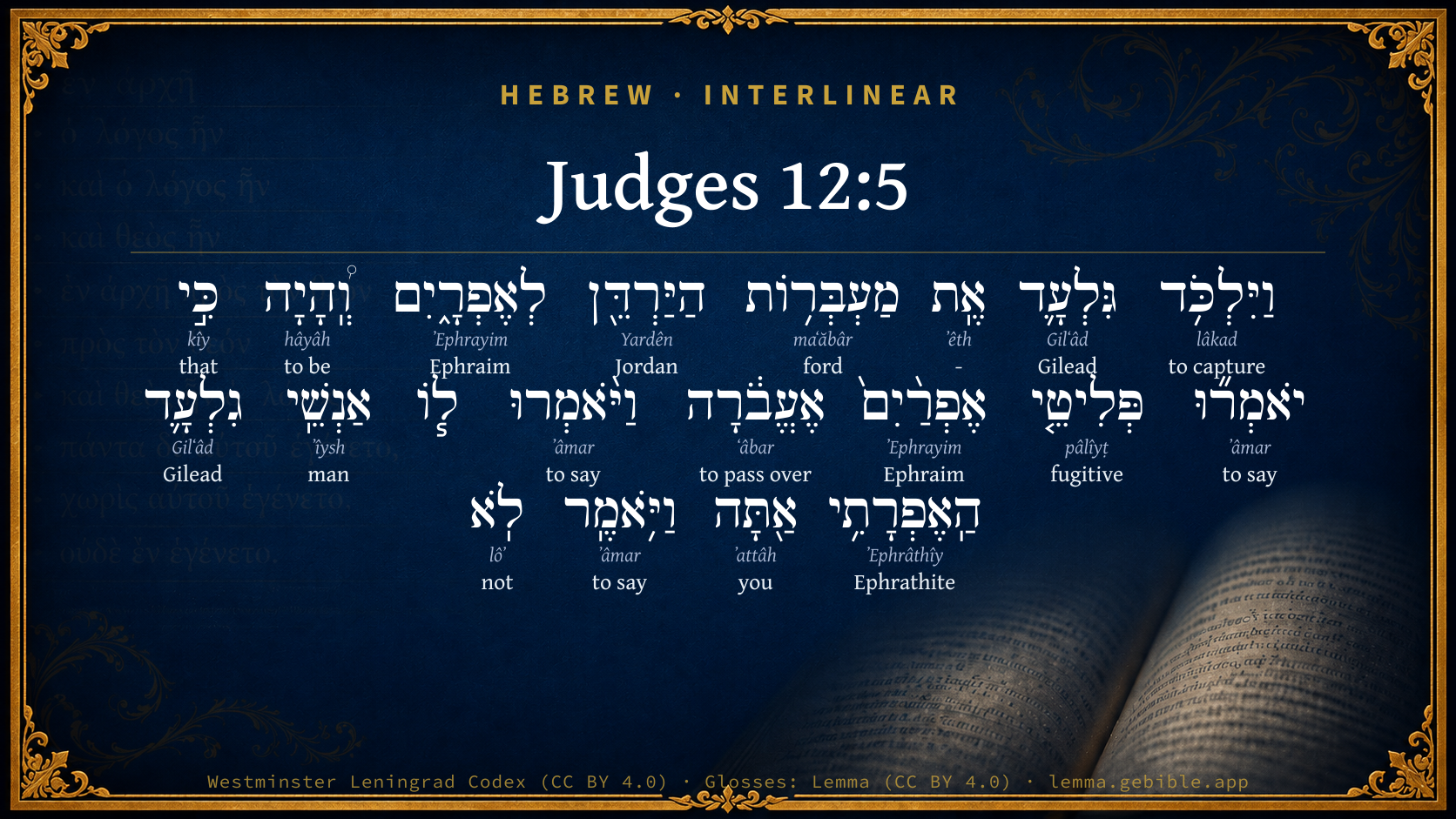

Judges 12:5

Hebrew (Westminster Leningrad Codex) Judges 12:5 appears in the Hebrew Old Testament. The text above is from the Westminster Leningrad Codex. Each word links to its Strong’s number, a concise gloss, and parsing drawn from the Open Scriptures Hebrew Bible morphology. Click any word for its full Brown-Driver-Briggs (BDB) entry.
Download image
Cite this verse

Judges 12:5 (World English Bible). Public Domain. Lemma interlinear Bible study tool, https://lemma.gebible.app/v/judges/12/5.

Show BibTeX & RIS
BibTeX
RIS
English Translation
The Gileadites took the fords of the Jordan against the Ephraimites. It was so, that when [any of] the fugitives of Ephraim said, Let me go over, the men of Gilead said to him, Are you an Ephraimite? If he said, No;
World English Bible · Public Domain
Highlights
  • 1 first appearance in the Hebrew Bible
Full analysis ↓
Download a study sheet

One document with this verse’s original text, its word-by-word gloss line, the meaning frame, cross-references with their text, attributed commentary, and full source and license credits — printable, and it pastes into notes with its structure intact.

This verse Autodidact and up

Study sheet (.html) Plain text (.txt)

A passage Seminary Student

Up to 50 verses in one chapter. A passage sheet keeps up to 6 commentary sources and 12 cross-references per verse, in the order this page ranks them, and says so on the sheet whenever that leaves anything out. Ask for a single verse and you get the Autodidact verse sheet above.

Everything on this page stays free to read, with no account — the sheet is a download of what is already on screen, not access to it.

Want to remove ads? Support Godless Engineer
Compare translations 3

The same verse in 3 English versions, stacked beneath the original-language interlinear above. Click any original word for its lexicon entry.

Each is an independent rendering of the whole verse — the interlinear is not word-aligned to these translations.

Highlighted words mark where these versions differ — a whole-verse word diff, not a word-by-word alignment.

  • World English Bible Public Domain
    The Gileadites took the fords of the Jordan against the Ephraimites. It was so, that when [any of] the fugitives of Ephraim said, Let me go over, the men of Gilead said to him, Are you an Ephraimite? If he said, No;
  • King James Version Public Domain
    And the Gileadites took the passages of Jordan before the Ephraimites: and it was so, that when those Ephraimites which were escaped said, Let me go over; that the men of Gilead said unto him, Art thou an Ephraimite? If he said, Nay;
  • unfoldingWord Literal Text CC BY-SA 4.0
    And Gilead captured the fords of the Jordan to Ephraim. And it happened, when the fugitives of Ephraim said, “Let me cross over,” then the men of Gilead said to him, “ you an Ephraimite?” If he said, “No,”

unfoldingWord Literal Text — © unfoldingWord, licensed CC BY-SA 4.0. Word-aligned USFM3 via Door43 (git.door43.org/unfoldingWord/en_ult).

Versions to compare (up to 4)

3 of 4 selected

Show all 18 translations

Every available English version of this verse, each an independent rendering of the whole verse.

  • World English Bible Public Domain
    The Gileadites took the fords of the Jordan against the Ephraimites. It was so, that when [any of] the fugitives of Ephraim said, Let me go over, the men of Gilead said to him, Are you an Ephraimite? If he said, No;
  • Berean Standard Bible Public Domain
    The Gileadites captured the fords of the Jordan leading to Ephraim, and whenever a fugitive from Ephraim would say, “Let me cross over,” the Gileadites would ask him, “Are you an Ephraimite?” If he answered, “No,”
  • Majority Standard Bible Public Domain
    The Gileadites captured the fords of the Jordan leading to Ephraim, and whenever a fugitive from Ephraim would say, “Let me cross over,” the Gileadites would ask him, “Are you an Ephraimite?” If he answered, “No,”
  • King James Version Public Domain
    And the Gileadites took the passages of Jordan before the Ephraimites: and it was so, that when those Ephraimites which were escaped said, Let me go over; that the men of Gilead said unto him, Art thou an Ephraimite? If he said, Nay;
  • American Standard Version (1901) Public Domain
    And the Gileadites took the fords of the Jordan against the Ephraimites. And it was so, that, when `any of' the fugitives of Ephraim said, Let me go over, the men of Gilead said unto him, Art thou an Ephraimite? If he said, Nay;
  • Revised Version (1885) Public Domain
    And the Gileadites took the fords of Jordan against the Ephraimites: and it was so, that when any of the fugitives of Ephraim said, Let me go over, the men of Gilead said unto him, Art thou an Ephraimite? If he said, Nay;
  • Geneva Bible (1599) Public Domain
    Also the Gileadites tooke the passages of Iorden before the Ephraimites, and when the Ephraimites that were escaped, saide, Let me passe, then the men of Gilead said vnto him, Art thou an Ephraimite? If he said, Nay,
  • Douay-Rheims (1899) Public Domain
    And the Galaadites secured the fords of the Jordan, by which Ephraim was to return. And when any one of the number of Ephraim came thither in the flight, and said: I beseech you let me pass: the Galaadites said to him: Art thou not an Ephraimite? If he said: I am not:
  • Young's Literal Translation Public Domain
    And Gilead captureth the passages of the Jordan to Ephraim, and it hath been, when `any of' the fugitives of Ephraim say, `Let me pass over,' and the men of Gilead say to him, `An Ephramite thou?' and he saith, `No;'
  • Literal Standard Version CC BY-SA 4.0
    And Gilead captures the passages of the Jordan to Ephraim, and it has been, when [any of] the fugitives of Ephraim say, “Let me pass over,” and the men of Gilead say to him, “[Are] you an Ephraimite?” And he says, “No”;
  • Unlocked Literal Bible CC BY-SA 4.0
    The Gileadites captured the fords of the Jordan leading to Ephraim. When any of the survivors of Ephraim said, “Let me go over the river,” the men of Gilead would say to him, “Are you an Ephraimite?” If he said, “No,”
  • unfoldingWord Literal Text CC BY-SA 4.0
    And Gilead captured the fords of the Jordan to Ephraim. And it happened, when the fugitives of Ephraim said, “Let me cross over,” then the men of Gilead said to him, “ you an Ephraimite?” If he said, “No,”
  • Darby Bible Public Domain
    And the Gileadites took the fords of the Jordan against the E'phraimites. And when any of the fugitives of E'phraim said, "Let me go over," the men of Gilead said to him, "Are you an E'phraimite?" When he said, "No,"
  • World Messianic Bible Public Domain
    The Gileadites took the fords of the Jordan against the Ephraimites. Whenever a fugitive of Ephraim said, “Let me go over,” the men of Gilead said to him, “Are you an Ephraimite?” If he said, “No;”
  • Webster's Bible Public Domain
    And the Gileadites took the passages of Jordan before the Ephraimites: and it was so, that when those Ephraimites who had escaped, said, Let me go over; that the men of Gilead said to him, Art thou an Ephraimite? If he said, No;
  • Free Bible Version CC BY-SA 4.0
    The Gileadites took control of the fords over the Jordan River that led to Ephraim's territory, and when an Ephraimite escapee from the battle would come and ask, “Let me cross over,” the Gileadites would question him, “Are you an Ephraimite?” If he answered, “No,”
  • Bible in Basic English Public Domain
    And the Gileadites took the crossing-places of Jordan against the Ephraimites; and when any of the men of Ephraim who had gone in flight said, let me go over; the men of Gilead said to him, Are you an Ephraimite? And if he said, No;
  • JPS Tanakh (1917) Public Domain
    And the Gileadites took the fords of the Jordan against the Ephraimites; and it was so, that when any of the fugitives of Ephraim said: 'Let me go over,' the men of Gilead said unto him: 'Art thou an Ephraimite?' If he said: 'Nay';

Literal Standard Version (2020), Covenant Press — licensed CC BY-SA 4.0. Text via the HelloAO Bible API (eBible.org). Unlocked Literal Bible (unfoldingWord) — licensed CC BY-SA 4.0. Text via the HelloAO Bible API (eBible.org). unfoldingWord Literal Text — © unfoldingWord, licensed CC BY-SA 4.0. Word-aligned USFM3 via Door43 (git.door43.org/unfoldingWord/en_ult). Free Bible Version, Dr. Jonathan Gallagher — licensed CC BY-SA 4.0. Text via the HelloAO Bible API (eBible.org).

Word by word

More ways to search: Search by grammar → Find every occurrence → Compare this word →

Practice this passage: Drill this verse → Learn its vocabulary →

הַֽאֶפְרָתִ֥י
ʼEphrâthîy
H673
“the · Ephrathite”
Particle, Definite Article + Noun, Gentilic, Masculine, Singular, Absolute
Part of Speech
Particle + Noun
Type
Gentilic
Gender
Masculine
Number
Singular
State
Absolute
Full BDB Definition

Origin: patrial form H672

TWOT: None

Ephrathite = "ashiness: fruitfulness" - an inhabitant or descendant of Ephraim - an inhabitant of Bethlehem
  1. וַיִּלְכֹּ֥ד lâkad H3920 “and · to capture” Conjunction + Verb, Qal, Sequential Imperfect, 3rd Person, Masculine, Singular
  2. גִּלְעָ֛ד Gilʻâd H1568 “Gilead” Noun, Proper
  3. אֶֽת ʼêth H853 “-” Particle, Direct Object
  4. מַעְבְּר֥וֹת maʻăbâr H4569 “fords of” Noun, Common, Feminine, Plural, Construct
  5. הַיַּרְדֵּ֖ן Yardên H3383 “the · Jordan” Particle, Definite Article + Noun, Proper
  6. לְאֶפְרָ֑יִם ʼEphrayim H669 “to/for · Ephraim” Preposition + Noun, Proper
  7. וְֽ֠הָיָה hâyâh H1961 “and · to be” Conjunction + Verb, Qal, Perfect, 3rd Person, Masculine, Singular
  8. כִּ֣י kîy H3588 “that” Conjunction
  9. יֹאמְר֞וּ ʼâmar H559 “to say” Verb, Qal, Imperfect, 3rd Person, Masculine, Plural
  10. פְּלִיטֵ֤י pâlîyṭ H6412 “fugitives of” Noun, Common, Masculine, Plural, Construct
  11. אֶפְרַ֨יִם֙ ʼEphrayim H669 “Ephraim” Noun, Proper
  12. אֶעֱבֹ֔רָה ʻâbar H5674 “to pass over” Verb, Qal, Imperfect, 1st Person, Common, Singular
  13. וַיֹּ֨אמְרוּ ʼâmar H559 “and · to say” Conjunction + Verb, Qal, Sequential Imperfect, 3rd Person, Masculine, Plural
  14. אַנְשֵֽׁי ʼîysh H376 “men of” Noun, Common, Masculine, Plural, Construct
  15. גִלְעָ֛ד Gilʻâd H1568 “Gilead” Noun, Proper
  16. אַ֖תָּה ʼattâh H859 “you” Pronoun, Personal, 2nd Person, Masculine, Singular
  17. וַיֹּ֥אמֶֽר ʼâmar H559 “and · to say” Conjunction + Verb, Qal, Sequential Imperfect, 3rd Person, Masculine, Singular
  18. לֹֽא lôʼ H3808 “not” Particle, Negative

About this verse

These counts appear in no published source. They are computed here, from the morphology-tagged text and Lemma’s own curated glosses. What Lemma adds →

20
words
15
distinct lemmas
Historical
section

Notable vocabulary

The rarest word here is הַֽאֶפְרָתִ֥י Ephrathite H673 — appearing just 5 times in the whole Hebrew Bible.

First appearance in Scripture

This word makes its first canonical appearance in the Hebrew Bible here:

  • הַֽאֶפְרָתִ֥י Ephrathite H673

Shared distinctive vocabulary

הַֽאֶפְרָתִ֥י Ephrathite H673 occurs in 5 verses of the Hebrew Bible. Also found in:

Grammatical profile

  • 6 verbs
  • 9 nouns
  • 1 pronoun
  • 1 preposition
  • 1 conjunction
  • 2 particles

Verb forms

  • וַיִּלְכֹּ֥ד Qal · Sequential Imperfect
  • וְֽ֠הָיָה Qal · Perfect
  • יֹאמְר֞וּ Qal · Imperfect
  • אֶעֱבֹ֔רָה Qal · Imperfect
  • וַיֹּ֨אמְרוּ Qal · Sequential Imperfect
  • וַיֹּ֥אמֶֽר Qal · Sequential Imperfect

Repetition

Words recur within this verse — often emphatic in Hebrew:

  • יֹאמְר֞וּ to say H559 ×3
  • גִּלְעָ֛ד Gilead H1568 ×2
  • לְאֶפְרָ֑יִם Ephraim H669 ×2

Hebrew & Septuagint length

In English translation the verse runs 42 words from the Hebrew and 36 from the Septuagint (LXX English) — closely comparable.

A rough comparison of the two English renderings, which tokenize alike — not a word-level alignment.

Word counts can differ between the Hebrew and the Greek without any difference in meaning — e.g. the Hebrew direct-object marker אֵת has no separate Greek word, and Greek often adds the article ὁ.

In the original languages it is 20 Hebrew tokens and 29 Greek tokens — but the two are counted differently (Hebrew bundles its prefixes and suffixes into one token; the Greek is in lemma form), so that isn’t a like-for-like length.

Cross-references

4

Topical passages linked to Judges 12:5 in the Treasury of Scripture Knowledge — connected by theme and wording, ordered by reader-vote popularity; previews shown in the World English Bible.

  • Judges 3:28 He said to them, Follow after me; for Yahweh has delivered your enemies the Moabites into your hand. They went down after him, and took the fords of the Jordan against the Moabites, and didn't allow a man to pass over.
  • Joshua 22:11 The children of Israel heard say, Behold, the children of Reuben and the children of Gad and the half-tribe of Manasseh have built an altar in the forefront of the land of Canaan, in the region about the Jordan, on the side that pertains to the children of Israel.
  • Joshua 2:7 The men pursued after them the way to the Jordan to the fords: and as soon as those who pursued after them were gone out, they shut the gate.
  • Judges 7:24 Gideon sent messengers throughout all the hill-country of Ephraim, saying, Come down against Midian, and take before them the waters, as far as Beth Barah, even the Jordan. So all the men of Ephraim were gathered together, and took the waters as far as Beth Barah, even the Jordan.

Cross-references courtesy of OpenBible.info (CC BY 4.0).

Hebrew and Greek witnesses Masoretic Hebrew ↔ Greek Septuagint

The same verse in the two great witnesses to the Old Testament, shown verse-for-verse.

These are two independent witnesses, not word-aligned to each other, and the Septuagint is shown in lemma (dictionary) form.

Hebrew Judges 12:5 Masoretic · Westminster Leningrad Codex

וַיִּלְכֹּ֥ד גִּלְעָ֛ד אֶֽת מַעְבְּר֥וֹת הַיַּרְדֵּ֖ן לְאֶפְרָ֑יִם וְֽ֠הָיָה כִּ֣י יֹאמְר֞וּ פְּלִיטֵ֤י אֶפְרַ֨יִם֙ אֶעֱבֹ֔רָה וַיֹּ֨אמְרוּ ל֧וֹ אַנְשֵֽׁי גִלְעָ֛ד הַֽאֶפְרָתִ֥י אַ֖תָּה וַיֹּ֥אמֶֽר לֹֽא

The Gileadites took the fords of the Jordan against the Ephraimites. It was so, that when [any of] the fugitives of Ephraim said, Let me go over, the men of Gilead said to him, Are you an Ephraimite? If he said, No;

World English Bible · Public Domain

Greek LXX Judges 12:5 Septuagint · lemma form

καί προ καταλαμβάνω γαλαάδ ὁ διάβασις ὁ ἰορδάνης ὁ ἐφράιμ καί εἶπον αὐτός ὁ διασώζω ἐφράιμ διαβαίνω καί εἶπον αὐτός ὁ ἀνήρ γαλαάδ μή εφραθίτης εἰμί καί εἶπον οὐ

And Galaad took the fords of Jordan before Ephraim; and they that escaped of Ephraim said to them, Let us go over: and the men of Galaad said, Are you an Ephrathite? and he said, No.

LXX2012 (modern English Septuagint) · Public Domain

Hebrew: Westminster Leningrad Codex (CC BY 4.0). Greek: Septuagint (public domain); English from LXX2012 (modern English Septuagint) (Public Domain). How the Septuagint differs from the Hebrew →

Targum (Aramaic paraphrase)

1

The Targum is the ancient Jewish Aramaic paraphrase of the Hebrew Scriptures — an interpretive translation, not the Hebrew text itself. Onkelos (literal) and Pseudo-Jonathan (expansive) render the Torah, and Jonathan the Prophets. Coverage is partial: where no permissively-licensed English translation exists for a verse, only the Aramaic is shown. This is verse-level text, not a word-by-word alignment to the Hebrew.

  1. Targum Jonathan Prophets (Joshua–Malachi)
    וַאֲחַדוּ דְבֵית גִלְעָד יַת מְגִיזַת יַרְדְנָא עַל דְבֵית אֶפְרַיִם וַהֲוָה כַּד אֲמַר חַד מִמְשֵׁיזְבַיָא דְבֵית אֶפְרַיִם אֶעְבַר וְאָמְרִין לֵיהּ אֱנָשֵׁי גִלְעָד אֶפְרָתִי אַתְּ וַאֲמַר לָא:

    (no public-domain English translation for this verse)

    Targum Jonathan — Aramaic: “Mikraot Gedolot” (public domain). English: “Sefaria Community Translation” (CC0 1.0 (public-domain dedication)); “London "Chaldee Paraphrase," 1871” (public domain). Text via Sefaria.

Commentary

Notes on Judges 12:5 from classic Christian and Jewish commentators (each source and its license shown beneath its notes). The classic Christian expositions comment on the surrounding passage and are grouped to its opening verse, so a note may address several verses; the Jewish commentaries on the Tanakh (Rashi and others) are per-verse, so they appear only where the commentator wrote on this verse.

Lemma curates 59 commentaries, every one of them public domain or Creative Commons licensed, each selected and text-cleaned for this edition rather than reprinted as found. About our sources →

Trapp's Complete Commentary

John Trapp

Jdg 12:5 And the Gileadites took the passages of Jordan before the Ephraimites: and it was [so], that when those Ephraimites which were escaped said, Let me go over; that the men of Gilead said unto him, [Art] thou an Ephraimite? If he said, Nay;

Ver. 5. Before the Ephraimites.] Who were now become a woeful example of that rule, "Pride goeth before destruction, and a haughty spirit before a fall." {Pro 16:18}

If he said, Nay.] As most men will do in such a case, rather lie than die; which yet they should not do, but resolve with that good woman in Jerome, when she was upon the rack, Non ideo negare volo, ne peream: sed ideo mentiri nolo, ne peccem. Lie I will not, but prefer affliction before sin.

John Trapp, A Commentary or Exposition upon All the Books of the Old and New Testament (1647–1656) — public domain. Text from a community e-Sword module.

Joseph Benson's Commentary

Jdg 12:5-6. If he said, Nay — To avoid the present danger. Then said they unto him, Say now Shibboleth — To find out the truth, they put him to this test; whether his pronunciation of some words was like that of the Gileadites; for people of the same nation, who speak the same language, generally differ very much in the pronunciation of it, according as they live in different parts of the country. As the word signifies a stream or river, and they desired to pass over one, it was a word proper for the occasion, and gave them no cause to suspect the design, because they were only desired to say, “Let me go over the Shibboleth or river.” And he said, Sibboleth — If he was an Ephraimite, he presently discovered himself, for he could not pronounce the Hebrew letter שׁ, shin; which probably proceeded from the long habit of that people, to express themselves in a different manner; so that they could not readily frame the organs of speech to pronounce as the Gileadites did. The Hebrew text, however, does not say that he could not, but that he did not frame to pronounce it right; because, not suspecting the design, he uttered hastily, according to his usual manner of expression. There fell forty and two thousand — Not in that place, but in that expedition, being slain either in the battle, or in the pursuit, or at Jordan. See the justice of God! They had gloried that they were Ephraimites; but how soon are they afraid to own their country! They had called the Gileadites fugitives; and now they are in good earnest become fugitives themselves. It is the same word (Jdg 12:5) used of the Ephraimites that fled, which they had used in scorn of the Gileadites. He that rolls the stone of reproach unjustly on another, it may justly return upon himself.

Joseph Benson's Commentary on the Old and New Testaments (1811–1818) — public domain. Text from a community e-Sword module.

Ellicott's Commentary for English Readers

(5) Took the passages of Jordan.—Only through these fords could the Ephraimites escape to their own tribe. (Comp. Jdg_3:28; Jdg_7:24.) But while it was excusable to cut off all escape from a dangerous foreign invader, it showed a terrible exasperation to leave no chance of flight to Israelites in a civil war.

Before the Ephraimites.—Literally, to Ephraim, which perhaps means “towards, or in the direction of, Ephraim” (per quœ Ephraim, reversurus erat, Vulg.).

When those Ephraimites which were escaped.—The fact that the Hebrew phrase is exactly the same as in Jdg_12:4, “fugitives of Ephraim,” adds. great additional force to the view which we have adopted. If the rendering of the English Version be adopted in Jdg_12:4, we can only suppose that there is a bitter retribution implied in the words. The Ephraimites had taunted the Eastern Manassites with being “fugitives of Ephraim,” and in the next verse they themselves appear to be in another, but fatal, sense “fugitives of Ephraim.”

Art thou an Ephraimite?—There must have been considerable traffic across the Jordan fords, and the object was to distinguish between Ephraimite fugitives and harmless travellers and merchants.

A Bible Commentary for English Readers, edited by Charles John Ellicott (1878–1897) — public domain. Text from a community e-Sword module.

The Cambridge Bible for Schools and Colleges

gen. ed. J. J. S. Perowne

5. took the fords] Cf. Jdg_3:28, Jdg_7:24. Render against (dat. incommodi) rather than toward (marg.) in these passages.

The Cambridge Bible for Schools and Colleges (gen. ed. J. J. S. Perowne; Cambridge University Press, 1878–1918) — public domain. Text from a community e-Sword module.

John Gill's Exposition

And the Gileadites took the passages of Jordan before the Ephraimites,.... Being either swifter of foot, or going a nearer and shorter way, being better acquainted with their own country:

and it was so, that when those Ephraimites which were escaped said, let me go over; the fugitives of Ephraim, as before called, who ran away from the battle, made their escape, and the best of their way to the passages of Jordan, to get over there to their own country:

that the men of Gilead said unto him; to everyone of them, as they came up:

art thou an Ephraimite? or an Ephrathite; for so it seems those of the tribe of Ephraim were called, as Jeroboam, Kg1 11:26.

if he said, nay; that he was not an Ephraimite;

John Gill's Exposition of the Whole Bible (1746–1763) — public domain (CC PDM 1.0). Text via the HelloAO Bible API.

Matthew Poole's English Annotations

Those Ephraimites which were escaped, Heb. the fugitives of Ephraim, as before; for the Hebrew words are the same; which may make the latter exposition of the foregoing words more probable, to wit, that it is not the Gileadites, but the Ephraimites, who are there as well as here so called, because they are smitten before Jephthah, and fled from him.

If he said, Nay; to avoid the present danger.

Matthew Poole's English Annotations on the Holy Bible (1683–1685) — public domain. Text from a community e-Sword/MySword module.

Whedon's Commentary on the Bible

Daniel D. Whedon

5. Took the passages of Jordan — Compare marginal reference.

Before the Ephraimites — Or, towards Ephraim, that is, towards the territory of that tribe. Across these fords would the defeated and retreating Ephraimites seek to make their escape from the land of Gilead.

Daniel D. Whedon (gen. ed.), Commentary on the Old and New Testaments (1874–1909) — public domain. Text from a community e-Sword module.

The Pulpit Commentary

Vers. 5, 6. Shibboleth: The importance of little defects, faults, etc.

This not absolute, but relative.

I WHEREIN THIS IMPORTANCE CONSISTS.

1. In what they suggest or reveal. A slip in accidence, or a blunder in the statement of matter of fact, may discredit the pretended scholar. A difference in tone or manner may mean indifference or enmity or hypocrisy. Temporary neglect of a child may prove want of real parental affection. Neglect of private or public prayer may be little in itself, but it may spring from the alienation of the soul from God. The glib utterance of a "white lie" may make us doubt the whole moral character of the speaker. Grave diseases often declare themselves by comparatively slight symptoms, as leprosy, paralytic ataxia, etc.

2. We see it in the order of life as a whole. In the vegetable and animal world the law of the:" survival of the fittest" often works through comparatively slight organic adaptations. In human life the advantage and ultimate success of men often depends upon their slight superiority to other competitors. A little ignorance, extravagance, carelessness, etc. may work ruin. "A stitch in time saves nine." "Ready, aye ready," is a noble motto. Great discoveries have been made by men who were just a little in advance of their fellows.

3. A critical occasion may give a trifle an unlooked-for importance. The cackling of geese saved Rome, according to the myth. Peter"s uncouth accent occasioned the observation of the maid, and his emphatic denial of Christ. Vessels have been wrecked because of a little carelessness in taking observations when mists have suddenly arisen, or rocks were in the course. Souls have been lost through impressions produced by the inconsistencies of professing Christians.

II OUR DUTY WITH RESPECT TO THEM. "Of course it is to correct them, to get rid of them," you say. Yes; but how? Sometimes they are so related to us that we cannot remove them. It is necessary then that we should do all in our power to compensate for them by cultivating other qualities, etc., or to neutralise their influence by timely explanations and clear proofs of our real intention, spirit, character, etc. Mere punctilio, or the scrupulosity of the martinet will not do. We must beware of the folly of those who "strain at a gnat and swallow a camel." Let the whole life be emphatic in contradiction, and let the spirit of Christ so shine through us that men will learn to know us in spite of those failings and defects which give us the lie. "Not far from the kingdom of heaven" may be worse than entire alienation from it.

Tests: their good and evil. As a means of discovering the Ephraimite, the device was highly natural and ingenious. In the main and roughly it was successful. Some such method was evidently required. There was no time to enter into minute detail or examination. But, on the other hand, it was quite possible that some who were not Ephraimites were slain by mistake. So in determining fitness for Church membership, office, or spiritual responsibility

I TESTS MAY BE NECESSARY. There are times when it is of the utmost importance for us to know who are God"s people and who are not. We are to "have no fellowship with the unfruitful works of darkness, but rather reprove them." From the unholy, disorderly, unbelieving we are commanded to withdraw ourselves. But this injunction were impossible of fulfilment were the distinction between saints and sinners not capable of being made. Christ has happily supplied a test their fruits ye shall know them." The confession of the lips is another element, but it must not be dissociated from the former. So in the life of every day we require to know men, and accordingly have to form our opinions and judgments of them. This is so vital and necessary to safety and happiness, that we do it almost automatically, unconsciously. The honest and the dishonest, the true and the false, the friend and the enemy, we learn to distinguish by actions and words, and the course of their conduct It is foolish, therefore, for persons to object to tests they are necessary throughout the whole range of life, temporal and spiritual. But

II THEY MAY MISLEAD. In the nature of things they must be superficial, local, accidental, etc. They are observed and interpreted by fallible men. Trifling differences may acquire factitious importance. A man is not to be condemned for a word; a careful study should be made of the whole conduct and character of the man. The Christian life has many "notes," and where one is not forthcoming another may be present. The Epistles have, therefore, a variety of points upon which Christians may test themselves and others. God alone knoweth the heart, and in Christ he will judge the world by infallible judgment. It is better to err on the side of leniency to offenders than on that of severity. It matters not how we may commend ourselves to men, our condition in the sight of God is of chief account. M.

The Pulpit Commentary (1880–1919), ed. H.D.M. Spence-Jones & Joseph S. Exell — public domain. Text from a community e-Sword module.

John Wesley's Explanatory Notes

Said Nay - To avoid the present danger.

John Wesley, Explanatory Notes Upon the Whole Bible (1754–1765) — public domain. Text via the GEBible commentary corpus.

unfoldingWord translationNotes

Door43 World Missions Community

to Ephraim

"to the land of Ephraim"

The Gileadites captured

"The Gileadites controlled" or "The Gileadites occupied"

fords

These are places where you can cross the river on foot because the water is shallow.

Ephraimite

person from the tribe of Ephraim

Shibboleth ... Sibboleth

These words have no meaning. Copy these words into your language, and make sure that the beginning of the words, that is the letters "Sh" and "S" are translated differently. (See: Copy or Borrow Words)

pronounce the word

"make the sound of the word"

Forty-two thousand

"42,000" (See: Numbers)

Forty-two thousand Ephraimites were killed

This can be stated in active form. AT: "They killed forty-two thousand Ephraimites" (See: Active or Passive)

translationWords

Gilead

Jordan River

Ephraim

seize

unfoldingWord translationNotes — © Distant Shores Media and the Door43 World Missions Community, licensed CC BY-SA 4.0. Source: git.door43.org/Door43/en_tn.

Rashi

Rabbi Shlomo Yitzchaki (Rashi)

The Gilodites captured the Yardein crossings. They posted sentries at the crossing areas.

Rashi on the Tanakh — English translations: “The Judaica Press complete Tanach with Rashi, translated by A. J. Rosenberg” (CC BY 4.0); “Pentateuch with Rashi's commentary by M. Rosenbaum and A.M. Silbermann, 1929-1934” (public domain); “The Metsudah Tanach series, Lakewood, N.J” (CC BY 4.0); and “The Book of Joshua, Metsudah Publications, 1997” (CC BY 4.0). Text via Sefaria.

Lesson kit

Teaching starters — assembled from the data on this page, not authored interpretation. Every prompt links to the verse data it draws on. Edit before teaching.

Judges, in the Historical, opens this verse with 20 words (15 distinct Hebrew lemmas). Its most distinctive word is ʼEphrâthîy (“Ephrathite”). A historical commentator’s framing appears above. Read the whole chapter for the surrounding context.

Discussion questions

  1. How does “Ephrathite” (ʼEphrâthîy) shape what this verse is saying?
  2. The word “Ephrathite” first appears here in Scripture. What is being introduced at this debut?
  3. Ruth 1:2 shares the word «Ephrathite» with this verse. How do the two illuminate each other?
  4. “to say” occurs 3× in this one verse. What is the effect of the repetition?
  5. The translations on this page render this verse differently — a whole-verse word diff, not a word-by-word alignment. What might account for the different wordings?
  6. The verb «וַיִּלְכֹּ֥ד» is Qal Sequential Imperfect. How does its form color the action?
  7. Reading how Trapp's Complete Commentary and Joseph Benson's Commentary read this verse, where do the two commentators agree and where do they part?

Things to notice

Reading settings

Reading text

Shown beneath each verse's original-language words.

Old Testament
Old Testament edition

Read the OT as the Masoretic Hebrew (MT) or the Greek Septuagint (LXX).

English shown for the Greek Septuagint (in the Hebrew ↔ Greek comparison).

Comparing translations? Open the Compare panel on any verse page to stack up to four side by side.