
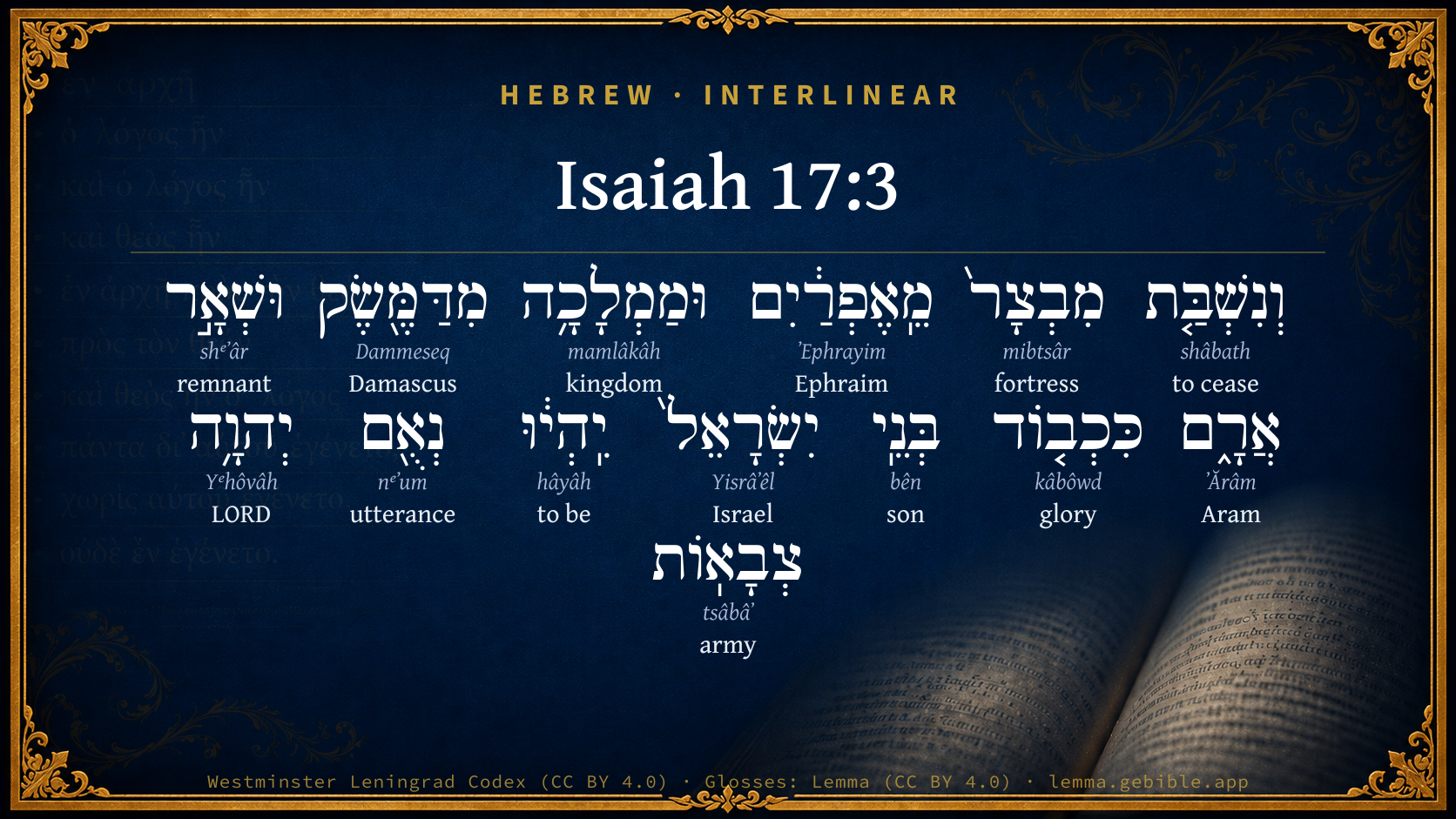
Isaiah 17:3

Hebrew (Westminster Leningrad Codex) Isaiah 17:3 appears in the Hebrew Old Testament. The text above is from the Westminster Leningrad Codex. Each word links to its Strong’s number, a concise gloss, and parsing drawn from the Open Scriptures Hebrew Bible morphology. Click any word for its full Brown-Driver-Briggs (BDB) entry.
Download image
Cite this verse

Isaiah 17:3 (World English Bible). Public Domain. Lemma interlinear Bible study tool, https://lemma.gebible.app/v/isaiah/17/3.

Show BibTeX & RIS
BibTeX
RIS
English Translation
The fortress shall cease from Ephraim, and the kingdom from Damascus, and the remnant of Syria; they shall be as the glory of the children of Israel, says Yahweh of Hosts.
World English Bible · Public Domain
Download a study sheet

One document with this verse’s original text, its word-by-word gloss line, the meaning frame, cross-references with their text, attributed commentary, and full source and license credits — printable, and it pastes into notes with its structure intact.

This verse Autodidact and up

Study sheet (.html) Plain text (.txt)

A passage Seminary Student

Up to 50 verses in one chapter. A passage sheet keeps up to 6 commentary sources and 12 cross-references per verse, in the order this page ranks them, and says so on the sheet whenever that leaves anything out. Ask for a single verse and you get the Autodidact verse sheet above.

Everything on this page stays free to read, with no account — the sheet is a download of what is already on screen, not access to it.

Want to remove ads? Support Godless Engineer
Compare translations 3

The same verse in 3 English versions, stacked beneath the original-language interlinear above. Click any original word for its lexicon entry.

Each is an independent rendering of the whole verse — the interlinear is not word-aligned to these translations.

Highlighted words mark where these versions differ — a whole-verse word diff, not a word-by-word alignment.

  • World English Bible Public Domain
    The fortress shall cease from Ephraim, and the kingdom from Damascus, and the remnant of Syria; they shall be as the glory of the children of Israel, says Yahweh of Hosts.
  • King James Version Public Domain
    The fortress also shall cease from Ephraim, and the kingdom from Damascus, and the remnant of Syria: they shall be as the glory of the children of Israel, saith the LORD of hosts.
  • unfoldingWord Literal Text CC BY-SA 4.0
    And fortification will be ceased from Ephraim, and the kingdom from Damascus. And the remnant of Aram, they will be like the glory of the sons of Israel” —the declaration of Yahweh of Armies.

unfoldingWord Literal Text — © unfoldingWord, licensed CC BY-SA 4.0. Word-aligned USFM3 via Door43 (git.door43.org/unfoldingWord/en_ult).

Versions to compare (up to 4)

3 of 4 selected

Show all 18 translations

Every available English version of this verse, each an independent rendering of the whole verse.

  • World English Bible Public Domain
    The fortress shall cease from Ephraim, and the kingdom from Damascus, and the remnant of Syria; they shall be as the glory of the children of Israel, says Yahweh of Hosts.
  • Berean Standard Bible Public Domain
    The fortress will disappear from Ephraim, and the sovereignty from Damascus. The remnant of Aram will be like the splendor of the Israelites,” declares the LORD of Hosts.
  • Majority Standard Bible Public Domain
    The fortress will disappear from Ephraim, and the sovereignty from Damascus. The remnant of Aram will be like the splendor of the Israelites,” declares the LORD of Hosts.
  • King James Version Public Domain
    The fortress also shall cease from Ephraim, and the kingdom from Damascus, and the remnant of Syria: they shall be as the glory of the children of Israel, saith the LORD of hosts.
  • American Standard Version (1901) Public Domain
    And the fortress shall cease from Ephraim, and the kingdom from Damascus, and the remnant of Syria; they shall be as the glory of the children of Israel, saith Jehovah of hosts.
  • Revised Version (1885) Public Domain
    The fortress also shall cease from Ephraim, and the kingdom from Damascus, and the remnant of Syria; they shall be as the glory of the children of Israel, saith the LORD of hosts.
  • Geneva Bible (1599) Public Domain
    The munition also shall cease from Ephraim, and the kingdome from Damascus, and the remnant of Aram shall be as the glory of the children of Israel, sayeth the Lord of hostes.
  • Douay-Rheims (1899) Public Domain
    And aid shall cease from Ephraim, and the kingdom from Damascus: and the remnant of Syria shall be as the glory of the children of Israel: saith the Lord of hosts.
  • Young's Literal Translation Public Domain
    And ceased hath the fortress from Ephraim, And the kingdom from Damascus, And the remnant of Aram are as the honour of the sons of Israel, The affirmation of Jehovah of Hosts!
  • Literal Standard Version CC BY-SA 4.0
    And the fortress has ceased from Ephraim, || And the kingdom from Damascus, || And the remnant of Aram are as the glory of the sons of Israel, || A declaration of YHWH of Hosts!
  • Unlocked Literal Bible CC BY-SA 4.0
    Fortified cities will disappear from Ephraim, the kingdom from Damascus, and the remnant of Aram—they will be like the glory of the people of Israel—this is the declaration of Yahweh of hosts.
  • unfoldingWord Literal Text CC BY-SA 4.0
    And fortification will be ceased from Ephraim, and the kingdom from Damascus. And the remnant of Aram, they will be like the glory of the sons of Israel” —the declaration of Yahweh of Armies.
  • Darby Bible Public Domain
    The fortress also shall cease from Ephraim, and the kingdom from Damascus, and the remnant of Syria: they shall be as the glory of the children of Israel, saith Jehovah of hosts.
  • World Messianic Bible Public Domain
    The fortress shall cease from Ephraim, and the kingdom from Damascus, and the remnant of Syria. They will be as the glory of the children of Israel,” says the LORD of Hosts.
  • Webster's Bible Public Domain
    The fortress also shall cease from Ephraim, and the kingdom from Damascus, and the remnant of Syria: they shall be as the glory of the children of Israel, saith the LORD of hosts.
  • Free Bible Version CC BY-SA 4.0
    The fortified city will disappear from Ephraim, Damascus will no longer be a kingdom, and those that are left of the Arameans will be like the lost glory of Israel, declares the Lord Almighty.
  • Bible in Basic English Public Domain
    The strong tower has gone from Ephraim, and the kingdom from Damascus: the rest of Aram will come to destruction, and be made like the glory of the children of Israel, says the Lord of armies.
  • JPS Tanakh (1917) Public Domain
    The fortress also shall cease from Ephraim, and the kingdom from Damascus; and the remnant of Aram shall be as the glory of the children of Israel, saith the LORD of hosts.

Literal Standard Version (2020), Covenant Press — licensed CC BY-SA 4.0. Text via the HelloAO Bible API (eBible.org). Unlocked Literal Bible (unfoldingWord) — licensed CC BY-SA 4.0. Text via the HelloAO Bible API (eBible.org). unfoldingWord Literal Text — © unfoldingWord, licensed CC BY-SA 4.0. Word-aligned USFM3 via Door43 (git.door43.org/unfoldingWord/en_ult). Free Bible Version, Dr. Jonathan Gallagher — licensed CC BY-SA 4.0. Text via the HelloAO Bible API (eBible.org).

Word by word

More ways to search: Search by grammar → Find every occurrence → Compare this word →

Practice this passage: Drill this verse → Learn its vocabulary →

וּשְׁאָ֣ר
shᵉʼâr
H7605
“and · remnant of”
Conjunction + Noun, Common, Masculine, Singular, Construct
Part of Speech
Conjunction + Noun
Type
Common
Gender
Masculine
Number
Singular
State
Construct
Full BDB Definition

Origin: from H7604

TWOT: 2307a

rest, residue, remnant, remainder
  1. וְנִשְׁבַּ֤ת shâbath H7673 “and · to cease” Conjunction + Verb, Niphal, Sequential Perfect, 3rd Person, Masculine, Singular
  2. מִבְצָר֙ mibtsâr H4013 “fortress” Noun, Common, Masculine, Singular, Absolute
  3. מֵֽאֶפְרַ֔יִם ʼEphrayim H669 “from · Ephraim” Preposition + Noun, Proper
  4. וּמַמְלָכָ֥ה mamlâkâh H4467 “and · kingdom” Conjunction + Noun, Common, Feminine, Singular, Absolute
  5. מִדַּמֶּ֖שֶׂק Dammeseq H1834 “from · Damascus” Preposition + Noun, Proper
  6. אֲרָ֑ם ʼĂrâm H758 “Aram” Noun, Proper
  7. כִּכְב֤וֹד kâbôwd H3519 “like/as · glory of” Preposition + Noun, Common, Both, Singular, Construct
  8. בְּנֵֽי bên H1121 “sons of” Noun, Common, Masculine, Plural, Construct
  9. יִשְׂרָאֵל֙ Yisrâʼêl H3478 “Israel” Noun, Proper
  10. יִֽהְי֔וּ hâyâh H1961 “to be” Verb, Qal, Imperfect, 3rd Person, Masculine, Plural
  11. נְאֻ֖ם nᵉʼum H5002 “utterance of” Noun, Common, Masculine, Singular, Construct
  12. יְהוָ֥ה Yᵉhôvâh H3068 “LORD” Noun, Proper
  13. צְבָאֽוֹת tsâbâʼ H6635 “armies” Noun, Common, Both, Plural, Absolute

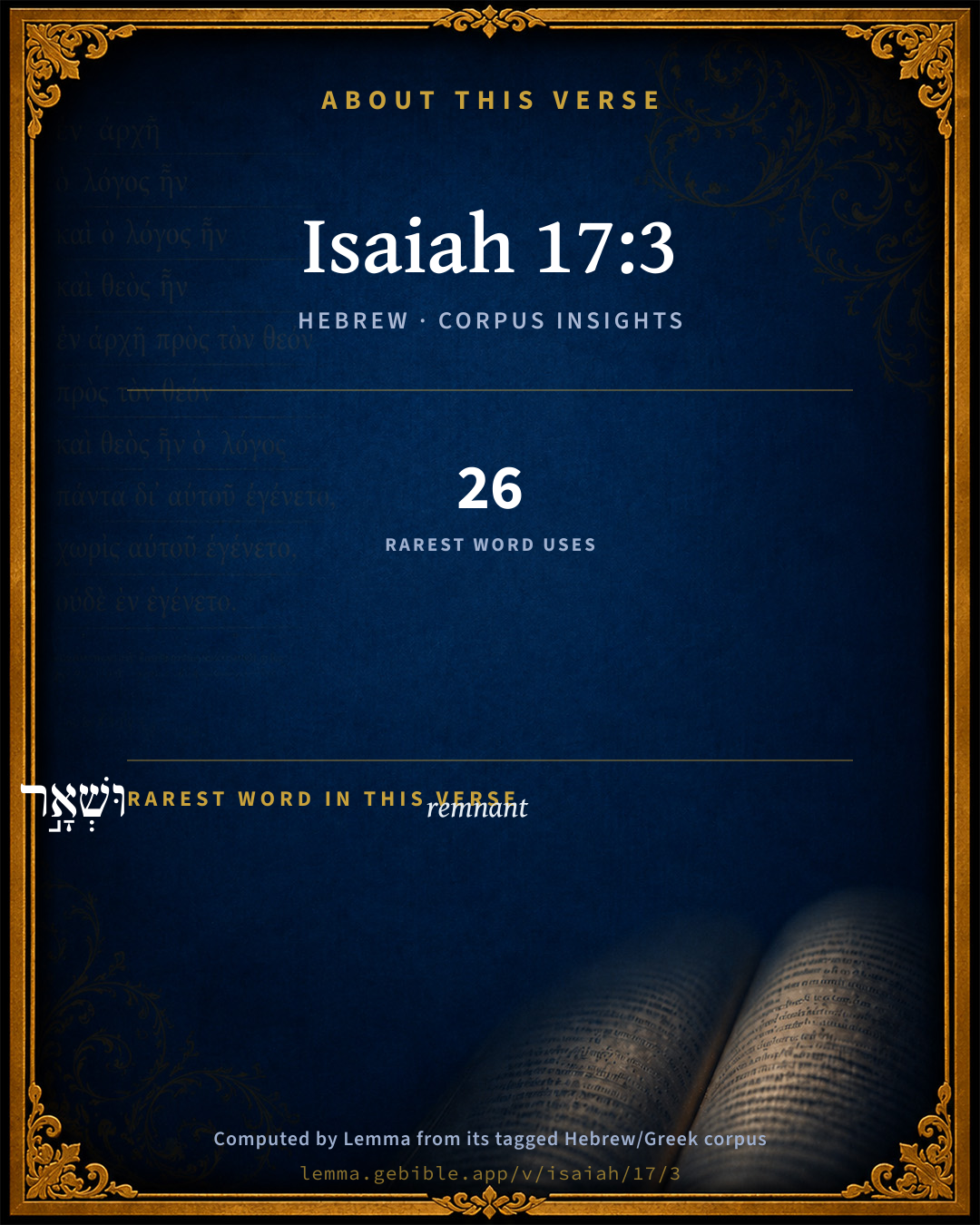
About this verse

These counts appear in no published source. They are computed here, from the morphology-tagged text and Lemma’s own curated glosses. What Lemma adds →

14
words
14
distinct lemmas
Prophets
section

Shared distinctive vocabulary

וּשְׁאָ֣ר remnant H7605 occurs in 25 verses of the Hebrew Bible. Also found in:

Grammatical profile

  • 2 verbs
  • 12 nouns

Verb forms

  • וְנִשְׁבַּ֤ת Niphal · Sequential Perfect
  • יִֽהְי֔וּ Qal · Imperfect

Hebrew & Septuagint length

In English translation the verse runs 31 words from the Hebrew and 49 from the Septuagint (LXX English) — the Septuagint runs noticeably longer here. See the side-by-side →

A rough comparison of the two English renderings, which tokenize alike — not a word-level alignment.

Word counts can differ between the Hebrew and the Greek without any difference in meaning — e.g. the Hebrew direct-object marker אֵת has no separate Greek word, and Greek often adds the article ὁ.

Cross-references

25

Topical passages linked to Isaiah 17:3 in the Treasury of Scripture Knowledge — connected by theme and wording, ordered by reader-vote popularity; previews shown in the World English Bible.

  • Isaiah 7:16 For before the child knows to refuse the evil, and choose the good, the land whose two kings you abhor shall be forsaken.
  • Isaiah 8:4 For before the child shall have knowledge to cry, My father, and, My mother, the riches of Damascus and the spoil of Samaria shall be carried away before the king of Assyria.
  • Hosea 9:11 As for Ephraim, their glory will fly away like a bird. There will be no birth, none with child, and no conception.
  • Isaiah 7:8 For the head of Syria is Damascus, and the head of Damascus is Rezin; and within sixty-five years Ephraim shall be broken in pieces, so that it shall not be a people;
  • Micah 1:4–9 The mountains melt under him, And the valleys split apart, Like wax before the fire, Like waters that are poured down a steep place.
  • 2 Kings 16:9 The king of Assyria listened to him; and the king of Assyria went up against Damascus, and took it, and carried [the people of] it captive to Kir, and killed Rezin.
  • 2 Kings 17:6 In the ninth year of Hoshea the king of Assyria took Samaria, and carried Israel away to Assyria, and placed them in Halah, and on the Habor, the river of Gozan, and in the cities of the Medes.
  • Isaiah 10:9 Isn't Calno as Carchemish? Isn't Hamath as Arpad? Isn't Samaria as Damascus?
  • Isaiah 16:14 But now Yahweh has spoken, saying, Within three years, as the years of a hireling, the glory of Moab shall be brought into contempt, with all his great multitude; and the remnant shall be very small and of no account.
  • Isaiah 17:4 It shall happen in that day, that the glory of Jacob shall be made thin, and the fatness of his flesh shall wax lean.
  • Isaiah 28:1–4 Woe to the crown of pride of the drunkards of Ephraim, and to the fading flower of his glorious beauty, which is on the head of the fat valley of those who are overcome with wine!
  • Hosea 1:4 Yahweh said to him, "Call his name Jezreel; for yet a little while, and I will avenge the blood of Jezreel on the house of Jehu, and will cause the kingdom of the house of Israel to cease.
  • Hosea 1:6 She conceived again, and bore a daughter. Then he said to him, "Call her name Lo-Ruhamah; for I will no longer have mercy on the house of Israel, that I should in any way pardon them.
  • Hosea 3:4 For the children of Israel shall abide many days without king, and without prince, and without sacrifice, and without sacred stone, and without ephod or idols.
  • Hosea 5:13–14 When Ephraim saw his sickness, And Judah his wound, Then Ephraim went to Assyria, And sent to king Jareb: But he is not able to heal you, Neither will he cure you of your wound.
  • Hosea 8:8 Israel is swallowed up. Now they are among the nations like a worthless thing.
  • Hosea 9:16–17 Ephraim is struck. Their root has dried up. They will bear no fruit. Even though they bring forth, yet I will kill the beloved ones of their womb."
  • Hosea 10:14 Therefore a battle roar will arise among your people, And all your fortresses will be destroyed, As Shalman destroyed Beth Arbel in the day of battle. The mother was dashed in pieces with her children.
  • Hosea 13:7–8 Therefore am I to them like a lion; Like a leopard I will lurk by the path.
  • Amos 2:6–9 Thus says Yahweh: "For three transgressions of Israel, yes, for four, I will not turn away its punishment; Because they have sold the righteous for silver, And the needy for a pair of shoes;
  • Amos 3:9–15 Proclaim in the palaces at Ashdod, And in the palaces in the land of Egypt, And say, "Assemble yourselves on the mountains of Samaria, And see what unrest is in her, And what oppression is among them."
  • Amos 5:25–27 "Did you bring to me sacrifices and offerings in the wilderness forty years, house of Israel?
  • Amos 6:7–11 Therefore they will now go captive with the first who go captive; And the feasting and lounging will end.
  • Amos 8:14–9:10 Those who swear by the sin of Samaria, And say, 'As your god, Dan, lives;' And, 'As the way of Beersheba lives;' They will fall, and never rise up again."
  • Hosea 13:15–16 Though he is fruitful among his brothers, an east wind will come, The breath of Yahweh coming up from the wilderness; And his spring will become dry, And his fountain will be dried up. He will plunder the storehouse of treasure.

Cross-references courtesy of OpenBible.info (CC BY 4.0).

Hebrew and Greek witnesses Masoretic Hebrew ↔ Greek Septuagint

The same verse in the two great witnesses to the Old Testament, shown verse-for-verse.

Here the Septuagint runs noticeably longer than the Hebrew — LXX2012 (modern English Septuagint) 49 words vs World English Bible 31. A rough length comparison of the two English translations, not a word-level alignment — read both below.

These are two independent witnesses, not word-aligned to each other, and the Septuagint is shown in lemma (dictionary) form.

Hebrew Isaiah 17:3 Masoretic · Westminster Leningrad Codex

וְנִשְׁבַּ֤ת מִבְצָר֙ מֵֽאֶפְרַ֔יִם וּמַמְלָכָ֥ה מִדַּמֶּ֖שֶׂק וּשְׁאָ֣ר אֲרָ֑ם כִּכְב֤וֹד בְּנֵֽי יִשְׂרָאֵל֙ יִֽהְי֔וּ נְאֻ֖ם יְהוָ֥ה צְבָאֽוֹת

The fortress shall cease from Ephraim, and the kingdom from Damascus, and the remnant of Syria; they shall be as the glory of the children of Israel, says Yahweh of Hosts.

World English Bible · Public Domain

Greek LXX Isaiah 17:3 Septuagint · lemma form

καί οὐκέτι εἰμί ὀχυρός ὁ καταφεύγω ἐφράιμ καί οὐκέτι εἰμί βασιλεία ἐν δαμασκός καί ὁ λοιπός ὁ σύρος ἀποὀλλύω οὐ γάρ σύ βελτίων εἰμί ὁ υἱός ἰσραήλ καί ὁ δόξα αὐτός ὅδε λέγω κύριος σαβαωθ

And she shall no longer be a strong place for Ephraim to flee to, and there shall no longer be a kingdom in Damascus, or a remnant of Syrians; for you are no better than the children of Israel, even than their glory; thus says the Lord of hosts.

LXX2012 (modern English Septuagint) · Public Domain

Hebrew: Westminster Leningrad Codex (CC BY 4.0). Greek: Septuagint (public domain); English from LXX2012 (modern English Septuagint) (Public Domain). How the Septuagint differs from the Hebrew →

Targum (Aramaic paraphrase)

1

The Targum is the ancient Jewish Aramaic paraphrase of the Hebrew Scriptures — an interpretive translation, not the Hebrew text itself. Onkelos (literal) and Pseudo-Jonathan (expansive) render the Torah, and Jonathan the Prophets. Coverage is partial: where no permissively-licensed English translation exists for a verse, only the Aramaic is shown. This is verse-level text, not a word-by-word alignment to the Hebrew.

  1. Targum Jonathan Prophets (Joshua–Malachi)
    וְיַבְטֵיל שׁוּלְטָן מֵאֶפְרַיִם וּמַלְכוּ מִדַמֶשֶׂק וּשְׁאָר יְחִידָאִין מֵאֲרַם וִיקָרְהוֹן כִּיקָר בְּנֵי יִשְׂרָאֵל יְהוֹן אֲמַר יְיָ צְבָאוֹת:

    The government shall cease from Ephraim, and the kingdom from Damascus, and the remnant of the solitary ones from Syria, and their glory shall be as the glory of the children of Israel, saith the Lord of hosts.

    Targum Jonathan — Aramaic: “Mikraot Gedolot” (public domain). English: “Sefaria Community Translation” (CC0 1.0 (public-domain dedication)); “London "Chaldee Paraphrase," 1871” (public domain). Text via Sefaria.

Commentary

Notes on Isaiah 17:3 from classic Christian and Jewish commentators (each source and its license shown beneath its notes). The classic Christian expositions comment on the surrounding passage and are grouped to its opening verse, so a note may address several verses; the Jewish commentaries on the Tanakh (Rashi and others) are per-verse, so they appear only where the commentator wrote on this verse.

Lemma curates 59 commentaries, every one of them public domain or Creative Commons licensed, each selected and text-cleaned for this edition rather than reprinted as found. About our sources →

Trapp's Complete Commentary

John Trapp

Isa 17:3 The fortress also shall cease from Ephraim, and the kingdom from Damascus, and the remnant of Syria: they shall be as the glory of the children of Israel, saith the LORD of hosts.

Ver. 3. The fortress also shall cease from Ephraim.] Heb., Shall sabbatise, or rest. Ephraim, or the ten tribes, had joined with Syria in a confederacy against Judah; they justly therefore partake with them in their punishment.

Shall be as the glory of the children of Israel.] Poor glory now; but so their low condition is called ironically and by way of contempt, saith Oecolamp.

John Trapp, A Commentary or Exposition upon All the Books of the Old and New Testament (1647–1656) — public domain. Text from a community e-Sword module.

Joseph Benson's Commentary

Isa 17:3-6. The fortress also shall cease from Ephraim — The meaning may be, that Damascus being destroyed, that fortress or protection, in which the Ephraimites had placed their confidence, should be taken; or, that at what time Damascus should be overthrown, and deprived of all government and power, the Ephraimites also should be weakened, and deprived of their chief fortresses by the Assyrians; which latter seems to be the true sense: see Hos 10:14; Mic 1:6. The reader will observe, the Syrians of Damascus bordered upon the Ephraimites; and though they had long lived in a state of hostility with them, yet their King Rezin, on receiving some injuries from Uzziah, king of Judah, had found means to unite them with him in an expedition against Jerusalem. As the design of that expedition was wholly frustrated, (see Isa 7:3-9,) so it hastened the destruction of both those nations: for the Assyrians, who were called in by Ahaz to his help, and who had a long time threatened Syria, took this occasion to seize and destroy Damascus, and transport the Damascene Syrians to Assyria and Media, which same fate, partly at the same time, and partly a little after, befell the Ephraimites also; a common cause involving these nations in a common calamity. In that day, the glory of Jacob shall be made thin — Hebrew, ירל, attenuabitur, shall be diminished, emptied, or exhausted. And the fatness of his flesh shall wax lean — Their principal citizens shall be spoiled of their dignity and wealth, and carried, with their property, into Assyria. And it shall be as when a harvest-man gathereth the corn — Taking care, as far as may be, that all be gathered in, and nothing left. So shall the whole body of the ten tribes be carried captive, some few gleanings only being left of them as it is in harvest. As he that gathereth ears in the valley of Rephaim — A very fruitful place near Jerusalem. Thus “the prophet explains the judgment upon Ephraim by two similes, and both elegant; the first taken from a beautiful body reduced by a consumption, meaning that their state should be deprived, not only of its chief citizens, but of all its power, wealth, and honour; that whatever it formerly possessed, which gave excellence and beauty, should entirely waste away and be consumed. The second simile is taken from the autumnal gathering in of fruits, or from that fertile harvest, whether of corn, wine, or oil, which used to be gathered in the valley of Rephaim.” Yet gleaning grapes shall be left in it, &c. — “Whereas the reapers are wont to leave a few ears of corn, and those that gather grapes and olives, a few of the worst bunches of the grapes, and of the worst berries of the olives, so, from the harvest, which the Assyrian should reap in Ephraim, a few men, and those of the least consequence, should be left as a remnant in the land.” This accordingly came to pass: some few Israelites were left after their captivity, who joined themselves to Judah, and were carried captive to Babylon with them, from whence also they returned with them.

Joseph Benson's Commentary on the Old and New Testaments (1811–1818) — public domain. Text from a community e-Sword module.

Tyndale Open Study Notes

Tyndale Open Resources

17:3 The strategic fortified towns of Israel were the pride of Israel, but they could not resist God’s purposes.

Tyndale Open Study Notes — © Tyndale Open Resources, licensed CC BY-SA 4.0. Text via the HelloAO Bible API.

Geneva Bible (1599)

Geneva Bible translators

The ten tribes gloried in their multitude and alliance with other nations: therefore he saith that they shall be brought down, and the Syrians also.

It seemeth that the Prophet would comfort the Church in declaring the destruction of these two kings of Syria and Israel, when as they had conspired the overthrow of Judah.

Geneva Bible (1599) marginal notes — public domain. Text via Bolls.life.

Jamieson, Fausset & Brown

Robert Jamieson, A. R. Fausset & David Brown

fortress . . . cease--The strongholds shall be pulled down (Samaria especially: Hos 10:14; Mic 1:6; Hab 1:10).

remnant of Syria--all that was left after the overthrow by Tiglath-pileser (Kg2 16:9).

as the glory of . . . Israel--They shall meet with the same fate as Israel, their ally.

Jamieson, Fausset & Brown — Commentary Critical and Explanatory on the Whole Bible (1871) — public domain (CC PDM 1.0). Text via the HelloAO Bible API.

Adam Clarke's Commentary

Verse 3. The remnant of Syria - "The pride of Syria."] For שאר shear, "remnant," Houbigant reads שאת seeth, "pride," answering, as the sentence seems evidently to require, to כבוד cabod, "the glory of Israel." The conjecture is so very probable that I venture to follow it.

As the glory] בכבוד bichbod, "IN the glory," is the reading of eight MSS., and ten editions.

Adam Clarke's Commentary on the Bible (1810–1826) — public domain. Text from a community e-Sword/MySword module.

The Cambridge Bible for Schools and Colleges

gen. ed. J. J. S. Perowne

3. The fortress also … Ephraim] Perhaps: And the bulwark shall be removed from Ephraim, meaning the kingdom of Damascus, which had been like a breakwater, sheltering Israel from the Assyrian onslaught. It is, however, equally possible to understand the “fortress” of Samaria, or collectively of the fortified cities of North Israel; and the parallelism with the next clause may be thought to favour this sense. But the mention of Samaria seems premature in this stanza, which deals with the ruin of Syria.

and the remnant of Syria: they shall be] A.V. here follows the accentuation of the Hebrew; it is better to neglect it and render and the remnant of Syria shall be, &c., letting the first member of the verse end with “Damascus.”

The Cambridge Bible for Schools and Colleges (gen. ed. J. J. S. Perowne; Cambridge University Press, 1878–1918) — public domain. Text from a community e-Sword module.

John Gill's Exposition

The fortress also shall cease from Ephraim,.... The ten tribes, now in confederacy with the Syrians, whose metropolis or fortress was Samaria, which seems to be intended here; and should be destroyed, at least taken out of the hands of the Israelites, and they be carried captive by Shalmaneser king of Assyria, Kg2 17:6 and this may be understood, not of that particular city and fortress only, but of all their strongholds, the singular being, put for the plural. The Targum is, "the government shall cease from Ephraim"; they shall have no more a king over them, nor have they to this day:

and the kingdom from Damascus, and the remnant of Syria; Damascus was the head city of Syria, where the kings of Syria had their palace; but now that and the rest of Syria should no more be a kingdom of itself, but should be subject unto others, as it has been ever since:

they shall be as the glory of the children of Israel, saith the Lord of hosts; that is, the Syrians, who were in alliance with Israel, should share the same fate; should be carried captive as they were; should have their metropolis and other cities, and their whole kingdom, taken from them, and be stripped of their grandeur and wealth, and have no more glory than they had; which was none at all; or at least very small, as the next verse shows Isa 17:4.

John Gill's Exposition of the Whole Bible (1746–1763) — public domain (CC PDM 1.0). Text via the HelloAO Bible API.

Albert Barnes' Notes on the Bible

The fortress - The strong place of defense; the fortified place.

Shall cease - Shall come to an end; shall cease to be, for so the word שׁבת shâbath is often used, Gen 8:22; Isa 24:8; Lam 5:15.

From Ephraim - The name given to the kingdom of Israel, or to the ten tribes, because Ephraim was the largest of the ten, and was a leading tribe in their councils (see the note at Isa 7:2). Ephraim, or the kingdom of Samaria, is mentioned here in connection with Damascus or Syria, because they were confederated together, and would be involved in the same overthrow.

And the remnant of Syria - That which is left of the kingdom of Syria after the capital Damascus shall be destroyed.

They shall be as the glory of the children of Israel - That is, as the defenses, or the strongly fortified towns and fastnesses of the kingdom of Israel shall pass away or be destroyed, so shall it be with the kingdom of Damascus. As they are allied with each other, they shall fare alike. The Chaldee reads this, ‘And the dominion shall cease from Ephraim, and the kingdom from Damascus.’

Albert Barnes' Notes on the Bible (1834–1885) — public domain. Text from a community e-Sword/MySword module.

Haydock's Catholic Bible Commentary

Damascus. Their too great union proved their ruin. Sennacherib took Damascus, as Salmanasar had done Samaria.

George Leo Haydock (1774–1849), Haydock's Catholic Family Bible and Commentary, 1859 edition — public domain. Excludes Psalms (Douay-Rheims chapter numbering differs from Protestant) and Deuterocanonical books (Catholic canon only).

Matthew Poole's English Annotations

The fortress; either Samaria, their chief fortress; or all their fortress or strong holds, the singular number being put for the plural; or all their strength and glory, which answers to the kingdom in the next clause.

And the remnant of Syria; or, and from (which particle is easily understood from the former clause) the remnant of Syria. So the sense is, The remainders of Damascus and Syria shall be a headless body, a people without a king.

They shall be as the glory; an ironical speech, implying their contemptible condition; for their glory is supposed to be departed from them, by what he had already said of them. The sense is, Syria shall have as much glory as Israel, i.e. neither of them shall have any at all.

Matthew Poole's English Annotations on the Holy Bible (1683–1685) — public domain. Text from a community e-Sword/MySword module.

Whedon's Commentary on the Bible

Daniel D. Whedon

3. The fortress… shall cease from Ephraim — During their confederacy, Damascus was the defence of Israel or Ephraim — so called because this tribe was the chief of the ten tribes of Israel. In the fall of Damascus this defence comes to an end. So does the glory of that city, and of the chief part of Syria, cease. Its inhabitants are removed. Ephraim loses its bulwark, and Damascus its position as the capital. Syria throughout becomes as miserable as depopulated Israel. One cannot but see bitter irony in the comparing of the glory of Damascus with that of decayed Israel.

Daniel D. Whedon (gen. ed.), Commentary on the Old and New Testaments (1874–1909) — public domain. Text from a community e-Sword module.

The Pulpit Commentary

The fortress also shall cease from Ephraim. Sargon did not destroy Samaria on the occasion of his first capture. But he says that he "reduced it to a heap of ruins" on the occasion of its second capture ("Records of the Past," l.s.c.). And the kingdom from Damascus. We do not hear of any King of Damascus after Rezin, who was slain by Tiglath-Pileser about B.C. 732. Damascus, however, reasserted her independence in B.C. 721, and probably set up a king at the same time. In B.C. 720 she was reduced and destroyed. Nothing more is heard of her until B.C. 694 the eleventh year of Sen-nacherib when her "governor" is Assyrian Eponym, and she must therefore have been absorbed into the Assyrian empire. The remnant of Syria. This phrase shows that the great blow which struck down Syria Tiglath-Pileser"s capture of Damascus and slaughter of Rezin was a thing of the past. Syria was already but "a remnant." Now she was to cease to exist altogether. They shall be as the glory of the children of Israel. Ironical. The irony is made apparent by the next verse.

The Pulpit Commentary (1880–1919), ed. H.D.M. Spence-Jones & Joseph S. Exell — public domain. Text from a community e-Sword module.

John Wesley's Explanatory Notes

The fortress - All their fortresses; the singular number being put for the plural. Remnant - The remainders of Damascus and Syria shall be an headless body, a people without a king. Of Israel - Syria shall have as much glory as Israel; that is, neither of them shall have any at all.

John Wesley, Explanatory Notes Upon the Whole Bible (1754–1765) — public domain. Text via the GEBible commentary corpus.

J. A. Alexander on Isaiah

Joseph Addison Alexander

“Then shall cease defense from Ephraim and royalty from Damascus and the rest of Syria. Like the glory of the children of Israel shall they be, saith Jehovah of Hosts.” The ‘defence’ may be either Damascus (as a protection of the ten tribes) or Samaria (Mic 1:5). ‘The rest of Syria’ may either mean the whole of Syria besides Damascus, or the remnant left by the Assyrian invaders. The latter agrees best with the terms of the comparison. What was left of Syria should resemble what was left of the glory of Israel. The glory of Israel includes all that constitutes the greatness of a people. (See above, Isa 5:14).

Joseph Addison Alexander, The Prophecies of Isaiah (1846–1847; New York: Scribner, 1870–1878) — public domain. Text from a community e-Sword module.

Rashi

Rabbi Shlomo Yitzchaki (Rashi)

like the glory of the ten tribes, shall these also be [var. Aram, too, shall be]. These shall be exiled to Halah and Habor, and these shall be exiled to Kir, as it is stated (II Kings 16:9): “And exiled its inhabitants to Kir, and he slew Rezin.”

Rashi on the Tanakh — English translations: “The Judaica Press complete Tanach with Rashi, translated by A. J. Rosenberg” (CC BY 4.0); “Pentateuch with Rashi's commentary by M. Rosenbaum and A.M. Silbermann, 1929-1934” (public domain); “The Metsudah Tanach series, Lakewood, N.J” (CC BY 4.0); and “The Book of Joshua, Metsudah Publications, 1997” (CC BY 4.0). Text via Sefaria.

Ibn Ezra

Rabbi Abraham ibn Ezra

The fortress also shall cease, etc. When Sennacherib came, Damascus had been already conquered and also Samaria with its fortresses.

And the remnant of Syria, Damascus was the capital of Syria. They shall be as the glory of the children of Israel, of which it is said, The glory of Jacob shall be made thin (ver. 4). Others explain, And the remnant of Syria will be reduced to so disgraceful a condition, that the condition of the Israelites will be considered glorious, in comparison with the fate of Damascus.

Ibn Ezra on the Tanakh — English translations: “Sefaria Community Translation” (CC0 1.0 (public-domain dedication)); “Yalkut, Sifsei Chachomim Chumash, Metsudah Publications, 2009” (CC BY 4.0); and “Commentary of Ibn Ezra on Isaiah - trans. by M. Friedlander, 1873” (public domain). Text via Sefaria.

Lesson kit

Teaching starters — assembled from the data on this page, not authored interpretation. Every prompt links to the verse data it draws on. Edit before teaching.

Isaiah, in the Prophets, opens this verse with 14 words (14 distinct Hebrew lemmas). Its most distinctive word is shᵉʼâr (“remnant”). The Greek Septuagint runs longer here. A historical commentator’s framing appears above. Read the whole chapter for the surrounding context.

Discussion questions

  1. The word shᵉʼâr carries the sense “remnant.” How does it shape the verse?
  2. 1 Chronicles 11:8 shares the word «remnant» with this verse. How do the two illuminate each other?
  3. Compared with the Hebrew, the Septuagint runs longer here. What questions does that raise?
  4. These translations render this verse differently; the difference is in the English rendering, not the original. What questions does that raise?
  5. The verb «וְנִשְׁבַּ֤ת» is Niphal Sequential Perfect. How does its form color the action?
  6. Reading how Trapp's Complete Commentary and Joseph Benson's Commentary read this verse, where do the two commentators agree and where do they part?

Things to notice

Reading settings

Reading text

Shown beneath each verse's original-language words.

Old Testament
Old Testament edition

Read the OT as the Masoretic Hebrew (MT) or the Greek Septuagint (LXX).

English shown for the Greek Septuagint (in the Hebrew ↔ Greek comparison).

Comparing translations? Open the Compare panel on any verse page to stack up to four side by side.