2 Chronicles 13:4

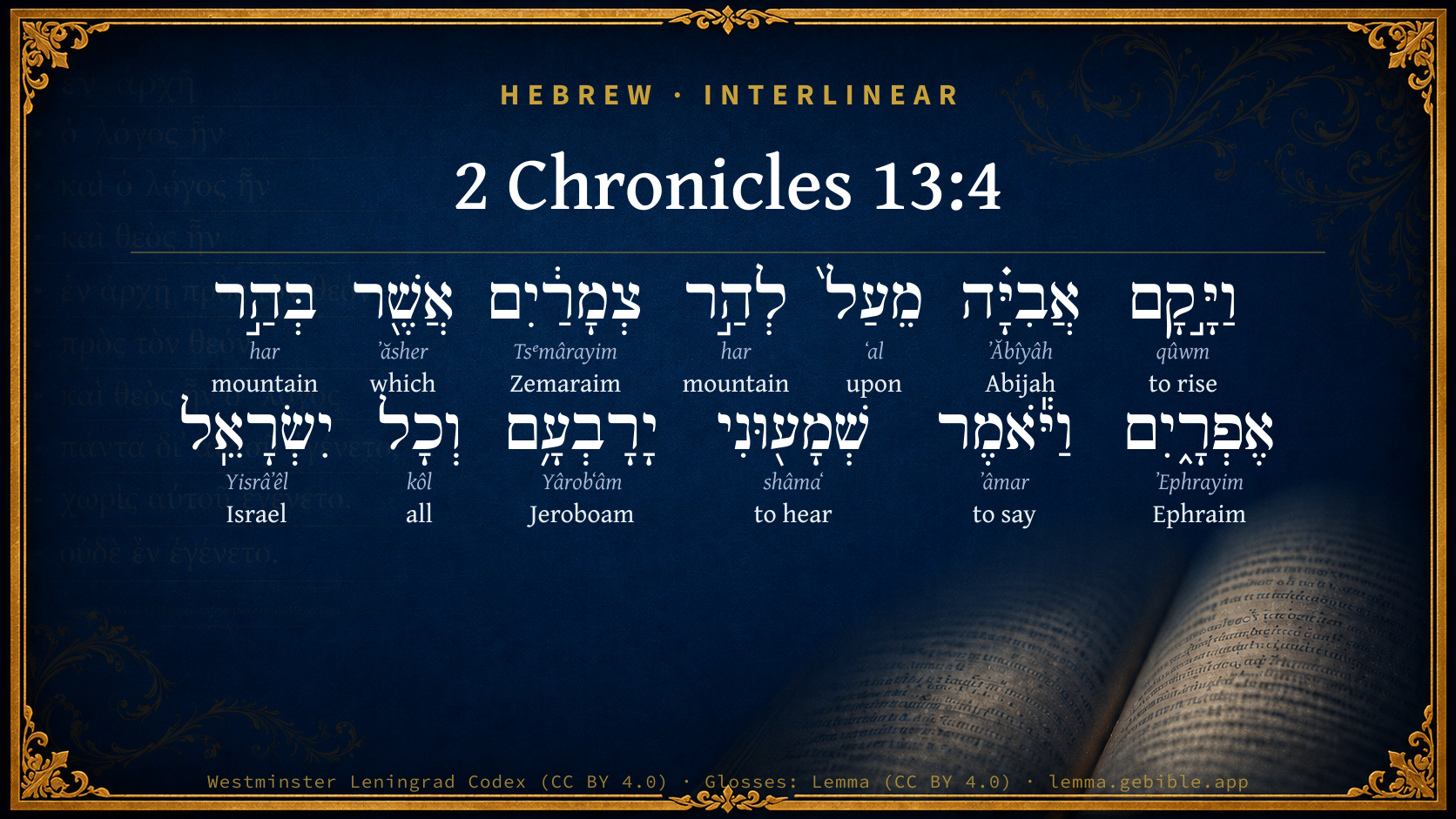
Hebrew (Westminster Leningrad Codex) 2 Chronicles 13:4 appears in the Hebrew Old Testament. The text above is from the Westminster Leningrad Codex. Each word links to its Strong’s number, a concise gloss, and parsing drawn from the Open Scriptures Hebrew Bible morphology. Click any word for its full Brown-Driver-Briggs (BDB) entry.
Download image
Cite this verse

2 Chronicles 13:4 (World English Bible). Public Domain. Lemma interlinear Bible study tool, https://lemma.gebible.app/v/2-chronicles/13/4.

Show BibTeX & RIS
BibTeX
RIS
English Translation
Abijah stood up on Mount Zemaraim, which is in the hill-country of Ephraim, and said, Hear me, Jeroboam and all Israel:
World English Bible · Public Domain
Download a study sheet

One document with this verse’s original text, its word-by-word gloss line, the meaning frame, cross-references with their text, attributed commentary, and full source and license credits — printable, and it pastes into notes with its structure intact.

This verse Autodidact and up

Study sheet (.html) Plain text (.txt)

A passage Seminary Student

Up to 50 verses in one chapter. A passage sheet keeps up to 6 commentary sources and 12 cross-references per verse, in the order this page ranks them, and says so on the sheet whenever that leaves anything out. Ask for a single verse and you get the Autodidact verse sheet above.

Everything on this page stays free to read, with no account — the sheet is a download of what is already on screen, not access to it.

Want to remove ads? Support Godless Engineer
Compare translations 3

The same verse in 3 English versions, stacked beneath the original-language interlinear above. Click any original word for its lexicon entry.

Each is an independent rendering of the whole verse — the interlinear is not word-aligned to these translations.

Highlighted words mark where these versions differ — a whole-verse word diff, not a word-by-word alignment.

  • World English Bible Public Domain
    Abijah stood up on Mount Zemaraim, which is in the hill-country of Ephraim, and said, Hear me, Jeroboam and all Israel:
  • King James Version Public Domain
    And Abijah stood up upon mount Zemaraim, which is in mount Ephraim, and said, Hear me, thou Jeroboam, and all Israel;
  • unfoldingWord Literal Text CC BY-SA 4.0
    And Abijah rose on Mount Zemaraim, which is in the hills of Ephraim, and he said, “Hear me, Jeroboam and all Israel!

unfoldingWord Literal Text — © unfoldingWord, licensed CC BY-SA 4.0. Word-aligned USFM3 via Door43 (git.door43.org/unfoldingWord/en_ult).

Versions to compare (up to 4)

3 of 4 selected

Show all 18 translations

Every available English version of this verse, each an independent rendering of the whole verse.

  • World English Bible Public Domain
    Abijah stood up on Mount Zemaraim, which is in the hill-country of Ephraim, and said, Hear me, Jeroboam and all Israel:
  • Berean Standard Bible Public Domain
    Then Abijah stood on Mount Zemaraim in the hill country of Ephraim and said, “Hear me, O Jeroboam and all Israel!
  • Majority Standard Bible Public Domain
    Then Abijah stood on Mount Zemaraim in the hill country of Ephraim and said, “Hear me, O Jeroboam and all Israel!
  • King James Version Public Domain
    And Abijah stood up upon mount Zemaraim, which is in mount Ephraim, and said, Hear me, thou Jeroboam, and all Israel;
  • American Standard Version (1901) Public Domain
    And Abijah stood up upon mount Zemaraim, which is in the hill-country of Ephraim, and said, Hear me, O Jeroboam and all Israel:
  • Revised Version (1885) Public Domain
    And Abijah stood up upon mount Zemaraim, which is in the hill country of Ephraim, and said, Hear me, O Jeroboam and all Israel;
  • Geneva Bible (1599) Public Domain
    And Abiiah stood vp vpon mount Zemeraim, which is in mount Ephraim, and sayde, O Ieroboam, and all Israel, heare you me,
  • Douay-Rheims (1899) Public Domain
    And Abia stood upon mount Semeron, which was in Ephraim, and said: Hear me, O Jeroboam, and all Israel:
  • Young's Literal Translation Public Domain
    And Abijah riseth up on the hill of Zemaraim that `is' in the hill-country of Ephraim, and saith, `Hear me, Jeroboam and all Israel!
  • Literal Standard Version CC BY-SA 4.0
    And Abijah rises up on the hill of Zemaraim that [is] in the hill-country of Ephraim, and says, “Hear me, Jeroboam and all Israel!
  • Unlocked Literal Bible CC BY-SA 4.0
    Abijah stood on Mount Zemaraim, which is in the hill country of Ephraim, and said, “Listen to me, Jeroboam and all Israel!
  • unfoldingWord Literal Text CC BY-SA 4.0
    And Abijah rose on Mount Zemaraim, which is in the hills of Ephraim, and he said, “Hear me, Jeroboam and all Israel!
  • Darby Bible Public Domain
    And Abijah stood up on the top of mount Zemaraim, which is in mount Ephraim, and said, Hear me, Jeroboam, and all Israel!
  • World Messianic Bible Public Domain
    Abijah stood up on Mount Zemaraim, which is in the hill country of Ephraim, and said, “Hear me, Jeroboam and all Israel:
  • Webster's Bible Public Domain
    And Abijah stood upon mount Zemaraim, which is in mount Ephraim, and said, Hear me, thou Jeroboam, and all Israel;
  • Free Bible Version CC BY-SA 4.0
    Abijah stood on Mount Zemaraim, in the hill country of Ephraim, and said, “Listen to me, Jeroboam and all of Israel!
  • Bible in Basic English Public Domain
    And Abijah took up his position on Mount Zemaraim, in the hill-country of Ephraim, and said, Give ear to me, O Jeroboam and all Israel:
  • JPS Tanakh (1917) Public Domain
    And Abijah stood up upon mount Zemaraim, which is in the hill-country of Ephraim, and said: 'Hear me, O Jeroboam and all Israel;

Literal Standard Version (2020), Covenant Press — licensed CC BY-SA 4.0. Text via the HelloAO Bible API (eBible.org). Unlocked Literal Bible (unfoldingWord) — licensed CC BY-SA 4.0. Text via the HelloAO Bible API (eBible.org). unfoldingWord Literal Text — © unfoldingWord, licensed CC BY-SA 4.0. Word-aligned USFM3 via Door43 (git.door43.org/unfoldingWord/en_ult). Free Bible Version, Dr. Jonathan Gallagher — licensed CC BY-SA 4.0. Text via the HelloAO Bible API (eBible.org).

Word by word

More ways to search: Search by grammar → Find every occurrence → Compare this word →

Practice this passage: Drill this verse → Learn its vocabulary →

צְמָרַ֔יִם
Tsᵉmârayim
H6787
“Zemaraim”
Noun, Proper
Part of Speech
Noun
Type
Proper
Full BDB Definition

Origin: dual of H6785

TWOT: None

Zemaraim = "double fleece of wool" - a city in northern Benjamin near Bethel - a hill in Ephraim
  1. וַיָּ֣קָם qûwm H6965 “and · to rise” Conjunction + Verb, Qal, Sequential Imperfect, 3rd Person, Masculine, Singular
  2. אֲבִיָּ֗ה ʼĂbîyâh H29 “Abijah” Noun, Proper
  3. מֵעַל֙ ʻal H5921 “from · upon” Preposition + Preposition
  4. לְהַ֣ר har H2022 “to/for · mountain of” Preposition + Noun, Common, Masculine, Singular, Construct
  5. אֲשֶׁ֖ר ʼăsher H834 “which” Particle, Relative
  6. בְּהַ֣ר har H2022 “in/at · mountain of” Preposition + Noun, Common, Masculine, Singular, Construct
  7. אֶפְרָ֑יִם ʼEphrayim H669 “Ephraim” Noun, Proper
  8. וַיֹּ֕אמֶר ʼâmar H559 “and · to say” Conjunction + Verb, Qal, Sequential Imperfect, 3rd Person, Masculine, Singular
  9. שְׁמָע֖וּנִי shâmaʻ H8085 “hear · me” Verb, Qal, Imperative, 2nd Person, Masculine, Plural + Suffix, Personal, 1st Person, Common, Singular
  10. יָרָבְעָ֥ם Yârobʻâm H3379 “Jeroboam” Noun, Proper
  11. וְכָל kôl H3605 “and · all of” Conjunction + Noun, Common, Masculine, Singular, Construct
  12. יִשְׂרָאֵֽל Yisrâʼêl H3478 “Israel” Noun, Proper

About this verse

These counts appear in no published source. They are computed here, from the morphology-tagged text and Lemma’s own curated glosses. What Lemma adds →

13
words
12
distinct lemmas
Historical
section

Notable vocabulary

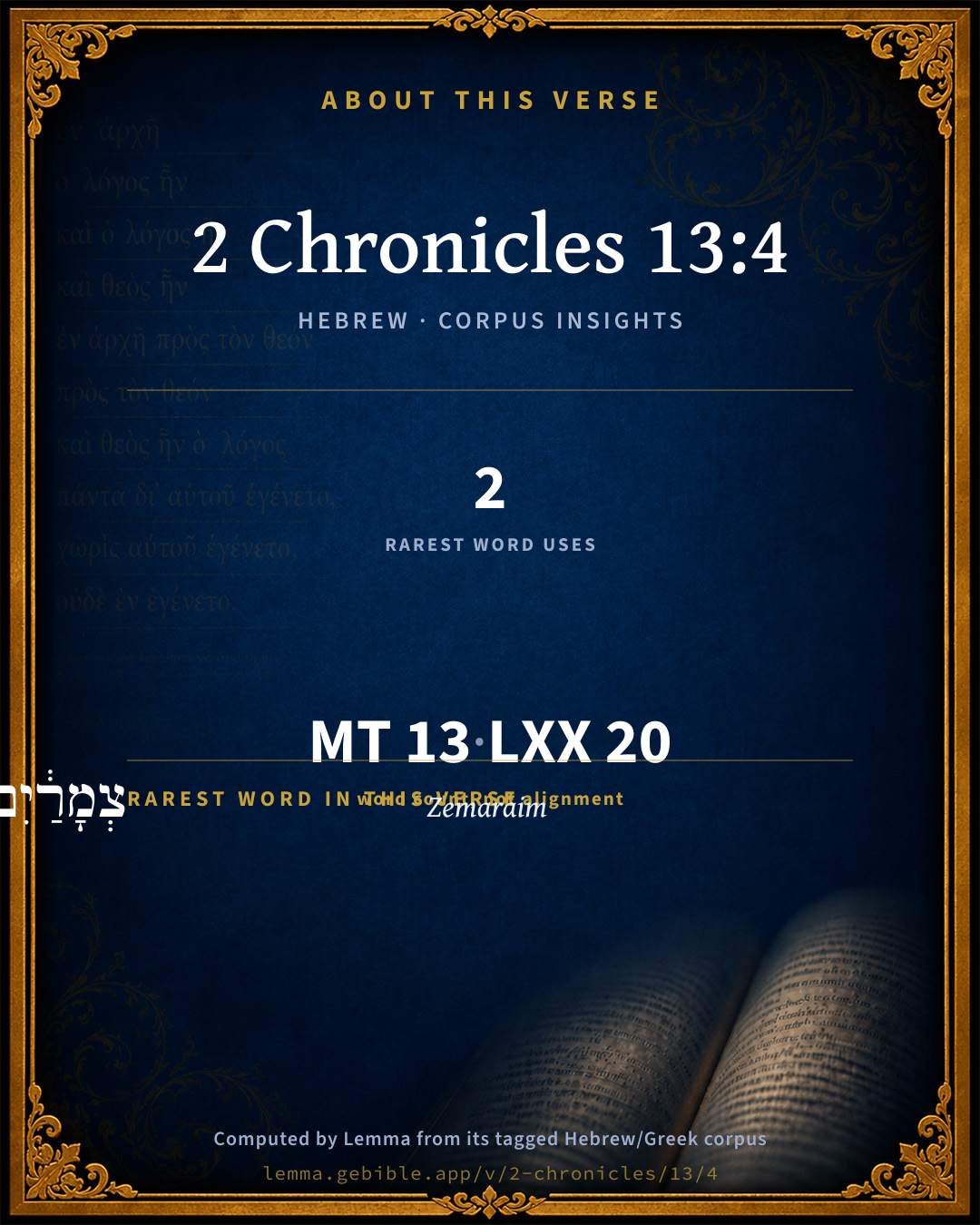
The rarest word here is צְמָרַ֔יִם Zemaraim H6787 — appearing just 2 times in the whole Hebrew Bible.

Shared distinctive vocabulary

צְמָרַ֔יִם Zemaraim H6787 occurs in 2 verses of the Hebrew Bible. Also found in:

Grammatical profile

  • 3 verbs
  • 8 nouns
  • 1 preposition
  • 1 particle

Verb forms

  • וַיָּ֣קָם Qal · Sequential Imperfect
  • וַיֹּ֕אמֶר Qal · Sequential Imperfect
  • שְׁמָע֖וּנִי Qal · Imperative

Repetition

A word recurs within this verse — often emphatic in Hebrew:

  • לְהַ֣ר mountain H2022 ×2

Hebrew & Septuagint length

In English translation the verse runs 21 words from the Hebrew and 21 from the Septuagint (LXX English) — the same length.

A rough comparison of the two English renderings, which tokenize alike — not a word-level alignment.

Word counts can differ between the Hebrew and the Greek without any difference in meaning — e.g. the Hebrew direct-object marker אֵת has no separate Greek word, and Greek often adds the article ὁ.

In the original languages it is 13 Hebrew tokens and 20 Greek tokens — but the two are counted differently (Hebrew bundles its prefixes and suffixes into one token; the Greek is in lemma form), so that isn’t a like-for-like length.

Cross-references

4

Topical passages linked to 2 Chronicles 13:4 in the Treasury of Scripture Knowledge — connected by theme and wording, ordered by reader-vote popularity; previews shown in the World English Bible.

  • Joshua 18:22 and Beth Arabah, and Zemaraim, and Bethel,
  • Judges 9:7 When they told it to Jotham, he went and stood on the top of Mount Gerizim, and lifted up his voice, and cried, and said to them, Listen to me, you men of Shechem, that God may listen to you.
  • 2 Chronicles 15:2 and he went out to meet Asa, and said to him, Hear you me, Asa, and all Judah and Benjamin: Yahweh is with you, while you are with him; and if you seek him, he will be found of you; but if you forsake him, he will forsake you.
  • Genesis 10:18 the Arvadite, the Zemarite, and the Hamathite. Afterward the families of the Canaanites were spread abroad.

Cross-references courtesy of OpenBible.info (CC BY 4.0).

Hebrew and Greek witnesses Masoretic Hebrew ↔ Greek Septuagint

The same verse in the two great witnesses to the Old Testament, shown verse-for-verse.

These are two independent witnesses, not word-aligned to each other, and the Septuagint is shown in lemma (dictionary) form.

Hebrew 2 Chronicles 13:4 Masoretic · Westminster Leningrad Codex

וַיָּ֣קָם אֲבִיָּ֗ה מֵעַל֙ לְהַ֣ר צְמָרַ֔יִם אֲשֶׁ֖ר בְּהַ֣ר אֶפְרָ֑יִם וַיֹּ֕אמֶר שְׁמָע֖וּנִי יָרָבְעָ֥ם וְכָל יִשְׂרָאֵֽל

Abijah stood up on Mount Zemaraim, which is in the hill-country of Ephraim, and said, Hear me, Jeroboam and all Israel:

World English Bible · Public Domain

Greek LXX 2 Chronicles 13:4 Septuagint · lemma form

καί ἀναἵστημι αβια ἀπό ὁ ὄρος σομορων ὅς εἰμί ἐν ὁ ὄρος ἐφράιμ καί εἶπον ἀκούω ιεροβοαμ καί πᾶς ἰσραήλ

And Abia rose up from the mount Somoron, which is in mount Ephraim, and said, Hear you⌃, Jeroboam, and all Israel:

LXX2012 (modern English Septuagint) · Public Domain

On this verse, The Pulpit Commentary discusses the Septuagint’s reading. Read the note in Commentary ↓

Hebrew: Westminster Leningrad Codex (CC BY 4.0). Greek: Septuagint (public domain); English from LXX2012 (modern English Septuagint) (Public Domain). How the Septuagint differs from the Hebrew →

Commentary

Notes on 2 Chronicles 13:4 from classic Christian and Jewish commentators (each source and its license shown beneath its notes). The classic Christian expositions comment on the surrounding passage and are grouped to its opening verse, so a note may address several verses; the Jewish commentaries on the Tanakh (Rashi and others) are per-verse, so they appear only where the commentator wrote on this verse.

Lemma curates 59 commentaries, every one of them public domain or Creative Commons licensed, each selected and text-cleaned for this edition rather than reprinted as found. About our sources →

Trapp's Complete Commentary

John Trapp

2Ch 13:4 And Abijah stood up upon mount Zemaraim, which [is] in mount Ephraim, and said, Hear me, thou Jeroboam, and all Israel;

Ver. 4. And Abijah stood upon mount Zemaraim.] As Jotham likewise had done upon mount Gerizim. {Jdg 9:7} It is probable that Abijah had, by his heralds or messengers, desired a parley: else he could not have delivered himself without danger.

John Trapp, A Commentary or Exposition upon All the Books of the Old and New Testament (1647–1656) — public domain. Text from a community e-Sword module.

The Biblical Illustrator

Joseph S. Exell

2Ch_13:4-12

And Abijah stood up upon mount Zemaraim.

A great speech

its claims concerning Judah. God recognised--

1. In the gift of the kingdom.

2. In the worship and services of the temple.

3. In the warfare of life.

II. In its accusations against Israel.

III. Its passionate appeal to the people.

1. Religion is appealed to.

2. History is appealed to.

3. Humanity is appealed to. (J. Wolfendale.)

Abijahs speech

Abijahs speech is unique. There have been other instances where commanders have tried to make oratory take the place of arms. Sennacheribs envoys. When Octavian was at war with his fellow-triumvir Lepidus he made a daring attempt to run over his enemys army. Riding openly into the hostile camp, he appealed to the soldiers by motives as lofty as those urged by Abijah, and called upon them to save their country from civil war by deserting Lepidus. At the moment his appeal failed, and he only escaped with a wound in his breast; but after a while his enemys soldiers came over to him in detachments, and eventually Lepidus was compelled to surrender to his rival. Another instance of a successful appeal to a hostile force is found in the history of the first Napoleon, when he was marching on Paris after his return from Elba. Near Grenoble he was met by a body of royal troops. He at once advanced to the front, and, exposing his breast, exclaimed to the opposing ranks, Here is your emperor; if any one would kill me let him fire. The detachment, which had been sent to arrest his progress, at once deserted to their old commander. (W. H. Bennett, M.A.)

The lessons of Abijahs speech

These are two.

I. The importance of an official and duly accredited ministry. Every Church has in practice some official ministry, even those Churches that profess to owe their separate existence to the necessity of protesting against an official ministry. Men whose chief occupation is to denounce priestcraft may themselves be saturated with the sacerdotal spirit.

II. The importance of a suitable and authoritative ritual. Every Church, too, has its ritual. The silence of a Friends meeting is as much a rite as the most elaborate genuflexion before a highly ornamented altar. To regard either the absence or presence of rites as essential is equally ritualistic. The man who leaves his wonted place of worship because Amen is sung at the end of a hymn is as bigoted a ritualist as his brother who dare not pass an altar without crossing himself. (W. H. Bennett, M. A.)

The Biblical Illustrator, edited by Joseph S. Exell (c. 1880s–1900s) — public domain. Text from a community e-Sword module.

Joseph Benson's Commentary

2Ch 13:4. Abijah stood upon mount Zemaraim — Some commodious place whence his words might be heard by Jeroboam, and some of his army, who possibly were pitched in the valley. Or, the two armies being pitched near each other, Abijah desired a parley before they fought, to see if they could accommodate matters without shedding blood. Whereupon Jeroboam and some of his commanders and soldiers probably drew near to him, and stood below at the bottom of the hill, from whence they could hear him. And this, it is likely, Jeroboam was the more willing to do, that in the mean time he might cause an ambushment to come behind Abijah and his army, as he did, (2Ch 13:13,) while he was quietly standing before them, and seemed to hearken to any terms of accommodation which were offered.

Joseph Benson's Commentary on the Old and New Testaments (1811–1818) — public domain. Text from a community e-Sword module.

Tyndale Open Study Notes

Tyndale Open Resources

13:4 Mount Zemaraim: The town of that name was on the northern border of Benjamin (see Josh 18:22), about five miles northeast of Bethel. Benjamin was a buffer and a battleground between the northern and southern kingdoms.

Tyndale Open Study Notes — © Tyndale Open Resources, licensed CC BY-SA 4.0. Text via the HelloAO Bible API.

Geneva Bible (1599)

Geneva Bible translators

Which was one of the tops of mount Ephraim.

Geneva Bible (1599) marginal notes — public domain. Text via Bolls.life.

Jamieson, Fausset & Brown

Robert Jamieson, A. R. Fausset & David Brown

Abijah stood up upon Mount Zemaraim--He had entered the enemy's territory and was encamped on an eminence near Beth-el (Jos 18:22). Jeroboam's army lay at the foot of the hill, and as a pitched battle was expected, Abijah, according to the singular usage of ancient times, harangued the enemy. The speakers in such circumstances, while always extolling their own merits, poured out torrents of invective and virulent abuse upon the adversary. So did Abijah. He dwelt on the divine right of the house of David to the throne; and sinking all reference to the heaven-condemned offenses of Solomon and the divine appointment of Jeroboam, as well as the divine sanction of the separation, he upbraided Jeroboam as a usurper, and his subjects as rebels, who took advantage of the youth and inexperience of Rehoboam. Then contrasting the religious state of the two kingdoms, he drew a black picture of the impious innovations and gross idolatry introduced by Jeroboam, with his expulsion and impoverishment (Ch2 11:14) of the Levites. He dwelt with reasonable pride on the pure and regular observance of the ancient institutions of Moses in his own dominion [Ch2 13:11] and concluded with this emphatic appeal: "O children of Israel, fight ye not against Jehovah, the God of your fathers, for ye shall not prosper."

Jamieson, Fausset & Brown — Commentary Critical and Explanatory on the Whole Bible (1871) — public domain (CC PDM 1.0). Text via the HelloAO Bible API.

Adam Clarke's Commentary

Verse 4. Stood up upon Mount Zemaraim] "Which was a mount of the tribe of the house of Ephraim."-Targum. Jarchi thinks that Abijah went to the confines of the tribe of Ephraim to attack Jeroboam. It could not be Shomeron, the mount on which Samaria was built in the days of Omri king of Israel, 1Kg 16:24.

Adam Clarke's Commentary on the Bible (1810–1826) — public domain. Text from a community e-Sword/MySword module.

Ellicott's Commentary for English Readers

(4) And Abijah stood up upon mount Zemaraim.—While the two hosts were facing each other, king Abijah addressed his foes from mount Zemaraim. as Jotham addressed the Shechemites from the top of Gerizim in the days of the judges (Jdg_9:7).

Upon.—Literally, from upon to mount Zemaraim; a mark of the chronicler’s hand.

Mount Zemaraim is otherwise unknown A city so called is mentioned (Jos_18:22) as near Bethel, and probably lay a little to the south of it, on the northern frontier of Judah, perhaps upon this mountain.

Mount Ephraim.—The hill country of Ephraim.

A Bible Commentary for English Readers, edited by Charles John Ellicott (1878–1897) — public domain. Text from a community e-Sword module.

The Cambridge Bible for Schools and Colleges

gen. ed. J. J. S. Perowne

4. Abijah stood up] it was natural that Abijah should attempt a conference before beginning civil war, both because his was the weaker side numerically and because he had a telling appeal to make to the revolted tribes (2Ch_13:8; 2Ch_13:12). It was equally natural that Jeroboam should break off the conference after using it to cover his stratagem (2Ch_13:13).

Zemaraim] A Zemaraim is mentioned in Jos_18:22 as one of the cities of Benjamin, whereas here Mount Zemaraim is assigned to Ephraim. The natural inference is that the battle took place on the border of the two kingdoms.

The Cambridge Bible for Schools and Colleges (gen. ed. J. J. S. Perowne; Cambridge University Press, 1878–1918) — public domain. Text from a community e-Sword module.

John Gill's Exposition

Ought you not to know,.... They did know what he afterwards says, but he would have them consider and acknowledge it:

that the Lord God of Israel gave the kingdom over Israel to David for ever; to him and his seed, particularly to the Messiah, that should spring from him; but whether Abijah had this in view is a question, see Sa2 7:13.

even to him and to his sons by a covenant of salt? that is, a perpetual one, which was inviolable, and never to be made void; called so, because salt preserves from corruption and putrefaction, and because made use of in sacrifices offered when covenants were made; the Targum is,"as salt waters, which never lose their saltness.''

John Gill's Exposition of the Whole Bible (1746–1763) — public domain (CC PDM 1.0). Text via the HelloAO Bible API.

Haydock's Catholic Bible Commentary

Semeron, on which Samaria was afterwards built. Hebrew reads, "Mount Tsemaraim." There was a city of this name in Benjamin. (Calmet) --- But this was a mount. Hebrew, "in Mount Ephraim." (Haydock)

George Leo Haydock (1774–1849), Haydock's Catholic Family Bible and Commentary, 1859 edition — public domain. Excludes Psalms (Douay-Rheims chapter numbering differs from Protestant) and Deuterocanonical books (Catholic canon only).

Matthew Poole's English Annotations

Upon Mount Zemaraim; some commodious place whence his voice might be heard by Jeroboam, and some of his host, who possibly were pitched in the valley. Or the two armies being pitched near to one another, Abijah might desire a parley, before they fight; whereupon Jeroboam, and some of his commanders and soldiers, might draw near to him, and stand below him at the bottom of the hill, where they might hear his speech; which Jeroboam was the more willing to do, that in the mean time he might cause an ambushment to come behind Abijah and his army, as he did, 2Ch 13:13, whilst he was quietly standing before them, and seemed to hearken to any terms of accommodation which might be offered.

Matthew Poole's English Annotations on the Holy Bible (1683–1685) — public domain. Text from a community e-Sword/MySword module.

Whedon's Commentary on the Bible

Daniel D. Whedon

4. Stood up upon mount Zemaraim — A general standing upon an eminence, could, like Jotham on Mount Gerizim, speak so as to be heard by a vast audience below. See note on Jdg_9:7. The locality of Mount Zemaraim is uncertain. Some have thought to connect it with the Benjamite town of the same name mentioned in Jos_18:22. But that was in the Jordan valley, this in Mount Ephraim. It was probably an eminence near the border of the two kingdoms, perhaps not far from Beth-el, near which the great battle was fought.

Hear me, thou Jeroboam — Abijah vainly thinks to make his enemies see the sin and folly of their separating from the kingdom of David. His speech was one sided, for he failed to observe that the permanency and integrity of David’s kingdom were conditioned upon obedience.

Daniel D. Whedon (gen. ed.), Commentary on the Old and New Testaments (1874–1909) — public domain. Text from a community e-Sword module.

The Pulpit Commentary

Mount Zemaraim. This mount is not mentioned elsewhere. Presumably it was a mountain or hill above the place called Zemaraim, mentioned in Jos_18:22 as in Benjamin"s allotment, and mentionedbetween the places called Beth ha-Arabah (i.e. the Jordan valley) and Bethel. Accordingly, it may be that itself lay between these two, or near enough to them one or both. This will quite suit our connection as placing the hill near the borders of Benjamin and Ephraim. It is said to be in Mount Ephraim; i.e. in the range of Mount Ephraim, which was one of considerable length, running through the midst of what was afterwards called Samaria, from the Plain of Esdraelon to Judah. Zemaraim may be so named from the Zemarite tribe, who were Hamites, and related to the Hittites and Amorites (Gen_10:18; 1Ch_1:16) descendants of Canaan; there are some faint traces of their having wandered from their northern settlements into mid and south Palestine. The Septuagint render Zemaraim by the same Greek as Samaria, Somorwn.

The Pulpit Commentary (1880–1919), ed. H.D.M. Spence-Jones & Joseph S. Exell — public domain. Text from a community e-Sword module.

unfoldingWord translationNotes

Door43 World Missions Community

Mount Zemaraim

(See: How to Translate Names)

Do you not know ... by a formal covenant?

Abijah asks this rhetorical question to emphasize the positive answer that it anticipates. The question can be translated as a statement. AT: "You know very well ... by a formal covenant." (See: Rhetorical Question)

translationWords

Ephraim

kingdom of Israel

Yahweh

God

David

eternity

covenant

unfoldingWord translationNotes — © Distant Shores Media and the Door43 World Missions Community, licensed CC BY-SA 4.0. Source: git.door43.org/Door43/en_tn.

Rashi

Rabbi Shlomo Yitzchaki (Rashi)

And Abijah arose For Abijah went to war against Jeroboam in Jeroboam’s territory on Mount Ephraim.

Rashi on the Tanakh — English translations: “The Judaica Press complete Tanach with Rashi, translated by A. J. Rosenberg” (CC BY 4.0); “Pentateuch with Rashi's commentary by M. Rosenbaum and A.M. Silbermann, 1929-1934” (public domain); “The Metsudah Tanach series, Lakewood, N.J” (CC BY 4.0); and “The Book of Joshua, Metsudah Publications, 1997” (CC BY 4.0). Text via Sefaria.

Lesson kit

Teaching starters — assembled from the data on this page, not authored interpretation. Every prompt links to the verse data it draws on. Edit before teaching.

2 Chronicles, in the Historical, opens this verse with 13 words (12 distinct Hebrew lemmas). Its most distinctive word is Tsᵉmârayim (“Zemaraim”). A historical commentator’s framing appears above. Read the whole chapter for the surrounding context.

Discussion questions

  1. The word Tsᵉmârayim carries the sense “Zemaraim.” How does it shape the verse?
  2. Joshua 18:22 shares the word «Zemaraim» with this verse. How do the two illuminate each other?
  3. “mountain” occurs 2× in this one verse. What is the effect of the repetition?
  4. These translations render this verse differently; the difference is in the English rendering, not the original. What questions does that raise?
  5. The verb «וַיָּ֣קָם» is Qal Sequential Imperfect. How does its form color the action?
  6. Reading how Trapp's Complete Commentary and The Biblical Illustrator read this verse, where do the two commentators agree and where do they part?

Things to notice

Reading settings

Reading text

Shown beneath each verse's original-language words.

Old Testament
Old Testament edition

Read the OT as the Masoretic Hebrew (MT) or the Greek Septuagint (LXX).

English shown for the Greek Septuagint (in the Hebrew ↔ Greek comparison).

Comparing translations? Open the Compare panel on any verse page to stack up to four side by side.