
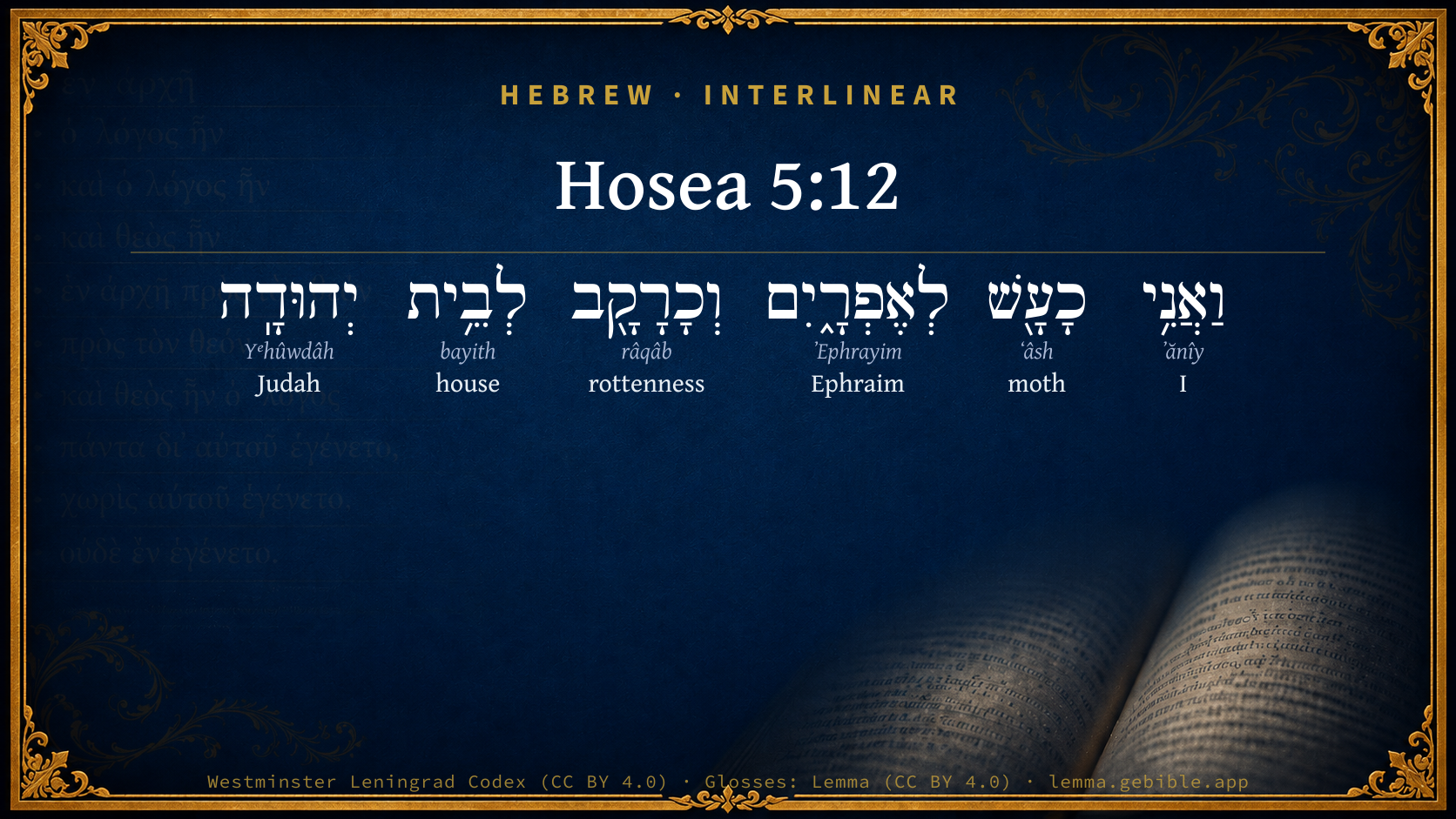
Hosea 5:12

Hebrew (Westminster Leningrad Codex) Hosea 5:12 appears in the Hebrew Old Testament. The text above is from the Westminster Leningrad Codex. Each word links to its Strong’s number, a concise gloss, and parsing drawn from the Open Scriptures Hebrew Bible morphology. Click any word for its full Brown-Driver-Briggs (BDB) entry.
Download image
Cite this verse

Hosea 5:12 (World English Bible). Public Domain. Lemma interlinear Bible study tool, https://lemma.gebible.app/v/hosea/5/12.

Show BibTeX & RIS
BibTeX
RIS
English Translation
Therefore I am to Ephraim like a moth, And to the house of Judah like rottenness.
World English Bible · Public Domain
Download a study sheet

One document with this verse’s original text, its word-by-word gloss line, the meaning frame, cross-references with their text, attributed commentary, and full source and license credits — printable, and it pastes into notes with its structure intact.

This verse Autodidact and up

Study sheet (.html) Plain text (.txt)

A passage Seminary Student

Up to 50 verses in one chapter. A passage sheet keeps up to 6 commentary sources and 12 cross-references per verse, in the order this page ranks them, and says so on the sheet whenever that leaves anything out. Ask for a single verse and you get the Autodidact verse sheet above.

Everything on this page stays free to read, with no account — the sheet is a download of what is already on screen, not access to it.

Want to remove ads? Support Godless Engineer
Compare translations 3

The same verse in 3 English versions, stacked beneath the original-language interlinear above. Click any original word for its lexicon entry.

Each is an independent rendering of the whole verse — the interlinear is not word-aligned to these translations.

Highlighted words mark where these versions differ — a whole-verse word diff, not a word-by-word alignment.

  • World English Bible Public Domain
    Therefore I am to Ephraim like a moth, And to the house of Judah like rottenness.
  • King James Version Public Domain
    Therefore will I be unto Ephraim as a moth, and to the house of Judah as rottenness.
  • unfoldingWord Literal Text CC BY-SA 4.0
    So I like a moth to Ephraim, and like rot to the house of Judah.

unfoldingWord Literal Text — © unfoldingWord, licensed CC BY-SA 4.0. Word-aligned USFM3 via Door43 (git.door43.org/unfoldingWord/en_ult).

Versions to compare (up to 4)

3 of 4 selected

Show all 18 translations

Every available English version of this verse, each an independent rendering of the whole verse.

  • World English Bible Public Domain
    Therefore I am to Ephraim like a moth, And to the house of Judah like rottenness.
  • Berean Standard Bible Public Domain
    So I am like a moth to Ephraim, and like decay to the house of Judah.
  • Majority Standard Bible Public Domain
    So I am like a moth to Ephraim, and like decay to the house of Judah.
  • King James Version Public Domain
    Therefore will I be unto Ephraim as a moth, and to the house of Judah as rottenness.
  • American Standard Version (1901) Public Domain
    Therefore am I unto Ephraim as a moth, and to the house of Judah as rottenness.
  • Revised Version (1885) Public Domain
    Therefore am I unto Ephraim as a moth, and to the house of Judah as rottenness.
  • Geneva Bible (1599) Public Domain
    Therefore wil I be vnto Ephraim as a moth, and to the house of Iudah as a rottennesse.
  • Douay-Rheims (1899) Public Domain
    And I will be like a moth to Ephraim: and like rottenness to the house of Juda.
  • Young's Literal Translation Public Domain
    And I `am' as a moth to Ephraim, And as a rotten thing to the house of Judah.
  • Literal Standard Version CC BY-SA 4.0
    And I [am] as a moth to Ephraim, || And as a rotten thing to the house of Judah.
  • Unlocked Literal Bible CC BY-SA 4.0
    So I will be like a moth to Ephraim, and like rot to the house of Judah.
  • unfoldingWord Literal Text CC BY-SA 4.0
    So I like a moth to Ephraim, and like rot to the house of Judah.
  • Darby Bible Public Domain
    And I will be unto Ephraim as a moth, and to the house of Judah as rottenness.
  • World Messianic Bible Public Domain
    Therefore I am to Ephraim like a moth, and to the house of Judah like rottenness.
  • Webster's Bible Public Domain
    Therefore will I be to Ephraim as a moth, and to the house of Judah as rottenness.
  • Free Bible Version CC BY-SA 4.0
    I am like a maggot to Ephraim, and like something rotten to the people of Judah.
  • Bible in Basic English Public Domain
    And so to Ephraim I am like a wasting insect, and a destruction to the children of Judah.
  • JPS Tanakh (1917) Public Domain
    Therefore am I unto Ephraim as a moth, and to the house of Judah as rottenness.

Literal Standard Version (2020), Covenant Press — licensed CC BY-SA 4.0. Text via the HelloAO Bible API (eBible.org). Unlocked Literal Bible (unfoldingWord) — licensed CC BY-SA 4.0. Text via the HelloAO Bible API (eBible.org). unfoldingWord Literal Text — © unfoldingWord, licensed CC BY-SA 4.0. Word-aligned USFM3 via Door43 (git.door43.org/unfoldingWord/en_ult). Free Bible Version, Dr. Jonathan Gallagher — licensed CC BY-SA 4.0. Text via the HelloAO Bible API (eBible.org).

Word by word

More ways to search: Search by grammar → Find every occurrence → Compare this word →

Practice this passage: Drill this verse → Learn its vocabulary →

About this verse

These counts appear in no published source. They are computed here, from the morphology-tagged text and Lemma’s own curated glosses. What Lemma adds →

6
words
6
distinct lemmas
Prophets
section

Notable vocabulary

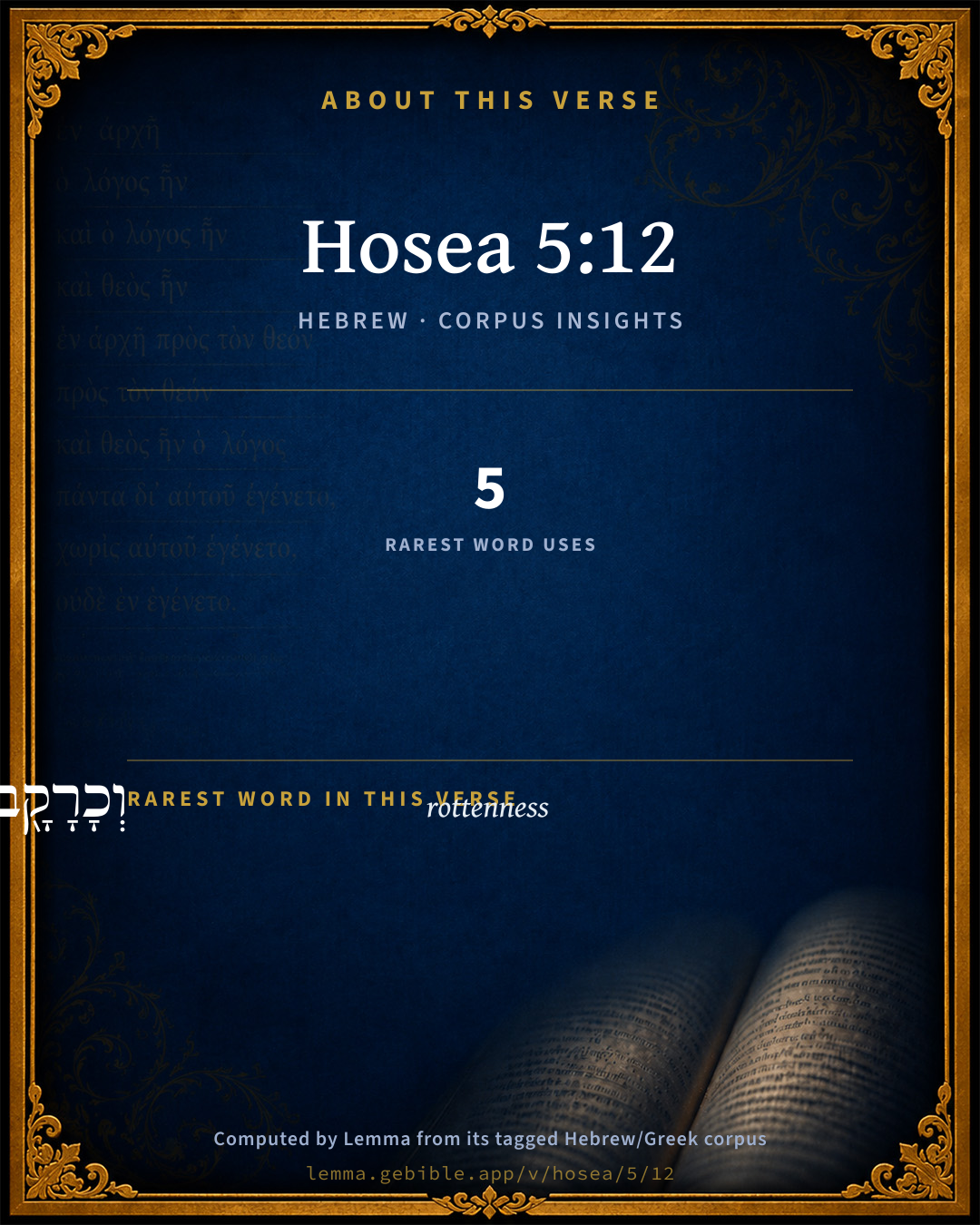
The rarest word here is וְכָרָקָ֖ב rottenness H7538 — appearing just 5 times in the whole Hebrew Bible.

Shared distinctive vocabulary

וְכָרָקָ֖ב rottenness H7538 occurs in 5 verses of the Hebrew Bible. Also found in:

Grammatical profile

  • 5 nouns
  • 1 pronoun

Hebrew & Septuagint length

In English translation the verse runs 16 words from the Hebrew and 17 from the Septuagint (LXX English) — closely comparable.

A rough comparison of the two English renderings, which tokenize alike — not a word-level alignment.

Word counts can differ between the Hebrew and the Greek without any difference in meaning — e.g. the Hebrew direct-object marker אֵת has no separate Greek word, and Greek often adds the article ὁ.

Cross-references

6

Topical passages linked to Hosea 5:12 in the Treasury of Scripture Knowledge — connected by theme and wording, ordered by reader-vote popularity; previews shown in the World English Bible.

  • Isaiah 51:8 For the moth shall eat them up like a garment, and the worm shall eat them like wool; but my righteousness shall be forever, and my salvation to all generations.
  • Job 13:28 Though I am decaying like a rotten thing, Like a garment that is moth-eaten.
  • Jonah 4:7 But God prepared a worm at dawn the next day, and it chewed on the vine, so that it withered.
  • Proverbs 12:4 A worthy woman is the crown of her husband, But a disgraceful wife is as rottenness in his bones.
  • Isaiah 50:9 Behold, the Lord Yahweh will help me; who is he who shall condemn me? Behold, all they shall wax old as a garment, the moth shall eat them up.
  • Mark 9:43–48 If your hand causes you to stumble, cut it off. It is better for you to enter into life maimed, rather than having your two hands to go into Gehenna, into the unquenchable fire,

Cross-references courtesy of OpenBible.info (CC BY 4.0).

Hebrew and Greek witnesses Masoretic Hebrew ↔ Greek Septuagint

The same verse in the two great witnesses to the Old Testament, shown verse-for-verse.

These are two independent witnesses, not word-aligned to each other, and the Septuagint is shown in lemma (dictionary) form.

Hebrew Hosea 5:12 Masoretic · Westminster Leningrad Codex

וַאֲנִ֥י כָעָ֖שׁ לְאֶפְרָ֑יִם וְכָרָקָ֖ב לְבֵ֥ית יְהוּדָֽה

Therefore I am to Ephraim like a moth, And to the house of Judah like rottenness.

World English Bible · Public Domain

Greek LXX Hosea 5:12 Septuagint · lemma form

καί ἐγώ ὡς ταραχή ὁ ἐφράιμ καί ὡς κέντρον ὁ οἶκος ιουδα

Therefore I will be as consternation to Ephraim, and as a goad to the house of Juda.

LXX2012 (modern English Septuagint) · Public Domain

Hebrew: Westminster Leningrad Codex (CC BY 4.0). Greek: Septuagint (public domain); English from LXX2012 (modern English Septuagint) (Public Domain). How the Septuagint differs from the Hebrew →

Targum (Aramaic paraphrase)

1

The Targum is the ancient Jewish Aramaic paraphrase of the Hebrew Scriptures — an interpretive translation, not the Hebrew text itself. Onkelos (literal) and Pseudo-Jonathan (expansive) render the Torah, and Jonathan the Prophets. Coverage is partial: where no permissively-licensed English translation exists for a verse, only the Aramaic is shown. This is verse-level text, not a word-by-word alignment to the Hebrew.

  1. Targum Jonathan Prophets (Joshua–Malachi)
    וּמֵימְרִי כְּעָשָׁא לִדְבֵית אֶפְרַיִם וּכְרַקָבָא לִדְבֵית יְהוּדָה:

    (no public-domain English translation for this verse)

    Targum Jonathan — Aramaic: “Mikraot Gedolot” (public domain). English: “Sefaria Community Translation” (CC0 1.0 (public-domain dedication)); “London "Chaldee Paraphrase," 1871” (public domain). Text via Sefaria.

Commentary

Notes on Hosea 5:12 from classic Christian and Jewish commentators (each source and its license shown beneath its notes). The classic Christian expositions comment on the surrounding passage and are grouped to its opening verse, so a note may address several verses; the Jewish commentaries on the Tanakh (Rashi and others) are per-verse, so they appear only where the commentator wrote on this verse.

Lemma curates 59 commentaries, every one of them public domain or Creative Commons licensed, each selected and text-cleaned for this edition rather than reprinted as found. About our sources →

Trapp's Complete Commentary

John Trapp

Hos 5:12 Therefore [will] I [be] unto Ephraim as a moth, and to the house of Judah as rottenness.

Ver. 12. Therefore will I be unto Ephraim as a moth] Their sin was the greater because they were so willing to it, and so easily drawn to idolatry, as most agreeable to their nature, and making much of their ease; which was Jeroboam’s main argument. It may very well be that he threatened punishment to those that disobeyed his commandment: but here they should have stood out, and have bid the worst; choosing affliction rather than sin; which because they did not, therefore they should perish by their own hand and counsels; they shall be moth-eaten, as a garment that breedeth the moth, and as a tree that breedeth the worm that wasteth it. Not but that God had a special hand in their punishment; and this not permissive only, but active too: "I will be unto Ephraim," &c. For is there evil in a city and he hath not done it? The changes and periods of kingdoms are of him, Psa 75:6-7, that men may know that the heavens do rule, Dan 4:26; so are the alterations in men’s bodies and estates, as Job setteth it forth, Job 4:19; Job 13:28; Job 27:18. Every one (say some chemists) hath his own balsam within him; his own bane it is sure he hath; his clay cottage is every day ready to drop on his head, 2Co 5:1. And for his estate, there are often times secret issues and drains of expense, at the which it runs out, as at a hole in the bottom of the bag, Hag 1:6. {See Trapp on "Hag 1:6"} Howbeit God’s holy hand is in all this; "I will be unto Ephraim as a moth," &c., that is, I will waste them sensim, sine sensu. Secretly, insensitively, slowly; but surely, and inevitably: this David after Job, acknowledgeth: Psa 39:11, "When thou with rebukes dost correct man for iniquity, thou makest his beauty to consume away like a moth," thou castest him into a corruptio totius substantive, as the physicians call the hectic: "Surely every man is vanity. Selah." Yea, he is "altogether vanity"; yea, and that in his best estate, when he is best underlaid, when settled on his best bottom, Hos 5:5; when he is gotten upon his mount with David, and thinks to die in his nest with Job; when he counts upon much good laid up in store for many years, as that rich fool, that reckoned without his host, as we say, Psa 30:7 Job 29:18 Luk 12:19. Tinea damnum facit, et sonitum non facit, saith Gregory. The moth maketh no noise, but doth a great deal of harm among clothes. The worm here, rendered rottenness, is minutissimus vermiculus, saith Luther here, a very small creature, but doth no small mischief, ( teredo), for it eats out the heart of the strongest wood, yea, of the strongest oaken planks at sea. See here what a poor creature is man, yea, a whole kingdom, whenas a moth and a little worm may consume them; when they may be crushed before the moth, as Job speaks, Job 4:19; he saith not before the lion, but before the moth. Learn also to take heed of sin, yea, of secret sins, 2Ki 17:9, lest we be secretly wasted, our graces cast into a consumption, our comfortables wiped away, our consciences wearied with secret buffets, as being smitten with the rod of God’s mouth, Isa 11:4; our estates melted as the fat of lambs before the fire, and our land insensibly wasted, and by degrees desolated; as Ephraim and Judah were, as the Greek empire was, and as it began to be here with us, in Queen Mary’s reign, which was never prosperous after she had abolished the gospel; for beside foreign losses, of Calais, extreme dearths raged, much harm was done by thunder from heaven, and by fire in the royal navy, and all things went to worse, till Queen Elizabeth came in, "a repairer of the breach, a restorer of paths to dwell in," Isa 53:12; according to that glorious epitaph, caused by King James to be inscribed upon her princely monument by him erected.

John Trapp, A Commentary or Exposition upon All the Books of the Old and New Testament (1647–1656) — public domain. Text from a community e-Sword module.

The Biblical Illustrator

Joseph S. Exell

Hos_5:12

Therefore will I be unto Ephraim as a moth.

The moth; or Gods quiet method of destroying

And I am like the moth to Ephraim, and like the worm to the house of Judah.--Keil and Delitzsch. The moth and worm are figures employed to represent destructive powers: the moth destroying clothes (Isa_50:9; Isa_51:8; Psa_39:12), the worm injuring both wood and flesh. The words indicate Gods quiet method of ruining. In two or three verses in this chapter He is spoken of as proceeding in His work of destruction as a lion. Here as a moth--working out ruin silently, slowly, and gradually.

I. He works decay thus sometimes in the bodies of men. Oftentimes men die violently and suddenly, but more frequently by some insidious hidden disease which, like a moth, works away quietly at the vitals, gradually poisoning the blood and undermining the constitution. The moth is often so small and secret in its workings that medical science can seldom find it out, and when it finds it out, though it may check it for a time, it cannot destroy it: the moth defies all medicine. At the heart of some of the strongest trees in the forest there are hosts of invisible insects noiselessly at work; the forester knows it not, the tree seems healthy; until one fine morning before a strong gust of wind it falls a victim to these silent workers. So with the strongest man amongst us.

II. He works decay thus sometimes in the enterprises of men. Often men find it impossible to succeed in their worldly avocations. Mercantile establishments that have been prosperous for generations have the moth in them. They have not been conducted by godly men and that in a right spirit; so God sent a moth, and the moth has been working away for years silently, secretly, and gradually, until all the vitality has been eaten up.

III. He works decay thus sometimes in the kingdoms of men. Effeminacy, luxury, ambition, greed, self-indulgence, servility, irreverence, these are moths, and decay sets in, and it falls not by the sword of the invader but by its own rottenness.

IV. He works decay thus sometimes in the churches of men. What destroyed the churches of Asia Minor? The moth of worldliness and religious error. Some of our modern churches are obviously slowly rotting away. A realising faith in the invisible; brotherly love; practical self-sacrifice; Christliness of spirit, are being eaten up by the moth of secularity, sectarianism, superstition, and religious pretence. Thus, too, individual souls lose their spiritual life and strength. God deliver us from those errors of heart that like a moth eat away the life! (Homilist.)

The moth

The mention of the moth in Scripture is, with a single exception, confined to the destruction caused in clothing by the larvae of the little clothes moth (Tineidae), of which very many species are found in Palestine. No other lepidopterous insect is alluded to in Scripture, and the class, including butterflies and moths, is not very numerously represented in the Holy Land, the dry climate of which, together with the scarcity of wood, is not particularly favourable to the development of this group. The number of recorded species in the Holy Land is about two hundred and eighty. (Canon Tristram.)

The Biblical Illustrator, edited by Joseph S. Exell (c. 1880s–1900s) — public domain. Text from a community e-Sword module.

The Preacher's Complete Homiletical Commentary

Joseph S. Exell (gen. ed.)

CRITICAL NOTES.—

Hos_5:12. Moth and rottenness] Destructive powers, one injuring cloths, the other wood and flesh; slowly but surely do they work (Job_13:28). The sinner has foes within and without; conscience gnaws like a worm, and Divine judgment falls like a plague.

HOMILETICS

DESTRUCTION SLOW AND SURE.—Hos_5:12

The ten tribes are compared to a garment eaten by the moth, and Judah is consumed by rottenness. The moth is injurious to clothing. The worm penetrates both wood and flesh. Both prefigure the inward and outward corruption of Israel; destruction slowly and surely progressing (Job_13:28).

I. Destruction small in its beginning. The moth is a small and mischievous creature. Touch it, and you kill it; permit it to live, and it makes havoc in the dwelling. Sins of youth may be despised and indulged, but they harden the heart and prepare for greater sins. Nations are not destroyed at once; families and churches are not always suddenly overcome. Some moral disease, like the moth, quietly gnaws away their beauty and vitality. Pride, intemperance, and vice prey upon their reputation and royalty. They are crushed with the moth.

II. Destruction slow in its progress. Little by little the hardest wood is pierced. Silently and slowly do rottenness and decay work their end. Yonder river rolling to the sea, rises from some small spot, and widens as it flows to join the mighty deep. The inhabitants of primeval forests are often startled by the fall of some giant tree. For centuries it was strong and grand in its foliage, but fell a victim to rottenness and decay. Insects came and gradually bored its sides and peeled its bark; the wind and air got access to its centre and heart. Now it lies a helpless trunk, to blend in common dust—“the place thereof knows it no more.” Family honour, mercantile prosperity, and national enterprises, may be upheld and flourish for a season. But secret sins and religious declensions, luxury and effeminacy, are, like the moth, slowly working out destruction. Rottenness entered the nations of antiquity, and their grandeur decayed like a flower. Superstition and priestly ambition, a sectarian and worldly spirit, will destroy spiritual life in our modern churches; lukewarmness and pride will hasten their ruin, and make them “desolate in the day of rebuke.”

III. Destruction sure in its end. Wherever the moth dwells destruction is costly and sure. The house of the moth is not a mansion of iron, a lasting habitation which never falls to ruin. The most precious stores are devoured. Rich perfumes and purple apparel are consumed and frittered away. “The moth,” says Dr Thomas, “is often so small and secret in its workings that medical science can seldom find it out, and when it finds it out, though it may check it for a time, it cannot destroy it: the moth defies all medicine.” So the judgments of God upon sin may be small in beginning, but increase in severity, and at length bring death and destruction. At first God tries gentle measures, mild chastisements, then loss and decay in bodily health, family prestige, and national glory; finally, after respite and space for repentance, calamities wear out and destroy the impenitent. “For the moth shall eat them up like a garment, and the worm shall eat them like wool.”

ILLUSTRATIONS TO CHAPTER 5

Hos_5:11-14. Vice is sometimes punished instantly and sometimes gradually. This seems to be the method of Divine procedure. We have slow and rapid consumption in the bodies of men. We have the gradual decay and the sudden overthrow of empires, the seed-time of evil and the harvest of judgment. The changes of circumstances are so various and frequent, so great and sudden, that the same person, the same people, afford an example of the greatest prosperity and the greatest misery. Henry the Fourth of France was despatched by a sacrilegious hand in his carriage, in the midst of popular applause and the triumphs of peace. Like Herod, the grandson of Herod the Great, he found but one step between adoration and oblivion. The ruin which God inflicts upon the impenitent and presumptuous sinners is often beyond precedent most sudden and most fearful. What folly, then, to trust in man, when God can easily destroy him!

The Preacher's Complete Homiletical Commentary (gen. ed. Joseph S. Exell; Funk & Wagnalls, c. 1892) — public domain (pre-1929). A full-Bible homiletical/sermon-outline anthology covering 65 of 66 books (2 John is absent from the source module). Text from a community e-Sword module.

Tyndale Open Study Notes

Tyndale Open Resources

5:12 as a moth . . . rotten wood: Sin can destroy the very fabric and foundation of a people while leaving them unaware that the destruction has taken place.

Tyndale Open Study Notes — © Tyndale Open Resources, licensed CC BY-SA 4.0. Text via the HelloAO Bible API.

Jamieson, Fausset & Brown

Robert Jamieson, A. R. Fausset & David Brown

as a moth--consuming a garment (Job 13:28; Psa 39:11; Isa 50:9).

Judah . . . rottenness--Ephraim, or the ten tribes, are as a garment eaten by the moth; Judah as the body itself consumed by rottenness (Pro 12:4). Perhaps alluding to the superiority of the latter in having the house of David, and the temple, the religious center of the nation [GROTIUS]. As in Hos 5:13-14, the violence of the calamity is prefigured by the "wound" which "a lion" inflicts, so here its long protracted duration, and the certainty and completeness of the destruction from small unforeseen beginnings, by the images of a slowly but surely consuming moth and rottenness.

Jamieson, Fausset & Brown — Commentary Critical and Explanatory on the Whole Bible (1871) — public domain (CC PDM 1.0). Text via the HelloAO Bible API.

Adam Clarke's Commentary

Verse 12. Unto Ephraim as a moth] I will consume them by little and little, as a moth frets a garment.

Adam Clarke's Commentary on the Bible (1810–1826) — public domain. Text from a community e-Sword/MySword module.

John Calvin's Commentaries

God now denounces punishment in common on the two kingdoms; but he speaks not as before, he says not that his fury would be like a deluge, to overwhelm and drown the people. What then? He compares himself to little worms which gnaw wood and consume cloths; or he compares himself to rottenness; for, as we have said, the second word is to be so taken, as רקב, rekob, is properly rottenness, and is derived from רקב, rekab, to rot;” it is then rottenness or putrescence. But as I have said, some would render it, “a grub;” and there is a probable reason for this, because he first mentioned moth; and these two, moth and grub , would be more suitable to each other, than moth and rottenness. However, the meaning of the Prophet is by no means obscure, and that is, that the Lord would by a slow corrosion consume both the people; that though he would not by one onset destroy them, yet they would pine away until they became wholly rotten. This is the meaning.

But we must observe why the Prophet used this metaphor. It was, that the Israelites and the Jews might understand, that though the Lord would in some measure withhold his hand from resting heavily upon them, and that though he would spare them, yet they would not be safe, because they would by little and little feel a slow decay, that would consume them. And the Lord meant in this way to turn the people to repentance; but he effected nothing: for such was their hardness, that they felt not this slow decay; as those who are stupid are not moved, except they feel a most grievous pain; they think that they are doing well, and they struggle against their own disease: many such we see. Hence the Prophet here reminds them, that though the Lord should not openly fulminate against the Israelites and the Jews, they yet in vain flattered themselves, because the Lord would be to them a moth and a worm; that is, that however gradually he might consume them, they would yet be greatly deceived, if they did not perceive that they had to do with him.

The chief instruction is, that God does not always punish men in the same way; for he deals with them differently, either to promote their salvation, or to render them in this way more inexcusable. Hence God sometimes pours forth his severity, and at another time he slowly chastises us. But whatever may be the way, we are reminded that we ought not to sleep, whenever the Lord awakens us; nor should we wait until he appears as a lion or a bear, until he devours us, until he rages against us in dreadful fury. We are then reminded that there is no reason why we should wait for this; but that when God consumes us by degrees, it ought instantly to occur to us, that though the moth and the worm are but very small insects, hardly seen by the eyes, yet a hard and firm tree is consumed by these little worms, or by its own cariousness; and that cloths are consumed with putridity, when once the moth enters into them; we see valuable furniture perishing. Since it is so, there is no reason for men to be secure when God shows any sign of his wrath, though he pours not forth his horrible vengeance, but is as a hidden putrefaction. We now perceive what Hosea means in this verse. It now follows —

John Calvin's Commentaries (1540-1563) — public domain. Text from the Calvin Translation Society English edition (1840s-50s) via the Christian Classics Ethereal Library (ccel.org). Calvin's coverage is partial (roughly two-thirds of the Bible); uncommented books and verses are honest gaps, never fabricated. The 19th-century editor's footnotes and remarks are omitted so the notes are faithfully Calvin's own voice.

Ellicott's Commentary for English Readers

(12) Rottenness.—The Authorised version is right in this rendering (the disease caries) rather than worm (margin). Both images express concealed causes of irreparable destruction which come suddenly to view when it is too late.

A Bible Commentary for English Readers, edited by Charles John Ellicott (1878–1897) — public domain. Text from a community e-Sword module.

The Cambridge Bible for Schools and Colleges

gen. ed. J. J. S. Perowne

12. Therefore will I be …] Rather, And as for me, I am, &c. The same two figures are of frequent occurrence; they are combined again in Job_13:28. A gradual inward corruption was destroying the two Israelitish states quite as effectually as a foreign conquest. Anarchy and civil war combined with a retrograde religion and a lax morality to bring northern Israel in particular to the verge of ruin. Elsewhere Hosea describes its condition as a living death (Hos_13:1).

The Cambridge Bible for Schools and Colleges (gen. ed. J. J. S. Perowne; Cambridge University Press, 1878–1918) — public domain. Text from a community e-Sword module.

John Gill's Exposition

Therefore will I be unto Ephraim as a moth,.... Which eats garments, penetrates into them, feeds on them privately, secretly, without any noise, and gradually and slowly consumes them; but at last utterly, that they are of no use and profit: this may signify the various things which befell the ten tribes in the reigns of Zachariah, Shallum, Menahem, Pekahiah, and Pekah, which secretly and gradually weakened them; and the utter consumption of them in the times of Hoshea by Shalmaneser:

and to the house of Judah as rottenness; as rottenness in the bones, Pro 12:4; which can never be got out or cured; or as a worm that eats into wood, as Jarchi interprets it; and gets into the very heart of a tree, and eats it out: thus the Lord threatens the house of Judah, or the two tribes, with a gradual, yet thorough, ruin and destruction.

John Gill's Exposition of the Whole Bible (1746–1763) — public domain (CC PDM 1.0). Text via the HelloAO Bible API.

Albert Barnes' Notes on the Bible

Therefore I will be unto Ephraim a moth - Literally, “and I as a moth.” This form of speaking expresses what God was doing, while Ephraim was “willingly following” sin. “And I” was all the while “as a moth.” The moth in a garment, and the decay in wood, corrode and prey upon the substance, in which they lie hid, slowly, imperceptibly, but, at the last, effectually. Such were God’s first judgments on Israel and Judah; such are they now commonly upon sinners. He tried, and now too tries at first, gentle measures and mild chastisements, uneasy indeed and troublesome and painful; yet slow in their working; each stage of loss and decay, a little beyond that which preceded it; but leaving long respite and time for repentance, before they finally wear out and destroy the impenitent. The two images, which He uses, may describe different kinds of decay, both slow, yet the one slower than the other, as Judah was, in fact, destroyed more slowly than Ephraim. For the “rottenness,” or caries in wood, preys more slowly upon wood, which is hard, than the moth on the wool.

So God visits the soul with different distresses, bodily or spiritual. He impairs, little by little, health of body, or fineness of understanding; or He withdraws grace or spiritual strength; or allows lukewarmness and distaste for the things of God to creep over the soul. These are the gnawing of the moth, overlooked by the sinner, if he persevere in carelessness as to his conscience, yet in the end, bringing entire decay of health, of understanding, of heart, of mind, unless God interfere by the mightier mercy of some heavy chastisement, to awaken him. : “A moth does mischief, and makes no sound. So the minds of the wicked, in that they neglect to take account of their losses, lose their soundness, as it were, without knowing it. For they lose innocency from the heart, truth from the lips, continency from the flesh, and, as time holds on, life from their age.” To Israel and Judah the moth and rottenness denoted the slow decay, by which they were gradually weakened, until they were carried away captive.

Albert Barnes' Notes on the Bible (1834–1885) — public domain. Text from a community e-Sword/MySword module.

Matthew Poole's English Annotations

Therefore, or And, Heb. I will be; I am; it is concise in the Hebrew, and might be thus expressed, But, or And, as for me, I am, and will be, to the ten tribes.

As a moth: moths do leisurely eat up and mar our clothes; so God was then, and had been from Jeroboam’s death to this day, weakening the ten tribes; their seditions did eat them up.

And to the house of Judah; the two tribes, who now with Ahaz did, as Ephraim, cast God off.

As rottenness; shall secretly consume and rot as wood doth by worms; so God will punish both Israel and Judah, these shall be forerunners and preparatories to the final desolation of both; of the one by Assyria, and of the other by Babylon.

Matthew Poole's English Annotations on the Holy Bible (1683–1685) — public domain. Text from a community e-Sword/MySword module.

The Pulpit Commentary

Therefore will I be unto Ephraim as a moth, and to the house of Judah as rottenness. This verse is well explained by Calvin as follows: "The meaning of the prophet is by no means obscure, and that is, that the Lord would by a slow corrosion consume both the people; and that, though he would not by one onset destroy them, yet they would pine away until they became wholly rotten." The two agents of destruction here named the moth which eats away clothes, and the woodworm which gnaws away wood figuratively represent slow but sure destruction. They are found together in Job_13:28. Kimchi explains the sense in like manner: Like the moth which eats away garments, and like the woodworm which consumes bones and wood, so shall I consume you." The pronoun at the beginning of the verse is emphatic: I your God, who would have been your protector and preserver, whom you have sinfully forsaken, and whose commandments you have arbitrarily set aside even I am to you as the source of rottenness, and of slow but sure ruin.

"The moth;" or, God"s quiet method of destroying.

"Therefore will I be unto Ephraim as a moth, and to the house of Judah as rottenness." "And I am like the moth to Ephraim, and like the worm to the house of Judah" (Keil and Delitzsch). "The moth and worm are figures employed to represent destructive powers the moth destroying clothes, (Isa_1:9 Psa_39:12) the worm injuring both wood and flesh." The words indicate Gods quiet method of destroying. In two or three verses in this chapter he is spoken of as proceeding in his work of destruction as a lion: I will be unto Ephraim as a lion." Here as a "moth working out ruin silently, slowly, and gradually.

I HE WORKS DECAY THUS SOMETIMES IN" THE BODIES OF MEN. Oftentimes men die violently and suddenly, but more frequently by some insidious hidden disease which, like a "moth," works away quietly at the vitals, gradually poisoning the blood and undermining the constitution. In truth, the seed of death, like a moth, gnaws away day after day and year after year in every human frame. The moth is often so small and secret in its workings that medical science can seldom find it out, and, when it finds it out, though it may check it for a time, it cannot destroy it: the moth defies all medicine. Truly we are crushed by a moth. At the heart of some of the strongest trees in the forest there are hosts of invisible insects noiselessly at work; the forester knows it not, the tree seems healthy; until one fine morning, before a strong gust of wind, it falls a victim to these silent workers. So with the strongest man amongst us.

II HE WORKS DECAY THUS SOMETIMES IN THE ENTERPRISES OF MEN. Often men find it impossible to succeed in their worldly avocations. Mercantile establishments that have been prosperous for generations have the "moth" in them. For years the fabric has been so firm that it has made but little way, the tree has grown and flourished though the worm was at its root; but the time comes when the effects are seen, and the existing proprietors begin to wonder they do not go on as usual, why the fruit is not so juicy and abundant as in their father"s time. One of their projects brings poor results, and another fails, at last the establishment collapses; the outsiders wonder, and a panic is created in the market. What is the matter? There has been a "moth" there for years. It has not been conducted by godly men, and that in a right spirit; so God sent a "moth," and the moth has been working away for years silently, secretly, and gradually, until all the vitality has been eaten up.

III HE WORKS DECAY THUS SOMETIMES IN THE KINGDOMS OF MEN. For a time a country flourishes; there is a vigor, an elasticity, an enterprise, a love of justice and honor in the spirit of the people, and all things seem to prosper. Its commerce flourishes, its laws are respected, its influence great amongst the nations, but there is a "moth" in its heart. Effeminacy, luxury, ambition, greed, self-indulgence, servility, irreverence, these are moths, and decay sets in, and it falls, not by the sword of theinvader, but by its own "rottenness." We fear there is a "moth "secretly but regularly working out the ruin of England. "I will be unto Ephraim as a moth." it was thus with the nations of antiquity. Where are they? The moth has eaten them. When nations go astray from age to age, The effects remain a fatal heritage; Bear witness, Egypt, thy huge monuments Of priestly fraud and tyranny austere! Bear witness, thou, whose only name presents All holy feelings to religion dear In earth"s dark circlet once the precious gem Of living light, O fallen Jerusalem! (Robert Southey.)

IV HE WORKS DECAY THUS SOMETIMES IN THE CHURCHES OF MEN. What destroyed the Churches of Asia Minor? The "moth" of worldliness and religious errors. Some of our modern Churches are obviously slowly rotting away. A realizing faith in the invisible, brotherly love, practical self-sacrifice, Christliness of spirit, these, which constitute the moral heart of the true Church, are being eaten up by the moth of secularity, sectarianism, superstition, and religious pretense. Thus, too, individual souls lose their spiritual life and strength. Many a soul, once earnestly alive to the higher things of being, has lost its vigor and fallen into spiritual decay. God deliver us from those errors of heart that like a moth eat away the life! "We read," says Archbishop Trench, "in books about the West Indies of a huge bat, which goes under the ugly name of the vampire bat. It has obtained this name, sucking as it does the blood of sleepers, even as the vampire is fabled to do. So far, indeed, there can be no doubt; but it is further reported, whether truly or not I will not undertake to say, to fan them with its mighty wings, that so they may not wake from their slumbers, but may be hushed into deeper sleep, while it is thus draining away the blood from their veins. Sin has often presented itself to me as such a vampire bat, possessing as it does the same fearful power to lull its victims into an even deeper slumber, to deceive those whom it is also destroying. D.T.

The Pulpit Commentary (1880–1919), ed. H.D.M. Spence-Jones & Joseph S. Exell — public domain. Text from a community e-Sword module.

John Wesley's Explanatory Notes

A moth - Moths leisurely eat up our clothes; so God was then, and had been, from Jeroboam's death, weakening the ten tribes. As rottenness - Secretly consuming them.

John Wesley, Explanatory Notes Upon the Whole Bible (1754–1765) — public domain. Text via the GEBible commentary corpus.

Keil & Delitzsch

C. F. Keil & F. Delitzsch

"And I am like the moth to Ephraim, and like the worm to the house of Judah." The moth and worm are figures employed to represent destructive powers; the moth destroying clothes (Isa 50:9; Isa 51:8; Psa 39:12), the worm injuring both wood and flesh. They are both connected again in Job 13:28, as things which destroy slowly but surely, to represent, as Calvin says, lenta Dei judicia. God becomes a destructive power to the sinner through the thorn of conscience, and the chastisements which are intended to effect his reformation, but which lead inevitably to his ruin when he hardens himself against them. The preaching of the law by the prophets sharpened the thorn in the conscience of Israel and Judah. The chastisement consisted in the infliction of the punishments threatened in the law, viz., in plagues and invasions of their foes.

Keil & Delitzsch — Biblical Commentary on the Old Testament (1861–1891) — public domain (CC PDM 1.0). Text via the HelloAO Bible API. (Old Testament only.)

unfoldingWord translationNotes

Door43 World Missions Community

General Information:

Yahweh is talking about Judah and Israel.

I will be like a moth to Ephraim, and like rot to the house of Judah

A moth on a piece of wool and rot in a piece of wood are both destructive. Yahweh will destroy both nations. (See: Simile)

moth ... rot

These two terms are translated in various ways because the meaning of the Hebrew word is either very broad or it is uncertain.

When Ephraim saw his sickness, and Judah saw his wound

Both Ephraim (the northern kingdom of Israel) and Judah (the southern kingdom of Israel) realized that they were in danger. (See: Metaphor)

then Ephraim went to Assyria, and Judah sent messengers to the great king

Ephraim and Judah asked Assyria for help instead of asking Yahweh for help. "Great king" was a title for the king of Assyria.

But he was not able

Here "he" refers to the king of Assyria.

translationWords

Ephraim

kingdom of Judah

Assyria

messenger

king

cure

unfoldingWord translationNotes — © Distant Shores Media and the Door43 World Missions Community, licensed CC BY-SA 4.0. Source: git.door43.org/Door43/en_tn.

Rashi

Rabbi Shlomo Yitzchaki (Rashi)

and like decay A worm which eats the wood and pulverizes it.

Rashi on the Tanakh — English translations: “The Judaica Press complete Tanach with Rashi, translated by A. J. Rosenberg” (CC BY 4.0); “Pentateuch with Rashi's commentary by M. Rosenbaum and A.M. Silbermann, 1929-1934” (public domain); “The Metsudah Tanach series, Lakewood, N.J” (CC BY 4.0); and “The Book of Joshua, Metsudah Publications, 1997” (CC BY 4.0). Text via Sefaria.

Lesson kit

Teaching starters — assembled from the data on this page, not authored interpretation. Every prompt links to the verse data it draws on. Edit before teaching.

Hosea, in the Prophets, opens this verse with 6 words (6 distinct Hebrew lemmas). Its most distinctive word is râqâb (“rottenness”). A historical commentator’s framing appears above. Read the whole chapter for the surrounding context.

Discussion questions

  1. The word râqâb carries the sense “rottenness.” How does it shape the verse?
  2. Job 13:28 shares the word «rottenness» with this verse. How do the two illuminate each other?
  3. These translations render this verse differently. What is at stake in choosing one wording over another?
  4. Reading how Trapp's Complete Commentary and The Biblical Illustrator read this verse, where do the two commentators agree and where do they part?

Things to notice

Reading settings

Reading text

Shown beneath each verse's original-language words.

Old Testament
Old Testament edition

Read the OT as the Masoretic Hebrew (MT) or the Greek Septuagint (LXX).

English shown for the Greek Septuagint (in the Hebrew ↔ Greek comparison).

Comparing translations? Open the Compare panel on any verse page to stack up to four side by side.