Hosea 6:10

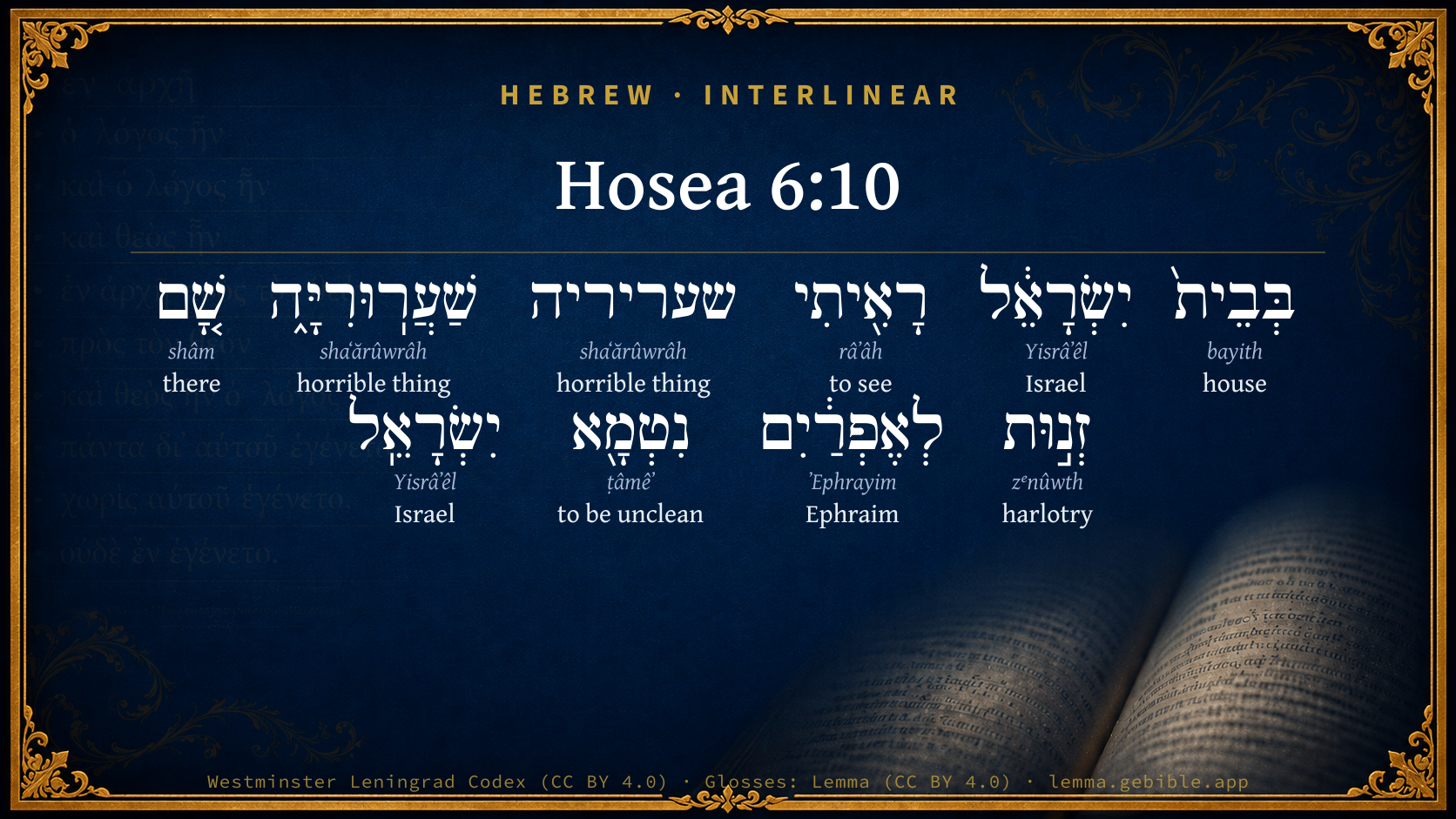
Hebrew (Westminster Leningrad Codex) Hosea 6:10 appears in the Hebrew Old Testament. The text above is from the Westminster Leningrad Codex. Each word links to its Strong’s number, a concise gloss, and parsing drawn from the Open Scriptures Hebrew Bible morphology. Click any word for its full Brown-Driver-Briggs (BDB) entry.
Download image
Cite this verse

Hosea 6:10 (World English Bible). Public Domain. Lemma interlinear Bible study tool, https://lemma.gebible.app/v/hosea/6/10.

Show BibTeX & RIS
BibTeX
RIS
English Translation
In the house of Israel I have seen a horrible thing. There is prostitution in Ephraim. Israel is defiled.
World English Bible · Public Domain
Download a study sheet

One document with this verse’s original text, its word-by-word gloss line, the meaning frame, cross-references with their text, attributed commentary, and full source and license credits — printable, and it pastes into notes with its structure intact.

This verse Autodidact and up

Study sheet (.html) Plain text (.txt)

A passage Seminary Student

Up to 50 verses in one chapter. A passage sheet keeps up to 6 commentary sources and 12 cross-references per verse, in the order this page ranks them, and says so on the sheet whenever that leaves anything out. Ask for a single verse and you get the Autodidact verse sheet above.

Everything on this page stays free to read, with no account — the sheet is a download of what is already on screen, not access to it.

Want to remove ads? Support Godless Engineer
Compare translations 3

The same verse in 3 English versions, stacked beneath the original-language interlinear above. Click any original word for its lexicon entry.

Each is an independent rendering of the whole verse — the interlinear is not word-aligned to these translations.

Highlighted words mark where these versions differ — a whole-verse word diff, not a word-by-word alignment.

  • World English Bible Public Domain
    In the house of Israel I have seen a horrible thing. There is prostitution in Ephraim. Israel is defiled.
  • King James Version Public Domain
    I have seen an horrible thing in the house of Israel: there is the whoredom of Ephraim, Israel is defiled.
  • unfoldingWord Literal Text CC BY-SA 4.0
    In the house of Israel I have seen the horrible; Ephraim’s prostitution there; Israel is defiled.

unfoldingWord Literal Text — © unfoldingWord, licensed CC BY-SA 4.0. Word-aligned USFM3 via Door43 (git.door43.org/unfoldingWord/en_ult).

Versions to compare (up to 4)

3 of 4 selected

Show all 18 translations

Every available English version of this verse, each an independent rendering of the whole verse.

  • World English Bible Public Domain
    In the house of Israel I have seen a horrible thing. There is prostitution in Ephraim. Israel is defiled.
  • Berean Standard Bible Public Domain
    In the house of Israel I have seen a horrible thing: Ephraim practices prostitution there, and Israel is defiled.
  • Majority Standard Bible Public Domain
    In the house of Israel I have seen a horrible thing: Ephraim practices prostitution there, and Israel is defiled.
  • King James Version Public Domain
    I have seen an horrible thing in the house of Israel: there is the whoredom of Ephraim, Israel is defiled.
  • American Standard Version (1901) Public Domain
    In the house of Israel I have seen a horrible thing: there whoredom is `found' in Ephraim, Israel is defiled.
  • Revised Version (1885) Public Domain
    In the house of Israel I have seen an horrible thing: there whoredom is found in Ephraim, Israel is defiled.
  • Geneva Bible (1599) Public Domain
    I haue seene vileny in the house of Israel: there is ye whoredome of Ephraim: Israel is defiled.
  • Douay-Rheims (1899) Public Domain
    I have seen a horrible thing in the house of Israel: the fornications of Ephraim there: Israel is defiled.
  • Young's Literal Translation Public Domain
    In the house of Israel I have seen a horrible thing, There `is' the whoredom of Ephraim -- defiled is Israel.
  • Literal Standard Version CC BY-SA 4.0
    In the house of Israel I have seen a horrible thing, || There [is] the whoredom of Ephraim—Israel is defiled.
  • Unlocked Literal Bible CC BY-SA 4.0
    In the house of Israel I have seen a horrible thing; Ephraim's prostitution is there, and Israel has become unclean.
  • unfoldingWord Literal Text CC BY-SA 4.0
    In the house of Israel I have seen the horrible; Ephraim’s prostitution there; Israel is defiled.
  • Darby Bible Public Domain
    In the house of Israel have I seen a horrible thing: the whoredom of Ephraim is there; Israel is defiled.
  • World Messianic Bible Public Domain
    In the house of Israel I have seen a horrible thing. There is prostitution in Ephraim. Israel is defiled.
  • Webster's Bible Public Domain
    I have seen a horrible thing in the house of Israel: there is the prostitution of Ephraim, Israel is defiled.
  • Free Bible Version CC BY-SA 4.0
    I have seen in the house of Israel something totally disgusting: Ephraim engages in prostitution and Israel is sexually corrupt.
  • Bible in Basic English Public Domain
    In Israel I have seen a very evil thing; there false ways are seen in Ephraim, Israel is unclean;
  • JPS Tanakh (1917) Public Domain
    In the house of Israel I have seen a horrible thing; there harlotry is found in Ephraim, Israel is defiled.

Literal Standard Version (2020), Covenant Press — licensed CC BY-SA 4.0. Text via the HelloAO Bible API (eBible.org). Unlocked Literal Bible (unfoldingWord) — licensed CC BY-SA 4.0. Text via the HelloAO Bible API (eBible.org). unfoldingWord Literal Text — © unfoldingWord, licensed CC BY-SA 4.0. Word-aligned USFM3 via Door43 (git.door43.org/unfoldingWord/en_ult). Free Bible Version, Dr. Jonathan Gallagher — licensed CC BY-SA 4.0. Text via the HelloAO Bible API (eBible.org).

Word by word

More ways to search: Search by grammar → Find every occurrence → Compare this word →

Practice this passage: Drill this verse → Learn its vocabulary →

About this verse

These counts appear in no published source. They are computed here, from the morphology-tagged text and Lemma’s own curated glosses. What Lemma adds →

10
words
8
distinct lemmas
Prophets
section

Notable vocabulary

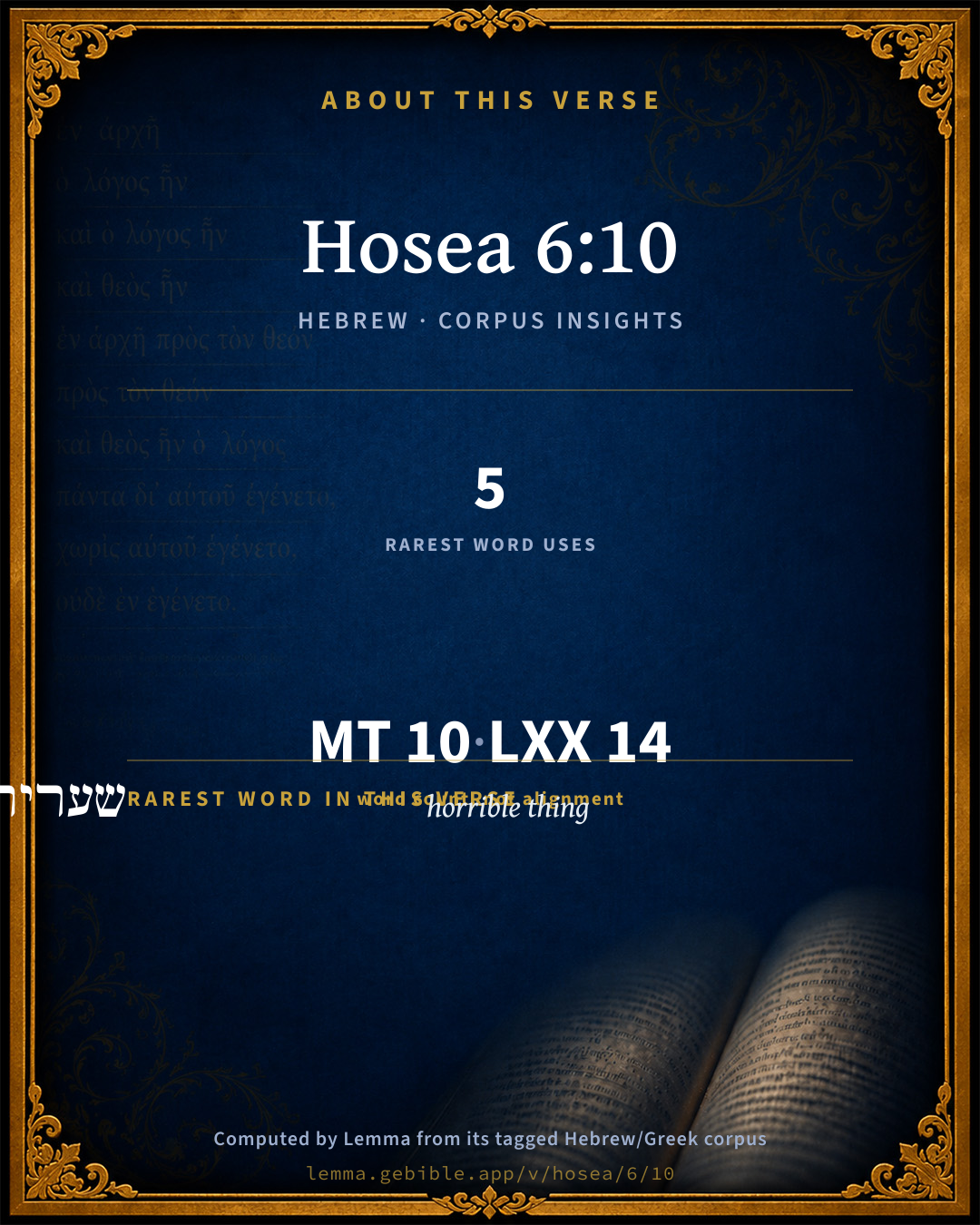
The rarest word here is שעריריה horrible thing H8186 — appearing just 5 times in the whole Hebrew Bible.

Shared distinctive vocabulary

שעריריה horrible thing H8186 occurs in 4 verses of the Hebrew Bible. Also found in:

Grammatical profile

  • 2 verbs
  • 5 nouns
  • 2 adjectives
  • 1 adverb

Verb forms

  • רָאִ֖יתִי Qal · Perfect
  • נִטְמָ֖א Niphal · Perfect

Repetition

Words recur within this verse — often emphatic in Hebrew:

  • יִשְׂרָאֵ֔ל Israel H3478 ×2
  • שעריריה horrible thing H8186 ×2

Hebrew & Septuagint length

In English translation the verse runs 19 words from the Hebrew and 31 from the Septuagint (LXX English) — the Septuagint runs noticeably longer here. See the side-by-side →

A rough comparison of the two English renderings, which tokenize alike — not a word-level alignment.

Word counts can differ between the Hebrew and the Greek without any difference in meaning — e.g. the Hebrew direct-object marker אֵת has no separate Greek word, and Greek often adds the article ὁ.

In the original languages it is 10 Hebrew tokens and 14 Greek tokens — but the two are counted differently (Hebrew bundles its prefixes and suffixes into one token; the Greek is in lemma form), so that isn’t a like-for-like length.

Cross-references

12

Topical passages linked to Hosea 6:10 in the Treasury of Scripture Knowledge — connected by theme and wording, ordered by reader-vote popularity; previews shown in the World English Bible.

  • Hosea 5:3 I know Ephraim, And Israel is not hidden from me; For now, Ephraim, you have played the prostitute. Israel is defiled.
  • Jeremiah 5:30–31 A wonderful and horrible thing is happen in the land:
  • Jeremiah 23:14 In the prophets of Jerusalem also I have seen a horrible thing: they commit adultery, and walk in lies; and they strengthen the hands of evil-doers, so that none does return from his wickedness: they are all of them become to me as Sodom, and the inhabitants of it as Gomorrah.
  • Ezekiel 23:5 Oholah played the prostitute when she was mine; and she doted on her lovers, on the Assyrians [her] neighbors,
  • 1 Kings 12:8 But he forsook the counsel of the old men which they had given him, and took counsel with the young men who had grown up with him, who stood before him.
  • 1 Kings 15:30 for the sins of Jeroboam which he sinned, and with which he made Israel to sin, because of his provocation with which he provoked Yahweh, the God of Israel, to anger.
  • 2 Kings 17:7 It was so, because the children of Israel had sinned against Yahweh their God, who brought them up out of the land of Egypt from under the hand of Pharaoh king of Egypt, and had feared other gods,
  • Jeremiah 2:12–13 Be astonished, you heavens, at this, and be horribly afraid, be you very desolate, says Yahweh.
  • Jeremiah 3:6 Moreover Yahweh said to me in the days of Josiah the king, Have you seen that which backsliding Israel has done? she is gone up on every high mountain and under every green tree, and there has played the prostitute.
  • Jeremiah 18:13 Therefore thus says Yahweh: Ask you now among the nations, who has heard such things; the virgin of Israel has done a very horrible thing.
  • Hosea 4:11 Prostitution, wine, and new wine take away understanding.
  • Hosea 4:17 Ephraim is joined to idols. Leave him alone!

Cross-references courtesy of OpenBible.info (CC BY 4.0).

Hebrew and Greek witnesses Masoretic Hebrew ↔ Greek Septuagint

The same verse in the two great witnesses to the Old Testament, shown verse-for-verse.

Here the Septuagint runs noticeably longer than the Hebrew — LXX2012 (modern English Septuagint) 31 words vs World English Bible 19. A rough length comparison of the two English translations, not a word-level alignment — read both below.

These are two independent witnesses, not word-aligned to each other, and the Septuagint is shown in lemma (dictionary) form.

Hebrew Hosea 6:10 Masoretic · Westminster Leningrad Codex

בְּבֵית֙ יִשְׂרָאֵ֔ל רָאִ֖יתִי שעריריה שַׁעֲרֽוּרִיָּ֑ה שָׁ֚ם זְנ֣וּת לְאֶפְרַ֔יִם נִטְמָ֖א יִשְׂרָאֵֽל

In the house of Israel I have seen a horrible thing. There is prostitution in Ephraim. Israel is defiled.

World English Bible · Public Domain

Greek LXX Hosea 6:10 Septuagint · lemma form

ἐν ὁ οἶκος ἰσραήλ ὁράω φρικώδης ἐκεῖ πορνεία ὁ ἐφράιμ μιαίνω ἰσραήλ καί ἰουδά

And your strength is that of a robber: the priests have hid the way, they have murdered the people of Sicima; for they have wrought iniquity in the house of Israel.

LXX2012 (modern English Septuagint) · Public Domain

On this verse, The Cambridge Bible for Schools and Colleges discusses the Septuagint’s reading. Read the note in Commentary ↓

Hebrew: Westminster Leningrad Codex (CC BY 4.0). Greek: Septuagint (public domain); English from LXX2012 (modern English Septuagint) (Public Domain). How the Septuagint differs from the Hebrew →

Targum (Aramaic paraphrase)

1

The Targum is the ancient Jewish Aramaic paraphrase of the Hebrew Scriptures — an interpretive translation, not the Hebrew text itself. Onkelos (literal) and Pseudo-Jonathan (expansive) render the Torah, and Jonathan the Prophets. Coverage is partial: where no permissively-licensed English translation exists for a verse, only the Aramaic is shown. This is verse-level text, not a word-by-word alignment to the Hebrew.

  1. Targum Jonathan Prophets (Joshua–Malachi)
    בְּבֵית יִשְׂרָאֵל חֲזֵיתִי שְׁנוּ אַשְׁנִיאוּ קְיָמָא דִגְזִיר עִמְהוֹן קְיָמָא דִגְזִיר עִמְהוֹן דְלָא לְמִפְלַח לְטַעֲוָתָא תָּבוּ אִינוּן לְמִטְעֵי בְּתַר עֶגְלַיָא בְּבֵית אַל תַּמָן טָעוּ בֵּית אֶפְרַיִם אִסְתַּאֲבוּ בֵּית יִשְׂרָאֵל:

    (no public-domain English translation for this verse)

    Targum Jonathan — Aramaic: “Mikraot Gedolot” (public domain). English: “Sefaria Community Translation” (CC0 1.0 (public-domain dedication)); “London "Chaldee Paraphrase," 1871” (public domain). Text via Sefaria.

Commentary

Notes on Hosea 6:10 from classic Christian and Jewish commentators (each source and its license shown beneath its notes). The classic Christian expositions comment on the surrounding passage and are grouped to its opening verse, so a note may address several verses; the Jewish commentaries on the Tanakh (Rashi and others) are per-verse, so they appear only where the commentator wrote on this verse.

Lemma curates 59 commentaries, every one of them public domain or Creative Commons licensed, each selected and text-cleaned for this edition rather than reprinted as found. About our sources →

The Cambridge Bible for Schools and Colleges

gen. ed. J. J. S. Perowne

10, 11. Jehovah is still the speaker. From his heavenly ‘place’ he points indignantly (as Hos_6:7) to the abominations practised ‘there’, i.e. in the whole land of Israel, for even Judah has not escaped the infection. The structure of the verses becomes more symmetrical, if we attach the concluding words of Hos_6:10 to Hos_6:11, and turn Hos_6:11 thus, altering one vowel-point, Israel is defiled; for thee also, Judah, a harvest is appointed. The Septuagint partly favours this, rendering ἐμιάνθη Ἰσραὴλ καὶ Ἰούδα. The concluding words of Hos_6:11 should rather be attached to Hos_6:1 of chap. 7.

The Cambridge Bible for Schools and Colleges (gen. ed. J. J. S. Perowne; Cambridge University Press, 1878–1918) — public domain. Text from a community e-Sword module.

Trapp's Complete Commentary

John Trapp

Hos 6:10 I have seen an horrible thing in the house of Israel: there [is] the whoredom of Ephraim, Israel is defiled.

Ver. 10. I have seen an horrible thing in the house of Israel] Now a very den of thieves, as Hos 6:9, a pantheon of all sorts of idols, a chamber of imagery, an Egyptian temple, gay and goodly without, but within an ox or calf, with "women weeping for Tammuz," Eze 8:12; Eze 8:14, that is, for Osiris, king of Egypt, whose image (under the shape of an ox) his wife, Isis, had advanced to be idolatrously there adored. This kind of abomination Jeroboam had learned in Egypt (whither he fled from Solomon, his master), and brought into the house of Israel. And whereas those idolaters said, "The Lord seeth us not, the Lord hath forsaken the earth," Eze 8:12; "I have seen it," saith God, and been sore troubled at it, and even frightened; so as a man is quando horripilatur, when his hairs stand on end; as when the devil appeareth to him like a hairy satyr. See Lev 17:7. {See Trapp on "Lev 17:7"} Certain it is that God hateth sin (but especially idolatry, that abominable thing, as he calleth it, Jer 44:4) worse than he hateth the devil himself; for he hateth the devil for sin’s sake, and not sin for the devil’s sake. Idolatry must needs be so much the more odious to him, because therein the devil sets up himself in the place of God; and requires men (as once he did Christ himself) to fall down and worship him. See Deu 32:17 1Co 10:20 Rev 9:20. So he dealeth by the poor Indians of this day, compelling them to worship him with bodily worship, and tormenting them, if they do not, worse (if worse may be) than the cruel Spaniards; who suppose they show the wretches favour, when they do not, for their pleasure, whip them with cords, and day by day drop their naked bodies with burning bacon. The Hebrew word here used hath some letters more than ordinary in it, to increase the signification, and to show what a very horrible thing idolatry is ( שׁעריריה). {Hebrew Text Note} It is spurca pollutio, as Jer 23:14, and worse. See Jer 2:11-12; Jer 18:13, and know that God doth not use to aggravate things beyond truth, as men do, witness Nebuchadnezzar, Dan 3:14, "Is it true, O Shadrach, Meshach, and Abednego?" Or is it of set purpose? Num de industria? so Buxtorf rendereth it. Is it for the nonce, to provoke me? Or Nunquid desolatio? so Arias Montanus; as if he should say, What! you to oppose the command of a king? If this be suffered, what desolation must needs follow! But this is not God’s way; he lays no more words upon a thing than the matter amounteth to. If he call idolatry filth, fornication, abomination, a horrible thing, such as a man would start or stand aghast at, we may be sure it is so. The Septuagint here render it φρικωδη, things to be trembled at, or shrieked at. In Barbary it is death for the Xeriff’s wife, when she seeth a man, though but through a casement, not suddenly to shriek out. God is a jealous God, and allows not his to look toward an idol. If they do he will soon see it, and visit for it. "I have seen," &c.

There is the whoredom of Ephraim] Thus God looketh upon it as filthiness and nastiness which the people beheld as fineness and neatness. And the same do all (that have the mind of God, and senses exercised to discern between good and evil) judge of all the Popish pomp and palterment, wherewith they bewitch the deluded common people, as the serpent Scytale doth the fleeing passenger, whom when she cannot overtake, yet with her beautiful colours she doth so astonish and amaze him, that he hath no power to pass away till stung to death.

John Trapp, A Commentary or Exposition upon All the Books of the Old and New Testament (1647–1656) — public domain. Text from a community e-Sword module.

Joseph Benson's Commentary

Hos 6:10-11. I have seen a horrible thing — Such an apostacy from God as cannot be mentioned without horror. There is the whoredom of Ephraim — Or rather, there, namely, in the house of Israel, BY the whoredom of Ephraim, that is, by the idolatry of Jeroboam, who was of that tribe, and first began the worship of the golden calves; Israel is defiled — The whole ten tribes are corrupted: for they soon all followed the example of Jeroboam in this idolatrous worship. Also, O Judah, he — That is, Ephraim; hath set a harvest for thee — For Ephraim, or Israel, had corrupted Judah by leading them into idolatry, and into the vices connected therewith, in consequence of which they were made ripe for destruction: for that the harvest is often a type of judgment is evident, among many other passages that might be adduced, from those quoted in the margin. When I returned the captivity of my people — Or rather, the Hebrew being in the future tense, when I shall turn, &c., (so the Vulgate,) or, more literally, and as the Seventy render it, in my turning the captivity of my people. According to this interpretation, the phrase of turning the captivity of God’s people is not to be taken in the sense in which the same phrase is generally understood in the Scriptures, namely, for bringing them out of captivity; punishment, and not a blessing, being supposed to be predicted: but the sense of the expression will be, When I shall return to make captives of my people; or, as Archbishop Newcome proposes rendering it, When I lead away the captivity of my people; that is, after I have again caused the Israelites to be carried into captivity. Tiglath-pileser first carried a part of them into captivity; then Shalmaneser carried away the remainder; and after this came Sennacherib, who wasted Judea, and laid siege to Jerusalem. Some eminent commentators, however, are of opinion, that not a judgment, but a blessing, is predicted to be conferred on Judah in this passage. They therefore translate the verse thus: But for thee, O Judah, a harvest is prepared; then when I shall bring back the captivity of my people: see Houbigant and Horsley. Mr. S. Clark’s note on the verse takes in both interpretations, thus: “And as Israel has been drawn to idolatry by Jeroboam, (Hos 6:10,) so hast thou, Judah, too: and therefore God has prepared a harvest of sorrow and sufferings for thee too, by sending thee into captivity; which yet afterward shall be turned into a harvest of joy, when thou shalt be returned out of captivity again.”

Joseph Benson's Commentary on the Old and New Testaments (1811–1818) — public domain. Text from a community e-Sword module.

Whedon's Commentary on the Bible

Daniel D. Whedon

Hos_6:10-11 sum up the accusation. Wherever the eye of Jehovah falls, he sees a horrible thing… whoredom — The former signifies abominations and crimes of every kind (Jer_18:13); the second, the one outstanding sin, spiritual and literal whoredom.

Israel is defiled — Compare Hos_5:3. In Hos_6:11 the prophet turns to Judah. This verse and Hos_7:1 a, are thought by some to be a later addition; so that Hos_7:1 b, “uncovered is the iniquity of Ephraim,” would be the continuation of Hos_6:10. The omitted words might, indeed, be left out without affecting seriously the thought of the prophet, but that is not sufficient reason for rejecting them. LXX. differs from the Hebrew, and in some respects is to be preferred. Following LXX. part of Hos_6:11 should probably be connected with Hos_7:1, chapter vi, closing, “Also, O Judah, there is a harvest appointed to thee.”

Harvest — Figure of judgment (Joe_3:13; Jer_51:33). Judah, as corrupt as Israel, must share the latter’s fate. 11b, in the same construction as the opening words of Hos_7:1, should be taken with the latter and rendered, “When I would turn the fortune of my people, when I would heal Israel.”

Returned [“bring back”] the captivity — The Hebrew phrase which is frequently thus rendered in the Old Testament is literally turn a turning. In some cases the turning involved is the restoration from exile; in others a more general idea is expressed, a turning in the fortunes of the people, of calamity into prosperity; and this latter meaning is suitable in every place where the phrase occurs (Amo_9:14; Zep_2:7, etc.). So here, “When I would turn the fortunes of my people.”

Daniel D. Whedon (gen. ed.), Commentary on the Old and New Testaments (1874–1909) — public domain. Text from a community e-Sword module.

Tyndale Open Study Notes

Tyndale Open Resources

6:10 something horrible: The prophet uses this rare word (also in Jer 18:13) to describe the depth of Israel’s sin in breaking God’s covenant and betraying his trust.

Tyndale Open Study Notes — © Tyndale Open Resources, licensed CC BY-SA 4.0. Text via the HelloAO Bible API.

Jamieson, Fausset & Brown

Robert Jamieson, A. R. Fausset & David Brown

horrible thing-- (Jer 5:30; Jer 18:13; Jer 23:14).

whoredom--idolatry.

Jamieson, Fausset & Brown — Commentary Critical and Explanatory on the Whole Bible (1871) — public domain (CC PDM 1.0). Text via the HelloAO Bible API.

Adam Clarke's Commentary

Verse 10. I have seen a horrible thing] That is, the idolatry that prevailed in Israel to such a degree that the whole land was defiled.

Adam Clarke's Commentary on the Bible (1810–1826) — public domain. Text from a community e-Sword/MySword module.

John Calvin's Commentaries

Here God declares that he is the fit judge to take cognizance of the vices of Israel; and this he does, that he might cut off the handle of vain excuses, which hypocrites often adduce when they are reproved. Who indeed can at this day persuade the Papists that all their worship is a filthy abomination, a mere profanation? We see how furiously they rise up as soon as any one by a whisper dares to touch their superstitions. Whence this? Because they wish their own will to stand for reason. Why? Good intention, they say, is the judge; as if this good intention were, forsooth, the queen, who ought to rule in heaven and earth, and God were now excluded from all his rights. This fury and this madness, even at this day, possess the Papists; and no wonder, for Satan dementates men, when he leads them to corrupt and degenerated forms of worship, and all hypocrites have been thus inebriated from the beginning. This then is the reason why the Prophet now says in the person of God, I have seen, or do see, infamy in the kingdom of Israel. God does here by one word lay prostrate whatever men may set up for themselves, and shows that there remains no more defense for what he declares he does not approve, however much men may value and applaud it. “What! you think this to be my worship; and in your imagination, this is most holy religion, this is the way of salvation, this is extraordinary sanctity; but I on the contrary declare, that it is profanation, that it is turpitude, that it is infamy. Go now,” he says, “pass elsewhere your fopperies, with me they are of no value.”

We now understand the meaning of the Prophet, when he says, In the house of Israel have I seen infamy: and by the house of Israel the Prophet means the whole kingdom of the ten tribes. How so? “Because there is the fornication of Ephraim”; that is, there idolatry reigns, which Jeroboam introduced, and which the other kings of Israel followed.

Thus we see that the Prophet spared neither the king, nor his counselors, nor the princes of the kingdom; and he did not spare before the priests. And this magnanimity becomes all God’s servants, so that they cast down every height that rises up against the word of the Lord; as it was said to Ezekiel,

Chide mountains and reprove hills,’ (Ezekiel 6:2, 36:1.)

An example of this the Prophet sets before us, when he compares priests to robbers, and then compares royal temples to a brothel. Jeroboam had built a temple in which he thought that God would be in the best manner worshipped; but this, says the Prophet, is a brothel, this is filthy fornication.

John Calvin's Commentaries (1540-1563) — public domain. Text from the Calvin Translation Society English edition (1840s-50s) via the Christian Classics Ethereal Library (ccel.org). Calvin's coverage is partial (roughly two-thirds of the Bible); uncommented books and verses are honest gaps, never fabricated. The 19th-century editor's footnotes and remarks are omitted so the notes are faithfully Calvin's own voice.

Ellicott's Commentary for English Readers

(10) House of Israel.—This phrase means Ephraim and Judah subsequently discriminated. The “horrible thing” refers to polluting idolatry. This peculiar word occurs again in Jeremiah. According to the punctuation of the Hebrew the reciter hesitates before pronouncing the “horrible thing” which grated through his teeth.

A Bible Commentary for English Readers, edited by Charles John Ellicott (1878–1897) — public domain. Text from a community e-Sword module.

John Gill's Exposition

I have seen an horrible thing in the house of Israel,.... Idolatry, the calves set up at Dan and Bethel, which God saw with abhorrence and detestation; or the prophet saw it, and it made his hair stand on end as it were, as the word (g) signifies, that such wickedness should be committed by a professing people:

there is the whoredom of Ephraim; in the house of Israel is the whoredom of Jeroboam, who was of the tribe of Ephraim, and caused Israel to sin, to go a whoring after idols; or the whoredom of the tribe of Ephraim, which belonged to the house of Israel, and even of all the ten tribes; both corporeal and spiritual whoredom, or idolatry, are here meant:

Israel is defiled; with whoredom of both kinds; it had spread itself all over the ten tribes; they were all infected with it, and polluted by it; see Hos 5:3.

(g) a "pilus".

John Gill's Exposition of the Whole Bible (1746–1763) — public domain (CC PDM 1.0). Text via the HelloAO Bible API.

Albert Barnes' Notes on the Bible

I have seen a horrible thing - Literally, “what would make one shudder.” God had seen it; therefore man could not deny it. In the sight of God, and amid the sense of His presence, all excuses fail.

In the house of Israel - o: “For what more horrible, more amazing than that this happened, not in any ordinary nation but “in the house of Israel,” in the people of God, in the portion of the Lord, as Moses said, “the Lord’s portion is His people, Jacob is the lot of His inheritance?” In another nation, idolatry was error. In Israel, which had the knowledge of the one true God and had received the law, it was horror.” “There is the whoredom of Ephraim,” widespread, over the whole land, wherever the house of Ephraim was, through the whole kingdom of the ten tribes, “there” was its spiritual adultery and defilement.

Albert Barnes' Notes on the Bible (1834–1885) — public domain. Text from a community e-Sword/MySword module.

Matthew Poole's English Annotations

I have seen: it may be understood of the prophet speaking what he had seen; or of God, who seeth now, and hath seen,

an horrible thing, a very horrible thing, as some observe from the word, in the house of Israel, the ten tribes.

The whoredom, idolatry,

of Ephraim; which was brought in by an Ephraimite, by Jeroboam the First, two hundred years ago, and it is there still.

Israel is defiled; it hath overspread all Israel, none free, but all defiled greatly with it.

Matthew Poole's English Annotations on the Holy Bible (1683–1685) — public domain. Text from a community e-Sword/MySword module.

The Pulpit Commentary

I have seen a horrible thing in the house of Israel: there is the whoredom of Ephraim, Israel is defiled. The house of Israel comprises

(1) the ten tribes of the northern kingdom, according to some; it seems more correct

(2) to understand it of the whole nation, including both the northern and southern kingdoms, in which case the remainder of the verse relates to the northern kingdom of the ten tribes, and the succeeding verse to the southern kingdom of the two tribes. Further, Israel is not synonymous with the parallel Ephraim, as Keil thinks; the latter is the principal tribe which led the way in Israel"s apostasy. The "horrible thing" comprehends every sort of crime and abomination; while the" whoredom," literal or spiritual, is specified as an example thereof. (For the explanation of "there," see on ver. 7)

The Pulpit Commentary (1880–1919), ed. H.D.M. Spence-Jones & Joseph S. Exell — public domain. Text from a community e-Sword module.

John Wesley's Explanatory Notes

The whoredom - Idolatry. Of Ephraim - Which was brought in by an Ephraimite, by Jeroboam, two hundred years ago, and is there still. Israel is defiled - It hath overspread all Israel.

John Wesley, Explanatory Notes Upon the Whole Bible (1754–1765) — public domain. Text via the GEBible commentary corpus.

unfoldingWord translationNotes

Door43 World Missions Community

General Information:

Yahweh is speaking.

Ephraim's prostitution

Here "prostitution" refers to Ephraim's worship of false gods. (See: Metonymy)

Israel has become unclean

Israel has become unacceptable to God because of her actions.

For you also, Judah, a harvest has been appointed

This can be stated in active form. AT: "I have set a time of harvest for you also, Judah" (See: Active or Passive)

harvest

Here "harvest" represents God's final judgment on Israel and Judah. (See: Metaphor)

fortunes

prosperity and security

translationWords

house

Israel

Ephraim

prostitute

clean

Judah

harvest

appoint

restore

people group

unfoldingWord translationNotes — © Distant Shores Media and the Door43 World Missions Community, licensed CC BY-SA 4.0. Source: git.door43.org/Door43/en_tn.

Rashi

Rabbi Shlomo Yitzchaki (Rashi)

a horrible thing Heb. שַׁעֲרוּרִיָה. Jonathan renders this as an expression of change, for they changed their way, and so: (Jer. 5:20) “an appalling and horrible thing (שֲעֲרוּרָה).”

Rashi on the Tanakh — English translations: “The Judaica Press complete Tanach with Rashi, translated by A. J. Rosenberg” (CC BY 4.0); “Pentateuch with Rashi's commentary by M. Rosenbaum and A.M. Silbermann, 1929-1934” (public domain); “The Metsudah Tanach series, Lakewood, N.J” (CC BY 4.0); and “The Book of Joshua, Metsudah Publications, 1997” (CC BY 4.0). Text via Sefaria.

Lesson kit

Teaching starters — assembled from the data on this page, not authored interpretation. Every prompt links to the verse data it draws on. Edit before teaching.

Hosea, in the Prophets, opens this verse with 10 words (8 distinct Hebrew lemmas). Its most distinctive word is shaʻărûwrâh (“horrible thing”). The Greek Septuagint runs longer here. A historical commentator’s framing appears above. Read the whole chapter for the surrounding context.

Discussion questions

  1. How does “horrible thing” (shaʻărûwrâh) shape what this verse is saying?
  2. How does Jeremiah 5:30, which shares the word «horrible thing», read alongside this verse?
  3. What does the repetition of “Israel” (2× in this one verse) do in this verse?
  4. The Septuagint runs longer here than the Hebrew. What might account for the difference?
  5. The translations on this page render this verse differently — a whole-verse word diff, not a word-by-word alignment. What might account for the different wordings?
  6. «רָאִ֖יתִי» is a Qal Perfect verb. How does that grammatical form shape the action described?
  7. Compare how The Cambridge Bible for Schools and Colleges and Trapp's Complete Commentary read this verse. Where do they agree or differ?

Things to notice

Reading settings

Reading text

Shown beneath each verse's original-language words.

Old Testament
Old Testament edition

Read the OT as the Masoretic Hebrew (MT) or the Greek Septuagint (LXX).

English shown for the Greek Septuagint (in the Hebrew ↔ Greek comparison).

Comparing translations? Open the Compare panel on any verse page to stack up to four side by side.