
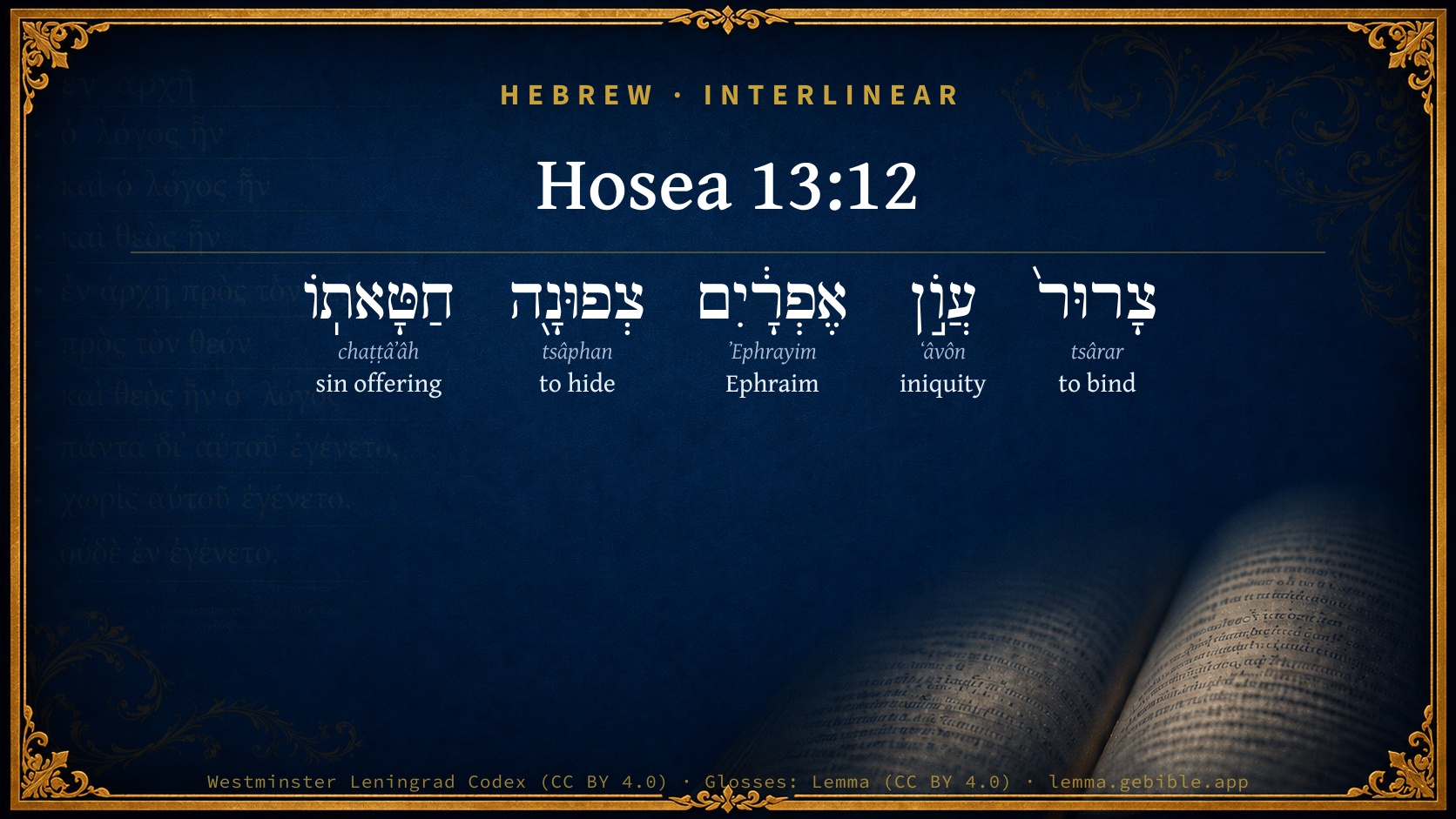
Hosea 13:12

Hebrew (Westminster Leningrad Codex) Hosea 13:12 appears in the Hebrew Old Testament. The text above is from the Westminster Leningrad Codex. Each word links to its Strong’s number, a concise gloss, and parsing drawn from the Open Scriptures Hebrew Bible morphology. Click any word for its full Brown-Driver-Briggs (BDB) entry.
Download image
Cite this verse

Hosea 13:12 (World English Bible). Public Domain. Lemma interlinear Bible study tool, https://lemma.gebible.app/v/hosea/13/12.

Show BibTeX & RIS
BibTeX
RIS
English Translation
The guilt of Ephraim is stored up. His sin is stored up.
World English Bible · Public Domain
Download a study sheet

One document with this verse’s original text, its word-by-word gloss line, the meaning frame, cross-references with their text, attributed commentary, and full source and license credits — printable, and it pastes into notes with its structure intact.

This verse Autodidact and up

Study sheet (.html) Plain text (.txt)

A passage Seminary Student

Up to 50 verses in one chapter. A passage sheet keeps up to 6 commentary sources and 12 cross-references per verse, in the order this page ranks them, and says so on the sheet whenever that leaves anything out. Ask for a single verse and you get the Autodidact verse sheet above.

Everything on this page stays free to read, with no account — the sheet is a download of what is already on screen, not access to it.

Want to remove ads? Support Godless Engineer
Compare translations 3

The same verse in 3 English versions, stacked beneath the original-language interlinear above. Click any original word for its lexicon entry.

Each is an independent rendering of the whole verse — the interlinear is not word-aligned to these translations.

Highlighted words mark where these versions differ — a whole-verse word diff, not a word-by-word alignment.

  • World English Bible Public Domain
    The guilt of Ephraim is stored up. His sin is stored up.
  • King James Version Public Domain
    The iniquity of Ephraim is bound up; his sin is hid.
  • unfoldingWord Literal Text CC BY-SA 4.0
    The iniquity of Ephraim bound up; his sin stored up.

unfoldingWord Literal Text — © unfoldingWord, licensed CC BY-SA 4.0. Word-aligned USFM3 via Door43 (git.door43.org/unfoldingWord/en_ult).

Versions to compare (up to 4)

3 of 4 selected

Show all 18 translations

Every available English version of this verse, each an independent rendering of the whole verse.

  • World English Bible Public Domain
    The guilt of Ephraim is stored up. His sin is stored up.
  • Berean Standard Bible Public Domain
    The iniquity of Ephraim is bound up; his sin is stored up.
  • Majority Standard Bible Public Domain
    The iniquity of Ephraim is bound up; his sin is stored up.
  • King James Version Public Domain
    The iniquity of Ephraim is bound up; his sin is hid.
  • American Standard Version (1901) Public Domain
    The iniquity of Ephraim is bound up; his sin is laid up in store.
  • Revised Version (1885) Public Domain
    The iniquity of Ephraim is bound up; his sin is laid up in store.
  • Geneva Bible (1599) Public Domain
    The iniquitie of Ephraim is bound vp: his sinne is hid.
  • Douay-Rheims (1899) Public Domain
    The iniquity of Ephraim is bound up, his sin is hidden.
  • Young's Literal Translation Public Domain
    Bound up `is' the iniquity of Ephraim, Hidden `is' his sin,
  • Literal Standard Version CC BY-SA 4.0
    Bound up [is] the iniquity of Ephraim, || Hidden [is] his sin,
  • Unlocked Literal Bible CC BY-SA 4.0
    Ephraim's iniquity has been stored up; his guilt has been stored up.
  • unfoldingWord Literal Text CC BY-SA 4.0
    The iniquity of Ephraim bound up; his sin stored up.
  • Darby Bible Public Domain
    The iniquity of Ephraim is bound up; his sin is laid by in store.
  • World Messianic Bible Public Domain
    The guilt of Ephraim is stored up. His sin is stored up.
  • Webster's Bible Public Domain
    The iniquity of Ephraim is bound up; his sin is hid.
  • Free Bible Version CC BY-SA 4.0
    Ephraim's guilt is packed up; their sin will be eradicated.
  • Bible in Basic English Public Domain
    The wrongdoing of Ephraim is shut up; his sin is put away in secret.
  • JPS Tanakh (1917) Public Domain
    The iniquity of Ephraim is bound up; his sin is laid up in store.

Literal Standard Version (2020), Covenant Press — licensed CC BY-SA 4.0. Text via the HelloAO Bible API (eBible.org). Unlocked Literal Bible (unfoldingWord) — licensed CC BY-SA 4.0. Text via the HelloAO Bible API (eBible.org). unfoldingWord Literal Text — © unfoldingWord, licensed CC BY-SA 4.0. Word-aligned USFM3 via Door43 (git.door43.org/unfoldingWord/en_ult). Free Bible Version, Dr. Jonathan Gallagher — licensed CC BY-SA 4.0. Text via the HelloAO Bible API (eBible.org).

Word by word

More ways to search: Search by grammar → Find every occurrence → Compare this word →

Practice this passage: Drill this verse → Learn its vocabulary →

About this verse

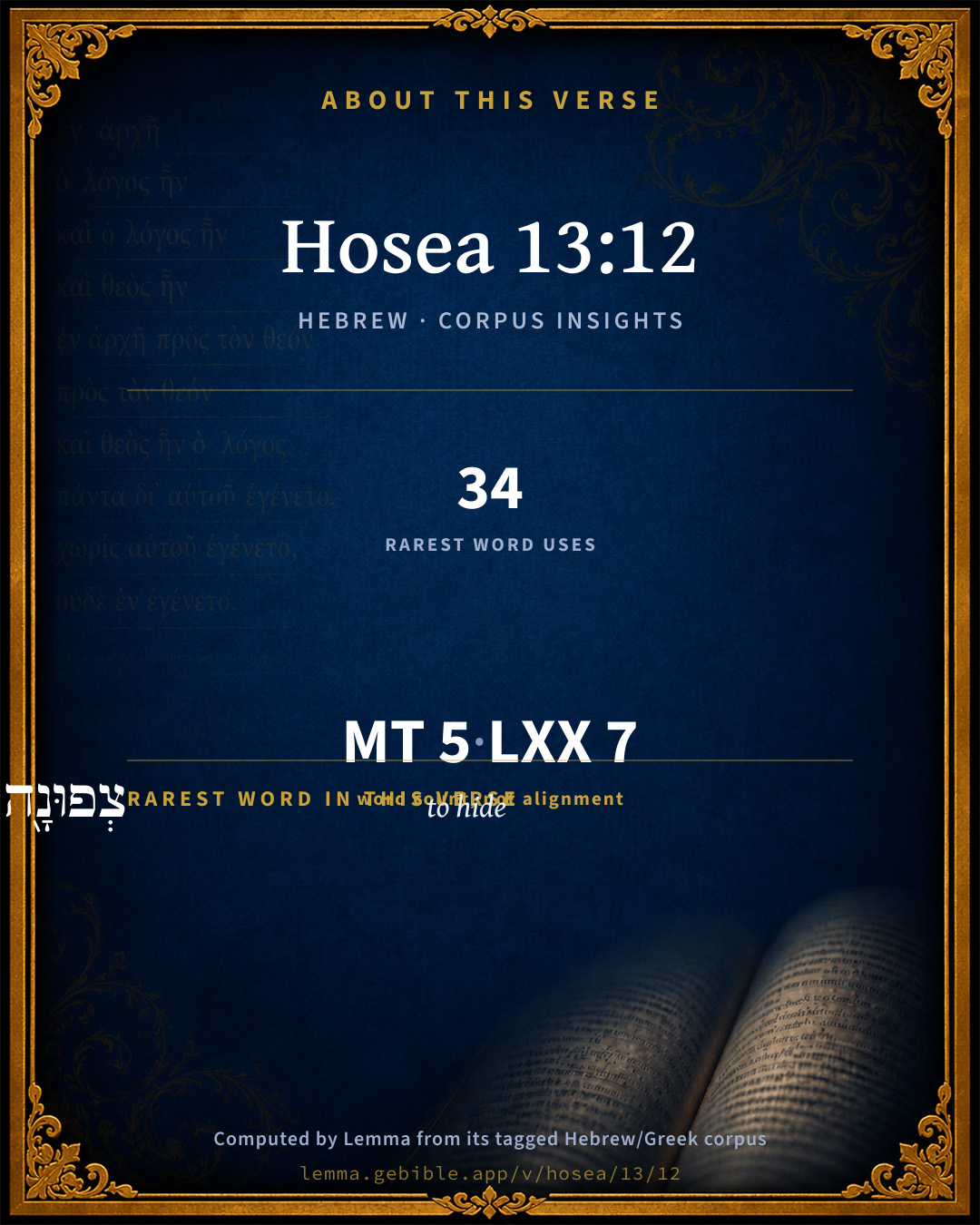
These counts appear in no published source. They are computed here, from the morphology-tagged text and Lemma’s own curated glosses. What Lemma adds →

5
words
5
distinct lemmas
Prophets
section

Shared distinctive vocabulary

צְפוּנָ֖ה to hide H6845 occurs in 31 verses of the Hebrew Bible. Also found in:

Grammatical profile

  • 2 verbs
  • 3 nouns

Verb forms

  • צָרוּר֙ Qal · Participle Passive
  • צְפוּנָ֖ה Qal · Participle Passive

Hebrew & Septuagint length

In English translation the verse runs 12 words from the Hebrew and 11 from the Septuagint (LXX English) — closely comparable.

A rough comparison of the two English renderings, which tokenize alike — not a word-level alignment.

Word counts can differ between the Hebrew and the Greek without any difference in meaning — e.g. the Hebrew direct-object marker אֵת has no separate Greek word, and Greek often adds the article ὁ.

In the original languages it is 5 Hebrew tokens and 7 Greek tokens — but the two are counted differently (Hebrew bundles its prefixes and suffixes into one token; the Greek is in lemma form), so that isn’t a like-for-like length.

Cross-references

4

Topical passages linked to Hosea 13:12 in the Treasury of Scripture Knowledge — connected by theme and wording, ordered by reader-vote popularity; previews shown in the World English Bible.

  • Deuteronomy 32:34–35 Isn't this laid up in store with me, Sealed up among my treasures?
  • Job 14:17 My disobedience is sealed up in a bag. You fasten up my iniquity.
  • Romans 2:5 But according to your hardness and unrepentant heart you are treasuring up for yourself wrath in the day of wrath, revelation, and of the righteous judgment of God;
  • Job 21:19 You say, 'God lays up his iniquity for his children.' Let him recompense it to himself, that he may know it.

Cross-references courtesy of OpenBible.info (CC BY 4.0).

Hebrew and Greek witnesses Masoretic Hebrew ↔ Greek Septuagint

The same verse in the two great witnesses to the Old Testament, shown verse-for-verse.

These are two independent witnesses, not word-aligned to each other, and the Septuagint is shown in lemma (dictionary) form.

Hebrew Hosea 13:12 Masoretic · Westminster Leningrad Codex

צָרוּר֙ עֲוֺ֣ן אֶפְרָ֔יִם צְפוּנָ֖ה חַטָּאתֽוֹ

The guilt of Ephraim is stored up. His sin is stored up.

World English Bible · Public Domain

Greek LXX Hosea 13:12 Septuagint · lemma form

συστροφή ἀδικία ἐφράιμ ἐνκρύπτω ὁ ἁμαρτία αὐτός

Ephraim has framed a conspiracy of unrighteousness, his sin is hidden.

LXX2012 (modern English Septuagint) · Public Domain

Hebrew: Westminster Leningrad Codex (CC BY 4.0). Greek: Septuagint (public domain); English from LXX2012 (modern English Septuagint) (Public Domain). How the Septuagint differs from the Hebrew →

Targum (Aramaic paraphrase)

1

The Targum is the ancient Jewish Aramaic paraphrase of the Hebrew Scriptures — an interpretive translation, not the Hebrew text itself. Onkelos (literal) and Pseudo-Jonathan (expansive) render the Torah, and Jonathan the Prophets. Coverage is partial: where no permissively-licensed English translation exists for a verse, only the Aramaic is shown. This is verse-level text, not a word-by-word alignment to the Hebrew.

  1. Targum Jonathan Prophets (Joshua–Malachi)
    בְּגִנְזִין חוֹבֵי בֵּית אֶפְרַיִם נְטִירִין לְאִתְפְּרָעָה כָּל חוֹבֵיהוֹן:

    (no public-domain English translation for this verse)

    Targum Jonathan — Aramaic: “Mikraot Gedolot” (public domain). English: “Sefaria Community Translation” (CC0 1.0 (public-domain dedication)); “London "Chaldee Paraphrase," 1871” (public domain). Text via Sefaria.

Commentary

Notes on Hosea 13:12 from classic Christian and Jewish commentators (each source and its license shown beneath its notes). The classic Christian expositions comment on the surrounding passage and are grouped to its opening verse, so a note may address several verses; the Jewish commentaries on the Tanakh (Rashi and others) are per-verse, so they appear only where the commentator wrote on this verse.

Lemma curates 59 commentaries, every one of them public domain or Creative Commons licensed, each selected and text-cleaned for this edition rather than reprinted as found. About our sources →

Trapp's Complete Commentary

John Trapp

Hos 13:12 The iniquity of Ephraim [is] bound up; his sin [is] hid.

Ver. 12. The iniquity of Ephraim is bound up] sc. in a bundle, or fardle, or fagot, as the French hath it. And like as all fardles are opened on a fair day, so shall Ephraim’s iniquities be brought to light, and punished at the last day: as the householder bindeth up the tares in bundles at harvest and burneth them; so shall it be in the end of the world. "The Son of man shall send forth his angels, and they shall gather out of his kingdom all scandals, and them which do iniquity; and shall cast them into a furnace of fire," Mat 13:30; Mat 13:41-42. As the clerk of assizes binds up the indictments of malefactors in bundles, or seals them up in a bag for more surety, and at the assizes brings his bag, takes them out, and reads them; so will it be at that last and great day. "My transgression is sealed up in a bag," saith Job, Job 14:17, "and thou sewest up mine iniquity," viz. as the writings, or informations of a process, which is ready to be sentenced. See Deu 32:34 Jer 17:1 Hos 9:9. Sinners shall one day know that God’s forbearance is no quittance; and that however he is silent for a season, and thereupon they are apt fondly to conceit him to be such another as themselves, yet he will confute them, and set their sins in order before their eyes, Psa 50:21 Their actions are already in print in heaven; and God will one day read them aloud in the ears of all the world. And then though their sin be hidden for the present, all shall be revealed, to their utter shame and everlasting contempt, Dan 12:2; that last light of the day of wrath shall reveal all, Rom 2:5, punish all, Hos 9:9. Whatever God hath threatened shall then be inflicted; whatever arrows are in the bowstring shall then flee, and hit, and stick deep. And the longer the Lord is in drawing the heavier they will light; Morae dispendium faenoris duplo pensabitur; the longer he forbeareth the heavier he punisheth; so that there shall be no cause why sinners should say, "Where is the God of judgment?" Mal 2:17. {See Trapp on "Mal 2:17"} God will inquire after their iniquity, and search after their sin, Job 10:6.

John Trapp, A Commentary or Exposition upon All the Books of the Old and New Testament (1647–1656) — public domain. Text from a community e-Sword module.

Joseph Benson's Commentary

Hos 13:12-13. The iniquity of Ephraim is bound up — This verse may be better rendered, The iniquity of Ephraim is treasured up, his sin is laid up — That is, laid up in my memory, as that which ought to be punished at a proper time. The sentence is manifestly equivalent to that expression in Job 14:17, My transgression is sealed up in a bag; that is, thou keepest an exact account of it, as men do of money which they seal up in a bag, to be forthcoming on a proper occasion. To the same purpose are those words, Deu 32:34, Is not this laid up in store for me, and sealed among my treasures? To me belongs vengeance, &c. The sorrows of a travailing woman — Grievous sorrows, or pains, shall come upon him — Great calamities are often compared to the pains of child- bearing. He is an unwise son: for he should not — Or rather, else he would not, stay long, &c. — As a child, if it could be supposed to have understanding, would deliver itself out of the womb, and not tarry there to the manifest danger of itself and the mother; so if Ephraim or Israel had acted wisely, they would have prevented their approaching destruction by a speedy reformation. Horsley’s version is, He is of the thoughtless race, for it is the critical moment, when he ought not to stand still; the children are in the aperture: Hebrew, in the breach. “They are actually passing through the opening of the parts distended by the throes of labour. It is the very moment when the pains must terminate in the delivery or the death of the woman. A proverbial expression, for a crisis of extreme danger and doubtful catastrophe: see Isa 37:3. At such a moment as this, thoughtless Ephraim is supine and unconcerned.”

Joseph Benson's Commentary on the Old and New Testaments (1811–1818) — public domain. Text from a community e-Sword module.

Keil & Delitzsch

C. F. Keil & F. Delitzsch

"The guilt of Ephraim is bound together: his sin is preserved. Hos 13:13. The pains of a travailing woman come upon him: he is an unwise son; that he does not place himself at the time in the breaking forth of children." Hos 13:12 is a special application of Deu 32:34 to the ten tribes. Tsârūr, bound up in a bundle, like a thing which you wish to take great care of (compare Job 14:17; Sa1 25:29). The same thing is applied in tsâphūn, hidden, carefully preserved, so as not to be lost (Job 21:19). "All their sins are preserved for punishment" (Chald.). Therefore will pains overtake Ephraim like a woman in labour. The pains of childbirth are not merely a figurative representation of violent agony, but of the sufferings and calamities connected with the refining judgments of God, by which new life was to be born, and a complete transformation of all things effected (cf. Mic 4:9-10; Isa 13:8; Isa 26:17; Mat 24:8). He cannot be spared these pains, for he is a foolish son (cf. Deu 32:6, Deu 32:28.). But in what respect? This is explained in the words כּי עת וגו, "for at the time," or as עת cannot stand for לעת, more correctly "when it is time," he does not place himself in, i.e., does not enter, the opening of the womb. Mishbar bânı̄m is to be explained as in Kg2 19:3 and Isa 37:3; and עמד, c. ב as in Eze 22:30. If the child does not come to the opening at the right time, the birth is retarded, and the life of both mother and child endangered. The mother and child are one person here. And this explains the transition from the pains of the mother to the behaviour of the child at the time of birth. Ephraim is an unwise son, inasmuch as even under the chastening judgment he still delays his conversion, and will not let himself be new-born, like a child, that at the time of the labour-pains will not enter the opening of the womb and so come to the birth.

Keil & Delitzsch — Biblical Commentary on the Old Testament (1861–1891) — public domain (CC PDM 1.0). Text via the HelloAO Bible API. (Old Testament only.)

Tyndale Open Study Notes

Tyndale Open Resources

13:12 God had carefully stored up the record of Israel’s sin and guilt. He could not escape his punishment.

Tyndale Open Study Notes — © Tyndale Open Resources, licensed CC BY-SA 4.0. Text via the HelloAO Bible API.

Geneva Bible (1599)

Geneva Bible translators

It is surely laid up to be punished, as Jer. 17:1.

Geneva Bible (1599) marginal notes — public domain. Text via Bolls.life.

Jamieson, Fausset & Brown

Robert Jamieson, A. R. Fausset & David Brown

bound up . . . hid--Treasures, meant to be kept, are bound up and hidden; that is, do not flatter yourselves, because of the delay, that I have forgotten your sin. Nay (Hos 9:9), Ephraim's iniquity is kept as it were safely sealed up, until the due time comes for bringing it forth for punishment (Deu 32:34; Job 14:17; Job 21:19; compare Rom 2:5). Opposed to "blotting out the handwriting against" the sinner (Col 2:14).

Jamieson, Fausset & Brown — Commentary Critical and Explanatory on the Whole Bible (1871) — public domain (CC PDM 1.0). Text via the HelloAO Bible API.

Adam Clarke's Commentary

Verse 12. The iniquity of Ephraim is bound up] It is registered in my court of justice; the death warrant is in store, and will be produced in due time. Though there be not at present the judgment inflicted which such glaring transgressions demand, yet it will surely come. Such crimes cannot go unpunished.

Adam Clarke's Commentary on the Bible (1810–1826) — public domain. Text from a community e-Sword/MySword module.

John Calvin's Commentaries

He says, first, that sealed is the iniquity of Ephraim, and that hidden is his sin; by which words he means, that hypocrites in vain flatter themselves while God suspends his vengeance; for though he may connive for a time, yet he does not sleep; nor ought it to be believed that he is blind, but he seals up the sins of men, and keeps them inclosed until the proper time for revealing them shall come. This is the chief point; but the Prophet has expressed something more. For as Jeremiah says,

‘The sin of Judah is written with a pen of iron, with the point of a diamond,’ (Jeremiah 17:1;)

so now also does Hosea say, that the iniquity of Ephraim was sealed up. For writings may perish, when they spread abroad: but what is laid up and put under a seal always remains. What, then, Hosea now means is, that the people flattered themselves in vain, while a truce was granted them; for the Lord kept their sins under his seal; as though he said “God forgets not your iniquity: as he, however, spares you only for a time, it would be far better to suffer immediate punishment, for thus the memory of your sin would pass away; but he now carefully keeps all your iniquities as it were under seal, and your sins are laid up in store.”

We now see that what the Prophet means in this verse is, that the Israelites had made such advances in their sins, that now no pardon or remission could be hoped for. “God then shall never be propitious to you, for your sin is sealed up.” And this sentence applies to all those who disguise themselves before God, when he does not severely treat them, but, on the contrary, kindly sustains and bears with them. Since, then, they thus disappointed his forbearance, it was necessary that this should befall them, that he should seal up their iniquities, and keep inclosed their sins.

John Calvin's Commentaries (1540-1563) — public domain. Text from the Calvin Translation Society English edition (1840s-50s) via the Christian Classics Ethereal Library (ccel.org). Calvin's coverage is partial (roughly two-thirds of the Bible); uncommented books and verses are honest gaps, never fabricated. The 19th-century editor's footnotes and remarks are omitted so the notes are faithfully Calvin's own voice.

Ellicott's Commentary for English Readers

(12) Bound up . . . Hid.—The binding up and hiding away of Ephraim’s sin as in a secret place, for ultimate disclosure, prepares us for the terrible words that follow.

A Bible Commentary for English Readers, edited by Charles John Ellicott (1878–1897) — public domain. Text from a community e-Sword module.

The Cambridge Bible for Schools and Colleges

gen. ed. J. J. S. Perowne

12. But this instability of government is not Israel’s full punishment.

bound up] Tied up as in a bag (comp. Job_14:17).

hid] Rather, laid by in store (as Job_21:19).

The Cambridge Bible for Schools and Colleges (gen. ed. J. J. S. Perowne; Cambridge University Press, 1878–1918) — public domain. Text from a community e-Sword module.

John Gill's Exposition

The iniquity of Ephraim is bound up; his sin is hid. Which Kimchi restrains to the sin of the calves, and worshipping them; and others to the request of a king, the context speaks of: but it seems best to understand it in a more general sense of these, with all other sins, which were bound up, and not loosed, or were not remitted and forgiven, they being impenitent, and persisting in their sins; and which were bound up as in a bag or purse, in order to be opened and brought forth in proper time in open court, and be took cognizance of in a judiciary way; with which agrees an expression in Job 14:17; or which were laid up among the treasures of divine omniscience, in the mind of God, and not forgotten by him, as they might be thought to be, and would in due time be brought to light, and vengeance took on them. So the Targum,

"the sins of the house of Ephraim are treasured up; they are reserved to punish all their offences;''

see Deu 32:34.

John Gill's Exposition of the Whole Bible (1746–1763) — public domain (CC PDM 1.0). Text via the HelloAO Bible API.

Albert Barnes' Notes on the Bible

The iniquity of Ephraim is bound up - (As in a bag or purse, and so, “treasured up”), as Job saith, using the same word, “My transgression is sealed up in a bag, and Thou sewest up mine iniquity.” Job 14:17. “His sin” is “hid” i. e., as people lay up hidden treasure, to be brought out in its season. What Job feared for himself; was to be the portion of Ephraim. All his sins should be counted, laid by, heaped up. No one of them should escape His eye who sees all things as they pass, and with whom, when past, they are present still. One by one, sins enter into the treasure-house of wrath; silently they are stored up, until the measure is full; to be brought out and unfolded in the Great Day. Ephraim thought, as do all sinners, that because God does not punish at once, He never will. They think, either that God will bear with them always, because He bears with them so long; or that He does not see, does not regard it, is not so precise about His laws being broken. “Because sentence against an evil work is not executed speedily, therefore the heart of the sons of men is fully set in them to do evil” Ecc 8:11.

But God had forewarned them; “Is not this laid up in store with Me, and sealed up among My treasures? To Me belongeth vengeance and recompense; their foot shall slide in due time” Deu 32:34, Deu 32:5; and, “These things hast thou done, and I kept silence; and thou thoughtest wickedly that I was altogether such an one as thyself; I will reprove thee, and set them in order before thine eyes” Psa 50:21. Unrepented sin is an evergrowing store of the wrath of God, hid out of sight in the depths of the divine judgments, but of which nothing will be lost, nothing missing. Man treasures it up, lays it up in store for himself, as the Apostle saith; “Despisest thou the riches of His goodness and forbearance and long-suffering, not knowing that the goodness of God leadeth thee to repentance; but after thy hardness and impenitent heart treasurest up unto thyself wrath against the day of wrath and revelation of the righteous judgment of God, who will render to every man according to his deeds?” Rom 2:4-6. : “‘Sin is hidden,’ when it is laid open by no voice of confession; yea, when it is covered with a shield of proud self-defense. Then iniquity is bound up, so that it cannot be loosed or forgiven. Contrariwise a holy man saith, “I acknowledged my sin unto Thee, and my iniquity have I not hid. I said, I will confess my transgressions unto the Lord; and Thou forgavest the iniquity of my sin” Psa 32:5.

But these hide their sin in the sight of people, and since they cannot hide it in the sight of God, they defend it with impenitent hearts, but “the pangs of a travailing woman,” he saith, “shall come upon him.” For as a woman can conceal her conception for a time, but, at last, the travail-pangs betraying her, she discloses what was concealed, so these can dissemble and conceal for a time their sin, but in their time all the hidden things of their hearts shall, with anguish, be revealed, according to that, ‘There is nothing covered, that shall not be revealed, and hid, that shall not be known.’ Mat 10:26.”

Albert Barnes' Notes on the Bible (1834–1885) — public domain. Text from a community e-Sword/MySword module.

Haydock's Catholic Bible Commentary

Hidden. He thinks to escape. (Haydock) --- But I keep it like pieces of silver, bound up in my treasury. (St. Jerome) (Calmet)

George Leo Haydock (1774–1849), Haydock's Catholic Family Bible and Commentary, 1859 edition — public domain. Excludes Psalms (Douay-Rheims chapter numbering differs from Protestant) and Deuterocanonical books (Catholic canon only).

Matthew Poole's English Annotations

The iniquity, in the singular, instead of the plural, all the iniquities and sins,

of Ephraim, the kingdom of the ten tribes,

is bound up; as indictments drawn up and tied together against the day of trial; or as bills and bonds tied up that they may be ready against the day of account, when all must be paid. Or, as sins unpardoned; for to loose sins is to forgive, and to bind sins is to charge them upon the sinner, Mat 16:19. O Ephraim, thine unpardoned sins lie in account against thee, thou shalt hear of them and smart for them.

His sin is hid; not from God, but laid up with God against the day of recompence, as Job 21:19; so Rom 2:5; Deu 32:34.

Matthew Poole's English Annotations on the Holy Bible (1683–1685) — public domain. Text from a community e-Sword/MySword module.

The Pulpit Commentary

The iniquity of Ephraim is bound up; his sin is hid. This verse is in tended to remove all doubt about the punishment of sin, whatever interval may have elapsed. The day of reckoning would certainly come, for the sin of Ephraim was neither forgotten nor blotted out. As a miser puts his money in a bag and seals it to prevent it being lost, so the Almighty had, as it were, hoarded Ephraim"s sin, putting it in a bag and tying it. A parallel expression occurs in Job_14:17," My transgression is sealed up in a bag, and thou sewest up mine iniquity." Usually when men put money into a bag, purse, or treasure-house, they count it; so the sins of Ephraim were reckoned, laid up in the treasury of wrath, till the amount should be full and the day of reckoning arrive. The sinner himself is represented as treasuring up unto himself wrath against the day of wrath. Aben Ezra only remarks on the place where it is treasured: "It is bound up in my heart; I shall not forget it as they have forgotten me, as is written above" (ver. 6, "They have forgotten me").

The Pulpit Commentary (1880–1919), ed. H.D.M. Spence-Jones & Joseph S. Exell — public domain. Text from a community e-Sword module.

John Wesley's Explanatory Notes

Is bound up - As sins unpardoned; for to loose sins is to forgive, and to bind sins is to charge them upon the sinner, Matt. xvi, 19. Hid - Not from God, but laid up with God against the day of recompense.

John Wesley, Explanatory Notes Upon the Whole Bible (1754–1765) — public domain. Text via the GEBible commentary corpus.

unfoldingWord translationNotes

Door43 World Missions Community

General Information:

Yahweh is speaking.

Ephraim's iniquity has been stored up; his guilt has been stored up

These two phrases are similar and mean basically the same thing. (See: Parallelism)

has been stored up

The northern kingdom's iniquity and guilt are spoken of as if they were objects that could be kept for a purpose. (See: Metaphor)

Pains of childbirth will come on him

Here Yahweh speaks of the suffering the people of Israel will suffer as if it were the pains of child birth. (See: Metaphor)

but he is an unwise son, for when it is time to be born, he does not come out of the womb

Yahweh now describes the people of Israel as the baby to which the mother is giving birth. The baby is unwise because it does not want to be born. The people do not want to repent and obey Yahweh. (See: Metaphor)

translationWords

Ephraim

iniquity

guilt

wise

son

womb

unfoldingWord translationNotes — © Distant Shores Media and the Door43 World Missions Community, licensed CC BY-SA 4.0. Source: git.door43.org/Door43/en_tn.

Rashi

Rabbi Shlomo Yitzchaki (Rashi)

The iniquity of Ephraim is bound up I did not overlook it; it is laid up with Me.

Rashi on the Tanakh — English translations: “The Judaica Press complete Tanach with Rashi, translated by A. J. Rosenberg” (CC BY 4.0); “Pentateuch with Rashi's commentary by M. Rosenbaum and A.M. Silbermann, 1929-1934” (public domain); “The Metsudah Tanach series, Lakewood, N.J” (CC BY 4.0); and “The Book of Joshua, Metsudah Publications, 1997” (CC BY 4.0). Text via Sefaria.

Lesson kit

Teaching starters — assembled from the data on this page, not authored interpretation. Every prompt links to the verse data it draws on. Edit before teaching.

Hosea, in the Prophets, opens this verse with 5 words (5 distinct Hebrew lemmas). Its most distinctive word is tsâphan (“to hide”). A historical commentator’s framing appears above. Read the whole chapter for the surrounding context.

Discussion questions

  1. What does “to hide” (tsâphan) contribute to the verse as a whole?
  2. How does Exodus 2:2, which shares the word «to hide», read alongside this verse?
  3. These translations render this verse differently. What is at stake in choosing one wording over another?
  4. «צָרוּר֙» is a Qal Participle Passive verb. How does that grammatical form shape the action described?
  5. Compare how Trapp's Complete Commentary and Joseph Benson's Commentary read this verse. Where do they agree or differ?

Things to notice

Reading settings

Reading text

Shown beneath each verse's original-language words.

Old Testament
Old Testament edition

Read the OT as the Masoretic Hebrew (MT) or the Greek Septuagint (LXX).

English shown for the Greek Septuagint (in the Hebrew ↔ Greek comparison).

Comparing translations? Open the Compare panel on any verse page to stack up to four side by side.