Judges 12:15

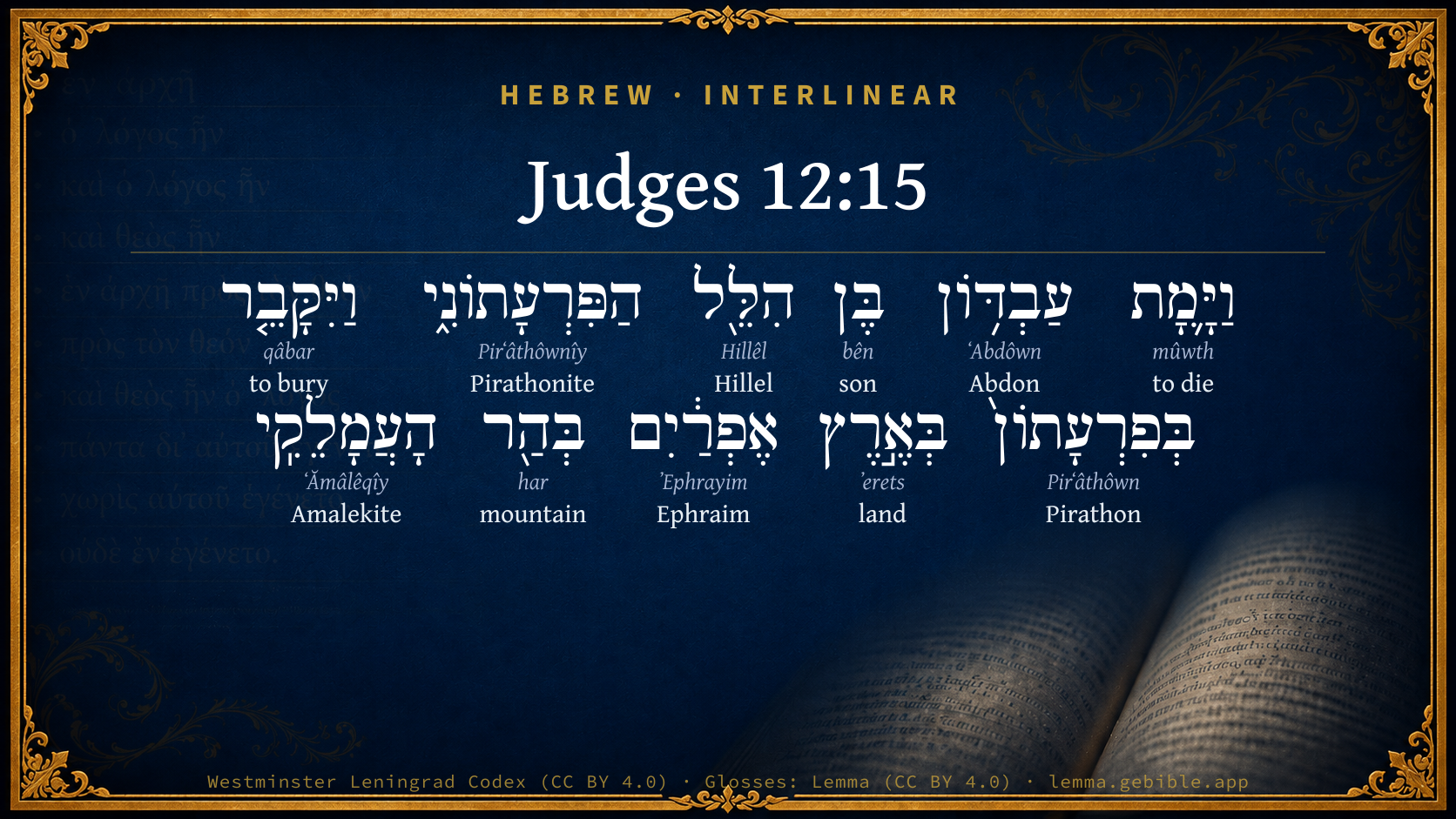
Hebrew (Westminster Leningrad Codex) Judges 12:15 appears in the Hebrew Old Testament. The text above is from the Westminster Leningrad Codex. Each word links to its Strong’s number, a concise gloss, and parsing drawn from the Open Scriptures Hebrew Bible morphology. Click any word for its full Brown-Driver-Briggs (BDB) entry.
Download image
Cite this verse

Judges 12:15 (World English Bible). Public Domain. Lemma interlinear Bible study tool, https://lemma.gebible.app/v/judges/12/15.

Show BibTeX & RIS
BibTeX
RIS
English Translation
Abdon the son of Hillel the Pirathonite died, and was buried in Pirathon in the land of Ephraim, in the hill-country of the Amalekites.
World English Bible · Public Domain
Highlights
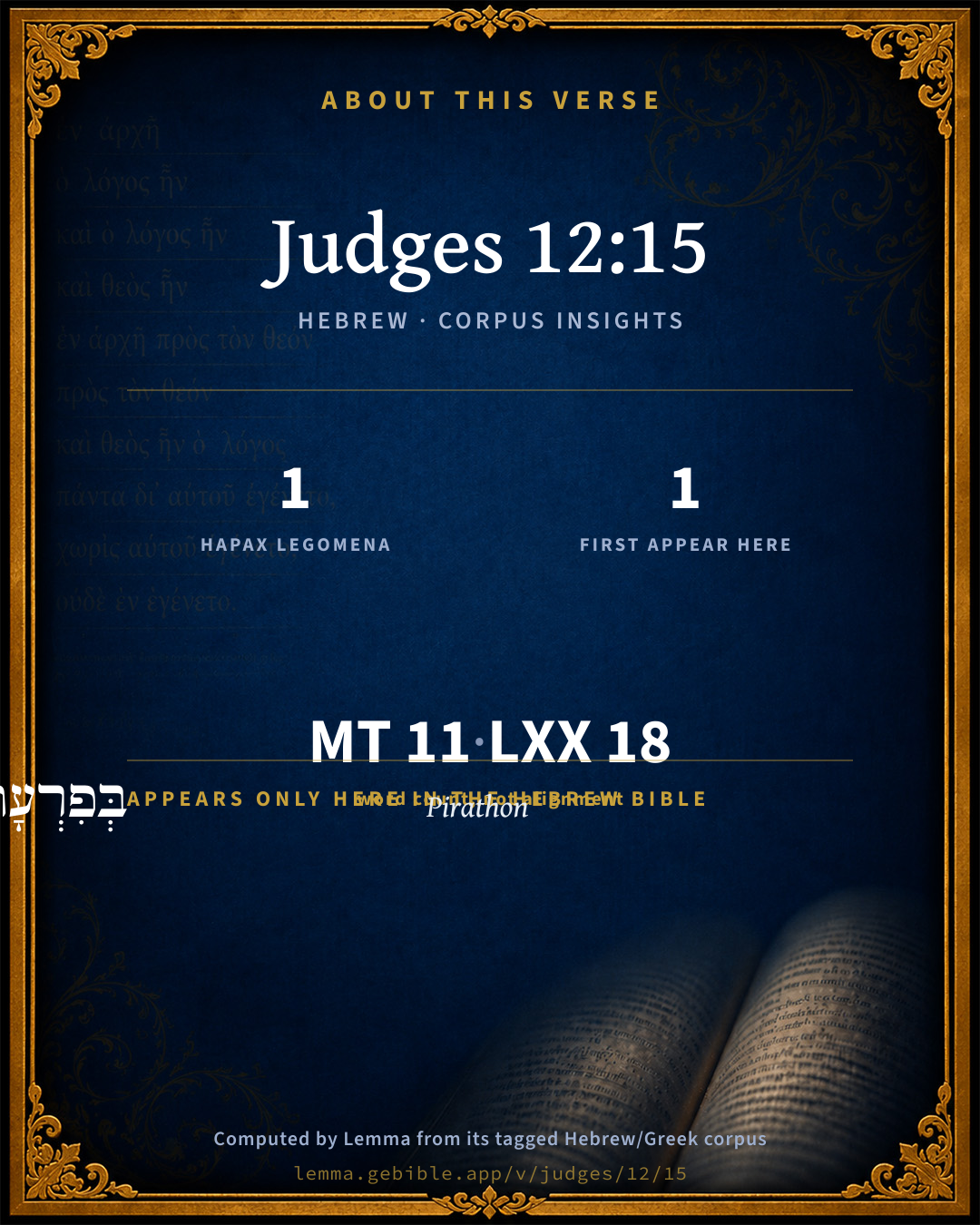
  • 1 hapax legomenon — only here in the Hebrew Bible
  • 1 first appearance in the Hebrew Bible
Full analysis ↓
Download a study sheet

One document with this verse’s original text, its word-by-word gloss line, the meaning frame, cross-references with their text, attributed commentary, and full source and license credits — printable, and it pastes into notes with its structure intact.

This verse Autodidact and up

Study sheet (.html) Plain text (.txt)

A passage Seminary Student

Up to 50 verses in one chapter. A passage sheet keeps up to 6 commentary sources and 12 cross-references per verse, in the order this page ranks them, and says so on the sheet whenever that leaves anything out. Ask for a single verse and you get the Autodidact verse sheet above.

Everything on this page stays free to read, with no account — the sheet is a download of what is already on screen, not access to it.

Want to remove ads? Support Godless Engineer
Compare translations 3

The same verse in 3 English versions, stacked beneath the original-language interlinear above. Click any original word for its lexicon entry.

Each is an independent rendering of the whole verse — the interlinear is not word-aligned to these translations.

Highlighted words mark where these versions differ — a whole-verse word diff, not a word-by-word alignment.

  • World English Bible Public Domain
    Abdon the son of Hillel the Pirathonite died, and was buried in Pirathon in the land of Ephraim, in the hill-country of the Amalekites.
  • King James Version Public Domain
    And Abdon the son of Hillel the Pirathonite died, and was buried in Pirathon in the land of Ephraim, in the mount of the Amalekites.
  • unfoldingWord Literal Text CC BY-SA 4.0
    Then Abdon, the son of Hillel, the Pirathonite, died and was buried in Pirathon in the land of Ephraim, in the hill country of the Amalekite.

unfoldingWord Literal Text — © unfoldingWord, licensed CC BY-SA 4.0. Word-aligned USFM3 via Door43 (git.door43.org/unfoldingWord/en_ult).

Versions to compare (up to 4)

3 of 4 selected

Show all 18 translations

Every available English version of this verse, each an independent rendering of the whole verse.

  • World English Bible Public Domain
    Abdon the son of Hillel the Pirathonite died, and was buried in Pirathon in the land of Ephraim, in the hill-country of the Amalekites.
  • Berean Standard Bible Public Domain
    Then Abdon son of Hillel, from Pirathon, died, and he was buried at Pirathon in Ephraim, in the hill country of the Amalekites.
  • Majority Standard Bible Public Domain
    Then Abdon son of Hillel, from Pirathon, died, and he was buried at Pirathon in Ephraim, in the hill country of the Amalekites.
  • King James Version Public Domain
    And Abdon the son of Hillel the Pirathonite died, and was buried in Pirathon in the land of Ephraim, in the mount of the Amalekites.
  • American Standard Version (1901) Public Domain
    And Abdon the son of Hillel the Pirathonite died, and was buried in Pirathon in the land of Ephraim, in the hill-country of the Amalekites.
  • Revised Version (1885) Public Domain
    And Abdon the son of Hillel the Pirathonite died, and was buried in Pirathon in the land of Ephraim, in the hill country of the Amalekites.
  • Geneva Bible (1599) Public Domain
    Then dyed Abdon the sonne of Hillel the Pirathonite, and was buryed in Pirathon, in ye lande of Ephraim, in the Mount of the Amalekites.
  • Douay-Rheims (1899) Public Domain
    And he died, and was buried in Pharathon in the land of Ephraim, in the mount of Amalech.
  • Young's Literal Translation Public Domain
    And Abdon son of Hillel, the Pirathonite, dieth, and is buried in Pirathon, in the land of Ephraim, in the hill-country of the Amalekite.
  • Literal Standard Version CC BY-SA 4.0
    And Abdon son of Hillel, the Pirathonite, dies, and is buried in Pirathon, in the land of Ephraim, in the hill-country of the Amalekite.
  • Unlocked Literal Bible CC BY-SA 4.0
    Abdon son of Hillel the Pirathonite died and was buried in Pirathon in the land of Ephraim in the hill country of the Amalekites.
  • unfoldingWord Literal Text CC BY-SA 4.0
    Then Abdon, the son of Hillel, the Pirathonite, died and was buried in Pirathon in the land of Ephraim, in the hill country of the Amalekite.
  • Darby Bible Public Domain
    Then Abdon the son of Hillel the Pira'thonite died, and was buried at Pira'thon in the land of E'phraim, in the hill country of the Amal'ekites.
  • World Messianic Bible Public Domain
    Abdon the son of Hillel the Pirathonite died, and was buried in Pirathon in the land of Ephraim, in the hill country of the Amalekites.
  • Webster's Bible Public Domain
    And Abdon the son of Hillel the Pirathonite died, and was buried in Pirathon in the land of Ephraim, in the mount of the Amalekites.
  • Free Bible Version CC BY-SA 4.0
    Then he died and was buried at Pirathon in the territory of Ephraim, in the hill country of the Amalekites.
  • Bible in Basic English Public Domain
    And Abdon, the son of Hillel, came to his death, and his body was put to rest in Pirathon in the land of Ephraim, in the hill-country of the Amalekites.
  • JPS Tanakh (1917) Public Domain
    And Abdon the son of Hillel the Pirathonite died, and was buried in Pirathon in the land of Ephraim, in the hill-country of the Amalekites.

Literal Standard Version (2020), Covenant Press — licensed CC BY-SA 4.0. Text via the HelloAO Bible API (eBible.org). Unlocked Literal Bible (unfoldingWord) — licensed CC BY-SA 4.0. Text via the HelloAO Bible API (eBible.org). unfoldingWord Literal Text — © unfoldingWord, licensed CC BY-SA 4.0. Word-aligned USFM3 via Door43 (git.door43.org/unfoldingWord/en_ult). Free Bible Version, Dr. Jonathan Gallagher — licensed CC BY-SA 4.0. Text via the HelloAO Bible API (eBible.org).

Word by word

More ways to search: Search by grammar → Find every occurrence → Compare this word →

Practice this passage: Drill this verse → Learn its vocabulary →

בְּפִרְעָתוֹן֙
Pirʻâthôwn
H6552
“in/at · Pirathon”
Preposition + Noun, Proper
Part of Speech
Preposition + Noun
Type
Proper
Full BDB Definition

Origin: from H6546

TWOT: None

Pirathon = "princely" - a town in Ephraim in the mount of the Amalekite - perhaps modern 'Ferata' located 1.5 miles (2.5 kilometers) south from Jaffa on the road to Nablus
  1. וַיָּ֛מָת mûwth H4191 “and · to die” Conjunction + Verb, Qal, Sequential Imperfect, 3rd Person, Masculine, Singular
  2. עַבְדּ֥וֹן ʻAbdôwn H5658 “Abdon” Noun, Proper
  3. בֶּן bên H1121 “son of” Noun, Common, Masculine, Singular, Construct
  4. הִלֵּ֖ל Hillêl H1985 “Hillel” Noun, Proper
  5. הַפִּרְעָתוֹנִ֑י Pirʻâthôwnîy H6553 “the · Pirathonite” Particle, Definite Article + Noun, Gentilic, Masculine, Singular, Absolute
  6. וַיִּקָּבֵ֤ר qâbar H6912 “and · to bury” Conjunction + Verb, Niphal, Sequential Imperfect, 3rd Person, Masculine, Singular
  7. בְּאֶ֣רֶץ ʼerets H776 “in/at · land of” Preposition + Noun, Common, Both, Singular, Construct
  8. אֶפְרַ֔יִם ʼEphrayim H669 “Ephraim” Noun, Proper
  9. בְּהַ֖ר har H2022 “in/at · mountain of” Preposition + Noun, Common, Masculine, Singular, Construct
  10. הָעֲמָלֵקִֽי ʻĂmâlêqîy H6003 “the · Amalekite” Particle, Definite Article + Noun, Gentilic, Masculine, Singular, Absolute

About this verse

These counts appear in no published source. They are computed here, from the morphology-tagged text and Lemma’s own curated glosses. What Lemma adds →

11
words
11
distinct lemmas
Historical
section

Notable vocabulary

1 hapax legomenon — a word that appears only here in the entire Hebrew Bible:

  • בְּפִרְעָתוֹן֙ Pirathon H6552

First appearance in Scripture

This word makes its first canonical appearance in the Hebrew Bible here:

  • בְּפִרְעָתוֹן֙ Pirathon H6552

Shared distinctive vocabulary

הִלֵּ֖ל Hillel H1985 occurs in 2 verses of the Hebrew Bible. Also found in:

Grammatical profile

  • 2 verbs
  • 9 nouns

Verb forms

  • וַיָּ֛מָת Qal · Sequential Imperfect
  • וַיִּקָּבֵ֤ר Niphal · Sequential Imperfect

Hebrew & Septuagint length

In English translation the verse runs 24 words from the Hebrew and 24 from the Septuagint (LXX English) — the same length.

A rough comparison of the two English renderings, which tokenize alike — not a word-level alignment.

Word counts can differ between the Hebrew and the Greek without any difference in meaning — e.g. the Hebrew direct-object marker אֵת has no separate Greek word, and Greek often adds the article ὁ.

In the original languages it is 11 Hebrew tokens and 18 Greek tokens — but the two are counted differently (Hebrew bundles its prefixes and suffixes into one token; the Greek is in lemma form), so that isn’t a like-for-like length.

Cross-references

7

Topical passages linked to Judges 12:15 in the Treasury of Scripture Knowledge — connected by theme and wording, ordered by reader-vote popularity; previews shown in the World English Bible.

  • Judges 5:14 Out of Ephraim [came down] they whose root is in Amalek; After you, Benjamin, among your peoples; Out of Machir came down governors, Out of Zebulun those who handle the marshal's staff.
  • 1 Samuel 15:7 Saul struck the Amalekites, from Havilah as you go to Shur, that is before Egypt.
  • Genesis 14:7 They returned, and came to En-mishpat (the same is Kadesh), and struck all the country of the Amalekites, and also the Amorites, that lived in Hazazon Tamar.
  • Exodus 17:8 Then Amalek came and fought with Israel in Rephidim.
  • Judges 3:13 He gathered to him the children of Ammon and Amalek; and he went and struck Israel, and they possessed the city of palm trees.
  • Judges 3:27 It happened, when he had come, that he blew a trumpet in the hill-country of Ephraim; and the children of Israel went down with him from the hill-country, and he before them.
  • 2 Samuel 23:30 Benaiah a Pirathonite, Hiddai of the brooks of Gaash.

Cross-references courtesy of OpenBible.info (CC BY 4.0).

Hebrew and Greek witnesses Masoretic Hebrew ↔ Greek Septuagint

The same verse in the two great witnesses to the Old Testament, shown verse-for-verse.

These are two independent witnesses, not word-aligned to each other, and the Septuagint is shown in lemma (dictionary) form.

Hebrew Judges 12:15 Masoretic · Westminster Leningrad Codex

וַיָּ֛מָת עַבְדּ֥וֹן בֶּן הִלֵּ֖ל הַפִּרְעָתוֹנִ֑י וַיִּקָּבֵ֤ר בְּפִרְעָתוֹן֙ בְּאֶ֣רֶץ אֶפְרַ֔יִם בְּהַ֖ר הָעֲמָלֵקִֽי

Abdon the son of Hillel the Pirathonite died, and was buried in Pirathon in the land of Ephraim, in the hill-country of the Amalekites.

World English Bible · Public Domain

Greek LXX Judges 12:15 Septuagint · lemma form

καί ἀποθνήσκω αβδων υἱός ελληλ ὁ φαραθωνίτης καί θάπτω ἐν φαραθωμ ἐν γῆ ἐφράιμ ἐν ὄρος ὁ αμαληκ

And Abdon the son of Ellel, the Pharathonite, died, and was buried in Pharathon in the land of Ephraim in the mount of Amalec.

LXX2012 (modern English Septuagint) · Public Domain

On this verse, The Cambridge Bible for Schools and Colleges discusses the Septuagint’s reading. Read the note in Commentary ↓

Hebrew: Westminster Leningrad Codex (CC BY 4.0). Greek: Septuagint (public domain); English from LXX2012 (modern English Septuagint) (Public Domain). How the Septuagint differs from the Hebrew →

Targum (Aramaic paraphrase)

1

The Targum is the ancient Jewish Aramaic paraphrase of the Hebrew Scriptures — an interpretive translation, not the Hebrew text itself. Onkelos (literal) and Pseudo-Jonathan (expansive) render the Torah, and Jonathan the Prophets. Coverage is partial: where no permissively-licensed English translation exists for a verse, only the Aramaic is shown. This is verse-level text, not a word-by-word alignment to the Hebrew.

  1. Targum Jonathan Prophets (Joshua–Malachi)
    וּמִית עַבְדוֹן בַּר הִלֵל דְמִפִּרְעָתוֹן וְאִתְקְבַר בְּפִרְעָתוֹן בְּאַרַע שִׁבְטָא דְאֶפְרַיִם בְּטוּרָא דְבֵית עֲמָלֵק:

    (no public-domain English translation for this verse)

    Targum Jonathan — Aramaic: “Mikraot Gedolot” (public domain). English: “Sefaria Community Translation” (CC0 1.0 (public-domain dedication)); “London "Chaldee Paraphrase," 1871” (public domain). Text via Sefaria.

Commentary

Notes on Judges 12:15 from classic Christian and Jewish commentators (each source and its license shown beneath its notes). The classic Christian expositions comment on the surrounding passage and are grouped to its opening verse, so a note may address several verses; the Jewish commentaries on the Tanakh (Rashi and others) are per-verse, so they appear only where the commentator wrote on this verse.

Lemma curates 59 commentaries, every one of them public domain or Creative Commons licensed, each selected and text-cleaned for this edition rather than reprinted as found. About our sources →

Trapp's Complete Commentary

John Trapp

Jdg 12:15 And Abdon the son of Hillel the Pirathonite died, and was buried in Pirathon in the land of Ephraim, in the mount of the Amalekites.

Ver. 15. And was buried in Pirathon.] Where Benaiah, David’s worthy, was born: and God loveth the places the better for that such and such of his servants were "born there." {Psa 87:4-6}

John Trapp, A Commentary or Exposition upon All the Books of the Old and New Testament (1647–1656) — public domain. Text from a community e-Sword module.

Joseph Benson's Commentary

Jdg 12:15. Mount of the Amalekites — So called from some remarkable exploit, done by or upon the Amalekites in that place. It is strange, that in the history of all these judges, there is not so much as once mention of the high-priest, or of any other priest or Levite, appearing either for counsel or action in any public affair, from Phinehas to Eli, which may well be computed two hundred and fifty years! Surely this intimates that the institution was chiefly intended to be typical, and that the benefits which were promised by it were to be chiefly looked for in its antitype, the everlasting priesthood of Christ, in comparison of which that priesthood had no glory.

Joseph Benson's Commentary on the Old and New Testaments (1811–1818) — public domain. Text from a community e-Sword module.

Ellicott's Commentary for English Readers

(15) In Pirathon.—The city of David’s hero, Benaiah (2Sa_23:30; 1Ma_9:50; Jos. Antt. xiii. 1, § 3). It is now Feratah, six miles west of Shechem.

In the mount of the Amalekites.—The phrase is explained in Jdg_12:14. It points to an early settlement of Amalekites in Central Palestine.

A Bible Commentary for English Readers, edited by Charles John Ellicott (1878–1897) — public domain. Text from a community e-Sword module.

The Cambridge Bible for Schools and Colleges

gen. ed. J. J. S. Perowne

15. in the land of Ephraim, in the hill country of the Amalekites] The Amalekites, however, were settled not in Ephraim, but in the Negeb, S. of Judah. It is true that ch. Jdg_5:14 brings Ephraim into connexion with Amalek, but the text is too uncertain (see note in loc.) to be used in support of the present passage. Moore (Polychr. Bible) notices that a group of mss. of LXX read ‘in the hill country of Ephraim, in the land of Sellçm,’ cf. 1Sa_9:4, where the Saaleim of LXX. cod. A. = the Hebr. Shaâlim. Since there is no way of accounting for the reading of these mss. by any confusion of letters, it may well be that they have preserved the true text here: in the hill country of E., in the land of Shaâlim.

The Cambridge Bible for Schools and Colleges (gen. ed. J. J. S. Perowne; Cambridge University Press, 1878–1918) — public domain. Text from a community e-Sword module.

Haydock's Catholic Bible Commentary

Amalec. The situation of this mountain, as well as of the town of Pharathon, is unknown. Some have supposed that Amalec had formerly had possession of this country, chap. v. 14. Septuagint (Alexandrian) reads "Mount Lanak." But this place occurs no where else, and other copies agree with the Vulgate. (Haydock) --- Amarias, who entered upon the pontificate the same year that Heli was born, died after a reign of 39 years, in the year of the world 2879, and left the care of the people to Achitob and Samson for 20 years. (Salien)

George Leo Haydock (1774–1849), Haydock's Catholic Family Bible and Commentary, 1859 edition — public domain. Excludes Psalms (Douay-Rheims chapter numbering differs from Protestant) and Deuterocanonical books (Catholic canon only).

Matthew Poole's English Annotations

So called from some remarkable exploit done either by or upon the Amalekites in that place.

Matthew Poole's English Annotations on the Holy Bible (1683–1685) — public domain. Text from a community e-Sword/MySword module.

The Pulpit Commentary

The mount of the Amalekites. This name points to some incident of which the memory is lost, though, with the usual tenacity of names, the name which once recorded it survives. It may have been some ancient settlement of the Amalekites, who were a very wandering, widespread race, which gave the name; or it may have been some great defeat and slaughter which they suffered from the Israelites, whose land they invaded, (Jud_1:6:3, 33) just as the rock Oreb and the wine-press of (Jud_1:7:25) commemorated the victory over those princes.

The Pulpit Commentary (1880–1919), ed. H.D.M. Spence-Jones & Joseph S. Exell — public domain. Text from a community e-Sword module.

John Wesley's Explanatory Notes

Mount of the Amalekites - So called from some remarkable exploit, done by, or upon the Amalekites in that place. It is strange, that in the history of all these Judges, there is not so much as once mention of the high-priest, or of any other priest or Levite, appearing either for council or action in any public affair, from Phinehas to Eli, which may well be computed two hundred and fifty years! Surely this intimates, that the institution was chiefly intended to be typical, and that the benefits which were promised by it, were to be chiefly looked for in its anti-type, the everlasting priesthood of Christ, in comparison of which that priesthood had no glory.

John Wesley, Explanatory Notes Upon the Whole Bible (1754–1765) — public domain. Text via the GEBible commentary corpus.

Lesson kit

Teaching starters — assembled from the data on this page, not authored interpretation. Every prompt links to the verse data it draws on. Edit before teaching.

Judges, in the Historical, opens this verse with 11 words (11 distinct Hebrew lemmas). Its most distinctive word is Pirʻâthôwn (“Pirathon”). A historical commentator’s framing appears above. Read the whole chapter for the surrounding context.

Discussion questions

  1. What does “Pirathon” (Pirʻâthôwn) contribute to the verse as a whole?
  2. 1 word here appears nowhere else in the Hebrew Bible. Why might the author reach for such rare wording?
  3. This is the first place “Pirathon” appears in Scripture (first appears here). What does its debut here establish?
  4. How does Judges 12:13, which shares the word «Hillel», read alongside this verse?
  5. These translations render this verse differently; the difference is in the English rendering, not the original. What questions does that raise?
  6. «וַיָּ֛מָת» is a Qal Sequential Imperfect verb. How does that grammatical form shape the action described?
  7. Compare how Trapp's Complete Commentary and Joseph Benson's Commentary read this verse. Where do they agree or differ?

Things to notice

Reading settings

Reading text

Shown beneath each verse's original-language words.

Old Testament
Old Testament edition

Read the OT as the Masoretic Hebrew (MT) or the Greek Septuagint (LXX).

English shown for the Greek Septuagint (in the Hebrew ↔ Greek comparison).

Comparing translations? Open the Compare panel on any verse page to stack up to four side by side.