
Judges 18:13

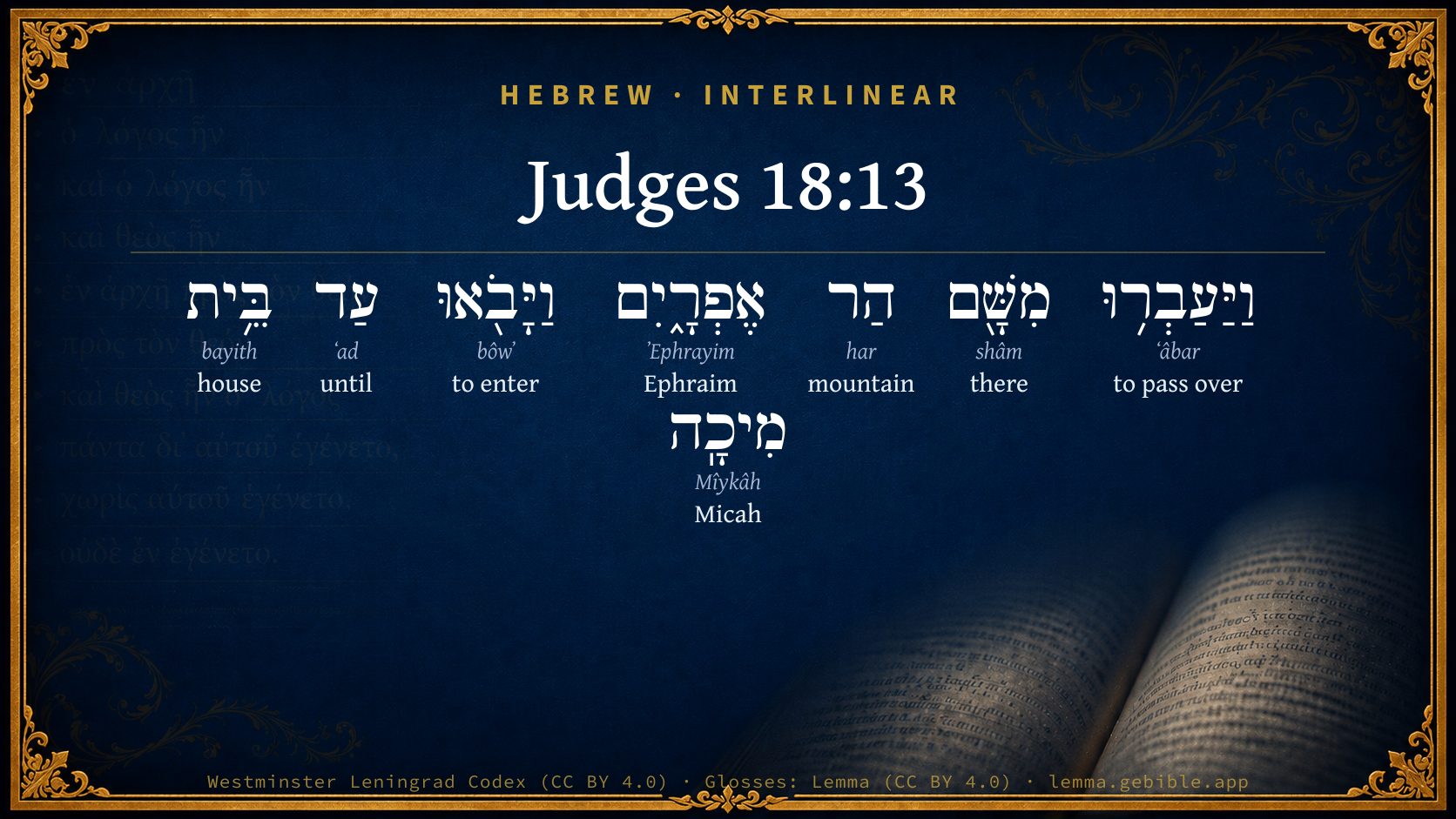
Hebrew (Westminster Leningrad Codex) Judges 18:13 appears in the Hebrew Old Testament. The text above is from the Westminster Leningrad Codex. Each word links to its Strong’s number, a concise gloss, and parsing drawn from the Open Scriptures Hebrew Bible morphology. Click any word for its full Brown-Driver-Briggs (BDB) entry.
Download image
Cite this verse

Judges 18:13 (World English Bible). Public Domain. Lemma interlinear Bible study tool, https://lemma.gebible.app/v/judges/18/13.

Show BibTeX & RIS
BibTeX
RIS
English Translation
They passed there to the hill-country of Ephraim, and came to the house of Micah.
World English Bible · Public Domain
Download a study sheet

One document with this verse’s original text, its word-by-word gloss line, the meaning frame, cross-references with their text, attributed commentary, and full source and license credits — printable, and it pastes into notes with its structure intact.

This verse Autodidact and up

Study sheet (.html) Plain text (.txt)

A passage Seminary Student

Up to 50 verses in one chapter. A passage sheet keeps up to 6 commentary sources and 12 cross-references per verse, in the order this page ranks them, and says so on the sheet whenever that leaves anything out. Ask for a single verse and you get the Autodidact verse sheet above.

Everything on this page stays free to read, with no account — the sheet is a download of what is already on screen, not access to it.

Want to remove ads? Support Godless Engineer
Compare translations 3

The same verse in 3 English versions, stacked beneath the original-language interlinear above. Click any original word for its lexicon entry.

Each is an independent rendering of the whole verse — the interlinear is not word-aligned to these translations.

Highlighted words mark where these versions differ — a whole-verse word diff, not a word-by-word alignment.

  • World English Bible Public Domain
    They passed there to the hill-country of Ephraim, and came to the house of Micah.
  • King James Version Public Domain
    And they passed thence unto mount Ephraim, and came unto the house of Micah.
  • unfoldingWord Literal Text CC BY-SA 4.0
    And they passed over from there the hill country of Ephraim, and they came to the house of Micah.

unfoldingWord Literal Text — © unfoldingWord, licensed CC BY-SA 4.0. Word-aligned USFM3 via Door43 (git.door43.org/unfoldingWord/en_ult).

Versions to compare (up to 4)

3 of 4 selected

Show all 18 translations

Every available English version of this verse, each an independent rendering of the whole verse.

  • World English Bible Public Domain
    They passed there to the hill-country of Ephraim, and came to the house of Micah.
  • Berean Standard Bible Public Domain
    And from there they traveled to the hill country of Ephraim and came to Micah’s house.
  • Majority Standard Bible Public Domain
    And from there they traveled to the hill country of Ephraim and came to Micah’s house.
  • King James Version Public Domain
    And they passed thence unto mount Ephraim, and came unto the house of Micah.
  • American Standard Version (1901) Public Domain
    And they passed thence unto the hill-country of Ephraim, and came unto the house of Micah.
  • Revised Version (1885) Public Domain
    And they passed thence unto the hill country of Ephraim, and came unto the house of Micah.
  • Geneva Bible (1599) Public Domain
    And they went thence vnto mount Ephraim, and came to the house of Michah.
  • Douay-Rheims (1899) Public Domain
    From thence they passed into mount Ephraim. And when they were come to the house of Michas,
  • Young's Literal Translation Public Domain
    And they pass over thence `to' the hill-country of Ephraim, and come in unto the house of Micah.
  • Literal Standard Version CC BY-SA 4.0
    And they pass over there [to] the hill-country of Ephraim, and come to the house of Micah.
  • Unlocked Literal Bible CC BY-SA 4.0
    They went away from there to the hill country of Ephraim and came to the house of Micah.
  • unfoldingWord Literal Text CC BY-SA 4.0
    And they passed over from there the hill country of Ephraim, and they came to the house of Micah.
  • Darby Bible Public Domain
    And they passed on from there to the hill country of E'phraim, and came to the house of Micah.
  • World Messianic Bible Public Domain
    They passed from there to the hill country of Ephraim, and came to the house of Micah.
  • Webster's Bible Public Domain
    And they passed thence to mount Ephraim, and came to the house of Micah.
  • Free Bible Version CC BY-SA 4.0
    Then they left from there and went into the hill country of Ephraim and came to Micah's house.
  • Bible in Basic English Public Domain
    From there they went on to the hill-country of Ephraim and came to the house of Micah.
  • JPS Tanakh (1917) Public Domain
    And they passed thence unto the hill-country of Ephraim, and came unto the house of Micah.

Literal Standard Version (2020), Covenant Press — licensed CC BY-SA 4.0. Text via the HelloAO Bible API (eBible.org). Unlocked Literal Bible (unfoldingWord) — licensed CC BY-SA 4.0. Text via the HelloAO Bible API (eBible.org). unfoldingWord Literal Text — © unfoldingWord, licensed CC BY-SA 4.0. Word-aligned USFM3 via Door43 (git.door43.org/unfoldingWord/en_ult). Free Bible Version, Dr. Jonathan Gallagher — licensed CC BY-SA 4.0. Text via the HelloAO Bible API (eBible.org).

Word by word

More ways to search: Search by grammar → Find every occurrence → Compare this word →

Practice this passage: Drill this verse → Learn its vocabulary →

מִיכָֽה
Mîykâh
H4318
“Micah”
Noun, Proper
Part of Speech
Noun
Type
Proper
Full BDB Definition

Origin: an abbrev. of H4320

TWOT: None

Micah or Micaiah or Michah = "who is like God" - the 6th in order of the minor prophets; a native of Moresheth, he prophesied during the reigns of Jotham, Ahaz, and Hezekiah of Judah, and was contemporary with the prophets Hosea, Amos, and Isaiah - an Ephraimite during the period of the judges - a descendant of Joel the Reubenite - son of Meribbaal and grandson of Jonathan - a Kohathite Levite, the eldest son of Uzziel the brother of Amram - father of Abdon, a man of high station in the reign of Josiah - son of Imlah and a prophet of Samaria who predicted the defeat and death of king Ahab of Israel
  1. וַיַּעַבְר֥וּ ʻâbar H5674 “and · to pass over” Conjunction + Verb, Qal, Sequential Imperfect, 3rd Person, Masculine, Plural
  2. מִשָּׁ֖ם shâm H8033 “from · there” Preposition + Adverb
  3. הַר har H2022 “mountain of” Noun, Common, Masculine, Singular, Construct
  4. אֶפְרָ֑יִם ʼEphrayim H669 “Ephraim” Noun, Proper
  5. וַיָּבֹ֖אוּ bôwʼ H935 “and · to enter” Conjunction + Verb, Qal, Sequential Imperfect, 3rd Person, Masculine, Plural
  6. עַד ʻad H5704 “until” Preposition
  7. בֵּ֥ית bayith H1004 “house of” Noun, Common, Masculine, Singular, Construct

About this verse

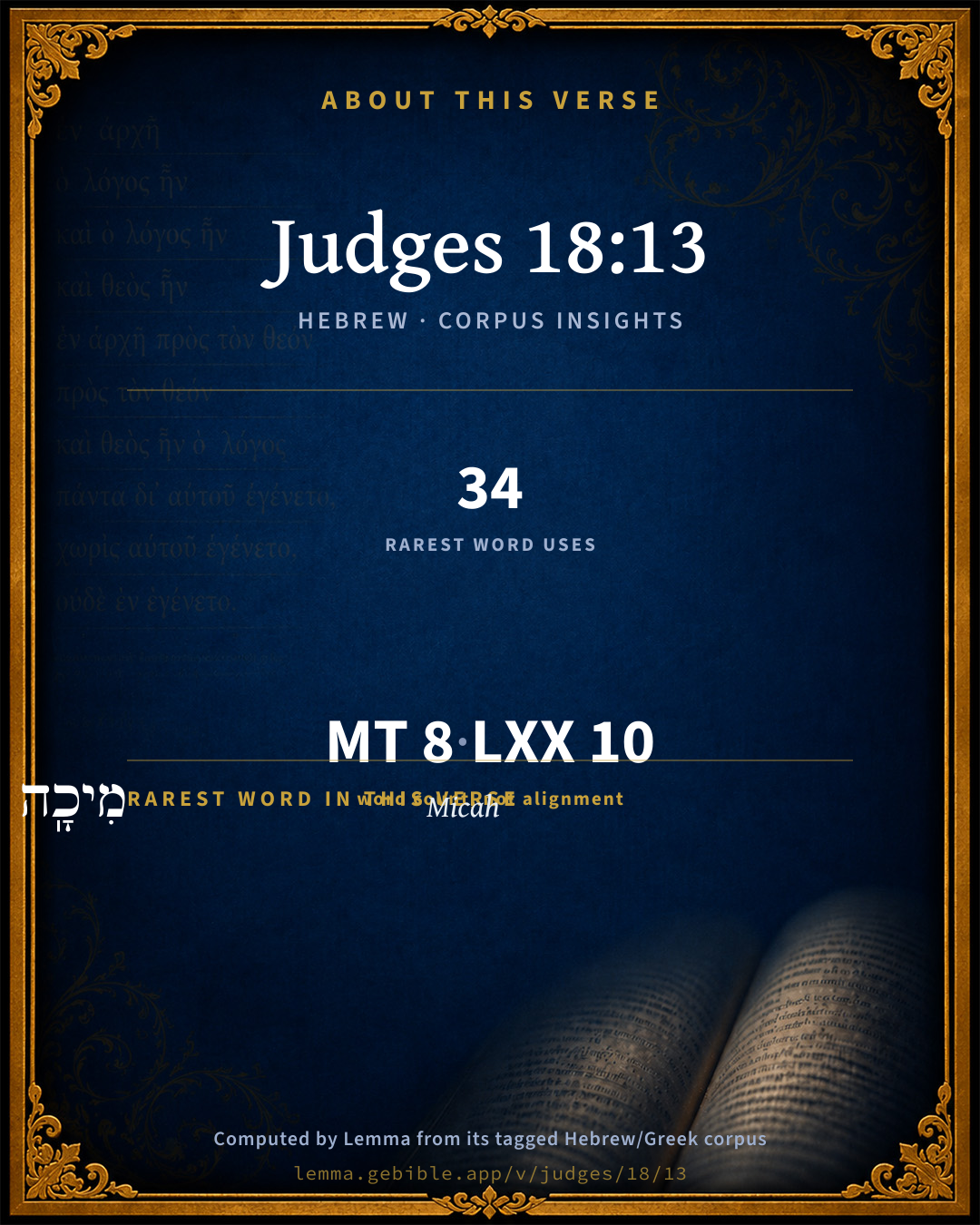
These counts appear in no published source. They are computed here, from the morphology-tagged text and Lemma’s own curated glosses. What Lemma adds →

8
words
8
distinct lemmas
Historical
section

Shared distinctive vocabulary

מִיכָֽה Micah H4318 occurs in 31 verses of the Hebrew Bible. Also found in:

Grammatical profile

  • 2 verbs
  • 4 nouns
  • 1 preposition
  • 1 adverb

Verb forms

  • וַיַּעַבְר֥וּ Qal · Sequential Imperfect
  • וַיָּבֹ֖אוּ Qal · Sequential Imperfect

Hebrew & Septuagint length

In English translation the verse runs 15 words from the Hebrew and 17 from the Septuagint (LXX English) — closely comparable.

A rough comparison of the two English renderings, which tokenize alike — not a word-level alignment.

Word counts can differ between the Hebrew and the Greek without any difference in meaning — e.g. the Hebrew direct-object marker אֵת has no separate Greek word, and Greek often adds the article ὁ.

In the original languages it is 8 Hebrew tokens and 10 Greek tokens — but the two are counted differently (Hebrew bundles its prefixes and suffixes into one token; the Greek is in lemma form), so that isn’t a like-for-like length.

Cross-references

5

Topical passages linked to Judges 18:13 in the Treasury of Scripture Knowledge — connected by theme and wording, ordered by reader-vote popularity; previews shown in the World English Bible.

  • Joshua 24:30 They buried him in the border of his inheritance in Timnathserah, which is in the hill-country of Ephraim, on the north of the mountain of Gaash.
  • Joshua 24:33 Eleazar the son of Aaron died; and they buried him in the hill of Phinehas his son, which was given him in the hill-country of Ephraim.
  • Judges 17:1 There was a man of the hill-country of Ephraim, whose name was Micah.
  • Judges 18:2–3 The children of Dan sent of their family five men from their whole number, men of valor, from Zorah, and from Eshtaol, to spy out the land, and to search it; and they said to them, Go, search the land. They came to the hill-country of Ephraim, to the house of Micah, and lodged there.
  • Judges 19:1 It happened in those days, when there was no king in Israel, that there was a certain Levite sojourning on the farther side of the hill-country of Ephraim, who took to him a concubine out of Bethlehem Judah.

Cross-references courtesy of OpenBible.info (CC BY 4.0).

Hebrew and Greek witnesses Masoretic Hebrew ↔ Greek Septuagint

The same verse in the two great witnesses to the Old Testament, shown verse-for-verse.

These are two independent witnesses, not word-aligned to each other, and the Septuagint is shown in lemma (dictionary) form.

Hebrew Judges 18:13 Masoretic · Westminster Leningrad Codex

וַיַּעַבְר֥וּ מִשָּׁ֖ם הַר אֶפְרָ֑יִם וַיָּבֹ֖אוּ עַד בֵּ֥ית מִיכָֽה

They passed there to the hill-country of Ephraim, and came to the house of Micah.

World English Bible · Public Domain

Greek LXX Judges 18:13 Septuagint · lemma form

καί παραἔρχομαι ἐκεῖθεν ὄρος ἐφράιμ καί ἔρχομαι ἕως οἶκος μιχαιας

And they went on thence to the mount of Ephraim, and came to the house of Michaias.

LXX2012 (modern English Septuagint) · Public Domain

Hebrew: Westminster Leningrad Codex (CC BY 4.0). Greek: Septuagint (public domain); English from LXX2012 (modern English Septuagint) (Public Domain). How the Septuagint differs from the Hebrew →

Targum (Aramaic paraphrase)

1

The Targum is the ancient Jewish Aramaic paraphrase of the Hebrew Scriptures — an interpretive translation, not the Hebrew text itself. Onkelos (literal) and Pseudo-Jonathan (expansive) render the Torah, and Jonathan the Prophets. Coverage is partial: where no permissively-licensed English translation exists for a verse, only the Aramaic is shown. This is verse-level text, not a word-by-word alignment to the Hebrew.

  1. Targum Jonathan Prophets (Joshua–Malachi)
    וַעֲבָרוּ מִתַּמָן לְטוּרָא דְבֵית אֶפְרַיִם וַאֲתוֹ עַד בֵּית מִיכָה:

    (no public-domain English translation for this verse)

    Targum Jonathan — Aramaic: “Mikraot Gedolot” (public domain). English: “Sefaria Community Translation” (CC0 1.0 (public-domain dedication)); “London "Chaldee Paraphrase," 1871” (public domain). Text via Sefaria.

Commentary

Notes on Judges 18:13 from classic Christian and Jewish commentators (each source and its license shown beneath its notes). The classic Christian expositions comment on the surrounding passage and are grouped to its opening verse, so a note may address several verses; the Jewish commentaries on the Tanakh (Rashi and others) are per-verse, so they appear only where the commentator wrote on this verse.

Lemma curates 59 commentaries, every one of them public domain or Creative Commons licensed, each selected and text-cleaned for this edition rather than reprinted as found. About our sources →

Trapp's Complete Commentary

John Trapp

Jdg 18:13 And they passed thence unto mount Ephraim, and came unto the house of Micah.

Ver. 13. And came unto the house of Micah.] Whom the five spies ill requited for his former hospitality and courtesy: Perraro grati reperiuntur, saith Cicero. A thankful man is a rare bird. Ungrateful persons are but like a mouse in a satchel or a snake in one’s bosom, who do ill repay their hosts for their lodging. Xerxes dealt barbarously with the sons of Pythias, who gave free quarter to that whole huge army of his. See Jdg 18:2.

John Trapp, A Commentary or Exposition upon All the Books of the Old and New Testament (1647–1656) — public domain. Text from a community e-Sword module.

Ellicott's Commentary for English Readers

(13) Unto the house of Micah.—Probably the precincts of the new sanctuary gave their name to a sort of village—Beth-Micah.

A Bible Commentary for English Readers, edited by Charles John Ellicott (1878–1897) — public domain. Text from a community e-Sword module.

John Gill's Exposition

And they passed thence unto Mount Ephraim,.... Steering their coast still northward; this, according to Bunting (b), was eight miles from Kirjathjearim, or Mahanehdan, in which Micah's house was, for as yet they were not come to it, see Jdg 18:15.

(b) Ibid. (Travels of the Patriarchs, &c. p. 112.)

John Gill's Exposition of the Whole Bible (1746–1763) — public domain (CC PDM 1.0). Text via the HelloAO Bible API.

Haydock's Catholic Bible Commentary

CHAPTER XVIII.

George Leo Haydock (1774–1849), Haydock's Catholic Family Bible and Commentary, 1859 edition — public domain. Excludes Psalms (Douay-Rheims chapter numbering differs from Protestant) and Deuterocanonical books (Catholic canon only).

Matthew Poole's English Annotations

i.e. To the town in which his house was, for they were not yet entered into it.

Matthew Poole's English Annotations on the Holy Bible (1683–1685) — public domain. Text from a community e-Sword/MySword module.

John Wesley's Explanatory Notes

To the house - That is, to the town in which his house was, for they were not yet entered into it.

John Wesley, Explanatory Notes Upon the Whole Bible (1754–1765) — public domain. Text via the GEBible commentary corpus.

Keil & Delitzsch

C. F. Keil & F. Delitzsch

From this point they went across to the mountains of Ephraim, and came to Micah's house, i.e., to a place near it.

Keil & Delitzsch — Biblical Commentary on the Old Testament (1861–1891) — public domain (CC PDM 1.0). Text via the HelloAO Bible API. (Old Testament only.)

Kretzmann's Popular Commentary

Paul E. Kretzmann

The Priest of Micah Taken to Laish

v. 13. And they passed thence unto Mount Ephraim, along the way taken by the spies, and came unto the house of Micah.

v. 14. Then answered the five men that went to spy out the country of Laish, and said unto their brethren, giving in advance the information which the members of their tribe would presently ask for, Do ye know that there is in these houses an ephod, and teraphim, and a graven image, and a molten image, a carved and chased idol with its molten pedestal? Now, therefore, consider what ye have to do, the suggestion of the spies being that the Danites should not overlook this opportunity to provide themselves with a worship of their own.

v. 15. And they, acting upon the hint received, turned thitherward, and came to the house of the young man, the Levite, where this private sanctuary was, fully equipped with everything needed in such an institution, even unto the house of Micah, and saluted him, they greeted the priest most kindly.

v. 16. And the six hundred men appointed with their weapons of war, which were of the children of Dan, stood by the entering of the gate, at the entrance to the enclosure, near the sanctuary.

v. 17. And the five men that went to spy out the land went up, and came in thither, being familiar with the location of everything from their previous visit, and took the graven image, and the ephod, and the teraphim, and the molten image, all the equipment of the sanctuary, the objects used in worship by Micah; and the priest stood in the entering of the gate with the six hundred men that were appointed with weapons of war. This strange behavior of the priest in permitting the robbery of the sanctuary for whose care he was hired is now explained, for this paragraph is here entered, although the event took place before the Levite deserted his post.

v. 18. And these went into Micah’s house, and fetched the carved image, the ephod, and the teraphim, and the molten image. Then said the priest unto them, it was then that he had tried to interfere, What do ye?

v. 19. And they said unto him, Hold thy peace, be absolutely quiet; lay thine hand upon thy mouth, and go with us, and be to us a father and a priest, the position which he had occupied in the house of Micah, Jdg 17:10. Is it better for thee to be a priest unto the house of one man, or that thou be a priest unto a tribe and a family in Israel? That was the argument which had appealed to the Levite’s ambitious and avaricious heart and caused him to turn his back when the five spies plundered Micah’s sanctuary.

v. 20. And the priest’s heart was glad, and he took the ephod, and the teraphim, and the graven image, and went in the midst of the people, where he was safe.

v. 21. So they turned and departed, and put the little ones and the cattle and the carriage, all their most valuable possessions, before them, to have them safe in case they should be attacked by Micah and his men.

v. 22. And when they were a good way from the house of Micah, the men that were in the houses near to Micah’s house, both those belonging to his own establishment and those of the village which arose near the sanctuary, were gathered together and overtook the children of Dan.

v. 23. And they cried unto the children of Dan, hailed them, bidding them stop. And they turned their faces, and said unto Micah, What aileth thee that thou comest with such a company? They feigned ignorance of any happening concerning Micah.

v. 24. And he said, Ye have taken away my gods which I made, and the priest, and ye are gone away; and what have I more? He no longer tries to deceive himself and others that it was really Jehovah’s worship which he was carrying on in his house, but calls his sin by the right name, confessing his idolatry. And what is this that ye say unto me, What aileth thee?

v. 25. And the children of Dan said unto him, depending upon their superior power and holding that might makes right, Let not thy voice be heard among us, lest angry fellows, men bitter of soul, of a fierce disposition, run upon thee, and thou lose thy life with the lives of thy household, any rash act on his part would cause not only his own death, but that of his entire family.

v. 26. And the children of Dan, having bullied Micah into silence, went their way; and when Micah saw that they were too strong for him, he turned and went back unto his house. He was a sadder and a wiser man, who, strictly speaking, had no redress, as he had sinned against Jehovah and could not appeal to the Lord of Israel for revenge.

v. 27. And they took the things which Micah had made, and the priest which he had, and came unto Laish, unto a people that were at quiet and secure, v. 7; and they smote them with the edge of the sword, in a sudden attack, and burned the city with fire.

v. 28. And there was no deliverer, as the spies had rightly reported, because it was far from Zidon, and they had no business with any man; and it was in the valley that lieth by Beth-rehob, extending to that city, along the valley of the upper Jordan. And they built a city and dwelt therein.

v. 29. And they called the name of the city Dan, after the name of Dan, their father, their progenitor, who was born unto Israel; howbeit the name of the city was Laish, or Leshem, Jos 19:47-48, at the first.

v. 30. And the children of Dan set up the graven image, for idolatrous purposes; and Jonathan, the son of Gershom, the son of Manasseh, rather, the descendant of Moses, for that, apparently, was the name of the idolatrous priest, he and his sons were priests to the tribe of Dan until the day of the captivity of the land, namely, when the Philistines captured the Ark of the Covenant and became masters of the entire country, 1Sa 4:21-22.

v. 31. And they set them up Micah’s graven image, which he made, all the time that the house of God was in Shiloh. Mark: Idolatry in every form, false doctrine, quickly and easily finds adherents and is hard to eradicate when once established. He that is guilty of introducing false doctrine not only deceives himself, but also gives occasion to others to fall. The harm usually extends to many generations and destroys many souls.

Paul E. Kretzmann, Popular Commentary of the Bible (1921–1924) — public domain. Text from a community e-Sword module.

unfoldingWord translationNotes

Door43 World Missions Community

Laish

Translate the name of this town the same as you did in Judges 18:7.

in these houses there are an ephod, ... metal figure? Decide ... will do

The five men asked this question to suggest and encourage the men that they should steal the idols. This can be written as a statement, and the implied information may be given in a parenthetical phrase. AT: "these houses contain an ephod, ... metal figure. (They were suggesting that the men steal these things.) Decide ... will do" (See: Rhetorical Question and Assumed Knowledge and Implicit Information)

in these houses there are

"in one of these house there is" or "among these houses is"

translationWords

Ephraim

house

ephod

household

false god

unfoldingWord translationNotes — © Distant Shores Media and the Door43 World Missions Community, licensed CC BY-SA 4.0. Source: git.door43.org/Door43/en_tn.

Lesson kit

Teaching starters — assembled from the data on this page, not authored interpretation. Every prompt links to the verse data it draws on. Edit before teaching.

Judges, in the Historical, opens this verse with 8 words (8 distinct Hebrew lemmas). Its most distinctive word is Mîykâh (“Micah”). A historical commentator’s framing appears above. Read the whole chapter for the surrounding context.

Discussion questions

  1. What does “Micah” (Mîykâh) contribute to the verse as a whole?
  2. How does Judges 17:5, which shares the word «Micah», read alongside this verse?
  3. These translations render this verse differently. What is at stake in choosing one wording over another?
  4. «וַיַּעַבְר֥וּ» is a Qal Sequential Imperfect verb. How does that grammatical form shape the action described?
  5. Compare how Trapp's Complete Commentary and Ellicott's Commentary for English Readers read this verse. Where do they agree or differ?

Things to notice

Reading settings

Reading text

Shown beneath each verse's original-language words.

Old Testament
Old Testament edition

Read the OT as the Masoretic Hebrew (MT) or the Greek Septuagint (LXX).

English shown for the Greek Septuagint (in the Hebrew ↔ Greek comparison).

Comparing translations? Open the Compare panel on any verse page to stack up to four side by side.