
Judges 17:8

Hebrew (Westminster Leningrad Codex) Judges 17:8 appears in the Hebrew Old Testament. The text above is from the Westminster Leningrad Codex. Each word links to its Strong’s number, a concise gloss, and parsing drawn from the Open Scriptures Hebrew Bible morphology. Click any word for its full Brown-Driver-Briggs (BDB) entry.
Download image
Cite this verse

Judges 17:8 (World English Bible). Public Domain. Lemma interlinear Bible study tool, https://lemma.gebible.app/v/judges/17/8.

Show BibTeX & RIS
BibTeX
RIS
English Translation
The man departed out of the city, out of Bethlehem Judah, to sojourn where he could find [a place], and he came to the hill-country of Ephraim to the house of Micah, as he traveled.
World English Bible · Public Domain
Download a study sheet

One document with this verse’s original text, its word-by-word gloss line, the meaning frame, cross-references with their text, attributed commentary, and full source and license credits — printable, and it pastes into notes with its structure intact.

This verse Autodidact and up

Study sheet (.html) Plain text (.txt)

A passage Seminary Student

Up to 50 verses in one chapter. A passage sheet keeps up to 6 commentary sources and 12 cross-references per verse, in the order this page ranks them, and says so on the sheet whenever that leaves anything out. Ask for a single verse and you get the Autodidact verse sheet above.

Everything on this page stays free to read, with no account — the sheet is a download of what is already on screen, not access to it.

Want to remove ads? Support Godless Engineer
Compare translations 3

The same verse in 3 English versions, stacked beneath the original-language interlinear above. Click any original word for its lexicon entry.

Each is an independent rendering of the whole verse — the interlinear is not word-aligned to these translations.

Highlighted words mark where these versions differ — a whole-verse word diff, not a word-by-word alignment.

  • World English Bible Public Domain
    The man departed out of the city, out of Bethlehem Judah, to sojourn where he could find [a place], and he came to the hill-country of Ephraim to the house of Micah, as he traveled.
  • King James Version Public Domain
    And the man departed out of the city from Bethlehemjudah to sojourn where he could find a place: and he came to mount Ephraim to the house of Micah, as he journeyed.
  • unfoldingWord Literal Text CC BY-SA 4.0
    And the man went from the city, from Bethlehem Judah, to sojourn in where he might find. And he entered the hill country of Ephraim, to the house of Micah, to make his way.

unfoldingWord Literal Text — © unfoldingWord, licensed CC BY-SA 4.0. Word-aligned USFM3 via Door43 (git.door43.org/unfoldingWord/en_ult).

Versions to compare (up to 4)

3 of 4 selected

Show all 18 translations

Every available English version of this verse, each an independent rendering of the whole verse.

  • World English Bible Public Domain
    The man departed out of the city, out of Bethlehem Judah, to sojourn where he could find [a place], and he came to the hill-country of Ephraim to the house of Micah, as he traveled.
  • Berean Standard Bible Public Domain
    This man left the city of Bethlehem in Judah to settle where he could find a place. And as he traveled, he came to Micah’s house in the hill country of Ephraim.
  • Majority Standard Bible Public Domain
    This man left the city of Bethlehem in Judah to settle where he could find a place. And as he traveled, he came to Micah’s house in the hill country of Ephraim.
  • King James Version Public Domain
    And the man departed out of the city from Bethlehemjudah to sojourn where he could find a place: and he came to mount Ephraim to the house of Micah, as he journeyed.
  • American Standard Version (1901) Public Domain
    And the man departed out of the city, out of Beth-lehem-judah, to sojourn where he could find `a place', and he came to the hill-country of Ephraim to the house of Micah, as he journeyed.
  • Revised Version (1885) Public Domain
    And the man departed out of the city, out of Beth-lehem-judah, to sojourn where he could find a place: and he came to the hill country of Ephraim to the house of Micah, as he journeyed.
  • Geneva Bible (1599) Public Domain
    And the man departed out of the citie, euen out of Beth-lehem Iudah, to dwell where he coulde finde a place: and as he iourneyed, he came to mount Ephraim to the house of Michah
  • Douay-Rheims (1899) Public Domain
    Now he went out from the city of Bethlehem, and desired to sojourn wheresoever he should find it convenient for him. And when he was come to mount Ephraim, as he was on his journey, and had turned aside a little into the house of Michas,
  • Young's Literal Translation Public Domain
    And the man goeth out of the city, out of Beth-Lehem-Judah, to sojourn where he doth find, and cometh to the hill-country of Ephraim, unto the house of Micah, to work his way.
  • Literal Standard Version CC BY-SA 4.0
    And the man goes out of the city, out of Beth-Lehem-Judah, to sojourn where he finds, and comes to the hill-country of Ephraim, to the house of Micah, to work his way.
  • Unlocked Literal Bible CC BY-SA 4.0
    The man left Bethlehem in Judah to go and find a place to live. As he journeyed, he came to Micah's house in the hill country of Ephraim.
  • unfoldingWord Literal Text CC BY-SA 4.0
    And the man went from the city, from Bethlehem Judah, to sojourn in where he might find. And he entered the hill country of Ephraim, to the house of Micah, to make his way.
  • Darby Bible Public Domain
    And the man departed from the town of Bethlehem in Judah, to live where he could find a place; and as he journeyed, he came to the hill country of E'phraim to the house of Micah.
  • World Messianic Bible Public Domain
    The man departed out of the city, out of Bethlehem Judah, to live where he could find a place, and he came to the hill country of Ephraim, to the house of Micah, as he traveled.
  • Webster's Bible Public Domain
    And the man departed out of the city from Beth-lehem-judah, to sojourn where he could find a place: and he came to mount Ephraim to the house of Micah, as he journeyed.
  • Free Bible Version CC BY-SA 4.0
    left Bethlehem to look for a different place to live. As he traveled through the hill country of Ephraim, he came to Micah's house.
  • Bible in Basic English Public Domain
    And he went away from the town of Beth-lehem-judah, looking for somewhere to make his living-place; and on his journey he came to the hill-country of Ephraim, to the house of Micah.
  • JPS Tanakh (1917) Public Domain
    And the man departed out of the city, out of Beth-lehem in Judah, to sojourn where he could find a place; and he came to the hill-country of Ephraim to the house of Micah, as he journeyed.

Literal Standard Version (2020), Covenant Press — licensed CC BY-SA 4.0. Text via the HelloAO Bible API (eBible.org). Unlocked Literal Bible (unfoldingWord) — licensed CC BY-SA 4.0. Text via the HelloAO Bible API (eBible.org). unfoldingWord Literal Text — © unfoldingWord, licensed CC BY-SA 4.0. Word-aligned USFM3 via Door43 (git.door43.org/unfoldingWord/en_ult). Free Bible Version, Dr. Jonathan Gallagher — licensed CC BY-SA 4.0. Text via the HelloAO Bible API (eBible.org).

Word by word

More ways to search: Search by grammar → Find every occurrence → Compare this word →

Practice this passage: Drill this verse → Learn its vocabulary →

מִיכָ֖ה
Mîykâh
H4318
“Micah”
Noun, Proper
Part of Speech
Noun
Type
Proper
Full BDB Definition

Origin: an abbrev. of H4320

TWOT: None

Micah or Micaiah or Michah = "who is like God" - the 6th in order of the minor prophets; a native of Moresheth, he prophesied during the reigns of Jotham, Ahaz, and Hezekiah of Judah, and was contemporary with the prophets Hosea, Amos, and Isaiah - an Ephraimite during the period of the judges - a descendant of Joel the Reubenite - son of Meribbaal and grandson of Jonathan - a Kohathite Levite, the eldest son of Uzziel the brother of Amram - father of Abdon, a man of high station in the reign of Josiah - son of Imlah and a prophet of Samaria who predicted the defeat and death of king Ahab of Israel
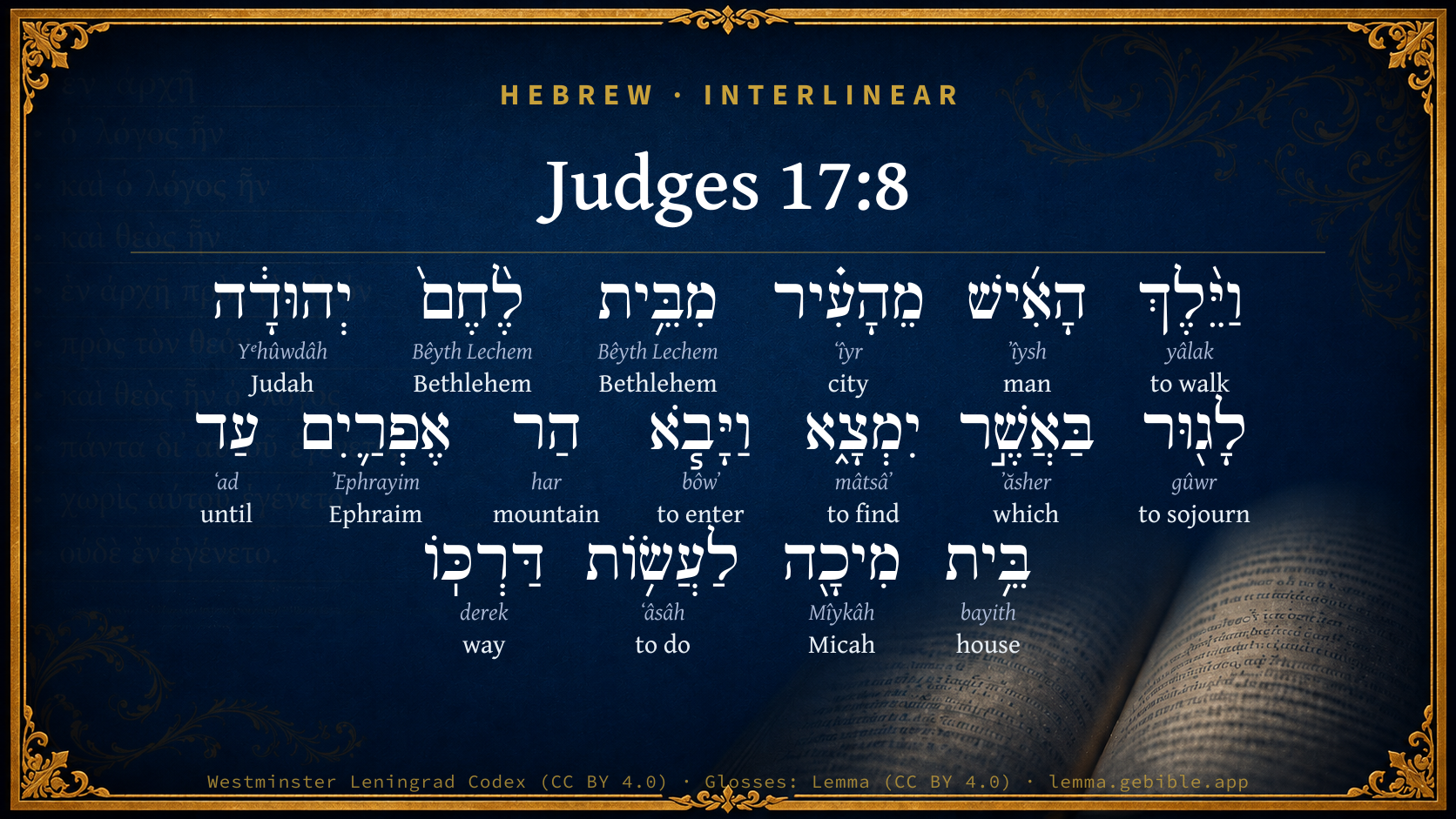
  1. וַיֵּ֨לֶךְ yâlak H3212 “and · to walk” Conjunction + Verb, Qal, Sequential Imperfect, 3rd Person, Masculine, Singular
  2. הָאִ֜ישׁ ʼîysh H376 “the · man” Particle, Definite Article + Noun, Common, Masculine, Singular, Absolute
  3. מֵהָעִ֗יר ʻîyr H5892 “from · the · city” Preposition + Particle, Definite Article + Noun, Common, Feminine, Singular, Absolute
  4. מִבֵּ֥ית Bêyth Lechem H1035 “from · Bethlehem” Preposition + Noun, Proper
  5. לֶ֨חֶם֙ Bêyth Lechem H1035 “Bethlehem” Noun, Proper
  6. יְהוּדָ֔ה Yᵉhûwdâh H3063 “Judah” Noun, Proper
  7. לָג֖וּר gûwr H1481 “to sojourn” Preposition + Verb, Qal, Infinitive Construct
  8. בַּאֲשֶׁ֣ר ʼăsher H834 “in/at · which” Preposition + Particle, Relative
  9. יִמְצָ֑א mâtsâʼ H4672 “to find” Verb, Qal, Imperfect, 3rd Person, Masculine, Singular
  10. וַיָּבֹ֧א bôwʼ H935 “and · to enter” Conjunction + Verb, Qal, Sequential Imperfect, 3rd Person, Masculine, Singular
  11. הַר har H2022 “mountain of” Noun, Common, Masculine, Singular, Construct
  12. אֶפְרַ֛יִם ʼEphrayim H669 “Ephraim” Noun, Proper
  13. עַד ʻad H5704 “until” Preposition
  14. בֵּ֥ית bayith H1004 “house of” Noun, Common, Masculine, Singular, Construct
  15. לַעֲשׂ֥וֹת ʻâsâh H6213 “to do” Preposition + Verb, Qal, Infinitive Construct
  16. דַּרְכּֽוֹ derek H1870 “way · his” Noun, Common, Both, Singular, Construct + Suffix, Personal, 3rd Person, Masculine, Singular

About this verse

These counts appear in no published source. They are computed here, from the morphology-tagged text and Lemma’s own curated glosses. What Lemma adds →

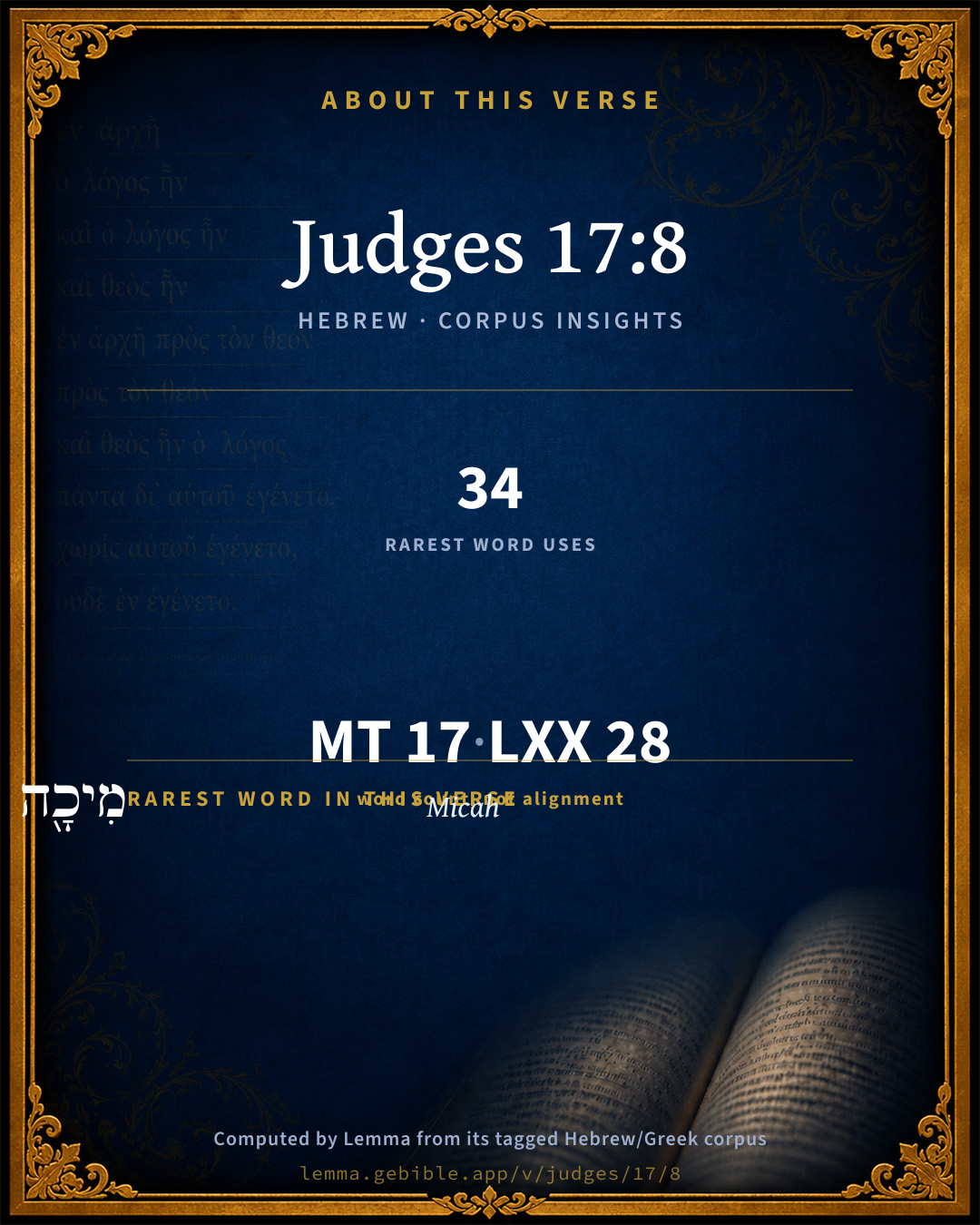
17
words
16
distinct lemmas
Historical
section

Shared distinctive vocabulary

מִיכָ֖ה Micah H4318 occurs in 31 verses of the Hebrew Bible. Also found in:

Grammatical profile

  • 5 verbs
  • 10 nouns
  • 1 preposition
  • 1 particle

Verb forms

  • וַיֵּ֨לֶךְ Qal · Sequential Imperfect
  • לָג֖וּר Qal · Infinitive Construct
  • יִמְצָ֑א Qal · Imperfect
  • וַיָּבֹ֧א Qal · Sequential Imperfect
  • לַעֲשׂ֥וֹת Qal · Infinitive Construct

Repetition

A word recurs within this verse — often emphatic in Hebrew:

  • מִבֵּ֥ית Bethlehem H1035 ×2

Hebrew & Septuagint length

In English translation the verse runs 35 words from the Hebrew and 36 from the Septuagint (LXX English) — closely comparable.

A rough comparison of the two English renderings, which tokenize alike — not a word-level alignment.

Word counts can differ between the Hebrew and the Greek without any difference in meaning — e.g. the Hebrew direct-object marker אֵת has no separate Greek word, and Greek often adds the article ὁ.

In the original languages it is 17 Hebrew tokens and 28 Greek tokens — but the two are counted differently (Hebrew bundles its prefixes and suffixes into one token; the Greek is in lemma form), so that isn’t a like-for-like length.

Cross-references

3

Topical passages linked to Judges 17:8 in the Treasury of Scripture Knowledge — connected by theme and wording, ordered by reader-vote popularity; previews shown in the World English Bible.

  • Joshua 24:33 Eleazar the son of Aaron died; and they buried him in the hill of Phinehas his son, which was given him in the hill-country of Ephraim.
  • Judges 17:11 The Levite was content to dwell with the man; and the young man was to him as one of his sons.
  • Nehemiah 13:10–11 I perceived that the portions of the Levites had not been given them; so that the Levites and the singers, who did the work, were fled everyone to his field.

Cross-references courtesy of OpenBible.info (CC BY 4.0).

Hebrew and Greek witnesses Masoretic Hebrew ↔ Greek Septuagint

The same verse in the two great witnesses to the Old Testament, shown verse-for-verse.

These are two independent witnesses, not word-aligned to each other, and the Septuagint is shown in lemma (dictionary) form.

Hebrew Judges 17:8 Masoretic · Westminster Leningrad Codex

וַיֵּ֨לֶךְ הָאִ֜ישׁ מֵהָעִ֗יר מִבֵּ֥ית לֶ֨חֶם֙ יְהוּדָ֔ה לָג֖וּר בַּאֲשֶׁ֣ר יִמְצָ֑א וַיָּבֹ֧א הַר אֶפְרַ֛יִם עַד בֵּ֥ית מִיכָ֖ה לַעֲשׂ֥וֹת דַּרְכּֽוֹ

The man departed out of the city, out of Bethlehem Judah, to sojourn where he could find [a place], and he came to the hill-country of Ephraim to the house of Micah, as he traveled.

World English Bible · Public Domain

Greek LXX Judges 17:8 Septuagint · lemma form

καί πορεύομαι ὁ ἀνήρ ἀπό βηθλεεμ ὁ πόλις ιουδα παραοἰκέω ἐν ὅς ἐάν εὑρίσκω τόπος καί ἔρχομαι ἕως ὄρος ἐφράιμ καί ἕως οἶκος μιχαιας ὁ ποιέω ὁδός αὐτός

And the man departed from Bethleem the city of Juda to sojourn in whatever place he might find; and he came as far as mount Ephraim, and to the house of Michaias to accomplish his journey.

LXX2012 (modern English Septuagint) · Public Domain

Hebrew: Westminster Leningrad Codex (CC BY 4.0). Greek: Septuagint (public domain); English from LXX2012 (modern English Septuagint) (Public Domain). How the Septuagint differs from the Hebrew →

Targum (Aramaic paraphrase)

1

The Targum is the ancient Jewish Aramaic paraphrase of the Hebrew Scriptures — an interpretive translation, not the Hebrew text itself. Onkelos (literal) and Pseudo-Jonathan (expansive) render the Torah, and Jonathan the Prophets. Coverage is partial: where no permissively-licensed English translation exists for a verse, only the Aramaic is shown. This is verse-level text, not a word-by-word alignment to the Hebrew.

  1. Targum Jonathan Prophets (Joshua–Malachi)
    וַאֲזַל גַבְרָא מִקַרְתֵּיהּ מִבֵּית לֶחֶם יְהוּדָה לְמֵידַר בַּאֲתַר דְיַשְׁכַּח וַאֲתָא לְטוּרָא דְבֵית אֶפְרַיִם עַד בֵּית מִיכָה לְמֶעְבַּד אוֹרְחֵיהּ:

    (no public-domain English translation for this verse)

    Targum Jonathan — Aramaic: “Mikraot Gedolot” (public domain). English: “Sefaria Community Translation” (CC0 1.0 (public-domain dedication)); “London "Chaldee Paraphrase," 1871” (public domain). Text via Sefaria.

Commentary

Notes on Judges 17:8 from classic Christian and Jewish commentators (each source and its license shown beneath its notes). The classic Christian expositions comment on the surrounding passage and are grouped to its opening verse, so a note may address several verses; the Jewish commentaries on the Tanakh (Rashi and others) are per-verse, so they appear only where the commentator wrote on this verse.

Lemma curates 59 commentaries, every one of them public domain or Creative Commons licensed, each selected and text-cleaned for this edition rather than reprinted as found. About our sources →

Trapp's Complete Commentary

John Trapp

Jdg 17:8 And the man departed out of the city from Bethlehemjudah to sojourn where he could find [a place]: and he came to mount Ephraim to the house of Micah, as he journeyed.

Ver. 8. To sojourn where he could find a place.] By the iniquity of the times, he was put to his shifts, and forced to seek a subsistence where he could get it. See the like in Neh 13:10-11. Ministers are not of the chameleon kind: they cannot live upon the air. It was a sad thing that Luther should be forced to complain, Spoliantur parochiae et scholae non aliter ac si fame necare nos velint: Parishes and schools are robbed, as if they meant to starve up the ministry. It was an ingenuous confession of that Popish priest, but a shame for those that put him to it, We preach the gospel, tantum ut nos pascat et vestiat, only for food and raiment. In many places they allow the ox nothing but the straw for treading out the grain: and so much straw as themselves please. O tempera!

John Trapp, A Commentary or Exposition upon All the Books of the Old and New Testament (1647–1656) — public domain. Text from a community e-Sword module.

Joseph Benson's Commentary

Jdg 17:8. To sojourn where he could find a place — For employment and a livelihood; for the tithes and offerings, which were their maintenance, not being brought unto the house of God, the Levites and priests were reduced to difficulties.

Joseph Benson's Commentary on the Old and New Testaments (1811–1818) — public domain. Text from a community e-Sword module.

Jamieson, Fausset & Brown

Robert Jamieson, A. R. Fausset & David Brown

the man departed . . . to sojourn where he could find a place--A competent provision being secured for every member of the Levitical order, his wandering about showed him to have been a person of a roving disposition or unsettled habits. In the course of his journeying he came to the house of Micah, who, on learning what he was, engaged his permanent services.

Jamieson, Fausset & Brown — Commentary Critical and Explanatory on the Whole Bible (1871) — public domain (CC PDM 1.0). Text via the HelloAO Bible API.

Adam Clarke's Commentary

Verse 8. To sojourn where he could find] He went about the country seeking for some employment, for the Levites had no inheritance: besides, no secure residence could be found where there was no civil government.

Adam Clarke's Commentary on the Bible (1810–1826) — public domain. Text from a community e-Sword/MySword module.

Ellicott's Commentary for English Readers

(8) To sojourn where he could find.—Or, as we should say, to get his living. It may easily be supposed that in the disorganisation of these days, the due support of the Levites would be much neglected. The same neglect occurred in the troubled days of Nehemiah: “I perceived that the portions of the Levites had not been given them: for the Levites and the singers, that did the work, were fled every one to his field,” &c. (Neh_13:10-11).

To the house of Micah.—Probably he was induced to go there by the rumour of Micah’s chapel and worship.

A Bible Commentary for English Readers, edited by Charles John Ellicott (1878–1897) — public domain. Text from a community e-Sword module.

The Cambridge Bible for Schools and Colleges

gen. ed. J. J. S. Perowne

8. And the man departed] Here comes the wandering Levite, who, in the course of his travels, arrives at Micah’s house; he is the counterpart of the young man already settled there. This narrative no doubt began with some such words as ‘Now there was a Levite out of Beth-lehem-judah,’ which naturally would not be repeated after Jdg_17:7, though out of Beth-lehem-judah had to be retained. Jdg_17:9-11 a, 12a continue the story.

The Cambridge Bible for Schools and Colleges (gen. ed. J. J. S. Perowne; Cambridge University Press, 1878–1918) — public domain. Text from a community e-Sword module.

John Gill's Exposition

And the man departed out of the city from Bethlehemjudah, to sojourn where he could find a place,.... Either being a man that had a rambling head, and of an unsettled mind, and could not easily fix any where; or else there being no supreme magistrate, to take care that the Levites had their due maintenance, for which there was a sufficient provision made by law; and the people being negligent of paying their tithes, there being none to oblige them to it, and they indifferent to the true worship of God, and prone to idolatry; this man was obliged to go abroad, and seek for a livelihood where he could get it, and sojourn in a place the most convenient for him:

and he came to Mount Ephraim, to the house of Micah, as he journeyed: not with a design to stay there, but called by the way, having heard perhaps that Micah was both a wealthy and an hospitable man, and he also might have heard of the new form of worship he had set up in his house.

John Gill's Exposition of the Whole Bible (1746–1763) — public domain (CC PDM 1.0). Text via the HelloAO Bible API.

Albert Barnes' Notes on the Bible

Jonathan’s state without a home gives us vivid picture of what must have been the condition of many Levites.

Albert Barnes' Notes on the Bible (1834–1885) — public domain. Text from a community e-Sword/MySword module.

Matthew Poole's English Annotations

Where he could find a place, for employment and a livelihood; for the tithes and offerings, which were their maintenance, not being brought in to the house of God, the Levites and priests must needs be reduced to great straits.

Matthew Poole's English Annotations on the Holy Bible (1683–1685) — public domain. Text from a community e-Sword/MySword module.

Whedon's Commentary on the Bible

Daniel D. Whedon

8. To sojourn where he could find a place — The irregularity and neglect of sanctuary worship, and of the several enactments of the law concerning the priests and Levites, probably left many of this tribe to wander idly through the land, seeking a residence wherever they might chance to find one.

Daniel D. Whedon (gen. ed.), Commentary on the Old and New Testaments (1874–1909) — public domain. Text from a community e-Sword module.

The Pulpit Commentary

From Bethlehem-judah. Rather, out of. The whole phrase means, out of the city, viz., out of Bethlehem. Mount Ephraim the hill country of Ephraim, as ver. 1, where see note.

The Pulpit Commentary (1880–1919), ed. H.D.M. Spence-Jones & Joseph S. Exell — public domain. Text from a community e-Sword module.

John Wesley's Explanatory Notes

To sojourn - For employment and a livelihood; for the tithes and offerings, which were their maintenance, not being brought into the house of God, the Levites and priests were reduced to straights.

John Wesley, Explanatory Notes Upon the Whole Bible (1754–1765) — public domain. Text via the GEBible commentary corpus.

Rashi

Rabbi Shlomo Yitzchaki (Rashi)

To make his way. The way by which he would journey.

Rashi on the Tanakh — English translations: “The Judaica Press complete Tanach with Rashi, translated by A. J. Rosenberg” (CC BY 4.0); “Pentateuch with Rashi's commentary by M. Rosenbaum and A.M. Silbermann, 1929-1934” (public domain); “The Metsudah Tanach series, Lakewood, N.J” (CC BY 4.0); and “The Book of Joshua, Metsudah Publications, 1997” (CC BY 4.0). Text via Sefaria.

Lesson kit

Teaching starters — assembled from the data on this page, not authored interpretation. Every prompt links to the verse data it draws on. Edit before teaching.

Judges, in the Historical, opens this verse with 17 words (16 distinct Hebrew lemmas). Its most distinctive word is Mîykâh (“Micah”). A historical commentator’s framing appears above. Read the whole chapter for the surrounding context.

Discussion questions

  1. What does “Micah” (Mîykâh) contribute to the verse as a whole?
  2. Judges 17:5 shares the word «Micah» with this verse. How do the two illuminate each other?
  3. “Bethlehem” occurs 2× in this one verse. What is the effect of the repetition?
  4. These translations render this verse differently; the difference is in the English rendering, not the original. What questions does that raise?
  5. The verb «וַיֵּ֨לֶךְ» is Qal Sequential Imperfect. How does its form color the action?
  6. Reading how Trapp's Complete Commentary and Joseph Benson's Commentary read this verse, where do the two commentators agree and where do they part?

Things to notice

Reading settings

Reading text

Shown beneath each verse's original-language words.

Old Testament
Old Testament edition

Read the OT as the Masoretic Hebrew (MT) or the Greek Septuagint (LXX).

English shown for the Greek Septuagint (in the Hebrew ↔ Greek comparison).

Comparing translations? Open the Compare panel on any verse page to stack up to four side by side.