

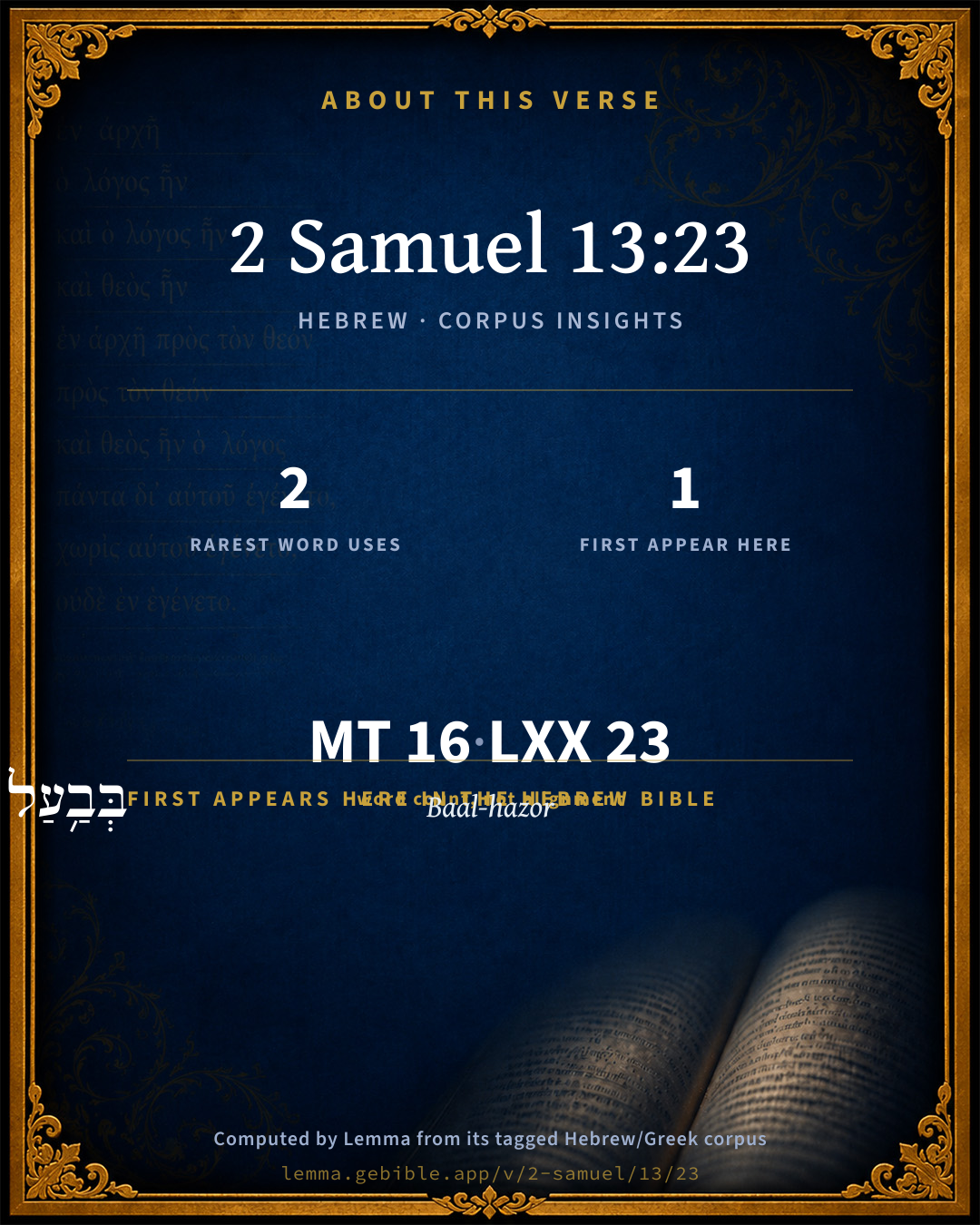
2 Samuel 13:23

Hebrew (Westminster Leningrad Codex) 2 Samuel 13:23 appears in the Hebrew Old Testament. The text above is from the Westminster Leningrad Codex. Each word links to its Strong’s number, a concise gloss, and parsing drawn from the Open Scriptures Hebrew Bible morphology. Click any word for its full Brown-Driver-Briggs (BDB) entry.
Download image
Cite this verse

2 Samuel 13:23 (World English Bible). Public Domain. Lemma interlinear Bible study tool, https://lemma.gebible.app/v/2-samuel/13/23.

Show BibTeX & RIS
BibTeX
RIS
English Translation
It happened after two full years, that Absalom had sheep-shearers in Baal Hazor, which is beside Ephraim: and Absalom invited all the king's sons.
World English Bible · Public Domain
Highlights
  • 1 first appearance in the Hebrew Bible
Full analysis ↓
Download a study sheet

One document with this verse’s original text, its word-by-word gloss line, the meaning frame, cross-references with their text, attributed commentary, and full source and license credits — printable, and it pastes into notes with its structure intact.

This verse Autodidact and up

Study sheet (.html) Plain text (.txt)

A passage Seminary Student

Up to 50 verses in one chapter. A passage sheet keeps up to 6 commentary sources and 12 cross-references per verse, in the order this page ranks them, and says so on the sheet whenever that leaves anything out. Ask for a single verse and you get the Autodidact verse sheet above.

Everything on this page stays free to read, with no account — the sheet is a download of what is already on screen, not access to it.

Want to remove ads? Support Godless Engineer
Compare translations 3

The same verse in 3 English versions, stacked beneath the original-language interlinear above. Click any original word for its lexicon entry.

Each is an independent rendering of the whole verse — the interlinear is not word-aligned to these translations.

Highlighted words mark where these versions differ — a whole-verse word diff, not a word-by-word alignment.

  • World English Bible Public Domain
    It happened after two full years, that Absalom had sheep-shearers in Baal Hazor, which is beside Ephraim: and Absalom invited all the king's sons.
  • King James Version Public Domain
    And it came to pass after two full years, that Absalom had sheepshearers in Baalhazor, which is beside Ephraim: and Absalom invited all the king's sons.
  • unfoldingWord Literal Text CC BY-SA 4.0
    And it happened after two years of days that shearers were to Absalom in Baal Hazor, which near Ephraim. And Absalom called to all of the sons of the king.

unfoldingWord Literal Text — © unfoldingWord, licensed CC BY-SA 4.0. Word-aligned USFM3 via Door43 (git.door43.org/unfoldingWord/en_ult).

Versions to compare (up to 4)

3 of 4 selected

Show all 18 translations

Every available English version of this verse, each an independent rendering of the whole verse.

  • World English Bible Public Domain
    It happened after two full years, that Absalom had sheep-shearers in Baal Hazor, which is beside Ephraim: and Absalom invited all the king's sons.
  • Berean Standard Bible Public Domain
    Two years later, when Absalom’s sheepshearers were at Baal-hazor near Ephraim, he invited all the sons of the king.
  • Majority Standard Bible Public Domain
    Two years later, when Absalom’s sheepshearers were at Baal-hazor near Ephraim, he invited all the sons of the king.
  • King James Version Public Domain
    And it came to pass after two full years, that Absalom had sheepshearers in Baalhazor, which is beside Ephraim: and Absalom invited all the king's sons.
  • American Standard Version (1901) Public Domain
    And it came to pass after two full years, that Absalom had sheep-shearers in Baal-hazor, which is beside Ephraim: and Absalom invited all the king's sons.
  • Revised Version (1885) Public Domain
    And it came to pass after two years, that Absalom had sheepshearers in Baal-hazor, which is beside Ephraim: and Absalom invited all the king’s sons.
  • Geneva Bible (1599) Public Domain
    And after the time of two yeeres, Absalom had sheepesherers in Baal-hazor, which is beside Ephraim, and Absalom called all the Kings sonnes.
  • Douay-Rheims (1899) Public Domain
    And it came to pass after two years, that the sheep of Absalom were shorn in Baalhasor, which is near Ephraim: and Absalom invited all the king's sons:
  • Young's Literal Translation Public Domain
    And it cometh to pass, after two years of days, that Absalom hath shearers in Baal-Hazor, which `is' with Ephraim, and Absalom calleth for all the sons of the king.
  • Literal Standard Version CC BY-SA 4.0
    And it comes to pass, after two years of days, that Absalom has shearers in Ba‘al-Hazor, which [is] near Ephraim, and Absalom calls for all the sons of the king.
  • Unlocked Literal Bible CC BY-SA 4.0
    It came about after two full years that Absalom had sheep shearers working at Baal Hazor, which is near Ephraim, and Absalom invited all the king's sons to visit there.
  • unfoldingWord Literal Text CC BY-SA 4.0
    And it happened after two years of days that shearers were to Absalom in Baal Hazor, which near Ephraim. And Absalom called to all of the sons of the king.
  • Darby Bible Public Domain
    And it came to pass after two full years, that Absalom had sheepshearers in Baal-Hazor, which is beside Ephraim; and Absalom invited all the king's sons.
  • World Messianic Bible Public Domain
    After two full years, Absalom had sheep shearers in Baal Hazor, which is beside Ephraim; and Absalom invited all the king’s sons.
  • Webster's Bible Public Domain
    And it came to pass after two full years, that Absalom had sheep-shearers in Baal-hazor, which is beside Ephraim: and Absalom invited all the king's sons.
  • Free Bible Version CC BY-SA 4.0
    Some two years later, when his sheepshearers were at Baal-hazor near Ephraim, Absalom invited all the king's sons to join the celebrations.
  • Bible in Basic English Public Domain
    Now after two full years, Absalom had men cutting the wool of his sheep in Baal-hazor, which is near Ephraim: and he sent for all the king's sons to come to his feast.
  • JPS Tanakh (1917) Public Domain
    And it came to pass after two full years, that Absalom had sheep-shearers in Baal-hazor, which is beside Ephraim; and Absalom invited all the king's sons.

Literal Standard Version (2020), Covenant Press — licensed CC BY-SA 4.0. Text via the HelloAO Bible API (eBible.org). Unlocked Literal Bible (unfoldingWord) — licensed CC BY-SA 4.0. Text via the HelloAO Bible API (eBible.org). unfoldingWord Literal Text — © unfoldingWord, licensed CC BY-SA 4.0. Word-aligned USFM3 via Door43 (git.door43.org/unfoldingWord/en_ult). Free Bible Version, Dr. Jonathan Gallagher — licensed CC BY-SA 4.0. Text via the HelloAO Bible API (eBible.org).

Word by word

More ways to search: Search by grammar → Find every occurrence → Compare this word →

Practice this passage: Drill this verse → Learn its vocabulary →

בְּבַ֥עַל
Baʻal Châtsôwr
H1178
“in/at · Baal-hazor”
Preposition + Noun, Proper
Part of Speech
Preposition + Noun
Type
Proper
Full BDB Definition

Origin: from H1167 and a modification of H2691

TWOT: None

Baal-hazor = "lord of the village" - a town on the border between Ephraim and Benjamin, apparent location of a sheep farm of Absalom and location of Amnon's murder
  1. וַֽיְהִי֙ hâyâh H1961 “and · to be” Conjunction + Verb, Qal, Sequential Imperfect, 3rd Person, Masculine, Singular
  2. לִשְׁנָתַ֣יִם shâneh H8141 “to/for · years” Preposition + Noun, Common, Feminine, Dual, Absolute
  3. יָמִ֔ים yôwm H3117 “days” Noun, Common, Masculine, Plural, Absolute
  4. וַיִּהְי֤וּ hâyâh H1961 “and · to be” Conjunction + Verb, Qal, Sequential Imperfect, 3rd Person, Masculine, Plural
  5. גֹֽזְזִים֙ gazâz H1494 “shearing” Verb, Qal, Participle Active, Masculine, Plural, Absolute
  6. לְאַבְשָׁל֔וֹם ʼĂbîyshâlôwm H53 “to/for · Absalom” Preposition + Noun, Proper
  7. חָצ֖וֹר Baʻal Châtsôwr H1178 “Baal-hazor” Noun, Proper
  8. אֲשֶׁ֣ר ʼăsher H834 “which” Particle, Relative
  9. עִם ʻim H5973 “with” Preposition
  10. אֶפְרָ֑יִם ʼEphrayim H669 “Ephraim” Noun, Proper
  11. וַיִּקְרָ֥א qârâʼ H7121 “and · to call” Conjunction + Verb, Qal, Sequential Imperfect, 3rd Person, Masculine, Singular
  12. אַבְשָׁל֖וֹם ʼĂbîyshâlôwm H53 “Absalom” Noun, Proper
  13. לְכָל kôl H3605 “to/for · all of” Preposition + Noun, Common, Masculine, Singular, Construct
  14. בְּנֵ֥י bên H1121 “sons of” Noun, Common, Masculine, Plural, Construct
  15. הַמֶּֽלֶךְ melek H4428 “the · king” Particle, Definite Article + Noun, Common, Masculine, Singular, Absolute

About this verse

These counts appear in no published source. They are computed here, from the morphology-tagged text and Lemma’s own curated glosses. What Lemma adds →

16
words
13
distinct lemmas
Historical
section

Notable vocabulary

The rarest word here is בְּבַ֥עַל Baal-hazor H1178 — appearing just 2 times in the whole Hebrew Bible.

First appearance in Scripture

This word makes its first canonical appearance in the Hebrew Bible here:

  • בְּבַ֥עַל Baal-hazor H1178

Grammatical profile

  • 4 verbs
  • 10 nouns
  • 1 preposition
  • 1 particle

Verb forms

  • וַֽיְהִי֙ Qal · Sequential Imperfect
  • וַיִּהְי֤וּ Qal · Sequential Imperfect
  • גֹֽזְזִים֙ Qal · Participle Active
  • וַיִּקְרָ֥א Qal · Sequential Imperfect

Repetition

Words recur within this verse — often emphatic in Hebrew:

  • וַֽיְהִי֙ to be H1961 ×2
  • לְאַבְשָׁל֔וֹם Absalom H53 ×2
  • בְּבַ֥עַל Baal-hazor H1178 ×2

Hebrew & Septuagint length

In English translation the verse runs 24 words from the Hebrew and 30 from the Septuagint (LXX English) — closely comparable.

A rough comparison of the two English renderings, which tokenize alike — not a word-level alignment.

Word counts can differ between the Hebrew and the Greek without any difference in meaning — e.g. the Hebrew direct-object marker אֵת has no separate Greek word, and Greek often adds the article ὁ.

In the original languages it is 16 Hebrew tokens and 23 Greek tokens — but the two are counted differently (Hebrew bundles its prefixes and suffixes into one token; the Greek is in lemma form), so that isn’t a like-for-like length.

Cross-references

10

Topical passages linked to 2 Samuel 13:23 in the Treasury of Scripture Knowledge — connected by theme and wording, ordered by reader-vote popularity; previews shown in the World English Bible.

  • Genesis 38:12–13 After many days, Shua's daughter, the wife of Judah, died. Judah was comforted, and went up to his sheep-shearers to Timnah, he and his friend Hirah, the Adullamite.
  • 1 Samuel 25:4 David heard in the wilderness that Nabal was shearing his sheep.
  • 1 Samuel 25:2 There was a man in Maon, whose possessions were in Carmel; and the man was very great, and he had three thousand sheep, and a thousand goats: and he was shearing his sheep in Carmel.
  • 1 Samuel 25:7 Now I have heard that you have shearers: your shepherds have now been with us, and we did them no hurt, neither was there anything missing to them, all the while they were in Carmel.
  • 1 Samuel 25:36 Abigail came to Nabal; and, behold, he held a feast in his house, like the feast of a king; and Nabal's heart was merry within him, for he was very drunken: therefore she told him nothing, less or more, until the morning light.
  • 1 Kings 1:9 Adonijah killed sheep and oxen and fatlings by the stone of Zoheleth, which is beside En Rogel; and he called all his brothers, the king's sons, and all the men of Judah, the king's servants:
  • 1 Kings 1:19 and he has slain oxen and fatlings and sheep in abundance, and has called all the sons of the king, and Abiathar the priest, and Joab the captain of the host; but he hasn't called Solomon your servant.
  • 1 Kings 1:25 For he is gone down this day, and has slain oxen and fatlings and sheep in abundance, and has called all the king's sons, and the captains of the host, and Abiathar the priest; and, behold, they are eating and drinking before him, and say, [Long] live king Adonijah.
  • 2 Kings 3:4 Now Mesha king of Moab was a sheep-master; and he rendered to the king of Israel the wool of one hundred thousand lambs, and of one hundred thousand rams.
  • 2 Chronicles 26:10 He built towers in the wilderness, and hewed out many cisterns, for he had much cattle; in the lowland also, and in the plain: [and he had] farmers and vineyard keepers in the mountains and in the fruitful fields; for he loved farming.

Cross-references courtesy of OpenBible.info (CC BY 4.0).

Hebrew and Greek witnesses Masoretic Hebrew ↔ Greek Septuagint

The same verse in the two great witnesses to the Old Testament, shown verse-for-verse.

These are two independent witnesses, not word-aligned to each other, and the Septuagint is shown in lemma (dictionary) form.

Hebrew 2 Samuel 13:23 Masoretic · Westminster Leningrad Codex

וַֽיְהִי֙ לִשְׁנָתַ֣יִם יָמִ֔ים וַיִּהְי֤וּ גֹֽזְזִים֙ לְאַבְשָׁל֔וֹם בְּבַ֥עַל חָצ֖וֹר אֲשֶׁ֣ר עִם אֶפְרָ֑יִם וַיִּקְרָ֥א אַבְשָׁל֖וֹם לְכָל בְּנֵ֥י הַמֶּֽלֶךְ

It happened after two full years, that Absalom had sheep-shearers in Baal Hazor, which is beside Ephraim: and Absalom invited all the king's sons.

World English Bible · Public Domain

Greek LXX 2 Samuel 13:23 Septuagint · lemma form

καί γίγνομαι εἰς διετηρίς ἡμέρα καί εἰμί κείρω ὁ αβεσσαλωμ ἐν βελασωρ ὁ ἔχω ἐφράιμ καί καλέω αβεσσαλωμ πᾶς ὁ υἱός ὁ βασιλεύς

And it came to pass at the end of two whole years, that they were shearing sheep for Abessalom in Belasor near Ephraim: and Abessalom invited all the king's sons.

LXX2012 (modern English Septuagint) · Public Domain

Hebrew: Westminster Leningrad Codex (CC BY 4.0). Greek: Septuagint (public domain); English from LXX2012 (modern English Septuagint) (Public Domain). How the Septuagint differs from the Hebrew →

Targum (Aramaic paraphrase)

1

The Targum is the ancient Jewish Aramaic paraphrase of the Hebrew Scriptures — an interpretive translation, not the Hebrew text itself. Onkelos (literal) and Pseudo-Jonathan (expansive) render the Torah, and Jonathan the Prophets. Coverage is partial: where no permissively-licensed English translation exists for a verse, only the Aramaic is shown. This is verse-level text, not a word-by-word alignment to the Hebrew.

  1. Targum Jonathan Prophets (Joshua–Malachi)
    וַהֲוָה לִזְמַן תַּרְתֵּין שְׁנִין וַהֲווֹ גָזְזִין לְאַבְשָׁלוֹם בְּמֵישַׁר חָצוֹר עִם בֵּית אֶפְרָיִם וְזַמִין אַבְשָׁלוֹם לְכָל בְּנֵי מַלְכָּא:

    (no public-domain English translation for this verse)

    Targum Jonathan — Aramaic: “Mikraot Gedolot” (public domain). English: “Sefaria Community Translation” (CC0 1.0 (public-domain dedication)); “London "Chaldee Paraphrase," 1871” (public domain). Text via Sefaria.

Commentary

Notes on 2 Samuel 13:23 from classic Christian and Jewish commentators (each source and its license shown beneath its notes). The classic Christian expositions comment on the surrounding passage and are grouped to its opening verse, so a note may address several verses; the Jewish commentaries on the Tanakh (Rashi and others) are per-verse, so they appear only where the commentator wrote on this verse.

Lemma curates 59 commentaries, every one of them public domain or Creative Commons licensed, each selected and text-cleaned for this edition rather than reprinted as found. About our sources →

Trapp's Complete Commentary

John Trapp

2Sa 13:23 And it came to pass after two full years, that Absalom had sheepshearers in Baalhazor, which [is] beside Ephraim: and Absalom invited all the king’s sons.

Ver. 23. And it came to pass after two full years.] So long Absalom had dissembled his wrath, which is - as we use to say of Runnet - the older, the stronger: and so long Amnon had gone unpunished by the patience of God, and the fondness of his father. Now, therefore, subito tollitur qui diu toleratur, God taketh the sword in hand which David - as to Amnon - bore in vain, {Rom 13:4} and executed justice upon him by such an executioner as afflicted his soul with double grief.

That Absalom had sheepshearers.] At which times there used to be feasting, - see 1Sa 25:7, - as there is still in many places.

John Trapp, A Commentary or Exposition upon All the Books of the Old and New Testament (1647–1656) — public domain. Text from a community e-Sword module.

Joseph Benson's Commentary

2Sa 13:23-25. After two full years — This circumstance of time is noted, as an aggravation of Absalom’s malice, which was so implacable; and as an act of policy, that both Amnon and David might more securely comply with his desires. Let the king and his servants go — He certainly did not wish the king to go; but invited him, to avoid all suspicion. He would not go, but blessed him — Gave him thanks for his invitation, and prayed God to bless him.

Joseph Benson's Commentary on the Old and New Testaments (1811–1818) — public domain. Text from a community e-Sword module.

Keil & Delitzsch

C. F. Keil & F. Delitzsch

Absalom's Revenge and Flight. - Sa2 13:23, Sa2 13:24. Absalom postponed his revenge for two full years. He then "kept sheep-shearing," which was celebrated as a joyous festival (see Sa1 25:2, Sa1 25:8), "at Baal-hazor, near Ephraim," where he must therefore have had some property. The situation of Baal-hazor cannot be precisely determined. The clause "which (was) beside Ephraim" points to a situation on the border of the tribe-territory of Ephraim (juxta Ephraim, according to the Onom. s.v. Baalasor); for the Old Testament never mentions any city of that name. This definition does not exactly tally with v. Raumer's conjecture (Pal. p. 149), that Baal-Hazor may have been preserved in Tell Asr ((Rob. Pal. ii. p. 151, iii. p. 79); for this Tell is about five Roman miles to the north-east of Bethel, i.e., within the limits of the tribe of Ephraim. There is greater probability in the suggestion made by Ewald and others, that Baal-hazor is connected with the Hazor of Benjamin (Neh 11:33), though the situation of Hazor has not yet been thoroughly decided; and it is merely a conjecture of Robinson's that it is to be found in Tell Asr. The following statement, that "Absalom invited all the king's sons" (sc., to the feast), somewhat anticipates the course of events: for, according to Sa2 13:24, Absalom invited the king himself, together with his courtiers; and it was not till the king declined the invitation for himself, that Absalom restricted his invitation to the royal princes.

Keil & Delitzsch — Biblical Commentary on the Old Testament (1861–1891) — public domain (CC PDM 1.0). Text via the HelloAO Bible API. (Old Testament only.)

Tyndale Open Study Notes

Tyndale Open Resources

13:23 Baal-hazor should not be confused with the famous fortified city of Hazor located north of the Sea of Galilee. The generally accepted location of Baal-hazor is Jebel el-Asur, some fifteen miles north of Jerusalem. • a feast: Sheep shearing was a time for sharing bounty and blessing with others (see 1 Sam 25:2-8).

Tyndale Open Study Notes — © Tyndale Open Resources, licensed CC BY-SA 4.0. Text via the HelloAO Bible API.

Geneva Bible (1599)

Geneva Bible translators

Or, in the plain of Hazor.

To wit, to a banquet, thinking thereby to fulfill his wicked purpose.

Geneva Bible (1599) marginal notes — public domain. Text via Bolls.life.

Jamieson, Fausset & Brown

Robert Jamieson, A. R. Fausset & David Brown

Absalom had sheep-shearers in Baal-hazor, which is beside Ephraim--A sheep-shearing feast is a grand occasion in the East. Absalom proposed to give such an entertainment at his estate in Baal-hazor, about eight miles northeast of Jerusalem near a town called Ephraim (Jos 11:10). He first invited the king and his court; but the king declining, on account of the heavy expense to which the reception of royalty would subject him [Sa2 13:25], Absalom then limited the invitation to the king's sons [Sa2 13:26], which David the more readily agreed to, in the hope that it might tend to the promotion of brotherly harmony and union.

Jamieson, Fausset & Brown — Commentary Critical and Explanatory on the Whole Bible (1871) — public domain (CC PDM 1.0). Text via the HelloAO Bible API.

Adam Clarke's Commentary

Verse 23. Absalom had sheep-shearers] These were times in which feasts were made, to which the neighbours and relatives of the family were invited.

Adam Clarke's Commentary on the Bible (1810–1826) — public domain. Text from a community e-Sword/MySword module.

Ellicott's Commentary for English Readers

(23) Absalom had sheepshearers.—Absalom had now silently nourished his revenge for “two full years.” No doubt he chose also to give full opportunity for his father to punish Amnon’s iniquity if he would; and by this long quiet waiting he so far disarmed suspicion that he was able to carry out his purpose. Sheepshearing always was, and still is, a time of feasting. (Comp. 1Sa_25:2.) The situation of Baalhazor and of Ephraim are quite unknown, but Absalom’s property was probably not many miles from Jerusalem.

A Bible Commentary for English Readers, edited by Charles John Ellicott (1878–1897) — public domain. Text from a community e-Sword module.

The Cambridge Bible for Schools and Colleges

gen. ed. J. J. S. Perowne

23–29. Absalom’s vengeance

23. Absalom had sheepshearers] Sheepshearing was and still is an occasion of festivity. Cp. 1Sa_25:7 ff.

Baal-hazor, which is beside Ephraim] Possibly Tell Asur, five miles north-east of Bethel, and two miles north-west of et-Taiyibeh, which is supposed to represent Ephraim. The preposition beside or near implies that Ephraim is here the name of a town not of the tribe territory. Cp. Joh_11:54.

The Cambridge Bible for Schools and Colleges (gen. ed. J. J. S. Perowne; Cambridge University Press, 1878–1918) — public domain. Text from a community e-Sword module.

John Gill's Exposition

And it came to pass after two full years,.... Two complete years after the rape was committed; so long Absalom kept it in his mind, and was contriving how to avenge it; he let it alone so long, that it might be thought by the king and Amnon, and all the family, that it was quite worn out of his mind, and entirely forgotten by him, and therefore might the more safely confide in him:

that Absalom had sheepshearers in Baalhazor, which is beside Ephraim; though a prince, the son of a king, he had his flocks, and attended to the care of them, and had shearers to shear them at the proper time of the year, which it now was. The Chinese shear their sheep three times a year, the spring, summer, and autumn; but the first time of shearing yields the best wool (g). The place of shearing them was, no doubt, near where they were kept in Baalhazor, in the plain of Hazor, as the Targum, and so some versions; which was a city in the tribe of Judah, Jos 15:25; and near to Ephraim; not that it was a city in the tribe of Ephraim, as Josephus says (h); but it was near to another city called Ephraim, perhaps the same as in Ch2 13:19 and in Joh 11:54; it lay to the northeast of Jerusalem, as you go to Jericho, and is thought by Reland (i) to lie between Bethel and Jericho; and, according to Eusebius (k), it was eight miles from Jerusalem; though Jerom (l), through mistake, says twenty; and both these places, according to Bunting (m), were eight miles from Jerusalem; it seems to be the same place that was spoken of in the Misnah (n), called Ephraim in the valley, and which is said to be the second place in the land of Israel for fine flour, and might have its name from its fruitfulness:

and Absalom invited all the king's sons; to the sheepshearing: that is, to the feast which was usually made at such times, and still is; see Gen 38:12.

(g) Semedo's History of China, part 1. ch. 3. (h) Antiqu. l. 7. c. 8. sect. 2. (i) Palestina Illustrat. tom. 1. p. 377. (k) Apud Reland, ib. & p. 490. & tom. 2. p. 765. (l) De loc. Heb. fol. 91. A. (m) Travels, &c. p. 143, 363. (n) Menachot, c. 8. sect. l.

John Gill's Exposition of the Whole Bible (1746–1763) — public domain (CC PDM 1.0). Text via the HelloAO Bible API.

Albert Barnes' Notes on the Bible

Sheepshearing was always a time of feasting (marginal references). Baal-hazor is not known.

Albert Barnes' Notes on the Bible (1834–1885) — public domain. Text from a community e-Sword/MySword module.

Haydock's Catholic Bible Commentary

Two. Hebrew, "full years." He waited so long, that he might put his murderous designs in execution with less suspicion. (Haydock) --- Sheep. It was esteemed the best husbandry, "to have fine flocks;" bene pascere: (Cato) even for the nobility. --- Ephraim, or Ephrem; (John xi. 54.) probably near Bethel. (Josephus, Jewish Wars v. 33.) (Calmet) --- Nabal had made a feast on a similar occasion, 1 Kings xxv. Absalom invites his father to avoid suspicion; (Menochius) though he would be glad at his refusing to come, unless perhaps he would not have hesitated to order his brother to be murdered in his very presence, in order to punish both. (Haydock)

George Leo Haydock (1774–1849), Haydock's Catholic Family Bible and Commentary, 1859 edition — public domain. Excludes Psalms (Douay-Rheims chapter numbering differs from Protestant) and Deuterocanonical books (Catholic canon only).

Matthew Poole's English Annotations

After two full years: this circumstance of time is noted, partly as an aggravation of Absalom’s malice, which was so inveterate and implacable; and partly as an act of Absalom’s policy, that both Amnon and David might more securely comply with his desires, as being now free from all suspicion of revenge.

Absalom had sheep-shearers, according to the manner of those ancient times, when princes did not give themselves up to sloth and luxury, but spent their time and pains in some honest employment.

Ephraim; either, first, The city called Ephraim, or Ephrem, Joh 11:54. Or, secondly, The tribe of Ephraim, towards or nigh unto which this place was situate.

Matthew Poole's English Annotations on the Holy Bible (1683–1685) — public domain. Text from a community e-Sword/MySword module.

Whedon's Commentary on the Bible

Daniel D. Whedon

23. Sheepshearers — The season of sheepshearing was the occasion of a great festival. See 1Sa_25:4; 1Sa_25:8; 1Sa_25:36, and notes.

Baal-hazor, which is beside Ephraim — Probably the modern Tell Asur, which is about ten miles north of Jerusalem, and near to the ancient Ophrah, (see Jos_18:23; 1Sa_13:17,) which was also called Ephraim. 2Ch_13:19; Joh_11:54. The identity of these places, however, has not been fully established.

Daniel D. Whedon (gen. ed.), Commentary on the Old and New Testaments (1874–1909) — public domain. Text from a community e-Sword module.

The Pulpit Commentary

Absalom had sheep shearers in Baal-hazor. The sheep shearing was a usual occasion for feasting and holiday keeping. (see 1Sa_25:2, 1Sa_25:8) Baal-hazor was apparently the name of Absalom"s estate, situated near the town Ephraim, (2Ch_13:19) which, according to Eusebius, lay about eight miles north of Jerusalem. As Ephraim was near the wilderness of Judah, it was probably the same town as that to which our Lord withdrew. (Joh_11:54) The phrase beside, literally, near, Ephraim, shows that it must be the town, and not the tribal territory, which is here meant. Two full years; Hebrew, years of days.

Vers. 23-39. The facts are:

1. Absalom, holding a sheep shearing festival at Baal-hazor, invites the king and his sons.

2. The king, declining to go on account of being unnecessarilyburdensome, gets rid of Absalom"s entreaty, and bestows on him a parting blessing.

3. After some persuasion, Absalom obtains permission for all the king"ssons to accompany him.

4. During the festivities the servants of Absalom, in obedience to theirmaster, smite Amnon, whereupon all the other of the king"s sons flee.

5. A false report having reached the king that all his sons were slain, hegives vent to his grief in most distressing form, until Jonadab, who was in the secret of the affair, informs him of the actual facts of the case.

6. Absalom flees, and the rest of the sons return home, and join their fatherin lamentation over the event.

7. During Absalom"s exile for three years, David, while recovering from his grief over Amnon, was in a mind to go out after him, were it possible.

Home troubles.

The words of the prophet were being swiftly and terribly fulfilled in the experience of the king. His own crimes of adultery and murder by stealth were now bearing retributive fruit in his own family in the form of adultery and murder, with the increment of incest. That these young men acted as free agents and were responsible for their deeds makes no difference to the fact that, in relation to the previous conduct of their father, it was a terrible retribution in the order of providence. God does chastise his people with the human rod. The blessed covenant made with the chosen one was not broken his soul was delivered from the mouth of destruction; (Psa_89:33-36) but a harvest of evil had to be reaped in the place where the dreadful seed had been sown in the family. Never, perhaps, has this family trouble been paralleled in the experience of good men; but though its precise features are mercifully exceptional, we may see mirrored in this family trouble elements of evil found in some form or other in other domestic circles.

I JEALOUSIES AND HATREDS CONSEQUENT ON DEEDS OF WRONG. There were signs of ill feeling in this home sprung from an Oriental harem, before the vile deed of Amnon was perpetrated; but this act developed and intensified whatever feeling of that character was in existence. In the most imperfect and unhappy homes a positive deed of wrong to a member of the family is sure to be resented by some other member whose temperament or sympathies flow in a certain direction. The world does not see the acts of harshness and even cruelty sometimes done within the sphere of home; these acts are the parents of a brood of ill feelings, which rankle and burn, waiting for occasion to vent their force on some marked object of hatred. And as the love of home is the tenderest and sweetest of all loves, so, when it is lost, there rises in its place the bitterest and most irreconcilable of hates. The best wine makes the sourest vinegar.

II PARENTS CRITICIZED. Reading between the lines of this piece of domestic history, we can see that the past conduct of David was not only known, so far at least as Bathsheba was concerned, but that it had not escaped the critical observation of his sons. How could it? A father"s domestic conduct is in open light to his children, and, although natural reverence may sway their bearing toward him, they cannot help making critical observations on anything that undermines the respect due. A really pious son would have wept in solitude over the father"s sin, and have tenderly covered his shame; but the base tendencies of such young men as Amnon, and the pride of an Absalom, would only have given keenness to the critical spirit. It is a sad prophecy of trouble when children begin to criticize a parent"s conduct, and it is moral ruin in a home when a father does deeds which his children, even with their slight knowledge of things, cannot but deplore. Once break down respect for moral conduct, and the home is open to the invasion of numberless ills.

III PARENTS" APPREHENSION. There is always some room for apprehension in connection with domestic life; for the powers of evil are active, and the best guarded home may be occasionally invaded from without by a foul spirit. But, as a rule, where prudence in management is combined with correctness of conduct and a spirit of true practical godliness, confidence is in the ascendant. The blessing of God is on the abode of the faithful. In David"s house at this time, consequent on the influence of his recent sin and the crime of Amnon, there was evident fear in the father"s heart (vers. 26, 27). He had secret reasons for not going or wishing Amnon to go to the feast. Fears of business failures, and of possible changes in domestic material comforts, are common and not to be altogether avoided, yet they may carry with them no secret sting; but anticipations of possible moral disasters and complications in the home life are of all things most fearful burdens to bear, and their gravity is the greater when they are felt to be connected with one"s own misconduct. Fathers and mothers should take care that they lay no foundation for painful apprehensions concerning the conduct of their children in deeds of their own performance.

IV DEVELOPMENTS OF SUPPRESSED ANIMOSITIES. The spirit of David was evidently troubled by observing the strained relations between his sons Amnon and Absalom. The probability is that they were not on terms of familiarity, and seldom visited each other. The ill feeling created by the ruin of his sister had been secretly but steadily cherished for two years, and the treasured revenge at last broke forth in the murder at the festival of sheep shearing. It is the pain of a father still sometimes to witness the development in violent and distressing forms of passions which he either, through loss of personal influence, could not or would not seek to remove or tone down. The first part of the prophet"s prediction had now been fulfilled two years; the other part was on its way, and only awaited the maturity of the forces that were being secretly gathered. When domestic troubles, having a root in moral evil, begin in a home, it is hard to say how long it will be before the powers of evil assume a portentous development. David was fearful, but he scarcely looked for such an issue of a family festival. Literally, in this, as in other cases, sin when it is finished brought forth death. (Jam_1:15) The harvest came after the sowing and germinating of the seed.

V A FATHER"S DEEDS THE JUSTIFICATION OF EVIL. The bitterest element in David"s domestic trouble was not simply the death of an incestuous son, sad as the death of a firstborn always is, but the knowledge that his own conduct was, in the mind of Absalom, the justification of the murder. Absalom seems to have reasoned thus: "Amnon has done a guilty deed worthy of death; no severe punishment has been inflicted on him by my father, perhaps because of his own previous adultery with Bathsheba, or because this is his firstborn; shame has been brought by this crime on the entire family as the brother of the disgraced and ruined woman, I am her legitimate avenger in the failure of law; and as the injury has been an open one in the centre of the family life, the doom shall be open, in the presence, if possible, of father and brothers." If David was the man of discernment now as formerly, he could scarcely have failed to see that there was something like this current of thought in the mind of his son Absalom, and that it formed a specious justification of his daring deed. Rightly or wrongly, some do reason in defence of their rash and evil deeds, and it is the most serious element of the domestic trouble when the foundation of their reasoning is found in the deeds or neglect of their parents. The devil encourages those who do wrong to get all possible support from the actions of those professing to be good.

VI A FOMENTER OF MISCHIEF AND EVIL. One of the troubles in David"s homo life was the presence of an influential double-faced man, who, being in the secrets, entered as adviser into the schemes of some of the family, and was instrumental in promoting incest, and then, on his own showing, knew that it was a settled thing to murder the incestuous man (vers. 3-5; cf. vers. 32, 33). This cunning man, who had not the courage or honesty to tell David of the design of Absalom, was a moral plague in David"s family connection. It is an instance of how much evil may come to a home by cultivating the friendship and intimacy of unprincipled or cowardly relatives. Alas! for the home (and there are such in our country) that is invaded by the pestilential influence of men who trample under their feet chastity, love, and, if need be, life itself! There are vipers and dragons in the world still (Mat_3:7; cf. Psa_91:13)

GENERAL LESSONS.

1. We see the wonderful contrast in domestic life where piety is maintainedin unfading beauty. Instead of jealousies and hatreds, parents blamed by sons and full of fear, evil feelings maturing into developed deeds of violence and cruelty, justified by reference to parental conduct, and stimulated or connived at by base friends, we shall see love and consideration, reverence for parents, confidence in children, generous sentiments ripening into holy deeds, encouragement for kind actions found in parental example, and friendships formed conducive to peace and harmony.

2. We learn the danger of deliberately nourishing feelings of revenge evenwhen wrong has been done. It is for God to vindicate his own justice. (Rom_12:9) Just sentiments of anger may, unless guard be kept over them, burn into more questionable forms.

1. The festive scenes of wicked men should be avoided, because of the evilcommunications which corrupt good manners, and the possible incidental evils arising therefrom.

2. When men are known to be proud and imperious and revengeful, theyare likely to be credited with more evil than they have really done (ver. 30); hence avoid such a spirit.

3. It is a shame to a man to be in the secrets of those intent on evil (vers. 3-5; cf. ver. 32); and, though such may escape punishment in human society, God will visit their sins on their own head.

4. Rulers and parents who show an unwise partiality (vers. 21, 22) in notadequately chastising evil doers, only defer the day of trouble and increase its sorrows (ver. 36).

Lost and exiled.

The closing verses of this chapter are very obscure in their construction and meaning. The sense most probable, and which we here proceed upon, is that Absalom"s asylum with the King of Geshur was a reason why David did not follow after him with a view to his apprehension and chastisement, and that while at first he mourned for Amnon every day, he was in process of time able to bear up under his loss. The calamity brought on by his own (2Sa_12:9-12) had now culminated in one son lost and another in exile.

I THERE IS A NATURAL PROGRESSION IN THE TROUBLES CONSEQUENT ON SIN. The first temporal human trouble attendant on David"s sin was dislike and aversion of his other wives, and this small beginning was followed by his being put under the power of Joab, (2Sa_11:6, 2Sa_11:18-21) his exposure to others, the incest of his children, the loss of influence by refraining from duty (vers. 21, 22), and now it came to a climax in the firstborn being in his grave, and the second son being banished as an exile. It is an evil and a bitter thing to sin against God, the more so according to the station and privileges of the sinner. A firstborn lost! A young man cut down with, so far as we can see, the vilest sins unforgiven on his head! The flower of the family, the man of spirit, and avenger in daring way of a sister"s wrong, in a foreign land, finding refuge from a father"s wrath with the heathen! Fathers and mothers, lead the lesson well, and seek for grace to be in the home pure and wise and loving, like unto the holy Saviour.

II THERE IS SHEER HELPLESSNESS IN FACE OF THE ACCUMULATED CALAMITIES CONSEQUENT ON SIN. David could only mourn over the lost one. And what bitterness in the mourning! The dire chain of moral causes ending in that wretched death could not be broken; for an inscrutable and just Providence had welded them to the first adulterous link of his own manufacture. Whatever anger was cherished against the brother assassin, and whatever desire to vindicate the law against him, policy and other considerations prevented his going out after him to drag him from the asylum afforded by another king. It was a time of correction in righteousness when the hitter but wholesome lessons of his life were to be taken to heart. It is fortunate if men, having by a succession of faults and sins brought themselves face to face with hard unalterable facts, apply their hearts with all earnestness to God for his sanctifying grace.

III THE DISCHARGE OF THE DUTIES OF LIFE BECOMES INCREASINGLY DIFFICULT WHEN THE JOYS OF HOME LIFE ARE DESTROYED. Though dwelling in distinct abodes in Jerusalem, the royal family had a common home life, and, under hallowed influences, this might have been to David a source of strength in the administration of affairs. Now, however, the joy of his heart was gone. Energy was spent in sorrowful memories and thoughts concerning the possible future efforts of the ambitious and now reckless exile, which otherwise would have gone in the direction of cheerful daily work for the nation. Fears of yet further troubles, and passionate desire to remove the public reproach of letting crime in his house go by default, were not helpful to calm effort for public good. Many a man loses energy for business consequent on the loss of domestic joys. Home is the proper place for weary men to find refreshment after toil, and cheer for new endeavours. We may truly pity the man whose domestic troubles come in such form as to impair his strength for the battle of life. If he has not the grace of God in his heart, it is not surprising if he yields to temptation and seeks relief in sinful pleasures.

The Pulpit Commentary (1880–1919), ed. H.D.M. Spence-Jones & Joseph S. Exell — public domain. Text from a community e-Sword module.

John Wesley's Explanatory Notes

Two years - This circumstance of time is noted, as an aggravation of Absalom's malice, which was so implacable: and as an act of policy, that both Amnon and David might more securely comply with his desires.

John Wesley, Explanatory Notes Upon the Whole Bible (1754–1765) — public domain. Text via the GEBible commentary corpus.

Kretzmann's Popular Commentary

Paul E. Kretzmann

Absalom’s Revenge

v. 23. And it came to pass after two full years, during all of which time Absalom carried his grudge toward Amnon in his heart, that Absalom had sheep-shearers in Baal-hazor, which is beside Ephraim, some miles northeast of Bethel, where he had a ranch; and Absalom invited all the king’s sons, for sheep-shearing was a joyous festival.

v. 24. And Absalom came to the king and said, Behold now, thy servant hath sheep-shearers; let the king, I beseech thee, and his servants go with thy servant, The invitation had originally been made to the king and his body-guard.

v. 25. And the king said to Absalom, Nay, my son, let us not all now go, lest we be chargeable unto thee, too large a number of invited guests might make the festival too expensive for Absalom. And he, Absalom, pressed him, tried to make him change his mind; howbeit he would not go, but blessed him, wished him success for the festival.

v. 26. Then said Absalom, who craftily saw that this arrangement favored his plans of revenge, if not, I pray thee, let my brother Amnon go with us. And the king said unto him, Why should he go with thee? He may have had some premonition of evil in hesitating about letting the heir apparent go along at this time.

v. 27. But Absalom pressed him that he let Amnon and all the king’s sons go with him. Here was another instance of David’s weakness in yielding to Absalom’s urgent request.

v. 28. Now, Absalom had commanded his servants, saying, Mark ye now when Amnon’s heart is merry with wine, when, under the influence of wine, he would throw aside caution, and when I say unto you, Smite Amnon, then kill him, fear not; have not I commanded you? He would take the responsibility of the murder upon himself, his purpose being chiefly to avenge his sister Tamar, but probably also to remove the crown prince, an act which would make him the heir apparent to the throne. Be courageous, and be valiant. The servants of Absalom needed this encouragement very much since they stood in awe of the king and his anger.

v. 29. And the servants of Absalom did unto Amnon, in the course of the festival meal, as Absalom had commanded. Then all the king’s sons arose, and every man gat him up upon his mule and fled, fearing for his own life.

v. 30. And it came to pass, while they, the princes, were in the way, on their flight to Jerusalem, that tidings came to David, saying, Absalom hath slain all the king’s sons, and there is not one of them left. This shows the usual exaggeration of rumors.

v. 31. Then the king arose and tare his garments, in token of his great grief, and lay on the earth; and all his servants, following the example of their master, stood by with their clothes rent.

v. 32. And Jonadab, the son of Shimeah, David’s brother, who had followed the development of matters with sharp eyes, answered and said, Let not my lord suppose that they have slain all the young men, the king’s sons; for Amnon only is dead; for by the appointment of Absalom this hath been determined from the day that he forced his sister Tamar, his determination to avenge the crime had been written in his features, in the fixed position of his mouth.

v. 33. Now, therefore, let not my lord the king take the thing to his heart, to think that all the king’s sons are dead, that was not the state of affairs; for Amnon only is dead.

v. 34. But Absalom fled; having accomplished his purpose, he thought it best to evade the king’s wrath. And the young man that kept the watch lifted up his eyes, watching the return of the people from the festival with double interest, and looked, and, behold, there came much people by the way of the hillside behind him, the princes coming in from the west, the shortest and quickest way.

v. 35. And Jonadab said unto the king, Behold, the king’s sons come; as thy servant said, so it Isaiah This confirmed Jonadab’s keen guess.

v. 36. And it came to pass, as soon as he had made an end of speaking, that, behold, the king’s sons came, and lifted up their voice and wept, in deep mourning over the death of Amnon; and the king also and all his servants wept very sore.

v. 37. But Absalom fled and went to Talmai, the son of Ammihud, king of Geshur, his grandfather, 2Sa 3:3. And David mourned for his son, namely, for Amnon, every day, literally, "all his days," all his life.

v. 38. So Absalom fled and went to Geshur, and was there three years.

v. 39. And the soul of King David longed to go forth unto Absalom, literally, "And held back, refrained, David, the king, from going forth to Absalom"; for he was comforted concerning Amnon, seeing he was dead, the grief gradually became less sharp, and therefore David abandoned the idea of calling Absalom to account for his revenge. The word of the Lord that the sword would not depart from the house of David had begun to be fulfilled. A sin is quickly committed, and there may be a momentary gratification, but in the end the consequences are such as to make all its fruits appear apples of Sodom, as they really are.

Paul E. Kretzmann, Popular Commentary of the Bible (1921–1924) — public domain. Text from a community e-Sword module.

unfoldingWord translationNotes

Door43 World Missions Community

It came about after two full years

This explains that two whole years has passed and introduces the next event in the story line. The phrase "full years" means that they are complete years. (See: Introduction of a New Event)

shearers

These are people who cut the wool from sheep.

Baal Hazor

This is the name of a place. (See: How to Translate Names)

Look now

This is a phrase used to draw someone's attention to what is said next. AT: "Listen"

your servant

Absalom is calling himself "your servant" to show respect.

has sheep shearers

It was customary for people in Israel to have a party after they had sheared their sheep.

may the king

Although he is talking to his father the king, he calls him "the king" instead of "you" to show respect for him.

translationWords

year

Absalom

ewe

works

Ephraim

son

servant

unfoldingWord translationNotes — © Distant Shores Media and the Door43 World Missions Community, licensed CC BY-SA 4.0. Source: git.door43.org/Door43/en_tn.

Rashi

Rabbi Shlomo Yitzchaki (Rashi)

The were shearing. It was there custom to make a party when they sheared their flocks.

Rashi on the Tanakh — English translations: “The Judaica Press complete Tanach with Rashi, translated by A. J. Rosenberg” (CC BY 4.0); “Pentateuch with Rashi's commentary by M. Rosenbaum and A.M. Silbermann, 1929-1934” (public domain); “The Metsudah Tanach series, Lakewood, N.J” (CC BY 4.0); and “The Book of Joshua, Metsudah Publications, 1997” (CC BY 4.0). Text via Sefaria.

Lesson kit

Teaching starters — assembled from the data on this page, not authored interpretation. Every prompt links to the verse data it draws on. Edit before teaching.

2 Samuel, in the Historical, opens this verse with 16 words (13 distinct Hebrew lemmas). Its most distinctive word is Baʻal Châtsôwr (“Baal-hazor”). A historical commentator’s framing appears above. Read the whole chapter for the surrounding context.

Discussion questions

  1. How does “Baal-hazor” (Baʻal Châtsôwr) shape what this verse is saying?
  2. The word “Baal-hazor” first appears here in Scripture. What is being introduced at this debut?
  3. Genesis 38:12–13 shares this passage’s theme. How do the two illuminate each other?
  4. “to be” occurs 2× in this one verse. What is the effect of the repetition?
  5. These translations render this verse differently. What is at stake in choosing one wording over another?
  6. The verb «וַֽיְהִי֙» is Qal Sequential Imperfect. How does its form color the action?
  7. Reading how Trapp's Complete Commentary and Joseph Benson's Commentary read this verse, where do the two commentators agree and where do they part?

Things to notice

Reading settings

Reading text

Shown beneath each verse's original-language words.

Old Testament
Old Testament edition

Read the OT as the Masoretic Hebrew (MT) or the Greek Septuagint (LXX).

English shown for the Greek Septuagint (in the Hebrew ↔ Greek comparison).

Comparing translations? Open the Compare panel on any verse page to stack up to four side by side.