
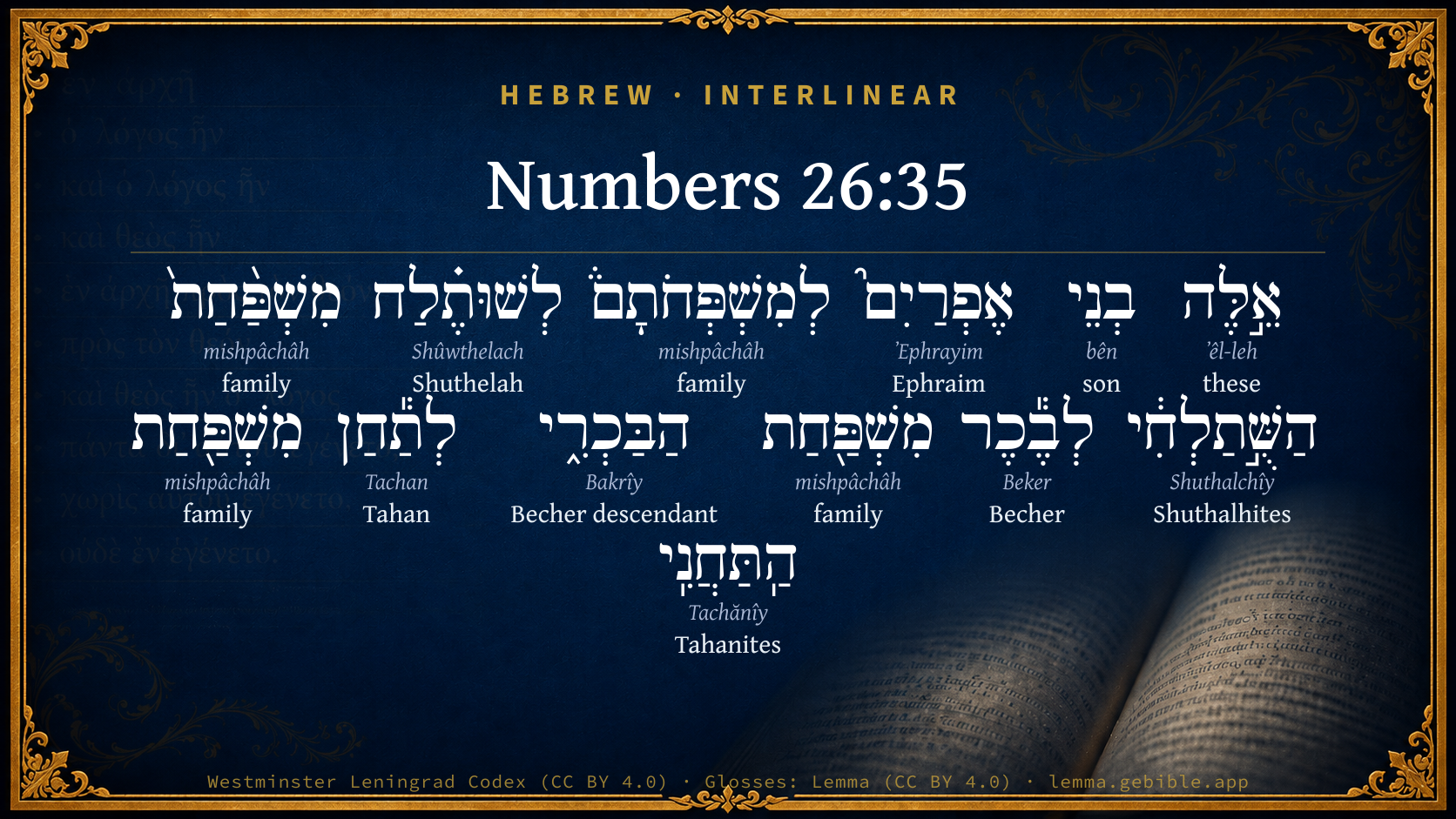
Numbers 26:35

Hebrew (Westminster Leningrad Codex) Numbers 26:35 appears in the Hebrew Old Testament. The text above is from the Westminster Leningrad Codex. Each word links to its Strong’s number, a concise gloss, and parsing drawn from the Open Scriptures Hebrew Bible morphology. Click any word for its full Brown-Driver-Briggs (BDB) entry.
Download image
Cite this verse

Numbers 26:35 (World English Bible). Public Domain. Lemma interlinear Bible study tool, https://lemma.gebible.app/v/numbers/26/35.

Show BibTeX & RIS
BibTeX
RIS
English Translation
These are the sons of Ephraim after their families: of Shuthelah, the family of the Shuthelahites; of Becher, the family of the Becherites; of Tahan, the family of the Tahanites.
World English Bible · Public Domain
Highlights Full analysis ↓
Download a study sheet

One document with this verse’s original text, its word-by-word gloss line, the meaning frame, cross-references with their text, attributed commentary, and full source and license credits — printable, and it pastes into notes with its structure intact.

This verse Autodidact and up

Study sheet (.html) Plain text (.txt)

A passage Seminary Student

Up to 50 verses in one chapter. A passage sheet keeps up to 6 commentary sources and 12 cross-references per verse, in the order this page ranks them, and says so on the sheet whenever that leaves anything out. Ask for a single verse and you get the Autodidact verse sheet above.

Everything on this page stays free to read, with no account — the sheet is a download of what is already on screen, not access to it.

Want to remove ads? Support Godless Engineer
Compare translations 3

The same verse in 3 English versions, stacked beneath the original-language interlinear above. Click any original word for its lexicon entry.

Each is an independent rendering of the whole verse — the interlinear is not word-aligned to these translations.

Highlighted words mark where these versions differ — a whole-verse word diff, not a word-by-word alignment.

  • World English Bible Public Domain
    These are the sons of Ephraim after their families: of Shuthelah, the family of the Shuthelahites; of Becher, the family of the Becherites; of Tahan, the family of the Tahanites.
  • King James Version Public Domain
    These are the sons of Ephraim after their families: of Shuthelah, the family of the Shuthalhites: of Becher, the family of the Bachrites: of Tahan, the family of the Tahanites.
  • unfoldingWord Literal Text CC BY-SA 4.0
    These were the sons of Ephraim according to their clans: of Shuthelah, the clan of the Shuthelahite; of Beker, the clan of the Bekerite; of Tahan, the clan of the Tahanite.

unfoldingWord Literal Text — © unfoldingWord, licensed CC BY-SA 4.0. Word-aligned USFM3 via Door43 (git.door43.org/unfoldingWord/en_ult).

Versions to compare (up to 4)

3 of 4 selected

Show all 18 translations

Every available English version of this verse, each an independent rendering of the whole verse.

  • World English Bible Public Domain
    These are the sons of Ephraim after their families: of Shuthelah, the family of the Shuthelahites; of Becher, the family of the Becherites; of Tahan, the family of the Tahanites.
  • Berean Standard Bible Public Domain
    These were the descendants of Ephraim by their clans: The Shuthelahite clan from Shuthelah, the Becherite clan from Becher, and the Tahanite clan from Tahan.
  • Majority Standard Bible Public Domain
    These were the descendants of Ephraim by their clans: The Shuthelahite clan from Shuthelah, the Becherite clan from Becher, and the Tahanite clan from Tahan.
  • King James Version Public Domain
    These are the sons of Ephraim after their families: of Shuthelah, the family of the Shuthalhites: of Becher, the family of the Bachrites: of Tahan, the family of the Tahanites.
  • American Standard Version (1901) Public Domain
    These are the sons of Ephraim after their families: of Shuthelah, the family of the Shuthelahites; of Becher, the family of the Becherites; of Tahan, the family of the Tahanites.
  • Revised Version (1885) Public Domain
    These are the sons of Ephraim after their families: of Shuthelah, the family of the Shuthelahites: of Becher, the family of the Becherites: of Tahan, the family of the Tahanites.
  • Geneva Bible (1599) Public Domain
    These are the sonnes of Ephraim after their families: of Shuthelah came the familie of the Shuthalhites: of Becher, the familie of the Bachrites: of Tahan, the familie of the Tahanites.
  • Douay-Rheims (1899) Public Domain
    And the sons of Ephraim by their kindreds were these: Suthala, of whom is the family of the Suthalaites: Becher, of whom is the family of the Becherites: Thehen, of whom is the family of the Thehenites.
  • Young's Literal Translation Public Domain
    These `are' sons of Ephraim by their families: of Shuthelah `is' the family of the Shuthelhite; of Becher the family of the Bachrite; of Tahan the family of the Tahanite.
  • Literal Standard Version CC BY-SA 4.0
    These [are] sons of Ephraim by their families: of Shuthelah [is] the family of the Shuthelhite; of Becher the family of the Bachrite; of Tahan the family of the Tahanite.
  • Unlocked Literal Bible CC BY-SA 4.0
    The clans of Ephraim's descendants were these: Through Shuthelah, the clan of the Shuthelahites, through Beker, the clan of the Bekerites, through Tahan, the clan of the Tahanites.
  • unfoldingWord Literal Text CC BY-SA 4.0
    These were the sons of Ephraim according to their clans: of Shuthelah, the clan of the Shuthelahite; of Beker, the clan of the Bekerite; of Tahan, the clan of the Tahanite.
  • Darby Bible Public Domain
    These are the sons of Ephraim, after their families: of Shuthelah, the family of the Shuthalhites; of Becher, the family of the Bachrites; of Tahan, the family of the Tahanites.
  • World Messianic Bible Public Domain
    These are the sons of Ephraim after their families: of Shuthelah, the family of the Shuthelahites; of Becher, the family of the Becherites; of Tahan, the family of the Tahanites.
  • Webster's Bible Public Domain
    These are the sons of Ephraim after their families: of Shuthelah, the family of the Shuthalhites: of Becher, the family of the Bachrites: of Tahan, the family of the Tahanites.
  • Free Bible Version CC BY-SA 4.0
    These were the descendants of Ephraim by family: Shuthelah, ancestor of the Shuthelahite family; Becher, ancestor of the Becherite family; and Tahan, ancestor of the Tahanite family.
  • Bible in Basic English Public Domain
    These are the sons of Ephraim by their families: of Shuthelah, the family of the Shuthelahites: of Becher, the family of the Becherites: of Tahan, the family of the Tahanites.
  • JPS Tanakh (1917) Public Domain
    These are the sons of Ephraim after their families: of Shuthelah, the family of the Shuthelahites; of Becher, the family of the Becherites; of Tahan, the family of the Tahanites.

Literal Standard Version (2020), Covenant Press — licensed CC BY-SA 4.0. Text via the HelloAO Bible API (eBible.org). Unlocked Literal Bible (unfoldingWord) — licensed CC BY-SA 4.0. Text via the HelloAO Bible API (eBible.org). unfoldingWord Literal Text — © unfoldingWord, licensed CC BY-SA 4.0. Word-aligned USFM3 via Door43 (git.door43.org/unfoldingWord/en_ult). Free Bible Version, Dr. Jonathan Gallagher — licensed CC BY-SA 4.0. Text via the HelloAO Bible API (eBible.org).

Word by word

More ways to search: Search by grammar → Find every occurrence → Compare this word →

Practice this passage: Drill this verse → Learn its vocabulary →

הַשֻּׁ֣תַלְחִ֔י
Shuthalchîy
H8364
“the · Shuthalhites”
Particle, Definite Article + Noun, Gentilic, Masculine, Singular, Absolute
Part of Speech
Particle + Noun
Type
Gentilic
Gender
Masculine
Number
Singular
State
Absolute
Full BDB Definition

Origin: patronymically from H7803

TWOT: None

Shuthalhites = see Shuthelah " freshly appointed" - descendants of Shuthelah, son of Ephraim, and of his son of the same name
  1. אֵ֣לֶּה ʼêl-leh H428 “these” Pronoun, Demonstrative, Common, Plural
  2. בְנֵי bên H1121 “sons of” Noun, Common, Masculine, Plural, Construct
  3. אֶפְרַיִם֮ ʼEphrayim H669 “Ephraim” Noun, Proper
  4. לְמִשְׁפְּחֹתָם֒ mishpâchâh H4940 “to/for · families · their” Preposition + Noun, Common, Feminine, Plural, Construct + Suffix, Personal, 3rd Person, Masculine, Plural
  5. לְשׁוּתֶ֗לַח Shûwthelach H7803 “to/for · Shuthelah” Preposition + Noun, Proper
  6. מִשְׁפַּ֨חַת֙ mishpâchâh H4940 “family of” Noun, Common, Feminine, Singular, Construct
  7. לְבֶ֕כֶר Beker H1071 “to/for · Becher” Preposition + Noun, Proper
  8. מִשְׁפַּ֖חַת mishpâchâh H4940 “family of” Noun, Common, Feminine, Singular, Construct
  9. הַבַּכְרִ֑י Bakrîy H1076 “the · Becher descendant” Particle, Definite Article + Noun, Gentilic, Masculine, Singular, Absolute
  10. לְתַ֕חַן Tachan H8465 “to/for · Tahan” Preposition + Noun, Proper
  11. מִשְׁפַּ֖חַת mishpâchâh H4940 “family of” Noun, Common, Feminine, Singular, Construct
  12. הַֽתַּחֲנִֽי Tachănîy H8470 “the · Tahanites” Particle, Definite Article + Noun, Gentilic, Masculine, Singular, Absolute

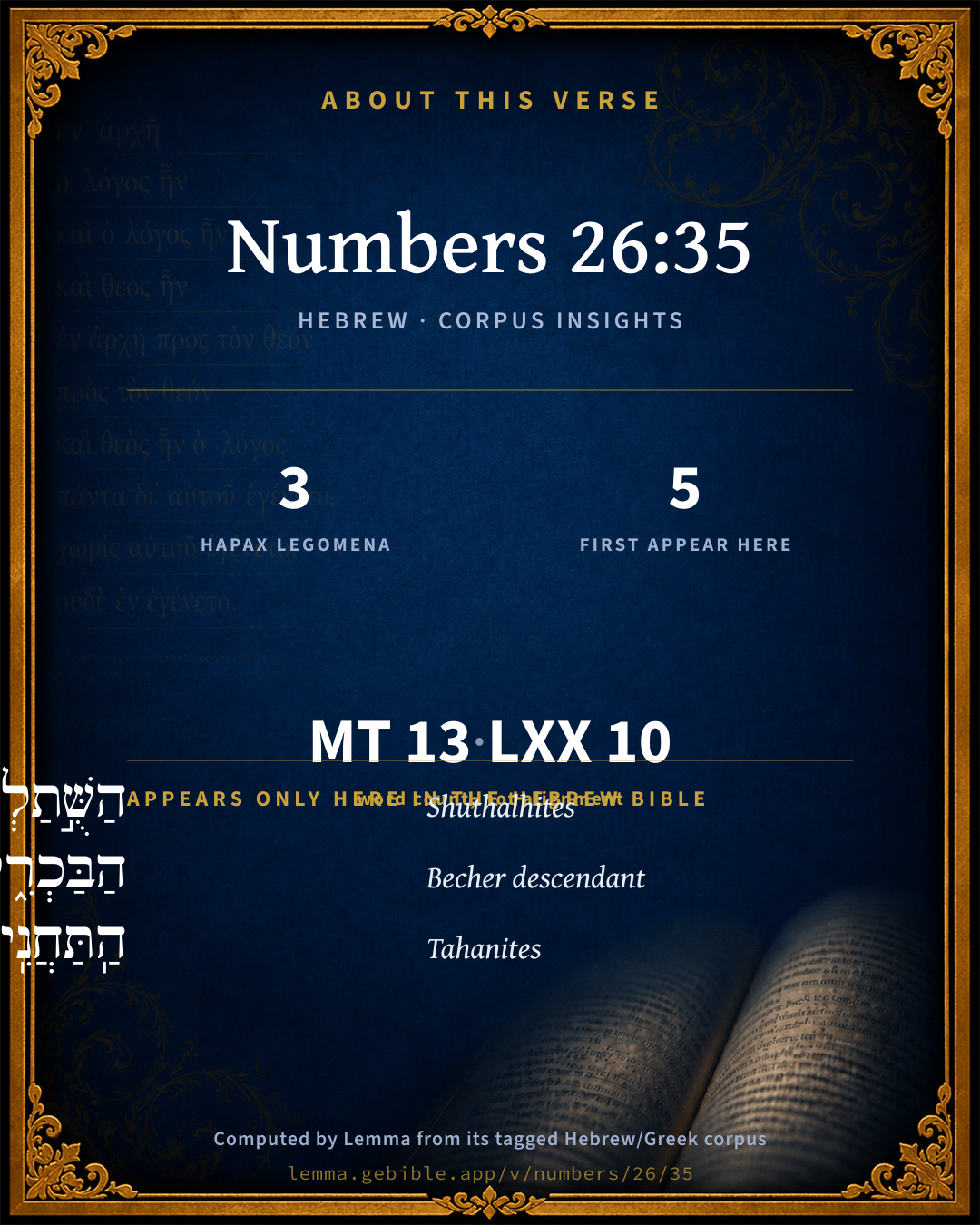
About this verse

These counts appear in no published source. They are computed here, from the morphology-tagged text and Lemma’s own curated glosses. What Lemma adds →

13
words
10
distinct lemmas
Pentateuch
section

Notable vocabulary

3 hapax legomena — words that appear only here in the entire Hebrew Bible:

  • הַשֻּׁ֣תַלְחִ֔י Shuthalhites H8364
  • הַבַּכְרִ֑י Becher descendant H1076
  • הַֽתַּחֲנִֽי Tahanites H8470

First appearance in Scripture

These words make their first canonical appearance in the Hebrew Bible here:

  • לְשׁוּתֶ֗לַח Shuthelah H7803
  • הַשֻּׁ֣תַלְחִ֔י Shuthalhites H8364
  • הַבַּכְרִ֑י Becher descendant H1076
  • לְתַ֕חַן Tahan H8465
  • הַֽתַּחֲנִֽי Tahanites H8470

Shared distinctive vocabulary

לְתַ֕חַן Tahan H8465 occurs in 2 verses of the Hebrew Bible. Also found in:

Grammatical profile

  • 12 nouns
  • 1 pronoun

Repetition

A word recurs within this verse — often emphatic in Hebrew:

  • לְמִשְׁפְּחֹתָם֒ family H4940 ×4

Hebrew & Septuagint length

In English translation the verse runs 30 words from the Hebrew and 14 from the Septuagint (LXX English) — the Septuagint runs noticeably shorter here. See the side-by-side →

A rough comparison of the two English renderings, which tokenize alike — not a word-level alignment.

Word counts can differ between the Hebrew and the Greek without any difference in meaning — e.g. the Hebrew direct-object marker אֵת has no separate Greek word, and Greek often adds the article ὁ.

In the original languages it is 13 Hebrew tokens and 10 Greek tokens — but the two are counted differently (Hebrew bundles its prefixes and suffixes into one token; the Greek is in lemma form), so that isn’t a like-for-like length.

Cross-references

1

Topical passages linked to Numbers 26:35 in the Treasury of Scripture Knowledge — connected by theme and wording, ordered by reader-vote popularity; previews shown in the World English Bible.

  • 1 Chronicles 7:20–21 The sons of Ephraim: Shuthelah, and Bered his son, and Tahath his son, and Eleadah his son, and Tahath his son,

Cross-references courtesy of OpenBible.info (CC BY 4.0).

Hebrew and Greek witnesses Masoretic Hebrew ↔ Greek Septuagint

The same verse in the two great witnesses to the Old Testament, shown verse-for-verse.

Here the Septuagint runs noticeably shorter than the Hebrew — LXX2012 (modern English Septuagint) 14 words vs World English Bible 30. A rough length comparison of the two English translations, not a word-level alignment — read both below.

These are two independent witnesses, not word-aligned to each other, and the Septuagint is shown in lemma (dictionary) form.

Hebrew Numbers 26:35 Masoretic · Westminster Leningrad Codex

אֵ֣לֶּה בְנֵי אֶפְרַיִם֮ לְמִשְׁפְּחֹתָם֒ לְשׁוּתֶ֗לַח מִשְׁפַּ֨חַת֙ הַשֻּׁ֣תַלְחִ֔י לְבֶ֕כֶר מִשְׁפַּ֖חַת הַבַּכְרִ֑י לְתַ֕חַן מִשְׁפַּ֖חַת הַֽתַּחֲנִֽי

These are the sons of Ephraim after their families: of Shuthelah, the family of the Shuthelahites; of Becher, the family of the Becherites; of Tahan, the family of the Tahanites.

World English Bible · Public Domain

Greek LXX Numbers 26:35 Septuagint · lemma form

ὁ εσριηλ δῆμος ὁ εσριηλι ὁ συχεμ δῆμος ὁ συχεμι

To Esriel, the family of the Esrielites; to Sychem, the family of the Sychemites.

LXX2012 (modern English Septuagint) · Public Domain

Hebrew: Westminster Leningrad Codex (CC BY 4.0). Greek: Septuagint (public domain); English from LXX2012 (modern English Septuagint) (Public Domain). How the Septuagint differs from the Hebrew →

Targum (Aramaic paraphrase)

2

The Targum is the ancient Jewish Aramaic paraphrase of the Hebrew Scriptures — an interpretive translation, not the Hebrew text itself. Onkelos (literal) and Pseudo-Jonathan (expansive) render the Torah, and Jonathan the Prophets. Coverage is partial: where no permissively-licensed English translation exists for a verse, only the Aramaic is shown. This is verse-level text, not a word-by-word alignment to the Hebrew.

  1. Targum Onkelos Torah (Genesis–Deuteronomy)
    אִלֵין בְּנֵי אֶפְרַיִם לְזַרְעֲיַתְהוֹן לְשׁוּתֶלַח זַרְעִית שׁוּתֶלַח לְבֶכֶר זַרְעִית בֶּכֶר לְתַחַן זַרעִית תַּחַן

    (no public-domain English translation for this verse)

    Targum Onkelos — Aramaic: “Onkelos Genesis” (public domain); “Onkelos Exodus” (public domain); “Onkelos Leviticus” (public domain); “Onkelos Numbers” (public domain); “Onkelos Deuteronomy” (public domain). English: “Sefaria Community Translation” (CC0 1.0 (public-domain dedication)); “J.W. Etheridge. The Targums of Onkelos and Jonathan Ben Uzziel on the Pentateuch. London: Longmans, Green, 1862” (public domain). Text via Sefaria.

  2. Targum Pseudo-Jonathan Torah (Genesis–Deuteronomy)
    אִלֵין בְּנֵי אֶפְרַיִם לִסְכוּמְהוֹן לְשׁוּתֶלַח גְנִיסַת שׁוּתֶלַח לְבֶכֶר גְנִיסַת בֶּכֶר לְתַחַן גְנִיסַת תַּחַן

    The Beni Ephraim by their numbers, of Shuthelah, the family of Shutelah; of Bekir, the family of Bekir; of Tachan, the family of Tachan.

    Targum Pseudo-Jonathan — Aramaic: “Targum Jonathan on Genesis” (public domain); “Targum Jonathan on Exodus” (public domain); “Targum Jonathan on Leviticus” (public domain); “Targum Jonathan on Numbers” (public domain); “Targum Jonathan on Deuteronomy” (public domain). English: “The Targum of Jonathan ben Uzziel, trans. J. W. Etheridge, London, 1862” (public domain). Text via Sefaria.

Commentary

Notes on Numbers 26:35 from classic Christian and Jewish commentators (each source and its license shown beneath its notes). The classic Christian expositions comment on the surrounding passage and are grouped to its opening verse, so a note may address several verses; the Jewish commentaries on the Tanakh (Rashi and others) are per-verse, so they appear only where the commentator wrote on this verse.

Lemma curates 59 commentaries, every one of them public domain or Creative Commons licensed, each selected and text-cleaned for this edition rather than reprinted as found. About our sources →

John Gill's Exposition

Unto these the land shall be divided for an inheritance,.... That were numbered, and to none else:

according to the number of their names; and for this end was the number of them now taken, that the land might be equally divided among them; women and minors, or such as were under twenty years of age, had no share in it; and even only those who were at that age at this time; so Jarchi says, it was not divided to any that were less than twenty years of age, even though they came to be full twenty before the division of the land; for they were seven years subduing it, and seven years dividing it, yet none took any part of it but these 601,730: nay, he says, if a man had six children they took but their father's part only.

John Gill's Exposition of the Whole Bible (1746–1763) — public domain (CC PDM 1.0). Text via the HelloAO Bible API.

Matthew Poole's English Annotations

Becher, called also Bered, 1Ch 7:20.

Matthew Poole's English Annotations on the Holy Bible (1683–1685) — public domain. Text from a community e-Sword/MySword module.

Whedon's Commentary on the Bible

Daniel D. Whedon

35. The sons of Ephraim founded three families, and a grandson founded one.

Daniel D. Whedon (gen. ed.), Commentary on the Old and New Testaments (1874–1909) — public domain. Text from a community e-Sword module.

The Pulpit Commentary

The sons of Ephraim. These formed but four families, three named after sons, one after a grandson. In 1Ch_7:21 two other sons of Ephraim are mentioned who were killed in their father"s lifetime, and a third, Beriah, who was the ancestor of Joshua. He does not seem to have founded a separate family, possibly because he was so very much younger than his brothers.

The Pulpit Commentary (1880–1919), ed. H.D.M. Spence-Jones & Joseph S. Exell — public domain. Text from a community e-Sword module.

unfoldingWord translationNotes

Door43 World Missions Community

General Information:

The leaders of Israel are counting the men, 20 years old and older, according to their tribes and families. (See: How to Translate Names and Numbers)

32,500 men

"thirty-two thousand five hundred men" (See: Numbers)

These were Joseph's descendants, counted

The word "these" refers to all of the men descended from Joseph's sons, Ephraim and Manasseh. The full meaning of this statement can be made clear. AT: "These were Joseph's descendants, descended from his sons Manasseh and Ephraim, counted" (See: Assumed Knowledge and Implicit Information)

counted in each of their clans

This can be stated in active form. AT: "they counted them in each of their clans" (See: Active or Passive)

translationWords

clan

Ephraim

descend

Joseph (OT)

unfoldingWord translationNotes — © Distant Shores Media and the Door43 World Missions Community, licensed CC BY-SA 4.0. Source: git.door43.org/Door43/en_tn.

Lesson kit

Teaching starters — assembled from the data on this page, not authored interpretation. Every prompt links to the verse data it draws on. Edit before teaching.

Numbers, in the Pentateuch, opens this verse with 13 words (10 distinct Hebrew lemmas). Its most distinctive word is Shuthalchîy (“Shuthalhites”). The Greek Septuagint runs shorter here. A historical commentator’s framing appears above. Read the whole chapter for the surrounding context.

Discussion questions

  1. What does “Shuthalhites” (Shuthalchîy) contribute to the verse as a whole?
  2. This verse holds 3 words here found nowhere else in the Hebrew Bible. What might the rare words draw attention to?
  3. 5 words here appear for the first time in Scripture. What is being introduced at this debut?
  4. 1 Chronicles 7:25 shares the word «Tahan» with this verse. How do the two illuminate each other?
  5. “family” occurs 4× in this one verse. What is the effect of the repetition?
  6. Compared with the Hebrew, the Septuagint runs shorter here. What questions does that raise?
  7. These translations render this verse differently. What is at stake in choosing one wording over another?
  8. Reading how John Gill's Exposition and Matthew Poole's English Annotations read this verse, where do the two commentators agree and where do they part?

Things to notice

  • 3 words in this verse appear nowhere else in the Hebrew Bible.
  • 5 words make their first canonical appearance in Scripture here.
  • This verse counts 13 Hebrew ↔ 10 Greek words.
  • These translations choose different wording for 16 words in this verse.
  • “family” occurs 4× in this single verse.

Reading settings

Reading text

Shown beneath each verse's original-language words.

Old Testament
Old Testament edition

Read the OT as the Masoretic Hebrew (MT) or the Greek Septuagint (LXX).

English shown for the Greek Septuagint (in the Hebrew ↔ Greek comparison).

Comparing translations? Open the Compare panel on any verse page to stack up to four side by side.