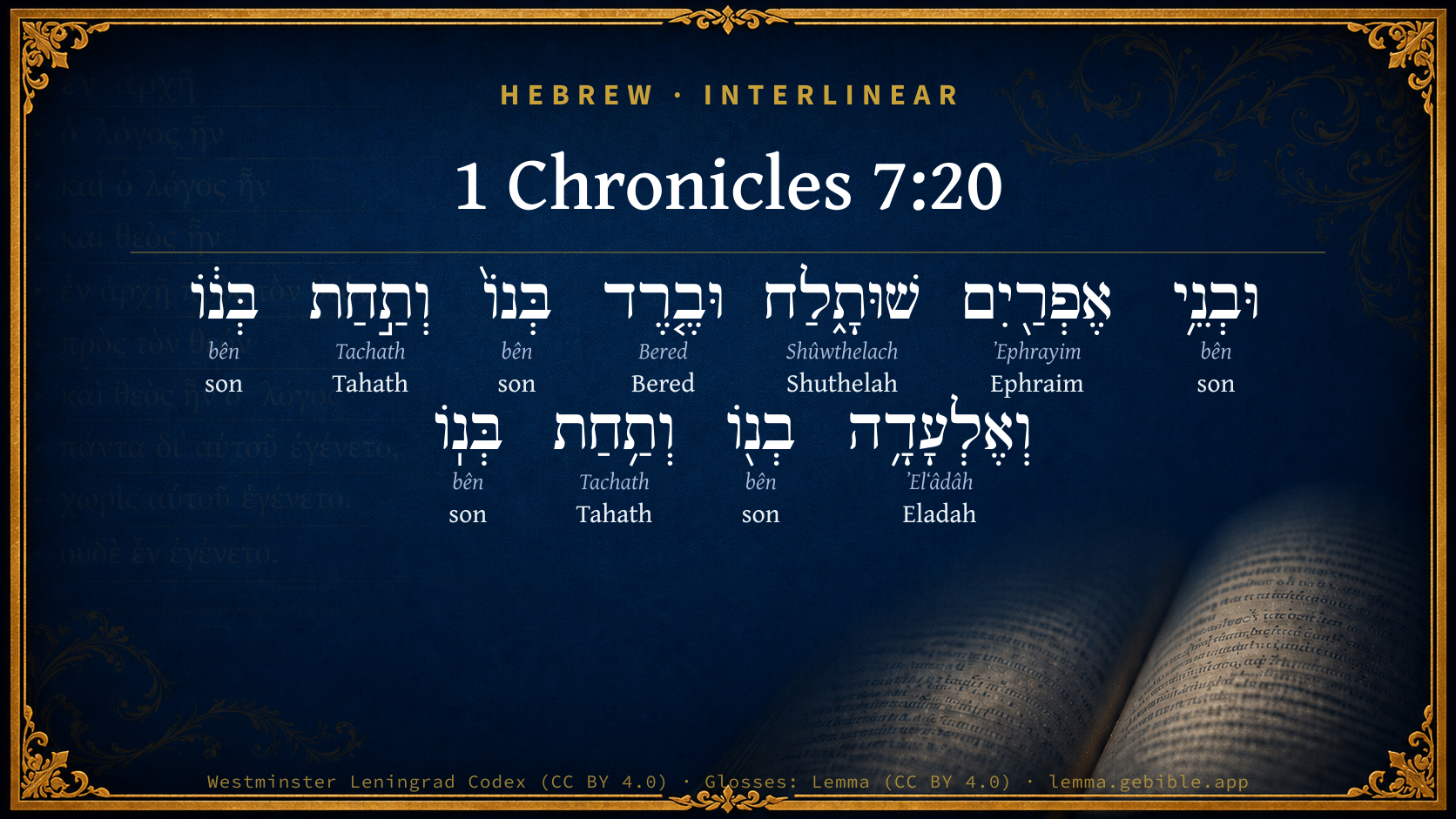
1 Chronicles 7:20

Hebrew (Westminster Leningrad Codex) 1 Chronicles 7:20 appears in the Hebrew Old Testament. The text above is from the Westminster Leningrad Codex. Each word links to its Strong’s number, a concise gloss, and parsing drawn from the Open Scriptures Hebrew Bible morphology. Click any word for its full Brown-Driver-Briggs (BDB) entry.
Download image
Cite this verse

1 Chronicles 7:20 (World English Bible). Public Domain. Lemma interlinear Bible study tool, https://lemma.gebible.app/v/1-chronicles/7/20.

Show BibTeX & RIS
BibTeX
RIS
English Translation
The sons of Ephraim: Shuthelah, and Bered his son, and Tahath his son, and Eleadah his son, and Tahath his son,
World English Bible · Public Domain
Highlights
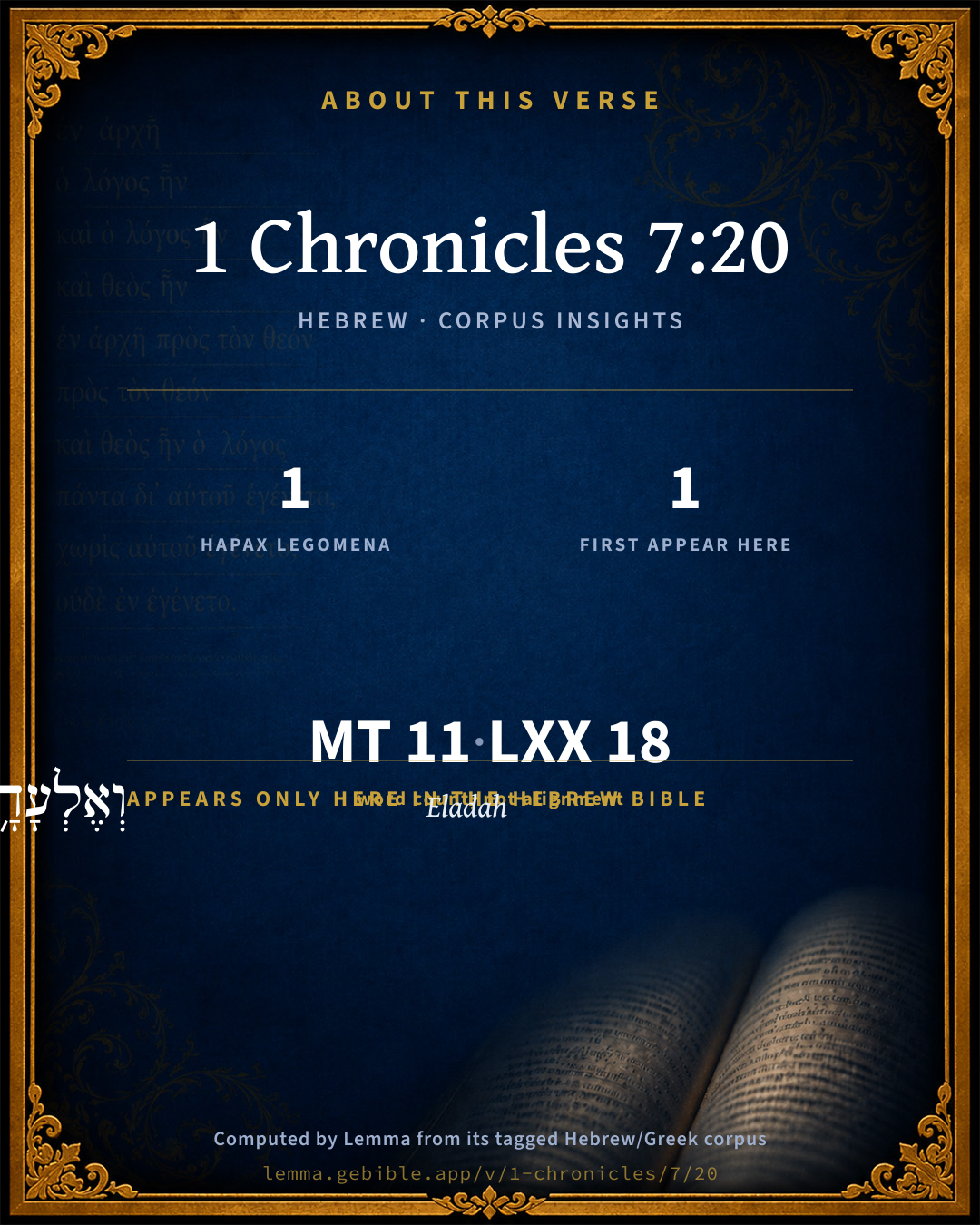
  • 1 hapax legomenon — only here in the Hebrew Bible
  • 1 first appearance in the Hebrew Bible
Full analysis ↓
Download a study sheet

One document with this verse’s original text, its word-by-word gloss line, the meaning frame, cross-references with their text, attributed commentary, and full source and license credits — printable, and it pastes into notes with its structure intact.

This verse Autodidact and up

Study sheet (.html) Plain text (.txt)

A passage Seminary Student

Up to 50 verses in one chapter. A passage sheet keeps up to 6 commentary sources and 12 cross-references per verse, in the order this page ranks them, and says so on the sheet whenever that leaves anything out. Ask for a single verse and you get the Autodidact verse sheet above.

Everything on this page stays free to read, with no account — the sheet is a download of what is already on screen, not access to it.

Want to remove ads? Support Godless Engineer
Compare translations 3

The same verse in 3 English versions, stacked beneath the original-language interlinear above. Click any original word for its lexicon entry.

Each is an independent rendering of the whole verse — the interlinear is not word-aligned to these translations.

Highlighted words mark where these versions differ — a whole-verse word diff, not a word-by-word alignment.

  • World English Bible Public Domain
    The sons of Ephraim: Shuthelah, and Bered his son, and Tahath his son, and Eleadah his son, and Tahath his son,
  • King James Version Public Domain
    And the sons of Ephraim; Shuthelah, and Bered his son, and Tahath his son, and Eladah his son, and Tahath his son,
  • unfoldingWord Literal Text CC BY-SA 4.0
    And the sons of Ephraim: Shuthelah and Bere his son, and Tahat his son, and Eleada his son, and Tahath, his son,

unfoldingWord Literal Text — © unfoldingWord, licensed CC BY-SA 4.0. Word-aligned USFM3 via Door43 (git.door43.org/unfoldingWord/en_ult).

Versions to compare (up to 4)

3 of 4 selected

Show all 18 translations

Every available English version of this verse, each an independent rendering of the whole verse.

  • World English Bible Public Domain
    The sons of Ephraim: Shuthelah, and Bered his son, and Tahath his son, and Eleadah his son, and Tahath his son,
  • Berean Standard Bible Public Domain
    The descendants of Ephraim: Shuthelah, Bered his son, Tahath his son, Eleadah his son, Tahath his son,
  • Majority Standard Bible Public Domain
    The descendants of Ephraim: Shuthelah, Bered his son, Tahath his son, Eleadah his son, Tahath his son,
  • King James Version Public Domain
    And the sons of Ephraim; Shuthelah, and Bered his son, and Tahath his son, and Eladah his son, and Tahath his son,
  • American Standard Version (1901) Public Domain
    And the sons of Ephraim: Shuthelah, and Bered his son, and Tahath his son, and Eleadah his son, and Tahath his son,
  • Revised Version (1885) Public Domain
    And the sons of Ephraim; Shuthelah, and Bered his son, and Tahath his son, and Eleadah his son, and Tahath his son,
  • Geneva Bible (1599) Public Domain
    The sonnes also of Ephraim were Shuthelah, and Bered his sonne, and Tahath his sonne, and his sonne Eladah, and Tahath his sonne,
  • Douay-Rheims (1899) Public Domain
    And the sons of Ephraim were Suthala, Bared his son, Thahath his son, Elada his son, Thahath his son, and his son Zabad,
  • Young's Literal Translation Public Domain
    And sons of Ephraim: Shuthelah, and Bered his son, and Tahath his son, and Eladah his son, and Tahath his son,
  • Literal Standard Version CC BY-SA 4.0
    And sons of Ephraim: Shuthelah, and Bered his son, and Tahath his son, and Eladah his son, and Tahath his son,
  • Unlocked Literal Bible CC BY-SA 4.0
    The descendants of Ephraim were as follows: Ephraim's son was Shuthelah. Shuthelah's son was Bered. Bered's son was Tahath. Tahath's son was Eleadah. Eleadah's son was Tahath.
  • unfoldingWord Literal Text CC BY-SA 4.0
    And the sons of Ephraim: Shuthelah and Bere his son, and Tahat his son, and Eleada his son, and Tahath, his son,
  • Darby Bible Public Domain
    And the sons of Ephraim: Shuthelah, and Bered his son, and Tahath his son, and Eladah his son, and Tahath his son,
  • World Messianic Bible Public Domain
    The sons of Ephraim: Shuthelah, Bered his son, Tahath his son, Eleadah his son, Tahath his son,
  • Webster's Bible Public Domain
    And the sons of Ephraim; Shuthelah, and Bered his son, and Tahath his son, and Eladah his son, and Tahath his son,
  • Free Bible Version CC BY-SA 4.0
    The descendants of Ephraim: Shuthelah, Bered his son, Tahath his son, Eleadah his son, Tahath his son,
  • Bible in Basic English Public Domain
    And the sons of Ephraim: Shuthelah and Bered his son, and Tahath his son, and Eleadah his son, and Tahath his son,
  • JPS Tanakh (1917) Public Domain
    And the sons of Ephraim: Shuthelah — and Bered was his son, and Tahath his son, and Eleadah his son, and Tahath his son,

Literal Standard Version (2020), Covenant Press — licensed CC BY-SA 4.0. Text via the HelloAO Bible API (eBible.org). Unlocked Literal Bible (unfoldingWord) — licensed CC BY-SA 4.0. Text via the HelloAO Bible API (eBible.org). unfoldingWord Literal Text — © unfoldingWord, licensed CC BY-SA 4.0. Word-aligned USFM3 via Door43 (git.door43.org/unfoldingWord/en_ult). Free Bible Version, Dr. Jonathan Gallagher — licensed CC BY-SA 4.0. Text via the HelloAO Bible API (eBible.org).

Word by word

More ways to search: Search by grammar → Find every occurrence → Compare this word →

Practice this passage: Drill this verse → Learn its vocabulary →

וְאֶלְעָדָ֥ה
ʼElʻâdâh
H497
“and · Eladah”
Conjunction + Noun, Proper
Part of Speech
Conjunction + Noun
Type
Proper
Full BDB Definition

Origin: from H410 and H5710

TWOT: None

Eladah = "God has adorned" - a descendant of Ephraim
  1. וּבְנֵ֥י bên H1121 “and · sons of” Conjunction + Noun, Common, Masculine, Plural, Construct
  2. אֶפְרַ֖יִם ʼEphrayim H669 “Ephraim” Noun, Proper
  3. שׁוּתָ֑לַח Shûwthelach H7803 “Shuthelah” Noun, Proper
  4. וּבֶ֤רֶד Bered H1260 “and · Bered” Conjunction + Noun, Proper
  5. בְּנוֹ֙ bên H1121 “son · his” Noun, Common, Masculine, Singular, Construct + Suffix, Personal, 3rd Person, Masculine, Singular
  6. וְתַ֣חַת Tachath H8480 “and · Tahath” Conjunction + Noun, Proper
  7. בְּנ֔וֹ bên H1121 “son · his” Noun, Common, Masculine, Singular, Construct + Suffix, Personal, 3rd Person, Masculine, Singular
  8. בְנ֖וֹ bên H1121 “son · his” Noun, Common, Masculine, Singular, Construct + Suffix, Personal, 3rd Person, Masculine, Singular
  9. וְתַ֥חַת Tachath H8480 “and · Tahath” Conjunction + Noun, Proper
  10. בְּנֽוֹ bên H1121 “son · his” Noun, Common, Masculine, Singular, Construct + Suffix, Personal, 3rd Person, Masculine, Singular

About this verse

These counts appear in no published source. They are computed here, from the morphology-tagged text and Lemma’s own curated glosses. What Lemma adds →

11
words
6
distinct lemmas
Historical
section

Notable vocabulary

1 hapax legomenon — a word that appears only here in the entire Hebrew Bible:

  • וְאֶלְעָדָ֥ה Eladah H497

First appearance in Scripture

This word makes its first canonical appearance in the Hebrew Bible here:

  • וְאֶלְעָדָ֥ה Eladah H497

Shared distinctive vocabulary

וּבֶ֤רֶד Bered H1260 occurs in 2 verses of the Hebrew Bible. Also found in:

Grammatical profile

  • 11 nouns

Repetition

Words recur within this verse — often emphatic in Hebrew:

  • וּבְנֵ֥י son H1121 ×5
  • וְתַ֣חַת Tahath H8480 ×2

Hebrew & Septuagint length

In English translation the verse runs 21 words from the Hebrew and 20 from the Septuagint (LXX English) — closely comparable.

A rough comparison of the two English renderings, which tokenize alike — not a word-level alignment.

Word counts can differ between the Hebrew and the Greek without any difference in meaning — e.g. the Hebrew direct-object marker אֵת has no separate Greek word, and Greek often adds the article ὁ.

In the original languages it is 11 Hebrew tokens and 18 Greek tokens — but the two are counted differently (Hebrew bundles its prefixes and suffixes into one token; the Greek is in lemma form), so that isn’t a like-for-like length.

Cross-references

1

Topical passages linked to 1 Chronicles 7:20 in the Treasury of Scripture Knowledge — connected by theme and wording, ordered by reader-vote popularity; previews shown in the World English Bible.

  • Numbers 26:35–36 These are the sons of Ephraim after their families: of Shuthelah, the family of the Shuthelahites; of Becher, the family of the Becherites; of Tahan, the family of the Tahanites.

Cross-references courtesy of OpenBible.info (CC BY 4.0).

Hebrew and Greek witnesses Masoretic Hebrew ↔ Greek Septuagint

The same verse in the two great witnesses to the Old Testament, shown verse-for-verse.

These are two independent witnesses, not word-aligned to each other, and the Septuagint is shown in lemma (dictionary) form.

Hebrew 1 Chronicles 7:20 Masoretic · Westminster Leningrad Codex

וּבְנֵ֥י אֶפְרַ֖יִם שׁוּתָ֑לַח וּבֶ֤רֶד בְּנוֹ֙ וְתַ֣חַת בְּנ֔וֹ וְאֶלְעָדָ֥ה בְנ֖וֹ וְתַ֥חַת בְּנֽוֹ

The sons of Ephraim: Shuthelah, and Bered his son, and Tahath his son, and Eleadah his son, and Tahath his son,

World English Bible · Public Domain

Greek LXX 1 Chronicles 7:20 Septuagint · lemma form

καί υἱός ἐφράιμ σωθαλα καί βαραδ υἱός αὐτός καί θααθ υἱός αὐτός ελεαδα υἱός αὐτός νομεε υἱός αὐτός

And the sons of Ephraim; Sothalath, and Barad his son, and Thaath his son, Elada his son, Saath his son,

LXX2012 (modern English Septuagint) · Public Domain

Hebrew: Westminster Leningrad Codex (CC BY 4.0). Greek: Septuagint (public domain); English from LXX2012 (modern English Septuagint) (Public Domain). How the Septuagint differs from the Hebrew →

Commentary

Notes on 1 Chronicles 7:20 from classic Christian and Jewish commentators (each source and its license shown beneath its notes). The classic Christian expositions comment on the surrounding passage and are grouped to its opening verse, so a note may address several verses; the Jewish commentaries on the Tanakh (Rashi and others) are per-verse, so they appear only where the commentator wrote on this verse.

Lemma curates 59 commentaries, every one of them public domain or Creative Commons licensed, each selected and text-cleaned for this edition rather than reprinted as found. About our sources →

Trapp's Complete Commentary

John Trapp

1Ch 7:20 And the sons of Ephraim; Shuthelah, and Bered his son, and Tahath his son, and Eladah his son, and Tahath his son,

Ver. 20. And the sons of Ephraim,] The Ephraimites were famous for their wealth, power, and prowess; but withal they are noted for insolent, proud, and quarrelsome. See Jdg 8:1; Jdg 12:1.

John Trapp, A Commentary or Exposition upon All the Books of the Old and New Testament (1647–1656) — public domain. Text from a community e-Sword module.

Tyndale Open Study Notes

Tyndale Open Resources

7:20-27 The genealogy of the descendants of Ephraim includes a story illustrating the circumstances of the tribe’s settlement in Canaan (7:21-24). The genealogy ends with Joshua son of Nun, who led Israel into the Promised Land.

Tyndale Open Study Notes — © Tyndale Open Resources, licensed CC BY-SA 4.0. Text via the HelloAO Bible API.

Matthew Henry's Commentary

We have here an account,

I. Of the tribe of Ephraim. Great things we read of that tribe when it came to maturity. Here we have an account of the disasters of its infancy, while it was in Egypt as it should seem; for Ephraim himself was alive when those things were done, which yet is hard to imagine if it were, as is here computed, seven generations off. Therefore I am apt to think that either it was another Ephraim or that those who were slain were the immediate sons of that Ephraim that was the son of Joseph. In this passage, which is related here only, we have, 1. The great breach that was made upon the family of Ephraim. The men of Gath, Philistines, giants, slew many of the sons of that family, because they came down to take away their cattle, Ch1 7:21. It is uncertain who were the aggressors here. Some make the men of Gath the aggressors, men born in the land of Egypt, but now resident in Gath, supposing that they came down into the land of Goshen, to drive away the Ephraimites' cattle, and slew the owners, because they stood up in the defence of them. Many a man's life has been exposed and betrayed by his wealth; so far is it from being a strong city. Others think that the Ephraimites made a descent upon the men of Gath to plunder them, presuming that the time had come when they should be put in possession of Canaan; but they paid dearly for their rashness and precipitation. Those that will not wait God's time cannot expect God's blessing. I rather think that the men of Gath came down upon the Ephraimites, because the Israelites in Egypt were shepherds, not soldiers, abounded in cattle of their own, and therefore were not likely to venture their lives for their neighbours' cattle: and the words may be read, The men of Gath slew them, for they came down to take away their cattle. Zabad the son of Ephraim, and Shuthelah, and Ezer, and Elead (his grandchildren), were, as Dr. Lightfoot thinks, the men that were slain. Jacob had foretold that the seed of Ephraim should become a multitude of nations (Gen 48:19), and yet that plant is thus nipped in the bud. God's providences often seem to contradict his promises; but, when they do so, they really magnify the promise, and make the performance of it, notwithstanding, so much more illustrious. The Ephraimites were the posterity of Joseph, and yet his power could not protect them, though some think he was yet living. The sword devours one as well as another. 2. The great grief which oppressed the father of the family hereupon: Ephraim mourned many days. Nothing brings the aged to the grave with more sorrow than their following the young that descend from them to the grave first, especially if in blood. It is often the burden of those that live to be old that they see those go before them of whom they said, These same shall comfort us. It was a brotherly friendly office which his brethren did, when they came to comfort him under this great affliction, to express their sympathy with him and concern for him, and to suggest that to him which would support and quiet him under this sad providence. Probably they reminded him of the promise of increase which Jacob had blessed him when he laid his right hand upon his head. Although his house was not so with God as he hoped, but a house of mourning, a shattered family, yet that promise was sure, Sa2 23:5. 3. The repair of this breach, in some measure, by addition of another son to his family in his old age (Ch1 7:23), like Seth, another seed instead of that of Abel whom Cain slew, Gen 4:25. When God thus restores comfort to his mourners, makes glad according to the days wherein he afflicted, setting the mercies over against the crosses, we ought therein to take notice of the kindness and tenderness of divine Providence; it is as if it repented God concerning his servants, Psa 90:13, Psa 90:15. Yet joy that a man was born into his family could not make him forget his grief; for he gives a melancholy name to his son, Beriah - in trouble, for he was born when the family was in mourning, when it went evil with his house. It is good to have in remembrance the affliction and the misery, the wormwood and the gall, that our souls may be humbled within us, Lam 3:19, Lam 3:20. What name more proper for man that is born of a woman than Beriah, because born into a troublesome world? It is added, as a further honour to the house of Ephraim, (1.) That a daughter of that tribe, Sherah by name, at the time of Israel's setting in Canaan, built some cities, either at her own charge or by her own care; one of them bore her name, Uzzen-sherah, Ch1 7:24. A virtuous woman may be as great an honour and blessing to a family as a mighty man. (2.) That a son of that tribe was employed in the conquest of Canaan, Joshua the son of Nun, Ch1 7:27. In this also the breach made on Ephraim's family was further repaired; and perhaps the resentment of this injury formerly done by the Canaanites to the Ephraimites might make him more vigorous in the war.

II. Of the tribe of Asher. Some men of note of that tribe are here named. Their militia was not numerous in comparison with some other tribes, only 26,000 men in all; but their princes were choice and mighty men of valour, chief of the princes (Ch1 7:40), and perhaps it was their wisdom that they coveted not to make their trained bands numerous, but rather to have a few, and those apt to the war and serviceable men.

Matthew Henry's Commentary on the Whole Bible (1708–1710) — public domain (CC PDM 1.0). Text via the HelloAO Bible API.

The Cambridge Bible for Schools and Colleges

gen. ed. J. J. S. Perowne

20–27. The Line of Ephraim to Joshua

20. Shuthelah … Bered … Tahath … Eladah] These four names are taken from Num_26:35-36, where they appear to correspond with Shuthelah … Becher … Tahan … Eran.

The Cambridge Bible for Schools and Colleges (gen. ed. J. J. S. Perowne; Cambridge University Press, 1878–1918) — public domain. Text from a community e-Sword module.

John Gill's Exposition

And Rephah was his son,.... The son of Beriah, whose genealogy from him is traced down to Joshua in this and the two following verses, and stands thus: after Rephah, Resheph, Telah, Tahan, Laadan, Ammihud, Elishama, who was prince of the tribe of Ephraim in the wilderness, Num 1:10, then Non or Nun, whose son was Jehoshua or Joshua.

, then Non or Nun, whose son was Jehoshua or Joshua.

1 Chronicles 7:28

ch1 7:28

ch1 7:28

ch1 7:28And their possessions and habitations,.... That is, of the sons of Ephraim, when come into the land of Canaan:

were Bethel, and the towns thereof; the villages belonging to it, which was formerly called Luz, and was the border of Ephraim, Jos 16:7.

and eastward Naaran: the same with Naarath, Jos 16:7.

and westward Gezer, with the towns thereof; of which see Jos 16:3,

and Shechem also, and the towns thereof; which was a city of refuge in Mount Ephraim, Jos 20:7

unto Gaza, and the towns thereof; not Gaza, a city of the Philistines, for the tribe of Ephraim did not reach so far; the Targum calls it Aiah; it may be read Adaza, as in the margin of our Bibles.

John Gill's Exposition of the Whole Bible (1746–1763) — public domain (CC PDM 1.0). Text via the HelloAO Bible API.

Albert Barnes' Notes on the Bible

The sons of Ephraim - The genealogy is difficult. It is perhaps best to consider Ezer and Elead 1Ch 7:21 as not sons of Zabad and brothers of the second Shuthelah, but natural sons of Ephraim. The passage would then run thusly:

“And the sons of Ephraim, Shuthelah (and Bered was his son, and Tahath his son and Eladah his son, and Tahath his son, and Zabad his son, and Shuthelah his son) and Ezer and Elead, whom the men of Gath slew” (i. e. the settled inhabitants, as contrasted with the nomadic Hebrews, Amalekites, etc.).

Albert Barnes' Notes on the Bible (1834–1885) — public domain. Text from a community e-Sword/MySword module.

Haydock's Catholic Bible Commentary

Bared, Thahath, probably called Becher and Theken, in Numbers. Three alone are there mentioned, though the other thirteen, whose names are given, seem to have been all the immediate sons of Ephriam, (Calmet) since he mourns for them, (ver. 22.; Menochius) and his other children afterwards. (Haydock) --- The dreadful slaughter made them, is perhaps the reason why only three are mentioned in Numbers, and none in Genesis.

George Leo Haydock (1774–1849), Haydock's Catholic Family Bible and Commentary, 1859 edition — public domain. Excludes Psalms (Douay-Rheims chapter numbering differs from Protestant) and Deuterocanonical books (Catholic canon only).

Matthew Poole's English Annotations

Bered his son; either,

1. The son of

Shuthelah; and so Tahath the son of Bered; and so the rest, which make up seven succeeding generations. Or,

2. The son of Ephraim; and so Tahath is the son not of Bered, but of Ephraim, and so forward. And thus all these were brethren, and sons or grandchildren of Ephraim, living together at one time with their father.

Object. This cannot be, because then Ephraim had two sons called Shuthelah, and two called Tahath.

Answ. That might easily happen, either because the first Shuthelah and Tahath were dead before the other two of those names were born; or because two of them were Ephraim’s sons, and two of them his grandchildren, called after their uncle’s names. For this is certain, the name of sons is promiscuously used concerning immediate children, and grandchildren, and great-grandchildren.

Matthew Poole's English Annotations on the Holy Bible (1683–1685) — public domain. Text from a community e-Sword/MySword module.

The Pulpit Commentary

Vers. 20-27. The chief difficulty of this passage lies in reconciling the points of chronology which it forces to the surface. Vers. 20, 21, purport to contain the line of descent from Ephraim through his son Shu-thelah to the seventh generation, viz. to another Shuthelah. The remaining two names, Ezer and Elead, may perhaps be two brothers of the first Shuthelah, i.e. own sons of Ephraim. If it be so, these two must not be supposed to correspond with Becher and Tahan, called "sons of Ephraim" in Num_26:35; for it is evident that they were generations succeeding Shuthelah. Now, Ephraim was born in Egypt, (Gen_46:20) so that, on the above showing, the actual sons of Ephraim must have made some incursion from Egypt into the territories of the settled or possibly aboriginal inhabitants of Gath, and met the fate over which Ephraim so mourned. Such excursions on the part of the Israelites out of Egypt have very little collateral evidence. But there would seem to be no impossibility in the matter, considering Gen_50:13-23. Next, vers. 23-27 seem to say that in his sorrow Ephraim has another son, whom he names Beriah, and of whose line in the ninth descent comes Joshua, the son of Nun. This also is very doubtful. It may very possibly be that the parenthesis continues to the end of ver. 23 or 24, and that vers. 25-27 carry on the generations from ver. 21. Meantime welcome light breaks in at the stage (ver. 26) at which Ammihud and Elishama are mentioned. For we find these immediate ancestors of the great Joshua repeatedly mentioned at the period of the Exodus; (Num_1:10 Num_2:18 Num_7:48, etc.) yet none of these places assist us to say that he did or did not come through Beriah. It is impossible to solve with any certainty the involved question of chronology and genealogy presented by this section. The passage is evidently mutilated and corrupt, though vindicating a high antiquity. Avery original presentation of the whole section, as ingenious as it is conjectural, by Lord A.C. Hervey, may be found in the art. "Shuthclah," Smith"s "Bible Dictionary," 3:1305. It is well worthy of attention that a great point is made in bringing Joshua to the place of the eighth generation from Joseph, in near analogy with the numbers in so many other known cases, of the generations that intervened from the descent into Egypt to the entrance into Canaan. There also may be found the most and best that can be said against the literal reading of what is here written respecting the men of Gath and the cattle.

Vers. 20-24.

Divine compensations.

We have, in brief, a story of family life which still has its interest and application to us in our domestic relations. We gather

I THAT GRIEVOUS AFFLICTION SOMETIMES FALLS ON A HUMAN HOME WITH OVERWHELMING SUDDENNESS. Several sons of one house" were slain in one day. Whichever party was the aggressor, and whether the Israelites were guilty or unfortunate, the blow fell with terrible effect on the elders of the family. "Ephraim their father mourned many days" (ver. 22). "Misfortunes never come alone" is only a hasty and false generalization: they generally do come alone. It is far truer to say, "One by one our sorrows meet us." For usually God tempers our griefs by sending them singly and with more or less of interval as also of preparation. More often than not the evil which awaits us" casts its shadow before it," and we prepare our hearts for the coming trouble. But sometimes it is otherwise. Occasionally, awful, aggravated, multiplied sorrows surge around us, and all the waves and billows of distress go over us without forewarning; from the height of prosperity and joy we go down, in one bitter hour, to the dark depth of loss and woe. No man can tell what tragedy is at hand for himself and his house. The holiest, the most beloved of God, may be standing, at any moment, in immediate peril of an almost unendurable calamity.

II THAT GOD HAS MERCIFUL COMPENSATIONS IN STORE FOE HIS STRICKEN CHILDREN. He wounds that he may heal; and that, as he heals, he may bless and save. It may be that he will send:

1. Human sympathy. Ephraim"s "brethren came to comfort him." Though the sympathy of human hearts cannot "do" anything for us, as men of coarse minds say, it can and does introduce into our hearts a soothing balm which is very precious to sensitive and responsive souls. It is seldom wasted; it is generally appreciated, and is often most highly esteemed. Or God may provide:

2. That which replaces the loss. To the bereaved Ephraim he gave another child, whose name, Beriah, was pathetically suggestive of this sad breach, but whose presence in the home must have gone no small way to repair it. And now it often happens that, instead of the child that is taken, comes the infant who is sent to fill its parents" hearts as well as its mother"s arms; or instead of the fortune that is lost the competency that is gained. Or God may send:

3. Some other compensating gift. From this stricken house he took away some parental love by the death of sons, but he gave a large measure of parental joy by the enterprising spirit of a daughter (ver. 24). It may be well for us that God should exchange one source of happiness for another. Long-continued enjoyment of one satisfaction often begets a false and guilty notion of independence, and even right of possession in the human heart. So God withdraws his gift which is ceasing to be a blessing; but he gives in place of it some other good which will work no evil to the soul.

4. Spiritual acquisition. When Ephraim was" mourning many days," his heart was tender, his mind docile, his soul receptive. Then, we may venture to say, he looked up to God with special earnestness, with filial submission, with peculiar devotion. Great sorrows, sweeping away earthly satisfactions and revealing our own helplessness, make the aid and arm of man seem but feebleness and cast us back on God. Then we hide in him; then we find that he is the Refuge and the Strength of his people, the true Dwelling-place of the human soul in all generations. In great and deep affliction, as at no other time, we

(1) see the meaning and feel the force of sacred truths;

(2) come into close fellowship with the Father, the Friend, the Comforter of the human spirit;

(3) realize the littleness of earthly life and the preciousness of the heritage which is beyond. Bereft of human wealth, we are "rich towards God.

C.

The Pulpit Commentary (1880–1919), ed. H.D.M. Spence-Jones & Joseph S. Exell — public domain. Text from a community e-Sword module.

Keil & Delitzsch

C. F. Keil & F. Delitzsch

And Rephah was his son,.... The son of Beriah, whose genealogy from him is traced down to Joshua in this and the two following verses, and stands thus: after Rephah, Resheph, Telah, Tahan, Laadan, Ammihud, Elishama, who was prince of the tribe of Ephraim in the wilderness, Num 1:10, then Non or Nun, whose son was Jehoshua or Joshua.

, then Non or Nun, whose son was Jehoshua or Joshua.

1 Chronicles 7:28

ch1 7:28

ch1 7:28

ch1 7:28And their possessions and habitations,.... That is, of the sons of Ephraim, when come into the land of Canaan:

were Bethel, and the towns thereof; the villages belonging to it, which was formerly called Luz, and was the border of Ephraim, Jos 16:7.

and eastward Naaran: the same with Naarath, Jos 16:7.

and westward Gezer, with the towns thereof; of which see Jos 16:3,

and Shechem also, and the towns thereof; which was a city of refuge in Mount Ephraim, Jos 20:7

unto Gaza, and the towns thereof; not Gaza, a city of the Philistines, for the tribe of Ephraim did not reach so far; the Targum calls it Aiah; it may be read Adaza, as in the margin of our Bibles.

Keil & Delitzsch — Biblical Commentary on the Old Testament (1861–1891) — public domain (CC PDM 1.0). Text via the HelloAO Bible API. (Old Testament only.)

unfoldingWord translationNotes

Door43 World Missions Community

General Information:

All of the names here except Gath are the names of men. Gath is the name of a place. (See: How to Translate Names)

Ezer and Elead were killed by men of Gath, natives in the land

This can be translated in active form. AT: "Men of Gath, the natives in the land, killed Ezer and Elead" (See: Active or Passive)

they went to steal their cattle

"the brothers went to steal the cattle from the people of Gath"

translationWords

Ephraim

Gath

mourn

comfort

unfoldingWord translationNotes — © Distant Shores Media and the Door43 World Missions Community, licensed CC BY-SA 4.0. Source: git.door43.org/Door43/en_tn.

Lesson kit

Teaching starters — assembled from the data on this page, not authored interpretation. Every prompt links to the verse data it draws on. Edit before teaching.

1 Chronicles, in the Historical, opens this verse with 11 words (6 distinct Hebrew lemmas). Its most distinctive word is ʼElʻâdâh (“Eladah”). A historical commentator’s framing appears above. Read the whole chapter for the surrounding context.

Discussion questions

  1. The word ʼElʻâdâh carries the sense “Eladah.” How does it shape the verse?
  2. This verse holds 1 word here found nowhere else in the Hebrew Bible. What might the rare word draw attention to?
  3. The word “Eladah” first appears here in Scripture. What is being introduced at this debut?
  4. Genesis 16:14 shares the word «Bered» with this verse. How do the two illuminate each other?
  5. “son” occurs 5× in this one verse. What is the effect of the repetition?
  6. These translations render this verse differently; the difference is in the English rendering, not the original. What questions does that raise?
  7. Reading how Trapp's Complete Commentary and Tyndale Open Study Notes read this verse, where do the two commentators agree and where do they part?

Things to notice

  • 1 word in this verse appears nowhere else in the Hebrew Bible.
  • 1 word makes its first canonical appearance in Scripture here.
  • This verse counts 11 Hebrew ↔ 18 Greek words.
  • These translations choose different wording for 6 words in this verse.
  • “son” occurs 5× in this single verse.

Reading settings

Reading text

Shown beneath each verse's original-language words.

Old Testament
Old Testament edition

Read the OT as the Masoretic Hebrew (MT) or the Greek Septuagint (LXX).

English shown for the Greek Septuagint (in the Hebrew ↔ Greek comparison).

Comparing translations? Open the Compare panel on any verse page to stack up to four side by side.