
Psalms 80:2

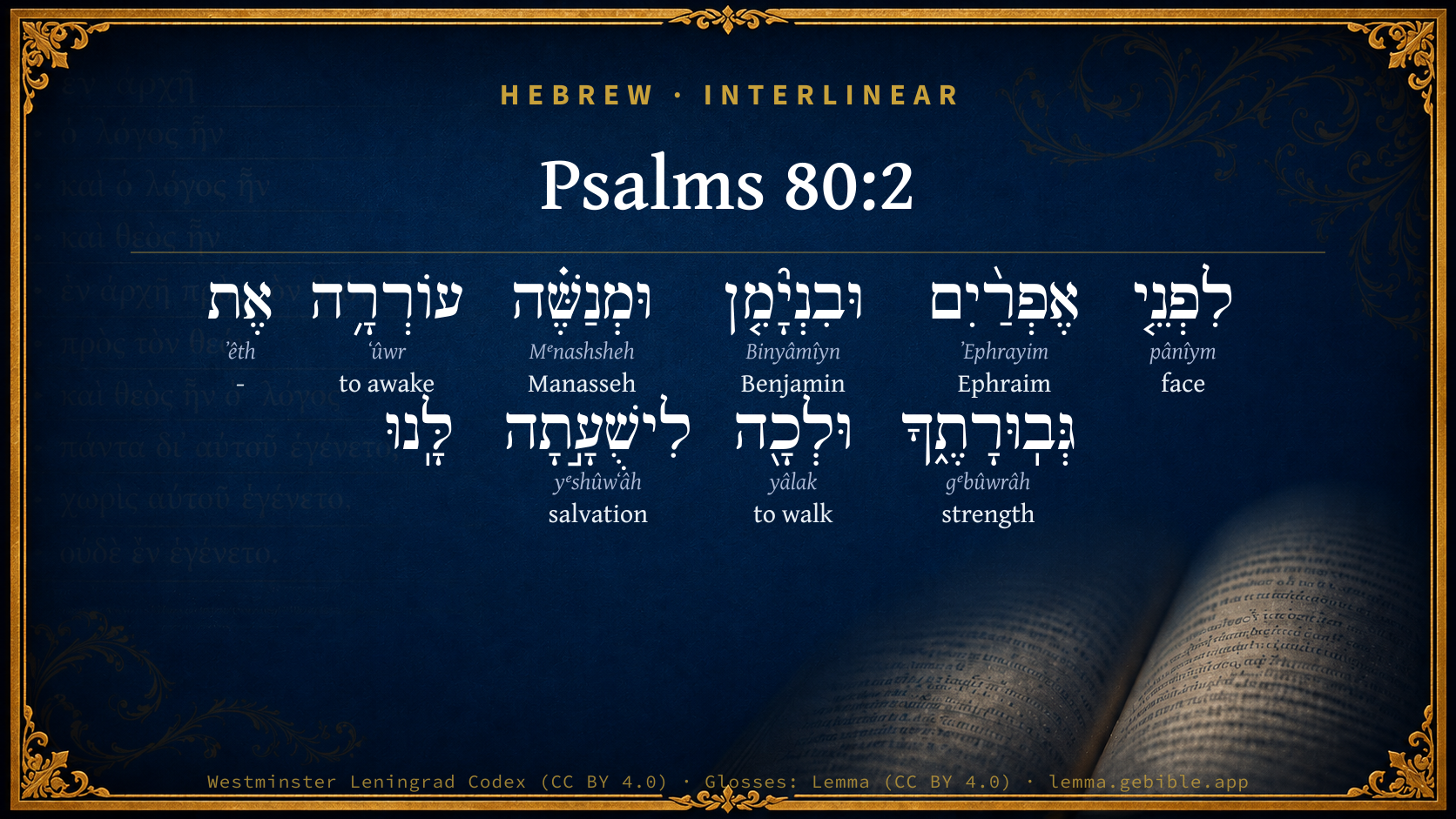
Hebrew (Westminster Leningrad Codex) Psalms 80:2 appears in the Hebrew Old Testament. The text above is from the Westminster Leningrad Codex. Each word links to its Strong’s number, a concise gloss, and parsing drawn from the Open Scriptures Hebrew Bible morphology. Click any word for its full Brown-Driver-Briggs (BDB) entry.
Download image
Cite this verse

Psalms 80:2 (World English Bible). Public Domain. Lemma interlinear Bible study tool, https://lemma.gebible.app/v/psalms/80/2.

Show BibTeX & RIS
BibTeX
RIS
English Translation
Before Ephraim and Benjamin and Manasseh, stir up your might! Come to save us!
World English Bible · Public Domain
Download a study sheet

One document with this verse’s original text, its word-by-word gloss line, the meaning frame, cross-references with their text, attributed commentary, and full source and license credits — printable, and it pastes into notes with its structure intact.

This verse Autodidact and up

Study sheet (.html) Plain text (.txt)

A passage Seminary Student

Up to 50 verses in one chapter. A passage sheet keeps up to 6 commentary sources and 12 cross-references per verse, in the order this page ranks them, and says so on the sheet whenever that leaves anything out. Ask for a single verse and you get the Autodidact verse sheet above.

Everything on this page stays free to read, with no account — the sheet is a download of what is already on screen, not access to it.

Want to remove ads? Support Godless Engineer
Compare translations 3

The same verse in 3 English versions, stacked beneath the original-language interlinear above. Click any original word for its lexicon entry.

Each is an independent rendering of the whole verse — the interlinear is not word-aligned to these translations.

Highlighted words mark where these versions differ — a whole-verse word diff, not a word-by-word alignment.

  • World English Bible Public Domain
    Before Ephraim and Benjamin and Manasseh, stir up your might! Come to save us!
  • King James Version Public Domain
    Before Ephraim and Benjamin and Manasseh stir up thy strength, and come and save us.
  • unfoldingWord Literal Text CC BY-SA 4.0
    To the face of Ephraim and Benjamin and Manasseh, awaken your might and come to us for salvation.

unfoldingWord Literal Text — © unfoldingWord, licensed CC BY-SA 4.0. Word-aligned USFM3 via Door43 (git.door43.org/unfoldingWord/en_ult).

Versions to compare (up to 4)

3 of 4 selected

Show all 18 translations

Every available English version of this verse, each an independent rendering of the whole verse.

  • World English Bible Public Domain
    Before Ephraim and Benjamin and Manasseh, stir up your might! Come to save us!
  • Berean Standard Bible Public Domain
    before Ephraim, Benjamin, and Manasseh. Rally Your mighty power and come to save us.
  • Majority Standard Bible Public Domain
    before Ephraim, Benjamin, and Manasseh. Rally Your mighty power and come to save us.
  • King James Version Public Domain
    Before Ephraim and Benjamin and Manasseh stir up thy strength, and come and save us.
  • American Standard Version (1901) Public Domain
    Before Ephraim and Benjamin and Manasseh, stir up thy might, And come to save us.
  • Revised Version (1885) Public Domain
    Before Ephraim and Benjamin and Manasseh, stir up thy might, and come to save us.
  • Geneva Bible (1599) Public Domain
    Before Ephraim and Beniamin and Manasseh stirre vp thy strength, and come to helpe vs.
  • Douay-Rheims (1899) Public Domain
    Give ear, O thou that rulest Israel: thou that leadest Joseph like a sheep. Thou that sittest upon the cherubims, shine forth
  • Young's Literal Translation Public Domain
    Before Ephraim, and Benjamin, and Manasseh, Wake up Thy might, and come for our salvation.
  • Literal Standard Version CC BY-SA 4.0
    Before Ephraim, and Benjamin, and Manasseh, || Wake up Your might, and come for our salvation.
  • Unlocked Literal Bible CC BY-SA 4.0
    In the sight of Ephraim and Benjamin and Manasseh, stir up your power; come and save us.
  • unfoldingWord Literal Text CC BY-SA 4.0
    To the face of Ephraim and Benjamin and Manasseh, awaken your might and come to us for salvation.
  • Darby Bible Public Domain
    Before Ephraim and Benjamin and Manasseh, stir up thy strength, and come to our deliverance.
  • World Messianic Bible Public Domain
    Before Ephraim, Benjamin, and Manasseh, stir up your might! Come to save us!
  • Webster's Bible Public Domain
    \\80:1\\To the chief Musician upon Shoshannim Eduth, A Psalm of Asaph. Give ear, O Shepherd of Israel, thou that leadest Joseph like a flock; thou that dwellest between the cherubim, shine forth.
  • Free Bible Version CC BY-SA 4.0
    in the presence of Ephraim, Benjamin, and Manasseh. Gather together your power and come to save us!
  • Bible in Basic English Public Domain
    Before Ephraim and Benjamin and Manasseh, let your strength be awake from sleep, and come as our salvation.
  • JPS Tanakh (1917) Public Domain
    (80-3) Before Ephraim and Benjamin and Manasseh, stir up Thy might, and come to save us.

Literal Standard Version (2020), Covenant Press — licensed CC BY-SA 4.0. Text via the HelloAO Bible API (eBible.org). Unlocked Literal Bible (unfoldingWord) — licensed CC BY-SA 4.0. Text via the HelloAO Bible API (eBible.org). unfoldingWord Literal Text — © unfoldingWord, licensed CC BY-SA 4.0. Word-aligned USFM3 via Door43 (git.door43.org/unfoldingWord/en_ult). Free Bible Version, Dr. Jonathan Gallagher — licensed CC BY-SA 4.0. Text via the HelloAO Bible API (eBible.org).

Word by word

More ways to search: Search by grammar → Find every occurrence → Compare this word →

Practice this passage: Drill this verse → Learn its vocabulary →

גְּבֽוּרָתֶ֑ךָ
gᵉbûwrâh
H1369
“strength · your”
Noun, Common, Feminine, Singular, Construct + Suffix, Personal, 2nd Person, Masculine, Singular
Part of Speech
Noun
Type
Common
Gender
Feminine
Number
Singular
State
Construct
Full BDB Definition

Origin: pass. participle from the same as H1368

TWOT: 310c

strength, might - strength - might, valour, bravery - might, mighty deeds (of God)
  1. לִפְנֵ֤י pânîym H6440 “to/for · face(s) of” Preposition + Noun, Common, Both, Plural, Construct
  2. אֶפְרַ֨יִם ʼEphrayim H669 “Ephraim” Noun, Proper
  3. וּבִנְיָ֘מִ֤ן Binyâmîyn H1144 “and · Benjamin” Conjunction + Noun, Proper
  4. וּמְנַשֶּׁ֗ה Mᵉnashsheh H4519 “and · Manasseh” Conjunction + Noun, Proper
  5. עוֹרְרָ֥ה ʻûwr H5782 “awake” Verb, Polel, Imperative, 2nd Person, Masculine, Singular + Suffix, h
  6. אֶת ʼêth H853 “-” Particle, Direct Object
  7. וּלְכָ֖ה yâlak H3212 “and · walk” Conjunction + Verb, Qal, Imperative, 2nd Person, Masculine, Singular + Suffix, h
  8. לִישֻׁעָ֣תָה yᵉshûwʻâh H3444 “to/for · salvation” Preposition + Noun, Common, Feminine, Singular, Absolute + Suffix, h

About this verse

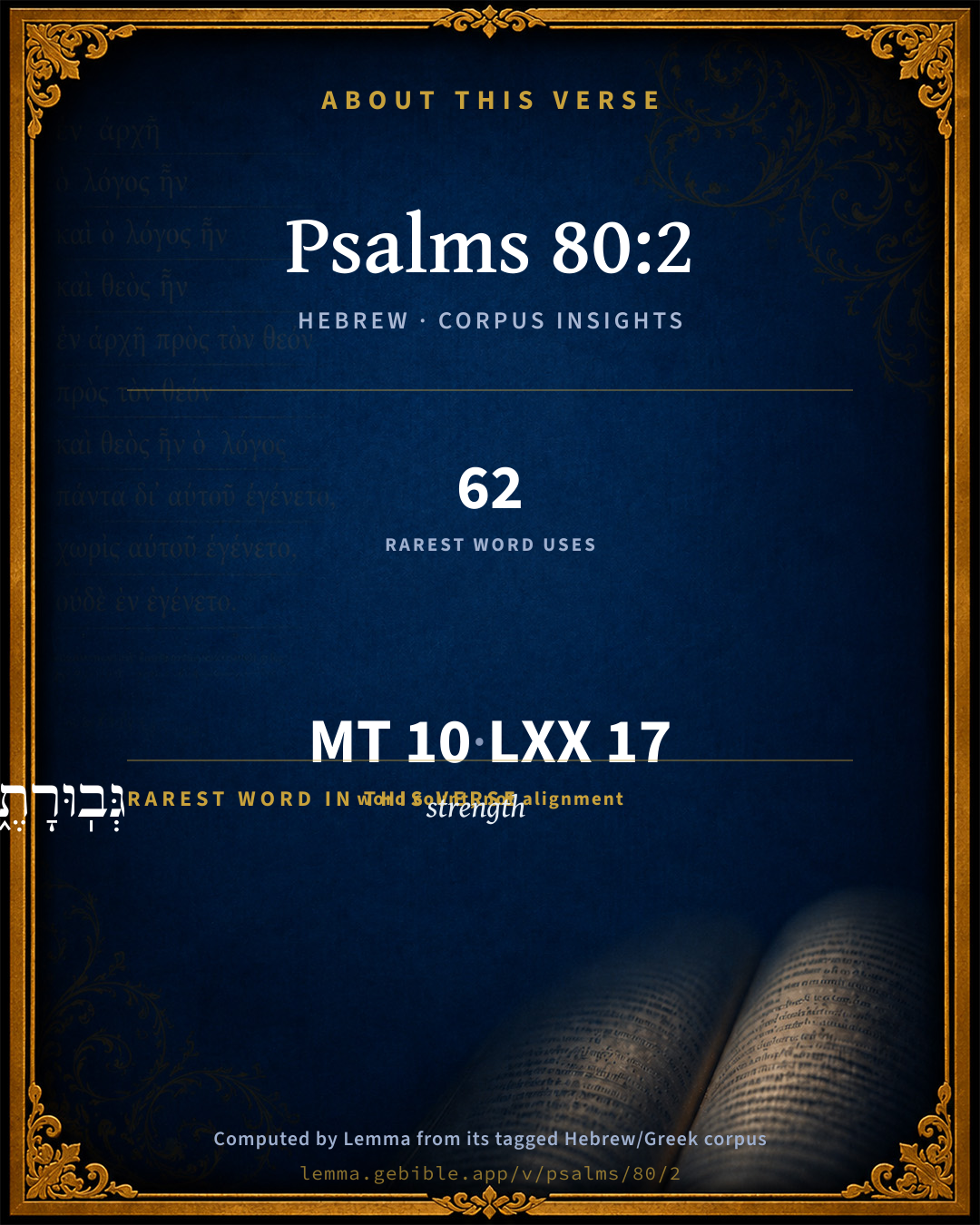
These counts appear in no published source. They are computed here, from the morphology-tagged text and Lemma’s own curated glosses. What Lemma adds →

10
words
9
distinct lemmas
Wisdom
section

Grammatical profile

  • 2 verbs
  • 6 nouns
  • 1 preposition
  • 1 particle

Verb forms

  • עוֹרְרָ֥ה Polel · Imperative
  • וּלְכָ֖ה Qal · Imperative

Hebrew & Septuagint length

In English translation the verse runs 14 words from the Hebrew and 15 from the Septuagint (LXX English) — closely comparable.

A rough comparison of the two English renderings, which tokenize alike — not a word-level alignment.

Word counts can differ between the Hebrew and the Greek without any difference in meaning — e.g. the Hebrew direct-object marker אֵת has no separate Greek word, and Greek often adds the article ὁ.

In the original languages it is 10 Hebrew tokens and 17 Greek tokens — but the two are counted differently (Hebrew bundles its prefixes and suffixes into one token; the Greek is in lemma form), so that isn’t a like-for-like length.

Cross-references

8

Topical passages linked to Psalms 80:2 in the Treasury of Scripture Knowledge — connected by theme and wording, ordered by reader-vote popularity; previews shown in the World English Bible.

  • Psalms 35:23 Wake up! Rise up to defend me, my God! My Lord, contend for me!
  • Numbers 2:18–24 "On the west side shall be the standard of the camp of Ephraim according to their divisions: and the prince of the children of Ephraim shall be Elishama the son of Ammihud.
  • Psalms 44:23–26 Wake up! Why do you sleep, Lord? Arise! Don't reject us forever.
  • Isaiah 42:13–14 Yahweh will go forth as a mighty man; he will stir up [his] zeal like a man of war: he will cry, yes, he will shout aloud; he will do mightily against his enemies.
  • Numbers 10:22–24 The standard of the camp of the children of Ephraim set forward according to their hosts: and over his host was Elishama the son of Ammihud.
  • Psalms 78:38 But he, being merciful, forgave iniquity, and didn't destroy them. Yes, many times he turned his anger away, And didn't stir up all his wrath.
  • Isaiah 25:9 It shall be said in that day, Behold, this is our God; we have waited for him, and he will save us: this is Yahweh; we have waited for him, we will be glad and rejoice in his salvation.
  • Isaiah 33:22 For Yahweh is our judge, Yahweh is our lawgiver, Yahweh is our king; he will save us.

Cross-references courtesy of OpenBible.info (CC BY 4.0).

Hebrew and Greek witnesses Masoretic Hebrew ↔ Greek Septuagint

The same verse in the two great witnesses to the Old Testament, shown verse-for-verse.

You’re reading Greek Psalm 79 (Hebrew Psalm 80). The Septuagint counts the superscription, so verse numbers can differ from the Hebrew — chapter-level alignment, not verse-by-verse. Numbering follows Rahlfs.

These are two independent witnesses, not word-aligned to each other, and the Septuagint is shown in lemma (dictionary) form.

Hebrew Psalms 80:2 Masoretic · Westminster Leningrad Codex

לִפְנֵ֤י אֶפְרַ֨יִם וּבִנְיָ֘מִ֤ן וּמְנַשֶּׁ֗ה עוֹרְרָ֥ה אֶת גְּבֽוּרָתֶ֑ךָ וּלְכָ֖ה לִישֻׁעָ֣תָה לָּֽנוּ

Before Ephraim and Benjamin and Manasseh, stir up your might! Come to save us!

World English Bible · Public Domain

Greek LXX Greek Psalm 79:2 Septuagint · lemma form

ὁ ποιμαίνω ὁ ἰσραήλ προςἔχω ὁ ὁδηγέω ὡσεί πρόβατον ὁ ιωσηφ ὁ καταἧμαι ἐπί ὁ χερουβείμ ἐνφαίνω

before Ephraim and Benjamin and Manasse, stir up your power, and come to deliver us.

LXX2012 (modern English Septuagint) · Public Domain

Hebrew: Westminster Leningrad Codex (CC BY 4.0). Greek: Septuagint (public domain); English from LXX2012 (modern English Septuagint) (Public Domain). How the Septuagint differs from the Hebrew →

Commentary

Notes on Psalms 80:2 from classic Christian and Jewish commentators (each source and its license shown beneath its notes). The classic Christian expositions comment on the surrounding passage and are grouped to its opening verse, so a note may address several verses; the Jewish commentaries on the Tanakh (Rashi and others) are per-verse, so they appear only where the commentator wrote on this verse.

Lemma curates 59 commentaries, every one of them public domain or Creative Commons licensed, each selected and text-cleaned for this edition rather than reprinted as found. About our sources →

Trapp's Complete Commentary

John Trapp

Psa 80:2 Before Ephraim and Benjamin and Manasseh stir up thy strength, and come [and] save us.

Ver. 2. Before Ephraim and Benjamin and Manasseh] These three tribes went next after the ark, when it removed, Num 2:18-24; Num 10:22-24

Stir up thy strength] Which seemeth at present to lie dormant.

John Trapp, A Commentary or Exposition upon All the Books of the Old and New Testament (1647–1656) — public domain. Text from a community e-Sword module.

The Biblical Illustrator

Joseph S. Exell

Psa_80:2

Before Ephraim and Benjamin and Manasseh stir up Thy strength, and come and save us.

For understanding of this verse we must remember that, when the ark of the covenant rested, or marched, in the wilderness, these three tribes were in the rearward of the host of Israel, or on the west side thereof, as is set down (Num_2:18-19). When the host marched, and the ark set forward, Moses said to the Lord, Rise up, Lord, and let thine enemies be scattered; and let them that hate Thee flee before Thee; answerable to this, doth the sixty-eighth psalm begin, when the ark removed, and was carried up to Mount Zion; now, the people of God being in distress here, do call those days to remembrance, and do request the Lord, that as He had in the eyesight of those three tribes here mentioned, manifested Himself many a time to be the leader and defender of His people, so He would now also in this their lamentable condition stir up Himself for their relief and safety. Whence learn

1. The remembrance of the Lords humbling Himself to be familiar with His people, and how sweet and glorious communion His people have had with Him, may, and should, encourage believers in Him to seek and expect new experience of the like mercy in their need, as here the Israelites do pray for new proof of that favour, which their ancestors did find sometimes.

2. The posterity of those who have been in fellowship with God should pray for themselves, and be prayed for by the Church, that they may have room in the Lords host, and have God their leader, as their godly fathers had before them. (D. Dickson.)

The Biblical Illustrator, edited by Joseph S. Exell (c. 1880s–1900s) — public domain. Text from a community e-Sword module.

Joseph Benson's Commentary

Psa 80:2. Before Ephraim, &c. — That is, before all the tribes; in the face of all the people assembled at Jerusalem. These three, indeed, in some sense included the whole, Benjamin being incorporated with Judah, and the greatest part of Jerusalem, and the temple being in its lot, Manasseh comprehending the country beyond Jordan; and Ephraim, which was the head of the ten tribes, including all the rest. Some think, however, that these three are named in allusion to their ancient situation in the wilderness, where these tribes were placed on the west side of the tabernacle, in which the ark was, which, consequently, was before them: and they followed it immediately in their marches. So that, as before them the ark of God’s strength arose to scatter their enemies, with a reference thereto, the sense here is, O thou who didst of old go forth before those tribes, do so again at this time. Perhaps, also, these tribes had a greater share of the calamities here referred to than the others, though this be not mentioned in the sacred history: and therefore the psalmist prays that God would appear particularly on their behalf.

Joseph Benson's Commentary on the Old and New Testaments (1811–1818) — public domain. Text from a community e-Sword module.

J. A. Alexander on Psalms

Joseph Addison Alexander

3. (Psa 80:2) Before Ephraim and Benjamin and Manasseh arouse thy strength and come to save us. The first clause alludes to the encampment and march through the wilderness, in which these three tribes always went together, as the descendants of one mother (Gen 44:20, Num 2:18-24; Num 10:22-24). It has commonly been inferred from 1Ki 12:21, that the tribe of Benjamin adhered to the kingdom of Judah. But Hengstenberg has made it highly probable, at least, that those words relate only to the dwellers in Jerusalem and the immediately circumjacent country; that the tribe, as such, was reckoned one of the ten tribes, among which Simeon was not included, because, in fulfilment of Jacob's prophecy (Gen 49:7), they had no distinct or compact territory of their own, but certain towns within the boundary of Judah (Jos 19:1-9). Hence we are told expressly and repeatedly that in the great schism after the death of Solomon, but one tribe remained faithful to the house of David (1Ki 11:13; 1Ki 11:32; 1Ki 11:36; 1Ki 12:20), i.e. one complete tribe, having a definite and independent share in the allotment of the land. That Benjamin should take part with Ephraim and Manasseh rather than with Judah, might have been expected from the near affinity and mutual affection of the sons of Rachel, and from the jealousy which must have been excited by the transfer of the crown from Saul, a Benjamite, to David, a Jew. The same thing incidentally appears from such passages as 2Sa 19:20, where Shimei, a Benjamite, speaks of himself as representing the whole house of Joseph. If this be admitted or assumed, the mention of Benjamin with Ephraim and Manasseh, in the verse before us, far from invalidating, seems to confirm the application of the passage to the kingdom of the Ten Tribes, and that of the whole psalm to their overthrow and deportation by the Assyrians. Thus understood, the verse before us is a prayer, that God would again march at the head of the "Camp of Ephraim," as he did of old. Arouse thy strength, awake from thy present state of seeming inaction and indifference. See above, on Psa 44:23), 78:65. Come, literally go, which may mean go forth, march; but see above, on (Psa 46:8. To save us, literally for salvation to us.

Joseph Addison Alexander, The Psalms Translated and Explained (1850) — public domain. Text from a community e-Sword module.

Adam Clarke's Commentary

Verse 2. Before Ephraim and Benjamin and Manasseh] It is supposed that these three tribes represent the whole, Benjamin being incorporated with Judah, Manasseh comprehending the country beyond Jordan, and Ephraim all the rest.-Dodd.

Adam Clarke's Commentary on the Bible (1810–1826) — public domain. Text from a community e-Sword/MySword module.

Ellicott's Commentary for English Readers

(2) Before Ephraim . . .—The tribes named from Joseph’s sons and his uterine brother naturally range together; they encamped side by side on the west of the Tabernacle, and when the ark moved forward they took their places immediately behind it to head the procession. The preposition “before” would alone show that this ancient arrangement, and no recent political event, determines the manner in which the poet introduces the tribes. It is used of a funeral procession (2Sa_3:31; Job_21:33).

A Bible Commentary for English Readers, edited by Charles John Ellicott (1878–1897) — public domain. Text from a community e-Sword module.

The Cambridge Bible for Schools and Colleges

gen. ed. J. J. S. Perowne

2. Ephraim, Benjamin, and Manasseh were united by the tie of common descent from Jacob’s beloved wife Rachel, who is regarded by Jeremiah (Jer_31:15) as the mother of the Northern Kingdom, and they are named as representatives of that Kingdom. According to Num_2:17 ff. these tribes encamped to the West of the Tabernacle, and marched immediately behind it (Num_2:24). Before Ephraim &c. therefore means, ‘placing Thyself at their head as a victorious leader, as Thou didst go before them of old in the journeyings of the wilderness.’ At first sight it may seem strange that Benjamin is reckoned among the Northern tribes, for partially at any rate it sided with Rehoboam (1Ki_12:21; 2Ch_11:3; 2Ch_11:23; 2Ch_15:8-9); but the one tribe remaining to David was Judah (1Ki_11:13; 1Ki_11:32; 1Ki_11:36), and Benjamin must be reckoned to the Northern Kingdom to make up Ten tribes, for Simeon had become merged in Judah and is not counted. The principal Benjamite towns of Bethel, Gilgal, and Jericho belonged to the Northern Kingdom.

stir up thy strength] Put in action thy might (Psa_20:6) which seems to be dormant. come and save us] R.V., come to save us: lit. come for salvation or deliverance for us.

The Cambridge Bible for Schools and Colleges (gen. ed. J. J. S. Perowne; Cambridge University Press, 1878–1918) — public domain. Text from a community e-Sword module.

John Gill's Exposition

Before Ephraim, Benjamin, and Manasseh, stir up thy strength,.... Which Christ did in the public ministry of the word, speaking as one having authority, and not as the Scribes and Pharisees; and in the performance of miracles, openly, and in the sight of all; and in his sufferings and death for the salvation of his people; in which he appeared to be the mighty God, travelling in the greatness of his strength, and mighty to save. These tribes design all Israel, before whom the above things were done; and the allusion is to these three tribes marching immediately after the Kohathites, who carried the ark on their shoulders in journeying, Num 2:17 which is called the Lord's strength, and the ark of his strength, Psa 78:61. The Targum in the king's Bible reads, to the children of Ephraim, &c. reading instead of see the Masorah, and Pro 4:3,

and come and save us; come from heaven to earth, not by change of place, but by assumption of nature; this was promised and expected, and is here prayed for; Christ is now come in the flesh, which to deny is antichristian; and his end in coming was to save his people from their sins, from the curse and condemnation of the law, and wrath to come; and as he came on this errand, he is become the author of eternal salvation, in working out which he has shown his great strength.

John Gill's Exposition of the Whole Bible (1746–1763) — public domain (CC PDM 1.0). Text via the HelloAO Bible API.

Albert Barnes' Notes on the Bible

Before Ephraim, and Benjamin, and Manasseh - Ephraim and Manasseh were the two sons of Joseph, and their names were given to two of the tribes of Israel. See the notes at Psa 78:67. They seem to have been particularly mentioned here, because Joseph, their father, had been referred to in the previous verse; and it was natural, in speaking of the people, to mention his sons. Benjamin is mentioned because, in the encampment and march through the wilderness, these three tribes always went together, as the descendants of the same mother. Gen 46:19-20; Num 2:18-24; Num 10:22-24. It is probable that they were always especially united in the great operations of the Hebrew people, and that when one was mentioned it was customary to mention the others, as being of the same family, or descended from the same mother. There does not appear, from the psalm itself, any particular reason why the prayer is offered that God would manifest himself especially to these three tribes; and nothing in regard to the occasion on which the psalm was composed, can be argued from the fact that they are thus mentioned.

Hengstenberg indeed supposes that the common idea that the tribe of Benjamin adhered to Judah in the revolt of the ten tribes is erroneous, and that Benjamin was one of the ten tribes which revolted; and that Simeon was not included in the number because he had no separate territory, but only certain towns and places within the limits of the tribe of Judah. Prof. Alexander, embracing this opinion, supposes that the psalm refers to the calamities which came upon the ten tribes at the time of their captivity. But this supposition seems to me to be improbable. The obvious and fair interpretation of the narrative on the subject is, that the tribe of Benjamin adhered to that of Judah at the time of the revolt, for it is said 1Ki 12:21 that “when Rehoboam was come to Jerusalem, he assembled all the house of Judah, with the tribe of Benjamin, an hundred and fourscore thousand chosen men, which were warriors, to right against the house of Israel, to bring the kingdom again to Rehoboam, the son of Solomon.” Besides, even on the supposition that Benjamin was one of the ten revolted tribes, the fact that these three tribes are particularly mentioned together would not prove that the psalm referred to the carrying away of the ten tribes into Assyria, for still the question would arise why these are particularly mentioned rather than any other of the ten. It seems to me, therefore, that the fact that these are specified can be explained on the suppositions above suggested:

(a) That the main reference in the psalm was to the coming out of Egypt - the bringing the “vine” - that is, the people - from that land Psa 80:8;

(b) That in alluding to that, it was natural to make mention of Joseph, who was so distinguished there, and who, after so many trials, was exalted to so great honor that his name might be given to the whole people;

(c) That when Joseph had been spoken of, it was natural, in the progress of the psalm, to mention particularly the names of his sons, Ephraim and Manasseh; and

(d) that having mentioned them, it was natural also to refer to one whose name was always associated with that of Joseph as his younger brother by the same mother, and to the tribe of that name which was always associated with Ephraim and Manasseh in the march.

I regard the psalm, therefore, as referring to the entire Hebrew people, and the names of these three tribes as representatives of the whole nation. The prayer is, that God would manifest; himself in the presence of his people.

Stir up thy strength - As if he were indifferent to their condition; as if he put forth no effort to save them. See the notes at Psa 35:23.

And come and save us - Margin, as in Hebrew, come for salvation to us. That is, Come and deliver us from our enemies and our dangers.

Albert Barnes' Notes on the Bible (1834–1885) — public domain. Text from a community e-Sword/MySword module.

Matthew Poole's English Annotations

i.e. Before all the tribes of Israel; for whom he mentions only these three tribes, either,

1. Because of their special relation to Joseph here named, Psa 80:1; Ephraim and Manasseh being his sons, and Benjamin his brother both by his father and mother. Or,

2. Because these were eminent tribes:

Ephraim, the head of the kingdom of the ten tribes;

Manasseh was planted and powerful on both sides of Jordan; and Benjamin, because the greatest part of Jerusalem and the temple was in its lot. Or,

3. With respect and allusion to the ancient situation of the tabernacle in the wilderness, where these tribes were placed on the west side of the tabernacle, Num 2:18, &c., in which the ark was, which consequently was before them. So the sense is, O thou who didst of old go forth before these tribes, &c., do so again at this time. Or,

4. Because these tribes had a greater share of the calamities here designed than others; which might be very true, though it be not expressed in the sacred history, in which we have only the substance of things, and such circumstances are commonly omitted.

Stir up thy strength; which seems now to be asleep, or idle and useless.

Matthew Poole's English Annotations on the Holy Bible (1683–1685) — public domain. Text from a community e-Sword/MySword module.

The Treasury of David

Charles H. Spurgeon

Ver. 2. "Before Ephraim and Benjamin and Manasseh stir up thy strength, and come and save us." It is wise to mention the names of the Lord's people in prayer, for they are precious to him. Jesus bears the names of his people on his breastplate. Just as the mention of the names of his children has power with a father, so it is with the Lord. The three names were near of kin; Ephraim and Manasseh represent Joseph, and it was meet that Benjamin, the other son of the beloved Rachel, should be mentioned in the same breath: these three tribes were wont to march together in the wilderness, following immediately behind the ark. The prayer is that the God of Israel would be mighty on behalf of his people, chasing away their foes, and saving his people. O that in these days the Lord may be pleased to remember every part of his church, and make all her tribes to see his salvation. We would not mention our own denomination only, but lift up prayer for all the sections of the one church.

Verse 2. "Before Ephraim and Benjamin and Manasseh." The three tribes of Ephraim, Manasseh, and Benjamin, the three sons of Rachel, went immediately behind the ark. Whenever the ark arose against the enemy, Moses used to exclaim, "Rise up, Lord, and let thine enemies be scattered; and let them that hate thee flee before thee." The Psalmist repeats this exclamation. "Cause thy face to shine upon us, " was the blessing of Aaron; the psalmist prays for the renewal of that blessing. Augustus F. Tholuck.

Verse 2. Salvation expected in connection with the people of God, their prayers, labours, and daily service.

Psalms 80:3*

Charles H. Spurgeon's The Treasury of David (1869–1885) — public domain. Psalms only. Text from a community e-Sword/MySword module.

Whedon's Commentary on the Bible

Daniel D. Whedon

2. Before Ephraim and Benjamin and Manasseh—These tribes constituted the western division in the grand desert march. Num_2:18-24. “Ephraim and Manasseh,” here, represent the alienating jealousy of the “ten tribes,” as Benjamin does the internal division of the kingdom of Judah through the political adherents of the house of Saul. See introduction.

Stir up thy strength—Compare “Take to thee thy great power,” Rev_11:17. This awaking to action stands opposed to indifference and delay. The language is anthropopathic in accommodation to our weakness, speaking of God according to what we know of men.

Daniel D. Whedon (gen. ed.), Commentary on the Old and New Testaments (1874–1909) — public domain. Text from a community e-Sword module.

The Pulpit Commentary

Before Ephraim and Benjamin and Manasseh. "Ephraim" and "Manasseh" form a natural expansion of the "Joseph" of the preceding verse; but it is difficult to understand the mention of "Benjamin" here. Hengstenberg suggests, and both Canon Cook and Professor Cheyne seem to accept the suggestion, that it was only a small portion of Benjamin which adhered to Judah at the division of the kingdoms, the greater part attaching itself to the rival power. Stir up thy strength ; i.e. "rouse thyself from thine inaction come forward, and make thy might to appear." And come and save us; literally, come for salvation to us. The writer identifies himself with the rebel tribes, who, after all, are a part of God"s people a part of Israel.

God"s strength needed for saving work.

"Stir up thy strength, and come and save us." It is singular that three only of the twelve tribes should be mentioned; but the poet"s mind was full of the wilderness associations, and he knew that these three tribes followed in the order of procession immediately behind the ark. So the shining forth of the glory is thought of as at once seen by them. "The writer prays that the brightness of the Shechinah, the light of God"s countenance, thus manifested in old time "before Ephraim and Benjamin and Manasseh," may be once more vouchsafed as a sign of favour." The expression here used, "Stir up thy strength for our salvation," implies that all God"s savings may be thought of as expenditures of the Divine strength the strength of the Divine activity, the strength of the Divine wisdom, and the strength of the Divine love.

I THE STRENGTH OF GOD"S ACTIVITY NEEDED FOR SAVING WORK. This is the point of the prayer of the psalmist. He wants God to show energy, to put forth energy, to bestir himself in order to do something for his people. The poetical thought is of God dormant, unconcerned with the trouble of his people. It is as if he would even awaken him to activity. The expression must be treated poetically. It brings out the idea that man needs God"s active strength, since man asks his help only when he feels helpless. The saving needed is beyond man, so he has a high idea of the energy and the power that must be required. "Twas great to speak a world from nought; "Twas greater to redeem.

Apply to the redemption of the world from sin through our Lord Jesus Christ. What activity, energy, skill, and power were required for the great salvation!

II THE STRENGTH OF GOD"S WISDOM NEEDED FOR SAVING WORK. The histories of the Old Testament abundantly illustrate the fact, that God"s times and ways of saving are seldom such as man could have thought of. The wisdom of them was fully seen in their issues; but it was altogether beyond men, too strong for men to grasp and understand. How Israel was to be saved from Egypt, or Assign, or Babylon, men could not tell. It was done in the times of Moses, and of Hezekiah, and in the "Return," through the strength of the Divine wisdom, combined with the strength of Divine energy. Apply to the great salvation from sin. The Divine wisdom in it has been the marvel of the ages, and it is marvellous still, deeper than even an ocean line can reach. "The wisdom of God in a mystery.

III THE STRENGTH OF GOD"S LOVE NEEDED FOR SAVING WORK. This leads into familiar ranges of thought. Our best deeds are done, and are best done, in the strength and inspiration of our love. And we are bidden to try and realize that love of God in human redemption, which is "beyond all manner of so much. R.T.

The Pulpit Commentary (1880–1919), ed. H.D.M. Spence-Jones & Joseph S. Exell — public domain. Text from a community e-Sword module.

John Wesley's Explanatory Notes

Before Ephraim - Here is an allusion to the ancient situation of the tabernacle in the wilderness, where these tribes were placed on the west-side of the tabernacle, in which the ark was, which consequently was before them.

John Wesley, Explanatory Notes Upon the Whole Bible (1754–1765) — public domain. Text via the GEBible commentary corpus.

Rashi

Rabbi Shlomo Yitzchaki (Rashi)

O Shepherd of Israel Their leader and supporter.

Joseph All Israel are called by the name Joseph because he sustained and supported them in time of famine.

He Who dwells between the cherubim As it is said (Exod. 25:22): “There I shall meet with you at appointed times, etc.”

appear Demonstrate Your might.

Rashi on the Tanakh — English translations: “The Judaica Press complete Tanach with Rashi, translated by A. J. Rosenberg” (CC BY 4.0); “Pentateuch with Rashi's commentary by M. Rosenbaum and A.M. Silbermann, 1929-1934” (public domain); “The Metsudah Tanach series, Lakewood, N.J” (CC BY 4.0); and “The Book of Joshua, Metsudah Publications, 1997” (CC BY 4.0). Text via Sefaria.

Lesson kit

Teaching starters — assembled from the data on this page, not authored interpretation. Every prompt links to the verse data it draws on. Edit before teaching.

Psalms, in the Wisdom, opens this verse with 10 words (9 distinct Hebrew lemmas). Its most distinctive word is gᵉbûwrâh (“strength”). A historical commentator’s framing appears above. Read the whole chapter for the surrounding context.

Discussion questions

  1. How does “strength” (gᵉbûwrâh) shape what this verse is saying?
  2. Psalms 35:23 shares this passage’s theme. How do the two illuminate each other?
  3. The translations on this page render this verse differently — a whole-verse word diff, not a word-by-word alignment. What might account for the different wordings?
  4. The verb «עוֹרְרָ֥ה» is Polel Imperative. How does its form color the action?
  5. Reading how Trapp's Complete Commentary and The Biblical Illustrator read this verse, where do the two commentators agree and where do they part?

Things to notice

Reading settings

Reading text

Shown beneath each verse's original-language words.

Old Testament
Old Testament edition

Read the OT as the Masoretic Hebrew (MT) or the Greek Septuagint (LXX).

English shown for the Greek Septuagint (in the Hebrew ↔ Greek comparison).

Comparing translations? Open the Compare panel on any verse page to stack up to four side by side.