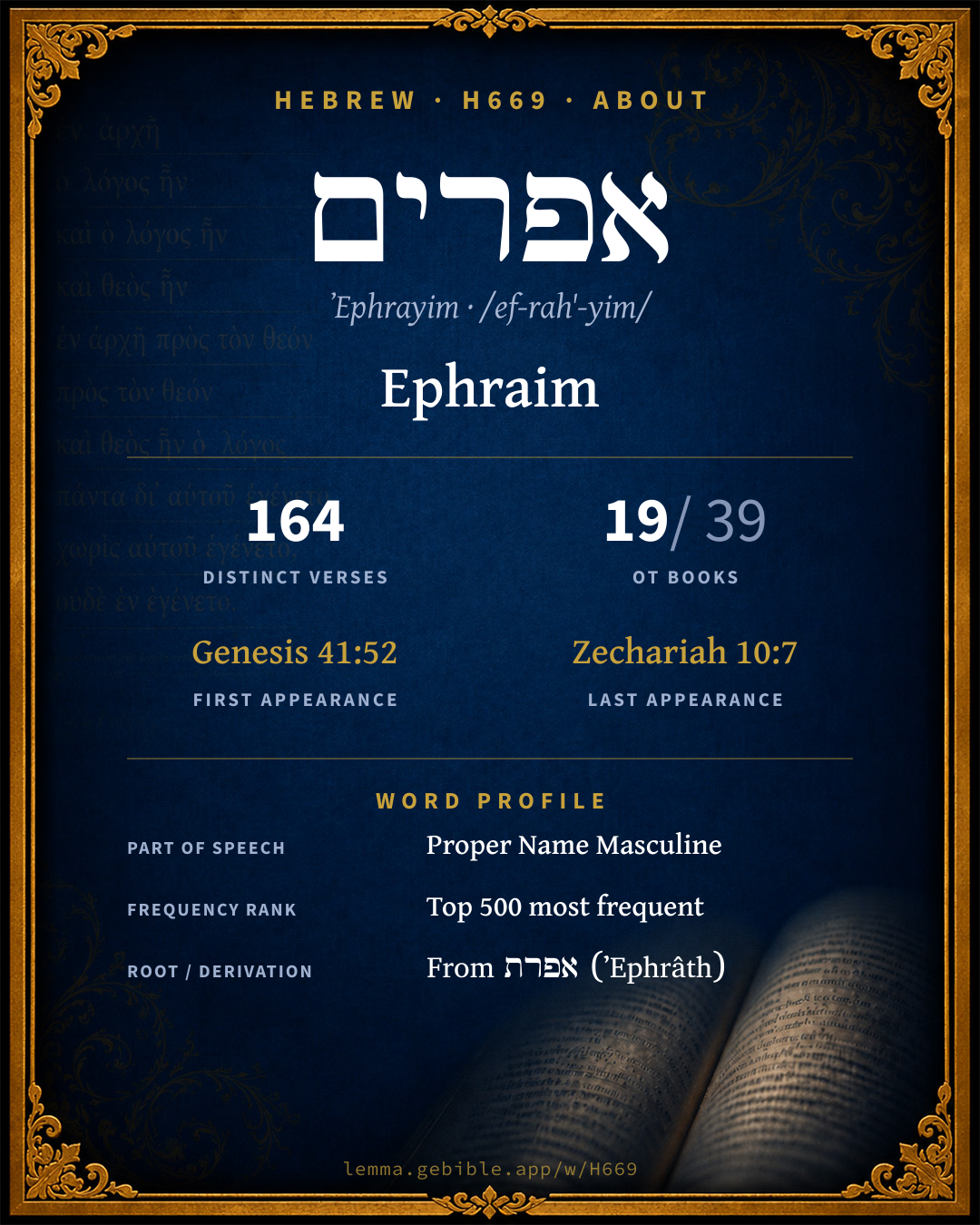
אֶפְרַ֫יִם
Ephraim
BDB lists 7 entries for ‘Ephraim’ fuller range ↓
Full lexicon entry — Brown-Driver-Briggs (BDB)
From Brown-Driver-Briggs (BDB)
Where this word appears
Grammar key — what these labels mean
Part of speech
- Noun
- A naming word — a person, place, thing, or idea.
Noun type
- Proper
- A name of a specific person, place, or people (e.g. Abraham, Zion, Israel).
Every verse where H669 appears in the Book of Obadiah — 1 distinct verse. Click any verse to open its interlinear word-by-word view. Verse text shown in the World English Bible for context — . Each verse’s Hebrew form is shown with its reference; the English is not keyword-highlighted, since the data carries no word-level English alignment. Use “Compare translations” on any verse to read it across multiple English versions. This concordance covers the Hebrew Bible; Septuagint (Greek Old Testament) occurrences are not indexed here.
Obadiah
About this entry
At a glance — auto-summarized from this page’s data, not written by a person. Every figure links to its source below. This summary describes the numbers; it doesn’t interpret them.
אפרים — transliterated ʼEphrayim — is a Hebrew name carrying the sense “Ephraim.” It first appears in Genesis 41:52. The Hebrew Bible uses it across 164 verses — common. See 164-verse concordance and the renderings breakdown below.
Gloss history
Strong's 1890 vs modern scholarship
About this word
Strong's H669 catalogs a Hebrew word from the Hebrew Old Testament.
These counts are not copied from any lexicon or concordance. They are computed here, from the morphology-tagged Hebrew Old Testament. What Lemma adds →
- 164
- distinct verses
- The word appears in 164 distinct verses.
- 19 / 39
- OT books
- The word appears in 19 of 39 Old Testament books.
- #259
- by frequency
- Top 500 most frequent Hebrew words (rank 259 of 8,640 Hebrew words by occurrence).
View all 164 occurrences in the concordance →
By section of the Old Testament
By traditional corpus
Conventional, traditional groupings — biblical authorship is debated, so this is a traditional corpus grouping, not an authorship claim. Each share is this word’s portion of its verses in that division of the Hebrew canon. Each figure is a share of the word’s 164 distinct verses.
- Prophets (Nevi'im) 109 verses · 66%
- Writings (Ketuvim) 32 verses · 20%
- Torah (Pentateuch) 23 verses · 14%
How translations render this word
Counts come from each version’s own published word-to-Strong’s tagging or interlinear alignment — an approximate guide to how each version renders this word, not a word-level alignment the data otherwise carries. Because each total is that version’s own tagged count, the per-version totals vary from one another and need not match the appearance or distinct-verse counts above. These counts may also differ from a printed concordance because Lemma counts each distinctly tagged rendering and does not collapse phrase taggings into a single head-word total. This is a fixed set of word-tagged versions (KJV, ASV, BSB, ULT) and does not change with the reading translation you choose elsewhere. Each version’s license is shown beside its name below (and on Sources).
- King James Version: Ephraim 154×, Ephraim's 3×, Ephraimites 3×
- American Standard Version: Ephraim 157×, Manasseh is mine 2×
- Berean Standard Bible: Ephraim 151×, Ephraim’s 8×, Ephraimites 3×
- unfoldingWord Literal Text: Ephraim 170×, Ephraim s 2×
King James Version Public Domain
Renders H669 across 180 tagged occurrences — most commonly:
Plus 18 renderings that appear only once — usually multi-word phrases or single function words the recovered tagging swept in, not distinct renderings.
American Standard Version Public Domain
Renders H669 across 180 tagged occurrences — most commonly:
Plus 21 renderings that appear only once — usually multi-word phrases or single function words the recovered tagging swept in, not distinct renderings.
Berean Standard Bible Public Domain
Renders H669 across 173 tagged occurrences — most commonly:
Plus 9 renderings that appear only once — usually multi-word phrases or single function words the recovered tagging swept in, not distinct renderings. Not rendered by a distinct English word in 7 further occurrences.
unfoldingWord Literal Text CC BY-SA 4.0
Renders H669 across 175 tagged occurrences — most commonly:
Plus 3 renderings that appear only once — usually multi-word phrases or single function words the recovered tagging swept in, not distinct renderings.
7 senses and sub-senses in the full BDB
What do BDB’s symbols mean?
BDB uses these scholarly abbreviations:
| Symbol | Meaning |
|---|---|
| 𝔊 | the Septuagint (the ancient Greek translation, LXX) |
| 𝔙 | the Vulgate (the Latin translation) |
| 𝔖 | the Syriac version (the Peshitta) |
| 𝔗 | the Targum (the Aramaic translation) |
| ψ | the Psalms |
| √ | root (the underlying root or stem) |
| ‖ | parallel passage (a synonymous or contrasted parallel) |
| † | the dagger: every passage where the word occurs is cited |
The 7 senses and sub-senses the full Brown-Driver-Briggs lexicon distinguishes for this word, in lexicon order (not ranked by frequency), with BDB’s own verbatim wording and sub-sense lettering. Shown in Hebrew script with BDB’s own scholarly abbreviations. The condensed entry is in the Lexicon Entry tab. See also the Forms in the corpus table below.
- 1. 2nd son of Joseph Gn 41:52; 46:20; reckoned among sons of Jacob, blessed by him, and given preference over Manasseh 48:1, 5, 13, 14, 17(×2) (cf. v 19) v 20(×2); 50:23 Nu 1:10 1 Ch 7:20, 22. e.g. Genesis 41:52
- 2. בְּנֵי אֶפְרַיִם (= descendants, tribe of E.) Nu 1:32; 2:18, 24; 7:48; 10:22; 26:35, 37 Jos 16:5, 9 (boundaries of territory), 17:8 1 Ch 9:3; 12:30(31); 27:10, 14, 20 2 Ch 28:12; less often מַטֵּה א׳ Nu 1:33; 13:8 Jos 21:5 1 Ch 6:51; מַטֵּה בְנֵי א׳ Nu 34:24 Jos 16:8 cf. 14:4; שֵׁבֶט א׳ ψ 78:67 (‖ אֹהֶל יוֹסֵף); בֵּית א׳ Ju 10:9; also א׳ alone, tribe Ephraim Nu 26:28 Dt 33:17 Jos 16:10 + often; א׳ וּמְנַשֶּׁה Jos 17:17 cf. Ju 12:15 (א׳ א׳ ומ׳) 2 Ch 30:10 e.g. Numbers 1:32
- 3. הַר־אֶפְרַיִם the mountain-country of Ephraim, a ridge stretching from N. to S. through territory assigned to Ephr., with fruitful land on both slopes, especially the western (cf. Di Jos 16:1) Jos 17:15; 19:50; 20:7 Ju 2:9; 3:27; 4:5 + 26 times e.g. Joshua 16:1
- 4. by Ho & Is (rarely later) אֶפְרַיִם = kingdom of northern Israel (from Ephr. as largest & strongest tribe in it) Ho 4:17; 5:3(×2), 5 (‖ יִשְׂרָאֵל) v 11, 12 + 30 times Ho; Is 7:2, 5, 8, 9, 17 + 9 times Is; also Je 7:15; 31:9, 18, 20 Ez 37:16 (del. Co) v 19 ψ 78:9 2 Ch 25:7, 10 cf. 30:1 ψ 60:9 = 108:9; עָרֵי א׳ 2 Ch 17:2 cf. 34:6; שְׁדֵה א׳ Ob 19; hence א׳ alone in loc. sense 2 Ch 31:1; also Ho 5:9, where fem. (& perhaps Is 7:2). e.g. Hosea 4:17
- 5. יַעַר אֶפְרַיִם 2 S 18:6, E. of Jordan; 𝔊L Klo read יער מַחֲנַיִם, cf. 17:24, 27. e.g. 2 Samuel 18:6
- 6. name of a city near Baal-hazor 2 S 13:23 (= Ἐφραϊμ John 11:54 & 1 Macc 11:34? Klo comp. 𝔊L Γοφραιμ & עפרון, Qr עֶפְרַיִן 2 Ch 13:19; so previously Bö Th Ke cf. Dr). e.g. 2 Samuel 13:23
- 7. שַׁעַר אֶפְרַיִם a chief gate of Jerusalem 2 K 14:13 2 Ch 25:23 Ne 8:16; 12:39; perhaps at NW. angle, near Holy Sepulchre, cf. Schick-GutheZPV 1885. e.g. 2 Kings 14:13
Senses from the full Brown-Driver-Briggs lexicon (Brown, Driver, Briggs; Oxford 1906 — public domain), digitized via Sefaria, supplemented by the OpenScriptures HebrewLexicon (CC BY 4.0). Full attribution on Sources.
Word origin
n.pr.m. Ephraim (Gn 41:52 connected with הִפְרָה, Hiph. of פרה, cf. פרא Hiph. Ho 13:15).
— Brown-Driver-Briggs (Oxford 1906, public domain), digitized via Sefaria, supplemented by the OpenScriptures HebrewLexicon (CC BY 4.0). See Sources.
Derived from אפרת (ʼEphrâth) (H672) — Ephrath.
Jastrow Dictionary
A second Hebrew/Aramaic lexicon for comparison, covering Aramaic and post-biblical (Talmudic, Targumic, Midrashic) usage that the biblical-Hebrew BDB does not. Matched by lemma rather than by Strong’s number, so a lemma may carry more than one Jastrow headword (shown separately below), and the entries cover usage well beyond the Bible.
אֶפְרַיִם
- (b. h.) pr. n. m. Ephraim.
- 1. son of Joseph, progenitor of the tribe of Ephraim. Gen. R. s. 98; a. fr.
- 2. name of the expected Messiah, also called the Messiah, son of Joseph, in contradist., in contradist. to the Messiah of the tribe of Judah. Pesik. R. s. 36; 37.
- 3. a disciple of R. Meïr. B. Mets. 87ᵃ; Gen. R. s. 85 א׳ מקשאה E. the disputant.
- 4. *E. the Scribe, a disciple of Resh Lakish. B. Mets. end (Ms. M. א׳ מקשאה, v. Rabb. D. S. a. l. note).
A Dictionary of the Targumim, the Talmud Babli and Yerushalmi, and the Midrashic Literature (Marcus Jastrow; London, Luzac, 1903) — Public Domain. Digitized via Sefaria. Digitized via Sefaria. Full attribution on Sources.
Forms in the corpus
The 39 distinct written forms H669 takes in the Hebrew Bible, most frequent first — each parse links to that state’s occurrences in the concordance. Hebrew forms include their vowel points and cantillation, so a single lemma takes many written forms.
| Form | Parsing | Example | Uses |
|---|---|---|---|
| אֶפְרַ֔יִם | Noun, Proper | Deuteronomy 33:17 | 26 |
| אֶפְרָ֑יִם | Noun, Proper | Genesis 41:52 | 23 |
| אֶפְרַ֖יִם | Noun, Proper | Deuteronomy 34:2 | 21 |
| אֶפְרַ֨יִם֙ | Noun, Proper | Genesis 48:5 | 21 |
| אֶפְרָֽיִם | Noun, Proper | Genesis 46:20 | 16 |
| אֶפְרַ֗יִם | Noun, Proper | Ezekiel 48:6 | 11 |
| אֶפְרַ֛יִם | Noun, Proper | Hosea 7:8 | 7 |
| לְ/אֶפְרַ֔יִם | Noun, Proper | Genesis 50:23 | 5 |
| אֶפְרַ֜יִם | Noun, Proper | Hosea 5:13 | 4 |
| אֶפְרַ֥יִם | Noun, Proper | Ezekiel 48:5 | 4 |
| אֶפְרַ֕יִם | Noun, Proper | Hosea 7:8 | 3 |
| אֶפְרָ֖יִם | Noun, Proper | Hosea 4:17 | 3 |
| מֵֽ/אֶפְרַ֔יִם | Noun, Proper | 2 Chronicles 25:10 | 3 |
| אֶ֠פְרַיִם | Noun, Proper | Joshua 21:5 | 2 |
| אֶפְרַ֣יִם | Noun, Proper | Hosea 10:6 | 2 |
| וְ/אֶפְרַ֗יִם | Noun, Proper | Hosea 5:5 | 2 |
| וְ/אֶפְרַ֨יִם֙ | Noun, Proper | Isaiah 9:21 | 2 |
| וְ/אֶפְרָֽיִם | Noun, Proper | Joshua 16:4 | 2 |
| וְ֭/אֶפְרַיִם | Noun, Proper | Psalms 60:7 | 2 |
| לְ/אֶפְרָ֑יִם | Noun, Proper | Hosea 5:12 | 2 |
| אֶ֝פְרַ֗יִם | Noun, Proper | Psalms 78:67 | 1 |
| אֶפְרַ֤יִם | Noun, Proper | Genesis 48:13 | 1 |
| אֶפְרַ֨יִם | Noun, Proper | Psalms 80:2 | 1 |
| אֶפְרַיִם֒ | Noun, Proper | Judges 19:18 | 1 |
| אֶפְרַיִם֮ | Noun, Proper | Numbers 26:35 | 1 |
| אֶפְרָ֔יִם | Noun, Proper | Hosea 13:12 | 1 |
| וְ/אֶפְרַ֕יִם | Noun, Proper | Hosea 9:13 | 1 |
| וְ/אֶפְרַ֖יִם | Noun, Proper | Jeremiah 31:9 | 1 |
| וְ/אֶפְרַ֛יִם | Noun, Proper | 2 Chronicles 34:6 | 1 |
| וְ/אֶפְרַ֜יִם | Noun, Proper | Hosea 10:11 | 1 |
| וְ/אֶפְרָ֑יִם | Noun, Proper | Joshua 14:4 | 1 |
| וּ/בְ/אֶפְרַ֥יִם | Noun, Proper | 2 Chronicles 31:1 | 1 |
| כְּ/אֶפְרַ֖יִם | Noun, Proper | Genesis 48:20 | 1 |
| לְ/אֶפְרַ֕יִם | Noun, Proper | Numbers 1:10 | 1 |
| לְ/אֶפְרַ֗יִם | Noun, Proper | Joshua 17:10 | 1 |
| לְ/אֶפְרַ֥יִם | Noun, Proper | Joshua 17:17 | 1 |
| מֵ/אֶפְרַ֗יִם | Noun, Proper | Zechariah 9:10 | 1 |
| מֵ/אֶפְרַ֥יִם | Noun, Proper | 2 Chronicles 15:9 | 1 |
| מֵֽ/אֶפְרַ֨יִם | Noun, Proper | 2 Chronicles 30:18 | 1 |
Same root — word family
Other BDB entries built from the same root as H669, grouped by Strong’s listed origin. These share a root / origin per the lexicon — not necessarily a shared meaning. Each links to that word’s own entry.
Derives from
Proper names from this root
People and places named from this root — a name, not an additional meaning of the word.
Compare all same-root words → 2 of the same-root words are proper names (people or places). They share a root, not necessarily a meaning.
Bible dictionary
Public-domain dictionary articles matched to this entry by name (Ephraim). A biblical name can be shared by more than one person or place, so an article may treat several.
Easton's Bible Dictionary · M. G. Easton, 1897
Double fruitfulness ("for God had made him fruitful in the land of his affliction"). The second son of Joseph, born in Egypt (Gen. 41:52; 46:20). The first incident recorded regarding him is his being placed, along with his brother Manasseh, before their grandfather, Jacob, that he might bless them (48:10; comp. 27:1). The intention of Joseph was that the right hand of the aged patriarch should be placed on the head of the elder of the two; but Jacob set Ephraim the younger before his brother, "guiding his hands wittingly." Before Joseph's death, Ephraim's family had reached the third generation (Gen. 50:23).
Smith's Bible Dictionary · William Smith, 1863
a city "in the district near the wilderness" to which our Lord retired with his disciples when threatened with violence by the priests. (John 11:54)
In "Baal-hazor which is by Ephraim" was Absalom's sheepfarm, at which took place the murder of Amnon, one of the earliest precursors of the great revolt. (2 Samuel 13:23) There is no clue to its situation.
that portion of Canaan named after Joseph's second son. (Genesis 41:50-52) The boundaries of the portion of Ephraim are given in (Joshua 16:1-10) The south boundary was coincident for part of its length with the north boundary of Benjamin. It extended from the Jordan on the east, at the reach opposite Jericho, to the Mediterranean on the west, probably about Joppa. On the north of Ephraim and Manasseh were the tribes of Asher, Zebulun and Issachar. The territory thus allotted to the "house of Joseph" may be roughly estimated at 55 miles from east to west by 70 from north to south. It was one at once of great richness and great security. Its fertile plains and well-watered valleys could only be reached by a laborious ascent through steep and narrow ravines, all but impassable for an army. Under Joshua the tribe must have taken a high position in the nation, to judge from the tone which the Ephraimites assumed on occasions shortly subsequent to the conquest. After the revolt of Jeroboam the history of Ephraim is the history of the kingdom of Israel, since not only did the tribe become a kingdom, but the kingdom embraced little besides the tribe.
(double fruitfulness), the second son of Joseph by his wife Asenath. (B.C. 1715-1708.) The first indication we have of that ascendancy over his elder brother Manasseh which at a later period the tribe of Ephraim so unmistakably possessed is in the blessing of the children by Jacob. (Genesis 48:1) ...
Hitchcock's Bible Names Dictionary · Roswell D. Hitchcock, 1869
fruitful; increasing
Classic public-domain reference works; full attribution on Sources.
Septuagint verse parallels
This word appears in 156 verses that also exist in the Greek Old Testament (Septuagint), out of the 164 Hebrew verses it occurs in. You can read those verses in Greek by switching the Old Testament edition to the Septuagint.
Read these verses in the Septuagint
- Genesis 41:52
- Numbers 1:10
- Deuteronomy 33:17
- Joshua 14:4
- Judges 1:29
- 1 Samuel 1:1
- 2 Samuel 2:9
- 1 Kings 4:8
- 2 Kings 5:22
- 1 Chronicles 6:66
- 2 Chronicles 13:4
- Psalms 60:7
This is a verse-level parallel only — the same verses exist in both the Hebrew and Greek Old Testaments. No word-level Hebrew↔Greek correspondence is claimed: the data carries no such alignment, so no Greek word is shown as this Hebrew word’s translation. Coverage is not total — the Septuagint omits the deuterocanon and renumbers the Psalms, so some Hebrew verses have no direct Greek parallel.