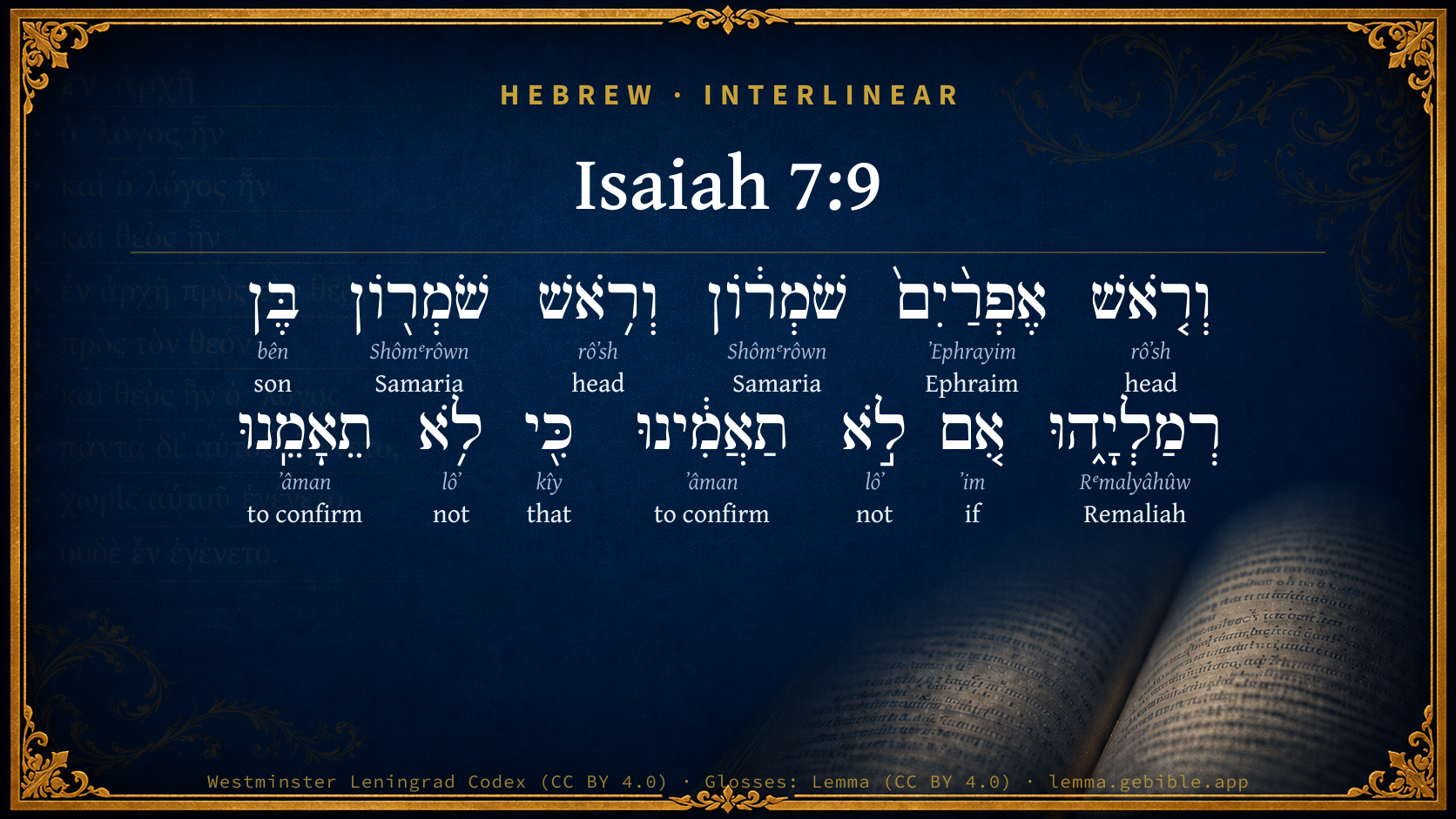
Isaiah 7:9

Hebrew (Westminster Leningrad Codex) Isaiah 7:9 appears in the Hebrew Old Testament. The text above is from the Westminster Leningrad Codex. Each word links to its Strong’s number, a concise gloss, and parsing drawn from the Open Scriptures Hebrew Bible morphology. Click any word for its full Brown-Driver-Briggs (BDB) entry.
Download image
Cite this verse

Isaiah 7:9 (World English Bible). Public Domain. Lemma interlinear Bible study tool, https://lemma.gebible.app/v/isaiah/7/9.

Show BibTeX & RIS
BibTeX
RIS
English Translation
and the head of Ephraim is Samaria, and the head of Samaria is Remaliah's son. If you will not believe, surely you shall not be established.'"
World English Bible · Public Domain
Download a study sheet

One document with this verse’s original text, its word-by-word gloss line, the meaning frame, cross-references with their text, attributed commentary, and full source and license credits — printable, and it pastes into notes with its structure intact.

This verse Autodidact and up

Study sheet (.html) Plain text (.txt)

A passage Seminary Student

Up to 50 verses in one chapter. A passage sheet keeps up to 6 commentary sources and 12 cross-references per verse, in the order this page ranks them, and says so on the sheet whenever that leaves anything out. Ask for a single verse and you get the Autodidact verse sheet above.

Everything on this page stays free to read, with no account — the sheet is a download of what is already on screen, not access to it.

Want to remove ads? Support Godless Engineer
Compare translations 3

The same verse in 3 English versions, stacked beneath the original-language interlinear above. Click any original word for its lexicon entry.

Each is an independent rendering of the whole verse — the interlinear is not word-aligned to these translations.

Highlighted words mark where these versions differ — a whole-verse word diff, not a word-by-word alignment.

  • World English Bible Public Domain
    and the head of Ephraim is Samaria, and the head of Samaria is Remaliah's son. If you will not believe, surely you shall not be established.'"
  • King James Version Public Domain
    And the head of Ephraim is Samaria, and the head of Samaria is Remaliah's son. If ye will not believe, surely ye shall not be established.
  • unfoldingWord Literal Text CC BY-SA 4.0
    And the head of Ephraim Samaria, and the head of Samaria the son of Remaliah. If you do not believe, then you will not be established.”’”

unfoldingWord Literal Text — © unfoldingWord, licensed CC BY-SA 4.0. Word-aligned USFM3 via Door43 (git.door43.org/unfoldingWord/en_ult).

Versions to compare (up to 4)

3 of 4 selected

Show all 18 translations

Every available English version of this verse, each an independent rendering of the whole verse.

  • World English Bible Public Domain
    and the head of Ephraim is Samaria, and the head of Samaria is Remaliah's son. If you will not believe, surely you shall not be established.'"
  • Berean Standard Bible Public Domain
    The head of Ephraim is Samaria, and the head of Samaria is the son of Remaliah. If you do not stand firm in your faith, then you will not stand at all.’”
  • Majority Standard Bible Public Domain
    The head of Ephraim is Samaria, and the head of Samaria is the son of Remaliah. If you do not stand firm in your faith, then you will not stand at all.’”
  • King James Version Public Domain
    And the head of Ephraim is Samaria, and the head of Samaria is Remaliah's son. If ye will not believe, surely ye shall not be established.
  • American Standard Version (1901) Public Domain
    and the head of Ephraim is Samaria, and the head of Samaria is Remaliah's son. If ye will not believe, surely ye shall not be established.
  • Revised Version (1885) Public Domain
    and the head of Ephraim is Samaria, and the head of Samaria is Remaliah’s son. If ye will not believe, surely ye shall not be established.
  • Geneva Bible (1599) Public Domain
    And the head of Ephraim is Samaria, and the head of Samaria is Remaliahs sonne. If ye beleeue not, surely ye shall not be established.
  • Douay-Rheims (1899) Public Domain
    And the head of Ephraim is Samaria and the head of Samaria the son of Romelia. If you will not believe, you shall not continue.
  • Young's Literal Translation Public Domain
    And the head of Ephraim `is' Samaria, And the head of Samaria `is' the son of Remaliah. If ye do not give credence, Surely ye are not stedfast.'
  • Literal Standard Version CC BY-SA 4.0
    And the head of Ephraim [is] Samaria, || And the head of Samaria [is] the son of Remaliah. If you do not give credence, || Surely you are not steadfast.”
  • Unlocked Literal Bible CC BY-SA 4.0
    The head of Ephraim is Samaria, and the head of Samaria is Remaliah's son. If you do not remain firm in faith, surely you will not remain secure.”'”
  • unfoldingWord Literal Text CC BY-SA 4.0
    And the head of Ephraim Samaria, and the head of Samaria the son of Remaliah. If you do not believe, then you will not be established.”’”
  • Darby Bible Public Domain
    and the head of Ephraim is Samaria, and the head of Samaria is Remaliah's son. If ye believe not, surely ye shall not be established.
  • World Messianic Bible Public Domain
    The head of Ephraim is Samaria, and the head of Samaria is Remaliah’s son. If you will not believe, surely you shall not be established.’”
  • Webster's Bible Public Domain
    And the head of Ephraim is Samaria, and the head of Samaria is Remaliah's son. If ye will not believe, surely ye shall not be established.
  • Free Bible Version CC BY-SA 4.0
    The head of Israel is Samaria, and the head of Samaria is Remaliah's son. If you don't trust in me, then you won't survive.”
  • Bible in Basic English Public Domain
    And the head of Ephraim is Samaria, and the head of Samaria is Remaliah's son. If you will not have faith, your kingdom will be broken.
  • JPS Tanakh (1917) Public Domain
    And the head of Ephraim is Samaria, and the head of Samaria is Remaliah's son. If ye will not have faith, surely ye shall not be established.'

Literal Standard Version (2020), Covenant Press — licensed CC BY-SA 4.0. Text via the HelloAO Bible API (eBible.org). Unlocked Literal Bible (unfoldingWord) — licensed CC BY-SA 4.0. Text via the HelloAO Bible API (eBible.org). unfoldingWord Literal Text — © unfoldingWord, licensed CC BY-SA 4.0. Word-aligned USFM3 via Door43 (git.door43.org/unfoldingWord/en_ult). Free Bible Version, Dr. Jonathan Gallagher — licensed CC BY-SA 4.0. Text via the HelloAO Bible API (eBible.org).

Word by word

More ways to search: Search by grammar → Find every occurrence → Compare this word →

Practice this passage: Drill this verse → Learn its vocabulary →

About this verse

These counts appear in no published source. They are computed here, from the morphology-tagged text and Lemma’s own curated glosses. What Lemma adds →

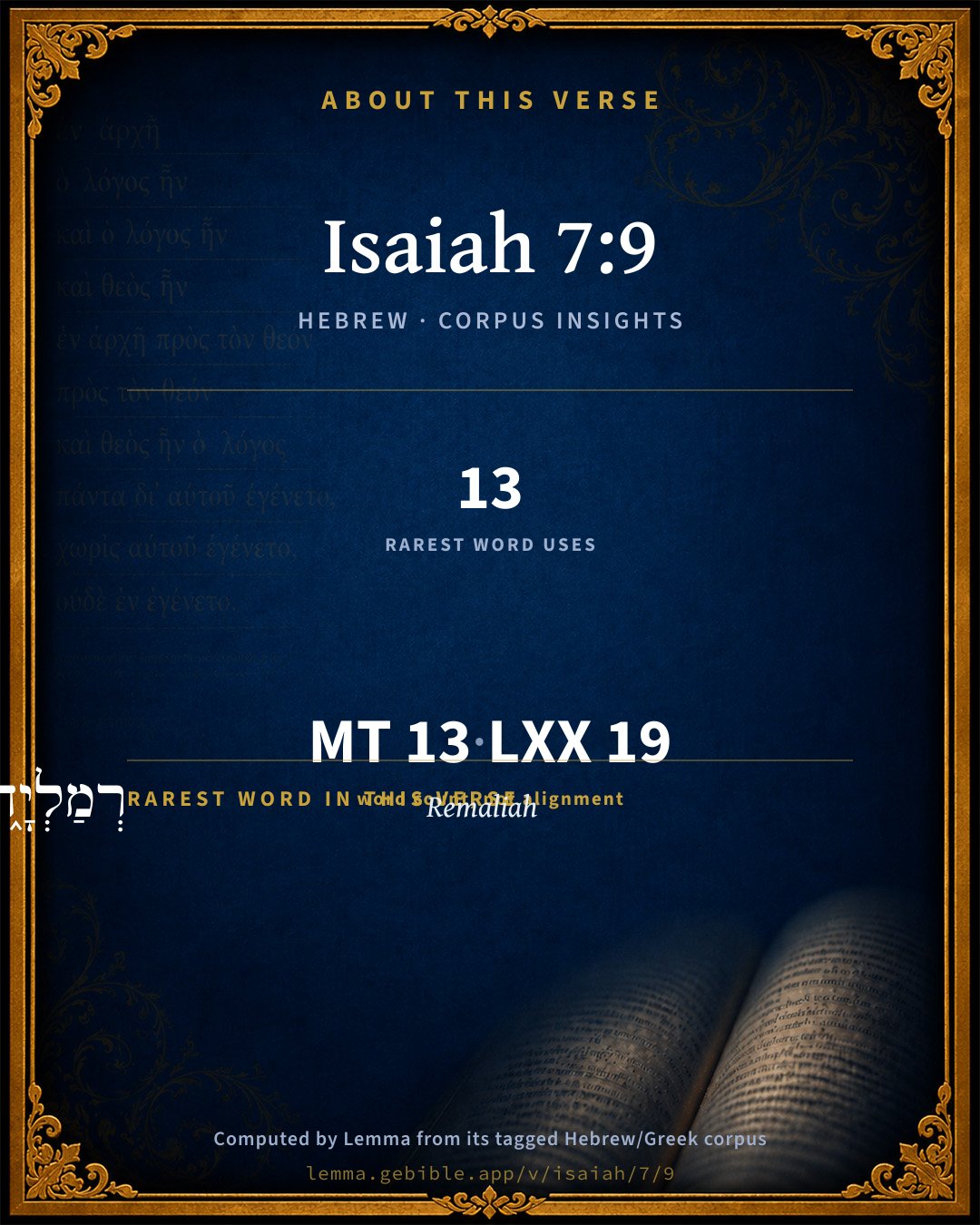
13
words
9
distinct lemmas
Prophets
section

Notable vocabulary

The rarest word here is רְמַלְיָ֑הוּ Remaliah H7425 — appearing just 13 times in the whole Hebrew Bible.

Shared distinctive vocabulary

רְמַלְיָ֑הוּ Remaliah H7425 occurs in 13 verses of the Hebrew Bible. Also found in:

Grammatical profile

  • 2 verbs
  • 7 nouns
  • 2 conjunctions
  • 2 particles

Verb forms

  • תַאֲמִ֔ינוּ Hiphil · Imperfect
  • תֵאָמֵֽנוּ Niphal · Imperfect

Repetition

Words recur within this verse — often emphatic in Hebrew:

  • וְרֹ֤אשׁ head H7218 ×2
  • שֹׁמְר֔וֹן Samaria H8111 ×2
  • תַאֲמִ֔ינוּ to confirm H539 ×2
  • לֹ֣א not H3808 ×2

Hebrew & Septuagint length

In English translation the verse runs 26 words from the Hebrew and 27 from the Septuagint (LXX English) — closely comparable.

A rough comparison of the two English renderings, which tokenize alike — not a word-level alignment.

Word counts can differ between the Hebrew and the Greek without any difference in meaning — e.g. the Hebrew direct-object marker אֵת has no separate Greek word, and Greek often adds the article ὁ.

In the original languages it is 13 Hebrew tokens and 19 Greek tokens — but the two are counted differently (Hebrew bundles its prefixes and suffixes into one token; the Greek is in lemma form), so that isn’t a like-for-like length.

Cross-references

10

Topical passages linked to Isaiah 7:9 in the Treasury of Scripture Knowledge — connected by theme and wording, ordered by reader-vote popularity; previews shown in the World English Bible.

  • Hebrews 11:6 Without faith it is impossible to be well pleasing to him, for he who comes to God must believe that he exists, and that he is a rewarder of those who seek him.
  • Romans 11:20 True; by their unbelief they were broken off, and you stand by your faith. Don't be conceited, but fear;
  • 2 Chronicles 20:20 They rose early in the morning, and went forth into the wilderness of Tekoa: and as they went forth, Jehoshaphat stood and said, Hear me, Judah, and you inhabitants of Jerusalem: believe in Yahweh your God, so shall you be established; believe his prophets, so shall you prosper.
  • 1 John 5:10 He who believes in the Son of God has the testimony in himself. He who doesn't believe God has made him a liar, because he has not believed in the testimony that God has given concerning his Son.
  • Acts 27:25 Therefore, sirs, cheer up! For I believe God, that it will be just as it has been spoken to me.
  • Isaiah 8:6–8 Because this people have refused the waters of Shiloah that go softly, and rejoice in Rezin and Remaliah's son;
  • Isaiah 30:12–14 Therefore thus says the Holy One of Israel, "Because you despise this word, and trust in oppression and perverseness, and rely thereon;
  • 1 Kings 16:24–29 He bought the hill Samaria of Shemer for two talents of silver; and he built on the hill, and called the name of the city which he built, after the name of Shemer, the owner of the hill, Samaria.
  • Acts 27:11 But the centurion gave more heed to the master and to the owner of the ship than to those things which were spoken by Paul.
  • 2 Kings 15:27 In the two and fiftieth year of Azariah king of Judah Pekah the son of Remaliah began to reign over Israel in Samaria, [and reigned] twenty years.

Cross-references courtesy of OpenBible.info (CC BY 4.0).

Hebrew and Greek witnesses Masoretic Hebrew ↔ Greek Septuagint

The same verse in the two great witnesses to the Old Testament, shown verse-for-verse.

These are two independent witnesses, not word-aligned to each other, and the Septuagint is shown in lemma (dictionary) form.

Hebrew Isaiah 7:9 Masoretic · Westminster Leningrad Codex

וְרֹ֤אשׁ אֶפְרַ֨יִם֙ שֹׁמְר֔וֹן וְרֹ֥אשׁ שֹׁמְר֖וֹן בֶּן רְמַלְיָ֑הוּ אִ֚ם לֹ֣א תַאֲמִ֔ינוּ כִּ֖י לֹ֥א תֵאָמֵֽנוּ

and the head of Ephraim is Samaria, and the head of Samaria is Remaliah's son. If you will not believe, surely you shall not be established.'"

World English Bible · Public Domain

Greek LXX Isaiah 7:9 Septuagint · lemma form

καί ὁ κεφαλή ἐφράιμ σομορων καί ὁ κεφαλή σομορων υἱός ὁ ρομελιας καί ἐάν μή πιστεύω οὐδέ μή συνεἰμί

And the head of Ephraim is Somoron, and the head of Somoron the son of Romelias: but if you⌃ believe not, neither will you⌃ at all understand.

LXX2012 (modern English Septuagint) · Public Domain

On this verse, Haydock's Catholic Bible Commentary discusses the Septuagint’s reading. Read the note in Commentary ↓

Hebrew: Westminster Leningrad Codex (CC BY 4.0). Greek: Septuagint (public domain); English from LXX2012 (modern English Septuagint) (Public Domain). How the Septuagint differs from the Hebrew →

Targum (Aramaic paraphrase)

1

The Targum is the ancient Jewish Aramaic paraphrase of the Hebrew Scriptures — an interpretive translation, not the Hebrew text itself. Onkelos (literal) and Pseudo-Jonathan (expansive) render the Torah, and Jonathan the Prophets. Coverage is partial: where no permissively-licensed English translation exists for a verse, only the Aramaic is shown. This is verse-level text, not a word-by-word alignment to the Hebrew.

  1. Targum Jonathan Prophets (Joshua–Malachi)
    וְרֵישׁ אֶפְרַיִם שֹׁמְרוֹן וְרֵישׁ שֹׁמְרוֹן בַּר רְמַלְיָה אִם לָא תְהֵימְנוּן בְּמִלֵי נְבִיָא אֲרֵי לָא תִתְקַיְמוּן:

    And the head of Ephraim is Samaria, and the head of Samaria is the son of Remaliah. If ye will not believe the words of the prophet, surely ye shall not be established,

    Targum Jonathan — Aramaic: “Mikraot Gedolot” (public domain). English: “Sefaria Community Translation” (CC0 1.0 (public-domain dedication)); “London "Chaldee Paraphrase," 1871” (public domain). Text via Sefaria.

Commentary

Notes on Isaiah 7:9 from classic Christian and Jewish commentators (each source and its license shown beneath its notes). The classic Christian expositions comment on the surrounding passage and are grouped to its opening verse, so a note may address several verses; the Jewish commentaries on the Tanakh (Rashi and others) are per-verse, so they appear only where the commentator wrote on this verse.

Lemma curates 59 commentaries, every one of them public domain or Creative Commons licensed, each selected and text-cleaned for this edition rather than reprinted as found. About our sources →

Trapp's Complete Commentary

John Trapp

Isa 7:9 And the head of Ephraim [is] Samaria, and the head of Samaria [is] Remaliah’s son. If ye will not believe, surely ye shall not be established.

Ver 9. And the head of Samariah, Remaliah’s son.] In contempt he hath neither his name nor title of a king given him, but is fairly warned to keep within his bounds; he is not like to hold long that he hath. It is dangerous meddling with Jerusalem. {Zec 12:2-3; Zec 12:6}

If ye will not believe, surely ye shall not be established.] Jehoshaphat said as much, {2Ch 20:20} and our Saviour somewhat like. {Joh 8:20} Isaiah saw the king and people still fluctuating and trembling, notwithstanding the divine promise, and telleth them what to trust to; unless they will trust in God, they will never he soundly settled. Faith quelleth and killeth distrustful fear, and maketh a man walk about the world like a conquerer. There is an elegance here in the original that cannot be translated. {a}

{a} Valde brevis sententia est, sed gravis admodum. - Oecolampadius.

John Trapp, A Commentary or Exposition upon All the Books of the Old and New Testament (1647–1656) — public domain. Text from a community e-Sword module.

The Biblical Illustrator

Joseph S. Exell

Isa_7:9

If ye will not believe, surely ye shall not be established

Faith in the Divine Word and promises the alone ground of the believers establishment and happiness

There are only two sources from which human hope or happiness can be derived, and these are sense and faith.

I. SENSE AS THE SOURCE OF HUMAN HAPPINESS. It is self-evident from the history of what is past and from observation and experience of what is present that, amidst all the enjoyments, whether more gross or more refined, the objects of sense can possibly furnish to flatter or gratify the passions, nothing is to be found that can give establishment to the human heart, or settle and compose the restless spirit. There are three things which render it impossible that any mere worldly object or pursuit should render us happy.

1. The difficulty of acquiring what, in imagination or forethought, we have placed our happiness upon, and in the possession of which we have fondly dreamed of enjoying all that our hearts could desire.

2. When with infinite labour we seem to have surmounted every difficulty and to have gained the point we had in view, our promised happiness is snatched from us in a moment, and we feel our disappointment and distress rendered more poignant from the flattering prospects that lay before us, and the ideal estimate we had formed of what we have lost.

3. But let us suppose that we could acquire with ease, and enjoy with security, for a limited time--to our dying day--the objects we so eagerly pursue; how do we know that we shall preserve our relish for them? Our very wishes give us not our wish.

II. FAITH ALONE HOLDS FORTH THOSE OBJECTS THAT CAN ESTABLISH THE HUMAN HEART OR QUIET THE RESTLESS SPIRIT. Nothing can give establishment to the mind of man but what can effectually remove the cause of our present disordered state and prove a never-failing source of inward peace and self-enjoyment.

1. What is the cause of this disorder; of this disquietude and restlessness, amidst all the objects of sense; of this vacancy of the human mind, amidst all the profusion of nature? The cause is evidently a departure from the original constitution of our nature. For no creature can be unhappy, continuing in that state, in which, he was placed by perfect wisdom and goodness.

2. The remedy which faith provides for the cure of this evil. It directs us to the righteousness of God, manifested without the law, being witnessed by the law and the prophets; even the righteousness of God which is by faith of Jesus Christ unto all and upon all that believe; for there is no difference. The doctrine that holds forth a finished salvation by the blood of Christ, as the alone ground of a believers hope, is, of all others, the best fitted to beget not only a humble submission, but a cheerful resignation to our gracious Lord in the various allotments of His providence concerning us. Who that believeth all this with all his heart could for a moment entertain a doubt that his bodily and temporal concerns would be safe in His hands? (T. Gordon.)

Stability through faith

1. The promises of God are not at all times easily, steadily, and firmly believed.

2. God, in the communication of His Word, does not regard us as mere machines. The Word cannot profit unless it be mixed with faith in those who hear it. In the Christians life there are three kinds of stability.

I. THERE IS A STABILITY OF JUDGMENT. This regards the truths of religion. It is of great importance to have a judgment clear and fixed as it respects the great concerns of the soul and eternity, and the doctrines of the Gospel of Christ; for as we think we feel, as we feel we desire, as we desire we act, and as we act our characters are formed, and our conditions determined. There are some things in revelation concerning which a mans mind, so to speak, need not be made up. Little or no injury will arise from his hesitation or suspense. But this is not the case with all. There are some things which must be fundamental, and therefore sustain others; and according to the firmness of the foundation will be the firmness of the whole superstructure. Now what is to lead us into this stability but faith? It cannot be human authority among men. What one patronises another denies, and here you would soon find yourself like a man in a labyrinth, who on this side and on that is calling out, Is this the way? and knows not what direction to take with safety and comfort. Or, if you depend upon reason, this may do something from observation and analogy; but if you receive the revelation of God only as far as you can understand it, you will make your faith commensurate with your knowledge. Thus obstructions and difficulties will arise continually, and you will be strangers to all satisfaction and repose. No, we must believe all that the Lord has spoken to us in His Word, and because He has spoken it. I had a little talent and a little learning, said Dr. Watts before his death; but now I lay them all aside, and endeavour to receive the Gospel as the poor and unlearned receive it.

II. THERE IS A STABILITY OF PRACTICE. This regards the duties of religion. By faith we stand. In order to see the strength and beauty of the sentiment contained in our text, let us place the believer in three positions.

1. In a place of secrecy. When alone, how do we act? Faith is a principle that always operates alike upon the mind, i.e., its motives are the same in private as in public. Faith shows us the future and eternal consequences of our actions. Faith brings God and places Him before us Hence the closet is visited as the temple. The good fight of faith is carried on amidst many struggles, unobserved by any human being, but all well known to Him who is the Captain of our salvation.

2. In cases of prosperity and indulgence. How easily is a person drawn aside from the path of duty by the honour which cometh from men, by a regard to the friendship of this world, or by earthly riches! We are therefore told that the prosperity of fools destroys them. But the believer in Christ is not a fool: faith makes him wise unto salvation, wise both for time and eternity. This is the victory that overcometh the world, even our faith.

3. In a condition of suffering and danger. What an agonizing trial was Abraham called to endure, when God bade him take his only son Isaac, whom he loved, and offer him up for a burnt offering! yet faith enabled him to do it. Moses had a hard task to accomplish, when he went and stood before Pharaoh, but we are told, he had respect unto the recompense of the reward; by faith he forsook Egypt, not fearing the wrath of the king, for he endured as seeing Him who is invisible. And how was it with Daniel? There was something dreadful in being cast into the den of lions; but what was this to a man who saw that God would shut the lions mouths, so that they should not hurt him? What was this to a man who by faith heard the voice of Him who said, Be not afraid of them that kill the body, and after that have no more that they can do; but fear Him who is able to destroy both body and soul in hell; yea, I say unto you, fear Him. Faith also views the Saviour as acting and as suffering for us.

III. THERE IS A STABILITY OF HOPE. This regards the comforts of religion. How is it that Christians can rejoice amidst their sorrows? The Scripture assigns the reason when it tells us of the joy of faith. Faith appropriates. (W. Jay.)

Isaiahs commission and King Ahaz

Isaiah had a very heavy commission from God. He was to go and speak to people who would not hear him, and to be to them a messenger rather of death than of life. Though the message itself would be full of life, yet they would refuse it, and so bring upon themselves a ten-fold death. As a sort of experiment in his work, he was called upon first to go and speak to King Ahaz, that wicked king. He knew in his own soul that what he had to say would be rejected; but, nevertheless, at the command of God, he went to speak to the king. He was told where he would meet him. God knows where to send His faithful servants. He knows how to adapt the message with great speciality to the individual case of each person who is within sound of the preachers voice; and He knows how to adapt even the voice itself to the ear of every hearer. (C. H. Spurgeon.)

No fixity without faith

These words furnish us with a warning and an encouragement.

I. GOD DESERVES TO BE BELIEVED.

1. He is God; and being God, He cannot lie.

2. His Word always has been true.

3. He has no motive for being untrue.

4. The honour of God is involved in His veracity.

5. Suppose even for a moment that we could not trust in the truthfulness of God, what would be left for us to trust to? When rocks move, what stands firm?

II. SOME ARE NOT WILLING TO BELIEVE GOD. That is clear by the fear expressed in the text: If ye will not believe, surely ye shall not be established. Believing is a matter of the will. Gods grace works faith, not upon us, but in us. God works in us to will and to do; and in the willing He leads us up to believing. We voluntarily believe; and certainly men voluntarily disbelieve. Why is this, this strange unwillingness of some men, nay, in a sense of all men, to believe in God?

1. They are willing to believe other things.

2. Another thing is significant, that men cling tenaciously to faith in themselves.

3. Instead of believing in the Lord Jesus Christ unto eternal life, some prefer an emotional religion.

4. Some stubbornly suffer under unbelief.

5. I notice, too, that such people demand this and that of God, beyond what He has revealed.

III. FAITH IS NOT A THING TO BE DESPISED. Have you never heard people say, Oh, they preach up faith, you know? Well, what is faith? Well, it is just believing so-and-so. Faith is a most wonderful thing, for--

1. It is a fair index of the heart.

2. A sure proof of a change of mind.

3. It inaugurates purity of life.

4. It is faith that leads to prayer, and prayer is the very breath of God in man.

5. It is faith that glorifies God.

IV. THOSE WHO REFUSE TO EXERCISE FAITH WILL MISS MANY GREAT PRIVILEGES. I might mention many, but the text gives us the one which I will dwell upon: If ye will not believe, surely he shall not be established.

1. It means, first, that those who believe not will miss establishment in comfort.

2. Ye shall never enjoy establishment in judgment. There are many persons who do not know what to believe; they heard one man the other day, and they thought that he spoke very cleverly, and they agreed with him. They heard another the next day, who was rather more clever, and he went the other way, so they went with him. Poor souls, driven to and fro, never knowing what is what! If ye will not believe, surely ye shall not be established; you shall be like the moon, that is never two days alike; you shall seem to believe this, and to believe that, and yet really believe nothing.

3. Next, we want an establishment in conduct.

4. So it is also with establishment in hope.

5. We want to be established in spiritual vigour and strength. (C. H.Spurgeon.)

The principle of true permanence

The principle of true permanence is here shown to be a holding of Divine truth. He who confides in God will abide. (B. Blake, B. D.)

Holding and being held

If Judah does not hold fast to his God, he will lose his fast hold by losing the country in which he dwells, the ground beneath his feet. (F. Delitzsch.)

Ahaz a representative of double-mindedness

Ahaz was a mixed character. He has been convicted in history of being an idolater as well as a professor of the true religion. He was therefore the representative of double-mindedness, a halting between two opinions, that double-mindedness which is unstable, and which cannot excel. Probably Isaiah, marking the workings of his countenance under the delivery of this communication, saw signs of fear, doubt, hesitancy: the king did not spring at the word with access of energy and with the confidence of inspiration; so the prophet, quick to detect all facial signs, blessed with the insight that follows the spirit in all its withdrawment, said instantly, If ye will not believe, surely ye shall not be established. (J. Parker, D. D.)

Unbelief undermines character

To take an illustration from architecture, materialism cuts out the foundation of the soul structure just where the strain comes. We are told that the lamentable disaster to the Campanile of St. Marks at Venice was due to the action of the Loggia architects in cutting out the stone coping in its whole length, thus making a wound on the side, where the pressure was severest, half a yard deep and half a yard high. If this be true, it is not remarkable that the massive tower came down bodily. Neither is the downfall of many a man remarkable to us when we come to know how his faith in God had been utterly destroyed. (Sunday School Chronicle.)

The power of faith

Lord Wolseley said, Give me 20,000 fanatics and I would march across Europe. Grotius, in describing the success of the Dutch in snapping the Spanish yoke, gives this as the secret of their prowess, Believing that they could do it they did it. (Sunday School Chronicle.)

The Biblical Illustrator, edited by Joseph S. Exell (c. 1880s–1900s) — public domain. Text from a community e-Sword module.

The Preacher's Complete Homiletical Commentary

Joseph S. Exell (gen. ed.)

FAITH, THE CONDITION OF FIRMNESS

Isa_7:9. If ye will not believe, surely ye shall not be established.

“Established” is what every man wishes to be—fixed in fact and in feeling; established like a great oak which, because its roots take fast hold of the soil, is able to grow broader and higher and more luxuriant year by year. Such growth is impossible to a tree that is frequently transplanted. Notwithstanding—nay, in perfect harmony with the desire for progress that is in us all, we all desire to be “established.”

But no man can be “established” unless he believes. It is a universal law: No faith, no firmness. There are two tilings essential to “establishment,” to blessedness and peace in life: First, that we should find a good foundation, and then that we should rest upon it calmly and immovably. These are the conditions of social, commercial, political, and scientific blessedness and prosperity. In every realm of human activity, if we would be strong in fact and in feeling, it is essential that we should find something trustworthy, and then that we should trust (H. E. I. 1882–1888).

We are only stating this general truth in its highest form, when we say that if men do not believe in God as He has revealed Himself in His Word, they cannot be “established.”

1. God has revealed Himself in His Word as the righteous Ruler of nations, who will exalt the nations that seek after righteousness, and bring swift vengeance upon those who follow courses of evil. What will happen if a statesman, like Ahaz, does not really believe this? He will become a mere politician; he will do what seems to him “expedient.” This will often be iniquitous, and this at no distant period will inevitably lead to disaster and ruin (P. D. 2544).

2. God has revealed Himself as the supporter and rewarder of individual men who are resolved always and simply to do what is right. Confidence in God as thus revealed to them was the secret of the courage and endurance of the martyrs (Dan_3:16-18), and of countless sacrifices for truth and righteousness known only to God, but which He will never forget. But if a man does not really believe this truth, how easily is he swept away by temptation, whether it presents itself threateningly or seductively!

3. God has revealed Himself as, for Christ’s sake, pardoning absolutely all who repent and believe. Into the hearts of those who accept this revelation there come peace and joy, but into their hearts only. Want of faith in this revelation is the secret of all painful efforts to merit the Divine mercy.

4. God reveals Himself as the Saviour of His people from sin, as their Sanctifier from all the stains of iniquity. Want of faith in this revelation is the secret of the trouble that fills and oppresses many devout souls. They will never travel towards Zion with steadfast feet and rejoicing hearts until they do indeed believe it (Jud_1:24-25).

5. God reveals Himself in Christ as the Good Shepherd who is with His people always. How troubled, because of the possibilities of life and the mystery of death, are those who do not with any vital faith accept this revelation which He has been pleased to give us! But the twenty-third Psalm is the song of those who do believe it (P. D. 1156–1160).

The practical application of all this is very simple, but supremely important. First, let us inquire whether God is worthy of our trust; and then, if the inquiry should lead us to an affirmative conclusion, let us trust Him. This trust will transform our whole life. No terrors shall have power to dismay us. The misery of Ahaz and his people (Isa_7:2) we shall never know (H. E. I. 1911–1919); but ours shall be the rejoicing confidence of the spiritual hero of whom Ahaz was such an unworthy descendant (Psa_27:1-6; P. D. 1177).

STABILITY THROUGH FAITH

Isa_7:9. If ye will not believe, surely ye shall not be established.

Thus closes the address of Isaiah to Ahaz and his people on a very memorable and trying occasion.… Its meaning is, Take God at His word; place entire reliance upon Him, and not upon an arm of flesh. If ye will not do this as a country, the state cannot be safe; and if you will not do this as individuals, your minds cannot be composed and established. Now, let us pass from the house of David naturally to the house of David spiritually, and pursue the train of thought set in motion. Let us consider the stability of faith, and the peace it induces. In the Christian’s life there are three kinds of stability.

I. There is a stability of judgment. This regards the truths of religion. It is of great importance to have a judgment clear and fixed, as it respects the great concerns of the soul and eternity, and the great doctrines of the Gospel of Christ; for as we think we feel, as we feel we desire, as we desire we act, and as we act our characters are formed and our conditions determined. Instability concerning these great truths is both perilous and painful; but whence is stability to come? Not through human authority; for what one patronises, another denies. Not through human reason (H. E. I. 537, 1087, 2022–2024; P. D. 2926, 2929, 2931, 2934). There must be a revelation received by faith; divine declarations, believed because God has made them. This leads to an experience which tends still further to establish the Christian in the faith (H. E. I. 1087, 1142–1148).

II. There is a stability of practice. This regards the duties of religion (1Pe_1:5). In order to see the strength and beauty of the sentiment contained in the text, let us place the believer in three positions.

1. In a place of secrecy. To many this is a place of temptation. Not so to the believer. Faith brings God and places him before us (Gen_16:13; Gen_39:9).

2. In prosperity and indulgence (Pro_1:32). But faith brings to the Christian the earnests of a better country, the firstfruits and foretastes of it, and thus gives him a victory which others can never achieve (1Jn_5:4).

3. In a condition of suffering and danger (Heb_11:24-27; Dan_6:10; H. E. I. 1911–1919).

III. There is a stability of hope. This regards the comforts of religion (Rom_15:13; 1Pe_1:8; Psa_23:1; Psa_23:4; Psa_23:6).

1. Beware of unbelief. It is a grievous offence against God; it is hurtful and perilous to man. Every sin renders our salvation impossible by the law, but only one sin renders it impossible by the Gospel, and that is unbelief; not by any decree or threatening of God, but by its natural tendency and result. For there is only one remedy that can restore a perishing sinner, and if this be rejected, destruction is inevitable (H. E. I. 443).

2. Labour and pray for an increase of faith (Mar_9:23 : 2Ch_20:20).—William Jay: Sunday Morning Sermons, pp. 101–109).

The Preacher's Complete Homiletical Commentary (gen. ed. Joseph S. Exell; Funk & Wagnalls, c. 1892) — public domain (pre-1929). A full-Bible homiletical/sermon-outline anthology covering 65 of 66 books (2 John is absent from the source module). Text from a community e-Sword module.

Tyndale Open Study Notes

Tyndale Open Resources

7:9 The last sentence is a play on two Hebrew words: If you do not have faith (ta’aminu), you will not stand firm (te’amenu). Firm trust in the Lord is utterly essential, especially for a leader of God’s people (see also 2 Chr 20:20), and it must be firmly acted upon in order to demonstrate that it exists. Ahaz and his contemporaries trusted their enemy (Assyria) rather than God. By contrast, Hezekiah later demonstrated his faith in the Lord in a similar context (see Isa 36–38).

Tyndale Open Study Notes — © Tyndale Open Resources, licensed CC BY-SA 4.0. Text via the HelloAO Bible API.

Jamieson, Fausset & Brown

Robert Jamieson, A. R. Fausset & David Brown

believe, . . . be established--There is a paronomasia, or play on the words, in the Hebrew: "if ye will not confide, ye shall not abide." Ahaz brought distress on himself by distrust in the Lord, and trust in Assyria.

Jamieson, Fausset & Brown — Commentary Critical and Explanatory on the Whole Bible (1871) — public domain (CC PDM 1.0). Text via the HelloAO Bible API.

Adam Clarke's Commentary

Verse 9. See Clarke on Isa 7:8.

Adam Clarke's Commentary on the Bible (1810–1826) — public domain. Text from a community e-Sword/MySword module.

Ellicott's Commentary for English Readers

(9) If ye will not believe . . .—The prophet reads the thoughts that were working in the king’s mind. He had no faith in these predictions terminating at a date which he was not likely to live to witness. By look, or possibly by words, he showed his incredulity, and Isaiah offers to meet it, in the consciousness of a Divine power that will not fail him. From Heaven to Hades, Ahaz may take his choice. The method of giving a sign by predicting something in the near future as a pledge for predictions that belong to a more remote time is specially characteristic of Isaiah. (Comp. Isa_37:30; Isa_38:7.) There is something significant in “the Lord thy God.” Ahaz, idolater as he was, had not formally abandoned the worship of Jehovah. The tone of authority in which Isaiah speaks may be either that belonging to his consciousness of his mission, or may imply some previous relation to the young king as a counsellor and teacher. (See Introduction.)

A Bible Commentary for English Readers, edited by Charles John Ellicott (1878–1897) — public domain. Text from a community e-Sword module.

The Cambridge Bible for Schools and Colleges

gen. ed. J. J. S. Perowne

9. If ye will not believe (ta’ǎmînû) ye shall not be established (tç’âmçnû, 2Sa_7:16). One of Isaiah’s paronomasias; “gläubet ihr nicht, so bleibet ihr nicht” (Luther); “if ye will not have faith, ye shall not have staith” (G. A. Smith). Cf. 2Ch_20:20. The words mark an epoch in the history of revelation; never before probably had the distinctively religious principle of faith been so plainly exhibited as the touchstone of character and of destiny (cf. Gen_15:6; Hab_2:4). Here as throughout Scripture faith means trust in the positive revelation of God, the faith required of Ahaz being whole-hearted acceptance of God’s word through Isaiah. The doctrine is one of the foundation truths of this prophet’s ministry (cf. Isa_28:16, Isa_30:15; and see Introd. p. lv.).

The Cambridge Bible for Schools and Colleges (gen. ed. J. J. S. Perowne; Cambridge University Press, 1878–1918) — public domain. Text from a community e-Sword module.

John Gill's Exposition

And the head of Ephraim is Samaria,..... Samaria was the metropolis or chief city of Ephraim, or the ten tribes of Israel:

and the head of Samaria is Remaliah's son; Pekah, son of Remaliah, was king of Samaria, as of all Israel. The sense is, that, until the sixty five years were ended, there should be no enlargement of the kingdom of Israel; Judah should not be added to it; Samaria should continue, and not Jerusalem be the metropolis of it; and Pekah, during his life, should be king of Israel, but not of Judah.

If ye will not believe; the Targum adds,

"the words of the prophet;''

surely ye shall not be established, or remain (g); that is, in their own land, but should be carried captive, as they were after a time; or it is, "because ye are not true and firm"; in the faith of God, as Kimchi interprets it; or, "because ye are not confirmed" (h); that is, by a sign; wherefore it follows:

(g) "non permanebitis", V. L. Cocceius. (h) "Quod non confirmamini", Junius & Tremellius.

John Gill's Exposition of the Whole Bible (1746–1763) — public domain (CC PDM 1.0). Text via the HelloAO Bible API.

Albert Barnes' Notes on the Bible

And the head of Ephraim - The capital city of Ephraim, or of Israel.

Is Samaria - This was long the capital of the kingdom of Israel. For a description of this city, see the notes at Isa 28:1. The meaning of the prophet is, that Samaria should continue to be the head of Ephraim; that is, Jerusalem should not be made its capital.

If ye will not believe, surely ye shall not be established - There is considerable variety in the interpretation of these words, though the general sense is evident. The Chaldee renders them, ‘If ye will not believe the words of the prophet, ye shall not remain.’ It is probable that Ahaz, who was greatly alarmed, and who trembled at the formidable power of Syria and Israel united, received the annunciation of the prophet with much distrust. He was anxious about the means of defense, but did not trust in the promise of God by the prophet. Isaiah, therefore, assures him, that if he did not believe him; if he did not put confidence in God, and his promises, he should not be protected from Syria and Ephraim. They would come and destroy his kingdom. ‘You have no occasion,’ is the language of the prophet, ‘to fear. God has resolved to protect you, and no portion of your land shall be taken by your enemies. Nevertheless, in order that you may obtain deliverance, you must believe his promise, and put your confidence in him, and not in the aid of the Assyrians. If you do this, your mind shall be calm, peaceful, and happy. But if you do “not” do this; if you rely on the aid of Assyria, you shall be troubled, alarmed, unsuccessful, and bring ruin upon yourself and nation.’ This, therefore, is an exhortation to confide solely in the promises of God, and is one of the instances constantly occurring in the Old Testament and the New, showing, that by faith or confidence in God only, can the mind he preserved calm when in the midst of dangers.

Albert Barnes' Notes on the Bible (1834–1885) — public domain. Text from a community e-Sword/MySword module.

Haydock's Catholic Bible Commentary

Continue. Septuagint, "and will not understand, even the Lord," &c. (Haydock) --- Hebrew, "and since you do not believe," (Calmet) or "because you are not confirmed" by a miracle. (Grotius)

George Leo Haydock (1774–1849), Haydock's Catholic Family Bible and Commentary, 1859 edition — public domain. Excludes Psalms (Douay-Rheims chapter numbering differs from Protestant) and Deuterocanonical books (Catholic canon only).

Matthew Poole's English Annotations

Is Samaria; or rather, shall be Samaria; and the sense is the same as in the foregoing verse, Samaria shall continue to be the chief city of the kingdom of Israel, and Pekah shall not conquer Jerusalem, as he hoped and designed to do.

Ye shall not be established; if you do not believe this and the other promises of God, but, in distrust of God, shall seek to the Assyrians for succour, to which I perceive you are inclined, instead of that deliverance and settlement which you expect, you shall be distressed and consumed thereby; the accomplishment of which threatening is recorded 2Ch 28:20. And by this threatening he implies, that if they did rely upon God’s word and help, they should be established. Only he delivereth it in the form of a threatening, rather than of promise, partly because he foresaw that they would choose the worse part, and bring the judgment threatened upon themselves; and partly because this was most necessary for them, to affright them out of their present security and infidelity.

Matthew Poole's English Annotations on the Holy Bible (1683–1685) — public domain. Text from a community e-Sword/MySword module.

The Pulpit Commentary

If ye will not believe, etc. Translate, If ye wiill not hold this faith fast, surely ye will not stand fast. Full faith in the promise of ver. 7 would have enabled Ahaz to dispense with all plans of earthly policy, and to "stand fast in the Lord," without calling in the aid of any "arm of flesh." Distrust of the promise would lead him to take steps which would not tend to "establish" him, but would make his position more insecure. (see 2Ki_16:7-18 2Ch_28:16, 2Ch_28:20)

HOMILIES BY W.M. STATHAM Ver. 9. No faith, no fixity.

If ye will not believe, surely ye shall not be established." Faith is older than the Law. It is, in fact, the eider principle of all Divine teachings. Believe. "For he that cometh to God must believe that he is." Moreover, it is a living principle. It is not a cold precept, but is vital with trust and confidence.

I THE PROPHETIC REVELATION. It is very wonderful, and very distinct. See the succeeding (ver. 14): "Therefore the Lord himself shall give you a sign; Behold, a virgin shall conceive, and bear a son, and shall call his name Immanuel." Well, therefore, has Isaiah been called" the evangelical prophet," seeing that we have in his words the revelation of an immaculate Messiah and a suffering Messiah.

II THE GENERAL PRINCIPLE. That we are not "established" unless we believe is a principle, not only of particular but of universal application. We must believe in each other to have commerce established. Home itself is never secure without mutual trust, and there can be no established character in religion unless we have that faith without which it is impossible to please God, and which gives vital energy to all other graces.

III THE ABSOLUTE CONDITION. "If ye will not believe." Here is the responsibility of the soul. And doubtless we are responsible for our beliefs. We are to weigh, to judge, to consider, to prove all things. "Judge, I pray you," says God in this same Book of Isaiah, (Isa_5:3) "betwixt meand my vineyard." The condition must be absolute. It is not a threat; it is a statement of that which cannot be other than so. If I do not believe that corn will grow, I shall not plant it. If I do not believe that God is able and willing to save, I shall not be amongst those who believe to the saving of their souls. If I do not believe that spiritual aid will be given to perfect my. graces, I shall not pray for it. "If ye will not believe, surely ye shall not be established. W.M.S.

Ver. 9. The faith-condition. "If ye have no faith, verily ye shall not have continuance" (Cheyne"s translation). "If ye hold not fast, verily ye shall not stand fast." See the expression illustrated in Jehoshaphat, when going out to meet the army of the Moabites and Ammonites. (2Ch_20:20) Habakkuk gives the same sentiment in his familiar expression, "The just shall live by his faith." Faith in him and in his Word is the one universal condition that God demands, and righteously demands, in view

(1) of what he is;

(2) of what he is in relation to us; and

(3) of what he has already done for his people, in the experience of which we have shared.

God"s law for creatures dependent on him is, "Trust me." God"s grace for his creatures is, "Response to trust." He unfolds his best blessings to those who can both trust and hope in him. The demand for faith, as the condition of receiving Divine blessings, may be traced in the Divine dealings with men through all the ages and dispensations.

I GOD REQUIRED FAITH IN THE PATRIARCHS. Enoch was translated as a response to a life of faith; Noah was saved from the flood because he believed; Abraham"s faith was "counted for righteousness." They all "died in faith." The glory on their lives is the shining of God"s acceptance given to men of faith.

II GOD REQUIRED FAITH IN THE ISRAELITES. For forty years he was teaching them the trust-lesson. And if the Divine reproaches and reprovals and chastisements could be gathered up into a sentence, they would read thus: "You will not trust me wholly." "The Lord said unto Moses, How long will this people despise me? and how long will they not believe, for all the signs which I have showed among them?". (Num_14:11) Those Israelites "could not enter in because of their unbelief". (Heb_3:19)

III GOD REQUIRED FAITH IN THE TIME OF THE KINGS. This was the one demand made in God"s Name by the prophets; and striking illustrative incidents may be found in the mission of Elijah, and in the reigns of Asa, Jehoshaphat, and Hezekiah.

IV GOD REQUIRED FAITH WHEN SPEAKING TO MEN THROUGH CHRIST. Illustrate

(1) his effort to secure faith in sufferers before he healed them; and

(2) his reproaches of his disciples, again, and again saying to them, "O ye of little faith!

"How is it that ye have no faith. Impress that this is God s necessary condition still, and for us. Whence proceed sterility and unfruitfulness in the knowledge of Christ, and inefficiency to good works, and the life of righteousness? The answer is We have not "faith, even as a grain of mustard seed. R.T.

The Pulpit Commentary (1880–1919), ed. H.D.M. Spence-Jones & Joseph S. Exell — public domain. Text from a community e-Sword module.

John Wesley's Explanatory Notes

Samaria - Samaria shall continue to be the chief city if the kingdom of Israel, and Pekah shall not conquer Jerusalem. If - If you do not believe this, but seek to the Assyrians for succor, ye shall be consumed thereby.

John Wesley, Explanatory Notes Upon the Whole Bible (1754–1765) — public domain. Text via the GEBible commentary corpus.

J. A. Alexander on Isaiah

Joseph Addison Alexander

And the head of Ephraim is Samaria. And the head of Samaria Remaliah’s son. If ye will not believe etc. Whether this be poetry or not, its structure is as regular as that of any other period of equal length in the writings of Isaiah. As to the substance of these verses, the similar clauses have already been explained, as a prediction that the two invading powers should remain without enlargement. The first of the uneven clauses, (i.e., the last of v. 8), adds to this prediction, that Ephraim, or the kingdom of the ten tribes, shall cease to exist within a prescribed period, which period is so defined as to include the three successive strokes by which that power was annihilated: first, the invasion of Tiglath-pileser, two or three years after the date of this prediction (2Ki 15:29; 2Ki 16:9), then the conquest of Samaria, and the deportation of the ten tribes, by Shalmaneser, about the sixth year of Hezekiah (2Ki 17:6), and finally, the introduction of another race by Esar-haddon in the reign of Manasseh (2Ki 17:24; 2Ch 33:11; Ezr 4:2). Within sixty-five years all these events were to occur, and Ephraim, in all these senses, was to cease to be a people. It seems then that the language of this clause has been carefully selected: so as to include the three events which might be represented as destructive of Ephraim, while in form it balances the last clause of the next verse, and is therefore essential to the rhythmical completeness of the passage.

Joseph Addison Alexander, The Prophecies of Isaiah (1846–1847; New York: Scribner, 1870–1878) — public domain. Text from a community e-Sword module.

Rashi

Rabbi Shlomo Yitzchaki (Rashi)

if you do not believe My prophecy, you, Ahaz, and his people, for I know that you are wicked.

it is because you cannot be believed There is no truth in you.

Rashi on the Tanakh — English translations: “The Judaica Press complete Tanach with Rashi, translated by A. J. Rosenberg” (CC BY 4.0); “Pentateuch with Rashi's commentary by M. Rosenbaum and A.M. Silbermann, 1929-1934” (public domain); “The Metsudah Tanach series, Lakewood, N.J” (CC BY 4.0); and “The Book of Joshua, Metsudah Publications, 1997” (CC BY 4.0). Text via Sefaria.

Ibn Ezra

Rabbi Abraham ibn Ezra

And the head of, etc. As I explained.

If you will not believe. Supply speak, or ask for a sign; wherefore immediately succeeds, And the Lord, etc., Ask thee a sign. But it appears that when the prophet said, If ye will not believe, etc., Ahaz did not answer.

כי לא תאמנו Because there is no truth in you; comp. ויאמנו דבריכם So shall your words be verified (Gen. 42:20)

Ibn Ezra on the Tanakh — English translations: “Sefaria Community Translation” (CC0 1.0 (public-domain dedication)); “Yalkut, Sifsei Chachomim Chumash, Metsudah Publications, 2009” (CC BY 4.0); and “Commentary of Ibn Ezra on Isaiah - trans. by M. Friedlander, 1873” (public domain). Text via Sefaria.

Lesson kit

Teaching starters — assembled from the data on this page, not authored interpretation. Every prompt links to the verse data it draws on. Edit before teaching.

Isaiah, in the Prophets, opens this verse with 13 words (9 distinct Hebrew lemmas). Its most distinctive word is Rᵉmalyâhûw (“Remaliah”). A historical commentator’s framing appears above. Read the whole chapter for the surrounding context.

Discussion questions

  1. The word Rᵉmalyâhûw carries the sense “Remaliah.” How does it shape the verse?
  2. How does 2 Kings 15:25, which shares the word «Remaliah», read alongside this verse?
  3. What does the repetition of “head” (2× in this one verse) do in this verse?
  4. The translations on this page render this verse differently — a whole-verse word diff, not a word-by-word alignment. What might account for the different wordings?
  5. «תַאֲמִ֔ינוּ» is a Hiphil Imperfect verb. How does that grammatical form shape the action described?
  6. Compare how Trapp's Complete Commentary and The Biblical Illustrator read this verse. Where do they agree or differ?

Things to notice

Reading settings

Reading text

Shown beneath each verse's original-language words.

Old Testament
Old Testament edition

Read the OT as the Masoretic Hebrew (MT) or the Greek Septuagint (LXX).

English shown for the Greek Septuagint (in the Hebrew ↔ Greek comparison).

Comparing translations? Open the Compare panel on any verse page to stack up to four side by side.