Hosea 10:6

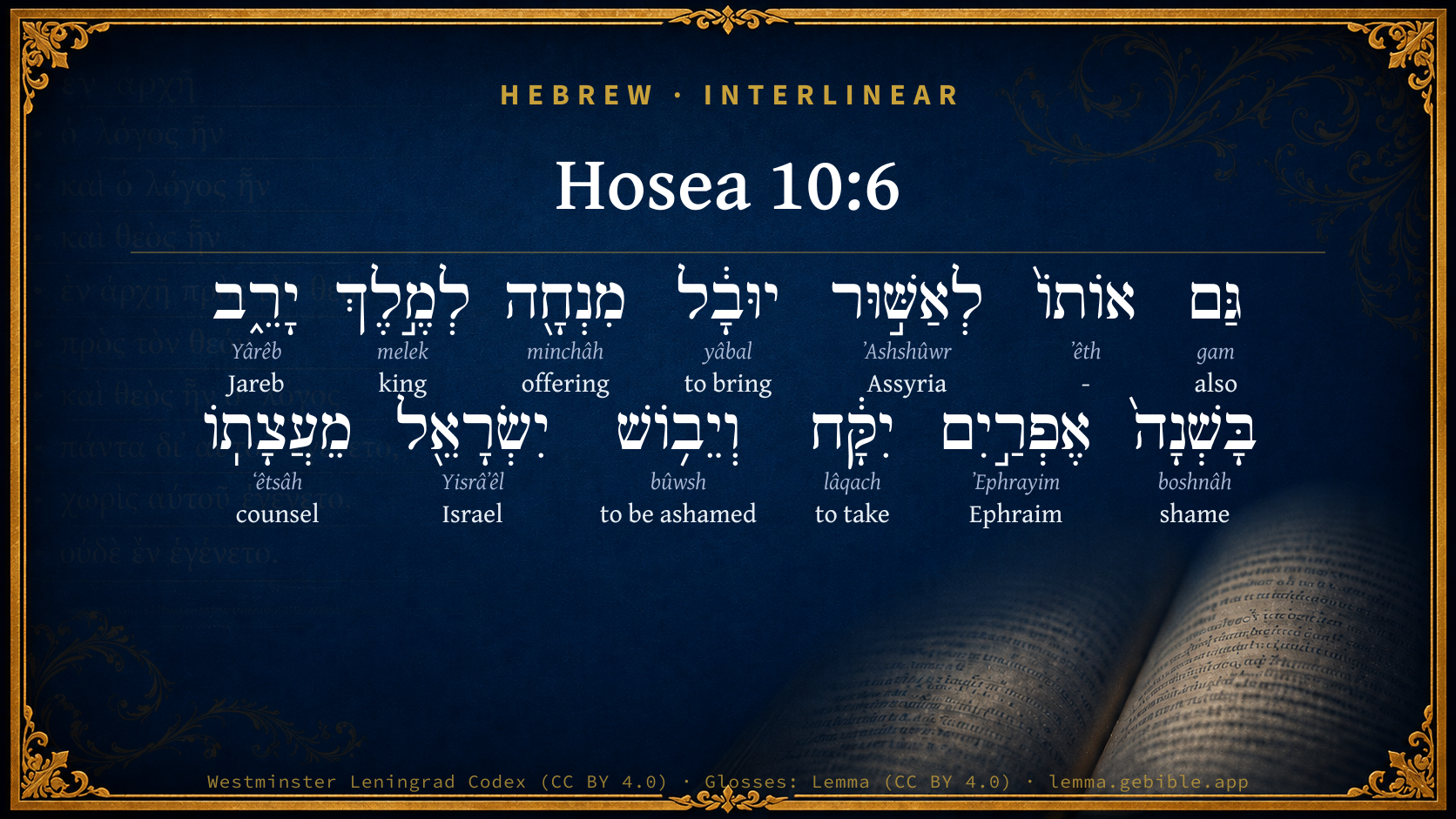
Hebrew (Westminster Leningrad Codex) Hosea 10:6 appears in the Hebrew Old Testament. The text above is from the Westminster Leningrad Codex. Each word links to its Strong’s number, a concise gloss, and parsing drawn from the Open Scriptures Hebrew Bible morphology. Click any word for its full Brown-Driver-Briggs (BDB) entry.
Download image
Cite this verse

Hosea 10:6 (World English Bible). Public Domain. Lemma interlinear Bible study tool, https://lemma.gebible.app/v/hosea/10/6.

Show BibTeX & RIS
BibTeX
RIS
English Translation
It also will be carried to Assyria for a present to a great king. Ephraim will receive shame, And Israel will be ashamed of his own counsel.
World English Bible · Public Domain
Highlights
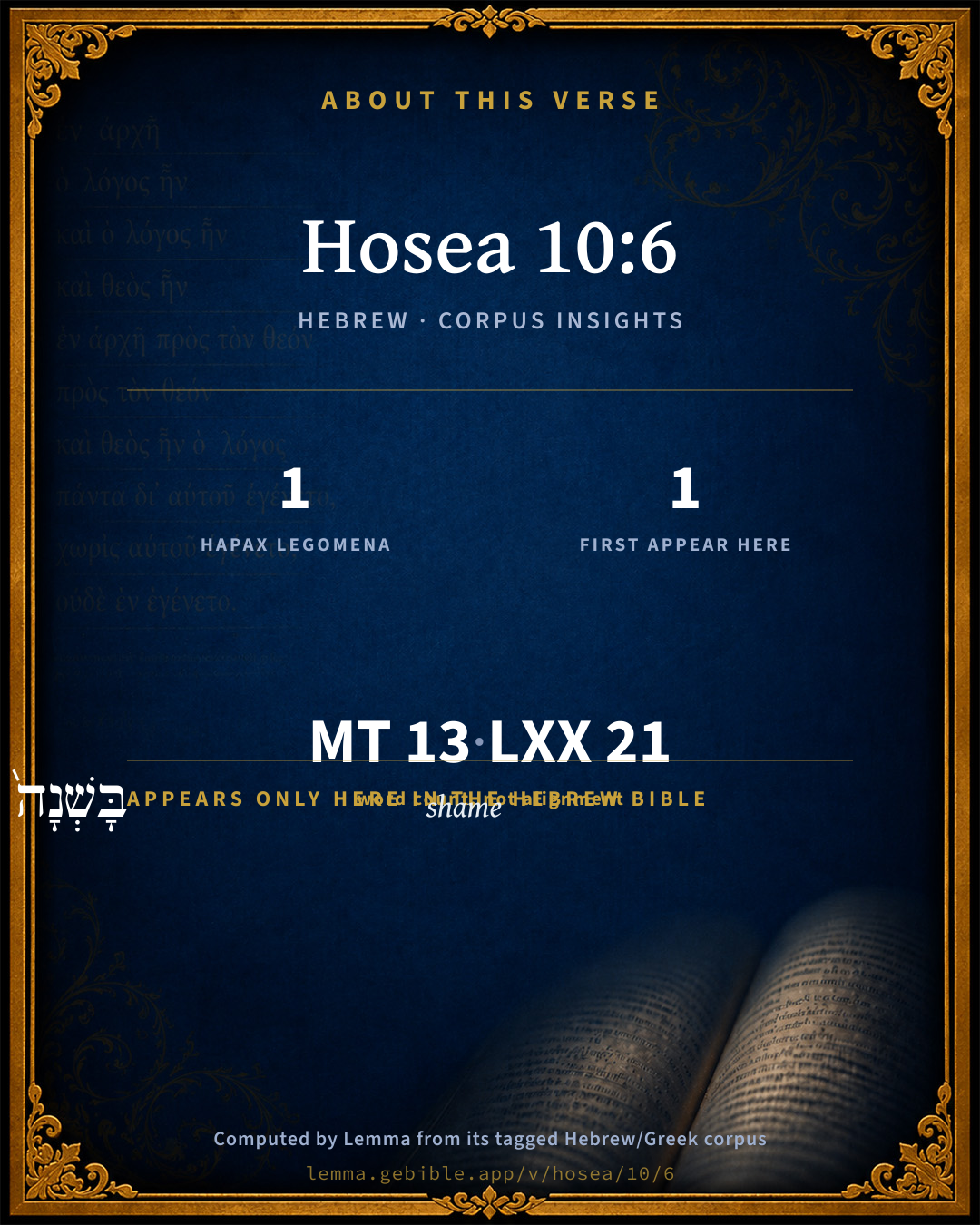
  • 1 hapax legomenon — only here in the Hebrew Bible
  • 1 first appearance in the Hebrew Bible
Full analysis ↓
Download a study sheet

One document with this verse’s original text, its word-by-word gloss line, the meaning frame, cross-references with their text, attributed commentary, and full source and license credits — printable, and it pastes into notes with its structure intact.

This verse Autodidact and up

Study sheet (.html) Plain text (.txt)

A passage Seminary Student

Up to 50 verses in one chapter. A passage sheet keeps up to 6 commentary sources and 12 cross-references per verse, in the order this page ranks them, and says so on the sheet whenever that leaves anything out. Ask for a single verse and you get the Autodidact verse sheet above.

Everything on this page stays free to read, with no account — the sheet is a download of what is already on screen, not access to it.

Want to remove ads? Support Godless Engineer
Compare translations 3

The same verse in 3 English versions, stacked beneath the original-language interlinear above. Click any original word for its lexicon entry.

Each is an independent rendering of the whole verse — the interlinear is not word-aligned to these translations.

Highlighted words mark where these versions differ — a whole-verse word diff, not a word-by-word alignment.

  • World English Bible Public Domain
    It also will be carried to Assyria for a present to a great king. Ephraim will receive shame, And Israel will be ashamed of his own counsel.
  • King James Version Public Domain
    It shall be also carried unto Assyria for a present to king Jareb: Ephraim shall receive shame, and Israel shall be ashamed of his own counsel.
  • unfoldingWord Literal Text CC BY-SA 4.0
    Even it will be carried to Assyria, a tribute to the king of Yareb. Ephraim will receive shame, and Israel will be ashamed of his counsel.

unfoldingWord Literal Text — © unfoldingWord, licensed CC BY-SA 4.0. Word-aligned USFM3 via Door43 (git.door43.org/unfoldingWord/en_ult).

Versions to compare (up to 4)

3 of 4 selected

Show all 18 translations

Every available English version of this verse, each an independent rendering of the whole verse.

  • World English Bible Public Domain
    It also will be carried to Assyria for a present to a great king. Ephraim will receive shame, And Israel will be ashamed of his own counsel.
  • Berean Standard Bible Public Domain
    Yes, it will be carried to Assyria as tribute to the great king. Ephraim will be seized with shame; Israel will be ashamed of its wooden idols.
  • Majority Standard Bible Public Domain
    Yes, it will be carried to Assyria as tribute to the great king. Ephraim will be seized with shame; Israel will be ashamed of its wooden idols.
  • King James Version Public Domain
    It shall be also carried unto Assyria for a present to king Jareb: Ephraim shall receive shame, and Israel shall be ashamed of his own counsel.
  • American Standard Version (1901) Public Domain
    It also shall be carried unto Assyria for a present to king Jareb: Ephraim shall receive shame, and Israel shall be ashamed of his own counsel.
  • Revised Version (1885) Public Domain
    It also shall be carried unto Assyria for a present to king Jareb: Ephraim shall receive shame, and Israel shall be ashamed of his own counsel.
  • Geneva Bible (1599) Public Domain
    It shall bee also brought to Asshur, for a present vnto King Iareb: Ephraim shall receiue shame, and Israel shall be ashamed of his owne counsell.
  • Douay-Rheims (1899) Public Domain
    For itself also is carried into Assyria, a present to the avenging king: shame shall fall upon Ephraim, and Israel shall be confounded in his own will.
  • Young's Literal Translation Public Domain
    Also it to Asshur is carried, a present to a warlike king, Shame doth Ephraim receive, And ashamed is Israel of its own counsel.
  • Literal Standard Version CC BY-SA 4.0
    Also, it is carried to Asshur, a present to a warlike king, || Ephraim receives shame, || And Israel is ashamed of its own counsel.
  • Unlocked Literal Bible CC BY-SA 4.0
    They will be carried to Assyria as a present for the great king. Ephraim will be disgraced, and Israel will be ashamed of its idol.
  • unfoldingWord Literal Text CC BY-SA 4.0
    Even it will be carried to Assyria, a tribute to the king of Yareb. Ephraim will receive shame, and Israel will be ashamed of his counsel.
  • Darby Bible Public Domain
    Yea, it shall be carried unto Assyria [as] a present for king Jareb: Ephraim shall be seized with shame, and Israel shall be ashamed of his own counsel.
  • World Messianic Bible Public Domain
    It also will be carried to Assyria for a present to a great king. Ephraim will receive shame, and Israel will be ashamed of his own counsel.
  • Webster's Bible Public Domain
    It shall also be carried to Assyria, for a present to king Jareb: Ephraim shall receive shame, and Israel shall be ashamed of his own counsel.
  • Free Bible Version CC BY-SA 4.0
    Ephraim will be disgraced, and Israel will be ashamed at its own decisions.
  • Bible in Basic English Public Domain
    And they will take it to Assyria and give it to the great king; shame will come on Ephraim, and Israel will be shamed because of its image.
  • JPS Tanakh (1917) Public Domain
    It also shall be carried unto Assyria, for a present to King Contentious; Ephraim shall receive shame, and Israel shall be ashamed of his own counsel.

Literal Standard Version (2020), Covenant Press — licensed CC BY-SA 4.0. Text via the HelloAO Bible API (eBible.org). Unlocked Literal Bible (unfoldingWord) — licensed CC BY-SA 4.0. Text via the HelloAO Bible API (eBible.org). unfoldingWord Literal Text — © unfoldingWord, licensed CC BY-SA 4.0. Word-aligned USFM3 via Door43 (git.door43.org/unfoldingWord/en_ult). Free Bible Version, Dr. Jonathan Gallagher — licensed CC BY-SA 4.0. Text via the HelloAO Bible API (eBible.org).

Word by word

More ways to search: Search by grammar → Find every occurrence → Compare this word →

Practice this passage: Drill this verse → Learn its vocabulary →

בָּשְׁנָה֙
boshnâh
H1317
“shame”
Noun, Common, Feminine, Singular, Absolute
Part of Speech
Noun
Type
Common
Gender
Feminine
Number
Singular
State
Absolute
Full BDB Definition

Origin: from H954

TWOT: 222b

shame - shame - shameful thing
  1. גַּם gam H1571 “also” Particle, Accusative
  2. אוֹתוֹ֙ ʼêth H853 “- · him” Particle, Direct Object + Suffix, Personal, 3rd Person, Masculine, Singular
  3. לְאַשּׁ֣וּר ʼAshshûwr H804 “to/for · Assyria” Preposition + Noun, Proper
  4. יוּבָ֔ל yâbal H2986 “to bring” Verb, Hophal, Imperfect, 3rd Person, Masculine, Singular
  5. מִנְחָ֖ה minchâh H4503 “offering” Noun, Common, Feminine, Singular, Absolute
  6. לְמֶ֣לֶךְ melek H4428 “to/for · king” Preposition + Noun, Common, Masculine, Singular, Absolute
  7. יָרֵ֑ב Yârêb H3377 “Jareb” Noun, Proper
  8. אֶפְרַ֣יִם ʼEphrayim H669 “Ephraim” Noun, Proper
  9. יִקָּ֔ח lâqach H3947 “to take” Verb, Qal, Imperfect, 3rd Person, Masculine, Singular
  10. וְיֵב֥וֹשׁ bûwsh H954 “and · to be ashamed” Conjunction + Verb, Qal, Imperfect, 3rd Person, Masculine, Singular
  11. יִשְׂרָאֵ֖ל Yisrâʼêl H3478 “Israel” Noun, Proper
  12. מֵעֲצָתֽוֹ ʻêtsâh H6098 “from · counsel · his” Preposition + Noun, Common, Feminine, Singular, Construct + Suffix, Personal, 3rd Person, Masculine, Singular

About this verse

These counts appear in no published source. They are computed here, from the morphology-tagged text and Lemma’s own curated glosses. What Lemma adds →

13
words
13
distinct lemmas
Prophets
section

Notable vocabulary

1 hapax legomenon — a word that appears only here in the entire Hebrew Bible:

  • בָּשְׁנָה֙ shame H1317

First appearance in Scripture

This word makes its first canonical appearance in the Hebrew Bible here:

  • בָּשְׁנָה֙ shame H1317

Shared distinctive vocabulary

יָרֵ֑ב Jareb H3377 occurs in 2 verses of the Hebrew Bible. Also found in:

Grammatical profile

  • 3 verbs
  • 8 nouns
  • 2 particles

Verb forms

  • יוּבָ֔ל Hophal · Imperfect
  • יִקָּ֔ח Qal · Imperfect
  • וְיֵב֥וֹשׁ Qal · Imperfect

Hebrew & Septuagint length

In English translation the verse runs 27 words from the Hebrew and 29 from the Septuagint (LXX English) — closely comparable.

A rough comparison of the two English renderings, which tokenize alike — not a word-level alignment.

Word counts can differ between the Hebrew and the Greek without any difference in meaning — e.g. the Hebrew direct-object marker אֵת has no separate Greek word, and Greek often adds the article ὁ.

In the original languages it is 13 Hebrew tokens and 21 Greek tokens — but the two are counted differently (Hebrew bundles its prefixes and suffixes into one token; the Greek is in lemma form), so that isn’t a like-for-like length.

Cross-references

21

Topical passages linked to Hosea 10:6 in the Treasury of Scripture Knowledge — connected by theme and wording, ordered by reader-vote popularity; previews shown in the World English Bible.

  • Isaiah 30:3 Therefore shall the strength of Pharaoh be your shame, and the refuge in the shadow of Egypt your confusion.
  • Hosea 5:13 When Ephraim saw his sickness, And Judah his wound, Then Ephraim went to Assyria, And sent to king Jareb: But he is not able to heal you, Neither will he cure you of your wound.
  • Jeremiah 7:24 But they didn't listen nor turn their ear, but walked in [their own] counsels [and] in the stubbornness of their evil heart, and went backward, and not forward.
  • Daniel 11:8 Also their gods, with their molten images, [and] with their goodly vessels of silver and of gold, shall he carry captive into Egypt; and he shall refrain some years from the king of the north.
  • 2 Kings 17:3 Against him came up Shalmaneser king of Assyria; and Hoshea became his servant, and brought him tribute.
  • Job 18:7 The steps of his strength shall be shortened, His own counsel shall cast him down.
  • Isaiah 1:29 For they shall be ashamed of the oaks which you have desired, And you shall be confounded for the gardens that you have chosen.
  • Isaiah 44:9–11 Those who fashion an engraved image are all of them vanity; and the things that they delight in shall not profit; and their own witnesses don't see, nor know: that they may be disappointed.
  • Isaiah 45:16 They shall be disappointed, yes, confounded, all of them; they shall go into confusion together who are makers of idols.
  • Isaiah 46:1–2 Bel bows down, Nebo stoops; their idols are on the animals, and on the cattle: the things that you carried about are made a load, a burden to the weary [animal].
  • Jeremiah 2:26–27 As the thief is ashamed when he is found, so is the house of Israel ashamed; they, their kings, their princes, and their priests, and their prophets;
  • Jeremiah 2:36–37 Why go you about so much to change your way? you shall be ashamed of Egypt also, as you were ashamed of Assyria.
  • Jeremiah 3:24–25 But the shameful thing has devoured the labor of our fathers from our youth, their flocks and their herds, their sons and their daughters.
  • Jeremiah 43:12–13 I will kindle a fire in the houses of the gods of Egypt; and he shall burn them, and carry them away captive: and he shall array himself with the land of Egypt, as a shepherd puts on his garment; and he shall go forth from there in peace.
  • Jeremiah 48:13 Moab shall be ashamed of Chemosh, as the house of Israel was ashamed of Bethel their confidence.
  • Ezekiel 36:31 Then shall you remember your evil ways, and your doings that were not good; and you shall loathe yourselves in your own sight for your iniquities and for your abominations.
  • Hosea 4:7 As they were multiplied, so they sinned against me. I will change their glory into shame.
  • Hosea 4:19 The wind has wrapped her up in its wings; And they shall be disappointed because of their sacrifices.
  • Hosea 8:6 For this is even from Israel! The workman made it, and it is no God; Indeed, the calf of Samaria shall be broken in pieces.
  • Hosea 11:5–6 "They won't return into the land of Egypt; But the Assyrian will be their king, Because they refused to repent.
  • Micah 6:16 For the statutes of Omri are kept, And all the works of the house of Ahab. You walk in their counsels, That I may make you a ruin, And her inhabitants a hissing; And you will bear the reproach of my people."

Cross-references courtesy of OpenBible.info (CC BY 4.0).

Hebrew and Greek witnesses Masoretic Hebrew ↔ Greek Septuagint

The same verse in the two great witnesses to the Old Testament, shown verse-for-verse.

These are two independent witnesses, not word-aligned to each other, and the Septuagint is shown in lemma (dictionary) form.

Hebrew Hosea 10:6 Masoretic · Westminster Leningrad Codex

גַּם אוֹתוֹ֙ לְאַשּׁ֣וּר יוּבָ֔ל מִנְחָ֖ה לְמֶ֣לֶךְ יָרֵ֑ב בָּשְׁנָה֙ אֶפְרַ֣יִם יִקָּ֔ח וְיֵב֥וֹשׁ יִשְׂרָאֵ֖ל מֵעֲצָתֽוֹ

It also will be carried to Assyria for a present to a great king. Ephraim will receive shame, And Israel will be ashamed of his own counsel.

World English Bible · Public Domain

Greek LXX Hosea 10:6 Septuagint · lemma form

καί αὐτός εἰς ἀσσύριος δέω ἀποφέρω ξενία ὁ βασιλεύς ιαριμ ἐν δόμα ἐφράιμ δέχομαι καί αἰσχύνω ἰσραήλ ἐν ὁ βουλή αὐτός

And having bound it for the Assyrians, they carried it away as presents to king Jarim: Ephraim shall receive a gift, and Israel shall be ashamed of his counsel.

LXX2012 (modern English Septuagint) · Public Domain

On this verse, Whedon's Commentary on the Bible discusses the Septuagint’s reading. Read the note in Commentary ↓

Hebrew: Westminster Leningrad Codex (CC BY 4.0). Greek: Septuagint (public domain); English from LXX2012 (modern English Septuagint) (Public Domain). How the Septuagint differs from the Hebrew →

Targum (Aramaic paraphrase)

1

The Targum is the ancient Jewish Aramaic paraphrase of the Hebrew Scriptures — an interpretive translation, not the Hebrew text itself. Onkelos (literal) and Pseudo-Jonathan (expansive) render the Torah, and Jonathan the Prophets. Coverage is partial: where no permissively-licensed English translation exists for a verse, only the Aramaic is shown. This is verse-level text, not a word-by-word alignment to the Hebrew.

  1. Targum Jonathan Prophets (Joshua–Malachi)
    אַף יָתֵיהּ לְאַתּוּר יוֹבְלוּן קוּרְבָּנָא לְמַלְכָּא דְיֵיתִי לְאִתְפְּרָעָא לְהוֹן נְבִיָא אֱמַר לְהוֹן בַּהֲתָא דְבֵית אֶפְרַיִם יְקַבְּלוּן וְיִבְהֲתוּן דְבֵית יִשְׂרָאֵל מִמַלְכֵי עֲצָתְהוֹן:

    (no public-domain English translation for this verse)

    Targum Jonathan — Aramaic: “Mikraot Gedolot” (public domain). English: “Sefaria Community Translation” (CC0 1.0 (public-domain dedication)); “London "Chaldee Paraphrase," 1871” (public domain). Text via Sefaria.

Commentary

Notes on Hosea 10:6 from classic Christian and Jewish commentators (each source and its license shown beneath its notes). The classic Christian expositions comment on the surrounding passage and are grouped to its opening verse, so a note may address several verses; the Jewish commentaries on the Tanakh (Rashi and others) are per-verse, so they appear only where the commentator wrote on this verse.

Lemma curates 59 commentaries, every one of them public domain or Creative Commons licensed, each selected and text-cleaned for this edition rather than reprinted as found. About our sources →

Trapp's Complete Commentary

John Trapp

Hos 10:6 It shall be also carried unto Assyria [for] a present to king Jareb: Ephraim shall receive shame, and Israel shall be ashamed of his own counsel.

Ver. 6. It shall be also carried unto Assyria, &c.] As no small part of the spoil, shall this Deafter be carried captive; being so far unable to save others, that he cannot save himself.

For a present to king Jareb] See Hos 3:1-3, in signum omnimodae victoriae; so Aeneas (Aeneid. 1),

“ Ilium in Italiam portat, victosque penates, ”

though in another sense; yet they must needs be poor despicable deities that fall into the enemies’ hands, see Isa 46:2. The ark indeed fell into the Philistines’ hands; but the ark was not God’s, but only a sign of his presence, which God suffered so to be taken for a punishment to his people, and for a plague to his enemies, whom he "smote in the hinder parts, and so put them to a perpetual reproach," Psa 78:66.

Ephraim shall receive shame] Because they hoped and harped upon better things, Job 6:20. O pray, with David, that our hopes be not disappointed; that they make us not ashamed, as Paul speaketh, Rom 5:5; that they prove not as the spider’s web, curiously framed, but to catch flies only; or as the child’s hope, who catcheth at the shadow on the wall which he thinks he holds fast, or at the butterfly, which if he catch, he hath no such great catch of.

And Israel shall be ashamed of his own counsels] Of their impolitic plots and practices, in dividing themselves from David’s house, and setting up unwarranted worships, calling in foreign helps, &c. Their own counsels have cast them down, Job 18:7, because they were acted by false principles, and aimed at their own corrupt ends. They took counsel, but not of God; and covered with a covering, but not of his Spirit, that they might add sin to sin, Isa 30:1. They made not the word the man of their counsel, as David did, Psa 119:24, neither prayed they as he, Psa 73:24, Guide me, Lord, with thy counsel, and so bring me to glory. In a word, they perished by their own counsels, Hos 11:6, whereby they provoked God, and so were brought low by their iniquity, Psa 106:48, and then they were ashamed of their own counsel, they saw themselves befooled by their carnal reason, and by that which they call reason of state, which indeed is treason, unless it be seasoned with justice and religion.

John Trapp, A Commentary or Exposition upon All the Books of the Old and New Testament (1647–1656) — public domain. Text from a community e-Sword module.

Joseph Benson's Commentary

Hos 10:6-8. It — The golden calf; shall be carried into Assyria — It was the custom of the eastern people, and also of the Romans, to carry away the gods of the conquered countries. For a present to King Jareb — See note on Hos 5:13. The king of Assyria is meant, whose dependant and tributary the king of Israel now was. Ephraim shall receive shame — They shall be ashamed to find that the idol in which they trusted could not defend them or itself from being disgraced and taken away. Bishop Horsley’s version here is, Ephraim shall be overtaken in sound sleep, namely, in a dream of security, when nothing will be less in his thoughts than danger; and Israel shall be disgraced by his own politics; that is, the politics of the treaties of alliance, mentioned Hos 10:4. An impolitic alliance with the king of Egypt was the immediate occasion of Shalmaneser’s rupture with Hoshea, which ended in the captivity of the ten tribes. As for Samaria, her king is cut off — Or, more literally, according to the Hebrew, Samaria is cut off, (or destroyed,) with her king; or, by a small alteration of the pointing, Her king is as the foam upon the water — Namely, as a bubble, which no sooner swells than it bursts: as if he had said, Many of her kings have rapidly passed away by assassination: and Hoshea shall soon be cut off by the king of Assyria. The high places also — The temples and altars dedicated to idolatrous worship, and usually placed on hills and mountains; of Aven — Or, Beth-aven; the sin of Israel — That is, the temples and altars, in and by which Israel has so greatly sinned, shall be destroyed, shall be entirely demolished; so that the thorn and the thistle shall come upon their altars — That is, their altar shall become such heaps of ruins, and the places around them be made so desolate, that thorns and thistles shall overrun and cover them. And they shall say to the mountains, Cover us — These words express the confusion and despair to which the Israelites should be reduced by the destruction of their country. Our Lord has made use of the same words, to denote the extremity of the Jews in the last siege of Jerusalem; and St. John, in the Revelation, to set forth the terror of the wicked in the day of judgment. They express also the great consternation of the wicked when any of God’s singular judgments overtake them, whose guilt prompts them to endeavour to hide themselves, and they even run into the darkest caves and holes of rocks to secure themselves.

Joseph Benson's Commentary on the Old and New Testaments (1811–1818) — public domain. Text from a community e-Sword module.

Whedon's Commentary on the Bible

Daniel D. Whedon

6. The calf itself will be carried to Assyria for a present — Not a present to secure help (Hos_7:11; Hos_12:1), though LXX. reads, “they shall carry it”; but after the conquest it is to be carried off as a part of the booty, which will be an additional proof of its helplessness.

King Jareb — See on Hos_5:13.

Shall receive shame,… shall be ashamed — Not so much, they will have a sense of remorse and shame, but, they will be put to shame or confusion (Isa_1:29).

Of — Or, through.

His own counsel — Counsel is the ability to find ways and means and to adapt them to proper ends (compare Isa_11:2). The establishment of the calf worship was thought to be a master stroke (1Ki_12:26 ff.); it is that very policy that will prove Israel’s undoing.

Hos_10:7 should be translated, “Samaria is destroyed, her king is like foam upon the water.” The tenses are prophetic perfects, equivalent to shall be, for the destruction is still future (Hos_10:6; Hos_10:8). The judgment will reach its climax in the fall of Samaria. It did so when about fifteen years later the city was taken by Sargon of Assyria, in 722-721.

Her king — The ruling monarch, not the idol god (Amo_5:26).

As the foam — So Targum, Vulgate, and a few modern commentators. The meaning of the Hebrew word is uncertain: Probably, like a chip, which is tossed about and, irresistibly carried hither and thither by the stream, finally vanishes forever.

Hos_10:8 in a sense continues Hos_10:6; the calf is to be carried away and the very place where it has stood is to be smitten by Jehovah. To prevent the apparent interruption of the thought and to preserve the climax Harper places 8a immediately after Hos_10:6.

High places — See on Hos_4:13.

Aven — Beth-aven (Hos_10:5).

Sin — They were the embodiment of Israel’s sin (compare Hos_4:12 ff.). The sanctuary, the altar, everything will vanish so completely that thorns and thistles will be allowed to grow undisturbed upon the ancient site (Hos_9:6). When the king has been swept away, the capital destroyed, the idols carried away, the sanctuary leveled to the ground, when all this has come to pass the people that are left behind will in their despair cry out for swift death and destruction; they will call for the mountains to cover them that they may be compelled no longer to endure the terrible judgments of Jehovah (compare Luk_23:30; Rev_6:16).

Daniel D. Whedon (gen. ed.), Commentary on the Old and New Testaments (1874–1909) — public domain. Text from a community e-Sword module.

Jamieson, Fausset & Brown

Robert Jamieson, A. R. Fausset & David Brown

It . . . also--The calf, so far from saving its worshippers from deportation, itself shall be carried off; hence "Israel shall be ashamed" of it.

Jareb--(See on Hos 5:13). "A present to the king (whom they looked to as) their defender," or else avenger, whose wrath they wished to appease, namely, Shalmaneser. The minor states applied this title to the Great King, as the avenging Protector.

his own counsel--the calves, which Jeroboam set up as a stroke of policy to detach Israel from Judah. Their severance from Judah and Jehovah proved now to be not politic, but fatal to them.

Jamieson, Fausset & Brown — Commentary Critical and Explanatory on the Whole Bible (1871) — public domain (CC PDM 1.0). Text via the HelloAO Bible API.

Adam Clarke's Commentary

Verse 6. A present to King Jareb] See on Ho 5:13. If this be a proper name, the person intended is not known in history: but it is most likely that Pul, king of Assyria, is intended, to whom Menahem, king of Israel, appears to have given one of the golden calves, to insure his assistance.

Adam Clarke's Commentary on the Bible (1810–1826) — public domain. Text from a community e-Sword/MySword module.

John Calvin's Commentaries

Here the Prophet expresses more clearly the cause of mourning to the priests and to the whole people, The calf, he says, “shall be carried into Assyria, and carried as a present to king Jareb”. It is probable, that when extreme danger came, the king of Israel was constrained either to cast the calf into a new form, or to break it in pieces, to redeem peace from the Assyrian king. As then the whole kingdom was reduced to great want, we may infer from this place that the calf or calves, were carried into Assyria for pacifying the king. Since then the Israelites saw that they were stripped of their protection, (for they were now without any hope of safety, as there was no God among them,) the Prophet mentioned above their grief: but he now shows that exile was nigh at hand, not only to the Israelites, but also to the calves which they worshipped and by whose aid they thought themselves to be secure and safe in their country.

There is a particular emphasis in the particle גם, gam, as though the Prophet said, “Not only the Israelites shall migrate, but the very calf shall also be carried into Assyria.” Of the word “Jareb,” we have spoken in the commentary on Hosea 5, it seems to have been the proper name of a man. Some conjecture it to be a city in Assyria, though not noticed by writers. Others think it to be the name of a neighbouring king to the Assyrian, but without reason, and they are refuted by this very passage; for the Prophet doubtless points out here the Assyrian king. He yet calls him Jareb; it may be that he was as yet a private man, or he may have so called him by way of reproach. This is however uncertain. Jerome renders the word, “avenger.” But it is sufficiently evident that it was a proper name, not of a city or place, but, as it has been said, of a man. And I am disposed to think, that he calls him king Jareb by way of contempt, for this contempt prevailed among the Israelites as long as they thought themselves strong enough to resist. But the Lord afterwards checked this pride: hence the Prophet says now in a cutting manner, “The calf shall be carried into Assyria to pacify king Jareb.”

He afterwards adds, Ephraim shall receive shame, or reproach; Israel shall be made ashamed of his counsel. He says the same thing in different ways and not without reason; for it was difficult at first to persuade the Israelites that what they thought to have been wisely contrived would turn out to their shame. The king Jeroboam the first, when he erected temples did indeed think it the best device to prevent the people, were they to repent, from submitting themselves again to the posterity of David. Hence he thought that the ten tribes were wholly torn away, when he set up that peculiar worship, which had nothing in common with that of the tribe of Judah. And doubtless had the ten tribes worshipped the true God at Jerusalem, this union might have been the means of again reuniting them into one body under one head. Hence the king Jeroboam thought that he had provided well for his kingdom, to render it permanent, by cutting off all communication between the two people: and there was none in Israel who did not approve of this counsel; for they took delight in their wealth, in the number of their men, and in other advantages. Since then the kingdom of Judah was much inferior, the Israelites were vastly pleased with themselves. This is the reason why the Prophet says, Ephraim shall receive shame; Israel shall be made ashamed of his counsel But this, as I have said, could not appear credible at first. For men promise to themselves the success they wish in their own craftiness: and hence it comes also, that they dare to attempt any thing they please without the aid of God. This is the reason why the Prophet repeats the same sentence, “Ephraim,” he says, “shall receive shame; Israel shall be made ashamed,” — for what? for their counsel. They think that their own counsel will be most useful to them; yea, they place their safety in their own craftiness. But the Lord will overrule for their shame whatever they have devised. It follows —

John Calvin's Commentaries (1540-1563) — public domain. Text from the Calvin Translation Society English edition (1840s-50s) via the Christian Classics Ethereal Library (ccel.org). Calvin's coverage is partial (roughly two-thirds of the Bible); uncommented books and verses are honest gaps, never fabricated. The 19th-century editor's footnotes and remarks are omitted so the notes are faithfully Calvin's own voice.

Ellicott's Commentary for English Readers

(6) Translate, Even that (i.e., the calf) shall be carried (in triumphant state) to Assyria, an offering to King Jareb. (See Hos_5:13, Excursus.)

A Bible Commentary for English Readers, edited by Charles John Ellicott (1878–1897) — public domain. Text from a community e-Sword module.

The Cambridge Bible for Schools and Colleges

gen. ed. J. J. S. Perowne

6. It shall be also] Rather, This also (viz. the steer) shall be.

for a present to king Jareb] Just as the kings of Judah repeatedly gave up the gold and silver in the temple to foreign foes. ‘King Jareb’ should rather be the fighting king (i.e. the king of Assyria, see on Hos_5:13).

shall be ashamed of his own counsel] i.e., shall find out what a mistake it was to set up a helpless idol as the protector of the nation.

The Cambridge Bible for Schools and Colleges (gen. ed. J. J. S. Perowne; Cambridge University Press, 1878–1918) — public domain. Text from a community e-Sword module.

John Gill's Exposition

It shall also be carried unto Assyria for a present to King Jareb,.... Or, "he himself" (z); not the people of Samaria, or of Bethaven, or of the calf, but the calf itself; which, being all of gold, was sent a present to the king of Assyria, here called Jareb; either Assyria, or the king of it; See Gill on Hos 5:13; this was done either by the people of Israel themselves, to appease the king of Assyria; or rather by the Assyrian army, who reserved the plunder of this as a proper present to their king and conqueror, to whom not only nations, but the gods of nations, were subject:

Ephraim shall receive shame; for worshipping such an idol, when they shall see it broke to pieces, and the gold of it made a present to the Assyrian king, and that it could not save them, nor itself:

and Israel shall be ashamed of his own counsel; of giving in to such idolatry, contrary to the counsel, mind, and will of God; or of the counsel which they and Jeroboam took to set up the calves at Dan and Bethel, and thereby to keep the people from going up to Jerusalem, Kg1 12:28; as well as of their counsel and covenant with the king of Egypt against the king of Assyria, Kg2 17:4.

(z) "etiam ipsemet", Pagninus, Montanus; "etiam ipse", Junius & Tremellius, Piscator; "etiam ille", Cocceius; "etiam ille ipse", Schmidt.

John Gill's Exposition of the Whole Bible (1746–1763) — public domain (CC PDM 1.0). Text via the HelloAO Bible API.

Albert Barnes' Notes on the Bible

It shall be also carried - (that is, “Itself also shall be carried”). Not Israel only shall be carried into captivity, but its god also. The victory over a nation was accounted of old a victory over its gods, as indeed it showed their impotence. Hence, the excuse made by the captains of Benhadad, that the gods of “Israel were gods of the hills, and not gods of the valleys” 1Ki 20:23, 1Ki 20:28, and God’s vindication of His own Almightiness, which was thus denied. Hence, also the boast of Sennacherib by Rabshakeh, “have any of the gods of the nations delivered at all his land out of the hand of the king of Assyria? Where are the gods of Hamath and of Arpad? where are the gods of Sepharvaim, Hena, and Ivah? have they delivered Samaria out of mine hand? Who are they among all the gods of the countries, that have delivered their country out of mine hand, that the Lord should deliver Jerusalem out of mine hand?” (2Ki 18:33-35, add, 2Ki 19:10-13; Num 21:29).

When God then, for the sin of His people, gave them into the hand of their enemies, He vindicated His own glory, first by avenging any insult offered to His worship, as in the capture of the ark by the Philistines, or Belshazzar’s insolent and drunken abuse of the vessels of the temple; or by vindicating His servants, as in the case of Daniel and the three children, or by chastening pride, as in Nebuchadnezzar, and explaining and pointing His chastisement through His servant Daniel, or by prophecy, as of Cyrus by Isaiah and Daniel. To His own people, His chastisements were the vindication of His glory which they had dishonored, and the close of the long strife between the true prophets and the false. The captivity of the calf ended its worship, and was its final disgrace. The destruction of the temple and the captivity of its vessels and of God’s people ended, not the worship, but the idolatries of Judah, and extended among their captors, and their captors’ captors, the Medes and Persians, the knowledge of the One true God.

Unto Assyria, for a present to king Jareb - (or to a hostile or strifeful king. See the note above at Hos 5:13.) Perhaps the name “Jareb” designates the Assyrian by that which was a characteristic of their empire, love of “strife.” The history of their kings, as given by themselves in the newly-found inscriptions, is one warfare. To that same king, to whom they sent for aid in their weakness, from whom they hoped for help, and whom God named as what He knew and willed him to be to them, “hostile, strifeful,” and “an avenger,” should the object of their idolatry be carried in triumph. They had trusted in the calf and in the Assyrians. The Assyrian, to whom they looked as the protector of their liberties, was to carry away their other trust, their god .

Ephraim shall receive shame - This shall be all his gain; this his purchase; this he had obtained for himself by his pride and willfulness and idolatry and ambition and wars: this is the end of all, as it is of all pursuits apart from God; this he “shall receive” from the Giver of all good, “shame.” “And Israel shall be ashamed of his own counsel.” Ephraim’s special “counsel” was that which Jeroboam “took” with the most worldly-wise of his people, a counsel which admirably served their immediate end, the establishment of a kingdom, separate from that of Judah. It was acutely devised; it seemed to answer its end for 230 years, so that Israel, until the latter part of the reign of Pekah, was strong, Judah, in comparison, weak. But it was “the sin wherewith he made Israel to sin,” and for which God scattered him among the pagan. His wisdom became his destruction and his shame. The policy which was to establish his family and his kingdom, destroyed his own family in the next generation, and ultimately, his people, not by its failure, but by its success.

Albert Barnes' Notes on the Bible (1834–1885) — public domain. Text from a community e-Sword/MySword module.

Haydock's Catholic Bible Commentary

Itself also is carried, &c. One of the golden calves was given by king Manahem to Phul, king of the Assyrians, to engage him to stand by him. (Challoner) --- Avenging. Chap. v. 13. --- Will, or expectation of aid. (Calmet) --- He had recourse to this nation, without consulting God. (Haydock)

George Leo Haydock (1774–1849), Haydock's Catholic Family Bible and Commentary, 1859 edition — public domain. Excludes Psalms (Douay-Rheims chapter numbering differs from Protestant) and Deuterocanonical books (Catholic canon only).

Matthew Poole's English Annotations

It; the golden calf made by Jeroboam the First, 1Ki 12:28.

Shall be carried; though it hath feet, it cannot go, it must be borne; as Isaiah derides the idols of Babylon, Isa 46:2,7; Jer 10:5; and it is carried in triumph. For a present; according to the custom of conquering generals, the rich and rare things of the conquered people were reserved for gifts to their kings; and here is a rarity indeed, a captive god, and it is rich, for it is made of gold.

King Jareb: see Hos 5:13.

Ephraim shall receive shame, and Israel shall be ashamed: the great confusion of this people is here foretold, and the certainty of it by the ingemination of the phrase: the Assyrians shall upbraid them with their brutish folly, to think that a god which could not keep itself from becoming a prey to insolent soldiers; and when thus taunted, Israel shall have nothing to answer, but must be silent with shame.

Of his own counsel; which is expressly mentioned 1Ki 12:28; it was against the counsel of God; and as they began, so they persisted in it by the same counsel.

Matthew Poole's English Annotations on the Holy Bible (1683–1685) — public domain. Text from a community e-Sword/MySword module.

The Pulpit Commentary

It shall he also carried unto Assyria for a present to King Jareb. Here we have an explanation and confirmation of what has just been said in the preceding verse. The calf, the glorious and magnificent national god, as Israel considered it, is brought to Assyria, and there offered as a present to the Assyrian king. The word gam is emphatic; that is, "it also," "itself also," or "it also with men and other spoils the golden idol of Beth-aven. Kimchi"s explanation of gam is as follows: "Genesis, extension or generalization of the term, refers to the glory he bad mentioned. He says, "Lo, in its place the glory shall depart from it as soon as they shall break it. Also, the stump of the calf, namely, the gold thereon, after its form is broken, they shall take away as a present to King Jareb. The sign of the accusative with suffix wjwOa, which here stands before a passive verb, may be taken either

(1) absolutely, as to it also," it shall be brought;" or

(2) as an instance of anacoluthon; or,

(3) according to Gesenius, the passive may be regarded as an impersonal active, and thus it may take the object of the action in the accusative. The word yubhal is from yabhal, primarily used of flowing in a strong and violent stream, and so the root of lwOBm, the flood; then it signifies "to go," "to be brought or carried." The minchah here spoken of cannot well mean tribute, but is rather a gift of homage.to the Assyrian conqueror, whom the prophet m vision sees already wasting the land of Israel and carrying away all its treasures and precious things. Ephraim shall receive shame, and Israel shall be ashamed of his own counsel. The feminine form, hnvb of which vN, the masculine, by analogy, is not in use is wrongly explained by the Hebrew expositors as having a pleonastic nun. The construction usually preferred is

(1) that given above.

(2) Others render it, "Shame shall seize Ephraim;" but tiffs constructs a feminine noun with a masculine verb, contrary to grammar.

(3) Hitzig translates," He (the Assyrian king) shall take away or carry off the shame of Ephraim; that is, the calf-idol." He remarks that the construct feminine does not always in the speech of North Israel end in tA, and cites several passages in proof. The counsel of which Israel would be ashamed is understood

(1) of the consultation held before making a covenant or treaty with the King of Assyria;

(2) it is generally and more correctly understood of Jeroboam taking counsel with his tribesmen of Ephraim about setting up the calf idols. Jareb is a proper name, or rather an appellation. The King of Assyria, or the great king, was looked up to by the smaller Asiatic states for protection, and consequently styled their Jareb, avenger or defender, just as swthr savior, was a title applied to or assumed by certain kings for a similar reason, as Ptolemy Soter and others. The object of Israel"s idolatry is carried off as a present to propitiate or appease the wrath of the Assyrian patron and protector probably Shalmaneser in the present instance or taken as a trophy to grace the triumph of the conqueror. So far from defending the calf-people, as Israel had become, their calf-god could not defend itself; instead of preserving its worshippers from deportation, it was doomed itself to deportation. Ephraim, the premier tribe. received shame, and Israel, the remaining tribes that had followed its lead and adopted its evil counsel, shared the shame; all of them together were thoroughly put to shame because of their mistaken and wicked policy. The counsel of Jeroboam for to it, in our opinion, is the reference appeared an able stroke of policy; but this policy, by which he hoped to detach Israel from Judah, was not only frustrated, but proved positively ruinous, so far were the means from effecting the end, or the end from justifying the wisdom of the means.

The Pulpit Commentary (1880–1919), ed. H.D.M. Spence-Jones & Joseph S. Exell — public domain. Text from a community e-Sword module.

John Wesley's Explanatory Notes

It - The golden calf.

John Wesley, Explanatory Notes Upon the Whole Bible (1754–1765) — public domain. Text via the GEBible commentary corpus.

Rashi

Rabbi Shlomo Yitzchaki (Rashi)

That too shall be carried off to Assyria This took place in the twelfth year of Ahaz, “And the Lord (sic) aroused the desire of Pul king of Assyria...and they exiled the Reubenites and the Gadites etc.” (I Chron. 5:26), and he took the golden calves that were in Bethel and went away, to fulfill what was said: “That too shall be carried off to Assyria.” [from Seder Olam ch. 22]

a gift to King Yareb This is Sennacherib.

Ephraim shall take shame Heb. בָּשְׁנָה. Jeroboam, who was from the tribe of Ephraim, shall take shame for himself, that he erected this calf for a deity.

and Israel shall be ashamed of that counsel that they took counsel to make them, as it is said: (I Kings 12:28) “The king took counsel and made two golden calves.”

Rashi on the Tanakh — English translations: “The Judaica Press complete Tanach with Rashi, translated by A. J. Rosenberg” (CC BY 4.0); “Pentateuch with Rashi's commentary by M. Rosenbaum and A.M. Silbermann, 1929-1934” (public domain); “The Metsudah Tanach series, Lakewood, N.J” (CC BY 4.0); and “The Book of Joshua, Metsudah Publications, 1997” (CC BY 4.0). Text via Sefaria.

Lesson kit

Teaching starters — assembled from the data on this page, not authored interpretation. Every prompt links to the verse data it draws on. Edit before teaching.

Hosea, in the Prophets, opens this verse with 13 words (13 distinct Hebrew lemmas). Its most distinctive word is boshnâh (“shame”). A historical commentator’s framing appears above. Read the whole chapter for the surrounding context.

Discussion questions

  1. What does “shame” (boshnâh) contribute to the verse as a whole?
  2. 1 word here appears nowhere else in the Hebrew Bible. Why might the author reach for such rare wording?
  3. This is the first place “shame” appears in Scripture (first appears here). What does its debut here establish?
  4. How does Hosea 5:13, which shares the word «Jareb», read alongside this verse?
  5. These translations render this verse differently. What is at stake in choosing one wording over another?
  6. «יוּבָ֔ל» is a Hophal Imperfect verb. How does that grammatical form shape the action described?
  7. Compare how Trapp's Complete Commentary and Joseph Benson's Commentary read this verse. Where do they agree or differ?

Things to notice

Reading settings

Reading text

Shown beneath each verse's original-language words.

Old Testament
Old Testament edition

Read the OT as the Masoretic Hebrew (MT) or the Greek Septuagint (LXX).

English shown for the Greek Septuagint (in the Hebrew ↔ Greek comparison).

Comparing translations? Open the Compare panel on any verse page to stack up to four side by side.