
Genesis 48:14

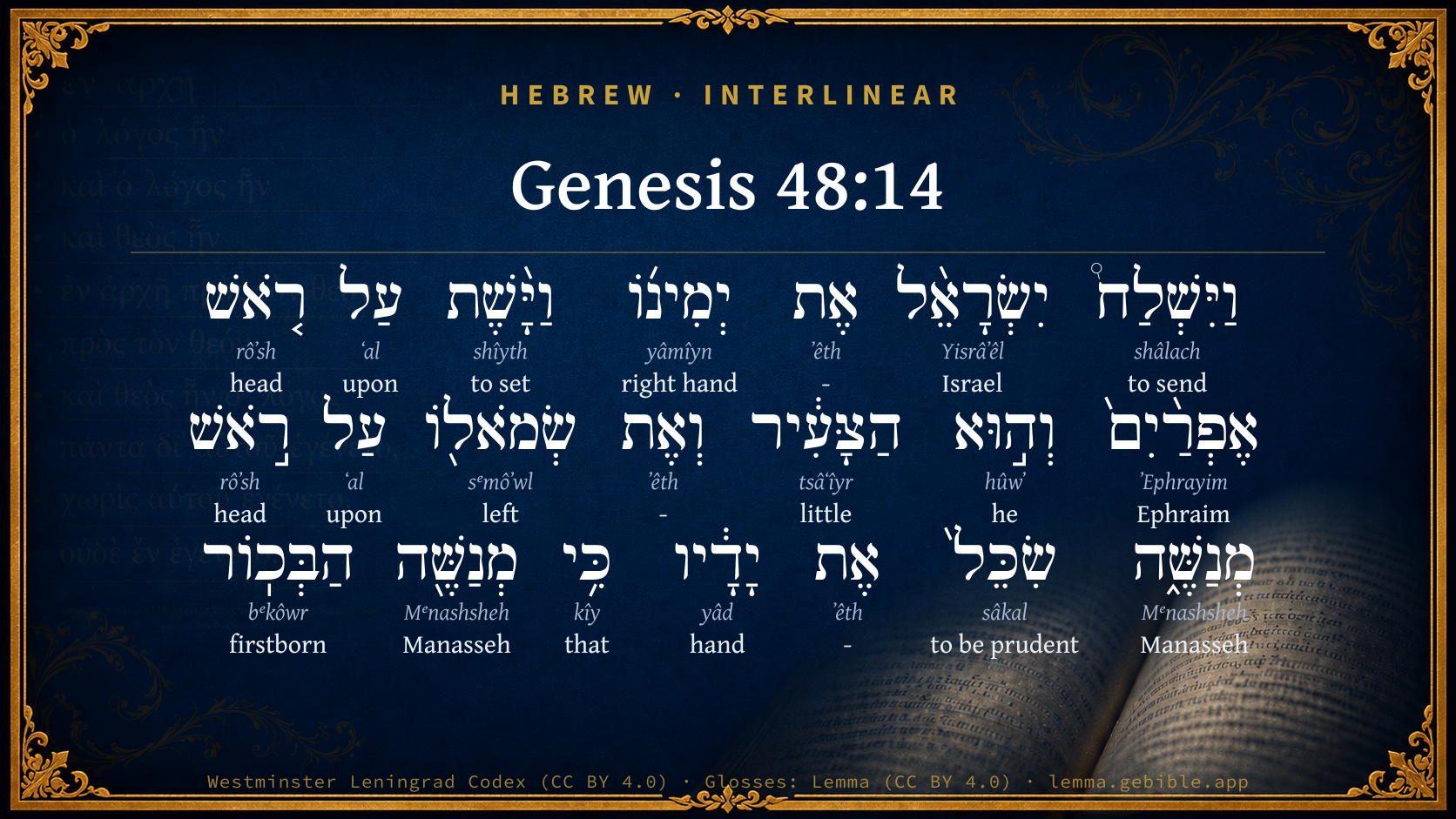
Hebrew (Westminster Leningrad Codex) Genesis 48:14 appears in the Hebrew Old Testament. The text above is from the Westminster Leningrad Codex. Each word links to its Strong’s number, a concise gloss, and parsing drawn from the Open Scriptures Hebrew Bible morphology. Click any word for its full Brown-Driver-Briggs (BDB) entry.
Download image
Cite this verse

Genesis 48:14 (World English Bible). Public Domain. Lemma interlinear Bible study tool, https://lemma.gebible.app/v/genesis/48/14.

Show BibTeX & RIS
BibTeX
RIS
English Translation
Israel stretched out his right hand, and laid it on Ephraim's head, who was the younger, and his left hand on Manasseh's head, guiding his hands knowingly, for Manasseh was the firstborn.
World English Bible · Public Domain
Download a study sheet

One document with this verse’s original text, its word-by-word gloss line, the meaning frame, cross-references with their text, attributed commentary, and full source and license credits — printable, and it pastes into notes with its structure intact.

This verse Autodidact and up

Study sheet (.html) Plain text (.txt)

A passage Seminary Student

Up to 50 verses in one chapter. A passage sheet keeps up to 6 commentary sources and 12 cross-references per verse, in the order this page ranks them, and says so on the sheet whenever that leaves anything out. Ask for a single verse and you get the Autodidact verse sheet above.

Everything on this page stays free to read, with no account — the sheet is a download of what is already on screen, not access to it.

Want to remove ads? Support Godless Engineer
Compare translations 3

The same verse in 3 English versions, stacked beneath the original-language interlinear above. Click any original word for its lexicon entry.

Each is an independent rendering of the whole verse — the interlinear is not word-aligned to these translations.

Highlighted words mark where these versions differ — a whole-verse word diff, not a word-by-word alignment.

  • World English Bible Public Domain
    Israel stretched out his right hand, and laid it on Ephraim's head, who was the younger, and his left hand on Manasseh's head, guiding his hands knowingly, for Manasseh was the firstborn.
  • King James Version Public Domain
    And Israel stretched out his right hand, and laid it upon Ephraim's head, who was the younger, and his left hand upon Manasseh's head, guiding his hands wittingly; for Manasseh was the firstborn.
  • unfoldingWord Literal Text CC BY-SA 4.0
    But Israel extended his right hand and placed on the head of Ephraim, and he the younger, and his left hand on the head of Manasseh. He guided his hands, because Manasseh the firstborn.

unfoldingWord Literal Text — © unfoldingWord, licensed CC BY-SA 4.0. Word-aligned USFM3 via Door43 (git.door43.org/unfoldingWord/en_ult).

Versions to compare (up to 4)

3 of 4 selected

Show all 18 translations

Every available English version of this verse, each an independent rendering of the whole verse.

  • World English Bible Public Domain
    Israel stretched out his right hand, and laid it on Ephraim's head, who was the younger, and his left hand on Manasseh's head, guiding his hands knowingly, for Manasseh was the firstborn.
  • Berean Standard Bible Public Domain
    But Israel stretched out his right hand and put it on the head of Ephraim, the younger; and crossing his hands, he put his left on Manasseh’s head, although Manasseh was the firstborn.
  • Majority Standard Bible Public Domain
    But Israel stretched out his right hand and put it on the head of Ephraim, the younger; and crossing his hands, he put his left on Manasseh’s head, although Manasseh was the firstborn.
  • King James Version Public Domain
    And Israel stretched out his right hand, and laid it upon Ephraim's head, who was the younger, and his left hand upon Manasseh's head, guiding his hands wittingly; for Manasseh was the firstborn.
  • American Standard Version (1901) Public Domain
    And Israel stretched out his right hand, and laid it upon Ephraim's head, who was the younger, and his left hand upon Manasseh's head, guiding his hands wittingly; for Manasseh was the first-born.
  • Revised Version (1885) Public Domain
    And Israel stretched out his right hand, and laid it upon Ephraim’s head, who was the younger, and his left hand upon Manasseh’s head, guiding his hands wittingly; for Manasseh was the firstborn.
  • Geneva Bible (1599) Public Domain
    But Israel stretched out his right hand, and layde it on Ephraims head, which was the yonger, and his left hande vpon Manassehs head (directing his handes of purpose) for Manasseh was the elder.
  • Douay-Rheims (1899) Public Domain
    But he stretching forth his right hand, put it upon the head of Ephraim the younger brother; and the left upon the head of Manasses who was the elder, changing his hands.
  • Young's Literal Translation Public Domain
    And Israel putteth out his right hand, and placeth `it' upon the head of Ephraim, who `is' the younger, and his left hand upon the head of Manasseh; he hath guided his hands wisely, for Manasseh `is' the first-born.
  • Literal Standard Version CC BY-SA 4.0
    And Israel puts out his right hand and places [it] on the head of Ephraim, who [is] the younger, and his left hand on the head of Manasseh; he has guided his hands wisely, for Manasseh [is] the firstborn.
  • Unlocked Literal Bible CC BY-SA 4.0
    Israel reached out with his right hand and laid it upon Ephraim's head, who was the younger, and his left hand upon Manasseh's head. He crossed his hands, for Manasseh was the firstborn.
  • unfoldingWord Literal Text CC BY-SA 4.0
    But Israel extended his right hand and placed on the head of Ephraim, and he the younger, and his left hand on the head of Manasseh. He guided his hands, because Manasseh the firstborn.
  • Darby Bible Public Domain
    But Israel stretched out his right hand, and laid [it] on Ephraim's head -- now he was the younger -- and his left hand on Manasseh's head; guiding his hands intelligently, for Manasseh was the firstborn.
  • World Messianic Bible Public Domain
    Israel stretched out his right hand, and laid it on Ephraim’s head, who was the younger, and his left hand on Manasseh’s head, guiding his hands knowingly, for Manasseh was the firstborn.
  • Webster's Bible Public Domain
    And Israel stretched out his right hand, and laid it upon Ephraim's head, who was the younger, and his left hand upon Manasseh's head, guiding his hands by design; for Manasseh was the first-born.
  • Free Bible Version CC BY-SA 4.0
    But when Israel reached out his hands, he crossed them over and placed his right hand on Ephraim the younger son, and placed his left on Manasseh, the firstborn.
  • Bible in Basic English Public Domain
    And Israel, stretching out his right hand, put it on the head of Ephraim, the younger, and his left hand on the head of Manasseh, crossing his hands on purpose, for Manasseh was the older.
  • JPS Tanakh (1917) Public Domain
    And Israel stretched out his right hand, and laid it upon Ephraim's head, who was the younger, and his left hand upon Manasseh's head, guiding his hands wittingly; for Manasseh was the first-born.

Literal Standard Version (2020), Covenant Press — licensed CC BY-SA 4.0. Text via the HelloAO Bible API (eBible.org). Unlocked Literal Bible (unfoldingWord) — licensed CC BY-SA 4.0. Text via the HelloAO Bible API (eBible.org). unfoldingWord Literal Text — © unfoldingWord, licensed CC BY-SA 4.0. Word-aligned USFM3 via Door43 (git.door43.org/unfoldingWord/en_ult). Free Bible Version, Dr. Jonathan Gallagher — licensed CC BY-SA 4.0. Text via the HelloAO Bible API (eBible.org).

Word by word

More ways to search: Search by grammar → Find every occurrence → Compare this word →

Practice this passage: Drill this verse → Learn its vocabulary →

הַצָּעִ֔יר
tsâʻîyr
H6810
“the · little”
Particle, Definite Article + Adjective, Adjective, Masculine, Singular, Absolute
Part of Speech
Particle + Adjective
Type
Adjective
Gender
Masculine
Number
Singular
State
Absolute
Full BDB Definition

Origin: from H6819

TWOT: 1948a

little, insignificant, young - little, insignificant - insignificant, mean - young, younger, youngest
  1. וַיִּשְׁלַח֩ shâlach H7971 “and · to send” Conjunction + Verb, Qal, Sequential Imperfect, 3rd Person, Masculine, Singular
  2. יִשְׂרָאֵ֨ל Yisrâʼêl H3478 “Israel” Noun, Proper
  3. אֶת ʼêth H853 “-” Particle, Direct Object
  4. יְמִינ֜וֹ yâmîyn H3225 “right hand · his” Noun, Common, Feminine, Singular, Construct + Suffix, Personal, 3rd Person, Masculine, Singular
  5. וַיָּ֨שֶׁת shîyth H7896 “and · to set” Conjunction + Verb, Qal, Sequential Imperfect, 3rd Person, Masculine, Singular
  6. עַל ʻal H5921 “upon” Preposition
  7. רֹ֤אשׁ rôʼsh H7218 “head of” Noun, Common, Masculine, Singular, Construct
  8. אֶפְרַ֨יִם֙ ʼEphrayim H669 “Ephraim” Noun, Proper
  9. וְה֣וּא hûwʼ H1931 “and · he” Conjunction + Pronoun, Personal, 3rd Person, Masculine, Singular
  10. וְאֶת ʼêth H853 “and · -” Conjunction + Particle, Direct Object
  11. שְׂמֹאל֖וֹ sᵉmôʼwl H8040 “left · his” Noun, Common, Masculine, Singular, Construct + Suffix, Personal, 3rd Person, Masculine, Singular
  12. עַל ʻal H5921 “upon” Preposition
  13. רֹ֣אשׁ rôʼsh H7218 “head of” Noun, Common, Masculine, Singular, Construct
  14. מְנַשֶּׁ֑ה Mᵉnashsheh H4519 “Manasseh” Noun, Proper
  15. שִׂכֵּל֙ sâkal H7919 “to be prudent” Verb, Piel, Perfect, 3rd Person, Masculine, Singular
  16. אֶת ʼêth H853 “-” Particle, Direct Object
  17. יָדָ֔יו yâd H3027 “hands · his” Noun, Common, Both, Dual, Construct + Suffix, Personal, 3rd Person, Masculine, Singular
  18. כִּ֥י kîy H3588 “that” Conjunction
  19. מְנַשֶּׁ֖ה Mᵉnashsheh H4519 “Manasseh” Noun, Proper
  20. הַבְּכֽוֹר bᵉkôwr H1060 “the · firstborn” Particle, Definite Article + Noun, Common, Masculine, Singular, Absolute

About this verse

These counts appear in no published source. They are computed here, from the morphology-tagged text and Lemma’s own curated glosses. What Lemma adds →

21
words
16
distinct lemmas
Pentateuch
section

Notable vocabulary

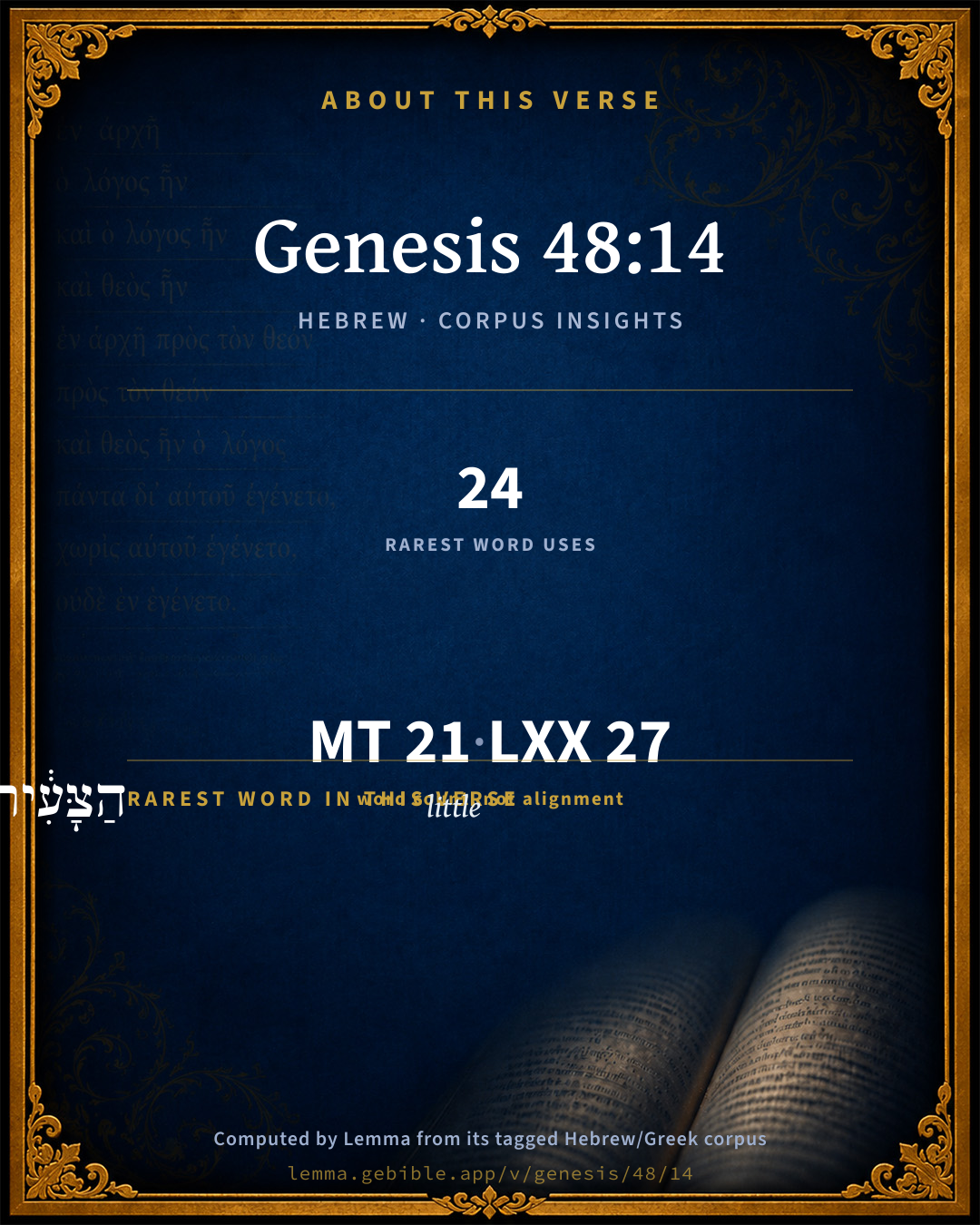
The rarest word here is הַצָּעִ֔יר little H6810 — appearing just 24 times in the whole Hebrew Bible.

Shared distinctive vocabulary

הַצָּעִ֔יר little H6810 occurs in 22 verses of the Hebrew Bible. Also found in:

Grammatical profile

  • 3 verbs
  • 10 nouns
  • 1 adjective
  • 1 pronoun
  • 2 prepositions
  • 1 conjunction
  • 3 particles

Verb forms

  • וַיִּשְׁלַח֩ Qal · Sequential Imperfect
  • וַיָּ֨שֶׁת Qal · Sequential Imperfect
  • שִׂכֵּל֙ Piel · Perfect

Repetition

Words recur within this verse — often emphatic in Hebrew:

  • עַל upon H5921 ×2
  • רֹ֤אשׁ head H7218 ×2
  • מְנַשֶּׁ֑ה Manasseh H4519 ×2

Hebrew & Septuagint length

In English translation the verse runs 32 words from the Hebrew and 33 from the Septuagint (LXX English) — closely comparable.

A rough comparison of the two English renderings, which tokenize alike — not a word-level alignment.

Word counts can differ between the Hebrew and the Greek without any difference in meaning — e.g. the Hebrew direct-object marker אֵת has no separate Greek word, and Greek often adds the article ὁ.

In the original languages it is 21 Hebrew tokens and 27 Greek tokens — but the two are counted differently (Hebrew bundles its prefixes and suffixes into one token; the Greek is in lemma form), so that isn’t a like-for-like length.

Cross-references

20

Topical passages linked to Genesis 48:14 in the Treasury of Scripture Knowledge — connected by theme and wording, ordered by reader-vote popularity; previews shown in the World English Bible.

  • Genesis 41:51 Joseph called the name of the firstborn Manasseh, "For," he said, "God has made me forget all my toil, and all my father's house."
  • Genesis 46:20 To Joseph in the land of Egypt were born Manasseh and Ephraim, whom Asenath, the daughter of Potiphera, priest of On, bore to him.
  • Genesis 48:18 Joseph said to his father, "Not so, my father; for this is the firstborn; put your right hand on his head."
  • Exodus 15:6 Your right hand, Yahweh, is glorious in power, Your right hand, Yahweh, dashes the enemy in pieces.
  • Numbers 8:10 You shall present the Levites before Yahweh. The children of Israel shall lay their hands on the Levites,
  • Numbers 8:18 I have taken the Levites instead of all the firstborn among the children of Israel.
  • Deuteronomy 34:9 Joshua the son of Nun was full of the spirit of wisdom; for Moses had laid his hands on him: and the children of Israel listened to him, and did as Yahweh commanded Moses.
  • Psalms 110:1 Yahweh says to my Lord, "Sit at my right hand, Until I make your enemies your footstool for your feet."
  • Psalms 118:16 The right hand of Yahweh is exalted! The right hand of Yahweh does valiantly!"
  • Matthew 6:5 "When you pray, you shall not be as the hypocrites, for they love to stand and pray in the synagogues and in the corners of the streets, that they may be seen by men. Most assuredly, I tell you, they have received their reward.
  • Matthew 16:18 I also tell you that you are Peter, and on this rock I will build my assembly, and the gates of Hades will not prevail against it.
  • Matthew 19:13 Then little children were brought to him, that he should lay his hands on them and pray; and the disciples rebuked them.
  • Matthew 19:15 He laid his hands on them, and departed from there.
  • Luke 4:40 When the sun was setting, all those who had any sick with various diseases brought them to him; and he laid his hands on every one of them, and healed them.
  • Luke 13:13 He laid his hands on her, and immediately she stood up straight, and glorified God.
  • Acts 6:6 whom they set before the apostles. When they had prayed, they laid their hands on them.
  • Acts 8:17–19 Then they laid their hands on them, and they received the Holy Spirit.
  • Acts 13:3 Then, when they had fasted and prayed and laid their hands on them, they sent them away.
  • 1 Timothy 4:14 Don't neglect the gift that is in you, which was given to you by prophecy, with the laying on of the hands of the elders.
  • 1 Timothy 5:22 Lay hands hastily on no one, neither be a participant in other men's sins. Keep yourself pure.

Cross-references courtesy of OpenBible.info (CC BY 4.0).

Hebrew and Greek witnesses Masoretic Hebrew ↔ Greek Septuagint

The same verse in the two great witnesses to the Old Testament, shown verse-for-verse.

These are two independent witnesses, not word-aligned to each other, and the Septuagint is shown in lemma (dictionary) form.

Hebrew Genesis 48:14 Masoretic · Westminster Leningrad Codex

וַיִּשְׁלַח֩ יִשְׂרָאֵ֨ל אֶת יְמִינ֜וֹ וַיָּ֨שֶׁת עַל רֹ֤אשׁ אֶפְרַ֨יִם֙ וְה֣וּא הַצָּעִ֔יר וְאֶת שְׂמֹאל֖וֹ עַל רֹ֣אשׁ מְנַשֶּׁ֑ה שִׂכֵּל֙ אֶת יָדָ֔יו כִּ֥י מְנַשֶּׁ֖ה הַבְּכֽוֹר

Israel stretched out his right hand, and laid it on Ephraim's head, who was the younger, and his left hand on Manasseh's head, guiding his hands knowingly, for Manasseh was the firstborn.

World English Bible · Public Domain

Greek LXX Genesis 48:14 Septuagint · lemma form

ἐκτείνω δέ ἰσραήλ ὁ χείρ ὁ δεξιός ἐπιβάλλω ἐπί ὁ κεφαλή ἐφράιμ οὗτος δέ εἰμί ὁ νέος καί ὁ ἀριστερός ἐπί ὁ κεφαλή μανασσή ἐναλλάξ ὁ χείρ

But Israel having stretched out his right hand, laid it on the head of Ephraim, and he was the younger; and his left hand on the head of Manasse, guiding his hands crosswise.

LXX2012 (modern English Septuagint) · Public Domain

On this verse, Ellicott's Commentary for English Readers discusses the Septuagint’s reading. Read the note in Commentary ↓

Hebrew: Westminster Leningrad Codex (CC BY 4.0). Greek: Septuagint (public domain); English from LXX2012 (modern English Septuagint) (Public Domain). How the Septuagint differs from the Hebrew →

Targum (Aramaic paraphrase)

2

The Targum is the ancient Jewish Aramaic paraphrase of the Hebrew Scriptures — an interpretive translation, not the Hebrew text itself. Onkelos (literal) and Pseudo-Jonathan (expansive) render the Torah, and Jonathan the Prophets. Coverage is partial: where no permissively-licensed English translation exists for a verse, only the Aramaic is shown. This is verse-level text, not a word-by-word alignment to the Hebrew.

  1. Targum Onkelos Torah (Genesis–Deuteronomy)
    וְאוֹשִׁיט יִשְׂרָאֵל יָת יְמִינֵהּ וְשַׁוִּי עַל רֵישָׁא דְאֶפְרַיִם וְהוּא זְעֵירָא וְיָת שְׂמָאלֵהּ עַל רֵישָׁא דִּמְנַשֶּׁה אַחְכִּמִינּוּן לִידוֹהִי אֲרֵי מְנַשֶּׁה בּוּכְרָא

    (no public-domain English translation for this verse)

    Targum Onkelos — Aramaic: “Onkelos Genesis” (public domain); “Onkelos Exodus” (public domain); “Onkelos Leviticus” (public domain); “Onkelos Numbers” (public domain); “Onkelos Deuteronomy” (public domain). English: “Sefaria Community Translation” (CC0 1.0 (public-domain dedication)); “J.W. Etheridge. The Targums of Onkelos and Jonathan Ben Uzziel on the Pentateuch. London: Longmans, Green, 1862” (public domain). Text via Sefaria.

  2. Targum Pseudo-Jonathan Torah (Genesis–Deuteronomy)
    וְאוֹשִׁיט יִשְרָאֵל יַת יְמִינֵיהּ וְשַׁוִי עַל רֵישָׁא דְאֶפְרַיִם וְהוּא זְעֵירָא וְיַת שְמָאלֵיהּ עַל רֵישָׁא דִמְנַשֶׁה פְּרַג יַת יְדוֹי אֲרוּם מְנַשֶׁה בּוּכְרָא

    And Israel stretched out his right hand and laid it upon the head of Ephraim, though he was the younger; and his left hand upon the head of Menasheh, altering his hands, for Menasheh was the firstborn.

    Targum Pseudo-Jonathan — Aramaic: “Targum Jonathan on Genesis” (public domain); “Targum Jonathan on Exodus” (public domain); “Targum Jonathan on Leviticus” (public domain); “Targum Jonathan on Numbers” (public domain); “Targum Jonathan on Deuteronomy” (public domain). English: “The Targum of Jonathan ben Uzziel, trans. J. W. Etheridge, London, 1862” (public domain). Text via Sefaria.

Commentary

Notes on Genesis 48:14 from classic Christian and Jewish commentators (each source and its license shown beneath its notes). The classic Christian expositions comment on the surrounding passage and are grouped to its opening verse, so a note may address several verses; the Jewish commentaries on the Tanakh (Rashi and others) are per-verse, so they appear only where the commentator wrote on this verse.

Lemma curates 59 commentaries, every one of them public domain or Creative Commons licensed, each selected and text-cleaned for this edition rather than reprinted as found. About our sources →

Trapp's Complete Commentary

John Trapp

Gen 48:14 And Israel stretched out his right hand, and laid [it] upon Ephraim’s head, who [was] the younger, and his left hand upon Manasseh’s head, guiding his hands wittingly; for Manasseh [was] the firstborn.

Ver. 14. Guiding his hands wittingly.] Cognoscebat palpando manibus suis, saith Junius: Intelligere fecit manus, saith Patens. An emphatical metaphor; as if he should say, Jacob with his eyes could not distinguish them, but his hands shall therefore do the office of his eyes. Bartolus {a} writes of Dr Gabriel Nele, that by the motion of the lips only, without any utterance, he understood all men; perceived and read in every man’s countenance what was his conceit. But that is far more credible, and no less admirable, that Jerome reports of Didymus of Alexandria; that though he had been blind of a little child, yet he was excellently skilled in all the liberal arts, and had written Commentaries upon the Psalms and Gospels, being at this time, saith he, eighty-three years of age. {b}

{a} Bartol., lib. i., De Ver. Oblig.

{b} Jerome, in Catalogo Virorum Illustrium.

John Trapp, A Commentary or Exposition upon All the Books of the Old and New Testament (1647–1656) — public domain. Text from a community e-Sword module.

Tyndale Open Study Notes

Tyndale Open Resources

48:14 The right hand was for the head of the firstborn, and Jacob was deliberately giving that position to the younger son. That pattern was followed for four consecutive generations: Isaac over Ishmael, Jacob over Esau, Joseph over Reuben, and Ephraim over Manasseh. Many years later, Ephraim became the leading tribe in the northern kingdom, superior to the tribe of Manasseh. The entire northern kingdom of Israel was occasionally called Ephraim (see study notes on 2 Chr 28:12; Isa 11:13; Ezek 37:15-28; Hos 6:4; Zech 9:10).

Tyndale Open Study Notes — © Tyndale Open Resources, licensed CC BY-SA 4.0. Text via the HelloAO Bible API.

Geneva Bible (1599)

Geneva Bible translators

God’s judgments is oft times contrary to man’s, and he preferreth that, which man despiseth.

Geneva Bible (1599) marginal notes — public domain. Text via Bolls.life.

Adam Clarke's Commentary

Verse 14. Israel stretched out his right hand, c.] Laying hands on the head was always used among the Jews in giving blessings, designating men to any office, and in the consecration of solemn sacrifices. This is the first time we find it mentioned but we often read of it afterwards. See Nu 27:18, Nu 27:23; De 34:9; Mt 19:13, Mt 19:15; Ac 6:6; 1Ti 4:14. Jacob laid his right hand on the head of the younger, which we are told he did wittingly - well knowing what he was about, for (or although) Manasseh was the first-born, knowing by the Spirit of prophecy that Ephraim's posterity would be more powerful than that of Manasseh. It is observable how God from the beginning has preferred the younger to the elder, as Abel before Cain; Shem before Japheth; Isaac before Ishmael; Jacob before Esau; Judah and Joseph before Reuben; Ephraim before Manasseh; Moses before Aaron; and David before his brethren. "This is to be resolved entirely into the wise and secret counsel of God, so far as it regards temporal blessings and national privileges, as the apostle tells us, Ro 9:11; See Clarke on Ge 25:23. But this preference has no concern with God's conferring a greater measure of his love and approbation on one person more than another; compare Ge 4:7, with Heb 11:4, and you will see that a difference in moral character was the sole cause why God preferred Abel to Cain." - Dodd. The grace that converts the soul certainly comes from the mere mercy of God, without any merit on man's part; and a sufficiency of this is offered to every man, Tit 2:11-12. But it is not less certain that God loves those best who are most faithful to this grace.

Adam Clarke's Commentary on the Bible (1810–1826) — public domain. Text from a community e-Sword/MySword module.

John Calvin's Commentaries

14. And Israel stretched out his right hand. Seeing his eyes were dim with age, so that he could not, by looking, discern which was the elder, he yet intentionally placed his hands across. And therefore Moses says that he guided his hands wittingly, because he did not rashly put them forth, nor transfer them from one youth to the other for the sake of feeling them: but using judgment, he purposely directed his right hand to Ephraim who was the younger: but placed his left hand on the first-born. Whence we gather that the Holy Spirit was the director of this act, who irradiated the mind of the holy man, and caused him to see more correctly, than those who were the most clear-sighted, into the nature of this symbolical act. I shall avoid saying more, because we shall be able to inquire into it from other passages.

John Calvin's Commentaries (1540-1563) — public domain. Text from the Calvin Translation Society English edition (1840s-50s) via the Christian Classics Ethereal Library (ccel.org). Calvin's coverage is partial (roughly two-thirds of the Bible); uncommented books and verses are honest gaps, never fabricated. The 19th-century editor's footnotes and remarks are omitted so the notes are faithfully Calvin's own voice.

Ellicott's Commentary for English Readers

(14) Guiding his hands wittingly.—The LXX., Syriac, and Vulg. translate, “placing his hands crosswise;” but the Targum of Onkelos favours the translation of our version. There is some amount of philological support for the rendering of the three chief versions; but it must mainly rest upon their own authority, which is, however, very great.

A Bible Commentary for English Readers, edited by Charles John Ellicott (1878–1897) — public domain. Text from a community e-Sword module.

The Cambridge Bible for Schools and Colleges

gen. ed. J. J. S. Perowne

14. guiding his hands wittingly] Better, as R.V. marg., crossing his hands. So LXX ἐναλλὰξ τὰς χεῖρας = “the hands crosswise”; Lat. commutans manus.

The aged Jacob is moved by a supernatural impulse to cross his hands as he blesses the two boys; and their destinies are determined accordingly.

The Cambridge Bible for Schools and Colleges (gen. ed. J. J. S. Perowne; Cambridge University Press, 1878–1918) — public domain. Text from a community e-Sword module.

John Gill's Exposition

And Israel stretched out his right hand,.... Not directly forward, but across, or otherwise it would have been laid on Manasseh, as Joseph designed it should by the position he placed him in:

and laid it upon Ephraim's head, who was the younger, the right hand being the strongest and most in use, as it was reckoned most honourable to sit at it, so to have it imposed, as being significative of the greater blessing:

and his left hand upon Manasseh's head; who was the older:

guiding his hands wittingly; this was not done accidentally, but on purpose: or made his "hands to understand" (q), they acted as if they understood what he would have done, as Aben Ezra; as if they were conscious of what should be, or would be; though he could not see clearly and distinctly, yet he knew, by the position of them before him, which was the elder and which was the younger: he knew that Joseph would set the firstborn in such a position before him as naturally to put his right hand on him, and the younger in such a position as that it would be readiest for him to put his left hand on him; and therefore, being under a divine impulse and spirit of prophecy, by which he discerned that the younger was to have the greater blessing, he crossed his bands, or changed them, and put his right hand on Ephraim, and his left hand on Manasseh:

for Manasseh was the firstborn; or rather, though (r) he was the firstborn, as Aben Ezra.

(q) "intelligere fecit suas manus", Paguinus, Montanus, Vatablus, Drusius, Cartwright. (r) "tametsi", Tigurine version; "quamvis", Piscator; so some in Fagius.

John Gill's Exposition of the Whole Bible (1746–1763) — public domain (CC PDM 1.0). Text via the HelloAO Bible API.

Haydock's Catholic Bible Commentary

Changing. Hebrew, "making his hands intelligent;" or giving to understand, by forming a cross with his extended hands, that he had some particular reason for so doing. (Haydock) --- By the preference given to Ephraim, he forshewed his royal dignity, in giving kings to the ten tribes, (Eusebius) and that his tribe would surpass that of his brother in glory and numbers; (ver. 19,) and lastly, give birth to that great leader, Josue; who, as a figure of Christ, should introduce the Israelites into the promised land. (Menochius) --- The custom of imposing hands on a person, is of high antiquity, and is still practiced in the Christian church in the ordination of her ministers. (Numbers viii. 10; Acts vi. 6.) See Matthew xix. 13; Numbers xxvii. 23. (Calmet) --- The cross of Christ is the source of all our exaltation. A preference for the younger children is generally observable in Scripture; being intended to shew that the Church, though chosen later out of all nations, should obtain the preference over the synagogue. (Theodoret) (Tirinus)

George Leo Haydock (1774–1849), Haydock's Catholic Family Bible and Commentary, 1859 edition — public domain. Excludes Psalms (Douay-Rheims chapter numbering differs from Protestant) and Deuterocanonical books (Catholic canon only).

Matthew Poole's English Annotations

The

right hand was more honourable both in Scripture account, and amongst the Gentiles.

Laid it upon Ephraim’s head; which was a rite used often, and in divers cases, as in the conferring of offices either sacred or civil, as Num 8:10; Deu 34:9; Act 6:6; 13:3; and among other things, in giving benedictions, as Mat 19:13.

Guiding his hands wittingly; this proceeded not from chance, or the mistake and weakness of his eyes, but from design, and the wisdom of his hands. Heb. He disposed his hands prudently, or, he dealt wisely with his hands. Here was a double wisdom showed.

1. Human, by which he gathered that Manasseh was the eldest, because Joseph placed him towards his right hand.

2. Divine and prophetical, by which he foresaw Ephraim’s advantage above Manasseh, and wisely suited the ceremony to the substance, giving the greater sign of honour to him, to whom God designed the thing.

Matthew Poole's English Annotations on the Holy Bible (1683–1685) — public domain. Text from a community e-Sword/MySword module.

Whedon's Commentary on the Bible

Daniel D. Whedon

14. Guiding his hands wittingly — Literally, he made wise his hands. “Instructing his hands,” says the Targum Onk.; his hands acted as if wise, and crossed each other, to symbolically express the prophetic preference of Ephraim to Manasseh. “The sacred writer minutely details this wonderful manifestation of inspired prescience. By events like this were the chosen people incessantly indoctrinated in the great truths of the divine foreknowledge and supervision of all human plans, while at the same time human and secondary causes are never ignored.” — Newhall.

Daniel D. Whedon (gen. ed.), Commentary on the Old and New Testaments (1874–1909) — public domain. Text from a community e-Sword module.

The Pulpit Commentary

And Israel stretched out his right hand, and laid it upon Ephraim"s head, the first instance of the imposition of hands being used as a symbol of blessing. Though not necessarily connected with the form of benediction, it is not without a natural fitness to suggest the transmission of spiritual benefit. Accordingly it afterwards became the recognized mode of conveying to another some supernatural power or gift, and was employed in the Old Testament Church in the dedication of priests (Num_27:18, Num_27:23; Deu_34:9) and in the New in the ordination of Christian office-bearers (Act_6:6 Act_8:17; 2Ti_1:6) as well as by the Savior and his apostles in the performance of many of their miracles (Mat_19:13; Mar_8:23, Act_9:17 Act_19:6 Act_28:8) who was the younger (literally, and he the little one, i.e. the younger), and his left hand upon Manasseh"s head, guiding his hands wittingly; literally, he placed his hands, prudently, i.e. of set purpose, the piel of lkc; to look at, conveying the intensive signification of acting with prudence and deliberation (Gesenius, Furst); intelligere fecit manus suas hoc est, docte, scite, et petite imposuit eis manus (Vatablus, vide Glass. "Phil Tract.," p. 761); a rendering of the words which has been adopted by the best scholars (Calvin, Dathe, Rosenm Keil, Kalisch, Murphy, Taylor Lewis, and others), though the translation, he crossed his hands," which regards lKeci as the pile of an unused root signifying to intertwine, ejnallax tav ceirav (LXX), commutans marius (Vulgate), is not entirely destitute of learned supporters (Targums of Jonathan and Jerusalem, Pererius, Knobel, Delitzsch, Gerlach, and others)for Manasseh was the firstborn.

The Pulpit Commentary (1880–1919), ed. H.D.M. Spence-Jones & Joseph S. Exell — public domain. Text from a community e-Sword module.

Keil & Delitzsch

C. F. Keil & F. Delitzsch

The patriarch then stretched out his right hand and laid it upon Ephraim's head, and placed his left upon the head of Manasseh (crossing his arms therefore), to bless Joseph in his sons. "Guiding his hands wittingly;" i.e., he placed his hands in this manner intentionally. Laying on the hand, which is mentioned here for the first time in the Scriptures, was a symbolical sign, by which the person acting transferred to another a spiritual good, a supersensual power or gift; it occurs elsewhere in connection with dedication to an office (Num 27:18, Num 27:23; Deu 34:9; Mat 19:13; Act 6:6; Act 8:17, etc.), with the sacrifices, and with the cures performed by Christ and the apostles. By the imposition of hands, Jacob transferred to Joseph in his sons the blessing which he implored for them from his own and his father's God: "The God (Ha-Elohim) before whom my fathers Abraham and Isaac did walk, the God (Ha-Elohim) who hath fed me (led and provided for me with a shepherd's faithfulness, Psa 23:1; Psa 28:9) from my existence up to this day, the Angel which redeemed me from all evil, bless the lads." This triple reference to God, in which the Angel who is placed on an equality with Ha-Elohim cannot possibly be a created angel, but must be the "Angel of God," i.e., God manifested in the form of the Angel of Jehovah, or the "Angel of His face" (Isa 43:9), contains a foreshadowing of the Trinity, though only God and the Angel are distinguished, not three persons of the divine nature. The God before whom Abraham and Isaac walked, had proved Himself to Jacob to be "the God which fed" and "the Angel which redeemed," i.e., according to the more fully developed revelation of the New Testament, ὁ Θεός and ὁ λόγος, Shepherd and Redeemer. By the singular יברך (bless, benedicat) the triple mention of God is resolved into the unity of the divine nature. Non dicit (Jakob) benedicant, pluraliter, nec repetit sed conjungit in uno opere benedicendi tres personas, Deum Patrem, Deum pastorem et Angelum. Sunt igitur hi tres unus Deus et unus benedictor. Idem opus facit Angelus quod pastor et Deus Patrum (Luther). "Let my name be named on them, and the names of my fathers Abraham and Isaac," i.e., not, "they shall bear my name and my fathers'," "dicantur filii mei et patrum meorum, licet ex te nati sint" (Rosenm.), which would only be another way of acknowledging his adoption of them, "nota adoptionis" (Calvin); for as the simple mention of adoption is unsuitable to such a blessing, so the words appended, "and according to the name of my fathers Abraham and Isaac," are still less suitable as a periphrasis for adoption. The thought is rather: the true nature of the patriarchs shall be discerned and acknowledged in Ephraim and Manasseh; in them shall those blessings of grace and salvation be renewed, which Jacob and his fathers Isaac and Abraham received from God. The name expressed the nature, and "being called" is equivalent to "being, and being recognised by what one is." The salvation promised to the patriarchs related primarily to the multiplication into a great nation, and the possession of Canaan. Hence Jacob proceeds: "and let them increase into a multitude in the midst of the land." דּגה: ἁπ λεγ, "to increase," from which the name דּג, a fish, is derived, on account of the remarkable rapidity with which they multiply.

Keil & Delitzsch — Biblical Commentary on the Old Testament (1861–1891) — public domain (CC PDM 1.0). Text via the HelloAO Bible API. (Old Testament only.)

unfoldingWord translationNotes

Door43 World Missions Community

his right hand and laid it upon Ephraim's head

Placing the right hand on Ephraim's head was the sign that he would receive the greater blessing. (See: Symbolic Action)

Israel blessed Joseph

Here "Joseph" also stands for Ephraim and Manasseh. Since Joseph is the father, he is the only one mentioned here. (See: Synecdoche)

The God before whom my fathers Abraham and Isaac walked

Serving God is spoken of as if it were walking before God. AT: "The God who my grandfather Abraham and father Isaac served" (See: Metaphor)

who has cared for me

God has taken care of Israel like a shepherd takes care of his sheep. AT: "who has cared for me like a shepherd cares for his animals" (See: Assumed Knowledge and Implicit Information)

the angel

Possible meanings are 1) this refers to the angel that God sent to protect Jacob or 2) this refers to God who appeared in angel form to protect Jacob.

protected me

"delivered me"

May my name be named in them, and the name of my fathers Abraham and Isaac

Here "name" stands for the person. The phrase "my name be named in them" is an idiom that means a person is remembered because of another person. This can be stated in active form. AT: "May people remember Abraham, Isaac, and me because of Ephraim and Manasseh" (See: Metonymy and Idiom and Active or Passive)

May they grow into a multitude on the earth

Here "they" refers to Ephraim and Manasseh, but it stands for their descendants. AT: "May they have many descendants who will live all over the earth" (See: Metonymy)

translationWords

Jacob

right hand

Ephraim

Manasseh

firstborn

bless

God

ancestor

Abraham

Isaac

walk

angel

name

unfoldingWord translationNotes — © Distant Shores Media and the Door43 World Missions Community, licensed CC BY-SA 4.0. Source: git.door43.org/Door43/en_tn.

Rashi

Rabbi Shlomo Yitzchaki (Rashi)

שכל את ידיו PLACING HIS HANDS DESIGNEDLY — Understand this as the Targum renders it: אחכמינון he put wisdom into them (viz., into his hands), meaning designedly and wisely he moved his hands for this purpose, intelligently and with full knowledge, for he knew that Manasseh was the first-born and yet he did not place his right hand upon him.

Rashi on the Tanakh — English translations: “The Judaica Press complete Tanach with Rashi, translated by A. J. Rosenberg” (CC BY 4.0); “Pentateuch with Rashi's commentary by M. Rosenbaum and A.M. Silbermann, 1929-1934” (public domain); “The Metsudah Tanach series, Lakewood, N.J” (CC BY 4.0); and “The Book of Joshua, Metsudah Publications, 1997” (CC BY 4.0). Text via Sefaria.

Radak

Rabbi David Kimhi (Radak)

שכל את ידיו, he conferred intelligence to his hands, so that they appeared to act intelligently on their own, seeing that Menashe was the firstborn and Yaakov saw with prophetic vision that he would be the “smaller one,” in the sense that his future would reflect less blessing than the future of his younger brother. Had he placed his right hand on Menashe, what intelligence would this have demonstrated? [the author surely means that the Torah does not have to speak about an act of special intelligence being required to put one’s right hand on the older of the two sons. Ed.]

Radak on the Tanakh — English translations: “Sefaria Community Translation” (CC0 1.0 (public-domain dedication)); “Eliyahu Munk, HaChut Hameshulash” (CC BY 4.0); “Rabbi Mike Feuer, Jerusalem Anthology” (CC BY 4.0); and “R. David Kimhi on the first book of Psalms, Translated by R.G. Finch, London, 1919” (public domain). Text via Sefaria.

Lesson kit

Teaching starters — assembled from the data on this page, not authored interpretation. Every prompt links to the verse data it draws on. Edit before teaching.

Genesis, in the Pentateuch, opens this verse with 21 words (16 distinct Hebrew lemmas). Its most distinctive word is tsâʻîyr (“little”). A historical commentator’s framing appears above. Read the whole chapter for the surrounding context.

Discussion questions

  1. What does “little” (tsâʻîyr) contribute to the verse as a whole?
  2. How does Genesis 19:31, which shares the word «little», read alongside this verse?
  3. What does the repetition of “upon” (2× in this one verse) do in this verse?
  4. The translations on this page render this verse differently — a whole-verse word diff, not a word-by-word alignment. What might account for the different wordings?
  5. «וַיִּשְׁלַח֩» is a Qal Sequential Imperfect verb. How does that grammatical form shape the action described?
  6. Compare how Trapp's Complete Commentary and Tyndale Open Study Notes read this verse. Where do they agree or differ?

Things to notice

Reading settings

Reading text

Shown beneath each verse's original-language words.

Old Testament
Old Testament edition

Read the OT as the Masoretic Hebrew (MT) or the Greek Septuagint (LXX).

English shown for the Greek Septuagint (in the Hebrew ↔ Greek comparison).

Comparing translations? Open the Compare panel on any verse page to stack up to four side by side.