Jeremiah 7:15

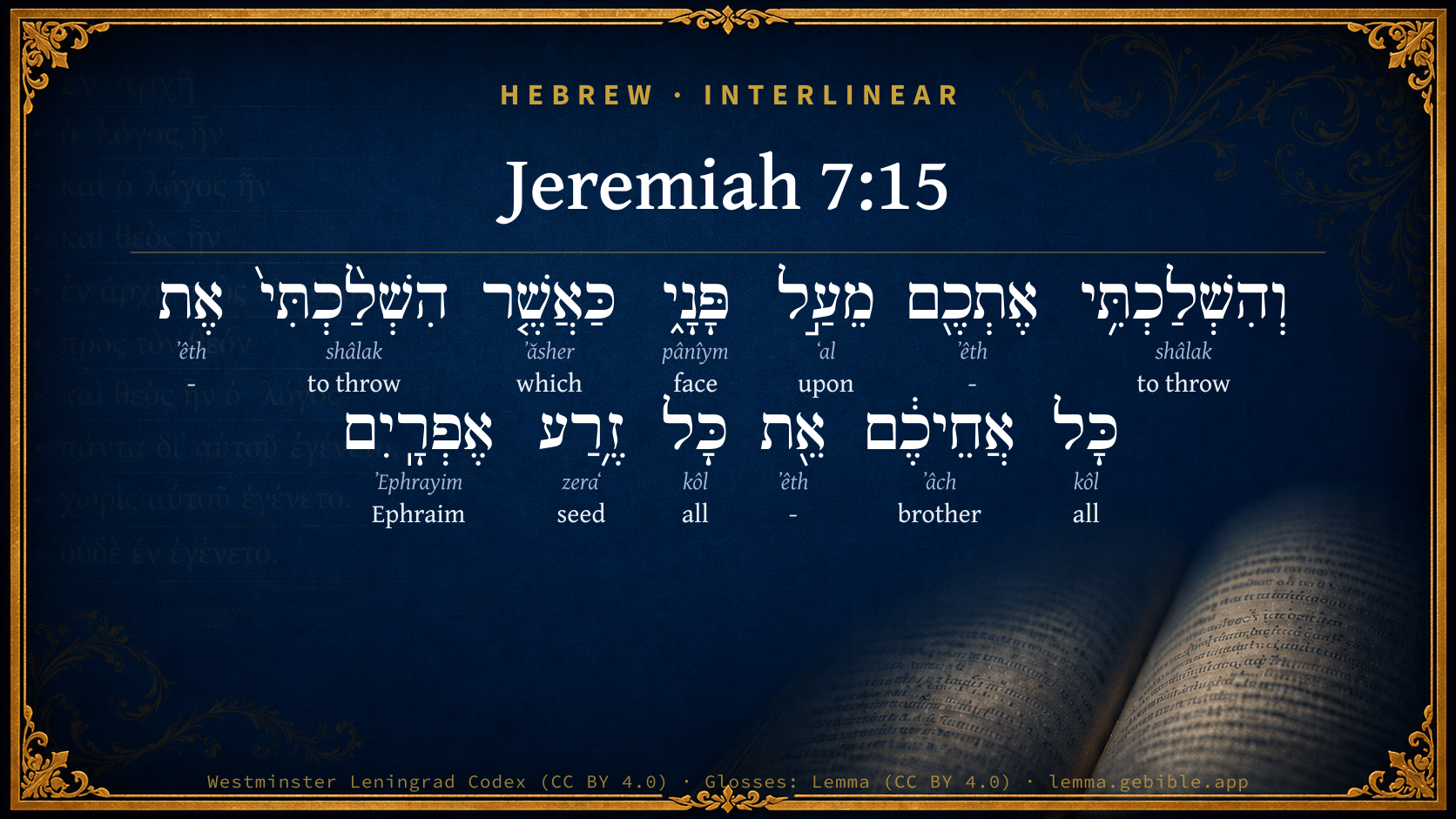
Hebrew (Westminster Leningrad Codex) Jeremiah 7:15 appears in the Hebrew Old Testament. The text above is from the Westminster Leningrad Codex. Each word links to its Strong’s number, a concise gloss, and parsing drawn from the Open Scriptures Hebrew Bible morphology. Click any word for its full Brown-Driver-Briggs (BDB) entry.
Download image
Cite this verse

Jeremiah 7:15 (World English Bible). Public Domain. Lemma interlinear Bible study tool, https://lemma.gebible.app/v/jeremiah/7/15.

Show BibTeX & RIS
BibTeX
RIS
English Translation
I will cast you out of my sight, as I have cast out all your brothers, even the whole seed of Ephraim.
World English Bible · Public Domain
Download a study sheet

One document with this verse’s original text, its word-by-word gloss line, the meaning frame, cross-references with their text, attributed commentary, and full source and license credits — printable, and it pastes into notes with its structure intact.

This verse Autodidact and up

Study sheet (.html) Plain text (.txt)

A passage Seminary Student

Up to 50 verses in one chapter. A passage sheet keeps up to 6 commentary sources and 12 cross-references per verse, in the order this page ranks them, and says so on the sheet whenever that leaves anything out. Ask for a single verse and you get the Autodidact verse sheet above.

Everything on this page stays free to read, with no account — the sheet is a download of what is already on screen, not access to it.

Want to remove ads? Support Godless Engineer
Compare translations 3

The same verse in 3 English versions, stacked beneath the original-language interlinear above. Click any original word for its lexicon entry.

Each is an independent rendering of the whole verse — the interlinear is not word-aligned to these translations.

Highlighted words mark where these versions differ — a whole-verse word diff, not a word-by-word alignment.

  • World English Bible Public Domain
    I will cast you out of my sight, as I have cast out all your brothers, even the whole seed of Ephraim.
  • King James Version Public Domain
    And I will cast you out of my sight, as I have cast out all your brethren, even the whole seed of Ephraim.
  • unfoldingWord Literal Text CC BY-SA 4.0
    And I shall cast you out from my face just as I have cast out all your brothers, all the seed of Ephraim.’

unfoldingWord Literal Text — © unfoldingWord, licensed CC BY-SA 4.0. Word-aligned USFM3 via Door43 (git.door43.org/unfoldingWord/en_ult).

Versions to compare (up to 4)

3 of 4 selected

Show all 18 translations

Every available English version of this verse, each an independent rendering of the whole verse.

  • World English Bible Public Domain
    I will cast you out of my sight, as I have cast out all your brothers, even the whole seed of Ephraim.
  • Berean Standard Bible Public Domain
    And I will cast you out of My presence, just as I have cast out all your brothers, all the descendants of Ephraim.
  • Majority Standard Bible Public Domain
    And I will cast you out of My presence, just as I have cast out all your brothers, all the descendants of Ephraim.
  • King James Version Public Domain
    And I will cast you out of my sight, as I have cast out all your brethren, even the whole seed of Ephraim.
  • American Standard Version (1901) Public Domain
    And I will cast you out of my sight, as I have cast out all your brethren, even the whole seed of Ephraim.
  • Revised Version (1885) Public Domain
    And I will cast you out of my sight, as I have cast out all your brethren, even the whole seed of Ephraim.
  • Geneva Bible (1599) Public Domain
    And I will cast you out of my sight, as I haue cast out all your brethren, euen the whole seede of Ephraim.
  • Douay-Rheims (1899) Public Domain
    And I will cast you away from before my face, as I have cast away all your brethren, the whole seed of Ephraim.
  • Young's Literal Translation Public Domain
    And I have cast you from before My face, As I have cast out all your brethren, The whole seed of Ephraim.
  • Literal Standard Version CC BY-SA 4.0
    And I have cast you from before My face, || As I have cast out all your brothers, || The whole seed of Ephraim.
  • Unlocked Literal Bible CC BY-SA 4.0
    For I will send you out from before me just as I had sent out all your brothers, all the descendants of Ephraim.'
  • unfoldingWord Literal Text CC BY-SA 4.0
    And I shall cast you out from my face just as I have cast out all your brothers, all the seed of Ephraim.’
  • Darby Bible Public Domain
    and I will cast you out of my sight, as I have cast out all your brethren, all the seed of Ephraim.
  • World Messianic Bible Public Domain
    I will cast you out of my sight, as I have cast out all your brothers, even the whole offspring of Ephraim.
  • Webster's Bible Public Domain
    And I will cast you out of my sight, as I have cast out all your brethren, even the whole seed of Ephraim.
  • Free Bible Version CC BY-SA 4.0
    I will throw you out of my presence, just as I expelled all your Israelite relatives, all the descendants of Ephraim.
  • Bible in Basic English Public Domain
    And I will send you away from before my face, as I have sent away all your brothers, even all the seed of Ephraim.
  • JPS Tanakh (1917) Public Domain
    And I will cast you out of My sight, as I have cast out all your brethren, even the whole seed of Ephraim.

Literal Standard Version (2020), Covenant Press — licensed CC BY-SA 4.0. Text via the HelloAO Bible API (eBible.org). Unlocked Literal Bible (unfoldingWord) — licensed CC BY-SA 4.0. Text via the HelloAO Bible API (eBible.org). unfoldingWord Literal Text — © unfoldingWord, licensed CC BY-SA 4.0. Word-aligned USFM3 via Door43 (git.door43.org/unfoldingWord/en_ult). Free Bible Version, Dr. Jonathan Gallagher — licensed CC BY-SA 4.0. Text via the HelloAO Bible API (eBible.org).

Word by word

More ways to search: Search by grammar → Find every occurrence → Compare this word →

Practice this passage: Drill this verse → Learn its vocabulary →

וְהִשְׁלַכְתִּ֥י
shâlak
H7993
“and · to throw”
Conjunction + Verb, Hiphil, Sequential Perfect, 1st Person, Common, Singular
Part of Speech
Conjunction + Verb
Stem
Hiphil
Form
Sequential Perfect
Person
1st Person
Gender
Common
Number
Singular
Full BDB Definition

Origin: a primitive root

TWOT: 2398

to throw, cast, hurl, fling - (Hiphil) - to throw, cast, throw away, cast off, shed, cast down - to cast (lots) (figuratively) - (Hophal) - to be thrown, be cast - to be cast forth or out - to be cast down - to be cast (metaphorically)
  1. אֶתְכֶ֖ם ʼêth H853 “- · you” Particle, Direct Object + Suffix, Personal, 2nd Person, Masculine, Plural
  2. מֵעַ֣ל ʻal H5921 “from · upon” Preposition + Preposition
  3. פָּנָ֑י pânîym H6440 “face(s) · my” Noun, Common, Both, Plural, Construct + Suffix, Personal, 1st Person, Common, Singular
  4. כַּאֲשֶׁ֤ר ʼăsher H834 “like/as · which” Preposition + Particle, Relative
  5. הִשְׁלַ֨כְתִּי֙ shâlak H7993 “to throw” Verb, Hiphil, Perfect, 1st Person, Common, Singular
  6. אֶת ʼêth H853 “-” Particle, Direct Object
  7. כָּל kôl H3605 “all of” Noun, Common, Masculine, Singular, Construct
  8. אֲחֵיכֶ֔ם ʼâch H251 “brothers · your” Noun, Common, Masculine, Plural, Construct + Suffix, Personal, 2nd Person, Masculine, Plural
  9. אֵ֖ת ʼêth H853 “-” Particle, Direct Object
  10. כָּל kôl H3605 “all of” Noun, Common, Masculine, Singular, Construct
  11. זֶ֥רַע zeraʻ H2233 “seed of” Noun, Common, Masculine, Singular, Construct
  12. אֶפְרָֽיִם ʼEphrayim H669 “Ephraim” Noun, Proper

About this verse

These counts appear in no published source. They are computed here, from the morphology-tagged text and Lemma’s own curated glosses. What Lemma adds →

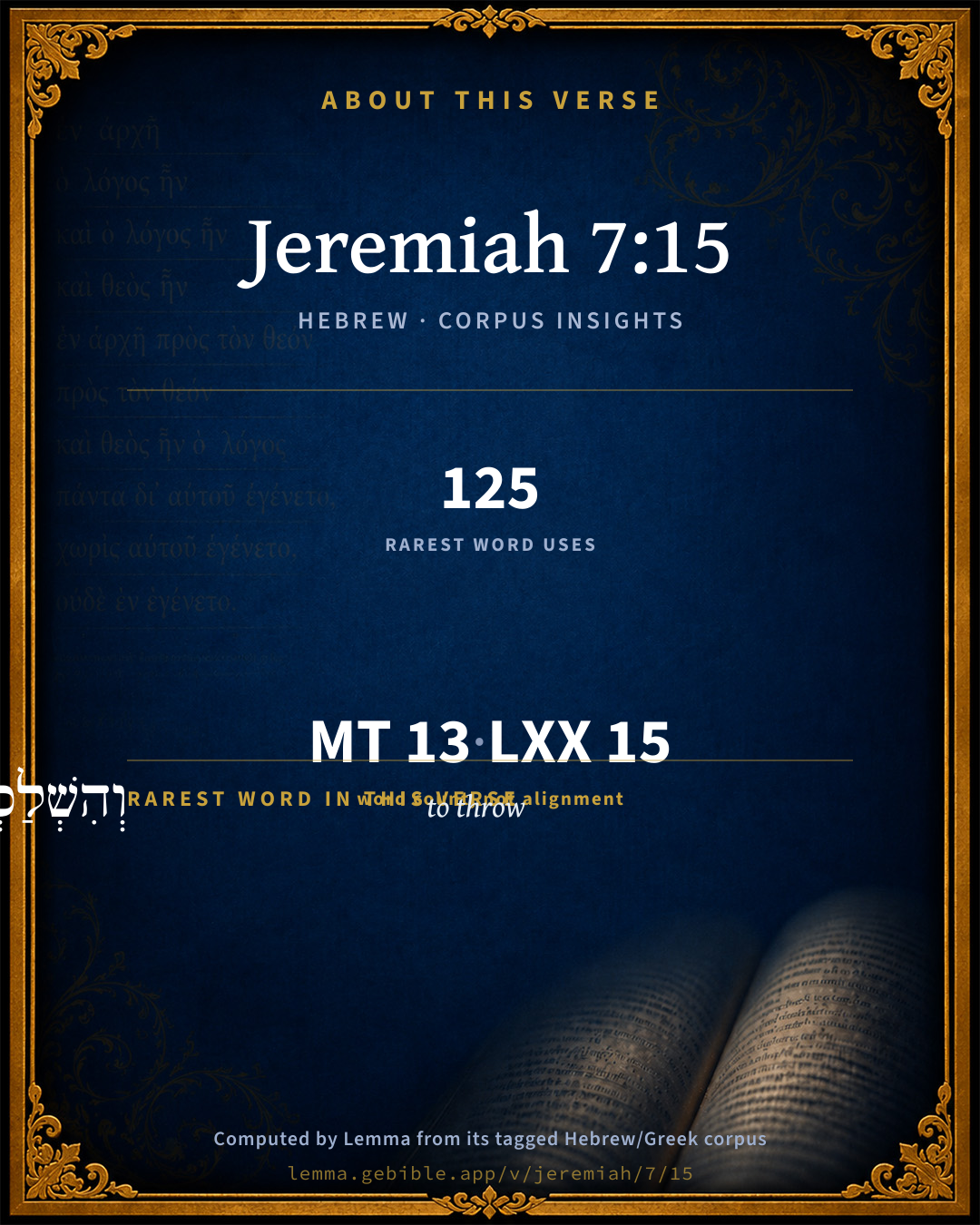
13
words
9
distinct lemmas
Prophets
section

Grammatical profile

  • 2 verbs
  • 6 nouns
  • 1 preposition
  • 4 particles

Verb forms

  • וְהִשְׁלַכְתִּ֥י Hiphil · Sequential Perfect
  • הִשְׁלַ֨כְתִּי֙ Hiphil · Perfect

Repetition

Words recur within this verse — often emphatic in Hebrew:

  • וְהִשְׁלַכְתִּ֥י to throw H7993 ×2
  • כָּל all H3605 ×2

Hebrew & Septuagint length

In the original languages it is 13 Hebrew tokens and 15 Greek tokens — but the two are counted differently (Hebrew bundles its prefixes and suffixes into one token; the Greek is in lemma form), so that isn’t a like-for-like length.

Cross-references

15

Topical passages linked to Jeremiah 7:15 in the Treasury of Scripture Knowledge — connected by theme and wording, ordered by reader-vote popularity; previews shown in the World English Bible.

  • Jeremiah 15:1 Then said Yahweh to me, Though Moses and Samuel stood before me, yet my mind would not be toward this people: cast them out of my sight, and let them go forth.
  • 2 Kings 17:23 until Yahweh removed Israel out of his sight, as he spoke by all his servants the prophets. So Israel was carried away out of their own land to Assyria to this day.
  • Jeremiah 52:3 For through the anger of Yahweh did it happen in Jerusalem and Judah, until he had cast them out from his presence. Zedekiah rebelled against the king of Babylon.
  • Hosea 9:16–17 Ephraim is struck. Their root has dried up. They will bear no fruit. Even though they bring forth, yet I will kill the beloved ones of their womb."
  • Hosea 13:16 Samaria will bear her guilt; For she has rebelled against her God. They will fall by the sword. Their infants will be dashed in pieces, And their pregnant women will be ripped open."
  • 2 Kings 17:18–20 Therefore Yahweh was very angry with Israel, and removed them out of his sight: there was none left but the tribe of Judah only.
  • 2 Kings 24:20 For through the anger of Yahweh did it happen in Jerusalem and Judah, until he had cast them out from his presence. Zedekiah rebelled against the king of Babylon.
  • 2 Chronicles 15:9 He gathered all Judah and Benjamin, and those who sojourned with them out of Ephraim and Manasseh, and out of Simeon: for they fell to him out of Israel in abundance, when they saw that Yahweh his God was with him.
  • Psalms 78:67–68 Moreover he rejected the tent of Joseph, And didn't choose the tribe of Ephraim,
  • Jeremiah 3:8 I saw, when, for this very cause that backsliding Israel had committed adultery, I had put her away and given her a bill of divorce, yet treacherous Judah, her sister, didn't fear; but she also went and played the prostitute.
  • Jeremiah 23:39 therefore, behold, I will utterly forget you, and I will cast you off, and the city that I gave to you and to your fathers, away from my presence:
  • Hosea 1:4 Yahweh said to him, "Call his name Jezreel; for yet a little while, and I will avenge the blood of Jezreel on the house of Jehu, and will cause the kingdom of the house of Israel to cease.
  • Hosea 9:3 They won't dwell in Yahweh's land; But Ephraim will return to Egypt, And they will eat unclean food in Assyria.
  • Hosea 9:9 They have deeply corrupted themselves, As in the days of Gibeah. He will remember their iniquity. He will punish them for their sins.
  • Hosea 12:1 Ephraim feeds on wind, And chases the east wind. He continually multiplies lies and desolation. They make a covenant with Assyria, And oil is carried into Egypt.

Cross-references courtesy of OpenBible.info (CC BY 4.0).

Hebrew and Greek witnesses Masoretic Hebrew ↔ Greek Septuagint

The same verse in the two great witnesses to the Old Testament, shown verse-for-verse.

These are two independent witnesses, not word-aligned to each other, and the Septuagint is shown in lemma (dictionary) form.

Hebrew Jeremiah 7:15 Masoretic · Westminster Leningrad Codex

וְהִשְׁלַכְתִּ֥י אֶתְכֶ֖ם מֵעַ֣ל פָּנָ֑י כַּאֲשֶׁ֤ר הִשְׁלַ֨כְתִּי֙ אֶת כָּל אֲחֵיכֶ֔ם אֵ֖ת כָּל זֶ֥רַע אֶפְרָֽיִם

I will cast you out of my sight, as I have cast out all your brothers, even the whole seed of Ephraim.

World English Bible · Public Domain

Greek LXX Structure differs

In the Septuagint, Jeremiah is about an eighth shorter than the Hebrew and arranges its material differently — the Oracles Against the Nations (Hebrew chapters 46–51) appear in the middle of the Greek book, after 25:13. Because the chapter and verse boundaries do not line up, a verse-for-verse comparison with the Hebrew is not shown.

A verse-for-verse comparison isn’t shown here because the chapters and verses don’t line up. Switch to the LXX edition with the MT / LXX toggle above to read the Greek directly.

Hebrew: Westminster Leningrad Codex (CC BY 4.0). Greek: Septuagint (public domain); English from a public-domain English Septuagint. How the Septuagint differs from the Hebrew →

Targum (Aramaic paraphrase)

1

The Targum is the ancient Jewish Aramaic paraphrase of the Hebrew Scriptures — an interpretive translation, not the Hebrew text itself. Onkelos (literal) and Pseudo-Jonathan (expansive) render the Torah, and Jonathan the Prophets. Coverage is partial: where no permissively-licensed English translation exists for a verse, only the Aramaic is shown. This is verse-level text, not a word-by-word alignment to the Hebrew.

  1. Targum Jonathan Prophets (Joshua–Malachi)
    וְאַגְלֵי יַתְכוֹן מֵאַרְעָא בֵּית שְׁכִנְתִּי כְּמָא דְאַגְלֵיתִי יַת כָּל אֲחֵיכוֹן יַת כָּל זַרְעָא דְיִשְׂרָאֵל:

    (no public-domain English translation for this verse)

    Targum Jonathan — Aramaic: “Mikraot Gedolot” (public domain). English: “Sefaria Community Translation” (CC0 1.0 (public-domain dedication)); “London "Chaldee Paraphrase," 1871” (public domain). Text via Sefaria.

Commentary

Notes on Jeremiah 7:15 from classic Christian and Jewish commentators (each source and its license shown beneath its notes). The classic Christian expositions comment on the surrounding passage and are grouped to its opening verse, so a note may address several verses; the Jewish commentaries on the Tanakh (Rashi and others) are per-verse, so they appear only where the commentator wrote on this verse.

Lemma curates 59 commentaries, every one of them public domain or Creative Commons licensed, each selected and text-cleaned for this edition rather than reprinted as found. About our sources →

Trapp's Complete Commentary

John Trapp

Jer 7:15 And I will cast you out of my sight, as I have cast out all your brethren, [even] the whole seed of Ephraim.

Ver. 15. And I will cast you out of my sight.] Heb., From against, or over against my face.

As I have cast out your brethren.] For your instance and admonition I hanged them up in gibbets, as it were at your very doors but nothing would warn you.

John Trapp, A Commentary or Exposition upon All the Books of the Old and New Testament (1647–1656) — public domain. Text from a community e-Sword module.

Geneva Bible (1599)

Geneva Bible translators

I will send you into captivity as I have done Ephraim, that is, the ten tribes.

Geneva Bible (1599) marginal notes — public domain. Text via Bolls.life.

Jamieson, Fausset & Brown

Robert Jamieson, A. R. Fausset & David Brown

your brethren--children of Abraham, as much as you.

whole seed of Ephraim--They were superior to you in numbers and power: they were ten tribes: ye but two. "Ephraim," as the leading tribe, stands for the whole ten tribes (Kg2 17:23; Psa 78:67-68).

Jamieson, Fausset & Brown — Commentary Critical and Explanatory on the Whole Bible (1871) — public domain (CC PDM 1.0). Text via the HelloAO Bible API.

Adam Clarke's Commentary

Verse 15. The whole seed of Ephraim.] Taken here for all the ten tribes, that of Ephraim being the principal.

Adam Clarke's Commentary on the Bible (1810–1826) — public domain. Text from a community e-Sword/MySword module.

John Calvin's Commentaries

He concludes the former verse. The Prophet had indeed sufficiently explained himself; but this confirmation was necessary for a people so refractory. He then alleges nothing new, but only shews that there would be no defense to his own people against God’s vengeance any more than to the Israelites: and hence he now calls them their brethren, as he had previously said that they were his people; for the state of the ten tribes was the same, until it had pleased God to remove the Ark of the Covenant to Mount Sion, that he might have his throne in the tribe of Judah. All the children of Abraham were indeed equal; but the Israelites were superior in number and in power. And he says, the whole seed. This is significantly added; for the Jews had with them only the half of the tribe of Manasse. The ten tribes had perished; in nothing could they exalt themselves; and they were in this respect inferior, because they were only one tribe and half, and the ten tribes were larger in number.

He calls them the seed of Ephraim, because of their first king, and also because that tribe was more illustrious than the other nine tribes. And in the Prophets Ephraim is in many places named for Israel, that is, for that second kingdom, which yet flourished more in wealth and power. We now perceive the meaning of the Prophet.

But we may hence learn this important truth, — that God had never so bound himself to any people or place, that he was not at liberty to inflict punishment on the impiety of those who had despised his favors, or profaned them by their ingratitude and their sins. And this ought to be carefully noticed; for we see that it is an evil as it were innate in us, that we become elated and proud whenever God deals bountifully with us; for we so abuse his favors as to think that more liberty is given us, because God has bestowed on us more than on others. But there is nothing more groundless than this presumption; and yet we become thus insolent whenever God honors us with peculiar favors. Let us therefore bear in mind what is taught here by the Prophet, — that God is ever at liberty to take vengeance on the ungodly and the ungrateful.

Hence also it appears how foolish is the boasting of the Papists; for whenever they bring against us the name of the apostolic throne, they think that God’s mouth is closed; they think that all authority is to be taken away from his word. In short, they harden themselves against God, as though they had a legitimate possession, because the gospel had been once preached at Rome, and because that place was the first seat of the Church in Italy as well as in Europe. But God never favored Rome with such a privilege, nor has he said that his habitation was to be there. If the Pope and his adherents had what the Jews then possessed, (which really belonged to Mount Sion,) who could bear their fury, I say not, their pride? But we see what Jeremiah says of Mount Sion, of which yet it had been said,

“This is my rest for ever; here will I dwell, because I have chosen it.” (Psalm 132:14)

Go now, he says, to Shiloh Now, since Shiloh and Jerusalem, and so many celebrated cities, where the gospel formerly flourished, have been taken away from us, it is not to be doubted, but that a dreadful vengeance and destruction await all those who reject the doctrine of salvation, and despise the treasure of the gospel. Since then God has shewn by so many proofs and examples that he is not bound to any places, how stupid is their madness who seek, through the mere name of an apostolic seat, to subvert all truth and all fear of God, and whatever belongs to true religion. Let us now proceed —

John Calvin's Commentaries (1540-1563) — public domain. Text from the Calvin Translation Society English edition (1840s-50s) via the Christian Classics Ethereal Library (ccel.org). Calvin's coverage is partial (roughly two-thirds of the Bible); uncommented books and verses are honest gaps, never fabricated. The 19th-century editor's footnotes and remarks are omitted so the notes are faithfully Calvin's own voice.

Ellicott's Commentary for English Readers

(15) The whole seed of Ephraim.—The fate of the tribes of the Northern kingdom, among which Ephraim had always held the leading position, was already familiar to the people. They were dwelling far off by Habor or Gozan, and the cities of the Medes (2Ki_15:29; 2Ki_17:6; 2Ki_18:11). A like exile was, they were now told, to be their own portion.

A Bible Commentary for English Readers, edited by Charles John Ellicott (1878–1897) — public domain. Text from a community e-Sword module.

The Cambridge Bible for Schools and Colleges

gen. ed. J. J. S. Perowne

15. I will cast you out of my sight] Observe that exile as the punishment is already foreshadowed, while in the latter words we may trace an allusion to the popular feeling (cp. Jdg_11:24; 1Sa_26:19) that Jehovah’s protection did not extend beyond Palestine.

Ephraim] as representing all the northern tribes.

The Cambridge Bible for Schools and Colleges (gen. ed. J. J. S. Perowne; Cambridge University Press, 1878–1918) — public domain. Text from a community e-Sword module.

John Gill's Exposition

And I will cast you out of my sight,.... Or, "from before my face", or "faces" (n); out of the land of Judea, and cause them to go into captivity; and so the Targum paraphrases it,

"I will cause you to remove out of the land of the house of my majesty:''

as I have cast out all your brethren, even the whole seed of Ephraim; or Israel, as the Targum; that is, the ten tribes so called, because Ephraim, a principal tribe, and the metropolis of the kingdom, was in it, and Jeroboam, the first king of the ten tribes, was of it: now, as they were carried captive into Babylon, so should the Jews; or they of the two tribes of Judah and Benjamin; who could not expect to fare better than their brethren, who were more in number than they; and especially since they were guilty of the same sins.

(n) "desuper faciebus meis", Montanus; "a faciebus meis" Schmidt.

John Gill's Exposition of the Whole Bible (1746–1763) — public domain (CC PDM 1.0). Text via the HelloAO Bible API.

Albert Barnes' Notes on the Bible

The whole seed of Ephraim - i. e., the whole of the nine northern tribes. Their casting out was a plain proof that the possession of the symbols of God’s presence does not secure a Church or nation from rejection, if unworthy of its privileges.

Albert Barnes' Notes on the Bible (1834–1885) — public domain. Text from a community e-Sword/MySword module.

Haydock's Catholic Bible Commentary

Ephraim. The ten tribes (Worthington) had been led into captivity in the days of Ezechias, the great-grandfather of Josias. (Calmet)

George Leo Haydock (1774–1849), Haydock's Catholic Family Bible and Commentary, 1859 edition — public domain. Excludes Psalms (Douay-Rheims chapter numbering differs from Protestant) and Deuterocanonical books (Catholic canon only).

Matthew Poole's English Annotations

You shall have my presence with and watchful eye over you no more, but I will send you into captivity to Babylon. as I did your brethren into Assyria. See on 2Ki 17:6,18. And he terms them here

brethren, to let them know that they and Israel proceeded from the same stock, and therefore had no reason to expect but it should fare alike with them, seeing their sins were alike, 2Ki 21:13,14, &c.

Ephraim, viz. the ten tribes, Isa 7:1,2, compared; called by this name often, because that was the most numerous and potent of all of them; Jeroboam their first king was of that tribe.

Matthew Poole's English Annotations on the Holy Bible (1683–1685) — public domain. Text from a community e-Sword/MySword module.

The Pulpit Commentary

I will cast you out of my sight; viz. into a foreign land. (see Deu_29:28) The land of Israel was in a special sense "Jehovah"s land". (Hos_9:3 Lev_25:23) Ephraim; here used for the northern tribes collectively, as Isa_7:2 Hos_4:17 Hos_5:9 Hos_12:1.

The Pulpit Commentary (1880–1919), ed. H.D.M. Spence-Jones & Joseph S. Exell — public domain. Text from a community e-Sword module.

John Wesley's Explanatory Notes

Even - The ten tribes.

John Wesley, Explanatory Notes Upon the Whole Bible (1754–1765) — public domain. Text via the GEBible commentary corpus.

Rashi

Rabbi Shlomo Yitzchaki (Rashi)

as I cast, etc. the ten tribes.

Rashi on the Tanakh — English translations: “The Judaica Press complete Tanach with Rashi, translated by A. J. Rosenberg” (CC BY 4.0); “Pentateuch with Rashi's commentary by M. Rosenbaum and A.M. Silbermann, 1929-1934” (public domain); “The Metsudah Tanach series, Lakewood, N.J” (CC BY 4.0); and “The Book of Joshua, Metsudah Publications, 1997” (CC BY 4.0). Text via Sefaria.

Lesson kit

Teaching starters — assembled from the data on this page, not authored interpretation. Every prompt links to the verse data it draws on. Edit before teaching.

Jeremiah, in the Prophets, opens this verse with 13 words (9 distinct Hebrew lemmas). Its most distinctive word is shâlak (“to throw”). A historical commentator’s framing appears above. Read the whole chapter for the surrounding context.

Discussion questions

  1. How does “to throw” (shâlak) shape what this verse is saying?
  2. Jeremiah 15:1 shares this passage’s theme. How do the two illuminate each other?
  3. “to throw” occurs 2× in this one verse. What is the effect of the repetition?
  4. These translations render this verse differently. What is at stake in choosing one wording over another?
  5. The verb «וְהִשְׁלַכְתִּ֥י» is Hiphil Sequential Perfect. How does its form color the action?
  6. Reading how Trapp's Complete Commentary and Geneva Bible (1599) read this verse, where do the two commentators agree and where do they part?

Things to notice

Reading settings

Reading text

Shown beneath each verse's original-language words.

Old Testament
Old Testament edition

Read the OT as the Masoretic Hebrew (MT) or the Greek Septuagint (LXX).

English shown for the Greek Septuagint (in the Hebrew ↔ Greek comparison).

Comparing translations? Open the Compare panel on any verse page to stack up to four side by side.