
Joshua 20:7

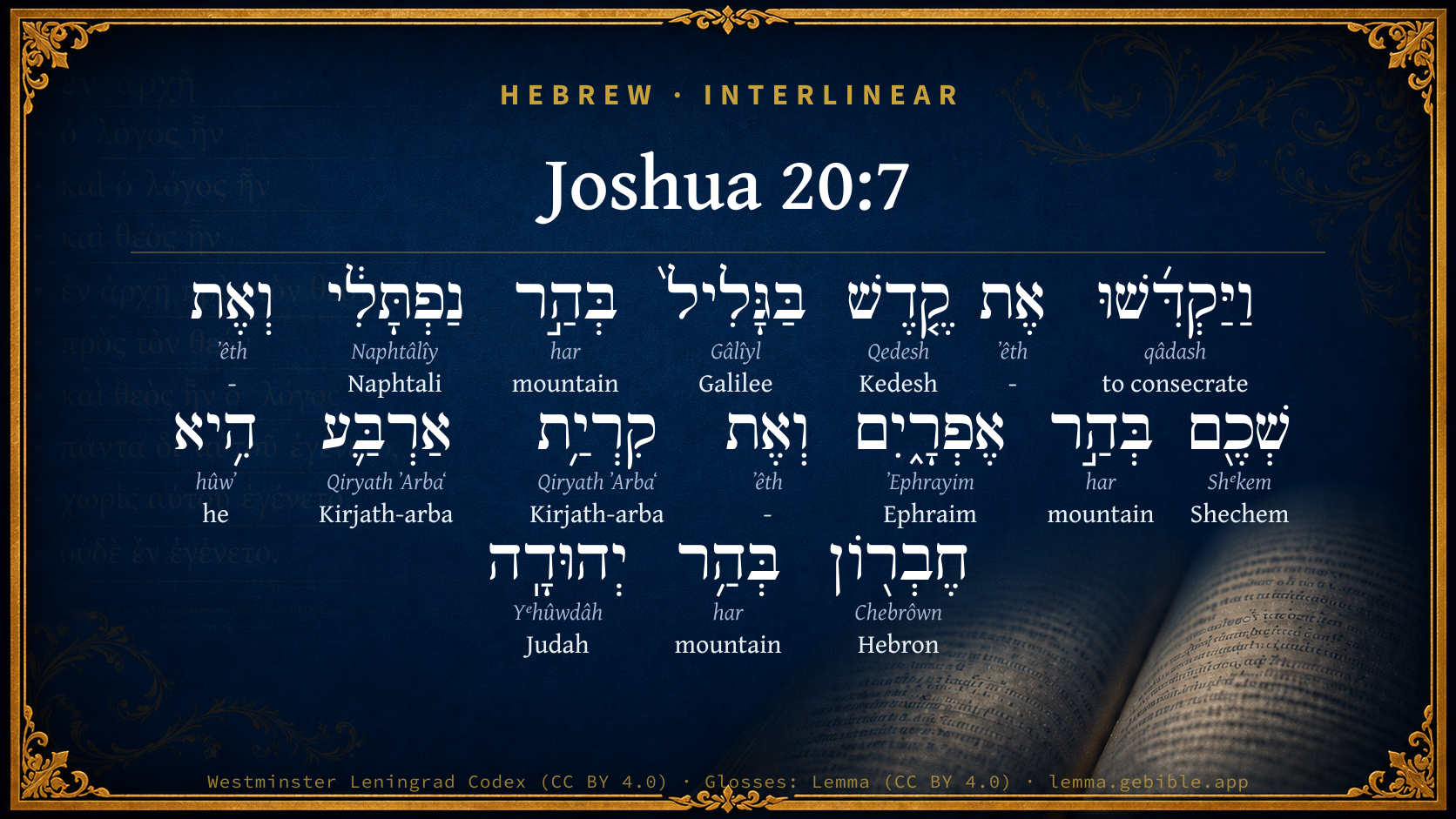
Hebrew (Westminster Leningrad Codex) Joshua 20:7 appears in the Hebrew Old Testament. The text above is from the Westminster Leningrad Codex. Each word links to its Strong’s number, a concise gloss, and parsing drawn from the Open Scriptures Hebrew Bible morphology. Click any word for its full Brown-Driver-Briggs (BDB) entry.
Download image
Cite this verse

Joshua 20:7 (World English Bible). Public Domain. Lemma interlinear Bible study tool, https://lemma.gebible.app/v/joshua/20/7.

Show BibTeX & RIS
BibTeX
RIS
English Translation
They set apart Kedesh in Galilee in the hill-country of Naphtali, and Shechem in the hill-country of Ephraim, and Kiriath Arba (the same is Hebron) in the hill-country of Judah.
World English Bible · Public Domain
Highlights
  • 1 first appearance in the Hebrew Bible
Full analysis ↓
Download a study sheet

One document with this verse’s original text, its word-by-word gloss line, the meaning frame, cross-references with their text, attributed commentary, and full source and license credits — printable, and it pastes into notes with its structure intact.

This verse Autodidact and up

Study sheet (.html) Plain text (.txt)

A passage Seminary Student

Up to 50 verses in one chapter. A passage sheet keeps up to 6 commentary sources and 12 cross-references per verse, in the order this page ranks them, and says so on the sheet whenever that leaves anything out. Ask for a single verse and you get the Autodidact verse sheet above.

Everything on this page stays free to read, with no account — the sheet is a download of what is already on screen, not access to it.

Want to remove ads? Support Godless Engineer
Compare translations 3

The same verse in 3 English versions, stacked beneath the original-language interlinear above. Click any original word for its lexicon entry.

Each is an independent rendering of the whole verse — the interlinear is not word-aligned to these translations.

Highlighted words mark where these versions differ — a whole-verse word diff, not a word-by-word alignment.

  • World English Bible Public Domain
    They set apart Kedesh in Galilee in the hill-country of Naphtali, and Shechem in the hill-country of Ephraim, and Kiriath Arba (the same is Hebron) in the hill-country of Judah.
  • King James Version Public Domain
    And they appointed Kedesh in Galilee in mount Naphtali, and Shechem in mount Ephraim, and Kirjatharba, which is Hebron, in the mountain of Judah.
  • unfoldingWord Literal Text CC BY-SA 4.0
    And they set apart Kedesh in Galilee in the hill country of Naphtali, and Shechem in the hill country of Ephraim, and Kiriath Arba (it is Hebron) in the hill country of Judah.

unfoldingWord Literal Text — © unfoldingWord, licensed CC BY-SA 4.0. Word-aligned USFM3 via Door43 (git.door43.org/unfoldingWord/en_ult).

Versions to compare (up to 4)

3 of 4 selected

Show all 18 translations

Every available English version of this verse, each an independent rendering of the whole verse.

  • World English Bible Public Domain
    They set apart Kedesh in Galilee in the hill-country of Naphtali, and Shechem in the hill-country of Ephraim, and Kiriath Arba (the same is Hebron) in the hill-country of Judah.
  • Berean Standard Bible Public Domain
    So they set apart Kedesh in Galilee in the hill country of Naphtali, Shechem in the hill country of Ephraim, and Kiriath-arba (that is, Hebron) in the hill country of Judah.
  • Majority Standard Bible Public Domain
    So they set apart Kedesh in Galilee in the hill country of Naphtali, Shechem in the hill country of Ephraim, and Kiriath-arba (that is, Hebron) in the hill country of Judah.
  • King James Version Public Domain
    And they appointed Kedesh in Galilee in mount Naphtali, and Shechem in mount Ephraim, and Kirjatharba, which is Hebron, in the mountain of Judah.
  • American Standard Version (1901) Public Domain
    And they set apart Kedesh in Galilee in the hill-country of Naphtali, and Shechem in the hill-country of Ephraim, and Kiriath-arba (the same is Hebron) in the hill-country of Judah.
  • Revised Version (1885) Public Domain
    And they set apart Kedesh in Galilee in the hill country of Naphtali, and Shechem in the hill country of Ephraim, and Kiriath-arba (the same is Hebron) in the hill country of Judah.
  • Geneva Bible (1599) Public Domain
    Then they appointed Kedesh in Galil in mount Naphtali, and Shechem in mount Ephraim, and Kiriath-arba, (which is Hebron) in the mountaine of Iudah.
  • Douay-Rheims (1899) Public Domain
    And they appointed Cedes in Galilee of mount Nephtali, and Sichem in mount Ephraim, and Cariath-Arbe, the same is Hebron in the mountain of Juda.
  • Young's Literal Translation Public Domain
    And they sanctify Kedesh in Galilee, in the hill-country of Naphtali, and Shechem in the hill-country of Ephraim, and Kirjath-Arba (it `is' Hebron), in the hill-country of Judah;
  • Literal Standard Version CC BY-SA 4.0
    And they sanctify Kedesh in Galilee, in the hill-country of Naphtali, and Shechem in the hill-country of Ephraim, and Kirjath-Arba (it [is] Hebron), in the hill-country of Judah;
  • Unlocked Literal Bible CC BY-SA 4.0
    So the Israelites selected Kedesh in Galilee in the hill country of Naphtali, Shechem in the hill country of Ephraim, and Kiriath Arba (the same as Hebron) in the hill country of Judah.
  • unfoldingWord Literal Text CC BY-SA 4.0
    And they set apart Kedesh in Galilee in the hill country of Naphtali, and Shechem in the hill country of Ephraim, and Kiriath Arba (it is Hebron) in the hill country of Judah.
  • Darby Bible Public Domain
    And they hallowed Kedesh in Galilee in the hill-country of Naphtali, and Shechem in the hill-country of Ephraim, and Kirjath-Arba, that is, Hebron, in the hill-country of Judah.
  • World Messianic Bible Public Domain
    They set apart Kedesh in Galilee in the hill country of Naphtali, Shechem in the hill country of Ephraim, and Kiriath Arba (also called Hebron) in the hill country of Judah.
  • Webster's Bible Public Domain
    And they appointed Kedesh in Galilee in mount Naphtali, and Shechem in mount Ephraim, and Kirjath-arba, (which is Hebron) in the mountain of Judah.
  • Free Bible Version CC BY-SA 4.0
    So they assigned the following sanctuary towns: Kedesh of Galilee, in the hill country of Naphtali; Shechem, in the hill country of Ephraim; and Kiriath-arba (or Hebron), in the hill country of Judah.
  • Bible in Basic English Public Domain
    So they made selection of Kedesh in Galilee in the hill-country of Naphtali, and Shechem in the hill-country of Ephraim, and Kiriath-arba (which is Hebron) in the hill-country of Judah.
  • JPS Tanakh (1917) Public Domain
    And they set apart Kedesh in Galilee in the hill-country of Naphtali, and Shechem in the hill-country of Ephraim, and Kiriath-arba — the same is Hebron — in the hill-country of Judah.

Literal Standard Version (2020), Covenant Press — licensed CC BY-SA 4.0. Text via the HelloAO Bible API (eBible.org). Unlocked Literal Bible (unfoldingWord) — licensed CC BY-SA 4.0. Text via the HelloAO Bible API (eBible.org). unfoldingWord Literal Text — © unfoldingWord, licensed CC BY-SA 4.0. Word-aligned USFM3 via Door43 (git.door43.org/unfoldingWord/en_ult). Free Bible Version, Dr. Jonathan Gallagher — licensed CC BY-SA 4.0. Text via the HelloAO Bible API (eBible.org).

Word by word

More ways to search: Search by grammar → Find every occurrence → Compare this word →

Practice this passage: Drill this verse → Learn its vocabulary →

בַּגָּלִיל֙
Gâlîyl
H1551
“in/at the · Galilee”
Preposition, Determined + Noun, Proper
Part of Speech
Preposition + Noun
Type
Proper
Full BDB Definition

Origin: the same as H1550

TWOT: None

Galilee = "circuit, district" - a territory in Naphtali largely occupied by heathen; a circuit of towns around Kedesh-Naphtali, in which were situated the 20 towns given by Solomon to Hiram king of Tyre as payment for his work in conveying timber from Lebanon to Jerusalem
  1. וַיַּקְדִּ֜שׁוּ qâdash H6942 “and · to consecrate” Conjunction + Verb, Hiphil, Sequential Imperfect, 3rd Person, Masculine, Plural
  2. אֶת ʼêth H853 “-” Particle, Direct Object
  3. קֶ֤דֶשׁ Qedesh H6943 “Kedesh” Noun, Proper
  4. בְּהַ֣ר har H2022 “in/at · mountain of” Preposition + Noun, Common, Masculine, Singular, Construct
  5. נַפְתָּלִ֔י Naphtâlîy H5321 “Naphtali” Noun, Proper
  6. וְאֶת ʼêth H853 “and · -” Conjunction + Particle, Direct Object
  7. שְׁכֶ֖ם Shᵉkem H7927 “Shechem” Noun, Proper
  8. בְּהַ֣ר har H2022 “in/at · mountain of” Preposition + Noun, Common, Masculine, Singular, Construct
  9. אֶפְרָ֑יִם ʼEphrayim H669 “Ephraim” Noun, Proper
  10. וְאֶת ʼêth H853 “and · -” Conjunction + Particle, Direct Object
  11. קִרְיַ֥ת Qiryath ʼArbaʻ H7153 “Kirjath-arba” Noun, Proper
  12. אַרְבַּ֛ע Qiryath ʼArbaʻ H7153 “Kirjath-arba” Adjective, Cardinal number, Feminine, Singular, Absolute
  13. הִ֥יא hûwʼ H1931 “he” Pronoun, Personal, 3rd Person, Feminine, Singular
  14. חֶבְר֖וֹן Chebrôwn H2275 “Hebron” Noun, Proper
  15. בְּהַ֥ר har H2022 “in/at · mountain of” Preposition + Noun, Common, Masculine, Singular, Construct
  16. יְהוּדָֽה Yᵉhûwdâh H3063 “Judah” Noun, Proper

About this verse

These counts appear in no published source. They are computed here, from the morphology-tagged text and Lemma’s own curated glosses. What Lemma adds →

17
words
12
distinct lemmas
Historical
section

Notable vocabulary

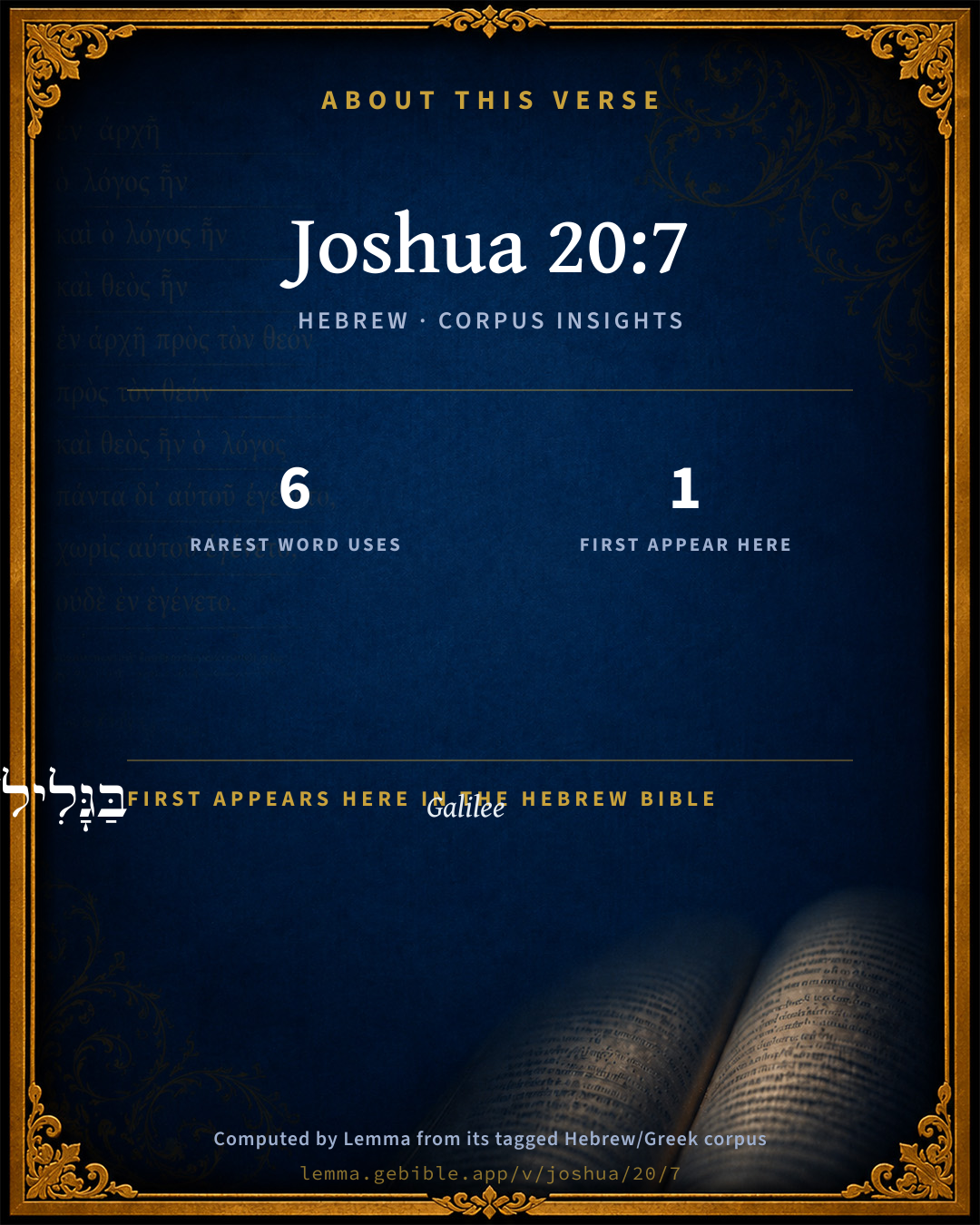
The rarest word here is בַּגָּלִיל֙ Galilee H1551 — appearing just 6 times in the whole Hebrew Bible.

First appearance in Scripture

This word makes its first canonical appearance in the Hebrew Bible here:

  • בַּגָּלִיל֙ Galilee H1551

Shared distinctive vocabulary

בַּגָּלִיל֙ Galilee H1551 occurs in 6 verses of the Hebrew Bible. Also found in:

Grammatical profile

  • 1 verb
  • 11 nouns
  • 1 adjective
  • 1 pronoun
  • 3 particles

Verb forms

  • וַיַּקְדִּ֜שׁוּ Hiphil · Sequential Imperfect

Repetition

Words recur within this verse — often emphatic in Hebrew:

  • בְּהַ֣ר mountain H2022 ×3
  • קִרְיַ֥ת Kirjath-arba H7153 ×2

Cross-references

9

Topical passages linked to Joshua 20:7 in the Treasury of Scripture Knowledge — connected by theme and wording, ordered by reader-vote popularity; previews shown in the World English Bible.

  • Joshua 21:11 They gave them Kiriath Arba, [which Arba was] the father of Anak (the same is Hebron), in the hill-country of Judah, with the suburbs of it round about it.
  • Joshua 21:32 Out of the tribe of Naphtali, Kedesh in Galilee with its suburbs, the city of refuge for the manslayer, and Hammothdor with its suburbs, and Kartan with its suburbs; three cities.
  • 1 Chronicles 6:76 and out of the tribe of Naphtali, Kedesh in Galilee with its suburbs, and Hammon with its suburbs, and Kiriathaim with its suburbs.
  • Luke 1:39 Mary arose in those days and went into the hill country with haste, into a city of Judah,
  • Joshua 14:15 Now the name of Hebron before was Kiriath Arba; [which Arba was] the greatest man among the Anakim. The land had rest from war.
  • Joshua 21:13 To the children of Aaron the priest they gave Hebron with its suburbs, the city of refuge for the manslayer, and Libnah with its suburbs,
  • Joshua 21:21 They gave them Shechem with its suburbs in the hill-country of Ephraim, the city of refuge for the manslayer, and Gezer with its suburbs,
  • Genesis 33:18–19 Jacob came in peace to the city of Shechem, which is in the land of Canaan, when he came from Paddan Aram; and encamped before the city.
  • 2 Chronicles 10:1 Rehoboam went to Shechem; for all Israel were come to Shechem to make him king.

Cross-references courtesy of OpenBible.info (CC BY 4.0).

Hebrew and Greek witnesses Masoretic Hebrew ↔ Greek Septuagint

The same verse in the two great witnesses to the Old Testament, shown verse-for-verse.

These are two independent witnesses, not word-aligned to each other, and the Septuagint is shown in lemma (dictionary) form.

Hebrew Joshua 20:7 Masoretic · Westminster Leningrad Codex

וַיַּקְדִּ֜שׁוּ אֶת קֶ֤דֶשׁ בַּגָּלִיל֙ בְּהַ֣ר נַפְתָּלִ֔י וְאֶת שְׁכֶ֖ם בְּהַ֣ר אֶפְרָ֑יִם וְאֶת קִרְיַ֥ת אַרְבַּ֛ע הִ֥יא חֶבְר֖וֹן בְּהַ֥ר יְהוּדָֽה

They set apart Kedesh in Galilee in the hill-country of Naphtali, and Shechem in the hill-country of Ephraim, and Kiriath Arba (the same is Hebron) in the hill-country of Judah.

World English Bible · Public Domain

On this verse, The Preacher's Complete Homiletical Commentary discusses the Septuagint’s reading. Read the note in Commentary ↓

Hebrew: Westminster Leningrad Codex (CC BY 4.0). Greek: Septuagint (public domain); English from a public-domain English Septuagint. How the Septuagint differs from the Hebrew →

Targum (Aramaic paraphrase)

1

The Targum is the ancient Jewish Aramaic paraphrase of the Hebrew Scriptures — an interpretive translation, not the Hebrew text itself. Onkelos (literal) and Pseudo-Jonathan (expansive) render the Torah, and Jonathan the Prophets. Coverage is partial: where no permissively-licensed English translation exists for a verse, only the Aramaic is shown. This is verse-level text, not a word-by-word alignment to the Hebrew.

  1. Targum Jonathan Prophets (Joshua–Malachi)
    וְזַמִינוּ יַת קֶדֶשׁ בְּגִלִילָא בְּטוּרָא דְבֵית נַפְתָּלִי וְיַת שְׁכֶם בְּטוּרָא דְבֵית אֶפְרָיִם וְיַת קִרְיַת אַרְבַּע הִיא חֶבְרוֹן בְּטוּרָא דְבֵית יְהוּדָה:

    (no public-domain English translation for this verse)

    Targum Jonathan — Aramaic: “Mikraot Gedolot” (public domain). English: “Sefaria Community Translation” (CC0 1.0 (public-domain dedication)); “London "Chaldee Paraphrase," 1871” (public domain). Text via Sefaria.

Commentary

Notes on Joshua 20:7 from classic Christian and Jewish commentators (each source and its license shown beneath its notes). The classic Christian expositions comment on the surrounding passage and are grouped to its opening verse, so a note may address several verses; the Jewish commentaries on the Tanakh (Rashi and others) are per-verse, so they appear only where the commentator wrote on this verse.

Lemma curates 59 commentaries, every one of them public domain or Creative Commons licensed, each selected and text-cleaned for this edition rather than reprinted as found. About our sources →

Jamieson, Fausset & Brown

Robert Jamieson, A. R. Fausset & David Brown

THE ISRAELITES APPOINT BY NAME THE CITIES OF REFUGE. (Jos 20:7-9)

they appointed . . . cities--There were six; three on the west, and three on the east, of Jordan. In the first instance, they were a provision of the criminal law of the Hebrews, necessary in the circumstances of that people (see on Num 35:11; Deu 19:2). At the same time they were designed also typically to point out the sinner's way to Christ (Heb 6:18).

Next: Joshua Chapter 21

Jamieson, Fausset & Brown — Commentary Critical and Explanatory on the Whole Bible (1871) — public domain (CC PDM 1.0). Text via the HelloAO Bible API.

Trapp's Complete Commentary

John Trapp

Jos 20:7 And they appointed Kedesh in Galilee in mount Naphtali, and Shechem in mount Ephraim, and Kirjatharba, which [is] Hebron, in the mountain of Judah.

Ver. 7. And they appointed Kedesh.] Heb., They sanctified Kedesh; where there is an elegancy in the Hebrew that cannot be Anglised. These cities of refuge belonged all to the Levites, who were best able to judge and to interpose betwixt party and party, both in respect of authority and advice. The priests’ lips were both to preserve knowledge, and to present it to the people.

And Shechem in mount Ephraim.] All of them in mountains or on plains, that they might the sooner be seen and more easily repaired unto: so precious in the sight of the Lord is the death, not of his saints only, though chiefly, but of his reasonable creatures. He is the preserver of men, and delighteth to show his philanthropy, or love to all.

John Trapp, A Commentary or Exposition upon All the Books of the Old and New Testament (1647–1656) — public domain. Text from a community e-Sword module.

Joseph Benson's Commentary

Jos 20:7. And they appointed — Concerning these cities, note, 1st, That they were all upon mountains, that they might be seen at a great distance, and so direct those who fled thither. 2d, That they were seated at a convenient distance one from another, for the benefit of the several tribes; for Kedesh was in the north, Hebron in the south, and Shechem between them. 3d, That they all belonged to the Levites; partly, that these causes might be more impartially examined and justly determined by them, who were presumed best able to understand the law of God, and most obliged to follow it, and not to be biased by any affection or corrupt interest; and partly, that their reputation with the people, and their good counsels, might lay a restraint upon revengeful persons, who might be inclined to follow the manslayer thither, and endeavour to kill him there. It was likewise an advantage to the poor refugee, that when he might not go up to the house of the Lord, yet he had the servants of God’s house with him, to instruct him, and pray for him, and help to make up the want of public ordinances.

Joseph Benson's Commentary on the Old and New Testaments (1811–1818) — public domain. Text from a community e-Sword module.

The Preacher's Complete Homiletical Commentary

Joseph S. Exell (gen. ed.)

Jos_20:7. And they appointed] Marg., “sanctified.” These cities were consecrated, as holy, to the sacred work of preserving life. Hence, only Levitical cities were chosen. Life was to be thus preserved in connection with religion Whether fleeing to the altar of sanctuary or the city of sanctuary, the Israelites were to learn to cry, “God is a refuge for us.” Kadesh] “Sanctuary,” a deriv. from the same root as the word just noticed. Kedesh is to be distinguished from the city of this name in the south of Judah (chap. Jos_15:23). and likewise from the Kedesh of the Gershonite Levites, in Issachar (cf. 1Ch_6:72; 1Ch_6:76), though this Kedesh of Naphtali was given to the same Levitical family. Shechem … and Hebron] It will be seen that the three cities of refuge on the west of Jordan, thus chosen, were as conveniently placed as possible. Kedesh was not in the extreme north, nor Hebron in the extreme south, while Shechem was in the very midst of the land; each city, also, lay in a good central position as between the line of the Jordan and the Mediterranean Sea.

Jos_20:8. On the other side Jordan] Moses had already appointed the three cities for the eastern territory (Deu_4:41-43). Bezer] called by the LXX. and Vulg. “Besor.” From 1Ch_6:78, we learn that it was given to the Merarites, and that it was opposite to Jericho. Ramoth in Gilead] So also in Deu_4:43; 1Ki_22:3; elsewhere Ramoth-Gilead. Probably identical with the Ramath-Mizpeh of chap. Jos_13:26. Golan] = “exile.” According to Josephus, as quoted by Gesenius, it was near to the sea of Galilee, and gave its name to the region afterwards known as Gaulanitis, now Jaulân.

Jos_20:9. Until he stood before the congregation] No homicide who could reach one of these cities was to be delivered up till he had obtained a hearing; those innocent of wilful murder were to be afforded an asylum in the city, till the death of the high priest rendered them free to depart; but those who were guilty of taking life deliberately, after this had been so decided, were given over to the avenger of blood.

The Preacher's Complete Homiletical Commentary (gen. ed. Joseph S. Exell; Funk & Wagnalls, c. 1892) — public domain (pre-1929). A full-Bible homiletical/sermon-outline anthology covering 65 of 66 books (2 John is absent from the source module). Text from a community e-Sword module.

Keil & Delitzsch

C. F. Keil & F. Delitzsch

List of the cites: Levitical cities were chosen, for the reasons explained in the Commentary on the Pentateuch.

Jos 20:7

In the land on this side (viz., Canaan) they sanctified the following cities. In the north, Kedesh (see at Jos 12:22), in Galil, on the mountains of Naphtali. Galil (a circle) was a district in the northern part of the subsequent province of Galilee; it is called הגּוים גּליל, circle of the heathen, in Isa 9:1, because an unusually large number of heathen or Gentiles were living there. In the centre of the land, Shechem, upon the mountains of Ephraim (see at Jos 17:7). And in the south, Kirjath-arba, i.e., Hebron, upon the mountains of Judah (see at Jos 10:3).

Jos 20:8-9

The cities in the land on the other side had already been appointed by Moses (Deu 4:41-43). For the sake of completeness, they are mentioned here again: viz., Bezer, Ramoth in Gilead, and Golan (see at Deu 4:43). The subject is brought to a close in Jos 20:9. המּוּעדה ערי signifies neither urbes congregationis (Kimchi) nor urbes asyli (Gesenius), but cities of appointment, - those which received the appointment already given and repeated again in what follows.

Keil & Delitzsch — Biblical Commentary on the Old Testament (1861–1891) — public domain (CC PDM 1.0). Text via the HelloAO Bible API. (Old Testament only.)

Tyndale Open Study Notes

Tyndale Open Resources

20:7-9 Joshua designated six cities of refuge: three on the east side of the Jordan, and three on the west. From anywhere in the land, one of these six well-known Levitical cities was no more than two days’ travel away.

Tyndale Open Study Notes — © Tyndale Open Resources, licensed CC BY-SA 4.0. Text via the HelloAO Bible API.

Geneva Bible (1599)

Geneva Bible translators

Or, Galilee.

Geneva Bible (1599) marginal notes — public domain. Text via Bolls.life.

Matthew Henry's Commentary

We have here the nomination of the cities of refuge in the land of Canaan, which was made by the advice and authority of Joshua and the princes (Jos 19:7); and upon occasion of the mention of this is repeated the nomination of the other three in the lot of the other two tribes and a half, which was made by Moses (Deu 4:43), but (as bishop Patrick thinks) they had not the privilege till now. 1. They are said to sanctify these cities, that is the original word for appointed, Jos 19:7. Not that any ceremony was used to signify the consecration of them, only they did by a public act of court solemnly declare them cities of refuge, and as such sacred to the honour of God, as the protector of exposed innocency. If they were sanctuaries, it was proper to say they were sanctified. Christ, our refuge, was sanctified by his Father; nay, for our sakes he sanctified himself, Joh 17:19. 2. These cities (as those also on the other side Jordan) stood in the three several parts of the country, so conveniently that a man might (they say) in half a day reach some one of them from any corner of the country. Kedesh was in Naphtali, the most northern tribe, Hebron in Judah, the most southern, and Shechem in Ephraim, which lay in the middle, about equally distant from the other two. God is a refuge at hand. 3. They were all Levites' cities, which put an honour upon God's tribe, making them judges in those cases wherein divine Providence was so nearly concerned, and protectors to oppressed innocency. It was also a kindness to the poor refugee, that when he might not go up to the house of the Lord, nor tread his courts, yet he had the servants of God's house with him, to instruct him, and pray for him, and help to make up the want of public ordinances. If he must be confined, it shall be to a Levite-city, where he may, if he will, improve his time. 4. These cities were upon hills to be seen afar off, for a city on a hill cannot be hid; and this would both direct and encourage the poor distressed man that was making that way; and, though therefore his way at last was up-hill, yet this would comfort him, that he would be in his place of safety quickly, and if he could but get into the suburbs of the city he was well enough off. 5. Some observe a significancy in the names of these cities with application to Christ our refuge. I delight not in quibbling upon names, yet am willing to take notice of these. Kedesh signifies holy, and our refuge is the holy Jesus. Shechem, a shoulder, and the government is upon his shoulder. Hebron, fellowship, and believers are called into the fellowship of Christ Jesus our Lord. Bezer, a fortification, for he is a strong-hold to all those that trust in him. Ramoth, high or exalted, for him hath God exalted with his own right hand. Golan, joy or exultation, for in him all the saints are justified, and shall glory. Lastly, Besides all these, the horns of the altar, wherever it was, were a refuge to those who took hold of them, if the crime were such as that sanctuary allowed. This is implied in that law (Exo 21:14), that a wilful murderer shall be taken from God's altar to be put to death. And we find the altar used for this purpose. Kg1 1:50; Kg1 2:28. Christ is our altar, who not only sanctifies the gift, but protects the giver.

Matthew Henry's Commentary on the Whole Bible (1708–1710) — public domain (CC PDM 1.0). Text via the HelloAO Bible API.

Adam Clarke's Commentary

Verse 7. They appointed Kedesh in Galilee] The cities of refuge were distributed through the land at proper distances from each other that they might be convenient to every part of the land; and it is said they were situated on eminences, that they might be easily seen at a distance, the roads leading to them being broad, even, and always kept in good repair. In the concluding note on Nu 35:33 it has been stated that these cities were a type of our blessed Lord, and that the apostle refers to them as such, Heb 6:17; Heb 6:18. Hence their names have been considered as descriptive of some character or office of Christ. I shall give each and its signification, and leave the application to others.

1. קדש KEDESH, from kadash, to separate or set apart, because it implies the consecration of a person or thing to the worship or service of God alone; hence to make or be holy, and hence Kedesh, holiness, the full consecration of a person to God.

2. שכם SHECHEM, from shacham, to be ready, forward, and diligent; hence Shechem, the shoulder, because of its readiness to bear burdens, prop up, sustain, c., and from this ideal meaning it has the metaphorical one of GOVERNMENT.

3. חברון chebron HEBRON, from חבר chabar, to associate, join, conjoin, unite as friends; and hence chebron, fellowship, friendly association, or with the diminutive nun, the little fellow-ship or association.

4. בצר BEZER, from batsar, to restrain, enclose, shut up, or encompass with a wall; and hence the goods or treasure thus secured, and hence a fortified place, a fortress.

5. ראמות RAMOTH, from ראם raam, to be raised, made high or exalted, and hence Ramoth, high places, eminences.

6. גולן GOLAN, from גלה galah, to remove, transmigrate, or pass away; hence Golan, a transmigration or passage. Some derive it from גל gal, to rejoice, hence GOLAN, rejoicing or exultation.

A person of the spirit and turn of Origen could preach the whole Gospel from these particulars.

Kedesh and Hebron were at the two extremities of the promised land; one was in Galilee, the other in the tribe of Judah, both in mountainous countries; and Shechem was in the tribe of Ephraim, nearly in the middle, between both.

Bezer was on the east side of Jordan, in the plain, opposite to Jericho.

Ramoth was about the midst of the country occupied by the two tribes and a half, about the middle of the mountains of Gilead.

Golan was the capital of a district called Gaulonitis, in the land of Bashan, towards the southern extremity of the lot of Manasseh.

Adam Clarke's Commentary on the Bible (1810–1826) — public domain. Text from a community e-Sword/MySword module.

John Calvin's Commentaries

7. And they appointed Kedesh, etc The Hebrew word Kedesh here used, signifies also to fit and consecrate. Accordingly, I interpret, that cities were selected according as common use required. Hence it is inferred that matters were well arranged so as to make private yield to public interest. Moreover, we shall see in the next chapter, that Ciriath-Arbah, which was afterwards called Hebron, was transferred to the Levites, though it had formerly been the property of Caleb. Hence appeared the rare, nay, the incomparable moderation of this aged saint, who readily gave up to others both the city and suburbs, which he had justly claimed as his right, the moment the lot showed that this was pleasing to God. It was necessary to advert briefly to this change, because the Lord was pleased that asylums should be found only in the Levitical cities, that their innocence might be defended with greater fidelity and authority.

John Calvin's Commentaries (1540-1563) — public domain. Text from the Calvin Translation Society English edition (1840s-50s) via the Christian Classics Ethereal Library (ccel.org). Calvin's coverage is partial (roughly two-thirds of the Bible); uncommented books and verses are honest gaps, never fabricated. The 19th-century editor's footnotes and remarks are omitted so the notes are faithfully Calvin's own voice.

The Cambridge Bible for Schools and Colleges

gen. ed. J. J. S. Perowne

7–9. The Selection of the Cities of Refuge

7. And they appointed] Rather, they sanctified, set apart for a sacred purpose. The Cities of Refuge were intended to preserve the People and the Land of Jehovah from blood-guiltiness. Hence the appointment to so high a purpose carried with it also the idea of solemn consecration. “They seuerden,” Wyclif translates it in the first edition, “thei ordeyneden” in the later edition. The cities selected were three on either side of the Jordan, almost equally remote from each other,

(a) On the West.

(b) On the East.

1. Kedesh, in Naphtali.

1. Golan, in Bashan.

2. Shechem, in Mount Ephraim.

2. Ramoth-Gilead, in Gad.

3. Hebron, in Judah.

3. Bezer, in Reuben.

It requires only to look at the map to see how wisely these spots were marked out, so as to make a “City of Refuge” easy of access from all parts of the land. They were chosen, it will be observed, out of the priestly and Levitical cities, as likely to be inhabited by the most intelligent part of the community. According to Maimonides, all the forty-eight Levitical cities (enumerated in the next Chapter) had the privilege of asylum, but these six cities were required to receive and lodge the homicide gratuitously.

Kedesh] was the most northerly city on the West. See above, Jos_12:22.

in Galilee] In that part of the province afterwards called “Galilee.” This name which in the Roman age was applied to a large province, seems to have been originally confined to a little “circuit” or “region”—Galil, Galilah, Galilæa—round Kedesh-Naphtali, in which were situated the twenty towns given by Solomon to Hiram, king of Tyre, as payment for the transportation of timber from Lebanon to Jerusalem (1Ki_9:11).

Shechem] was the central city on the west of the Jordan; see above, ch. Jos_8:30; and ch. Jos_17:7; in Mount Ephraim. See above, ch. Jos_17:15.

Kirjath-arba, which is Hebron] The most southerly of the selected cities on the west; see above, ch. Jos_10:3, Jos_14:15.

in the mountain of Judah] On this mountain-district, see above, ch. Jos_11:21.

The Cambridge Bible for Schools and Colleges (gen. ed. J. J. S. Perowne; Cambridge University Press, 1878–1918) — public domain. Text from a community e-Sword module.

John Gill's Exposition

And they appointed Kedesh in Galilee in Mount Naphtali,.... Of which see Jos 19:37; the appointment of this and the two cities following was made by the children of Israel at this time:

and Shechem in Mount Ephraim; called Sichem, Gen 12:6; and Shechem from a prince of that name that possessed it, Gen 34:2; it fell to the lot of the tribe of Ephraim; its name in the New Testament is Sychar, Joh 4:5; and it is now called Neapolis, or Naplouse:

and Kirjatharba, which is Hebron, in the mountain of Judah; it stood in the hill country of Judea, Luk 1:39; of which see Jos 14:15. There seems to be a difficulty here, since this city was before given to Caleb, Jos 14:13; and yet afterwards given to the Levites, and appointed a city of refuge. The Jews reconcile this by observing, that the city and suburbs were given to the Levites, and fixed for a city of refuge; but the villages and fields, and country around it, and belonging to it, were given to Caleb, Jos 21:12; and Abarbinel makes no doubt that the children of Judah gave something else to Caleb in lieu of it. As these cities of refuge were typical of Christ, as has been observed on Num 35:29; their names are applicable to him. "Kedesh" signifies "holy" or "holiness"; Christ is holy in both his natures, divine and human; and so abundantly qualified to be the Mediator, Saviour, and Redeemer; and is the fountain of holiness to his people, and is made sanctification to them, Psa 16:10 Co1 1:30; and "Shechem" signifies the "shoulder"; and not only the government of the church and people of God is on the shoulder of Christ, but all their sins have been laid upon him, and bore by him; and every particular soul in conversion, every lost sheep, is looked up by him, and taken up and brought home on his shoulder, Isa 9:6 Luk 15:4. "Hebron" signifies "fellowship"; in the effectual calling, the saints are called into fellowship with Christ, and their fellowship is with the Father, and his Son Jesus Christ; through him they have access to God, and communion with him now, and shall have uninterrupted communion with him to all eternity, Co1 1:9 Joh 17:24.

John Gill's Exposition of the Whole Bible (1746–1763) — public domain (CC PDM 1.0). Text via the HelloAO Bible API.

Haydock's Catholic Bible Commentary

Cedes and Gaulon lay on the north, Sichem and Ramoth in the middle, Hebron and Bosor on the south of the country. (Haydock)

George Leo Haydock (1774–1849), Haydock's Catholic Family Bible and Commentary, 1859 edition — public domain. Excludes Psalms (Douay-Rheims chapter numbering differs from Protestant) and Deuterocanonical books (Catholic canon only).

Matthew Poole's English Annotations

Concerning these cities, note,

1. That they were all upon mountains, that they might be seen at a great distance, and so direct those who fled thither.

2. That they were seated at convenient distance one from another, for the benefit of the several tribes; for Kedesh was in the north, Hebron in the south, and Shechem between them.

3. That they all belonged to the Levites; partly that these causes might be more impartially examined and justly determined by them, who are presumed best able to understand the law of God, and most obliged and likely to follow it in their judgment, and not to be biassed by any affection or corrupt interest; and partly that their just reputation with the people, and their good counsels, might lay some restraint upon revengeful persons, who might be inclined or tempted to follow the man-slayer thither, and endeavour to kill him there.

Matthew Poole's English Annotations on the Holy Bible (1683–1685) — public domain. Text from a community e-Sword/MySword module.

Whedon's Commentary on the Bible

Daniel D. Whedon

7. Appointed — Hebrews, They sanctified; set apart to a sacred use, so that all the fugitives were impressed with the thought that when within these cities they were surrounded by the munitions of Jehovah’s especial mercy. None but Levitical cities were chosen. Since the object of the refuge was distinctly religious, to preserve the land from blood-guiltiness, it was not proper that a secular city should be chosen. They were very carefully distributed throughout the whole land. The two and a half tribes east of the Jordan had as many as the western tribes, because they were scattered over a territory nearly as large.

Kedesh — See on Jos_12:22.

Shechem — See on Jos_17:7.

Hebron — Jos_10:3, note.

Daniel D. Whedon (gen. ed.), Commentary on the Old and New Testaments (1874–1909) — public domain. Text from a community e-Sword module.

The Pulpit Commentary

And they appointed. The original, which, strange to say, the LXX and Vulgate, as well as our version, have neglected to render, is sanctified (heiligten, Luther). The selection is itself a proof that our author knew well what he was writing about. It is not likely that in the later times of Jewish history, when the law had been forgotten (2Ki_22:8) and its precepts had long been in abeyance, that the institution of the city of refuge remained in full force. But we find three cities selected on each side of Jordan. Those on the west were in the tribe of Naphtali on the north, of Ephraim in the centre, and of Judah in the south. The same is the case with those on the other side Jordan. Thus every little detail of the narrative, when closely scrutinised, does but show more entirely how free this narrative is from the reproach so hastily cast upon it of being a loose and inaccurate compilation, attempted by a man who had not the slightest literary fitness for the task he had undertaken. A corroboration of this view may be found in the fact that all these cities were Levitical cities. Thus, as the crime of homicide was looked upon under the Mosaic law as a crime apart from all other crimes, inasmuch as it was an offence against the life which was God"s gift, and man, who was God"s image, so the offender who pleaded extenuating circumstances for his offence was placed, until his trial could be held, under the special protection of the Divine law. For "the priest"s lips should keep knowledge, and men should seek the law at his mouth." It was the special privilege of the tribe of Levi to possess the "key of knowledge." It was to them that the duty of ascertaining the wilt of God by Urim and Thummim was assigned. (Num_27:21) Thus a special acquaintance with the law, (Deu_33:8) and a special fitness for deciding the difficult questions sometimes arising out of it, would naturally be found in the elders of those cities which had been set apart as cities of refuge. In Galilee. Hebrew, Hag-Galil, the circle. Here we have the masculine, as in Jos_13:2 Jos_17:17 Jos_22:10, Jos_22:11, the feminine form. This is the first place in Scripture in which the word Galil, or Galilee, is applied to this region. Gesenius regards it as having been originally a district of twenty towns round Kedesh in Naphtali. Such a region of twenty towns is mentioned in 1Ki_9:11. (see also Isa_8:2-3; or, Isa_9:1 in our version) Kedesh has already been noticed. (see also Jos_21:32)

The Pulpit Commentary (1880–1919), ed. H.D.M. Spence-Jones & Joseph S. Exell — public domain. Text from a community e-Sword module.

John Wesley's Explanatory Notes

And they appointed - Concerning these cities note,

1. That they were all upon mountains, that they might be seen at a great distance, and so direct those who fled thither.

2. That they were seated at convenient distance one from another, for the benefit of the several tribes; for Kedesh was in the north, Hebron in the south, and Shechem between them.

3. That they all belonged to the Levites; partly that these causes might be more impartially examined, and justly determined by them who are presumed best able to understand the law of God, and most obliged to follow it and not to be biass'd by any affection or corrupt interest, and partly, that their reputation with the people, and their good counsels, might lay a restraint upon revengeful persons, who might be inclined to follow the man- slayer thither, and endeavour to kill him there. It was likewise an advantage to the poor refugee, that when he might not go up to the house of the Lord, yet he had the servants of God's house with him, to instruct him, and pray for him, and help to make up the want of public ordinances.

John Wesley, Explanatory Notes Upon the Whole Bible (1754–1765) — public domain. Text via the GEBible commentary corpus.

unfoldingWord translationNotes

Door43 World Missions Community

General Information:

There are a lot of names in this section. (See: How to Translate Names)

the Jordan

This is a short name for the Jordan River.

translationWords

Kedesh

Galilee

Naphtali

Shechem

Ephraim

Hebron

Judah

Jordan River

Jericho

desert

tribe

Reuben

Gad

Bashan

Manasseh

unfoldingWord translationNotes — © Distant Shores Media and the Door43 World Missions Community, licensed CC BY-SA 4.0. Source: git.door43.org/Door43/en_tn.

Lesson kit

Teaching starters — assembled from the data on this page, not authored interpretation. Every prompt links to the verse data it draws on. Edit before teaching.

Joshua, in the Historical, opens this verse with 17 words (12 distinct Hebrew lemmas). Its most distinctive word is Gâlîyl (“Galilee”). A historical commentator’s framing appears above. Read the whole chapter for the surrounding context.

Discussion questions

  1. How does “Galilee” (Gâlîyl) shape what this verse is saying?
  2. This is the first place “Galilee” appears in Scripture (first appears here). What does its debut here establish?
  3. How does Joshua 21:32, which shares the word «Galilee», read alongside this verse?
  4. What does the repetition of “mountain” (3× in this one verse) do in this verse?
  5. The translations on this page render this verse differently — a whole-verse word diff, not a word-by-word alignment. What might account for the different wordings?
  6. «וַיַּקְדִּ֜שׁוּ» is a Hiphil Sequential Imperfect verb. How does that grammatical form shape the action described?
  7. Compare how Jamieson, Fausset & Brown and Trapp's Complete Commentary read this verse. Where do they agree or differ?

Things to notice

  • 1 word makes its first canonical appearance in Scripture here.
  • These translations choose different wording for 13 words in this verse.
  • “mountain” occurs 3× in this single verse.
  • 12 distinct Hebrew lemmas span 17 words in this verse.

Reading settings

Reading text

Shown beneath each verse's original-language words.

Old Testament
Old Testament edition

Read the OT as the Masoretic Hebrew (MT) or the Greek Septuagint (LXX).

English shown for the Greek Septuagint (in the Hebrew ↔ Greek comparison).

Comparing translations? Open the Compare panel on any verse page to stack up to four side by side.