Joshua 21:20

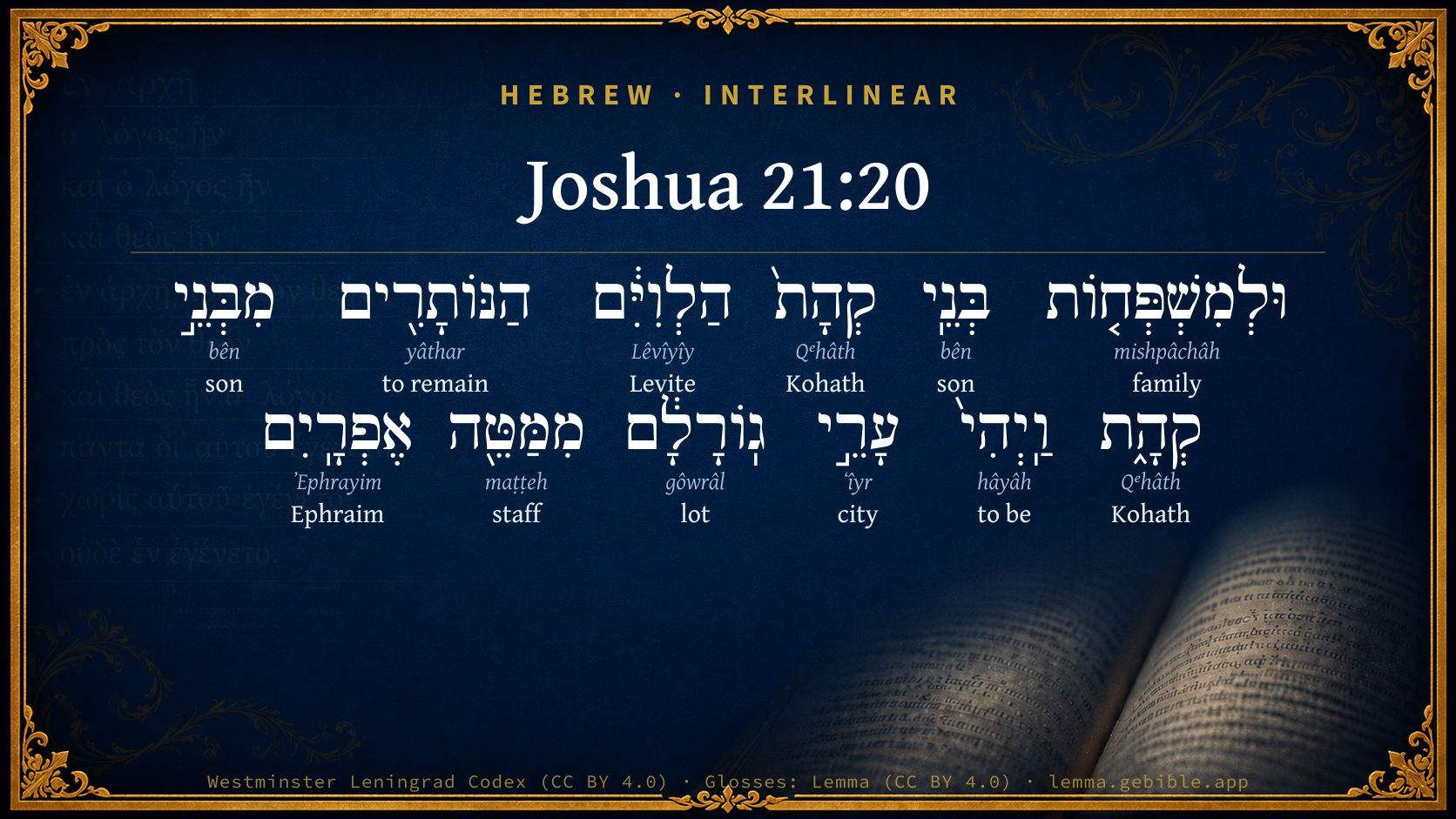
Hebrew (Westminster Leningrad Codex) Joshua 21:20 appears in the Hebrew Old Testament. The text above is from the Westminster Leningrad Codex. Each word links to its Strong’s number, a concise gloss, and parsing drawn from the Open Scriptures Hebrew Bible morphology. Click any word for its full Brown-Driver-Briggs (BDB) entry.
Download image
Cite this verse

Joshua 21:20 (World English Bible). Public Domain. Lemma interlinear Bible study tool, https://lemma.gebible.app/v/joshua/21/20.

Show BibTeX & RIS
BibTeX
RIS
English Translation
The families of the children of Kohath, the Levites, even the rest of the children of Kohath, they had the cities of their lot out of the tribe of Ephraim.
World English Bible · Public Domain
Download a study sheet

One document with this verse’s original text, its word-by-word gloss line, the meaning frame, cross-references with their text, attributed commentary, and full source and license credits — printable, and it pastes into notes with its structure intact.

This verse Autodidact and up

Study sheet (.html) Plain text (.txt)

A passage Seminary Student

Up to 50 verses in one chapter. A passage sheet keeps up to 6 commentary sources and 12 cross-references per verse, in the order this page ranks them, and says so on the sheet whenever that leaves anything out. Ask for a single verse and you get the Autodidact verse sheet above.

Everything on this page stays free to read, with no account — the sheet is a download of what is already on screen, not access to it.

Want to remove ads? Support Godless Engineer
Compare translations 3

The same verse in 3 English versions, stacked beneath the original-language interlinear above. Click any original word for its lexicon entry.

Each is an independent rendering of the whole verse — the interlinear is not word-aligned to these translations.

Highlighted words mark where these versions differ — a whole-verse word diff, not a word-by-word alignment.

  • World English Bible Public Domain
    The families of the children of Kohath, the Levites, even the rest of the children of Kohath, they had the cities of their lot out of the tribe of Ephraim.
  • King James Version Public Domain
    And the families of the children of Kohath, the Levites which remained of the children of Kohath, even they had the cities of their lot out of the tribe of Ephraim.
  • unfoldingWord Literal Text CC BY-SA 4.0
    And for the clans of the sons of Kohath, the Levites, the remaining ones from the sons of Kohath, the cities of their lot from the tribe of Ephraim.

unfoldingWord Literal Text — © unfoldingWord, licensed CC BY-SA 4.0. Word-aligned USFM3 via Door43 (git.door43.org/unfoldingWord/en_ult).

Versions to compare (up to 4)

3 of 4 selected

Show all 18 translations

Every available English version of this verse, each an independent rendering of the whole verse.

  • World English Bible Public Domain
    The families of the children of Kohath, the Levites, even the rest of the children of Kohath, they had the cities of their lot out of the tribe of Ephraim.
  • Berean Standard Bible Public Domain
    The remaining Kohathite clans of the Levites were allotted these cities: From the tribe of Ephraim
  • Majority Standard Bible Public Domain
    The remaining Kohathite clans of the Levites were allotted these cities: From the tribe of Ephraim
  • King James Version Public Domain
    And the families of the children of Kohath, the Levites which remained of the children of Kohath, even they had the cities of their lot out of the tribe of Ephraim.
  • American Standard Version (1901) Public Domain
    And the families of the children of Kohath, the Levites, even the rest of the children of Kohath, they had the cities of their lot out of the tribe of Ephraim.
  • Revised Version (1885) Public Domain
    And the families of the children of Kohath, the Levites, even the rest of the children of Kohath, they had the cities of their lot out of the tribe of Ephraim.
  • Geneva Bible (1599) Public Domain
    But to the families of the children of Kohath of the Leuites, which were the rest of the children of Kohath (for the cities of their lot were out of the tribe of Ephraim)
  • Douay-Rheims (1899) Public Domain
    And to the rest of the families of the children of Caath of the race of Levi was given this possession.
  • Young's Literal Translation Public Domain
    And for the families of the sons of Kohath, the Levites, who are left of the sons of Kohath, even the cities of their lot are of the tribe of Ephraim;
  • Literal Standard Version CC BY-SA 4.0
    And for the families of the sons of Kohath, the Levites, who are left of the sons of Kohath, even the cities of their lot are of the tribe of Ephraim;
  • Unlocked Literal Bible CC BY-SA 4.0
    As for the rest of Kohathites who belong to the Kohathite clans of the Levites—they had cities given to them from the tribe of Ephraim by the casting of lots.
  • unfoldingWord Literal Text CC BY-SA 4.0
    And for the clans of the sons of Kohath, the Levites, the remaining ones from the sons of Kohath, the cities of their lot from the tribe of Ephraim.
  • Darby Bible Public Domain
    And to the families of the children of Kohath, the Levites that remained of the children of Kohath, [they gave cities]. And the cities of their lot were out of the tribe of Ephraim,
  • World Messianic Bible Public Domain
    The families of the children of Kohath, the Levites, even the rest of the children of Kohath, had the cities of their lot out of the tribe of Ephraim.
  • Webster's Bible Public Domain
    And the families of the children of Kohath, the Levites who remained of the children of Kohath, even they had the cities of their lot out of the tribe of Ephraim.
  • Free Bible Version CC BY-SA 4.0
    As for the remaining families of the children of Kothah from the tribe of Levi, they were given by lot four towns and their pastures from the tribe of Ephraim:
  • Bible in Basic English Public Domain
    The rest of the families of the children of Kohath, the Levites, were given towns from the tribe of Ephraim.
  • JPS Tanakh (1917) Public Domain
    And the families of the children of Kohath, the Levites, even the rest of the children of Kohath, they had the cities of their lot out of the tribe of Ephraim.

Literal Standard Version (2020), Covenant Press — licensed CC BY-SA 4.0. Text via the HelloAO Bible API (eBible.org). Unlocked Literal Bible (unfoldingWord) — licensed CC BY-SA 4.0. Text via the HelloAO Bible API (eBible.org). unfoldingWord Literal Text — © unfoldingWord, licensed CC BY-SA 4.0. Word-aligned USFM3 via Door43 (git.door43.org/unfoldingWord/en_ult). Free Bible Version, Dr. Jonathan Gallagher — licensed CC BY-SA 4.0. Text via the HelloAO Bible API (eBible.org).

Word by word

More ways to search: Search by grammar → Find every occurrence → Compare this word →

Practice this passage: Drill this verse → Learn its vocabulary →

קְהָת֙
Qᵉhâth
H6955
“Kohath”
Noun, Proper
Part of Speech
Noun
Type
Proper
Full BDB Definition

Origin: from an unused root meaning to ally oneself

TWOT: None

Kohath = "assembly" - the 2nd of the 3 sons of Levi and progenitor of a family in the tribe of Levi
  1. וּלְמִשְׁפְּח֤וֹת mishpâchâh H4940 “and · to/for · families of” Conjunction + Preposition + Noun, Common, Feminine, Plural, Construct
  2. בְּנֵֽי bên H1121 “sons of” Noun, Common, Masculine, Plural, Construct
  3. הַלְוִיִּ֔ם Lêvîyîy H3881 “the · Levites” Particle, Definite Article + Noun, Gentilic, Masculine, Plural, Absolute
  4. הַנּוֹתָרִ֖ים yâthar H3498 “the · remaining” Particle, Definite Article + Verb, Niphal, Participle Active, Masculine, Plural, Absolute
  5. מִבְּנֵ֣י bên H1121 “from · sons of” Preposition + Noun, Common, Masculine, Plural, Construct
  6. קְהָ֑ת Qᵉhâth H6955 “Kohath” Noun, Proper
  7. וַֽיְהִי֙ hâyâh H1961 “and · to be” Conjunction + Verb, Qal, Sequential Imperfect, 3rd Person, Masculine, Singular
  8. עָרֵ֣י ʻîyr H5892 “cities of” Noun, Common, Feminine, Plural, Construct
  9. גֽוֹרָלָ֔ם gôwrâl H1486 “lot · their” Noun, Common, Masculine, Singular, Construct + Suffix, Personal, 3rd Person, Masculine, Plural
  10. מִמַּטֵּ֖ה maṭṭeh H4294 “from · staff of” Preposition + Noun, Common, Masculine, Singular, Construct
  11. אֶפְרָֽיִם ʼEphrayim H669 “Ephraim” Noun, Proper

About this verse

These counts appear in no published source. They are computed here, from the morphology-tagged text and Lemma’s own curated glosses. What Lemma adds →

12
words
10
distinct lemmas
Historical
section

Shared distinctive vocabulary

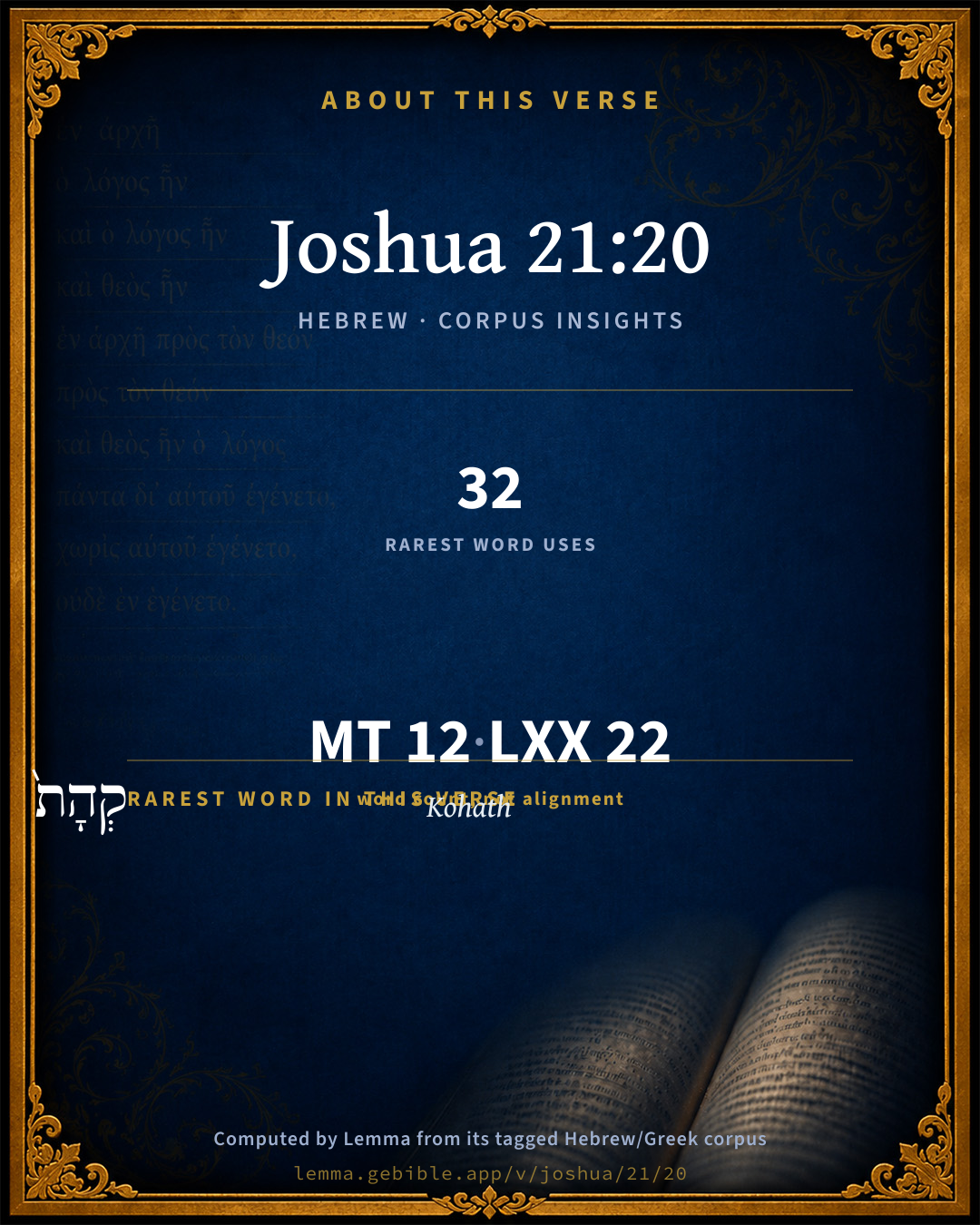
קְהָת֙ Kohath H6955 occurs in 29 verses of the Hebrew Bible. Also found in:

Grammatical profile

  • 2 verbs
  • 10 nouns

Verb forms

  • הַנּוֹתָרִ֖ים Niphal · Participle Active
  • וַֽיְהִי֙ Qal · Sequential Imperfect

Repetition

Words recur within this verse — often emphatic in Hebrew:

  • בְּנֵֽי son H1121 ×2
  • קְהָת֙ Kohath H6955 ×2

Hebrew & Septuagint length

In English translation the verse runs 30 words from the Hebrew and 25 from the Septuagint (LXX English) — closely comparable.

A rough comparison of the two English renderings, which tokenize alike — not a word-level alignment.

Word counts can differ between the Hebrew and the Greek without any difference in meaning — e.g. the Hebrew direct-object marker אֵת has no separate Greek word, and Greek often adds the article ὁ.

In the original languages it is 12 Hebrew tokens and 22 Greek tokens — but the two are counted differently (Hebrew bundles its prefixes and suffixes into one token; the Greek is in lemma form), so that isn’t a like-for-like length.

Cross-references

2

Topical passages linked to Joshua 21:20 in the Treasury of Scripture Knowledge — connected by theme and wording, ordered by reader-vote popularity; previews shown in the World English Bible.

  • 1 Chronicles 6:66 Some of the families of the sons of Kohath had cities of their borders out of the tribe of Ephraim.
  • Joshua 21:5 The rest of the children of Kohath had by lot out of the families of the tribe of Ephraim, and out of the tribe of Dan, and out of the half-tribe of Manasseh, ten cities.

Cross-references courtesy of OpenBible.info (CC BY 4.0).

Hebrew and Greek witnesses Masoretic Hebrew ↔ Greek Septuagint

The same verse in the two great witnesses to the Old Testament, shown verse-for-verse.

These are two independent witnesses, not word-aligned to each other, and the Septuagint is shown in lemma (dictionary) form.

Hebrew Joshua 21:20 Masoretic · Westminster Leningrad Codex

וּלְמִשְׁפְּח֤וֹת בְּנֵֽי קְהָת֙ הַלְוִיִּ֔ם הַנּוֹתָרִ֖ים מִבְּנֵ֣י קְהָ֑ת וַֽיְהִי֙ עָרֵ֣י גֽוֹרָלָ֔ם מִמַּטֵּ֖ה אֶפְרָֽיִם

The families of the children of Kohath, the Levites, even the rest of the children of Kohath, they had the cities of their lot out of the tribe of Ephraim.

World English Bible · Public Domain

Greek LXX Joshua 21:20 Septuagint · lemma form

καί ὁ δῆμος υἱός κααθ ὁ λευίτης ὁ καταλείπω ἀπό ὁ υἱός κααθ καί γίγνομαι πόλις ὁ ὅριον αὐτός ἀπό φυλή ἐφράιμ

And to the families, even the sons of Caath the Levites, that were left of the sons of Caath, there was given their priests' city,

LXX2012 (modern English Septuagint) · Public Domain

Hebrew: Westminster Leningrad Codex (CC BY 4.0). Greek: Septuagint (public domain); English from LXX2012 (modern English Septuagint) (Public Domain). How the Septuagint differs from the Hebrew →

Targum (Aramaic paraphrase)

1

The Targum is the ancient Jewish Aramaic paraphrase of the Hebrew Scriptures — an interpretive translation, not the Hebrew text itself. Onkelos (literal) and Pseudo-Jonathan (expansive) render the Torah, and Jonathan the Prophets. Coverage is partial: where no permissively-licensed English translation exists for a verse, only the Aramaic is shown. This is verse-level text, not a word-by-word alignment to the Hebrew.

  1. Targum Jonathan Prophets (Joshua–Malachi)
    וּלְזַרְעֲיַת בְּנֵי קְהָת לְוָאֵי דְאִשְׁתָּאֲרוּ מִבְּנֵי קְהָת וַהֲוָאָה קִרְוֵי עַדְבֵיהוֹן מִשִׁבְטָא דִבְנֵי אֶפְרָיִם:

    (no public-domain English translation for this verse)

    Targum Jonathan — Aramaic: “Mikraot Gedolot” (public domain). English: “Sefaria Community Translation” (CC0 1.0 (public-domain dedication)); “London "Chaldee Paraphrase," 1871” (public domain). Text via Sefaria.

Commentary

Notes on Joshua 21:20 from classic Christian and Jewish commentators (each source and its license shown beneath its notes). The classic Christian expositions comment on the surrounding passage and are grouped to its opening verse, so a note may address several verses; the Jewish commentaries on the Tanakh (Rashi and others) are per-verse, so they appear only where the commentator wrote on this verse.

Lemma curates 59 commentaries, every one of them public domain or Creative Commons licensed, each selected and text-cleaned for this edition rather than reprinted as found. About our sources →

Joseph Benson's Commentary

Jos 21:20. Which remained — Over and above those who were priests.

Joseph Benson's Commentary on the Old and New Testaments (1811–1818) — public domain. Text from a community e-Sword module.

Geneva Bible (1599)

Geneva Bible translators

That were not Priests.

Geneva Bible (1599) marginal notes — public domain. Text via Bolls.life.

John Calvin's Commentaries

20. And the families of the children of Kohath, etc Why it was necessary that the Levites should be dispersed among the different tribes, the reader may see in my Commentaries on the Books of Moses. This dispersion had, indeed, been imposed on their progenitor as a punishment for the cruelty and perfidy of which he had been guilty toward the children of Shechem, but the disgrace of it had been converted into the highest honor by their appointment as a kind of guardians in every district to retain the people in the pure worship of God. It is true, they were everywhere strangers; but still it was with the very high dignity of acting as stewards for God, and preventing their countrymen from revolting from piety. This is the reason for stating so carefully how many cities they obtained from each tribe; they were everywhere to keep watch, and preserve the purity of sacred rites unimpaired.

John Calvin's Commentaries (1540-1563) — public domain. Text from the Calvin Translation Society English edition (1840s-50s) via the Christian Classics Ethereal Library (ccel.org). Calvin's coverage is partial (roughly two-thirds of the Bible); uncommented books and verses are honest gaps, never fabricated. The 19th-century editor's footnotes and remarks are omitted so the notes are faithfully Calvin's own voice.

The Cambridge Bible for Schools and Colleges

gen. ed. J. J. S. Perowne

20–26. Cities of the rest of the Kohathites

20. And the families of the children of Kohath] i. e. those who were not of the priestly order, received

(a) Four cities in Ephraim,

(b) Four in Dan,

(c) Two in Western Manasseh.

The Cambridge Bible for Schools and Colleges (gen. ed. J. J. S. Perowne; Cambridge University Press, 1878–1918) — public domain. Text from a community e-Sword module.

John Gill's Exposition

And the families of the children of Kohath, the Levites,.... Who were not priests:

which remained of the children of Kohath; these are the children of Moses, as Jarchi says, and those that descended from Kohath in the lines of Izhar, Hebron, and Uzziel:

even they had the cities of their lot out of the tribe of Ephraim; and were as follow.

John Gill's Exposition of the Whole Bible (1746–1763) — public domain (CC PDM 1.0). Text via the HelloAO Bible API.

Albert Barnes' Notes on the Bible

Of the cities of the non-priestly Kohathites, for Kibzaim we find Jokmeam in 1Ch 6:68. This is perhaps another name for the same place, since both names may be derived from roots having a similar meaning; and for Gath-rimmon in 1Ch 6:70, Bileam is given, and probably correctly; Gath-rimmon having apparently been repeated inadvertently from the preceding verse. Bileam is but another form of Ibleam Jos 17:11.

Albert Barnes' Notes on the Bible (1834–1885) — public domain. Text from a community e-Sword/MySword module.

Matthew Poole's English Annotations

The families which remained of the children of Kohath, over and above those of them who were priests.

Matthew Poole's English Annotations on the Holy Bible (1683–1685) — public domain. Text from a community e-Sword/MySword module.

John Wesley's Explanatory Notes

Which remained - Over and above those who were priests.

John Wesley, Explanatory Notes Upon the Whole Bible (1754–1765) — public domain. Text via the GEBible commentary corpus.

Kretzmann's Popular Commentary

Paul E. Kretzmann

The Cities of the Kohathites, the Gershonites, and the Merabites

v. 20. And the families of the children of Kohath, the descendants of Izhar, Hebron, and Uzziel, and of Moses, the Levites which remained of the children of Kohath, namely, after the priests, the children of Aaron, had received their allotment, even they had the cities of their lot out of the tribe of Ephraim.

v. 21. For they gave them, the Levites,Shechem with her suburbs in Mount Ephraim, to be a city of refuge for the slayer, Jos 20:7; and Gezer with her suburbs,

v. 22. and Kibzaim with her suburbs, and Beth-horon with her suburbs: four cities.

v. 23. And out of the tribe of Dan, El-tekeh with her suburbs, Gibbe-thon with her suburbs,

v. 24. Aijalon with her suburbs, Gath-rimmon with her suburbs, four cities.

v. 25. And out of the half tribe of Manasseh, west of Jordan, Tanach with her suburbs, and Gath-rimmon, or, Bileam (Ibleam), with her suburbs, Jos 17:11: two cities.

v. 26. All the cities were ten with their suburbs, their meadow-lands, for the families of the children of Kohath that remained.

v. 27. and unto the children of Gershon, of the families of the Levites, out of the other half tribe of Manasseh, east of Jordan, they gave Golan in Bashan with her suburbs, to be a city of refuge for the slayer, Jos 20:8; and Beesh-terah with her suburbs: two cities.

v. 28. And out of the tribe of Issachar, Kishon with her suburbs, Dabareh with her suburbs,

v. 29. Jarmuth with her suburbs, En-gan-nim with her suburbs, Jos 19:12-21: four cities.

v. 30. And out of the tribe of Asher, Mishal with her suburbs, Abdon with her suburbs,

v. 31. Helkath with her suburbs, and Rehob with her suburbs, Jos 19:25-28: four cities.

v. 32. And out of the tribe of Naphtali, Kedesh in Galilee with her suburbs, to be a city of refuge for the slayer, Jos 20:7; and Hammoth-dor with her suburbs, and Kartan with her suburbs, Jos 19:35-37: three cities.

v. 33. All the cities of the Gershonites according to their families were thirteen cities with their suburbs.

v. 34. And unto the families of the children of Merari, the rest of the Levites, the last family to be supplied, out of the tribe of Zebulun, Jokneam with her suburbs and Kartah with her suburbs,

v. 35. Dimnah, or Rimmono, with her suburbs, Nahalal, or Tabor, with her suburbs, Jos 19:11-15: four cities.

v. 36. And out of the tribe of Reuben, Bezer, with her suburbs, and Jahazah with her suburbs,

v. 37. Kedemoth with her suburbs, and Mephaath with her suburbs, Jos 20:8; Jos 13:18; Deu 4:43: four cities.

v. 38. And out of the tribe of Gad, in Southern Gilead, Ramoth in Gilead with her suburbs, to be a city of refuge for the slayer; and Mahanaim with her suburbs,

v. 39. Heshbon with her suburbs, Jazer with her suburbs, Jos 20:8; Jos 13:17-26: four cities in all.

v. 40. So all the cities for the children of Merari by their families, which were remaining of the families of the Levites, were by their lot twelve cities.

v. 41. All the cities of the Levites within the possession of the children of Israel were forty and eight cities with their suburbs, including the six cities set apart as cities of refuge.

v. 42. These cities were every one with their suburbs round about them, the meadow-land was distinctly included for the perpetual use of the Levites; thus were all these cities.

v. 43. And the Lord, by this distribution of the country, gave unto Israel all the land which He sware to give unto their fathers, Gen 12:7; Gen 15:18; Num 11:12; Deu 21:12; and they possessed it and dwelt therein.

v. 44. And the Lord gave them rest round about, all the heathen nations being subdued for the time being, according to all that He sware unto their fathers; and there stood not a man of all their enemies before them, not one was able to offer a successful resistance; the Lord delivered all their enemies into their hand. Although not entirely subjugated, the enemies were in a condition where they dared no enterprise against the Israelites while Joshua lived.

v. 45. There failed not aught of any good thing which the Lord had spoken unto the house of Israel; all came to pass. God is always faithful in His promises, but we, through unbelief and indifference, stand in His way. Perfection, true happiness, lasting joy, will be ours in the rest of yonder life, Hebrews 4.

Paul E. Kretzmann, Popular Commentary of the Bible (1921–1924) — public domain. Text from a community e-Sword module.

unfoldingWord translationNotes

Door43 World Missions Community

the Kohathite clans

The priests in this group were descendants of Levi's son Kohath. A portion of them were also descendants of Aaron, Kohath's grandson. (See: How to Translate Names)

they had cities given to them

This can be stated in active form. AT: "they received cities" (See: Active or Passive)

casting of lots

A random method of choosing to remove the choice from the leader's will, often done with the idea that God will decide the outcome. See how you translated this in Joshua 19:1.

Gezer ... Kibzaim ... Beth Horon

names of cities (See: How to Translate Names)

four cities in all

This refers to the list by the total number. (See: Numbers)

translationWords

family

Ephraim

Shechem

refuge

unfoldingWord translationNotes — © Distant Shores Media and the Door43 World Missions Community, licensed CC BY-SA 4.0. Source: git.door43.org/Door43/en_tn.

Lesson kit

Teaching starters — assembled from the data on this page, not authored interpretation. Every prompt links to the verse data it draws on. Edit before teaching.

Joshua, in the Historical, opens this verse with 12 words (10 distinct Hebrew lemmas). Its most distinctive word is Qᵉhâth (“Kohath”). A historical commentator’s framing appears above. Read the whole chapter for the surrounding context.

Discussion questions

  1. The word Qᵉhâth carries the sense “Kohath.” How does it shape the verse?
  2. How does Genesis 46:11, which shares the word «Kohath», read alongside this verse?
  3. What does the repetition of “son” (2× in this one verse) do in this verse?
  4. These translations render this verse differently; the difference is in the English rendering, not the original. What questions does that raise?
  5. «הַנּוֹתָרִ֖ים» is a Niphal Participle Active verb. How does that grammatical form shape the action described?
  6. Compare how Joseph Benson's Commentary and Geneva Bible (1599) read this verse. Where do they agree or differ?

Things to notice

Reading settings

Reading text

Shown beneath each verse's original-language words.

Old Testament
Old Testament edition

Read the OT as the Masoretic Hebrew (MT) or the Greek Septuagint (LXX).

English shown for the Greek Septuagint (in the Hebrew ↔ Greek comparison).

Comparing translations? Open the Compare panel on any verse page to stack up to four side by side.