
Zechariah 9:10

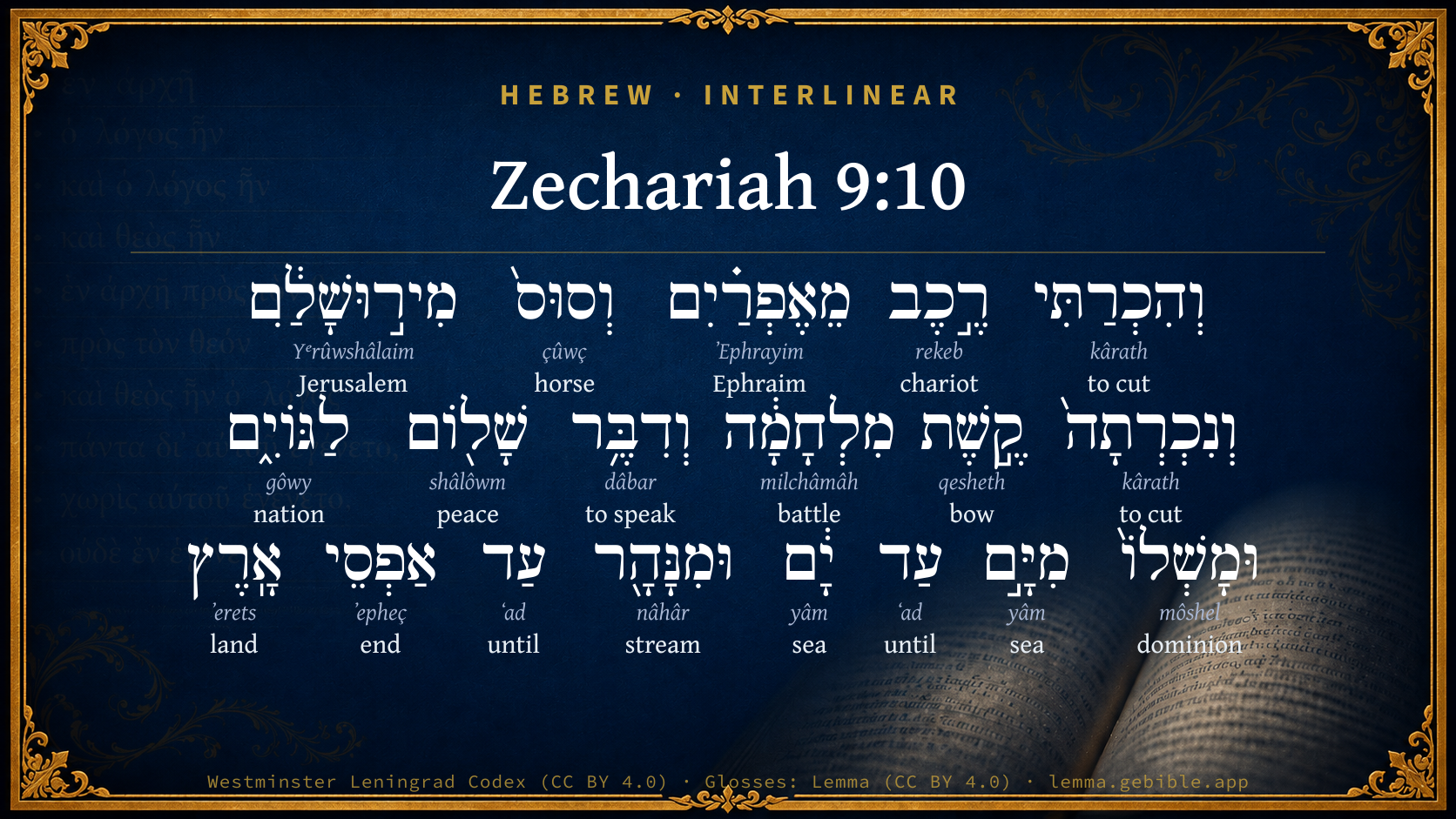
Hebrew (Westminster Leningrad Codex) Zechariah 9:10 appears in the Hebrew Old Testament. The text above is from the Westminster Leningrad Codex. Each word links to its Strong’s number, a concise gloss, and parsing drawn from the Open Scriptures Hebrew Bible morphology. Click any word for its full Brown-Driver-Briggs (BDB) entry.
Download image
Cite this verse

Zechariah 9:10 (World English Bible). Public Domain. Lemma interlinear Bible study tool, https://lemma.gebible.app/v/zechariah/9/10.

Show BibTeX & RIS
BibTeX
RIS
English Translation
I will cut off the chariot from Ephraim, And the horse from Jerusalem; And the battle bow will be cut off; And he will speak peace to the nations: And his dominion will be from sea to sea, And from the River to the ends of the earth.
World English Bible · Public Domain
Download a study sheet

One document with this verse’s original text, its word-by-word gloss line, the meaning frame, cross-references with their text, attributed commentary, and full source and license credits — printable, and it pastes into notes with its structure intact.

This verse Autodidact and up

Study sheet (.html) Plain text (.txt)

A passage Seminary Student

Up to 50 verses in one chapter. A passage sheet keeps up to 6 commentary sources and 12 cross-references per verse, in the order this page ranks them, and says so on the sheet whenever that leaves anything out. Ask for a single verse and you get the Autodidact verse sheet above.

Everything on this page stays free to read, with no account — the sheet is a download of what is already on screen, not access to it.

Want to remove ads? Support Godless Engineer
Compare translations 3

The same verse in 3 English versions, stacked beneath the original-language interlinear above. Click any original word for its lexicon entry.

Each is an independent rendering of the whole verse — the interlinear is not word-aligned to these translations.

Highlighted words mark where these versions differ — a whole-verse word diff, not a word-by-word alignment.

  • World English Bible Public Domain
    I will cut off the chariot from Ephraim, And the horse from Jerusalem; And the battle bow will be cut off; And he will speak peace to the nations: And his dominion will be from sea to sea, And from the River to the ends of the earth.
  • King James Version Public Domain
    And I will cut off the chariot from Ephraim, and the horse from Jerusalem, and the battle bow shall be cut off: and he shall speak peace unto the heathen: and his dominion shall be from sea even to sea, and from the river even to the ends of the earth.
  • unfoldingWord Literal Text CC BY-SA 4.0
    Then I will cut off the chariot from Ephraim and the horse from Jerusalem, and the bow will be cut off from battle; for he will speak peace to the nations, and his dominion from sea to sea, and from the River to the ends of the earth!

unfoldingWord Literal Text — © unfoldingWord, licensed CC BY-SA 4.0. Word-aligned USFM3 via Door43 (git.door43.org/unfoldingWord/en_ult).

Versions to compare (up to 4)

3 of 4 selected

Show all 18 translations

Every available English version of this verse, each an independent rendering of the whole verse.

  • World English Bible Public Domain
    I will cut off the chariot from Ephraim, And the horse from Jerusalem; And the battle bow will be cut off; And he will speak peace to the nations: And his dominion will be from sea to sea, And from the River to the ends of the earth.
  • Berean Standard Bible Public Domain
    And I will cut off the chariot from Ephraim and the horse from Jerusalem, and the bow of war will be broken. Then He will proclaim peace to the nations. His dominion will extend from sea to sea, and from the Euphrates to the ends of the earth.
  • Majority Standard Bible Public Domain
    And I will cut off the chariot from Ephraim and the horse from Jerusalem, and the bow of war will be broken. Then He will proclaim peace to the nations. His dominion will extend from sea to sea, and from the Euphrates to the ends of the earth.
  • King James Version Public Domain
    And I will cut off the chariot from Ephraim, and the horse from Jerusalem, and the battle bow shall be cut off: and he shall speak peace unto the heathen: and his dominion shall be from sea even to sea, and from the river even to the ends of the earth.
  • American Standard Version (1901) Public Domain
    And I will cut off the chariot from Ephraim, and the horse from Jerusalem; and the battle bow shall be cut off; and he shall speak peace unto the nations: and his dominion shall be from sea to sea, and from the River to the ends of the earth.
  • Revised Version (1885) Public Domain
    And I will cut off the chariot from Ephraim, and the horse from Jerusalem, and the battle bow shall be cut off; and he shall speak peace unto the nations: and his dominion shall be from sea to sea, and from the River to the ends of the earth.
  • Geneva Bible (1599) Public Domain
    And I wil cut off the charets from Ephraim, and the horse from Ierusalem: the bowe of the battel shalbe broken, and he shall speake peace vnto the heathen, and his dominion shalbe from sea vnto sea, and from the Riuer to the end of the land.
  • Douay-Rheims (1899) Public Domain
    And I will destroy the chariot out of Ephraim, and the horse out of Jerusalem, and the bow for war shall be broken: and he shall speak peace to the Gentiles, and his power shall be from sea to sea, and from the rivers even to the end of the earth.
  • Young's Literal Translation Public Domain
    And I have cut off the chariot from Ephraim, And the horse from Jerusalem, Yea, cut off hath been the bow of battle, And he hath spoken peace to nations, And his rule `is' from sea unto sea, And from the river unto the ends of earth.
  • Literal Standard Version CC BY-SA 4.0
    And I have cut off the chariot from Ephraim, || And the horse from Jerusalem, || Indeed, the bow of battle has been cut off, || And He has spoken peace to nations, || And His rule [is] from sea to sea, || And from the river to the ends of the earth.
  • Unlocked Literal Bible CC BY-SA 4.0
    Then I will cut off the chariot from Ephraim and the horse from Jerusalem, and the bow will be cut off from battle; for he will speak peace to the nations, and his dominion will be from sea to sea, and from the River to the ends of the earth!
  • unfoldingWord Literal Text CC BY-SA 4.0
    Then I will cut off the chariot from Ephraim and the horse from Jerusalem, and the bow will be cut off from battle; for he will speak peace to the nations, and his dominion from sea to sea, and from the River to the ends of the earth!
  • Darby Bible Public Domain
    And I will cut off the chariot from Ephraim, and the horse from Jerusalem; and the battle-bow shall be cut off. And he shall speak peace unto the nations; and his dominion shall be from sea to sea, and from the river to the ends of the earth.
  • World Messianic Bible Public Domain
    I will cut off the chariot from Ephraim and the horse from Jerusalem. The battle bow will be cut off; and he will speak peace to the nations. His dominion will be from sea to sea, and from the River to the ends of the earth.
  • Webster's Bible Public Domain
    And I will cut off the chariot from Ephraim, and the horse from Jerusalem, and the battle-bow shall be cut off: and he shall speak peace to the heathen: and his dominion shall be from sea to sea, and from the river to the ends of the earth.
  • Free Bible Version CC BY-SA 4.0
    (I will remove the chariots from Ephraim and the warhorses from Jerusalem. I will destroy the bows used in battle.) He will proclaim peace to the nations, and he will rule from sea to sea, from the Euphrates River to the ends of the earth.
  • Bible in Basic English Public Domain
    And he will have the war-carriage cut off from Ephraim, and the horse from Jerusalem, and the bow of war will be cut off: and he will say words of peace to the nations: and his rule will be from sea to sea, and from the River to the ends of the earth.
  • JPS Tanakh (1917) Public Domain
    And I will cut off the chariot from Ephraim, and the horse from Jerusalem, and the battle bow shall be cut off, and he shall speak peace unto the nations; and his dominion shall be from sea to sea, and from the River to the ends of the earth.

Literal Standard Version (2020), Covenant Press — licensed CC BY-SA 4.0. Text via the HelloAO Bible API (eBible.org). Unlocked Literal Bible (unfoldingWord) — licensed CC BY-SA 4.0. Text via the HelloAO Bible API (eBible.org). unfoldingWord Literal Text — © unfoldingWord, licensed CC BY-SA 4.0. Word-aligned USFM3 via Door43 (git.door43.org/unfoldingWord/en_ult). Free Bible Version, Dr. Jonathan Gallagher — licensed CC BY-SA 4.0. Text via the HelloAO Bible API (eBible.org).

Word by word

More ways to search: Search by grammar → Find every occurrence → Compare this word →

Practice this passage: Drill this verse → Learn its vocabulary →

וּמָשְׁלוֹ֙
môshel
H4915
“and · dominion · his”
Conjunction + Noun, Common, Masculine, Singular, Construct + Suffix, Personal, 3rd Person, Masculine, Singular
Part of Speech
Conjunction + Noun
Type
Common
Gender
Masculine
Number
Singular
State
Construct
Full BDB Definition

Origin: from H4910

TWOT: 1259a

dominion - likeness, one like, similitude
  1. וְהִכְרַתִּי kârath H3772 “and · to cut” Conjunction + Verb, Hiphil, Perfect, 1st Person, Common, Singular
  2. רֶ֣כֶב rekeb H7393 “chariot” Noun, Common, Masculine, Singular, Absolute
  3. מֵאֶפְרַ֗יִם ʼEphrayim H669 “from · Ephraim” Preposition + Noun, Proper
  4. וְסוּס֙ çûwç H5483 “and · horse” Conjunction + Noun, Common, Masculine, Singular, Absolute
  5. מִיר֣וּשָׁלִַ֔ם Yᵉrûwshâlaim H3389 “from · Jerusalem” Preposition + Noun, Proper
  6. וְנִכְרְתָה֙ kârath H3772 “and · to cut” Conjunction + Verb, Niphal, Perfect, 3rd Person, Feminine, Singular
  7. קֶ֣שֶׁת qesheth H7198 “bow of” Noun, Common, Feminine, Singular, Construct
  8. מִלְחָמָ֔ה milchâmâh H4421 “battle” Noun, Common, Feminine, Singular, Absolute
  9. וְדִבֶּ֥ר dâbar H1696 “and · to speak” Conjunction + Verb, Piel, Perfect, 3rd Person, Masculine, Singular
  10. שָׁל֖וֹם shâlôwm H7965 “peace” Noun, Common, Masculine, Singular, Absolute
  11. לַגּוֹיִ֑ם gôwy H1471 “to/for the · nations” Preposition, Determined + Noun, Common, Masculine, Plural, Absolute
  12. מִיָּ֣ם yâm H3220 “from · sea” Preposition + Noun, Common, Masculine, Singular, Absolute
  13. עַד ʻad H5704 “until” Preposition
  14. יָ֔ם yâm H3220 “sea” Noun, Common, Masculine, Singular, Absolute
  15. וּמִנָּהָ֖ר nâhâr H5104 “and · from · stream” Conjunction + Preposition + Noun, Common, Masculine, Singular, Absolute
  16. עַד ʻad H5704 “until” Preposition
  17. אַפְסֵי ʼepheç H657 “ends of” Noun, Common, Masculine, Plural, Construct
  18. אָֽרֶץ ʼerets H776 “land” Noun, Common, Both, Singular, Absolute

About this verse

These counts appear in no published source. They are computed here, from the morphology-tagged text and Lemma’s own curated glosses. What Lemma adds →

19
words
16
distinct lemmas
Prophets
section

Notable vocabulary

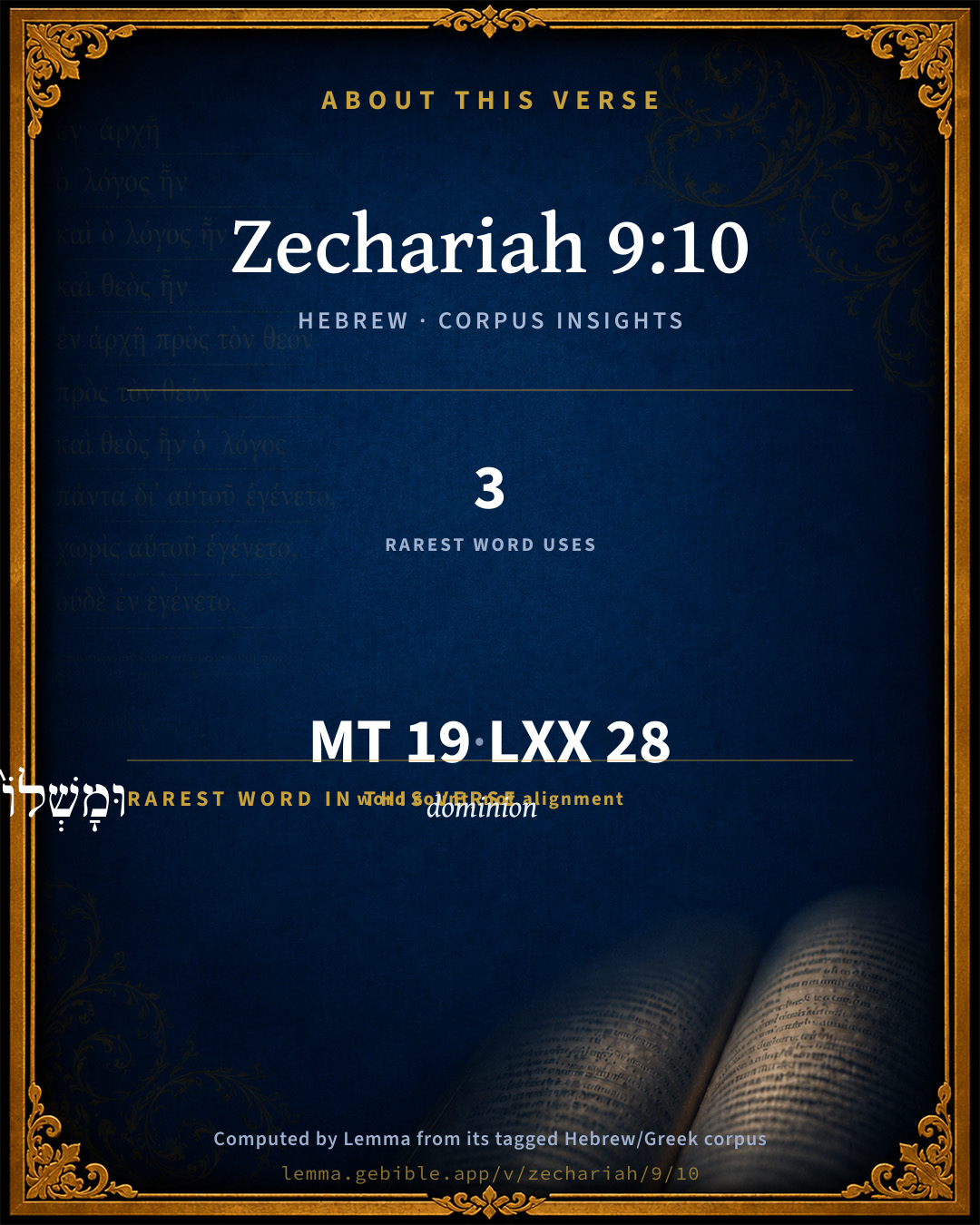
The rarest word here is וּמָשְׁלוֹ֙ dominion H4915 — appearing just 3 times in the whole Hebrew Bible.

Shared distinctive vocabulary

וּמָשְׁלוֹ֙ dominion H4915 occurs in 3 verses of the Hebrew Bible. Also found in:

Grammatical profile

  • 3 verbs
  • 14 nouns
  • 2 prepositions

Verb forms

  • וְהִכְרַתִּי Hiphil · Perfect
  • וְנִכְרְתָה֙ Niphal · Perfect
  • וְדִבֶּ֥ר Piel · Perfect

Repetition

Words recur within this verse — often emphatic in Hebrew:

  • וְהִכְרַתִּי to cut H3772 ×2
  • מִיָּ֣ם sea H3220 ×2
  • עַד until H5704 ×2

Hebrew & Septuagint length

In English translation the verse runs 48 words from the Hebrew and 56 from the Septuagint (LXX English) — closely comparable.

A rough comparison of the two English renderings, which tokenize alike — not a word-level alignment.

Word counts can differ between the Hebrew and the Greek without any difference in meaning — e.g. the Hebrew direct-object marker אֵת has no separate Greek word, and Greek often adds the article ὁ.

In the original languages it is 19 Hebrew tokens and 28 Greek tokens — but the two are counted differently (Hebrew bundles its prefixes and suffixes into one token; the Greek is in lemma form), so that isn’t a like-for-like length.

Cross-references

27

Topical passages linked to Zechariah 9:10 in the Treasury of Scripture Knowledge — connected by theme and wording, ordered by reader-vote popularity; previews shown in the World English Bible.

  • Hosea 1:7 But I will have mercy on the house of Judah, and will save them by Yahweh their God, and will not save them by bow, nor by sword, nor by battle, by horses, nor by horsemen."
  • Hosea 2:18 In that day I will make a covenant for them with the animals of the field, And with the birds of the sky, And with the creeping things of the ground. I will break the bow, the sword, and the battle out of the land, And will make them lie down safely.
  • 2 Corinthians 10:4–5 for the weapons of our warfare are not of the flesh, but mighty before God to the throwing down of strongholds,
  • Psalms 72:7–11 In his days, the righteous shall flourish, And abundance of peace, until the moon is no more.
  • Colossians 1:20–21 and through him to reconcile all things to himself, by him, whether things on the earth, or things in the heavens, having made peace through the blood of his cross.
  • Revelation 11:15 The seventh angel sounded, and great voices in heaven followed, saying, "The kingdom of the world has become the Kingdom of our Lord, and of his Christ. He will reign forever and ever!"
  • Psalms 2:8–12 Ask of me, and I will give the nations for your inheritance, The uttermost parts of the earth for your possession.
  • Isaiah 9:6–7 For to us a child is born, to us a son is given; and the government shall be on his shoulder: and his name shall be called Wonderful, Counselor, Mighty God, Everlasting Father, Prince of Peace.
  • Isaiah 49:6 yes, he says, It is too light a thing that you should be my servant to raise up the tribes of Jacob, and to restore the preserved of Israel: I will also give you for a light to the Gentiles, that you may be my salvation to the end of the earth.
  • Isaiah 57:18–19 I have seen his ways, and will heal him: I will lead him also, and restore comforts to him and to his mourners.
  • Isaiah 60:12 For that nation and kingdom that will not serve you shall perish; yes, those nations shall be utterly wasted.
  • Micah 4:2–4 Many nations will go and say, "Come, and let us go up to the mountain of Yahweh, And to the house of the God of Jacob; And he will teach us of his ways, And we will walk in his paths." For out of Zion will go forth the law, And the word of Yahweh from Jerusalem;
  • Micah 5:4 He shall stand, and shall shepherd in the strength of Yahweh, In the majesty of the name of Yahweh his God: And they will live, for then he will be great to the ends of the earth.
  • Micah 5:10–11 "It will happen in that day," says Yahweh, "That I will cut off your horses out of the midst of you, And will destroy your chariots.
  • Ephesians 2:13–17 But now in Christ Jesus you who once were far off are made near in the blood of Christ.
  • Deuteronomy 11:24 Every place whereon the sole of your foot shall tread shall be yours: from the wilderness, and Lebanon, from the river, the river Euphrates, even to the hinder sea shall be your border.
  • Psalms 72:3 The mountains shall bring prosperity to the people. The hills bring the fruit of righteousness.
  • Psalms 72:17 His name endures forever. His name continues as long as the sun. Men shall be blessed by him. All nations will call him blessed.
  • Psalms 98:1–3 Sing to Yahweh a new song, For he has done marvelous things! His right hand, and his holy arm, have worked salvation for him.
  • Isaiah 11:10 It shall happen in that day, that the root of Jesse, who stands for an ensign of the peoples, to him shall the nations seek; and his resting-place shall be glorious.
  • Haggai 2:22 I will overthrow the throne of kingdoms. I will destroy the strength of the kingdoms of the nations. I will overthrow the chariots, and those who ride in them. The horses and their riders will come down, everyone by the sword of his brother.
  • Zechariah 10:4–5 From him will come forth the corner-stone, From him the nail, From him the battle bow, From him every ruler together.
  • Acts 10:36 The word which he sent to the children of Israel, preaching good news of peace by Jesus Christ--he is Lord of all--
  • Romans 15:9–13 and that the Gentiles might glorify God for his mercy. As it is written, "Therefore will I give praise to you among the Gentiles, And sing to your name."
  • 2 Corinthians 5:18 But all things are of God, who reconciled us to himself through Jesus Christ, and gave to us the ministry of reconciliation;
  • 2 Corinthians 5:20 We are therefore ambassadors on behalf of Christ, as though God were entreating by us. We beg you on behalf of Christ, be reconciled to God.
  • 1 Kings 4:21 Solomon ruled over all the kingdoms from the River to the land of the Philistines, and to the border of Egypt: they brought tribute, and served Solomon all the days of his life.

Cross-references courtesy of OpenBible.info (CC BY 4.0).

Hebrew and Greek witnesses Masoretic Hebrew ↔ Greek Septuagint

The same verse in the two great witnesses to the Old Testament, shown verse-for-verse.

These are two independent witnesses, not word-aligned to each other, and the Septuagint is shown in lemma (dictionary) form.

Hebrew Zechariah 9:10 Masoretic · Westminster Leningrad Codex

וְהִכְרַתִּי רֶ֣כֶב מֵאֶפְרַ֗יִם וְסוּס֙ מִיר֣וּשָׁלִַ֔ם וְנִכְרְתָה֙ קֶ֣שֶׁת מִלְחָמָ֔ה וְדִבֶּ֥ר שָׁל֖וֹם לַגּוֹיִ֑ם וּמָשְׁלוֹ֙ מִיָּ֣ם עַד יָ֔ם וּמִנָּהָ֖ר עַד אַפְסֵי אָֽרֶץ

I will cut off the chariot from Ephraim, And the horse from Jerusalem; And the battle bow will be cut off; And he will speak peace to the nations: And his dominion will be from sea to sea, And from the River to the ends of the earth.

World English Bible · Public Domain

Greek LXX Zechariah 9:10 Septuagint · lemma form

καί ἐκὀλεθρεύω ἅρμα ἐκ ἐφράιμ καί ἵππος ἐκ ἰερουσαλήμ καί ἐκὀλεθρεύω τόξον πολεμικός καί πλῆθος καί εἰρήνη ἐκ ἔθνος καί καταἄρχω ὕδωρ ἕως θάλασσα καί ποταμός διεκβολή γῆ

And he shall destroy the chariots out of Ephraim, and the horse out of Jerusalem, and the bow of war shall be utterly destroyed; and there shall be abundance and peace out of the nations; and he shall rule over the waters as far as the sea, and the rivers to the ends of the earth.

LXX2012 (modern English Septuagint) · Public Domain

Hebrew: Westminster Leningrad Codex (CC BY 4.0). Greek: Septuagint (public domain); English from LXX2012 (modern English Septuagint) (Public Domain). How the Septuagint differs from the Hebrew →

Targum (Aramaic paraphrase)

1

The Targum is the ancient Jewish Aramaic paraphrase of the Hebrew Scriptures — an interpretive translation, not the Hebrew text itself. Onkelos (literal) and Pseudo-Jonathan (expansive) render the Torah, and Jonathan the Prophets. Coverage is partial: where no permissively-licensed English translation exists for a verse, only the Aramaic is shown. This is verse-level text, not a word-by-word alignment to the Hebrew.

  1. Targum Jonathan Prophets (Joshua–Malachi)
    וֶאֱשֵׁיצֵי רְתִיכִין מֵאֶפְרַיִם וְסוּסְוָן מִירוּשְׁלֵם וְאִתְבַר תְּקוֹף עָבְדֵי קְרָב מַשִׁירְיַת עַמְמַיָא וִידִין שְׁלָמָא לְמַלְכוּתָא וְיִשְׁלוֹט מִיַמָא עַד מַעַרְבָא וּמִפְּרַת עַד סְיָפֵי אַרְעָא:

    (no public-domain English translation for this verse)

    Targum Jonathan — Aramaic: “Mikraot Gedolot” (public domain). English: “Sefaria Community Translation” (CC0 1.0 (public-domain dedication)); “London "Chaldee Paraphrase," 1871” (public domain). Text via Sefaria.

Commentary

Notes on Zechariah 9:10 from classic Christian and Jewish commentators (each source and its license shown beneath its notes). The classic Christian expositions comment on the surrounding passage and are grouped to its opening verse, so a note may address several verses; the Jewish commentaries on the Tanakh (Rashi and others) are per-verse, so they appear only where the commentator wrote on this verse.

Lemma curates 59 commentaries, every one of them public domain or Creative Commons licensed, each selected and text-cleaned for this edition rather than reprinted as found. About our sources →

Trapp's Complete Commentary

John Trapp

Zec 9:10 And I will cut off the chariot from Ephraim, and the horse from Jerusalem, and the battle bow shall be cut off: and he shall speak peace unto the heathen: and his dominion [shall be] from sea [even] to sea, and from the river [even] to the ends of the earth.

Ver. 10. And I will cut off the chariot, &c.] This is the same in effect with that of Isa 9:7 "Of the increase of Christ’s government and peace there shall be no end"; and Isa 2:4 "They shall beat their swords into plowshares, and their spears into pruninghooks: nation shall not lift up sword against nation, neither shall they learn war any more." Christ was born in the reign of Augustus Caesar, then when having vanquished Lepidus, Antony, and the rest of his enemies both at home and abroad, he set open the gates of Janus in token of a universal peace, and reigned as lord and monarch of the Roman world Polydor Virgil out of Orosius tells us that the self-same day wherein Christ was born Augustus Caesar made proclamation that no man should thenceforth give him the title of Lord, manifesto praesagio maioris dominatus qui tum in terris ortus est, saith he, not without a manifest presage of a greater lord than himself then born into the world; greater, 1. Both for the peaceableness of his government, as here; no use of weapons or warlike engines. "The weapons of our warfare are not carnal, but spiritual," 2Co 10:4. Christ shall bring both to Jews and Gentiles the gospel of peace and the peace of the gospel:

He shall speak peace unto the heathen] Peace of country and peace of conscience too: and, 2. For the extent of his government it should be as large as the world, a Catholic kingdom.

His dominion shall be from sea to sea] From the Red Sea to the Mediterranean Sea, or the Sea of Palestine; for these two seas were the bounds of the land of Canaan, Num 34:6; Num 34:12, for the Jews scarcely knew any other sea but these two. And the prophet here alludeth to the times of Solomon’s reign, as appears by Psa 72:8 "He shall have dominion also from sea to sea, and from the river unto the ends of the earth"; that is, from Euphrates to the utmost bounds of the Holy Land, which by a common custom of speech are put for the utmost quarters of the world.

John Trapp, A Commentary or Exposition upon All the Books of the Old and New Testament (1647–1656) — public domain. Text from a community e-Sword module.

Joseph Benson's Commentary

Zec 9:10. And I will cut off the chariot from Ephraim — This plainly shows that the character given of the Messiah, that he should ride on an ass, was in opposition to the pride of their warlike kings, to set an example of humility, and to show that his kingdom was not of this world. To the same purpose speaks the Prophet Hos 1:7; and Mic 5:10-11 : passages which mutually support and cast light on each other, and show undeniably what the prophet had in view when he foretold that the Messiah should ride on an ass. This verse is also intended to signify that the kingdom of the Messiah should be a kingdom of peace, by which characteristic it is frequently described in the prophetic writings. Not that wars were immediately to cease on the earth at his coming, but because his doctrine, example, and grace, naturally tend to produce and promote universal peace and harmony; to diffuse among men a spirit of benevolence and humility, of meekness and forbearance; of doing to others, in every case, as we would they should do unto us in the like case. So that, if Christ’s religion were truly and universally received and practised, certain it is there would be a universal peace among men, and we should no longer see or hear of wars and slaughters. And undoubtedly, before the consummation of all things, his religion will diffuse peace over all the earth. Another thing intended in this prediction is, that Christ’s kingdom should not be set up, nor advanced, by external force and violence, by carnal weapons, or an arm of flesh; but by the power of truth and grace. For it follows, He shall speak peace unto the heathen, or, unto the nations, as the Hebrew is, namely, to the Gentile nations that were afar off, as well as to the Jews that were nigh; his gospel being the gospel of peace, proclaiming and ensuring peace to all the truly penitent that believe in him with their heart unto righteousness; even peace with God, peace of conscience, tranquillity of mind, and a disposition, as far as possible, to live peaceably with all men. And his dominion shall be from sea even to sea, and from the river, &c. — As was foretold by David, Psa 72:8, from whence these words are taken: see the note there. The sense is, his kingdom shall extend itself to all parts of the world, in defiance of the opposition made to it. The preachers of his gospel shall carry it from one country to another; from one island and continent to another; till the remotest parts of the earth are enlightened, and reduced by it to the obedience of the faith, and the practice of love and holiness.

Joseph Benson's Commentary on the Old and New Testaments (1811–1818) — public domain. Text from a community e-Sword module.

Keil & Delitzsch

C. F. Keil & F. Delitzsch

Just as the coming of the King does not contain within itself a sign of earthly power and exaltation, so will His kingdom not be established by worldly power. The war-chariots and horses, in which the kingdoms of the world seek their strength, will be exterminated by Jehovah out of Ephraim and Jerusalem (cf. Mic 5:9). And so also will the war-chariots, for which "the battle-bow" stands synecdochically. Ephraim denotes the former kingdom of the ten tribes, and Jerusalem is mentioned as the capital in the place of the kingdom of Judah. Under the Messiah will the two kingdoms that were formerly divided be united once more, and through the destruction of their military power will their nature be also changed, the covenant nation be divested of its political and worldly character, and made into a spiritual nation or kingdom. The rule of this King will also speak peace to the nations, i.e., will not command peace through His authoritative word (Hitzig, Koehler, etc.), but bring the contests among the nations to an end (Mic 4:3); for dibbēr shâlōm does not mean to command peace, but it either simply denotes such a speaking as has peace for its subject, giving an assurance of peace and friendship, i.e., uttering words of peace (a meaning which is inapplicable here), or signifies to speak peace for the purpose of bringing disputes to an end (Est 10:3). But this is done not by authoritative commands, but by His gaining the nations over through the spiritual power of His word, or establishing His spiritual kingdom in the midst of them. It is only as thus interpreted, that the statement concerning the extension of His kingdom harmonizes with the rest. This statement rests upon Psa 72:8, "from sea to sea," as in Amo 8:12 and Mic 7:12, viz., from the sea to the other end of the world where sea begins again. "From the river:" i.e., from the Euphrates, which is intended here by nâhâr without the article, as in Mic 7:12 and Isa 7:20, and is mentioned as the remotest eastern boundary of the land of Israel, according to Gen 15:18; Exo 23:31, as being the terminus a quo, to which the ends of the earth are opposed as the terminus ad quem.

The leading thought in the promise (Zac 9:8-10) is therefore the following: When the catastrophe shall burst upon the Persian empire, Israel will enjoy the marvellous protection of its God, and the promised King will come for Zion, endowed with righteousness and salvation, but in outward humiliation; and through the extermination of the materials of war out of Israel, as well as by the peaceful settlement of the contests of the nations, He will establish a kingdom of peace, which will extend over all the earth. On the fulfilment of this prophecy, we learn from the gospel history, that when Jesus took His last journey to Jerusalem, He so arranged His entrance into this city, that our prophecy (Zac 9:9), "Say ye to the daughter Zion, Behold, thy King cometh," etc., was fulfilled (cf. Mat 21:2., Mar 11:2., Luk 19:30., and Joh 12:14.). The exact agreement between the arrangement made by Jesus on this occasion and our prophecy is especially evident from the account given by Matthew, according to which Jesus ordered not only the ass's foal (πῶλον ὀνάριον), upon which He rode into Jerusalem, to be brought, as Mark, Luke, and John relate, but a she-ass and a foal with her (Mat 21:2, Mat 21:7), "that it might be fulfilled which was spoken by the prophet" (Mat 21:4), although He could really only ride upon one animal. The she-ass was to follow, to set forth Zechariah's figurative description with greater completeness. For we see, from the corresponding accounts of the other three evangelists, that Jesus only mounted the ass's foal. John, even when quoting our prophecy, only mentions the "sitting on an ass's colt" (Joh 12:15), and then adds in Joh 12:16, that the allusion in this act of Jesus to the Old Testament prophecy was only understood by the disciples after Jesus was glorified. By this mode of entering Jerusalem before His death, Jesus intended to exhibit Himself to the people as the King foretold by the prophets, who, coming in lowliness, would establish His kingdom through suffering and dying, so as to neutralize the carnal expectations of the people as to the worldly character of the Messianic kingdom. The fulfilment, however, which Jesus thereby gave to our prophecy is not to be sought for in this external agreement between His act and the words of the prophet. The act of Jesus was in itself simply an embodiment of the thought lying at the basis of the prophecy, - namely, that the kingdom of the Messiah would unfold itself, through lowliness and suffering, to might and glory; that Jesus, as the promised Messiah, would not conquer the world by the force of arms, and so raise His people to political supremacy, but that He would found His kingdom by suffering and dying, - a kingdom which, though not of this world, would nevertheless overcome the world. The figurative character of the prophetic picture, according to which "riding upon an ass" merely serves to individualize עני, and set forth the lowliness of the true King of Zion under appropriate imagery, has been already pointed out by Calvin

(Note: Calvin says: "I have no doubt that the prophet added this clause (viz., 'riding upon an ass,' etc.) as an appendix to the word עני, as much as to say: The King of whom I speak will not be illustrious for His magnificent and splendid state, as earthly princes generally are." He then gives this explanation of the riding upon the ass: "He will not prevail by His great exaltation; nor will He be conspicuous for arms, riches, splendour, the number of his soldiers, or even the royal insignia, which attract the eyes of the people.")

and Vitringa; and the latter has also correctly observed, that the prophecy would have been fulfilled in Christ, even if He had not made His entry into Jerusalem in this manner.

(Note: Vitringa says, on Isa 53:4 : "In that passage of Zechariah, indeed, according to its spiritual and mystical sense, his meaning would have been evident without this accident of the entry of Christ into Jerusalem; but when God would put all the emphasis of which the words are capable upon the predictions uttered by the prophets, His own providence took care that this accident should also occur, so that no part of the machinery might be wanting here.")

Hengstenberg and Koehler adopt the same view. Nevertheless, this entry of Christ into Jerusalem forms the commencement of the fulfilment of our prophecy, and that not merely inasmuch as Jesus thereby declared Himself to be the promised Messiah and King of Zion, and set forth in a living symbol the true nature of His person and of His kingdom in contrast with the false notions of His friends and foes, but still more in this respect, that the entry into Jerusalem formed the commencement of the establishment of His kingdom, since it brought to maturity the resolution on the part of the Jewish rulers to put Him to death; and His death was necessary to reconcile the sinful world to God, and restore the foundation of peace upon which His kingdom was to be built. With the spread of His kingdom over the earth, treated of in Zac 9:10, the fulfilment continues till the annihilation of all the ungodly powers, after which all war will ceased. But this end can only be reached through severe conflicts and victory. This is the subject of the following section.

Keil & Delitzsch — Biblical Commentary on the Old Testament (1861–1891) — public domain (CC PDM 1.0). Text via the HelloAO Bible API. (Old Testament only.)

Scofield Reference Notes

C. I. Scofield

And I will cut off

Having introduced the King in Zec 9:9,; Zec 9:10 and the verses which follow look forward to the end-time and kingdom. Except in Zec 9:9, this present age is not seen in Zechariah.

The Scofield Reference Bible (1917 edition), notes by C. I. Scofield — public domain. Text from a community e-Sword module.

Tyndale Open Study Notes

Tyndale Open Resources

9:10 As used here, Israel stands in contrast to Judah, the southern kingdom. The pairing of Israel and Jerusalem signifies a reunited Israel and the regaining of the covenant land. • The kingdoms of Assyria, Babylonia, Persia, and Israel were established by military conquest. By contrast, the kingdom of the Messiah will dismantle the machinery of war and eradicate all arsenals of weapons (see Isa 2:4; 9:5; Mic 5:10-11; Joel 3:10). • The Euphrates River was the northern boundary of the Promised Land (Gen 15:18). • the ends of the earth: The righteous king will establish universal peace.

Tyndale Open Study Notes — © Tyndale Open Resources, licensed CC BY-SA 4.0. Text via the HelloAO Bible API.

Geneva Bible (1599)

Geneva Bible translators

That is, from the red sea, to the sea, called Syriacum: and by these places which the Jews knew, he meant an infinite space and compass over the whole world.

No power of man or creature shall be able to let this kingdom of Christ, and he shall peaceably govern them by his word.

That is, from Euphrates.

Geneva Bible (1599) marginal notes — public domain. Text via Bolls.life.

Jamieson, Fausset & Brown

Robert Jamieson, A. R. Fausset & David Brown

(Isa 2:4; Hos 2:18; Mic 5:10).

Ephraim . . . Jerusalem--the ten tribes, and Judah and Benjamin; both alike to be restored hereafter.

speak peace--command it authoritatively.

dominion . . . from sea . . . river . . . ends of . . . earth--fulfilling Gen 15:18; Exo 23:31; and Psa 72:8. "Sea . . . sea," are the Red Sea and Mediterranean. The "river" is the Euphrates. Jerusalem and the Holy Land, extended to the limits promised to Abraham, are to be the center of His future dominion; whence it will extend to the remotest parts of the earth.

Jamieson, Fausset & Brown — Commentary Critical and Explanatory on the Whole Bible (1871) — public domain (CC PDM 1.0). Text via the HelloAO Bible API.

Adam Clarke's Commentary

Verse 10. I will cut off the chariot from Ephraim, and the horse from Jerusalem] No wars shall be employed to spread the kingdom of the Messiah; for it shall be founded and established, "not by might nor by power, but by the Spirit of the Lord of hosts," Zec 4:6.

Adam Clarke's Commentary on the Bible (1810–1826) — public domain. Text from a community e-Sword/MySword module.

John Calvin's Commentaries

The Prophet here expresses more clearly what he had briefly referred to by the word poor, and by the metaphor which we have explained. Hence he says, that there would be no horses, no chariots, no bows, no warlike instruments in Christ’s kingdom; for tranquillity would prevail in it. The sum of the whole is, that Christ and his people would not be kept safe and secure by human defences, by means of many soldiers and of similar helps being at hand; but that God would restrain, and even compose and allay all warlike commotions, so that there would be no need of such aids. We now understand the Prophet’s design.

But we must notice the language here used. God declares here that he would be the giver of peace, so that the Messiah would continue safe in his kingdom; I will cut off, he says; for it might have been objected — “If he is to be poor, what hope can there be of safety?” The answer is, because it will be God’s work to restrain all the assaults of enemies. He means, in short, that the Messiah’s kingdom would be safe, because God from heaven would check all the rage of enemies, so that however disposed they might be to do harm, they would yet find themselves held captive by the hidden bridle of God, so as not to be able to move a finger.

But after having said that the Jews and Israelites would be safe, though stripped naked of all defences, he adds, He will speak peace to the nations; that is, though he will not use threats or terrors, nor bring forth great armies, yet the nations will obey him; for there will be no need of employing any force. To speak peace then to the nations means, that they will calmly hear, though not terrified nor threatened. Some with more ingenuity make the meaning to be that Christ, who reconciles the Father to us, will proclaim this favor of reconciliation; but the Prophet, as I think, with more simplicity, says, that Christ would be content with his own word, inasmuch as the Gentiles would become obedient, and quietly submit to his authority. The import of the whole is, that Christ would so rule far and wide, that the farthest would live contentedly under his protection, and not cast off the yoke laid on them.

He states in the last place, that his dominion would be from sea to sea, that is, from the Red sea to the Syrian sea, towards Cilicia, and from the river, that is, Euphrates, to the extreme borders of the earth. By the earth we are not to understand the whole world, as some interpreters have unwisely said; for the Prophet no doubt mentioned those places already known to the Jews. For we know that remarkable oracle —

“He shall reign from sea to sea.” (Psalm 72:8.)

But God speaks of David only, and the words are the same as here; and there was no oracle more commonly known among the Jews. The Prophet, then, who adduces here nothing new, only reminds the Jews of what they had long ago heard, and repeats, as it were, word for word, what was familiar to them all. For we must bear in mind what I said at the beginning — that the Prophet here strengthens the minds of the godly, and on this account, because the Messiah, on whose coming was founded the gratuitous adoption of the people, as well as their hope of salvation, had not yet appeared. We now then understand the real meaning of this passage. He then adds —

John Calvin's Commentaries (1540-1563) — public domain. Text from the Calvin Translation Society English edition (1840s-50s) via the Christian Classics Ethereal Library (ccel.org). Calvin's coverage is partial (roughly two-thirds of the Bible); uncommented books and verses are honest gaps, never fabricated. The 19th-century editor's footnotes and remarks are omitted so the notes are faithfully Calvin's own voice.

Ellicott's Commentary for English Readers

(10) Speak peace.—Not only to His own people (Isa_52:7), but also to the heathen by setting up His spiritual kingdom among them. (Comp. Zec_6:13.) With the latter part of this verse comp. Psa_72:8.

The river.—Namely, the Euphrates (Mic_7:12; Isa_7:20).

A Bible Commentary for English Readers, edited by Charles John Ellicott (1878–1897) — public domain. Text from a community e-Sword module.

The Cambridge Bible for Schools and Colleges

gen. ed. J. J. S. Perowne

10. I will cut off] Like Himself and His advent shall the character of His kingdom be. Not by weapons of earthly warfare shall it be established. As a kingdom of peace it shall cover the widest extent of the promised land, and thence extend over all the heathen nations of the world. Compare Isaiah’s prophecy (Zec_9:4-6): “for every greave of the warrior tramping with noise, and every (military) cloak rolled in blood shall be consigned to burning as fuel of fire. For unto us a Child is born … and the government shall be upon His shoulder, and His name shall be called … the Prince of Peace. Of the increase of His government and of peace there shall be no end.”

from Ephraim] The use of this name to denote the ten tribes (comp. Zec_9:13 and Zec_10:7) is not, as has been alleged, conclusive as to the ante-captivity date of this part of this Book. It is true that the name is not so used in “acknowledged post-captivity writings,” but it does not follow that because a writer so uses it, he is not a post-captivity writer. In chap. Zec_8:13 of this Book, which is confessedly written after the captivity, the “house of Judah” and the “house of Israel” are distinguished. And in a prophecy during the captivity, and why not therefore in one after it? the ten tribes are distinguished from the two by this very name of Ephraim. Eze_37:15-28.

from sea even to sea, &c.] Identical with Psa_72:8, where Dean Perowne quotes Pusey (Daniel, p. 480), “From the Mediterranean, their Western boundary, to the encircling sea beyond Asia’s utmost verge; and from their Eastern boundary, the river, the Euphrates, unto the ends of the earth,” and adds, “But perhaps we have only a poetical expression, not to be construed into the prose of geography, or to be explained (as by Rashi and others) as indicating the extent of territory laid down in Exo_23:31.”

The Cambridge Bible for Schools and Colleges (gen. ed. J. J. S. Perowne; Cambridge University Press, 1878–1918) — public domain. Text from a community e-Sword module.

John Gill's Exposition

And I will cut off the chariot from Ephraim,.... That is, the military one; signifying that wars shall cease, Psa 46:9,

and the horse from Jerusalem; the warlike one; see Mic 5:10. Ephraim designs the ten tribes, and Jerusalem stands for the two tribes of Judah and Benjamin; and the sense is, that these shall be one in the days of the Messiah, as Kimchi observes; and that all instruments of war shall be removed from them, and there shall be an entire peace between them; see Isa 11:13,

and the battle bow shall be cut off; another instrument of war. The Targum paraphrases it,

"I will break the strength of those that make war, the armies of the people;''

all this does not design so much the outward peace that should be in the world at the birth of Christ, as the spiritual peace of his kingdom; and that, as it is not of this world, so neither is it spread, supported, and defended by carnal weapons; and also the peaceableness and safety of his subjects, and the destruction of their enemies:

and he shall speak peace unto the heathen; not only the church of Christ, gathered out of the Jews, should enjoy great spiritual peace, prosperity, and safety; but the Gentiles also should share in it, to whom Christ went, and preached peace; not in his own person, being the minister of the circumcision: but by his apostles, who had the ministration of reconciliation committed to them; and being sent forth by Christ, went everywhere preaching peace by him, who is Lord of all, unto all nations; see Eph 2:17,

and his dominion shall be from sea even to sea, and from the river even to the ends of the earth; according to Aben Ezra, from the Red Sea to the sea of the Philistines, and from the river Euphrates to the ends of the earth: or, as Kimchi cites him, from the south sea, called the sea of Edom, to the north sea, which is the sea of the ocean; from the river that goes out from Eden, which is at the beginning of the east, unto the ends of the earth, which is the end of the west: or, as the Targum paraphrases it,

"from the sea to the west, and from Euphrates to the ends of the earth.''

The phrases are expressive of the extensiveness of Christ's dominion, through the preaching of the Gospel, both in Judea and in the Gentile world, before the destruction of Jerusalem; and especially in the latter day; see Psa 72:8. This and the preceding clause are allowed to belong to the Messiah, by a modern Jewish writer (i).

(i) R. Isaac, Chizzuk Emuna, par. 1. c. 1. p. 43, 44. So Kimchi in Isa. lxv. 19.

John Gill's Exposition of the Whole Bible (1746–1763) — public domain (CC PDM 1.0). Text via the HelloAO Bible API.

Albert Barnes' Notes on the Bible

And I will cut off the chariot - The horse is the symbol of worldly power, as the ass is of meekness. “Some,” says the Psalmist, “put their trust in chariots, and some in horses; but we will remember the name of the Lord our God” Psa 20:7. “A horse is but a vain thing to save a man” Psa 33:17. “He delighteth not in the strength of a horse” Psa 147:10). In scarcely any place in Holy Scripture is the horse spoken of in relation to man, except as the instrument of war. It represents human might, which is either to be consecrated to the Lord, or destroyed by Him (see Mic 5:10). As the “stone, cut out without hands” Dan 2:34, broke in pieces and absorbed into itself all the kingdoms of the world, so here He, whose Kingdom should not be of this world, should supersede human might. His kingdom was to begin by doing away, among His followers, all, whereby human kingdoms are established. He first cuts off the chariot and the horse, not from His enemies, but from His own people; His people, not as a civil polity, but as the people of God. For the prophet speaks of them as Ephraim and Judah, but Ephraim had no longer a distinct existence.

And He shall speak peace unto the pagan - As the Apostle says, “He came and preached peace to you which were afar off, and to them that were nigh” Eph 2:17. He shall speak it to them, as He who hath power to give it to them, peace with God, peace in themselves, the reconciliation of God and man, and the remission of their sins.

Osorius: “At His birth the heavenly host announced peace to men; all His doctrine has peace for its end; when His death was at hand, He especially commended peace to His disciples, that peace which the world knoweth not, which is contained in tranquility of mind, burning zeal for charity. Divine grace. This same peace He brought to all who gathered themselves to His empire and guidance, that, emerging from intestine wars and foul darkness, they might behold the light of liberty, and, in all wisdom keep the grace of God.”

And His dominion shall be from sea to sea - The bounds of the promised land, in its utmost range, on the west, were the Mediterranean sea; on the east, “the great river,” the Euphrates. The prophet pictures its extension, so as to embrace the whole world, taking away, first the one bound, then the other. “From sea to sea” is from the Mediterranean to the most extreme east, Where the Ocean encircles the continent of Asia; “from the river to the ends of the earth,” is from the Euphrates to the most extreme west, embracing the whole of Europe; and whatever may lie beyond, to the ends of the earth, where earth ceaseth to be . It is this same lowly and afflicted king, whose entry into Jerusalem is on a despised animal, who shall, by His mere will, make war to cease, who shall, by His mere word, give peace to the pagan.

Albert Barnes' Notes on the Bible (1834–1885) — public domain. Text from a community e-Sword/MySword module.

Haydock's Catholic Bible Commentary

Chariot. Arms shall be useless, Micheas v. 10. --- Earth. This can be understood only of Christ’s kingdom, (Calmet) though it alludes to the greatest limits of the promised land. (Haydock)

George Leo Haydock (1774–1849), Haydock's Catholic Family Bible and Commentary, 1859 edition — public domain. Excludes Psalms (Douay-Rheims chapter numbering differs from Protestant) and Deuterocanonical books (Catholic canon only).

Matthew Poole's English Annotations

I will cut off the chariot from Ephraim: when the Messiah comes and sets up his kingdom, he will need no external force, he will do that by the power of his Spirit; chariots of war are for other kind of kings and kingdoms, but in promoting of his own kingdom he will make no use of such force.

And the horse from Jerusalem; either literal or typical.

The battle bow; another instrument of war, but not useful to the Prince of peace; neither bow’ nor sword brought salvation to him, nor shall they be mentioned in the day of his conquest.

He shall speak peace unto the heathen; make peace for them, and then publish it to them; that on the cross, this in the gospel; the Gentiles shall through him be reconciled unto God and one another, Eph 2:16.

His dominion; how mean soever on the ass, yet he hath a large dominion, is King of the universe.

From sea even to sea; from the Red Sea, and from the Arabian Gulf, to the Syrian Sea.

From the river, Euphrates, utmost bound east,

to the ends of the earth; to the utmost end of Canaan, toward the Mediterranean sea; a type of all the world to be the inheritance of Christ. These things promised here are of a spiritual nature, and are blessings of a spiritual kingdom.

Matthew Poole's English Annotations on the Holy Bible (1683–1685) — public domain. Text from a community e-Sword/MySword module.

The Pulpit Commentary

I will cut off the chariot. All the apparatus of war will be removed, Messiah"s rule being not established by physical force, or maintained by military defences. The Jews seem to have used war chariots from the time of Solomon, who, we are told, had fourteen hundred of them. (1Ki_10:26) Ephraim...Jerusalem. The former term denotes the kingdom of the ten tribes; the latter, that of Judah; the two together comprising the whole Israelite nation. From the use of these terms here it cannot be concluded that the author wrote at a time when the two kingdoms existed side by side. In the first place, the description of the whole people is given poetically, and must not be taken to have more significance than is intended; and secondly, in Zec_8:13, which is confessedly post-exilian, the "house of Judah," and the "house of Israel" are distinguished. Dr. Cheyne notes, too, that in Ezekiel, (Eze_37:15-28) who prophesied during the Captivity, the ten tribes are distinguished by the name of Ephraim, and pertinently asks why such term may not be also used by one who wrote after the Captivity. The battle bow stands for all weapons of war. That Messiah"s kingdom should be peaceful and peace-bringing, see the prophecies. (Psa_72:7 Isa_2:4 Isa_9:4-7; comp. Mic_5:10, Mic_5:11) He shall speak peace unto the heathen. He will extend this peace to all the world, teaching the heathen to receive his spiritual rule, to compose their differences, to lay aside their arms, and live as one united family. (comp. Eph_2:17) From sea even to sea. Geographically, the phrase means from the Dead Sea on the east to the Mediterranean on the west, as in Exo_23:31 and Psa_72:8, from whence our passage is derived. Poetically, an Eastern sea, perhaps, is supposed to bound that side of the earth. From the river even to the ends of the earth. From the Enphrates unto the utmost limits of the world. (see Amo_8:12 Mic_7:12) Both expressions obtain an unlimited significance, and show the universal extent of Messiah"s kingdom; for in him, according to the promise made to Abraham, all the families of the earth should be blessed.

The Pulpit Commentary (1880–1919), ed. H.D.M. Spence-Jones & Joseph S. Exell — public domain. Text from a community e-Sword module.

John Wesley's Explanatory Notes

I will cut off - When the Messiah comes and sets up his kingdom, he will need no external force. Neither chariot, bow nor sword, brought salvation to him, neither shall they be mentioned in the day of his conquest. The heathen - The Heathens through him shall be reconciled unto God, and one another, Eph. ii, 17. From the river - From Euphrates to the utmost end of Canaan, to the Mediterranean sea; a type of all the world, which was in due time to be the inheritance of Christ.

John Wesley, Explanatory Notes Upon the Whole Bible (1754–1765) — public domain. Text via the GEBible commentary corpus.

Rashi

Rabbi Shlomo Yitzchaki (Rashi)

And I will cut off the chariots for they will not need them.

and his rule וּמָשְׁלוֹ

from the sea to the west From its sea to the west, to the end of the world.

and from the river The Euphrates.

Rashi on the Tanakh — English translations: “The Judaica Press complete Tanach with Rashi, translated by A. J. Rosenberg” (CC BY 4.0); “Pentateuch with Rashi's commentary by M. Rosenbaum and A.M. Silbermann, 1929-1934” (public domain); “The Metsudah Tanach series, Lakewood, N.J” (CC BY 4.0); and “The Book of Joshua, Metsudah Publications, 1997” (CC BY 4.0). Text via Sefaria.

Lesson kit

Teaching starters — assembled from the data on this page, not authored interpretation. Every prompt links to the verse data it draws on. Edit before teaching.

Zechariah, in the Prophets, opens this verse with 19 words (16 distinct Hebrew lemmas). Its most distinctive word is môshel (“dominion”). A historical commentator’s framing appears above. Read the whole chapter for the surrounding context.

Discussion questions

  1. What does “dominion” (môshel) contribute to the verse as a whole?
  2. How does Job 41:33, which shares the word «dominion», read alongside this verse?
  3. What does the repetition of “to cut” (2× in this one verse) do in this verse?
  4. These translations render this verse differently; the difference is in the English rendering, not the original. What questions does that raise?
  5. «וְהִכְרַתִּי» is a Hiphil Perfect verb. How does that grammatical form shape the action described?
  6. Compare how Trapp's Complete Commentary and Joseph Benson's Commentary read this verse. Where do they agree or differ?

Things to notice

Reading settings

Reading text

Shown beneath each verse's original-language words.

Old Testament
Old Testament edition

Read the OT as the Masoretic Hebrew (MT) or the Greek Septuagint (LXX).

English shown for the Greek Septuagint (in the Hebrew ↔ Greek comparison).

Comparing translations? Open the Compare panel on any verse page to stack up to four side by side.