Isaiah 7:8

Hebrew (Westminster Leningrad Codex) Isaiah 7:8 appears in the Hebrew Old Testament. The text above is from the Westminster Leningrad Codex. Each word links to its Strong’s number, a concise gloss, and parsing drawn from the Open Scriptures Hebrew Bible morphology. Click any word for its full Brown-Driver-Briggs (BDB) entry.
Download image
Cite this verse

Isaiah 7:8 (World English Bible). Public Domain. Lemma interlinear Bible study tool, https://lemma.gebible.app/v/isaiah/7/8.

Show BibTeX & RIS
BibTeX
RIS
English Translation
For the head of Syria is Damascus, and the head of Damascus is Rezin; and within sixty-five years Ephraim shall be broken in pieces, so that it shall not be a people;
World English Bible · Public Domain
Download a study sheet

One document with this verse’s original text, its word-by-word gloss line, the meaning frame, cross-references with their text, attributed commentary, and full source and license credits — printable, and it pastes into notes with its structure intact.

This verse Autodidact and up

Study sheet (.html) Plain text (.txt)

A passage Seminary Student

Up to 50 verses in one chapter. A passage sheet keeps up to 6 commentary sources and 12 cross-references per verse, in the order this page ranks them, and says so on the sheet whenever that leaves anything out. Ask for a single verse and you get the Autodidact verse sheet above.

Everything on this page stays free to read, with no account — the sheet is a download of what is already on screen, not access to it.

Want to remove ads? Support Godless Engineer
Compare translations 3

The same verse in 3 English versions, stacked beneath the original-language interlinear above. Click any original word for its lexicon entry.

Each is an independent rendering of the whole verse — the interlinear is not word-aligned to these translations.

Highlighted words mark where these versions differ — a whole-verse word diff, not a word-by-word alignment.

  • World English Bible Public Domain
    For the head of Syria is Damascus, and the head of Damascus is Rezin; and within sixty-five years Ephraim shall be broken in pieces, so that it shall not be a people;
  • King James Version Public Domain
    For the head of Syria is Damascus, and the head of Damascus is Rezin; and within threescore and five years shall Ephraim be broken, that it be not a people.
  • unfoldingWord Literal Text CC BY-SA 4.0
    For the head of Aram Damascus, and the head of Damascus Rezin, and within 65 years, Ephraim will be shattered from a people.

unfoldingWord Literal Text — © unfoldingWord, licensed CC BY-SA 4.0. Word-aligned USFM3 via Door43 (git.door43.org/unfoldingWord/en_ult).

Versions to compare (up to 4)

3 of 4 selected

Show all 18 translations

Every available English version of this verse, each an independent rendering of the whole verse.

  • World English Bible Public Domain
    For the head of Syria is Damascus, and the head of Damascus is Rezin; and within sixty-five years Ephraim shall be broken in pieces, so that it shall not be a people;
  • Berean Standard Bible Public Domain
    For the head of Aram is Damascus, and the head of Damascus is Rezin. Within sixty-five years Ephraim will be shattered as a people.
  • Majority Standard Bible Public Domain
    For the head of Aram is Damascus, and the head of Damascus is Rezin. Within sixty-five years Ephraim will be shattered as a people.
  • King James Version Public Domain
    For the head of Syria is Damascus, and the head of Damascus is Rezin; and within threescore and five years shall Ephraim be broken, that it be not a people.
  • American Standard Version (1901) Public Domain
    For the head of Syria is Damascus, and the head of Damascus is Rezin; and within threescore and five years shall Ephraim be broken in pieces, so that is shall not be a people:
  • Revised Version (1885) Public Domain
    For the head of Syria is Damascus, and the head of Damascus is Rezin: and within threescore and five years shall Ephraim be broken in pieces, that it be not a people:
  • Geneva Bible (1599) Public Domain
    For the head of Aram is Damascus, and the head of Damascus is Rezin: and within fiue and threescore yeere, Ephraim shalbe destroyed from being a people.
  • Douay-Rheims (1899) Public Domain
    But the head of Syria is Damascus, and the head of Damascus is Basin: and within threescore and five years, Ephraim shall cease to be a people:
  • Young's Literal Translation Public Domain
    For the head of Aram `is' Damascus, And the head of Damascus `is' Rezin, And within sixty and five years Is Ephraim broken from `being' a people.
  • Literal Standard Version CC BY-SA 4.0
    For the head of Aram [is] Damascus, || And the head of Damascus [is] Rezin, || And within sixty-five years || Is Ephraim broken from [being] a people.
  • Unlocked Literal Bible CC BY-SA 4.0
    because the head of Aram is Damascus, and the head of Damascus is Rezin. Within sixty-five years, Ephraim will be shattered and will no longer be a people.
  • unfoldingWord Literal Text CC BY-SA 4.0
    For the head of Aram Damascus, and the head of Damascus Rezin, and within 65 years, Ephraim will be shattered from a people.
  • Darby Bible Public Domain
    for the head of Syria is Damascus, and the head of Damascus is Rezin; and within sixty-five years shall Ephraim be broken, so as to be no [more a] people;
  • World Messianic Bible Public Domain
    For the head of Syria is Damascus, and the head of Damascus is Rezin. Within sixty-five years Ephraim shall be broken in pieces, so that it shall not be a people.
  • Webster's Bible Public Domain
    For the head of Syria is Damascus, and the head of Damascus is Rezin; and within sixty five years shall Ephraim be broken, that it be not a people.
  • Free Bible Version CC BY-SA 4.0
    For the head of Aram is Damascus, and the head of Damascus is Rezin. In addition, within sixty-five years Israel as a nation will be destroyed.
  • Bible in Basic English Public Domain
    For the head of Aram is Damascus, and the head of Damascus is Rezin (and in sixty-five years from now Ephraim will be broken, and will no longer be a people):
  • JPS Tanakh (1917) Public Domain
    For the head of Aram is Damascus, and the head of Damascus is Rezin; and within threescore and five years shall Ephraim be broken, that it be not a people;

Literal Standard Version (2020), Covenant Press — licensed CC BY-SA 4.0. Text via the HelloAO Bible API (eBible.org). Unlocked Literal Bible (unfoldingWord) — licensed CC BY-SA 4.0. Text via the HelloAO Bible API (eBible.org). unfoldingWord Literal Text — © unfoldingWord, licensed CC BY-SA 4.0. Word-aligned USFM3 via Door43 (git.door43.org/unfoldingWord/en_ult). Free Bible Version, Dr. Jonathan Gallagher — licensed CC BY-SA 4.0. Text via the HelloAO Bible API (eBible.org).

Word by word

More ways to search: Search by grammar → Find every occurrence → Compare this word →

Practice this passage: Drill this verse → Learn its vocabulary →

יֵחַ֥ת
chath
H2844
“terror”
Verb, Niphal, Imperfect, 3rd Person, Masculine, Singular
Part of Speech
Verb
Stem
Niphal
Form
Imperfect
Person
3rd Person
Gender
Masculine
Number
Singular
Full BDB Definition

Origin: from H2865

TWOT: 784a

fear, terror - shattered, dismayed - shattered - dismayed
  1. כִּ֣י kîy H3588 “that” Conjunction
  2. רֹ֤אשׁ rôʼsh H7218 “head of” Noun, Common, Masculine, Singular, Construct
  3. אֲרָם֙ ʼĂrâm H758 “Aram” Noun, Proper
  4. דַּמֶּ֔שֶׂק Dammeseq H1834 “Damascus” Noun, Proper
  5. וְרֹ֥אשׁ rôʼsh H7218 “and · head of” Conjunction + Noun, Common, Masculine, Singular, Construct
  6. דַּמֶּ֖שֶׂק Dammeseq H1834 “Damascus” Noun, Proper
  7. רְצִ֑ין Rᵉtsîyn H7526 “Rezin” Noun, Proper
  8. וּבְע֗וֹד bᵉʻad H1157 “and · in/at · behind” Conjunction + Preposition + Adverb
  9. שִׁשִּׁ֤ים shishshîym H8346 “sixty” Adjective, Cardinal number, Both, Plural, Absolute
  10. וְחָמֵשׁ֙ châmêsh H2568 “and · five” Conjunction + Adjective, Cardinal number, Feminine, Singular, Absolute
  11. שָׁנָ֔ה shâneh H8141 “year” Noun, Common, Feminine, Singular, Absolute
  12. אֶפְרַ֖יִם ʼEphrayim H669 “Ephraim” Noun, Proper
  13. מֵעָֽם ʻam H5971 “from · people” Preposition + Noun, Common, Masculine, Singular, Absolute

About this verse

These counts appear in no published source. They are computed here, from the morphology-tagged text and Lemma’s own curated glosses. What Lemma adds →

14
words
12
distinct lemmas
Prophets
section

Notable vocabulary

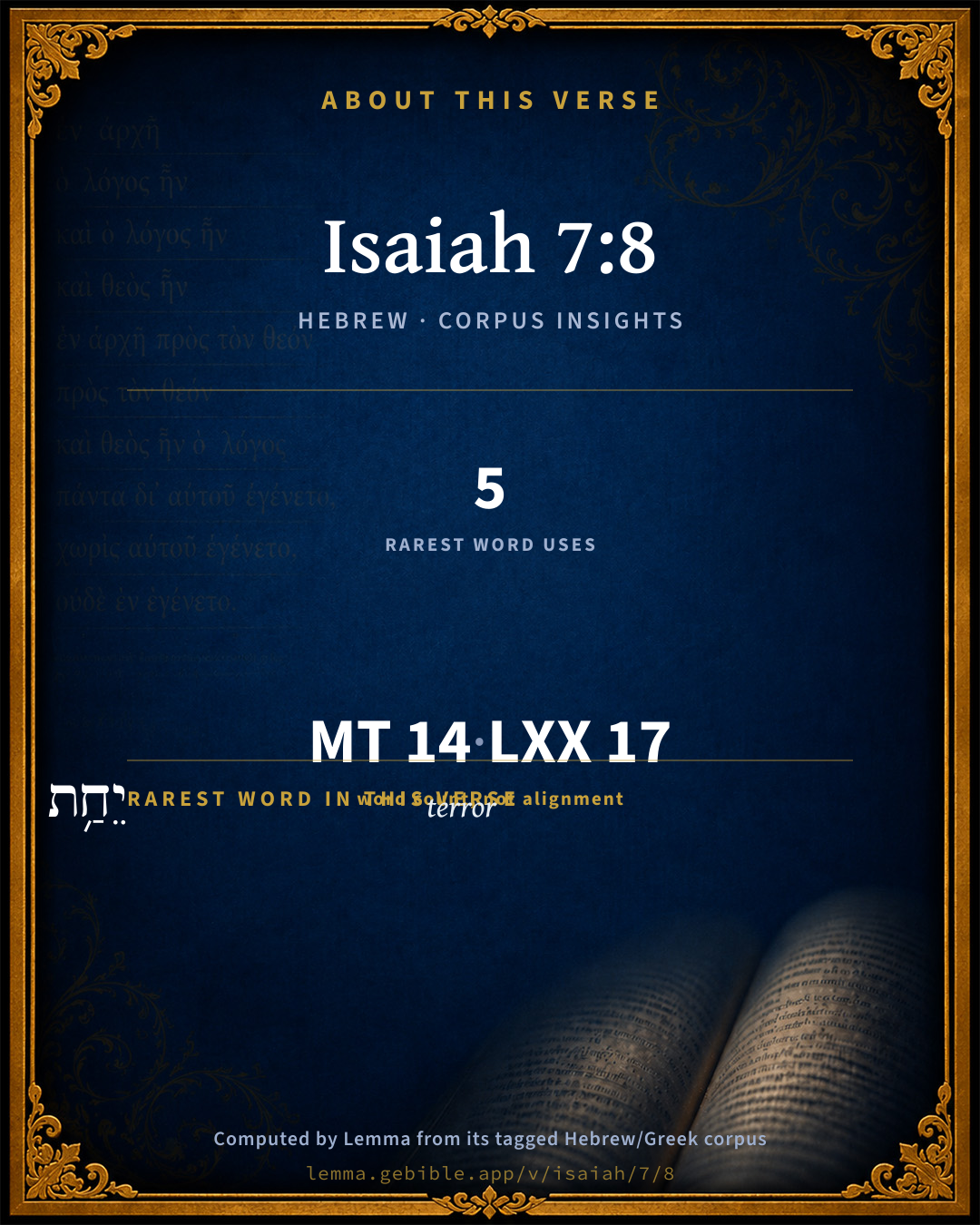
The rarest word here is יֵחַ֥ת terror H2844 — appearing just 5 times in the whole Hebrew Bible.

Shared distinctive vocabulary

יֵחַ֥ת terror H2844 occurs in 5 verses of the Hebrew Bible. Also found in:

Grammatical profile

  • 1 verb
  • 9 nouns
  • 2 adjectives
  • 1 conjunction
  • 1 adverb

Verb forms

  • יֵחַ֥ת Niphal · Imperfect

Repetition

Words recur within this verse — often emphatic in Hebrew:

  • רֹ֤אשׁ head H7218 ×2
  • דַּמֶּ֔שֶׂק Damascus H1834 ×2

Hebrew & Septuagint length

In English translation the verse runs 32 words from the Hebrew and 30 from the Septuagint (LXX English) — closely comparable.

A rough comparison of the two English renderings, which tokenize alike — not a word-level alignment.

Word counts can differ between the Hebrew and the Greek without any difference in meaning — e.g. the Hebrew direct-object marker אֵת has no separate Greek word, and Greek often adds the article ὁ.

In the original languages it is 14 Hebrew tokens and 17 Greek tokens — but the two are counted differently (Hebrew bundles its prefixes and suffixes into one token; the Greek is in lemma form), so that isn’t a like-for-like length.

Cross-references

7

Topical passages linked to Isaiah 7:8 in the Treasury of Scripture Knowledge — connected by theme and wording, ordered by reader-vote popularity; previews shown in the World English Bible.

  • Isaiah 17:1–3 The burden of Damascus. Behold, Damascus is taken away from being a city, and it shall be a ruinous heap.
  • Genesis 14:15 He divided himself against them by night, he and his servants, and struck them, and pursued them to Hobah, which is on the left hand of Damascus.
  • 2 Samuel 8:6 Then David put garrisons in Syria of Damascus; and the Syrians became servants to David, and brought tribute. Yahweh gave victory to David wherever he went.
  • 2 Kings 17:5–23 Then the king of Assyria came up throughout all the land, and went up to Samaria, and besieged it three years.
  • Ezra 4:2 then they drew near to Zerubbabel, and to the heads of fathers' [houses], and said to them, Let us build with you; for we seek your God, as you do; and we sacrifice to him since the days of Esar Haddon king of Assyria, who brought us up here.
  • Isaiah 8:4 For before the child shall have knowledge to cry, My father, and, My mother, the riches of Damascus and the spoil of Samaria shall be carried away before the king of Assyria.
  • Hosea 1:6–10 She conceived again, and bore a daughter. Then he said to him, "Call her name Lo-Ruhamah; for I will no longer have mercy on the house of Israel, that I should in any way pardon them.

Cross-references courtesy of OpenBible.info (CC BY 4.0).

Hebrew and Greek witnesses Masoretic Hebrew ↔ Greek Septuagint

The same verse in the two great witnesses to the Old Testament, shown verse-for-verse.

These are two independent witnesses, not word-aligned to each other, and the Septuagint is shown in lemma (dictionary) form.

Hebrew Isaiah 7:8 Masoretic · Westminster Leningrad Codex

כִּ֣י רֹ֤אשׁ אֲרָם֙ דַּמֶּ֔שֶׂק וְרֹ֥אשׁ דַּמֶּ֖שֶׂק רְצִ֑ין וּבְע֗וֹד שִׁשִּׁ֤ים וְחָמֵשׁ֙ שָׁנָ֔ה יֵחַ֥ת אֶפְרַ֖יִם מֵעָֽם

For the head of Syria is Damascus, and the head of Damascus is Rezin; and within sixty-five years Ephraim shall be broken in pieces, so that it shall not be a people;

World English Bible · Public Domain

Greek LXX Isaiah 7:8 Septuagint · lemma form

ἀλλά ὁ κεφαλή αραμ δαμασκός ἀλλά ἔτι ἑξήκοντα καί πέντε ἔτος ἐκλείπω ὁ βασιλεία ἐφράιμ ἀπό λαός

But the head of Aram is Damascus, and the head of Damascus, Rasim; and yet within sixty and five years the kingdom of Ephraim shall cease from being a people.

LXX2012 (modern English Septuagint) · Public Domain

Hebrew: Westminster Leningrad Codex (CC BY 4.0). Greek: Septuagint (public domain); English from LXX2012 (modern English Septuagint) (Public Domain). How the Septuagint differs from the Hebrew →

Targum (Aramaic paraphrase)

1

The Targum is the ancient Jewish Aramaic paraphrase of the Hebrew Scriptures — an interpretive translation, not the Hebrew text itself. Onkelos (literal) and Pseudo-Jonathan (expansive) render the Torah, and Jonathan the Prophets. Coverage is partial: where no permissively-licensed English translation exists for a verse, only the Aramaic is shown. This is verse-level text, not a word-by-word alignment to the Hebrew.

  1. Targum Jonathan Prophets (Joshua–Malachi)
    אֲרֵי רֵישׁ אֲרָם דַמֶשֶׂק וְרֵישׁ דַמֶשֶׂק רְצִין וּבְסוֹף שִׁתִּין וַחֲמֵשׁ שְׁנִין יִבְטְלוּן בֵּית יִשְׂרָאֵל מִמָלְכוּ:

    For the head of Syria is Damascus, and the head of Damascus is Rezin, and at the end of threescore and five years the house of Israel shall cease from being a kingdom.

    Targum Jonathan — Aramaic: “Mikraot Gedolot” (public domain). English: “Sefaria Community Translation” (CC0 1.0 (public-domain dedication)); “London "Chaldee Paraphrase," 1871” (public domain). Text via Sefaria.

Commentary

Notes on Isaiah 7:8 from classic Christian and Jewish commentators (each source and its license shown beneath its notes). The classic Christian expositions comment on the surrounding passage and are grouped to its opening verse, so a note may address several verses; the Jewish commentaries on the Tanakh (Rashi and others) are per-verse, so they appear only where the commentator wrote on this verse.

Lemma curates 59 commentaries, every one of them public domain or Creative Commons licensed, each selected and text-cleaned for this edition rather than reprinted as found. About our sources →

Jamieson, Fausset & Brown

Robert Jamieson, A. R. Fausset & David Brown

head--that is, in both Syria and Israel the capital shall remain as it is; they shall not conquer Judah, but each shall possess only his own dominions.

threescore and five . . . not a people--As these words break the symmetry of the parallelism in this verse, either they ought to be placed after "Remaliah's son," in Isa 7:9, or else they refer to some older prophecy of Isaiah, or of Amos (as the Jewish writers represent), parenthetically; to which, in Isa 7:8, the words, "If ye will not believe . . . not be established," correspond in parallelism. One deportation of Israel happened within one or two years from this time, under Tiglath-pileser (Kg2 15:29). Another in the reign of Hoshea, under Shalmaneser (Kg2 17:1-6), was about twenty years after. But the final one which utterly "broke" up Israel so as to be "not a people," accompanied by a colonization of Samaria with foreigners, was under Esar-haddon, who carried away Manasseh, king of Judah, also, in the twenty-second year of his reign, sixty-five years from the utterance of this prophecy (compare Ezr 4:2-3, Ezr 4:10, with Kg2 17:24; Ch2 33:11) [USHER]. The event, though so far off, was enough to assure the people of Judah that as God, the Head of the theocracy, would ultimately interpose to destroy the enemies of His people, so they might rely on Him now.

Jamieson, Fausset & Brown — Commentary Critical and Explanatory on the Whole Bible (1871) — public domain (CC PDM 1.0). Text via the HelloAO Bible API.

Trapp's Complete Commentary

John Trapp

Isa 7:8 For the head of Syria [is] Damascus, and the head of Damascus [is] Rezin; and within threescore and five years shall Ephraim be broken, that it be not a people.

Ver. 8. For the head of Syria is Damascus.] Not Jerusalem, as they haply had contrived it; looking upon Jerusalem as a city fatally founded to bear rule, as one saith of Constantinople.

And the head of Damascus is Rezin.] Let him set his heart at rest, and not reach after the dominion of Judah; lest, falling from his high hopes, he lose that he hath already, and cry out with that ambitionist, Sic mea fata sequor.

And within threescore and five years,] sc., From the time that Amos foretold it, {Amo 5:27; Amo 7:8} that is, from the twenty-fourth year of Uzziah to the sixth of Hezekiah, whenas the ten tribes were carried away by Shalmaneser. {2Ki 17:3-6} Thus Jerome out of Seder Olam. But I like better Piscator’s computation, which is thus within sixty-five years, that is, from the fourth year of Ahaz, now current, to the twenty-third of Manasseh, when Ephraim ceased indeed to be a people by the command of Esarhaddon, son of Sennacherib; whereof see Ezr 4:2.

John Trapp, A Commentary or Exposition upon All the Books of the Old and New Testament (1647–1656) — public domain. Text from a community e-Sword module.

Whedon's Commentary on the Bible

Daniel D. Whedon

8, 9. In these verses there is at first sight a degree of complexity which has induced some able commentators to propose amendments of the text. But a closer investigation reveals the real parallelisms. In each verse there is an antecedent statement and a result, and the two statements correspond, and the two results correspond. In Isa_7:8 the statement is, that the ally of Israel — Ephraim — is nothing more than Syria, with its capital, Damascus, culminating like a pyramid in king Rezin; and the result is that Israel — Ephraim — in spite of the alliance, shall be broken up within sixty-five years. That is, the Assyrian kingdom does not amount to much, is a temporary combination, soon to vanish. In Isa_7:9 the statement is that Ephraim, Samaria, and Pekah taper up into a similar and even smaller pyramid; but yet it is only by faith in Jehovah that the third pyramid, Judah, Jerusalem, and Ahaz, can maintain position.

Daniel D. Whedon (gen. ed.), Commentary on the Old and New Testaments (1874–1909) — public domain. Text from a community e-Sword module.

Keil & Delitzsch

C. F. Keil & F. Delitzsch

"For head of Aram is Damascus, and head of Damascus Rezin, and in five-and-sixty years will Ephraim as a people be broken in pieces. And head of Ephraim is Samaria, and head of Samaria the son of Remalyahu; if ye believe not, surely ye will not remain." The attempt to remove Isa 7:8, as a gloss at variance with the context, which is supported by Eichhorn, Gesenius, Hitzig, Knobel, and others, is a very natural one; and in that case the train of thought would simply be, that the two hostile kingdoms would continue in their former relation without the annexation of Judah. But when we look more closely, it is evident that the removal of Isa 7:8 destroys both the internal connection and the external harmony of the clauses. For just as Isa 7:8 and Isa 7:8 correspond, so do Isa 7:9 and Isa 7:9. Ephraim, i.e., the kingdom of the ten tribes, which has entered into so unnatural and ungodly a covenant with idolatrous Syria, will cease to exist as a nation in the course of sixty-five years; "and ye, if ye do not believe, but make flesh your arm, will also cease to exist." Thus the two clauses answer to one another: Isa 7:8 is a prophecy announcing Ephraim's destruction, and Isa 7:9 a warning, threatening Judah with destruction, if it rejects the promise with unbelief. Moreover, the style of Isa 7:8 is quite in accordance with that of Isaiah (on בּעוד, see Isa 21:16 and Isa 16:14; and on מעם, "away from being a people," in the sense of "so that it shall be no longer a nation," Isa 17:1; Isa 25:2, and Jer 48:2, Jer 48:42). And the doctrinal objection, that the prophecy is too minute, and therefore taken ex eventu, has no force whatever, since the Old Testament prophecy furnishes an abundance of examples of the same kind (vid., Isa 20:3-4; Isa 38:5; Isa 16:14; Isa 21:16; Eze 4:5., Isa 24:1., etc.). The only objection that can well be raised is, that the time given in Isa 7:8 is wrong, and is not in harmony with Isa 7:16. Now, undoubtedly the sixty-five years do not come out if we suppose the prophecy to refer to what was done by Tiglath-pileser after the Syro-Ephraimitish war, and to what was also done to Ephraim by Shalmanassar in the sixth year of Hezekiah's reign, to which Isa 7:16 unquestionably refers, and more especially to the former. But there is another event still, through which the existence of Ephraim, not only as a kingdom, but also as a people, was broken up - namely, the carrying away of the last remnant of the Ephraimitish population, and the planting of colonies from Eastern Asia by Esarhaddon.

(Note: The meaning of this king's name is Assur fratrem dedit (Asuṙacḣyiddin): vid., Oppert, Expedition, t. ii. p. 354.)

on Ephraimitish soil (Kg2 17:24; Ezr 4:2). Whereas the land of Judah was left desolate after the Chaldean deportation, and a new generation grew up there, and those who were in captivity were once more enabled to return; the land of Ephraim was occupied by heathen settlers, and the few who were left behind were melted up with these into the mixed people of the Samaritans, and those in captivity were lost among the heathen. We have only to assume that what was done to Ephraim by Esarhaddon, as related in the historical books, took place in the twenty-second and twenty-third years of Manasseh (the sixth year of Esarhaddon), which is very probable, since it must have been under Esarhaddon that Manasseh was carried away to Babylon about the middle of his reign (Ch2 33:11); and we get exactly sixty-five years from the second year of the reign of Ahaz to the termination of Ephraim's existence as a nation (viz., Ahaz, 14; Hezekiah, 29; Manasseh, 22; in all, 65). It was then that the unconditional prediction, "Ephraim as a people will be broken in pieces," was fulfilled (yēchath mē‛âm; it is certainly not the 3rd pers. fut. kal, but the niphal, Mal 2:5), just as the conditional threat "ye shall not remain" was fulfilled upon Judah in the Babylonian captivity. נאמן signifies to have a fast hold, and האמין to prove fast-holding. If Judah did not hold fast to its God, it would lose its fast hold by losing its country, the ground beneath its feet. We have the same play upon words in Ch2 20:20. The suggestion of Geiger is a very improbable one, viz., that the original reading was בי תאמינו לא אם, but that בי appeared objectionable, and was altered into כּי. Why should it be objectionable, when the words form the conclusion to a direct address of Jehovah Himself, which is introduced with all solemnity? For this כּי, passing over from a confirmative into an affirmative sense, and employed, as it is here, to introduce the apodosis of the hypothetical clause, see Sa1 14:39, and (in the formula עתּה כּי) Gen 31:42; Gen 43:10; Num 22:29, Num 22:33; Sa1 14:30 : their continued existence would depend upon their faith, as this chi emphatically declares.

Keil & Delitzsch — Biblical Commentary on the Old Testament (1861–1891) — public domain (CC PDM 1.0). Text via the HelloAO Bible API. (Old Testament only.)

Tyndale Open Study Notes

Tyndale Open Resources

7:8 The Assyrian kings Esarhaddon and Ashurbanipal had Israel resettled with people from other places within sixty-five years (by 670 BC; see 2 Kgs 17:24-34). • Damascus was crushed and completely destroyed by 732 BC, and Samaria was crushed by 722 BC.

Tyndale Open Study Notes — © Tyndale Open Resources, licensed CC BY-SA 4.0. Text via the HelloAO Bible API.

Geneva Bible (1599)

Geneva Bible translators

Counting from the five and twentieth year of the reign of Uzziah, at what time Amos prophesied this thing, and now Isaiah confirmeth that the Israelites should be led into perpetual captivity, which thing came to pass within 20 years after that Isaiah did this message.

Geneva Bible (1599) marginal notes — public domain. Text via Bolls.life.

Adam Clarke's Commentary

Verse 8. - 9. For the head of Syria, c.]

"Though the head of Syria be Damascus,

And the head of Damascus Retsin

Yet within threescore and five years

Ephraim shall be broken, that he be no more a people:

And the head of Ephraim be Samaria;

And the head of Samaria Remaliah's son.

"Here are six lines, or three distichs, the order of which seems to have been disturbed by a transposition, occasioned by three of the lines beginning with the same word וראש verosh, "and the head," which three lines ought not to have been separated by any other line intervening; but a copyist, having written the first of them, and casting his eye on the third, might easily proceed to write after the first line beginning with וראש verosh, that which ought to have followed the third line beginning with וראש verosh. Then finding his mistake, to preserve the beauty of his copy, added at the end the distich which should have been in the middle; making that the second distich, which ought to have been the third. For the order as it now stands is preposterous: the destruction of Ephraim is denounced, and then their grandeur is set forth; whereas naturally the representation of the grandeur of Ephraim should precede that of their destruction. And the destruction of Ephraim has no coherence with the grandeur of Syria, simply as such, which it now follows: but it naturally and properly follows the grandeur of Ephraim, joined to that of Syria their ally.

"The arrangement then of the whole sentence seems originally to have been thus: -

Though the head of Syria be Damascus,

And the head of Damascus Retsin

And the head of Ephraim be Samaria;

And the head of Samaria Remaliah's son:

Yet within threescore and five years

Ephraim shall be broken that he be no more a people."

DR. JUBB.

Threescore and five years] It was sixty-five years from the beginning of the reign of Ahaz, when this prophecy was delivered, to the total depopulation of the kingdom of Israel by Esarhaddon, who carried away the remains of the ten tribes which had been left by Tiglath-pileser, and Shalmaneser, and who planted the country with new inhabitants. That the country was not wholly stripped of its inhabitants by Shalmaneser appears from many passages of the history of Josiah, where Israelites are mentioned as still remaining there, 2Ch 34:6-7; 2Ch 34:33; 2Ch 35:18; 2Kg 23:19-20. This seems to be the best explanation of the chronological difficulty in this place, which has much embarrassed the commentators: see Usserii Annal. V. T. ad an. 3327, and Sir I. Newton, Chronol. p. 283.

"That the last deportation of Israel by Esarhaddon was in the sixty-fifth year after the second of Ahaz, is probable for the following reasons: The Jews, in Seder Olam Rabba, and the Talmudists, in D. Kimchi on Ezek. iv., say that Manasseh king of Judah was carried to Babylon by the king of Assyria's captains, 2Ch 33:11, in the twenty-second year of his reign; that is, before Christ 676, according to Dr. Blair's tables. And they are probably right in this. It could not be much earlier; as the king of Assyria was not king of Babylon till 680, ibid. As Esarhaddon was then in the neighbourhood of Samaria, it is highly probable that he did then carry away the last remains of Israel, and brought those strangers thither who mention him as their founder, Ezr 4:2. But this year is just the sixty-fifth from the second of Ahaz, which was 740 before Christ. Now the carrying away the remains of Israel, who, till then, though their kingdom was destroyed forty-five years before, and though small in number, might yet keep up some form of being a people, by living according to their own laws, entirely put an end to the people of Israel, as a people separate from all others: for from this time they never returned to their own country in a body, but were confounded with the people of Judah in the captivity; and the whole people, the ten tribes included, were called Jews." - DR. JUBB. Two MSS. have twenty-five instead of sixty-five; and two others omit the word five, reading only sixty.

If ye will not believe - "If ye believe not"] "This clause is very much illustrated by considering the captivity of Manasseh as happening at the same time with this predicted final ruin of Ephraim as a people. The near connection of the two facts makes the prediction of the one naturally to cohere with the prediction of the other. And the words are well suited to this event in the history of the people of Judah: 'If ye believe not, ye shall not be established;' that is, unless ye believe this prophecy of the destruction of Israel, ye Jews also, as well as the people of Israel, shall not remain established as a kingdom and people; ye also shall be visited with punishment at the same time: as our Saviour told the Jews in his time, 'Unless ye repent, ye shall all likewise perish;' intimating their destruction by the Romans; to which also, as well as to the captivity of Manasseh, and to the Babylonish captivity, the views of the prophet might here extend. The close connection of this threat to the Jews with the prophecy of the destruction of Israel, is another strong proof that the order of the preceding lines above proposed is right." - DR. JUBB.

"If ye believe not in me." - The exhortation of Jehoshaphat, 2Ch 20:20, to his people, when God had promised to them, by the prophet Jahaziel, victory over the Moabites and Ammonites, is very like this both in sense and expression, and seems to be delivered in verse:

"Hear me, O Judah; and ye inhabitants of Jerusalem;

Believe in JEHOVAH your God, and ye shall be established:

Believe his prophets, and ye shall prosper."

Where both the sense and construction render very probable a conjecture of Archbishop Secker on this place; that instead of כי ki, we should read בי bi. "If ye will not believe in me, ye shall not be established." So likewise Dr. Durell. The Chaldee has, "If ye will not believe in the words of the prophet;" which seems to be a paraphrase of the reading here proposed. In favour of which it may be farther observed, that in one MS. כי ki is upon a rasure; and another for the last לא lo reads ולא velo, which would properly follow בי bi, but could not follow כי ki.

Some translate thus, and paraphrase thus: If ye will not believe, surely ye shall not be established. Or, If ye do not give credit, it is because ye are unfaithful. Ye have not been faithful to the grace already given: therefore ye are now incapable of crediting my promises.

Adam Clarke's Commentary on the Bible (1810–1826) — public domain. Text from a community e-Sword/MySword module.

Ellicott's Commentary for English Readers

(8) The head of Syria is Damascus . . .—The prediction of the failure of the alliance is emphasised. Each city, Damascus and Samaria, should continue to be what it was, the head of a comparatively weak kingdom, and should not be aggrandised by the conquest of Judah and Jerusalem. There is an implied comparison of the two hostile cities and their kings with Jerusalem and its supreme King, Jehovah. Bolder critics, like Ewald, assume that a clause expressing that contrast has been displaced by that which now follows, and which they reject as a later interpolation.

Within threescore and five years shall Ephraim be broken.—Assuming the genuineness of the clause, we have in it the first direct chronological prediction in the prophet’s utterances. Others follow in Isa_16:14; Isa_17:1; Isa_21:6; Isa_23:1. Reckoning from B.C. 736 as the probable date of the prophecy, the sixty-five years bring us to B.C. 671. At that date Assyrian inscriptions show that Assurbanipal, the “Asnapper” of Ezr_4:2-10, co-regent with his father Esarhaddon, had carried off the last remnant of the people of Samaria, and peopled it with an alien race (Smith’s Assurbanipal, p. 363). This completed the work which had been begun by Salmaneser and Sargon (2Ki_17:6). Ephraim then was no more a people.

A Bible Commentary for English Readers, edited by Charles John Ellicott (1878–1897) — public domain. Text from a community e-Sword module.

The Cambridge Bible for Schools and Colleges

gen. ed. J. J. S. Perowne

8. and within threescore and five years … people] This clause is suspicious on several grounds. (1) Because of its position; Ephraim has not yet been mentioned, and a prophecy of its annihilation would hardly have been followed by an argument (9a) which assumes its continued independence. (2) There is no analogy in the prophets for so exact a specification of time with regard to a distant event. When the prophets fix a term of years they use round numbers (ch. Isa_23:17, &c.). (3) Isaiah could not expect to allay the fears of Ahaz by a prediction that was not to be fulfilled for 65 years. In Isa_7:16 and ch. Isa_8:4 he foretells the overthrow of Pekah and Rezin within a very short period. Even Delitzsch, who defends the verse as a whole, admits the force of the last two objections and proposes to substitute the words “within a little while.” But the great majority of commentators agree in regarding the whole clause as a marginal gloss, intended to be read after the first half of Isa_7:9. This view ought probably to be accepted; but Duhm rightly observes that the gloss must be a very old one, since a late annotator would almost certainly have dated the extermination of Ephraim from the destruction of Samaria in 721, about 15 years after Isaiah spoke. What precise event he had in his mind is indeed very uncertain. The most plausible conjecture remains that of Archbishop Ussher, who explained it of the settlement of foreign colonists in Samaria by Esarhaddon or Asshurbanipal (Osnappar, Ezr_4:2; Ezr_4:10). Sixty-five years from the assigned date of the prediction would bring us to about 670 b.c.; and Esarhaddon was succeeded by Asshurbanipal about 668. Of course the chronology need not be strictly accurate.

8, 9. A confirmation of Isa_7:7; but the thought is difficult to grasp. The general meaning seems to be that the league is an attempt to obliterate the political distinctions which Jehovah has established between the neighbouring states. (Observe that in Isa_7:16 the prophet seems to speak as if Syria and Israel had become one kingdom in virtue of their alliance.) Syria and Ephraim are separate nationalities, each with its own capital and king; Judah belongs to neither of them and is not to be amalgamated with them. In short: “Damascus is the head of Syria and of nothing else, &c.” We may even suppose (with Ewald) that Isaiah intended to add, “but the head of Judah is Jerusalem and the head of Jerusalem is Jehovah of Hosts.”

The Cambridge Bible for Schools and Colleges (gen. ed. J. J. S. Perowne; Cambridge University Press, 1878–1918) — public domain. Text from a community e-Sword module.

John Gill's Exposition

For the head of Syria is Damascus,.... Damascus was the metropolis of Syria, the chief city in it, where the king had his palace, and kept his court; of which See Gill on Gen 15:2, Act 9:2,

and the head of Damascus is Rezin; he was king of it, as of all Syria; the meaning is, that Syria, of which Damascus was the principal city, was the only country that Rezin should govern, his dominion should not be enlarged; and Ahaz, king of Judah, might assure himself that Rezin should never possess his kingdom, or be able to depose him, and set up another; and as for Ephraim or Israel, the ten tribes, they should be so far from succeeding in such a design against him, that it should befall them as follows:

and within threescore and five years shall Ephraim be broken, that it be not a people; which is by some reckoned, not from the time of this prophecy, that being in the third or fourth year of Ahaz, who reigned in all but sixteen years; and in the ninth of Hosea king of Israel, and in the sixth of Hezekiah king of Judah, Samaria was taken, and Israel carried captive into Assyria, Kg2 17:6 which was but about eighteen or nineteen years from this time: some think indeed the time was shortened, because of their sins; but this does not appear, nor is it probable: and others think that it designs any time within that term; but the true meaning undoubtedly is, as the Targum renders it,

"at the end of sixty and five years, the kingdom of the house of Israel shall cease.''

This is commonly reckoned by the Jewish writers (d) from the prophecy of Amos, who prophesied two years before the earthquake in Uzziah's time, concerning the captivity both of Syria and Israel, Amo 1:1, Amo 7:11 which account may be carried either through the kings of Judah or of Israel; Jarchi goes the former way, reckoning thus,

"the prophecy of Amos was two years before Uzziah was smitten with the leprosy, according to Amo 1:1. Uzziah was a leper twenty five years, lo, twenty seven. Jotham reigned sixteen years, Ahaz sixteen, and Hezekiah six; as it is said, "in the sixth year of Hezekiah (that is, the ninth year of Hoshea king of Israel) Samaria was taken", Kg2 18:10 lo, sixty five years.''

So Abarbinel; but Kimchi goes another way, which comes to the same, reckoning thus,

"the prophecy of Amos, according to computation, was in the seventeenth year of Jeroboam, son of Joash, king of Israel, how is it? Jeroboam reigned forty one years, Menahem ten, so there are fifty one; Pekahiah the son of Menahem two, so fifty three; and Pekah twenty, so seventy three; and Hoshea the son of Elah nine, and then Israel were carried captive, so there are eighty two: take out of them seventeen (the years of Jeroboam before the prophecy), and there remain sixty five, the number intended; for we do not reckon the six months of Zechariah, and the month of Shallum.''

Cocceius reckons from the death of Jeroboam, who died in the forty first year of his reign, and in the fifteenth of Uzziah, so that there remained thirty seven years of Uzziah; in the twentieth of Jotham, that is, in the fourth after his death, Hoshea son of Elah was made king, this was the twelfth of Ahaz, Kg2 15:30 and in the ninth of Hoshea, Samaria was taken, and Israel carried captive. But Junius and Tremellius are of a different mind from either of these, and think the prophecy wholly respects time to come; they observe, that

"Isaiah in these words first shows, that the kingdom of Syria should be immediately cut off, and the king should die, which at furthest must needs happen four years after; so (say they) we may suppose that these things were said by the prophet in the first year of Ahaz; thence, from the destruction of the Syrians, to the full carrying captive of the Israelites, or from the time of this prophecy, sixty five years must have run out; for although the kingdom of Israel was abolished in the sixth year of Hezekiah, yet Israel did not immediately cease to be a people when only some part of it was carried away; but they entirely ceased to be a people when new colonies were introduced by Esarhaddon, the son of Sennacherib, and all the Israelites were forced into bondage, which the Samaritans explain, Ezr 4:2 wherefore so we fix the series of the times, from the fourth year of Ahaz, in which the kingdom of Syria fell, unto the end, are eleven years, Hezekiah reigned twenty nine years, so the last translation of the Israelites was in the twenty fifth year of Manasseh's reign; but if you begin from the time of the prophecy; the thing will fall upon the twenty first or twenty second of Manasseh's reign; at which time perhaps, as some say, Manasseh was carried captive into Babylon.''

And of this mind was the learned Dr. Prideaux (e), who observes, that in the twenty second year of Manasseh, Esarhaddon prepared a great army, and marched into the parts of Syria and Palestine, and again added them to the Assyrian empire; and adds,

"and then was accomplished the prophecy which was spoken by Isaiah in the first year of Ahaz against Samaria, that within threescore and five years Ephraim should be absolutely broken, so as from thenceforth to be no more a people; for this year being exactly sixty five years from the first of Ahaz, Esarhaddon, after he had settled all affairs in Syria, marched into the land of Israel, and there taking captive all those who were the remains of the former captivity (excepting only some few, who escaped his hands, and continued still in the land), carried them away into Babylon and Assyria; and then, to prevent the land becoming desolate, he brought others from Babylon, and from Cutha, and from Havah, and Hamath, and Sephervaim, to dwell in the cities of Samaria in their stead; and so the ten tribes of Israel, which had separated from the house of David, were brought to a full and utter destruction, and never after recovered themselves again.''

And this seems to be the true accomplishment of this prophecy; though the sense of the Jewish writers is followed by many, and preferred by Noldius; so that there is no need with Grotius and Vitringa to suppose a corruption of the text. Gussetius (f) fancies that signifies twice six, that is, twelve; as twice ten, or twenty; and so five, added to twelve, makes seventeen; and from the fourth of Ahaz, to the taking of Samaria, was about seventeen years.

(d) Seder Olam Rabba, c. 28. p. 85. Aben Ezra in loc. (e) Connection, &c. par, 1. B. 1. p. 30. Bishop Usher, Annal. Vet. Test. A. M. 3327. (f) Comment Ebr. p. 892.

John Gill's Exposition of the Whole Bible (1746–1763) — public domain (CC PDM 1.0). Text via the HelloAO Bible API.

Albert Barnes' Notes on the Bible

For the head of Syria - The “capital.” The “head” is often used in this sense.

Is Damascus - For an account of this city, see the notes at Isa 17:1; compare the notes at Act 9:2. The sense of this passage is, ‘Do not be alarmed as if Rezin was about to enlarge his kingdom, by taking Judea and making Jerusalem his capital. The revolution which these kings contemplate cannot be accomplished. The kingdoms of Syria and Israel shall not be enlarged by the conquest of Judah. The center of their power shall remain where it is now, and their dominion shall not be extended by conquest. The capital of Syria is, and shall continue to be, Damascus. The king of Syria shall be confined within his present limits, and Jerusalem, therefore, shall be safe.’

The head of Damascus - The “ruler, or king” of Damascus is Rezin.

And within threescore and five years - There has been some inquiry why “Ephraim” is mentioned here, as the prophet in the former part of the verse was speaking of “Syria.” But it should be remembered that he was speaking of Syria and Ephraim as “confederate.” It was natural, therefore, to intimate, in close connection, that no fear was to be apprehended from either of them. There has been much difficulty experienced in establishing the fact of the exact fulfillment of this, and in fixing the precise event to which it refers. One catastrophe happened to the kingdom of Ephraim or Israel within one or two years of this time, when Tiglath-pileser, king of Assyria, invaded the land and carried no small part of the people to Assyria; 2Ki 15:29. Another occurred in the next reign, the reign of Hoshea, king of Israel, when Shalmaneser king of Assyria took Samaria, and carried Israel away captive into Assyria; 2Ki 17:1-6.

This occurred in the twelfth year of Ahaz. But that the Israelites remained in Samaria, and kept up the forms of a civil community, and were not finally carried away until the time of Esarhaddon, is evident; compare 2Ch 34:6-7, 2Ch 34:33; 2Ch 35:18; 2Ki 23:19-20. Manasseh, king of Judah, was taken captive by the king of Assyria’s captains 2Ch 33:2 in the twenty-second year of his reign; that is, sixty-five years from the second year of Ahaz, when this prophecy is supposed to have been delivered. And it is also supposed that at this time Esarhaddon took away the remains of the people in Samaria, and put an end to the kingdom, and put in their place the people who are mentioned in Ezr 4:3. “Dr. Jubb, as quoted by Lowth.” The entire extinction of the people of Israel and the kingdom did not take place until Esarhaddon put new colonists from Babylon, and from Cuthah, and from Ava, and from Hamath, and from Sepharvaim in the cities of Samaria, instead of the children of Israel; 2Ki 17:24; compare Ezr 4:2, Ezr 4:10.

Long before this, indeed, the power of the kingdom had been on the wane; a large portion of the people had been removed 2Ki 17:5-6, 2Ki 17:18; but its entire extinction was not accomplished, and the kingdom utterly destroyed, until this was done. Until this occurred, the land might be still regarded as in the possession somewhat of its former people, and all hopes of their rising again to the dignity of a kingdom was not extinguished. But when foreigners were introduced, and took possession of the land; when all the social organization of the ancient people was dissolved; then it might be said that ‘Ephraim was forever broken,’ and that it was demonstrated that it ‘should be no more a people.’ Its inhabitants were transferred to a distant land, no longer to be organized into a unique community, but to mingle with other people, and finally all traces of their origin as Jews were to be lost. This event, of placing the foreigners in the cities of Samaria, occurred just sixty-five years after it had been predicted by Isaiah. - “Dr. Usher.”

It may be asked here, how the statement of what was to occur at so remote a period as sixty-five years could be any consolation to Ahaz, or any security that the designs of the kings of Syria and Samaria should “then” fail of being accomplished? To this we may reply:

(1) It was the assurance that Jerusalem could not be finally and permanently reduced to submission before these dreaded enemies. “Their” power was to cease, and of course Jerusalem had nothing “ultimately and finally” to dread.

(2) The design was to inspire confidence in Yahweh, and to lead Ahaz to look directly to him. If these formidable powers could not ultimately prevail, and if there was a certain prediction that they should be destroyed, then it was possible for God, if Ahaz would look to him, now to interpose, and save the city. To inspire that confidence in Yahweh was the leading purpose of Isaiah.

(3) This prediction is in accordance with many which occur in Isaiah, that all the enemies of the people of God would be ultimately defeated, and that God, as the head of the theocracy, would defend and deliver his people; see the notes at Isa. 34. A kingdom that was so soon to be destroyed as Ephraim was, could not be an object of great dread and alarm. Rosenmuller conjectures, that Isaiah refers to some unrecorded prophecy made before his time, that in sixty-five years Israel would be destroyed; and that he refers here to that prophecy to encourage the heart of Ahaz, and to remind him that a kingdom could not be very formidable that was so soon to come to an end. At all events, there is no contradiction between the prophecy and the fulfillment, for within the time mentioned here, Ephraim ceased to be a kingdom. The ancient Jewish writers, with one consent, say, that Isaiah referred here to the prophecy of Amos, who prophesied in the days of Uzziah, and whose predictions relate mainly to the kingdom of Israel. But as Amos, does not specify any particular time when the kingdom should be destroyed, it is apparent that Isaiah here could not have referred to any recorded prophecy of his.

Be broken - Its power shall be destroyed; the kingdom, as a kingdom, shall come to an end.

Albert Barnes' Notes on the Bible (1834–1885) — public domain. Text from a community e-Sword/MySword module.

Haydock's Catholic Bible Commentary

Rasin. Both the king and his capital shall be ruined. --- And five. Capellus (p. 497.) would read six and five; or, in eleven years time. But (Calmet) Ephraim was led captive twenty-one years after, and the Cutheans took their place when sixty-five years had elapsed. (The year of the world 3327., Usher) --- Most people date from the prophecy of Amos to the ruin of Samaria, just sixty-five years. The former solution seems preferable. (Calmet)

George Leo Haydock (1774–1849), Haydock's Catholic Family Bible and Commentary, 1859 edition — public domain. Excludes Psalms (Douay-Rheims chapter numbering differs from Protestant) and Deuterocanonical books (Catholic canon only).

Matthew Poole's English Annotations

Is Damascus; or rather, shall be Damascus; for the verb is not expressed in the Hebrew text, and therefore may be either way supplied. The sense is, Damascus shall still continue to be the capital and chief city of the kingdom of Syria; and therefore Jerusalem shall not be taken, nor become a part of Rezin’s dominion; but he shall be kept within his own bounds, and be king of Damascus only, and not, as he hopes, of Jerusalem.

Within threescore and five years; to be computed either,

1. From the prophecy of Amos, who prophesied in the days of Uzziah, two years before the earthquake, Amo 1:1, which the Jews affirm to have happened about the time of his usurpation of the priest’s office, and being smitten with leprosy, 2Ch 26:16, &c., which though it be not proved, yet it may be admitted, because it cannot be disproved. And it is more than probable that that action and accident was divers years before his death, during which time Jotham acted as his viceroy, 2Ch 26:21. And the prophecy of Amos being express and full concerning the destruction of the people and commonwealth of Israel, being also fresh in the memory of many now living, the prophet Isaiah might well have respect to it. So the sense is as if he had said, There shall be but sixty-five years between the delivery and the execution of that prophecy. And so the number of years may be thus made up. Fix the beginning of them ten years before Uzziah’s death, add the sixteen years of Jotham’s reign, and then the sixteen years of Ahaz’s reign, and then six of Hezekiah’s reign, in which Israel was carried captive, 2Ki 18:10, these make up forty-eight years; and for the seventeen years which yet remain of the sixty-five, they may be taken out of the rest of Hezekiah’s reign. For although the transportation of that people began in the sixth year of Hezekiah, yet it might be continued or repeated divers years after, and completed seventeen years after, Jer 52:28-30. Or rather,

2. These years may be computed from the time of this prophecy of Isaiah. And whereas it may objected against this opinion, that the judgment here threatened was executed in the sixth year of Hezekiah, as was before noted, and therefore within eighteen or nineteen years of this prophecy, which was delivered in the third or fourth year of Ahaz; two things may be answered,

1. That the Israelites were not transported in the sixth year of Hezekiah; for although Samaria be said to be taken in the sixth year of Hezekiah, 2Ki 18:10, and the transportation of the Israelites be mentioned immediately after it, Isa 7:11, yet it doth not thence follow that it was done immediately, and at that one time; because this is not unusual in Scripture, in historical relations to mention those things together which were done at a considerable distance of time one from another, as it is recorded, Act 7:15,16, Jacob died, he and our fathers, and were carried over into Sychem, and laid in the sepulchre of Abraham, &c., although it was above two hundred years ere all which is said in those few words was done. And other instances of like nature might easily be produced.

2. That this work of transportation was not done at once, but successively, and by degrees. Thus it certainly was in the transportation of Judah, which was begun in Nebuchadnezzar’s seventh year, continued in his eighteenth year, and perfected in his three and twentieth year, Jer 52:28-30. And thus it might be, and probably was, in this transportation. It might be begun presently after the taking of Samaria, and afterwards continued, until at last the whole body of the people was removed; and as soon as that was done, and not before, the king of Assyria brought into their place those new colonies mentioned 2Ki 17:24. Which that it was not done at the time of the taking of Samaria, but many years after it, seems to me evident, because those colonies were not brought thither by Shalmanezer, who took Samaria, 2Ki 18:10, no, nor by Sennacherib, his next successor; but by Esar-haddon, as is affirmed, Ezr 4:2, who was the son and successor of Sennacherib, 2Ki 19:37, and reigned above fifty years; for he seems to have begun his reign about the fourteenth year of Hezekiah’s reign, by comparing 2Ki 18:13, and 2Ki 19:35-37; and so he reigned with Hezekiah about fifteen years, and with Manasseh above forty years, as the learned Sir John Marsham affirms in his Chronicus Canon, &c, p. 496. And this work of transporting the remainders of the Israelites, and bringing the new colonies, might not be done till towards the end of his reign; which delay might be occasioned by his wars, or other great affairs. And lest this should seem to be only my own private conjecture, if the reader consult Sir John Marsham’s fourth and last chronological table, inserted after p. 589 of his work, he will find that learned chronologer to be of the same mind, and to make above fifty years’ distance between the taking of Samaria, and the translation of the new colonies into those parts. And thus these sixty-five years might well be accomplished in his time. And so this place agrees with other scriptures, and the difficulties objected against other interpretations seem to be avoided.

Matthew Poole's English Annotations on the Holy Bible (1683–1685) — public domain. Text from a community e-Sword/MySword module.

The Pulpit Commentary

For the head of Syria is Damascus, etc. Syria and Ephraim have merely human heads the one Rezin, the other (ver. 9) Pekah; but Judah, it is implied, has a Divine Head, even Jehovah. How, then, should mere mortals think to oppose their will and their designs to God"s? Of course, their designs must come to naught. Within threescore and five years shall Ephraim be broken, etc. If this prophecy was delivered, as we have supposed, in B.C. 733 (see note on ver. 1), sixty-five years later would bring us to B.C. 669. This was the year in which Esar-haddon, having made his son, Asshur-bani-pal, King of Assyria, transferred his own residence to Babylon, and probably the year in which he sent from Babylonia and the adjacent countries a number of colonists who occupied Samaria, and entirely destroyed the nationality, which, fifty-three years earlier, had received a rude blow from Sargon. (comp. Ezr_4:2, Ezr_4:9, Ezr_4:10, 2Ki_17:6-24 and 2Ch_33:11) It is questioned whether, under the circumstances, the prophet can have comforted Ahaz with this distant prospect, and suggested that in the present chapter prophecies pronounced at widely distant periods have been mixed up (Cheyne); but there is no such appearance of dislocation in Isaiah 7., in its present form, as necessitates any such theory; and, while it may be granted that the comfort of the promise given in ver. 8 would be slight, it cannot be said that it would be nil; it may, therefore, have been (as it seems to us) without impropriety added to the main promise, which is that of ver. 7. The entire clause, from "and within" to "not a people," must be regarded as parenthetic.

The Pulpit Commentary (1880–1919), ed. H.D.M. Spence-Jones & Joseph S. Exell — public domain. Text from a community e-Sword module.

John Wesley's Explanatory Notes

Damascus - Damascus shall still continue the capital of the kingdom of Syria; and therefore Jerusalem shall not become a part of Rezin's dominion: but he shall keep within his own bounds, and be king of Damascus only.

John Wesley, Explanatory Notes Upon the Whole Bible (1754–1765) — public domain. Text via the GEBible commentary corpus.

J. A. Alexander on Isaiah

Joseph Addison Alexander

The plans of the enemy cannot be accomplished, because God has decreed that while the kingdoms of Syria and Israel continue to exist, they shall remain without enlargement, or at least without the addition of Jerusalem or Judah to their territories. “It shall not stand or come to pass, because the head (or capital) of Aram is Damascus (and shall be so still), and the head (chief or sovereign) of Damascus is Rezin (and shall be so still; and as for the other power there is as little cause of fear) for in yet sixty and five years (in sixty-five years more) shall Ephraim be broken from a people (i.e., from being a people, so as not to be a people); and even in the mean time, it shall not be enlarged by the addition of Judah) for the head (or capital) of Ephraim is Samaria, and the head (chief or sovereign) of Samaria is Remaliah’s son. If you will not believe (it is) because you are not to be established.” Here again Syria is the prominent object, and Ephraim subjoined, as if by an afterthought. The order of ideas is, that Syria shall remain as it is, and as for Ephraim it is soon to be destroyed, but while it does last, it shall remain as it is likewise; Pekah shall never reign in any other capital, nor Samaria be the capital of any other kingdom. To this natural expression of the thought corresponds the rhythmical arrangement of the sentences, the first clause of the eighth verse answering exactly to the first clause of the ninth, while the two last clauses, though dissimilar, complete the nose. For the head of Syria is Damascus. And the head of Damascus Rezin. And in sixty-five years more etc.

Joseph Addison Alexander, The Prophecies of Isaiah (1846–1847; New York: Scribner, 1870–1878) — public domain. Text from a community e-Sword module.

Rashi

Rabbi Shlomo Yitzchaki (Rashi)

For the head of Aram that is Damascus, and Jerusalem has nothing with them.

and the head of Damascus is Rezin In Damascus he shall be head, but not in Jerusalem, and also as regards Pekah and the ten tribes in another sixty-five years from the day it was decreed in the days of Amos (7:11): “And Israel shall surely be exiled from upon its land.”

Ephraim shall be broken, no longer to be a people Ephraim shall be shattered, no longer to be a people, for Sennacherib will exile them with their king, Hoshea son of Elah. Go out and calculate from Amos’ prophecy until the ten tribes were exiled, and you will find them to be sixty-five years. Amos’ prophecy was two years before Uzziah was stricken, as it is stated (Amos 1:1): “Two years before the earthquake.” And Uzziah was stricken for twenty-five years, plus these two years, giving us a total of twenty-seven years. Add the sixteen years of Jotham and the sixteen years of Ahaz and six years of Hezekiah, as it is stated (II Kings 18:10, 11): “And they captured it [at the end of three years]; in the sixth year of Hezekiah, which is the ninth year of Hoshea, king of Israel...And the king of Assyria exiled Israel to Assyria.” Here are sixty-five years. Now how do we know that the duration of Uzziah’s state as a confirmed metzora was twenty-five years? For it is stated (ibid. 15:1): “In the twenty-seventh year of Jeroboam the king of Israel, Azariah the son of Amaziah the king of Judah, became king.” Is it possible to say this? Did not Uzziah and Jeroboam reign simultaneously, according to the calculation you will find in the Book of Kings (See Rashi II Kings 14:22)? Rather he reigned a plagued kingship. In the twenty-seventh year he was stricken, and he reigned for fifty-two years. It is impossible, however, to count “and in another sixty-five years” from the day that Isaiah said this prophecy, for he said it in the days of Ahaz, and they were exiled in the sixth year of Hezekiah. In this manner it is explained in Seder Olam (ch. 28), that Scripture counted from the prophecy of Amos.

Rashi on the Tanakh — English translations: “The Judaica Press complete Tanach with Rashi, translated by A. J. Rosenberg” (CC BY 4.0); “Pentateuch with Rashi's commentary by M. Rosenbaum and A.M. Silbermann, 1929-1934” (public domain); “The Metsudah Tanach series, Lakewood, N.J” (CC BY 4.0); and “The Book of Joshua, Metsudah Publications, 1997” (CC BY 4.0). Text via Sefaria.

Ibn Ezra

Rabbi Abraham ibn Ezra

כי Although, Comp. כי עם קשה ערף הוא Although they be a stiffnecked people. (Exod. 34:9.) This plan will not be realised, although Rezin and Pekah besiege Jerusalem.

And yet threescore, etc. Comp. the common phrase so and so many years are still left before such and such an event will take place. ב in בעוד is superfluous as in (טרם═)בטרם before. These sixty-five years begin with the year of the earthquake, that happened in the days of Uzziah, when Amos prophesied And Israel will surely go into exile (Amos 7:11). Comp. And it was at the end of forty years (2 Sam. 15:7.)

יֵחַת Shall be broken; comp. החתות Thou hast broken (9:3); it is Niphal, like יִמַּס (13:7) Will be melted מֵעָם By a people. Evil shall befall them by means of a people that will come against them. יֵחַת can also be Kal of a verb נחת,פ״נ to go down, (like יִגַּשׁ he will approach; comp. תֵּחַת It comes down) (Prov. 17:9); הנחת Cause to come down (Joel 3:11), where the נ is not omitted. The meaning of יֵחַת מֵעָם is accordingly: They will go down and be no more considered as a nation.

Ibn Ezra on the Tanakh — English translations: “Sefaria Community Translation” (CC0 1.0 (public-domain dedication)); “Yalkut, Sifsei Chachomim Chumash, Metsudah Publications, 2009” (CC BY 4.0); and “Commentary of Ibn Ezra on Isaiah - trans. by M. Friedlander, 1873” (public domain). Text via Sefaria.

Lesson kit

Teaching starters — assembled from the data on this page, not authored interpretation. Every prompt links to the verse data it draws on. Edit before teaching.

Isaiah, in the Prophets, opens this verse with 14 words (12 distinct Hebrew lemmas). Its most distinctive word is chath (“terror”). A historical commentator’s framing appears above. Read the whole chapter for the surrounding context.

Discussion questions

  1. How does “terror” (chath) shape what this verse is saying?
  2. Genesis 9:2 shares the word «terror» with this verse. How do the two illuminate each other?
  3. “head” occurs 2× in this one verse. What is the effect of the repetition?
  4. These translations render this verse differently. What is at stake in choosing one wording over another?
  5. The verb «יֵחַ֥ת» is Niphal Imperfect. How does its form color the action?
  6. Reading how Jamieson, Fausset & Brown and Trapp's Complete Commentary read this verse, where do the two commentators agree and where do they part?

Things to notice

Reading settings

Reading text

Shown beneath each verse's original-language words.

Old Testament
Old Testament edition

Read the OT as the Masoretic Hebrew (MT) or the Greek Septuagint (LXX).

English shown for the Greek Septuagint (in the Hebrew ↔ Greek comparison).

Comparing translations? Open the Compare panel on any verse page to stack up to four side by side.