
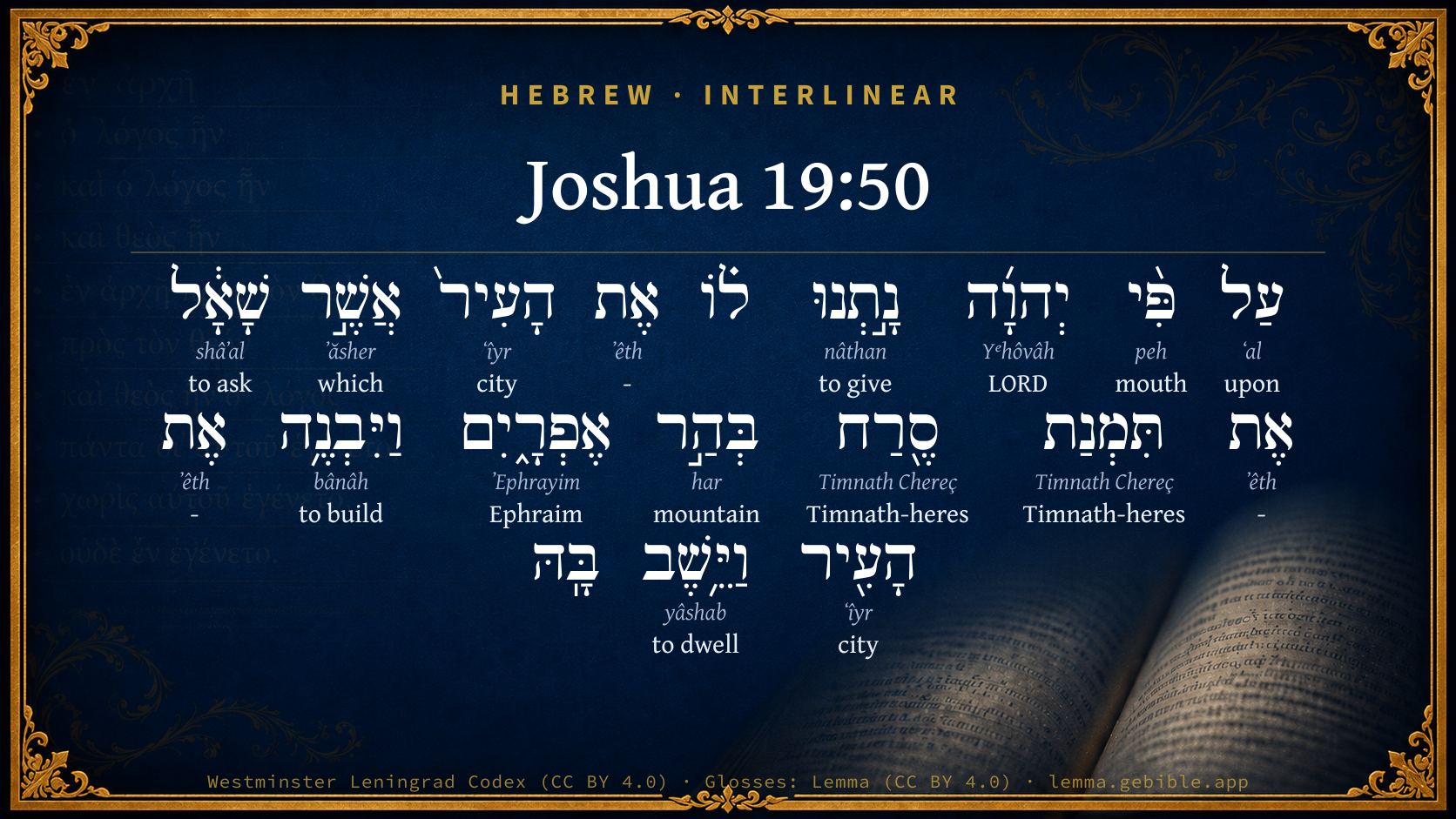
Joshua 19:50

Hebrew (Westminster Leningrad Codex) Joshua 19:50 appears in the Hebrew Old Testament. The text above is from the Westminster Leningrad Codex. Each word links to its Strong’s number, a concise gloss, and parsing drawn from the Open Scriptures Hebrew Bible morphology. Click any word for its full Brown-Driver-Briggs (BDB) entry.
Download image
Cite this verse

Joshua 19:50 (World English Bible). Public Domain. Lemma interlinear Bible study tool, https://lemma.gebible.app/v/joshua/19/50.

Show BibTeX & RIS
BibTeX
RIS
English Translation
according to the commandment of Yahweh they gave him the city which he asked, even Timnathserah in the hill-country of Ephraim; and he built the city, and lived therein.
World English Bible · Public Domain
Highlights
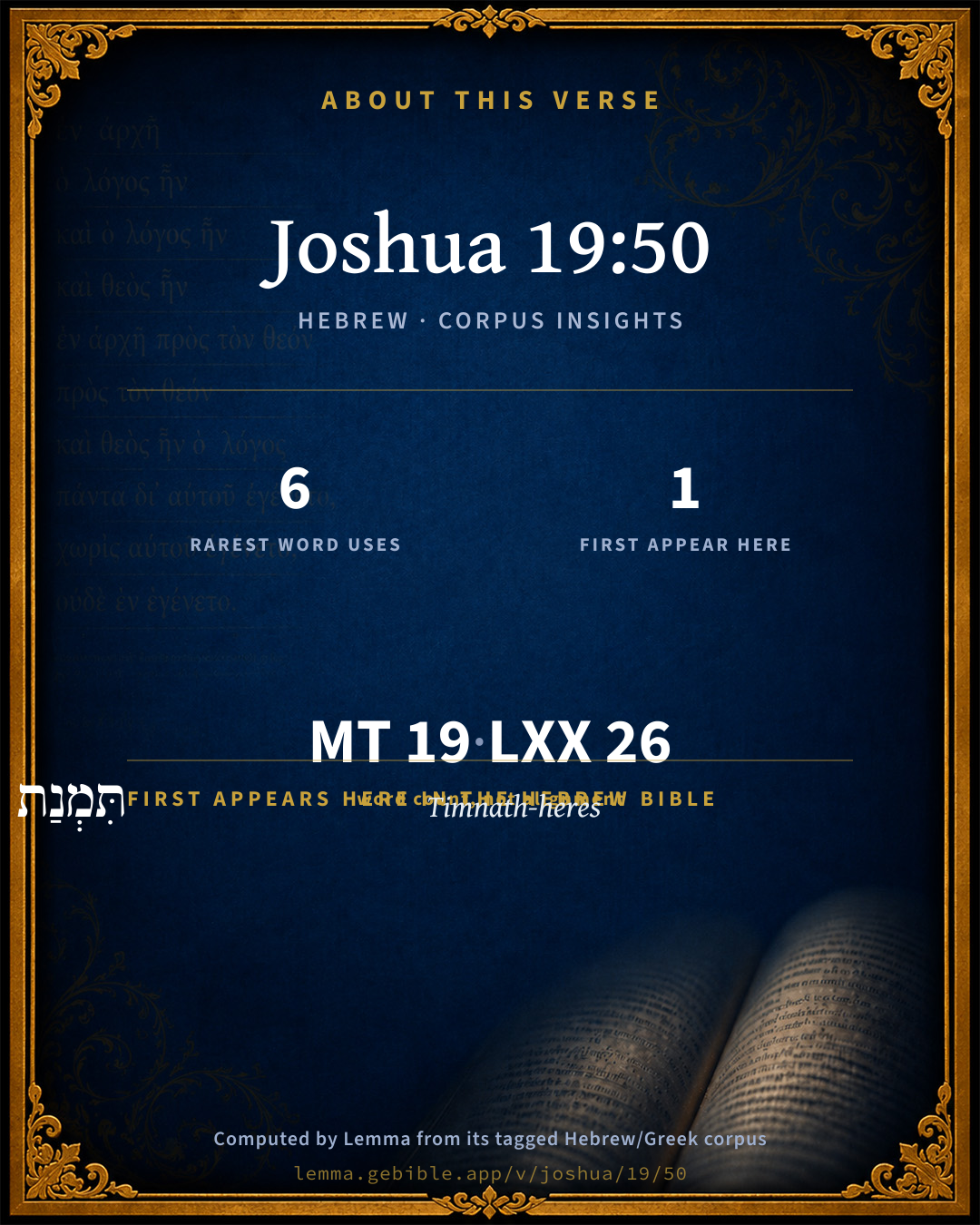
  • 1 first appearance in the Hebrew Bible
Full analysis ↓
Download a study sheet

One document with this verse’s original text, its word-by-word gloss line, the meaning frame, cross-references with their text, attributed commentary, and full source and license credits — printable, and it pastes into notes with its structure intact.

This verse Autodidact and up

Study sheet (.html) Plain text (.txt)

A passage Seminary Student

Up to 50 verses in one chapter. A passage sheet keeps up to 6 commentary sources and 12 cross-references per verse, in the order this page ranks them, and says so on the sheet whenever that leaves anything out. Ask for a single verse and you get the Autodidact verse sheet above.

Everything on this page stays free to read, with no account — the sheet is a download of what is already on screen, not access to it.

Want to remove ads? Support Godless Engineer
Compare translations 3

The same verse in 3 English versions, stacked beneath the original-language interlinear above. Click any original word for its lexicon entry.

Each is an independent rendering of the whole verse — the interlinear is not word-aligned to these translations.

Highlighted words mark where these versions differ — a whole-verse word diff, not a word-by-word alignment.

  • World English Bible Public Domain
    according to the commandment of Yahweh they gave him the city which he asked, even Timnathserah in the hill-country of Ephraim; and he built the city, and lived therein.
  • King James Version Public Domain
    According to the word of the LORD they gave him the city which he asked, even Timnathserah in mount Ephraim: and he built the city, and dwelt therein.
  • unfoldingWord Literal Text CC BY-SA 4.0
    Upon the mouth of Yahweh, they gave to him the city that he requested, Timnath Serah in the hill country of Ephraim. And he built the city and dwelled in it.

unfoldingWord Literal Text — © unfoldingWord, licensed CC BY-SA 4.0. Word-aligned USFM3 via Door43 (git.door43.org/unfoldingWord/en_ult).

Versions to compare (up to 4)

3 of 4 selected

Show all 18 translations

Every available English version of this verse, each an independent rendering of the whole verse.

  • World English Bible Public Domain
    according to the commandment of Yahweh they gave him the city which he asked, even Timnathserah in the hill-country of Ephraim; and he built the city, and lived therein.
  • Berean Standard Bible Public Domain
    as the LORD had commanded. They gave him the city of Timnath-serah in the hill country of Ephraim, as he requested. He rebuilt the city and settled in it.
  • Majority Standard Bible Public Domain
    as the LORD had commanded. They gave him the city of Timnath-serah in the hill country of Ephraim, as he requested. He rebuilt the city and settled in it.
  • King James Version Public Domain
    According to the word of the LORD they gave him the city which he asked, even Timnathserah in mount Ephraim: and he built the city, and dwelt therein.
  • American Standard Version (1901) Public Domain
    according to the commandment of Jehovah they gave him the city which he asked, even Timnath-serah in the hill-country of Ephraim; and he built the city, and dwelt therein.
  • Revised Version (1885) Public Domain
    according to the commandment of the LORD they gave him the city which he asked, even Timnath-serah in the hill country of Ephraim: and he built the city, and dwelt therein.
  • Geneva Bible (1599) Public Domain
    According to the worde of the Lord they gaue him the citie which hee asked, euen Timnath-serah in mount Ephraim: and hee built the citie and dwelt therein.
  • Douay-Rheims (1899) Public Domain
    According to the commandment of the Lord, the city which he asked for, Thamnath Saraa, in mount Ephraim: and he built up the city, and dwelt in it.
  • Young's Literal Translation Public Domain
    by the command of Jehovah they have given to him the city which he asked, Timnath-Serah, in the hill-country of Ephraim, and he buildeth the city and dwelleth in it.
  • Literal Standard Version CC BY-SA 4.0
    by the command of YHWH they have given to him the city which he asked for, Timnath-Serah, in the hill-country of Ephraim, and he builds the city and dwells in it.
  • Unlocked Literal Bible CC BY-SA 4.0
    By the command of Yahweh they gave him the city for which he asked, Timnath Serah in the hill country of Ephraim. He rebuilt the city and lived there.
  • unfoldingWord Literal Text CC BY-SA 4.0
    Upon the mouth of Yahweh, they gave to him the city that he requested, Timnath Serah in the hill country of Ephraim. And he built the city and dwelled in it.
  • Darby Bible Public Domain
    According to the word of Jehovah they gave him the city that he asked, Timnath-serah in the hill-country of Ephraim; and he built the city, and dwelt in it.
  • World Messianic Bible Public Domain
    According to the LORD’s commandment, they gave him the city which he asked, even Timnathserah in the hill country of Ephraim; and he built the city, and lived there.
  • Webster's Bible Public Domain
    According to the word of the LORD they gave him the city which he asked, even Timnath-serah in mount Ephraim: and he built the city, and dwelt in it.
  • Free Bible Version CC BY-SA 4.0
    Following the Lord's command, they gave him the town he requested—Timnath-serah in the hill country of Ephraim. He rebuilt the town and settled there.
  • Bible in Basic English Public Domain
    By the orders of the Lord they gave him the town for which he made request, Timnath-serah in the hill-country of Ephraim: there, after building the town, he made his living-place.
  • JPS Tanakh (1917) Public Domain
    according to the commandment of the LORD they gave him the city which he asked, even Timnath-serah in the hill-country of Ephraim; and he built the city, and dwelt therein.

Literal Standard Version (2020), Covenant Press — licensed CC BY-SA 4.0. Text via the HelloAO Bible API (eBible.org). Unlocked Literal Bible (unfoldingWord) — licensed CC BY-SA 4.0. Text via the HelloAO Bible API (eBible.org). unfoldingWord Literal Text — © unfoldingWord, licensed CC BY-SA 4.0. Word-aligned USFM3 via Door43 (git.door43.org/unfoldingWord/en_ult). Free Bible Version, Dr. Jonathan Gallagher — licensed CC BY-SA 4.0. Text via the HelloAO Bible API (eBible.org).

Word by word

More ways to search: Search by grammar → Find every occurrence → Compare this word →

Practice this passage: Drill this verse → Learn its vocabulary →

תִּמְנַת
Timnath Chereç
H8556
“Timnath-heres”
Noun, Proper
Part of Speech
Noun
Type
Proper
Full BDB Definition

Origin: from H8553 and H2775

TWOT: None

Timnath-heres or Timnath-serah = "portion of the sun" - a city given to Joshua as a inheritance in the mountains of Ephraim on the north of the hill of Gaash where he was buried
  1. עַל ʻal H5921 “upon” Preposition
  2. פִּ֨י peh H6310 “mouth of” Noun, Common, Masculine, Singular, Construct
  3. יְהוָ֜ה Yᵉhôvâh H3068 “LORD” Noun, Proper
  4. נָ֣תְנוּ nâthan H5414 “to give” Verb, Qal, Perfect, 3rd Person, Common, Plural
  5. אֶת ʼêth H853 “-” Particle, Direct Object
  6. הָעִיר֙ ʻîyr H5892 “the · city” Particle, Definite Article + Noun, Common, Feminine, Singular, Absolute
  7. אֲשֶׁ֣ר ʼăsher H834 “which” Particle, Relative
  8. שָׁאָ֔ל shâʼal H7592 “to ask” Verb, Qal, Perfect, 3rd Person, Masculine, Singular
  9. אֶת ʼêth H853 “-” Particle, Direct Object
  10. סֶ֖רַח Timnath Chereç H8556 “Timnath-heres” Noun, Proper
  11. בְּהַ֣ר har H2022 “in/at · mountain of” Preposition + Noun, Common, Masculine, Singular, Construct
  12. אֶפְרָ֑יִם ʼEphrayim H669 “Ephraim” Noun, Proper
  13. וַיִּבְנֶ֥ה bânâh H1129 “and · to build” Conjunction + Verb, Qal, Sequential Imperfect, 3rd Person, Masculine, Singular
  14. אֶת ʼêth H853 “-” Particle, Direct Object
  15. הָעִ֖יר ʻîyr H5892 “the · city” Particle, Definite Article + Noun, Common, Feminine, Singular, Absolute
  16. וַיֵּ֥שֶׁב yâshab H3427 “and · to dwell” Conjunction + Verb, Qal, Sequential Imperfect, 3rd Person, Masculine, Singular

About this verse

These counts appear in no published source. They are computed here, from the morphology-tagged text and Lemma’s own curated glosses. What Lemma adds →

19
words
13
distinct lemmas
Historical
section

Notable vocabulary

The rarest word here is תִּמְנַת Timnath-heres H8556 — appearing just 6 times in the whole Hebrew Bible.

First appearance in Scripture

This word makes its first canonical appearance in the Hebrew Bible here:

  • תִּמְנַת Timnath-heres H8556

Shared distinctive vocabulary

תִּמְנַת Timnath-heres H8556 occurs in 3 verses of the Hebrew Bible. Also found in:

Grammatical profile

  • 4 verbs
  • 8 nouns
  • 3 prepositions
  • 4 particles

Verb forms

  • נָ֣תְנוּ Qal · Perfect
  • שָׁאָ֔ל Qal · Perfect
  • וַיִּבְנֶ֥ה Qal · Sequential Imperfect
  • וַיֵּ֥שֶׁב Qal · Sequential Imperfect

Repetition

Words recur within this verse — often emphatic in Hebrew:

  • הָעִיר֙ city H5892 ×2
  • תִּמְנַת Timnath-heres H8556 ×2

Hebrew & Septuagint length

In English translation the verse runs 29 words from the Hebrew and 32 from the Septuagint (LXX English) — closely comparable.

A rough comparison of the two English renderings, which tokenize alike — not a word-level alignment.

Word counts can differ between the Hebrew and the Greek without any difference in meaning — e.g. the Hebrew direct-object marker אֵת has no separate Greek word, and Greek often adds the article ὁ.

In the original languages it is 19 Hebrew tokens and 26 Greek tokens — but the two are counted differently (Hebrew bundles its prefixes and suffixes into one token; the Greek is in lemma form), so that isn’t a like-for-like length.

Cross-references

3

Topical passages linked to Joshua 19:50 in the Treasury of Scripture Knowledge — connected by theme and wording, ordered by reader-vote popularity; previews shown in the World English Bible.

  • Joshua 24:30 They buried him in the border of his inheritance in Timnathserah, which is in the hill-country of Ephraim, on the north of the mountain of Gaash.
  • Judges 2:9 They buried him in the border of his inheritance in Timnath Heres, in the hill country of Ephraim, on the north of the mountain of Gaash.
  • 1 Chronicles 7:24 His daughter was Sheerah, who built Beth Horon the lower and the upper, and Uzzen Sheerah.

Cross-references courtesy of OpenBible.info (CC BY 4.0).

Hebrew and Greek witnesses Masoretic Hebrew ↔ Greek Septuagint

The same verse in the two great witnesses to the Old Testament, shown verse-for-verse.

These are two independent witnesses, not word-aligned to each other, and the Septuagint is shown in lemma (dictionary) form.

Hebrew Joshua 19:50 Masoretic · Westminster Leningrad Codex

עַל פִּ֨י יְהוָ֜ה נָ֣תְנוּ ל֗וֹ אֶת הָעִיר֙ אֲשֶׁ֣ר שָׁאָ֔ל אֶת תִּמְנַת סֶ֖רַח בְּהַ֣ר אֶפְרָ֑יִם וַיִּבְנֶ֥ה אֶת הָעִ֖יר וַיֵּ֥שֶׁב בָּֽהּ

according to the commandment of Yahweh they gave him the city which he asked, even Timnathserah in the hill-country of Ephraim; and he built the city, and lived therein.

World English Bible · Public Domain

Greek LXX Joshua 19:50 Septuagint · lemma form

διά πρόσταγμα ὁ θεός καί δίδωμι αὐτός ὁ πόλις ὅς αἰτέω θαμνασαραχ ὅς εἰμί ἐν ὁ ὄρος ἐφράιμ καί οἰκοδομέω ὁ πόλις καί καταοἰκέω ἐν αὐτός

by the command of God, and they gave him the city which he asked for, Thamnasarach, which is in the mount of Ephraim; and he built the city, and lived in it.

LXX2012 (modern English Septuagint) · Public Domain

On this verse, The Pulpit Commentary discusses the Septuagint’s reading. Read the note in Commentary ↓

Hebrew: Westminster Leningrad Codex (CC BY 4.0). Greek: Septuagint (public domain); English from LXX2012 (modern English Septuagint) (Public Domain). How the Septuagint differs from the Hebrew →

Targum (Aramaic paraphrase)

1

The Targum is the ancient Jewish Aramaic paraphrase of the Hebrew Scriptures — an interpretive translation, not the Hebrew text itself. Onkelos (literal) and Pseudo-Jonathan (expansive) render the Torah, and Jonathan the Prophets. Coverage is partial: where no permissively-licensed English translation exists for a verse, only the Aramaic is shown. This is verse-level text, not a word-by-word alignment to the Hebrew.

  1. Targum Jonathan Prophets (Joshua–Malachi)
    עַל מֵימְרָא דַייָ יְהֲבוּ לֵיהּ יַת קַרְתָּא דִי שְׁאֵל יַת תִּמְנַת סָרַח בְּטוּרָא דְאֶפְרָיִם וּבְנָא יַת קַרְתָּא וִיתִיב בָּהּ:

    (no public-domain English translation for this verse)

    Targum Jonathan — Aramaic: “Mikraot Gedolot” (public domain). English: “Sefaria Community Translation” (CC0 1.0 (public-domain dedication)); “London "Chaldee Paraphrase," 1871” (public domain). Text via Sefaria.

Commentary

Notes on Joshua 19:50 from classic Christian and Jewish commentators (each source and its license shown beneath its notes). The classic Christian expositions comment on the surrounding passage and are grouped to its opening verse, so a note may address several verses; the Jewish commentaries on the Tanakh (Rashi and others) are per-verse, so they appear only where the commentator wrote on this verse.

Lemma curates 59 commentaries, every one of them public domain or Creative Commons licensed, each selected and text-cleaned for this edition rather than reprinted as found. About our sources →

Trapp's Complete Commentary

John Trapp

Jos 19:50 According to the word of the LORD they gave him the city which he asked, [even] Timnathserah in mount Ephraim: and he built the city, and dwelt therein.

Ver. 50. Even Timnathserah.] Called also Timnathheres in Jdg 2:9; that is, the figure of the sun, because, belike, there the sun had been worshipped: another Heliopolis.

And he built the city.] An old ruinous city, but by him repaired and beautified, that there he might spend and end his days.

“ Regum aequabat opes animis. ”

And well he might have engraven over his gates that distich of Ennius concerning Scipio -

“ Si fas (caedendo / cedendo) caelestia scandere cuiquam,

Mi soli caeli maxima porta pater."

John Trapp, A Commentary or Exposition upon All the Books of the Old and New Testament (1647–1656) — public domain. Text from a community e-Sword module.

Joseph Benson's Commentary

Jos 19:50. According to the word of the Lord, they gave him the city which he asked — God indeed had ordered that he should have a portion, and that he himself should choose it; but he was content to stay for it till every one else was amply provided for. We do not expressly read of this command; but many particulars were said and done which are not recorded. And Joshua being as faithful and upright as Caleb, and chosen besides to be the captain of God’s people, we cannot but think, that when God ordered what Caleb should have, he gave the same direction with respect to Joshua: see Jos 16:6. Even Timnath-serah in mount Ephraim — Joshua did not choose the best place in all the country, but a convenient one in his own tribe; which was seated on the north side of a hill called Gaash, as we read in the latter end of this book. And he built the city and dwelt therein — Repaired it, we suppose, (for in all probability there was a city in that situation before,) and made a convenient habitation for his family and relations. But we read nothing of them afterward; for as he did not affect to make himself king of Canaan, so he contented himself with a moderate allotment, and made no large provision for his posterity.

Joseph Benson's Commentary on the Old and New Testaments (1811–1818) — public domain. Text from a community e-Sword module.

Jamieson, Fausset & Brown

Robert Jamieson, A. R. Fausset & David Brown

THE CHILDREN OF ISRAEL GIVE AN INHERITANCE TO JOSHUA. (Jos 19:49-51)

According to the word of the Lord they gave him the city which he asked--It was most proper that the great leader should receive an inheritance suited to his dignity, and as a reward for his public services. But the gift was not left to the spontaneous feelings of a grateful people. It was conferred "according to the word of the Lord"--probably an unrecorded promise, similar to what had been made to Caleb (Jos 14:9).

Timnath-serah--or Heres, on Mount Gaash (Jdg 2:9). Joshua founded it, and was afterwards buried there (Jos 24:30).

Jamieson, Fausset & Brown — Commentary Critical and Explanatory on the Whole Bible (1871) — public domain (CC PDM 1.0). Text via the HelloAO Bible API.

Adam Clarke's Commentary

Verse 50. Timnath-serah] Called Timnath-heres in Jdg 2:9, where we find that the mountain on which it was built was called Gaash. It is generally allowed to have been a barren spot in a barren country.

Adam Clarke's Commentary on the Bible (1810–1826) — public domain. Text from a community e-Sword/MySword module.

The Cambridge Bible for Schools and Colleges

gen. ed. J. J. S. Perowne

50. according to the word of the Lord] We do not find any Divine injunction in the Pentateuch to the effect that Joshua was to receive a special portion in the Land of Canaan. But as Caleb had received a definite promise of the same kind, which is not to be found in its literal form in the Pentateuch, we may conclude that a like promise had been been made to Joshua.

even Timnath-serah] In Jdg_2:9 the name of the city given to the Israelitish leader is altered to Timnath-heres = “portion of the sun.” In the same place it is defined as having been situated “in the mount of Ephraim, on the north side of the hill Gaash.” The word Timnath, or Timnah, means “allotted portion,” and was given to several places. It is now generally identified with Tibnah, between Jifna and el-Mejdel, and was first discovered by Dr Eli Smith in 1843, where he found the ruins of a considerable town. Opposite the town was a much higher hill, in the north side of which were several excavated sepulchres. “Of all sites I have seen,” says Lieut. Conder, “none is so striking as that of Joshua’s home, surrounded as it is with deep valleys and wild rugged hills.” Paula is described by St Jerome as “satis mirata quod distributor possessionum sibi aspera et montana delegisset” (Epist. cviii., Epitaph. Paulæ).

and he built the city] or perhaps rather, fortified it. The site may have been previously unoccupied, and named Timnath-serah = “remaining portion” by Joshua himself.

The Cambridge Bible for Schools and Colleges (gen. ed. J. J. S. Perowne; Cambridge University Press, 1878–1918) — public domain. Text from a community e-Sword module.

John Gill's Exposition

These are the inheritances which Eleazar the priest, and Joshua the son of Nun,.... The one the high priest, and the other the chief governor of the nation:

and the heads of the fathers of the tribes of the children of Israel; the princes appointed for this service, whose names are given Num 34:18; the inheritances before described in the preceding chapters by their boundaries and cities, these the said persons

divided for an inheritance by lot in Shiloh; and so has particular reference to the seven lots drawn there for seven of the tribes, by which their inheritances were assigned to them: and this was done

before the Lord, at the door of the tabernacle of the congregation; see Jos 18:1,

so they made an end of dividing the country; though it was not as yet wholly subdued.

Next: Joshua Chapter 20

John Gill's Exposition of the Whole Bible (1746–1763) — public domain (CC PDM 1.0). Text via the HelloAO Bible API.

Albert Barnes' Notes on the Bible

Nothing is said of any express command of God respecting the inheritance of Joshua. But as such special portion appears to have been promised to Caleb at the time when he and Joshua alone out of the twelve spies remained faithful Jos 14:6-9, it is probable that a like promise was made to Joshua. The name of the place is also written Timnath-heres Jdg 2:9, by a transposition of the letters. The rabbinical explanation that the name Timnath-heres (i. e. “portion of the sun”) was given because a representation of the sun was affixed to the tomb in memory of Joshua’s command to the sun to stand still, appears to be an afterthought. The name Timnath-serah (“portion that remains”) was perhaps conferred on the spot in consequence of its being allotted to Joshua, the last allotment made in the whole distribution of his conquests. The site has been conjectured to be “Tibneh,” a village about five miles north-west of Lydda (or, by Conder, Kerr Hares, nine miles south of Nablous).

Albert Barnes' Notes on the Bible (1834–1885) — public domain. Text from a community e-Sword/MySword module.

Haydock's Catholic Bible Commentary

Lord, by the mouth of Eleazar. Josue was content with one of the most barren parts of the country. He waits till all are provided for, shewing throughout his life a pattern of moderation and disinterestedness, which render him worthy to be considered as a figure of Jesus Christ, who reduced himself to the lowest state of abjection for our sakes. (Calmet) See chap. xiv. 6. (Menochius) --- Ephraim. It was before called Gaas; and the city, which Josue enlarged, lay on the north side of it, chap. xxiv. 30., and Judges ii. 9.

George Leo Haydock (1774–1849), Haydock's Catholic Family Bible and Commentary, 1859 edition — public domain. Excludes Psalms (Douay-Rheims chapter numbering differs from Protestant) and Deuterocanonical books (Catholic canon only).

Matthew Poole's English Annotations

According to the word of the Lord; as God promised or commanded; either, first, formerly, as may be gathered from Jos 16:6; where we read that the Lord said something unto Moses concerning me, Caleb, and thee, Joshua; though only what is said to Caleb be there expressed, the other not being to his purpose there; for Joshua having showed the same courage and faithfulness which Caleb did, did doubtless receive equal encouragement and comfort from God at that time. Or, secondly, now at this time by Eleazar.

Timnath-serah, called Timnath-heres, Jdg 2:9. He built, i.e. repaired and enlarged it, in which sense Nebuchadnezzar is said to have built Babylon, Dan 4:30.

Matthew Poole's English Annotations on the Holy Bible (1683–1685) — public domain. Text from a community e-Sword/MySword module.

The Pulpit Commentary

The city which he asked. He asked for a city, certainly. But the law of the inheritance was not to be set aside for him any more than for the meanest in Israel. Timnath-serah was in his own tribe. Timnath-serah. Called Thamna by Josephus and the LXX, and Timnath-heres, or Tinmath of the sun by a transposition of the letters, in Jud_1:2:9. Rabbi-Solomon Jarchi gives a singular reason for the latter name. It came to be so called because there was a representation of the sun upon the tomb of him who caused the sun to stand still. Timnath-serah must not be confounded with Timnah, or Timnathah, in the tribe of Dan (ver. 48). For a long time its site was unknown, but within the last 40 years it has been identified with Tibneh, seven hours north of Jerusalem, among the mountains of Ephraim. Dr. Eli Smith was the first to suggest this, and though it was doubted by Robinson, it has since been accepted by Vandevelde and other high authorities. Tibneh seems to have anciently been a considerable town. It is described in Ritter"s "Geography of Palestine" as a gentle hill, crowned with extensive ruins. Opposite these, on the slope of a much higher eminence, are excavations like what are called the Tombs of the Kings at Jerusalem. Jewish tradition, however, points to Kefr Haris, some distance south of Shechem, as the site of Joshua"s tomb, and several able writers have advocated its claims in the papers of the Palestine Exploration Fund, on the ground that on such a point Jewish tradition was not likely to be mistaken.

The Pulpit Commentary (1880–1919), ed. H.D.M. Spence-Jones & Joseph S. Exell — public domain. Text from a community e-Sword module.

John Wesley's Explanatory Notes

The word of The Lord - As God had promised, or commanded; either formerly, or at this time by Eleazar. He built - That is, repaired and enlarged it, in which sense Nebuchadnezzar is said to have built Babylon, Dan. iv, 30.

John Wesley, Explanatory Notes Upon the Whole Bible (1754–1765) — public domain. Text via the GEBible commentary corpus.

Lesson kit

Teaching starters — assembled from the data on this page, not authored interpretation. Every prompt links to the verse data it draws on. Edit before teaching.

Joshua, in the Historical, opens this verse with 19 words (13 distinct Hebrew lemmas). Its most distinctive word is Timnath Chereç (“Timnath-heres”). A historical commentator’s framing appears above. Read the whole chapter for the surrounding context.

Discussion questions

  1. How does “Timnath-heres” (Timnath Chereç) shape what this verse is saying?
  2. This is the first place “Timnath-heres” appears in Scripture (first appears here). What does its debut here establish?
  3. How does Joshua 24:30, which shares the word «Timnath-heres», read alongside this verse?
  4. What does the repetition of “city” (2× in this one verse) do in this verse?
  5. These translations render this verse differently; the difference is in the English rendering, not the original. What questions does that raise?
  6. «נָ֣תְנוּ» is a Qal Perfect verb. How does that grammatical form shape the action described?
  7. Compare how Trapp's Complete Commentary and Joseph Benson's Commentary read this verse. Where do they agree or differ?

Things to notice

Reading settings

Reading text

Shown beneath each verse's original-language words.

Old Testament
Old Testament edition

Read the OT as the Masoretic Hebrew (MT) or the Greek Septuagint (LXX).

English shown for the Greek Septuagint (in the Hebrew ↔ Greek comparison).

Comparing translations? Open the Compare panel on any verse page to stack up to four side by side.