
Joshua 21:5

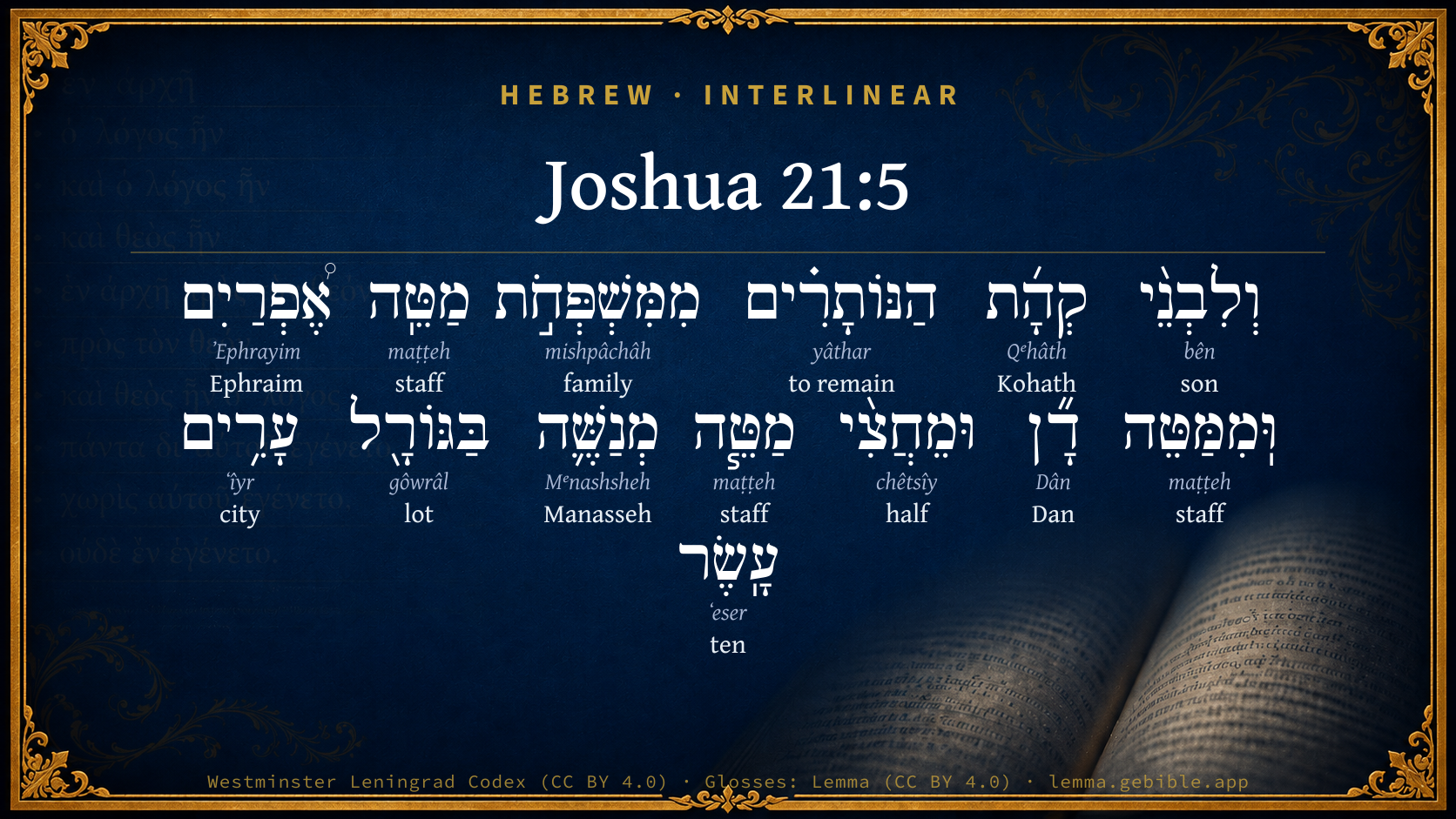
Hebrew (Westminster Leningrad Codex) Joshua 21:5 appears in the Hebrew Old Testament. The text above is from the Westminster Leningrad Codex. Each word links to its Strong’s number, a concise gloss, and parsing drawn from the Open Scriptures Hebrew Bible morphology. Click any word for its full Brown-Driver-Briggs (BDB) entry.
Download image
Cite this verse

Joshua 21:5 (World English Bible). Public Domain. Lemma interlinear Bible study tool, https://lemma.gebible.app/v/joshua/21/5.

Show BibTeX & RIS
BibTeX
RIS
English Translation
The rest of the children of Kohath had by lot out of the families of the tribe of Ephraim, and out of the tribe of Dan, and out of the half-tribe of Manasseh, ten cities.
World English Bible · Public Domain
Download a study sheet

One document with this verse’s original text, its word-by-word gloss line, the meaning frame, cross-references with their text, attributed commentary, and full source and license credits — printable, and it pastes into notes with its structure intact.

This verse Autodidact and up

Study sheet (.html) Plain text (.txt)

A passage Seminary Student

Up to 50 verses in one chapter. A passage sheet keeps up to 6 commentary sources and 12 cross-references per verse, in the order this page ranks them, and says so on the sheet whenever that leaves anything out. Ask for a single verse and you get the Autodidact verse sheet above.

Everything on this page stays free to read, with no account — the sheet is a download of what is already on screen, not access to it.

Want to remove ads? Support Godless Engineer
Compare translations 3

The same verse in 3 English versions, stacked beneath the original-language interlinear above. Click any original word for its lexicon entry.

Each is an independent rendering of the whole verse — the interlinear is not word-aligned to these translations.

Highlighted words mark where these versions differ — a whole-verse word diff, not a word-by-word alignment.

  • World English Bible Public Domain
    The rest of the children of Kohath had by lot out of the families of the tribe of Ephraim, and out of the tribe of Dan, and out of the half-tribe of Manasseh, ten cities.
  • King James Version Public Domain
    And the rest of the children of Kohath had by lot out of the families of the tribe of Ephraim, and out of the tribe of Dan, and out of the half tribe of Manasseh, ten cities.
  • unfoldingWord Literal Text CC BY-SA 4.0
    And for the remaining sons of Kohath, ten cities by the lot from the clans of the tribe of Ephraim and from the tribe of Dan and from half of the tribe of Manasseh.

unfoldingWord Literal Text — © unfoldingWord, licensed CC BY-SA 4.0. Word-aligned USFM3 via Door43 (git.door43.org/unfoldingWord/en_ult).

Versions to compare (up to 4)

3 of 4 selected

Show all 18 translations

Every available English version of this verse, each an independent rendering of the whole verse.

  • World English Bible Public Domain
    The rest of the children of Kohath had by lot out of the families of the tribe of Ephraim, and out of the tribe of Dan, and out of the half-tribe of Manasseh, ten cities.
  • Berean Standard Bible Public Domain
    The remaining descendants of Kohath received ten cities by lot from the tribes of Ephraim, Dan, and the half-tribe of Manasseh.
  • Majority Standard Bible Public Domain
    The remaining descendants of Kohath received ten cities by lot from the tribes of Ephraim, Dan, and the half-tribe of Manasseh.
  • King James Version Public Domain
    And the rest of the children of Kohath had by lot out of the families of the tribe of Ephraim, and out of the tribe of Dan, and out of the half tribe of Manasseh, ten cities.
  • American Standard Version (1901) Public Domain
    And the rest of the children of Kohath had by lot out of the families of the tribe of Ephraim, and out of the tribe of Dan, and out of the half-tribe of Manasseh, ten cities.
  • Revised Version (1885) Public Domain
    And the rest of the children of Kohath had by lot out of the families of the tribe of Ephraim, and out of the tribe of Dan, and out of the half tribe of Manasseh, ten cities.
  • Geneva Bible (1599) Public Domain
    And the rest of the children of Kohath had by lot out of the families of the tribe of Ephraim, and out of the tribe of Dan, and out of the halfe tribe of Manasseh, tenne cities.
  • Douay-Rheims (1899) Public Domain
    And to the rest of the children of Caath, that is, to the Levites, who remained, out of the tribes of Ephraim, and of Dan, and the half tribe of Manasses, ten cities.
  • Young's Literal Translation Public Domain
    and for the sons of Kohath who are left, out of the families of the tribe of Ephraim, and out of the tribe of Dan, and out of the half of the tribe of Manasseh, by lot ten cities:
  • Literal Standard Version CC BY-SA 4.0
    and for the sons of Kohath who are left, out of the families of the tribe of Ephraim, and out of the tribe of Dan, and out of the half-tribe of Manasseh, ten cities by lot.
  • Unlocked Literal Bible CC BY-SA 4.0
    The rest of the Kohathites were allotted ten cities from the clans of the tribes of Ephraim, Dan, and from the half tribe of Manasseh.
  • unfoldingWord Literal Text CC BY-SA 4.0
    And for the remaining sons of Kohath, ten cities by the lot from the clans of the tribe of Ephraim and from the tribe of Dan and from half of the tribe of Manasseh.
  • Darby Bible Public Domain
    And the children of Kohath that remained had by lot out of the families of the tribe of Ephraim, and out of the tribe of Dan, and out of the half tribe of Manasseh, ten cities.
  • World Messianic Bible Public Domain
    The rest of the children of Kohath had ten cities by lot out of the families of the tribe of Ephraim, out of the tribe of Dan, and out of the half-tribe of Manasseh.
  • Webster's Bible Public Domain
    And the rest of the children of Kohath had by lot out of the families of the tribe of Ephraim, and out of the tribe of Dan, and out of the half-tribe of Manasseh, ten cities.
  • Free Bible Version CC BY-SA 4.0
    The remaining families of the descendants of Kothah were allotted ten towns from the tribes of Ephraim, Dan, and the half-tribe of Manasseh.
  • Bible in Basic English Public Domain
    The rest of the children of Kohath by their families were given ten towns from the tribes of Ephraim and Dan and the half-tribe of Manasseh.
  • JPS Tanakh (1917) Public Domain
    And the rest of the children of Kohath had by lot out of the families of the tribe of Ephraim, and out of the tribe of Dan, and out of the half-tribe of Manasseh, ten cities.

Literal Standard Version (2020), Covenant Press — licensed CC BY-SA 4.0. Text via the HelloAO Bible API (eBible.org). Unlocked Literal Bible (unfoldingWord) — licensed CC BY-SA 4.0. Text via the HelloAO Bible API (eBible.org). unfoldingWord Literal Text — © unfoldingWord, licensed CC BY-SA 4.0. Word-aligned USFM3 via Door43 (git.door43.org/unfoldingWord/en_ult). Free Bible Version, Dr. Jonathan Gallagher — licensed CC BY-SA 4.0. Text via the HelloAO Bible API (eBible.org).

Word by word

More ways to search: Search by grammar → Find every occurrence → Compare this word →

Practice this passage: Drill this verse → Learn its vocabulary →

קְהָ֜ת
Qᵉhâth
H6955
“Kohath”
Noun, Proper
Part of Speech
Noun
Type
Proper
Full BDB Definition

Origin: from an unused root meaning to ally oneself

TWOT: None

Kohath = "assembly" - the 2nd of the 3 sons of Levi and progenitor of a family in the tribe of Levi
  1. וְלִבְנֵ֨י bên H1121 “and · to/for · sons of” Conjunction + Preposition + Noun, Common, Masculine, Plural, Construct
  2. הַנּוֹתָרִ֗ים yâthar H3498 “the · remaining” Particle, Definite Article + Verb, Niphal, Participle Active, Masculine, Plural, Absolute
  3. מִמִּשְׁפְּחֹ֣ת mishpâchâh H4940 “from · families of” Preposition + Noun, Common, Feminine, Plural, Construct
  4. מַטֵּֽה maṭṭeh H4294 “staff of” Noun, Common, Masculine, Singular, Construct
  5. אֶ֠פְרַיִם ʼEphrayim H669 “Ephraim” Noun, Proper
  6. וּֽמִמַּטֵּה maṭṭeh H4294 “and · from · staff of” Conjunction + Preposition + Noun, Common, Masculine, Singular, Construct
  7. דָ֞ן Dân H1835 “Dan” Noun, Proper
  8. וּמֵחֲצִ֨י chêtsîy H2677 “and · from · half of” Conjunction + Preposition + Noun, Common, Masculine, Singular, Construct
  9. מַטֵּ֧ה maṭṭeh H4294 “staff of” Noun, Common, Masculine, Singular, Construct
  10. מְנַשֶּׁ֛ה Mᵉnashsheh H4519 “Manasseh” Noun, Proper
  11. בַּגּוֹרָ֖ל gôwrâl H1486 “in/at the · lot” Preposition, Determined + Noun, Common, Masculine, Singular, Absolute
  12. עָרִ֥ים ʻîyr H5892 “cities” Noun, Common, Feminine, Plural, Absolute
  13. עָֽשֶׂר ʻeser H6235 “ten” Adjective, Cardinal number, Feminine, Singular, Absolute

About this verse

These counts appear in no published source. They are computed here, from the morphology-tagged text and Lemma’s own curated glosses. What Lemma adds →

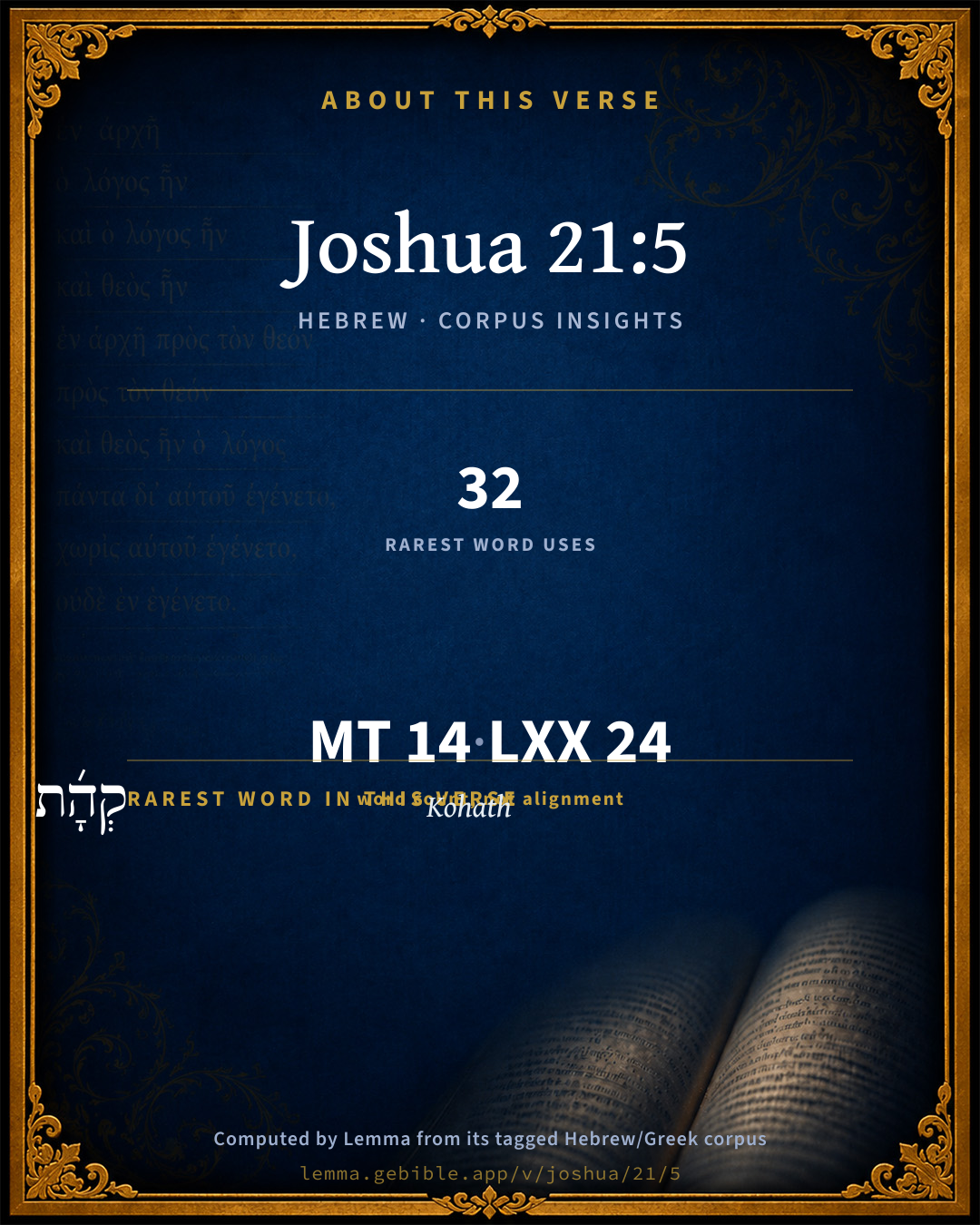
14
words
12
distinct lemmas
Historical
section

Shared distinctive vocabulary

קְהָ֜ת Kohath H6955 occurs in 29 verses of the Hebrew Bible. Also found in:

Grammatical profile

  • 1 verb
  • 12 nouns
  • 1 adjective

Verb forms

  • הַנּוֹתָרִ֗ים Niphal · Participle Active

Repetition

A word recurs within this verse — often emphatic in Hebrew:

  • מַטֵּֽה staff H4294 ×3

Hebrew & Septuagint length

In English translation the verse runs 35 words from the Hebrew and 36 from the Septuagint (LXX English) — closely comparable.

A rough comparison of the two English renderings, which tokenize alike — not a word-level alignment.

Word counts can differ between the Hebrew and the Greek without any difference in meaning — e.g. the Hebrew direct-object marker אֵת has no separate Greek word, and Greek often adds the article ὁ.

In the original languages it is 14 Hebrew tokens and 24 Greek tokens — but the two are counted differently (Hebrew bundles its prefixes and suffixes into one token; the Greek is in lemma form), so that isn’t a like-for-like length.

Cross-references

7

Topical passages linked to Joshua 21:5 in the Treasury of Scripture Knowledge — connected by theme and wording, ordered by reader-vote popularity; previews shown in the World English Bible.

  • Joshua 21:20–26 The families of the children of Kohath, the Levites, even the rest of the children of Kohath, they had the cities of their lot out of the tribe of Ephraim.
  • Genesis 46:11 The sons of Levi: Gershon, Kohath, and Merari.
  • Exodus 6:16–25 These are the names of the sons of Levi according to their generations: Gershon, and Kohath, and Merari; and the years of the life of Levi were one hundred thirty-seven years.
  • Numbers 3:27 Of Kohath was the family of the Amramites, and the family of the Izharites, and the family of the Hebronites, and the family of the Uzzielites: these are the families of the Kohathites.
  • 1 Chronicles 6:18–19 The sons of Kohath were Amram, and Izhar, and Hebron, and Uzziel.
  • 1 Chronicles 6:61 To the rest of the sons of Kohath [were given] by lot, out of the family of the tribe, out of the half-tribe, the half of Manasseh, ten cities.
  • 1 Chronicles 6:66–70 Some of the families of the sons of Kohath had cities of their borders out of the tribe of Ephraim.

Cross-references courtesy of OpenBible.info (CC BY 4.0).

Hebrew and Greek witnesses Masoretic Hebrew ↔ Greek Septuagint

The same verse in the two great witnesses to the Old Testament, shown verse-for-verse.

These are two independent witnesses, not word-aligned to each other, and the Septuagint is shown in lemma (dictionary) form.

Hebrew Joshua 21:5 Masoretic · Westminster Leningrad Codex

וְלִבְנֵ֨י קְהָ֜ת הַנּוֹתָרִ֗ים מִמִּשְׁפְּחֹ֣ת מַטֵּֽה אֶ֠פְרַיִם וּֽמִמַּטֵּה דָ֞ן וּמֵחֲצִ֨י מַטֵּ֧ה מְנַשֶּׁ֛ה בַּגּוֹרָ֖ל עָרִ֥ים עָֽשֶׂר

The rest of the children of Kohath had by lot out of the families of the tribe of Ephraim, and out of the tribe of Dan, and out of the half-tribe of Manasseh, ten cities.

World English Bible · Public Domain

Greek LXX Joshua 21:5 Septuagint · lemma form

καί ὁ υἱός κααθ ὁ καταλείπω ἐκ ὁ φυλή ἐφράιμ καί ἐκ ὁ φυλή δαν καί ἀπό ὁ ἥμισυς φυλή μανασσή κληρωτί πόλις δέκα

And to the sons of Caath that were left were given by lot ten cities, out of the tribe of Ephraim, and out of the tribe of Dan, and out of the half tribe of Manasse.

LXX2012 (modern English Septuagint) · Public Domain

Hebrew: Westminster Leningrad Codex (CC BY 4.0). Greek: Septuagint (public domain); English from LXX2012 (modern English Septuagint) (Public Domain). How the Septuagint differs from the Hebrew →

Targum (Aramaic paraphrase)

1

The Targum is the ancient Jewish Aramaic paraphrase of the Hebrew Scriptures — an interpretive translation, not the Hebrew text itself. Onkelos (literal) and Pseudo-Jonathan (expansive) render the Torah, and Jonathan the Prophets. Coverage is partial: where no permissively-licensed English translation exists for a verse, only the Aramaic is shown. This is verse-level text, not a word-by-word alignment to the Hebrew.

  1. Targum Jonathan Prophets (Joshua–Malachi)
    וְלִבְנֵי קְהָת דְאִשְׁתָּאֲרוּ מִזַרְעִית שִׁבְטָא דְאֶפְרַיִם וּמִשִׁבְטָא דְדָן וּמִפַּלְגוּת שִׁבְטָא דִמְנַשֶׁה בְּעַדְבָא קִרְוִין עָשֶׂר:

    (no public-domain English translation for this verse)

    Targum Jonathan — Aramaic: “Mikraot Gedolot” (public domain). English: “Sefaria Community Translation” (CC0 1.0 (public-domain dedication)); “London "Chaldee Paraphrase," 1871” (public domain). Text via Sefaria.

Commentary

Notes on Joshua 21:5 from classic Christian and Jewish commentators (each source and its license shown beneath its notes). The classic Christian expositions comment on the surrounding passage and are grouped to its opening verse, so a note may address several verses; the Jewish commentaries on the Tanakh (Rashi and others) are per-verse, so they appear only where the commentator wrote on this verse.

Lemma curates 59 commentaries, every one of them public domain or Creative Commons licensed, each selected and text-cleaned for this edition rather than reprinted as found. About our sources →

Trapp's Complete Commentary

John Trapp

Jos 21:5 And the rest of the children of Kohath [had] by lot out of the families of the tribe of Ephraim, and out of the tribe of Dan, and out of the half tribe of Manasseh, ten cities.

Ver. 5. And the rest of the children of Kohath.] Thus the Levites were dispersed throughout the land - as salt is sprinkled upon meat, to keep it from putrifying; "ye are the salt of the earth" {Mat 5:13} - for instruction of the people; and herein that malediction, Gen 49:7, was turned into a benediction. It were happy if every congregation had an able minister. To many churches here at the first Reformation, for want of preachers, readers were sent; whence one of the martyrs wished that every able minister might have ten congregations committed to his charge till further provision could be made.

John Trapp, A Commentary or Exposition upon All the Books of the Old and New Testament (1647–1656) — public domain. Text from a community e-Sword module.

Joseph Benson's Commentary

Jos 21:5. Children of Kohath — Who were of Aaron’s family. Ephraim, Dan, and Manasseh — Which tribes were nearest to the three former, and so the Kohathites are placed next to their brethren the Aaronites. Ten cities — Fewer than they gave out of the three former tribes, because their inheritance was less than the former.

Joseph Benson's Commentary on the Old and New Testaments (1811–1818) — public domain. Text from a community e-Sword module.

Tyndale Open Study Notes

Tyndale Open Resources

21:5 The remaining families of the Kohathite clan received cities in the central part of the hill country, north of Jerusalem.

Tyndale Open Study Notes — © Tyndale Open Resources, licensed CC BY-SA 4.0. Text via the HelloAO Bible API.

Adam Clarke's Commentary

Verse 5. And the rest of the children of Kohath] That is, the remaining part of that family that were not priests, for those who were priests had their lot in the preceding tribes. Those, therefore, of the family of Kohath, who were simply Levites, and not of the priests or Aaron's family, (see Jos 21:10), had their habitations in Ephraim, Dan, and the half tribe of Manasseh.

It has been asked in what sense did the Levites possess those cities, seeing they had no inheritance? To which it may be answered that it is not likely the Levites had the exclusive property of the cities in which they dwelt, for it is evident that the other Israelites dwelt among them. We know, says Calmet, by history, that the cities of the Levites were almost entirely filled with Israelites of other tribes. For instance, Gibeah of Benjamin, which is here given to the Levites, Jos 21:17, was always peopled by the Benjamites, as appears from the history of the Levite, whose wife was so horribly abused by them; Jdg 19:22-27. Saul and all his family dwelt in the same city; and David and his court spent the first years of his reign at Hebron, which was also a city of the Levites, Jos 21:10. It appears, therefore, that they had no other property in those cities than merely the right to certain houses, which they might sell, but always with the right of perpetual redemption, for they could finally alienate nothing; and if the possessor of such a house, having sold it, did not redeem it at the year of jubilee, it reverted to the Levites. And as to their lands for their cattle, which extended two thousand cubits without the city, these they were not permitted to sell: they were considered as the Lord's property. See Le 25:32-34, and the notes there. It is therefore very likely that, in the first instance, the Levites had simply the right to choose, in all the cities assigned them, the houses in which they were to dwell, and that those of the tribe to which the city belonged occupied all the other dwellings. There is also reason to believe that in process of time, when the families of the Levites increased, they had more dwellings assigned to them, which were probably built at the public expense.

We may also observe that the Levites were not absolutely bound to live in these and no other cities: for when the tabernacle was at Nob, priests and Levites dwelt there, see 1Sa 21:1, c. and when the worship of God was established at Jerusalem, multitudes both of priests and Reviles dwelt there, though it was no Levitical city: as did the courses of priests afterwards at Jericho. This was a circumstance which Moses had foreseen, and for which he had provided. See De 18:6, &c.

Adam Clarke's Commentary on the Bible (1810–1826) — public domain. Text from a community e-Sword/MySword module.

The Cambridge Bible for Schools and Colleges

gen. ed. J. J. S. Perowne

5. And the rest of the children of Kohath] i.e. those who sprang from Moses, Izhar, Hebron, and Uzziel, and formed the non-priestly portion, shared ten cities in the land of Ephraim, Dan, and half Manasseh west of the Jordan.

The Cambridge Bible for Schools and Colleges (gen. ed. J. J. S. Perowne; Cambridge University Press, 1878–1918) — public domain. Text from a community e-Sword module.

John Gill's Exposition

And the rest of the children of Kohath,.... Which did not descend from him in the line of Amram and Aaron, but of Izhar, Hebron, and Uzziel, who were not priests, but Levites:

had by lot out of the families of the tribe of Ephraim, and out of the tribe of Dan, and out of the half tribe of Manasseh, ten cities; these other sort of Kohathites had their cities in tribes next to the other three where the Kohathites that were priests had theirs.

John Gill's Exposition of the Whole Bible (1746–1763) — public domain (CC PDM 1.0). Text via the HelloAO Bible API.

Albert Barnes' Notes on the Bible

The non-priestly Kohathites had been diminished by the destruction of Korah and his company Num. 16. On comparing Num 26:57 following with Num 3:27 ff, two of the families of the Kohathites seem to have disappeared altogether. Hence, it is not surprising that the rest of the Kohathites were sufficiently accommodated in ten cities.

Albert Barnes' Notes on the Bible (1834–1885) — public domain. Text from a community e-Sword/MySword module.

Matthew Poole's English Annotations

The children of Kohath were of Aaron’s family, or priests, but Levites only. These tribes are nearest to the three former, and so the Kohathites are placed next to their brethren the Aaronites.

Ten cities; fewer than they gave out for the three former tribes, because their inheritance was less than the former. See Num 35:8.

Matthew Poole's English Annotations on the Holy Bible (1683–1685) — public domain. Text from a community e-Sword/MySword module.

John Wesley's Explanatory Notes

Children of Kohath - Who were of Aaron's family. Ephraim, Daniel, and Manesseh - Which tribes are nearest to the three former, and so the Kohathites are placed next to their brethren the Aaronites. Ten cities - Fewer than they gave out of the three former tribes, because their inheritance was less than the former.

John Wesley, Explanatory Notes Upon the Whole Bible (1754–1765) — public domain. Text via the GEBible commentary corpus.

Rashi

Rabbi Shlomo Yitzchaki (Rashi)

And the remaining descendants of Kehos. They were the descendants of Moshe, the descendants of Yitzhar, Chevron and Uzziel.

From the families of the tribe of Ephraim. From the inheritance of the tribe of the descendants of Ephraim, these cities were alloted to them. They received cities from the portion of each tribe, as it is said: “Take more from a larger [portion], and less from a smaller [portion]; each person according to his inheritance, shall give of his cities to the Levi’im.

Rashi on the Tanakh — English translations: “The Judaica Press complete Tanach with Rashi, translated by A. J. Rosenberg” (CC BY 4.0); “Pentateuch with Rashi's commentary by M. Rosenbaum and A.M. Silbermann, 1929-1934” (public domain); “The Metsudah Tanach series, Lakewood, N.J” (CC BY 4.0); and “The Book of Joshua, Metsudah Publications, 1997” (CC BY 4.0). Text via Sefaria.

Lesson kit

Teaching starters — assembled from the data on this page, not authored interpretation. Every prompt links to the verse data it draws on. Edit before teaching.

Joshua, in the Historical, opens this verse with 14 words (12 distinct Hebrew lemmas). Its most distinctive word is Qᵉhâth (“Kohath”). A historical commentator’s framing appears above. Read the whole chapter for the surrounding context.

Discussion questions

  1. How does “Kohath” (Qᵉhâth) shape what this verse is saying?
  2. Genesis 46:11 shares the word «Kohath» with this verse. How do the two illuminate each other?
  3. “staff” occurs 3× in this one verse. What is the effect of the repetition?
  4. The translations on this page render this verse differently — a whole-verse word diff, not a word-by-word alignment. What might account for the different wordings?
  5. The verb «הַנּוֹתָרִ֗ים» is Niphal Participle Active. How does its form color the action?
  6. Reading how Trapp's Complete Commentary and Joseph Benson's Commentary read this verse, where do the two commentators agree and where do they part?

Things to notice

Reading settings

Reading text

Shown beneath each verse's original-language words.

Old Testament
Old Testament edition

Read the OT as the Masoretic Hebrew (MT) or the Greek Septuagint (LXX).

English shown for the Greek Septuagint (in the Hebrew ↔ Greek comparison).

Comparing translations? Open the Compare panel on any verse page to stack up to four side by side.