Hosea 9:16

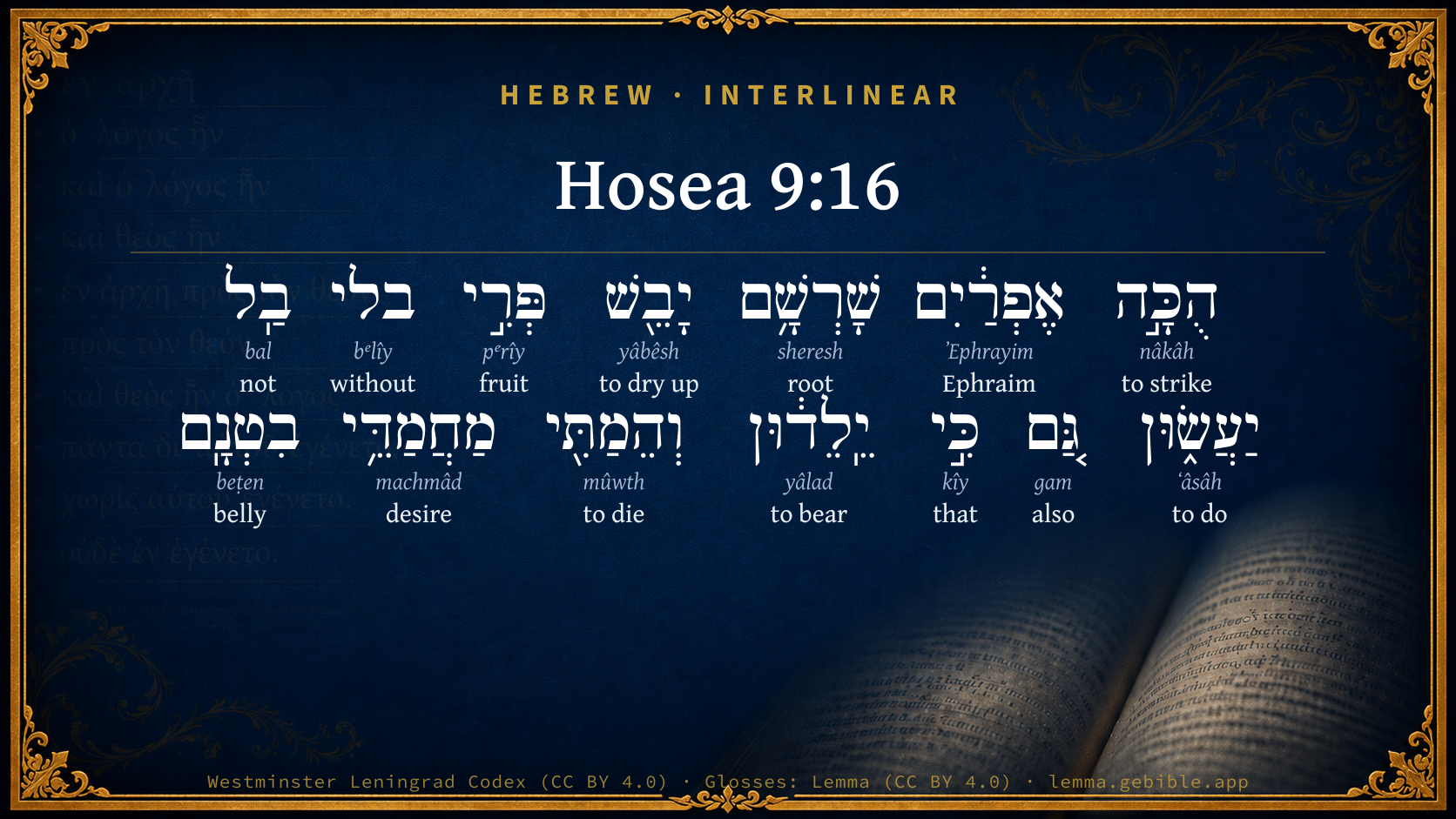
Hebrew (Westminster Leningrad Codex) Hosea 9:16 appears in the Hebrew Old Testament. The text above is from the Westminster Leningrad Codex. Each word links to its Strong’s number, a concise gloss, and parsing drawn from the Open Scriptures Hebrew Bible morphology. Click any word for its full Brown-Driver-Briggs (BDB) entry.
Download image
Cite this verse

Hosea 9:16 (World English Bible). Public Domain. Lemma interlinear Bible study tool, https://lemma.gebible.app/v/hosea/9/16.

Show BibTeX & RIS
BibTeX
RIS
English Translation
Ephraim is struck. Their root has dried up. They will bear no fruit. Even though they bring forth, yet I will kill the beloved ones of their womb."
World English Bible · Public Domain
Download a study sheet

One document with this verse’s original text, its word-by-word gloss line, the meaning frame, cross-references with their text, attributed commentary, and full source and license credits — printable, and it pastes into notes with its structure intact.

This verse Autodidact and up

Study sheet (.html) Plain text (.txt)

A passage Seminary Student

Up to 50 verses in one chapter. A passage sheet keeps up to 6 commentary sources and 12 cross-references per verse, in the order this page ranks them, and says so on the sheet whenever that leaves anything out. Ask for a single verse and you get the Autodidact verse sheet above.

Everything on this page stays free to read, with no account — the sheet is a download of what is already on screen, not access to it.

Want to remove ads? Support Godless Engineer
Compare translations 3

The same verse in 3 English versions, stacked beneath the original-language interlinear above. Click any original word for its lexicon entry.

Each is an independent rendering of the whole verse — the interlinear is not word-aligned to these translations.

Highlighted words mark where these versions differ — a whole-verse word diff, not a word-by-word alignment.

  • World English Bible Public Domain
    Ephraim is struck. Their root has dried up. They will bear no fruit. Even though they bring forth, yet I will kill the beloved ones of their womb."
  • King James Version Public Domain
    Ephraim is smitten, their root is dried up, they shall bear no fruit: yea, though they bring forth, yet will I slay even the beloved fruit of their womb.
  • unfoldingWord Literal Text CC BY-SA 4.0
    Ephraim is struck; their root has dried up; they will not produce fruit. Even if they do give birth, then I will kill the precious ones of their womb.

unfoldingWord Literal Text — © unfoldingWord, licensed CC BY-SA 4.0. Word-aligned USFM3 via Door43 (git.door43.org/unfoldingWord/en_ult).

Versions to compare (up to 4)

3 of 4 selected

Show all 18 translations

Every available English version of this verse, each an independent rendering of the whole verse.

  • World English Bible Public Domain
    Ephraim is struck. Their root has dried up. They will bear no fruit. Even though they bring forth, yet I will kill the beloved ones of their womb."
  • Berean Standard Bible Public Domain
    Ephraim is struck down; their root is withered; they cannot bear fruit. Even if they bear children, I will slay the darlings of their wombs.
  • Majority Standard Bible Public Domain
    Ephraim is struck down; their root is withered; they cannot bear fruit. Even if they bear children, I will slay the darlings of their wombs.
  • King James Version Public Domain
    Ephraim is smitten, their root is dried up, they shall bear no fruit: yea, though they bring forth, yet will I slay even the beloved fruit of their womb.
  • American Standard Version (1901) Public Domain
    Ephraim is smitten, their root is dried up, they shall bear no fruit: yea, though they bring forth, yet will I slay the beloved fruit of their womb.
  • Revised Version (1885) Public Domain
    Ephraim is smitten, their root is dried up, they shall bear no fruit: yea, though they bring forth, yet will I slay the beloved fruit of their womb.
  • Geneva Bible (1599) Public Domain
    Ephraim is smitten, their roote is dried vp: they can bring no fruite: yea, though they bring foorth, yet will I slaie euen the dearest of their bodie.
  • Douay-Rheims (1899) Public Domain
    Ephraim is struck, their root is dried up, they shall yield no fruit. And if they should have issue, I will slay the best beloved fruit of their womb.
  • Young's Literal Translation Public Domain
    Ephraim hath been smitten, Their root hath dried up, fruit they yield not, Yea, though they bring forth, I have put to death the desired of their womb.
  • Literal Standard Version CC BY-SA 4.0
    Ephraim has been struck, || Their root has dried up, they do not yield fruit, || Indeed, though they bring forth, || I have put to death the desired of their womb.
  • Unlocked Literal Bible CC BY-SA 4.0
    Ephraim is diseased, and their root is dried up; they bear no fruit. Even if they have children, I will put their beloved children to death.”
  • unfoldingWord Literal Text CC BY-SA 4.0
    Ephraim is struck; their root has dried up; they will not produce fruit. Even if they do give birth, then I will kill the precious ones of their womb.
  • Darby Bible Public Domain
    Ephraim is smitten: their root is dried up, they shall bear no fruit; yea, though they should bring forth, yet will I slay the beloved [fruit] of their womb.
  • World Messianic Bible Public Domain
    Ephraim is struck. Their root has dried up. They will bear no fruit. Even though they give birth, yet I will kill the beloved ones of their womb.”
  • Webster's Bible Public Domain
    Ephraim is smitten, their root is dried up, they shall bear no fruit: yes, though they bring forth, yet will I slay even the beloved fruit of their womb.
  • Free Bible Version CC BY-SA 4.0
    Ephraim, you are blighted, dried up from the roots. You shall bear no fruit. Even if you have children, I will slaughter your beloved offspring.
  • Bible in Basic English Public Domain
    The rod has come on Ephraim, their root is dry, let them have no fruit; even though they give birth, I will put to death the dearest fruit of their bodies.
  • JPS Tanakh (1917) Public Domain
    Ephraim is smitten, their root is dried up, they shall bear no fruit; yea, though they bring forth, yet will I slay the beloved fruit of their womb.

Literal Standard Version (2020), Covenant Press — licensed CC BY-SA 4.0. Text via the HelloAO Bible API (eBible.org). Unlocked Literal Bible (unfoldingWord) — licensed CC BY-SA 4.0. Text via the HelloAO Bible API (eBible.org). unfoldingWord Literal Text — © unfoldingWord, licensed CC BY-SA 4.0. Word-aligned USFM3 via Door43 (git.door43.org/unfoldingWord/en_ult). Free Bible Version, Dr. Jonathan Gallagher — licensed CC BY-SA 4.0. Text via the HelloAO Bible API (eBible.org).

Word by word

More ways to search: Search by grammar → Find every occurrence → Compare this word →

Practice this passage: Drill this verse → Learn its vocabulary →

מַחֲמַדֵּ֥י
machmâd
H4261
“desires of”
Noun, Common, Masculine, Plural, Construct
Part of Speech
Noun
Type
Common
Gender
Masculine
Number
Plural
State
Construct
Full BDB Definition

Origin: from H2530

TWOT: 673d , 673e

desire, desirable thing, pleasant thing
  1. הֻכָּ֣ה nâkâh H5221 “to strike” Verb, Hophal, Perfect, 3rd Person, Masculine, Singular
  2. אֶפְרַ֔יִם ʼEphrayim H669 “Ephraim” Noun, Proper
  3. שָׁרְשָׁ֥ם sheresh H8328 “root · their” Noun, Common, Masculine, Singular, Construct + Suffix, Personal, 3rd Person, Masculine, Plural
  4. יָבֵ֖שׁ yâbêsh H3001 “to dry up” Verb, Qal, Perfect, 3rd Person, Masculine, Singular
  5. פְּרִ֣י pᵉrîy H6529 “fruit” Noun, Common, Masculine, Singular, Absolute
  6. בלי bᵉlîy H1097 “without” Particle, Negative
  7. בַֽל bal H1077 “not” Particle, Negative
  8. יַעֲשׂ֑וּן ʻâsâh H6213 “to do” Verb, Qal, Imperfect, 3rd Person, Masculine, Plural + Suffix, n
  9. גַּ֚ם gam H1571 “also” Particle, Accusative
  10. כִּ֣י kîy H3588 “that” Conjunction
  11. יֵֽלֵד֔וּן yâlad H3205 “to bear” Verb, Qal, Imperfect, 3rd Person, Masculine, Plural + Suffix, n
  12. וְהֵמַתִּ֖י mûwth H4191 “and · to die” Conjunction + Verb, Hiphil, Sequential Perfect, 1st Person, Common, Singular
  13. בִטְנָֽם beṭen H990 “belly · their” Noun, Common, Feminine, Singular, Construct + Suffix, Personal, 3rd Person, Masculine, Plural

About this verse

These counts appear in no published source. They are computed here, from the morphology-tagged text and Lemma’s own curated glosses. What Lemma adds →

14
words
14
distinct lemmas
Prophets
section

Notable vocabulary

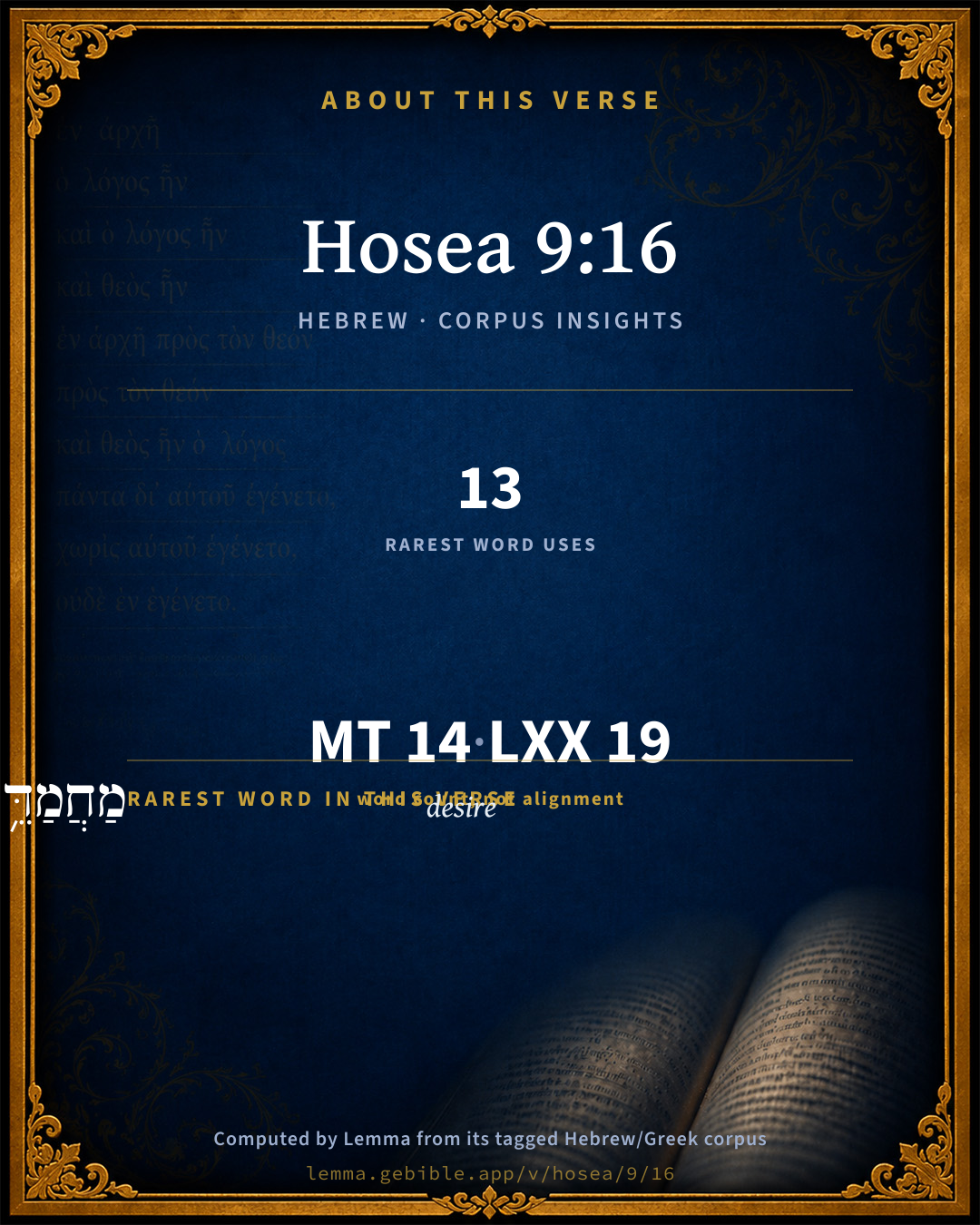
The rarest word here is מַחֲמַדֵּ֥י desire H4261 — appearing just 13 times in the whole Hebrew Bible.

Shared distinctive vocabulary

מַחֲמַדֵּ֥י desire H4261 occurs in 13 verses of the Hebrew Bible. Also found in:

Grammatical profile

  • 5 verbs
  • 5 nouns
  • 1 conjunction
  • 3 particles

Verb forms

  • הֻכָּ֣ה Hophal · Perfect
  • יָבֵ֖שׁ Qal · Perfect
  • יַעֲשׂ֑וּן Qal · Imperfect
  • יֵֽלֵד֔וּן Qal · Imperfect
  • וְהֵמַתִּ֖י Hiphil · Sequential Perfect

Hebrew & Septuagint length

In English translation the verse runs 28 words from the Hebrew and 35 from the Septuagint (LXX English) — closely comparable.

A rough comparison of the two English renderings, which tokenize alike — not a word-level alignment.

Word counts can differ between the Hebrew and the Greek without any difference in meaning — e.g. the Hebrew direct-object marker אֵת has no separate Greek word, and Greek often adds the article ὁ.

In the original languages it is 14 Hebrew tokens and 19 Greek tokens — but the two are counted differently (Hebrew bundles its prefixes and suffixes into one token; the Greek is in lemma form), so that isn’t a like-for-like length.

Cross-references

8

Topical passages linked to Hosea 9:16 in the Treasury of Scripture Knowledge — connected by theme and wording, ordered by reader-vote popularity; previews shown in the World English Bible.

  • Hosea 9:11–13 As for Ephraim, their glory will fly away like a bird. There will be no birth, none with child, and no conception.
  • Ezekiel 24:21 Speak to the house of Israel, Thus says the Lord Yahweh: Behold, I will profane my sanctuary, the pride of your power, the desire of your eyes, and that which your soul pities; and your sons and your daughters whom you have left behind shall fall by the sword.
  • Isaiah 5:24 Therefore as the tongue of fire devours the stubble, And as the dry grass sinks down in the flame, So their root shall be as rottenness, And their blossom shall go up as dust; Because they have rejected the law of Yahweh of Hosts, And despised the word of the Holy One of Israel.
  • Job 18:16 His roots shall be dried up beneath, Above shall his branch be cut off.
  • Isaiah 40:24 Yes, they have not been planted; yes, they have not been sown; yes, their stock has not taken root in the earth: moreover he blows on them, and they wither, and the whirlwind takes them away as stubble.
  • Hosea 5:11 Ephraim is oppressed, He is crushed in judgment; Because he is intent in his pursuit of idols.
  • Hosea 8:7 For they sow the wind, And they will reap the whirlwind. He has no standing grain. The stalk will yield no head. If it does yield, strangers will swallow it up.
  • Malachi 4:1 "For, behold, the day comes, it burns as a furnace; and all the proud, and all who work wickedness, will be stubble; and the day that comes will burn them up," says Yahweh of Hosts, "that it shall leave them neither root nor branch.

Cross-references courtesy of OpenBible.info (CC BY 4.0).

Hebrew and Greek witnesses Masoretic Hebrew ↔ Greek Septuagint

The same verse in the two great witnesses to the Old Testament, shown verse-for-verse.

These are two independent witnesses, not word-aligned to each other, and the Septuagint is shown in lemma (dictionary) form.

Hebrew Hosea 9:16 Masoretic · Westminster Leningrad Codex

הֻכָּ֣ה אֶפְרַ֔יִם שָׁרְשָׁ֥ם יָבֵ֖שׁ פְּרִ֣י בלי בַֽל יַעֲשׂ֑וּן גַּ֚ם כִּ֣י יֵֽלֵד֔וּן וְהֵמַתִּ֖י מַחֲמַדֵּ֥י בִטְנָֽם

Ephraim is struck. Their root has dried up. They will bear no fruit. Even though they bring forth, yet I will kill the beloved ones of their womb."

World English Bible · Public Domain

Greek LXX Hosea 9:16 Septuagint · lemma form

πονέω ἐφράιμ ὁ ῥίζα αὐτός ξηραίνω καρπός οὐκέτι μή φέρω διότι καί ἐάν γεννάω ἀποκτείνω ὁ ἐπιθύμημα κοιλία αὐτός

Ephraim is sick, he is dried up at his roots, he shall in no wise any more bear fruit: therefore even if they should beget children, I will kill the desired fruit of their womb.

LXX2012 (modern English Septuagint) · Public Domain

Hebrew: Westminster Leningrad Codex (CC BY 4.0). Greek: Septuagint (public domain); English from LXX2012 (modern English Septuagint) (Public Domain). How the Septuagint differs from the Hebrew →

Targum (Aramaic paraphrase)

1

The Targum is the ancient Jewish Aramaic paraphrase of the Hebrew Scriptures — an interpretive translation, not the Hebrew text itself. Onkelos (literal) and Pseudo-Jonathan (expansive) render the Torah, and Jonathan the Prophets. Coverage is partial: where no permissively-licensed English translation exists for a verse, only the Aramaic is shown. This is verse-level text, not a word-by-word alignment to the Hebrew.

  1. Targum Jonathan Prophets (Joshua–Malachi)
    בֵּית יִשְׂרָאֵל דָמָן לְאִילָנָא דִקְלָא שָׁרָשׁוֹהִי מִלְרַע וְיָבֵשׁ נוֹפֵיהּ מִלְעֵלָא נוֹב לָא יַעֲבֵיד אַף אִם יַרְבּוּן בְּנִין וְאֶקְטוֹל שְׁפַר מָעֵיהוֹן:

    (no public-domain English translation for this verse)

    Targum Jonathan — Aramaic: “Mikraot Gedolot” (public domain). English: “Sefaria Community Translation” (CC0 1.0 (public-domain dedication)); “London "Chaldee Paraphrase," 1871” (public domain). Text via Sefaria.

Commentary

Notes on Hosea 9:16 from classic Christian and Jewish commentators (each source and its license shown beneath its notes). The classic Christian expositions comment on the surrounding passage and are grouped to its opening verse, so a note may address several verses; the Jewish commentaries on the Tanakh (Rashi and others) are per-verse, so they appear only where the commentator wrote on this verse.

Lemma curates 59 commentaries, every one of them public domain or Creative Commons licensed, each selected and text-cleaned for this edition rather than reprinted as found. About our sources →

Trapp's Complete Commentary

John Trapp

Hos 9:16 Ephraim is smitten, their root is dried up, they shall bear no fruit: yea, though they bring forth, yet will I slay [even] the beloved [fruit] of their womb.

Ver. 16. Ephraim is smitten] As a tree that hath received a deadly wound, or that hath the bark pulled off it, so that the sap cannot find the way to the branches; or that is blasted, as the fig tree in the Gospel was by Christ’s curse; and as a vine smitten by great hailstones, and beaten down to the ground. "The Lord shall smite Israel," saith another prophet, "as a reed is shaken in the water, and he shall root up Israel," &c., 1Ki 14:15, root and branch in one day.

The root is dried up, they shall bear no fruit] "The root of the righteous shall not be moved," Pro 12:3. "The root of the matter is found in me," saith Job, Job 19:28. "The holy seed shall be the substance thereof," Isa 6:13; "as a teil tree, and as an oak, whose substance is in them." The Duke of Florence gave for his ensign a great tree with many spreading boughs, one of them being cut off with this posy, Uno avulso non deficit alter Aureus (Virg.). But it is otherwise with the ungodly; as it was with Nebuchadnezzar, Dan 4:14, nay, worse; for not so much as a stump of their roots is left in the earth, but they are written in the earth, Jer 17:13, written childless, Jer 22:30, their root is dried up, the parents shall perish; they shall bear no fruit, beget no children, which are the fruit of the womb, Deu 28:11; Deu 28:18 Luk 1:42. Doeg’s doom shall befall them, Psa 52:5, "God shall destroy thee for ever; he shall take thee away, and pluck thee out of thy dwelling place, and root thee out of the land of the living. Selah."

Yea, though they bring forth] As Ahab did seventy sons, after that God had threatened his utter extirpation, following the work of generation so much the rather; {See Trapp on "Hos 9:13"}

Yet I will slay] For it is God that lets in and sets on the enemy; it is he that killeth and maketh alive, 1Sa 2:6.

Even the beloved fruit of their womb] Heb. their desires, or their desirable ones, their dearest children, called by Cicero also his desideria, Valete, mea desideria, valete (Cic.). The Latins seem to have their filius, a son, from φιλος, beloved: there is an ocean of love in a father’s heart; though the more he loveth the less he is loved sometimes (as David by Absalom), and is sure, if he belong to God, to be crossed in his earthly idol. Children are certain cares, but uncertain comforts; they may prove as Augustus’ three children did, whom he called his three ulcers or cancers, Tres vomicas tria carcinomata (Sueton.).

John Trapp, A Commentary or Exposition upon All the Books of the Old and New Testament (1647–1656) — public domain. Text from a community e-Sword module.

Keil & Delitzsch

C. F. Keil & F. Delitzsch

"Ephraim is smitten: their root is dried up; they will bear no fruit: even if they beget, I slay the treasures of their womb. Hos 9:17. My God rejects them: for they have not hearkened to Him, and they shall be fugitives among the nations." In Hos 9:16 Israel is compared to a plant, that is so injured by the heat of the sun (Psa 121:6; Psa 102:5), or by a worm (Jon 4:7), that it dries up and bears no more fruit. The perfects are a prophetic expression, indicating the certain execution of the threat. This is repeated in Hos 9:16 in figurative language; and the threatening in Hos 9:11, Hos 9:12, is thereby strengthened. Lastly, in Hos 9:17 the words of threatening are rounded off by a statement of the reason for the rejection of Israel; and this rejection is described as banishment among the nations, according to Deu 28:65.

Keil & Delitzsch — Biblical Commentary on the Old Testament (1861–1891) — public domain (CC PDM 1.0). Text via the HelloAO Bible API. (Old Testament only.)

Jamieson, Fausset & Brown

Robert Jamieson, A. R. Fausset & David Brown

The figures "root," "fruit," are suggested by the word "Ephraim," that is, fruitful (see on Hos 9:11-12). "Smitten," namely, with a blight (Psa 102:4).

Jamieson, Fausset & Brown — Commentary Critical and Explanatory on the Whole Bible (1871) — public domain (CC PDM 1.0). Text via the HelloAO Bible API.

Adam Clarke's Commentary

Verse 16. Ephraim is smitten] The thing being determined, it is considered as already done.

Their root is dried up] They shall never more be a kingdom. And they never had any political form from their captivity by the Assyrians to the present day.

Yea, though they bring forth] See Clarke on Ho 9:11; "Ho 9:12".

Adam Clarke's Commentary on the Bible (1810–1826) — public domain. Text from a community e-Sword/MySword module.

John Calvin's Commentaries

The Prophet again threatens extreme vengeance to the Israelites. It is no wonder that the same sentence is so often repeated; for hypocrites, we know, too much flatter themselves, and are not frightened even by the most grievous threatening. As then hypocrites are so stupid, they must be often, nay, frequently pricked, and most sharply, that they may at length be awakened out of their torpor. Hence the Prophet repeats the threatening which he had often before announced, and says, that Israel had been so smitten, that their root had dried up The comparison is taken from a tree, which not only has had its branches cut off, but has also been torn from the roots. The meaning is, that God would take such vengeance on this miserable people, as wholly to destroy them, without any hope of recovery. The root then is dried up, they will produce fruit no more.

He then leaves this similitude or metaphor, and says, If they generate, I will slay the desirable fruit of their womb; that is, though some seed be begotten, I will yet destroy it.

We now then apprehend the design of the Prophet, which was to show, that the Lord would no more be content with some moderate punishment, for he had often found that this abandoned people were in vain chastised by paternal love; but that extreme vengeance awaited them, which would consume not only the men, but also their children so that no residue should remain. The reason is afterwards added —

John Calvin's Commentaries (1540-1563) — public domain. Text from the Calvin Translation Society English edition (1840s-50s) via the Christian Classics Ethereal Library (ccel.org). Calvin's coverage is partial (roughly two-thirds of the Bible); uncommented books and verses are honest gaps, never fabricated. The 19th-century editor's footnotes and remarks are omitted so the notes are faithfully Calvin's own voice.

Ellicott's Commentary for English Readers

(16) They shall bear no fruit.—Ephraim, whose very name signifies fruitfulness.

A Bible Commentary for English Readers, edited by Charles John Ellicott (1878–1897) — public domain. Text from a community e-Sword module.

The Cambridge Bible for Schools and Colleges

gen. ed. J. J. S. Perowne

16. Ephraim is smitten …] Ephraim’s population is compared to the branches of a tree, and the national vitality to the root. The tree is ‘smitten’ by the withering heat, or by lightning, or, like Jonah’s ‘ricinus’, by ‘worms’ (Jon_4:7), so that root and branches dry up; the idea of Hos_9:11 b in figurative form. Comp. Amo_2:9; Mal_4:1.

yea (even) though they bring forth] The prophet steps out of the language of metaphor, and repeats in effect Hos_9:12 a. This defines the meaning of ‘bear no fruit’,

The Cambridge Bible for Schools and Colleges (gen. ed. J. J. S. Perowne; Cambridge University Press, 1878–1918) — public domain. Text from a community e-Sword module.

John Gill's Exposition

My God will cast them away,.... With loathsomeness and contempt, having sinned against him, and done such abominable things; cast them out of their own land, as men not fit to live in it; cast them out of his sight, as not able to endure them; cast them away, as unprofitable and good for nothing; reject them from being his people; no more own them in the relation they had stood in to him; nor show them any more favour, at least until the conversion of them in the times of the Messiah. These are the words of the prophet, who calls the Lord his God, whom he worshipped, by whom he was sent, and in whose name he prophesied; and this in opposition to, and distinction from Israel, who worshipped other gods, and who had cast off the true God, and were now, or would be, cast away by him, and so no longer their God:

because they did not hearken unto him; to his word, as the Targum; to him speaking by his prophets; to the instructions, admonitions, threatenings, and predictions delivered to them from him; they did not obey his law, regard his will, or attend his worship; which was the cause of the rejection of them, and a just one:

and they shall be wanderers among the nations; being dispersed by the Assyrians in the several nations of the world, where they were fugitives and vagabonds; as their posterity are to this day.

Next: Hosea Chapter 10

John Gill's Exposition of the Whole Bible (1746–1763) — public domain (CC PDM 1.0). Text via the HelloAO Bible API.

Albert Barnes' Notes on the Bible

Ephraim is smitten - The prophet, under the image of a tree, repeats the same sentence of God upon Israel. The word “smitten” is used of the smiting of the tree from above, especially by the visitation of God, as by “blasting” and “mildew” Amo 4:9. Yet such smiting, although it falls heavily for the time, leaves hope for the future. He adds then, “their root is” also “withered,” so that “they should bear no fruit;” or if, perchance, while the root was still drying up and not quite dead, any fruit he yet found, “yet will I slay,” God says, “the beloved,” fruit “of their womb,” the desired fruit of their bodies, that which their souls longed for. : “So long as they have children, and multiply the fruit of the womb, they think that they bear fruit, they deem not that “their root is dried,” or that they have been severed by the axe of excision, and “rooted out of the land of the living;” but, in the anguish at the “slaying” of those they most loved, they shall say, better had it been to have had no children.”

Albert Barnes' Notes on the Bible (1834–1885) — public domain. Text from a community e-Sword/MySword module.

Haydock's Catholic Bible Commentary

Dried up. They are compared to a vine, chap. x. 1. (Calmet)

George Leo Haydock (1774–1849), Haydock's Catholic Family Bible and Commentary, 1859 edition — public domain. Excludes Psalms (Douay-Rheims chapter numbering differs from Protestant) and Deuterocanonical books (Catholic canon only).

Matthew Poole's English Annotations

Ephraim is smitten: this gives us some guess at the time of this prophecy, which was after Jeroboam’s death, in whose life and reign Ephraim was as a very flourishing tree, whose roots were full of sap and life; but after the death of this king they were, as here it is expressed, a tree smitten, as if scorched with lightning, or burnt up with a vehement and continued heat and drought by day; blasted they were, whatever was the means: or possibly it may refer to those seditions, civil wars, and rebellious conspiracies which (say some) did for some years afflict the kingdom of the ten tribes, which unnatural wars were as an axe to the root of this tree, and gave Pul king of Assyria opportunity and courage to set upon them, of whom they were forced to buy their peace at a dear rate, viz. a thousand talents of silver; or to the captivating of Naphtali, and taking many fortified towns out of Pekah’s hand by Tiglath-pileser, who came up to the rescue of Ahaz, 2Ki 15.

Their root is dried up; this hath dried up the very roots of this tree; this blast from heaven hath not only scorched the top boughs, but rent the very body of this Israelitish tree, and hath spoiled its roots; or civil wars first, and foreign wars next, have cut up the roots of this tree, the strong and valiant young men, who were to perpetuate the life and beauty of this people.

They shall bear no fruit: as such a dead root cannot spring out; so these Ephraimites never shall spring forth, they shall ever be barren. Though they bring forth; suppose they should yet bring forth, (such a supposition you meet with Hos 9:12, which see,) they shall not grow to maturity and greatness.

Yet will I slay even the beloved fruit of their womb; either by diseases, which are legibly from God’s hand, or by the sword of one another, or of a foreign invader: if you do not enumerate all the ways God will take, we are sure he will take ways enough to make good his own word, and slay their beloved children, those children that were the more beloved for that their parents had either few, or else had lost some they had before.

Matthew Poole's English Annotations on the Holy Bible (1683–1685) — public domain. Text from a community e-Sword/MySword module.

unfoldingWord translationNotes

Door43 World Missions Community

General Information:

Yahweh is speaking in verse 16. Hosea begins speaking in verse 17.

Ephraim is diseased, and their root is dried up; they bear no fruit

Yahweh speaks of the people of Israel as if they were a diseased tree that does not produce fruit and is ready to be cut down. This is a statement that the people have become weak, and that soon their enemies will come and defeat them. (See: Metaphor)

translationWords

Ephraim

fruit

children

beloved

die

God

reject

obey

nation

unfoldingWord translationNotes — © Distant Shores Media and the Door43 World Missions Community, licensed CC BY-SA 4.0. Source: git.door43.org/Door43/en_tn.

Rashi

Rabbi Shlomo Yitzchaki (Rashi)

they shall not produce fruit It is not good for them to multiply, for, even if they bear children, I will slay the precious ones of their womb.

Rashi on the Tanakh — English translations: “The Judaica Press complete Tanach with Rashi, translated by A. J. Rosenberg” (CC BY 4.0); “Pentateuch with Rashi's commentary by M. Rosenbaum and A.M. Silbermann, 1929-1934” (public domain); “The Metsudah Tanach series, Lakewood, N.J” (CC BY 4.0); and “The Book of Joshua, Metsudah Publications, 1997” (CC BY 4.0). Text via Sefaria.

Lesson kit

Teaching starters — assembled from the data on this page, not authored interpretation. Every prompt links to the verse data it draws on. Edit before teaching.

Hosea, in the Prophets, opens this verse with 14 words (14 distinct Hebrew lemmas). Its most distinctive word is machmâd (“desire”). A historical commentator’s framing appears above. Read the whole chapter for the surrounding context.

Discussion questions

  1. The word machmâd carries the sense “desire.” How does it shape the verse?
  2. 1 Kings 20:6 shares the word «desire» with this verse. How do the two illuminate each other?
  3. These translations render this verse differently; the difference is in the English rendering, not the original. What questions does that raise?
  4. The verb «הֻכָּ֣ה» is Hophal Perfect. How does its form color the action?
  5. Reading how Trapp's Complete Commentary and Keil & Delitzsch read this verse, where do the two commentators agree and where do they part?

Things to notice

Reading settings

Reading text

Shown beneath each verse's original-language words.

Old Testament
Old Testament edition

Read the OT as the Masoretic Hebrew (MT) or the Greek Septuagint (LXX).

English shown for the Greek Septuagint (in the Hebrew ↔ Greek comparison).

Comparing translations? Open the Compare panel on any verse page to stack up to four side by side.