
Hosea 9:11

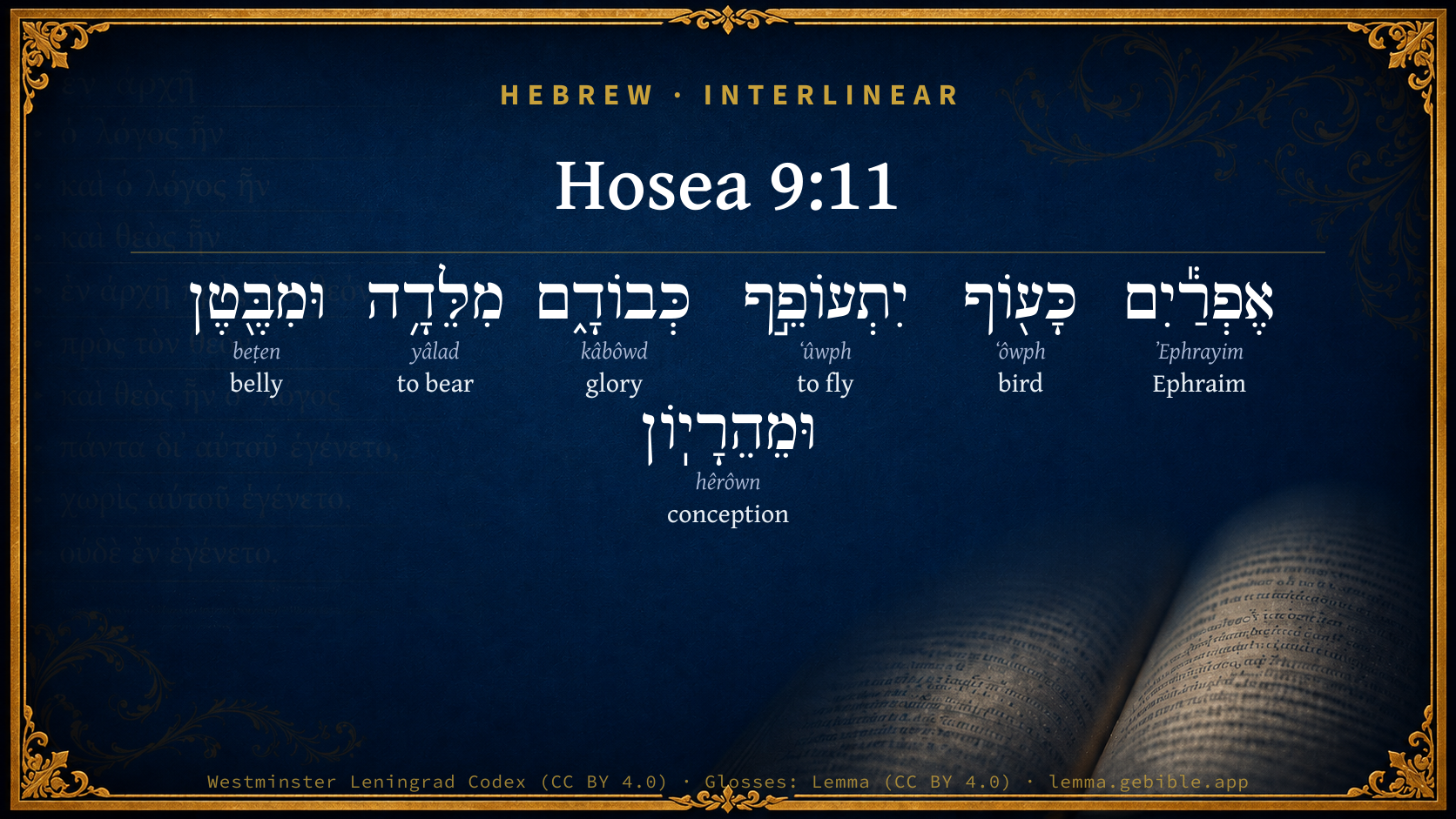
Hebrew (Westminster Leningrad Codex) Hosea 9:11 appears in the Hebrew Old Testament. The text above is from the Westminster Leningrad Codex. Each word links to its Strong’s number, a concise gloss, and parsing drawn from the Open Scriptures Hebrew Bible morphology. Click any word for its full Brown-Driver-Briggs (BDB) entry.
Download image
Cite this verse

Hosea 9:11 (World English Bible). Public Domain. Lemma interlinear Bible study tool, https://lemma.gebible.app/v/hosea/9/11.

Show BibTeX & RIS
BibTeX
RIS
English Translation
As for Ephraim, their glory will fly away like a bird. There will be no birth, none with child, and no conception.
World English Bible · Public Domain
Download a study sheet

One document with this verse’s original text, its word-by-word gloss line, the meaning frame, cross-references with their text, attributed commentary, and full source and license credits — printable, and it pastes into notes with its structure intact.

This verse Autodidact and up

Study sheet (.html) Plain text (.txt)

A passage Seminary Student

Up to 50 verses in one chapter. A passage sheet keeps up to 6 commentary sources and 12 cross-references per verse, in the order this page ranks them, and says so on the sheet whenever that leaves anything out. Ask for a single verse and you get the Autodidact verse sheet above.

Everything on this page stays free to read, with no account — the sheet is a download of what is already on screen, not access to it.

Want to remove ads? Support Godless Engineer
Compare translations 3

The same verse in 3 English versions, stacked beneath the original-language interlinear above. Click any original word for its lexicon entry.

Each is an independent rendering of the whole verse — the interlinear is not word-aligned to these translations.

Highlighted words mark where these versions differ — a whole-verse word diff, not a word-by-word alignment.

  • World English Bible Public Domain
    As for Ephraim, their glory will fly away like a bird. There will be no birth, none with child, and no conception.
  • King James Version Public Domain
    As for Ephraim, their glory shall fly away like a bird, from the birth, and from the womb, and from the conception.
  • unfoldingWord Literal Text CC BY-SA 4.0
    Ephraim—like a bird their glory will fly away— from birth, and from womb, and from conception.

unfoldingWord Literal Text — © unfoldingWord, licensed CC BY-SA 4.0. Word-aligned USFM3 via Door43 (git.door43.org/unfoldingWord/en_ult).

Versions to compare (up to 4)

3 of 4 selected

Show all 18 translations

Every available English version of this verse, each an independent rendering of the whole verse.

  • World English Bible Public Domain
    As for Ephraim, their glory will fly away like a bird. There will be no birth, none with child, and no conception.
  • Berean Standard Bible Public Domain
    Ephraim’s glory will fly away like a bird, with no birth, no pregnancy, and no conception.
  • Majority Standard Bible Public Domain
    Ephraim’s glory will fly away like a bird, with no birth, no pregnancy, and no conception.
  • King James Version Public Domain
    As for Ephraim, their glory shall fly away like a bird, from the birth, and from the womb, and from the conception.
  • American Standard Version (1901) Public Domain
    As for Ephraim, their glory shall fly away like a bird: there shall be no birth, and none with child, and no conception.
  • Revised Version (1885) Public Domain
    As for Ephraim, their glory shall fly away like a bird: there shall be no birth, and none with child, and no conception.
  • Geneva Bible (1599) Public Domain
    Ephraim their glorie shall flee away like a birde: from the birth and from the wombe, and from the conception.
  • Douay-Rheims (1899) Public Domain
    As for Ephraim, their glory hath flown away like a bird from the birth, and from the womb, and from the conception.
  • Young's Literal Translation Public Domain
    Ephraim `is' as a fowl, Fly away doth their honour, without birth, And without womb, and without conception.
  • Literal Standard Version CC BY-SA 4.0
    Ephraim [is] as a bird, their glory flies away, without birth, and without womb, and without conception.
  • Unlocked Literal Bible CC BY-SA 4.0
    As for Ephraim, their glory will fly away like a bird. There will be no birth, no pregnancy, and no conception.
  • unfoldingWord Literal Text CC BY-SA 4.0
    Ephraim—like a bird their glory will fly away— from birth, and from womb, and from conception.
  • Darby Bible Public Domain
    As for Ephraim, their glory shall fly away as a bird, -- no birth, no pregnancy, no conception!
  • World Messianic Bible Public Domain
    As for Ephraim, their glory will fly away like a bird. There will be no birth, no one with child, and no conception.
  • Webster's Bible Public Domain
    As for Ephraim, their glory shall fly away like a bird, from the birth, and from the womb, and from the conception.
  • Free Bible Version CC BY-SA 4.0
    Ephraim! Like a bird that flies away so shall your glory be—no births, no pregnancies, no conceptions.
  • Bible in Basic English Public Domain
    As for Ephraim, their glory will go in flight like a bird: there will be no birth and no one with child and no giving of life.
  • JPS Tanakh (1917) Public Domain
    As for Ephraim, their glory shall fly away like a bird; there shall be no birth, and none with child, and no conception.

Literal Standard Version (2020), Covenant Press — licensed CC BY-SA 4.0. Text via the HelloAO Bible API (eBible.org). Unlocked Literal Bible (unfoldingWord) — licensed CC BY-SA 4.0. Text via the HelloAO Bible API (eBible.org). unfoldingWord Literal Text — © unfoldingWord, licensed CC BY-SA 4.0. Word-aligned USFM3 via Door43 (git.door43.org/unfoldingWord/en_ult). Free Bible Version, Dr. Jonathan Gallagher — licensed CC BY-SA 4.0. Text via the HelloAO Bible API (eBible.org).

Word by word

More ways to search: Search by grammar → Find every occurrence → Compare this word →

Practice this passage: Drill this verse → Learn its vocabulary →

About this verse

These counts appear in no published source. They are computed here, from the morphology-tagged text and Lemma’s own curated glosses. What Lemma adds →

7
words
7
distinct lemmas
Prophets
section

Notable vocabulary

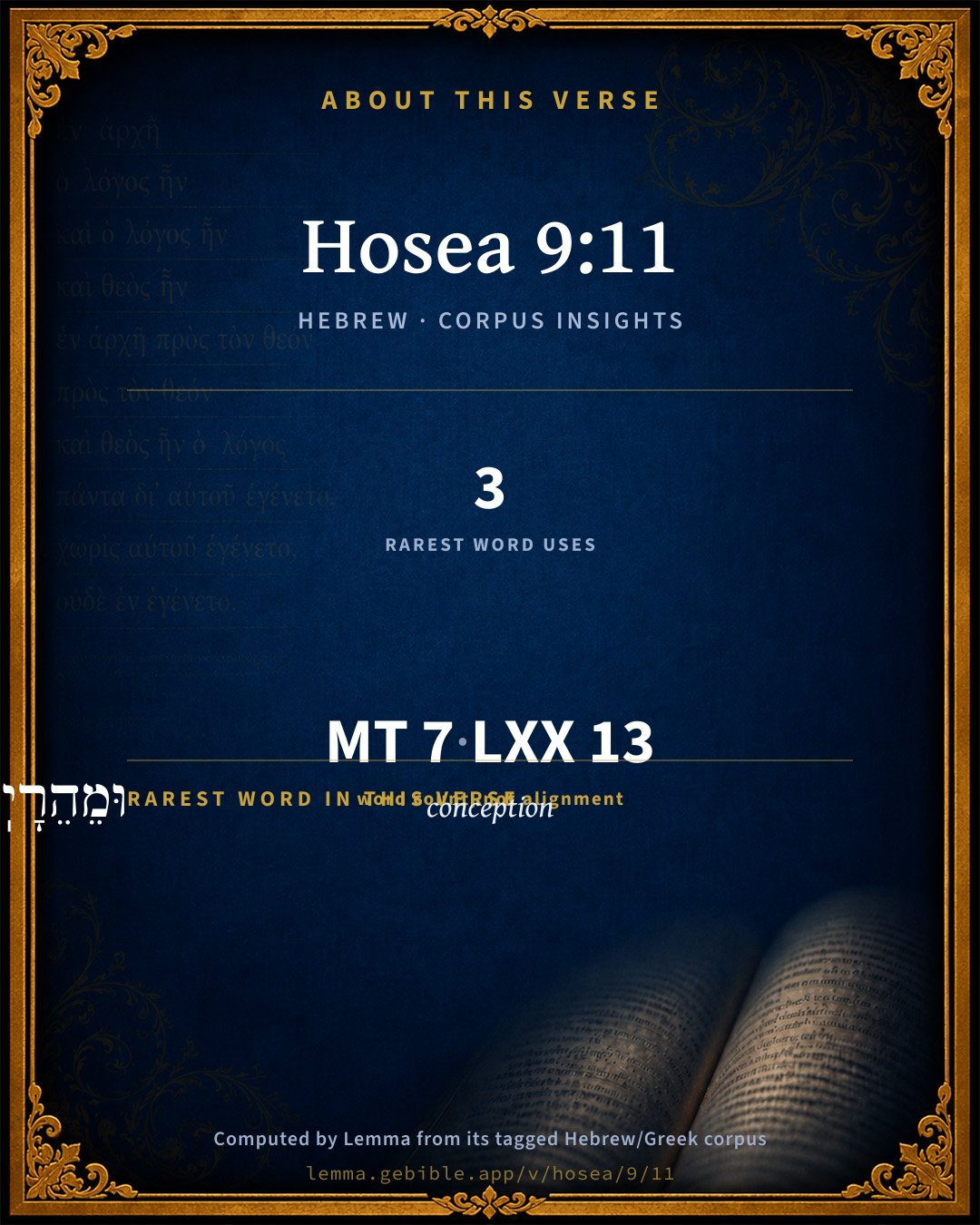
The rarest word here is וּמֵהֵרָיֽוֹן conception H2032 — appearing just 3 times in the whole Hebrew Bible.

Shared distinctive vocabulary

וּמֵהֵרָיֽוֹן conception H2032 occurs in 3 verses of the Hebrew Bible. Also found in:

Grammatical profile

  • 1 verb
  • 6 nouns

Verb forms

  • יִתְעוֹפֵ֣ף Hithpolel · Imperfect

Hebrew & Septuagint length

In English translation the verse runs 22 words from the Hebrew and 18 from the Septuagint (LXX English) — closely comparable.

A rough comparison of the two English renderings, which tokenize alike — not a word-level alignment.

Word counts can differ between the Hebrew and the Greek without any difference in meaning — e.g. the Hebrew direct-object marker אֵת has no separate Greek word, and Greek often adds the article ὁ.

In the original languages it is 7 Hebrew tokens and 13 Greek tokens — but the two are counted differently (Hebrew bundles its prefixes and suffixes into one token; the Greek is in lemma form), so that isn’t a like-for-like length.

Cross-references

15

Topical passages linked to Hosea 9:11 in the Treasury of Scripture Knowledge — connected by theme and wording, ordered by reader-vote popularity; previews shown in the World English Bible.

  • Genesis 41:52 The name of the second, he called Ephraim: "For God has made me fruitful in the land of my affliction."
  • Deuteronomy 28:18 Cursed shall be the fruit of your body, and the fruit of your ground, the increase of your cattle, and the young of your flock.
  • Hosea 4:7 As they were multiplied, so they sinned against me. I will change their glory into shame.
  • Hosea 9:14 Give them--Yahweh what will you give? Give them a miscarrying womb and dry breasts.
  • Hosea 10:5 The inhabitants of Samaria will be in terror for the calves of Beth Aven; For its people will mourn over it, Along with its priests who rejoiced over it, For its glory, because it has departed from it.
  • Genesis 48:16–20 the angel who has redeemed me from all evil, bless the lads, and let my name be named on them, and the name of my fathers Abraham and Isaac. Let them grow into a multitude in the midst of the earth."
  • Genesis 49:22 "Joseph is a fruitful vine, A fruitful vine by a spring; His branches run over the wall.
  • Deuteronomy 28:57 and toward her young one who comes out from between her feet, and toward her children whom she shall bear; for she shall eat them for want of all things secretly, in the siege and in the distress with which your enemy shall distress you in your gates.
  • Deuteronomy 33:17 The firstborn of his herd, majesty is his; His horns are the horns of the wild-ox: With them he shall push the peoples all of them, [even] the ends of the earth: They are the ten thousands of Ephraim, They are the thousands of Manasseh.
  • Job 18:5 "Yes, the light of the wicked shall be put out, The spark of his fire shall not shine.
  • Job 18:18–19 He shall be driven from light into darkness, And chased out of the world.
  • Psalms 58:8 Let them be like a snail which melts and passes away, Like the stillborn child, who has not seen the sun.
  • Ecclesiastes 6:3 If a man fathers a hundred children, and lives many years, so that the days of his years are many, but his soul is not filled with good, and moreover he has no burial; I say, that an untimely birth is better than he:
  • Amos 1:13 Thus says Yahweh: "For three transgressions of the children of Ammon, yes, for four, I will not turn away its punishment; Because they have ripped open the pregnant women of Gilead, That they may enlarge their border.
  • Luke 23:29 For behold, the days are coming in which they will say, 'Blessed are the barren, the wombs that never bore, and the breasts that never nursed.'

Cross-references courtesy of OpenBible.info (CC BY 4.0).

Hebrew and Greek witnesses Masoretic Hebrew ↔ Greek Septuagint

The same verse in the two great witnesses to the Old Testament, shown verse-for-verse.

These are two independent witnesses, not word-aligned to each other, and the Septuagint is shown in lemma (dictionary) form.

Hebrew Hosea 9:11 Masoretic · Westminster Leningrad Codex

אֶפְרַ֕יִם כָּע֖וֹף יִתְעוֹפֵ֣ף כְּבוֹדָ֑ם מִלֵּדָ֥ה וּמִבֶּ֖טֶן וּמֵהֵרָיֽוֹן

As for Ephraim, their glory will fly away like a bird. There will be no birth, none with child, and no conception.

World English Bible · Public Domain

Greek LXX Hosea 9:11 Septuagint · lemma form

ἐφράιμ ὡς ὄρνεον ἐκπετάζω ὁ δόξα αὐτός ἐκ τόκος καί ὠδίν καί σύλληψις

Ephraim has flown away as a bird; their glories from the birth, and the travail, and the conception.

LXX2012 (modern English Septuagint) · Public Domain

On this verse, John Gill's Exposition discusses the Septuagint’s reading. Read the note in Commentary ↓

Hebrew: Westminster Leningrad Codex (CC BY 4.0). Greek: Septuagint (public domain); English from LXX2012 (modern English Septuagint) (Public Domain). How the Septuagint differs from the Hebrew →

Targum (Aramaic paraphrase)

1

The Targum is the ancient Jewish Aramaic paraphrase of the Hebrew Scriptures — an interpretive translation, not the Hebrew text itself. Onkelos (literal) and Pseudo-Jonathan (expansive) render the Torah, and Jonathan the Prophets. Coverage is partial: where no permissively-licensed English translation exists for a verse, only the Aramaic is shown. This is verse-level text, not a word-by-word alignment to the Hebrew.

  1. Targum Jonathan Prophets (Joshua–Malachi)
    בֵּית יִשְׂרָאֵל כְּעוֹפָא דְאַפְרְחוּהִי מִקְנֵיהּ וְאִיטַלְטַל כֵּן גְלָא יַת יְקָרֵהוֹן וְלַד לָא יִסְגוּן וּמִפֵּרֵי מְעֵיהוֹן לָא יֶחְדוּן וְעַל דְאִתְמְנָעוּ רִגְלֵיהוֹן מִלְאִתְחַזָאָה בְּבֵית מַקְדְשִׁי:

    (no public-domain English translation for this verse)

    Targum Jonathan — Aramaic: “Mikraot Gedolot” (public domain). English: “Sefaria Community Translation” (CC0 1.0 (public-domain dedication)); “London "Chaldee Paraphrase," 1871” (public domain). Text via Sefaria.

Commentary

Notes on Hosea 9:11 from classic Christian and Jewish commentators (each source and its license shown beneath its notes). The classic Christian expositions comment on the surrounding passage and are grouped to its opening verse, so a note may address several verses; the Jewish commentaries on the Tanakh (Rashi and others) are per-verse, so they appear only where the commentator wrote on this verse.

Lemma curates 59 commentaries, every one of them public domain or Creative Commons licensed, each selected and text-cleaned for this edition rather than reprinted as found. About our sources →

Matthew Henry's Commentary

In the foregoing verses we saw the sin of Israel derived from their fathers; here we see the punishment of Israel derived to their children; for, as death entered by sin at first, so it is still entailed with it. We may observe, in these verses,

I. The sin of Ephraim. Some expressions are here which describe that. 1. They did not hearken to God (Hos 9:17); they did not give attention to the voice either of his word or of his rod; they did not believe what he said, nor would they be ruled by him. He told them their duty, their interest, their danger, but they regarded him not; all he said to them by his words and by his prophets was to them as a tale that is told; and then no wonder that we hear, 2. Of the wickedness of their doings (Hos 9:15), the downright malice that was in their sins; they were not infirmities, but daring presumptions. How can those but do wickedly who will not hearken to the word of God, that would teach and persuade them to do well? And no wonder that there were wicked doings among them when, 3. Their worship was corrupt (Hos 9:15): All their wickedness is in Gilgal, which was a place infamous for idolatry, as appears, Hos 4:15; Hos 12:11; Amo 4:4; Amo 5:5. It is probable that the idolaters chose that place for their head-quarters because it had been famous in other ages for solemn transactions between God and Israel, as Jos 5:2, Jos 5:10; Sa1 10:8; Sa1 11:15. There, where the source of idolatry was, whence it spread through the kingdom, there it might be said that all their wickedness was, for all other wickedness owed its origin to that. Corruptions in worship make way for corruptions in morals. The mother of harlots is the mother of all other abominations, Rev 17:5. The learned Grotius conjectures that there is a mystical sense here. Golgotha in Syriac is the same with Gilgal in Hebrew, and therefore he thinks this may have reference to the putting of Christ to death at Golgotha, which was the greatest sin of the Jewish nation, and of which it might truly be said, All their wickedness was summed up in that. And no wonder that the people did wickedly, both in worship and conversation, when 4. All their princes were revolters; the whole succession of the kings of the ten tribes did evil in the sight of the Lord, or all the set of judges and magistrates at this time were wicked; they turned aside to sinful ways and persisted in those ways.

II. The displeasure of God against Ephraim for sin. This is variously expressed here, to show what a provocation sin is to the pure eyes of his glory, and how odious it makes the sinner to him. 1. He departs from them, Hos 9:12. When they revolt from him, and withdraw from their allegiance to him, how can they expect but that he should depart from them and withdraw both his protection and his bounty? And well may his threatening be enforced as it is, and made terrible: Woe also unto them when I depart from them! Note, Those are in a woeful condition indeed whom God has forsaken. Our weal or woe depends upon the gracious presence of God with us; and, if he goes, all weal goes with him and all woes come upon us. God has forsaken him; persecute and take him. Saul knew this when he laid such an emphasis upon this part of his complaint, The Philistines make war against me, and God has departed from me. Nay, he does not only depart from them, but, 2. He hates them. In Gilgal, where all their wickedness is, there I hated them. There, where the abominations of sin are committed, there God abominates the sinners. In Gilgal he had bestowed many tokens of his favour upon their ancestors, but now that is the place where he hates them for their base ingratitude. Nay, he not only hates them, but, 3. He will love them no more, will never take them into his favour again; the breach between God and Israel is wide as the sea, which cannot be healed. This agrees with what he had said, (Hos 1:6, Hos 1:7), I will no more have mercy upon the house of Israel, the ten tribes. 4. He will discard them, and have no more to do with them: For the wickedness of their doings, I will drive them out of my house. He will no longer own them as his, or as belonging to his family in the world; he will turn them out of doors as unfaithful tenants that pay him no rent, as unprofitable servants that do him neither credit nor work. Note, Those that profane God's house can expect no other than to be expelled his house, and no longer suffered to be either lodgers in it or retainers to it. Nay, he will not only drive them out of his house, but, 5. He will drive them far enough (Hos 9:17): My God will cast them away, not only out of his house, but out of his sight; he will quite abandon and reject them; they shall be cast-aways. God said that he would drive them out of his house, and here the prophet seconds it, as one that knew his Master's mind very well: My God will cast them away. See with what comfort and pleasure he calls God his God. Note, When others disown God, and are disowned by him, it is a very great satisfaction to good people that they can call God their God, can cheerfully own him and see themselves owned by him - all revolters, all ruined, yet God is my God.

III. The fruit of this displeasure, in the cutting off and abandoning of their posterity, which is the judgment here threatened again and again. Observe here,

1. How numerous Ephraim seemed likely to be. The name Ephraim is derived from fruitfulness, Gen 41:51. Joseph is a fruitful bough, Gen 49:22. And Moses's blessing foretold the ten thousands of Ephraim, Deu 33:17. This was his glory, Hos 9:11. For this he seemed designed by him that appoints the bounds of men's habitation; for Ephraim, as I saw Tyrus, is planted in a pleasant place, to encourage his increase, which one may expect as from a tree planted by the river's side. Ephraim is as strong and rich as ever Tyre was, and as proud and secure. The Chaldee paraphrase gives this sense of it, The congregation of Israel, while they observed the law, was like to Tyrus in prosperity and security.

2. How few Ephraim should be (Hos 9:11): Their glory shall fly away like a bird; their children shall be taken away and the hopes of their families cut off. All their glory shall fly as an eagle towards heaven, swiftly and irrecoverably. Note, Worldly glory is glory that will fly away; but those that have their God their glory have in him an unfading everlasting glory. Ephraim has been as a fruitful tree. But now Ephraim is smitten, is blasted; their root is dried up; they shall bear no fruit, Hos 9:16. If the root be dried, the branch must wither of course. Observe,

(1.) God's threatening this judgment of the destroying of their children. [1.] They shall perish of themselves by the immediate hand of God (Hos 9:11): They shall fly away from the birth, and from the womb, and from the conception. Some of their children shall die as soon as they are born; the cradle shall be presently turned into a coffin. Others of them shall be still-born, or the womb shall be their grave, and their death there their mothers' death too. Of others their mothers shall miscarry almost as soon as they have conceived, and they shall be as untimely fruit. See how easily God can, and how justly we are sure he might, root out the whole race of mankind, that degenerate, guilty, obnoxious race, and blot out the name of it from under heaven; it is but doing as he does by Ephraim here, writing them all childless, making all their glory to fly away from the birth, the womb, and the conception, drying up their root, that they bear no fruit, and their business is done in a few years. [2.] They shall perish by the hand of their enemies; they shall die violent deaths (Hos 9:12): "Though they bring up their children to some maturity, though they escape the diseases and deaths which the infant age is liable to, and are thought to be reared past danger, yet will I bereave them (Hos 9:12), by one judgment or other, so that there shall not be a man left to build up their families and bear up their name." Again (Hos 9:13), Ephraim shall bring forth his children to the murderer. The mothers shall travail with pain to bear their children, and a great deal of care, and pains, and cost shall be bestowed upon the nursing of them, and when a cruel enemy comes and puts all to the word, young and old, without mercy, then they seem but as lambs that were all this while fed for the slaughter. Note, It is a great alloy to the comfort parents have in their children that they know not what they have brought them forth and brought them up for, perhaps for the murderer, or, which is worse, to be themselves the plagues of their generation. It is threatened again (Hos 9:16), Though they bring forth, yet will I slay even the beloved fruit of their womb, those children that they are most fond of. Note, The parents' love is no security to the children's lives; nay, sometimes death is commissioned to take the darlings of the family and leave the burdens of it. When sentence was passed upon Israel in the wilderness, that they should all perish there, this mercy was mixed with the wrath, that their children should nevertheless enter into that rest which they through unbelief could not enter into. But this is a total and final rejection; even their children shall be cut off, and the land shall escheat to the crown, ob defectum sanguinis - shall be lost for want of heirs. The Chaldee-paraphrase, and many of the rabbin, by the murderers to whom the children were brought forth, understand those that sacrificed their children to Moloch, a sin which was its own punishment, which showed the parents void of bowels and justly left them void of blessings. [3.] Those few that escape and remain shall be dispersed (Hos 9:17): They shall be wanderers among the nations; so the remains of the Jews are at this day, and there is no place in the world where they are a distinct nation.

(2.) The prophet's prayer relating to it (Hos 9:14): Give them, O Lord! what wilt thou give? What shall I ask for a people thus doomed to destruction? It is this; since the decree has gone forth, that they must either die from the womb or be brought forth for the murderer, of the two let them rather die from the womb. Rather let them have no children than have them to be made miserable; for the same reason, when a total ruin was coming on the Jewish nation, Christ said, Blessed is the womb that never bore and the paps that never gave suck, Luk 23:29. "Give therefore a miscarrying womb and dry breasts; for it is better to fall into the hands of the Lord, whose mercies are great, than into the hands of man." Note, Those that are childless may with this reconcile themselves to the will of God herein, that the time may come when, if they were not so, they would wish they had been so.

Matthew Henry's Commentary on the Whole Bible (1708–1710) — public domain (CC PDM 1.0). Text via the HelloAO Bible API.

Trapp's Complete Commentary

John Trapp

Hos 9:11 [As for] Ephraim, their glory shall fly away like a bird, from the birth, and from the womb, and from the conception.

Ver. 11. As for Ephraim, their glory shall flee away as a bird] Heb. Ephraim, by a nominative absolute. Or, O Ephraim, as with a sigh, or a shriek, for grief and horror of their ensuing calamity, exilium, excidium, et exitium. "The Lord afflicts not willingly, nor grieves the children of men," Lam 3:33. It goes as much against the heart with him as against the hair with us; witness this pathetic expression. See also Hos 11:8. Their glory, that is, their God, as in the next verse. Or, their children, as in the next words. They worshipped Baalpeor for fruitfulness; but it shall not do: for either they shall be punished with barrenness, or else with a luctuosa foecunditas (as Jerome saith of Loeta, who buried many children), a doleful fruitfulness.

Their glory shall flee away as a bird] Suddenly, swiftly, irrecoverably, shall their numerous posterity, which they looked upon as themselves multiplied and eternalized, be cut off, be snatched away by the hand of death; so that, Rachel-like, they shall refuse to be comforted, because her children were not: or as Cratisiclea, in Plutarch, who, seeing her dear children slain before her, and herself ready to be served in like sort, uttered only this word, Quo pueri, estis profecti? Poor children, what is become of you?

From the birth, and from the womb, and from the conception] In all these states shall the curse follow them close: either they shall not conceive, or die in the womb, or be stifled in the birth; they shall all prove Ichabods. It is God that gives strength to conceive, as he did to Sarah, Hannah, Elizabeth, &c. It is he that formeth us in the womb, and that by the book, Psa 139:15-16, and preserveth us there, Job 10:8, when neither we can shift for ourselves, nor our parents provide for us. It is he that taketh us thence, Psa 22:9-10, as a nurse or midwife doth the newborn babe. It is he that keepeth us in the cradle, and in childhood, when we are subject to a thousand deaths and dangers; for puerilitas est periculorum pelagus; it is a just wonder that any child attains to maturity. But if wicked men’s children do so, a soft they do (for "they are full of children, and leave the rest of their substance to their babes," Psa 17:14), yet it follows,

John Trapp, A Commentary or Exposition upon All the Books of the Old and New Testament (1647–1656) — public domain. Text from a community e-Sword module.

Joseph Benson's Commentary

Hos 9:11-13. As for Ephraim, or, Ephraim! their glory shall fly away like a bird — What they make their boast of so much shall depart from them. The fruitfulness of their women seems to be the thing here spoken of. From the birth — Their children shall die soon after they are born; from the womb — They shall be untimely births, or abortions; and from the conception — They shall not even be conceived as they were wont to be. Dr. Wheeler renders this clause, They shall not bring forth, nor bear in the womb, nor conceive. Though they bring up, &c. — If some of them happen to bring up their children to a state of youth, or manhood, yet will I bereave them — Yet still shall they be deprived of them, for they shall be slain in war, or carried away captive. Yea, wo also to them when I depart from them — They shall suffer still greater and greater miseries when I wholly withdraw my protection from them, Deu 31:17; 2Ki 17:18-23. Ephraim, as I saw Tyrus, is planted in a pleasant place — The situation of Ephraim, and particularly of the royal city, Samaria, is as pleasant as that of Tyre: see Eze 27:3. But Ephraim shall bring forth, &c., to the murderer — Shall be obliged to deliver up his children to his enemies. Instead of Tyre, some interpreters render the word צור, a rock, which it generally signifies, and translate the passage, Ephraim, which, when I looked upon him, was as a rock planted in a pleasant place, shall bring forth, &c. So Houbigant, and to the same sense Newcome and Horsley.

Joseph Benson's Commentary on the Old and New Testaments (1811–1818) — public domain. Text from a community e-Sword module.

The Preacher's Complete Homiletical Commentary

Joseph S. Exell (gen. ed.)

CRITICAL NOTES.—

Hos_9:11. Their glory] Children the glory of parents, sterility a reproach. Eph.]= fruitfulness (Gen_41:52, marg), which characteristic should cease; licentious worship would diminish the people: leave them childless, by threefold gradation. “First, when their parents should have joy in their birth, they were to come into the world only to go out of it; then their mother’s womb was to be itself their grave; then, stricken with barrenness, the womb itself was to refuse to conceive them.” Cf. the threefold stages of failure (ch. Hos_8:7).

Hos_9:12. Bereave] them, though they should rear children (Job_27:14). A man] Lit. from man. Woe] Lit. for woe. God’s departure the source of all evil (1Sa_4:21; 1Sa_28:15-16). Loss of children sad, but loss of God beyond description.

Hos_9:13. Planted] Ephraim chosen, and carefully put in soil to grow and flourish, like Tyre, a royal city strongly built and pleasantly situated. The image suggested from the name, a fruitful tree (Eze_16:27-28). Children] brought forth only to be slain.

Hos_9:14. Give] As if overwhelmed, the prophet deliberates; prays in compassion, let this never happen; then leaves it with God. Miscarrying] Barrenness, usually counted misfortune (Job_3:3; Jer_20:14), will be a blessing, so great will be their calamity.

THE GLORY AND GRIEF OF A PEOPLE.—Hos_9:11-14

Ephraim had parted with God, the true glory, and now all in which they gloried should be taken from them. Their posterity should be cut off, their prosperity would decay, and God himself would depart from them. The most powerful tribe of the people became the most miserable, and all its glory was turned into grief.

I. The glory of a people. Fruitfulness and strength were promised to Ephraim in great abundance (Gen_48:19). Moses had assigned tens of thousands to him, while to Manasseh thousands only were promised (Deu_33:17). She was proud of her offspring and increase, of her wealth and situation.

1. Posterity is considered the glory of a people. In families “children are an heritage from the Lord.” We boast of our sons and daughters. In them we love to see our image, hope to perpetuate our name, and secure our fortunes. Like Cornelia, the mother of the Gracchi, when asked to display our jewels we point to our sons and say, “These are my jewels.” In nations posterity are the hope and foundation of the future. From the rising generation, fathers and mothers, leaders and teachers, are to spring. As “the child is father of the man,” so children are the nation’s population and prosperity in the bud. Hence to our posterity are entrusted the interests of our commerce, the defence of our throne, and the glory of our name. In them are the germs of national virtues and vices, feelings and sentiments which will determine the character and decide the fate of this empire. “The worth of a state, in the long run, is the worth of the individuals comprising it,” says J. S. Mill.

II. Outward prosperity is considered the glory of a people. “Ephraim, as I saw Tyrus, is planted in a pleasant place.” Ephraim, like Tyre, was populous and wealthy; strong and beautifully situated; planted with care, and defended by God. Beauty and strength surrounded her. “Thou hast been in Eden, the garden of God; every precious stone was thy covering,” &c. (Eze_28:2; Eze_28:13). So now nations trust to the abundance of their revenues, the beauty of their public buildings, and the strength of their fortifications. England relies on its wealth and position, its armies and its fleets, its philosophy and its morality. But our chief strength, our real power, consists in the characters of the rising generation, the enlightenment of our citizens, and the integrity of our conduct. The nation that has no higher god than pleasure, gold, or position, is poor indeed. Heathen deities often imaged human virtues, but these are vanities to depend upon, and will cause a people’s downfall. Glory is false glory when attributed to numbers and wealth, to outward prosperity and empire, to anything short of God. God warns us as he did Israel. “If thou wilt not observe to do all the words of this law—ye shall be left few in number—the Lord will rejoice over you to destroy you, and to bring you to nought” (Deu_28:58; Deu_28:62-63).

III. The glory of a people turned into grief. The glory departed from Ephraim in the destruction of their children, the decay of national prosperity, and the departure of God from their midst.

1. The loss of children brings grief. “Though they bring up their children, yet will I bereave them.” This carriage and abortion, death at the very birth of their offspring, would diminish their number, and weaken their nation. (a.) They would die suddenly. “Their glory shall fly away like a bird.” Swiftly cut off, like Job’s family, by tornado, whirlwind, or accident. (b.) They would die violently. “Ephraim shall bring forth his children to the murderer.” If any grew up to manhood, they were to be cut off by the sword. (c.) They were to die hopelessly. “There shall not be a man left.” They were reduced in every stage from conception to maturity—to die suddenly and prematurely by ruthless hands and sword. Thus the beauty of all earthly blessings is quickly blasted (Isa_60:6; Isa_60:8). Accidents and diseases, “the pestilence that walketh in darkness, and the destruction that wasteth at noonday,” cut down the hopes of our life. We mourn like Burke at the loss of his only son: “They who should have succeeded me have gone before me. They who should have been to me as posterity are in the place of ancestors.” “Thou shalt beget sons and daughters, but thou shalt not enjoy them; for they shall go into captivity.”

2. The decay of national prosperity brings grief. Strong and rich, proud and secure, as Tyre was, Ephraim’s glory would fade away like a flower. Riches take unto themselves wings and fly away. Trade may prosper and mechanism flourish; the dew may couch beneath, and the sun shine above; the chief things of the ancient mountains and the precious things of the lasting hills may abound (Deu_33:13-16); but the greatness of a nation depends not on the wealth of its population, nor the extent of its territories. Idleness and love of pleasure, idolatry and forgetfulness of God, will cause inevitable decay. The fatal weakness of Athens were free men, outnumbered by slaves, citizens, corrupt in morals, and women unchaste in conduct. The decline and fall of Rome may be traced to the general corruption of the people. Ephraim fell into sin, and her glory departed from her.

3. The departure of God from a people brings grief. “Woe also to them when I depart from them.” The loss of children was grievous; the decay of present prosperity and future hope sad enough; but God’s departure was the source of all evil to them. When God withdraws his presence and providence nothing can sustain a Church or people. When Cain was cut off, and Saul forsaken by God, they became more wicked and miserable. When the ark of God was taken Ichabod was pronounced, for the glory had departed from Israel (1Sa_4:21-22). Pestilence and famine can turn a nation’s glory into grief. Withdrawment of Divine favour can change the pride of the Church into shame, and the hope of the family into grief. God’s favour is the sublimest of all joys, all triumphs, and all delights. But woe unto any with whom God is angry and from whom God departs. Present afflictions only foreshadow future judgments. Their sun will set, and darkness cover their lands. “I will forsake them, and I will hide my face from them, and they shall be devoured, and many evils and troubles shall befall them; so that they will say in that day, Are not these evils come upon us, because our God is not among us” (Deu_31:17)?

HOMILETIC HINTS AND OUTLINES

Hos_9:12. Bring up their children. How soon could our God insensibly waste the most populous nations! Nay, how often does he thus decrease them! and what awful instances of this has our eventful age exhibited! What an alloy it is to our comfort in our beloved children to reflect for what purposes they may possibly be brought up and reserved! “This is a sore vanity;” but the best remedy of it is submission and confidence in God, and a conscientious performance of our duty: especially in training up our families in the fear of God, and in seeking for them, as well as ourselves, “first the kingdom of God and his righteousness,” and setting them a good example. Surely it is far more desirable to be written childless, than to bring up children in the service of sin and Satan [Scott].

The destiny of the rising generation and the fate of the nation is in the “Home School.” The great German teacher Fröbel declared that the great motto of the people should be, “Let us live for our children.” If Simon had thought of what Judas might have been, would not this have affected his treatment of the boy? What if the mother of Napoleon, and of his brother kings and sister queers, had foreseen what became of those around her humble fireside in Corsica? We do not know what part our children may play in life, what joy or sorrow they may cause to millions yet unborn. Think how much depends upon early training!

God’s departure. They had departed and turned away from or against God. It had been their characteristic (ch. Hos_4:16). Now God himself would requite them, as they had requited him. He would depart from them. This is the last state of privation, which forms “the punishment of loss” in hell. When the soul has lost God, what has it [Pusey]?

Woe unto them.

1. In personal bereavement.

2. In national distress.

3. In the hour of death.

4. In the day of judgment. “It shall be well with them that fear God … But it shall not be well with the wicked” (Ecc_8:12-13).

ILLUSTRATIONS TO CHAPTER 9

Hos_9:11-12. Children. “Better is it to have no children, and to have virtue: for the memorial thereof is immortal; because it is known with God and with men” (Wis. of Son_4:1). “Our children that lie in the cradle are ours, and bear in them those lives which shall yet make them to appear, the boy like the father, and the daughter like the mother” [Beecher]. Glory or shame lies in the future of your child, according to your conduct and training.

The Preacher's Complete Homiletical Commentary (gen. ed. Joseph S. Exell; Funk & Wagnalls, c. 1892) — public domain (pre-1929). A full-Bible homiletical/sermon-outline anthology covering 65 of 66 books (2 John is absent from the source module). Text from a community e-Sword module.

Keil & Delitzsch

C. F. Keil & F. Delitzsch

It is very evident that this is what he has in his mind, and that he regards the apostasy of the ten tribes as merely a continuation of that particular idolatry, from the punishment which is announced in Hos 9:11, Hos 9:12, as about to fall upon Ephraim in consequence. Hos 9:11. "Ephraim, its glory will fly away like a bird; no birth, and no pregnancy, and no conception. Hos 9:12. Yea, though they bring up their sons, I make them bereft, without a man; for woe to them when I depart from them!" The glory which God gave to His people through great multiplication, shall vanish away. The licentious worship of luxury will be punished by the diminution of the numbers of the people, by childlessness, and the destruction of the youth that may have grown up. מלּדה, so that there shall be no bearing. בּטן, the womb, for pregnancy or the fruit of the womb. Even (kı̄ emphatic) if the sons (the children) grow up, God will make them bereft, מאדם, so that there shall be no men there. The grown-up sons shall be swept away by death, by the sword (cf. Deu 32:25). The last clause gives the reason for the punishment threatened. גּם adds force; it usually stands at the head of the sentence, and here belongs to להם: Yea, woe to them, if I depart from them, or withdraw my favour from them! שׂוּר stands for סוּר, according to the interchangeableness of שׂ and ס (Aquila and Vulg.). This view has more to support it than the supposition that שׂוּר is an error of the pen for שׁוּר (Ewald, Hitzig, etc.), since שׁוּר, to look, construed with מן, in the sense of to look away from a person, is never met with, although the meaning is just the same.

Keil & Delitzsch — Biblical Commentary on the Old Testament (1861–1891) — public domain (CC PDM 1.0). Text via the HelloAO Bible API. (Old Testament only.)

Tyndale Open Study Notes

Tyndale Open Resources

9:11 Israel worshiped the baals to ensure that they would have many children, but God would punish them by preventing birth, pregnancy, and even conception.

Tyndale Open Study Notes — © Tyndale Open Resources, licensed CC BY-SA 4.0. Text via the HelloAO Bible API.

Geneva Bible (1599)

Geneva Bible translators

Signifying, that God would destroy their children by these sundry means, and so consume them by little and little.

Geneva Bible (1599) marginal notes — public domain. Text via Bolls.life.

Jamieson, Fausset & Brown

Robert Jamieson, A. R. Fausset & David Brown

their glory shall fly away--fit retribution to those who "separated themselves unto that shame" (Hos 9:10). Children were accounted the glory of parents; sterility, a reproach. "Ephraim" means "fruitfulness" (Gen 41:52); this its name shall cease to be its characteristic.

from the birth . . . womb . . . conception--Ephraim's children shall perish in a threefold gradation; (1) From the time of birth. (2) From the time of pregnancy. (3) From the time of their first conception.

Jamieson, Fausset & Brown — Commentary Critical and Explanatory on the Whole Bible (1871) — public domain (CC PDM 1.0). Text via the HelloAO Bible API.

Adam Clarke's Commentary

Verse 11. Their glory shall fly away] It shall suddenly spring away from them, and return no more.

From the birth] "So that there shall be no birth, no carrying in the womb, no conception."-Newcome. They shall cease to glory in their numbers; for no children shall be born, no woman shall be pregnant, for none shall conceive. Here judgment blasts the very germs of population.

Adam Clarke's Commentary on the Bible (1810–1826) — public domain. Text from a community e-Sword/MySword module.

John Calvin's Commentaries

The Hebrews, we know, have often abrupt sentences as in this place, Ephraim! their glory has fled Ephraim is to be placed by itself; and the speech seems striking, when the Lord thus breaks off the sentence, Ephraim! he does not continue the sense, but immediately adds, Like a bird their glory has fled. When he speaks of Ephraim, he no doubt refers especially to his offspring; and by mentioning a part for the whole, he includes whatever was then deemed to be wealth, or glory, or power. The Prophet, I say, speaks of offspring, for he immediately adds, from the birth, and the womb, and the conception But they are mistaken who confine this sentence to offspring only; for it is, as I have said, a mode of speaking, by which a part is taken for the whole. According to the letter, he mentions children or offspring; but yet he includes generally the whole condition of the people.

Then as a bird the glory of Ephraim fled away In what respect? From the birth, from the womb, from the conception. The Prophet, no doubt, sets forth here the gradations of God’s vengeance, which was yet in part near at hand to the Israelites, and which was in part already evident by clear proofs. He says, from the birth, then from the womb, and, lastly, from the conception If, then, the glory of Ephraim had vanished at the beginning, the Prophet would not have thus spoken; but as the Lord showed signs of his wrath by degrees, that vengeance at length might reach the highest point, the Prophets in the first place, mentions birth, then the womb; as though he said, “The glory of Israel shall vanish from the birth, but if they still continue proud, and seem not subdued by this punishment, I will slay them in the womb itself; nay, in the conception, if they repent not; they shall be suffocated as in the very womb.”

John Calvin's Commentaries (1540-1563) — public domain. Text from the Calvin Translation Society English edition (1840s-50s) via the Christian Classics Ethereal Library (ccel.org). Calvin's coverage is partial (roughly two-thirds of the Bible); uncommented books and verses are honest gaps, never fabricated. The 19th-century editor's footnotes and remarks are omitted so the notes are faithfully Calvin's own voice.

Ellicott's Commentary for English Readers

(11) From the birth . . .—Or rather, so that there shall be no childbirth, nor pregnancy, nor conception—an ascending climax. Progeny was the glory of ancient Israel (Gen_22:17; Deu_7:13-14; Psa_127:5; Pro_17:6).

A Bible Commentary for English Readers, edited by Charles John Ellicott (1878–1897) — public domain. Text from a community e-Sword module.

The Cambridge Bible for Schools and Colleges

gen. ed. J. J. S. Perowne

11. The prophet leaves us to supply the idea that Ephraim’s present transgressions are as heinous as those of old, and passes on to the punishment.

their glory … like a bird] Rather, like birds. All their earthly prosperity shall take to itself wings, because, as we have already heard, ‘they have exchanged their (true) glory for infamy’ (Hos_4:7). Kimchi narrows the meaning too much, when he says, ‘He calls children “glory”, for they are the glory of fathers (Pro_17:6).’ But of course populousness formed a part of the Israelite’s conception of national prosperity.

from the birth, &c.] Rather, that there shall be no birth, nor being with child, nor conception. Such is the retribution for their sins against chastity (see on Hos_4:10).

The Cambridge Bible for Schools and Colleges (gen. ed. J. J. S. Perowne; Cambridge University Press, 1878–1918) — public domain. Text from a community e-Sword module.

John Gill's Exposition

Though they bring up their children,.... Though this be the case of some, as to be conceived, carried in the womb to the full time, and be born, and brought up to a more adult age, and appear very promising to live, and perpetuate the names of their fathers and their families:

yet will I bereave them; their parents of them, by the sword, famine, pestilence, or by carrying them captive into a foreign country:

that there shall not be a man left; in the whole land of Israel, but all shall be destroyed, or carried captive; or, "from men" (i); that is, either from being men, as the Targum; though they are brought up to some ripeness, and a more adult age than others, yet arrive not to such a time and age as to be called men, as Kimchi observes; or from being among men, being either taken away by death, or removed from the society of men to live among beasts, and to he slaves like them:

yea, woe also to them, when I depart from them; withdraw my presence, favour, and protection from them; or remove my Shechinah from them, as the Targum; and leave them to the spoil and cruelty of their enemies, which would be a greater calamity and judgment than the former. The Septuagint, and so Theodotion, render it, "woe is to them, my flesh is of them"; which some of the ancients interpret of the incarnation of Christ, not considering that the words are spoken of Ephraim, or the ten tribes; whereas the Messiah was to spring, and did, from the family of David, and tribe of Judah.

(i) "ab homine", Montanus, Tigurine version, Schmidt; "ut non sint homines", Pagninus.

John Gill's Exposition of the Whole Bible (1746–1763) — public domain (CC PDM 1.0). Text via the HelloAO Bible API.

Albert Barnes' Notes on the Bible

As for Ephraim, their glory shall fly away, like a bird - Ephraim had parted with God, his true Glory. In turn, God would quickly take from him all created glory, all which he counted glory, or in which he gloried. When man parts with the substance, his true honor, God takes away the shadow, lest he should content himself therewith, and not see his shame, and, boasting himself to be something, abide in his nothingness and poverty and shame to which he had reduced himself. “Fruitfulness,” and consequent strength, had been God’s special promise to Ephraim. His name, Ephraim, contained in itself the promise of his future fruitfulness. Gen 41:52. With this Jacob had blessed him. He was to be greater than Manasseh, his older brother, “and his seed shall become a multitude of nations” Gen 48:19. Moses had assigned to him “tens of thousands” Deu 33:17, while to Manasseh he had promised “thousands” only. On this blessing Ephraim had presumed, and had made it to feed his pride; so now God, in his justice and mercy, would withdraw it from him. It should “make” itself “wings, and fly away” Pro 23:5, with the swiftness of a bird, and “like a bird,” not to return again to the place, from where it has been scared.

From the birth - Their children were to perish at every stage in which they received life. This sentence pursued them back to the very beginning of life. First, when their parents should have joy in “their birth,” they were to come into the world only to go out of it; then, their mothers womb was to be itself their grave; then, stricken with barrenness, the womb itself was to refuse to conceive them.

: “The glory of Ephraim passes away, from the birth, the womb, the conception, when the mind which before was, for glory, half-deified, receives, through the just judgment of God, ill report for good report, misery for glory, hatred for favor, contempt for reverence, loss for gain, famine for abundance. Act is the “birth;” intention the “womb;” thought the “conception.” “The glory of Ephraim then flies away from the birth, the womb, the conception,” when, in those who before did outwardly live nobly, and gloried in themselves for the outward propriety of their life, the acts are disgraced, the intention corrupted, the thoughts defiled.”

Albert Barnes' Notes on the Bible (1834–1885) — public domain. Text from a community e-Sword/MySword module.

Haydock's Catholic Bible Commentary

Conception. Their children, in whom they glory, shall be destroyed (Calmet) in the very embryo. (Haydock)

George Leo Haydock (1774–1849), Haydock's Catholic Family Bible and Commentary, 1859 edition — public domain. Excludes Psalms (Douay-Rheims chapter numbering differs from Protestant) and Deuterocanonical books (Catholic canon only).

Matthew Poole's English Annotations

Their glory; their children or posterity, which was as much the glory of Israel, as their multiplying was above the common rate of other nations’ multiplying; it was to them a singular blessing, and performing of promise, and they did greatly rejoice and glory in this blessing, Psa 128; Pr 17:6.

Shall fly away like a bird: it is proverbial, and speaks a sudden and unexpected loss of children. which vanish and are gone as a bird: see Pro 23:5, where sudden loss of riches is expressed in the same proverb.

From the birth; shall die as soon as born.

From the womb; prove abortive, their mothers shall not bring the fruit of the womb to perfection, or alive into the world.

From the conception; through barrenness their wives shall not conceive.

Matthew Poole's English Annotations on the Holy Bible (1683–1685) — public domain. Text from a community e-Sword/MySword module.

The Pulpit Commentary

Vers. 11-14. Having referred to the most flagrant instances of Israel"s transgressions in the past Gibeah in the time of the judges, Baal-peor at a still earlier period even in the days of Moses, and having merely indicated the parallel between their present sin and previous enormities, the prophet proceeds to denounce the punishments deserved and ready to descend upon them. As for Ephraim, their glory shall fly away like a bird, from the birth, and from the womb, and from the conception. The greatest glory, perhaps, of Ephraim was their fruitfulness fruitfulness" being the very meaning of the name and the multiplication of their numbers; now that glory of populousness was to vanish speedily and entirely, like birds winging their way swiftly and out of sight. After the figure comes the fact, and it is expressed in anti-climactic form no childbearing, no pregnancy, no conception. The course of barrenness takes the place of the blessing of fruitfulness. Though they bring up their children, yet will I believe them, that there shall not be a man left. Even if their sons should grow up to manhood and attain maturity, yet they would be cut off by the sword and swept away by death, so that their progeny would perish.

This accords with the threatened punishment of unfaithfulness recorded in Deu_32:25, "The sword without, and terror within, shall destroy both the young man and the virgin, the suckling also with the man of grey hairs." The negative sense of rain, equivalent to "so that not," is common before verbs, also before nouns the min being put for the fuller twOyhme. Yea, woe also to them when I depart from them! This accounts for the coming calamity; it is the departure of Jehovah from Israel, and the withdrawal of his favor. The word rWc

(1) stands for rWs, sin and samech being interchanged; or

(2) it may be for rWv, sin put for shin by a clerical error.

The meaning is a little different: "when I look away from them." Rashi mentions the fact that this word belongs to those words written with sin but read with samech. His comment on the verse is correct: "For what benefit have they when they bring up their children? Because, if they do bring them up, then I bereave them so that they do not become men;" similarly Kimchi: "If there be some among them who escape these mishaps and reach the birth, and they (the parents) bring them up yet shall they die in youth, and never reach the season when they shall be called men.

(3) The misreading of yricB instead of yriWcB by the LXX led to the strange misrendering, "Wherefore also there is a woe to them (though) my flesh is of them (dioti kai ouai autoiv esti sarx mon ex autwn ,) of which Cyril connects the first member with the preceding words, and, detaching the remainder, interpreted, "Let my flesh be far for exemption from the punishment threatened. Ephraim, as I saw Tyrus, is planted in a pleasant place: but Ephraim shall bring forth his children to the murderer. The first member of this verse has called forth great diversity of translation and interpretation. It were tedious, and not conducive to the right understanding of the verse, to enumerate the various expositions given of it.

A very few of the most important may be briefly noticed.

(1) The LXX, reading dWxl, rendered, "Ephraim, even as I saw, gave her children for a prey (eiv yhran )

(2) Ewald, conjecturing hrWx, renders," Ephraim is, as I judge, according to the form, a planting in a meadow." Rejecting both these, we come

(3) to that of Gesenius: Ephraim, like Tyro (as if it were Tyro), is planted in a beautiful meadow;" De Wette"s is," Ephraim, when (or if) I look as far as Tyro, is planted on a pleasant meadow;" Keil has, "Ephraim, as I selected it for a Tyro planted in the valley; so shall Ephraim lead out its sons to the murderer." All these renderings are faulty in one respect or other; some of them miss the sense altogether, and others of them obscure it.

(4) The rendering that appears to us simplest, most in harmony with the Hebrew, and most suitable to the context, is that of Wunshe, but with a modification that of a secure dwelling-place instead of meadow: Ephraim , as I look towards Tyro, is planted on a meadow rather, "sure resting-place", and Ephraim must lead out its sons to the murderer." The meaning, then, is that Ephraim is a lovely land in whatever direction one looks towards it, like the famous Tyro; it was beautiful and blooming, populous as well as pleasant; or rather, strong in its natural fortifications, like the famous capital of Phoenicia; yet the wrath of Heaven hung over it it would become waste and emptied of its male population, Ephraim being obliged to send forth the bravest of her sons to repel the hostile invader, and to perish in the tumult of the battle. By combining a part of Rashi"s exposition with part of Kimchi"s, we reach the correct sense. Rashi has, Ephraim as I look towards Tyro, which in its prosperity is crowned above all cities, so I look upon Ephraim planted on a meadow;" so far the explanation is correct, not so what follow: "And Ephraim how does he reward me? He is busied in bringing forth his sons to the murderer in order to sacrifice them to idols;" in place of this latter part we substitute the following of Kimchi: The enemies shall come upon them, and they shall march out from their cities to meet them in battle, and the enemies shall slay them." The infinitive with le, ayxiwhl, implies the necessity imposed on Ephraim to do so. Ephraim is to had out, or must lead out, his sons to the murderer. Rosenm in his commentary, has the following remark on this idiom at the fifteenth verse of the forty-ninth psalm: "Tempus infinitivum positum esse fututri sire aoristi, vice, pro eo quod plenum esset yl dyt= paratus est," etc. He adds that the Syriac prefixes arid, equivalent to paratus est to the infinitive with lomad, and so makes a paraphrase of the future; while the Hebrews omit arid. Driver ("Hebrew Tenses," p. 300) says of this usage of the so-called "periphrastic future," "Hero the infinitive with l, expressing as usual a direction, tendency, or aim, forms the sole predicate: the subject, as a rule, stands first, so as to engage the mind, the purpose which is postulated for it follows; and thus the idea arises of an inevitable sequence or obligation, though net one of a formal or pronounced character, which is expressed in Hebrew by other means (i.e. by the addition of l, or of l, as yl, equivalent to "incumbent upon me"); Hos_9:13, "And Ephraim is for bringing forth his sons to the slayer;" or, as this is the entire scope and object in regard to which Ephraim is here consideredis to or must bring forth." Give them, O Lord: what writ thou give? give them a miscarrying womb and dry breasts. The prophet seems at a loss to know what he should ask for his countrymen. Though it was not total excision, but rather diminution of numbers, that was threatened in accordance with the statement, If thou wilt not observe to do all the words of this Law... ye shall be left few in number, whereas ye were as the stars of heaven for multitude;" yet at every stage their offspring was to be cut off, or, if spared to arrive at manhood, it was only to fall by the hand of the murderer. No wonder, then, the prophet is perplexed in regard to the petition that would be most expedient for them. He hardly knew what was best to ask on their behalf.

(1) The thought at length flashed upon him that utter childishness was preferable to bringing up children to be slain with the sword or trained in idolatry; hence tie prayed for what he regarded as the less calamity miscarrying womb and dry breasts." Or

(2) the prophet is agitated between compassion for his countrymen and indignation at their sin. Justly indignant at the heinousness of their iniquity, he is about to appeal to Heaven for vengeance on the transgressors, but in pity for the erring people he cheeks the half-uttered imprecation, or softens it into the milder request for their extinction by childlessness.

Vers. 11-17. Ephraim"s woe.

"Woe also to them when I depart kern them" (ver. 12). It is this thought of woe as the result of God departing from Ephraim them," "loving them no more" (ver. 15) which is the key-note of the passage. The prophet compares the ideal which God set up for Ephraim fruitfulness, Tyre-like pleasantness of situation, settled habitation in Canaan with the miserable end now awaiting the people. His mind dwells with a sort of fixity of horror on the bringing forth of the children to slaughter with the sword (vers. 12, 13, 16). Woe would descend on Ephraim to the reversal of the Divine ideal.

I IN RESPECT OF FRUITFULNESS. (Vers. 11, 12) Fruitfulness and strength of numbers was an especial part of the promise to Ephraim, (Gen_49:22, 26 Deu_33:17) even as a numerous posterity was the promise to Israel generally. This "glory" would now be taken from the people that boasted of it. Licentiousness had already, in part, undermined the nation"s strength. (Hos_4:10) The sword would now finish what their own misconduct had begun. As in a previous figure, (Hos_8:7) and in ver. 16, the curse is represented as working to the frustration of the people"s wishes at every stage in the advance of their hopes. First, there is no conception; then, in the cases where there is conception, there is "a miscarrying womb" (ver. 14); then, at the stage of birth, there is failure to bring forth; even if the child is born, it is doomed to be killed by the sword. Nothing goes right; everything goes wrong; there is but woe, failure, frustration, disappointment, when God departs from us. The numbers of a nation are in God"s hand. He can bless or he can blast. His judgment works both through natural laws and events of providence.

II IN RESPECT OF PLEASANTNESS. (Vers. 13, 14, 16) God designed for Ephraim a situation pleasant as that of Tyre; he had in reserve for him all "precious things" "blessings of the heaven above, blessings of the deep that lieth under". (Gen_49:25, 26 Deu_33:13-15) Thus gloriously planted, Ephraim was to be the cynosure of the tribes, a paragon of sweetness and beauty. How ghastly the contrast Ephraim shall bring forth his children to the murderer" (ver. 13)!

1. A worm at the root. "Ephraim is smitten, their root is dried up, they shall bear no fruit," etc. (ver. 16). This is the fate of all glory without God. Its root is not drawn from the sources of perennial life in the eternal One. It has in it the principle of decay. It is a glory of the world, fading, perishing. Sic transeat. The Christian"s inheritance is incorruptible, undefiled, and fadeth not away. (1Pe_1:4)

2. Ruthless butchery. (Vers. 13, 16) The pleasantness of Ephraim would be smutched with the blood of his own children the beloved" ones, the darlings" of the womb. The very thought of the carnage that is to come almost makes the prophet"s brain reel. He has threatened Ephraim with barrenness, but now that he has to frame a prayer for his people, he can think of no kinder one than that they may have a miscarrying womb and dry breasts". (cf. Luk_23:29) One woe swallows up another, and makes it all but seem a blessing in comparison. Terrible, truly, when God departs!

III IN RESPECT OF SETTLEMENT. (Vers. 15, 17) Ephraim would be driven from God"s house, i.e. rejected from being his people, or spiritual house, and would be sent abroad as "wanderers among the nations." This, again, was in contradistinction to the original design of a permanent settlement as the Lord"s people in the Lord"s land.

1. The often-reiterated cause of the banishment is here again specified. The people were driven out

(1) for their wickedness, which had assumed peculiarly aggravated and concentrated forms ("in Gilgal"); and

(2) for their obduracy: "They did not hearken unto him," i.e. God. Even their wickedness would not have ruined them, had they repented of it when God reproved and pleaded with them. Now the day for repentance was past. "I will love them no more.

2. The doom is further individualized. "Wanderers among the nations." Such are the Jews at this day. Prophecy never spoke a truer word. J.O.

The Pulpit Commentary (1880–1919), ed. H.D.M. Spence-Jones & Joseph S. Exell — public domain. Text from a community e-Sword module.

John Wesley's Explanatory Notes

Their glory - Their children or posterity, which was the glory of Israel. Shall fly - It is proverbial, and speaks a sudden loss of children. From the birth - As soon as born. From the womb - Their mothers shall not bring their fruit alive into the world. The conception - Their wives shall not conceive.

John Wesley, Explanatory Notes Upon the Whole Bible (1754–1765) — public domain. Text via the GEBible commentary corpus.

unfoldingWord translationNotes

Door43 World Missions Community

General Information:

Yahweh is speaking.

their glory will fly away like a bird

The people of Ephraim, or the northern kingdom of Israel, will lose everything that makes other nations respect them. Their glory will quickly disappear, as a bird flies away. AT: "their glory will be like a bird that flies away from them" (See: Simile)

when I turn away from them

When God stops helping the northern kingdom, it will be as if he physically turned away from them. (See: Metaphor)

translationWords

Ephraim

glory

children

woe

unfoldingWord translationNotes — © Distant Shores Media and the Door43 World Missions Community, licensed CC BY-SA 4.0. Source: git.door43.org/Door43/en_tn.

Rashi

Rabbi Shlomo Yitzchaki (Rashi)

As for Ephraim their honor shall fly away like a bird etc. Said the prophet: If only they would be like a bird that wanders from its nest and ceases to multiply, so should they be bereft of their seed, either at the time of birth, or that it should disintegrate and they should miscarry, or at the time of conception that they should not conceive, for what use is it that they raise their children, since, if they raise them, I will bereave them before they become men.

Rashi on the Tanakh — English translations: “The Judaica Press complete Tanach with Rashi, translated by A. J. Rosenberg” (CC BY 4.0); “Pentateuch with Rashi's commentary by M. Rosenbaum and A.M. Silbermann, 1929-1934” (public domain); “The Metsudah Tanach series, Lakewood, N.J” (CC BY 4.0); and “The Book of Joshua, Metsudah Publications, 1997” (CC BY 4.0). Text via Sefaria.

Lesson kit

Teaching starters — assembled from the data on this page, not authored interpretation. Every prompt links to the verse data it draws on. Edit before teaching.

Hosea, in the Prophets, opens this verse with 7 words (7 distinct Hebrew lemmas). Its most distinctive word is hêrôwn (“conception”). A historical commentator’s framing appears above. Read the whole chapter for the surrounding context.

Discussion questions

  1. The word hêrôwn carries the sense “conception.” How does it shape the verse?
  2. How does Genesis 3:16, which shares the word «conception», read alongside this verse?
  3. The translations on this page render this verse differently — a whole-verse word diff, not a word-by-word alignment. What might account for the different wordings?
  4. «יִתְעוֹפֵ֣ף» is a Hithpolel Imperfect verb. How does that grammatical form shape the action described?
  5. Compare how Matthew Henry's Commentary and Trapp's Complete Commentary read this verse. Where do they agree or differ?

Things to notice

Reading settings

Reading text

Shown beneath each verse's original-language words.

Old Testament
Old Testament edition

Read the OT as the Masoretic Hebrew (MT) or the Greek Septuagint (LXX).

English shown for the Greek Septuagint (in the Hebrew ↔ Greek comparison).

Comparing translations? Open the Compare panel on any verse page to stack up to four side by side.