
Joshua 14:4

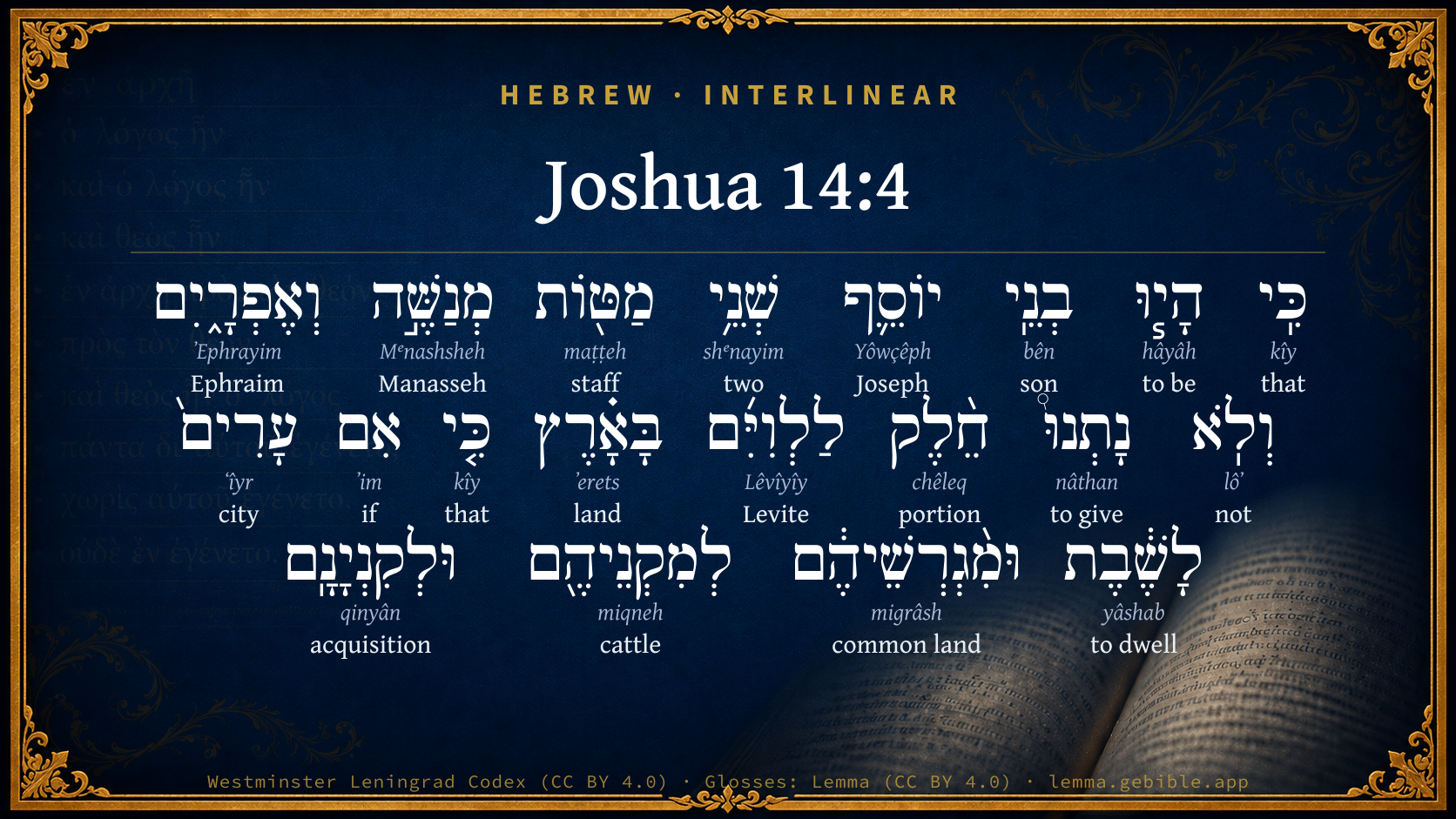
Hebrew (Westminster Leningrad Codex) Joshua 14:4 appears in the Hebrew Old Testament. The text above is from the Westminster Leningrad Codex. Each word links to its Strong’s number, a concise gloss, and parsing drawn from the Open Scriptures Hebrew Bible morphology. Click any word for its full Brown-Driver-Briggs (BDB) entry.
Download image
Cite this verse

Joshua 14:4 (World English Bible). Public Domain. Lemma interlinear Bible study tool, https://lemma.gebible.app/v/joshua/14/4.

Show BibTeX & RIS
BibTeX
RIS
English Translation
For the children of Joseph were two tribes, Manasseh and Ephraim: and they gave no portion to the Levites in the land, save cities to dwell in, with the suburbs of it for their cattle and for their substance.
World English Bible · Public Domain
Download a study sheet

One document with this verse’s original text, its word-by-word gloss line, the meaning frame, cross-references with their text, attributed commentary, and full source and license credits — printable, and it pastes into notes with its structure intact.

This verse Autodidact and up

Study sheet (.html) Plain text (.txt)

A passage Seminary Student

Up to 50 verses in one chapter. A passage sheet keeps up to 6 commentary sources and 12 cross-references per verse, in the order this page ranks them, and says so on the sheet whenever that leaves anything out. Ask for a single verse and you get the Autodidact verse sheet above.

Everything on this page stays free to read, with no account — the sheet is a download of what is already on screen, not access to it.

Want to remove ads? Support Godless Engineer
Compare translations 3

The same verse in 3 English versions, stacked beneath the original-language interlinear above. Click any original word for its lexicon entry.

Each is an independent rendering of the whole verse — the interlinear is not word-aligned to these translations.

Highlighted words mark where these versions differ — a whole-verse word diff, not a word-by-word alignment.

  • World English Bible Public Domain
    For the children of Joseph were two tribes, Manasseh and Ephraim: and they gave no portion to the Levites in the land, save cities to dwell in, with the suburbs of it for their cattle and for their substance.
  • King James Version Public Domain
    For the children of Joseph were two tribes, Manasseh and Ephraim: therefore they gave no part unto the Levites in the land, save cities to dwell in, with their suburbs for their cattle and for their substance.
  • unfoldingWord Literal Text CC BY-SA 4.0
    For the sons of Joseph were two tribes, Manasseh and Ephraim. And they gave no portion to the Levites in the land if not cities for dwelling and their pasturelands for their livestock and for their property.

unfoldingWord Literal Text — © unfoldingWord, licensed CC BY-SA 4.0. Word-aligned USFM3 via Door43 (git.door43.org/unfoldingWord/en_ult).

Versions to compare (up to 4)

3 of 4 selected

Show all 18 translations

Every available English version of this verse, each an independent rendering of the whole verse.

  • World English Bible Public Domain
    For the children of Joseph were two tribes, Manasseh and Ephraim: and they gave no portion to the Levites in the land, save cities to dwell in, with the suburbs of it for their cattle and for their substance.
  • Berean Standard Bible Public Domain
    The descendants of Joseph became two tribes, Manasseh and Ephraim. And no portion of the land was given to the Levites, except for cities in which to live, along with pasturelands for their flocks and herds.
  • Majority Standard Bible Public Domain
    The descendants of Joseph became two tribes, Manasseh and Ephraim. And no portion of the land was given to the Levites, except for cities in which to live, along with pasturelands for their flocks and herds.
  • King James Version Public Domain
    For the children of Joseph were two tribes, Manasseh and Ephraim: therefore they gave no part unto the Levites in the land, save cities to dwell in, with their suburbs for their cattle and for their substance.
  • American Standard Version (1901) Public Domain
    For the children of Joseph were two tribes, Manasseh and Ephraim: and they gave no portion unto the Levites in the land, save cities to dwell in, with the suburbs thereof for their cattle and for their substance.
  • Revised Version (1885) Public Domain
    For the children of Joseph were two tribes, Manasseh and Ephraim: and they gave no portion unto the Levites in the land, save cities to dwell in, with the suburbs thereof for their cattle and for their substance.
  • Geneva Bible (1599) Public Domain
    For the childre of Ioseph were two tribes, Manasseh and Ephraim: therefore they gaue no part vnto the Leuites in the lande, saue cities to dwell in, with the suburbes of the same for their beastes and their substance.
  • Douay-Rheims (1899) Public Domain
    But in their place succeeded the children of Joseph divided into two tribes, of Manasses and Ephraim: neither did the Levites receive other portion of land, but cities to dwell in, and their suburbs to feed their beasts and flocks.
  • Young's Literal Translation Public Domain
    for the sons of Joseph hath been two tribes, Manasseh and Ephraim, and they have not given a portion to the Levites in the land, except cities to dwell in, and their suburbs for their cattle, and for their possessions;
  • Literal Standard Version CC BY-SA 4.0
    for the sons of Joseph have been two tribes, Manasseh and Ephraim, and they have not given a portion to the Levites in the land, except cities to dwell in, and their outskirts for their livestock, and for their possessions;
  • Unlocked Literal Bible CC BY-SA 4.0
    The tribe of Joseph was actually two tribes, Manasseh and Ephraim. The Levites were given no portion of the inheritance in the land, but only certain cities to live in, with their pasturelands for livestock and for their own material resources.
  • unfoldingWord Literal Text CC BY-SA 4.0
    For the sons of Joseph were two tribes, Manasseh and Ephraim. And they gave no portion to the Levites in the land if not cities for dwelling and their pasturelands for their livestock and for their property.
  • Darby Bible Public Domain
    For the children of Joseph were two tribes, Manasseh and Ephraim; and they gave no part to the Levites in the land, save cities to dwell in, and their suburbs for their cattle and for their substance.
  • World Messianic Bible Public Domain
    For the children of Joseph were two tribes, Manasseh and Ephraim. They gave no portion to the Levites in the land, except cities to dwell in, with their pasture lands for their livestock and for their property.
  • Webster's Bible Public Domain
    For the children of Joseph were two tribes, Manasseh and Ephraim: therefore they gave no part to the Levites in the land, save cities to dwell in, with their suburbs for their cattle, and for their substance.
  • Free Bible Version CC BY-SA 4.0
    The descendants of Joseph had become two tribes, Manasseh and Ephraim. The Levites were not given any land, only towns to live in and pasture for their flocks and herds.
  • Bible in Basic English Public Domain
    Because the children of Joseph were two tribes, Manasseh and Ephraim; and they gave the Levites no part in the land, only towns for their living-places, with the grass-lands for their cattle and for their property.
  • JPS Tanakh (1917) Public Domain
    For the children of Joseph were two tribes, Manasseh and Ephraim; and they gave no portion unto the Levites in the land, save cities to dwell in, with the open land about them for their cattle and for their substance. —

Literal Standard Version (2020), Covenant Press — licensed CC BY-SA 4.0. Text via the HelloAO Bible API (eBible.org). Unlocked Literal Bible (unfoldingWord) — licensed CC BY-SA 4.0. Text via the HelloAO Bible API (eBible.org). unfoldingWord Literal Text — © unfoldingWord, licensed CC BY-SA 4.0. Word-aligned USFM3 via Door43 (git.door43.org/unfoldingWord/en_ult). Free Bible Version, Dr. Jonathan Gallagher — licensed CC BY-SA 4.0. Text via the HelloAO Bible API (eBible.org).

Word by word

More ways to search: Search by grammar → Find every occurrence → Compare this word →

Practice this passage: Drill this verse → Learn its vocabulary →

וּלְקִנְיָנָֽם
qinyân
H7075
“and · to/for · acquisition · their”
Conjunction + Preposition + Noun, Common, Masculine, Singular, Construct + Suffix, Personal, 3rd Person, Masculine, Plural
Part of Speech
Conjunction + Preposition + Noun
Type
Common
Gender
Masculine
Number
Singular
State
Construct
Full BDB Definition

Origin: from H7069

TWOT: 2039a

thing acquired, acquisition, possession, purchased property, wealth - thing acquired (by purchase) - creatures (more general)
  1. כִּֽי kîy H3588 “that” Conjunction
  2. הָי֧וּ hâyâh H1961 “to be” Verb, Qal, Perfect, 3rd Person, Common, Plural
  3. בְנֵֽי bên H1121 “sons of” Noun, Common, Masculine, Plural, Construct
  4. יוֹסֵ֛ף Yôwçêph H3130 “Joseph” Noun, Proper
  5. שְׁנֵ֥י shᵉnayim H8147 “two” Adjective, Cardinal number, Masculine, Dual, Construct
  6. מַטּ֖וֹת maṭṭeh H4294 “staffs” Noun, Common, Masculine, Plural, Absolute
  7. מְנַשֶּׁ֣ה Mᵉnashsheh H4519 “Manasseh” Noun, Proper
  8. וְאֶפְרָ֑יִם ʼEphrayim H669 “and · Ephraim” Conjunction + Noun, Proper
  9. וְלֹֽא lôʼ H3808 “and · not” Conjunction + Particle, Negative
  10. נָתְנוּ֩ nâthan H5414 “to give” Verb, Qal, Perfect, 3rd Person, Common, Plural
  11. חֵ֨לֶק chêleq H2506 “portion” Noun, Common, Masculine, Singular, Absolute
  12. לַלְוִיִּ֜ם Lêvîyîy H3881 “to/for the · Levites” Preposition, Determined + Noun, Gentilic, Masculine, Plural, Absolute
  13. בָּאָ֗רֶץ ʼerets H776 “in/at the · land” Preposition, Determined + Noun, Common, Both, Singular, Absolute
  14. כִּ֤י kîy H3588 “that” Conjunction
  15. אִם ʼim H518 “if” Conjunction
  16. עָרִים֙ ʻîyr H5892 “cities” Noun, Common, Feminine, Plural, Absolute
  17. לָשֶׁ֔בֶת yâshab H3427 “to dwell” Preposition + Verb, Qal, Infinitive Construct
  18. וּמִ֨גְרְשֵׁיהֶ֔ם migrâsh H4054 “and · common lands · their” Conjunction + Noun, Common, Masculine, Plural, Construct + Suffix, Personal, 3rd Person, Masculine, Plural
  19. לְמִקְנֵיהֶ֖ם miqneh H4735 “to/for · cattle · their” Preposition + Noun, Common, Masculine, Plural, Construct + Suffix, Personal, 3rd Person, Masculine, Plural

About this verse

These counts appear in no published source. They are computed here, from the morphology-tagged text and Lemma’s own curated glosses. What Lemma adds →

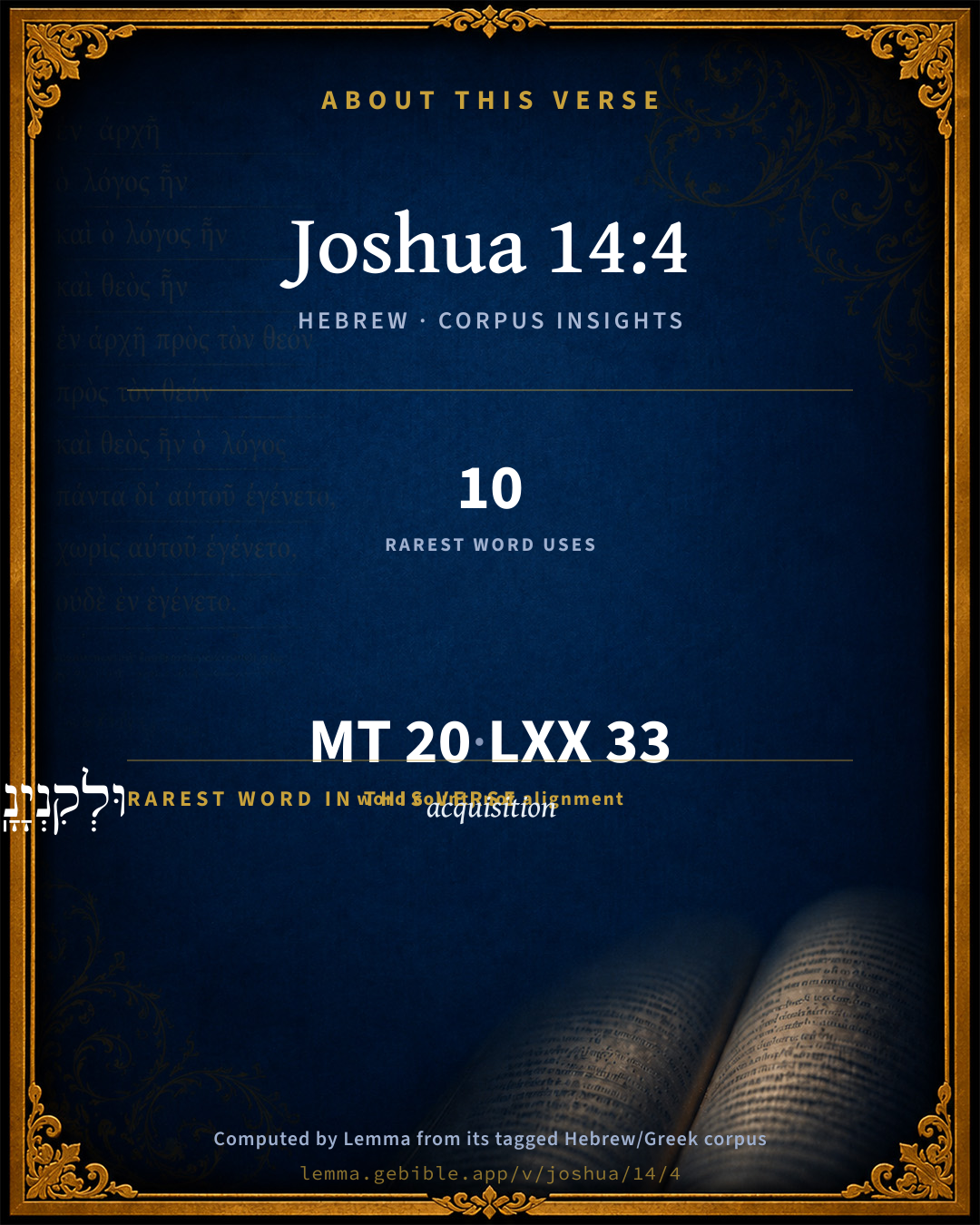
20
words
19
distinct lemmas
Historical
section

Notable vocabulary

The rarest word here is וּלְקִנְיָנָֽם acquisition H7075 — appearing just 10 times in the whole Hebrew Bible.

Shared distinctive vocabulary

וּלְקִנְיָנָֽם acquisition H7075 occurs in 10 verses of the Hebrew Bible. Also found in:

Grammatical profile

  • 3 verbs
  • 12 nouns
  • 1 adjective
  • 3 conjunctions
  • 1 particle

Verb forms

  • הָי֧וּ Qal · Perfect
  • נָתְנוּ֩ Qal · Perfect
  • לָשֶׁ֔בֶת Qal · Infinitive Construct

Repetition

A word recurs within this verse — often emphatic in Hebrew:

  • כִּֽי that H3588 ×2

Hebrew & Septuagint length

In English translation the verse runs 39 words from the Hebrew and 38 from the Septuagint (LXX English) — closely comparable.

A rough comparison of the two English renderings, which tokenize alike — not a word-level alignment.

Word counts can differ between the Hebrew and the Greek without any difference in meaning — e.g. the Hebrew direct-object marker אֵת has no separate Greek word, and Greek often adds the article ὁ.

In the original languages it is 20 Hebrew tokens and 33 Greek tokens — but the two are counted differently (Hebrew bundles its prefixes and suffixes into one token; the Greek is in lemma form), so that isn’t a like-for-like length.

Cross-references

5

Topical passages linked to Joshua 14:4 in the Treasury of Scripture Knowledge — connected by theme and wording, ordered by reader-vote popularity; previews shown in the World English Bible.

  • Genesis 48:5 Now your two sons, who were born to you in the land of Egypt before I came to you into Egypt, are mine; Ephraim and Manasseh, even as Reuben and Simeon, will be mine.
  • 1 Chronicles 5:1–2 The sons of Reuben the firstborn of Israel (for he was the firstborn; but, because he defiled his father's couch, his birthright was given to the sons of Joseph the son of Israel; and the genealogy is not to be reckoned after the birthright.
  • Numbers 35:2–8 Command the children of Israel that they give to the Levites of the inheritance of their possession cities to dwell in; and suburbs for the cities round about them shall you give to the Levites.
  • Joshua 21:2–42 and they spoke to them at Shiloh in the land of Canaan, saying, Yahweh commanded Moses to give us cities to dwell in, with the suburbs of it for our cattle.
  • 1 Chronicles 6:54–81 Now these are their dwelling-places according to their encampments in their borders: to the sons of Aaron, of the families of the Kohathites (for theirs was the [first] lot),

Cross-references courtesy of OpenBible.info (CC BY 4.0).

Hebrew and Greek witnesses Masoretic Hebrew ↔ Greek Septuagint

The same verse in the two great witnesses to the Old Testament, shown verse-for-verse.

These are two independent witnesses, not word-aligned to each other, and the Septuagint is shown in lemma (dictionary) form.

Hebrew Joshua 14:4 Masoretic · Westminster Leningrad Codex

כִּֽי הָי֧וּ בְנֵֽי יוֹסֵ֛ף שְׁנֵ֥י מַטּ֖וֹת מְנַשֶּׁ֣ה וְאֶפְרָ֑יִם וְלֹֽא נָתְנוּ֩ חֵ֨לֶק לַלְוִיִּ֜ם בָּאָ֗רֶץ כִּ֤י אִם עָרִים֙ לָשֶׁ֔בֶת וּמִ֨גְרְשֵׁיהֶ֔ם לְמִקְנֵיהֶ֖ם וּלְקִנְיָנָֽם

For the children of Joseph were two tribes, Manasseh and Ephraim: and they gave no portion to the Levites in the land, save cities to dwell in, with the suburbs of it for their cattle and for their substance.

World English Bible · Public Domain

Greek LXX Joshua 14:4 Septuagint · lemma form

ὅτι εἰμί ὁ υἱός ιωσηφ δύο φυλή μανασσή καί ἐφράιμ καί οὐ δίδωμι μερίς ἐν ὁ γῆ ὁ λευίτης ἀλλά ἤ πόλις καταοἰκέω καί ὁ ἀποὁρίζω αὐτός ὁ κτῆνος καί ὁ κτῆνος αὐτός

For the sons of Joseph were two tribes, Manasse and Ephraim; and there was none inheritance in the land given to the Levites, only cities to dwell in, and their suburbs separated for the cattle, and their cattle.

LXX2012 (modern English Septuagint) · Public Domain

Hebrew: Westminster Leningrad Codex (CC BY 4.0). Greek: Septuagint (public domain); English from LXX2012 (modern English Septuagint) (Public Domain). How the Septuagint differs from the Hebrew →

Targum (Aramaic paraphrase)

1

The Targum is the ancient Jewish Aramaic paraphrase of the Hebrew Scriptures — an interpretive translation, not the Hebrew text itself. Onkelos (literal) and Pseudo-Jonathan (expansive) render the Torah, and Jonathan the Prophets. Coverage is partial: where no permissively-licensed English translation exists for a verse, only the Aramaic is shown. This is verse-level text, not a word-by-word alignment to the Hebrew.

  1. Targum Jonathan Prophets (Joshua–Malachi)
    אֲרֵי הֲווֹ בְנֵי יוֹסֵף תְּרֵין שִׁבְטִין מְנַשֶׁה וְאֶפְרָיִם וְלָא יְהָבוּ חוּלֵק לְלֵוָאֵי בְּאַרְעָא אֱלָהֵן קִרְוִין לְמִתַּב וּרְוָחֵיהוֹן לִבְעִירֵיהוֹן וּלְגֵיתֵיהוֹן:

    (no public-domain English translation for this verse)

    Targum Jonathan — Aramaic: “Mikraot Gedolot” (public domain). English: “Sefaria Community Translation” (CC0 1.0 (public-domain dedication)); “London "Chaldee Paraphrase," 1871” (public domain). Text via Sefaria.

Commentary

Notes on Joshua 14:4 from classic Christian and Jewish commentators (each source and its license shown beneath its notes). The classic Christian expositions comment on the surrounding passage and are grouped to its opening verse, so a note may address several verses; the Jewish commentaries on the Tanakh (Rashi and others) are per-verse, so they appear only where the commentator wrote on this verse.

Lemma curates 59 commentaries, every one of them public domain or Creative Commons licensed, each selected and text-cleaned for this edition rather than reprinted as found. About our sources →

Trapp's Complete Commentary

John Trapp

Jos 14:4 For the children of Joseph were two tribes, Manasseh and Ephraim: therefore they gave no part unto the Levites in the land, save cities to dwell [in], with their suburbs for their cattle and for their substance.

Ver. 4. For the children of Joseph were two tribes.] And so both Joseph had a double portion, the privilege of the firstborn which Reuben had forefeited, {1Ch 5:1} and the number of twelve tribes was made up, notwithstanding the Levites were not reckoned. The Papists, to make up the number of ten commandments, when they have cashiered the second, as making utterly against their image worship, divide the last into two; so loath are heretics to have their asses’ ears seen. But Paul, who knew better than any of them the analysis of the law, calleth that last "the commandment," not commandments. {Rom 7:7}

John Trapp, A Commentary or Exposition upon All the Books of the Old and New Testament (1647–1656) — public domain. Text from a community e-Sword module.

Joseph Benson's Commentary

Jos 14:4-5. The children of Joseph were two tribes — That is, had the portion of two tribes, and therefore, though Levi was excluded, there remained nine tribes and a half to be provided for in Canaan. They divided, &c. — That is, the persons named, (Jos 14:1,) who acted in the name of the children of Israel. They were disposed to divide it; they began to take measures for doing it.

Joseph Benson's Commentary on the Old and New Testaments (1811–1818) — public domain. Text from a community e-Sword module.

Tyndale Open Study Notes

Tyndale Open Resources

14:4 Joseph, the elder son of Jacob’s favorite wife Rachel, received a double portion of land through his sons Manasseh and Ephraim (see study note on Gen 48:5-7). Because the Levites did not receive a separate tribal territory (Josh 13:14), the total number of tribes with land remained at twelve.

Tyndale Open Study Notes — © Tyndale Open Resources, licensed CC BY-SA 4.0. Text via the HelloAO Bible API.

Geneva Bible (1599)

Geneva Bible translators

So though Levi lacked, yet were there still twelve tribes by this means.

Geneva Bible (1599) marginal notes — public domain. Text via Bolls.life.

Jamieson, Fausset & Brown

Robert Jamieson, A. R. Fausset & David Brown

The children of Joseph were two tribes, Manasseh and Ephraim--As two and a half tribes were settled on the east Jordan, and the Levites had no inheritance assigned them in land, there would have been only eight and a half tribes to provide for. But Ephraim and Manasseh, the two sons of Joseph, had been constituted two tribes (Gen 48:5), and although Levi was excluded, the original number of the tribes of Israel was still preserved.

Jamieson, Fausset & Brown — Commentary Critical and Explanatory on the Whole Bible (1871) — public domain (CC PDM 1.0). Text via the HelloAO Bible API.

Adam Clarke's Commentary

Verse 4. The children of Joseph were two tribes] This was ascertained by the prophetic declaration of their grandfather Jacob, Ge 48:5-6; and as Levi was taken out of the tribes for the service of the sanctuary, one of these sons of Joseph came in his place, and Joseph was treated as the first-born of Jacob, in the place of Reuben, who forfeited his right of primogeniture.

With their suburbs for their cattle] For the meaning of this passage the reader is referred to Clarke's note on "Nu 35:6".

Adam Clarke's Commentary on the Bible (1810–1826) — public domain. Text from a community e-Sword/MySword module.

John Calvin's Commentaries

4. They gave no part unto the Levites, etc It is here repeated for the third time with regard to the Levites, that they were not included in the number, so as to have the portion of a tribe assigned to them; but it is mentioned for a different purpose, for it is immediately after added, that the sons of Joseph were divided into two tribes, and were thus privileged to obtain a double portion. Thus had Jacob prophesied, (Genesis 49) or rather, like an arbiter appointed by God, he had in this matter preferred the sons of Joseph to the others. God therefore assumed the Levites to himself as a peculiar inheritance, and in their stead substituted one of the two families of Joseph.

John Calvin's Commentaries (1540-1563) — public domain. Text from the Calvin Translation Society English edition (1840s-50s) via the Christian Classics Ethereal Library (ccel.org). Calvin's coverage is partial (roughly two-thirds of the Bible); uncommented books and verses are honest gaps, never fabricated. The 19th-century editor's footnotes and remarks are omitted so the notes are faithfully Calvin's own voice.

The Cambridge Bible for Schools and Colleges

gen. ed. J. J. S. Perowne

4. For the children of Joseph] There would have been only eight tribes and a half left, but the two sons of Joseph, Manasseh and Ephraim, had been adopted by Jacob as his sons (Gen_48:5), and were reckoned as tribes, and therefore there were still nine tribes and a half to receive their inheritance.

therefore they gave] Rather, and they gave. The repetition of these statements respecting the Levites is not due “to the redundancy of the Semitic style,” but is intended to shew the reader that the instructions left by Moses (Num_18:20; Num_35:2) had been literally and exactly fulfilled.

with their suburbs] i. e. pasture-ground within the precincts of the cities, or certain districts round them in which their cattle might graze. These “pasture-grounds,” rendered by Bunsen “commons,” and in Switzerland called All-menden, are incorrectly translated in our version “suburbs,” from the Vulgate suburbana; “suburbis of hem to hous beestis and his feeld beestis to be fed,” Wyclif.

The Cambridge Bible for Schools and Colleges (gen. ed. J. J. S. Perowne; Cambridge University Press, 1878–1918) — public domain. Text from a community e-Sword module.

John Gill's Exposition

For the children of Joseph were two tribes, Manasseh and Ephraim,.... For the birthright being forfeited by Reuben, was given to Joseph, who had the double portion, the privilege of the firstborn; by which means the number of the twelve tribes was kept up in the division of the land, though that of Levi had no share in it; and which is also a reason why they had none, that Joseph's two sons might be reckoned two tribes:

therefore they gave no part unto the Levites in the land; to make way for the sons of Joseph to have the double portion:

save cities to dwell in; and that only, for they might not sell them, as other Israelites could theirs:

with their suburbs, for their cattle, and for their substance; the Targum is,

"for all their beasts, and for their cattle;''that is, for convenient places to put them into, and for pasturage for, them; which Kimchi and Ben Melech interpret of their larger and lesser cattle, their herds and their flocks, their oxen and sheep.

John Gill's Exposition of the Whole Bible (1746–1763) — public domain (CC PDM 1.0). Text via the HelloAO Bible API.

Haydock's Catholic Bible Commentary

Suburbs. A certain quantity of ground, which the Levites were not allowed to till or plant with vines. (Grotius) (Numbers xxxv. 4.) --- The tribe of Manasses, which was divided, fell heir to the portion which would have been allotted to Levi, who was also scattered among his brethren. (Haydock) --- Thus Joseph obtained the birth-right of Ruben. (Calmet) --- Twelve portions were made, as Jacob had adopted Ephraim and Manasses, Genesis xlviii. (Worthington)

George Leo Haydock (1774–1849), Haydock's Catholic Family Bible and Commentary, 1859 edition — public domain. Excludes Psalms (Douay-Rheims chapter numbering differs from Protestant) and Deuterocanonical books (Catholic canon only).

Matthew Poole's English Annotations

Were two tribes, i.e. had the double portion, or the portion of two tribes, 1Ch 5:1,2, and therefore though Levi was excluded, there remained nine tribes and a half, was said Jos 14:2, to be provided for in Canaan.

Matthew Poole's English Annotations on the Holy Bible (1683–1685) — public domain. Text from a community e-Sword/MySword module.

Whedon's Commentary on the Bible

Daniel D. Whedon

4. Joseph… two tribes — So making up the twelve tribes without reckoning the tribe of Levi, who were to have no allotment, but were to be scattered among the tribes as judicial and ecclesiastical advisers and judges among the people.

Daniel D. Whedon (gen. ed.), Commentary on the Old and New Testaments (1874–1909) — public domain. Text from a community e-Sword module.

The Pulpit Commentary

For the children of Joseph were two tribes: (see Gen_48:5) therefore they gave. There is no "therefore" In the original. The passage is a simple repetition of what we find in Jos_13:14, Jos_13:33, and is added here to explain how the twelve tribes who actually divided the land were composed. Suburbs. Rather, "pasture lands;" literally, places where the cattle were driven out to pasture. (cf. Num_35:2 1Ch_13:2, where the Hebrew is "cities of driving out We may illustrate this phrase by the similar arrangements made by the Germanic tribes in early times. "The clearing," says Professor Stubbs, in his "Constitutional History of England," p. 49, "is surrounded by a thick border of wood or waste .... In the centre of the clearing the village is placed .... The fully qualified freeman has a share in the land of the community. He has a right to the enjoyment of the woods, the pastures, the meadow and the arable land of the mark.... The use of the meadow land is definitely apportioned .... When the grass beans to grow the cattle are driven out, and the meadow is fenced round and divided into as many equal shares as there are mark families in the village. For the arable land similar measures are taken although the task is somewhat more complex". (see note on Jos_13:23) Some similar arrangement must have taken place in the primitive Jewish settlement of Palestine. For the rude huts of the Teutonic tribes we must substitute the more civilised "cities, walled up to heaven," of the Phoenician races; for the scanty supply of gram and pasture, provided by a northern climate, we must substitute the rich plenty of a land "flowing with milk and honey," and with all the produce of a southern sky. The area of land assigned to each of the Levitical cities was definitely marked out, (see Num_35:4, Num_35:5) and subdivided, as the hints in the narrative seem to imply that all the land was, into as many sections as there were "mark families that is, families of freemen exclusive of the servile classes in the town.

The Pulpit Commentary (1880–1919), ed. H.D.M. Spence-Jones & Joseph S. Exell — public domain. Text from a community e-Sword module.

John Wesley's Explanatory Notes

Were two tribes - That is, had the portion of two tribes, and therefore though Levi was excluded, there remained nine tribes and a half, to be provided for in Canaan.

John Wesley, Explanatory Notes Upon the Whole Bible (1754–1765) — public domain. Text via the GEBible commentary corpus.

Rashi

Rabbi Shlomo Yitzchaki (Rashi)

The descendants of Yoseif were two tribes. In place of the tribe of Levi. were not to be given a portion of the land. The land was to be divided only among the other eleven tribes. The children of Menashe and Ephraim were counted as two tribes so that the land would be divided by twelve tribes. This came about through the will of Yaakov, who told Yoseif that his two sons, Ephraim and Menashe, would be considered as his own two son, Reuven and Shimon. (See Bereishis 48:7) This is mentioned here to explain how Yehoshua was to divide the land among nine and half tribes, when without Levi, there would be only eight and a half. We are told therefore that Menashe and Ephraim were counted as two tribes, thus this would compensate for the omission of Levi.

Rashi on the Tanakh — English translations: “The Judaica Press complete Tanach with Rashi, translated by A. J. Rosenberg” (CC BY 4.0); “Pentateuch with Rashi's commentary by M. Rosenbaum and A.M. Silbermann, 1929-1934” (public domain); “The Metsudah Tanach series, Lakewood, N.J” (CC BY 4.0); and “The Book of Joshua, Metsudah Publications, 1997” (CC BY 4.0). Text via Sefaria.

Lesson kit

Teaching starters — assembled from the data on this page, not authored interpretation. Every prompt links to the verse data it draws on. Edit before teaching.

Joshua, in the Historical, opens this verse with 20 words (19 distinct Hebrew lemmas). Its most distinctive word is qinyân (“acquisition”). A historical commentator’s framing appears above. Read the whole chapter for the surrounding context.

Discussion questions

  1. The word qinyân carries the sense “acquisition.” How does it shape the verse?
  2. How does Genesis 31:18, which shares the word «acquisition», read alongside this verse?
  3. What does the repetition of “that” (2× in this one verse) do in this verse?
  4. The translations on this page render this verse differently — a whole-verse word diff, not a word-by-word alignment. What might account for the different wordings?
  5. «הָי֧וּ» is a Qal Perfect verb. How does that grammatical form shape the action described?
  6. Compare how Trapp's Complete Commentary and Joseph Benson's Commentary read this verse. Where do they agree or differ?

Things to notice

Reading settings

Reading text

Shown beneath each verse's original-language words.

Old Testament
Old Testament edition

Read the OT as the Masoretic Hebrew (MT) or the Greek Septuagint (LXX).

English shown for the Greek Septuagint (in the Hebrew ↔ Greek comparison).

Comparing translations? Open the Compare panel on any verse page to stack up to four side by side.