
Jeremiah 31:9

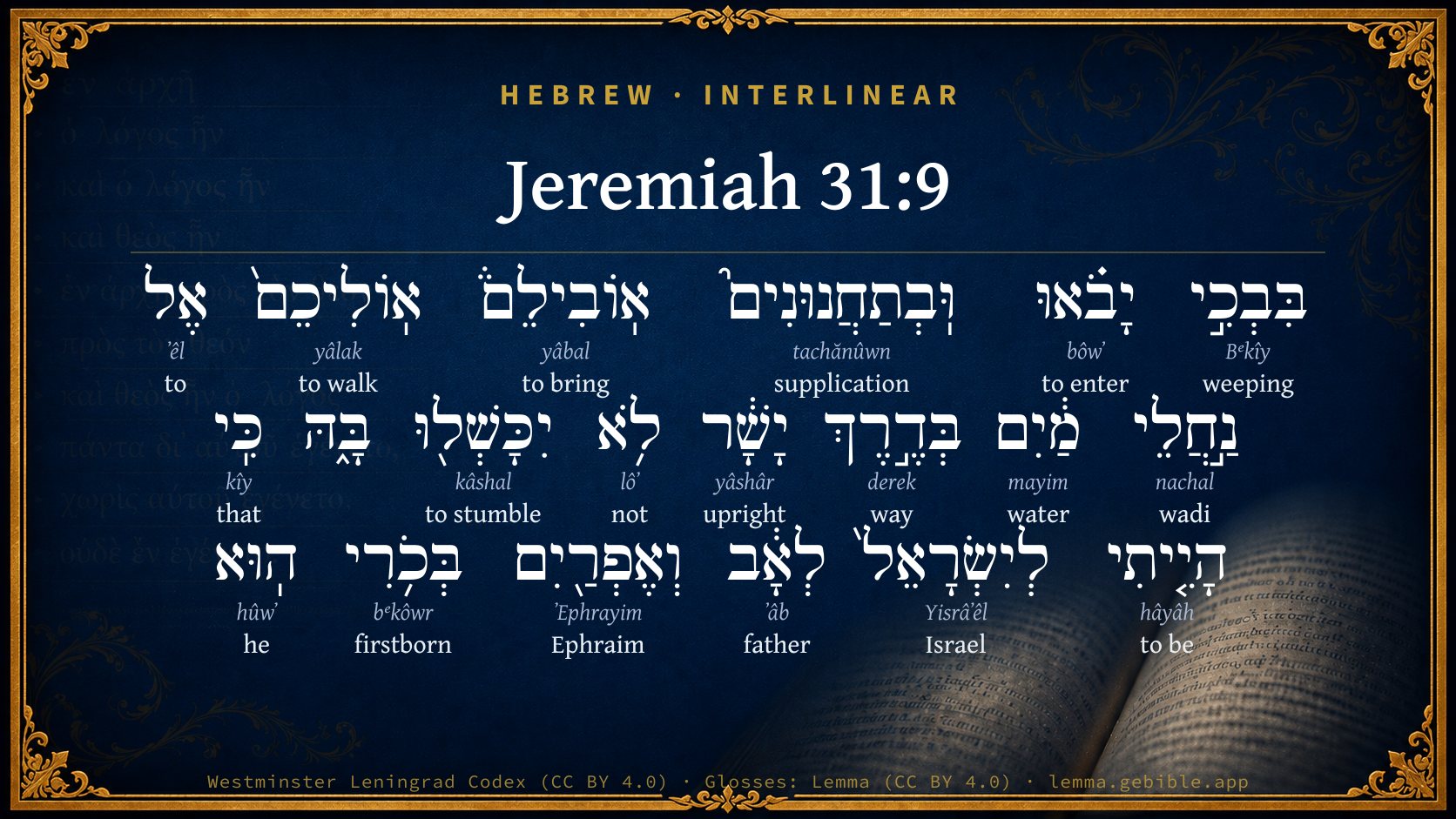
Hebrew (Westminster Leningrad Codex) Jeremiah 31:9 appears in the Hebrew Old Testament. The text above is from the Westminster Leningrad Codex. Each word links to its Strong’s number, a concise gloss, and parsing drawn from the Open Scriptures Hebrew Bible morphology. Click any word for its full Brown-Driver-Briggs (BDB) entry.
Download image
Cite this verse

Jeremiah 31:9 (World English Bible). Public Domain. Lemma interlinear Bible study tool, https://lemma.gebible.app/v/jeremiah/31/9.

Show BibTeX & RIS
BibTeX
RIS
English Translation
They shall come with weeping; and with petitions will I lead them: I will cause them to walk by rivers of waters, in a straight way in which they shall not stumble; for I am a father to Israel, and Ephraim is my firstborn.
World English Bible · Public Domain
Download a study sheet

One document with this verse’s original text, its word-by-word gloss line, the meaning frame, cross-references with their text, attributed commentary, and full source and license credits — printable, and it pastes into notes with its structure intact.

This verse Autodidact and up

Study sheet (.html) Plain text (.txt)

A passage Seminary Student

Up to 50 verses in one chapter. A passage sheet keeps up to 6 commentary sources and 12 cross-references per verse, in the order this page ranks them, and says so on the sheet whenever that leaves anything out. Ask for a single verse and you get the Autodidact verse sheet above.

Everything on this page stays free to read, with no account — the sheet is a download of what is already on screen, not access to it.

Want to remove ads? Support Godless Engineer
Compare translations 3

The same verse in 3 English versions, stacked beneath the original-language interlinear above. Click any original word for its lexicon entry.

Each is an independent rendering of the whole verse — the interlinear is not word-aligned to these translations.

Highlighted words mark where these versions differ — a whole-verse word diff, not a word-by-word alignment.

  • World English Bible Public Domain
    They shall come with weeping; and with petitions will I lead them: I will cause them to walk by rivers of waters, in a straight way in which they shall not stumble; for I am a father to Israel, and Ephraim is my firstborn.
  • King James Version Public Domain
    They shall come with weeping, and with supplications will I lead them: I will cause them to walk by the rivers of waters in a straight way, wherein they shall not stumble: for I am a father to Israel, and Ephraim is my firstborn.
  • unfoldingWord Literal Text CC BY-SA 4.0
    They will come weeping; I will lead them as they make their pleas. I will have them journey to streams of water on a straight road. They will not stumble on it, for I will be a father to Israel, and Ephraim will be my firstborn.”

unfoldingWord Literal Text — © unfoldingWord, licensed CC BY-SA 4.0. Word-aligned USFM3 via Door43 (git.door43.org/unfoldingWord/en_ult).

Versions to compare (up to 4)

3 of 4 selected

Show all 18 translations

Every available English version of this verse, each an independent rendering of the whole verse.

  • World English Bible Public Domain
    They shall come with weeping; and with petitions will I lead them: I will cause them to walk by rivers of waters, in a straight way in which they shall not stumble; for I am a father to Israel, and Ephraim is my firstborn.
  • Berean Standard Bible Public Domain
    They will come with weeping, and by their supplication I will lead them; I will make them walk beside streams of waters, on a level path where they will not stumble. For I am Israel’s Father, and Ephraim is My firstborn.”
  • Majority Standard Bible Public Domain
    They will come with weeping, and by their supplication I will lead them; I will make them walk beside streams of waters, on a level path where they will not stumble. For I am Israel’s Father, and Ephraim is My firstborn.”
  • King James Version Public Domain
    They shall come with weeping, and with supplications will I lead them: I will cause them to walk by the rivers of waters in a straight way, wherein they shall not stumble: for I am a father to Israel, and Ephraim is my firstborn.
  • American Standard Version (1901) Public Domain
    They shall come with weeping; and with supplications will I lead them: I will cause them to walk by rivers of waters, in a straight way wherein they shall not stumble; for I am a father to Israel, and Ephraim is my first-born.
  • Revised Version (1885) Public Domain
    They shall come with weeping, and with supplications will I lead them: I will cause them to walk by rivers of waters, in a straight way wherein they shall not stumble: for I am a father to Israel, and Ephraim is my firstborn.
  • Geneva Bible (1599) Public Domain
    They shall come weeping, and with mercie will I bring them againe: I will lead them by the riuers of water in a straight way, wherein they shall not stumble: for I am a father to Israel, and Ephraim is my first borne.
  • Douay-Rheims (1899) Public Domain
    They shall come with weeping: and I will bring them back in mercy: and I will bring them through the torrents of waters in a right way, and they shall not stumble in it: for I am a father to Israel, and Ephraim is my firstborn.
  • Young's Literal Translation Public Domain
    With weeping they come in, And with supplications I bring them, I cause them to go unto streams of waters, In a right way -- they stumble not in it, For I have been to Israel for a father, And Ephraim -- My first-born `is' he.
  • Literal Standard Version CC BY-SA 4.0
    They come in with weeping, || And I bring them with supplications, || I cause them to go to streams of waters, || In a right way—they do not stumble in it, || For I have been a Father to Israel, || And Ephraim—he [is] My firstborn.”
  • Unlocked Literal Bible CC BY-SA 4.0
    They will come weeping; I will lead them as they make their pleas. I will have them journey to streams of water on a straight road. They will not stumble on it, for I will be a father to Israel, and Ephraim will be my firstborn.”
  • unfoldingWord Literal Text CC BY-SA 4.0
    They will come weeping; I will lead them as they make their pleas. I will have them journey to streams of water on a straight road. They will not stumble on it, for I will be a father to Israel, and Ephraim will be my firstborn.”
  • Darby Bible Public Domain
    They shall come with weeping, and with supplications will I lead them; I will cause them to walk by water-brooks, in a straight way, wherein they shall not stumble; for I will be a father to Israel, and Ephraim is my firstborn.
  • World Messianic Bible Public Domain
    They will come with weeping. I will lead them with petitions. I will cause them to walk by rivers of waters, in a straight way in which they won’t stumble; for I am a father to Israel. Ephraim is my firstborn.
  • Webster's Bible Public Domain
    They shall come with weeping, and with supplications will I lead them: I will cause them to walk by the rivers of waters in a straight way, wherein they shall not stumble: for I am a father to Israel, and Ephraim is my first-born.
  • Free Bible Version CC BY-SA 4.0
    They will come back with tears in their eyes, and they will be praying as I take them home. I will lead them beside streams of waters, on level paths where they won't stumble. For I am Israel's Father; Ephraim is my firstborn.
  • Bible in Basic English Public Domain
    They will come with weeping, and going before them I will be their guide: guiding them by streams of water in a straight way where there is no falling: for I am a father to Israel, and Ephraim is the first of my sons.
  • JPS Tanakh (1917) Public Domain
    They shall come with weeping, and with supplications will I lead them; I will cause them to walk by rivers of waters, in a straight way wherein they shall not stumble; for I am become a father to Israel, and Ephraim is My first-born.

Literal Standard Version (2020), Covenant Press — licensed CC BY-SA 4.0. Text via the HelloAO Bible API (eBible.org). Unlocked Literal Bible (unfoldingWord) — licensed CC BY-SA 4.0. Text via the HelloAO Bible API (eBible.org). unfoldingWord Literal Text — © unfoldingWord, licensed CC BY-SA 4.0. Word-aligned USFM3 via Door43 (git.door43.org/unfoldingWord/en_ult). Free Bible Version, Dr. Jonathan Gallagher — licensed CC BY-SA 4.0. Text via the HelloAO Bible API (eBible.org).

Word by word

More ways to search: Search by grammar → Find every occurrence → Compare this word →

Practice this passage: Drill this verse → Learn its vocabulary →

וּֽבְתַחֲנוּנִים֮
tachănûwn
H8469
“and · in/at · supplications”
Conjunction + Preposition + Noun, Common, Masculine, Plural, Absolute
Part of Speech
Conjunction + Preposition + Noun
Type
Common
Gender
Masculine
Number
Plural
State
Absolute
Full BDB Definition

Origin: from H2603

TWOT: 694g

supplication, supplication for favour - to man - to God
  1. בִּבְכִ֣י Bᵉkîy H1065 “in/at · weeping” Preposition + Noun, Common, Masculine, Singular, Absolute
  2. יָבֹ֗אוּ bôwʼ H935 “to enter” Verb, Qal, Imperfect, 3rd Person, Masculine, Plural
  3. אֽוֹבִילֵם֒ yâbal H2986 “to bring · them” Verb, Hiphil, Imperfect, 1st Person, Common, Singular + Suffix, Personal, 3rd Person, Masculine, Plural
  4. אֽוֹלִיכֵם֙ yâlak H3212 “to walk · them” Verb, Hiphil, Imperfect, 1st Person, Common, Singular + Suffix, Personal, 3rd Person, Masculine, Plural
  5. אֶל ʼêl H413 “to” Preposition
  6. נַ֣חֲלֵי nachal H5158 “wadis of” Noun, Common, Masculine, Plural, Construct
  7. מַ֔יִם mayim H4325 “water(s)” Noun, Common, Masculine, Plural, Absolute
  8. בְּדֶ֣רֶךְ derek H1870 “in/at · way” Preposition + Noun, Common, Both, Singular, Absolute
  9. יָשָׁ֔ר yâshâr H3477 “upright” Adjective, Adjective, Masculine, Singular, Absolute
  10. לֹ֥א lôʼ H3808 “not” Particle, Negative
  11. יִכָּשְׁל֖וּ kâshal H3782 “to stumble” Verb, Niphal, Imperfect, 3rd Person, Masculine, Plural
  12. כִּֽי kîy H3588 “that” Conjunction
  13. הָיִ֤יתִי hâyâh H1961 “to be” Verb, Qal, Perfect, 1st Person, Common, Singular
  14. לְיִשְׂרָאֵל֙ Yisrâʼêl H3478 “to/for · Israel” Preposition + Noun, Proper
  15. לְאָ֔ב ʼâb H1 “to/for · father” Preposition + Noun, Common, Masculine, Singular, Absolute
  16. וְאֶפְרַ֖יִם ʼEphrayim H669 “and · Ephraim” Conjunction + Noun, Proper
  17. בְּכֹ֥רִי bᵉkôwr H1060 “firstborn · my” Noun, Common, Masculine, Singular, Construct + Suffix, Personal, 1st Person, Common, Singular
  18. הֽוּא hûwʼ H1931 “he” Pronoun, Personal, 3rd Person, Masculine, Singular

About this verse

These counts appear in no published source. They are computed here, from the morphology-tagged text and Lemma’s own curated glosses. What Lemma adds →

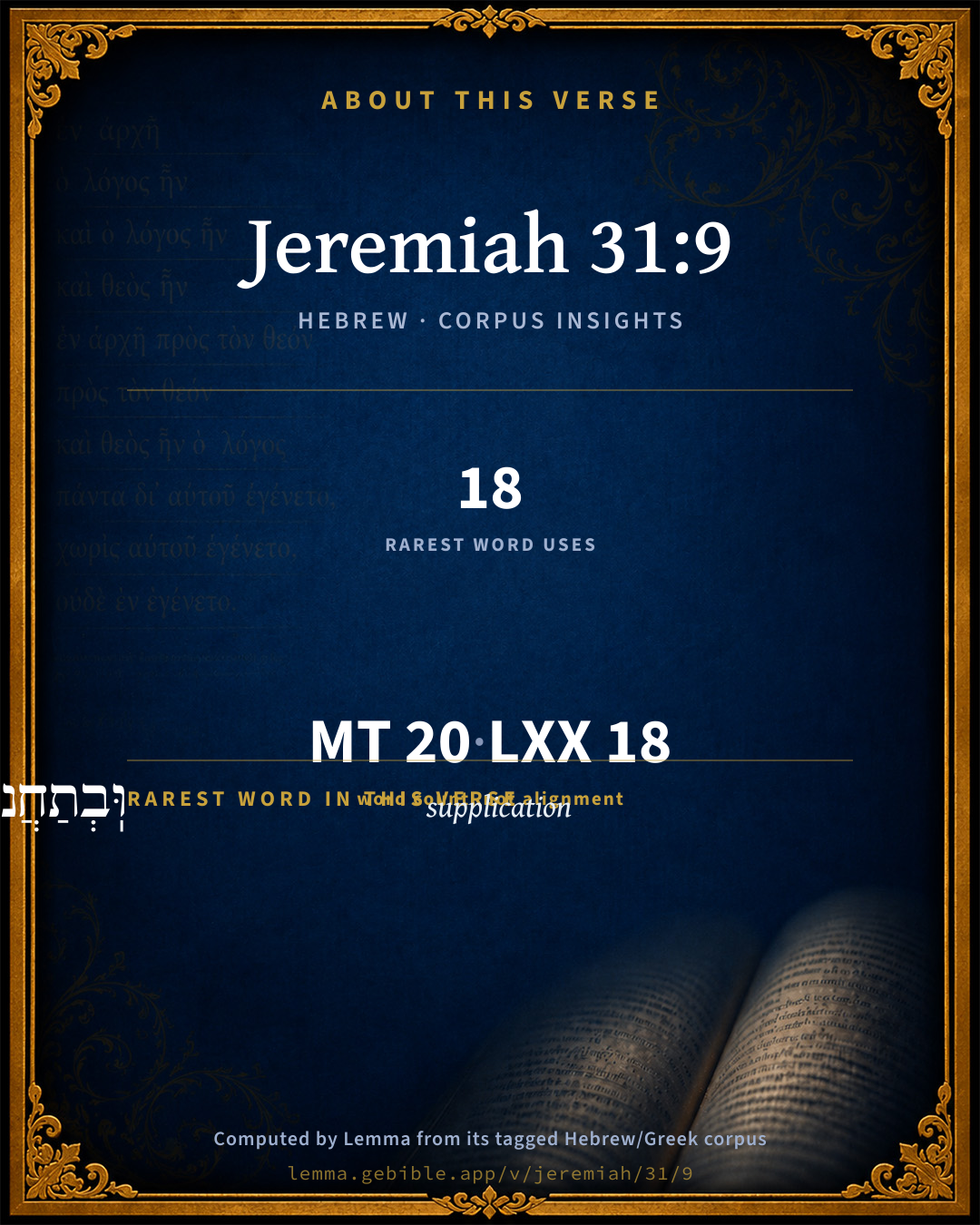
20
words
19
distinct lemmas
Prophets
section

Notable vocabulary

The rarest word here is וּֽבְתַחֲנוּנִים֮ supplication H8469 — appearing just 18 times in the whole Hebrew Bible.

Shared distinctive vocabulary

וּֽבְתַחֲנוּנִים֮ supplication H8469 occurs in 18 verses of the Hebrew Bible. Also found in:

Grammatical profile

  • 5 verbs
  • 9 nouns
  • 1 adjective
  • 1 pronoun
  • 2 prepositions
  • 1 conjunction
  • 1 particle

Verb forms

  • יָבֹ֗אוּ Qal · Imperfect
  • אֽוֹבִילֵם֒ Hiphil · Imperfect
  • אֽוֹלִיכֵם֙ Hiphil · Imperfect
  • יִכָּשְׁל֖וּ Niphal · Imperfect
  • הָיִ֤יתִי Qal · Perfect

Hebrew & Septuagint length

In the original languages it is 20 Hebrew tokens and 18 Greek tokens — but the two are counted differently (Hebrew bundles its prefixes and suffixes into one token; the Greek is in lemma form), so that isn’t a like-for-like length.

Cross-references

34

Topical passages linked to Jeremiah 31:9 in the Treasury of Scripture Knowledge — connected by theme and wording, ordered by reader-vote popularity; previews shown in the World English Bible.

  • Matthew 5:4 Blessed are those who mourn, For they shall be comforted.
  • Exodus 4:22 You shall tell Pharaoh, 'Thus says Yahweh, Israel is my son, my firstborn,
  • Jeremiah 3:4 Will you not from this time cry to me, My Father, you are the guide of my youth?
  • Jeremiah 31:20 Is Ephraim my dear son? is he a darling child? for as often as I speak against him, I do earnestly remember him still: therefore my heart yearns for him; I will surely have mercy on him, says Yahweh.
  • Jeremiah 50:4 In those days, and in that time, says Yahweh, the children of Israel shall come, they and the children of Judah together; they shall go on their way weeping, and shall seek Yahweh their God.
  • Psalms 23:2 He makes me lie down in green pastures. He leads me beside still waters.
  • Isaiah 35:6–8 Then shall the lame man leap as a hart, and the tongue of the mute shall sing; for in the wilderness shall waters break out, and streams in the desert.
  • Isaiah 63:13 who led them through the depths, as a horse in the wilderness, so that they didn't stumble?
  • Isaiah 40:3–4 The voice of one who cries, Prepare you in the wilderness the way of Yahweh; make level in the desert a highway for our God.
  • Isaiah 57:14 He will say, Cast up, cast up, prepare the way, take up the stumbling-block out of the way of my people.
  • Isaiah 64:8 But now, Yahweh, you are our Father; we are the clay, and you our potter; and we all are the work of your hand.
  • Jeremiah 3:19 But I said, How I will put you among the children, and give you a pleasant land, a goodly heritage of the hosts of the nations! and I said, You shall call me My Father, and shall not turn away from following me.
  • Zechariah 12:10 I will pour on the house of David, and on the inhabitants of Jerusalem, the spirit of grace and of supplication; and they will look to me whom they have pierced; and they shall mourn for him, as one mourns for his only son, and will grieve bitterly for him, as one grieves for his firstborn.
  • Matthew 6:9 Pray like this: 'Our Father in heaven, may your name be kept holy.
  • Luke 6:21 Blessed are you who hunger now, For you will be filled. Blessed are you who weep now, For you will laugh.
  • Revelation 7:17 for the Lamb who is in the midst of the throne shepherds them, and leads them to springs of waters of life. And God will wipe away every tear from their eyes."
  • Deuteronomy 32:6 Do you thus requite Yahweh, Foolish people and unwise? Isn't he your father who has bought you? He has made you, and established you.
  • 1 Chronicles 29:10 Therefore David blessed Yahweh before all the assembly; and David said, You are blessed, Yahweh, the God of Israel our father, forever and ever.
  • Psalms 126:5–6 Those who sow in tears will reap in joy.
  • Isaiah 41:17–19 The poor and needy seek water, and there is none, and their tongue fails for thirst; I, Yahweh, will answer them, I, the God of Israel, will not forsake them.
  • Isaiah 43:16–19 Thus says Yahweh, who makes a way in the sea, and a path in the mighty waters;
  • Isaiah 49:9–11 saying to those who are bound, Go forth; to those who are in darkness, Show yourselves. They shall feed in the ways, and on all bare heights shall be their pasture.
  • Isaiah 63:16 For you are our Father, though Abraham doesn't know us, and Israel does not acknowledge us: you, Yahweh, are our Father; our Redeemer from everlasting is your name.
  • Ezekiel 34:12–14 As a shepherd seeks out his flock in the day that he is among his sheep that are scattered abroad, so will I seek out my sheep; and I will deliver them out of all places where they have been scattered in the cloudy and dark day.
  • Daniel 9:17–18 Now therefore, our God, listen to the prayer of your servant, and to his petitions, and cause your face to shine on your sanctuary that is desolate, for the Lord's sake.
  • Hosea 12:4 Indeed, he had power over the angel, and prevailed; He wept, and made supplication to him. He found him at Bethel, and there he spoke with us,
  • Matthew 3:3 For this is he who was spoken of by Isaiah the prophet, saying, "The voice of one crying in the wilderness, Make ready the way of the Lord, Make his paths straight."
  • Luke 3:4–6 As it is written in the book of the words of Isaiah the prophet, "The voice of one crying in the wilderness, 'Make ready the way of the Lord. Make his paths straight.
  • Romans 8:26 In the same way, the Spirit also helps our weaknesses, for we don't know how to pray as we ought. But the Spirit himself makes intercession for us with groanings which can't be uttered.
  • 2 Corinthians 6:18 I will be to you a Father. You will be to me sons and daughters,' says the Lord Almighty."
  • 2 Corinthians 7:9–11 I now rejoice, not that you were made sorry, but that you were made sorry to repentance. For you were made sorry in a godly way, that you might suffer loss by us in nothing.
  • Hebrews 5:7 He, in the days of his flesh, having offered up prayers and petitions with strong crying and tears to him who was able to save him from death, and having been heard for his godly fear,
  • Hebrews 12:13 and make straight paths for your feet, so that which is lame may not be dislocated, but rather be healed.
  • Hebrews 12:23 to the general assembly and assembly of the firstborn who are enrolled in heaven, to God the Judge of all, to the spirits of just men made perfect,

Cross-references courtesy of OpenBible.info (CC BY 4.0).

Hebrew and Greek witnesses Masoretic Hebrew ↔ Greek Septuagint

The same verse in the two great witnesses to the Old Testament, shown verse-for-verse.

These are two independent witnesses, not word-aligned to each other, and the Septuagint is shown in lemma (dictionary) form.

Hebrew Jeremiah 31:9 Masoretic · Westminster Leningrad Codex

בִּבְכִ֣י יָבֹ֗אוּ וּֽבְתַחֲנוּנִים֮ אֽוֹבִילֵם֒ אֽוֹלִיכֵם֙ אֶל נַ֣חֲלֵי מַ֔יִם בְּדֶ֣רֶךְ יָשָׁ֔ר לֹ֥א יִכָּשְׁל֖וּ בָּ֑הּ כִּֽי הָיִ֤יתִי לְיִשְׂרָאֵל֙ לְאָ֔ב וְאֶפְרַ֖יִם בְּכֹ֥רִי הֽוּא

They shall come with weeping; and with petitions will I lead them: I will cause them to walk by rivers of waters, in a straight way in which they shall not stumble; for I am a father to Israel, and Ephraim is my firstborn.

World English Bible · Public Domain

Greek LXX Structure differs

In the Septuagint, Jeremiah is about an eighth shorter than the Hebrew and arranges its material differently — the Oracles Against the Nations (Hebrew chapters 46–51) appear in the middle of the Greek book, after 25:13. Because the chapter and verse boundaries do not line up, a verse-for-verse comparison with the Hebrew is not shown.

A verse-for-verse comparison isn’t shown here because the chapters and verses don’t line up. Switch to the LXX edition with the MT / LXX toggle above to read the Greek directly.

On this verse, The Cambridge Bible for Schools and Colleges discusses the Septuagint’s reading. Read the note in Commentary ↓

Hebrew: Westminster Leningrad Codex (CC BY 4.0). Greek: Septuagint (public domain); English from a public-domain English Septuagint. How the Septuagint differs from the Hebrew →

Targum (Aramaic paraphrase)

1

The Targum is the ancient Jewish Aramaic paraphrase of the Hebrew Scriptures — an interpretive translation, not the Hebrew text itself. Onkelos (literal) and Pseudo-Jonathan (expansive) render the Torah, and Jonathan the Prophets. Coverage is partial: where no permissively-licensed English translation exists for a verse, only the Aramaic is shown. This is verse-level text, not a word-by-word alignment to the Hebrew.

  1. Targum Jonathan Prophets (Joshua–Malachi)
    בְּמִגְלְהוֹן כַּד הֲווֹ בָכָן גְלוֹ בִּמְתָבְהוֹן מִבֵּינֵי גַלְוַתְהוֹן בְּרַחֲמִין סַגִיאִין אֱקָרְבִינוּן אֱדַבְּרִינוּן עַל פְּצִירֵי מַיָא בְּאוֹרַח תַּקְנָא לָא יִתְקְלוּן בָּהּ אֲרֵי הֲוָה מֵימְרִי לְיִשְׂרָאֵל כְּאָב וְאֶפְרַיִם חָבִיב הוּא קָדְמַי:

    When they were exiled, weeping, it was plain that they would return from their exile. With great mercy I will bring them near; I will guide them by streams of water, on a straight road upon which they will not stumble; because My command has been to Israel as a father, and Ephraim is dear to Me.

    Targum Jonathan — Aramaic: “Mikraot Gedolot” (public domain). English: “Sefaria Community Translation” (CC0 1.0 (public-domain dedication)); “London "Chaldee Paraphrase," 1871” (public domain). Text via Sefaria.

Commentary

Notes on Jeremiah 31:9 from classic Christian and Jewish commentators (each source and its license shown beneath its notes). The classic Christian expositions comment on the surrounding passage and are grouped to its opening verse, so a note may address several verses; the Jewish commentaries on the Tanakh (Rashi and others) are per-verse, so they appear only where the commentator wrote on this verse.

Lemma curates 59 commentaries, every one of them public domain or Creative Commons licensed, each selected and text-cleaned for this edition rather than reprinted as found. About our sources →

Trapp's Complete Commentary

John Trapp

Jer 31:9 They shall come with weeping, and with supplications will I lead them: I will cause them to walk by the rivers of waters in a straight way, wherein they shall not stumble: for I am a father to Israel, and Ephraim [is] my firstborn.

Ver. 9. They shall come with weeping.] Prae gaudio, inquit, flebunt, before happiness, it is said, they were weeping, they shall weep for joy, having first soaked themselves in godly sorrow by the spirit of grace and of supplications or deprecations poured upon them, {Zec 12:10} being solicitous about their salvation.

And I will make them to walk by the rivers of waters.] Heb., To the brooks of waters, i.e., to the holy ordinances. {as Psa 23:3}

For I am a Father to Israel.] I do all of free grace.

Ephraim is my firstborn.] And therefore higher than the kings of the earth. {Psa 89:27}

John Trapp, A Commentary or Exposition upon All the Books of the Old and New Testament (1647–1656) — public domain. Text from a community e-Sword module.

The Biblical Illustrator

Joseph S. Exell

Jer_31:9

They shall come with weeping, and with supplications will I lead them.

The penitent sinner returning to his God

I. Some of the first steps by which a sinner returns to his offended God.

1. Contrition; a heartfelt sorrow and grief on account of his sins. Many causes may conspire to awaken the sinner; but, as soon as the natural blindness of his heart begins to be removed, fear and alarm will be among the earliest effects. The apprehension of Gods future judgment stops him in his course; fills his heart with terror, and his eyes with tears. He has also a more immediate cause of alarm, in the state of his own mind and heart. Beginning now, for the first time, to abhor iniquity, he is confounded on discovering its power and dominion within him. Something more than this is required, in order to make a true and lasting penitent. After trembling under the condemnation of the law, and mourning over your corrupt nature, you must look upon Christ, and behold in Him the effects of your guilt.

2. From penitent tears, the next step is to fervent prayer.

II. Abundant aid is promised to those who are setting out on their return to God.

1. God will help the repenting sinner by holy influences; by inspiring him with holy desires, and restraining the corrupt inclinations of the natural mind.

2. He will come to your aid with His refreshing consolations. These are the rivers of waters, by which He will cause you to walk.

3. The repentant sinner is assured of instruction, sufficient to guide him on his way, and easy to be comprehended and followed.

4. He, who leads the sinner into the way of light and consolation, will also uphold him therein. (J. Jowett, M. A.)

Christian pilgrims

I. Their character.

1. There is no discouragement which God will not enable us to surmount.

2. God has chosen those who arc in the most discouraging circumstances on purpose that His own power may be the more displayed and glorified.

II. Their journey.

1. Its commencement

2. Its progress. Address--

(1) Those who yet are in a state of bondage.

(2) Those who are travelling towards Zion. (C. Simeon, M. A.)

In a straight way, wherein they shall not stumble.

A beaten track

Here there is a well-beaten track under our feet. Let us keep it. It may not be quite the shortest way; it may not take us through all the grandeur and sublimity which bolder pedestrians might see: we may miss a picturesque waterfall, a remarkable glacier, a charming view: but the track will bring us safe to our quarters for the night. (R. W. Dale, M. A.)

The Biblical Illustrator, edited by Joseph S. Exell (c. 1880s–1900s) — public domain. Text from a community e-Sword module.

Tyndale Open Study Notes

Tyndale Open Resources

31:9 Those returning to their homeland would cry for joy, knowing the Lord as their shepherd (Ps 23:1-3) and feeling secure (see Isa 35:10) with God as their father.

Tyndale Open Study Notes — © Tyndale Open Resources, licensed CC BY-SA 4.0. Text via the HelloAO Bible API.

Geneva Bible (1599)

Geneva Bible translators

That is, lamenting their sins, which had not given ear to the Prophets, and therefore it followeth that God received them to mercy, Jer. 50:4. Some take it that they should weep for joy.

Where they found no impediments, but abundance of all things.

That is, my dearly beloved, as the first child is to the father.

Geneva Bible (1599) marginal notes — public domain. Text via Bolls.life.

Jamieson, Fausset & Brown

Robert Jamieson, A. R. Fausset & David Brown

weeping--for their past sins which caused their exile (Psa 126:5-6). Although they come with weeping, they shall return with joy (Jer 50:4-5).

supplications--(Compare Jer 31:18-19; Jer 3:21-25; Zac 12:10). Margin translates "favors," as in Jos 11:20; Ezr 9:8; thus God's favors or compassions are put in opposition to the people's weeping; their tears shall be turned into joy. But English Version suits the parellelism best.

I will cause . . . to walk by . . . waters . . . straight way-- (Isa 35:6-8; Isa 43:19; Isa 49:10-11). God will give them waters to satisfy their thirst as in the wilderness journey from Egypt. So spiritually (Mat 5:6; Joh 7:37).

Ephraim--the ten tribes no longer severed from Judah, but forming one people with it.

my first-born-- (Exo 4:22; Hos 11:1; Rom 9:4). So the elect Church (Co2 6:18; Jam 1:18).

Jamieson, Fausset & Brown — Commentary Critical and Explanatory on the Whole Bible (1871) — public domain (CC PDM 1.0). Text via the HelloAO Bible API.

Adam Clarke's Commentary

Verse 9. They shall come with weeping] Duly penetrated with a sense of their sins, they shall deeply deplore them; and, while weeping for them, earnestly supplicate God to have mercy upon them.

By the rivers of waters] I will so guide and provide for them in the arid deserts, that they shall find streams of water whenever necessary. Every one knows of how much consequence water is to travellers in the eastern deserts.

Ephraim is my first-born.] Ephraim, being the most considerable, is often put for the whole of the ten tribes.

Adam Clarke's Commentary on the Bible (1810–1826) — public domain. Text from a community e-Sword/MySword module.

John Calvin's Commentaries

The Prophet still pursues the same subject; but he adds, that though they went with weeping into exile, yet that would be no impediment, that God should not restore them again to their own country: for I take the beginning of this verse, in weeping shall they come, in an adversative sense. Some explain weeping as the effect of joy; for joy as well as grief sometimes brings tears. Some then think the meaning of the Prophet to be, that so great would be the joy on their return, that tears would flow from their eyes. But I, on the contrary, think, that the Prophet means what was afterwards repeated in one of the Psalms,

“Going forth they went forth and wept; but coming they shall come with exultation, carrying their sheaves.” (Psalm 126:6)

For the Prophet compares the exile of the people to sowing; for except the seed cast on the earth dies, it remains dry and barren, and does not germinate: the death then of the seed is the cause of production. So also it was necessary for the people to be by exile thus cast on the ground, that their calamity might be a kind of death to them. But he says that the Jews when cast forth as a seed, that is, when driven into exile to be put to death by the chastening rod of God, “had come with weeping;” but that afterwards they returned with joy as in harvest, that is, when liberty to return was granted them. So also the Prophet here speaks, as I think, in an adversative sense, of the Jews; the particle though is to be understood.

It afterwards follows, With prayers, or mercies, will I lead them The word תחנונים, techenunim, which is found mostly in the plural number, means prayers; and I know not whether this sense is suitable here. In Zechariah, the word being connected with grace, it cannot be otherwise explained than of mercy, (Zechariah 7:9) and I am inclined to adopt this meaning here, even that the weeping of the people would be no hinderance, that God should not at last shew mercy to them, and turn their weeping and tears into laughter and joy. But if any one prefers to render the word, prayers, the sense would not be improper; that is, that when they began suppliantly to confess their sins, and to flee to God’s mercy, there would then come the time of joy. But weeping then must be applied to blind grief, for the Jews were not as yet subdued so as to submit to God, to be humbled and to repent. Hence weeping is to be taken in a bad sense, even for grief, mixed with perverseness, when they murmured against God; and the Prophet must have taken prayers as tokens of repentance, that is, when the Jews, having been truly convinced of their sins by many and continual evils, would begin to flee to God’s mercy. But he seems rather to set God’s mercies in opposition to the sorrow in which the Jews were involved when God hid his favor from them.

He adds, I will lead them to fountains of waters, according to what is said in the book of Psalms, that they would find fountains and wells on their journey. (Psalm 84:6) For the Jews had to travel through deserts and sterile sands; so they thought that they lived in another world while they were in Chaldea: they remembered how vast was the solitude through which they had passed. Hence then was their despair, so that they refused every comfort when the Prophets exhorted them to entertain good hope. God therefore promises to be their leader on their journey, so that they should not want water in the lonely and barren desert. And we see that the Prophet, by the various figures he uses, means one and the same thing, even that whatever obstacles may meet us, to prevent us from tasting of God’s goodness, and to embrace the promises of salvation, they will all vanish away, if we bear in mind the infinite power of God. I will then lead them by fountains of water

Then he says, through a straight way, in which they shall not stumble, according to what is said in Isaiah 40:3,

“A voice crying in the wilderness, Prepare ye the way of Jehovah, make straight the paths of our God; let every valley be raised and mountain be made low, so that rough places may become plain, and the crooked (or tortuous) become straight ways.”

We thus see how these prophecies harmonize, and ought to be regarded as teaching the same thing, — that God surmounts all obstacles when it is his purpose to save his Church; for how much soever all the elements may unite against the salvation of the godly, God can by one breath dissipate them all, and cast down the loftiest mountains that may be in his way, and give rivers in deserts and dry lands; and thus he can constrain to obey him whatever may seem opposed to the salvation of his Church.

He afterwards adds, for I shall be a Father to Israel, Ephraim my first-born he, or shall be; for הוא, eua, as it is well known, is taken in the place of a verb. Here Jeremiah points out the cause, and as it were the fountain of the deliverance of which he has been hitherto speaking, even because God would become reconciled to his people. He intimates also the cause of the exile and of all the evils that had been and would be, because they had provoked God by their sins. God had indeed adopted them as his people in the person of Abraham; but the Prophet intimates an interruption when he says, I will be, though the covenant of God had never been annulled. He was then ever the Father of the Church, but the benefit of adoption did not appear; as to outward appearance the people seemed as rejected, as it has been said in other places: and on this subject Hosea also speaks in these words,

“I will say to her who obtained not mercy, Thou shalt obtain mercy; I will say to the not beloved, Thou art a beloved people.” (Hosea 2:23)

For nothing could have been said of the Jews when expelled from their inheritance, but that they were wholly alienated from God. He was therefore no Father to them at that time, that is, he did not appear to be so, although he did prove himself to be a Father really and effectually. He then began to be a Father when the people returned into their own country, because God’s favor then shone forth, which for a time had been as it were extinct.

John Calvin's Commentaries (1540-1563) — public domain. Text from the Calvin Translation Society English edition (1840s-50s) via the Christian Classics Ethereal Library (ccel.org). Calvin's coverage is partial (roughly two-thirds of the Bible); uncommented books and verses are honest gaps, never fabricated. The 19th-century editor's footnotes and remarks are omitted so the notes are faithfully Calvin's own voice.

Ellicott's Commentary for English Readers

(9) They shall come with weeping . . .—The present version agrees with the Hebrew punctuation, but a slight change would give, They shall come with weeping and with supplications; I will lead them; I will cause them to walk . . . The procession of those whom the prophet sees with his mental eye is that of those who weep tears of sorrow for the past, of joy for the present, and pour out prayers for the future. Of this we have a partial fulfilment in the memorable and touching scene brought before us in Ezr_3:12-13. A hand which they do not see shall lead them by the “rivers of waters,” both literally and figuratively. (Comp. Isa_35:7-8; Isa_43:19; Isa_48:21; Isa_49:10-11, for like promises.)

Ephraim is my firstborn.—Ephraim stands here, as often elsewhere (e.g., Hos_11:3; Hos_11:12; Hos_13:1; Hos_13:12) for the whole northern kingdom of the Ten Tribes, of which it was the most conspicuous member. The term “firstborn” is used, as an echo of Exo_4:22, as marking out Ephraim as the object of the special favour of Jehovah, the birthright of Reuben having been transferred to the sons of Joseph (1Ch_5:1). The prominence of Ephraim over the other tribes is conspicuous throughout the whole history (Jdg_12:1-3). The prophet apparently recognised it as taking its place once more in the restored unity of the people, when the king should be of the house of David, Jerusalem the centre of worship, Ephraim the leading tribe. (Comp. the contemporary prophecy of Eze_37:19.) It is not without interest to note how the northern prophet looks to Judah as more faithful than Ephraim (Hos_11:12), while Jeremiah turns from the sins of the princes and priests of Judah to look with hope on the remnant of Israel.

A Bible Commentary for English Readers, edited by Charles John Ellicott (1878–1897) — public domain. Text from a community e-Sword module.

The Cambridge Bible for Schools and Colleges

gen. ed. J. J. S. Perowne

9. with weeping] tears of contrition, cp. Jer_3:21. But LXX, “They went forth with weeping, but with consolation will I bring them back,” though giving quite a different turn to the passage, may well be correct. As Peake points out, the LXX are supported by the great prominence given in 2 Isaiah to the comforting of Israel.

by rivers] to rivers. Neither thirst nor roughness of the road shall trouble them as they traverse the desert homewards. Cp. Isa_41:18; Isa_43:19 f., Jer_48:21, Jer_49:10; so Isa_40:4 (mg.), Jer_42:16. Cp. also Isaiah 35.

Ephraim is my firstborn] It is remarkable, if this passage be not Jeremianic, that Ephraim should be granted by the writer the title of firstborn. But cp. 1Ch_5:1-3.

The Cambridge Bible for Schools and Colleges (gen. ed. J. J. S. Perowne; Cambridge University Press, 1878–1918) — public domain. Text from a community e-Sword module.

John Gill's Exposition

They shall come with weeping,.... For joy, as Kimchi and Ben Melech observe; of which there are instances, Gen 29:11; so the Jews will come to Christ, and to the Gospel church, as well as into their own land, with joy that they have found the Messiah, and are brought under his government, and into the enjoyment of the privileges of the Gospel, and the possession of their own land; or with tears of repentance for all their sins, original and actual, especially for their sin of unbelief, and rejection of the Messiah; they shall look upon him whom they have pierced, and mourn, when a spirit of grace and supplication is poured out upon them, Zac 12:10; with which agrees what follows:

and with supplications will I lead them; to Christ, and his church; and being drawn by the Father, and led by the Spirit, they will come to him with supplications and entreaties for mercy to be showed unto them; particularly for pardoning grace and mercy, and for salvation by him, which they will now see they stand in need of. Some render it, "with favours" (n), or mercies; blessings of grace bestowed on them; as a justifying righteousness; remission of sins; adoption; sanctifying grace; a right and title and meetness for eternal life; which are all owing to the free favour and grace of God:

I will cause them to walk by the rivers of waters; or, "to rivers of waters" (o); to God himself, the fountain of living waters; and his everlasting love, that river, the streams whereof make glad the city of God; and to Christ, the fountain of gardens, and well of living waters; and to those wells of salvation, and fulness of grace, that are in him; and to the Gospel, its doctrines and ordinances, which are the still waters to it, by which the great Shepherd leads his flock. These rivers of waters may denote the blessings of grace which spring from the love of God, and flow through Christ in his word and ordinances, in great abundance; and it is very pleasant and profitable walking by these:

in a straight way, wherein they shall not stumble; in a direct way to Christ, without going round about, by works of righteousness done by them, to render them acceptable to him; but they shall go directly to him as they are; or in a plain way, as it is to them that understand it, and in which men, though fools, shall not err: or in a righteous way, a way of righteousness; in a way that leads to Christ for righteousness; and in which men are taught to live soberly, righteously, and godly; and in which, though they may stumble and fall into sin, for "in many things we all offend", Jam 3:2; yet not stumble at the word, as some do; or at the stumbling stone, Christ, as the Jews' forefathers did; or so as to fall, be broken, and perish, Isa 8:14;

for am a father to Israel, and Ephraim is my firstborn; and so very dear to him, as in Jer 31:20. So the Targum,

"and Ephraim is beloved before me;''

all the blessings of grace which God bestows upon men, whether Jews or Gentiles, all flow from a prior relation he stands in to them; he first takes them into the relation of children, is a father to them in covenant; and then bestows children's blessings and covenant mercies on them. The allusion, perhaps, is to Joseph's having the birthright, and whose younger son, Ephraim, was preferred to Manasseh the elder, Ch1 5:2. Ephraim intends the same as Israel, the ten tribes, and includes the whole body of the Jewish nation.

(n) "cum beneficientiis", Tigurine version, Gataker; so Kimchi and Ben Melech. (o) "ad torrentes, vel fluvios aquarum", Munster, Tigurine version, Calvin, Cocceius; "ad fontes aquarum", Schmidt.

John Gill's Exposition of the Whole Bible (1746–1763) — public domain (CC PDM 1.0). Text via the HelloAO Bible API.

Albert Barnes' Notes on the Bible

Weeping - For joy, not for sorrow.

Supplications - The conviction that God is guiding them, encourages them to pray.

Ephraim is My firstborn - The house of Joseph is thus to be restored to its old preeminence.

Albert Barnes' Notes on the Bible (1834–1885) — public domain. Text from a community e-Sword/MySword module.

Haydock's Catholic Bible Commentary

Shall, or "came" into captivity, Baruch vi. 6., Psalm cxxv. 6., and Isaias lxvi. 20. --- Way. They shall find every accommodation, and plenty of water, Isaias xxxv. 7., and xlix. 10. --- Born. Chaldean, "beloved." I will treat the ten tribes as well as Juda. Christ inebriates his disciples with his graces. (Calmet) --- Ephraim shall be treated with all the love and attention shewn to the first-born. (Worthington)

George Leo Haydock (1774–1849), Haydock's Catholic Family Bible and Commentary, 1859 edition — public domain. Excludes Psalms (Douay-Rheims chapter numbering differs from Protestant) and Deuterocanonical books (Catholic canon only).

Matthew Poole's English Annotations

They shall come with weeping; some think that it had been better translated, They went weeping; for though the verb be the future tense in the Hebrew, yet that tense hath often the signification of the preterperfect tense; thus it answereth, Psa 126:5,6, He that goeth forth weeping, bearing precious seed, shall doubtless come again rejoicing, &c.; but there is no need of it here, for there is a weeping for joy, as well as for sorrow, as we have it in the instances both of Jacob and Joseph, Gen 29:11; 43:30; and thus the text correspondeth with that, Zec 12:10, I will pour upon them the Spirit of grace and supplications, and they shall look upon him whom they have pierced, and mourn. Weeping also here may be understood for their past sins. I will cause them to walk, by the rivers of waters; and they shall have no want as they had when they came out of Egypt, through the wilderness, where they often wanted water.

In a straight way, wherein they shall not stumble; neither shall they have any rough ways, nor turn backward and forward, as God made them to do in their passage through the wilderness.

For I am a father to Israel, and Ephraim is my first-born; for as I have the affection of a father for all Israel, so will I show the care and kindness of a father to them, and use them as a man useth his first-born; so God anciently called the Jews, Exo 4:22, they being the first of all nations, whom God owned and took into covenant, and who owned God, and worshipped the true and living God only.

Matthew Poole's English Annotations on the Holy Bible (1683–1685) — public domain. Text from a community e-Sword/MySword module.

Whedon's Commentary on the Bible

Daniel D. Whedon

9. Weeping — For joy, indeed, in view of God’s wonderful goodness in permitting their return; and yet this weeping suggests the dark background of their great sin and sorrow. The rivers of waters represent God’s gracious supply of their need in this desert land.

Ephraim is my first-born — The family of Joseph, as we are told in 1Ch_5:2, was selected for the honour of primogeniture. They were among those who went first into captivity, and are compensated by this distinction in the return. But no disparagement of Judah is intended.

Daniel D. Whedon (gen. ed.), Commentary on the Old and New Testaments (1874–1909) — public domain. Text from a community e-Sword module.

The Pulpit Commentary

With weeping; i.e. with a joy dashed with sorrow at the thought of the sin which has rendered such an interposition necessary. (Jer_31:18) Cause them to walk by the rivers of waters. The reference here is primarily to the homeward journey of the exiles, which shall be free from the trials of the first Exodus, but not exclusively (see on next verse). The question arises how this prediction is to be reconciled with facts. For, as Kimchi has remarked, we find no reference to miracles performed for the Jews who returned from Babylon. A twofold reply seems admissible. We may say either that to those who enjoy a vivid sense of the favour and protection of God no trial is grievous, no circumstances exclude an undercurrent of joy; (comp. Ps 23) or that the prophecy is still waiting for its complete fulfillment, Israel having still a great future reserved for it upon its recognition of the true Messiah. In a straight way; or, in an even way, i.e. one free from hindrances. Comp. Ezra"s prayer, (Ezr_8:21) and Psa_107:7, in both of which passages "right" should probably be "even." Ephraim is my firstborn. It is doubted whether this simply means that Ephraim (i.e. North Israel) shall be in no respect inferior to Judah a strong form of expression being chosen, on account of the longer continuance of Ephraim"s captivity; or whether it implies a restoration to the tribes of Joseph of the prerogative conferred upon the sons of Joseph. (1Ch_5:1, 1Ch_5:2; comp. Gen_48:15) The former view seems hardly consistent with the dignity of a prophetic writer. "Forms of expression," i.e. rhetorical phrases, may be admitted in poetical passages, but hardly in solemn prophetic revelations. It was true that Judah had "prevailed above his brethren;" but the original "gift of God" to Ephraim was "without repentance." With regard to the fulfillment of this prediction, we must remember that the remnant of the northern tribes whose faith was strong enough to induce them to profit by the edict of Cyrus, was smaller than that of the southern. Hence the outward signs of God"s favour to Ephraim could not be so great as they would have been had the moral conditions of the fulfillment of the promise been more fully complied with.

The Pulpit Commentary (1880–1919), ed. H.D.M. Spence-Jones & Joseph S. Exell — public domain. Text from a community e-Sword module.

John Wesley's Explanatory Notes

With weeping - Some think that it had been better translated, they went weeping; for though the verb be the future tense in the Hebrew, yet that tense has often the signification of the preterperfect tense, thus it answereth, Psalm 1xxvi, 5, 6. He that goeth forth weeping, bearing precious seed, shalt doubtless come again rejoicing. There is a weeping for joy, as well as for sorrow, and thus the text corresponds with that, Zech xii, 10. I will pour upon them the spirit of grace and supplications, and they shall look upon him whom they have pierced, and mourn. By rivers - And they shall have no want as they had when they came out of Egypt, through the wilderness, where they often wanted water.

John Wesley, Explanatory Notes Upon the Whole Bible (1754–1765) — public domain. Text via the GEBible commentary corpus.

Rashi

Rabbi Shlomo Yitzchaki (Rashi)

With weeping will they come Through prayer and repentance.

Rashi on the Tanakh — English translations: “The Judaica Press complete Tanach with Rashi, translated by A. J. Rosenberg” (CC BY 4.0); “Pentateuch with Rashi's commentary by M. Rosenbaum and A.M. Silbermann, 1929-1934” (public domain); “The Metsudah Tanach series, Lakewood, N.J” (CC BY 4.0); and “The Book of Joshua, Metsudah Publications, 1997” (CC BY 4.0). Text via Sefaria.

Lesson kit

Teaching starters — assembled from the data on this page, not authored interpretation. Every prompt links to the verse data it draws on. Edit before teaching.

Jeremiah, in the Prophets, opens this verse with 20 words (19 distinct Hebrew lemmas). Its most distinctive word is tachănûwn (“supplication”). A historical commentator’s framing appears above. Read the whole chapter for the surrounding context.

Discussion questions

  1. The word tachănûwn carries the sense “supplication.” How does it shape the verse?
  2. 2 Chronicles 6:21 shares the word «supplication» with this verse. How do the two illuminate each other?
  3. These translations render this verse differently; the difference is in the English rendering, not the original. What questions does that raise?
  4. The verb «יָבֹ֗אוּ» is Qal Imperfect. How does its form color the action?
  5. Reading how Trapp's Complete Commentary and The Biblical Illustrator read this verse, where do the two commentators agree and where do they part?

Things to notice

Reading settings

Reading text

Shown beneath each verse's original-language words.

Old Testament
Old Testament edition

Read the OT as the Masoretic Hebrew (MT) or the Greek Septuagint (LXX).

English shown for the Greek Septuagint (in the Hebrew ↔ Greek comparison).

Comparing translations? Open the Compare panel on any verse page to stack up to four side by side.