
Judges 3:27

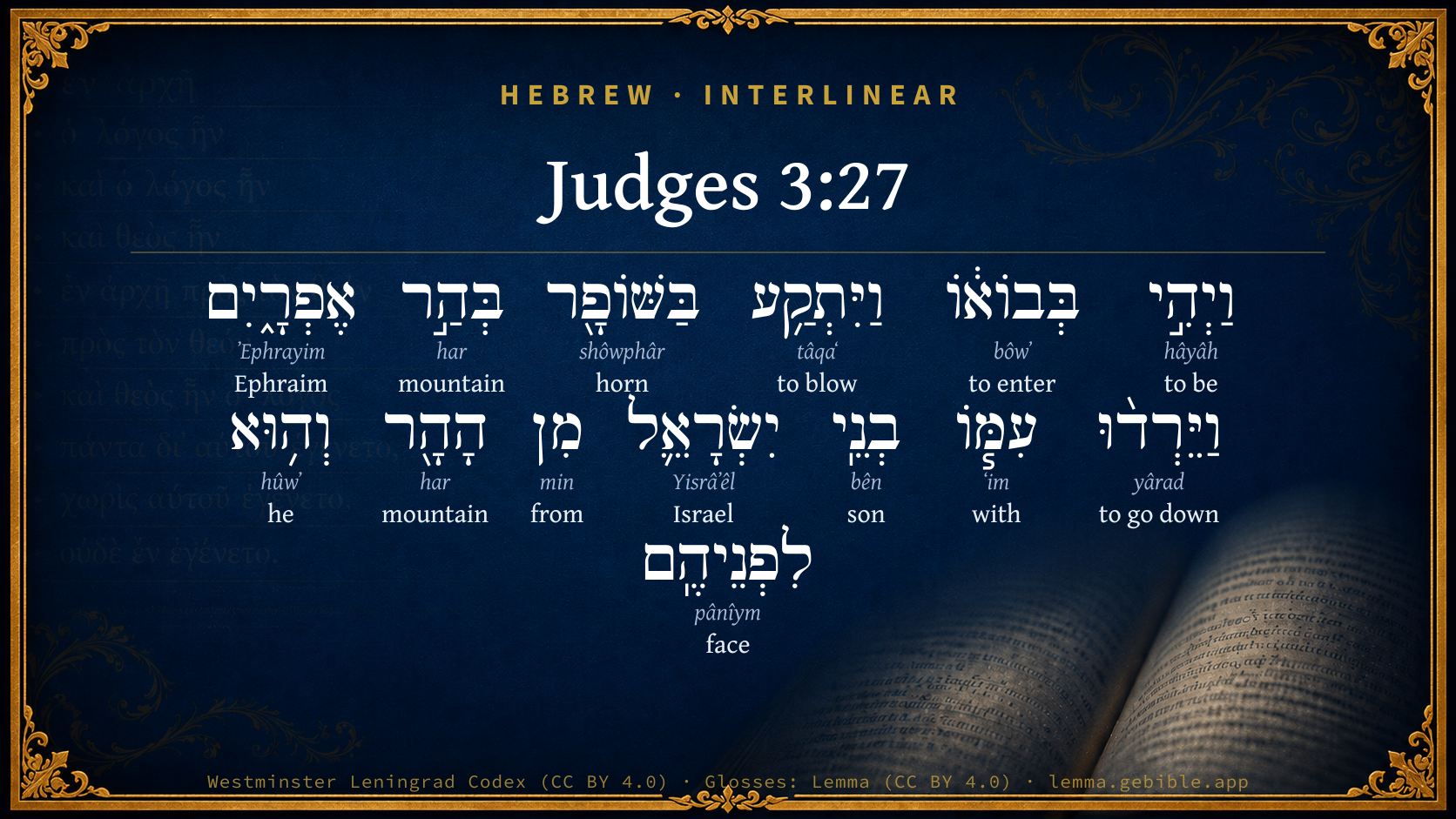
Hebrew (Westminster Leningrad Codex) Judges 3:27 appears in the Hebrew Old Testament. The text above is from the Westminster Leningrad Codex. Each word links to its Strong’s number, a concise gloss, and parsing drawn from the Open Scriptures Hebrew Bible morphology. Click any word for its full Brown-Driver-Briggs (BDB) entry.
Download image
Cite this verse

Judges 3:27 (World English Bible). Public Domain. Lemma interlinear Bible study tool, https://lemma.gebible.app/v/judges/3/27.

Show BibTeX & RIS
BibTeX
RIS
English Translation
It happened, when he had come, that he blew a trumpet in the hill-country of Ephraim; and the children of Israel went down with him from the hill-country, and he before them.
World English Bible · Public Domain
Download a study sheet

One document with this verse’s original text, its word-by-word gloss line, the meaning frame, cross-references with their text, attributed commentary, and full source and license credits — printable, and it pastes into notes with its structure intact.

This verse Autodidact and up

Study sheet (.html) Plain text (.txt)

A passage Seminary Student

Up to 50 verses in one chapter. A passage sheet keeps up to 6 commentary sources and 12 cross-references per verse, in the order this page ranks them, and says so on the sheet whenever that leaves anything out. Ask for a single verse and you get the Autodidact verse sheet above.

Everything on this page stays free to read, with no account — the sheet is a download of what is already on screen, not access to it.

Want to remove ads? Support Godless Engineer
Compare translations 3

The same verse in 3 English versions, stacked beneath the original-language interlinear above. Click any original word for its lexicon entry.

Each is an independent rendering of the whole verse — the interlinear is not word-aligned to these translations.

Highlighted words mark where these versions differ — a whole-verse word diff, not a word-by-word alignment.

  • World English Bible Public Domain
    It happened, when he had come, that he blew a trumpet in the hill-country of Ephraim; and the children of Israel went down with him from the hill-country, and he before them.
  • King James Version Public Domain
    And it came to pass, when he was come, that he blew a trumpet in the mountain of Ephraim, and the children of Israel went down with him from the mount, and he before them.
  • unfoldingWord Literal Text CC BY-SA 4.0
    Now it happened at his coming that he blew on the shofar in the hill country of Ephraim. Then the sons of Israel went down with him from the hill country, and he to the face of them.

unfoldingWord Literal Text — © unfoldingWord, licensed CC BY-SA 4.0. Word-aligned USFM3 via Door43 (git.door43.org/unfoldingWord/en_ult).

Versions to compare (up to 4)

3 of 4 selected

Show all 18 translations

Every available English version of this verse, each an independent rendering of the whole verse.

  • World English Bible Public Domain
    It happened, when he had come, that he blew a trumpet in the hill-country of Ephraim; and the children of Israel went down with him from the hill-country, and he before them.
  • Berean Standard Bible Public Domain
    On arriving in Seirah, he blew the ram’s horn throughout the hill country of Ephraim. The Israelites came down with him from the hills, and he became their leader.
  • Majority Standard Bible Public Domain
    On arriving in Seirah, he blew the ram’s horn throughout the hill country of Ephraim. The Israelites came down with him from the hills, and he became their leader.
  • King James Version Public Domain
    And it came to pass, when he was come, that he blew a trumpet in the mountain of Ephraim, and the children of Israel went down with him from the mount, and he before them.
  • American Standard Version (1901) Public Domain
    And it came to pass, when he was come, that he blew a trumpet in the hill-country of Ephraim; and the children of Israel went down with him from the hill-country, and he before them.
  • Revised Version (1885) Public Domain
    And it came to pass, when he was come, that he blew a trumpet in the hill country of Ephraim, and the children of Israel went down with him from the hill country, and he before them.
  • Geneva Bible (1599) Public Domain
    And when he came home, he blew a trumpet in mount Ephraim, and the children of Israel went downe with him from the mountaine, and he went before them.
  • Douay-Rheims (1899) Public Domain
    And forthwith he sounded the trumpet in mount Ephraim: and the children of Israel went down with him, he himself going in the front.
  • Young's Literal Translation Public Domain
    And it cometh to pass, in his coming in, that he bloweth with a trumpet in the hill-country of Ephraim, and go down with him do the sons of Israel from the hill-country, and he before them;
  • Literal Standard Version CC BY-SA 4.0
    And it comes to pass, in his coming in, that he blows with a horn in the hill-country of Ephraim, and the sons of Israel go down with him from the hill-country, and he before them;
  • Unlocked Literal Bible CC BY-SA 4.0
    When he arrived, he blew a trumpet in the hill country of Ephraim. Then the people of Israel went down with him from the hills, and he was leading them.
  • unfoldingWord Literal Text CC BY-SA 4.0
    Now it happened at his coming that he blew on the shofar in the hill country of Ephraim. Then the sons of Israel went down with him from the hill country, and he to the face of them.
  • Darby Bible Public Domain
    When he arrived, he sounded the trumpet in the hill country of E'phraim; and the people of Israel went down with him from the hill country, having him at their head.
  • World Messianic Bible Public Domain
    When he had come, he blew a shofar in the hill country of Ephraim; and the children of Israel went down with him from the hill country, and he led them.
  • Webster's Bible Public Domain
    And it came to pass when he had come, that he blew a trumpet in the mountain of Ephraim, and the children of Israel went down with him from the mount, and he before them.
  • Free Bible Version CC BY-SA 4.0
    When he got there, he blew a trumpet in the hill country of Ephraim, and the Israelites joined him. They went down from the hills, with Ehud leading them.
  • Bible in Basic English Public Domain
    And when he came there, he had a horn sounded in the hill-country of Ephraim, and all the children of Israel went down with him from the hill-country, and he at their head.
  • JPS Tanakh (1917) Public Domain
    And it came to pass, when he was come, that he blew a horn in the hill-country of Ephraim, and the children of Israel went down with him from the hill-country, and he before them.

Literal Standard Version (2020), Covenant Press — licensed CC BY-SA 4.0. Text via the HelloAO Bible API (eBible.org). Unlocked Literal Bible (unfoldingWord) — licensed CC BY-SA 4.0. Text via the HelloAO Bible API (eBible.org). unfoldingWord Literal Text — © unfoldingWord, licensed CC BY-SA 4.0. Word-aligned USFM3 via Door43 (git.door43.org/unfoldingWord/en_ult). Free Bible Version, Dr. Jonathan Gallagher — licensed CC BY-SA 4.0. Text via the HelloAO Bible API (eBible.org).

Word by word

More ways to search: Search by grammar → Find every occurrence → Compare this word →

Practice this passage: Drill this verse → Learn its vocabulary →

וַיִּתְקַ֥ע
tâqaʻ
H8628
“and · to blow”
Conjunction + Verb, Qal, Sequential Imperfect, 3rd Person, Masculine, Singular
Part of Speech
Conjunction + Verb
Stem
Qal
Form
Sequential Imperfect
Person
3rd Person
Gender
Masculine
Number
Singular
Full BDB Definition

Origin: a primitive root

TWOT: 2541

to blow, clap, strike, sound, thrust, give a blow, blast - (Qal) - to thrust, drive (of weapon) - to give a blast, give a blow - to strike or clap hands - (Niphal) - to be blown, blast (of horn) - to strike or pledge oneself
  1. וַיְהִ֣י hâyâh H1961 “and · to be” Conjunction + Verb, Qal, Sequential Imperfect, 3rd Person, Masculine, Singular
  2. בְּבוֹא֔וֹ bôwʼ H935 “in/at · to enter · him” Preposition + Verb, Qal, Infinitive Construct + Suffix, Personal, 3rd Person, Masculine, Singular
  3. בַּשּׁוֹפָ֖ר shôwphâr H7782 “in/at the · horn” Preposition, Determined + Noun, Common, Masculine, Singular, Absolute
  4. בְּהַ֣ר har H2022 “in/at · mountain of” Preposition + Noun, Common, Masculine, Singular, Construct
  5. אֶפְרָ֑יִם ʼEphrayim H669 “Ephraim” Noun, Proper
  6. וַיֵּרְד֨וּ yârad H3381 “and · to go down” Conjunction + Verb, Qal, Sequential Imperfect, 3rd Person, Masculine, Plural
  7. עִמּ֧וֹ ʻim H5973 “with · him” Preposition + Suffix, Personal, 3rd Person, Masculine, Singular
  8. בְנֵֽי bên H1121 “sons of” Noun, Common, Masculine, Plural, Construct
  9. יִשְׂרָאֵ֛ל Yisrâʼêl H3478 “Israel” Noun, Proper
  10. מִן min H4480 “from” Preposition
  11. הָהָ֖ר har H2022 “the · mountain” Particle, Definite Article + Noun, Common, Masculine, Singular, Absolute
  12. וְה֥וּא hûwʼ H1931 “and · he” Conjunction + Pronoun, Personal, 3rd Person, Masculine, Singular
  13. לִפְנֵיהֶֽם pânîym H6440 “to/for · face(s) · their” Preposition + Noun, Common, Both, Plural, Construct + Suffix, Personal, 3rd Person, Masculine, Plural

About this verse

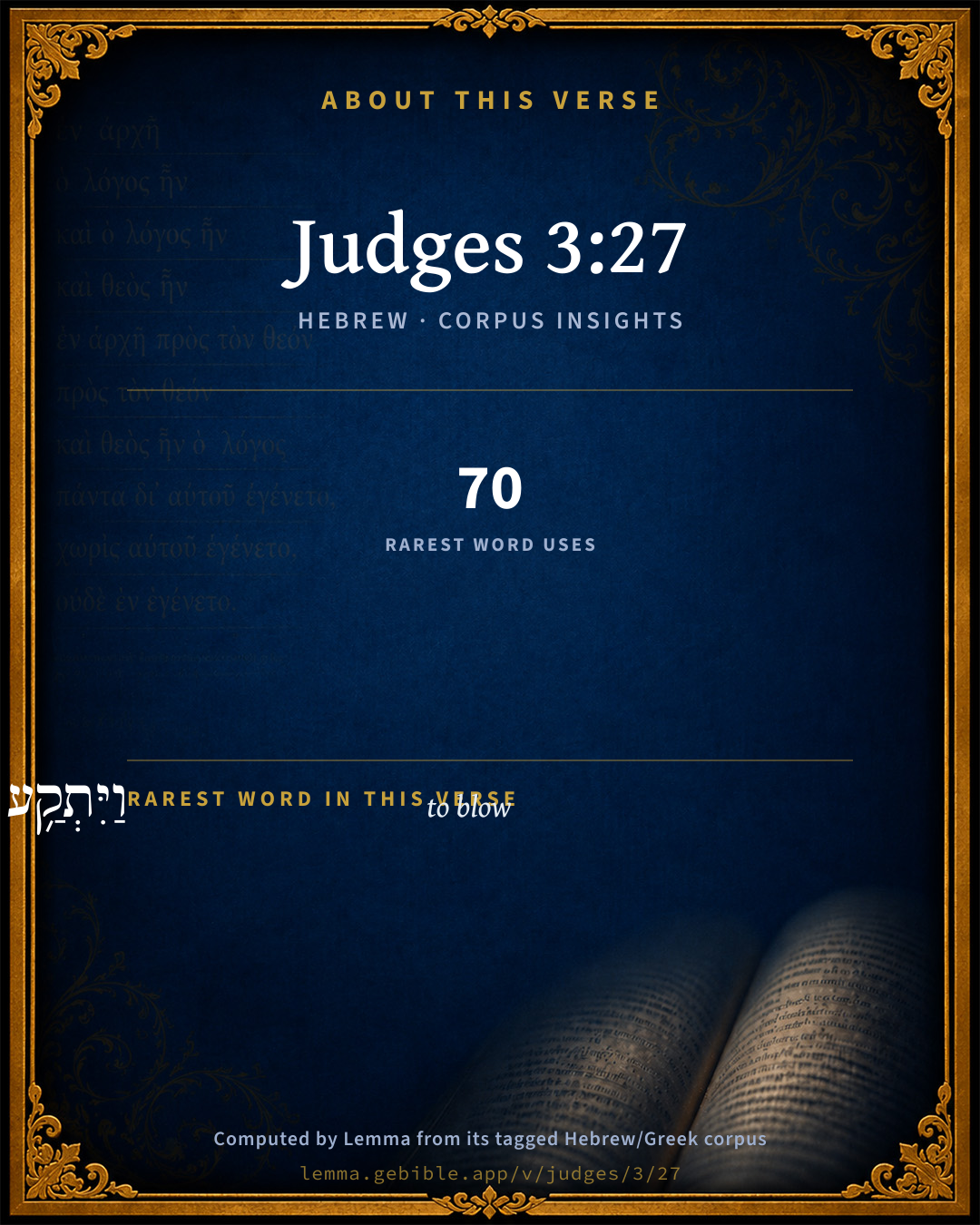
These counts appear in no published source. They are computed here, from the morphology-tagged text and Lemma’s own curated glosses. What Lemma adds →

14
words
13
distinct lemmas
Historical
section

Grammatical profile

  • 4 verbs
  • 7 nouns
  • 1 pronoun
  • 2 prepositions

Verb forms

  • וַיְהִ֣י Qal · Sequential Imperfect
  • בְּבוֹא֔וֹ Qal · Infinitive Construct
  • וַיִּתְקַ֥ע Qal · Sequential Imperfect
  • וַיֵּרְד֨וּ Qal · Sequential Imperfect

Repetition

A word recurs within this verse — often emphatic in Hebrew:

  • בְּהַ֣ר mountain H2022 ×2

Hebrew & Septuagint length

In English translation the verse runs 32 words from the Hebrew and 38 from the Septuagint (LXX English) — closely comparable.

A rough comparison of the two English renderings, which tokenize alike — not a word-level alignment.

Word counts can differ between the Hebrew and the Greek without any difference in meaning — e.g. the Hebrew direct-object marker אֵת has no separate Greek word, and Greek often adds the article ὁ.

Cross-references

10

Topical passages linked to Judges 3:27 in the Treasury of Scripture Knowledge — connected by theme and wording, ordered by reader-vote popularity; previews shown in the World English Bible.

  • Judges 6:34 But the Spirit of Yahweh came on Gideon; and he blew a trumpet; and Abiezer was gathered together after him.
  • 1 Samuel 13:3 Jonathan struck the garrison of the Philistines that was in Geba: and the Philistines heard of it. Saul blew the trumpet throughout all the land, saying, Let the Hebrews hear.
  • Joshua 17:15 Joshua said to them, If you are a great people, go up to the forest, and cut down for yourself there in the land of the Perizzites and of the Rephaim; since the hill-country of Ephraim is too narrow for you.
  • Joshua 17:18 but the hill-country shall be yours; for though it is a forest, you shall cut it down, and the goings out of it shall be yours; for you shall drive out the Canaanites, though they have chariots of iron, and though they are strong.
  • Judges 5:14 Out of Ephraim [came down] they whose root is in Amalek; After you, Benjamin, among your peoples; Out of Machir came down governors, Out of Zebulun those who handle the marshal's staff.
  • Judges 7:24 Gideon sent messengers throughout all the hill-country of Ephraim, saying, Come down against Midian, and take before them the waters, as far as Beth Barah, even the Jordan. So all the men of Ephraim were gathered together, and took the waters as far as Beth Barah, even the Jordan.
  • Judges 17:1 There was a man of the hill-country of Ephraim, whose name was Micah.
  • Judges 19:1 It happened in those days, when there was no king in Israel, that there was a certain Levite sojourning on the farther side of the hill-country of Ephraim, who took to him a concubine out of Bethlehem Judah.
  • 2 Samuel 20:22 Then the woman went to all the people in her wisdom. They cut off the head of Sheba the son of Bichri, and threw it out to Joab. He blew the trumpet, and they were dispersed from the city, every man to his tent. Joab returned to Jerusalem to the king.
  • 2 Kings 9:13 Then they hurried, and took every man his garment, and put it under him on the top of the stairs, and blew the trumpet, saying, Jehu is king.

Cross-references courtesy of OpenBible.info (CC BY 4.0).

Hebrew and Greek witnesses Masoretic Hebrew ↔ Greek Septuagint

The same verse in the two great witnesses to the Old Testament, shown verse-for-verse.

These are two independent witnesses, not word-aligned to each other, and the Septuagint is shown in lemma (dictionary) form.

Hebrew Judges 3:27 Masoretic · Westminster Leningrad Codex

וַיְהִ֣י בְּבוֹא֔וֹ וַיִּתְקַ֥ע בַּשּׁוֹפָ֖ר בְּהַ֣ר אֶפְרָ֑יִם וַיֵּרְד֨וּ עִמּ֧וֹ בְנֵֽי יִשְׂרָאֵ֛ל מִן הָהָ֖ר וְה֥וּא לִפְנֵיהֶֽם

It happened, when he had come, that he blew a trumpet in the hill-country of Ephraim; and the children of Israel went down with him from the hill-country, and he before them.

World English Bible · Public Domain

Greek LXX Judges 3:27 Septuagint · lemma form

καί γίγνομαι ἡνίκα ἔρχομαι αωδ εἰς γῆ ἰσραήλ καί σαλπίζω ἐν κερατίνη ἐν ὁ ὄρος ἐφράιμ καί καταβαίνω σύν αὐτός ὁ υἱός ἰσραήλ ἀπό ὁ ὄρος καί αὐτός ἔμπροσθεν αὐτός

And it came to pass when Aod came into the land of Israel, that he blew the horn in mount Ephraim, and the children of Israel came down with him from the mountain, and he was before them.

LXX2012 (modern English Septuagint) · Public Domain

On this verse, Ellicott's Commentary for English Readers discusses the Septuagint’s reading. Read the note in Commentary ↓

Hebrew: Westminster Leningrad Codex (CC BY 4.0). Greek: Septuagint (public domain); English from LXX2012 (modern English Septuagint) (Public Domain). How the Septuagint differs from the Hebrew →

Targum (Aramaic paraphrase)

1

The Targum is the ancient Jewish Aramaic paraphrase of the Hebrew Scriptures — an interpretive translation, not the Hebrew text itself. Onkelos (literal) and Pseudo-Jonathan (expansive) render the Torah, and Jonathan the Prophets. Coverage is partial: where no permissively-licensed English translation exists for a verse, only the Aramaic is shown. This is verse-level text, not a word-by-word alignment to the Hebrew.

  1. Targum Jonathan Prophets (Joshua–Malachi)
    וַהֲוָה בְּמֵיתוֹהִי וּתְקַע בְּשׁוֹפָרָא בְּטוּרָא דְבֵית אֶפְרָיִם וּנְחָתוּ עִמֵיהּ בְּנֵי יִשְׂרָאֵל מִן טוּרָא וְהוּא קֳדָמֵיהוֹן:

    (no public-domain English translation for this verse)

    Targum Jonathan — Aramaic: “Mikraot Gedolot” (public domain). English: “Sefaria Community Translation” (CC0 1.0 (public-domain dedication)); “London "Chaldee Paraphrase," 1871” (public domain). Text via Sefaria.

Commentary

Notes on Judges 3:27 from classic Christian and Jewish commentators (each source and its license shown beneath its notes). The classic Christian expositions comment on the surrounding passage and are grouped to its opening verse, so a note may address several verses; the Jewish commentaries on the Tanakh (Rashi and others) are per-verse, so they appear only where the commentator wrote on this verse.

Lemma curates 59 commentaries, every one of them public domain or Creative Commons licensed, each selected and text-cleaned for this edition rather than reprinted as found. About our sources →

Trapp's Complete Commentary

John Trapp

Jdg 3:27 And it came to pass, when he was come, that he blew a trumpet in the mountain of Ephraim, and the children of Israel went down with him from the mount, and he before them.

Ver. 27. He blew a trumpet in the mountain of Ephraim.] He gave the alarm to those valiant and warlike men, such as are for most part your mountaineers; and while the Moabites were all on a hurry about their king’s death, he taketh his opportunity, which, as in all things else, so especially in military matters, is much to be observed, and hastily apprehended, since it is headlong, and once past, irrecoverable.

John Trapp, A Commentary or Exposition upon All the Books of the Old and New Testament (1647–1656) — public domain. Text from a community e-Sword module.

Joseph Benson's Commentary

Jdg 3:27-28. He blew a trumpet — In order to summon those who were disposed to recover their liberty to take arms and follow him. And the children of Israel went down with him — Whom doubtless he had prepared by his emissaries, and gathered together in considerable numbers. With these he attacked the Moabites who were in garrisons on the west of Jordan, and slew ten thousand of their best men; which utterly broke the power of Moab, and freed the Israelites from the yoke of that nation. They took the fords of Jordan — Where that river was usually passed, that neither the Moabites that were in Canaan might escape, nor any more Moabites come over Jordan to their succour.

Joseph Benson's Commentary on the Old and New Testaments (1811–1818) — public domain. Text from a community e-Sword module.

Geneva Bible (1599)

Geneva Bible translators

Or, caused the trumpet to be blown, Num. 20:2,3.

Geneva Bible (1599) marginal notes — public domain. Text via Bolls.life.

Jamieson, Fausset & Brown

Robert Jamieson, A. R. Fausset & David Brown

he blew a trumpet in the mountain of Ephraim--summoned to arms the people of that mountainous region, which, adjoining the territory of Benjamin, had probably suffered most from the grievous oppression of the Moabites.

Jamieson, Fausset & Brown — Commentary Critical and Explanatory on the Whole Bible (1871) — public domain (CC PDM 1.0). Text via the HelloAO Bible API.

Ellicott's Commentary for English Readers

(27) He blew a trumpet.—The word for “trumpet” is shophar. The LXX. have “he trumpeted with a horn” (Esalpisen en keratine).

In the mountain of Ephraim.—The hill country of Ephraim was always the fastness of Israelitish freedom (Jdg_4:5; Jdg_10:1; 1Sa_1:1; 1Sa_13:6; 1Sa_14:22).

He before them.—He assumed the leadership.

A Bible Commentary for English Readers, edited by Charles John Ellicott (1878–1897) — public domain. Text from a community e-Sword module.

The Cambridge Bible for Schools and Colleges

gen. ed. J. J. S. Perowne

27. when he was come] If Se‘îrah was meant, ‘thither’ should have been written. Some indication of the place is needed; the LXX. cod. B adds ‘unto the land of Israel,’ shewing that the obscurity was felt. Perhaps the simplest course is to suppose that the original order of words has been disturbed, and to read when he was come to (omit in) the highlands of Ephraim he blew a trumpet. For the summons to arms cf. Jdg_6:34; 1Sa_13:3.

the hill country of E.… the hill country] Cf. Jdg_2:9, Jdg_4:5, Jdg_7:24, Jdg_17:1; Jos_17:15. The Highlands, which extend continuously from the Great Plain to the S. of Judah, were occupied in the northern half by W. Manasseh, Ephraim, and Benjamin (‘the hill country of E.’), in the southern half by Judah (‘the hill country of J.’ Jos_21:11); at this period a line of Canaanite strongholds separated the territories of Joseph and Judah. The country between Ramah and Beth-el lay ‘in the hill country of E.’ Jdg_4:5; it was the Israelites of this neighbourhood, i.e. the Benjamites, who responded to their clansman’s call.

The Cambridge Bible for Schools and Colleges (gen. ed. J. J. S. Perowne; Cambridge University Press, 1878–1918) — public domain. Text from a community e-Sword module.

John Gill's Exposition

And he said unto them, follow after me,.... This he said to encourage them, putting himself at the head of them showing himself ready to expose his own life, if there was any danger:

for the Lord hath delivered your enemies the Moabites into your hands; which he concluded from the success he had had in cutting off the king of Moab which had thrown the Moabites into great confusion and distress, and from an impulse on his mind from the Lord, assuring him of this deliverance:

and they went down after him: from the mountain of Ephraim:

and took the fords of Jordan towards Moab; where the river was fordable, and there was a passage into the country of Moab, which lay on the other side Jordan; this they did to prevent the Moabites, which were in the land of Israel, going into their own land upon this alarm, and those in the land of Moab from going over to help them:

and suffered not a man to pass over; neither out of Israel into Moab, nor out of Moab into Israel.

John Gill's Exposition of the Whole Bible (1746–1763) — public domain (CC PDM 1.0). Text via the HelloAO Bible API.

Haydock's Catholic Bible Commentary

Seirath seems to have been on the road from Galgal to Mount Ephraim. Some conjecture that Josephus speaks of it under the name of Syriad, (Calmet) where he saw the inscriptions, which he asserts were left by the children of Seth before the deluge. (Haydock) --- They might perhaps be the idols which are mentioned here.

George Leo Haydock (1774–1849), Haydock's Catholic Family Bible and Commentary, 1859 edition — public domain. Excludes Psalms (Douay-Rheims chapter numbering differs from Protestant) and Deuterocanonical books (Catholic canon only).

Matthew Poole's English Annotations

Doubtless he had prepared

the children of Israel, and by his emissaries gathered together in considerable numbers.

Matthew Poole's English Annotations on the Holy Bible (1683–1685) — public domain. Text from a community e-Sword/MySword module.

Whedon's Commentary on the Bible

Daniel D. Whedon

27. Blew a trumpet — The alarm-signal to call a people rapidly together. Compare Jdg_6:34; 1Sa_13:3; 2Sa_20:1; 1Ki_1:34. Thus Joel, (Joe_2:1,) “Blow ye the trumpet in Zion, and sound an alarm in my holy mountain.”

Mountain of Ephraim — See on Jdg_17:1, and Jos_17:15. Ehud does not first rally his own tribe to his standard, because Benjamin had at this time been almost annihilated by the other tribes. Chapters 19-21.

Daniel D. Whedon (gen. ed.), Commentary on the Old and New Testaments (1874–1909) — public domain. Text from a community e-Sword module.

The Pulpit Commentary

He blew a trumpet. Like Alfred in the marshes of Somerset, he gathered a host around him in the shelter of the forest; and then, full of faith in his Divine mission, "strong in the Lord, and in the power of his might," dashed down boldly into the plain, and, seizing the fords, cut off all communication between the Moabites at Jericho and their countrymen east of the Jordan. They could neither escape into Moab nor get help from Moab. Thrown into confusion by the death of their king and the suddenness of the attack, the Moabites fell to the number of 10, 000 men; and so ended the second servitude, to be followed by a rest (if the numeral in the text is sound) of eighty years.

The Pulpit Commentary (1880–1919), ed. H.D.M. Spence-Jones & Joseph S. Exell — public domain. Text from a community e-Sword module.

John Wesley's Explanatory Notes

The children of Israel - Whom doubtless he had prepared by his emissaries gathered together in considerable numbers.

John Wesley, Explanatory Notes Upon the Whole Bible (1754–1765) — public domain. Text via the GEBible commentary corpus.

Rashi

Rabbi Shlomo Yitzchaki (Rashi)

It happened that, when he arrived. He crossed the Yardein, and arrived at his place in the land of Canaan.

At Mount Ephrayim. Which was in the land of Canaan, on the western side of the Yardein. The land of Moav was on the eastern side of the Yardein, but as they had subdued Yisroel and crossed the Yardein, they occupied Yericho as stated above, and installed their princes and governors over Yisroel.

Rashi on the Tanakh — English translations: “The Judaica Press complete Tanach with Rashi, translated by A. J. Rosenberg” (CC BY 4.0); “Pentateuch with Rashi's commentary by M. Rosenbaum and A.M. Silbermann, 1929-1934” (public domain); “The Metsudah Tanach series, Lakewood, N.J” (CC BY 4.0); and “The Book of Joshua, Metsudah Publications, 1997” (CC BY 4.0). Text via Sefaria.

Lesson kit

Teaching starters — assembled from the data on this page, not authored interpretation. Every prompt links to the verse data it draws on. Edit before teaching.

Judges, in the Historical, opens this verse with 14 words (13 distinct Hebrew lemmas). Its most distinctive word is tâqaʻ (“to blow”). A historical commentator’s framing appears above. Read the whole chapter for the surrounding context.

Discussion questions

  1. What does “to blow” (tâqaʻ) contribute to the verse as a whole?
  2. Judges 6:34 shares this passage’s theme. How do the two illuminate each other?
  3. “mountain” occurs 2× in this one verse. What is the effect of the repetition?
  4. These translations render this verse differently; the difference is in the English rendering, not the original. What questions does that raise?
  5. The verb «וַיְהִ֣י» is Qal Sequential Imperfect. How does its form color the action?
  6. Reading how Trapp's Complete Commentary and Joseph Benson's Commentary read this verse, where do the two commentators agree and where do they part?

Things to notice

Reading settings

Reading text

Shown beneath each verse's original-language words.

Old Testament
Old Testament edition

Read the OT as the Masoretic Hebrew (MT) or the Greek Septuagint (LXX).

English shown for the Greek Septuagint (in the Hebrew ↔ Greek comparison).

Comparing translations? Open the Compare panel on any verse page to stack up to four side by side.