Hosea 9:8

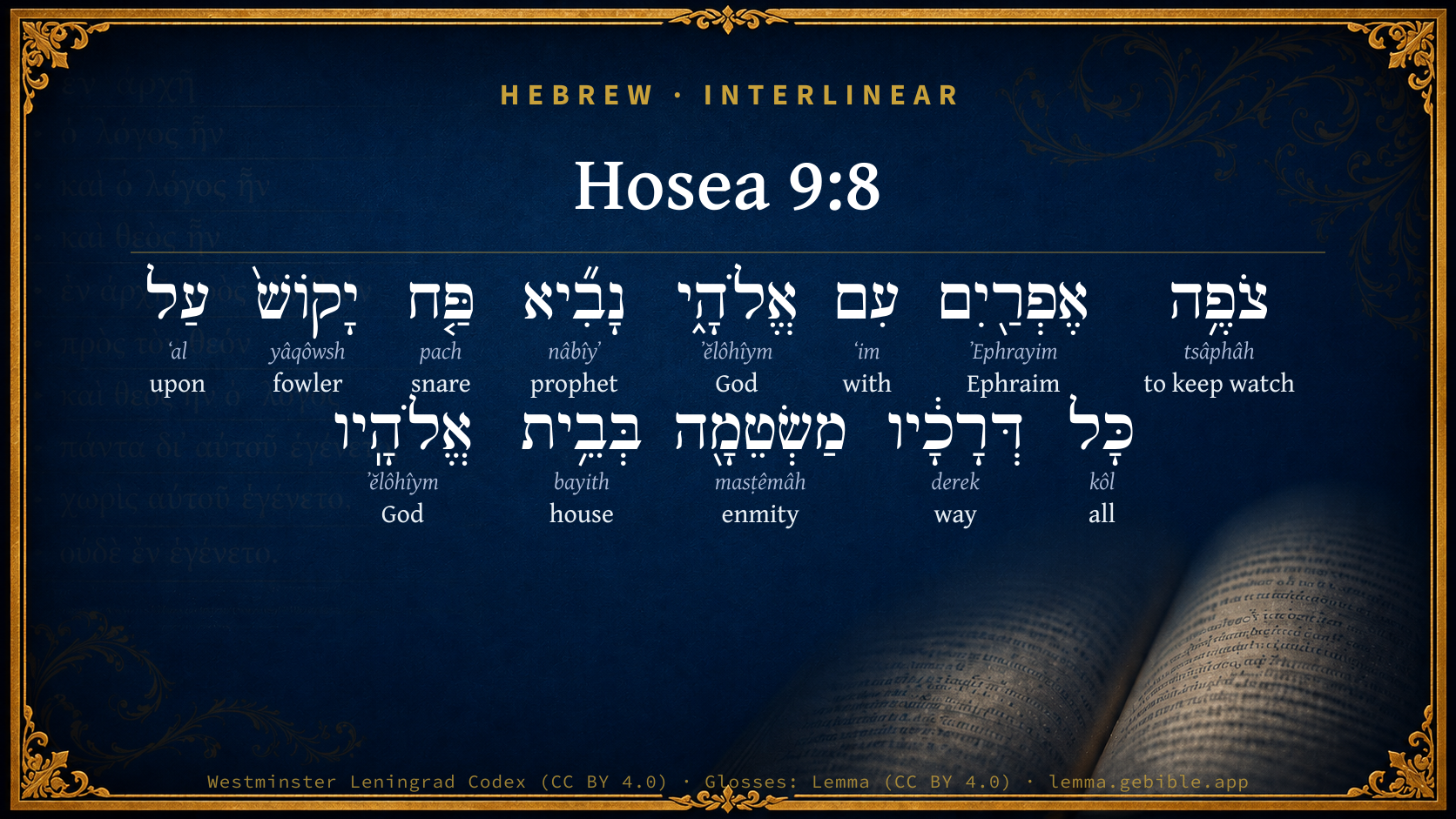
Hebrew (Westminster Leningrad Codex) Hosea 9:8 appears in the Hebrew Old Testament. The text above is from the Westminster Leningrad Codex. Each word links to its Strong’s number, a concise gloss, and parsing drawn from the Open Scriptures Hebrew Bible morphology. Click any word for its full Brown-Driver-Briggs (BDB) entry.
Download image
Cite this verse

Hosea 9:8 (World English Bible). Public Domain. Lemma interlinear Bible study tool, https://lemma.gebible.app/v/hosea/9/8.

Show BibTeX & RIS
BibTeX
RIS
English Translation
A prophet watches over Ephraim with my God. A fowler's snare is on all of his paths, And hostility in the house of his God.
World English Bible · Public Domain
Highlights
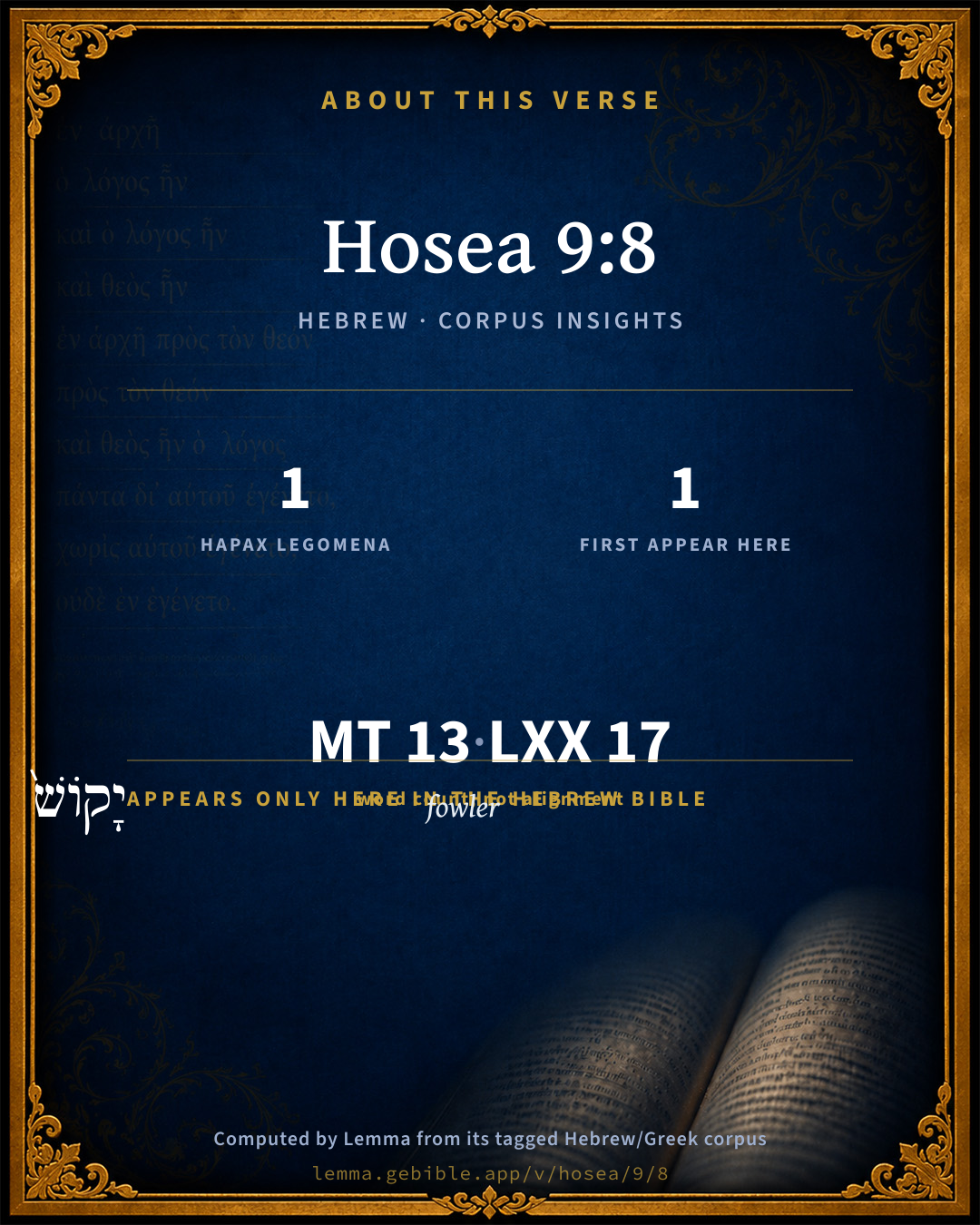
  • 1 hapax legomenon — only here in the Hebrew Bible
  • 1 first appearance in the Hebrew Bible
Full analysis ↓
Download a study sheet

One document with this verse’s original text, its word-by-word gloss line, the meaning frame, cross-references with their text, attributed commentary, and full source and license credits — printable, and it pastes into notes with its structure intact.

This verse Autodidact and up

Study sheet (.html) Plain text (.txt)

A passage Seminary Student

Up to 50 verses in one chapter. A passage sheet keeps up to 6 commentary sources and 12 cross-references per verse, in the order this page ranks them, and says so on the sheet whenever that leaves anything out. Ask for a single verse and you get the Autodidact verse sheet above.

Everything on this page stays free to read, with no account — the sheet is a download of what is already on screen, not access to it.

Want to remove ads? Support Godless Engineer
Compare translations 3

The same verse in 3 English versions, stacked beneath the original-language interlinear above. Click any original word for its lexicon entry.

Each is an independent rendering of the whole verse — the interlinear is not word-aligned to these translations.

Highlighted words mark where these versions differ — a whole-verse word diff, not a word-by-word alignment.

  • World English Bible Public Domain
    A prophet watches over Ephraim with my God. A fowler's snare is on all of his paths, And hostility in the house of his God.
  • King James Version Public Domain
    The watchman of Ephraim was with my God: but the prophet is a snare of a fowler in all his ways, and hatred in the house of his God.
  • unfoldingWord Literal Text CC BY-SA 4.0
    The watcher of Ephraim with my God; the prophet, a snare of a fowler on all his ways; hostility in the house of his God.

unfoldingWord Literal Text — © unfoldingWord, licensed CC BY-SA 4.0. Word-aligned USFM3 via Door43 (git.door43.org/unfoldingWord/en_ult).

Versions to compare (up to 4)

3 of 4 selected

Show all 18 translations

Every available English version of this verse, each an independent rendering of the whole verse.

  • World English Bible Public Domain
    A prophet watches over Ephraim with my God. A fowler's snare is on all of his paths, And hostility in the house of his God.
  • Berean Standard Bible Public Domain
    The prophet is Ephraim’s watchman, along with my God, yet the snare of the fowler lies on all his paths. Hostility is in the house of his God!
  • Majority Standard Bible Public Domain
    The prophet is Ephraim’s watchman, along with my God, yet the snare of the fowler lies on all his paths. Hostility is in the house of his God!
  • King James Version Public Domain
    The watchman of Ephraim was with my God: but the prophet is a snare of a fowler in all his ways, and hatred in the house of his God.
  • American Standard Version (1901) Public Domain
    Ephraim `was' a watchman with my God: as for the prophet, a fowler's snare is in all his ways, `and' enmity in the house of his God.
  • Revised Version (1885) Public Domain
    Ephraim was a watchman with my God: as for the prophet, a fowler’s snare is in all his ways, and enmity in the house of his God.
  • Geneva Bible (1599) Public Domain
    The watchman of Ephraim shoulde bee with my God: but the Prophet is the snare of a fouler in all his waies, and hatred in the House of his God.
  • Douay-Rheims (1899) Public Domain
    The watchman of Ephraim was with my God: the prophet is become a snare of ruin upon all his ways, madness is in the house of his God.
  • Young's Literal Translation Public Domain
    Ephraim is looking `away' from My God, The prophet! a snare of a fowler `is' over all his ways, Hatred `is' in the house of his God.
  • Literal Standard Version CC BY-SA 4.0
    Ephraim is looking [away] from My God, || The prophet! A snare of a fowler [is] over all his ways, || Hatred [is] in the house of his God.
  • Unlocked Literal Bible CC BY-SA 4.0
    The prophet is the watchman for my God over Ephraim. But a bird snare is on all of his paths, and hostility toward him is in the house of his God.
  • unfoldingWord Literal Text CC BY-SA 4.0
    The watcher of Ephraim with my God; the prophet, a snare of a fowler on all his ways; hostility in the house of his God.
  • Darby Bible Public Domain
    Is Ephraim a watchman with my God? [nay] the prophet is a fowler's snare on all his ways, enmity in the house of his God.
  • World Messianic Bible Public Domain
    A prophet watches over Ephraim with my God. A fowler’s snare is on all of his paths, and hostility in the house of his God.
  • Webster's Bible Public Domain
    The watchman of Ephraim was with my God: but the prophet is a snare of a fowler in all his ways, and hatred in the house of his God.
  • Free Bible Version CC BY-SA 4.0
    The watchman over Ephraim is with my God, and a prophet is a birdcatcher's snare on all his ways. Hatred is in the house of his God
  • Bible in Basic English Public Domain
    There is great hate against the watchman of Ephraim, the people of my God; as for the prophet, there is a net in all his ways, and hate in the house of his God.
  • JPS Tanakh (1917) Public Domain
    Ephraim is a watchman with my God; as for the prophet, a fowler's snare is in all his ways, and enmity in the house of his God.

Literal Standard Version (2020), Covenant Press — licensed CC BY-SA 4.0. Text via the HelloAO Bible API (eBible.org). Unlocked Literal Bible (unfoldingWord) — licensed CC BY-SA 4.0. Text via the HelloAO Bible API (eBible.org). unfoldingWord Literal Text — © unfoldingWord, licensed CC BY-SA 4.0. Word-aligned USFM3 via Door43 (git.door43.org/unfoldingWord/en_ult). Free Bible Version, Dr. Jonathan Gallagher — licensed CC BY-SA 4.0. Text via the HelloAO Bible API (eBible.org).

Word by word

More ways to search: Search by grammar → Find every occurrence → Compare this word →

Practice this passage: Drill this verse → Learn its vocabulary →

יָקוֹשׁ֙
yâqôwsh
H3352
“fowler”
Noun, Common, Masculine, Singular, Absolute
Part of Speech
Noun
Type
Common
Gender
Masculine
Number
Singular
State
Absolute
Full BDB Definition

Origin: from H3369

TWOT: 906a

fowler, bait-layer
  1. צֹפֶ֥ה tsâphâh H6822 “keeping watch” Verb, Qal, Participle Active, Masculine, Singular, Absolute
  2. אֶפְרַ֖יִם ʼEphrayim H669 “Ephraim” Noun, Proper
  3. עִם ʻim H5973 “with” Preposition
  4. אֱלֹהָ֑י ʼĕlôhîym H430 “God(s) · my” Noun, Common, Masculine, Plural, Construct + Suffix, Personal, 1st Person, Common, Singular
  5. נָבִ֞יא nâbîyʼ H5030 “prophet” Noun, Common, Masculine, Singular, Absolute
  6. פַּ֤ח pach H6341 “snare of” Noun, Common, Masculine, Singular, Construct
  7. עַל ʻal H5921 “upon” Preposition
  8. כָּל kôl H3605 “all of” Noun, Common, Masculine, Singular, Construct
  9. דְּרָכָ֔יו derek H1870 “ways · his” Noun, Common, Both, Plural, Construct + Suffix, Personal, 3rd Person, Masculine, Singular
  10. מַשְׂטֵמָ֖ה masṭêmâh H4895 “enmity” Noun, Common, Feminine, Singular, Absolute
  11. בְּבֵ֥ית bayith H1004 “in/at · house of” Preposition + Noun, Common, Masculine, Singular, Construct
  12. אֱלֹהָֽיו ʼĕlôhîym H430 “God(s) · his” Noun, Common, Masculine, Plural, Construct + Suffix, Personal, 3rd Person, Masculine, Singular

About this verse

These counts appear in no published source. They are computed here, from the morphology-tagged text and Lemma’s own curated glosses. What Lemma adds →

13
words
12
distinct lemmas
Prophets
section

Notable vocabulary

1 hapax legomenon — a word that appears only here in the entire Hebrew Bible:

  • יָקוֹשׁ֙ fowler H3352

First appearance in Scripture

This word makes its first canonical appearance in the Hebrew Bible here:

  • יָקוֹשׁ֙ fowler H3352

Shared distinctive vocabulary

מַשְׂטֵמָ֖ה enmity H4895 occurs in 2 verses of the Hebrew Bible. Also found in:

Grammatical profile

  • 1 verb
  • 10 nouns
  • 2 prepositions

Verb forms

  • צֹפֶ֥ה Qal · Participle Active

Repetition

A word recurs within this verse — often emphatic in Hebrew:

  • אֱלֹהָ֑י God H430 ×2

Hebrew & Septuagint length

In English translation the verse runs 25 words from the Hebrew and 26 from the Septuagint (LXX English) — closely comparable.

A rough comparison of the two English renderings, which tokenize alike — not a word-level alignment.

Word counts can differ between the Hebrew and the Greek without any difference in meaning — e.g. the Hebrew direct-object marker אֵת has no separate Greek word, and Greek often adds the article ὁ.

In the original languages it is 13 Hebrew tokens and 17 Greek tokens — but the two are counted differently (Hebrew bundles its prefixes and suffixes into one token; the Greek is in lemma form), so that isn’t a like-for-like length.

Cross-references

36

Topical passages linked to Hosea 9:8 in the Treasury of Scripture Knowledge — connected by theme and wording, ordered by reader-vote popularity; previews shown in the World English Bible.

  • Ezekiel 3:17 Son of man, I have made you a watchman to the house of Israel: therefore hear the word at my mouth, and give them warning from me.
  • Hosea 5:1 "Listen to this, you priests! Listen, house of Israel, And give ear, house of the king! For the judgment is against you; For you have been a snare at Mizpah, And a net spread on Tabor.
  • Isaiah 62:6 I have set watchmen on your walls, Jerusalem; they shall never hold their peace day nor night: you who call on Yahweh, take no rest,
  • Lamentations 4:13 [It is] because of the sins of her prophets, [and] the iniquities of her priests, That have shed the blood of the just in the midst of her.
  • Ezekiel 33:7 So you, son of man, I have set you a watchman to the house of Israel; therefore hear the word at my mouth, and give them warning from me.
  • Micah 7:4 The best of them is like a brier. The most upright is worse than a thorn hedge. The day of your watchmen, Even your visitation, has come; Now is the time of their confusion.
  • John 15:24 If I hadn't done among them the works which no one else did, they wouldn't have had sin. But now have they seen and also hated both me and my Father.
  • 1 Kings 22:22 Yahweh said to him, 'How?' He said, 'I will go forth, and will be a lying spirit in the mouth of all his prophets.' He said, 'You shall entice him, and shall prevail also: go forth, and do so.'
  • 1 Kings 22:28 Micaiah said, If you return at all in peace, Yahweh has not spoken by me. He said, Hear, you peoples, all of you.
  • 2 Kings 2:14 He took the mantle of Elijah that fell from him, and struck the waters, and said, Where is Yahweh, the God of Elijah? and when he also had struck the waters, they were divided here and there; and Elisha went over.
  • 2 Kings 2:21 He went forth to the spring of the waters, and cast salt therein, and said, Thus says Yahweh, I have healed these waters; there shall not be from there any more death or miscarrying.
  • 2 Kings 3:15–20 But now bring me a minstrel. It happened, when the minstrel played, that the hand of Yahweh came on him.
  • 2 Kings 4:1–7 Now there cried a certain woman of the wives of the sons of the prophets to Elisha, saying, Your servant my husband is dead; and you know that your servant did fear Yahweh: and the creditor is come to take to him my two children to be bondservants.
  • 2 Kings 4:33–37 He went in therefore, and shut the door on them both, and prayed to Yahweh.
  • 2 Kings 4:41 But he said, Then bring meal. He cast it into the pot; and he said, Pour out for the people, that they may eat. There was no harm in the pot.
  • 2 Kings 4:43 His servant said, What, should I set this before a hundred men? But he said, Give the people, that they may eat; for thus says Yahweh, They shall eat, and shall leave of it.
  • 2 Kings 6:17–18 Elisha prayed, and said, Yahweh, Please open his eyes, that he may see. Yahweh opened the eyes of the young man; and he saw: and, behold, the mountain was full of horses and chariots of fire round about Elisha.
  • 2 Kings 7:2 Then the captain on whose hand the king leaned answered the man of God, and said, Behold, if Yahweh should make windows in heaven, might this thing be? He said, Behold, you shall see it with your eyes, but shall not eat of it.
  • 2 Kings 7:19 and that captain answered the man of God, and said, Now, behold, if Yahweh should make windows in heaven, might such a thing be? and he said, Behold, you shall see it with your eyes, but shall not eat of it:
  • 2 Kings 13:21 It happened, as they were burying a man, that behold, they spied a band; and they cast the man into the tomb of Elisha: and as soon as the man touched the bones of Elisha, he revived, and stood up on his feet.
  • Song of Solomon 3:3 The watchmen who go about the city found me; "Have you seen him whom my soul loves?"
  • Jeremiah 6:14 They have healed also the hurt of my people slightly, saying, Peace, peace; when there is no peace.
  • Jeremiah 6:17 I set watchmen over you, [saying], Listen to the sound of the trumpet; but they said, We will not listen.
  • Jeremiah 14:13 Then said I, Ah, Lord Yahweh! behold, the prophets tell them, You shall not see the sword, neither shall you have famine; but I will give you assured peace in this place.
  • Jeremiah 31:6 For there shall be a day, that the watchmen on the hills of Ephraim shall cry, Arise you, and let us go up to Zion to Yahweh our God.
  • Lamentations 2:14 Your prophets have seen for you false and foolish visions; They have not uncovered your iniquity, to bring back your captivity, But have seen for you false oracles and causes of banishment.
  • Hebrews 13:17 Obey your leaders and submit to them, for they watch on behalf of your souls, as those who will give account, that they may do this with joy, and not with groaning, for that would be unprofitable for you.
  • 1 Kings 17:1 Elijah the Tishbite, who was of the foreigners of Gilead, said to Ahab, As Yahweh, the God of Israel, lives, before whom I stand, there shall not be dew nor rain these years, but according to my word.
  • 1 Kings 18:1 It happened after many days, that the word of Yahweh came to Elijah, in the third year, saying, Go, show yourself to Ahab; and I will send rain on the earth.
  • 1 Kings 18:19 Now therefore send, and gather to me all Israel to Mount Carmel, and the prophets of Baal four hundred fifty, and the prophets of the Asherah four hundred, who eat at Jezebel's table.
  • 1 Kings 18:36–39 It happened at the time of the offering of the [evening] offering, that Elijah the prophet came near, and said, Yahweh, the God of Abraham, of Isaac, and of Israel, let it be known this day that you are God in Israel, and that I am your servant, and that I have done all these things at your word.
  • 1 Kings 22:6 Then the king of Israel gathered the prophets together, about four hundred men, and said to them, Shall I go against Ramoth-gilead to battle, or shall I forbear? They said, Go up; for the Lord will deliver it into the hand of the king.
  • 1 Kings 22:11 Zedekiah the son of Chenaanah made him horns of iron, and said, Thus says Yahweh, With these shall you push the Syrians, until they be consumed.
  • 2 Kings 5:14 Then went he down, and dipped [himself] seven times in the Jordan, according to the saying of the man of God; and his flesh came again like the flesh of a little child, and he was clean.
  • 2 Kings 5:27 The leprosy therefore of Naaman shall cleave to you, and to your seed forever. He went out from his presence a leper [as white] as snow.
  • Romans 3:7 For if the truth of God through my lie abounded to his glory, why am I also still judged as a sinner?

Cross-references courtesy of OpenBible.info (CC BY 4.0).

Hebrew and Greek witnesses Masoretic Hebrew ↔ Greek Septuagint

The same verse in the two great witnesses to the Old Testament, shown verse-for-verse.

These are two independent witnesses, not word-aligned to each other, and the Septuagint is shown in lemma (dictionary) form.

Hebrew Hosea 9:8 Masoretic · Westminster Leningrad Codex

צֹפֶ֥ה אֶפְרַ֖יִם עִם אֱלֹהָ֑י נָבִ֞יא פַּ֤ח יָקוֹשׁ֙ עַל כָּל דְּרָכָ֔יו מַשְׂטֵמָ֖ה בְּבֵ֥ית אֱלֹהָֽיו

A prophet watches over Ephraim with my God. A fowler's snare is on all of his paths, And hostility in the house of his God.

World English Bible · Public Domain

Greek LXX Hosea 9:8 Septuagint · lemma form

σκοπός ἐφράιμ μετά θεός προφήτης παγίς σκολιός ἐπί πᾶς ὁ ὁδός αὐτός μανία ἐν οἶκος κύριος καταπήγνυμι

The watchman of Ephraim was with God: the prophet is a crooked snare in all his ways: they have established madness in the house of God.

LXX2012 (modern English Septuagint) · Public Domain

On this verse, Joseph Benson's Commentary discusses the Septuagint’s reading. Read the note in Commentary ↓

Hebrew: Westminster Leningrad Codex (CC BY 4.0). Greek: Septuagint (public domain); English from LXX2012 (modern English Septuagint) (Public Domain). How the Septuagint differs from the Hebrew →

Targum (Aramaic paraphrase)

1

The Targum is the ancient Jewish Aramaic paraphrase of the Hebrew Scriptures — an interpretive translation, not the Hebrew text itself. Onkelos (literal) and Pseudo-Jonathan (expansive) render the Torah, and Jonathan the Prophets. Coverage is partial: where no permissively-licensed English translation exists for a verse, only the Aramaic is shown. This is verse-level text, not a word-by-word alignment to the Hebrew.

  1. Targum Jonathan Prophets (Joshua–Malachi)
    מַסְכֵּן בֵּית יִשְׂרָאֵל דִי יִתְקַיֵם לְהוֹן פּוּלְחַן טַעֲוָתָא לִגְבִיֵיהוֹן קוֹלִין צְלַן עַל כָּל אוֹרְחָתְהוֹן מַסְגָן תַּקְלָא בְּבֵית מַקְדְשָׁא דֶאֱלָהָהוֹן:

    (no public-domain English translation for this verse)

    Targum Jonathan — Aramaic: “Mikraot Gedolot” (public domain). English: “Sefaria Community Translation” (CC0 1.0 (public-domain dedication)); “London "Chaldee Paraphrase," 1871” (public domain). Text via Sefaria.

Commentary

Notes on Hosea 9:8 from classic Christian and Jewish commentators (each source and its license shown beneath its notes). The classic Christian expositions comment on the surrounding passage and are grouped to its opening verse, so a note may address several verses; the Jewish commentaries on the Tanakh (Rashi and others) are per-verse, so they appear only where the commentator wrote on this verse.

Lemma curates 59 commentaries, every one of them public domain or Creative Commons licensed, each selected and text-cleaned for this edition rather than reprinted as found. About our sources →

The Cambridge Bible for Schools and Colleges

gen. ed. J. J. S. Perowne

8. The watchman of Ephraim was with my God] Rather, is with my God. There is a various reading ‘his God’ (so also Rashi), but ‘my God’ can be well defended; for the watchman spoken of is Hosea himself. We have ‘my God’ again in Hos_9:17. The figure implied is developed more fully in Jer_6:17, ‘Also I set watchmen over you, (saying,) Hearken to the sound of the trumpet.’ ‘With my God’ = ‘in communion with’ or ‘helped by.’ The connexion will, however, be improved if we suppose that, owing to the fact that ‘Ephraim’ ends with a Mem, the same letter has dropped out at the beginning of the next word. In this case, render (connecting this and the next clause), Ephraim’s watchman, appointed by my God [comp. in the Hebrew, Isa_8:11], even the prophet—a fowler’s snare is, &c. An entirely wrong view of the construction is suggested by the vowel-points (which of course form no part of the text proper), viz. ‘Ephraim looketh out (for help) beside my God’; but ‘beside’ cannot mean ‘apart from’; or ‘Ephraim is a lier in wait (in his fight) against my God.’

but the prophet is, &c.] See last note. The prophet meant is a true not a false prophet (as Keil takes it), for though the false prophets might be likened to a fowler’s snare, their conduct could not be spoken of as ‘envious’ or ‘persecuting’ towards Ephraim. It is rather the Ephraimites who are always laying snares (comp. Isa_29:21) for their troublesome ‘watchman.’

hatred] Rather, enmity (or, hostility; or, persecution).

in the house of his God] This must to some extent be equivalent to the parallel words ‘in all his ways.’ In Hos_9:15 ‘mine house’ means the land of Canaan, and so probably here. Jehovah is not their God, for they (Israel) ‘know’ Him not; and they cannot abide those who, like Hosea (Hos_9:8) and the psalmist (Psa_73:23), are ‘continually with Him.’

The Cambridge Bible for Schools and Colleges (gen. ed. J. J. S. Perowne; Cambridge University Press, 1878–1918) — public domain. Text from a community e-Sword module.

John Gill's Exposition

They have deeply corrupted themselves, as in the days of Gibeah,.... Not the false prophets and watchmen only; but rather Ephraim, or the ten tribes, through their means became extremely corrupt in principle and practice; they had most sadly degenerated, and were deeply sunk and immersed in all manner of wickedness, and rooted in it, and continued obstinate and incorrigible, so that there was no hope of reformation among them; they had got to as great a pitch of wickedness, and were guilty of the like uncleanness, lewdness, barbarity, and cruelty, as were acted by the men of Gibeah, with respect to the Levite and his concubine, Jdg 19:1; for Gibeah of Benjamin is here meant, where the people asked a king, and rebelled against the words of the prophet, as some in Jarchi interpret it:

therefore he will remember their iniquity, he will visit their sins: that is, God, my God, as the prophet calls him in Hos 9:8, will not forgive and forget their sins; pardon being often expressed by a non-remembrance of sins; but will make inquiry after them, and visit them in a way of wrath and vengeance, and punish for them as they deserve: they being obstinate and impenitent, and persisting in their sins, like the men of Gibeah and Benjamin.

John Gill's Exposition of the Whole Bible (1746–1763) — public domain (CC PDM 1.0). Text via the HelloAO Bible API.

Trapp's Complete Commentary

John Trapp

Hos 9:8 The watchman of Ephraim [was] with my God: [but] the prophet [is] a snare of a fowler in all his ways, [and] hatred in the house of his God.

Ver. 8. The watchman of Ephraim was with my God] i.e. The false prophets above mentioned pretend themselves to be with God, and for him speak, look, and act as if they came out of God’s bosom, or were so many angels newly dropped from heaven; take upon them glorious titles to that purpose, as watchmen, prophets, spiritual men, he. These titles proved snares to many that inquired not narrowly into them; and especially because they preached placentia, pleasing things, soothed men up in their sins, sewed pillows under their elbows, daubed with untempered mortar, &c. Hence silly people lent both their ears to them (as birds do to the lure or whistle of the fowler), and were soon insnared.

The prophet is as a snare of a fowler, &c.] Seducers have their pithanology, their art to persuade before they teach, as the Valentinians had; they are cunning, and insinuate, as Zanchy testifieth of Laelius Socinus, that by propounding questions he sought to insnare him, semper interrogans quasi cuperet doceri, labouring to drop into him certain dangerous principles of the Samosatenian heresy. This sly trick they have learned of that old manslayer, the devil, who by these emissaries of his catcheth simple people, as the fowler doth the bird, by casting baits; or as the fisher, by one fish catcheth another, that he may feed upon both.

And hatred in the house of his God] Satanic hatred (as in the former verse), which these wicked watchmen do stir up against the true prophets, and faithful servants of God. Diodati carrieth it thus, These wicked watchmen are the chief occasion of God’s hatred, and of the rejection of his people, who are as it were his family. Luther, Wigandus, and others set this sense upon the whole verse (taking the former part to be spoken of the good watchmen). These ancient watchmen of Ephraim were joined with my God, and wholly for him; but those to this day are a snare, &c., and if there be any yet left of the former stock, they have left off to do good, and are become hateful, as Psa 36:2-3, their iniquity is found to be hateful. There are that render the words by way of exclamation thus, O rem odiosam et abominandam in domo Dei! Oh, hideous and hateful! oh, how hath the devil bestirred him, to stir up such seducers, to do so much mischief among God’s people! There are those who interpret these two verses, not of false prophets, but of the true, who were looked upon as fools and madmen by the mad world; ever beside itself in point of salvation, &c. It is not for nought that Rivet saith, Hi duo versus saris sunt iutricati, These two verses are very intricate. And of this eighth verse Luther saith, that the brevity thereof hath caused obscurity. Drusius also saith, Locus iste difficilior est quam vulgus existimat, This text is harder than most men imagine.

John Trapp, A Commentary or Exposition upon All the Books of the Old and New Testament (1647–1656) — public domain. Text from a community e-Sword module.

Joseph Benson's Commentary

Hos 9:8-9. The watchman of Ephraim was with my God — Or, as some read. it, on the authority of divers MSS., אלהיו, his God, or, as the LXX. read it, with God. “The watchman is here evidently a title by which some faithful prophet is distinguished from the temporizers and seducers. But who in particular is this watchman, thus honourably distinguished, and how is he with his God? I think,” says Bishop Horsley, “the allusion is to Elijah, and his miraculous translation. ‘Elijah, that faithful watchman, that resolute opposer of idolatry in the reign of Ahab and Jezebel, is now with God, receiving the reward of his fidelity in the enjoyment of the beatific vision. But the prevaricating prophets, which now are, are the victims of judicial delusion.’“ They have deeply corrupted themselves, as in the days of Gibeah — They have not only sinned lightly, or trivially, but have sunk into the deepest wickedness, and have become as bad altogether as the men of Gibeah were in former times: see Jdg 19:15, &c. Therefore he will remember their iniquity, &c. — God, who hateth such workers of iniquity, will not pardon their crimes, but severely punish them.

Joseph Benson's Commentary on the Old and New Testaments (1811–1818) — public domain. Text from a community e-Sword module.

Tyndale Open Study Notes

Tyndale Open Resources

9:8 The watchman stood guard on the wall of the city to warn of any threat (e.g., 1 Sam 14:16). In the same way, a prophet was God’s watchman, stationed to warn Israel of her sin and of the judgment that sin would inevitably bring (see Jer 6:17; Ezek 3:17). Despite his service to the people, all the prophet received was hostility.

Tyndale Open Study Notes — © Tyndale Open Resources, licensed CC BY-SA 4.0. Text via the HelloAO Bible API.

Geneva Bible (1599)

Geneva Bible translators

The Prophet’s duty is to bring men to God, and not to be a snare to pull them from God.

Geneva Bible (1599) marginal notes — public domain. Text via Bolls.life.

Jamieson, Fausset & Brown

Robert Jamieson, A. R. Fausset & David Brown

The watchman . . . was with my God--The spiritual watchmen, the true prophets, formerly consulted my God (Jer 31:6; Hab 2:1); but their so-called prophet is a snare, entrapping Israel into idolatry.

hatred--rather, "(a cause of) apostasy" (see Hos 9:7) [MAURER].

house of his God--that is, the state of Ephraim, as in Hos 8:1 [MAURER]. Or, "the house of his (false) god," the calves [CALVIN]. Jehovah, "my God," seems contrasted with "his God." CALVIN'S view is therefore preferable.

Jamieson, Fausset & Brown — Commentary Critical and Explanatory on the Whole Bible (1871) — public domain (CC PDM 1.0). Text via the HelloAO Bible API.

Adam Clarke's Commentary

Verse 8. The watchman of Ephraim] The true prophet, was with-faithful to, God.

The prophet] The false prophet is the snare of a fowler; is continually deceiving the people, and leading them into snares, and infusing into their hearts deep hatred against God and his worship.

Adam Clarke's Commentary on the Bible (1810–1826) — public domain. Text from a community e-Sword/MySword module.

John Calvin's Commentaries

Interpreters obscure this verse by their various opinions. Almost all suppose a verb to be understood that Ephraim “had set” a watchman. But I see no need to make any change in the words of the Prophet: I therefore take them simply as they are. Now some think that there is here a comparison between the old Prophets who had not turned aside from God’s command, and those flatterers who pretended the name of God, while they were the ministers of Satan to deceive. They therefore thus distinguish them, The watchman of Ephraim was with my God; that is, there was a time formerly when the watchmen of Ephraim were connected with God, and declared no strange doctrine, when they drew from the true fountain all that they taught; there was then a connection between God and the Prophets, for they depended on the mouth of God, and the Prophets delivered to the people, as from hand to hand, whatever God commanded; there was then nothing corrupt, or impure, or adventitious in their words. But now the Prophet is a snare of a fowler; that is, the dice is turned, a deplorable change has taken place; for now the Prophets lay snares to draw people by their disciples into destruction; and this abomination bears rule, that is, this monstrous wickedness prevails in the temple of God: these Prophets live not in caves nor traverse public roads, but they occupy a place in the temple of God; so that of the sacred temple of God they make a brothel for the impostures of Satan. Such is their view.

But I read the verse as connected together, The watchman of Ephraim, who ought to have been with God, even the Prophet, is a snare of a fowler on all his ways The former view would have indeed met my approbations did not the words appear to be forced; and I do not love strained meanings. This is the reason which prevents me from subscribing to an exposition which in itself I approve, as it embraces a useful doctrine. But this simple view is more correct, that the watchman of Ephraim, a Prophet, is a snare of a fowler: and he adds, with God; for it is the duty of teachers to have nothing unconnected with God. Hosea then shows what Prophets ought to do, not what they may do. A Prophet then is he who is a watchman of Israel; for this command, we know, is given in common to all Prophets — to be as it were on their watch-tower, and to be vigilant over the people of God. It is therefore no wonder that the Prophet dignifies with his own title all those who were then teachers among God’s people. But he thus doubles their crime, by saying that they were only keen and sharp-sighted to snare the people. Then the watchmen of Israel, the Prophet, who was placed on the watch-tower to watch or to exercise vigilance over the safety of the whole people — this Prophet was a snare of a fowler! But he triplicates the crime when he says, With my God: for as we have already observed, teachers could not faithfully discharge their office, except they were connected with God, and were able truly to testify that they brought forth nothing that was invented, but what the Lord himself had spoken, and that they were his organs. We now then apprehend the real meaning of the Prophet; and according to this view there is nothing strained in the words.

The Prophet also thus confirms what he had said before, that the Prophets were fools, that is, that their prophecies would at length appear empty and vain; for they could not prevent God from inflicting punishment on the wicked by their fallacious flatteries; he confirms this truth when he says, The watchmen of Ephraim is a snare of a fowler on all his ways: that is, he ought to have guided the people, and to have kept them safe from intrigues. But now the people could not move a foot without meeting with a snare; and whence came this snare but from false doctrine and impostures? What then was to be at last? Could the snares avail to make them cautious? By no means; but Satan thus hunts his prey, when he soothes the people by his false teachers, and keeps them, as it were, asleep, that they may not regard the hand of God. There was then no reason for the Israelites to think well of the fowlers by whom they were drawn into ruin.

This indignity is more emphatically expressed, when he says, that there was a detestable thing in the temple of God There was not, indeed, a temple of God in Bethel, as we have often said; but as the people were wont to pretend the name of God, the Prophet, conceding this point, says, that these abominations were covered over by this pretence. There is then no need anxiously to inquire here, whether it was the temple at Samaria or at Bethel, or the house and sanctuary of God; for a concession proves not a thing to be so, but it is to speak according to the general opinion. So then the Prophet does not without reason complain, that the place, on which was inscribed the name of God, was profaned, and that, instead of the teaching of salvation, there was fowling everywhere, which drew the people into apostasy, and finally into utter ruin. It follows —

John Calvin's Commentaries (1540-1563) — public domain. Text from the Calvin Translation Society English edition (1840s-50s) via the Christian Classics Ethereal Library (ccel.org). Calvin's coverage is partial (roughly two-thirds of the Bible); uncommented books and verses are honest gaps, never fabricated. The 19th-century editor's footnotes and remarks are omitted so the notes are faithfully Calvin's own voice.

Ellicott's Commentary for English Readers

(8) Prophet.—Many hold that here (as in the previous verse) this word is used in a bad sense (false prophet), and standing contrasted with “the watchman of Ephraim” (or true prophet, Hosea himself, Jer_6:17; Eze_3:17). They would render:—“The watchman of Ephraim is with my God.” But the verse is capable of an altogether different, and, on the whole, more satisfactory interpretation: Ephraim is a lier-in-wait, in conflict with my God. As for the prophet, the fowler’s snare is in all his ways. (Comp. Mat_23:34-35.) There is persecution in the house of his God. The objection to this rendering lies in this use of the Hebrew ‘im (“in conflict with”). But the word might be read ‘am, “people” (comp. LXX. on 2Sa_1:2): “Ephraim, the people of my God, is a lier-in-wait”—a thought full of pathos, and in harmony with the main idea of this prophecy.

A Bible Commentary for English Readers, edited by Charles John Ellicott (1878–1897) — public domain. Text from a community e-Sword module.

Albert Barnes' Notes on the Bible

The watchman of Ephraim was with my God - These words may well contrast the office of the true prophet with the false. For Israel had had many true prophets, and such was Hosea himself now. The true prophet was at all times with “God.” He was “with God,” as holpen by God, “watching” or looking out and on into the future by the help of God. He was “with God,” as walking with God in a constant sense of His presence, and in continual communion with Him. He was “with God,” as associated by God with Himself, in teaching, warning, correcting, exhorting His people, as the Apostle says, “we then as workers together with Him” 2Co 6:1.

It might also be rendered in nearly the same sense, “Ephraim was a watchman with my God,” and this is more according to the Hebrew words. As though the whole people of Israel had an office from God , “and God addressed it as a whole, ‘I made thee, as it were, a watchman and prophet of God to the neighboring nations, that through My providence concerning thee, and thy living according to the law, they too might receive the knowledge of Me. But thou hast acted altogether contrary to this, for thou hast become a snare to them. ‘“

Yet perhaps, if so construed, it would rather mean, “Ephraim is a watchman, beside my God,” as it is said, “There is none upon earth, that I desire with Thee” Psa 73:25, i. e., beside Thee. In God the Psalmist had all, and desired to have nothing “with,” i. e., beside God. Ephraim was not content with God’s revelations, but would himself be “a seer, an espier” of future events, the prophet says with indignation, “together with my God.” God, in fact, sufficed. Ephraim not. Ahab hated God’s prophet, “because he did not speak good concerning him but evil” 1Ki 22:8, 1Ki 22:18. And so the kings of Israel had court-prophets of their own, an establishment, as it would seem, of four hundred and fifty prophets of Baal, and four hundred prophets of Ashtaroth 1Ki 18:19, which was filled up again by new impostors 2Ki 3:13; 2Ki 10:19, when after the miracle of Mount Carmel, Elijah, according to the law Deu 13:5; Deu 17:5, put to death the prophets of Baal. These false prophets, as well as those of Judah in her evil days, flattered the kings who supported them, misled them, encouraged them in disbelieving the threatenings of God, and so led to their destruction. By these means, the bad priests maintained their hold over the people. They were the antichrists of the Old Testament, disputing the authority of God, in whose name they prophesied. Ephraim encouraged their sins, as God says of Judah by Jeremiah, “My people love to have it so” Jer 5:31. It willed to be deceived, and was so.

“On searching diligently ancient histories,” says Jerome, “I could not find that any divided the Church, or seduced people from the house of the Lord, except those who have been set by God as priests and prophets, i. e. watchmen. These then are turned into a snare, setting a stumbling-block everywhere, so that whosoever entereth on their ways, falls, and cannot stand in Christ, and is led away by various errors and crooked paths to a precipice.” : “No one,” says another great father, “doth wider injury than one who acteth perversely, while he hath a name or an order of holiness.” “God endureth no greater prejudice from any than from priests, when He seeth those whom He has set for the correction of others, give from themselves examples of perverseness, when “we” sin, who ought to restrain sin. What shall become of the flock, when the pastors become wolves?”

The false prophet is the snare of a fowler in - (literally, “upon”) all his ways i. e., whatever Ephraim would do, wherever the people, as a whole or any of them, would go, there the false prophet beset them, endeavoring to make each and everything a means of holding them back from their God. This they did, “being hatred in the house of his God.” As one says, “I am (all) prayer” Psa 109:4, because he was so given up to prayer that he seemed turned into prayer; his whole soul was concentrated in prayer; so of these it is said, “they” were “hatred.” They hated so intensely, that their whole soul was turned into hatred; they were as we say, hatred personified; hatred was embodied in them, and they ensouled with hate. They were also the source of hatred against God and man. And this each false prophet was “in the house of his God!” for God was still his God, although not owned by him as God. God is the sinners God to avenge, if he will not allow Him to be his God, to convert and pardon.

Albert Barnes' Notes on the Bible (1834–1885) — public domain. Text from a community e-Sword/MySword module.

Haydock's Catholic Bible Commentary

My God. I am such; but the false prophets strive to seduce you. (Calmet) --- Jeroboam ought to have restrained the people, and he did the reverse, setting up a calf at Bethel, which proved more ruinous than the crime of Gabaa, (Judges xix.) or the election of Saul. "In ancient records, I cannot find that any have divided the Church but those who were appointed by God, priests and prophets, that is watchmen." (St. Jerome) --- Indeed, almost all heresies owe their rise to the pride or lust of some who have been in high stations. --- Madness. Hebrew, "and hatred in (marginal note: against) the," &c. (Protestants) (Haydock) --- Instead of standing up for the people, he provokes God.

George Leo Haydock (1774–1849), Haydock's Catholic Family Bible and Commentary, 1859 edition — public domain. Excludes Psalms (Douay-Rheims chapter numbering differs from Protestant) and Deuterocanonical books (Catholic canon only).

Matthew Poole's English Annotations

The watchman of Ephraim was with my God; the old true prophets indeed were with God, heard what he spake, and told it to the people; they were for God, for his honour, law, worship, and temple; and so should prophets now be. Ephraim once had such prophets, such were Elijah and Elisha, but none such now, or Ephraim cares not for them. The prophet speaks of God, the true God, as his God, in opposition to idols, on which Ephraim doted now, whose pretended oracles they believed.

But the prophet; the prophets now-a-days, who call themselves prophets, and are so accounted by the people, have, as the people, left God, and do no more consult with God.

Is a snare of a fowler; their pretended predictions and promises are but a snare, such as fowlers lay to take fowl in; and these impostors are conscious to themselves that they are deceivers; at least they cannot but know that the true God never gave them answer at any of their images, yet they pretend he hath done it, and that he will prosper them; so they insnare the people first in sin, next in punishment.

In all his ways; and all they design and endeavour by all means is to keep the people in this opinion and hope.

And hatred in the house of his God; so is hatred in the sight of God, he doth hate such deceivers; and he is hatred, i.e. ere long will he hatred, in the sight of the people he deceived; they shall hate their false prophets, who from the house of their God, by answers from the idols in their temples, confirmed the people in their rebellion, and hardened them against returning to God, which ends in their ruin: or else hatred, &c., i.e. cause of the people’s hatred, against God and one another.

Matthew Poole's English Annotations on the Holy Bible (1683–1685) — public domain. Text from a community e-Sword/MySword module.

The Pulpit Commentary

The watchman.

Among the many similitudes employed to set forth the character and office of the prophet, the spiritual teacher and counselor of men, none is more striking than this. It is a figure employed also by Ezekiel and Habakkuk, and may be presumed accordingly to have commended itself to the judgment of the people generally, or at least of those who reverenced the Lord"s messengers. Every preacher and teacher may be regarded as a watchman stationed on the wails, bound to give the people warning of approaching danger, and so to secure their safety.

I BY WHOM APPOINTED. The watchman is placed at his post by authority. "I have set thee a watchman," is the utterance of the Lord himself. The minister of Christ prefaces his counsels and admonitions, as did the olden prophets theirs, with the assertion "Thus saith the Lord.

II OVER WHOM STATIONED. The Hebrew prophet testified to the Hebrew people. There is no limit to the commission of the Christian preacher, who is bound to witness to Jew and Gentile, to young and old, etc.

III WITH WHAT FUNCTION CHARGED. St. Paul describes this when he writes of spiritual pastors and overseers, "They watch for your souls, as those who shall give account." Warning of the temptations which assail, counsels regarding the way of escape and the promises of deliverance, these form a large part of the duties of the spiritual watchman"s sacred office.

IV WITH WHAT RESPONSIBILITY ATTACHED. The watchman who fulfils his trust is permitted to cast the responsibility upon those to whom he ministers. It is for them to take warning. If they do so, they will escape; if not, their blood will be upon their own head.

V OF WHAT TREATMENT DESERVING. For his work"s sake, for his message"s sake, for his Master"s sake, he merits a respectful hearing and a grateful regard. No superstitious reverence attaches to his person, but his office is a sacred office, and the herald is honored when he faithfully carries his message to sinful men.

VI THE PERSONAL PROBATION INVOLVED. Let it not be forgotten by him who is stationed upon the walls as a watchman entrusted with stuffs, that he also, as well as those to whom he ministers, is upon his trial. By faithfulness he may deliver his soul, whilst he secures the safety of the people and the approval of the Lord. By unfaithfulness he may not only be the means of ruining others; he may incur the displeasure of God, and may bring down upon himself the sentence due to disobedience or remissness.

APPLICATION.

1. The watchman is admonished to watch.

2. Those who hear his warning are entreated to give heed to what they hear, and thus escape the danger:, of this probationary life, and avail themselves of the opportunities of salvation. T.

The Pulpit Commentary (1880–1919), ed. H.D.M. Spence-Jones & Joseph S. Exell — public domain. Text from a community e-Sword module.

John Wesley's Explanatory Notes

The watchman - The old true prophets indeed were with God. My God - The God of Hosea. The prophet - The false prophets have, as well as the people, left God. Is a snare - Their pretended predictions are but a snare, such as fowlers lay. And hatred - Such prophets are full of hatred and malice: yea, they are hatred itself.

John Wesley, Explanatory Notes Upon the Whole Bible (1754–1765) — public domain. Text via the GEBible commentary corpus.

unfoldingWord translationNotes

Door43 World Missions Community

General Information:

Hosea the prophet is speaking.

The prophet is the watchman for my God over Ephraim

A "watchman" watches outside his city to see if danger is coming. The prophet warning the people when they are sinning and are in danger of having his God punish them is spoken of as if he were a watchman for the city. AT: "The prophet is like a watchman for God over Ephraim" (See: Metaphor)

The prophet is the watchman for my God over Ephraim

Some versions translate this passage as "The prophet with my God is the watchman over Ephraim."

The prophet is

This refers to prophets in general that God has appointed. AT: "Prophets are" or "True prophets are" (See: Generic Noun Phrases)

Ephraim

Here "Ephraim" represents all the people of Israel. (See: Synecdoche)

a bird snare is on all of his paths

A "bird snare" is a trap used to catch a bird. This means the people of Israel do whatever they can to stop God's prophet. AT: "the people set a trap for him wherever he goes" or "the people do all they can to harm him" (See: Metaphor)

They have deeply corrupted themselves as in the days of Gibeah

"The people of Israel have sinned and become very corrupt as they did at Gibeah long ago." This is probably a reference to the shocking actions of the tribe of Benjamin recounted in Judges 19-21.

translationWords

prophet

God

watch

Ephraim

snare

house of God

corrupt

Gibeah

iniquity

punish

sin

unfoldingWord translationNotes — © Distant Shores Media and the Door43 World Missions Community, licensed CC BY-SA 4.0. Source: git.door43.org/Door43/en_tn.

Rashi

Rabbi Shlomo Yitzchaki (Rashi)

Ephraim is a prophet with my God They set up for themselves their prophets, who attract them toward their idolatry.

[for the] prophet [they lay] a fowler’s snare on all his ways And for the true prophet they conceal snares to trap them.

[causing] hatred in the house of his God In the Temple they assassinated Zechariah (II Chron. 24:21), and they sought to assassinate Jeremiah, according to the matter that is stated: (Jer. 26: 11) “This man is liable to death etc.”

Rashi on the Tanakh — English translations: “The Judaica Press complete Tanach with Rashi, translated by A. J. Rosenberg” (CC BY 4.0); “Pentateuch with Rashi's commentary by M. Rosenbaum and A.M. Silbermann, 1929-1934” (public domain); “The Metsudah Tanach series, Lakewood, N.J” (CC BY 4.0); and “The Book of Joshua, Metsudah Publications, 1997” (CC BY 4.0). Text via Sefaria.

Lesson kit

Teaching starters — assembled from the data on this page, not authored interpretation. Every prompt links to the verse data it draws on. Edit before teaching.

Hosea, in the Prophets, opens this verse with 13 words (12 distinct Hebrew lemmas). Its most distinctive word is yâqôwsh (“fowler”). A historical commentator’s framing appears above. Read the whole chapter for the surrounding context.

Discussion questions

  1. How does “fowler” (yâqôwsh) shape what this verse is saying?
  2. 1 word here appears nowhere else in the Hebrew Bible. Why might the author reach for such rare wording?
  3. This is the first place “fowler” appears in Scripture (first appears here). What does its debut here establish?
  4. How does Hosea 9:7, which shares the word «enmity», read alongside this verse?
  5. What does the repetition of “God” (2× in this one verse) do in this verse?
  6. These translations render this verse differently. What is at stake in choosing one wording over another?
  7. «צֹפֶ֥ה» is a Qal Participle Active verb. How does that grammatical form shape the action described?
  8. Compare how The Cambridge Bible for Schools and Colleges and John Gill's Exposition read this verse. Where do they agree or differ?

Things to notice

  • 1 word in this verse appears nowhere else in the Hebrew Bible.
  • 1 word makes its first canonical appearance in Scripture here.
  • This verse counts 13 Hebrew ↔ 17 Greek words.
  • These translations choose different wording for 10 words in this verse.
  • “God” occurs 2× in this single verse.

Reading settings

Reading text

Shown beneath each verse's original-language words.

Old Testament
Old Testament edition

Read the OT as the Masoretic Hebrew (MT) or the Greek Septuagint (LXX).

English shown for the Greek Septuagint (in the Hebrew ↔ Greek comparison).

Comparing translations? Open the Compare panel on any verse page to stack up to four side by side.