Judges 8:2

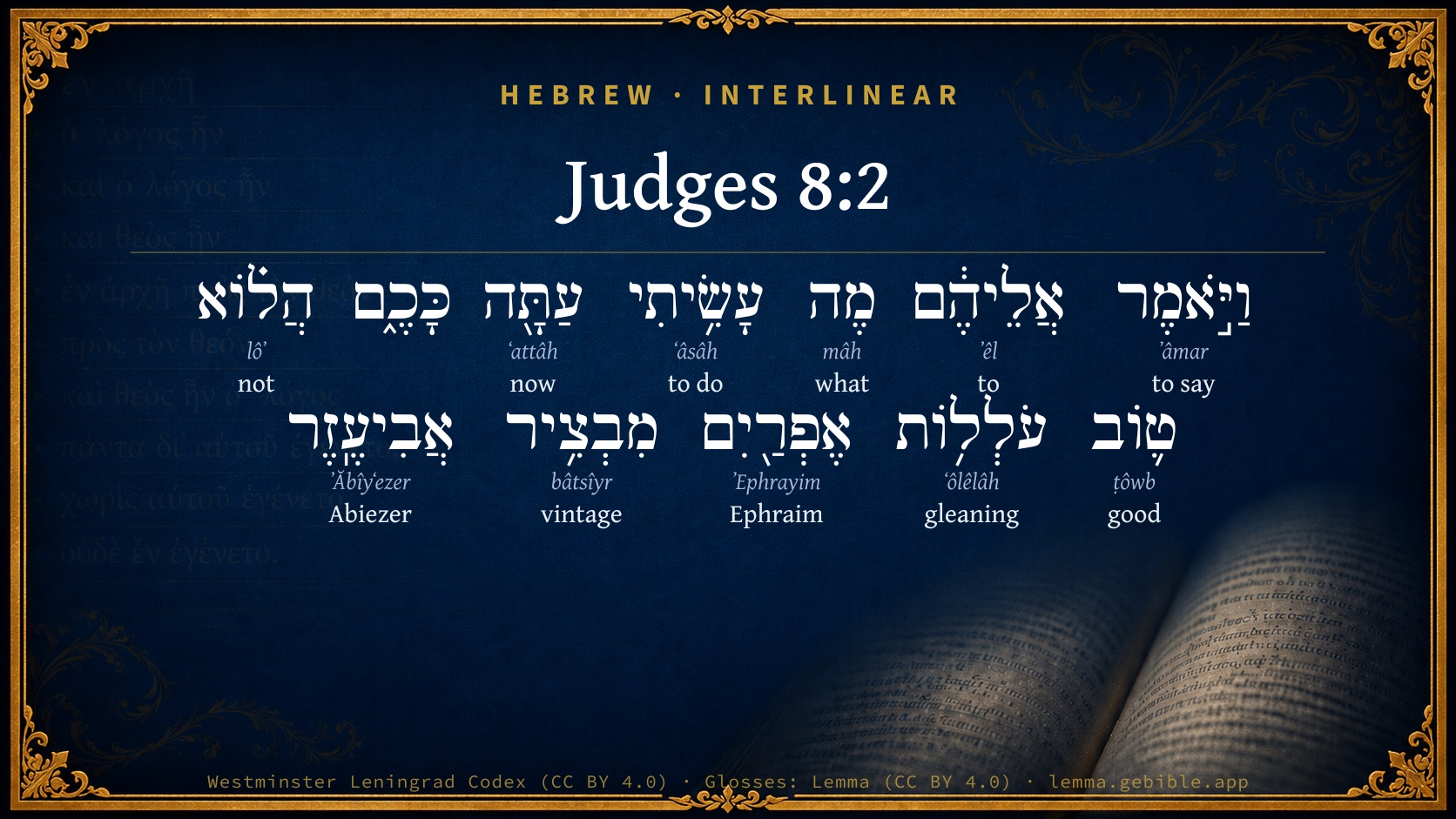
Hebrew (Westminster Leningrad Codex) Judges 8:2 appears in the Hebrew Old Testament. The text above is from the Westminster Leningrad Codex. Each word links to its Strong’s number, a concise gloss, and parsing drawn from the Open Scriptures Hebrew Bible morphology. Click any word for its full Brown-Driver-Briggs (BDB) entry.
Download image
Cite this verse

Judges 8:2 (World English Bible). Public Domain. Lemma interlinear Bible study tool, https://lemma.gebible.app/v/judges/8/2.

Show BibTeX & RIS
BibTeX
RIS
English Translation
He said to them, What have I now done in comparison with you? Isn't the gleaning of the grapes of Ephraim better than the vintage of Abiezer?
World English Bible · Public Domain
Highlights
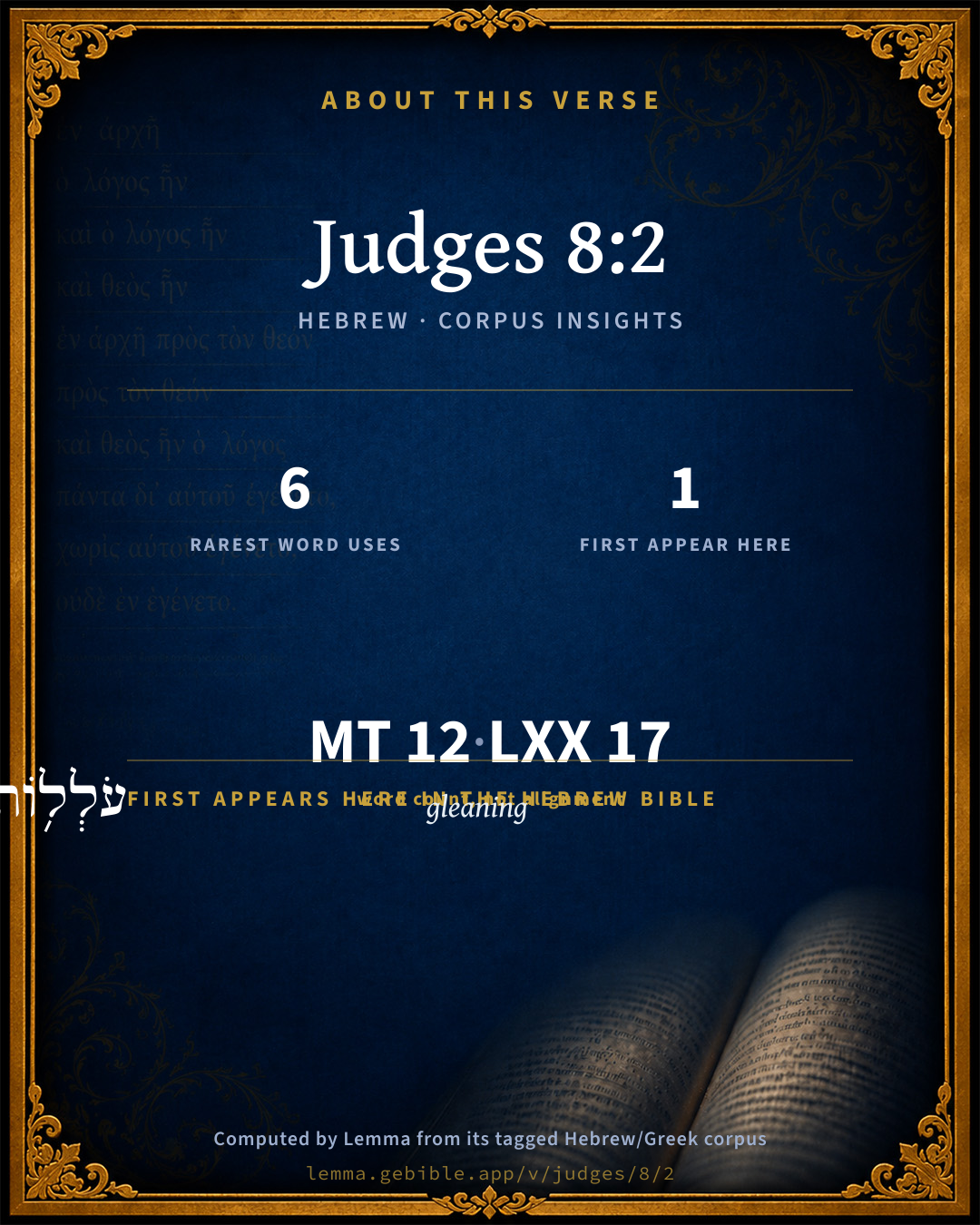
  • 1 first appearance in the Hebrew Bible
Full analysis ↓
Download a study sheet

One document with this verse’s original text, its word-by-word gloss line, the meaning frame, cross-references with their text, attributed commentary, and full source and license credits — printable, and it pastes into notes with its structure intact.

This verse Autodidact and up

Study sheet (.html) Plain text (.txt)

A passage Seminary Student

Up to 50 verses in one chapter. A passage sheet keeps up to 6 commentary sources and 12 cross-references per verse, in the order this page ranks them, and says so on the sheet whenever that leaves anything out. Ask for a single verse and you get the Autodidact verse sheet above.

Everything on this page stays free to read, with no account — the sheet is a download of what is already on screen, not access to it.

Want to remove ads? Support Godless Engineer
Compare translations 3

The same verse in 3 English versions, stacked beneath the original-language interlinear above. Click any original word for its lexicon entry.

Each is an independent rendering of the whole verse — the interlinear is not word-aligned to these translations.

Highlighted words mark where these versions differ — a whole-verse word diff, not a word-by-word alignment.

  • World English Bible Public Domain
    He said to them, What have I now done in comparison with you? Isn't the gleaning of the grapes of Ephraim better than the vintage of Abiezer?
  • King James Version Public Domain
    And he said unto them, What have I done now in comparison of you? Is not the gleaning of the grapes of Ephraim better than the vintage of Abiezer?
  • unfoldingWord Literal Text CC BY-SA 4.0
    But he said to them, “What have I now done like you? not the gleanings of Ephraim better than the vintage of Abiezer?

unfoldingWord Literal Text — © unfoldingWord, licensed CC BY-SA 4.0. Word-aligned USFM3 via Door43 (git.door43.org/unfoldingWord/en_ult).

Versions to compare (up to 4)

3 of 4 selected

Show all 18 translations

Every available English version of this verse, each an independent rendering of the whole verse.

  • World English Bible Public Domain
    He said to them, What have I now done in comparison with you? Isn't the gleaning of the grapes of Ephraim better than the vintage of Abiezer?
  • Berean Standard Bible Public Domain
    But Gideon answered them, “Now what have I accomplished compared to you? Are not the gleanings of Ephraim better than the grape harvest of Abiezer?
  • Majority Standard Bible Public Domain
    But Gideon answered them, “Now what have I accomplished compared to you? Are not the gleanings of Ephraim better than the grape harvest of Abiezer?
  • King James Version Public Domain
    And he said unto them, What have I done now in comparison of you? Is not the gleaning of the grapes of Ephraim better than the vintage of Abiezer?
  • American Standard Version (1901) Public Domain
    And he said unto them, What have I now done in comparison with you? Is not the gleaning of the grapes of Ephraim better than the vintage of Abiezer?
  • Revised Version (1885) Public Domain
    And he said unto them, What have I now done in comparison of you? Is not the gleaning of the grapes of Ephraim better than the vintage of Abiezer?
  • Geneva Bible (1599) Public Domain
    To whom he said, What haue I now done in comparison of you? is not the gleaning of grapes of Ephraim better, then the vintage of Abiezer?
  • Douay-Rheims (1899) Public Domain
    And he answered them: What could I have done like to that which you have done? Is not one bunch of grapes of Ephraim better than the vintages of Abiezer?
  • Young's Literal Translation Public Domain
    and he saith unto them, `What have I done now like you? are not the gleanings of Ephraim better than the harvest of Abi-Ezer?
  • Literal Standard Version CC BY-SA 4.0
    and he says to them, “What have I now done like you? Are the gleanings of Ephraim not better than the harvest of Abi-Ezer?
  • Unlocked Literal Bible CC BY-SA 4.0
    He said to them, “What have I done now compared to you? Are not the gleanings of Ephraim's grapes better than the full grape harvest of Abiezer?
  • unfoldingWord Literal Text CC BY-SA 4.0
    But he said to them, “What have I now done like you? not the gleanings of Ephraim better than the vintage of Abiezer?
  • Darby Bible Public Domain
    And he said to them, "What have I done now in comparison with you? Is not the gleaning of the grapes of E'phraim better than the vintage of Abi-e'zer?
  • World Messianic Bible Public Domain
    He said to them, “What have I now done in comparison with you? Isn’t the gleaning of the grapes of Ephraim better than the vintage of Abiezer?
  • Webster's Bible Public Domain
    And he said to them, What have I done now in comparison of you? Is not the gleaning of the grapes of Ephraim better than the vintage of Abiezer?
  • Free Bible Version CC BY-SA 4.0
    “Now what have I achieved in comparison to you?” Gideon replied. “Even Ephraim's left-over grapes are better than Abiezer's whole grape harvest!
  • Bible in Basic English Public Domain
    And he said to them, What have I done in comparison with you? Is not that which Ephraim took up after the grape-cutting better than all the grapes which Abiezer got in from the grape-cutting?
  • JPS Tanakh (1917) Public Domain
    And he said unto them: 'What have I now done in comparison with you? Is not the gleaning of Ephraim better than the vintage of Abiezer?

Literal Standard Version (2020), Covenant Press — licensed CC BY-SA 4.0. Text via the HelloAO Bible API (eBible.org). Unlocked Literal Bible (unfoldingWord) — licensed CC BY-SA 4.0. Text via the HelloAO Bible API (eBible.org). unfoldingWord Literal Text — © unfoldingWord, licensed CC BY-SA 4.0. Word-aligned USFM3 via Door43 (git.door43.org/unfoldingWord/en_ult). Free Bible Version, Dr. Jonathan Gallagher — licensed CC BY-SA 4.0. Text via the HelloAO Bible API (eBible.org).

Word by word

More ways to search: Search by grammar → Find every occurrence → Compare this word →

Practice this passage: Drill this verse → Learn its vocabulary →

עֹלְל֥וֹת
ʻôlêlâh
H5955
“gleanings of”
Noun, Common, Feminine, Plural, Construct
Part of Speech
Noun
Type
Common
Gender
Feminine
Number
Plural
State
Construct
Full BDB Definition

Origin: act part of H5953

TWOT: 1627a

gleaning
  1. וַיֹּ֣אמֶר ʼâmar H559 “and · to say” Conjunction + Verb, Qal, Sequential Imperfect, 3rd Person, Masculine, Singular
  2. אֲלֵיהֶ֔ם ʼêl H413 “to · them” Preposition + Suffix, Personal, 3rd Person, Masculine, Plural
  3. מֶה mâh H4100 “what” Particle, Interrogative
  4. עָשִׂ֥יתִי ʻâsâh H6213 “to do” Verb, Qal, Perfect, 1st Person, Common, Singular
  5. עַתָּ֖ה ʻattâh H6258 “now” Adverb
  6. הֲל֗וֹא lôʼ H3808 “not” Particle, Interrogative + Particle, Negative
  7. ט֛וֹב ṭôwb H2896 “good” Adjective, Adjective, Masculine, Singular, Absolute
  8. אֶפְרַ֖יִם ʼEphrayim H669 “Ephraim” Noun, Proper
  9. מִבְצִ֥יר bâtsîyr H1210 “from · vintage of” Preposition + Noun, Common, Masculine, Singular, Construct
  10. אֲבִיעֶֽזֶר ʼĂbîyʻezer H44 “Abiezer” Noun, Proper

About this verse

These counts appear in no published source. They are computed here, from the morphology-tagged text and Lemma’s own curated glosses. What Lemma adds →

12
words
11
distinct lemmas
Historical
section

Notable vocabulary

The rarest word here is עֹלְל֥וֹת gleaning H5955 — appearing just 6 times in the whole Hebrew Bible.

First appearance in Scripture

This word makes its first canonical appearance in the Hebrew Bible here:

  • עֹלְל֥וֹת gleaning H5955

Shared distinctive vocabulary

עֹלְל֥וֹת gleaning H5955 occurs in 6 verses of the Hebrew Bible. Also found in:

Grammatical profile

  • 2 verbs
  • 4 nouns
  • 1 adjective
  • 2 prepositions
  • 1 adverb
  • 2 particles

Verb forms

  • וַיֹּ֣אמֶר Qal · Sequential Imperfect
  • עָשִׂ֥יתִי Qal · Perfect

Hebrew & Septuagint length

In English translation the verse runs 27 words from the Hebrew and 26 from the Septuagint (LXX English) — closely comparable.

A rough comparison of the two English renderings, which tokenize alike — not a word-level alignment.

Word counts can differ between the Hebrew and the Greek without any difference in meaning — e.g. the Hebrew direct-object marker אֵת has no separate Greek word, and Greek often adds the article ὁ.

In the original languages it is 12 Hebrew tokens and 17 Greek tokens — but the two are counted differently (Hebrew bundles its prefixes and suffixes into one token; the Greek is in lemma form), so that isn’t a like-for-like length.

Cross-references

7

Topical passages linked to Judges 8:2 in the Treasury of Scripture Knowledge — connected by theme and wording, ordered by reader-vote popularity; previews shown in the World English Bible.

  • James 1:19–20 So, then, my beloved brothers, let every man be swift to hear, slow to speak, and slow to anger;
  • Judges 6:11 The angel of Yahweh came, and sat under the oak which was in Ophrah, that pertained to Joash the Abiezrite: and his son Gideon was beating out wheat in the winepress, to hide it from the Midianites.
  • Judges 6:34 But the Spirit of Yahweh came on Gideon; and he blew a trumpet; and Abiezer was gathered together after him.
  • 1 Corinthians 13:4–7 Love is patient and is kind; love doesn't envy. Love doesn't brag, is not proud,
  • Galatians 5:14–15 For the whole law is fulfilled in one word, in this: "You shall love your neighbor as yourself."
  • Philippians 2:2–3 make my joy full, by being like-minded, having the same love, being of one accord, of one mind;
  • James 3:13–18 Who is wise and understanding among you? Let him show by his good conduct that his deeds are done in gentleness of wisdom.

Cross-references courtesy of OpenBible.info (CC BY 4.0).

Hebrew and Greek witnesses Masoretic Hebrew ↔ Greek Septuagint

The same verse in the two great witnesses to the Old Testament, shown verse-for-verse.

These are two independent witnesses, not word-aligned to each other, and the Septuagint is shown in lemma (dictionary) form.

Hebrew Judges 8:2 Masoretic · Westminster Leningrad Codex

וַיֹּ֣אמֶר אֲלֵיהֶ֔ם מֶה עָשִׂ֥יתִי עַתָּ֖ה כָּכֶ֑ם הֲל֗וֹא ט֛וֹב עֹלְל֥וֹת אֶפְרַ֖יִם מִבְצִ֥יר אֲבִיעֶֽזֶר

He said to them, What have I now done in comparison with you? Isn't the gleaning of the grapes of Ephraim better than the vintage of Abiezer?

World English Bible · Public Domain

Greek LXX Judges 8:2 Septuagint · lemma form

καί εἶπον πρός αὐτός τίς ποιέω νῦν καθώς σύ ἤ οὐ κρείσσων ἐπιφυλλίς ἐφράιμ ἤ τρύγητος αβιεζερ

And he said to them, What have I now done in comparison of you? is not the gleaning of Ephraim better than the vintage of Abiezer?

LXX2012 (modern English Septuagint) · Public Domain

On this verse, Haydock's Catholic Bible Commentary discusses the Septuagint’s reading. Read the note in Commentary ↓

Hebrew: Westminster Leningrad Codex (CC BY 4.0). Greek: Septuagint (public domain); English from LXX2012 (modern English Septuagint) (Public Domain). How the Septuagint differs from the Hebrew →

Targum (Aramaic paraphrase)

1

The Targum is the ancient Jewish Aramaic paraphrase of the Hebrew Scriptures — an interpretive translation, not the Hebrew text itself. Onkelos (literal) and Pseudo-Jonathan (expansive) render the Torah, and Jonathan the Prophets. Coverage is partial: where no permissively-licensed English translation exists for a verse, only the Aramaic is shown. This is verse-level text, not a word-by-word alignment to the Hebrew.

  1. Targum Jonathan Prophets (Joshua–Malachi)
    וַאֲמַר לְהוֹן מֶה עַבְדֵית כְּעַן כְּוַתְכוֹן הֲלָא טָבִין חַלָשַׁיָא דְבֵית אֶפְרַיִם מִתַּקְפַיָא דְבֵית אֲבִיעֶזֶר:

    (no public-domain English translation for this verse)

    Targum Jonathan — Aramaic: “Mikraot Gedolot” (public domain). English: “Sefaria Community Translation” (CC0 1.0 (public-domain dedication)); “London "Chaldee Paraphrase," 1871” (public domain). Text via Sefaria.

Commentary

Notes on Judges 8:2 from classic Christian and Jewish commentators (each source and its license shown beneath its notes). The classic Christian expositions comment on the surrounding passage and are grouped to its opening verse, so a note may address several verses; the Jewish commentaries on the Tanakh (Rashi and others) are per-verse, so they appear only where the commentator wrote on this verse.

Lemma curates 59 commentaries, every one of them public domain or Creative Commons licensed, each selected and text-cleaned for this edition rather than reprinted as found. About our sources →

Trapp's Complete Commentary

John Trapp

Jdg 8:2 And he said unto them, What have I done now in comparison of you? [Is] not the gleaning of the grapes of Ephraim better than the vintage of Abiezer?

Ver. 2. What have I done now in comparison of you?] By a soft answer he pacifieth their wrath. {Pro 17:1; Pro 25:15} Milk quencheth wildfire: oil, saith Luther, quenches lime, which water kindles. Hard to hard, will never do well: but you may break a flint upon a cushion; a bullet if it light upon a wool sack, dieth there. "Dearly beloved, avenge not yourselves, but rather give place unto wrath." {Rom 12:19} Howbeit some men are as nettles: handle them gently, they sting you; handle them hard, and they will do you no hurt.

John Trapp, A Commentary or Exposition upon All the Books of the Old and New Testament (1647–1656) — public domain. Text from a community e-Sword module.

Joseph Benson's Commentary

Jdg 8:2. What have I done now? &c. — What I have done in cutting off some of the common soldiers is not to be compared with your destroying their princes. I began the war, but you have finished it. Gideon here shows a noble temper of mind, which deserves admiration and imitation. Though in the midst of a most glorious victory, in which he was the chief instrument; yet, for the sake of the common good, that there might be no dissension, nor the help of the Ephraimites be wanting to distress the enemy, he receives their reproaches without anger, and even humbles himself before them, making himself of no account in comparison with them, and magnifying their service as greatly superior to his own. He disarms their insolence by his humility; their anger by his meekness; “a singular instance,” says Dr. Dodd, “of modesty and prudence in a man of Gideon’s courage.” Is not the gleaning of the grapes of Ephraim — What you have gleaned, or done after me; better than the vintage of Abi-ezer? — That is, of the Abi-ezrites, to whom he modestly ascribes the honour of the victory, and does not arrogate it to himself. It is not improbable but this might be a proverbial expression in those days, whereby it was customary to commend the smallest action of one as superior to the greatest of another. And the proverb, perhaps, was founded on fact, namely, that more grapes were usually gleaned in the large and extensive country occupied by the Ephramites, than the whole vintage of the small district belonging to Abi-ezer afforded. Be this as it will, the proverb is here applied with all the propriety imaginable, and its meaning is obvious. It is as if he had said, These scattered parties which you have gleaned and picked up at the fords of Jordan are much more considerable than those which I and my whole host have destroyed.

Joseph Benson's Commentary on the Old and New Testaments (1811–1818) — public domain. Text from a community e-Sword module.

Geneva Bible (1599)

Geneva Bible translators

Which have slain two princes, Oreb and Zeeb.

This last act of the whole tribe is more famous, than the whole enterprise of one man of one family.

Geneva Bible (1599) marginal notes — public domain. Text via Bolls.life.

Jamieson, Fausset & Brown

Robert Jamieson, A. R. Fausset & David Brown

he said unto them, What have I done now in comparison of you?--His mild and truly modest answer breathes the spirit of a great as well as good man, who was calm, collected, and self-possessed in the midst of most exciting scenes. It succeeded in throwing oil on the troubled waters (Pro 16:1), and no wonder, for in the height of generous self-denial, it ascribes to his querulous brethren a greater share of merit and glory than belonged to himself (Co1 13:4; Phi 2:3).

Jamieson, Fausset & Brown — Commentary Critical and Explanatory on the Whole Bible (1871) — public domain (CC PDM 1.0). Text via the HelloAO Bible API.

Adam Clarke's Commentary

Verse 2. Is not the gleaning, c.] That is, The Ephraimites have performed more important services than Gideon and his men and he supports the assertion by observing that it was they who took the two Midianitish generals, having discomfited their hosts at the passes of Jordan.

Adam Clarke's Commentary on the Bible (1810–1826) — public domain. Text from a community e-Sword/MySword module.

Ellicott's Commentary for English Readers

(2) What have I done now in comparison of you?—Since Gideon was by no means a man of very placable and pacific disposition, we see the strong and noble self-control which this answer manifests. He was not in a condition, even had he wished it, to humble the fierce jealousy of this kindred tribe, as the more independent Jephthah, who was not so closely bound to them, did not scruple to do. He remembered that Zebah and Zalmunna were still safe; the Midianites were as yet by no means finally crushed. Patriotism as well as right feeling demanded that at such a moment there should be no civil discord.

Is not the gleaning . . .?—The answer has a proverbial sound. (Comp. Deu_24:21.) It here implies that Ephraim, by a mere subsequent and secondary effort, had achieved more (as yet) than Gideon himself had done, or perhaps that the two bloody heads which were their “gleaning” were better than the “vintage” of obscure thousands. In admitting this, in waiving all self-assertion, Gideon was setting an example of the spirit which is content to suffer wrong, and to take less than its proper due (elassousthai, Time. i. 77). Nor was there any irony or wilful sacrifice of truth in his remark, for there can be no doubt that the Ephraimites had wrought a splendid victory (Isa_10:26). The Chaldee renders it, “Are not the weak of the house of Ephraim better than the strong of the house of Abiezer?”

A Bible Commentary for English Readers, edited by Charles John Ellicott (1878–1897) — public domain. Text from a community e-Sword module.

The Cambridge Bible for Schools and Colleges

gen. ed. J. J. S. Perowne

2. Gideon, like his father (Jdg_6:31), had the ready wit to extricate himself from an awkward situation. For the gleaning of the grapes see Isa_17:6, Mic_7:1; the word is used of fruit, not of corn. Ephraim indeed arrived late upon the scene, but they had the glory of capturing the chiefs. Gideon speaks only of Abiezer, his own clansmen; the 300 warriors chosen from different tribes, Jdg_7:2-8, belong to another version of the story. Probably Jdg_8:3 was followed by Jdg_8:29 in the original narrative.

The Cambridge Bible for Schools and Colleges (gen. ed. J. J. S. Perowne; Cambridge University Press, 1878–1918) — public domain. Text from a community e-Sword module.

John Gill's Exposition

And he said unto them,.... In a very mild and gentle manner, giving soft words, which turn away wrath:

what have I done in comparison of you? he and his men, he signifies, had only blew trumpets, broke pitchers, and held torches; it was the Lord that did all, and set the Midianites one against another to slay each other; and in the pursuit as yet he had only picked up and slain some common soldiers, they had taken two princes of Midian, Oreb and Zeeb, and had brought their heads in triumph to him:

is not the gleaning of the grapes of Ephraim better than the vintage of Abiezer? the family of Abiezer, of which Gideon was; the meaning is, that whereas he began the fight, which may be called the vintage, and they had finished it, which was like gleaning; yet what they did last was much preferable to what was done by him at first; or the princes of Midian, which they had taken in the pursuit, and was like gleaning after a vintage, were equal, yea, superior to all the camp of Midian, or that part of it that had fallen into his hands. The Targum is,"are not the weak of the house of Ephraim better than the strong of the house of Abiezer?''

John Gill's Exposition of the Whole Bible (1746–1763) — public domain (CC PDM 1.0). Text via the HelloAO Bible API.

Albert Barnes' Notes on the Bible

A civil war with the great tribe of Ephraim would soon have turned Israel’s victory into mourning. Gideon therefore soothes their wounded pride by confessing that Ephraim had done more, though they had joined him so late in the day, than he had been able to effect in the whole campaign. The grape-gleaning of Ephraim was better than the whole vintage of Abi-ezer.

Albert Barnes' Notes on the Bible (1834–1885) — public domain. Text from a community e-Sword/MySword module.

Haydock's Catholic Bible Commentary

What could I, &c. A meek and humble answer appeased them; who otherwise might have come to extremities. So great is the power of humility both with God and man. (Challoner) (Proverbs xv. 1.) --- Could. Hebrew and Septuagint, "What have I yet done like you? (Menochius) --- Is not the gleaning?" &c. I only commenced the war; you have brought it to a happy termination, by killing the princes of the enemy. (Debrio adag. 157.) At the first siege of Troy, Telamon having entered the city before Hercules, the latter was on the point of killing him, when Telamon, collecting a heap of stones, which he said he intended for an altar in honour of "the victorious Hercules," the hero’s fury was appeased. (Apol. Bibl. ii. 6.)

George Leo Haydock (1774–1849), Haydock's Catholic Family Bible and Commentary, 1859 edition — public domain. Excludes Psalms (Douay-Rheims chapter numbering differs from Protestant) and Deuterocanonical books (Catholic canon only).

Matthew Poole's English Annotations

What was done was done by God’s immediate making them one to kill another; what I have done, in cutting off some of the fugitive common soldiers, is not to be compared with your exploit in destroying their princes; I began the war, but you have finished.

The gleaning of the grapes of Ephraim; what you have gleaned or done after me.

Of Abi-ezer, i.e. of the Abi-ezrites, to whom he modestly communicateth the honour of the victory, and doth not arrogate it to himself, as generals commonly do.

Matthew Poole's English Annotations on the Holy Bible (1683–1685) — public domain. Text from a community e-Sword/MySword module.

Whedon's Commentary on the Bible

Daniel D. Whedon

2. Is not the gleaning — Is not the slaughter of these two chieftains a greater glory than all that I have done? The gleaning of the grapes of Ephraim, here, means the victory which these Ephraimites had gained by destroying Oreb and Zeeb. So memorable was this victory that Isaiah alludes to it as an instance of utter defeat and ruin. Isa_10:26. The vintage of Abi-ezer refers particularly to what Gideon and his three hundred had done. Gideon was an Abi-ezrite, and perhaps the three hundred were largely of the same family, who were the first to rally around him at the trumpet call. Jdg_6:34. This attributing to the Ephraimites greater honour than he claimed for himself settled the quarrel at once. His soft answer turned away their wrath, and became a proverb.

Daniel D. Whedon (gen. ed.), Commentary on the Old and New Testaments (1874–1909) — public domain. Text from a community e-Sword module.

The Pulpit Commentary

What have I done, etc. Gideon"s character comes out splendidly in this answer. Humble and unassuming, (Jud_1:6:15, 36, note) and indisposed to glory, he was willing to give the Ephraimites full credit for their share in the great victory; prudent, and a lover of his country, he saw the immense importance of union among themselves, and the danger of intestine divisions and discord, and so at once met Ephraim"s taunts by the soft answer which turneth away wrath. (Pro_15:1) The grapes. The insertion of the word grapes, which is not in the Hebrew, rather spoils the proverb. It would run better, The gleaning of Ephraim is better than the vintage of Abi-ezer. The word vintage sufficiently shows that the gleaning meant was a gleaning of grapes. Ephraim, who came in at the end of the fight, like the gleaner when the vintage is finished, had got more glory by the capture of Oreb and Zeeb than the Manassites, who had gone through the whole campaign. The passage above referred to in Isaiah (Isa_10:25) implies that a great slaughter of the Midianites took place at the rock of Oreb.

The Pulpit Commentary (1880–1919), ed. H.D.M. Spence-Jones & Joseph S. Exell — public domain. Text from a community e-Sword module.

John Wesley's Explanatory Notes

What have I, &c. - What I have done in cutting off some of the common soldiers, is not to be compared with your destroying their princes; I began the war, but you have finished. The gleaning - What you have gleaned or done after me, Of Abiezer - That is, of the Abiezrites, to whom he modestly communicates the honour of the victory, and does not arrogate it to himself.

John Wesley, Explanatory Notes Upon the Whole Bible (1754–1765) — public domain. Text via the GEBible commentary corpus.

unfoldingWord translationNotes

Door43 World Missions Community

General Information:

Gideon replies to the men from Ephraim.

What have I done now compared to you?

Gideon uses this question to honor the people of Ephraim. AT: "I have done very little compared with what you have done!" (See: Rhetorical Question)

Are not the gleanings of Ephraim's grapes better than the full grape harvest of Abiezer?

Gideon was calming the people of Ephraim with this rhetorical question. AT: "Certainly the grapes you people of Ephraim gleaned are better than what we the descendants of Abiezer gathered from the whole harvest!" (See: Rhetorical Question)

Are not the gleanings of Ephraim's grapes better than the full grape harvest of Abiezer?

Gideon and his army defeating the Medianites is spoken of as if it were a grape harvest. The people of Ephraim killing Oreb and Zeeb at the end of the battle is spoken of as if they were gleaning grapes at the end of the harvest. AT: "What you people of Ephraim did at the end of the battle is more important than what we descendants of Abiezer did at the beginning." (See: Rhetorical Question and Metaphor)

Abiezer

This is the name of one of Gideon's ancestors. Gideon used his name to refer to Abiezer's descendants and their land. (See: Metonymy and How to Translate Names)

Oreb and Zeeb

See how you translated these names in Judges 7:25.

What have I accomplished compared to you?

Gideon uses this question to honor the people of Ephraim. This can be expressed as a statement. AT: "What you have done is more important than what I have done." (See: Rhetorical Question)

died down

"became less"

translationWords

glean

Ephraim

grape

harvest

God

prince

Midian

anger

unfoldingWord translationNotes — © Distant Shores Media and the Door43 World Missions Community, licensed CC BY-SA 4.0. Source: git.door43.org/Door43/en_tn.

Rashi

Rabbi Shlomo Yitzchaki (Rashi)

Can any action of mine compare with yours? How significant were my actions at the beginning in comparison with yours at the end?

Do not Ephraim's underripened gleanings surpass. The gleanings which you acquired at the end surpass the early harvest which my family and I gathered, for Adonoy delivered the kings into your hands.

Rashi on the Tanakh — English translations: “The Judaica Press complete Tanach with Rashi, translated by A. J. Rosenberg” (CC BY 4.0); “Pentateuch with Rashi's commentary by M. Rosenbaum and A.M. Silbermann, 1929-1934” (public domain); “The Metsudah Tanach series, Lakewood, N.J” (CC BY 4.0); and “The Book of Joshua, Metsudah Publications, 1997” (CC BY 4.0). Text via Sefaria.

Lesson kit

Teaching starters — assembled from the data on this page, not authored interpretation. Every prompt links to the verse data it draws on. Edit before teaching.

Judges, in the Historical, opens this verse with 12 words (11 distinct Hebrew lemmas). Its most distinctive word is ʻôlêlâh (“gleaning”). A historical commentator’s framing appears above. Read the whole chapter for the surrounding context.

Discussion questions

  1. How does “gleaning” (ʻôlêlâh) shape what this verse is saying?
  2. The word “gleaning” first appears here in Scripture. What is being introduced at this debut?
  3. Isaiah 17:6 shares the word «gleaning» with this verse. How do the two illuminate each other?
  4. The translations on this page render this verse differently — a whole-verse word diff, not a word-by-word alignment. What might account for the different wordings?
  5. The verb «וַיֹּ֣אמֶר» is Qal Sequential Imperfect. How does its form color the action?
  6. Reading how Trapp's Complete Commentary and Joseph Benson's Commentary read this verse, where do the two commentators agree and where do they part?

Things to notice

Reading settings

Reading text

Shown beneath each verse's original-language words.

Old Testament
Old Testament edition

Read the OT as the Masoretic Hebrew (MT) or the Greek Septuagint (LXX).

English shown for the Greek Septuagint (in the Hebrew ↔ Greek comparison).

Comparing translations? Open the Compare panel on any verse page to stack up to four side by side.