
Jeremiah 31:20

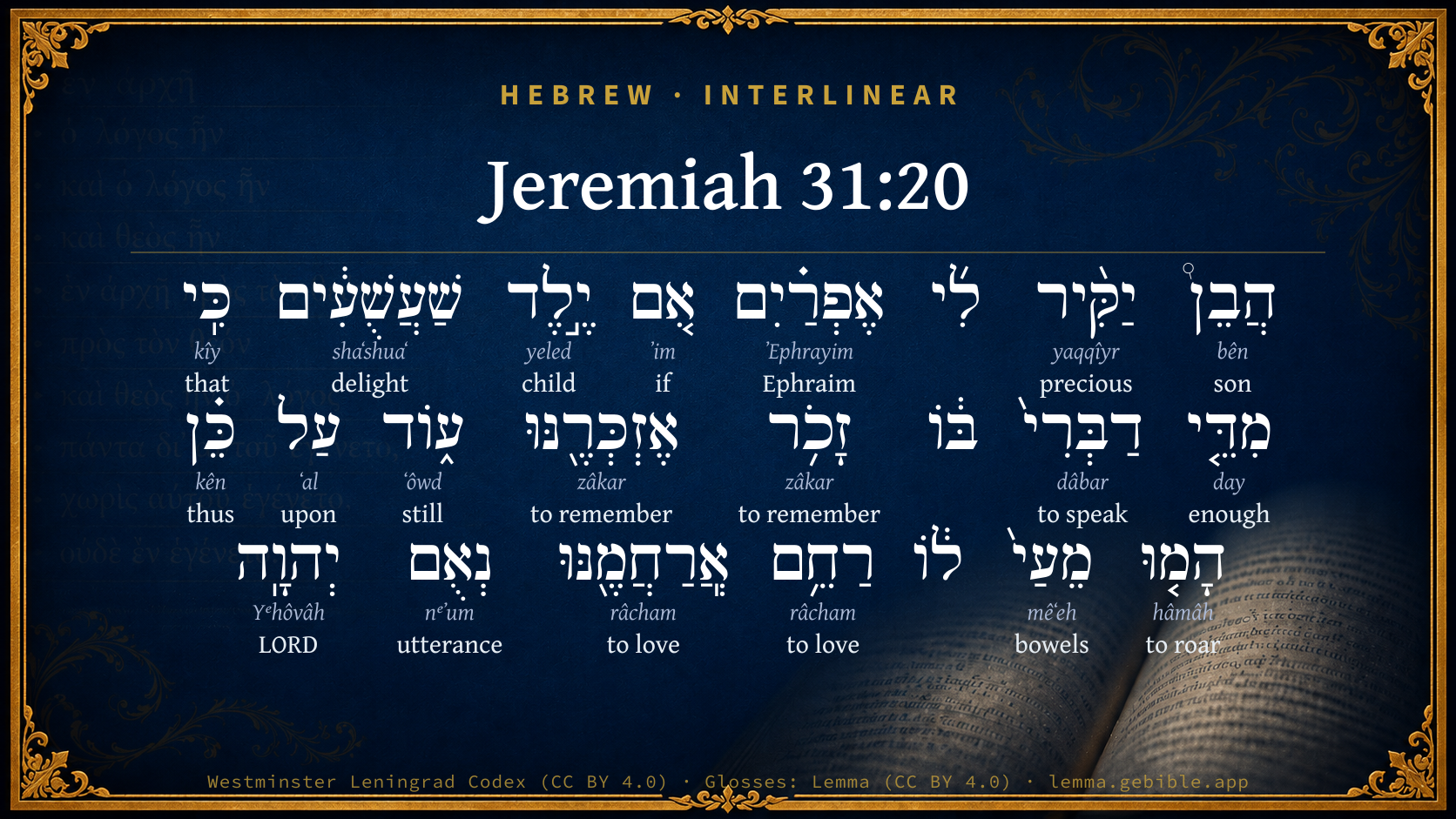
Hebrew (Westminster Leningrad Codex) Jeremiah 31:20 appears in the Hebrew Old Testament. The text above is from the Westminster Leningrad Codex. Each word links to its Strong’s number, a concise gloss, and parsing drawn from the Open Scriptures Hebrew Bible morphology. Click any word for its full Brown-Driver-Briggs (BDB) entry.
Download image
Cite this verse

Jeremiah 31:20 (World English Bible). Public Domain. Lemma interlinear Bible study tool, https://lemma.gebible.app/v/jeremiah/31/20.

Show BibTeX & RIS
BibTeX
RIS
English Translation
Is Ephraim my dear son? is he a darling child? for as often as I speak against him, I do earnestly remember him still: therefore my heart yearns for him; I will surely have mercy on him, says Yahweh.
World English Bible · Public Domain
Highlights
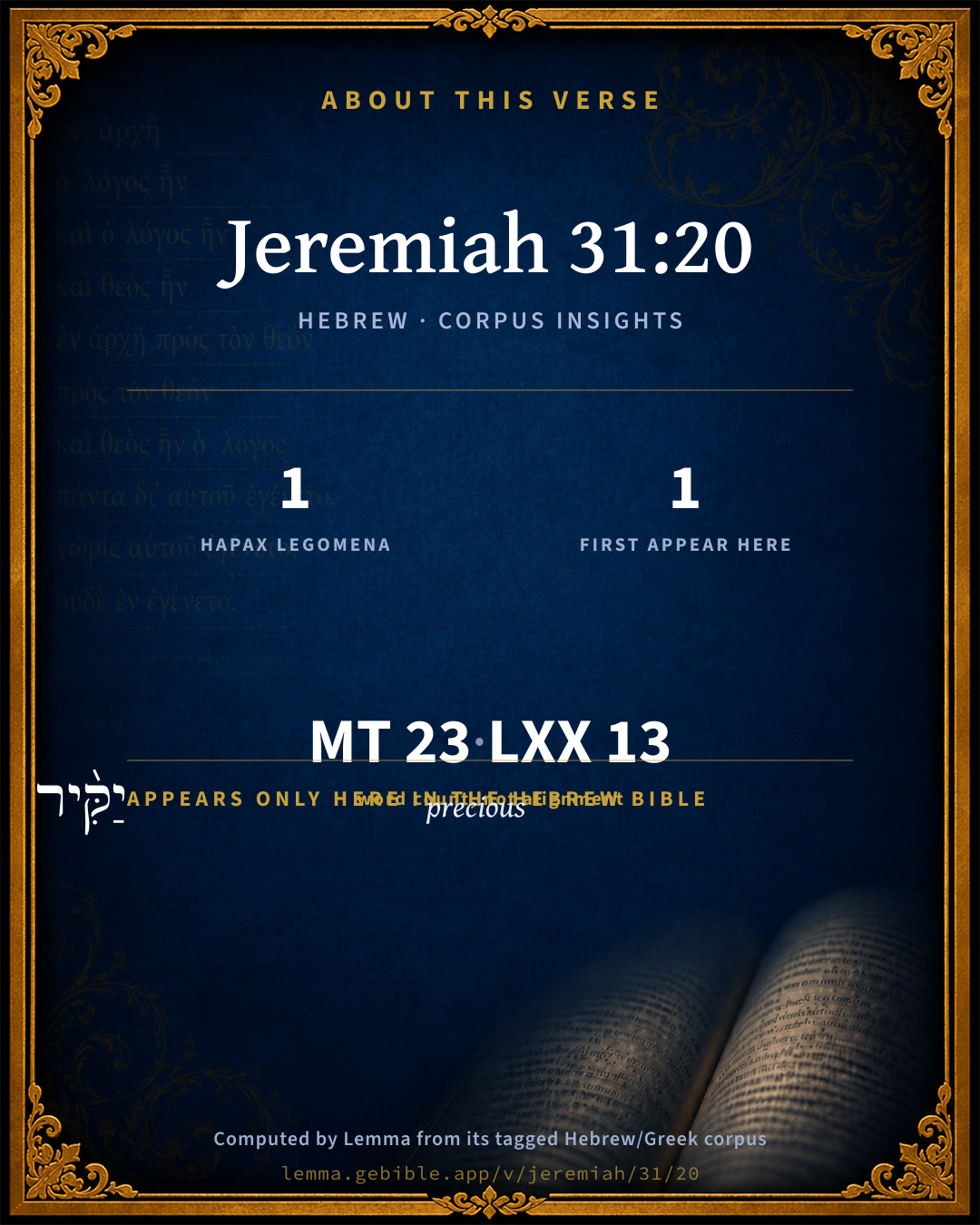
  • 1 hapax legomenon — only here in the Hebrew Bible
  • 1 first appearance in the Hebrew Bible
Full analysis ↓
Download a study sheet

One document with this verse’s original text, its word-by-word gloss line, the meaning frame, cross-references with their text, attributed commentary, and full source and license credits — printable, and it pastes into notes with its structure intact.

This verse Autodidact and up

Study sheet (.html) Plain text (.txt)

A passage Seminary Student

Up to 50 verses in one chapter. A passage sheet keeps up to 6 commentary sources and 12 cross-references per verse, in the order this page ranks them, and says so on the sheet whenever that leaves anything out. Ask for a single verse and you get the Autodidact verse sheet above.

Everything on this page stays free to read, with no account — the sheet is a download of what is already on screen, not access to it.

Want to remove ads? Support Godless Engineer
Compare translations 3

The same verse in 3 English versions, stacked beneath the original-language interlinear above. Click any original word for its lexicon entry.

Each is an independent rendering of the whole verse — the interlinear is not word-aligned to these translations.

Highlighted words mark where these versions differ — a whole-verse word diff, not a word-by-word alignment.

  • World English Bible Public Domain
    Is Ephraim my dear son? is he a darling child? for as often as I speak against him, I do earnestly remember him still: therefore my heart yearns for him; I will surely have mercy on him, says Yahweh.
  • King James Version Public Domain
    Is Ephraim my dear son? is he a pleasant child? for since I spake against him, I do earnestly remember him still: therefore my bowels are troubled for him; I will surely have mercy upon him, saith the LORD.
  • unfoldingWord Literal Text CC BY-SA 4.0
    Is not Ephraim my precious child? Is he not my dear, delightful son? For whenever I speak against him, I certainly still call him to my loving mind. In this way my heart longs for him. I will certainly have compassion on him—this is Yahweh’s declaration.”

unfoldingWord Literal Text — © unfoldingWord, licensed CC BY-SA 4.0. Word-aligned USFM3 via Door43 (git.door43.org/unfoldingWord/en_ult).

Versions to compare (up to 4)

3 of 4 selected

Show all 18 translations

Every available English version of this verse, each an independent rendering of the whole verse.

  • World English Bible Public Domain
    Is Ephraim my dear son? is he a darling child? for as often as I speak against him, I do earnestly remember him still: therefore my heart yearns for him; I will surely have mercy on him, says Yahweh.
  • Berean Standard Bible Public Domain
    Is not Ephraim a precious son to Me, a delightful child? Though I often speak against him, I still remember him. Therefore My heart yearns for him; I have great compassion for him,” declares the LORD.
  • Majority Standard Bible Public Domain
    Is not Ephraim a precious son to Me, a delightful child? Though I often speak against him, I still remember him. Therefore My heart yearns for him; I have great compassion for him,” declares the LORD.
  • King James Version Public Domain
    Is Ephraim my dear son? is he a pleasant child? for since I spake against him, I do earnestly remember him still: therefore my bowels are troubled for him; I will surely have mercy upon him, saith the LORD.
  • American Standard Version (1901) Public Domain
    Is Ephraim my dear son? is he a darling child? for as often as I speak against him, I do earnestly remember him still: therefore my heart yearneth for him; I will surely have mercy upon him, saith Jehovah.
  • Revised Version (1885) Public Domain
    Is Ephraim my dear son? is he a pleasant child? for as often as I speak against him, I do earnestly remember him still: therefore my bowels are troubled for him; I will surely have mercy upon him, saith the LORD.
  • Geneva Bible (1599) Public Domain
    Is Ephraim my deare sonne or pleasant childe? yet since I spake vnto him, I still remembred him: therefore my bowels are troubled for him: I wil surely haue compassion vpon him, saith the Lord.
  • Douay-Rheims (1899) Public Domain
    Surely Ephraim is an honourable son to me, surely he is a tender child: for since I spoke of him, I will still remember him. Therefore are my bowels troubled for him: pitying I will pity him, saith the Lord.
  • Young's Literal Translation Public Domain
    A precious son is Ephraim to Me? A child of delights? For since My speaking against him, I do thoroughly remember him still, Therefore have My bowels been moved for him, I do greatly love him, An affirmation of Jehovah.
  • Literal Standard Version CC BY-SA 4.0
    Is Ephraim a precious son to Me? A child of delights? For since My speaking against him, || I still thoroughly remember him, || Therefore My bowels have been moved for him, || I love him greatly,” || A declaration of YHWH.
  • Unlocked Literal Bible CC BY-SA 4.0
    Is not Ephraim my precious child? Is he not my dear, delightful son? For whenever I speak against him, I certainly still call him to my loving mind. In this way my heart longs for him. I will certainly have compassion on him—this is Yahweh's declaration.”
  • unfoldingWord Literal Text CC BY-SA 4.0
    Is not Ephraim my precious child? Is he not my dear, delightful son? For whenever I speak against him, I certainly still call him to my loving mind. In this way my heart longs for him. I will certainly have compassion on him—this is Yahweh’s declaration.”
  • Darby Bible Public Domain
    Is Ephraim a dear son unto me? is he a child of delights? For whilst I have been speaking against him, I do constantly remember him still. Therefore my bowels are troubled for him: I will certainly have mercy upon him, saith Jehovah.
  • World Messianic Bible Public Domain
    Is Ephraim my dear son? Is he a darling child? For as often as I speak against him, I still earnestly remember him. Therefore my heart yearns for him. I will surely have mercy on him,” says the LORD.
  • Webster's Bible Public Domain
    Is Ephraim my dear son? is he a pleasant child? for since I spoke against him, I do earnestly remember him still: therefore my bowels are troubled for him; I will surely have mercy upon him, saith the LORD.
  • Free Bible Version CC BY-SA 4.0
    But isn't Ephraim still my precious son, my lovely child? Even though I often have to scold him, I can't forget him. So I'm torn inside with longing, wanting to show how much I care about him! declares the Lord.
  • Bible in Basic English Public Domain
    Is Ephraim my dear son? is he the child of my delight? for whenever I say things against him, I still keep him in my memory: so my heart is troubled for him; I will certainly have mercy on him, says the Lord.
  • JPS Tanakh (1917) Public Domain
    Is Ephraim a darling son unto Me? Is he a child that is dandled? For as often as I speak of him, I do earnestly remember him still; Therefore My heart yearneth for him, I will surely have compassion upon him, saith the LORD.

Literal Standard Version (2020), Covenant Press — licensed CC BY-SA 4.0. Text via the HelloAO Bible API (eBible.org). Unlocked Literal Bible (unfoldingWord) — licensed CC BY-SA 4.0. Text via the HelloAO Bible API (eBible.org). unfoldingWord Literal Text — © unfoldingWord, licensed CC BY-SA 4.0. Word-aligned USFM3 via Door43 (git.door43.org/unfoldingWord/en_ult). Free Bible Version, Dr. Jonathan Gallagher — licensed CC BY-SA 4.0. Text via the HelloAO Bible API (eBible.org).

Word by word

More ways to search: Search by grammar → Find every occurrence → Compare this word →

Practice this passage: Drill this verse → Learn its vocabulary →

יַקִּ֨יר
yaqqîyr
H3357
“precious”
Adjective, Adjective, Masculine, Singular, Absolute
Part of Speech
Adjective
Type
Adjective
Gender
Masculine
Number
Singular
State
Absolute
Full BDB Definition

Origin: from H3365

TWOT: 905c

rare, very precious, honour, dear
  1. הֲבֵן֩ bên H1121 “son” Particle, Interrogative + Noun, Common, Masculine, Singular, Absolute
  2. אֶפְרַ֗יִם ʼEphrayim H669 “Ephraim” Noun, Proper
  3. אִ֚ם ʼim H518 “if” Conjunction
  4. יֶ֣לֶד yeled H3206 “child of” Noun, Common, Masculine, Singular, Construct
  5. שַׁעֲשֻׁעִ֔ים shaʻshuaʻ H8191 “delights” Noun, Common, Masculine, Plural, Absolute
  6. כִּֽי kîy H3588 “that” Conjunction
  7. מִדֵּ֤י day H1767 “from · enough of” Preposition + Noun, Common, Masculine, Singular, Construct
  8. דַבְּרִי֙ dâbar H1696 “to speak · me” Verb, Piel, Infinitive Construct + Suffix, Personal, 1st Person, Common, Singular
  9. זָכֹ֥ר zâkar H2142 “to remember” Verb, Qal, Infinitive Absolute
  10. אֶזְכְּרֶ֖נּוּ zâkar H2142 “to remember · him” Verb, Qal, Imperfect, 1st Person, Common, Singular + Suffix, Personal, 3rd Person, Masculine, Singular
  11. ע֑וֹד ʻôwd H5750 “still” Adverb
  12. עַל ʻal H5921 “upon” Preposition
  13. כֵּ֗ן kên H3651 “thus” Particle, Demonstrative
  14. הָמ֤וּ hâmâh H1993 “to roar” Verb, Qal, Perfect, 3rd Person, Common, Plural
  15. מֵעַי֙ mêʻeh H4578 “bowels · my” Noun, Common, Masculine, Plural, Construct + Suffix, Personal, 1st Person, Common, Singular
  16. רַחֵ֥ם râcham H7355 “to love” Verb, Piel, Infinitive Absolute
  17. אֲֽרַחֲמֶ֖נּוּ râcham H7355 “to love · him” Verb, Piel, Imperfect, 1st Person, Common, Singular + Suffix, Personal, 3rd Person, Masculine, Singular
  18. נְאֻם nᵉʼum H5002 “utterance of” Noun, Common, Masculine, Singular, Construct
  19. יְהוָֽה Yᵉhôvâh H3068 “LORD” Noun, Proper

About this verse

These counts appear in no published source. They are computed here, from the morphology-tagged text and Lemma’s own curated glosses. What Lemma adds →

23
words
18
distinct lemmas
Prophets
section

Notable vocabulary

1 hapax legomenon — a word that appears only here in the entire Hebrew Bible:

  • יַקִּ֨יר precious H3357

First appearance in Scripture

This word makes its first canonical appearance in the Hebrew Bible here:

  • יַקִּ֨יר precious H3357

Shared distinctive vocabulary

שַׁעֲשֻׁעִ֔ים delight H8191 occurs in 9 verses of the Hebrew Bible. Also found in:

Grammatical profile

  • 6 verbs
  • 8 nouns
  • 1 adjective
  • 4 prepositions
  • 2 conjunctions
  • 1 adverb
  • 1 particle

Verb forms

  • דַבְּרִי֙ Piel · Infinitive Construct
  • זָכֹ֥ר Qal · Infinitive Absolute
  • אֶזְכְּרֶ֖נּוּ Qal · Imperfect
  • הָמ֤וּ Qal · Perfect
  • רַחֵ֥ם Piel · Infinitive Absolute
  • אֲֽרַחֲמֶ֖נּוּ Piel · Imperfect

Repetition

Words recur within this verse — often emphatic in Hebrew:

  • זָכֹ֥ר to remember H2142 ×2
  • רַחֵ֥ם to love H7355 ×2

Hebrew & Septuagint length

In the original languages it is 23 Hebrew tokens and 13 Greek tokens — but the two are counted differently (Hebrew bundles its prefixes and suffixes into one token; the Greek is in lemma form), so that isn’t a like-for-like length.

Cross-references

21

Topical passages linked to Jeremiah 31:20 in the Treasury of Scripture Knowledge — connected by theme and wording, ordered by reader-vote popularity; previews shown in the World English Bible.

  • Isaiah 55:7 let the wicked forsake his way, and the unrighteous man his thoughts; and let him return to Yahweh, and he will have mercy on him; and to our God, for he will abundantly pardon.
  • Micah 7:18–19 Who is a God like you, who pardons iniquity, And passes over the disobedience of the remnant of his heritage? He doesn't retain his anger forever, Because he delights in loving kindness.
  • Judges 10:16 They put away the foreign gods from among them, and served Yahweh; and his soul was grieved for the misery of Israel.
  • Psalms 103:13 Like a father has compassion on his children, So Yahweh has compassion on those who fear him.
  • Isaiah 63:15 Look down from heaven, and see from the habitation of your holiness and of your glory: where are your zeal and your mighty acts? the yearning of your heart and your compassion is restrained toward me.
  • Lamentations 3:31–32 For the Lord will not cast off forever.
  • Hosea 14:4 "I will heal their waywardness. I will love them freely; For my anger is turned away from him.
  • Luke 15:24 for this, my son, was dead, and is alive again. He was lost, and is found.' They began to celebrate.
  • Isaiah 16:11 Why my heart sounds like a harp for Moab, and my inward parts for Kir Heres.
  • Jeremiah 48:36 Therefore my heart sounds for Moab like pipes, and my heart sounds like pipes for the men of Kir Heres: therefore the abundance that he has gotten is perished.
  • Hosea 11:8–9 "How can I give you up, Ephraim? How can I hand you over, Israel? How can I make you like Admah? How can I make you like Zeboiim? My heart is turned within me, My compassion is aroused.
  • Philippians 1:8 For God is my witness, how I long after all of you in the tender mercies of Christ Jesus.
  • Isaiah 57:16–18 For I will not contend forever, neither will I be always angry; for the spirit would faint before me, and the souls who I have made.
  • Jeremiah 3:19 But I said, How I will put you among the children, and give you a pleasant land, a goodly heritage of the hosts of the nations! and I said, You shall call me My Father, and shall not turn away from following me.
  • Jeremiah 31:9 They shall come with weeping; and with petitions will I lead them: I will cause them to walk by rivers of waters, in a straight way in which they shall not stumble; for I am a father to Israel, and Ephraim is my firstborn.
  • Genesis 43:30 Joseph made haste; for his heart yearned over his brother: and he sought a place to weep; and he entered into his room, and wept there.
  • Deuteronomy 32:36 For Yahweh will judge his people, Repent himself for his servants; When he sees that [their] power is gone, There is none [remaining], shut up or left at large.
  • 1 Kings 3:26 Then spoke the woman whose the living child was to the king, for her heart yearned over her son, and she said, Oh, my lord, give her the living child, and in no way kill it. But the other said, It shall be neither mine nor yours; divide it.
  • Proverbs 3:12 For whom Yahweh loves, he reproves; Even as a father reproves the son in whom he delights.
  • Song of Solomon 5:4 My beloved thrust his hand in through the latch opening. My heart pounded for him.
  • Luke 15:32 But it was appropriate to celebrate and be glad, for this, your brother, was dead, and is alive again. He was lost, and is found.'"

Cross-references courtesy of OpenBible.info (CC BY 4.0).

Hebrew and Greek witnesses Masoretic Hebrew ↔ Greek Septuagint

The same verse in the two great witnesses to the Old Testament, shown verse-for-verse.

These are two independent witnesses, not word-aligned to each other, and the Septuagint is shown in lemma (dictionary) form.

Hebrew Jeremiah 31:20 Masoretic · Westminster Leningrad Codex

הֲבֵן֩ יַקִּ֨יר לִ֜י אֶפְרַ֗יִם אִ֚ם יֶ֣לֶד שַׁעֲשֻׁעִ֔ים כִּֽי מִדֵּ֤י דַבְּרִי֙ בּ֔וֹ זָכֹ֥ר אֶזְכְּרֶ֖נּוּ ע֑וֹד עַל כֵּ֗ן הָמ֤וּ מֵעַי֙ ל֔וֹ רַחֵ֥ם אֲֽרַחֲמֶ֖נּוּ נְאֻם יְהוָֽה

Is Ephraim my dear son? is he a darling child? for as often as I speak against him, I do earnestly remember him still: therefore my heart yearns for him; I will surely have mercy on him, says Yahweh.

World English Bible · Public Domain

Greek LXX Structure differs

In the Septuagint, Jeremiah is about an eighth shorter than the Hebrew and arranges its material differently — the Oracles Against the Nations (Hebrew chapters 46–51) appear in the middle of the Greek book, after 25:13. Because the chapter and verse boundaries do not line up, a verse-for-verse comparison with the Hebrew is not shown.

A verse-for-verse comparison isn’t shown here because the chapters and verses don’t line up. Switch to the LXX edition with the MT / LXX toggle above to read the Greek directly.

Hebrew: Westminster Leningrad Codex (CC BY 4.0). Greek: Septuagint (public domain); English from a public-domain English Septuagint. How the Septuagint differs from the Hebrew →

Targum (Aramaic paraphrase)

1

The Targum is the ancient Jewish Aramaic paraphrase of the Hebrew Scriptures — an interpretive translation, not the Hebrew text itself. Onkelos (literal) and Pseudo-Jonathan (expansive) render the Torah, and Jonathan the Prophets. Coverage is partial: where no permissively-licensed English translation exists for a verse, only the Aramaic is shown. This is verse-level text, not a word-by-word alignment to the Hebrew.

  1. Targum Jonathan Prophets (Joshua–Malachi)
    הַכְבַר חֲבִיב קָדָמַי יִשְׂרָאֵל הֲלָא רָבֵי רָחֵים הוּא אֲרֵי בִזְמַן דִמְשַׁוֵי פִּתְגָמֵי אוֹרַיְתִי עַל לִבֵּיהּ לְמֶעְבַּדְהוֹן מִדְכַר דָכֵירְנָא לְאוֹטָבָא לֵיהּ עוֹד עַל כֵּן אִתְגוֹלָלוּ רַחֲמַי עֲלֵיהוֹן רַחֲמָא אֲרַחֵים עֲלֵיהוֹן אֲמַר יְיָ:

    How precious as a son is Israel to Me. Is he not a beloved child? Whenever he takes My Torah words upon his heart to perform them, I remember for his benefit—therefore My compassion stirs upon him, I have great mercy upon him, says Hashem.

    Targum Jonathan — Aramaic: “Mikraot Gedolot” (public domain). English: “Sefaria Community Translation” (CC0 1.0 (public-domain dedication)); “London "Chaldee Paraphrase," 1871” (public domain). Text via Sefaria.

Commentary

Notes on Jeremiah 31:20 from classic Christian and Jewish commentators (each source and its license shown beneath its notes). The classic Christian expositions comment on the surrounding passage and are grouped to its opening verse, so a note may address several verses; the Jewish commentaries on the Tanakh (Rashi and others) are per-verse, so they appear only where the commentator wrote on this verse.

Lemma curates 59 commentaries, every one of them public domain or Creative Commons licensed, each selected and text-cleaned for this edition rather than reprinted as found. About our sources →

Trapp's Complete Commentary

John Trapp

Jer 31:20 [Is] Ephraim my dear son? [is he] a pleasant child? for since I spake against him, I do earnestly remember him still: therefore my bowels are troubled for him; I will surely have mercy upon him, saith the LORD.

Ver. 20. Is Ephraim a dear son? is he a pleasant child?] q.d., Ay sure he is; and never more dear and pleasant than when thus beblubbered; like as some faces appear most oriently beautiful when they are most enstamped with sorrow. Heb., Is he a child of delight? q.d., He may seem to be otherwise by my hard dealing with him; but so he is assuredly - "Behold, he whom thou lovest is sick." {Joh 11:3}

For since I spake against him, I do earnestly remember him still.] Or, So oft as I speak of him, I am mindful still of him. See Isa 49:14; Isa 49:16.

Therefore my bowels are troubled for him.] Perstrepunt viscera mea. My bowels work, as that mother’s did toward her child; {1Ki 3:26} as Croesus’ dumb son’s did, when seeing a fellow ready to kill his father, he burst out into, Kill not king Croesus. {a} See Hos 11:8. {See Trapp on "Hos 11:8"}

{a} Aνθρωπε, υη κτεινε τον Kροισον. - Herod.

John Trapp, A Commentary or Exposition upon All the Books of the Old and New Testament (1647–1656) — public domain. Text from a community e-Sword module.

Joseph Benson's Commentary

Jer 31:20. Is Ephraim my dear son? Is he, &c. — These questions are designed to be answered in the affirmative, as appears from the inference, therefore my bowels are moved for him. It seems that, to suit the idiom of our language, and fully to express the sense of the original, the particle not ought to have been supplied, and the clause to have been read, Is not Ephraim my dear son? Is he not a pleasant child? That is, is he not one that I have set my affections on, as a parent does upon a child in whom he delights? Thus Dr. Waterland, Lowth, and many others interpret the words. Houbigant, however, defends the common reading, and thinks that God means to deny that Ephraim was his son, in order to show him that his bowels were moved toward him solely through free mercy, and not on account of any merits or deservings of his people. For since I spake against him — Or, of him, as the same phrase in the original is translated Jer 48:27. I do earnestly remember him still — Ever since I have so severely reproved and chastised him, my thoughts toward him have been thoughts of peace. I have a fatherly kindness and affection for him. Therefore my bowels are troubled for him — Or, yearn over him, as Joseph’s bowels yearned toward his brethren, even when he spake roughly to them. Observe, reader, when God afflicts his people, yet he does not forget them; when he casts them out of their land, yet he does not cast them out of his sight, nor out of his mind. Even then, when God is speaking against us, yet he is acting for us, and designing our good in all; and this is our comfort in our affliction, that the Lord thinketh upon us, though we have forgotten him. When Israel’s afflictions extorted a penitent confession and submission, it is said, (Jdg 10:16,) his soul was grieved for the misery of Israel: for he always afflicts with the greatest tenderness. It was his compassion that mitigated Ephraim’s punishment, (Hos 11:8-9,) My heart is turned within me, &c., and now the same compassion accepted Ephraim’s repentance, and induced God to say, I will surely have mercy upon him.

Joseph Benson's Commentary on the Old and New Testaments (1811–1818) — public domain. Text from a community e-Sword module.

Tyndale Open Study Notes

Tyndale Open Resources

31:20 The exiled people had been in the Lord’s memory all along. God responded to his people’s repentance with a father’s love for his wayward children (cp. Luke 15:11-24).

Tyndale Open Study Notes — © Tyndale Open Resources, licensed CC BY-SA 4.0. Text via the HelloAO Bible API.

Geneva Bible (1599)

Geneva Bible translators

To wit, in pity him for my promise’s sake.

As though he would say: No, for by his iniquity he did what lay in him to cast me off.

Geneva Bible (1599) marginal notes — public domain. Text via Bolls.life.

Jamieson, Fausset & Brown

Robert Jamieson, A. R. Fausset & David Brown

Is Ephraim my dear son? &c.--The question implies that a negative answer was to be expected. Who would have thought that one so undutiful to His heavenly Father as Ephraim had been should still be regarded by God as a "pleasant child?" Certainly he was not so in respect to his sin. But by virtue of God's "everlasting love" (Jer 31:3) on Ephraim's being "turned" to God, he was immediately welcomed as God's "dear son." This verse sets forth God's readiness to welcome the penitent (Jer 31:18-19), anticipating his return with prevenient grace and love. Compare Luk 15:20 : "When he was yet a great way off, his father saw him and had compassion," &c.

spake against--threatened him for his idolatry.

remember--with favor and concern, as in Gen 8:1; Gen 30:22.

bowels . . . troubled for him-- (Deu 32:36; Isa 63:15; Hos 11:8) --namely, with the yearnings of compassionate love. The "bowels" include the region of the heart, the seat of the affections.

Jamieson, Fausset & Brown — Commentary Critical and Explanatory on the Whole Bible (1871) — public domain (CC PDM 1.0). Text via the HelloAO Bible API.

Adam Clarke's Commentary

Verse 20. Is Ephraim my dear son?] It is impossible to conceive any thing more tenderly affectionate than this. Let us consider the whole account. The ten tribes, called here Ephraim, for the reason before alleged, are represented as acknowledging their sins. I have heard Ephraim bemoaning himself; and in his lamentation he says,

1. Thou hast chastised me.

2. Though he at first rebelled against the chastisement, yet at last he submitted and acknowledged his offences.

3. He turned from all his offenses; he was converted.

4. After his conversion, (שובי shubi,) he repented; after conviction came contrition, as before stated.

5. Being in a state of godly sorrow, he was instructed, הודעי hivvadei, he got a thorough knowledge of the desperate wickedness of his heart and life.

6. Having received this instruction, he was filled with excessive grief; which is signified here by smiting on his thigh. See above.

7. He finds that from his youth up he had been sinning against God; and although his youthful sins had long passed from his memory, yet the light of God brought them back, and he was ashamed and confounded at the sight of them.

8. In this state of confusion and distress God sees him; and, commiserating his state, thus speaks: -

1. Is Ephraim my dear son? Bad as he is in his own sight, and in the sight of my justice, he is now a penitent, and to me is precious.

2. However loathsome and disfigured he may be with sin and sorrow, he is to me a pleasant child - a child of delights; one in whose conversion I delight, and my angels rejoice.

3. I did speak against him: כי מדי דברי בו ki middey dabberi bo, for "from the abundance of my speaking in him;" accusing, threatening, promising, exhorting, encouraging; "I do still earnestly remember him." God has taken much pains with him, and is unwilling to give him up; but now that he repents, he has not received the grace of God utterly in vain.

4. God feels a yearning desire towards him; המו מעי לו hamu meai lo, "my bowels are agitated for him." I feel nothing towards him but pity and love. When a sinner turns to God, God ceases to be angry with him.

5. God expresses his determination to save him; ארחמנו רחם rachem arachamennu, "I will be affectionately merciful to him, with tender mercy, saith the Lord." He shall find that I treat him as a father does a returning prodigal son. So every penitent is sure to find mercy at the hand of God.

Adam Clarke's Commentary on the Bible (1810–1826) — public domain. Text from a community e-Sword/MySword module.

John Calvin's Commentaries

God here complains of the Israelites, because he had produced so little an effect on them by his great goodness: for the adoption with which he had favored them was an immense benefit;but by their ingratitude they had in a manner annihilated that favor. God then here asks, what sort of people the Israelites had been. But a question makes a thing stronger; for he who asks a question shews that he speaks not of a thing uncertain, but the knowledge of which is so conspicuous that it cannot be denied. It is then the same as though he had said, that Ephraim was unworthy of any honor or esteem, and that he was no object of delight. We now then perceive what God means in the beginning of the verse, even that the people were unworthy of any mercy, because they had abolished, as far as they could, the favor of adoption: for by the word son, he refers to that special favor, the covenant which he had made with the seed of Abraham.

In the first place, he calls him a son, בן, ben, and then a child, ילד, ilad, which refers to his birth: but by these two names, God here intimates that they were to him a peculiar people, as he everywhere calls those his sons who were the descendants of Abraham; for circumcision was to them a symbol and pledge of the covenant; and so the time is a circumstance that ought to be noticed, because God does not shew here what the Israelites were before he had chosen them to be his people. But as I have already said, he charges them with ingratitude, since the time they had been adopted by him as his children. He then calls them sons, or children, by way of concession, and with regard to their adoption, as Jerusalem was called the holy city, because it was God’s habitation. There is then a concession as to the name given to them. But he afterwards adds, that this son was not precious, that is, worthy of any honor, and that he was not an object of delight; as though he had said, that he was of a perverse and wicked disposition, so that he could not take any delight in him, as by another simile he complains in Jeremiah 2:21, as we have seen, that the Jews were become bitter to him,

“My vine have I planted thee; why then art thou turned to me into bitterness?”

So also now he says, that the Israelites were indeed his sons, but that they were evil-disposed sons, disobedient sons, sons who only vexed their father, who wounded his feelings, who filled him with sorrow.

He then adds, For from the time I spake in him, so it is literally. It is commonly agreed that these words are to be read with those which follow. “For from what time I spake;” and thus the relative אשר, asher, is to be understood; but literally it is, “For from the time I spake in him,” בו, bu, or, as some render it, “concerning him;” but it may suitably be rendered “with him.” Then they read, in connection with this, Remembering I will yet remember him

This passage, on account of its brevity, is obscure, and therefore ambiguous; but the common opinion is this, — that though Ephraim was not a child of delight, yet God would be merciful towards him; and thus they take כי ki, in an adversative sense, “notwithstanding,” or yet: “Is Ephraim a precious son? Is he a child of delight? yet remembering I will still remember him;” as though he had said, that he would not be prevented by the people’s wickedness, for he would still pity him according to his infinite goodness, or that his goodness would surpass their wickedness. This sense is plausible; yet it may be doubted whether this be the meaning. Some read the words, “From the time I spake concerning him,” that is, while I now speak of him: but I know not whether this explanation can stand. I am therefore inclined to the opinion of those who refer this to threatenings, even that from the time God had spoken against Israel, he was yet ready to be reconciled to them, according to what is said by the Prophet Habakkuk,

“In wrath wilt thou remember mercy.” (Habakkuk 3:2)

But this ought to be rather understood of the covenant, as though God had said, “From the time I spake with him, I will remember him;” that is, that he might shew the reason why he dealt so mercifully with the people. For as their wickedness and corruption were so great, a doubt might arise, “Can God still patiently endure them?” Here then our attention is called back to the fountain of gratuitous mercy, even that God would forgive his people, because he had once chosen them.

But still when I narrowly weigh everything, I think the meaning of the Prophet to be different. I therefore separate the two clauses, “From the time I spake with him,” and, “Remembering I will yet remember him;” for the sentence is harsh, when we say, “From the time I spake with him,” and then add, “I will yet remember him.” But the exposition, the most suitable in my opinion, is this, “From the time I spake with him,” (for ב means with) that is, I desisted not continually to exhort him to repentance, and yet I effected nothing; notwithstanding I will still remember him; that is, “Though I have found this people very perverse, and though they have long given many proofs of their obstinacy, for I have spoken to them for a long time, nevertheless I will still remember them.” For the people deserved eternal ruin who had been so often warned; but God declares that he would still be propitious to them, though he had spoken to them for a time, that is, a long time; for he had not ceased for a long space of time to exhort that people by his Prophets, but with no success. So then I read the words, “From the time I spake with him,” separately from what follows, and connect them with the former clauses, “Is he a precious son? Is he a child of delight?” For he complains that they had been rebellious and untameable, not only from the time he had only once addressed them and sought to do them good, but for several ages. He therefore declares that the people themselves had no hope, because they had been intractable for a long time. He yet adds, though it was so, Remembering I will still remember him

And he enhances the benefit of this reconciliation, and says, Therefore sounded have my bowels for him, pitying I will pity him Here God ascribes to himself human feelings; for the bowels are moved and make a noise under immoderate grief; and we sigh and groan deeply, when we are pressed down by great sorrow. So also when God expresses the feelings of a tender father, he says that his bowels made a noise, because he wished to receive his people again into favor. This, indeed, does not properly belong to God; but as he could not otherwise express the greatness of his love towards us, he thus speaks in condescension to our capacities. It follows —

John Calvin's Commentaries (1540-1563) — public domain. Text from the Calvin Translation Society English edition (1840s-50s) via the Christian Classics Ethereal Library (ccel.org). Calvin's coverage is partial (roughly two-thirds of the Bible); uncommented books and verses are honest gaps, never fabricated. The 19th-century editor's footnotes and remarks are omitted so the notes are faithfully Calvin's own voice.

Ellicott's Commentary for English Readers

(20) Is Ephraim my dear son?—Literally, a child of delight—i.e., fondled and caressed.

Is he a pleasant child?—We have to ask whether an affirmative or negative answer is implied to these questions. On the former view, the words express the yearning of a father’s heart towards the son whom he still loves in spite of all his faults. Jehovah wonders, as it were, at his affection for one who has been so rebellious. On the latter, they give prominence to the faults as having deprived him of all claim to love, even though the father’s heart yearned towards the prodigal in pity. The former gives, beyond all doubt, the best meaning. In every word, whether of reproof or invitation, there was implied a loving remembrance.

For since I spake against him.—Better, As often as I speak to him. The preposition can hardly have the meaning of “against,” for which Jeremiah uses different words, and implies rather (as in the “communed with” of 1Sa_25:39; “When she shall be spoken for,” Song Son_8:8)—speaking with a view to win. By some commentators (Ewald) the word for “speak” is rendered “smite,” but the ordinary rendering gives an adequate meaning. The original gives both for “earnestly remember” and “surely have mercy” the Hebrew idiom of reduplication—Remembering, I remember; pitying, I pity. The thought expressed is that Jehovah could not bring himself to utter the sentence of rejection. His love turned to the penitent who turned to Him. We have something like a foreshadowing of the love of the father of the prodigal in Luk_15:20.

A Bible Commentary for English Readers, edited by Charles John Ellicott (1878–1897) — public domain. Text from a community e-Sword module.

The Cambridge Bible for Schools and Colleges

gen. ed. J. J. S. Perowne

20. God is represented as the speaker. He asks Himself whether Ephraim is still beloved by Him. The answer is contained in the words that follow. As often as He makes mention of him, His affection towards him is stirred. The picture is of course adapted to human modes of thought and feeling, and represents God as acting in the same way in which a man would, when thinking upon the ingratitude and rebellion of a son, whom he nevertheless cannot but continue to love.

pleasant child] lit. a child of delights, a beloved child.

as often as I speak against him] or, as often as I speak of him.

my bowels are troubled] lit. as mg. sound. The meaning is, my heart yearns. See on Jer_4:19.

The Cambridge Bible for Schools and Colleges (gen. ed. J. J. S. Perowne; Cambridge University Press, 1878–1918) — public domain. Text from a community e-Sword module.

John Gill's Exposition

Is Ephraim my dear son?.... Questions put in this form, in the Hebrew language, usually more vehemently deny; and then the sense must be, Ephraim is not my dear son: and agreeably to this all the following clauses must be interpreted; which seems quite contrary to the scope and design of the context: wherefore it seems better to render the words thus, "Is not Ephraim my dear son?" (w) yes, he is; and so is everyone that stands in the relation of children to the Lord, they are all of them his dear children, Eph 5:1; his beloved ones, loved by him with an everlasting love; they are "precious" to him, as the word used signifies; they are dear to him as the apple of his eye; they are highly esteemed of by him; they are his jewels and peculiar treasure: how precious they are to him appears by his parting with his own most precious Son for their sakes; by sympathizing with them under all their afflictions; by providing so largely and liberally for them; by feeding them with the most delicious food; by clothing them with the robe of righteousness, and garments of salvation; by protecting them with a guard of angels, and preparing an incorruptible inheritance for them;

is he a pleasant child? or, "is he not a child of delights" (x)? verily he is: and so are all the children of God by adopting grace; they are pleasant to him for delights; they are little images of himself, in whom he is well pleased; they are lovely and comely in his sight, through the perfect comeliness of Christ, that is put upon them; their speech is comely and pleasant to him; their prayer is his delight; and especially he loves to hear them cry "Abba", Father, though they do but lisp it out; just as parents take pleasure in their children, which are images of themselves, and comely in their view; particularly when they begin to talk, and can just lisp out their names. Moreover, as the little actions of children, though there may be a great deal of childishness in them, are pleasing to their parents, so are the acts of grace and duty well pleasing to God; those of faith, hope, fear, and love, and the several duties of religion, though but imperfectly performed: and their nearness to him, and communion with him, which he indulges them with, show his delight in them; he kisses them with the kisses of his mouth; he dandles them on his knee, and comforts them, as one whom his mother comforts; he carries them in his bosom; he takes them by the hand, and teaches them to go, and lays meat before them;

for since I spake against him; in his word, and by his providences; by way of complaint, as a peevish, perverse, backsliding, and rebellious child; by way of threatening with the rod, in case of impenitence and obstinacy; by way of rebuke, though in love, for many misdemeanors and offences; and in a providential, though not in a judicial way: God has nothing against his children in a judicial way, all their sins being stoned for by Christ; but in a providential way he has many things against them for their correction and chastisement; at least which seem to be against them, though they all work together for their good. However, as he here says,

I do earnestly remember him still; or, "in remembering I will" or "do remember him still" (y); constantly as well as earnestly; God never forgets his children, though they and others may think he does; see Isa 49:14; he forgets their sins, but not their persons; he is ever mindful of his covenant with them, and remembers his promises to them; he remembers both his love to them, and their love to him; yea, he remembers their thoughts of him, their words concerning him, and their works done in his name, and to his glory; his dear children are had in everlasting remembrance, and are never forgotten by him;

therefore my bowels are troubled for him; sound for him, or yearn toward him; so that he did not do what he threatened, or was seemingly about to do. The phrase is expressive of great relentings, strong and melting pity in his heart, towards his his dear and delightful children; see Hos 11:8;

I will surely have mercy on him, saith the Lord; or show mercy to him; as the Lord does to his children, by receiving them graciously upon, their return; by manifesting and applying pardoning grace; by bestowing fresh mercies and favours on them; and by bringing them safe to eternal glory and happiness.

(w) "nonne filius pretiosus mihi?" Pagninus, Montanus. (x) "nonne natus delicarum?" Montanus; "unum natus delicarum?" Schmidt. (y) "recordando recordabor ejus iterum", Schmidt; so Pagninus, Montanus, Calvin; "recordor", Junius & Tremellius, Piscator.

John Gill's Exposition of the Whole Bible (1746–1763) — public domain (CC PDM 1.0). Text via the HelloAO Bible API.

Haydock's Catholic Bible Commentary

I spoke. Hebrew, "my word is in him," and he is docile to my instructions.

George Leo Haydock (1774–1849), Haydock's Catholic Family Bible and Commentary, 1859 edition — public domain. Excludes Psalms (Douay-Rheims chapter numbering differs from Protestant) and Deuterocanonical books (Catholic canon only).

Matthew Poole's English Annotations

Interpreters run into a very great variety in their explications of this text; that which seemeth to be the cause of it is, that, amongst the Hebrews, affirmative interrogations are notes of the vehement denial of the thing as to which the question is propounded, which leads some to interpret these words into a denial that Ephraim was his

dear son, or a

pleasant child, and denying the truth of his professed repentance. But certainly this is quite contrary to the whole scope of the prophet. The reverend author of the English Annotations hath observed, that the affirmative interrogation sometimes in Scripture doth imply a negative, for the negative particle is suppressed, and ה is put for הלא so that, Is Ephraim my dear son? here, is the same with, Is not Ephraim my dear son? He gives for instances 1Sa 2:27,28, where did I? plainly is the same with did I not? So Job 20:4, where we have supplied not, Knowest thou not, &c.? So Jer 3:6, where, Hast thou seen? is the same with, Hast thou not seen? So Eze 20:30; Amo 6:2. So that though the particle prefixed ה be an affirmative particle, yet it is often put for דלן and signifieth negatively, the negative being suppressed and to be understood. I have also sometimes thought that even here it may be fairly enough interpreted, Is Ephraim now become my dear son? Is he a pleasant child? Is his heart turned? So is mine. For since I spake against him, or with him, or of him, , מדי דברי Ar. Montanus translateth it, from the sufficiency of my speaking with him; the reason of the difference is, די signifies to suffice, and it signifies time. I see no reason to vary from our translation, since, or from the time, as the same particle signifieth, 1Sa 18:30; 1Ki 14:28; Isa 28:19, I spake against him by my threatenings, I do remember him with the affection and compassion of a father.

My bowels are troubled for him, is as much as, I have pitied him; as the bowels of parents are turned and troubled for their children in calamities; therefore, saith God, I will certainly show him favour.

Matthew Poole's English Annotations on the Holy Bible (1683–1685) — public domain. Text from a community e-Sword/MySword module.

The Pulpit Commentary

The Divine speaker asks, as it were in surprise, whether Ephraim, who has so flagrantly sinned against him, can really be his dear (or, precious) son, his pleasant child (literally, child of caressing, i.e. one caressed). The latter expression occurs in a remarkable passage of Isaiah. (Isa_5:7) Since I spake against him; rather, as often as I spake against him; i.e. as often as I pronounced sentence against Ephraim such a sentence as is recorded in Isa_9:8-21 (where the future tenses should he perfects) and Isa_28:1-4. We must remember that, with God, to speak is to perform. Often as Jehovah punished Israel, he still remembered him in love a love which was the pledge of his future restoration to favour upon his true repentance. I do earnestly remember; rather, I verily remembered. "To remember" is the Old Testament term for providential care. (comp. Gen_8:1 Gen_19:29) My bowels are troubled; literally, sound, moan. (Isa_16:11 Isa_63:15) Something analogous to the thrilling sensation of deep human grief is predicated of Jehovah. Such is the "humility" of the God of revelation. (Psa_18:35; comp. Hos_11:8)

The Pulpit Commentary (1880–1919), ed. H.D.M. Spence-Jones & Joseph S. Exell — public domain. Text from a community e-Sword module.

John Wesley's Explanatory Notes

For since - From the time I spake against him by my threatenings, I remember him with the affection and compassion of a father.

John Wesley, Explanatory Notes Upon the Whole Bible (1754–1765) — public domain. Text via the GEBible commentary corpus.

Rashi

Rabbi Shlomo Yitzchaki (Rashi)

“Is Ephraim a son who is dear to me?” These are the words of the Shechinah. That is to say, He is complaining, “And as for Me, I have a change of heart to have pity. Is he My dear son (as one who has but one son, whose every wish he grants him)?” dandled (Esbaniement in O.F.)

whenever I speak of him Every time that I speak of him. And the Midrash Leviticus Rabbah (2:3) explains: It is enough My speech (דַּי דִבּוּרִי) with which I endowed him, that I taught him My Torah, for Me to have mercy on him.

Rashi on the Tanakh — English translations: “The Judaica Press complete Tanach with Rashi, translated by A. J. Rosenberg” (CC BY 4.0); “Pentateuch with Rashi's commentary by M. Rosenbaum and A.M. Silbermann, 1929-1934” (public domain); “The Metsudah Tanach series, Lakewood, N.J” (CC BY 4.0); and “The Book of Joshua, Metsudah Publications, 1997” (CC BY 4.0). Text via Sefaria.

Lesson kit

Teaching starters — assembled from the data on this page, not authored interpretation. Every prompt links to the verse data it draws on. Edit before teaching.

Jeremiah, in the Prophets, opens this verse with 23 words (18 distinct Hebrew lemmas). Its most distinctive word is yaqqîyr (“precious”). A historical commentator’s framing appears above. Read the whole chapter for the surrounding context.

Discussion questions

  1. How does “precious” (yaqqîyr) shape what this verse is saying?
  2. 1 word here appears nowhere else in the Hebrew Bible. Why might the author reach for such rare wording?
  3. This is the first place “precious” appears in Scripture (first appears here). What does its debut here establish?
  4. How does Psalms 119:24, which shares the word «delight», read alongside this verse?
  5. What does the repetition of “to remember” (2× in this one verse) do in this verse?
  6. These translations render this verse differently; the difference is in the English rendering, not the original. What questions does that raise?
  7. «דַבְּרִי֙» is a Piel Infinitive Construct verb. How does that grammatical form shape the action described?
  8. Compare how Trapp's Complete Commentary and Joseph Benson's Commentary read this verse. Where do they agree or differ?

Things to notice

  • 1 word in this verse appears nowhere else in the Hebrew Bible.
  • 1 word makes its first canonical appearance in Scripture here.
  • This verse counts 23 Hebrew ↔ 13 Greek words.
  • These translations choose different wording for 33 words in this verse.
  • “to remember” occurs 2× in this single verse.

Reading settings

Reading text

Shown beneath each verse's original-language words.

Old Testament
Old Testament edition

Read the OT as the Masoretic Hebrew (MT) or the Greek Septuagint (LXX).

English shown for the Greek Septuagint (in the Hebrew ↔ Greek comparison).

Comparing translations? Open the Compare panel on any verse page to stack up to four side by side.