

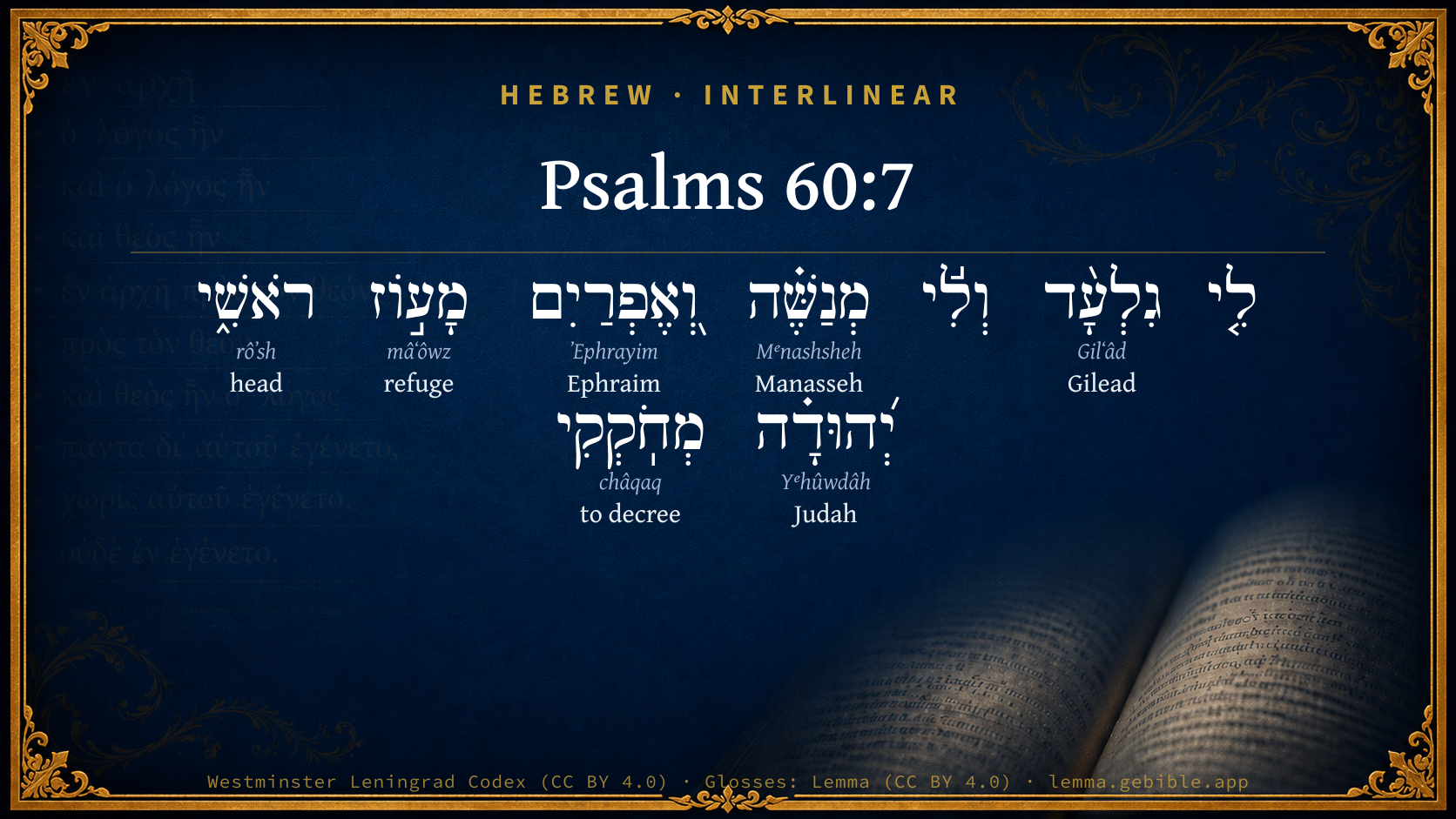
לִ֤י גִלְעָ֨ד וְלִ֬י מְנַשֶּׁ֗ה וְ֭אֶפְרַיִם מָע֣וֹז רֹאשִׁ֑י יְ֝הוּדָ֗ה מְחֹֽקְקִי
Gilead is mine, and Manasseh is mine. Ephraim also is the defense of my head. Judah is my scepter.
World English Bible · Public Domain
Gilead is mine, and Manasseh is mine. Ephraim also is the defense of my head. Judah is my scepter.
One document with this verse’s original text, its word-by-word gloss line, the meaning frame, cross-references with their text, attributed commentary, and full source and license credits — printable, and it pastes into notes with its structure intact.
This verse Autodidact and up
A passage Seminary Student
Up to 50 verses in one chapter. A passage sheet keeps up to 6 commentary sources and 12 cross-references per verse, in the order this page ranks them, and says so on the sheet whenever that leaves anything out. Ask for a single verse and you get the Autodidact verse sheet above.
Everything on this page stays free to read, with no account — the sheet is a download of what is already on screen, not access to it.
The same verse in 3 English versions, stacked beneath the original-language interlinear above. Click any original word for its lexicon entry.
Each is an independent rendering of the whole verse — the interlinear is not word-aligned to these translations.
Highlighted words mark where these versions differ — a whole-verse word diff, not a word-by-word alignment.
Gilead is mine, and Manasseh is mine. Ephraim also is the defense of my head. Judah is my scepter.
Gilead is mine, and Manasseh is mine; Ephraim also is the strength of mine head; Judah is my lawgiver;
To me Gilead, and to me Manasseh. And Ephraim the protection of my head; Judah, my scepter.
unfoldingWord Literal Text — © unfoldingWord, licensed CC BY-SA 4.0. Word-aligned USFM3 via Door43 (git.door43.org/unfoldingWord/en_ult).
Every available English version of this verse, each an independent rendering of the whole verse.
Gilead is mine, and Manasseh is mine. Ephraim also is the defense of my head. Judah is my scepter.
Gilead is Mine, and Manasseh is Mine; Ephraim is My helmet, Judah is My scepter.
Gilead is Mine, and Manasseh is Mine; Ephraim is My helmet, Judah is My scepter.
Gilead is mine, and Manasseh is mine; Ephraim also is the strength of mine head; Judah is my lawgiver;
Gilead is mine, and Manasseh is mine; Ephraim also is the defence of my head; Judah is my sceptre.
Gilead is mine, and Manasseh is mine; Ephraim also is the defence of mine head; Judah is my sceptre.
Gilead shalbe mine, and Manasseh shalbe mine: Ephraim also shalbe the strength of mine head: Iudah is my lawgiuer.
Save me with thy right hand, and hear me.
Mine `is' Gilead, and mine `is' Manasseh, And Ephraim `is' the strength of my head, Judah `is' my lawgiver,
Gilead [is] Mine, and Manasseh [is] Mine, || And Ephraim [is] the strength of My head, || Judah [is] My lawgiver,
Gilead is mine, and Manasseh is mine; Ephraim also is my helmet; Judah is my scepter.
To me Gilead, and to me Manasseh. And Ephraim the protection of my head; Judah, my scepter.
Gilead is mine, and Manasseh is mine, and Ephraim is the strength of my head; Judah is my law-giver;
Gilead is mine, and Manasseh is mine. Ephraim also is the defense of my head. Judah is my scepter.
\\60:5\\That thy beloved may be delivered; save with thy right hand, and hear me.
Both Gilead and Manasseh belong to me. Ephraim is my helmet, and Judah is my scepter.
Gilead is mine, and Manasseh is mine; and Ephraim is the strength of my head; Judah is my law-giver;
(60-9) Gilead is mine, and Manasseh is mine; Ephraim also is the defence of my head; Judah is my sceptre.
Literal Standard Version (2020), Covenant Press — licensed CC BY-SA 4.0. Text via the HelloAO Bible API (eBible.org). Unlocked Literal Bible (unfoldingWord) — licensed CC BY-SA 4.0. Text via the HelloAO Bible API (eBible.org). unfoldingWord Literal Text — © unfoldingWord, licensed CC BY-SA 4.0. Word-aligned USFM3 via Door43 (git.door43.org/unfoldingWord/en_ult). Free Bible Version, Dr. Jonathan Gallagher — licensed CC BY-SA 4.0. Text via the HelloAO Bible API (eBible.org).
More ways to search: Search by grammar → Find every occurrence → Compare this word →
Practice this passage: Drill this verse → Learn its vocabulary →
These counts appear in no published source. They are computed here, from the morphology-tagged text and Lemma’s own curated glosses. What Lemma adds →
Notable vocabulary
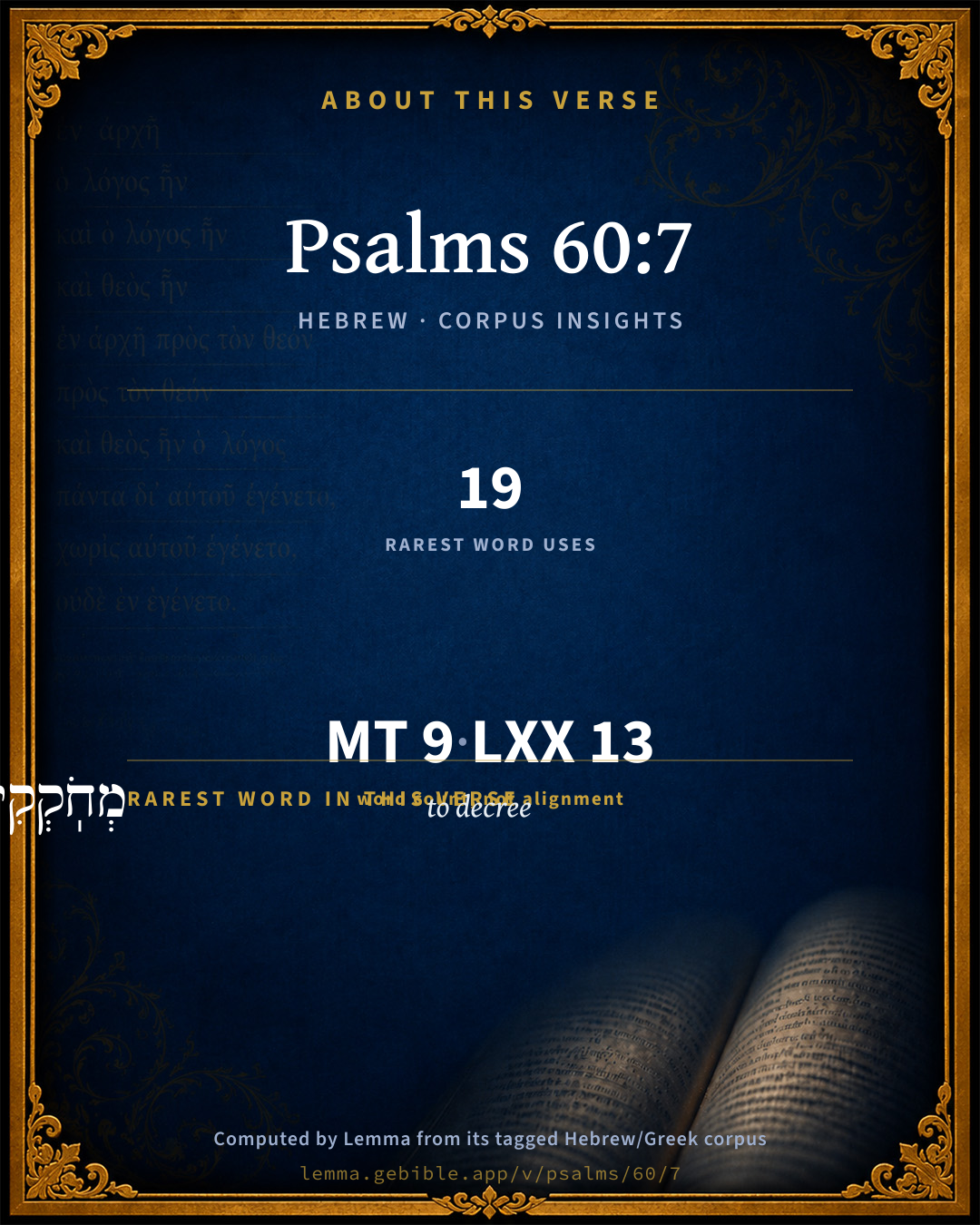
The rarest word here is מְחֹֽקְקִי to decree H2710 — appearing just 19 times in the whole Hebrew Bible.
Shared distinctive vocabulary
מְחֹֽקְקִי to decree H2710 occurs in 19 verses of the Hebrew Bible. Also found in:
Grammatical profile
Verb forms
Hebrew & Septuagint length
In English translation the verse runs 19 words from the Hebrew and 15 from the Septuagint (LXX English) — closely comparable.
A rough comparison of the two English renderings, which tokenize alike — not a word-level alignment.
Word counts can differ between the Hebrew and the Greek without any difference in meaning — e.g. the Hebrew direct-object marker אֵת has no separate Greek word, and Greek often adds the article ὁ.
In the original languages it is 9 Hebrew tokens and 13 Greek tokens — but the two are counted differently (Hebrew bundles its prefixes and suffixes into one token; the Greek is in lemma form), so that isn’t a like-for-like length.
Topical passages linked to Psalms 60:7 in the Treasury of Scripture Knowledge — connected by theme and wording, ordered by reader-vote popularity; previews shown in the World English Bible.
Cross-references courtesy of OpenBible.info (CC BY 4.0).
The same verse in the two great witnesses to the Old Testament, shown verse-for-verse.
You’re reading Greek Psalm 59 (Hebrew Psalm 60). The Septuagint counts the superscription, so verse numbers can differ from the Hebrew — chapter-level alignment, not verse-by-verse. Numbering follows Rahlfs.
These are two independent witnesses, not word-aligned to each other, and the Septuagint is shown in lemma (dictionary) form.
לִ֤י גִלְעָ֨ד וְלִ֬י מְנַשֶּׁ֗ה וְ֭אֶפְרַיִם מָע֣וֹז רֹאשִׁ֑י יְ֝הוּדָ֗ה מְחֹֽקְקִי
Gilead is mine, and Manasseh is mine. Ephraim also is the defense of my head. Judah is my scepter.
World English Bible · Public Domain
ὅπως ἄν ῥύομαι ὁ ἀγαπητός σύ σώζω ὁ δεξιός σύ καί ἐπιἀκούω ἐγώ
Galaad is mine, and Manasse is mine; and Ephraim is the strength of my head;
LXX2012 (modern English Septuagint) · Public Domain
On this verse, Ellicott's Commentary for English Readers discusses the Septuagint’s reading. Read the note in Commentary ↓
Hebrew: Westminster Leningrad Codex (CC BY 4.0). Greek: Septuagint (public domain); English from LXX2012 (modern English Septuagint) (Public Domain). How the Septuagint differs from the Hebrew →
Teaching starters — assembled from the data on this page, not authored interpretation. Every prompt links to the verse data it draws on. Edit before teaching.
Psalms, in the Wisdom, opens this verse with 9 words (7 distinct Hebrew lemmas). Its most distinctive word is châqaq (“to decree”). A historical commentator’s framing appears above. Read the whole chapter for the surrounding context.
Commentary
Notes on Psalms 60:7 from classic Christian and Jewish commentators (each source and its license shown beneath its notes). The classic Christian expositions comment on the surrounding passage and are grouped to its opening verse, so a note may address several verses; the Jewish commentaries on the Tanakh (Rashi and others) are per-verse, so they appear only where the commentator wrote on this verse.
Lemma curates 59 commentaries, every one of them public domain or Creative Commons licensed, each selected and text-cleaned for this edition rather than reprinted as found. About our sources →
Trapp's Complete Commentary
John Trapp
John Trapp, A Commentary or Exposition upon All the Books of the Old and New Testament (1647–1656) — public domain. Text from a community e-Sword module.
Joseph Benson's Commentary
Joseph Benson's Commentary on the Old and New Testaments (1811–1818) — public domain. Text from a community e-Sword module.
J. A. Alexander on Psalms
Joseph Addison Alexander
Joseph Addison Alexander, The Psalms Translated and Explained (1850) — public domain. Text from a community e-Sword module.
Geneva Bible (1599)
Geneva Bible translators
Geneva Bible (1599) marginal notes — public domain. Text via Bolls.life.
Jamieson, Fausset & Brown
Robert Jamieson, A. R. Fausset & David Brown
Jamieson, Fausset & Brown — Commentary Critical and Explanatory on the Whole Bible (1871) — public domain (CC PDM 1.0). Text via the HelloAO Bible API.
Adam Clarke's Commentary
Adam Clarke's Commentary on the Bible (1810–1826) — public domain. Text from a community e-Sword/MySword module.
Ellicott's Commentary for English Readers
A Bible Commentary for English Readers, edited by Charles John Ellicott (1878–1897) — public domain. Text from a community e-Sword module.
The Cambridge Bible for Schools and Colleges
gen. ed. J. J. S. Perowne
The Cambridge Bible for Schools and Colleges (gen. ed. J. J. S. Perowne; Cambridge University Press, 1878–1918) — public domain. Text from a community e-Sword module.
John Gill's Exposition
John Gill's Exposition of the Whole Bible (1746–1763) — public domain (CC PDM 1.0). Text via the HelloAO Bible API.
Albert Barnes' Notes on the Bible
Albert Barnes' Notes on the Bible (1834–1885) — public domain. Text from a community e-Sword/MySword module.
Matthew Poole's English Annotations
Matthew Poole's English Annotations on the Holy Bible (1683–1685) — public domain. Text from a community e-Sword/MySword module.
The Treasury of David
Charles H. Spurgeon
Charles H. Spurgeon's The Treasury of David (1869–1885) — public domain. Psalms only. Text from a community e-Sword/MySword module.
Whedon's Commentary on the Bible
Daniel D. Whedon
Daniel D. Whedon (gen. ed.), Commentary on the Old and New Testaments (1874–1909) — public domain. Text from a community e-Sword module.
The Pulpit Commentary
The Pulpit Commentary (1880–1919), ed. H.D.M. Spence-Jones & Joseph S. Exell — public domain. Text from a community e-Sword module.
John Wesley's Explanatory Notes
John Wesley, Explanatory Notes Upon the Whole Bible (1754–1765) — public domain. Text via the GEBible commentary corpus.
Rashi
Rabbi Shlomo Yitzchaki (Rashi)
Rashi on the Tanakh — English translations: “The Judaica Press complete Tanach with Rashi, translated by A. J. Rosenberg” (CC BY 4.0); “Pentateuch with Rashi's commentary by M. Rosenbaum and A.M. Silbermann, 1929-1934” (public domain); “The Metsudah Tanach series, Lakewood, N.J” (CC BY 4.0); and “The Book of Joshua, Metsudah Publications, 1997” (CC BY 4.0). Text via Sefaria.