
Hosea 11:3

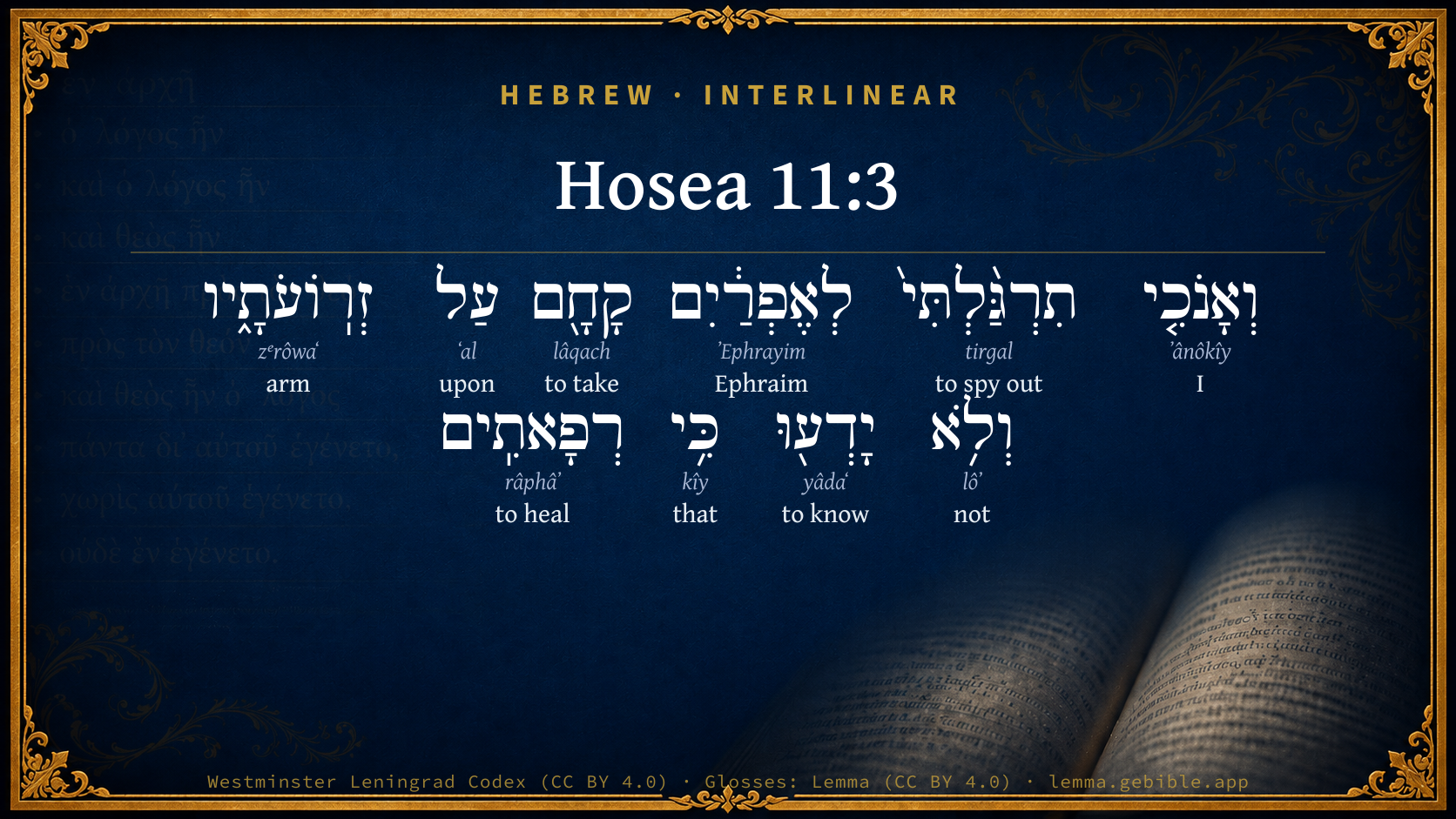
Hebrew (Westminster Leningrad Codex) Hosea 11:3 appears in the Hebrew Old Testament. The text above is from the Westminster Leningrad Codex. Each word links to its Strong’s number, a concise gloss, and parsing drawn from the Open Scriptures Hebrew Bible morphology. Click any word for its full Brown-Driver-Briggs (BDB) entry.
Download image
Cite this verse

Hosea 11:3 (World English Bible). Public Domain. Lemma interlinear Bible study tool, https://lemma.gebible.app/v/hosea/11/3.

Show BibTeX & RIS
BibTeX
RIS
English Translation
Yet I taught Ephraim to walk. I took them by his arms; But they didn't know that I healed them.
World English Bible · Public Domain
Highlights
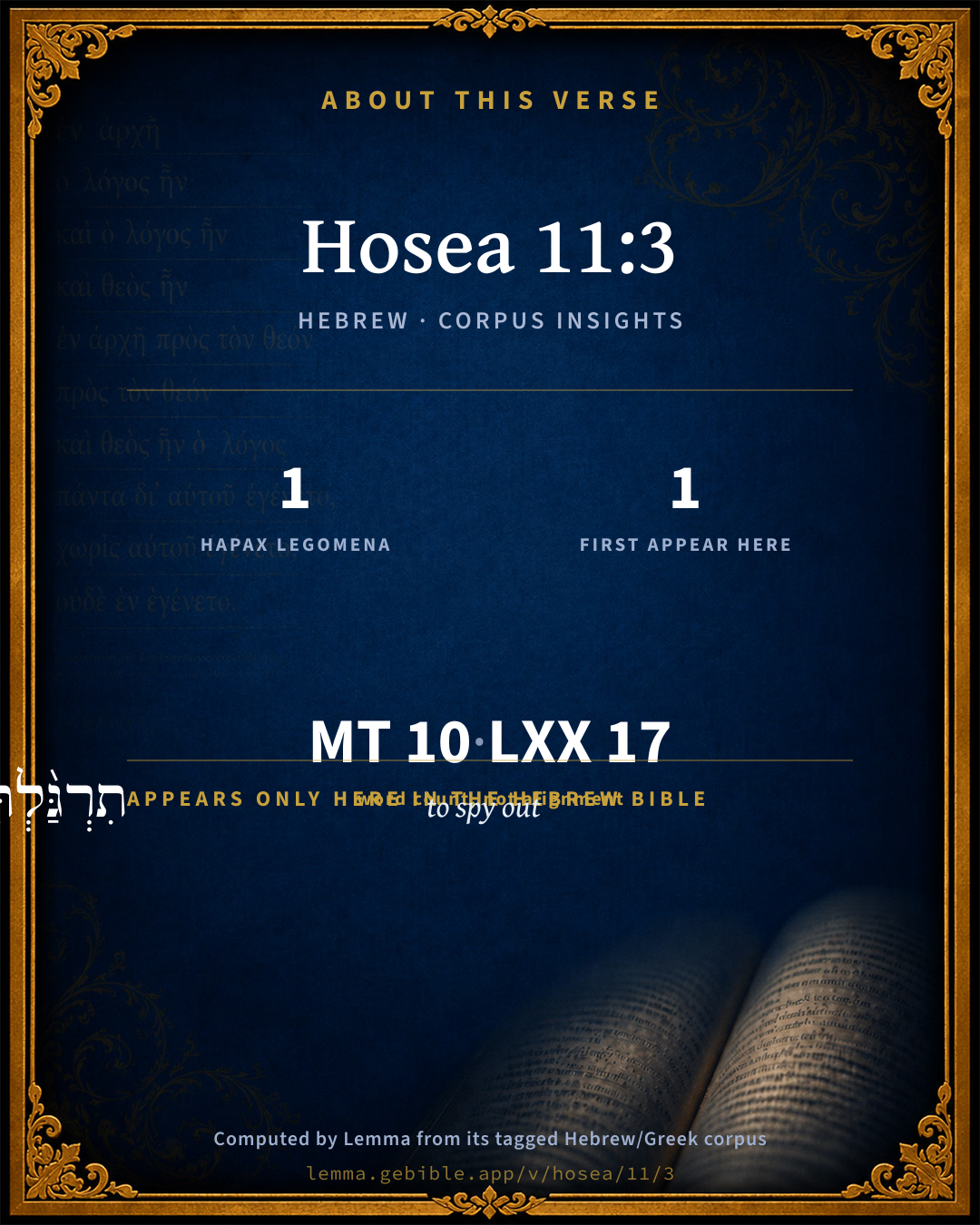
  • 1 hapax legomenon — only here in the Hebrew Bible
  • 1 first appearance in the Hebrew Bible
Full analysis ↓
Download a study sheet

One document with this verse’s original text, its word-by-word gloss line, the meaning frame, cross-references with their text, attributed commentary, and full source and license credits — printable, and it pastes into notes with its structure intact.

This verse Autodidact and up

Study sheet (.html) Plain text (.txt)

A passage Seminary Student

Up to 50 verses in one chapter. A passage sheet keeps up to 6 commentary sources and 12 cross-references per verse, in the order this page ranks them, and says so on the sheet whenever that leaves anything out. Ask for a single verse and you get the Autodidact verse sheet above.

Everything on this page stays free to read, with no account — the sheet is a download of what is already on screen, not access to it.

Want to remove ads? Support Godless Engineer
Compare translations 3

The same verse in 3 English versions, stacked beneath the original-language interlinear above. Click any original word for its lexicon entry.

Each is an independent rendering of the whole verse — the interlinear is not word-aligned to these translations.

Highlighted words mark where these versions differ — a whole-verse word diff, not a word-by-word alignment.

  • World English Bible Public Domain
    Yet I taught Ephraim to walk. I took them by his arms; But they didn't know that I healed them.
  • King James Version Public Domain
    I taught Ephraim also to go, taking them by their arms; but they knew not that I healed them.
  • unfoldingWord Literal Text CC BY-SA 4.0
    Yet I, I taught Ephraim to walk. he took them upon his arms, but they did not know that I healed them.

unfoldingWord Literal Text — © unfoldingWord, licensed CC BY-SA 4.0. Word-aligned USFM3 via Door43 (git.door43.org/unfoldingWord/en_ult).

Versions to compare (up to 4)

3 of 4 selected

Show all 18 translations

Every available English version of this verse, each an independent rendering of the whole verse.

  • World English Bible Public Domain
    Yet I taught Ephraim to walk. I took them by his arms; But they didn't know that I healed them.
  • Berean Standard Bible Public Domain
    It was I who taught Ephraim to walk, taking them in My arms, but they never realized that it was I who healed them.
  • Majority Standard Bible Public Domain
    It was I who taught Ephraim to walk, taking them by the arms, but they never realized that it was I who healed them.
  • King James Version Public Domain
    I taught Ephraim also to go, taking them by their arms; but they knew not that I healed them.
  • American Standard Version (1901) Public Domain
    Yet I taught Ephraim to walk; I took them on my arms; but they knew not that I healed them.
  • Revised Version (1885) Public Domain
    Yet I taught Ephraim to go; I took them on my arms; but they knew not that I healed them.
  • Geneva Bible (1599) Public Domain
    I ledde Ephraim also, as one shoulde beare them in his armes: but they knewe not that I healed them.
  • Douay-Rheims (1899) Public Domain
    And I was like a foster father to Ephraim, I carried them in my arms: and they knew not that I healed them.
  • Young's Literal Translation Public Domain
    And I have caused Ephraim to go on foot, Taking them by their arms, And they have not known that I strengthened them.
  • Literal Standard Version CC BY-SA 4.0
    And I have caused Ephraim to go on foot, || Taking them by their arms, || And they have not known that I strengthened them.
  • Unlocked Literal Bible CC BY-SA 4.0
    Yet it was I who taught Ephraim to walk. It was I who lifted them up by their arms, but they did not know that I cared for them.
  • unfoldingWord Literal Text CC BY-SA 4.0
    Yet I, I taught Ephraim to walk. he took them upon his arms, but they did not know that I healed them.
  • Darby Bible Public Domain
    And I it was that taught Ephraim to walk, -- He took them upon his arms, -- but they knew not that I healed them.
  • World Messianic Bible Public Domain
    Yet I taught Ephraim to walk. I took them by their arms, but they didn’t know that I healed them.
  • Webster's Bible Public Domain
    I taught Ephraim also to go, taking them by their arms; but they knew not that I healed them.
  • Free Bible Version CC BY-SA 4.0
    I myself taught Ephraim to walk, taking them by the hand, but they didn't realize I was the one who healed them.
  • Bible in Basic English Public Domain
    But I was guiding Ephraim's footsteps; I took them up in my arms, but they were not conscious that I was ready to make them well.
  • JPS Tanakh (1917) Public Domain
    And I, I taught Ephraim to walk, taking them by their arms; but they knew not that I healed them.

Literal Standard Version (2020), Covenant Press — licensed CC BY-SA 4.0. Text via the HelloAO Bible API (eBible.org). Unlocked Literal Bible (unfoldingWord) — licensed CC BY-SA 4.0. Text via the HelloAO Bible API (eBible.org). unfoldingWord Literal Text — © unfoldingWord, licensed CC BY-SA 4.0. Word-aligned USFM3 via Door43 (git.door43.org/unfoldingWord/en_ult). Free Bible Version, Dr. Jonathan Gallagher — licensed CC BY-SA 4.0. Text via the HelloAO Bible API (eBible.org).

Word by word

More ways to search: Search by grammar → Find every occurrence → Compare this word →

Practice this passage: Drill this verse → Learn its vocabulary →

תִרְגַּ֨לְתִּי֙
tirgal
H8637
“to spy out”
Verb, Tiphil, Perfect, 1st Person, Common, Singular
Part of Speech
Verb
Stem
Tiphil
Form
Perfect
Person
1st Person
Gender
Common
Number
Singular
Full BDB Definition

Origin: a denominative from H7270

TWOT: 2113

to go on foot, spy out, cause to walk - (Tiphel) to teach to walk
  1. וְאָנֹכִ֤י ʼânôkîy H595 “and · I” Conjunction + Pronoun, Personal, 1st Person, Common, Singular
  2. לְאֶפְרַ֔יִם ʼEphrayim H669 “to/for · Ephraim” Preposition + Noun, Proper
  3. קָחָ֖ם lâqach H3947 “to take · them” Verb, Qal, Perfect, 3rd Person, Masculine, Singular + Suffix, Personal, 3rd Person, Masculine, Plural
  4. עַל ʻal H5921 “upon” Preposition
  5. זְרֽוֹעֹתָ֑יו zᵉrôwaʻ H2220 “arms · his” Noun, Common, Both, Plural, Construct + Suffix, Personal, 3rd Person, Masculine, Singular
  6. וְלֹ֥א lôʼ H3808 “and · not” Conjunction + Particle, Negative
  7. יָדְע֖וּ yâdaʻ H3045 “to know” Verb, Qal, Perfect, 3rd Person, Common, Plural
  8. כִּ֥י kîy H3588 “that” Conjunction
  9. רְפָאתִֽים râphâʼ H7495 “to heal · them” Verb, Qal, Perfect, 1st Person, Common, Singular + Suffix, Personal, 3rd Person, Masculine, Plural

About this verse

These counts appear in no published source. They are computed here, from the morphology-tagged text and Lemma’s own curated glosses. What Lemma adds →

10
words
10
distinct lemmas
Prophets
section

Notable vocabulary

1 hapax legomenon — a word that appears only here in the entire Hebrew Bible:

  • תִרְגַּ֨לְתִּי֙ to spy out H8637

First appearance in Scripture

This word makes its first canonical appearance in the Hebrew Bible here:

  • תִרְגַּ֨לְתִּי֙ to spy out H8637

Grammatical profile

  • 4 verbs
  • 2 nouns
  • 1 pronoun
  • 1 preposition
  • 1 conjunction
  • 1 particle

Verb forms

  • תִרְגַּ֨לְתִּי֙ Tiphil · Perfect
  • קָחָ֖ם Qal · Perfect
  • יָדְע֖וּ Qal · Perfect
  • רְפָאתִֽים Qal · Perfect

Hebrew & Septuagint length

In English translation the verse runs 20 words from the Hebrew and 21 from the Septuagint (LXX English) — closely comparable.

A rough comparison of the two English renderings, which tokenize alike — not a word-level alignment.

Word counts can differ between the Hebrew and the Greek without any difference in meaning — e.g. the Hebrew direct-object marker אֵת has no separate Greek word, and Greek often adds the article ὁ.

In the original languages it is 10 Hebrew tokens and 17 Greek tokens — but the two are counted differently (Hebrew bundles its prefixes and suffixes into one token; the Greek is in lemma form), so that isn’t a like-for-like length.

Cross-references

18

Topical passages linked to Hosea 11:3 in the Treasury of Scripture Knowledge — connected by theme and wording, ordered by reader-vote popularity; previews shown in the World English Bible.

  • Exodus 15:26 and he said, "If you will diligently listen to the voice of Yahweh your God, and will do that which is right in his eyes, and will pay attention to his commandments, and keep all his statutes, I will put none of the diseases on you, which I have put on the Egyptians; for I am Yahweh who heals you."
  • Deuteronomy 1:31 and in the wilderness, where you have seen how that Yahweh your God bore you, as a man does bear his son, in all the way that you went, until you came to this place.
  • Jeremiah 30:17 For I will restore health to you, and I will heal you of your wounds, says Yahweh; because they have called you an outcast, [saying], It is Zion, whom no man seeks after.
  • Hosea 7:15 Though I have taught and strengthened their arms, Yet they plot evil against me.
  • Exodus 23:25 You shall serve Yahweh your God, and he will bless your bread and your water, and I will take sickness away from your midst.
  • Deuteronomy 8:2 You shall remember all the way which Yahweh your God has led you these forty years in the wilderness, that he might humble you, to prove you, to know what was in your heart, whether you would keep his commandments, or not.
  • Deuteronomy 32:10–12 He found him in a desert land, In the waste howling wilderness; He compassed him about, he cared for him, He kept him as the apple of his eye.
  • Isaiah 30:26 Moreover the light of the moon shall be as the light of the sun, and the light of the sun shall be sevenfold, as the light of seven days, in the day that Yahweh binds up the hurt of his people, and heals the stroke of their wound.
  • Isaiah 46:3 Listen to me, house of Jacob, and all the remnant of the house of Israel, that have been borne [by me] from their birth, that have been carried from the womb;
  • Isaiah 63:9 In all their affliction he was afflicted, and the angel of his presence saved them: in his love and in his pity he redeemed them; and he bore them, and carried them all the days of old.
  • Hosea 2:8 For she did not know that I gave her the grain, the new wine, and the oil, And multiplied to her silver and gold, which they used for Baal.
  • Hosea 7:1 When I would heal Israel, Then the iniquity of Ephraim is uncovered, Also the wickedness of Samaria; For they commit falsehood, And the thief enters in, And the gang of robbers ravages outside.
  • Hosea 14:4 "I will heal their waywardness. I will love them freely; For my anger is turned away from him.
  • Acts 13:18 For a period of about forty years he put up with them in the wilderness.
  • Exodus 19:4 'You have seen what I did to the Egyptians, and how I bore you on eagles' wings, and brought you to myself.
  • Numbers 11:11–12 Moses said to Yahweh, Why have you dealt ill with your servant? and why haven't I found favor in your sight, that you lay the burden of all this people on me?
  • Isaiah 1:2 Hear, heavens, And listen, earth; for Yahweh has spoken: I have nourished and brought up children, And they have rebelled against me.
  • Jeremiah 8:22 Is there no balm in Gilead? is there no physician there? why then isn't the health of the daughter of my people recovered?

Cross-references courtesy of OpenBible.info (CC BY 4.0).

Hebrew and Greek witnesses Masoretic Hebrew ↔ Greek Septuagint

The same verse in the two great witnesses to the Old Testament, shown verse-for-verse.

These are two independent witnesses, not word-aligned to each other, and the Septuagint is shown in lemma (dictionary) form.

Hebrew Hosea 11:3 Masoretic · Westminster Leningrad Codex

וְאָנֹכִ֤י תִרְגַּ֨לְתִּי֙ לְאֶפְרַ֔יִם קָחָ֖ם עַל זְרֽוֹעֹתָ֑יו וְלֹ֥א יָדְע֖וּ כִּ֥י רְפָאתִֽים

Yet I taught Ephraim to walk. I took them by his arms; But they didn't know that I healed them.

World English Bible · Public Domain

Greek LXX Hosea 11:3 Septuagint · lemma form

καί ἐγώ συνποδίζω ὁ ἐφράιμ ἀναλαμβάνω αὐτός ἐπί ὁ βραχίων ἐγώ καί οὐ γιγνώσκω ὅτι ἰάομαι αὐτός

Yet I bound the feet of Ephraim, I took him on my arm; but they knew not that I healed them.

LXX2012 (modern English Septuagint) · Public Domain

On this verse, The Pulpit Commentary discusses the Septuagint’s reading. Read the note in Commentary ↓

Hebrew: Westminster Leningrad Codex (CC BY 4.0). Greek: Septuagint (public domain); English from LXX2012 (modern English Septuagint) (Public Domain). How the Septuagint differs from the Hebrew →

Targum (Aramaic paraphrase)

1

The Targum is the ancient Jewish Aramaic paraphrase of the Hebrew Scriptures — an interpretive translation, not the Hebrew text itself. Onkelos (literal) and Pseudo-Jonathan (expansive) render the Torah, and Jonathan the Prophets. Coverage is partial: where no permissively-licensed English translation exists for a verse, only the Aramaic is shown. This is verse-level text, not a word-by-word alignment to the Hebrew.

  1. Targum Jonathan Prophets (Joshua–Malachi)
    וַאֲנָא בְמַלְאָךְ שְׁלִיחַ מִן קָדָמַי דַבְּרֵית בְּאוֹרַח תַּקְנָא לְיִשְׂרָאֵל וּנְטַלְתִּינוּן כִּדְעַל דַרְעִין וְלָא יָדְעִין דְמִן קָדָמַי מִתְרַחֵים עֲלֵיהוֹן:

    (no public-domain English translation for this verse)

    Targum Jonathan — Aramaic: “Mikraot Gedolot” (public domain). English: “Sefaria Community Translation” (CC0 1.0 (public-domain dedication)); “London "Chaldee Paraphrase," 1871” (public domain). Text via Sefaria.

Commentary

Notes on Hosea 11:3 from classic Christian and Jewish commentators (each source and its license shown beneath its notes). The classic Christian expositions comment on the surrounding passage and are grouped to its opening verse, so a note may address several verses; the Jewish commentaries on the Tanakh (Rashi and others) are per-verse, so they appear only where the commentator wrote on this verse.

Lemma curates 59 commentaries, every one of them public domain or Creative Commons licensed, each selected and text-cleaned for this edition rather than reprinted as found. About our sources →

Trapp's Complete Commentary

John Trapp

Hos 11:3 I taught Ephraim also to go, taking them by their arms; but they knew not that I healed them.

Ver. 3. I taught Ephraim also to go] A child he was, Hos 11:1, and like a child I dealt with him, teaching him how to set his feet, pedare, to foot it, as nurses do their little ones: he keepeth the feet of his saints, 1Sa 2:9; he guideth their feet in the way of peace, Luk 1:79. See for this, Deu 1:31; Deu 32:11 Num 11:12. So great is the goodness of God to his people, that he dealeth with us as with his little children, nos sublevando, submonendo, docendo, ducendo, regendo, tegendo, convocando, condonando, portando, confortando, &c., we are supported, admonished, taught, lead, guided, protected, assembled, forgiven, carried, comforted, saith a learned interpreter truly, and trimly (Tarnovius). He speaketh unto us as unto children, Heb 12:5 paterne diligit, amice dirigit, he loveth us as a father, he directs us as a friend, guiding us with his eye, leading us in his hand, setting us between his knees, as some interpret that text, Deu 33:3, setting us upon his knees, as a father doth his darling, and rejoicing over us with joy, yea, joying over us with singing, Zep 3:17. His affections are more than fatherly; and his expressions are according. "We are like infants" (saith Mr Baine), "newly born in a manner. They are kept by the loving parents from fire and water; they are fed, laid to sleep, made ready, and unready, and shifted in their scapes, but they know not who doth all this for them. So doth our heavenly Father by us in Christ." But (he knows) little understanding have we of him. After this, he teacheth us to go,

taking us by the arms.] to help our feeble knees. And taking us up in his own arms, when we come to a foul or rough place, helping us over the quagmires of crosses, and the difficulties of duties. And whereas we fall seven times a day, and in many things fail all; he taketh us up after that we have caught a knock, and cherisheth us in his bosom, &c. Montanus and Junius carry the sense another way, as if the words were not a description of God’s love to the people, but of their unthankfulness to God; rendering the words thus: When, as I inform Ephraim, he taketh them in his arms, that is, he setteth up idols, and after the manner of impudent and shameless strumpets, he taketh the puppets in his arms, and embraceth them before my face. But I like the former sense better.

But they knew not that I healed them] Not only held them, that they might not fall, but healed them when they had fallen. Daring they would be sometimes to stand upon their own legs, to prevail by their own strength, 1Sa 2:9, to say with her in the poet, Consilii satis est in me mihi, &c. (Arachno apud Ovid. Metam.). I am wise enough, and able enough to go on, as if they were petty gods within themselves, and had no need of nor dependance upon me. Hence they hurt themselves, but I healed them. I forgave all their iniquities, I healed all their diseases, Psa 103:3, their bruises and putrefying sores, that else had not been closed, bound up, nor mollified with ointment, Isa 1:6. God left not his people in their low estate, as some physicians do their patients; but provided a sovereign salve, a horn of salvation, such as would cure any disease or maim, {a} even the sin against the Holy Ghost too, but that it is the nature of it to rage and rave both against the physic and the physician. Christ is both the one and the other; as being made unto us of God, wisdom righteousness, sanctification, and redemption, 1Co 1:30. Quod sanitas in corpore, id sanctitas in corde. He is Jehovah that healeth for he is Jehovah that sanctifieth. This Ephraim knew not, that is, out of pride and stoutness they acknowledged it not, but sacrificed to their own nets, wits, endeavours, &c. Of all things God can least endure to be neglected or to have the glory of his benefits transferred upon others, {see Hos 2:8, with the note} When men shall either say, in the language of Ashdod, It is a chance, or else, I have made myself thus and thus happy, 1Sa 6:9 this, though the saints should at any time do yet God will pardon their frowardness, and say as Isa 57:17-18, I have seen his ways, his waywardness, and will heal him nevertheless and restore comforts to him.

{a} An injury to the body which causes the loss of a limb, or of the use of it; a mutilation, or mutilating wound. †In early use more widely, any lasting wound or bodily injury. ŒD

John Trapp, A Commentary or Exposition upon All the Books of the Old and New Testament (1647–1656) — public domain. Text from a community e-Sword module.

The Biblical Illustrator

Joseph S. Exell

Hos_11:3

I taught Ephraim also to go, taking them by their arms.

Taken by the arm

When God redeems and shelters His people by the blood of the Paschal Lamb,--i.e., of Christ our Passover sacrificed for us--and gives them His law, telling them to serve Him, He does not leave them to their own strength, but gives them power to do what He bids them: He teaches them how to go, taking them, as a nurse would, by the arms. Our obedience is not the cause which procures or awakens Gods love to us, but His love is the cause that procures and awakens our obedience. The text tells us what God is doing for the true disciples of Jesus, and how God undertakes to teach them how to go. Taking them by the arms. As a nurse teaches a helpless child to walk, He invites us to rely upon His strength and watchful care. He knows our weakness. The thought may be illustrated by Deu_32:11. In this life we cannot go without the support of Christ; but there are different ways in which He gives this to His people. At first He teaches them to fight against their own evil passions, to resist their own wayward wills, to quench their fiery temptations. But soon they pass onward. The new nature moves, stirs, waxes stronger, grows; the old decays. At first He leads, He guides them against their will, then without it, and it is a happy day when their will cheerfully goes along with His; then they are taught to go. (W. Grant.)

But they knew not that I healed them.

Unrecognised blessings

Two different types of ignorance in relation to two different methods of Divine dealings. Look--

1. At the words uttered by the Lord to Cyrus, the Persian king--I girded thee, though thou hast not known Me (Isa_45:5). From these words we learn that while God uses His own people for a gracious purpose, they are not the only people that He uses for the furtherance of His designs. He places men in high positions, and by their instrumentality He often brings about the fulfilment of His own purpose, though they themselves have had no conscious part in the accomplishment of such a glorious end.

2. Our text points to a very different dealing, namely, Gods treatment of the Jewish people. The ignorance of Cyrus, as a heathen, was not the culpable thing that ignorance of God on the part of any king of Israel or Judah would have been. God had granted Israel a special revelation, and admitted them into an exceptional relationship with Himself as His people. Notwithstanding all Gods goodness to Israel, Hosea says, in Gods name, They knew not that I healed them. Thus we have two types of ignorance. That of the man who has never been brought under godly influence; and the wilful ignorance of those who sin against the light, and in spite of gracious influences. The latter is the only ignorance possible to us. The surprising thing about Israel was that they could be so ignorant of Gods goodness after all that He had done for them. Knowledge of God they had, but it had formed no part of their being, had not permeated their character and life, and had not given a bent to their conduct. Their attitude Godward was atheistic. They talked flippantly enough about their history, but there was no gratitude in the heart that would mould and fashion life into submissive obedience to the law of God. Thus their ignorance was all the worse for being so wilful and persistent. Ye are weary of Me, exclaimed God to them. I know of no charge more pathetic than that. This ignorance is the result of the blinding power of a sinful passion; an ignorance which will not let a man know the truth because he is too closely wedded to his evil. (D. Davies.)

The Biblical Illustrator, edited by Joseph S. Exell (c. 1880s–1900s) — public domain. Text from a community e-Sword module.

Joseph Benson's Commentary

Hos 11:3-4. I taught Ephraim also to go — Hebrew, תרגלתי לאפרים, I directed the feet of Ephraim. In this time of Ephraim’s childhood, I supported and directed his steps, as a mother or nurse those of a child whom she is teaching to walk. Taking them by their arms — To guide them, that they might not stray from the right way; and to hold them up, that they might not stumble and fall: see notes on Deu 1:31; Deu 32:11-12; Isaiah 63. Thus did God deal with Israel in the wilderness; and thus he directs and supports the steps of his spiritual Israel, amidst all their difficulties and dangers. But they knew not that I healed them — They did not acknowledge this my care over, and kindness to, them. I drew them with cords of a man — I made use of those means of drawing them to myself, which were most proper to work upon them as creatures possessed of understanding and affection. The explanation in the Chaldee is just and beautiful: “As beloved children are drawn, I drew them by the strength of love.” And I was to them as they that take off the yoke on their jaws — Or rather, on their cheek. As a careful husbandman, in due season, takes the yoke from his labouring oxen, and takes off the muzzle with which they were kept from eating when at work; so compassionately did I give relief to, and provide sustenance for Israel. I laid meat unto them — Brought them provision in their wants. God seems here to allude to the manna and quails which he provided for his people in the wilderness.

Joseph Benson's Commentary on the Old and New Testaments (1811–1818) — public domain. Text from a community e-Sword module.

Keil & Delitzsch

C. F. Keil & F. Delitzsch

Nevertheless the Lord continued to show love to them. Hos 11:3, Hos 11:4. "And I, I have taught Ephraim to walk: He took them in His arms, and they did not know that I healed them. I drew them with bands of a man, with cords of love, and became to them like a lifter up of the yoke upon their jaws, and gently towards him did I give (him) food." תּרגּלתּי, a hiphil, formed after the Aramaean fashion (cf. Ges. 55, 5), by hardening the ה into ת, and construed with ל, as the hiphil frequently is (e.g., Hos 10:1; Amo 8:9), a denom. of רגל, to teach to walk, to guide in leading-strings, like a child that is being trained to walk. It is a figurative representation of paternal care foz a child's prosperity. קחם, per aphaeresin, for לקחם, like קח for לקח in Eze 17:5. The sudden change from the first person to the third seems very strange to our ears; but it is not uncommon in Hebrew, and is to be accounted for here from the fact, that the prophet could very easily pass from speaking in the name of God to speaking of God Himself. קח cannot be either an infinitive or a participle, on account of the following word זרועתיו, his arms. The two clauses refer chiefly to the care and help afforded by the Lord to His people in the Arabian desert; and the prophet had Deu 1:31 floating before his mind: "in the wilderness the Lord thy God bare thee, as a man doth bear his son." The last clause also refers to this, רפאתים pointing back to Exo 15:26, where the Lord showed Himself as the physician of Israel, by making the bitter water at Marah drinkable, and at the same time as their helper out of every trouble. In Hos 11:4, again, there is a still further reference to the manifestation of the love of God to Israel on the journey through the wilderness. חבלי אדם, cords with which men are led, more especially children that are weak upon their feet, in contrast with ropes, with which men control wild, unmanageable beasts (Psa 32:9), are a figurative representation of the paternal, human guidance of Israel, as explained in the next figure, "cords of love." This figure leads on to the kindred figure of the yoke laid upon beasts, to harness them for work. As merciful masters lift up the yoke upon the cheeks of their oxen, i.e., push it so far back that the animals can eat their food in comfort, so has the Lord made the yoke of the law, which has been laid upon His people, both soft and light. As הרים על על does not mean to take the yoke away from (מעל) the cheeks, but to lift it above the cheeks, i.e., to make it easier, by pushing it back, we cannot refer the words to the liberation of Israel from the bondage of Egypt, but can only think of what the Lord did, to make it easy for the people to observe the commandments imposed upon them, when they were received into His covenant (Exo 24:3, Exo 24:7), including not only the many manifestations of mercy which might and ought to have allured them to reciprocate His love, and yield a willing obedience to His commandments, but also the means of grace provided in their worship, partly in the institution of sacrifice, by which a way of approach was opened to divine grace to obtain forgiveness of sin, and partly in the institution of feasts, at which they could rejoice in the gracious gifts of their God. ואט is not the first pers. imperf. hiphil of נטה ("I inclined myself to him;" Symm., Syr., and others), in which case we should expect ואט, but an adverb, softly, comfortably; and אליו belongs to it, after the analogy of Sa2 18:5. אוכיל is an anomalous formation for אאכיל, like אוביד for אאביד in Jer 46:8 (cf. Ewald, 192, d; Ges. 68, 2, Anm. 1). Jerome has given the meaning quite correctly: "and I gave them manna for food in the desert, which they enjoyed."

Keil & Delitzsch — Biblical Commentary on the Old Testament (1861–1891) — public domain (CC PDM 1.0). Text via the HelloAO Bible API. (Old Testament only.)

Tyndale Open Study Notes

Tyndale Open Resources

11:3-4 God’s nurture of the infant Israel was marked by kindness and love.

Tyndale Open Study Notes — © Tyndale Open Resources, licensed CC BY-SA 4.0. Text via the HelloAO Bible API.

Jamieson, Fausset & Brown

Robert Jamieson, A. R. Fausset & David Brown

taught . . . to go--literally "to use his feet." Compare a similar image, Deu 1:31; Deu 8:2, Deu 8:5, Deu 8:15; Deu 32:10-11; Neh 9:21; Isa 63:9; Amo 2:10. God bore them as a parent does an infant, unable to supply itself, so that it has no anxiety about food, raiment, and its going forth. Act 13:18, which probably refers to this passage of Hosea; He took them by the arms, to guide them that they might not stray, and to hold them up that they might not stumble.

knew not that I healed them--that is, that My design was to restore them spiritually and temporally (Exo 15:26).

Jamieson, Fausset & Brown — Commentary Critical and Explanatory on the Whole Bible (1871) — public domain (CC PDM 1.0). Text via the HelloAO Bible API.

Adam Clarke's Commentary

Verse 3. I taught Ephraim also to go] An allusion to a mother or nurse teaching a child to walk, directing it how to lift and lay its feet, and supporting it in the meantime by the arms, that it may use its feet with the greater ease. This is a passage truly pathetic.

Adam Clarke's Commentary on the Bible (1810–1826) — public domain. Text from a community e-Sword/MySword module.

John Calvin's Commentaries

Here again God amplifies the sin of the people, by saying, that by no kindness, even for a long time, could they be allured, or turned, or reformed, or reduced to a sound mind. It was surely enough that the people of Israeli who had been brought by the hand of God from the grave to the light of life, should have repudiated every instruction; it was a great and an atrocious sin; but now God goes on farther, and says, that he had not ceased to show his love to them, and yet had attained nothing by his perseverance; for the wickedness and depravity of the people were incurable. Hence he says, I have led Ephraim on foot Some are of opinion that it is a noun, from רגל, regel, foot, and it seems the most suitable. For otherwise there will be a change of a letter, which grammarians do not allow in the beginning of a word; for ת, tau, in this case would be put instead of ה, he; and put so as if it was of frequent occurrence in Hebrew; but no such instance can be adduced. So they who are skilful in the language think that for this reason it is a noun, and with them I agree. They, however, who regard it as a verb, give this view, — “I have led him on foot, תרגלתי, teregelti; that is, as a child who cannot yet walk with a firm foot, is by degrees accustomed to do so, and the nurse, or the father, or the mother, who lead him, have a regard for his infancy; so also have I led Israel, as much as his feet could bear. But the other version is less obscure, and that is, My walking on foot was for him; that is, I humbled myself as mothers are wont to do; and hence he says, that he had carried the people on his shoulders; and we shall presently see the same comparison used. And Moses says in Deuteronomy, that the people had been carried on God’s wings, or that God had expanded his wings like the eagle who flies over her young ones. With regard to the matter itself the meaning of the Prophet is not obscure; for he means, that this people had been treated by God in a paternal and indulgent manner; and also, that the perseverance of the Lord in continuing to bestow his blessings on them had been without any fruit.

He afterwards adds, To carry on his arms Some render the expression, קחם, kochem, “He carried them,” as if the verb were in the past tense; and they consider the word, Moses, to be understood. But it is God who speaks here. Some think it to be an infinitive — “To carry,” as when one carries another on his shoulders; and this seems to be the most suitable exposition. There is in the sense no ambiguity; for the design of the Prophet is what I have already stated, which is to show that this people were most wicked in not obeying God, since they had been so kindly treated by Him. For what could they have expected more than what God had done for them? As he also says by Isaiah, ‘What, my vine, ought I to have done more than what I have done?’ So also in this place, My walking has been on foot with Ephraim; and for this end, to carry them, as when one carries another in his arms. ‘They yet,’ he says, ‘did not know that I healed them;’ that is, “Neither the beginning of my goodness, nor its continued exercise, avails anything with them. When I brought them forth from Egypt, I restored the dead to life; this kindness has been blotted out. Again, in the desert I testified, in various ways, that I was their best and most indulgent Father: I have in this instance also lost all my labour.” How so? “Because my favour has been in no way acknowledged by this perverse and foolish people.” We now then see what the Prophet meant: and he continues the same subject in the next verse.

John Calvin's Commentaries (1540-1563) — public domain. Text from the Calvin Translation Society English edition (1840s-50s) via the Christian Classics Ethereal Library (ccel.org). Calvin's coverage is partial (roughly two-thirds of the Bible); uncommented books and verses are honest gaps, never fabricated. The 19th-century editor's footnotes and remarks are omitted so the notes are faithfully Calvin's own voice.

Ellicott's Commentary for English Readers

(3) Read, Yet it was I who guided Ephraim’s steps, taking him by his arms. There is a beautiful parallel to this in Deu_32:10-11.

Knew not . . .—This obtuseness to the source of all mercies—the refusal to recognise the true origin in Divine revelation of those ideas which, though they bless and beautify life, are not recognised as such revelation, but are treated as “the voice of nature,” or “development of humanity,” or “dictum of human reason “—is one of the commonest and most deadly sins of modern Christendom. The unwillingness to recognise the Divine Hand in “creation,” “literature,” “history” takes the opposed forms of Pantheism and Pyrrhonism. To each of these the prophet’s words apply.

A Bible Commentary for English Readers, edited by Charles John Ellicott (1878–1897) — public domain. Text from a community e-Sword module.

The Cambridge Bible for Schools and Colleges

gen. ed. J. J. S. Perowne

3. I taught Ephraim also to go] Rather, Whereas I taught Ephraim to go. A figure for the special providence watching over Ephraim. Not Judah, but Ephraim, is spoken of, for the kingdom of Israel embraced the fairer part of the territory, and was far stronger than that of Judah.

taking them by their arms] Rather, if we accept the Massoretic reading, ‘he took them up in his arms.’ There are however grave philological objections to this rendering, and we should probably, with most of the versions, correct the reading, and translate, I took them up in my arms. There is a beautiful climax in this part of the figure; not only did Jehovah train Israel to walk, but when he was tired, Jehovah carried him in his arms, comp. Isa_63:9; Deu_1:31, (Deu_32:11), and comp. a parallel passage in the Rig-Veda (x. 69, 10, Max Müller), ‘Thou barest him as a father bears his son in his lap.’

they knew not] i.e. they recognized not (as Hos_1:3).

that I healed them] The same figure as in Hos_5:13, Hos_6:1, Hos_7:1. Comp. Exo_15:26, ‘for I am Jehovah thy healer.’

The Cambridge Bible for Schools and Colleges (gen. ed. J. J. S. Perowne; Cambridge University Press, 1878–1918) — public domain. Text from a community e-Sword module.

John Gill's Exposition

I taught Ephraim also to go,.... All the tribes of Israel and Ephraim, or the ten tribes with the rest; these the Lord instructed in the way of his commandments, and taught them to walk therein; he his angel before them, to conduct them through the wilderness; yea, he himself went before them in the pillar of cloud by day, and in the pillar of fire by night, to which history this seems to refer. So the Targum,

"I, by an angel sent by me, led Israel in the right way.''

The allusion seems to be to a mother or nurse accommodating herself to her child, beginning to go; she stoops down, sets it on its feet, and one foot before another, forms its steps, teaches it how to go, and walks its pace with it. And in like manner the Lord deals with his spiritual Israel, his regenerated ones, who become like little children, and are used as such; as in regeneration they are quickened, and have some degree of spiritual strength given them, they are taught to go; they are taught what a Saviour Christ is, and their need of him; they are instructed to go to him by faith for everything they want, and to walk by faith on him, as they have received him; and having heard and learned of the Father, they go to Christ, Joh 6:45; and are taught also to go to the throne of grace for all supplies of grace; and to the house of God, to attend the word and ordinances, for the benefit of their souls; and to walk in the ways of the Lord, for his glory, and their good;

taking them by their arms; or "on his own arms" (x); bearing and carrying them in his arms, as a father his son; see Deu 1:31 Num 11:12; so the Lord deals with his spiritual Israel, either holding them by their arms while walking, as nurses their children, to help and ease them in walking, and that they may not stumble and fall; so the Lord holds up the goings of his people in his ways, that their footsteps slip not, and upholds them with the right hand of his righteousness: or taking them up in his own arms when weary, he carries them in his bosom; or, when they are failing or fallen, lays hold on them, and takes them up again; and so they are not utterly cast down, whether the fall is into sin, or into some calamity and affliction; when he puts underneath his everlasting arms, and bears them and keeps them from sinking, as well as from a final and total falling away. Abarbinel, and others after him, interpret this of Ephraim taking up and carrying in his arms Baalim, the graven images and golden calves; which is mentioned as an instance of ingratitude; but very wrongly;

but they knew not that I healed them; of the diseases of Egypt, or preserved them from them: this includes the whole of their salvation and deliverance from Egypt, and all the benefits and favours accompanying it, which they imputed to their idols, and not to the Lord; see Exo 15:26. "Healing", in a spiritual sense, generally signifies the forgiveness of sin, which the Lord's people may have, and not know it; and, through want of better light and knowledge, may also ascribe it to their repentance, humiliation, and tears, when it is alone owing to the grace of God, and blood of Christ.

(x) "super brachiis suis", Montanus; "super brachia sua", Piscator; "in brachis sua", Cocceius.

John Gill's Exposition of the Whole Bible (1746–1763) — public domain (CC PDM 1.0). Text via the HelloAO Bible API.

Albert Barnes' Notes on the Bible

I taught Ephraim also to go - Literally, “and I set Ephraim on his feet;” i. e., while they were rebelling, I was helping and supporting them, as a nurse doth her child, teaching it to go with little steps, step by step, “accustoming it to go by little and little without weariness;” and not only so, but “taking them by their arms;” or it may be equally translated, “He took them in His arms,” i. e., God not only gently “taught” them “to walk,” but when they were wearied, “He took them up in His arms,” as a nurse doth a child when tired with its little attempts to walk. Such was the love and tender care of God, guiding and upholding Israel in His ways which He taught him, guarding him from weariness, or, if wearied, taking him in the arms of His mercy and refreshing him. So Moses says, “In the wilderness thou hast seen, how that the Lord thy God bare thee, as a man doth bear his son, in all the way that ye went, until ye came unto this place” Deu 1:31; and he expostulates with God, “Have I conceived all this people? have I begotten them, that Thou shouldest say unto me, Carry them in thy bosom, as a nursing father beareth his sucking child, unto the land which Thou swarest unto their father’s?” Num 11:12. : “Briefly yet magnificently doth this place hint at the wondrous patience of God, whereof Paul too speaks, “for forty years suffered He their manner’s in the wilderness” Act 13:18.

For as a nursing father beareth patiently with a child, who hath not yet come to years of discretion, and, although at times he be moved to strike it in return, yet mostly he sootheth its childish follies with blandishments, and, ungrateful though it be, carries it in his arms, so the Lord God, whose are these words, patiently bore with the unformed people, ignorant of the spiritual mysteries of the kingdom of heaven, and although He killed the bodies of many of them in the wilderness yet the rest He soothed with many and great miracles, “leading them about, and instructing them, (as Moses says) keeping them as the apple of His eye” Deu 32:10.

But they knew not that I healed them - They laid it not to heart, and therefore what they knew with their understanding was worse than ignorance. : “I who was a Father, became a nurse, and Myself carried My little one in My arms, that he should not be hurt in the wilderness, or scared by heat or darkness. By day I was a cloud; by night, a column of fire, that I might by My light illumine, and heal those whom I had protected. And when they had sinned and had made the calf, I gave them place for repentance, and they knew not that I healed them, so as, for forty years, to close the wound of idolatry, restore them to their former health.”

: “The Son of God carried us in His arms to the Father, when He went forth carrying His Cross, and on the wood of the Cross stretched out His arms for our redemption. Those too doth Christ carry daily in His arms, whom He continually entreateth, comforteth, preserveth, so gently, that with much alacrity and without any grievous hindrance they perform every work of God, and with heart enlarged run, rather than walk, the way of God’s commandments. Yet do these need great caution, that they be clothed with great circumspection and humility, and despise not others. Else Christ would say of them, “They knew not that I healed them.”

Albert Barnes' Notes on the Bible (1834–1885) — public domain. Text from a community e-Sword/MySword module.

Haydock's Catholic Bible Commentary

Healed them. My laws were designed to counteract idolatry. (Haydock) --- I treated them with the utmost tenderness, Deuteronomy i. 31., and xxxii. 11.

George Leo Haydock (1774–1849), Haydock's Catholic Family Bible and Commentary, 1859 edition — public domain. Excludes Psalms (Douay-Rheims chapter numbering differs from Protestant) and Deuterocanonical books (Catholic canon only).

Matthew Poole's English Annotations

I taught Ephraim also to go; as a mother or nurse doth help the child, and with tenderest care doth guide and form its steps, and by long-continued patience waits on it; such like was the tenderness of God toward Israel in his childhood.

Taking them by their arms; supporting and bearing them up, as nurses bear up the child in their hands, taking them up by the arms, giving strength for motion, till the child should grow to strength.

But they knew not that I healed them; unthankful, sottish, and heedless ones, neither would see nor acknowledge me in it, but within few months’ time ascribe their deliverance to a golden calf, Exo 32:4; thus foolishly they requite the love of their God.

Matthew Poole's English Annotations on the Holy Bible (1683–1685) — public domain. Text from a community e-Sword/MySword module.

The Pulpit Commentary

I taught Ephraim also to fro, taking them by their alms; but they knew not that I healed them. This picture of God"s guiding and guarding care of Ephraim is very touching and tender. It is that of an affectionate parent or tender nurse teaching a child to walk by leading-strings; taking it up in the arms when stumbling or making a false step; and in case it fell curing the wound. Thus, nurse-like, God taught Ephraim, his wayward perverse child, to use his feet (so the original word imports), all the while lending considerate help and seasonable aid. He took them by the hand to guide them, that they might not stray; he took them in his arms to hold them up, that they might not stumble and to help them over any obstacle that might lie in the way; and when, left to themselves during a short season, and in order to test their strength, they did stumble and fall, he healed their hurt. And yet they did not apprehend nor appreciate God"s gracious design and dealings with them in thus guiding and guarding them, and in healing their diseases both temporal and spiritual. There is, perhaps, an allusion to Exo_15:26, I will put none of these diseases upon thee which I have brought upon the Egyptians: for I am the Lord that healeth thee." This promise, it will be remembered, was vouchsafed immediately after the bitter waters of Marah had been sweetened by the tree which, according to Divine direction, had been cast therein. Thus Kimchi: And they have not acknowledged that I healed them of every sickness and every affliction, as he said, "I will put none of these diseases upon thee. The reference is rather to all those evidences of his love which God manifested to them during their forty years" wandering in the wilderness; or perhaps to his guidance of them by "his Law throughout their entire history. Rashi remarks that "they knew it very well, but dissembled literally, "trod it down with the heel," equivalent to "despised and acted, as if they did not know." The word yjlgdt is properly taken both by Kimchi and Gesenius

(1) for yjlgrh; the former says; "The tar stands in place of he: this is the opinion of the grammarians;" the latter regards it as a solitary example of Tiphel; others again consider it a corrupt reading instead of the ordinary form of Hiph.

(2) Some take it for a noun, as J. Kimchi, who says it is "a noun after the form of yjrapj, and although the word is Milel (while in yjrapt it is Milra), yet it is the same form;" thus the translation is, "As for me, my guidance was to Ephraim;" so Jerome, "I have been as a nurse to Ephraim;" likewise also Cyril. The former explanation is simpler and also otherwise preferable.

(3) The Septuagint has the incorrect rendering sunepodisa , "I bound the feet of Ephraim," which Jerome explains, "I bound the feet of Ephraim that they might not fly further from me," though his own rendering is that given above. The word has also occasioned some difficulty and consequent diversity of explanation.

(1) Some explain it to be an infinitive construct equivalent to the Latin gerund indo, as elsewhere. Thus in the Authorized Version it is "taking them by their arms;" but the common form of the infinitive of this verb is tjq; besides, the suffixes and wAy are contradictory.

(2) Olshausen and Ewald read in the first person, the received text having, according to the latter, maintained its place only through wyjwrw; but this is conjectural and wants manuscript authority.

(3) Still worse is Abarbanel"s interpretation, who understands the subject of the verb and the suffix of the noun as referring to Ephraim; thus: "He (Ephraim) took them (i.e. the idols) on his arms.

(4) The correct explanation, as we think, is that of Kimchi and Gesenius, who take the verb for by a not unusual aphaeris of the lamed: "He took them in his arms," the transition from the first to the third person being justified by the pictorially descriptive style of the passage. The following comment of Kimchi is worthy of attention: "The prophet only mentions Ephraim (instead of all Israel), because it was he that made the calves. He says, "And how does Ephraim reward me for this that I bestowed on them so many benefits, and accustomed them to go on their feet, and did not burthen them with my commandments and my service?" And because he has compared Ephraim to a boy, he uses the word, "I led them by strings." Just as one leads a boy that he may accustom himself to go little by little without trouble, so I led them from station to station, when I brought them out of Egypt; I led them gradually without overexertion, the cloud going before them by day, and the pillar of fire by night.

HOMILIES BY A. ROWLAND Ver. 3 (first clause). The tenderness of Divine discipline.

Amidst Hosea"s strong denunciations of sin, such a description as this of Divine tenderness to wayward men is sweet as a song amidst a storm. Both sternness and sweetness must of necessity appear before us in order to give a true apprehension of the method of God"s dealing with human souls. That method is as varied as are the works of the same God in nature, where every flower and leaf, every wind and stream, has its own place and its own use. We cannot expect to find a uniform religious experience amongst men. We have no right to demand of others the agony of shame or the rapture of pardon we ourselves know, or to declare that their experience is unreal because it is different from our own. The metaphors of the Bible might teach us this. One series represents the Word as the hammer, that breaks the rock with resistless power; as the sword, which pierces the inmost soul and kills the old life; as the fire, that burns out the dross of character and fuses the whole nature in a glow of love to God. But there arc metaphors which represent the same Word as being like the sun, gradually diffusing light, slowly developing the flowers and fruits; as the attractive force, so subtle that it can only be known by its result; as the key which fits, and silently turns the lock, so that the door is opened and the heavenly guests come in to abide there in holy fellowship. It is in harmony with all we know of the variety of God"s dealings with men, that the same prophet who speaks of the unwilling heifer dragged onward by ropes, should also speak of the little child who is lovingly upheld by his father when he takes his first tottering steps.

I THE FIGURE THAT SETS FORTH THE TRUTH.

1. Its boldness. None but an inspired man, who was conscious of inspiration, would have dared thus to describe the God he humbly reverenced. Sometimes a painting represents the glories of sunset, or the swell of the sea after a storm, the colors of which are so vivid that the onlooker at first says, "That is unnatural." A second-rate artist might have shrunk from such a bold representation, but the great artist revels in the splendor of the scene; he feels that he must represent to others what was revealed to him; and so hands down to the future what had appeared at first a startling revelation of glory, even to himself. A people accustomed, like the Jews, to the signs of awful reverence with which Jehovah was approached would have been more surprised than we, who know God in Christ, to hear the prophet speak of him as a Father, or Mother, or Nurse, holding the child by the arms as he totters and trembles over his first footsteps.

2. Its beauty. Any natural figure drawn from a human home is beautiful. It is well that family life has so often been made the basis of religious teaching. There are few scenes more universally familiar than this. When we exercise care and forethought for our children, and our hearts go out in tenderness to them in their helplessness, we know what God is to us. When we remember the sense of rest and sympathy and help which was ours in childhood"s home, we become more conscious of what we may find, yet so often fail to find, in our heavenly Father"s love.

3. Its truthfulness. Israel had become a great nation because of the Divine care which overshadowed them in their feeble infancy. In Egypt they had no national life, but were degraded serfs for whom revolt was useless. Brought out by Divine power, they became conscious of new powers and possibilities. In the wilderness they were fed, not only with manna, but with the rudiments of piety, which were well adapted to their infancy. By penalties which immediately and visibly followed disobedience to Law, they learnt that God was King, that he was near, that he was wise; and imperfect though the revelation was, it was the most they could receive. God spake as they were able to bear it. He dealt with them as we deal with children. Nor is he less wise or less tender in our culture, but bears with us while we are feeble in thought and resolve, and blesses us in the first trembling steps we essay in the way of righteousness.

II THE TRUTH SET FORTH BY THE FIGURE namely, that the Lord is very pitiful, and of tender mercy.

1. In his condescension he does not despise us. Ezekiel describes a newly born child, taken up in its poverty and misery by tender hands, as a representation of what Israel had been to God. We have known such examples of human kindness: the foundling left to the stranger, whose motherly heart went out in pity, as she resolved that, in spite of all her own cares, the little one should not perish for want because of its parent"s sin. Much more unworthy are we of the Divine regard, for each may say, "I am no more worthy to be called thy son." Even in earthly advantages we never won nor deserved, how many of us have been blessed! The home where no evil words are heard, where those who love us are daily witnesses for God, the heritage of a good name and wholesome habits, the tears and entreaties and prayers which win us to the love of righteousness, all these are signs that God can say of many now in wisdom"s way, "I taught you to walk, taking you by the arms.

2. In his wisdom he does not force us. We are not automatons. They may do wonderful things without noise, or disobedience, or wrangling; but God has not made us thus. We are, as the text suggests, children, who can make their own effort, but to it they must be prompted, in it they must be supported and helped. When the stirrings of a new life are felt in the soul, the question comes, "Who then is willing to consecrate himself to the Lord?" and it is only the self-consecrated servants God will have. It is a poor thing to employ the forced labor of those whose bodies are their owner"s, but whose souls loathe him; but a blessed thing to have the loyal and loving service of the child, to whom a glance or a whisper means a command which it is his joy to obey.

3. In his graciousness he does not curse us. Children are weak and wayward; they forget what they are told, and do what is amiss; but their father says to himself, "They are but children," and he cannot be bitter or unjust. When Peter denied his Lord, falling through moral weakness, an angry curse might have driven him to despair; but "the Lord turned and looked on him," and as he went out, weeping bitterly, he yet could say, "The Lord loves me still." Christ drew him back with cords of love.

4. In his patience he does not demand of us instant perfection. Picture the scene suggested here. A child is about to take his first step. The mother is beside him, encouraging every step, or half-step, with a smile. Her eye does not wander from him for a moment; her hands are out to encourage, to support, to save, as she says, "Try, dear, try." When at last the effort is made, she catches him up in her arms and kisses him; and if you wondered at so much gladness and love being shown over such a feeble attempt, she would be annoyed at your dullness, because she sees in this the promise of the future. By such a homely illustration does Hoses set forth the Divine tenderness. God"s "gentleness makes us great." Christ Jesus expected nothing wonderful from his disciples; but patiently lived with them and taught them, forgiving, encouraging, and upholding, till they became brave and stalwart heroes of the cross. Only let us keep near him, and as we recognize the difficulties of our way and the weakness of our nature, let the prayer of the psalmist be ours, "Hold thou me up, and I shall be safe. A.R.

Healing grace unrecognized.

The gentle, considerate, and tender manner in which Jehovah had treated Ephraim is very strikingly portrayed in the figurative language of the first part of this verse. Ephraim is depicted as a little child who is just learning to walk. The Lord condescends to represent himself as taking Ephraim by the arms, upholding the feeble, tottering form, and guiding the uncertain, unsteady steps. Such treatment augments the sin of insensibility and ingratitude on the part of those who have been dealt with so compassionately, and yet have forgotten their Helper.

I THE CHARACTER IN WHICH GOD REVEALED HIMSELF IN ISRAEL. He was their "Healer," which implies that they had been wounded, sick, and helpless. When Israel had been in such a case, their covenant God had again and again interposed upon their behalf to succor, to heal, to save them.

II THE INSENSIBILITY WHICH ISRAEL HAD DISPLAYED TO SUCH GRACIOUS TREATMENT.

1. This insensibility was a proof that the spiritual benefit intended had not been realized. Men often resemble Israel in receiving temporal advantages and bounties from the hand of God, without learning the lesson of devout acknowledgment and filial affection.

2. This insensibility was an occasion of sorrow to the Divine Benefactor. God is not indifferent to such a response rendered to his kindness and love; it distresses his fatherly heart.

3. This insensibility called for repentance and a better mind; or must needs involve, if persevered in, debasement and punishment. T.

The Pulpit Commentary (1880–1919), ed. H.D.M. Spence-Jones & Joseph S. Exell — public domain. Text from a community e-Sword module.

John Wesley's Explanatory Notes

I taught - As a mother or nurse helps the child. Taking them - Supporting and bearing them up. They knew not - They would not see nor acknowledge me in it.

John Wesley, Explanatory Notes Upon the Whole Bible (1754–1765) — public domain. Text via the GEBible commentary corpus.

unfoldingWord translationNotes

Door43 World Missions Community

General Information:

Yahweh is speaking about how he cared for Israel.

it was I who taught Ephraim to walk

Yahweh refers to Israel as a small child whom he taught to walk. (See: Metaphor)

lifted them up by their arms

This expression continues the metaphor. AT: "took care of them"

I led them with cords of humanity, with bands of love

Yahweh loved his people in ways that they as humans could understand and appreciate. (See: Parallelism)

I was to them like someone who eased the yoke on their jaws

Yahweh is speaking of the nation of Israel as a hardworking animal whose work he made easier. (See: Simile)

I bent down to them and fed them

This expression continues the metaphor in which Israel is pictured as a young child. It may mean that Yahweh provided for all their physical needs.

translationWords

Ephraim

walk

love

yoke

unfoldingWord translationNotes — © Distant Shores Media and the Door43 World Missions Community, licensed CC BY-SA 4.0. Source: git.door43.org/Door43/en_tn.

Rashi

Rabbi Shlomo Yitzchaki (Rashi)

But I sent to train Ephraim, he took them etc. I sent a leader before them who would train them gently.

he took them on his arms This is Moses, concerning whom it is stated (Num. 11:12): “As the nursing father carries the sucking child.”

The form תִּרְגַּלְתִּי is like הִרגַּלְתִּי, I trained, or accustomed, and there is no similar form in Scripture.

but they did not know that I healed them They, in fact, knew, but they trod with their heels; they pretended not to know. The Aggadah in the Midrash of Rabbi Tanhuma (Gen. 48:1) expounds it in reference to the sons of Joseph. When he brought them before Jacob to bless them, Jacob perceived wicked men destined to come from Ephraim, viz. Jeroboam and Ahab, and the Holy Spirit left him, “and he said: Who are these?” Joseph prayed for mercy, and the Holy Spirit rested on Jacob and he blessed them. This is the meaning of: And I trained My spirit upon Jacob for Ephraim’s benefit, and he took them on his arms.

Rashi on the Tanakh — English translations: “The Judaica Press complete Tanach with Rashi, translated by A. J. Rosenberg” (CC BY 4.0); “Pentateuch with Rashi's commentary by M. Rosenbaum and A.M. Silbermann, 1929-1934” (public domain); “The Metsudah Tanach series, Lakewood, N.J” (CC BY 4.0); and “The Book of Joshua, Metsudah Publications, 1997” (CC BY 4.0). Text via Sefaria.

Lesson kit

Teaching starters — assembled from the data on this page, not authored interpretation. Every prompt links to the verse data it draws on. Edit before teaching.

Hosea, in the Prophets, opens this verse with 10 words (10 distinct Hebrew lemmas). Its most distinctive word is tirgal (“to spy out”). A historical commentator’s framing appears above. Read the whole chapter for the surrounding context.

Discussion questions

  1. How does “to spy out” (tirgal) shape what this verse is saying?
  2. 1 word here appears nowhere else in the Hebrew Bible. Why might the author reach for such rare wording?
  3. This is the first place “to spy out” appears in Scripture (first appears here). What does its debut here establish?
  4. How does Exodus 15:26, which shares this passage’s theme, read alongside this verse?
  5. The translations on this page render this verse differently — a whole-verse word diff, not a word-by-word alignment. What might account for the different wordings?
  6. «תִרְגַּ֨לְתִּי֙» is a Tiphil Perfect verb. How does that grammatical form shape the action described?
  7. Compare how Trapp's Complete Commentary and The Biblical Illustrator read this verse. Where do they agree or differ?

Things to notice

Reading settings

Reading text

Shown beneath each verse's original-language words.

Old Testament
Old Testament edition

Read the OT as the Masoretic Hebrew (MT) or the Greek Septuagint (LXX).

English shown for the Greek Septuagint (in the Hebrew ↔ Greek comparison).

Comparing translations? Open the Compare panel on any verse page to stack up to four side by side.