Zechariah 10:7

Hebrew (Westminster Leningrad Codex) Zechariah 10:7 appears in the Hebrew Old Testament. The text above is from the Westminster Leningrad Codex. Each word links to its Strong’s number, a concise gloss, and parsing drawn from the Open Scriptures Hebrew Bible morphology. Click any word for its full Brown-Driver-Briggs (BDB) entry.
Download image
Cite this verse

Zechariah 10:7 (World English Bible). Public Domain. Lemma interlinear Bible study tool, https://lemma.gebible.app/v/zechariah/10/7.

Show BibTeX & RIS
BibTeX
RIS
English Translation
Ephraim will be like a mighty man, And their heart will rejoice as through wine; Yes, their children will see it, and rejoice. Their heart will be glad in Yahweh.
World English Bible · Public Domain
Download a study sheet

One document with this verse’s original text, its word-by-word gloss line, the meaning frame, cross-references with their text, attributed commentary, and full source and license credits — printable, and it pastes into notes with its structure intact.

This verse Autodidact and up

Study sheet (.html) Plain text (.txt)

A passage Seminary Student

Up to 50 verses in one chapter. A passage sheet keeps up to 6 commentary sources and 12 cross-references per verse, in the order this page ranks them, and says so on the sheet whenever that leaves anything out. Ask for a single verse and you get the Autodidact verse sheet above.

Everything on this page stays free to read, with no account — the sheet is a download of what is already on screen, not access to it.

Want to remove ads? Support Godless Engineer
Compare translations 3

The same verse in 3 English versions, stacked beneath the original-language interlinear above. Click any original word for its lexicon entry.

Each is an independent rendering of the whole verse — the interlinear is not word-aligned to these translations.

Highlighted words mark where these versions differ — a whole-verse word diff, not a word-by-word alignment.

  • World English Bible Public Domain
    Ephraim will be like a mighty man, And their heart will rejoice as through wine; Yes, their children will see it, and rejoice. Their heart will be glad in Yahweh.
  • King James Version Public Domain
    And they of Ephraim shall be like a mighty man, and their heart shall rejoice as through wine: yea, their children shall see it, and be glad; their heart shall rejoice in the LORD.
  • unfoldingWord Literal Text CC BY-SA 4.0
    Then Ephraim will be like a warrior, and their hearts will rejoice as with wine; their children will see and rejoice. Their hearts will rejoice in me!

unfoldingWord Literal Text — © unfoldingWord, licensed CC BY-SA 4.0. Word-aligned USFM3 via Door43 (git.door43.org/unfoldingWord/en_ult).

Versions to compare (up to 4)

3 of 4 selected

Show all 18 translations

Every available English version of this verse, each an independent rendering of the whole verse.

  • World English Bible Public Domain
    Ephraim will be like a mighty man, And their heart will rejoice as through wine; Yes, their children will see it, and rejoice. Their heart will be glad in Yahweh.
  • Berean Standard Bible Public Domain
    Ephraim will be like a mighty man, and their hearts will be glad as with wine. Their children will see it and be joyful; their hearts will rejoice in the LORD.
  • Majority Standard Bible Public Domain
    Ephraim will be like a mighty man, and their hearts will be glad as with wine. Their children will see it and be joyful; their hearts will rejoice in the LORD.
  • King James Version Public Domain
    And they of Ephraim shall be like a mighty man, and their heart shall rejoice as through wine: yea, their children shall see it, and be glad; their heart shall rejoice in the LORD.
  • American Standard Version (1901) Public Domain
    And `they of' Ephraim shall be like a mighty man, and their heart shall rejoice as through wine; yea, their children shall see it, and rejoice; their heart shall be glad in Jehovah.
  • Revised Version (1885) Public Domain
    And they of Ephraim shall be like a mighty man, and their heart shall rejoice as through wine: yea, their children shall see it, and rejoice; their heart shall be glad in the LORD.
  • Geneva Bible (1599) Public Domain
    And they of Ephraim shall be as a gyant, and their heart shall reioyce as thorowe wine: yea, their children shall see it, and be glad: and their heart shall reioyce in the Lord.
  • Douay-Rheims (1899) Public Domain
    And they shall be as the valiant men of Ephraim, and their heart shall rejoice as through wine: and their children shall see, and shall rejoice, and their heart shall be joyful in the Lord.
  • Young's Literal Translation Public Domain
    And Ephraim hath been as a hero, And rejoiced hath their heart as wine, And their sons see, and they have rejoiced, Rejoice doth their heart in Jehovah.
  • Literal Standard Version CC BY-SA 4.0
    And Ephraim has been as a hero, || And their heart has rejoiced as wine, || And their sons see, and they have rejoiced, || Their heart rejoices in YHWH.
  • Unlocked Literal Bible CC BY-SA 4.0
    Then Ephraim will be like a warrior, and their hearts will rejoice as with wine; their children will see and rejoice. Their hearts will rejoice in me!
  • unfoldingWord Literal Text CC BY-SA 4.0
    Then Ephraim will be like a warrior, and their hearts will rejoice as with wine; their children will see and rejoice. Their hearts will rejoice in me!
  • Darby Bible Public Domain
    And [they of] Ephraim shall be like a mighty man, and their hearts shall rejoice as through wine; and their children shall see [it], and rejoice; their heart shall be joyful in Jehovah.
  • World Messianic Bible Public Domain
    Ephraim will be like a mighty man, and their heart will rejoice as through wine. Yes, their children will see it and rejoice. Their heart will be glad in the LORD.
  • Webster's Bible Public Domain
    And they of Ephraim shall be like a mighty man, and their heart shall rejoice as through wine: yes, their children shall see it, and be glad; their heart shall rejoice in the LORD.
  • Free Bible Version CC BY-SA 4.0
    The people of Ephraim will become like warriors, and they will become so happy—as if they had drunk wine. Their children will see what is happening and will be glad too, joyful in the Lord.
  • Bible in Basic English Public Domain
    And Ephraim will be like a man of war, and their hearts will be glad as with wine; and their children will see it with joy; their hearts will be glad in the Lord.
  • JPS Tanakh (1917) Public Domain
    And they of Ephraim shall be like a mighty man, and their heart shall rejoice as through wine; yea, their children shall see it, and rejoice, their heart shall be glad in the LORD.

Literal Standard Version (2020), Covenant Press — licensed CC BY-SA 4.0. Text via the HelloAO Bible API (eBible.org). Unlocked Literal Bible (unfoldingWord) — licensed CC BY-SA 4.0. Text via the HelloAO Bible API (eBible.org). unfoldingWord Literal Text — © unfoldingWord, licensed CC BY-SA 4.0. Word-aligned USFM3 via Door43 (git.door43.org/unfoldingWord/en_ult). Free Bible Version, Dr. Jonathan Gallagher — licensed CC BY-SA 4.0. Text via the HelloAO Bible API (eBible.org).

Word by word

More ways to search: Search by grammar → Find every occurrence → Compare this word →

Practice this passage: Drill this verse → Learn its vocabulary →

יָגֵ֥ל
gîyl
H1523
“to rejoice”
Verb, Qal, Imperfect, 3rd Person, Masculine, Singular
Part of Speech
Verb
Stem
Qal
Form
Imperfect
Person
3rd Person
Gender
Masculine
Number
Singular
Full BDB Definition

Origin: a primitive root

TWOT: 346

to rejoice, exult, be glad - (Qal) - to rejoice - to tremble (from fear)
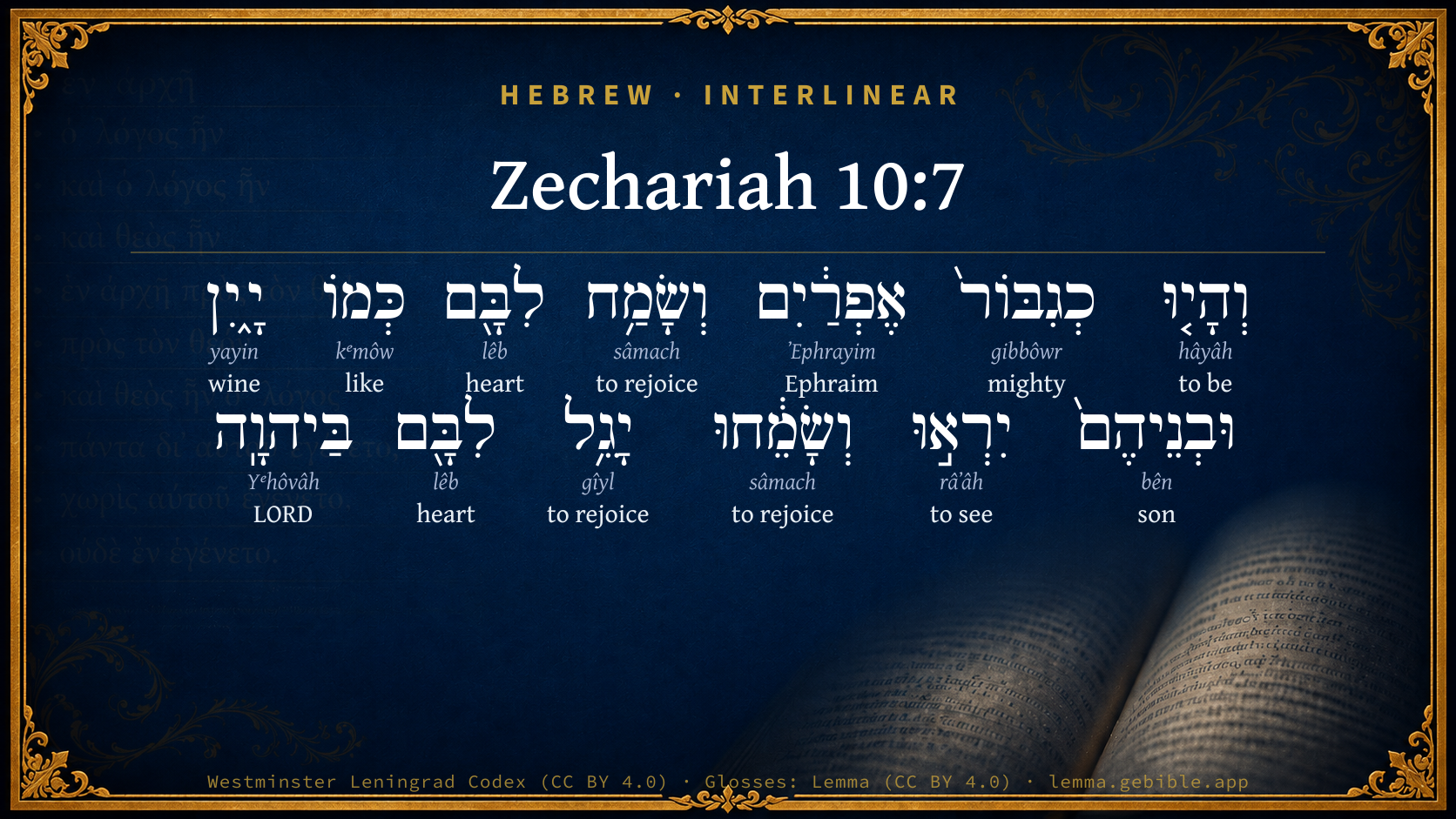
  1. וְהָי֤וּ hâyâh H1961 “and · to be” Conjunction + Verb, Qal, Perfect, 3rd Person, Common, Plural
  2. כְגִבּוֹר֙ gibbôwr H1368 “like/as · mighty of” Preposition + Adjective, Adjective, Masculine, Singular, Construct
  3. אֶפְרַ֔יִם ʼEphrayim H669 “Ephraim” Noun, Proper
  4. וְשָׂמַ֥ח sâmach H8055 “and · to rejoice” Conjunction + Verb, Qal, Perfect, 3rd Person, Masculine, Singular
  5. לִבָּ֖ם lêb H3820 “heart · their” Noun, Common, Masculine, Singular, Construct + Suffix, Personal, 3rd Person, Masculine, Plural
  6. כְּמוֹ kᵉmôw H3644 “like” Preposition
  7. יָ֑יִן yayin H3196 “wine” Noun, Common, Masculine, Singular, Absolute
  8. וּבְנֵיהֶם֙ bên H1121 “and · sons · their” Conjunction + Noun, Common, Masculine, Plural, Construct + Suffix, Personal, 3rd Person, Masculine, Plural
  9. יִרְא֣וּ râʼâh H7200 “to see” Verb, Qal, Imperfect, 3rd Person, Masculine, Plural
  10. וְשָׂמֵ֔חוּ sâmach H8055 “and · to rejoice” Conjunction + Verb, Qal, Perfect, 3rd Person, Common, Plural
  11. לִבָּ֖ם lêb H3820 “heart · their” Noun, Common, Masculine, Singular, Construct + Suffix, Personal, 3rd Person, Masculine, Plural
  12. בַּיהוָֽה Yᵉhôvâh H3068 “in/at · LORD” Preposition + Noun, Proper

About this verse

These counts appear in no published source. They are computed here, from the morphology-tagged text and Lemma’s own curated glosses. What Lemma adds →

13
words
11
distinct lemmas
Prophets
section

Shared distinctive vocabulary

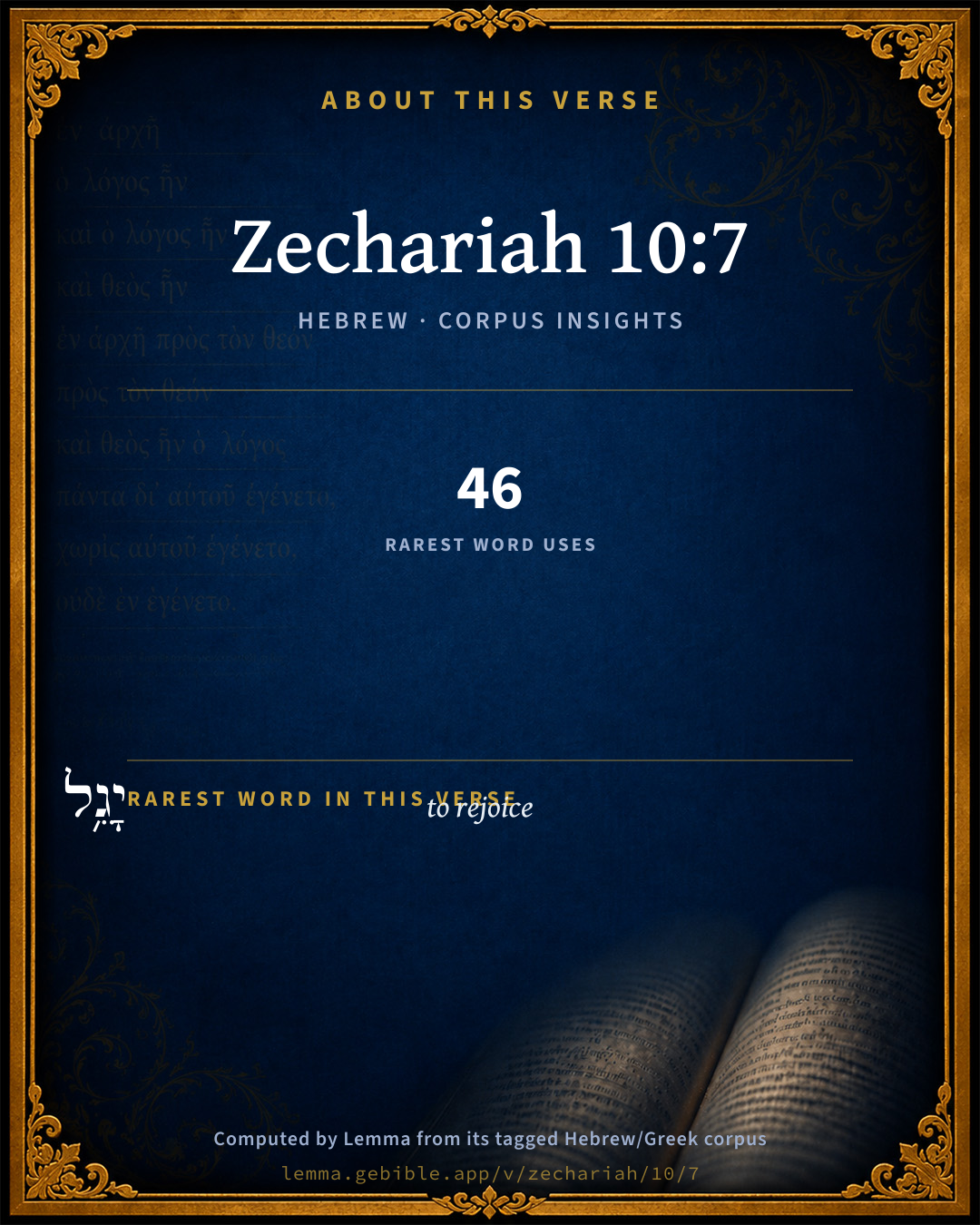
יָגֵ֥ל to rejoice H1523 occurs in 44 verses of the Hebrew Bible. Also found in:

Grammatical profile

  • 5 verbs
  • 6 nouns
  • 1 adjective
  • 1 preposition

Verb forms

  • וְהָי֤וּ Qal · Perfect
  • וְשָׂמַ֥ח Qal · Perfect
  • יִרְא֣וּ Qal · Imperfect
  • וְשָׂמֵ֔חוּ Qal · Perfect
  • יָגֵ֥ל Qal · Imperfect

Repetition

Words recur within this verse — often emphatic in Hebrew:

  • וְשָׂמַ֥ח to rejoice H8055 ×2
  • לִבָּ֖ם heart H3820 ×2

Hebrew & Septuagint length

In English translation the verse runs 30 words from the Hebrew and 35 from the Septuagint (LXX English) — closely comparable.

A rough comparison of the two English renderings, which tokenize alike — not a word-level alignment.

Word counts can differ between the Hebrew and the Greek without any difference in meaning — e.g. the Hebrew direct-object marker אֵת has no separate Greek word, and Greek often adds the article ὁ.

Cross-references

25

Topical passages linked to Zechariah 10:7 in the Treasury of Scripture Knowledge — connected by theme and wording, ordered by reader-vote popularity; previews shown in the World English Bible.

  • Zechariah 9:15 Yahweh of Hosts will defend them; And they will destroy and overcome with sling-stones; And they will drink, and roar as through wine; And they will be filled like bowls, Like the corners of the altar.
  • Luke 1:47 My spirit has rejoiced in God my Savior,
  • Philippians 4:4 Rejoice in the Lord always! Again I will say, Rejoice!
  • 1 Peter 1:8 whom not having known you love; in whom, though now you don't see him, yet believing, you rejoice greatly with joy unspeakable and full of glory--
  • Genesis 18:19 For I have known him, to the end that he may command his children and his household after him, that they may keep the way of Yahweh, to do righteousness and justice; to the end that Yahweh may bring on Abraham that which he has spoken of him."
  • Genesis 43:34 He sent portions to them from before him, but Benjamin's portion was five times as much as any of theirs. They drank, and were merry with him.
  • 1 Samuel 2:1 Hannah prayed, and said: My heart exults in Yahweh; My horn is exalted in Yahweh; My mouth is enlarged over my enemies; Because I rejoice in your salvation.
  • Psalms 13:5 But I trust in your loving kindness. My heart rejoices in your salvation.
  • Psalms 28:7 Yahweh is my strength and my shield. My heart has trusted in him, and I am helped. Therefore my heart greatly rejoices. With my song I will thank him.
  • Psalms 102:28 The children of your servants will continue. Their seed will be established before you."
  • Psalms 104:15 Wine that makes glad the heart of man, Oil to make his face to shine, And bread that strengthens man's heart.
  • Proverbs 31:6–7 Give strong drink to him who is ready to perish; And wine to the bitter in soul:
  • Isaiah 38:19 The living, the living, he shall praise you, as I do this day: The father to the children shall make known your truth.
  • Isaiah 66:14 You shall see [it], and your heart shall rejoice, and your bones shall flourish like the tender grass: and the hand of Yahweh shall be known toward his servants; and he will have indignation against his enemies.
  • Jeremiah 32:39 and I will give them one heart and one way, that they may fear me forever, for the good of them, and of their children after them:
  • Habakkuk 3:18 Yet I will rejoice in Yahweh. I will be joyful in the God of my salvation!
  • Zephaniah 3:14 Sing, daughter of Zion! Shout, Israel! Be glad and rejoice with all your heart, daughter of Jerusalem.
  • Zechariah 9:17 For how great is his goodness, And how great is his beauty! Grain will make the young men flourish, And new wine the virgins.
  • John 16:22 Therefore you now have sorrow, but I will see you again, and your heart will rejoice, and no one will take your joy away from you.
  • Acts 2:13–18 Others, mocking, said, "They are filled with new wine."
  • Acts 2:26 Therefore my heart was glad, and my tongue rejoiced. Moreover my flesh also will dwell in hope;
  • Psalms 90:16 Let your work appear to your servants; Your glory to their children.
  • Acts 2:39 For to you is the promise, and to your children, and to all who are far off, even as many as the Lord our God will call to himself."
  • Acts 13:33 that God has fulfilled the same to us, their children, in that he raised up Jesus. As it is also written in the second psalm, 'You are my Son. Today I have become your father.'
  • Ephesians 5:18–19 Don't be drunken with wine, in which is dissipation, but be filled with the Spirit,

Cross-references courtesy of OpenBible.info (CC BY 4.0).

Hebrew and Greek witnesses Masoretic Hebrew ↔ Greek Septuagint

The same verse in the two great witnesses to the Old Testament, shown verse-for-verse.

These are two independent witnesses, not word-aligned to each other, and the Septuagint is shown in lemma (dictionary) form.

Hebrew Zechariah 10:7 Masoretic · Westminster Leningrad Codex

וְהָי֤וּ כְגִבּוֹר֙ אֶפְרַ֔יִם וְשָׂמַ֥ח לִבָּ֖ם כְּמוֹ יָ֑יִן וּבְנֵיהֶם֙ יִרְא֣וּ וְשָׂמֵ֔חוּ יָגֵ֥ל לִבָּ֖ם בַּיהוָֽה

Ephraim will be like a mighty man, And their heart will rejoice as through wine; Yes, their children will see it, and rejoice. Their heart will be glad in Yahweh.

World English Bible · Public Domain

Greek LXX Zechariah 10:7 Septuagint · lemma form

καί εἰμί ὡς μαχητής ὁ ἐφράιμ καί χαίρω ὁ καρδία αὐτός ὡς ἐν οἶνος καί ὁ τέκνον αὐτός ὁράω καί εὐφραίνω καί χαίρω ὁ καρδία αὐτός ἐπί ὁ κύριος

And they shall be as the warriors of Ephraim, and their heart shall rejoice as with wine: and their children also shall see it, and be glad; and their heart shall rejoice in the Lord.

LXX2012 (modern English Septuagint) · Public Domain

Hebrew: Westminster Leningrad Codex (CC BY 4.0). Greek: Septuagint (public domain); English from LXX2012 (modern English Septuagint) (Public Domain). How the Septuagint differs from the Hebrew →

Targum (Aramaic paraphrase)

1

The Targum is the ancient Jewish Aramaic paraphrase of the Hebrew Scriptures — an interpretive translation, not the Hebrew text itself. Onkelos (literal) and Pseudo-Jonathan (expansive) render the Torah, and Jonathan the Prophets. Coverage is partial: where no permissively-licensed English translation exists for a verse, only the Aramaic is shown. This is verse-level text, not a word-by-word alignment to the Hebrew.

  1. Targum Jonathan Prophets (Joshua–Malachi)
    וִיהוֹן כְּגִבָּרִין דְבֵית אֶפְרַיִם וְיֶחְדֵי לִבְּהוֹן כְּשָׁתֵי חֲמַר וּבְנֵיהוֹן יֶחֱזוֹן וְיֶחֱדוֹן יְבוּעַ לִבְּהוֹן בְּמֵימְרָא דַיָי:

    (no public-domain English translation for this verse)

    Targum Jonathan — Aramaic: “Mikraot Gedolot” (public domain). English: “Sefaria Community Translation” (CC0 1.0 (public-domain dedication)); “London "Chaldee Paraphrase," 1871” (public domain). Text via Sefaria.

Commentary

Notes on Zechariah 10:7 from classic Christian and Jewish commentators (each source and its license shown beneath its notes). The classic Christian expositions comment on the surrounding passage and are grouped to its opening verse, so a note may address several verses; the Jewish commentaries on the Tanakh (Rashi and others) are per-verse, so they appear only where the commentator wrote on this verse.

Lemma curates 59 commentaries, every one of them public domain or Creative Commons licensed, each selected and text-cleaned for this edition rather than reprinted as found. About our sources →

Trapp's Complete Commentary

John Trapp

Zec 10:7 And [they of] Ephraim shall be like a mighty [man], and their heart shall rejoice as through wine: yea, their children shall see [it], and be glad; their heart shall rejoice in the LORD.

Ver. 7. And they of Ephraim shall be as a mighty man] The same again, and in the same words, for more assurance; because the return of the ten tribes might seem a thing more incredible, Erant enim quasi putridum cadaver, saith Calvin here: they were as rotten carcases, and they had obiter in passing only heard of these promises; as if some grain of seed should be dropped by the highwayside: for they were now as aliens from the commonwealth of Israel.

And their heart shall rejoice as through wine] Which naturally exhilarateth, Psa 104:15, and is called by Plato one of the mitigators. (μαλακτικα) of human misery. See Pro 31:6. {See Trapp on "Pro 31:6"} Some nations use to drink wine freely before they enter the battle, to make them undaunted. Some think here may be an allusion to such a custom. I should rather understand it of that generous wine of the Spirit, Eph 5:18.

Yea, their children shall see it] Therefore they were not to antedate the promises, but to wait the accomplishment which should certainly be, if not to them, yet to theirs after them, even a full restoration in due season.

John Trapp, A Commentary or Exposition upon All the Books of the Old and New Testament (1647–1656) — public domain. Text from a community e-Sword module.

Jamieson, Fausset & Brown

Robert Jamieson, A. R. Fausset & David Brown

like a mighty man--in the battle with the foe (Zac 10:3, Zac 10:5).

rejoice--at their victory over the foe.

children shall see it--who are not yet of age to serve. To teach patient waiting for God's promises. If ye do not at present see the fulfilment, your children shall, and their joy shall be complete.

rejoice in the Lord--the Giver of such a glorious victory.

Jamieson, Fausset & Brown — Commentary Critical and Explanatory on the Whole Bible (1871) — public domain (CC PDM 1.0). Text via the HelloAO Bible API.

Adam Clarke's Commentary

Verse 7. Ephraim shall be like a mighty man] This tribe was always distinguished for its valour.

Adam Clarke's Commentary on the Bible (1810–1826) — public domain. Text from a community e-Sword/MySword module.

John Calvin's Commentaries

He declares the same in other words: he had said in the last verse, that he would strengthen both the house of Judah and the house of Joseph, that is, the ten tribes; he now speaks of Ephraim alone, but includes the kingdom of Judah; and he names Ephraim, not because he deserved to be honored, or to be preferred to the Jews, for Ephraim had become apostate; but because the return of the ten tribes was an event more incredible: this is clearly the reason why the Prophet expressly mentions Ephraim. For even to the very destruction of the city and of the temple, God had continued to promise restoration to the Jews: the hope then of the Jews was certain and peculiar to themselves; but as to the Israelites, they were like a putrid carcass, for they had heard only something here and there, and received only some portion of the prophecies, as a grain of seed that falls outside of the field; for they were then as it were alienated from the people of God. We now then understand what the Prophet means by saying, that the Israelites would be like giants; for though they had been cast down by their enemies, and then driven in great dishonor and disgrace into exile, and had been exposed to all kinds of reproaches, and oppressed by extreme bondage; yet God promises them the strength of giants.

Now we have said that the words contain a part for the whole; for this promise no doubt belongs especially to the Jews: there is yet no mention of them, though they were first in rank, and had a better ground of hope as to their return, and the Lord had already given them some proof.

He says, Rejoice shall their hearts through wine; and see shall their sons and be glad; exult shall their heart in Jehovah. It is certain that they had already a cause for joy, as it is said in the book of Psalms,

“We became like those who dream, when the Lord restored his captives.” (Psalm 126:1.)

But the Prophet speaks here of a greater joy, that is, when they should see gathered all the tribes from their miserable and grievous dispersion: hence it is said in the same Psalm, “Gather, Lord, our captivity, like the stream in the south;” and then he adds, “They who sow in tears, in joy shall reap.” In part then did the faithful lament, and in part did they rejoice: the beginning of redemptions had raised their minds to joy; but on seeing their brethren still living under the tyranny of their enemies and having hardly a hope of restoration, they could not but mourn. Now the Prophet here declares, that their joy would be full, when their complete restoration came.

And he extends this joy to their sons; for it was needful to restrain their armor in expecting a full favor, as they ever closed up their way to God by their complaints, according to what we do when we give loose reigns to our wishes, for we then in a manner turn away from God. In order then to teach the people patience, the Prophet says, “Though ye see not this today with your eyes, yet your sons shall at length see it.” We now perceive that he here exhorts them to patience, that they might not anticipate with too much haste the promises of God.

Of the metaphor it is not needful to say much: he compares to the drunken, or to such as become cheerful through drinking, those who rejoice in the Lord, not that he expresses an approval of drunkenness, but because he wished to show that it would be no common joy, as though they were carried away beyond themselves. It would be then superfluous to move here the question, whether it be right to seek joy by drinking freely. It is indeed true that hilarity is connected with the lawful use of wine (Psalm 104:15;) but as we are too prone to excess, we ought to restrain the lusts of the flesh rather than to seek some color of excuse for a sinful indulgence. But as I have said, this question does not belong to the present passage. It follows —

John Calvin's Commentaries (1540-1563) — public domain. Text from the Calvin Translation Society English edition (1840s-50s) via the Christian Classics Ethereal Library (ccel.org). Calvin's coverage is partial (roughly two-thirds of the Bible); uncommented books and verses are honest gaps, never fabricated. The 19th-century editor's footnotes and remarks are omitted so the notes are faithfully Calvin's own voice.

The Cambridge Bible for Schools and Colleges

gen. ed. J. J. S. Perowne

7. as through wine] Comp. Zec_9:15.

The Cambridge Bible for Schools and Colleges (gen. ed. J. J. S. Perowne; Cambridge University Press, 1878–1918) — public domain. Text from a community e-Sword module.

John Gill's Exposition

And they of Ephraim shall be like a mighty man,.... What remain, and shall be found of the ten tribes, shall be as is said of Judah, or the Jews of the two tribes, Zac 10:5,

and their heart shall rejoice as through wine: they shall be filled with inward and spiritual joy, through the love of God shed abroad in their heart; and through the Gospel of Christ having a place there; and through the blessings of divine grace, those streams of love, and which flow in the Gospel, and make glad the hearts of God's people; all which are comparable to wine:

yea, their children shall see it, and be glad; they shall see the strength, victory, and salvation of their fathers, and the joy they shall be possessed of, and join with them in it, having a share in the same blessings they are partakers of:

their heart shall rejoice in the Lord; in the person and offices of Christ, who will now be known by the spiritual seed and offspring of the church, and in the great salvation wrought out by him, and in all the blessings of grace that accompany it. The Targum is,

"their heart shall rejoice in the word of the Lord;''

the essential Word, the Son of God.

John Gill's Exposition of the Whole Bible (1746–1763) — public domain (CC PDM 1.0). Text via the HelloAO Bible API.

Albert Barnes' Notes on the Bible

And Ephraim, they shall be like a mighty man - Prophecy, through the rest of the chapter, turns to Ephraim, which had not yet been restored. With regard to them, human victory retires out of sight, though doubtless, when their wide prison was broken at the destruction of the Persian empire, many were free to return to their native country, as others spread over the West in Asia Minor, Greece, Rome, and so some may have taken part in the victories of the Maccabees. Yet not victory, but strength, gladness beyond natural g adness, as through wine, whereby the mind is exhilarated above itself; and that, lasting, transmitted to their children, large increase, holy life in God, are the outlines of the promise.

Their heart shall rejoice in the Lord - Psa 44:3 : “As the principal object, the first, highest, most worthy Giver of all good, to whom is to be referred all gladness, which is conceived from created goods, that ‘whose glorieth may glory in the Lord’ 2Co 10:17, in whom alone the rational creature ought to take delight.”

Albert Barnes' Notes on the Bible (1834–1885) — public domain. Text from a community e-Sword/MySword module.

Haydock's Catholic Bible Commentary

Valiant. Ephraim was a powerful and valiant tribe, Deuteronomy xxxiii. 17. (Calmet)

George Leo Haydock (1774–1849), Haydock's Catholic Family Bible and Commentary, 1859 edition — public domain. Excludes Psalms (Douay-Rheims chapter numbering differs from Protestant) and Deuterocanonical books (Catholic canon only).

Matthew Poole's English Annotations

Ephraim: see Zec 10:6. Shall be like a mighty man, see Zec 10:5.

Their heart shall rejoice as through wine; which warmeth the blood, cheereth the spirits, and adds life greatly, where a good and joyful success concurreth, as here it doth.

Their children shall see it, and be glad; either thus, in the days of your children this shall be; or rather, when the time comes for these things they shall continue through your generations to children that shall be born.

Their heart shall rejoice in the Lord; the goodness, power, wisdom, and faithfulness of God shall be the cause of this joy, and many of these people shall indeed rejoice in the Lord, and in the Messiah.

Matthew Poole's English Annotations on the Holy Bible (1683–1685) — public domain. Text from a community e-Sword/MySword module.

Whedon's Commentary on the Bible

Daniel D. Whedon

7. Ephraim, like Judah, is transformed into a nation of heroes, and realizing that once more the divine favor is theirs, they will rejoice greatly.

As through wine — They will be beside themselves for joy (compare Zec_9:15). The magnitude of rejoicing is indicated in the rest of the verse. It will become contagious; all will join in it, and all will give the glory to Jehovah who has wrought the wonderful salvation.

Their children — Not young boys and girls, but the individual Ephraimites; compare “sons (the same word in Hebrew) of Zion” (Zec_9:13).

Daniel D. Whedon (gen. ed.), Commentary on the Old and New Testaments (1874–1909) — public domain. Text from a community e-Sword module.

The Pulpit Commentary

They of Ephraim; i.e. as well as Judah, shall be heroes. Not many members of the northern kingdom returned at first from the Captivity; but the prophet gives the assurance that they shall come and prove themselves mighty warriors. As through wine. They shall hasten to the battle cheerfully and exultingly, like men refreshed and strengthened with wine. (see Zec_9:15 Psa_78:65, Psa_78:66) Their children shall see it. Though unable to participate in the struggle, their children shall share the universal joy. Their heart shall rejoice in the Lord. (Psa_63:7 Isa_41:16 Joe_2:23 Hab_3:18) Attempts have been made to find the fulfilment of these prophecies (ver. 3, etc.) in certain events of Maccabean times. Thus, according to Patritius, the sin for which the Hebrews surfeited such distress at the hands of the Seleucidae (ver. 2) was their imitation of heathen practices mentioned in RAPC 1Ma 1:13-15 and RAPC 2Ma 4:7-17, when the high priest purchased his office by a bribe, and the other priests followed Greek customs. The prophet is supposed to refer specially to this state of things when he says, "They were troubled because there was no shepherd. Mine auger was kindled against the shepherds." But we have shown above that Zechariah is here speaking of the past, not of the future. There is more verisimilitude in discerning the wars and victories of Judas, his brothers and successors, in the allusions of vers 4-7. The truth is that such descriptions suit many different events, and have various applications. Though their complete fulfilment may be expected only in Messianic times and circumstances, yet we may see many anticipatory and preparative transactions, which are meant to introduce the final accomplishment. The Jewish prophet is not always foretelling certain definite events. Oftentimes he is teaching, warning, and exhorting; and generally he is enunciating great principles, the truth of which shall be clear in the future, rather than predicting particular facts. Not unfrequently commentators have neglected this consideration, and sought too curiously to restrict the prophet"s words to some one issue. It may be noted, further, that where the prophetic language concerning the destiny of the restored people seems to be exaggerated and not borne out by subsequent facts, the promises are always conditioned by the moral state of the recipients. If they answered fully and consistently to God"s call, the result would be such as was predicted. That the event in all respects did not correspond with the high ideal previously announced must be attributed, not to the prophet"s mistake, but to the people"s waywardness and disobedience.

The Pulpit Commentary (1880–1919), ed. H.D.M. Spence-Jones & Joseph S. Exell — public domain. Text from a community e-Sword module.

John Wesley's Explanatory Notes

Their children shall see - These blessings shall continue through your generations, to children that shall be born.

John Wesley, Explanatory Notes Upon the Whole Bible (1754–1765) — public domain. Text via the GEBible commentary corpus.

Lesson kit

Teaching starters — assembled from the data on this page, not authored interpretation. Every prompt links to the verse data it draws on. Edit before teaching.

Zechariah, in the Prophets, opens this verse with 13 words (11 distinct Hebrew lemmas). Its most distinctive word is gîyl (“to rejoice”). A historical commentator’s framing appears above. Read the whole chapter for the surrounding context.

Discussion questions

  1. The word gîyl carries the sense “to rejoice.” How does it shape the verse?
  2. How does 1 Chronicles 16:31, which shares the word «to rejoice», read alongside this verse?
  3. What does the repetition of “to rejoice” (2× in this one verse) do in this verse?
  4. The translations on this page render this verse differently — a whole-verse word diff, not a word-by-word alignment. What might account for the different wordings?
  5. «וְהָי֤וּ» is a Qal Perfect verb. How does that grammatical form shape the action described?
  6. Compare how Trapp's Complete Commentary and Jamieson, Fausset & Brown read this verse. Where do they agree or differ?

Things to notice

Reading settings

Reading text

Shown beneath each verse's original-language words.

Old Testament
Old Testament edition

Read the OT as the Masoretic Hebrew (MT) or the Greek Septuagint (LXX).

English shown for the Greek Septuagint (in the Hebrew ↔ Greek comparison).

Comparing translations? Open the Compare panel on any verse page to stack up to four side by side.