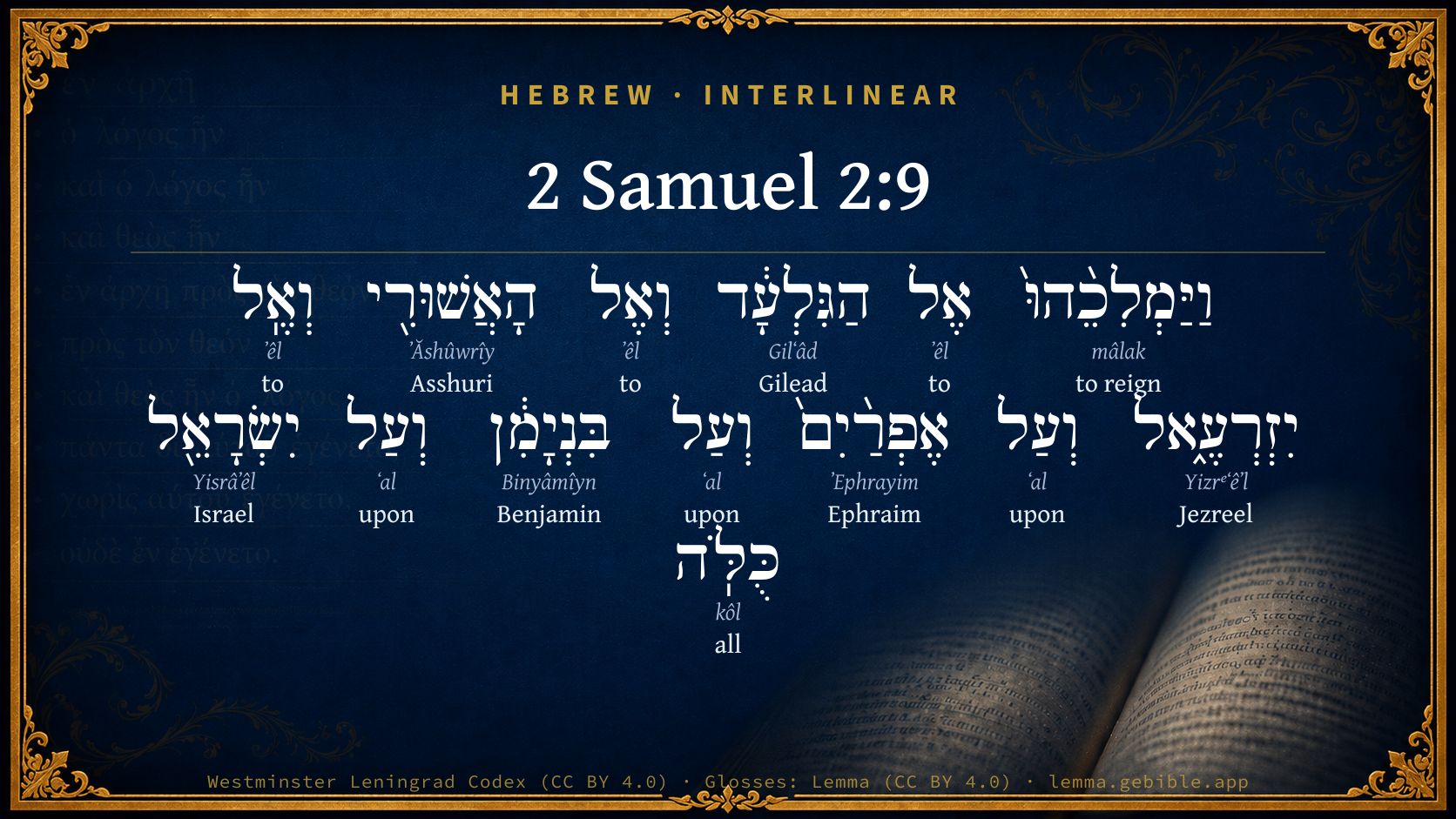
2 Samuel 2:9

Hebrew (Westminster Leningrad Codex) 2 Samuel 2:9 appears in the Hebrew Old Testament. The text above is from the Westminster Leningrad Codex. Each word links to its Strong’s number, a concise gloss, and parsing drawn from the Open Scriptures Hebrew Bible morphology. Click any word for its full Brown-Driver-Briggs (BDB) entry.
Download image
Cite this verse

2 Samuel 2:9 (World English Bible). Public Domain. Lemma interlinear Bible study tool, https://lemma.gebible.app/v/2-samuel/2/9.

Show BibTeX & RIS
BibTeX
RIS
English Translation
and he made him king over Gilead, and over the Ashurites, and over Jezreel, and over Ephraim, and over Benjamin, and over all Israel.
World English Bible · Public Domain
Download a study sheet

One document with this verse’s original text, its word-by-word gloss line, the meaning frame, cross-references with their text, attributed commentary, and full source and license credits — printable, and it pastes into notes with its structure intact.

This verse Autodidact and up

Study sheet (.html) Plain text (.txt)

A passage Seminary Student

Up to 50 verses in one chapter. A passage sheet keeps up to 6 commentary sources and 12 cross-references per verse, in the order this page ranks them, and says so on the sheet whenever that leaves anything out. Ask for a single verse and you get the Autodidact verse sheet above.

Everything on this page stays free to read, with no account — the sheet is a download of what is already on screen, not access to it.

Want to remove ads? Support Godless Engineer
Compare translations 3

The same verse in 3 English versions, stacked beneath the original-language interlinear above. Click any original word for its lexicon entry.

Each is an independent rendering of the whole verse — the interlinear is not word-aligned to these translations.

Highlighted words mark where these versions differ — a whole-verse word diff, not a word-by-word alignment.

  • World English Bible Public Domain
    and he made him king over Gilead, and over the Ashurites, and over Jezreel, and over Ephraim, and over Benjamin, and over all Israel.
  • King James Version Public Domain
    And made him king over Gilead, and over the Ashurites, and over Jezreel, and over Ephraim, and over Benjamin, and over all Israel.
  • unfoldingWord Literal Text CC BY-SA 4.0
    And he made him rule over Gilead and over the Ashurite and over Jezreel and over Ephraim and over Benjamin and over Israel, all of it.

unfoldingWord Literal Text — © unfoldingWord, licensed CC BY-SA 4.0. Word-aligned USFM3 via Door43 (git.door43.org/unfoldingWord/en_ult).

Versions to compare (up to 4)

3 of 4 selected

Show all 18 translations

Every available English version of this verse, each an independent rendering of the whole verse.

  • World English Bible Public Domain
    and he made him king over Gilead, and over the Ashurites, and over Jezreel, and over Ephraim, and over Benjamin, and over all Israel.
  • Berean Standard Bible Public Domain
    and made him king over Gilead, Asher, Jezreel, Ephraim, and Benjamin—over all Israel.
  • Majority Standard Bible Public Domain
    and made him king over Gilead, Asher, Jezreel, Ephraim, and Benjamin—over all Israel.
  • King James Version Public Domain
    And made him king over Gilead, and over the Ashurites, and over Jezreel, and over Ephraim, and over Benjamin, and over all Israel.
  • American Standard Version (1901) Public Domain
    and he made him king over Gilead, and over the Ashurites, and over Jezreel, and over Ephraim, and over Benjamin, and over all Israel.
  • Revised Version (1885) Public Domain
    and he made him king over Gilead, and over the Ashurites, and over Jezreel, and over Ephraim, and over Benjamin, and over all Israel.
  • Geneva Bible (1599) Public Domain
    And made him King ouer Gilead, and ouer the Ashurites, and ouer Izreel, and ouer Ephraim, and ouer Beniamin, and ouer al Israel.
  • Douay-Rheims (1899) Public Domain
    And made him king over Galaad, and, over Gessuri, and over Jezrahel, and over Ephraim, and over Benjamin, and over all Israel.
  • Young's Literal Translation Public Domain
    and causeth him to reign over Gilead, and over the Ashurite, and over Jezreel, and over Ephraim, and over Benjamin, and over Israel -- all of it.
  • Literal Standard Version CC BY-SA 4.0
    and causes him to reign over Gilead, and over the Ashurite, and over Jezreel, and over Ephraim, and over Benjamin, and over Israel—all of it.
  • Unlocked Literal Bible CC BY-SA 4.0
    He made Ishbosheth king over Gilead, Asher, Jezreel, Ephraim, Benjamin, and over all Israel.
  • unfoldingWord Literal Text CC BY-SA 4.0
    And he made him rule over Gilead and over the Ashurite and over Jezreel and over Ephraim and over Benjamin and over Israel, all of it.
  • Darby Bible Public Domain
    and made him king over Gilead, and over the Asshurites, and over Jizreel, and over Ephraim, and over Benjamin, and over all Israel.
  • World Messianic Bible Public Domain
    He made him king over Gilead, over the Ashurites, over Jezreel, over Ephraim, over Benjamin, and over all Israel.
  • Webster's Bible Public Domain
    And he made him king over Gilead, and over the Ashurites, and over Jezreel, and over Ephraim, and over Benjamin, and over all Israel.
  • Free Bible Version CC BY-SA 4.0
    There he set up Ishbosheth as king over Gilead, Asher, Jezreel, Ephraim, and Benjamin, in fact over all Israel.
  • Bible in Basic English Public Domain
    And made him king over Gilead and the Asherites and over Jezreel and Ephraim and Benjamin, that is, over all Israel.
  • JPS Tanakh (1917) Public Domain
    and he made him king over Gilead, and over the Ashurites, and over Jezreel, and over Ephraim, and over Benjamin, and over all Israel.

Literal Standard Version (2020), Covenant Press — licensed CC BY-SA 4.0. Text via the HelloAO Bible API (eBible.org). Unlocked Literal Bible (unfoldingWord) — licensed CC BY-SA 4.0. Text via the HelloAO Bible API (eBible.org). unfoldingWord Literal Text — © unfoldingWord, licensed CC BY-SA 4.0. Word-aligned USFM3 via Door43 (git.door43.org/unfoldingWord/en_ult). Free Bible Version, Dr. Jonathan Gallagher — licensed CC BY-SA 4.0. Text via the HelloAO Bible API (eBible.org).

Word by word

More ways to search: Search by grammar → Find every occurrence → Compare this word →

Practice this passage: Drill this verse → Learn its vocabulary →

הָאֲשׁוּרִ֖י
ʼĂshûwrîy
H805
“the · Asshuri”
Particle, Definite Article + Noun, Gentilic, Masculine, Singular, Absolute
Part of Speech
Particle + Noun
Type
Gentilic
Gender
Masculine
Number
Singular
State
Absolute
Full BDB Definition

Origin: from a patrial word of the same form as H804

TWOT: None

Asshuri = "steps" - a tribe inhabiting the plain of Esdraelon - a tribe descended from Abraham and Keturah
  1. וַיַּמְלִכֵ֨הוּ֙ mâlak H4427 “and · to reign · him” Conjunction + Verb, Hiphil, Sequential Imperfect, 3rd Person, Masculine, Singular + Suffix, Personal, 3rd Person, Masculine, Singular
  2. אֶל ʼêl H413 “to” Preposition
  3. הַגִּלְעָ֔ד Gilʻâd H1568 “the · Gilead” Particle, Definite Article + Noun, Proper
  4. וְאֶל ʼêl H413 “and · to” Conjunction + Preposition
  5. וְאֶֽל ʼêl H413 “and · to” Conjunction + Preposition
  6. יִזְרְעֶ֑אל Yizrᵉʻêʼl H3157 “Jezreel” Noun, Proper
  7. וְעַל ʻal H5921 “and · upon” Conjunction + Preposition
  8. אֶפְרַ֨יִם֙ ʼEphrayim H669 “Ephraim” Noun, Proper
  9. וְעַל ʻal H5921 “and · upon” Conjunction + Preposition
  10. בִּנְיָמִ֔ן Binyâmîyn H1144 “Benjamin” Noun, Proper
  11. וְעַל ʻal H5921 “and · upon” Conjunction + Preposition
  12. יִשְׂרָאֵ֖ל Yisrâʼêl H3478 “Israel” Noun, Proper
  13. כֻּלֹּֽה kôl H3605 “all · her” Noun, Common, Masculine, Singular, Construct + Suffix, Personal, 3rd Person, Feminine, Singular

About this verse

These counts appear in no published source. They are computed here, from the morphology-tagged text and Lemma’s own curated glosses. What Lemma adds →

14
words
10
distinct lemmas
Historical
section

Notable vocabulary

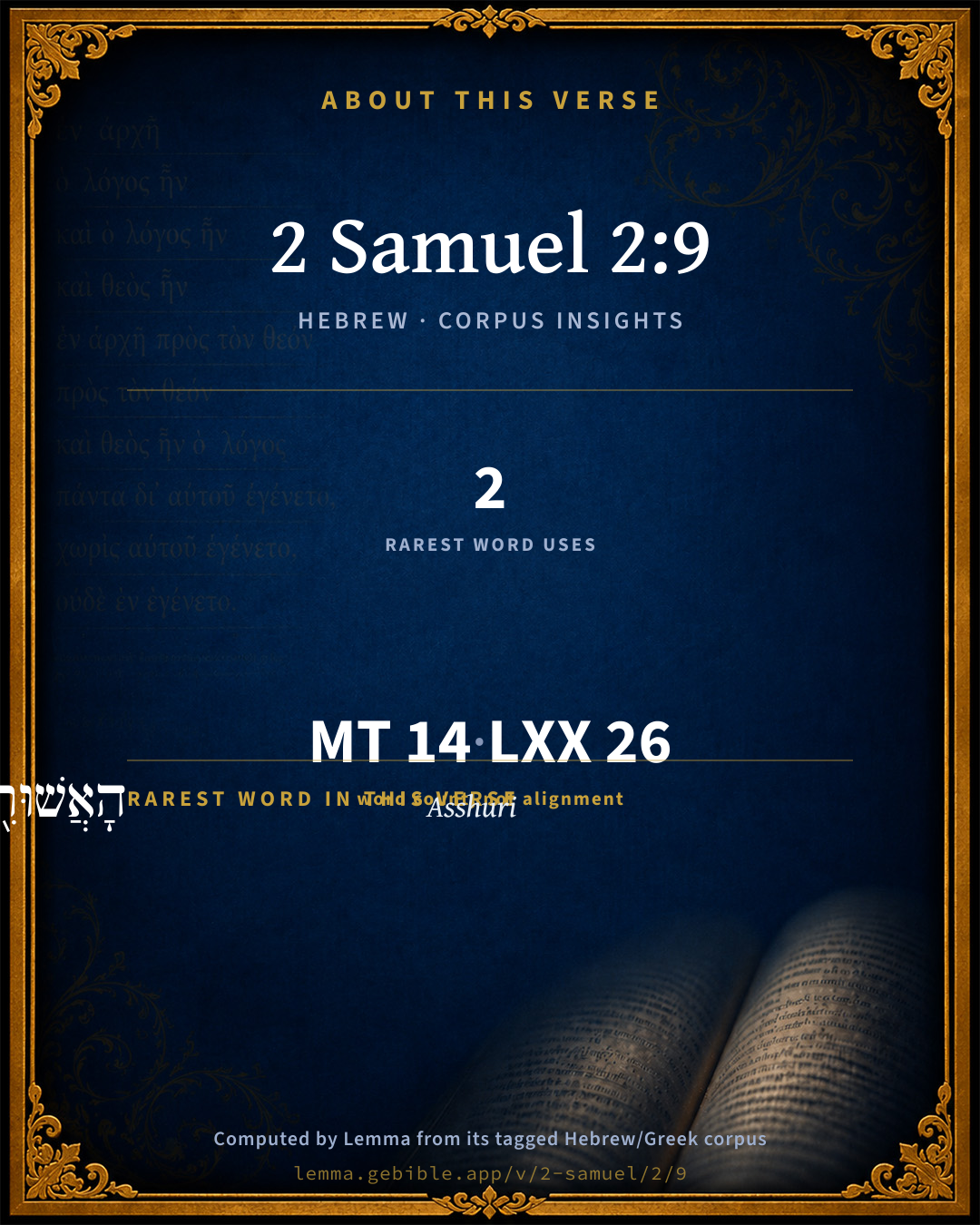
The rarest word here is הָאֲשׁוּרִ֖י Asshuri H805 — appearing just 2 times in the whole Hebrew Bible.

Shared distinctive vocabulary

הָאֲשׁוּרִ֖י Asshuri H805 occurs in 2 verses of the Hebrew Bible. Also found in:

Grammatical profile

  • 1 verb
  • 7 nouns
  • 6 prepositions

Verb forms

  • וַיַּמְלִכֵ֨הוּ֙ Hiphil · Sequential Imperfect

Repetition

Words recur within this verse — often emphatic in Hebrew:

  • וְעַל upon H5921 ×3
  • אֶל to H413 ×3

Hebrew & Septuagint length

In English translation the verse runs 24 words from the Hebrew and 25 from the Septuagint (LXX English) — closely comparable.

A rough comparison of the two English renderings, which tokenize alike — not a word-level alignment.

Word counts can differ between the Hebrew and the Greek without any difference in meaning — e.g. the Hebrew direct-object marker אֵת has no separate Greek word, and Greek often adds the article ὁ.

In the original languages it is 14 Hebrew tokens and 26 Greek tokens — but the two are counted differently (Hebrew bundles its prefixes and suffixes into one token; the Greek is in lemma form), so that isn’t a like-for-like length.

Cross-references

7

Topical passages linked to 2 Samuel 2:9 in the Treasury of Scripture Knowledge — connected by theme and wording, ordered by reader-vote popularity; previews shown in the World English Bible.

  • Genesis 30:13 Leah said, "Happy am I, for the daughters will call me happy." She named him Asher.
  • Numbers 1:40 Of the children of Asher, their generations, by their families, by their fathers' houses, according to the number of the names, from twenty years old and upward, all who were able to go forth to war;
  • Numbers 32:1–42 Now the children of Reuben and the children of Gad had a very great multitude of cattle: and when they saw the land of Jazer, and the land of Gilead, that behold, the place was a place for cattle;
  • Joshua 13:8–11 With him the Reubenites and the Gadites received their inheritance, which Moses gave them, beyond the Jordan eastward, even as Moses the servant of Yahweh gave them:
  • Joshua 19:18 Their border was to Jezreel, and Chesulloth, and Shunem,
  • Judges 1:32 but the Asherites lived among the Canaanites, the inhabitants of the land; for they did not drive them out.
  • Psalms 108:8 Gilead is mine. Manasseh is mine. Ephraim also is my helmet. Judah is my scepter.

Cross-references courtesy of OpenBible.info (CC BY 4.0).

Hebrew and Greek witnesses Masoretic Hebrew ↔ Greek Septuagint

The same verse in the two great witnesses to the Old Testament, shown verse-for-verse.

These are two independent witnesses, not word-aligned to each other, and the Septuagint is shown in lemma (dictionary) form.

Hebrew 2 Samuel 2:9 Masoretic · Westminster Leningrad Codex

וַיַּמְלִכֵ֨הוּ֙ אֶל הַגִּלְעָ֔ד וְאֶל הָאֲשׁוּרִ֖י וְאֶֽל יִזְרְעֶ֑אל וְעַל אֶפְרַ֨יִם֙ וְעַל בִּנְיָמִ֔ן וְעַל יִשְׂרָאֵ֖ל כֻּלֹּֽה

and he made him king over Gilead, and over the Ashurites, and over Jezreel, and over Ephraim, and over Benjamin, and over all Israel.

World English Bible · Public Domain

Greek LXX 2 Samuel 2:9 Septuagint · lemma form

καί βασιλεύω αὐτός ἐπί ὁ γαλααδῖτιν καί ἐπί ὁ θασιρι καί ἐπί ὁ ιεζραελ καί ἐπί ὁ ἐφράιμ καί ἐπί ὁ βενιαμίν καί ἐπί πᾶς ἰσραήλ

and made him king over the land of Galaad, and over Thasiri, and over Jezrael, and over Ephraim, and over Benjamin, and over all Israel.

LXX2012 (modern English Septuagint) · Public Domain

On this verse, The Pulpit Commentary discusses the Septuagint’s reading. Read the note in Commentary ↓

Hebrew: Westminster Leningrad Codex (CC BY 4.0). Greek: Septuagint (public domain); English from LXX2012 (modern English Septuagint) (Public Domain). How the Septuagint differs from the Hebrew →

Targum (Aramaic paraphrase)

1

The Targum is the ancient Jewish Aramaic paraphrase of the Hebrew Scriptures — an interpretive translation, not the Hebrew text itself. Onkelos (literal) and Pseudo-Jonathan (expansive) render the Torah, and Jonathan the Prophets. Coverage is partial: where no permissively-licensed English translation exists for a verse, only the Aramaic is shown. This is verse-level text, not a word-by-word alignment to the Hebrew.

  1. Targum Jonathan Prophets (Joshua–Malachi)
    וְאַמְלְכֵיהּ עַל דְבֵית גִלְעָד וְעַל דְבֵית אָשֵׁר וְעַל דְבֵית יִזְרְעֶאל וְעַל דְבֵית אֶפְרַיִם וְעַל דְבֵית בִּנְיָמִן וְעַל דְבֵית יִשְׂרָאֵל כּוּלְהוֹן:

    (no public-domain English translation for this verse)

    Targum Jonathan — Aramaic: “Mikraot Gedolot” (public domain). English: “Sefaria Community Translation” (CC0 1.0 (public-domain dedication)); “London "Chaldee Paraphrase," 1871” (public domain). Text via Sefaria.

Commentary

Notes on 2 Samuel 2:9 from classic Christian and Jewish commentators (each source and its license shown beneath its notes). The classic Christian expositions comment on the surrounding passage and are grouped to its opening verse, so a note may address several verses; the Jewish commentaries on the Tanakh (Rashi and others) are per-verse, so they appear only where the commentator wrote on this verse.

Lemma curates 59 commentaries, every one of them public domain or Creative Commons licensed, each selected and text-cleaned for this edition rather than reprinted as found. About our sources →

Trapp's Complete Commentary

John Trapp

2Sa 2:9 And made him king over Gilead, and over the Ashurites, and over Jezreel, and over Ephraim, and over Benjamin, and over all Israel.

Ver. 9. And over all Israel.] Except the tribe of Judah, and some few others. {1Ch 12:1-40} This was an ill precedent, and as it were a preparative to that great schism in Rehoboam’s days, that could never be made up again.

John Trapp, A Commentary or Exposition upon All the Books of the Old and New Testament (1647–1656) — public domain. Text from a community e-Sword module.

Joseph Benson's Commentary

2Sa 2:9-11. He made him king over Gilead — Over all the tribes on the other side Jordan, which are comprehended under this name. Over the Ashurites — That is, the tribe of Asher, as the Chaldee paraphrast and others understand it. Over Jezreel — A large and rich valley, situate in the borders of the tribes of Zebulun, Issachar, and Naphtali, and so put for them all. And over all Israel — All the tribes on this side Jordan, save only the tribe of Judah. Ish-bosheth was forty years old — Being born in the year that Saul was made king; for Saul reigned forty years, Act 13:41. And reigned two years — Before there was any hostility between him and David, which, after it began, continued five years and a half, during which time David resided in Hebron, and was king over the tribe of Judah, and Ish-bosheth reigned over Israel, or rather Abner, for that general had the power, and left him only the name of a king.

Joseph Benson's Commentary on the Old and New Testaments (1811–1818) — public domain. Text from a community e-Sword module.

Tyndale Open Study Notes

Tyndale Open Resources

2:9 Gilead was the easternmost district of the northern kingdom, Jezreel the northernmost, and Benjamin the southernmost, with Ephraim in the middle. It is unclear which area was the land of the Ashurites. All the rest of Israel refers to the tribes that Ishbosheth ruled over rather than to the geographical area of his kingdom.

Tyndale Open Study Notes — © Tyndale Open Resources, licensed CC BY-SA 4.0. Text via the HelloAO Bible API.

Geneva Bible (1599)

Geneva Bible translators

Over the eleven tribes.

Geneva Bible (1599) marginal notes — public domain. Text via Bolls.life.

Jamieson, Fausset & Brown

Robert Jamieson, A. R. Fausset & David Brown

over Gilead--used in a loose sense for the land beyond Jordan.

Ashurites--the tribe of Asher in the extreme north.

Jezreel--the extensive valley bordering on the central tribes.

over all Israel . . . But Judah--David neither could nor would force matters. He was content to wait God's time and studiously avoided any collision with the rival king, till, at the lapse of two years, hostilities were threatened from that quarter.

Jamieson, Fausset & Brown — Commentary Critical and Explanatory on the Whole Bible (1871) — public domain (CC PDM 1.0). Text via the HelloAO Bible API.

Adam Clarke's Commentary

Verse 9. Made him king over Gilead] These were places beyond Jordan; for as the Philistines had lately routed the Israelites, they were no doubt in possession of some of the principal towns, and were now enjoying the fruits of their victory. Abner was therefore afraid to bring the new king to any place where he was likely to meet with much resistance, till he had got his army well recruited.

Who the Ashurites were is not generally agreed; probably men of the tribe of Ashur.

Adam Clarke's Commentary on the Bible (1810–1826) — public domain. Text from a community e-Sword/MySword module.

Ellicott's Commentary for English Readers

(9) The Ashurites, and over Jezreel.—This verse apparently expresses the gradual extension of Ishbosheth’s dominion as the country became freed from the Philistines. At first, his authority was established over Gilead—i.e., the country on the east of the Jordan; then “over the Ashurites.” No satisfactory explanation of this name as it stands has been found, but it is probably meant for Asherites, or the tribe of Asher, the reading of some MSS. and of the Chaldee Version; the name of this tribe standing for the whole region west of the Jordan, and north of the plain of Esdraelon; then southwards, “over Jezreel,”the wide plain between the mountains of Gilboa and the little Hermon; then “over Ephraim,” including the half-tribe of Manasseh; and, still southwards, “over Benjamin;” and finally, “over all Israel,” excepting, of course, Judah.

A Bible Commentary for English Readers, edited by Charles John Ellicott (1878–1897) — public domain. Text from a community e-Sword module.

The Cambridge Bible for Schools and Colleges

gen. ed. J. J. S. Perowne

9. Gilead] Here apparently, as in Jos_22:9, Gilead includes the whole district occupied by the Israelites to the E. of the Jordan, and not merely the central portion of it, between the S. end of the Lake of Gennesaret and the N. end of the Dead Sea.

the Ashurites] Probably an alternative form or a corrupt reading for Asherites (Jdg_1:32), i.e. the tribe of Asher, named as the principal inhabitants of Western Palestine north of the plain of Esdraelon. The Targum gives “house of Asher.” The Vulgate and Syriac versions however read Geshurites. If this reading is adopted, by Geshurites must be understood the tribe which maintained itself among the Israelites in the district S. of Mount Hermon (Jos_13:13), to be distinguished from the independent kingdom of Geshur in Syria (ch. 2Sa_3:3), and from the Geshurites on the borders of Philistia (1Sa_27:8).

Jezreel] The great plain of Esdraelon is thus named from its principal city. See note on 1Sa_29:1.

all Israel] Ish-bosheth’s dominions were gradually extended until they included all the country which afterwards formed the kingdom of Israel as distinguished from that of Judah.

The Cambridge Bible for Schools and Colleges (gen. ed. J. J. S. Perowne; Cambridge University Press, 1878–1918) — public domain. Text from a community e-Sword module.

John Gill's Exposition

And he made him king over Gilead,.... Which lay beyond Jordan, and included the tribes of Gad and Reuben, and the half tribe of Manasseh; these he prevailed upon to acknowledge Ishbosheth, their king, and proclaimed him king over them:

and over the Ashurites: that is, those of the house or tribe of Asher, as the Targum, and indeed none else can well be thought of; some indeed read the Geshurites, as the Vulgate Latin version; but these were never expelled by the Israelites, and had at this time a king over them, Sa2 3:3; see Jos 13:13,

and over Jezreel; the great plain which went along the borders of Zebulun, Issachar, and Naphtali, and included these tribes:

and over Ephraim, and over Benjamin: the tribes of Ephraim and Benjamin:

and over all Israel, excepting the tribe of Judah; that is, he prevailed first on one of these, then on another, until he got all the tribes of Israel to own him for their king; David all this time being still and quiet, and not opposing him, waiting God's own time to open the way for his possession of the kingdom over all Israel, and having a strict regard to his oath to Saul, Sa1 24:21.

John Gill's Exposition of the Whole Bible (1746–1763) — public domain (CC PDM 1.0). Text via the HelloAO Bible API.

Albert Barnes' Notes on the Bible

The Ashurites - If the tribe of Asher, the verse indicates the order in which Abner recovered the different districts from the Philistines, and added them to the dominions of Ish-bosheth, beginning with Gilead, and then gradually adding, on the west of Jordan, first the territory of Asher as far as Carmel and the whole plain of Esdraelon, and then the country of Ephraim and Benjamin, being in fact all Israel, as distinguished from Judah; and this reconquest may have occupied five years. Ish-bosheth’s reign over Israel may not have been reckoned to begin until the conquest was complete.

Albert Barnes' Notes on the Bible (1834–1885) — public domain. Text from a community e-Sword/MySword module.

Haydock's Catholic Bible Commentary

Gessuri. There was one south of Juda: but this country was probably near Hermon, and might be tributary to Israel. David perhaps married this king’s daughter, in order to detach him from the party of Isboseth, chap. iii. 3. Hebrew reads, "Assuri;" and St. Jerome observes, that many explained it of the tribe of Aser, (Trad. Heb.[Hebrew tradition?]) with the Chaldee, (Du Hamel; Menochius) or of the Assurians, Genesis xxv. 3. --- Israel, by degrees. In the mean time the Philistines occupied many cities, which might prevent Isboseth from attempting to fix his residence on the west side of the Jordan, ver. 19.

George Leo Haydock (1774–1849), Haydock's Catholic Family Bible and Commentary, 1859 edition — public domain. Excludes Psalms (Douay-Rheims chapter numbering differs from Protestant) and Deuterocanonical books (Catholic canon only).

Matthew Poole's English Annotations

Gilead; largely so taken for all the land of Israel beyond Jordan, as it is Jos 22:9; Jdg 10:8.

The Ashurites, i.e. the tribe of Asher, as the Chaldee Paraphrast and others understand it.

Jezreel; a large and rich valley situate in the borders of the tribes of Zebulun, Issachar, and Naphtali, and so put synecedochically for them all.

All Israel; except Judah, as it follows.

Matthew Poole's English Annotations on the Holy Bible (1683–1685) — public domain. Text from a community e-Sword/MySword module.

Whedon's Commentary on the Bible

Daniel D. Whedon

9. Gilead — The mountainous region east of the Jordan. See map, page 234.

The Ashurites — Who these were it is impossible to determine. They could not have been the people of Asshur, (Assyria,) nor the Asshurim of Gen_25:3. Better is the reading of the Chaldee, the house of Asher, by which is meant the territory of the tribe of Asher in the north of Palestine, and the adjacent country north of the plain of Jezreel. The Vulgate, Syriac, and Arabic read, the Geshurites. But these could not have been the Geshurites of 1Sa_27:8, nor is it likely that Ishbosheth reigned over the kingdom of Talmai, whose daughter David had taken to wife. 2Sa_3:3.

Jezreel — The city and great plain of this name. See on Jos_15:56; Jos_17:16. This great plain was mainly occupied by the tribes of Issachar and Zebulun.

Over all Israel — With the exception, of course, of Judah, over which David had been anointed king. The recovering of all the territory specified in this verse, and the subjecting of it to Ishbosheth, probably occupied Abner and his army some time. See on 2Sa_2:10.

Daniel D. Whedon (gen. ed.), Commentary on the Old and New Testaments (1874–1909) — public domain. Text from a community e-Sword module.

The Pulpit Commentary

Make him king over. A different preposition is used with the first three names from that employed afterwards, as though Ishbosheth"s reign over Gilead and Jezreel was a reality, but that he had only a shadowy claim to dominion over Ephraim, Benjamin, and all Israel. Gilead. As Mahanaim lay upon the borders of Gad and Manasseh, Abner would easily control these two tribes, and Reuben, which was never an active or enterprising tribe, would follow their lead. Of the Ashurites nothing is known, and the reading is uncertain, as the LXX has "Thasir," and the Vulgate and Syriac "Geshur." The Chaldee paraphrase boldly gives "the house of Asher;" but this tribe lay close to Phoenicia, on the extreme northwest. There are two places called Geshur, (see on 2Sa_3:3) but neither of them seems meant, and more probably it was some place the name of which was uncommon, and so was wrongly copied by scribes until the present confusion arose. Jezreel. The name of this place, as specially subject to Ishbosheth, is surprising; for the town, at this time of no importance, lay in the wide plain between the mountains of Gilboa and the little Hermon. But this district was the prize won by the Philistines, and was a region where their cavalry and chariots gave them a great advantage.

For Ishbosheth to have had even a nominal dominion over Jezreel, he must either have become a tributary, or Abner must have maintained a not unsuccessful struggle there after the battle of Gilboa. The latter is the more probable. In safe possession of all the country east of the Jordan, Abner was not likely to consent to anything so humiliating as submission to the Philistines; while David"s connection with Achish made it neither so galling to him nor so disadvantageous. As the Transjordanic tribes assembled at Hebron to make David king to the number of one hundred and twenty thousand men, (1Ch_12:37) Abner plainly had large resources at his command, and, though the people were not very earnest in the cause of Saul"s house, yet they would probably assemble in considerable numbers after the battle of Gilboa, to prevent any irruption of the victors into their country. At their head Abner probably gained some advantages over the Philistines, and thus became powerful enough to proclaim Ishbosheth king, and as Ephraim and Benjamin acquiesced, he became nominally ruler over all Israel.

The Pulpit Commentary (1880–1919), ed. H.D.M. Spence-Jones & Joseph S. Exell — public domain. Text from a community e-Sword module.

John Wesley's Explanatory Notes

Gilead - Largely so taken, for all the land of Israel beyond Jordan. Ashurites - That is, the tribe of Asher, as the Chaldee paraphrast and others understand it. Jezreel - A large and rich valley situate in the borders of the tribes of Zebulun, Issachar and Naphtali, and so put for them all. All Israel - Except Judah.

John Wesley, Explanatory Notes Upon the Whole Bible (1754–1765) — public domain. Text via the GEBible commentary corpus.

Lesson kit

Teaching starters — assembled from the data on this page, not authored interpretation. Every prompt links to the verse data it draws on. Edit before teaching.

2 Samuel, in the Historical, opens this verse with 14 words (10 distinct Hebrew lemmas). Its most distinctive word is ʼĂshûwrîy (“Asshuri”). A historical commentator’s framing appears above. Read the whole chapter for the surrounding context.

Discussion questions

  1. The word ʼĂshûwrîy carries the sense “Asshuri.” How does it shape the verse?
  2. Genesis 25:3 shares the word «Asshuri» with this verse. How do the two illuminate each other?
  3. “upon” occurs 3× in this one verse. What is the effect of the repetition?
  4. The translations on this page render this verse differently — a whole-verse word diff, not a word-by-word alignment. What might account for the different wordings?
  5. The verb «וַיַּמְלִכֵ֨הוּ֙» is Hiphil Sequential Imperfect. How does its form color the action?
  6. Reading how Trapp's Complete Commentary and Joseph Benson's Commentary read this verse, where do the two commentators agree and where do they part?

Things to notice

Reading settings

Reading text

Shown beneath each verse's original-language words.

Old Testament
Old Testament edition

Read the OT as the Masoretic Hebrew (MT) or the Greek Septuagint (LXX).

English shown for the Greek Septuagint (in the Hebrew ↔ Greek comparison).

Comparing translations? Open the Compare panel on any verse page to stack up to four side by side.