Galatians 1:12

Greek (Tischendorf 8th ed.) Galatians 1:12 appears in the Greek New Testament. The text above is from the Tischendorf 8th edition. Each word links to its Strong’s number and a concise gloss. Click any word for its full Thayer’s Greek Lexicon entry.
Download image
Cite this verse

Galatians 1:12 (World English Bible). Public Domain. Lemma interlinear Bible study tool, https://lemma.gebible.app/v/galatians/1/12.

Show BibTeX & RIS
BibTeX
RIS
English Translation
For neither did I receive it from man, nor was I taught it, but it came to me through revelation of Jesus Christ.
World English Bible · Public Domain
Download a study sheet

One document with this verse’s original text, its word-by-word gloss line, the meaning frame, cross-references with their text, attributed commentary, and full source and license credits — printable, and it pastes into notes with its structure intact.

This verse Autodidact and up

Study sheet (.html) Plain text (.txt)

A passage Seminary Student

Up to 50 verses in one chapter. A passage sheet keeps up to 6 commentary sources and 12 cross-references per verse, in the order this page ranks them, and says so on the sheet whenever that leaves anything out. Ask for a single verse and you get the Autodidact verse sheet above.

Everything on this page stays free to read, with no account — the sheet is a download of what is already on screen, not access to it.

Want to remove ads? Support Godless Engineer
Compare translations 3

The same verse in 3 English versions, stacked beneath the original-language interlinear above. Click any original word for its lexicon entry.

Each is an independent rendering of the whole verse — the interlinear is not word-aligned to these translations.

Highlighted words mark where these versions differ — a whole-verse word diff, not a word-by-word alignment.

  • World English Bible Public Domain
    For neither did I receive it from man, nor was I taught it, but it came to me through revelation of Jesus Christ.
  • King James Version Public Domain
    For I neither received it of man, neither was I taught it, but by the revelation of Jesus Christ.
  • unfoldingWord Literal Text CC BY-SA 4.0
    For neither I did receive it from man, nor was I taught it, but by revelation of Jesus Christ.

unfoldingWord Literal Text — © unfoldingWord, licensed CC BY-SA 4.0. Word-aligned USFM3 via Door43 (git.door43.org/unfoldingWord/en_ult).

Versions to compare (up to 4)

3 of 4 selected

Show all 19 translations

Every available English version of this verse, each an independent rendering of the whole verse.

  • World English Bible Public Domain
    For neither did I receive it from man, nor was I taught it, but it came to me through revelation of Jesus Christ.
  • Berean Standard Bible Public Domain
    I did not receive it from any man, nor was I taught it; rather, I received it by revelation from Jesus Christ.
  • Majority Standard Bible Public Domain
    I did not receive it from any man, nor was I taught it; rather, I received it by revelation from Jesus Christ.
  • King James Version Public Domain
    For I neither received it of man, neither was I taught it, but by the revelation of Jesus Christ.
  • American Standard Version (1901) Public Domain
    For neither did I receive it from man, nor was I taught it, but `it came to me' through revelation of Jesus Christ.
  • Revised Version (1885) Public Domain
    For neither did I receive it from man, nor was I taught it, but it came to me through revelation of Jesus Christ.
  • Geneva Bible (1599) Public Domain
    For neither receiued I it of man, neither was I taught it, but by the reuelation of Iesus Christ.
  • Douay-Rheims (1899) Public Domain
    For neither did I receive it of man, nor did I learn it; but by the revelation of Jesus Christ.
  • Young's Literal Translation Public Domain
    for neither did I from man receive it, nor was I taught `it', but through a revelation of Jesus Christ,
  • Literal Standard Version CC BY-SA 4.0
    for neither did I receive it from man, nor was I taught [it], but through a revelation of Jesus Christ,
  • Unlocked Literal Bible CC BY-SA 4.0
    I did not receive it from any man, nor was I taught it. Instead, it was by revelation of Jesus Christ to me.
  • unfoldingWord Literal Text CC BY-SA 4.0
    For neither I did receive it from man, nor was I taught it, but by revelation of Jesus Christ.
  • Darby Bible Public Domain
    For neither did I receive them from man, neither was I taught [them], but by revelation of Jesus Christ.
  • World Messianic Bible Public Domain
    For I didn’t receive it from man, nor was I taught it, but it came to me through revelation of Yeshua the Messiah.
  • Webster's Bible Public Domain
    For I neither received it from man, neither was I taught it, but by the revelation of Jesus Christ.
  • Free Bible Version CC BY-SA 4.0
    I didn't receive it from anyone, and nobody taught it to me—it was Jesus Christ who revealed it to me.
  • Bible in Basic English Public Domain
    For I did not get it from man, and I was not given teaching in it, but it came to me through revelation of Jesus Christ.
  • Text-Critical English NT CC BY 4.0
    For I did not receive it from man, nor was I taught it, but I received it by a revelation of Jesus Christ.
  • Tyndale New Testament (1534) Public Domain
    nether receaved I it of man nether was I taught it: but receaved it by the revelacion of Iesus Christ.

Literal Standard Version (2020), Covenant Press — licensed CC BY-SA 4.0. Text via the HelloAO Bible API (eBible.org). Unlocked Literal Bible (unfoldingWord) — licensed CC BY-SA 4.0. Text via the HelloAO Bible API (eBible.org). unfoldingWord Literal Text — © unfoldingWord, licensed CC BY-SA 4.0. Word-aligned USFM3 via Door43 (git.door43.org/unfoldingWord/en_ult). Free Bible Version, Dr. Jonathan Gallagher — licensed CC BY-SA 4.0. Text via the HelloAO Bible API (eBible.org).

Word by word

More ways to search: Search by grammar → Find every occurrence → Compare this word →

Practice this passage: Drill this verse → Learn its vocabulary →

ἀποκαλύψεως
apokálypsis
G602
“disclosure”
Noun, Genitive, Singular, Feminine
Part of Speech
Noun
Case
Genitive
Number
Singular
Gender
Feminine
Full Thayer's Definition

Origin: from G601

TDNT: 12:23,4

1. laying bear, making naked 2. a disclosure of truth, instruction a. concerning things before unknown b. used of events by which things or states or persons hitherto withdrawn from view are made visible to all 3. manifestation, appearance
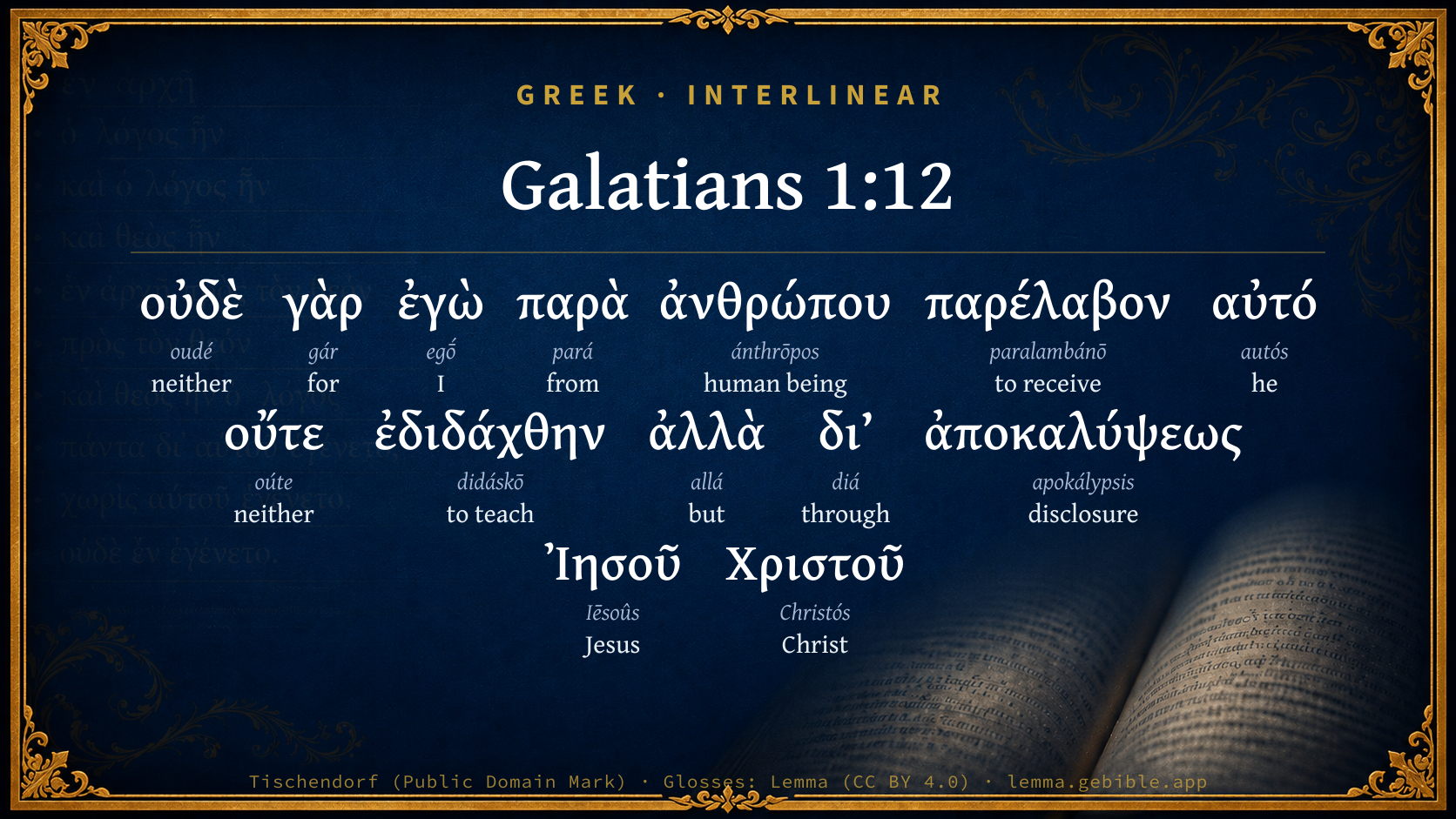
  1. οὐδὲ oudé G3761 “neither” Conjunction, Negative
  2. γὰρ gár G1063 “for” Conjunction
  3. ἐγὼ egṓ G1473 “I” Personal pronoun, 1st person, Nominative, Singular
  4. παρὰ pará G3844 “from” Preposition
  5. ἀνθρώπου ánthrōpos G444 “human being” Noun, Genitive, Singular, Masculine
  6. παρέλαβον paralambánō G3880 “to receive” Verb, Aorist, Active, Indicative, 1st person, Singular
  7. αὐτό autós G846 “he” Personal pronoun, Accusative, Singular, Neuter
  8. οὔτε oúte G3777 “neither” Conjunction, Negative
  9. ἐδιδάχθην didáskō G1321 “to teach” Verb, Aorist, Passive, Indicative, 1st person, Singular
  10. ἀλλὰ allá G235 “but” Conjunction
  11. δι’ diá G1223 “through” Preposition
  12. Ἰησοῦ Iēsoûs G2424 “Jesus” Noun, Genitive, Singular, Masculine
  13. Χριστοῦ Christós G5547 “Christ” Noun, Genitive, Singular, Masculine

About this verse

These counts appear in no published source. They are computed here, from the morphology-tagged text and Lemma’s own curated glosses. What Lemma adds →

14
words
14
distinct lemmas
Pauline Epistles
section

Notable vocabulary

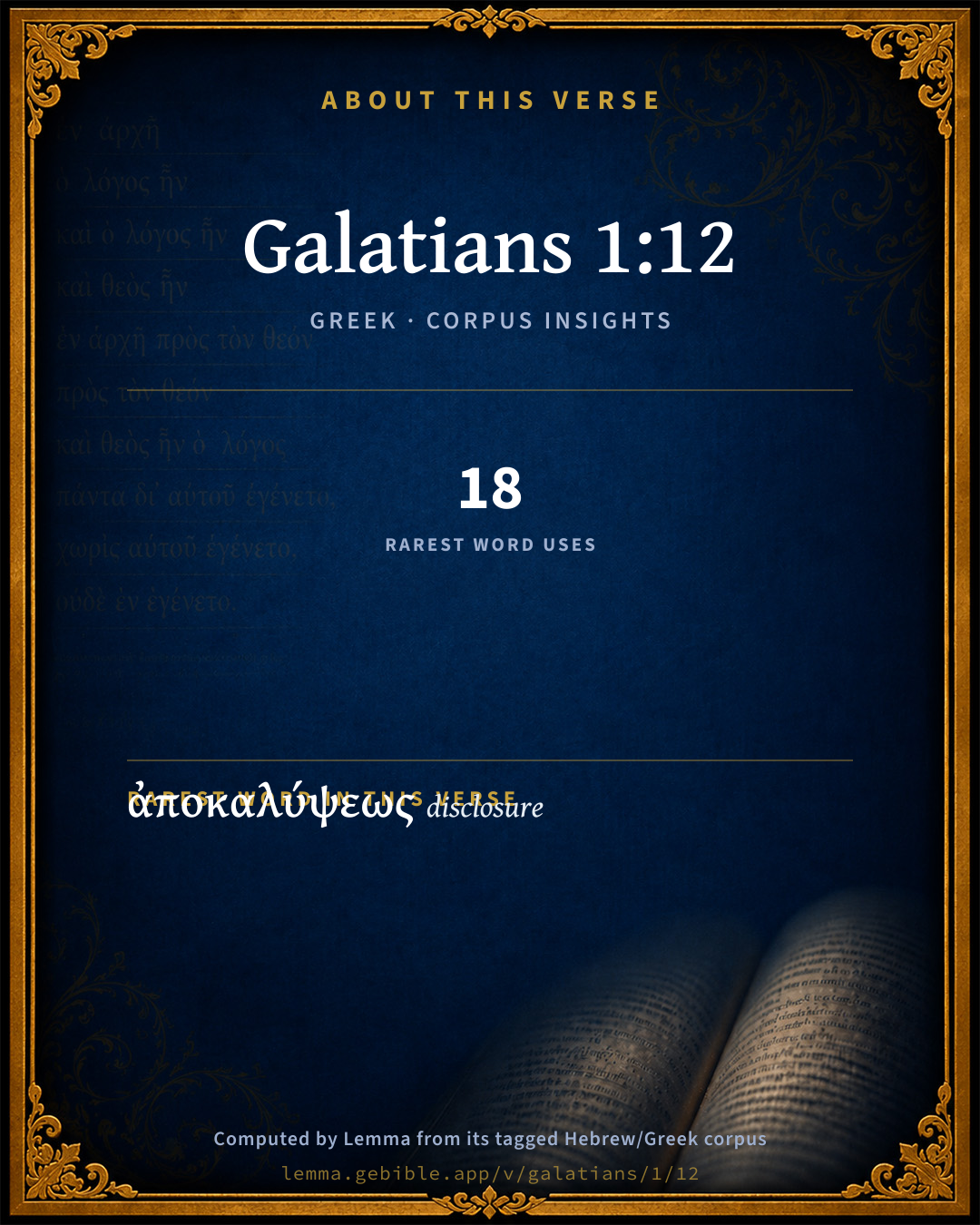
The rarest word here is ἀποκαλύψεως disclosure G602 — appearing just 18 times in the whole Greek New Testament.

Shared distinctive vocabulary

ἀποκαλύψεως disclosure G602 occurs in 18 verses of the Greek New Testament. Also found in:

Cross-references

5

Topical passages linked to Galatians 1:12 in the Treasury of Scripture Knowledge — connected by theme and wording, ordered by reader-vote popularity; previews shown in the World English Bible.

  • 1 Corinthians 2:10 But to us, God revealed them through the Spirit. For the Spirit searches all things, yes, the deep things of God.
  • Galatians 1:16 to reveal his Son in me, that I might preach him among the Gentiles, I didn't immediately confer with flesh and blood,
  • Galatians 1:1 Paul, an apostle (not from men, neither through man, but through Jesus Christ, and God the Father, who raised him from the dead),
  • 2 Corinthians 12:1 It is doubtless not profitable for me to boast. For I will come to visions and revelations of the Lord.
  • 1 Corinthians 11:23 For I received from the Lord that which also I delivered to you, that the Lord Jesus on the night in which he was betrayed took bread.

Cross-references courtesy of OpenBible.info (CC BY 4.0).

Commentary

Notes on Galatians 1:12 from classic Christian and Jewish commentators (each source and its license shown beneath its notes). The classic Christian expositions comment on the surrounding passage and are grouped to its opening verse, so a note may address several verses; the Jewish commentaries on the Tanakh (Rashi and others) are per-verse, so they appear only where the commentator wrote on this verse.

Lemma curates 59 commentaries, every one of them public domain or Creative Commons licensed, each selected and text-cleaned for this edition rather than reprinted as found. About our sources →

Tyndale Open Study Notes

Tyndale Open Resources

1:12 no human source . . . no one taught me: Jewish scholars primarily depended on teachers. The Judaizers argued that Paul had received his commission and message from the other apostles, but then had unfaithfully changed the message. • I received it by direct revelation from Jesus Christ: See 1:17; Acts 9:3-15; 26:12-18. Paul’s unique experience gave him distinctive authority and insight. But he learned other matters, such as the life of Christ, from others (e.g., Gal 1:18; 1 Cor 11:23-26; 15:3-11).

Tyndale Open Study Notes — © Tyndale Open Resources, licensed CC BY-SA 4.0. Text via the HelloAO Bible API.

Bengel's Gnomon

Johann Albrecht Bengel

Gal 1:12. Παρέλαβον, I received) This differs from I was taught it [ἐδιδάχθην]; for the one is accomplished without labour; the other is acquired by the labour of learning.—διʼ ἀποκαλύψεως, by revelation) viz., I received.

Bengel's Gnomon of the New Testament — English translation (T&T Clark, Edinburgh, 1860) — public domain. Text from a community e-Sword module.

Meyer's Critical & Exegetical Commentary

Heinrich August Wilhelm Meyer

Gal_1:12. Proof of the statement, τὸ εὐαγγέλιον … οὐκ ἔστι κατὰ ἄνθρωπον.

οὐδὲ γὰρ ἐγώ] for neither I, any more than the other apostles. On οὐδὲ γάρ, for neither, which corresponds with the positive καὶ γάρ, comp. Bornemann, ad Xen. Symp. p. 200; Hartung, Partikell. I. p. 211. The earlier expositors (also Morus, Koppe, and others) neglect both the signification of οὐδέ and the emphasis on ἐγώ, which is also overlooked by de Wette, for also I have not, etc.; and Ewald, I obtained it not at all. Comp., on the contrary, Mat_21:27; Luk_20:8; Joh_8:11. Rückert, Matthies, and Schott understand οὐδέ only as if it were οὔ, assuming it to be used on account of the previous negation; and see in ἐγώ a contrast to those, quibus ipse tradiderit evangelium, in which case there must have been αὐτός instead of ἐγώ. This remark also applies to Hofmanns view, that he himself has not received what he preached through human instruction. Besides, the supposed reference of ἐγώ would be quite unsuitable, for the apostle had not at all in view a comparison with his disciples; a comparison with the other apostles was the point agitating his mind. Lastly, Winer finds too much in οὐδέ, nam ne ego quidem. This is objectionable, not because, as Schott and Olshausen, following Rückert, assume, οὐδʼ ἐγὼ γάρ or καὶ γὰρ οὐδʼ ἐγώ must in that case have been written, for in fact γάρ would have its perfectly regular position (Gal_6:13; Rom_8:7; Joh_5:22; Joh_7:5; Joh_8:42, et al.); but because ne ego quidem would imply the concession of a certain higher position for the other apostles (comp. 1Co_15:8-9), which would not be in harmony with the apostles present train of thought, where his argument turned rather on his equality with them (comp. 1Co_9:1).

παρὰ ἀνθρώπου] from a man, who had given it to me. Not to be confounded with ἀπʼ ἀνθρώπου (see on 1Co_11:23, and Hermann, ad Soph. El. 65). Here also, as in Gal_1:1, we have the contrast between ἄνθρωπος and Ἰησ. Χριστός.

αὐτό] viz. τὸ εὐαγγέλιον τὸ εὐαγγελισθὲν ὑπʼ ἐμοῦ.

οὔτε ἐδιδάχθην] As οὔτε refers only to the οὐκ contained in the preceding οὐδέ, and δέ and τέ do not correspond, οὔτε is here by no means inappropriate (as Rückert alleges). See Hand, De part. τέ diss. II. p. 13; Hartung, Partikell. I. p. 101 f.; Buttmann, neutest. Gr. p. 315. Comp. on Act_23:8. For neither have I received it from a man, nor learned it. Παρέλαβον denotes the receiving through communication in general (comp. Gal_1:9), ἐδιδάχθην the receiving specially through instruction duly used.

ἀλλὰ διʼ ἀποκαλύψ. Ἰ. Χ.] The contrast to παρὰ ἀνθρώπου; Ἰησοῦ Χ. is therefore the genitive, not of the object (Theodoret, Matthies, Schott), but of the subject (comp. 2Co_12:1; Rev_1:1), by Jesus Christ giving to me revelation. Paul alludes to the revelations[25] received soon after the event at Damascus, and consequent therefore upon his calling, which enabled him to comply with it and to come forward as a preacher of the gospel. Comp. Gal_1:15-16; Eph_3:3. The revelation referred to in 2Co_12:1 ff. (Thomas, Cornelius a Lapide, Balduin, and others) cannot be meant; because this occurred at a subsequent period, when Paul had for a long time been preaching the gospel. Nor must we (with Koppe, Flatt, and Schott) refer it to the revelations which were imparted to him generally, including those of the later period, for here mention is made only of a revelation by which he received and learned the gospel.

How the ἀποκάλυψις took place (according to Calovius, through the Holy Spirit; comp. Act_9:17), must be left undecided. It may have taken place with or without vision, in different stages, partly even before his baptism in the three days mentioned Act_9:6; Act_9:9, partly at and immediately after it, but not through instruction on the part of Ananias. The ἘΝ ἘΜΟΊ in Gal_1:16 is consistent with either supposition.

[25] Of which, however, the book of Acts gives us no account; for in Act_22:17, Christ appeared to him not to reveal to him the gospel, but for the purpose of giving a special instruction. Hence they are not to be referred to the event at Damascus itself, as, following Jerome and Theodoret, many earlier and more recent expositors (Rückert, Usteri, Olshausen, Baumgarten-Crusius, Hofmann, Wieseler) assume. The calling of the apostle, by which he was converted at Damascus, is expressly distinguished in ver. 16 from the divine ἀποκαλύψαι τὸν υἱὸν ἐν ἐμοί, so that this inward ἀποκάλυψις followed the calling; the calling was the fact which laid the foundation for the ἀποκάλυψις (comp. Möller on de Wette)the historical preliminary to it. In identifying the ἀποκάλυψις of our passage with the phenomenon at Damascus, it would be necessary to assume that Paul, to whom at Damascus the resurrection of Jesus was revealed, had come to add to this fundamental fact of his preaching the remaining contents of the doctrine of salvation, partly by means of argument, partly by further revelation, and partly by information derived from others (see especially Wieseler). This idea is, however, inconsistent with the assurance of our passage, which relates without restriction to the whole gospel preached by the apostle, consequently to the whole of its essential contents. The same objection may be specially urged against the view, with which Hofmann contents himself, that the wonderful phenomenon at Damascus certified to Pauls mind the truth of the Christian faith, which had not been unknown to him before. Such a conception of the matter falls far short of the idea of the ἀποκάλυψις of the gospel through Christ, especially as the apostle refers specifically to his gospel.

Meyer — Critical and Exegetical Commentary on the New Testament — English translation by Peter Christie, edited by Frederick Crombie (T&T Clark, 1880) — public domain. Text from a community e-Sword module.

Expositor's Greek Testament

ed. W. Robertson Nicoll

Gal 1:12 . ἐγὼ . The personal pronoun is inserted, because the author is here laying stress on the special education he had received for his ministry of the Gospel He had not learnt it, like his converts, from human teaching, but by direct communion with God in spirit, as the Twelve had learnt it from Christ’s own teaching. This independence of older Christians is a marked feature in the history of his life. The agency of Ananias was necessary for his admission into the Church, but after his baptism no older Christian appears on the scene at Damascus.

The Expositor's Greek Testament, edited by W. Robertson Nicoll (1897–1910) — public domain. Text from a community e-Sword module.

Geneva Bible (1599)

Geneva Bible translators

This place is to be understood of an extraordinary revelation, for otherwise the Son alone revealed his Gospel by his Spirit, although by the ministry of men, which Paul shutteth out here.

Geneva Bible (1599) marginal notes — public domain. Text via Bolls.life.

Jamieson, Fausset & Brown

Robert Jamieson, A. R. Fausset & David Brown

Translate, "For not even did I myself (any more than the other apostles) receive it from man, nor was I taught it (by man)." "Received it," implies the absence of labor in acquiring it. "Taught it," implies the labor of learning.

by the revelation of Jesus Christ--Translate, "by revelation of [that is, from] Jesus Christ." By His revealing it to me. Probably this took place during the three years, in part of which he sojourned in Arabia (Gal 1:17-18), in the vicinity of the scene of the giving of the law; a fit place for such a revelation of the Gospel of grace, which supersedes the ceremonial law (Gal 4:25). He, like other Pharisees who embraced Christianity, did not at first recognize its independence of the Mosaic law, but combined both together. Ananias, his first instructor, was universally esteemed for his legal piety and so was not likely to have taught him to sever Christianity from the law. This severance was partially recognized after the martyrdom of Stephen. But Paul received it by special revelation (Co1 11:23; Co1 15:3; Th1 4:15). A vision of the Lord Jesus is mentioned (Act 22:18), at his first visit to Jerusalem (Gal 1:18); but this seems to have been subsequent to the revelation here meant (compare Gal 1:15-18), and to have been confined to giving a particular command. The vision "fourteen years before" (Co2 12:1) was in A.D. 43, still later, six years after his conversion. Thus Paul is an independent witness to the Gospel. Though he had received no instruction from the apostles, but from the Holy Ghost, yet when he met them his Gospel exactly agreed with theirs.

Jamieson, Fausset & Brown — Commentary Critical and Explanatory on the Whole Bible (1871) — public domain (CC PDM 1.0). Text via the HelloAO Bible API.

Adam Clarke's Commentary

Verse 12. I neither received it of man] By means of any apostle, as was remarked Ga 1:1. No man taught me what I have preached to you.

But by the revelation of Jesus Christ.] Being commissioned by himself alone; receiving the knowledge of it from Christ crucified.

Adam Clarke's Commentary on the Bible (1810–1826) — public domain. Text from a community e-Sword/MySword module.

John Calvin's Commentaries

12. For I neither received it from man. What then? shall the authority of the word be diminished, because one who has been instructed by the instrumentality of men shall afterwards become a teacher? We must take into account, all along, the weapons with which the false apostles attacked him, alleging that his gospel was defective and spurious; that he had obtained it from an inferior and incompetent teacher; and that his imperfect education led him to make unguarded statements. They boasted, on the other hand, that they had been instructed by the highest apostles, with whose views they were most intimately acquainted. It was therefore necessary that Paul should state his doctrine in opposition to the whole world, and should rest it on this ground, that he had acquired it not in the school of any man, but by revelation from God. In no other way could he have set aside the reproaches of the false apostles.

The objection, that Ananias (Acts 9:10) was his teacher, may be easily answered. His divine instruction, communicated to him by immediate inspiration, did not render it improper that a man should be employed in teaching him, were it only to give weight to his public ministry. In like manner, we have already shown, that he had a direct call from God by revelation, and that he was ordained by the votes and the solemn approbation of men. These statements are not inconsistent with each other.

John Calvin's Commentaries (1540-1563) — public domain. Text from the Calvin Translation Society English edition (1840s-50s) via the Christian Classics Ethereal Library (ccel.org). Calvin's coverage is partial (roughly two-thirds of the Bible); uncommented books and verses are honest gaps, never fabricated. The 19th-century editor's footnotes and remarks are omitted so the notes are faithfully Calvin's own voice.

Ellicott's Commentary for English Readers

(12) For I neither received it.—The first “neither” in this verse does not answer to the second, but qualifies the pronoun “I.” The connection in the thought is perhaps something of this kind: “The gospel is not human as it comes to you; neither was it human as it first came to me.”

Taught.—There is an antithesis between this word and “revelation” in the next clause. “I did not receive my doctrine from man by a process of teaching and learning, but from Christ Himself by direct revelation.”

By the revelation.—It is better to omit the article: “by,” or “through the medium of,” revelation. What was this revelation, and when was it given? The context shows that it must have been at some time either at or near the Apostle’s conversion. This would be sufficient to exclude the later revelation of 2Co_12:1. But can it be the vision on the way to Damascus itself alone? At first sight it would seem as if this was too brief, and its object too special, to include the kind of “sum of Christian doctrine” of which the Apostle is speaking. But this at least contained the two main points—the Messiahship of Jesus, and faith in Jesus, from which all the rest of the Apostle’s teaching flowed naturally and logically. When once it was felt that the death of Christ upon the cross was not that of a criminal, but of the Son of God, the rest all seemed to follow. Putting this together with the sense, which we may well believe had been growing upon him, of the inefficacy of the Law, we can easily see how the idea would arise of a sacrifice superseding the Law, and in the relegation of the Law to this very secondary position the main barrier between Jew and Gentile would be removed. St. Paul himself, by laying stress upon his retreat to the deserts of Arabia, evidently implies that the gospel, as taught by him in its complete form, was the result of gradual development and prolonged reflection; but whether this is to be regarded as implicitly contained in the first revelation, or whether we are to suppose that there were successive revelations, of which there is no record in the Acts, cannot be positively determined.

Of Jesus Christ—i.e., given by Jesus Christ; of which Jesus Christ is the Author.

A Bible Commentary for English Readers, edited by Charles John Ellicott (1878–1897) — public domain. Text from a community e-Sword module.

The Cambridge Bible for Schools and Colleges

gen. ed. J. J. S. Perowne

12. For I neither received it of man] ‘I’ is emphatic: I received not the Gospel, any more than did the other Apostles, from man.

neither was I taught it] St Paul might have received the Gospel from God, and yet have been more fully instructed by men. This was not the case, comp. ch. Gal_2:6. He both received and was taught it by direct revelation. The commission to Ananias (Act_9:10, &c.) is not at variance with this declaration. It does not appear that he made any communication of religious knowledge to St Paul (Gal_1:18-19).

by the revelation of Jesus Christ] Rather, through the revelation. ‘Jesus Christ’ may be either the subject or the object, the Revealer or the Revealed; but probably the latter is primarily intended, see Gal_1:16. Different opinions are held as to the time when this revelation was made. Certainly it took place at the time of his conversion, and probably on other subsequent occasions. In 2Co_12:7 he speaks of “the abundance of the revelations” which he had received; comp. 2Co_12:1.

The Cambridge Bible for Schools and Colleges (gen. ed. J. J. S. Perowne; Cambridge University Press, 1878–1918) — public domain. Text from a community e-Sword module.

John Gill's Exposition

For I neither received it of man,.... Not from Gamaliel, at whose feet he was brought up; he received the law from him, and knowledge in the Jews' religion, and in the traditions of the elders, but not a whit of the Gospel; on the contrary, he received prejudices against it from him, or was strengthened in them by him; no, nor from the apostles of Christ neither, whom he saw not, had no conversation with for some years, after he was a preacher of the Gospel, and therefore did not receive it at their hands; no, nor from Ananias, nor any other man:

neither was I taught it: that is, by man; he did not learn it of men, as men learn law, physics, logic, rhetoric, natural philosophy, and other things at school:

but by the revelation of Jesus Christ; meaning, not through Christ being revealed to him by the Father, as in Gal 1:16 though it is a sense not to be overlooked; but by Christ, the revealer of it to him; and regards either the time of his rapture into the third heaven, when he heard words not to be uttered; or rather since that is not so certain when it was, the time of his conversion, when Christ personally appeared unto him, and made him a minister of his Gospel; and immediately from himself, without the interposition, or use of any man, or means, gave him such light into it, and such a furniture of mind for the preaching of it, that he directly, as soon as ever he was baptized, set about the ministration of it, to the admiration of the saints, and confusion of the enemies of Christ. These words furnish out another proof of the deity of Christ; for if the Gospel is not after man, nor received of, or taught by man, but by Christ, then Christ cannot be a mere man, or else being by him, it would be by man; and which also confirms the authority and validity of the Gospel, and carries in it a strong reason for the apostle's anathematizing all such as preach any other.

John Gill's Exposition of the Whole Bible (1746–1763) — public domain (CC PDM 1.0). Text via the HelloAO Bible API.

Trapp's Complete Commentary

John Trapp

12 For I neither received it of man, neither was I taught it, but by the revelation of Jesus Christ.

Ver. 12. Received it of man] i.e. Of mere man. Jesus Christ is more than a man.

John Trapp, A Commentary or Exposition upon All the Books of the Old and New Testament (1647–1656) — public domain. Text from a community e-Sword module.

Albert Barnes' Notes on the Bible

For I neither received it of man - This is very probably said in reply to his opponents, who had maintained that Paul had derived his knowledge of the gospel from other people, since he had not been personally known to the Lord Jesus, or been of the number of those whom Jesus called to be his apostles. In reply to this, he says, that he did not receive his gospel in any way from man.

Neither was I taught it - That is, by man. He was not taught it by any written account of it, or by the instruction of man in any way. The only plausible objection to this statement which could be urged would be the fact that Paul had an interview with Ananias Act 9:17 before his baptism, and that he would probably receive instructions from him. But to this it may be replied:

That there is no evidence that Ananias went into an explanation of the nature of the Christian religion in his interview with Paul; Before this, Paul had been taught what Christianity was by his encounter with the Lord Jesus on the way to Damascus Act 9:5; Act 26:14-18; The purpose for which Ananias was sent to him in Damascus was that Paul might receive his sight, and be filled with the Holy Spirit, Act 9:17. Whatever instructions he may have received through Ananias, it is still true that his call was directly from the Lord Jesus, and his information of the nature of Christianity from Jesus’ revelation.

But by the revelation of Jesus Christ - On his way to Damascus, and subsequently in the temple, Act 22:17-21. Doubtless, he received communications at various times from the Lord Jesus with regard to the nature of the gospel and his duty. The sense here is, that he was not indebted to people for his knowledge of the gospel, but had derived it entirely from the Saviour.

Albert Barnes' Notes on the Bible (1834–1885) — public domain. Text from a community e-Sword/MySword module.

Matthew Poole's English Annotations

Not of man, as my first and sole instructor, not only at second-hand, from Peter, James, or John, as the false teachers had suggested, nor was I taught it otherwise than by the immediate revelation of Jesus Christ.

Revelation signifieth the discovery of something which is secret (as the gospel, and doctrine of it, is called a mystery hid from ages). It may be objected, that Paul was instructed by Ananias, Act 9:17. But this prejudiceth nothing the truth of what the apostle saith in this place, neither do we read of much that Ananias said to him in a way of instruction; it is only said, that he laid his hands on him, and he was filled with the Holy Ghost. When, or where, he had these revelations, the apostle saith not; probably while he lay in a trance, blind, and neither eating nor drinking for three days, Act 9:9. Others think it was when he was caught up into the third heaven, 2Co 12:2. Certain it is, that St. Paul had revelations from Christ, Act 22:17,18; 26:15-18. Revelation signifies an immediate conveying of the knowledge of Divine things to a person, without human means; and in that Paul ascribes the revelation of the gospel to Jesus Christ, he plainly asserts the Divine nature of the Lord Jesus Christ.

Matthew Poole's English Annotations on the Holy Bible (1683–1685) — public domain. Text from a community e-Sword/MySword module.

Whedon's Commentary on the Bible

Daniel D. Whedon

12. Received it—As a gift or deposit.

Taught it—As a lesson, doctrine, or system.

Revelation—Direct disclosure from Christ to Paul. The Greek word is a form of our term apocalypse; so that not only John had his apocalypse, but Paul. See Introductory note to 1Co_15:1.

Daniel D. Whedon (gen. ed.), Commentary on the Old and New Testaments (1874–1909) — public domain. Text from a community e-Sword module.

The Pulpit Commentary

For I neither received it of man, neither was I taught it (oujde gar ejgw parapou parelabon aujto oute ejdidacqhn); for neither at the hand of man did I myself receive it or was taught it. The "for" introduces a consideration fortifying the foregoing affirmation, that the apostle"s gospel was not in its characteristic complexion human; it was no wonder that it was not; for neither was it human in its origin. The "neither" (oujde) points forward to the whole subsequent clause, at the hand of men did I myself receive it. " In a similar manner does for neither" (oujde gar) point to the whole subsequent clause in Joh_5:22 Joh 8:42; Act_4:34. The ejgw ("I myself") is inserted in the Greek, as contrasting the preacher with those to whom the gospel had been preached (ver. 11), in the same way as it is inserted in 1Co_11:23, "I myself received (ejgwlabon) of the Lord that which also I delivered unto you." Some expositors (as Meyer, Alford) connect the "for neither" with the pronoun "I myself" only; as if the meaning were, "For neither did I, any more than Cephas or James, receive the gospel from men." This restriction of the "neither" to the noun or pronoun only which follows, is grammatically, of course, not inadmissible. (comp. Joh_7:5) But there is nothing in the immediate context to suggest the idea that the writer is just now thinking of the other apostles, and the sentence is perfectly clear without our introducing it. It is quite clear that the apostle means in the words oute ejdidacqhn to affirm that man did not teach him the gospel any more than deliver it to him. But the verb "was taught," taken by itself, does not convey the idea of merely human instruction, being used continually in the Gospels of our Lord"s teaching, and Joh_14:26 ofthe "teaching" of the Holy Spirit. We must, therefore, conclude that the passive verb "I was taught it" is, in the writer"s intention, conjoined with the active verb "I received it," as both alike depending upon the first words in the sentence," at the hand of man." If so, we have here another instance of the use of the figure zeugma (see above on ver. 10); for while the preposition para is used in its proper sense, when, as here, it is connected with parelabon, it is only in a strained, improper sense that it could be employed, like uJpo, with a passive verb, to simply denote the agent. Some difficulty is felt in determining in what way the writer regards the notion of "receiving the gospel" as distinguishable from that of "being taught it." It is possible that the latter is added merely, as Bishop Lightfoot supposes, to explain and enforce the former. But another view is descrying of consideration. We may suppose "the gospel" to be regarded, in the one case, as a kind of objective creed or form of doctrine,"received" by a man on its being put before him, in consideration of the authority with which it comes invested, as a whole and so to speak en bloc, before ever its details have been definitely grasped by him. But in addition to this, and subsequently to this, this same gospel rosy be regarded as brought within the range of the recipient"s distinguishing consciousness, by means of a "teacher" from without, whether Divine or human, instilling into his mind successively the various several truths which compose it. Now, it was conceivable that the apostle may, in the sense above supposed, have "received" the gospel direct from God or from Christ, while, however, man may to a large extent have been the "teaching" instrument, through which its truths were brought home to his understanding. But in the present passage St. Paul affirms that in actual fact man had no more to do with his reception of the gospel in the latter sense than in the former. And this affirmation tallies closely with what we read in the sixteenth verse of this chapter, and again with the sixth verse of the next chapter, both of which passages were written, no doubt, with an eye to the very notion respecting the source of his knowledge of the gospel which he is here concerned to negative. Textual critics differ among themselves whether pute ("nor") or oujde ("nor yet") should be read before ejdidacqhn. The only difference is that "nor yet" would of the two the more clearly mark a distinction subsisting between the notions expressed by the two preceding verbs. If we acquiesce in the reading of the received text, which is "nor," then, since the negative has been already expressed, the idiom of our language would here suppress the negative in "nor," and substitute the simple "or." But (ajlla); but only. The strongly adversative sense which marks this form of "but" requires that in thought we supply after it the words, "I received it and was taught it;" for which, in translating, we may put, as an adequate substitute, the word "only." Bishop Wordsworth translates this ajlla "except," citing in justification Mat_20:23. But the grammatical construction of that passage is not sufficiently clear to justify us in giving to ajlla a sense which does not appear conformable with its ordinary usage. The apostle, then, affirms that it was not from or by man that he had received the gospel or been taught it. From whom, then, does he mean that he had received and by whom been taught it? Are we to say, God the Father? or, Jesus Christ? Just at present, it should seem, the apostle is not concerned definitely or contradistinctively to present to view either one of these Divine personalities. As has been re, marked above with reference to the words in ver. 3, "from God the Father and the Lord Jesus Christ," the two conceptions appear blended together to the apostle"s view, when he thinks of the Source flora which spiritual gifts accrue to us. His immediate purpose is to assert that his gospel was in its origin Divine, and not human. For this it is enough to say that it came to him "through the revelation of Jesus Christ." But in preparation for the discussion of these words, it may be here remarked that the supreme agency of God the Father, as in all else, so also in particular in the communication to the world of the gospel, is an idea very distinctly put forth in a great many passages of the New Testament, and is in fact the dominant representation. As examples of this, we may refer to Col_1:26, Col_1:27; Eph_1:9; 2Co_5:18, 2Co_5:20; Heb_1:2. "The words" which "the Son spake" were those which "he had heard of the Father," as were also those which the promised Paraclete was to "speak." The first verse of the Book of the Revelation furnishes a striking illustration of this truth. It runs thus: "The revelation of Jesus Christ, which God gave him to show unto his servants, even the things which must shortly come to pass: and he i.e. Jesus Christ) sent and signified it by his angel unto his servant John." Of course, the verse refers to that disclosure of future events which forms the subject-matter of the particular book which it prefaces. Nevertheless, what is written here is no exceptional statement, but.one. simply exemplary; it is true in this particular reference, just because it is true also with reference to the whole of that disclosure of spiritual facts which through the gospel is made known to the Church. By the revelation of Jesus Christ (di ajpokaluyewv jIhsou Cristou); through the revelation of Jesus Christ. This genitive clause, "of Jesus Christ," has by most interpreters been understood subjectively; that is, as denoting the subject or agent implied in the verbal noun "revelation;" in other words, they suppose St. Paul herein presents Jesus Christ as having revealed to him the gospel This does indeed appear to be the meaning of the phrase, "the revelation of Jesus Christ" inluyiv, Rev_1:1, just now referred to. Taken thus, the words put before us explicitly the agency of only Christ in the revelation spoken of, leaving the agency of God without specific reference. None the less, however, does even in this case the thought of God"s agency naturally recur to our minds as implied in connection with the mention of Jesus Christ, even as in the first verse of the chapter where it is explicitly named therewith. But we have to observe that in every other passage in which the Apostle Paul uses a genitive with the noun "revelation" (ajpoka) the genitive denotes the object which is revealed. These are Rom_2:5," Revelation of the righteous judgment of God;" Rom_8:19, "Revelation of the seas of God;" Rom_16:25, "Revelation of the mystery;" and the passages in which he designates our Lord"s second coming as "his revelation;" 1Co_1:7; 2Th_1:7; with which comp. 1Pe_1:7, 13 4:13. That in these five last passages the genitive is objective and not subjective, if it could otherwise be called in question, is indicated by the circumstance thatneia) 1Ti_6:14, 1Ti_6:15; where the apostle uses the word "appearing"(ejpifa) instead of "revelation," he adds, "which in its own times he shall show who is the blessed and only Potentate," etc., manifestly meaning the Father. One other passage remains to be mentioned, namely, (av) 2Co_12:1, "visions and revelations of the Lord," which many critics take as meaning "vouchsafed by the Lord," and which in consequence is commonly referred to in support of a similar interpretation of the passage now before us. But it may be questioned whether the apostle does not there denote by "visions" (ojptasi) a somewhat different class of spiritual phenomena from those denoted by "revelations of the Lord;" by the former intending such visions as those, e.g. in which he seemed to himself to be transported into Paradise, or into the third heaven; and by the latter, appearances vouchsafed to him of the Lord Jesus in personal presence. These latter, it is true, might be also fitly styled" visions" (ojptasiai), as, in fact, the most important of them all is styled in the speech before Agrippa; (Act_26:19) whilst on the other hand, the former may be justly supposed to be included under the term "revelations," as employed presently after in ver. 7. But the addition, "of the Lord," has at least much more point, if we assume the above-stated discrimination to have been intended between the two classes of phenomena; if, indeed, it is not a quite superfluous adjunct on the other view; tot the "visions and revelations" referred to would be, of course, conceived of as coming from "the Lord," without the apostle"s saying so. Instead of being available in support of the subjective view of the genitive before us, the passage 2Co_12:1 rather favours the other interpretation. And this interpretation of the words, "of Jesus Christ," as objective is favoured by the subsequent context. For comparing this twelfth verse with the five verses which follow, we observe that in this verse the apostle affirms that his gospel was not human in its character, because that he had not received it from man nor been taught it by man, but only "through the revelation of Jesus Christ. " Then in the five verses which follow, to make this affirmation good, he states that up to the time of his conversion he had been wholly averse to the Christian doctrine and intensely devoted to Pharisean Judaism, and that when God, calling him by his grace, "revealed his Son in him that he might preach him among the Gentiles," he applied to no human being for mental direction, but kept himself aloof from even those who were apostles before him. Now, in setting the statement of ver. 12 over against the professedly illustrative statement which follows, we observe that "the revelation of Jesus Christ" in the former occupies precisely the same position in the line of thought which in the latter is held by "God"s revealing his Son in him;" for the apostle attributes his possession of the truth of the gospel in the one to "the revelation of Jesus Christ," and in the other to God"s revealing his Son in him, and in each ease to nothing else. Surely it follows "that the revelation of Jesus Christ" which gives him the gospel in the one ease, is identical with "God"s revealing his Son in him" which gives him the gospel in the other. Thus both the sense in which the genitive is ordinarily found when joined with the word "revelation," and the guidance of the context, concur in determining for the genitive in the present case the objective sense. This interpretation seems at first sight to labour under the inconvenience that, so construed, the sentence lacks the clearly expressed antithethon to the foregoing noun "man," which we might naturally expect to find. But in reality the required antithesis is quite distinctly though implicitly indicated in the very term "revelation; "for this essentially carries with it the notion of an agency not merely superhuman, but Divine. It would be an altogether contracted and indeed erroneous view of this "revelation" to suppose that it means no more than the manifestation to Saul"s bodily senses of the personal presence and glory of Christ. Beyond question this was of itself sufficient to convince Saul of the truth that Jesus, though once crucified, was now both living and highly exalted in the supersensuous world, and by consequence to furnish the necessary basis for further discoveries of truth. But more was required than the mere bodily sight of the glorified Jesus. This might confound and crush down his antagonism, but would not of itself" impart converting and healing faith. Men might see" and yet "not believe". (Joh_6:36) There was required also the true and just perception of the relation which this exalted Jesus bore to individual human souls, in particular to Saul"s own soul; and further, of the relation which he bore to the dispensations of God as dealing with his people, and as dealing with mankind at large; a perception of these things which would then only be true and just when accompanied with a duly appreciative, satisfying, adoring sense of the infinite excellency of what was thus disclosed to him, and of its perfect adaptation to the wants of man as sinful. In short, this "revelation" to Saul "of Jesus Christ" involved that spiritual transformation which, in 2Co_4:6, the apostle describes in the following words: "It is God, that said, Light shall shine out of darkness, who shined in our hearts, to give the light or, illumination) of the knowledge of the glory of God in the face of Jesus Christ." For in that passage, though in the form in which he clothes his thought he speaks as if conjoining others with himself, it appears almost certain that he is describing there, as further on in vers. 7-12, his own personal experiences (see beginning of note on ver. 8). and also that he is describing that first introduction into his own understanding and heart of the truths of the gospel, which qualified him thenceforward to fulfil his mission to proclaim it. This appears confessedly to have been in a very marked degree a miracle a moral and spiritual miracle. In truth, the new birth of a human soul into the kingdom of God (Joh_3:8) must ever be such, coming we know not how. What, however, seems to distinguish this case from most others, even from that of those previously called to be apostles, is the rapidity with which was formed in Saul the mind of "an apostle of the Gentiles a mind, that is, distinctly and unhaltingly conscious of the "mystery" which in Eph_3:3 he says "was by revelation made known to him," the hitherto kept back "secret" of God"s love in Christ to all the world, Gentile and Jew alike; of God"s readiness and purpose to embrace and bless with all spiritual blessings, without any reference now to Mosaism, every human creature that simply repented and believed in Jesus Christ. As the proclamation to the world of this "mystery" was to be his great and pre-eminently distinguishing function, so at the very first he became fitted and qualified for its discharge by its impartation to his soul, not through slow processes of thought and reasoning, but by an inward manifestation of the Christ, the suddenness and vividness of which corresponded in no small degree to the suddenness and vividness of that outward manifestation of the Christ which was simultaneously made to his corporeal sense. This presents itself to us as, in the moral and spiritual sphere of our being, a miracle; and as such the apostle himself manifestly regarded it. It is hard to believe but that he would have repudiated with high disdain (1Co_2:15) any attempt to solve the marvellousness of the phenomenon in the alembic of rational explanation; any theory which should find the phenomenon to be satisfactorily accounted for by these or those conditions of his foregoing psychological history. These last may have prepared a favourable field of development; but he knew for a surety that the product itself was no natural offspring of any spontaneous operations of his own mind. The very phrase in the verse before us, "the revelation of Jesus Christ," as well as the comparison which 2Co_4:6 he draws between his spiritual transformation and the supernatural operation of the Almighty"s fiat, "Let there be light," plainly shows that he would have refused to allow the cause discoverable anywhere else save in the unexplainable operations of sovereign, almighty grace. And in all prudence we should be content to be herein not wiser than he.

The Pulpit Commentary (1880–1919), ed. H.D.M. Spence-Jones & Joseph S. Exell — public domain. Text from a community e-Sword module.

John Wesley's Explanatory Notes

For neither did I receive it - At once. Nor was I taught it - Slowly and gradually, by any man. But by the Revelation of Jesus Christ - Our Lord revealed to him at first, his resurrection, ascension, and the calling of the gentiles, and his own apostleship; and told him then, there were other things for which he would appear to him.

John Wesley, Explanatory Notes Upon the Whole Bible (1754–1765) — public domain. Text via the GEBible commentary corpus.

Luther on Galatians

Martin Luther

see note on vs 11

Martin Luther — Commentary on the Epistle to the Galatians (1535), English translation by Theodore Graebner (Zondervan, 1939) — public domain (U.S. copyright not renewed). Text from a community e-Sword module.

McGarvey & Pendleton's Commentaries

J. W. McGarvey

For neither did I receive it from man, nor was I taught it, but it came to me through revelation of Jesus Christ. [I want you to understand that the gospel which I preach was in no sense my own invention or production, for it was of a nature not after man; i. e., not such as man could design or devise. And the method by which I received it proves that it was not of a human origin, and hence also not of a human character; for I did not receive it from man, nor did I acquire it by the slow and progressive method of teaching, but it came to me through revelation of Jesus Christ. Jesus revealed himself to Paul on the way to Damascus and he was soon preaching the gospel in that city. Therefore Paul's revelations must have been received about the time of his conversion, and most probably during his sojourn in Arabia. As to exactly when they were received Paul himself is silent; but as to the manner, he declares that he received them from Jesus, so his gospel was from the same source as that of the other apostles. The rest of the chapter is taken up in proving the statements of these two verses.]

J. W. McGarvey (with Philip Y. Pendleton), Commentaries on the New Testament (The Fourfold Gospel, 1914; Acts; and the epistles) — public domain. Text from a community e-Sword/MySword module.

The People's New Testament

B. W. Johnson

12. For I neither received it of man, etc. It could not be of man, for it did not come to him from man. No preacher or apostle taught it to him, but it came by a direct revelation of Christ. The first revelation was on the way to Damascus (Acts 26:13–18). There were no doubt successive revelations (2 Cor. 12:1).

B. W. Johnson's The People's New Testament with Notes (1889–1891) — public domain. Electronic text from the Christian Classics Ethereal Library (CCEL) ThML edition.

Cambridge Greek Testament for Schools and Colleges

12. οὐδὲ γὰρ ἐγὼ κ.τ.λ. Expanding the thought of κατὰ ἄνθρωπον. My Gospel is not after the measure of man, for indeed it came to me not through man at all but through the personal revelation of Jesus Christ. οὐδὲ apparently does not emphasize the ἐγώ, as though he was claiming equality with the Twelve, but refers to the whole clause.

παρὰ ἀνθρώπου παρέλαβον, “at the hands of man.” “In all cases where the idea of transmission is prominent παρὰ will be used in preference to ἀπό, be the communication direct or indirect; so Php 4:18” (Lightfoot). For παραλαμβάνω παρά see 1Th 2:13; 1Th 4:1; 2Th 3:6.

οὔτε. The marginal οὐδὲ (אAD*) suggests reception from man in a minor degree.

ἐδιδάχθην. Though received from God it might have been explained by man. This was not the case.

ἀλλὰ δι ̓ ἀποκαλύψεως Ἰησοῦ Χριστοῦ. “But it came to me through revelation from Jesus Christ”; as his apostleship (Gal 1:1) so his reception of the Gospel. He is doubtless thinking only of the time of his conversion, not of his later experiences recorded in 2Co 12:1-7. ἀποκάλυψις (Gal 2:2, cf. verb Gal 1:16, Gal 3:23) always of the unveiling of Divine things (which therefore are presumably not far off), never of one man revealing a secret to another. “Revelation is distinguished from ordinary moral and spiritual influences by its suddenness. It shows us in an instant, what under ordinary circumstances would grow up gradually and insensibly. In the individual it is accompanied by a sudden transition from darkness to light; in the world at large it is an anticipation of moral truth and of the course of human experience” (Jowett).

Ἰησοῦ Χρ. is doubtless subjective, as even in Rev 1:1. Observe that the words form a claim parallel to the affirmation by our Lord about St Peter (Mat 16:17). Perhaps not unintentionally, if, as is probable, St Paul knew of our Lord’s saying.

Cambridge Greek Testament for Schools and Colleges (Cambridge University Press, 1896; 21 vols, various authors incl. Carr, Maclear, Plummer, Farrar, Lumby, Moule, M. R. James, Simcox) — public domain. Text from a community e-Sword module.

Alford’s Greek Testament

Henry Alford

12.] Enunciation of this subject.

γν. γάρ] The γάρ seems to have been corrected to δέ, as not applying immediately to the foregoing,—or perhaps in reminiscence of 1Co 15:1; 2Co 8:1. It refers back to vv. 8, 9. On γνωρ., see note, 1Co 15:1.

κατὰ ἄνθρωπον] according to man, as E. V. (see reff.): i.e. measured by merely human rules and considerations, as it would be were it of human origin: so βελτίονος ἢ κατʼ ἄνθρωπον νομοθέτου, Xen. Mem. iv. 4. 24, κατά cannot itself express the origin (as Aug., a-Lapide, Est., al.), though it is included by implication: see note ver. 4, on κατὰ τὸ θέλημα.

12.] proof of this. For neither (οὐδὲ γάρ in negative sentences, answers to καὶ γάρ in positive; e.g. in Herod. i. 3, ἐπιστάμενον πάντως ὅτι οὐ δώσει δίκας· οὐδὲ γὰρ ἐκείνους διδόναι:—omit the οὐ, and substitute καί for οὐδέ, and the sentence becomes affirmative. So that οὐδέ has nothing to do, except in ruling the negative form of the clause, with οὔτε following, but belongs to this clause only. See on the whole, Ellic.’s note) did I (ἐγώ strongly emphatic,—see example from Herodot. above: ‘neither did I, any more than the other Apostles.’ Thus this clause stands alone; the ‘neither’ is exhausted and does not extend to the next clause) receive it (historically) from man (i.e. ‘any man;’ not ‘a man,’ but generic, the article being omitted after the preposition as in ver. 1), nor was taught it (dogmatically); but through revelation of (i.e. from, genitive subjective: see reff. Thdrt. (but not altogether: for he subjoins, αὐτὸς αὐτὸν ἔσχε διδάσκαλον) al. take the genitive as objective, ‘revelation of,’ i.e. revealing) Jesus Christ.

When did this revelation take place?—clearly, soon after his conversion, imparting to him as it did the knowledge of the Gospel which he afterwards preached; and therefore in all probability it is to be placed during that sojourn in Arabia referred to in ver. 17. It cannot be identical with the visions spoken of 2Co 12:1 ff.,—for 2 Cor. was written in a.d. 57, and fourteen years before that would bring us to a.d. 43, whereas his conversion was in 37 (see Chron. Table in Prolegomena, Vol. II.), and his subsequent silence, during which we may conceive him to have been under preparation by this apocalyptic imparting of the Gospel, lasted but three years, ver. 18.

Nor can it be the same as that appearance of the Lord to him related Act 22:18,—for that was not the occasion of any revelation, but simply of warning and command.

He appears to refer to this special revelation in 1Co 11:23 (where see on the supposed distinction between ἀπό and παρά); 15:3. 1Th 4:15; see notes in those places.

Henry Alford, The Greek Testament (1849–1861) — public domain. Text from a community e-Sword module.

International Critical Commentary

12. οὐδὲ γὰρ ἐγὼ παρὰ ἀνθρώπου παρέλαβον αὐτό, “for neither did I receive it from man.” This is the first step of the proof of the preceding general statement that his gospel is not a human message. Like the proposition itself it is negative, denying human source. οὐδέ coupled with γάρ may (1) serve to introduce a statement of what is at the same time a fact additional to the one already stated and an evidence for it, as is the case especially in arguments from analogy (see Luk 20:36, Joh 5:22, Act 4:12, Rom 8:7), or (2) οὐδέ may throw its force upon a single term of the sentence, suggesting a comparison of the case mentioned with some other case previously mentioned or in mind. On this latter view the comparison would doubtless be with the Twelve, who, it is taken for granted, received the gospel otherwise than from man. This comparison itself, however, may be of either one of two kinds: (a) It may be comparison simply and, so to speak, on equal terms, “For neither did I any more than they receive it, etc.” (Cf. Joh 7:5, as interpreted in AV., “for neither did his brethren believe on him.” See also a similar use of οὐδέ without γάρ in Mar 11:26; or (b) it may be ascensive comparison: “For not even I, of whom, not being of the Twelve, it might have been supposed that I must have received the gospel from men, received it thus” (cf. Gal 6:13). Of these three views the first (maintained by Sief.) is most in accord with N. T. usage of οὐδὲ γάρ (see exx. above), but is objectionable because the statement here made can not easily be thought of as a co-ordinate addition to the preceding, and because the presence of ἐγώ, emphatic by the mere fact of its insertion, almost requires that οὐδέ shall be interpreted as throwing its force upon it. The second view, 2(a), is more probable than the third, 2(b); the implication of the latter that his receiving his gospel otherwise than from man is in a sense an extreme case seems foreign to the state of mind of the apostle as it appears in this chapter. The objection that there is no ground for assuming a comparison with the Twelve is without force; the whole tenor of this chapter and the following goes to show that Paul’s commission had been declared to be inferior to that of the Twelve, and that he has this in mind throughout his defence; when, therefore, by the use of ἐγώ he indicates that he is comparing himself with some one else as respects the source of his gospel, we scarcely need to be informed that the unexpressed term of the comparison is the Twelve.

The verb παραλαμβάνω bears in N. T. two meanings: (1) “To take to or along with one’s self,” “to accept.” (2) “To receive something transmitted to one.” The latter is the uniform or all but uniform use in Paul. 1Co 11:23, 1Co 11:15:1, 1Co 11:3, Gal 1:9, Php 4:9, Col 2:6 (?) 4:17 (?) 1Th 2:13, 1Th 2:4:1, 2Th 3:6, and is the undoubted meaning here.

παρὰ ἀνθρώπου. The original force of παρά with the genitive is “from beside,” denoting procession from a position beside or with some one. In N. T. precisely this sense is rare (Joh 15:26, Joh 16:27), but in the majority of instances the meaning is one which is derived from this. Thus both in Greek writers and in N. T. it is used after verbs of learning, hearing, inquiring, issuing, receiving, yet often in a sense scarcely distinguishable from that of ἀπό. With Mar 5:35 cf. Luk 8:49, and with Mat 12:38 cf. Luk 11:16. When used after a verb which implies transmission, especially a compound of παρά, παρά before the noun apparently acquires by association the sense “along from,” marking its object as source, but at the same time as transmitter from a more ultimate source. Such seems to be the force of the preposition in 1Th 2:13, 1Th 2:4:1, 2Th 3:6; it is also entirely appropriate to the first instance of its occurrence in Php 4:18; its use the second time may be due either to the fact that Paul avoided the suggestion of a different relation in the two cases which a change to ἀπό would have conveyed, or even to a desire delicately to hint a divine source back of the Philippians themselves, making them also transmitters. This latter instance seems in any case to be strongly against the view of Winer (WM. p. 463 f. n.) and Mey. on 1Co 11:23 that παρά means “directly from.” On the other hand, Ltft.’s view that “where the idea of transmission is prominent παρά will be used in preference to ἀπό, ” whether the object be the immediate or the remote source, is not sustained by the evidence as a whole. Not only is παρά often used of ultimate source, with no suggestion of transmission, but ἀπό is used, in 1Co 11:23 at least, when the idea of transmission is suggested by the verb, and in every instance where παρά is used before a transmitting source, the idea of transmission is suggested by the verb or context, and the object is the mediate source. To this rule Php 4:18 is, as remarked above, probably no exception. The force of παρά accordingly in the present phrase παρά ἀνθρώπου, joined with παρέλαβον, which distinctly suggests receiving by transmission, is probably “along from,” and taken with οὐδέ the phrase denies that the gospel which Paul preached was received by him from men as the intermediate source. This, of course, carries with it, also, the denial of man as the ultimate source, since the supposition of an ultimate human source with a divine mediate source is excluded by its own absurdity. In effect, therefore, παρά in the present phrase covers the ground more specifically covered in v. 1 by ἀπό and διά.

Ἀνθρώπου is probably to be taken as in διʼ ἀνθρώπου in v. 1 in the most general qualitative sense, not as having reference to any individual; it is hence to be translated “from man,” rather than “from a man.” Cf. on v. 1, and see Joh 5:34.

οὔτε ἐδιδάχθην, “nor was I taught it.” To the denial of man as the source from which he received his gospel the apostle adds as a correlative statement a denial of instruction as the method by which he obtained it. This was, of course, precisely the method by which the great majority of the Christians and even of the Christian teachers of that day had received the gospel. It had been communicated to them by other men. Cf. the case of Apollos, Act 18:25, Act 18:26, of Timothy, 2Ti 3:14, and the frequent use of the word “teach” in reference to the work of apostles and preachers in general: Act 4:18, Act 4:5:28, Act 4:20:20, 1Co 4:17, Col 1:28, etc. The apostle characterises his as an exceptional case. As a pupil of the Pharisees he had been taught something very different from the gospel, but he had had no connection with those who at the beginning were the teachers of the gospel. See the reference to these facts in vv. 13-17.

Οὐδέ before ἐδιδ. is read by אAD*FGP 31, 104, 326, 436, 442 Boh. Eus. Chr. Euthal. Cyr. Thdrt. Dam.; οὔτε by BDcKL Oec. al. Since the latter evidence proves that οὔτε is not simply an idiosyncrasy of B., and the Western authorities are almost unanimously on the side of οὐδέ, the probability is that οὐδέ is a Western digression from the original reading οὔτε, produced either by accidental assimilation to the preceding οὐδέ or by correction of the unusual combination οὐδέ … οὔτε. Cf. WM. pp. 617 f.

The οὔτε before ἐδιδ. can not be regarded as strictly correlative to οὐδέ at the beginning of the verse, since οὐδέ and οὔτε are not correlative conjunctions (WM. p. 617), the “neither … nor” of the English translation by its suggestion of this relation to that extent misrepresenting the Greek. Nor would the clauses be correlative if οὐδέ be read instead of οὔτε here (see below), since οὐδέ … οὐδέ express not correlation—the first looking forward to the second and the second back to the first—but successive negation, each οὐδέ looking backward and adding a negation to one already in mind. With the reading οὔτε, however, the second clause is introduced as correlative to the first, though the first had been expressed with a backward look to the preceding sentence, not with a forward look to the present clause.

ἀλλὰ διʼ ἀποκαλύψεως Ἰησοῦ Χριστοῦ. “but it came to me through revelation of Jesus Christ.” A verb such as is suggested by παρέλαβον and ἐδιδάχθην is of necessity to be supplied in thought with διʼ ἀποκαλύψεως, yet not ἐδιδάξθην itself, since there is a manifest contrast between instruction and revelation, the first being denied and the latter affirmed, as the method by which the apostle obtained his gospel. On the meaning of ἀποκάλυψις, see detached note on Ἀποκαλύπτω and Ἀποκάλύψις, p. 433. It is evident that the apostle is here using the term in its third sense, viz., a divine disclosure of a person or truth, involving also perception of that which is revealed by the person to whom the disclosure is made. He is speaking neither of an epiphany of Jesus as a world event, nor of a disclosure of him which, being made to men at large, as, e. g., through his life and death, might be perceived by some and fall ineffectual upon others, but of a personal experience, divine in its origin (cf. οὐδὲ … παρὰ ἀνθρώπου), personal to himself and effectual.

It has been much disputed whether Ἰησοῦ Χριστοῦ is an objective or subjective genitive, whether Christ is the revealed or the revealer. According to the former interpretation, Paul in effect affirms that Jesus Christ had been revealed to him, and in such way that that revelation carried with it the substance of the gospel. If Christ is the revealer, it is doubtless the gospel that is revealed. It is in favour of the former view (1) that Paul is wont to speak of God as the author of revelations; and of Christ as the one revealed, not as the revealer: see for the former usage 1Co 2:10, 2Co 12:1, and for the latter 1Co 1:7, 2Th 1:7, Gal 1:16; (2) that this latter usage occurs in this very context (v. 16) where Paul, apparently speaking of the same fact to which he here refers, uses the phrase ἀποκαλύψαι τὸν υἱὸν αὐτοῦ ἐν ἐμοί, in which Jesus is unambiguously represented as the one revealed. It may be urged in favour of the second interpretation (1) that the phrase thus understood furnishes the proper antithesis to παρὰ ἀνθρώπου and ἐδιδάχθην, affirming Christ as the source and revelation as the method over against man as the source and instruction as the method; (2) that the gospel, especially the gospel of Paul as distinguished from the Jewish-Christian conception of the gospel, requires as its source a revelation of larger and more definite content than is implied when the genitive is taken as objective. But these arguments are by no means decisive. Paul is not wont to preserve his antitheses perfect in form, and the first view as truly as the second preserves it substantially, since it is self-evident that if Christ was revealed to him (or in him) God was the revealer. As to whether a revelation of which Christ was the content was adequate to be the source of his gospel, there is much reason to believe that in his conception of Jesus obtained by the revelation of him there were virtually involved for Paul all the essential and distinctive features of his gospel. Thus it certainly included the resurrection of Jesus, and as an inference from it his divine sonship (Rom 1:4); these in view of Paul’s previous attitude towards the law might, probably did, lead him to recognise the futility of righteousness by law, this in turn preparing the way at least for the recognition of faith as the true principle of the religious life; this accepted may have led to the conviction that the Gentile could be justified without circumcision. While it can not perhaps be proved that precisely this was the order of Paul’s thought, his various references to his experience find their most natural explanation in this view, that the new conception of Jesus which Paul gained by the revelation of Christ in him furnished the premise from which the essential elements of his gospel were derived. See Php 3:4-9, Gal 2:19, Rom 7:25, Rom 7:3:29, 30, and v. 16 of this chap., where he closely connects the two extremes of the experience attributed to him, viz., the revelation of Christ and the mission to the Gentiles. See also Act 26:16, Act 26:17, where a similar connection occurs. It seems, therefore, more probable that the genitive Ἰησοῦ Χριστοῦ is objective, and that the apostle refers to a divinely given revelation of Jesus Christ which carried with it the conviction that he was the Son of God. See further on v. 16.

Ἀποκαλύψεως, being without the article, may be either indefinite, “a revelation” or qualitative, “revelation.” In the former case the reference is to a single specific though unidentified experience. In the latter case the phrase simply describes the method by which the gospel was received without reference to singleness or multiplicity of experience. The reference in the apostle’s mind may be to the Damascus experience only (cf. vv. 16, 17) or may include any revelations by which Christ was made known to him. In the absence of evidence of specific reference “by revelation” is preferable to “by a revelation” as a translation of the phrase.

International Critical Commentary — older volumes (1896–1929), various authors — public domain. Text from a community e-Sword module.

Vincent's Word Studies in the New Testament

Marvin R. Vincent

Of man [παρα ανθρωπου] . Better, from man. Para from emphasises the idea of transmission, and marks the connection between giver and receiver. Comp. 1Th 2:13; 1Th 4:1; 2Ti 3:14; Act 10:22. In the Gospels and Acts paralambanein usually means to take, in the sense of causing to accompany, as Mt 4:5; Mt 17:1; Mr 4:36, etc. Scarcely ever in the sense of receive : see Mr 7:4. In Paul only in the sense of receive, and only with para, with the single exception of 1Co 11:23 [απο] . The simple lambanw usually with para, but with ajpo, 1Jo 2:27; 1Jo 3:22.

By the revelation of Jesus Christ [δι αποκαλυψεως ιησου χριστου] . Not, by Jesus Christ being revealed to me, but, I received the gospel by Jesus Christ 's revealing it to me. The subject of the revelation is the gospel, not Christ. Christ was the revealer. Rev. (it came to me) through revelation of Jesus Christ.

Marvin R. Vincent, Word Studies in the New Testament (1887–1900) — public domain. Text from a community e-Sword/MySword module.

Lesson kit

Teaching starters — assembled from the data on this page, not authored interpretation. Every prompt links to the verse data it draws on. Edit before teaching.

Galatians, in the Pauline Epistles, opens this verse with 14 words (14 distinct Greek lemmas). Its most distinctive word is apokálypsis (“disclosure”). A historical commentator’s framing appears above. Read the whole chapter for the surrounding context.

Discussion questions

  1. How does “disclosure” (apokálypsis) shape what this verse is saying?
  2. Luke 2:32 shares the word «disclosure» with this verse. How do the two illuminate each other?
  3. The translations on this page render this verse differently — a whole-verse word diff, not a word-by-word alignment. What might account for the different wordings?
  4. Reading how Tyndale Open Study Notes and Bengel's Gnomon read this verse, where do the two commentators agree and where do they part?

Things to notice

Reading settings

Reading text

Shown beneath each verse's original-language words.

Old Testament
Old Testament edition

Read the OT as the Masoretic Hebrew (MT) or the Greek Septuagint (LXX).

English shown for the Greek Septuagint (in the Hebrew ↔ Greek comparison).

Comparing translations? Open the Compare panel on any verse page to stack up to four side by side.