Numbers 11:19

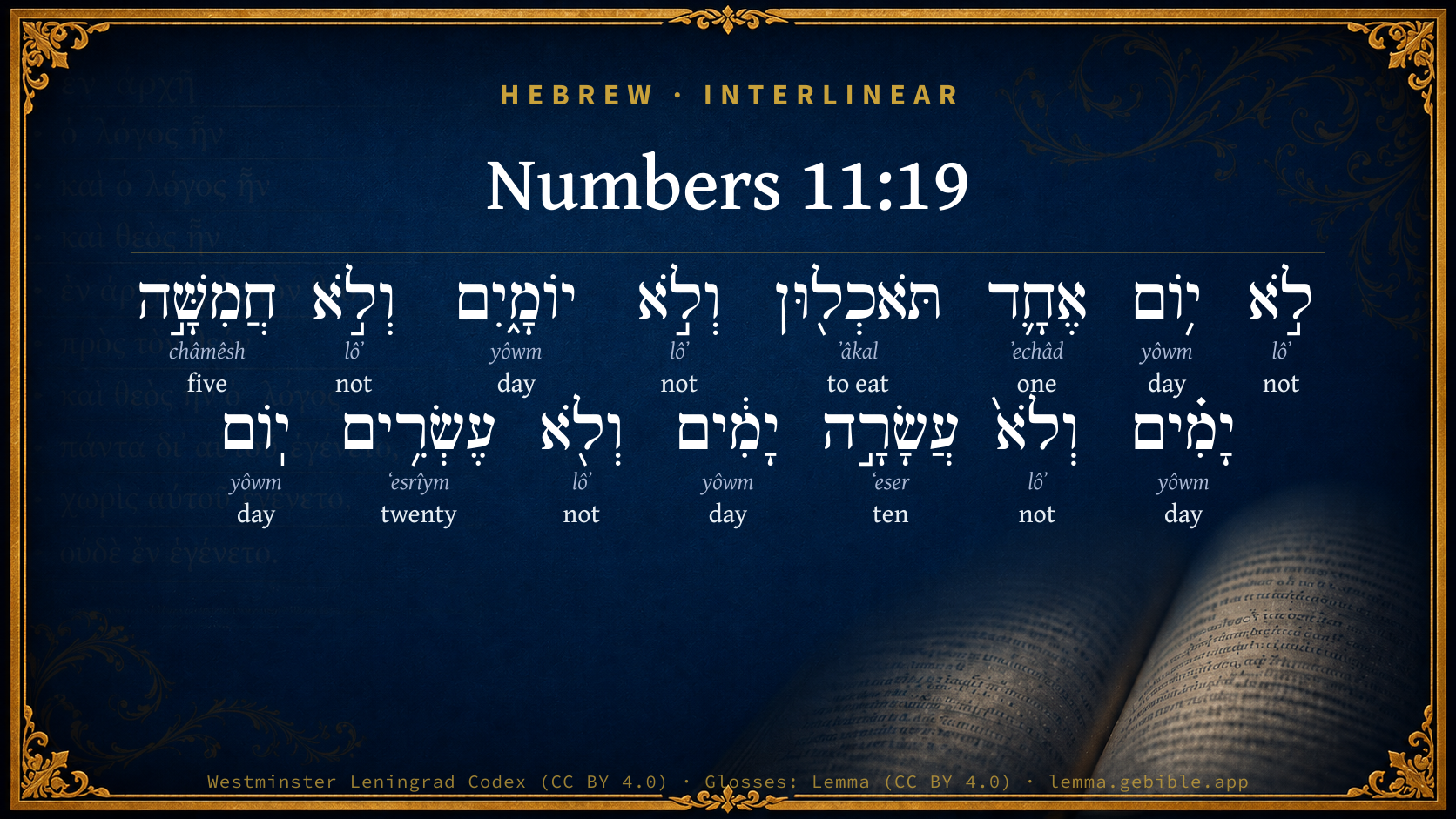
Hebrew (Westminster Leningrad Codex) Numbers 11:19 appears in the Hebrew Old Testament. The text above is from the Westminster Leningrad Codex. Each word links to its Strong’s number, a concise gloss, and parsing drawn from the Open Scriptures Hebrew Bible morphology. Click any word for its full Brown-Driver-Briggs (BDB) entry.
Download image
Cite this verse

Numbers 11:19 (World English Bible). Public Domain. Lemma interlinear Bible study tool, https://lemma.gebible.app/v/numbers/11/19.

Show BibTeX & RIS
BibTeX
RIS
English Translation
You shall not eat one day, nor two days, nor five days, neither ten days, nor twenty days,
World English Bible · Public Domain
Download a study sheet

One document with this verse’s original text, its word-by-word gloss line, the meaning frame, cross-references with their text, attributed commentary, and full source and license credits — printable, and it pastes into notes with its structure intact.

This verse Autodidact and up

Study sheet (.html) Plain text (.txt)

A passage Seminary Student

Up to 50 verses in one chapter. A passage sheet keeps up to 6 commentary sources and 12 cross-references per verse, in the order this page ranks them, and says so on the sheet whenever that leaves anything out. Ask for a single verse and you get the Autodidact verse sheet above.

Everything on this page stays free to read, with no account — the sheet is a download of what is already on screen, not access to it.

Want to remove ads? Support Godless Engineer
Compare translations 3

The same verse in 3 English versions, stacked beneath the original-language interlinear above. Click any original word for its lexicon entry.

Each is an independent rendering of the whole verse — the interlinear is not word-aligned to these translations.

Highlighted words mark where these versions differ — a whole-verse word diff, not a word-by-word alignment.

  • World English Bible Public Domain
    You shall not eat one day, nor two days, nor five days, neither ten days, nor twenty days,
  • King James Version Public Domain
    Ye shall not eat one day, nor two days, nor five days, neither ten days, nor twenty days;
  • unfoldingWord Literal Text CC BY-SA 4.0
    You shall eat not one day and not two days and not five days and not ten days and not 20 days,

unfoldingWord Literal Text — © unfoldingWord, licensed CC BY-SA 4.0. Word-aligned USFM3 via Door43 (git.door43.org/unfoldingWord/en_ult).

Versions to compare (up to 4)

3 of 4 selected

Show all 18 translations

Every available English version of this verse, each an independent rendering of the whole verse.

  • World English Bible Public Domain
    You shall not eat one day, nor two days, nor five days, neither ten days, nor twenty days,
  • Berean Standard Bible Public Domain
    You will eat it not for one or two days, nor for five or ten or twenty days,
  • Majority Standard Bible Public Domain
    You will eat it not for one or two days, nor for five or ten or twenty days,
  • King James Version Public Domain
    Ye shall not eat one day, nor two days, nor five days, neither ten days, nor twenty days;
  • American Standard Version (1901) Public Domain
    Ye shall not eat one day, nor two days, nor five days, neither ten days, nor twenty days,
  • Revised Version (1885) Public Domain
    Ye shall not eat one day, nor two days, nor five days, neither ten days, nor twenty days;
  • Geneva Bible (1599) Public Domain
    Ye shall not eat one day nor two daies, nor fiue daies, neither ten daies, nor twentie dayes,
  • Douay-Rheims (1899) Public Domain
    Not for one day, nor two, nor five, nor ten, no nor for twenty.
  • Young's Literal Translation Public Domain
    Ye do not eat one day, nor two days, nor five days, nor ten days, nor twenty days; --
  • Literal Standard Version CC BY-SA 4.0
    You do not eat one day, nor two days, nor five days, nor ten days, nor twenty days,
  • Unlocked Literal Bible CC BY-SA 4.0
    You will not eat meat for only one day, two days, five days, ten days, or twenty days,
  • unfoldingWord Literal Text CC BY-SA 4.0
    You shall eat not one day and not two days and not five days and not ten days and not 20 days,
  • Darby Bible Public Domain
    Not one day shall ye eat, nor two days, nor five days, neither ten days, nor twenty days;
  • World Messianic Bible Public Domain
    You will not eat just one day, or two days, or five days, or ten days, or twenty days,
  • Webster's Bible Public Domain
    Ye shall not eat one day, nor two days, nor five days, neither ten days, nor twenty days;
  • Free Bible Version CC BY-SA 4.0
    You're going to eat it, not for just a day or two, and not for five or ten or twenty days.
  • Bible in Basic English Public Domain
    Not for one day only, or even for five or ten or twenty days;
  • JPS Tanakh (1917) Public Domain
    Ye shall not eat one day, nor two days, nor five days, neither ten days, nor twenty days;

Literal Standard Version (2020), Covenant Press — licensed CC BY-SA 4.0. Text via the HelloAO Bible API (eBible.org). Unlocked Literal Bible (unfoldingWord) — licensed CC BY-SA 4.0. Text via the HelloAO Bible API (eBible.org). unfoldingWord Literal Text — © unfoldingWord, licensed CC BY-SA 4.0. Word-aligned USFM3 via Door43 (git.door43.org/unfoldingWord/en_ult). Free Bible Version, Dr. Jonathan Gallagher — licensed CC BY-SA 4.0. Text via the HelloAO Bible API (eBible.org).

Word by word

More ways to search: Search by grammar → Find every occurrence → Compare this word →

Practice this passage: Drill this verse → Learn its vocabulary →

עֲשָׂרָ֣ה
ʻeser
H6235
“ten”
Adjective, Cardinal number, Masculine, Singular, Absolute
Part of Speech
Adjective
Type
Cardinal number
Gender
Masculine
Number
Singular
State
Absolute
Full BDB Definition

Origin: from H6237

TWOT: 1711a

ten - ten - with other numbers
  1. לֹ֣א lôʼ H3808 “not” Particle, Negative
  2. י֥וֹם yôwm H3117 “day” Noun, Common, Masculine, Singular, Absolute
  3. אֶחָ֛ד ʼechâd H259 “one” Adjective, Cardinal number, Masculine, Singular, Absolute
  4. תֹּאכְל֖וּן ʼâkal H398 “to eat” Verb, Qal, Imperfect, 2nd Person, Masculine, Plural + Suffix, n
  5. וְלֹ֣א lôʼ H3808 “and · not” Conjunction + Particle, Negative
  6. יוֹמָ֑יִם yôwm H3117 “days” Noun, Common, Masculine, Dual, Absolute
  7. וְלֹ֣א lôʼ H3808 “and · not” Conjunction + Particle, Negative
  8. חֲמִשָּׁ֣ה châmêsh H2568 “five” Adjective, Cardinal number, Masculine, Singular, Absolute
  9. יָמִ֗ים yôwm H3117 “days” Noun, Common, Masculine, Plural, Absolute
  10. וְלֹא֙ lôʼ H3808 “and · not” Conjunction + Particle, Negative
  11. יָמִ֔ים yôwm H3117 “days” Noun, Common, Masculine, Plural, Absolute
  12. וְלֹ֖א lôʼ H3808 “and · not” Conjunction + Particle, Negative
  13. עֶשְׂרִ֥ים ʻesrîym H6242 “twenty” Adjective, Cardinal number, Both, Plural, Absolute
  14. יֽוֹם yôwm H3117 “day” Noun, Common, Masculine, Singular, Absolute

About this verse

These counts appear in no published source. They are computed here, from the morphology-tagged text and Lemma’s own curated glosses. What Lemma adds →

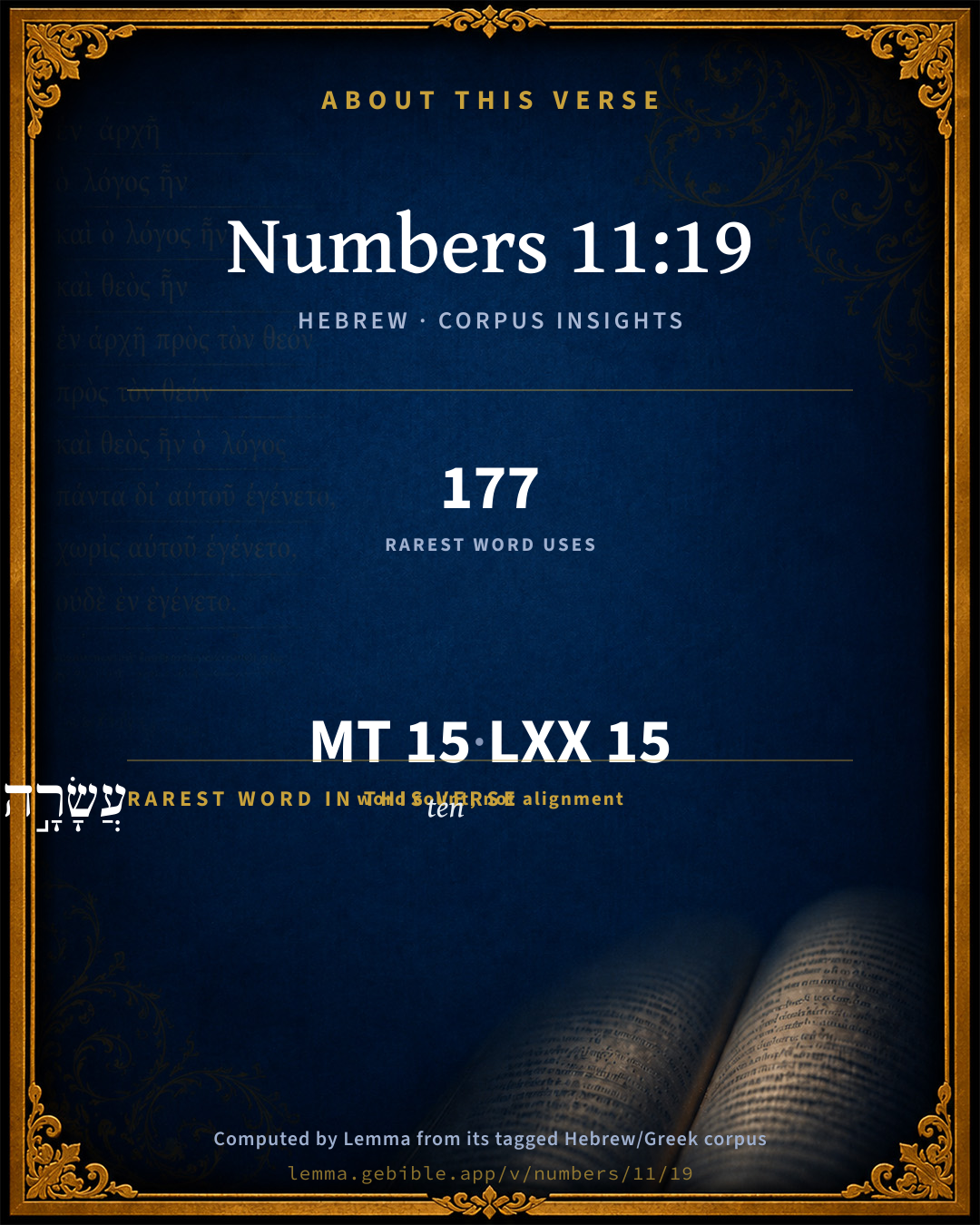
15
words
7
distinct lemmas
Pentateuch
section

Grammatical profile

  • 1 verb
  • 5 nouns
  • 4 adjectives
  • 5 particles

Verb forms

  • תֹּאכְל֖וּן Qal · Imperfect

Repetition

Words recur within this verse — often emphatic in Hebrew:

Hebrew & Septuagint length

In English translation the verse runs 18 words from the Hebrew and 17 from the Septuagint (LXX English) — closely comparable.

A rough comparison of the two English renderings, which tokenize alike — not a word-level alignment.

Word counts can differ between the Hebrew and the Greek without any difference in meaning — e.g. the Hebrew direct-object marker אֵת has no separate Greek word, and Greek often adds the article ὁ.

In the original languages it is 15 Hebrew tokens and 15 Greek tokens — but the two are counted differently (Hebrew bundles its prefixes and suffixes into one token; the Greek is in lemma form), so that isn’t a like-for-like length.

Hebrew and Greek witnesses Masoretic Hebrew ↔ Greek Septuagint

The same verse in the two great witnesses to the Old Testament, shown verse-for-verse.

These are two independent witnesses, not word-aligned to each other, and the Septuagint is shown in lemma (dictionary) form.

Hebrew Numbers 11:19 Masoretic · Westminster Leningrad Codex

לֹ֣א י֥וֹם אֶחָ֛ד תֹּאכְל֖וּן וְלֹ֣א יוֹמָ֑יִם וְלֹ֣א חֲמִשָּׁ֣ה יָמִ֗ים וְלֹא֙ עֲשָׂרָ֣ה יָמִ֔ים וְלֹ֖א עֶשְׂרִ֥ים יֽוֹם

You shall not eat one day, nor two days, nor five days, neither ten days, nor twenty days,

World English Bible · Public Domain

Greek LXX Numbers 11:19 Septuagint · lemma form

οὐ ἡμέρα εἷς ἐσθίω οὐδέ δύο οὐδέ πέντε ἡμέρα οὐδέ δέκα ἡμέρα οὐδέ εἴκοσι ἡμέρα

You⌃ shall not eat one day, nor two, nor five days, nor ten days, nor twenty days;

LXX2012 (modern English Septuagint) · Public Domain

Hebrew: Westminster Leningrad Codex (CC BY 4.0). Greek: Septuagint (public domain); English from LXX2012 (modern English Septuagint) (Public Domain). How the Septuagint differs from the Hebrew →

Targum (Aramaic paraphrase)

2

The Targum is the ancient Jewish Aramaic paraphrase of the Hebrew Scriptures — an interpretive translation, not the Hebrew text itself. Onkelos (literal) and Pseudo-Jonathan (expansive) render the Torah, and Jonathan the Prophets. Coverage is partial: where no permissively-licensed English translation exists for a verse, only the Aramaic is shown. This is verse-level text, not a word-by-word alignment to the Hebrew.

  1. Targum Onkelos Torah (Genesis–Deuteronomy)
    לָא יוֹמָא חַד תֵּיכְלוּן וְלָא תְרֵין יוֹמִין וְלָא חַמְשָׁא יוֹמִין וְלָא עַשְׂרָא יוֹמִין וְלָא עַשְׂרִין יוֹמִין

    (no public-domain English translation for this verse)

    Targum Onkelos — Aramaic: “Onkelos Genesis” (public domain); “Onkelos Exodus” (public domain); “Onkelos Leviticus” (public domain); “Onkelos Numbers” (public domain); “Onkelos Deuteronomy” (public domain). English: “Sefaria Community Translation” (CC0 1.0 (public-domain dedication)); “J.W. Etheridge. The Targums of Onkelos and Jonathan Ben Uzziel on the Pentateuch. London: Longmans, Green, 1862” (public domain). Text via Sefaria.

  2. Targum Pseudo-Jonathan Torah (Genesis–Deuteronomy)
    לָא יוֹמָא חָד תֵּיכְלוּן וְלָא תְּרֵין יוֹמִין וְלָא חַמְשָׁא יוֹמִין וְלָא עַשְרָא יוֹמִין וְלָא עַשְרִין יוֹמִין

    You shall not eat it one day, nor two days, nor five, nor ten, nor twenty days;

    Targum Pseudo-Jonathan — Aramaic: “Targum Jonathan on Genesis” (public domain); “Targum Jonathan on Exodus” (public domain); “Targum Jonathan on Leviticus” (public domain); “Targum Jonathan on Numbers” (public domain); “Targum Jonathan on Deuteronomy” (public domain). English: “The Targum of Jonathan ben Uzziel, trans. J. W. Etheridge, London, 1862” (public domain). Text via Sefaria.

Commentary

Notes on Numbers 11:19 from classic Christian and Jewish commentators (each source and its license shown beneath its notes). The classic Christian expositions comment on the surrounding passage and are grouped to its opening verse, so a note may address several verses; the Jewish commentaries on the Tanakh (Rashi and others) are per-verse, so they appear only where the commentator wrote on this verse.

Lemma curates 59 commentaries, every one of them public domain or Creative Commons licensed, each selected and text-cleaned for this edition rather than reprinted as found. About our sources →

Ellicott's Commentary for English Readers

(19) Ye shall not eat one day . . . —The quails which had been sent the preceding year appear to have covered the camp only during one day (Exo_16:13).

A Bible Commentary for English Readers, edited by Charles John Ellicott (1878–1897) — public domain. Text from a community e-Sword module.

John Gill's Exposition

Ye shall not eat one day,.... Only, as in Exo 16:12,

nor two days, nor five days, neither ten days, nor twenty days; but even thirty days, a whole month, as in Num 11:20.

John Gill's Exposition of the Whole Bible (1746–1763) — public domain (CC PDM 1.0). Text via the HelloAO Bible API.

Whedon's Commentary on the Bible

Daniel D. Whedon

19. Ye shall not eat one day — As they did a year before. Exo_16:12-13.

Daniel D. Whedon (gen. ed.), Commentary on the Old and New Testaments (1874–1909) — public domain. Text from a community e-Sword module.

Ramban (Nachmanides)

Rabbi Moshe ben Nachman (Ramban / Nachmanides)

YE SHALL NOT EAT ONE DAY. The meaning thereof is: “you shall not eat for only one day, nor only two days [but even a whole month]. Similarly, the phrase not once nor twice means “not only once nor twice.” And in my opinion it cannot be said of a person who eats or does something for many consecutive days that he ate or did [that action] for one day. is to be understood literally, for since they will eat for a consecutive period of thirty days, it cannot be said of them that they ate for one day. Likewise the phrase nor twenty days is to be understood in its plain sense: “you will not eat of it twenty days, but thirty days.” Similarly it cannot be said of one who eats [something] for thirty consecutive days that he ate it for twenty days. is to be understood literally, for since they will eat for a consecutive period of thirty days, it cannot be said of them that they ate for one day. Likewise the phrase nor twenty days is to be understood in its plain sense: “you will not eat of it twenty days, but thirty days.” Or it may be that the word “one” [Ye shall not eat ‘one’ day] is connected [with the following phrases]: “Ye shall not eat one day, nor two days, nor ten or twenty single [non-consecutive] days, but a full month.” Thus He gave them the meat which they craved for, but not the fish or the vegetables, for their main demand for which they wept was give us flesh. And the meaning of the expression, But even a whole month, until it come out of your nostrils, and it be loathsome unto you is that He will give them a lot of meat, and they will eat it for a whole month to such a great extent that they will become sick of it, and they will consider it detestable and like a strange inedible food.According to the plain meaning of Scripture the following is what happened: On the first day [of their eating the meat] they were smitten with a very great plague and the people that were the first to lust died, Verse 34. these being the mixed multitude that was among them, also the children of Israel mentioned at the beginning who said, Who shall give us flesh to eat? But the rest of the people who wept afterwards family by family, every man at the door of his tent, Verse 10. ate of it for a whole month until it became loathsome to them and they threw away any heaps they had left of it. And so does the psalm state: He caused flesh also to rain upon them as the dust; So they did eat, and were well-filled, and He gave them that which they craved. They were not estranged from their craving, their food was still in their mouths, when the anger of G-d went up against them etc., Verses 29-31. For some of them ate and were well-filled, but those who lusted did not satisfy their lust at all, for while their food was still in their mouths … the anger of G-d went up against them., Verses 29-31.Now the [Midrashic] interpretations of Rabbi Shimon 22. If flocks and herds be slain for them, will they suffice them? or if all the fish be gathered together for them ‘umatza lahem’ (will they suffice them)?” Since it is inconceivable that Moses actually doubted G-d’s powers, Rashi [in Verse 22] quotes the interpretation of Rabbi Shimon in the Sifre, that Moses’ intent was as follows: “The people are so many, and Thou hast said ‘I will give them flesh, for a whole month’ — and then you will kill them! Shall the flock and herds be slaughtered for them so that they [the people] will be killed immediately, and this eating should be their last, satisfying them forever!” Then G-d said to Moses: Now shalt thou see etc. (see note that follows). and of Rabbi Yehudah Hanasi (Verse 23) — for they will not listen unto thee.” Moses then went to appease them and told them what G-d said to him: Is the hand of the Eternal waxed short? (ibid.) But the people answered that He indeed has no power to grant their request. This is what the following verse [24] means: And Moses went out, and told the people the words of the Eternal. Since, however, they refused to listen to him, the verse continues, and he gathered seventy men etc. do not fit in properly with the language of Scripture, because He said, Now shalt thou see whether My word shall come to pass unto thee or not. And Moses said: ‘I will go to appease them.’ And G-d said to him: ‘They will not listen unto thee. Now shalt thou see whether My word shall come to pass unto thee [that they will not listen unto thee] or not …’” the interpretations of Rabbi Shimon and of Rabbi Yehudah Hanasi would have fitted in with the text of Scripture. But all which is written after the phrase, Is the hand of the Eternal waxed short? is: Now shalt thou see etc. which implies that Moses, as it were, doubted that G-d would satisfy them. Hence we must offer another interpretation, as set forth in the text that follows. And the interpretation of Rabbi Akiba who says that the words [of Moses] are to be taken literally, namely “Will it be enough for them?” is the true sense of Scripture, and this is the opinion of Onkelos [who translated umatza lahem — “will it suffice them?”]. But the event itself is amazing, as Rabbi Shimon said [commenting on Rabbi Akiba’s interpretation]: “The person of whom Scripture writes, he is trusted in all My house, would he say that G-d cannot supply enough for them!” Moreover, all of them had already seen far greater wonders than this! And Rabbi Abraham ibn Ezra answered this [by saying] that Moses thought that G-d would not create a new wonder except to vindicate His prophet [as happened in the affair of Korach, further, Chapter 16; and since the truth of his prophecy was not now in question, Moses thought that no miracle would happen merely to satisfy the people’s requests]. But this too, does not appear correct to me, for He had already done for them [a miracle] of this sort with the first quail, and also with the water, 17:6. and the manna, Chapter 16. for all of these things were given to them to satisfy their complaints.The correct interpretation appears to me to be that when G-d does signs and wonders for Israel, they are deeds of kindness from Him, and they are all for their good, for The Eternal is good to all; and His tender mercies are over all His works, except when there is wrath gone out against those who transgress His Will, when He acts towards them with anger and the attribute of judgment to their complete punishment. Thus miracles can only be [manifestations of] complete and perfect goodness in mercy, or retribution by the attribute of judgment. But now when G-d told Moses that He would fulfill their request and they would eat meat until it cometh out at your nostrils, and it be loathsome unto you, Moses our teacher knew that there would not be a wonder from G-d to supply them with flesh as He gave them the corn of heaven, similar to which the Sages say: “No evil thing comes down from heaven.” Moreover, all miracles He told Moses about beforehand: Behold, I will cause to rain bread from heaven for you; Behold, I will stand before thee there on the rock in Horeb; [and thou shalt smite the rock, and there shall come water out of it]., 17:6. But here since He told him, And say unto the people: Sanctify yourselves against tomorrow, and He did not inform him [that he would then give them meat, as He informed about the other miracles], Moses understood that there would be no miracle from Him, blessed be He. Therefore he asked in astonishment: “What can He do [to satisfy] them by natural means? If all the flocks and herds around them be slaughtered for them they will still not be satisfied, and if all the fish of the sea in the place nearest to them be gathered in for them it would still not be sufficient for them.” Therefore G-d answered that His hand is not too short to fulfill their request even by ordinary events, this being the meaning of the expression ‘ha’yikrecha’ [of the root mikreh — “chance”] My word or not, [i.e., Now shalt thou see whether My word ‘shall suffice for thee even by chance’]. And He said, Is the Eternal’s ‘yad’ (hand) waxed short, similar to the expression, and royal wine in abundance, according to the ‘yad’ (bounty) of the king, but He did not say, Is there anything too hard for me? since this was not done by a wonder. And so indeed it came to pass, that there went forth a wind from the Eternal in accordance with natural events, neither a very strong west wind nor a strong east wind, as Scripture mentions in speaking of the miracles, but a normal wind as is usual, and it brought across quails from the sea, not that they were now created for their sake, and so there was nothing different in this from the natural events of the world. Besides, this had already happened to them before, and the only new element in it now was that the quails were in great abundance.

Ramban (Nachmanides) on the Tanakh — English translation: “Commentary on the Torah by Ramban (Nachmanides). Translated and annotated by Charles B. Chavel. New York, Shilo Pub. House, 1971-1976” (CC BY 4.0). Text via Sefaria.

Lesson kit

Teaching starters — assembled from the data on this page, not authored interpretation. Every prompt links to the verse data it draws on. Edit before teaching.

Numbers, in the Pentateuch, opens this verse with 15 words (7 distinct Hebrew lemmas). Its most distinctive word is ʻeser (“ten”). A historical commentator’s framing appears above. Read the whole chapter for the surrounding context.

Discussion questions

  1. How does “ten” (ʻeser) shape what this verse is saying?
  2. “day” occurs 5× in this one verse. What is the effect of the repetition?
  3. The translations on this page render this verse differently — a whole-verse word diff, not a word-by-word alignment. What might account for the different wordings?
  4. The verb «תֹּאכְל֖וּן» is Qal Imperfect. How does its form color the action?
  5. Reading how Ellicott's Commentary for English Readers and John Gill's Exposition read this verse, where do the two commentators agree and where do they part?

Things to notice

Reading settings

Reading text

Shown beneath each verse's original-language words.

Old Testament
Old Testament edition

Read the OT as the Masoretic Hebrew (MT) or the Greek Septuagint (LXX).

English shown for the Greek Septuagint (in the Hebrew ↔ Greek comparison).

Comparing translations? Open the Compare panel on any verse page to stack up to four side by side.