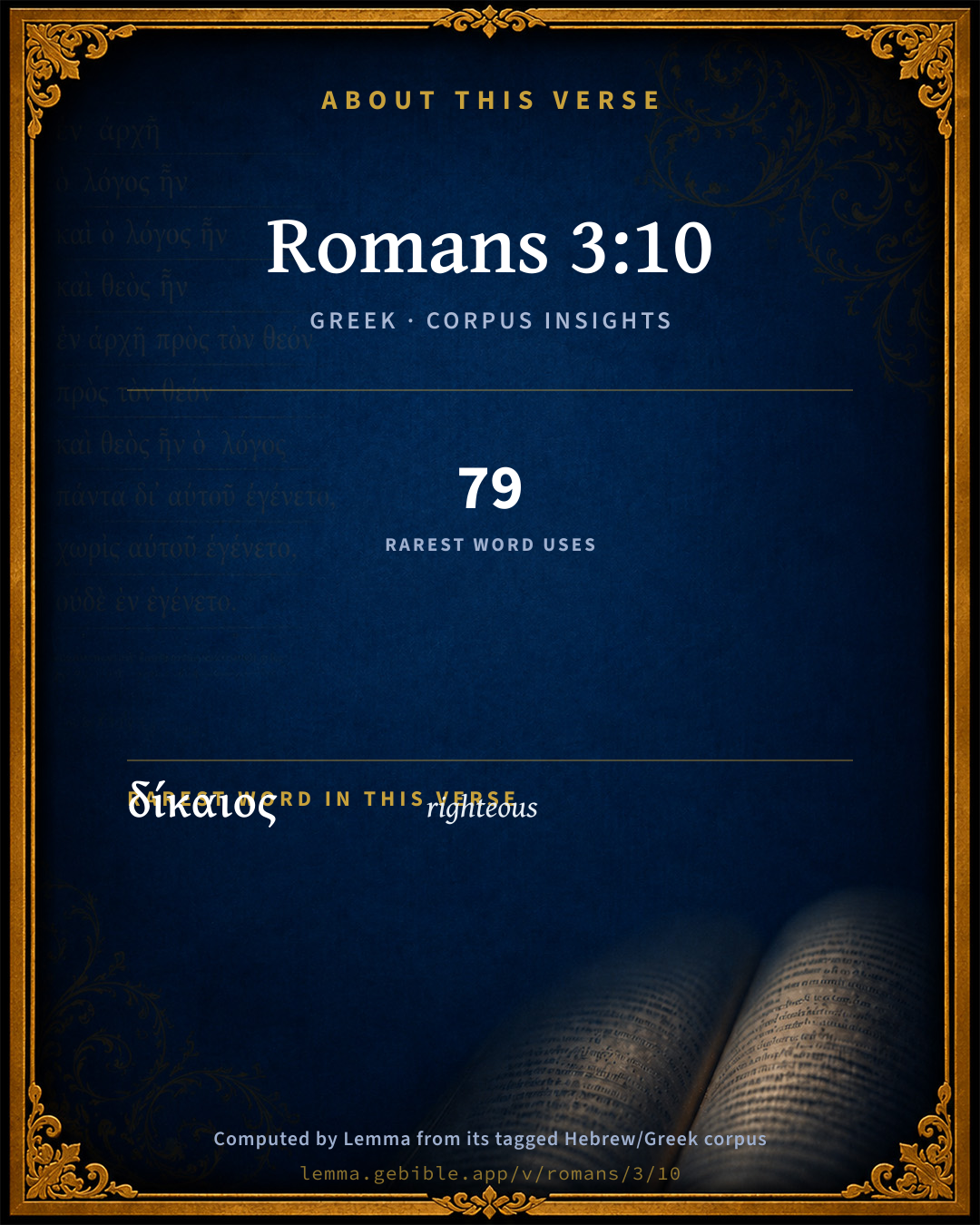
Romans 3:10

Greek (Tischendorf 8th ed.) Romans 3:10 appears in the Greek New Testament. The text above is from the Tischendorf 8th edition. Each word links to its Strong’s number and a concise gloss. Click any word for its full Thayer’s Greek Lexicon entry.
Download image
Cite this verse

Romans 3:10 (World English Bible). Public Domain. Lemma interlinear Bible study tool, https://lemma.gebible.app/v/romans/3/10.

Show BibTeX & RIS
BibTeX
RIS
English Translation
As it is written, "There is no one righteous. No, not one.
World English Bible · Public Domain
Download a study sheet

One document with this verse’s original text, its word-by-word gloss line, the meaning frame, cross-references with their text, attributed commentary, and full source and license credits — printable, and it pastes into notes with its structure intact.

This verse Autodidact and up

Study sheet (.html) Plain text (.txt)

A passage Seminary Student

Up to 50 verses in one chapter. A passage sheet keeps up to 6 commentary sources and 12 cross-references per verse, in the order this page ranks them, and says so on the sheet whenever that leaves anything out. Ask for a single verse and you get the Autodidact verse sheet above.

Everything on this page stays free to read, with no account — the sheet is a download of what is already on screen, not access to it.

Want to remove ads? Support Godless Engineer
Compare translations 3

The same verse in 3 English versions, stacked beneath the original-language interlinear above. Click any original word for its lexicon entry.

Each is an independent rendering of the whole verse — the interlinear is not word-aligned to these translations.

Highlighted words mark where these versions differ — a whole-verse word diff, not a word-by-word alignment.

  • World English Bible Public Domain
    As it is written, "There is no one righteous. No, not one.
  • King James Version Public Domain
    As it is written, There is none righteous, no, not one:
  • unfoldingWord Literal Text CC BY-SA 4.0
    Just as it is written: “There is none righteous, not even one.

unfoldingWord Literal Text — © unfoldingWord, licensed CC BY-SA 4.0. Word-aligned USFM3 via Door43 (git.door43.org/unfoldingWord/en_ult).

Versions to compare (up to 4)

3 of 4 selected

Show all 19 translations

Every available English version of this verse, each an independent rendering of the whole verse.

  • World English Bible Public Domain
    As it is written, "There is no one righteous. No, not one.
  • Berean Standard Bible Public Domain
    As it is written: “There is no one righteous, not even one.
  • Majority Standard Bible Public Domain
    As it is written: “There is no one righteous, not even one.
  • King James Version Public Domain
    As it is written, There is none righteous, no, not one:
  • American Standard Version (1901) Public Domain
    as it is written, There is none righteous, no, not one;
  • Revised Version (1885) Public Domain
    as it is written, There is none righteous, no, not one;
  • Geneva Bible (1599) Public Domain
    As it is written, There is none righteous, no not one.
  • Douay-Rheims (1899) Public Domain
    As it is written: There is not any man just.
  • Young's Literal Translation Public Domain
    according as it hath been written -- `There is none righteous, not even one;
  • Literal Standard Version CC BY-SA 4.0
    according as it has been written: “There is none righteous, not even one;
  • Unlocked Literal Bible CC BY-SA 4.0
    This is as it is written: “There is no one righteous, not one.
  • unfoldingWord Literal Text CC BY-SA 4.0
    Just as it is written: “There is none righteous, not even one.
  • Darby Bible Public Domain
    according as it is written, There is not a righteous [man], not even one;
  • World Messianic Bible Public Domain
    As it is written, “There is no one righteous; no, not one.
  • Webster's Bible Public Domain
    As it is written, There is none righteous, no, not one:
  • Free Bible Version CC BY-SA 4.0
    As Scripture says, “No one does what is right, not even one.
  • Bible in Basic English Public Domain
    As it is said in the holy Writings, There is not one who does righteousness;
  • Text-Critical English NT CC BY 4.0
    just as it is written, “There is none righteous, not even one;
  • Tyndale New Testament (1534) Public Domain
    as it is writte: There is none righteous no not one:

Literal Standard Version (2020), Covenant Press — licensed CC BY-SA 4.0. Text via the HelloAO Bible API (eBible.org). Unlocked Literal Bible (unfoldingWord) — licensed CC BY-SA 4.0. Text via the HelloAO Bible API (eBible.org). unfoldingWord Literal Text — © unfoldingWord, licensed CC BY-SA 4.0. Word-aligned USFM3 via Door43 (git.door43.org/unfoldingWord/en_ult). Free Bible Version, Dr. Jonathan Gallagher — licensed CC BY-SA 4.0. Text via the HelloAO Bible API (eBible.org).

Word by word

More ways to search: Search by grammar → Find every occurrence → Compare this word →

Practice this passage: Drill this verse → Learn its vocabulary →

δίκαιος
díkaios
G1342
“righteous”
Adjective, Nominative, Singular, Masculine
Part of Speech
Adjective
Case
Nominative
Number
Singular
Gender
Masculine
Full Thayer's Definition

Origin: from G1349

TDNT: 05:02,2

1. righteous, observing divine laws a. in a wide sense, upright, righteous, virtuous, keeping the commands of God 1. of those who seem to themselves to be righteous, who pride themselves to be righteous, who pride themselves in their virtues, whether real or imagined 2. innocent, faultless, guiltless 3. used of him whose way of thinking, feeling, and acting is wholly conformed to the will of God, and who therefore needs no rectification in the heart or life 1a b. only Christ truly 1. approved of or acceptable of God c. in a narrower sense, rendering to each his due and that in a judicial sense, passing just judgment on others, whether expressed in words or shown by the manner of dealing with them
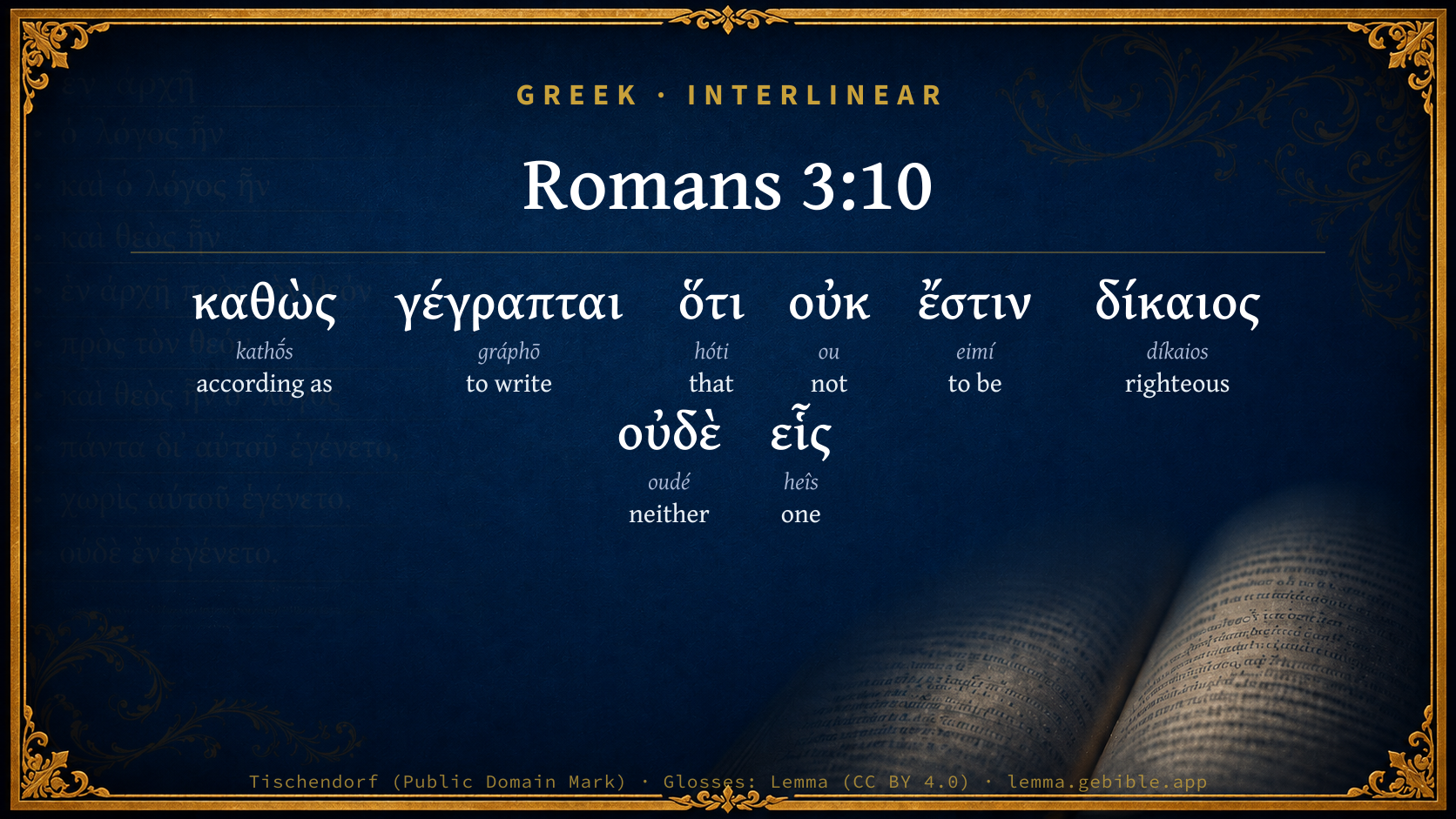
  1. καθὼς kathṓs G2531 “according as” Adverb
  2. γέγραπται gráphō G1125 “to write” Verb, Perfect, Passive, Indicative, 3rd person, Singular
  3. ὅτι hóti G3754 “that” Conjunction
  4. οὐκ ou G3756 “not” Particle, Negative
  5. ἔστιν eimí G1510 “to be” Verb, Present, Active, Indicative, 3rd person, Singular
  6. οὐδὲ oudé G3761 “neither” Conjunction, Negative
  7. εἷς heîs G1520 “one” Adjective, Nominative, Singular, Masculine

About this verse

These counts appear in no published source. They are computed here, from the morphology-tagged text and Lemma’s own curated glosses. What Lemma adds →

8
words
8
distinct lemmas
Pauline Epistles
section

Cross-references

27

Topical passages linked to Romans 3:10 in the Treasury of Scripture Knowledge — connected by theme and wording, ordered by reader-vote popularity; previews shown in the World English Bible.

  • Psalms 53:1–3 The fool has said in his heart, "There is no God." They are corrupt, and have done abominable iniquity. There is no one who does good.
  • Psalms 14:1–3 The fool has said in his heart, "There is no God." They are corrupt. They have done abominable works. There is none who does good.
  • Romans 3:23 for all have sinned, and fall short of the glory of God;
  • 1 John 1:8–10 If we say that we have no sin, we deceive ourselves, and the truth is not in us.
  • Job 15:14 What is man, that he should be clean? He who is born of a woman, that he should be righteous?
  • Job 25:4 How then can man be just with God? Or how can he who is born of a woman be clean?
  • Mark 7:21–22 For from within, out of the hearts of men, proceed evil thoughts, adulteries, sexual sins, murders, thefts,
  • Mark 10:18 Jesus said to him, "Why do you call me good? No one is good except one-- God.
  • Matthew 15:19 For out of the heart come forth evil thoughts, murders, adulteries, sexual sins, thefts, false testimony, and blasphemies.
  • Jeremiah 17:9 The heart is deceitful above all things, and it is exceedingly corrupt: who can know it?
  • Titus 3:3 For we were also once foolish, disobedient, deceived, serving various lusts and pleasures, living in malice and envy, hateful, and hating one another.
  • Ephesians 5:3–6 But sexual immorality, and all uncleanness, or covetousness, let it not even be mentioned among you, as becomes saints;
  • 1 Timothy 1:9–10 as knowing this, that law is not made for a righteous man, but for the lawless and insubordinate, for the ungodly and sinners, for the unholy and profane, for murderers of fathers and murderers of mothers, for manslayers,
  • 1 Peter 1:16 because it is written, "You shall be holy; for I am holy."
  • Job 14:4 Who can bring a clean thing out of an unclean? Not one.
  • Galatians 5:19–21 Now the works of the flesh are obvious, which are: adultery, sexual immorality, uncleanness, lustfulness,
  • Colossians 3:5–9 Put to death therefore your members which are on the earth: sexual immorality, uncleanness, depraved passion, evil desire, and covetousness, which is idolatry;
  • 2 Timothy 3:2–5 For men will be lovers of self, lovers of money, boastful, arrogant, blasphemers, disobedient to parents, unthankful, unholy,
  • Romans 3:4 May it never be! Yes, let God be found true, but every man a liar. As it is written, "That you might be justified in your words, And might prevail when you come into judgment."
  • Ephesians 2:1–3 You were made alive when you were dead in transgressions and sins,
  • Job 15:16 How much less one who is abominable and corrupt, A man who drinks iniquity like water!
  • 1 Corinthians 6:9–10 Or don't you know that the unrighteous will not inherit the Kingdom of God? Don't be deceived. Neither the sexually immoral, nor idolaters, nor adulterers, nor male prostitutes, nor homosexuals,
  • Revelation 22:15 Outside are the dogs, the sorcerers, the sexually immoral, the murderers, the idolaters, and everyone who loves and practices falsehood.
  • Isaiah 8:20 To the law and to the testimony! if they don't speak according to this word, surely there is no morning for them.
  • Revelation 21:8 But for the cowardly, unbelieving, sinners, abominable, murderers, sexually immoral, sorcerers, idolaters, and all liars, their part is in the lake that burns with fire and sulfur, which is the second death."
  • Romans 11:8 According as it is written, "God gave them a spirit of stupor, eyes that they should not see, and ears that they should not hear, to this very day."
  • Romans 15:3–4 For even Christ didn't please himself. But, as it is written, "The reproaches of those who reproached you fell on me."

Cross-references courtesy of OpenBible.info (CC BY 4.0).

Commentary

Notes on Romans 3:10 from classic Christian and Jewish commentators (each source and its license shown beneath its notes). The classic Christian expositions comment on the surrounding passage and are grouped to its opening verse, so a note may address several verses; the Jewish commentaries on the Tanakh (Rashi and others) are per-verse, so they appear only where the commentator wrote on this verse.

Lemma curates 59 commentaries, every one of them public domain or Creative Commons licensed, each selected and text-cleaned for this edition rather than reprinted as found. About our sources →

The Cambridge Bible for Schools and Colleges

gen. ed. J. J. S. Perowne

10. There is none, &c.] In Rom_3:10-18 we have a chain of Scripture quotations. The originals are found, verbally or in substance, in Psa_5:9; Psa_10:7; Psa_14:1-3; Psa_36:1; Psa_140:3; Pro_1:16; Isa_59:7. In the Alexandrine MS. of the LXX. of Psalms 14 (LXX. 13):3, appears a singular phenomenon: the Gr. is much ampler than the original Hebrew (for Which see E. V.), and is verbatim the same as the Gr. of Rom_3:12-18 of this chapter. There can be little doubt that this was the work of a copyist acquainted with this passage of St Paul.—Rom_3:10 would better read: as it is written that there is none righteous, no, not one. The precise quotations would then begin at Rom_3:11. The words of Rom_3:10 are not found in the O. T., and read rather as a summary of what is to follow.

The awful charges of Rom_3:10-18 are specially pointed at the Jews: see Rom_3:19. The passages quoted are descriptive of Israelites, some of them of Israelites of the best days of Israel. What at least they establish is that the root of sin was vigorous in Jewish hearts, and that its fruits in Jewish lives were abominable in the sight of God. Meantime we must not narrow the reference too closely. The Apostle’s doctrine of human sinfulness (see e.g. Tit_3:3) is that the worst developments of individual sin only indicate the possibilities of the sinful heart in general. Passages like those cited here thus prove, not only what certain men were, but what man is. See Jer_17:9.

The Cambridge Bible for Schools and Colleges (gen. ed. J. J. S. Perowne; Cambridge University Press, 1878–1918) — public domain. Text from a community e-Sword module.

Albert Barnes' Notes on the Bible

As it is written - The apostle is reasoning with Jews; and he proceeds to show from their own Scriptures, that what he had affirmed was true. The point to be proved was, that the Jews, in the matter of justification, had no advantage or preference over the Gentiles; that the Jew had failed to keep the Law which had been given him, as the Gentile had failed to keep the Law which had been given him; and that both, therefore, were equally dependent on the mercy of God, incapable of being justified and saved by their works. To show this, the apostle adduces texts to show what was the character of the Jewish people; or to show that according to their own Scriptures, they were sinners no less than the Gentiles. The point, then, is to prove the depravity of the Jews, not that of universal depravity. The interpretation should be confined to the bearing of the passages on the Jews, and the quotations should not be adduced as directly proving the doctrine of universal depravity. In a certain sense, which will be stated soon, they may be adduced as bearing on that subject. But their direct reference is to the Jewish nation. The passages which follow, are taken from various parts of the Old Testament. The design of this is to show, that this characteristic of sin was not confined to any particular period of the Jewish history, but pertained to them as a people; that it had characterised them throughout their existence as a nation. Most of the passages are quoted in the language of the Septuagint. The quotation in Rom 3:10-12, is from Psa 14:1-3; and from Psa 53:1-3. Psa 53:1-6 is the same as Psa 14:1-7, with some slight variations.

(Yet if we consult Psa 14:1-7 and Psa 53:1-6, from which the quotations in Rom 3:10-12 are taken, we shall be constrained to admit that their original application is nothing short of universal. The Lord is represented as looking down from heaven, (not upon the Jewish people only, but upon the “children of men” at large, “to see if there were any that did understand and seek God);” and declaring, as the result of his unerring scrutiny, “there is “none” that doeth good, no, not one.”

That the apostle applies the passages to the case of the Jews is admitted, yet it is evident more is contained in them than the single proof of Jewish depravity. They go all the length of proving the depravity of mankind, and are cited expressly with this view. “We have before proved both Jews and Gentiles,” says Paul in Rom 3:9, “that they are all under sin.” Immediately on this, the quotations in question are introduced with the usual formula, “as it is written,” etc. Now since the apostle adduces his Scripture proofs, to establish the doctrine that both Jews and Gentiles are all under sin,” we cannot reasonably decide against him by confining their application to the Jews only.

In Rom 3:19 Paul brings his argument to bear directly on the Jews. That they might not elude his aim, by interpreting the universal expressions he had introduced, of all the pagan only, leaving themselves favorably excepted; he reminds them that” whatsoever things the law saith, it saith to them that were under it.” Not contented with having placed them alongside of the Gentiles in Rom 3:9; by this second application of the general doctrine of human depravity, to their particular case, he renders escape or evasion impossible. The scope of the whole passage then, is, that all people are depraved, and that the Jews form no exception. This view is further strengthened by the apostle’s conclusion in Rom 3:20. “Therefore, by the deeds of the law there shall no flesh be justified in his (God’s) sight.”

“If the words,” says President Edwards, “which the apostle uses, do not most fully and determinately signify an universality, no words ever used in the Bible are sufficient to do it. I might challenge any man to produce any one paragraph in the scriptures, from the beginning to the end, where there is such a repetition and accumulation of terms, so strongly, and emphatically, and carefully, to express the most perfect and absolute universality, or any place to be compared to it.” - “Edwards on Original Sin, - Haldane’s Commentary.”

There is none righteous - The Hebrew Psa 14:1 is, there is none that doeth good. The Septuagint has the same. The apostle quotes according to the sense of the passage. The design of the apostle is to show that none could be justified by the Law. He uses an expression, therefore, which is exactly conformable to his argument, and which accords in meaning with the Hebrew, “there is none just,” δίκαιος dikaios.

No, not one - This is not in the Hebrew, but is in the Septuagint. It is a strong universal expression, denoting the state of almost universal corruption which existed in the time of the psalmist. The expression should not be interpreted to mean that there was not literally “one pious man” in the nation; but that the characteristic of the nation was, at that time, that it was exceedingly corrupt. Instead of being righteous, as the Jew claimed, because they were Jews, the testimony of their own Scriptures was, that they were universally wicked.

(The design of the apostle, however, is not to prove that there were few or none pious. He is treating of the impossibility of justification by works, and alleges in proof that, according to the judgment of God in the Psa 14:1 Psalm, there were none righteous, etc., in regard to their natural estate, or the condition in which man is, previous to his being justified. In this condition, all are deficient in righteousness, and have nothing to commend them to the divine favor. What people may afterward become by grace is another question, on which the apostle does not, in this place, enter. Whatever number of pious people, therefore, there might be in various places of the world, the argument of the apostle is not in the least affected. It will hold good even in the millennium!)

Albert Barnes' Notes on the Bible (1834–1885) — public domain. Text from a community e-Sword/MySword module.

Tyndale Open Study Notes

Tyndale Open Resources

3:10-18 The six quotations in these verses, drawn from various parts of the Old Testament, all address human sinfulness. Paul follows the practice of rabbis who gathered together Old Testament texts on similar themes in a practice called pearl-stringing.

3:10-12 This quotation from Pss 14:1-3; 53:1-3 directly supports the argument that all people are under the power of sin.

Tyndale Open Study Notes — © Tyndale Open Resources, licensed CC BY-SA 4.0. Text via the HelloAO Bible API.

Bengel's Gnomon

Johann Albrecht Bengel

Rom 3:10. Καθως, as) That all men are under sin, is very clearly proved from the vices which always, and everywhere, have been prevalent [have stalked abroad] among mankind; just as, also, the internal holiness of Christ is displayed in [pourtratyed by means of] the innocency of His words and actions. Paul therefore quotes, with propriety, David and Isaiah, although it is concerning the people of their own times that they complain, and that accompanied with an exception in favour of the godly [some of whom are always to be found], Psa 14:4, etc. For that complaint describes men such as God looking down from heaven finds them to be, not such as He makes them by His grace.

Rom 3:10. Ὅτι οὐκ ἔστι δίκαιος οὐδὲ εἷς κτλ.) Psa 14:2, etc. The LXX., ὀυκ ἔστι ποιῶν χρηστότητα, οὐκ ἔστιν ἕως ἑνός.—εἰ ἔστι συνιῶν ἢ ἐκζητῶν τὸν Θεόν.—ἑνός, The general phrase is, there is none righteous; the parts follow: the dispositions and pursuits, Rom 3:11-12; the conversation, Rom 3:13-14; the actions, Rom 3:15-17; the general demeanour, (gestus et nutus), ver.18.—δίκαιος, righteous) a suitable word in a discourse on righteousness.—οὐδὲ εἷς, not even one) who can except any one here? Rom 3:23, not so much as one under heaven. The exception, even of one, or at least of a few, might procure [conciliate] favour to all; as it is, wrath is on that account the greater.

Bengel's Gnomon of the New Testament — English translation (T&T Clark, Edinburgh, 1860) — public domain. Text from a community e-Sword module.

Meyer's Critical & Exegetical Commentary

Heinrich August Wilhelm Meyer

Rom_3:10-18. Conformity with Scripture of the charge referred to, Ἰουδαίους τε καὶ Ἕλλην. πάντ. ὑφʼ ἁμ. εἶναι, so far (Rom_3:19) as this charge cuts off from the Jews every προέχεσθαι of Rom_3:9.

The recitative ὅτι introduces citations from Scripture very various in character, which after the national habit (Surenhusius, καταλλ. thes. 7) are arranged in immediate succession. They are taken from the LXX., though for the most part with variations, partly due to quotation from memory, and partly intentional, for the purpose of defining the sense more precisely. The arrangement is such that testimony is adduced for1st, the state of sin generally (Rom_3:10-12); 2nd, the practice of sin in word (Rom_3:13-14) and deed (Rom_3:15-17); and 3rd, the sinful source of the whole (Rom_3:18). More artificial schemes of arrangement are not to be sought (as e.g. in Hofmann), not even by a play on numbers.[776]

οὐκ ἔστι δίκαιος οὐδὲ εἷς] There exists not a righteous person (who is such as he ought to be), not even one. Taken from Psa_14:1, where the Sept. has ποιῶν χρηστότητα instead of δίκαιος; Paul has put the latter on purpose at once, in accordance with the aim of his whole argument, prominently to characterise the ὑφʼ ἁμαρτ. εἶναι as a want of δικαιοσύνη. Michaelis regards the words as the Apostles own, under which he comprehends all that follows. So also Eckermann, Koppe, Köllner and Fritzsche. But it is quite at variance with the habit of the Apostle, after using the formula of quotation, to prefix to the words of Scripture a summary of their contents; and this supposition is here the more improbable, seeing that the Apostle continues in Rom_3:11 in the words of the same Psalm, with the first verse of which our passage substantially agrees.

Regarding οὐδὲ εἷς see on 1Co_6:5, and Stallbaum, a[777] Plat. Symp. p. 214 D.

Rom_3:11 is from Psa_14:2, and so quoted, that the negative sense which results indirectly from the text in the Hebrew and LXX. is expressed by Paul directly: there exists not the understanding one (the practically wise, i.e. the pious one; see Gesenius, Thes. s. v. חָכָם): there exists not the seeker after God (whose thoughts and endeavours are directed towards God, Heb_11:6, and see Gesenius, s. v. דָרַשׁ). The article denotes the genus as a definite concrete representing it. Compare Buttmanns neut. Gr. p. 253 f. On the idea, which is also classical, of sin as folly, see Nägelsbach, Hom. Theol. VI. 2.

The form ΣΥΝΊΩΝ (so accentuated by Lachmann; compare Buttmann, I. p. 543), or ΣΥΝΙῶΝ (though the former is the more probable; compare Winer, p. 77 f. [E. T. 97], also Ellendt, Lex. Soph. II. p. 768), is the usual one in the Sept. (instead of συνιείς, Psa_33:15). Psa_41:1; Jer_30:12; 2Ch_34:12 et al[778]

ἘΚΖΗΤ.] stronger than the simple form; compare 1Pe_1:10; very frequent in the LXX.

Rom_3:12. From Psa_14:3 closely after the LXX. ἘΞΈΚΛΙΝΑΝ, namely from the right way, denotes the demoralisation (see Gesenius, s. v. םוּד), as does also ἨΧΡΕΙΏΘΗΣΑΝ, נֶאֱלָחוּ: they have become useless, corrupt, good for nothing, ἀχρεῖοι (Mat_25:30); Polyb. i. 14, 6, i. 48, 9. The following ποιῶν χρηστότητα is correlative. This ἅμα (altogether) ἨΧΡΕΙΏΘ. has still ΠΆΝΤΕς for its subject.

ἝΩς ἙΝΌς] The ΟὐΚ ἜΣΤΙΝ holds as far as to one (inclusively), so that therefore not one is excepted. Compare Jdg_4:16. Hebraism, see Ewald, Lehrb. § 217, 3. The Latin ad unum omnes is similar.

Rom_3:13 as far as ἐδολ. is from Psa_5:10, and thence till αὐτῶν from Psa_140:4, both closely after the LXX.[779]

τάφος ἀνεῳγμ. ὁ λάρ. αὐτ.] Estius: Sicut sepulcrum patens exhalat tetrum ac pestiferum foetorem, ita ex ore illorum impuri, pestilentes noxiique sermones exeunt. Comp Pelagius, Bengel, Tholuck, Mehring and Hofmann. But it is more in harmony with the further description, as well as the parallel in Jer_5:16 (where the quiver of the Chaldeans is compared with an open grave), to find the comparison in the point that, when the godless have opened their throats for lying and corrupting discourse, it is just as if a grave stood opened (observe the perfect) to which the corpse ought to be consigned for decay and destruction.[781] So certainly and unavoidably corrupting is their discourse. Moreover λάρυγξ, which is here to be taken in its original sense, (as organ of speech, not equivalent to φάρυγξ, the gullet) is more forcibly graphic than στόμα, representing the speech as passionate crying. Compare λαρυγγίζειν, Dem. 323, 1, and λαρυγγισμός, of crying lustily.

ἐδολιοῦσαν] they were deceiving. The imperfect denotes what had taken place as continuing up till the present time; and on this form of the third person plural, of very frequent occurrence in the LXX., see Sturz, Dial. Al. p. 60; Ahrens, Dial. II. p. 304, I. p. 237.

ἰὸς ἀσπίδων] The poison of asps, a figure for the insidiously corrupting. See similar passages in Alberti, Obss. p. 301.

Rom_3:14 is from Psa_10:7, taken freely from the LXX., who however with their πικρίας deviate from the Hebrew מִרְמו̇ת, because they either read it otherwise or translated it erroneously.

πικρία, figurative designation of the hateful nature. Comp Eph_4:31; Act_8:23; Jam_3:14; see Wetstein.

Rom_3:15-17 are from Isa_59:7-8, quoted freely and with abbreviations from the LXX.

ἘΝ ΤΑῖς ὉΔΟῖς ΑὐΤῶΝ] Where they go, is desolation (fragments שֹׁד) and misery, which they produce.

ὁδὸν εἰρ. οὐκ ἔγν.] i.e. a way on which one walks peacefully (the opposite of the ὁδοί, on which is σύντριμμα κ. ταλαιπ.), they have not known (2Co_5:21), it has remained strange to them.

Rom_3:18 is from Psa_36:1. The fear of God, which would have preserved them from such conduct and have led them to an entirely different course, is not before their eyes. There is objectivity ascribed to a condition which is, psychologically, subjective. Morison.

[776] According to Hofmann the first and second parts consist each of seven propositions. Thus even the conclusion of ver. 12, οὐκ ἔστιν ἕως ἑνός, is to be reckoned as a separate proposition! How all the parallelism of Hebrew poetry is mutilated by such artifices!

[777] d refers to the note of the commentator or editor named on the particular passage.

[778] t al. and others; and other passages; and other editions.

[779] The MSS. of the LXX. which read the whole passage vv. 1318 at Psa_14:3, have been interpolated from our passage in Christian times. See Wolf, Cur. on ver. 10.

[781] The metaphorical representation in classical passages, in which, e.g., the Cyclops is termed ζῶν τύμβος (Anth. Pal. xiv. 109, 3), or the vultures ἔμψυχοι τάφοι (Gorgias, ap. Longin. 3), is not similar.

Meyer — Critical and Exegetical Commentary on the New Testament — English translation by Peter Christie, edited by Frederick Crombie (T&T Clark, 1880) — public domain. Text from a community e-Sword module.

Expositor's Greek Testament

ed. W. Robertson Nicoll

Rom 3:10 . The long series of quotations, beginning with this verse, has many points of interest. The καθὼς γέγραπται with which it is introduced, shows that the assertion of indiscriminate sinfulness which the Apostle has just made, corresponds with Scripture testimony. It is as if he had said, I can express my opinion in inspired words, and therefore it has God upon its side. The quotations themselves are taken from various parts of the O.T. without distinction; no indication is given when the writer passes from one book to another. Thus Rom 3:10-12 are from Psa 14:1-3 ; Rom 3:13 gives the LXX of Psa 5:9 ; Rom 3:14 corresponds best to Psa 10:7 ; in Rom 3:15-17 there is a condensation of Isa 59:7 f.; and in Rom 3:18 we have part of the first verse of Psa 36 . No attention whatever is paid to the context. The value of the quotations for the Apostle’s purpose has been disputed. It has been pointed out that in Psa 14 , for instance, there is mention of a people of God, “a generation of the righteous,” as well as of the godless world; and that in other passages only the contemporaries of the writer, or some of them, and not all men in all times, are described. Perhaps if we admit that there is no possibility of an empirical proof of the universality of sin, it covers the truth there is in such comments. Paul does not rest his case on these words of Scripture, interpreted as modern exegetical science would interpret them. He has brought the charge of sin against all men in chap. Rom 1:17 , in announcing righteousness as the gift of the Gospel; in chap. Rom 1:18-32 he has referred to the facts which bring the charge home to Gentile consciences; in chap. 2 he has come to close quarters with evasions which would naturally suggest themselves to Jews: and in both cases he has counted upon finding in conscience a sure ally. Hence we do not need to lay too heavy a burden of proof on these quotations: it is enough if they show that Scripture points with unmistakable emphasis in the direction in which the Apostle is leading his readers. And there can be no doubt that it does so. As Gifford well says on Rom 3:18 : “In the deep inner sense which St. Paul gives to the passage, ‘the generation of the righteous’ would be the first to acknowledge that they form no exception to the universal sinfulness asserted in the opening verses of the Psalm”.

Rom 3:10 . Οὐκ ἔστιν δίκαιος οὐδὲ εἶς . There is something to be said for the idea that this is Paul’s thesis, rather than a quotation of Psa 14:3 .Psa 14:3Psa 14:3 is correctly quoted in Rom 3:12 , and the Apostle would hardly quote it twice: δίκαιος , too, seems chosen to express exactly the conclusion to which he means to come in Rom 3:20 . Still, the words come after καθὼς γέγραπται : hence they must be Scripture, and there is nothing they resemble so much as a free rendering of Psa 14:3 .

The Expositor's Greek Testament, edited by W. Robertson Nicoll (1897–1910) — public domain. Text from a community e-Sword module.

Hodge's Commentary on Romans, Ephesians & First Corinthians

Charles Hodge

Rom_3:10

Rom_3:10-18, contain the confirmation of the doctrine of the universal sinfulness of men by the testimony of the Scriptures. These passages are not found consecutively in any one place in the Old Testament. Rom_3:10-12 are from Psa_14:1-7 and Psa_53:1-6; Rom_3:13 is from Psa_5:9; Rom_3:14 is from Psa_10:7; Rom_3:15-17 are from Isa_59:7, Isa_59:8; and Rom_3:18 is from Psa_36:1. These passages, it will be observed, are of two different classes; the one descriptive of the general character of men; the other referring to particular sinful acts, on the principle by their fruits ye shall know them. This method of reasoning is common and legitimate. The national character of a people may be proved by the prevalence of certain acts by which it is manifested. The prevalence of crime among men is a legitimate proof that the race is apostate, though every man is not a shedder of blood, or guilty of robbery or violence.

There is none righteous, no not one. Psa_14:1, in the Hebrew is, there is none doing good; in the Septuagint it is ποιῶν χρηστότητα; Paul has, οὐκ ἔστι δίκαιος, there is none righteous. The sense is the same. Paul probably uses δίκαιος, righteous, because the question which he is discussing is whether men are righteous, or can be justified on the ground of their own righteousness in the sight of God. This is a declaration of the universal sinfulness of men. The two ideas included in the negation of righteousness, want of piety and want of rectitude, are expressed in the following verses.

Charles Hodge — Commentary on Romans (1835), First Corinthians (1857), and Ephesians (1856) — public domain. Text from a community e-Sword module.

Jamieson, Fausset & Brown

Robert Jamieson, A. R. Fausset & David Brown

As it is written, &c.-- (Psa 14:1-3; Psa 53:1-3). These statements of the Psalmist were indeed suggested by particular manifestations of human depravity occurring under his own eye; but as this only showed what man, when unrestrained, is in his present condition, they were quite pertinent to the apostle's purpose.

Jamieson, Fausset & Brown — Commentary Critical and Explanatory on the Whole Bible (1871) — public domain (CC PDM 1.0). Text via the HelloAO Bible API.

Adam Clarke's Commentary

Verse 10. As it is written] See Ps 14:1-3; from which this and the two following verses are taken.

There is none righteous] This is true, not only of the Jews, but of the Gentiles; of every soul of man, considered in his natural and practical state, previously to his receiving the mercy of our Lord Jesus Christ. There is no righteous principle in them, and, consequently, no righteous act can be expected from them; see on Ro 3:12. God himself is represented as looking down from heaven to see if there were any that feared and sought after him; and yet he, who cannot be deceived, could find none! And therefore we may safely conclude there was none to be found.

Adam Clarke's Commentary on the Bible (1810–1826) — public domain. Text from a community e-Sword/MySword module.

John Calvin's Commentaries

10. As it is written, etc. He has hitherto used proofs or arguments to convince men of their iniquity; he now begins to reason from authority; and it is to Christians the strongest kind of proof, when authority is derived from the only true God. And hence let ecclesiastical teachers learn what their office is; for since Paul asserts here no truth but what he confirms by the sure testimony of Scripture, much less ought such a thing to be attempted by those, who have no other commission but to preach the gospel, which they have received through Paul and others.

There is none righteous, etc. The Apostle, who gives the meaning rather than the entire words, seems, in the first place, before he comes to particulars, to state generally the substance of what the Prophet declares to be in man, and that is — that none is righteous; he afterwards particularly enumerates the effects or fruits of this unrighteousness.

John Calvin's Commentaries (1540-1563) — public domain. Text from the Calvin Translation Society English edition (1840s-50s) via the Christian Classics Ethereal Library (ccel.org). Calvin's coverage is partial (roughly two-thirds of the Bible); uncommented books and verses are honest gaps, never fabricated. The 19th-century editor's footnotes and remarks are omitted so the notes are faithfully Calvin's own voice.

John Gill's Exposition

There is none that understandeth,.... This is rightly concluded, from what the Psalmist says, Psa 14:2, "The Lord looked down from heaven upon the children of men", on all the children of men, Jews and Gentiles, "to see if there were any that did understand"; and it appears, upon this survey of them, there was not one understanding person among them: man thinks himself a very wise and understanding creature, though he is born a very ignorant one: true indeed, he has not lost by sin the natural faculty of the understanding, so as to become like the horse and mule, which are without any; and it must be allowed, that natural men have some understanding of things natural, civil, and moral; though there is none that understands even these, as Adam did: but then they have no understanding of things spiritual; no spiritual knowledge of God; no true sense of themselves, their sin and misery; nor do they truly know the way of salvation by Christ; nor have they any experience of the work of the Spirit of God upon their souls; nor any experimental knowledge of the doctrines of the Gospel: no man can understand these of himself, by the mere strength of reason, and light of nature; nor can even a spiritual man fully understand them in this life; in consequence of this account and character of men it follows, that

there is none that seeketh after God; that worships him in Spirit and in truth, or prays to him with the Spirit, and with the understanding; who seek him chiefly, and in the first place, with their whole hearts, earnestly, diligently, and constantly; who seek him in Christ, and under the assistance of the Spirit; who seek after the knowledge of God in Christ, communion with him through the Mediator, or his honour and glory.

John Gill's Exposition of the Whole Bible (1746–1763) — public domain (CC PDM 1.0). Text via the HelloAO Bible API.

Trapp's Complete Commentary

John Trapp

10 As it is written, There is none righteous, no, not one:

Ver. 10. As it is written] What the prophets had said of some particular people or person is here applied to the whole race of mankind, because by nature there is never a better of us. Κακοι μεν θριπες, κακοι δε και ιπες. (Eras. Adag.)

John Trapp, A Commentary or Exposition upon All the Books of the Old and New Testament (1647–1656) — public domain. Text from a community e-Sword module.

Haydock's Catholic Bible Commentary

There is not any man just, viz. virtue either of the law of nature, or of the law of Moses; but only by faith and grace. (Challoner) --- The apostle here adduces a series of passages from the ancient Scripture, to convince both Jews and Gentiles, that not one amongst them was just, nor had any title to glory, on account of his good works. Not that a just man could not be found under the old law, or even before the law; an infinite number of passages of Scripture will shew the contrary: but he must be understood as speaking of man left to himself, as a son of Adam, conceived in sin, and brought forth a child of wrath. (Calmet) --- These crimes, enumerated by the apostle, are not mentioned as if found in each individual, but some of this black catalogue of crimes were found in one man; some in another; yet so that all had become infected with sin and iniquity, all had deserted the path of virtue. There was none just, none found, who feared or sought after God. (Estius) --- These texts of Scripture, though formerly, even before the times of St. Jerome and St. Augustine, they were found together in some Latin editions, viz. Psalm xiii. cannot be found united either in the Hebrew text, or Septuagint version, as St. Jerome affirms, in Præf. lib. xvi. commentar. in Isai. This, he says, all the Greek commentators allow. He says, that those who were ignorant of this apostle’s art in uniting together the texts of different pasts of Scripture, upon finding no part where they were all together, placed them, without any authority, in that psalm whence the first part of the citation is taken. The words, an open sepulchre, are taken from Psalm xiii. (Hebrew text xiv.) the verse "Their throat is an open sepulchre, with their tongues they have dealt deceit fully," from Psalm v. "The venom of asps is under their lips," from Psalm cxxxix. "Whose mouth is full of curses and bitterness," from Psalm ix. "Their feet are swift," &c. as far as, there is no fear, from Isaias chap. lix. "There is not the fear of God before their eyes," from Psalm xxxv. (Estius)

George Leo Haydock (1774–1849), Haydock's Catholic Family Bible and Commentary, 1859 edition — public domain. Excludes Psalms (Douay-Rheims chapter numbering differs from Protestant) and Deuterocanonical books (Catholic canon only).

Matthew Poole's English Annotations

As it is written; viz. in several places of Scripture, which he quotes in the following verses, giving us the sense, though not so strictly tying himself to the words; and this is a proper proof, to the Jews at least, whom he had called a little before the keepers of these oracles.

There is none righteous, no, not one: the more general proof with which he begins, is taken out of Psa 14:3, and Psa 53:1, upon which places see the annotations.

Matthew Poole's English Annotations on the Holy Bible (1683–1685) — public domain. Text from a community e-Sword/MySword module.

Whedon's Commentary on the Bible

Daniel D. Whedon

10. Not one—Not that none are regenerate and so righteous, but that none in nature’s condition are so.

Daniel D. Whedon (gen. ed.), Commentary on the Old and New Testaments (1874–1909) — public domain. Text from a community e-Sword module.

The Pulpit Commentary

Vers. 10-18. As it is written, There is none righteous, no, not one: there is none that understandeth, there is none that seeketh after God. They are all gone out of the way, they are altogether become unprofitable; there is none that doeth good, no, not one. (Ps 14 or Ps 53) Their throat is an open sepulchre; with their tongues they hays used deceit; (Psa_5:9) the poison of asps is under their lips: (Psa_140:3) whose mouth is full of cursing and bitterness: (Psa_10:7) their feet are swift to shed blood: destruction and misery are in their ways: and the way of peace have they not known: (Pro_1:16 and Isa_59:7) there is no fear of God before their eyes. (Psa_36:1) These texts are from various unconnected passages of the Old Testament, quoted from the LXX, though not all accurately. They seem to be put together from memory by way of showing the general scriptural view of human depravity. It may be said that they do not establish the apostle"s position of all men being guilty; for that they are for the most part rhetorical rather than dogmatic, that most of them refer only to certain classes of men, and that the righteous are spoken of too, and this in the sequence of even the most sweeping of them all (that from Ps 14 or lift.), which does, literally understood, assert universal sinfulness. Any such objection to the cogency of the quotations may be met by regarding them as adduced, not as rigid proofs, but as only generally confirmatory of the apostle"s position. See, he would say to the Jew, the picture your own Scriptures give you; observe their continued testimony to human depravity: and the main point of all the quotations is that which is brought out in the next verse, viz. that they had reference, not to the Gentile world, but to the chosen people themselves.

The Pulpit Commentary (1880–1919), ed. H.D.M. Spence-Jones & Joseph S. Exell — public domain. Text from a community e-Sword module.

John Wesley's Explanatory Notes

As it is written - That all men are under sin appears from the vices which have raged in all ages. St. Paul therefore rightly cites David and Isaiah, though they spoke primarily of their own age, and expressed what manner of men God sees, when he "looks down from heaven;" not what he makes them by his grace. There is none righteous - This is the general proposition. The particulars follow: their dispositions and designs, ver. 11, 12; their discourse, ver. 13, 14; their actions, ver. 16-18. Psalm xiv, 1, &c.

John Wesley, Explanatory Notes Upon the Whole Bible (1754–1765) — public domain. Text via the GEBible commentary corpus.

Scofield Reference Notes

C. I. Scofield

righteous

(See Scofield "Rom 10:10").

The Scofield Reference Bible (1917 edition), notes by C. I. Scofield — public domain. Text from a community e-Sword module.

Burkitt's Expository Notes on the New Testament

William Burkitt

Observe here, How the apostle proves his assertion; namely, That both Jew and Gentile were under the guilt both of original and actual transgression, from the testimony of David, Psalms 14 where the state of corrupt nature is described, and the natural condition of all men declared, till they are either restrained or renewed by the grace of God: There is none righteous, no not one. Which words are true in several respects:

1. There is none originally righteous, no not one; none righteous in their first plantation in the world, until they are transplanted into the body of Christ, wrought and fashioned by his Holy Spirit.

2. There is none efficiently righteous, no not one: None have a righteousness of their own making, but of God’s. The righteousness of justification and sanctification both are from Christ, not from ourselves; we are his workmanship, not our own.

3. There is none meritoriously righteous, no not one; none that can deserve or demand anything as a due debt at God’s hand; but the most rigorous and holy saints are but unprofitable servants.

4. There is none perfectly and completely righteous, no not one; but inchoatively only: None righteous in a strict and legal sense, but in a gospel and qualified sense only: He that doeth righteousness is righteous, in the account of God; and, as such, shall be accepted and rewarded by him.

Observe, 2. How the apostle proves the corruption of mankind in general, by an induction of particulars. He surveys him in all the principal faculties of his soul, and members of his body; his understanding, will and affections; his eye, hand, tongue, and feet all corrupted and depraved: Their mouth is full or cursing, and bitter speeches: Their heart an open sepulchre, gaping after, and devouring the good name of their neighbours, and belching out filthy, ill scented, and unsavoury words against them. They seek not God in anything they do, and there is no fear of God, no respect of God before their eyes.

The apostle suts up all with this, because want of the fear of God before our eyes, is the fountain from which all other evils do proceed and flow. The fear of God is the bridle and curb which restrains from sin; where that is wanting, all iniquity abounds; where that is present and prevalent, it keeps the soul close to God, I will put my fear in their hearts, and they shall not depart from me. Jer 32:32

We usually depart far, yea, run fast from those we fear; but the true fear of God will make us cleave close unto him, because love is intermixed with it, and renders it a delightful fear.

William Burkitt's Expository Notes on the New Testament (1700–1703) — public domain. Text from a community e-Sword module.

Godbey's Commentary on the New Testament

William B. Godbey

10. “As has been written, that there is none righteous, no, not one,” i. e., not a single one of the above classes, i. e., Jews and Greeks who are all under sin, i. e., all church members of all ages and nations so far as the efficacy of membership, water baptism, church rites and legal obedience are concerned. Since these things, though all right in their places, never did have any power to justify a soul; therefore they leave all their votaries in their sins both actual and original, on the same plane with the unregenerate heathen.

William B. Godbey, Commentary on the New Testament (1896–1900) — public domain. Text from a community e-Sword module.

McGarvey & Pendleton's Commentaries

J. W. McGarvey

as it is written, There is none righteous, no, not one ;

J. W. McGarvey (with Philip Y. Pendleton), Commentaries on the New Testament (The Fourfold Gospel, 1914; Acts; and the epistles) — public domain. Text from a community e-Sword/MySword module.

The People's New Testament

B. W. Johnson

10–18. As it is written. Psalms 14:1–3 and 53:1–3. Paul quotes the Jewish Scriptures to confirm his statement. None righteous. None absolutely free from sin.

B. W. Johnson's The People's New Testament with Notes (1889–1891) — public domain. Electronic text from the Christian Classics Ethereal Library (CCEL) ThML edition.

Cambridge Greek Testament for Schools and Colleges

10–18. This string of quotations is adduced to justify from Scripture the assertion of Rom 3:9. On the Rabbinic practice of stringing quotations cf. S. H., who instance also Rom 9:25 f., 2Co 7:16, alibi The references are (W. H.) Psalms 14 (13) 1 ff., Psa 5:9; Psa 140:3, Rom 10:7 (Rom 9:28); Isa 59:7 f.; Psalms 36 (35) 1. The quotation is free in 10, 14, 15–17. On the reaction of this passage on text of Psalms cf. S. H.

Cambridge Greek Testament for Schools and Colleges (Cambridge University Press, 1896; 21 vols, various authors incl. Carr, Maclear, Plummer, Farrar, Lumby, Moule, M. R. James, Simcox) — public domain. Text from a community e-Sword module.

Alford’s Greek Testament

Henry Alford

10-18.] Proof of this universal sinfulness from the Scripture, said directly (ver. 19) of the Jews, but a portion including, and taken for granted of, the Gentiles. Compare throughout the LXX (reff.).

Henry Alford, The Greek Testament (1849–1861) — public domain. Text from a community e-Sword module.

International Critical Commentary

10. The long quotation which follows, made up of a number of passages taken from different parts of the O. T., and with no apparent break between them, is strictly in accordance with the Rabbinical practice. ‘A favourite method was that which derived its name from the stringing together of beads (Charaz), when a preacher having quoted a passage or section from the Pentateuch, strung on to it another and like-sounding, or really similar, from the Prophets and the Hagiographa’ (Edersheim, Life and Times, &c. i. 449). We may judge from this instance that the first quotation did not always necessarily come from the Pentateuch—though no doubt there is a marked tendency in Christian as compared with Jewish writers to equalize the three divisions of the O. T. Other examples of such compounded quotations are Rom 9:25 f.; 27 f.; 11:26 f.; 34 f.; 12:19 f.; 2Co 6:16. Here the passages are from Psa_14[13]:1-3 (= Psa 53:1-3 [52:2-4]), ver. 1 free, ver. 2 abridged, ver. 3 exact; 5:9 [10] exact; 140:3 [139:4] exact: 10:7 [9:28] free; Isa 59:7, Isa 59:8 abridged; Psa_36 [35]. 1. The degree of relevance of each of these passages to the argument is indicated by the paraphrase: see also the additional note at the end of ch. 10.

As a whole this conglomerate of quotations has had a curious history. The quotations in N.T. frequently react upon the text of O.T., and they have done so here: vv. 13-18 got imported bodily into Psa_14 [13 LXX] as an appendage to ver. 4 in the ‘common’ text of the LXX (ἡ κοινή, i.e. the unrevised text current in the time of Origen). They are still found in Codd. א* B R U and many cursive MSS. of LXX (om. אc a A), though the Greek commentators on the Psalms do not recognize them. From interpolated MSS. such as these they found their way into Lat.-Vet., and so into Jerome’s first edition of the Psalter (the ‘Roman’), also into his second edition (the ‘Gallican,’ based upon Origen’s Hexapla), though marked with an obelus after the example of Origen. The obelus dropped out, and they are commonly printed in the Vulgate text of the Psalms, which is practically the Gallican. From the Vulgate they travelled into Coverdale’s Bible (a.d. 1535); from thence into Matthew’s (Rogers’) Bible, which in the Psalter reproduces Coverdale (a.d. 1537), and also into the ‘Great Bible’ (first issued by Cromwell in 1539, and afterwards with a preface by Cranmer, whence it also bears the name of Cranmer’s Bible, in 1540). The Psalter of the Great Bible was incorporated in the Book of Common Prayer, in which it was retained as being familiar and smoother to sing, even in the later revision which substituted elsewhere the Authorized Version of 1611. The editing of the Great Bible was due to Coverdale, who put an * to the passages found in the Vulgate but wanting in the Hebrew. These marks however had the same fate which befell the obeli of Jerome. They were not repeated in the Prayer-Book; so that English Churchmen still read the interpolated verses in Psa_14 with nothing to distinguish them from the rest of the text. Jerome himself was well aware that these verses were no part of the Psalm. In his commentary on Isaiah, lib. 16, he notes that St. Paul quoted Isa 59:7, Isa 59:8 in Ep. to Rom., and he adds, quod multi ignorantes, de tertio decimo psalmo sumptum putant, qui versus [στίχοι] in editione Vulgata [i. e. the κοινή of the LXX] additi sunt et in Hebraico non habentur (Hieron. Opp. ed. Migne, iv. 601; comp. the preface to the same book, ibid. col. 568 f.; also the newly discovered Commentarioli in Psalmos, ed. Morin, 1895, p. 24 f.).

10. Some have thought that this verse was not part of the quotation, but a summary by St. Paul of what follows. It does indeed present some variants from the original, δίκαιος for ποιῶν χρηστότητα and οὐδὲ εἷς for οὐκ ἔστιν ἕως ἑνός. In the LXX this clause is a kind of refrain which is repeated exactly in ver. 3. St. Paul there keeps to his text; but we cannot be surprised that in the opening words he should choose a simpler form of phrase which more directly suggests the connexion with his main argument. The δίκαιος ‘shall live by faith’; but till the coming of Christianity there was no true δίκαιος and no true faith. The verse runs too much upon the same lines as the Psalm to be other than a quotation, though it is handled in the free and bold manner which is characteristic of St. Paul.

International Critical Commentary — older volumes (1896–1929), various authors — public domain. Text from a community e-Sword module.

Godet's Commentaries

Frédéric Louis Godet

Vv. 10-12. “As it is written, There is none righteous, no, not one: there is none that understandeth, there is none that seeketh after God. They are all gone out of the way, they are together become useless; there is none that doeth good, no, not even one.”

These six sentences are taken from Psa 14:1-3. At the first glance, this psalm seems to be depicting the wickedness of the Gentiles only; comp. Rom 3:4 : “They eat up my people, as if they were eating bread.” But on looking at it more closely, it is clear that the term my people denotes the true people of Jehovah, “the afflicted” (Rom 3:6), in opposition to the proud and violent as well within as without the theocracy. This delineation therefore applies to the moral character of man, so long as he remains beyond the influence of divine action.

Ver. 10 contains the most general statement. Instead of the word righteous, there is in the Hebrew: the man that doeth good, which comes to the same thing.

The two terms which follow in Rom 3:11 have a more particular sense. The first is related to the understanding: the knowledge of the Creator in His works; the second to the will: the aspiration after union with this perfect being. The Sinaït., like most of the Mjj., reads the article ὁ before the two participles. This article is in keeping with the meaning of the psalm. God is represented as seeking that one man and not finding him. We may accentuate συνιῶν as an unusual participle of συνιέω, or συνίων, from the verb συνίω, which sometimes takes the place of the verb συνίημι.

In the case where positive good is not produced (seeking after God), the heart immediately falls under the dominion of evil; this state is described in general terms, Rom 3:12.

᾿Εκκλίνειν, to deviate, to go in a bad way, because one has voluntarily fled from the good (Rom 3:11). ᾿Αχρειοῦσθαι, to become useless, unfit for good, corresponds to the Hebrew alach, to become sour, to be spoiled.

The sixth proposition reproduces, by way of resumé, the idea of the first. Mankind resembles a caravan which has strayed, and is moving in the direction opposite to the right one, and whose members can do nothing to help one another in their common misery (do good).

Here begins a second and more particular description, that of human wickedness manifesting itself in the form of speech.

Frédéric Louis Godet — Commentaries on Luke, John, Romans, and 1 Corinthians — English translation (T&T Clark, Edinburgh, 1870s–1890s) — public domain. Text from a community e-Sword module.

Lesson kit

Teaching starters — assembled from the data on this page, not authored interpretation. Every prompt links to the verse data it draws on. Edit before teaching.

Romans, in the Pauline Epistles, opens this verse with 8 words (8 distinct Greek lemmas). Its most distinctive word is díkaios (“righteous”). A historical commentator’s framing appears above. Read the whole chapter for the surrounding context.

Discussion questions

  1. The word díkaios carries the sense “righteous.” How does it shape the verse?
  2. Psalms 53:1–3 shares this passage’s theme. How do the two illuminate each other?
  3. These translations render this verse differently. What is at stake in choosing one wording over another?
  4. Reading how The Cambridge Bible for Schools and Colleges and Albert Barnes' Notes on the Bible read this verse, where do the two commentators agree and where do they part?

Things to notice

Reading settings

Reading text

Shown beneath each verse's original-language words.

Old Testament
Old Testament edition

Read the OT as the Masoretic Hebrew (MT) or the Greek Septuagint (LXX).

English shown for the Greek Septuagint (in the Hebrew ↔ Greek comparison).

Comparing translations? Open the Compare panel on any verse page to stack up to four side by side.