
Leviticus 19:27

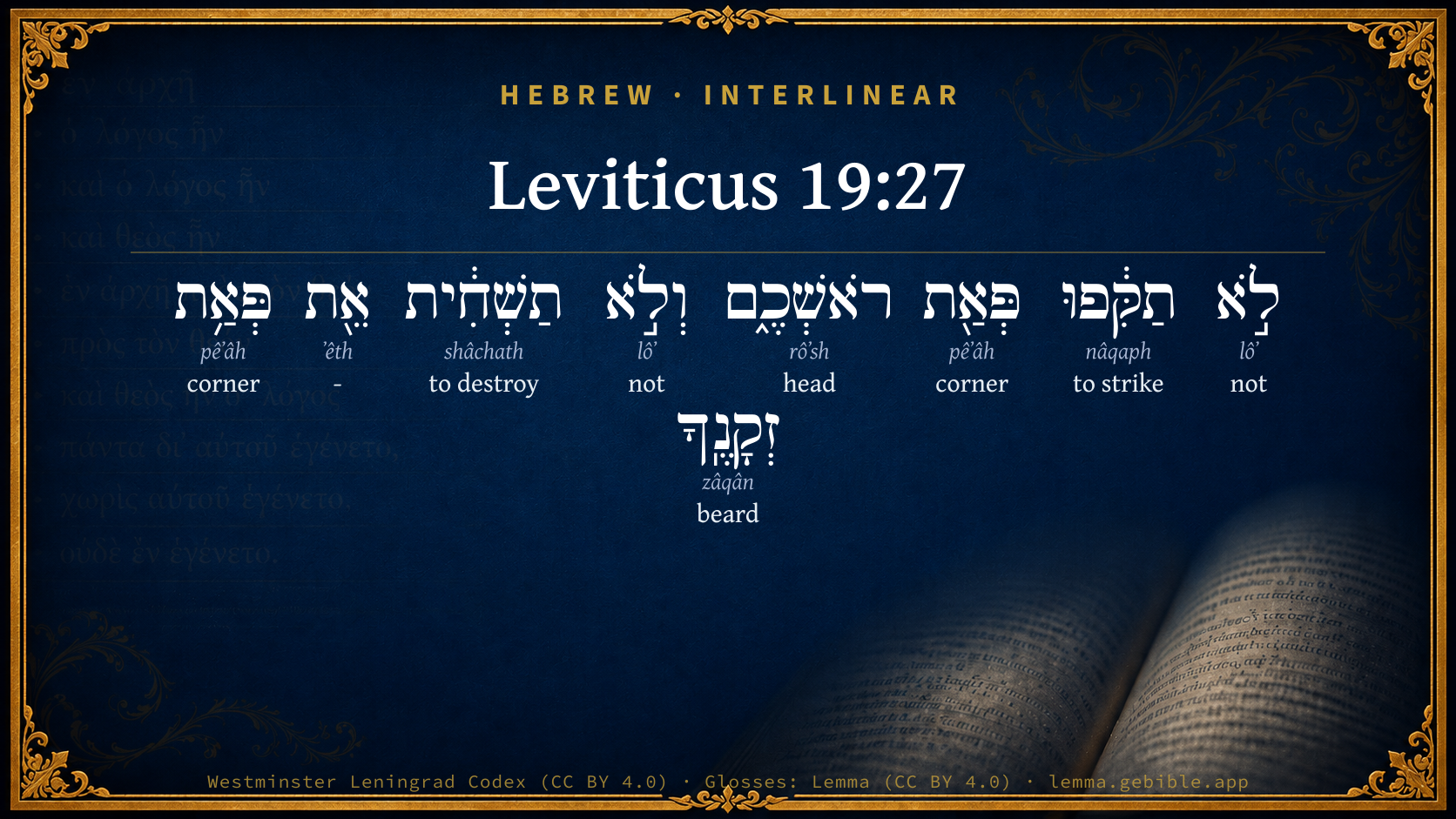
Hebrew (Westminster Leningrad Codex) Leviticus 19:27 appears in the Hebrew Old Testament. The text above is from the Westminster Leningrad Codex. Each word links to its Strong’s number, a concise gloss, and parsing drawn from the Open Scriptures Hebrew Bible morphology. Click any word for its full Brown-Driver-Briggs (BDB) entry.
Download image
Cite this verse

Leviticus 19:27 (World English Bible). Public Domain. Lemma interlinear Bible study tool, https://lemma.gebible.app/v/leviticus/19/27.

Show BibTeX & RIS
BibTeX
RIS
English Translation
You shall not cut the hair on the sides of your heads, neither shall you clip off the edge of your beard.
World English Bible · Public Domain
Highlights
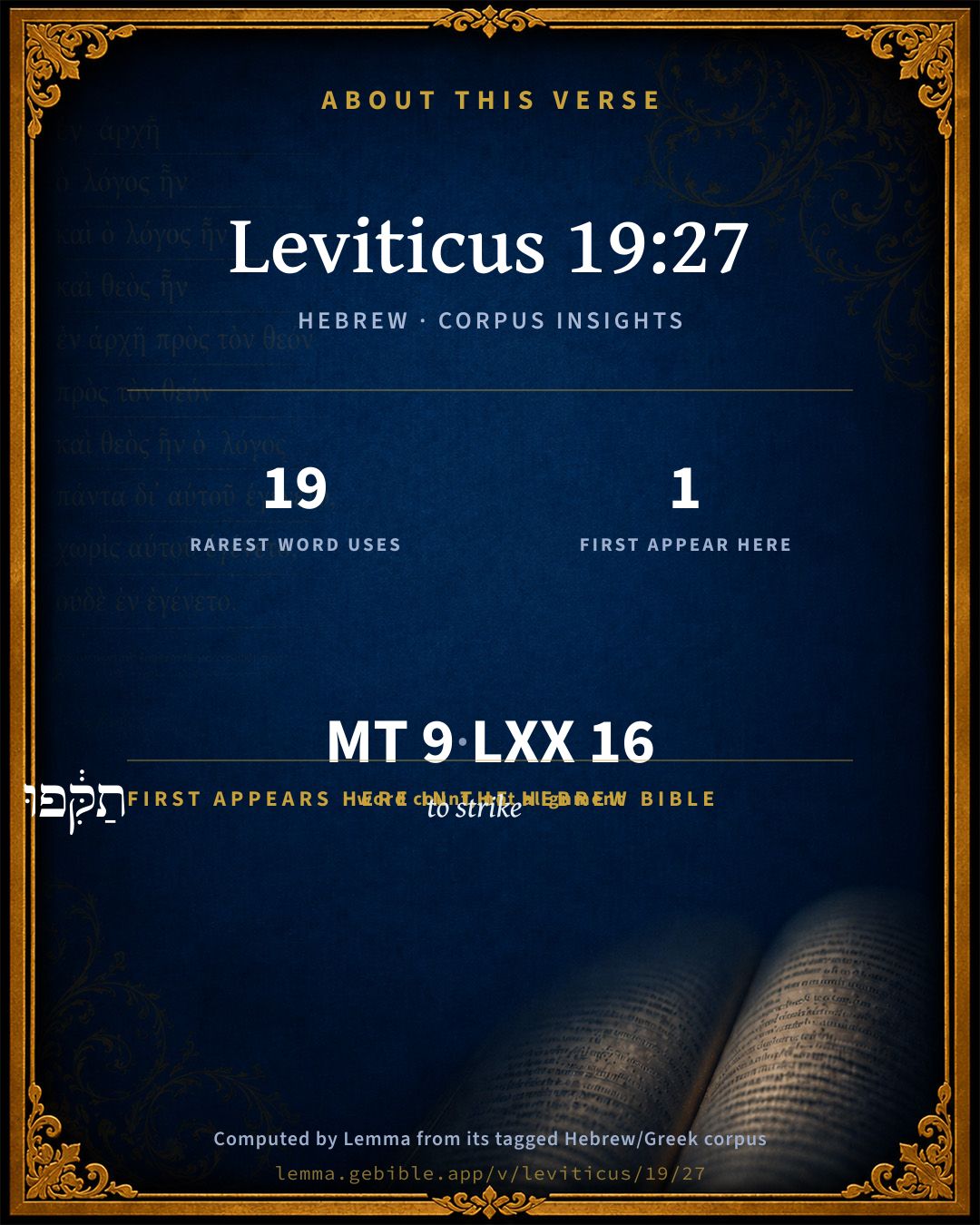
  • 1 first appearance in the Hebrew Bible
Full analysis ↓
Download a study sheet

One document with this verse’s original text, its word-by-word gloss line, the meaning frame, cross-references with their text, attributed commentary, and full source and license credits — printable, and it pastes into notes with its structure intact.

This verse Autodidact and up

Study sheet (.html) Plain text (.txt)

A passage Seminary Student

Up to 50 verses in one chapter. A passage sheet keeps up to 6 commentary sources and 12 cross-references per verse, in the order this page ranks them, and says so on the sheet whenever that leaves anything out. Ask for a single verse and you get the Autodidact verse sheet above.

Everything on this page stays free to read, with no account — the sheet is a download of what is already on screen, not access to it.

Want to remove ads? Support Godless Engineer
Compare translations 3

The same verse in 3 English versions, stacked beneath the original-language interlinear above. Click any original word for its lexicon entry.

Each is an independent rendering of the whole verse — the interlinear is not word-aligned to these translations.

Highlighted words mark where these versions differ — a whole-verse word diff, not a word-by-word alignment.

  • World English Bible Public Domain
    You shall not cut the hair on the sides of your heads, neither shall you clip off the edge of your beard.
  • King James Version Public Domain
    Ye shall not round the corners of your heads, neither shalt thou mar the corners of thy beard.
  • unfoldingWord Literal Text CC BY-SA 4.0
    You shall not round off the corners of your head, and you shall not ruin the corners of your beard.

unfoldingWord Literal Text — © unfoldingWord, licensed CC BY-SA 4.0. Word-aligned USFM3 via Door43 (git.door43.org/unfoldingWord/en_ult).

Versions to compare (up to 4)

3 of 4 selected

Show all 18 translations

Every available English version of this verse, each an independent rendering of the whole verse.

  • World English Bible Public Domain
    You shall not cut the hair on the sides of your heads, neither shall you clip off the edge of your beard.
  • Berean Standard Bible Public Domain
    You must not cut off the hair at the sides of your head or clip off the edges of your beard.
  • Majority Standard Bible Public Domain
    You must not cut off the hair at the sides of your head or clip off the edges of your beard.
  • King James Version Public Domain
    Ye shall not round the corners of your heads, neither shalt thou mar the corners of thy beard.
  • American Standard Version (1901) Public Domain
    Ye shall not round the corners of your heads, neither shalt thou mar the corners of thy beard.
  • Revised Version (1885) Public Domain
    Ye shall not round the corners of your heads, neither shalt thou mar the corners of thy beard.
  • Geneva Bible (1599) Public Domain
    Ye shall not cut rounde the corners of your heades, neither shalt thou marre the tuftes of thy beard.
  • Douay-Rheims (1899) Public Domain
    Nor shall you cut your hair roundwise: nor shave your beard.
  • Young's Literal Translation Public Domain
    `Ye do not round the corner of your head, nor destroy the corner of thy beard.
  • Literal Standard Version CC BY-SA 4.0
    You do not round the corner of your head, nor destroy the corner of your beard.
  • Unlocked Literal Bible CC BY-SA 4.0
    You will not round off the corners of the hair on the sides of your head or shave off the edge of your beard.
  • unfoldingWord Literal Text CC BY-SA 4.0
    You shall not round off the corners of your head, and you shall not ruin the corners of your beard.
  • Darby Bible Public Domain
    -- Ye shall not shave the corners of your head round, neither shalt thou mutilate the corners of thy beard.
  • World Messianic Bible Public Domain
    “‘You shall not cut the hair on the sides of your head or clip off the edge of your beard.
  • Webster's Bible Public Domain
    Ye shall not round the corners of your heads, neither shalt thou mar the corners of thy beard.
  • Free Bible Version CC BY-SA 4.0
    Don't cut your hair on the sides of your head or trim the sides of your beard,
  • Bible in Basic English Public Domain
    The ends of the hair round your face and on your chin may not be cut off.
  • JPS Tanakh (1917) Public Domain
    Ye shall not round the corners of your heads, neither shalt thou mar the corners of thy beard.

Literal Standard Version (2020), Covenant Press — licensed CC BY-SA 4.0. Text via the HelloAO Bible API (eBible.org). Unlocked Literal Bible (unfoldingWord) — licensed CC BY-SA 4.0. Text via the HelloAO Bible API (eBible.org). unfoldingWord Literal Text — © unfoldingWord, licensed CC BY-SA 4.0. Word-aligned USFM3 via Door43 (git.door43.org/unfoldingWord/en_ult). Free Bible Version, Dr. Jonathan Gallagher — licensed CC BY-SA 4.0. Text via the HelloAO Bible API (eBible.org).

Word by word

More ways to search: Search by grammar → Find every occurrence → Compare this word →

Practice this passage: Drill this verse → Learn its vocabulary →

תַקִּ֔פוּ
nâqaph
H5362
“to strike”
Verb, Hiphil, Imperfect, 2nd Person, Masculine, Plural
Part of Speech
Verb
Stem
Hiphil
Form
Imperfect
Person
2nd Person
Gender
Masculine
Number
Plural
Full BDB Definition

Origin: a primitive root

TWOT: 1415 , 1416

to strike, strike off - (Piel) to strike off skin - to go around, compass, round - (Qal) to go around - (Hiphil) - to go around, surround, encompass, enclose - to make the round, complete the circuit - to make round, round off
  1. לֹ֣א lôʼ H3808 “not” Particle, Negative
  2. פְּאַ֖ת pêʼâh H6285 “corner of” Noun, Common, Feminine, Singular, Construct
  3. רֹאשְׁכֶ֑ם rôʼsh H7218 “head · your” Noun, Common, Masculine, Singular, Construct + Suffix, Personal, 2nd Person, Masculine, Plural
  4. וְלֹ֣א lôʼ H3808 “and · not” Conjunction + Particle, Negative
  5. תַשְׁחִ֔ית shâchath H7843 “to destroy” Verb, Hiphil, Imperfect, 2nd Person, Masculine, Singular
  6. אֵ֖ת ʼêth H853 “-” Particle, Direct Object
  7. פְּאַ֥ת pêʼâh H6285 “corner of” Noun, Common, Feminine, Singular, Construct
  8. זְקָנֶֽךָ zâqân H2206 “beard · your” Noun, Common, Both, Singular, Construct + Suffix, Personal, 2nd Person, Masculine, Singular

About this verse

These counts appear in no published source. They are computed here, from the morphology-tagged text and Lemma’s own curated glosses. What Lemma adds →

9
words
7
distinct lemmas
Pentateuch
section

Notable vocabulary

The rarest word here is תַקִּ֔פוּ to strike H5362 — appearing just 19 times in the whole Hebrew Bible.

First appearance in Scripture

This word makes its first canonical appearance in the Hebrew Bible here:

  • תַקִּ֔פוּ to strike H5362

Shared distinctive vocabulary

תַקִּ֔פוּ to strike H5362 occurs in 19 verses of the Hebrew Bible. Also found in:

Grammatical profile

  • 2 verbs
  • 4 nouns
  • 3 particles

Verb forms

  • תַקִּ֔פוּ Hiphil · Imperfect
  • תַשְׁחִ֔ית Hiphil · Imperfect

Repetition

Words recur within this verse — often emphatic in Hebrew:

  • פְּאַ֖ת corner H6285 ×2
  • לֹ֣א not H3808 ×2

Hebrew & Septuagint length

In English translation the verse runs 22 words from the Hebrew and 17 from the Septuagint (LXX English) — closely comparable.

A rough comparison of the two English renderings, which tokenize alike — not a word-level alignment.

Word counts can differ between the Hebrew and the Greek without any difference in meaning — e.g. the Hebrew direct-object marker אֵת has no separate Greek word, and Greek often adds the article ὁ.

In the original languages it is 9 Hebrew tokens and 16 Greek tokens — but the two are counted differently (Hebrew bundles its prefixes and suffixes into one token; the Greek is in lemma form), so that isn’t a like-for-like length.

Cross-references

7

Topical passages linked to Leviticus 19:27 in the Treasury of Scripture Knowledge — connected by theme and wording, ordered by reader-vote popularity; previews shown in the World English Bible.

  • Leviticus 21:5 "'They shall not shave their heads, neither shall they shave off the corners of their beards, nor make any cuttings in their flesh.
  • Deuteronomy 14:1 You are the children of Yahweh your God: you shall not cut yourselves, nor make any baldness between your eyes for the dead.
  • Ezekiel 44:20 Neither shall they shave their heads, nor allow their locks to grow long; they shall only cut off the hair of their heads.
  • Isaiah 15:2 They are gone up to Bayith, and to Dibon, to the high places, to weep: Moab wails over Nebo, and over Medeba; on all their heads is baldness, every beard is cut off.
  • Jeremiah 48:37 For every head is bald, and every beard clipped: on all the hands are cuttings, and on the loins sackcloth.
  • Jeremiah 16:6 Both great and small shall die in this land; they shall not be buried, neither shall men lament for them, nor cut themselves, nor make themselves bald for them;
  • Ezekiel 7:18 They shall also gird themselves with sackcloth, and horror shall cover them; and shame shall be on all faces, and baldness on all their heads.

Cross-references courtesy of OpenBible.info (CC BY 4.0).

Hebrew and Greek witnesses Masoretic Hebrew ↔ Greek Septuagint

The same verse in the two great witnesses to the Old Testament, shown verse-for-verse.

These are two independent witnesses, not word-aligned to each other, and the Septuagint is shown in lemma (dictionary) form.

Hebrew Leviticus 19:27 Masoretic · Westminster Leningrad Codex

לֹ֣א תַקִּ֔פוּ פְּאַ֖ת רֹאשְׁכֶ֑ם וְלֹ֣א תַשְׁחִ֔ית אֵ֖ת פְּאַ֥ת זְקָנֶֽךָ

You shall not cut the hair on the sides of your heads, neither shall you clip off the edge of your beard.

World English Bible · Public Domain

Greek LXX Leviticus 19:27 Septuagint · lemma form

οὐ ποιέω σισόη ἐκ ὁ κόμη ὁ κεφαλή σύ οὐδέ φθείρω ὁ ὄψις ὁ πώγων σύ

You⌃ shall not make a round cutting of the hair of your head, nor disfigure your beard.

LXX2012 (modern English Septuagint) · Public Domain

On this verse, Haydock's Catholic Bible Commentary discusses the Septuagint’s reading. Read the note in Commentary ↓

Hebrew: Westminster Leningrad Codex (CC BY 4.0). Greek: Septuagint (public domain); English from LXX2012 (modern English Septuagint) (Public Domain). How the Septuagint differs from the Hebrew →

Targum (Aramaic paraphrase)

2

The Targum is the ancient Jewish Aramaic paraphrase of the Hebrew Scriptures — an interpretive translation, not the Hebrew text itself. Onkelos (literal) and Pseudo-Jonathan (expansive) render the Torah, and Jonathan the Prophets. Coverage is partial: where no permissively-licensed English translation exists for a verse, only the Aramaic is shown. This is verse-level text, not a word-by-word alignment to the Hebrew.

  1. Targum Onkelos Torah (Genesis–Deuteronomy)
    לָא תַקְפוּן פָּאתָא דְרֵישְׁכוֹן וְלָא תְחַבֵּל יָת פָּאתָא דְדִקְנָךְ

    (no public-domain English translation for this verse)

    Targum Onkelos — Aramaic: “Onkelos Genesis” (public domain); “Onkelos Exodus” (public domain); “Onkelos Leviticus” (public domain); “Onkelos Numbers” (public domain); “Onkelos Deuteronomy” (public domain). English: “Sefaria Community Translation” (CC0 1.0 (public-domain dedication)); “J.W. Etheridge. The Targums of Onkelos and Jonathan Ben Uzziel on the Pentateuch. London: Longmans, Green, 1862” (public domain). Text via Sefaria.

  2. Targum Pseudo-Jonathan Torah (Genesis–Deuteronomy)
    לָא תַקְפֵי צִדְעֵי רֵישֵׁיכוֹן וְלָא תִגְלְבוּן יַת שׁוּמַת דִיקְנֵיכוֹן

    You shall not round off the (hair on) the sides of your heads, nor shave the corners of your beards.

    Targum Pseudo-Jonathan — Aramaic: “Targum Jonathan on Genesis” (public domain); “Targum Jonathan on Exodus” (public domain); “Targum Jonathan on Leviticus” (public domain); “Targum Jonathan on Numbers” (public domain); “Targum Jonathan on Deuteronomy” (public domain). English: “The Targum of Jonathan ben Uzziel, trans. J. W. Etheridge, London, 1862” (public domain). Text via Sefaria.

Commentary

Notes on Leviticus 19:27 from classic Christian and Jewish commentators (each source and its license shown beneath its notes). The classic Christian expositions comment on the surrounding passage and are grouped to its opening verse, so a note may address several verses; the Jewish commentaries on the Tanakh (Rashi and others) are per-verse, so they appear only where the commentator wrote on this verse.

Lemma curates 59 commentaries, every one of them public domain or Creative Commons licensed, each selected and text-cleaned for this edition rather than reprinted as found. About our sources →

The Cambridge Bible for Schools and Colleges

gen. ed. J. J. S. Perowne

27. round the corners of your heads] i.e. cut off the hair from the temples. Cp. Jer_9:26; Jer_25:23; Jer_49:32. According to Herod. (iii. 8) it had a religious significance with certain Arab tribes. The belief that the hair was specially fitted to mark union with the Divine being, seems to have arisen from its continuous growth so long as life continues. See Rob.-Sm. Rel. of the Sem.2. 323 ff., 481 ff.

28 cuttings in your flesh for the dead] Another practice common among half-civilized races. It represented the custom of human sacrifices (see e.g. Herod. 4:71) as a propitiation to the spirit of the departed. Cp. Jer_41:5, and perhaps (C.B.) Hos_7:14. A. R. S. Kennedy, on the other hand (HDB. i. 172), considers that the original idea was to make an enduring covenant with the dead. He quotes Rob.-Sm. Rel. Sem.2 p. 305. For the prohibitions in this and Lev_19:27, cp. Lev_21:5; Deu_14:1.

The Cambridge Bible for Schools and Colleges (gen. ed. J. J. S. Perowne; Cambridge University Press, 1878–1918) — public domain. Text from a community e-Sword module.

Trapp's Complete Commentary

John Trapp

Lev 19:27 Ye shall not round the corners of your heads, neither shalt thou mar the corners of thy beard.

Ver. 27. Ye shall not round.] Because the Arabians their neighbours did so, and they should not be conformed to idolaters. {a} Oleaster, a Popish interpreter, understandeth such a shaving here, as their priest use to bear. But shaving is so bald a ceremony, that some priests in France are ashamed of the mark, and few of them have it that can handsomely avoid it.

{a} Herod., in Thal.

John Trapp, A Commentary or Exposition upon All the Books of the Old and New Testament (1647–1656) — public domain. Text from a community e-Sword module.

The Biblical Illustrator

Joseph S. Exell

Lev_19:27

Ye shall not round the corners of your heads.

That is, they are not to shave off the hair around the temples and behind the ears, so as to leave the head bald except a dish-like tuft upon the crown, thus imparting to their heads the form of a hemisphere. This was done by the Arabs, and other worshippers of the god Orotal. Hence the Arabs are ironically called those with the corner of their hairpolled (Jer_9:26; Jer_25:23; Jer_49:32). (C. D. Ginsburg, LL. D.)

The true worshipper to appear as such

The command means, that the Israelite was not only to worship God alone, but he was not to adopt a fashion in dress which, because commonly associated with idolatry, might thus misrepresent his real position as a worshipper of the only living and true God. (S. H. Kellogg, D. D.)

Neither shalt thou mar the corners of thy beard.--An injunction not to mar the beard might hardly appear necessary, since it is well known with what pride and scrupulous care the beard was cultivated by the Hebrews and other Eastern nations; that it was deemed the greatest ornament of a man, a badge of his dignity, and a type of his vigour and perfect manhood; beard and life were hence often employed as synonymous, and oaths were confirmed, and blessings bestowed, by invoking the one or the other; suppliants, desirous to give the utmost solemnity to their appeals, touched the beards of those they addressed; and a mutilation of the beard was looked upon as an unbearable disgrace, and often regarded as more calamitous than death. In some countries the beard was the distinctive mark of free men. An old Spartan law forbade the ephori, from the moment of their taking office, to clip their beards; and those who had fled before the enemy in battle were compelled to appear in public with half-shorn beards. However, it was customary among several nations for young men to present to their gods the firstlings of their beards; and it was possibly to prevent the adoption of similar usages among the Hebrews that the injunction was deemed desirable. Besides, marring the cornets of the beard was a heathen mode of mourning, which was not to be imitated, since it might easily lead to more objectionable perversities. (M. M. Kaliseh, Ph. D.)

The Biblical Illustrator, edited by Joseph S. Exell (c. 1880s–1900s) — public domain. Text from a community e-Sword module.

Joseph Benson's Commentary

Lev 19:27. The corners of your heads — That is, your temples; ye shall not cut off the hair of your heads round about your temples. This the Gentiles did, either for the worship of their idols, to whom young men used to consecrate their hair, being cut off from their heads, as Homer, Plutarch, and many others write; or in funerals or immoderate mournings, as appears from Isa 15:2; Jer 48:37. And the like is to be thought concerning the beard, or the hair in the corner, that is, corners of the beard. The reason then of this prohibition is, because God would not have his people agree with idolaters, neither in their idolatries, nor in their excessive sorrowing, nor so much as in the appearances of it.

Joseph Benson's Commentary on the Old and New Testaments (1811–1818) — public domain. Text from a community e-Sword module.

Tyndale Open Study Notes

Tyndale Open Resources

19:27 Do not trim: As discovered in Egyptian wall paintings, Canaanites carefully trimmed their hair and beards. The Israelites were not to imitate this practice so that they would not be influenced by Canaanite religion and ethics.

Tyndale Open Study Notes — © Tyndale Open Resources, licensed CC BY-SA 4.0. Text via the HelloAO Bible API.

Geneva Bible (1599)

Geneva Bible translators

Or, cut, or tear.

As did the Gentiles in sign of mourning.

Geneva Bible (1599) marginal notes — public domain. Text via Bolls.life.

Jamieson, Fausset & Brown

Robert Jamieson, A. R. Fausset & David Brown

Ye shall not round the corners of your heads, &c.--It seems probable that this fashion had been learned by the Israelites in Egypt, for the ancient Egyptians had their dark locks cropped short or shaved with great nicety, so that what remained on the crown appeared in the form of a circle surrounding the head, while the beard was dressed into a square form. This kind of coiffure had a highly idolatrous meaning; and it was adopted, with some slight variations, by almost all idolaters in ancient times. (Jer 9:25-26; Jer 25:23, where "in the utmost corners" means having the corners of their hair cut.) Frequently a lock or tuft of hair was left on the hinder part of the head, the rest being cut round in the form of a ring, as the Turks, Chinese, and Hindus do at the present day.

neither shalt thou mar, &c.--The Egyptians used to cut or shave off their whiskers, as may be seen in the coffins of mummies, and the representations of divinities on the monuments. But the Hebrews, in order to separate them from the neighboring nations, or perhaps to put a stop to some existing superstition, were forbidden to imitate this practice. It may appear surprising that Moses should condescend to such minutiæ as that of regulating the fashion of the hair and the beard--matters which do not usually occupy the attention of a legislator--and which appear widely remote from the province either of government or of a religion. A strong presumption, therefore, arises that he had in mind by these regulations to combat some superstitious practices of the Egyptians.

Jamieson, Fausset & Brown — Commentary Critical and Explanatory on the Whole Bible (1871) — public domain (CC PDM 1.0). Text via the HelloAO Bible API.

Adam Clarke's Commentary

Verse 27. Ye shall not round the corners your heads] This and the following verse evidently refer to customs which must have existed among the Egyptians when the Israelites sojourned in Egypt; and what they were it is now difficult, even with any probability, to conjecture. Herodotus observes that the Arabs shave or cut their hair round, in honour of Bacchus, who, they say, had his hair cut in this way, lib. iii., cap. 8. He says also that the Macians, a people of Libya, cut their hair round, so as to leave a tuft on the top of the head, lib. iv., cap. 175. In this manner the Chinese cut their hair to the present day. This might have been in honour of some idol, and therefore forbidden to the Israelites.

The hair was much used in divination among the ancients, and for purposes of religious superstition among the Greeks; and particularly about the time of the giving of this law, as this is supposed to have been the era of the Trojan war. We learn from Homer that it was customary for parents to dedicate the hair of their children to some god; which, when they came to manhood, they cut off and consecrated to the deity. Achilles, at the funeral of Patroclus, cut off his golden locks which his father had dedicated to the river god Sperchius, and threw them into the flood: -

Στας απανευθε πυρης ξονθην απεκειρατο χαιτην,

Την ῥα Σπερχειῳ ποταμῳ τρεφε τηλεθοωσαν·

Οχθησας δ' αρα ειπεν, ιδων επι οινοπα ποντον·

Σπερχει', αλλως σοι γε πατηρ ηρησατο Πηλευς. κ. τ. λ.

Iliad, 1. xxiii., ver. 142, c.

But great Achilles stands apart in prayer,

And from his head divides the yellow hair,

Those curling locks which from his youth he vowed,

And sacred threw to Sperchius' honoured flood.

Then sighing, to the deep his looks he cast,

And rolled his eyes around the watery waste.

Sperchius! whose waves, in mazy errors lost,

Delightful roll along my native coast!

To whom we vainly vowed, at our return,

These locks to fall, and hecatombs to burn

So vowed my father, but he vowed in vain,

No more Achilles sees his native plain

In that vain hope these hairs no longer grow;

Patrocius bears them to the shades below.

POPE.

From Virgil we learn that the topmost lock of hair was dedicated to the infernal gods; see his account of the death of Dido: -

"Nondum illi flavum Proserpina vertice crinem

Abstulerat, Stygioque caput damnaverat orco--

-----------------------Hunc ego Diti

Sacrum jussa fero; teque isto corpore solvo.

Sic ait, et dextra crinem secat."

AEneid, lib. iv., ver. 698.

The sisters had not cut the topmost hair,

Which Proserpine and they can only know.

Nor made her sacred to the shades below-

This offering to the infernal gods I bear;

Thus while she spoke, she cut the fatal hair.

DRYDEN.

If the hair was rounded, and dedicated for purposes of this kind, it will at once account for the prohibition in this verse.

The corners of thy beard.] Probably meaning the hair of the cheek that connects the hair of the head with the beard. This was no doubt cut in some peculiar manner, for the superstitious purposes mentioned above. Several of our own countrymen wear this said hair in a curious form; for what purposes they know best: we cannot say precisely that it is the ancient Egyptian custom revived. From the images and paintings which remain of the ancient Egyptians, we find that they were accustomed to shave the whole hair off their face, except merely that upon the chin, which last they cut off only in times of mourning.

Adam Clarke's Commentary on the Bible (1810–1826) — public domain. Text from a community e-Sword/MySword module.

Ellicott's Commentary for English Readers

(27) Round the corners of your heads.—That is, they are not to shave off the hair around the temples and behind the ears, so as to leave the head bald except a dish-like tuft upon the crown, thus imparting to their heads the form of a hemisphere. This was done by the Arabs, and other worshippers of the god Orotal. Hence the Arabs are ironically called “those with the corner of their hair polled,” as it is rightly rendered in the Margin (Jer_9:26; Jer_25:23; Jer_49:32).

Mar the corners of thy beard.—The beard was regarded by the Hebrews and other eastern nations as the greatest ornament of a man, and was as dear to them as life itself. It was the object of salutation (2Sa_20:9), and the mutilation of it was looked upon as the greatest disgrace and most degrading punishment (2Sa_10:4; Isa_7:20; Ezr_5:1-5, &c.). It was only in seasons of sorrow that the Hebrews neglected their beards; and sometimes, to show how deeply they were afflicted, they covered them up, or even cut them off, or tore them out (2Sa_19:24; Isa_15:2; Jer_41:5, &c.). Because it was so precious a treasure, it was customary among some of the ancients to present to their gods the firstlings of their beards. The prohibition before us alludes to this practice.

A Bible Commentary for English Readers, edited by Charles John Ellicott (1878–1897) — public domain. Text from a community e-Sword module.

John Gill's Exposition

Ye shall not round the corners of your heads,.... The extremities of the hairs of the head, round about, on the forehead, temples, and behind the ears; this is done, as Jarchi says, when any one makes his temples, behind his ears, and his forehead alike, so that the circumference of his head is found to be round all about, as if they had been cut as with a bowl; and so the Arabians cut their hair, as Herodotus (b) reports; see Gill on Jer 9:26,

neither shall thou mar the corners of thy beard; by shaving them entirely; Jarchi and other Jewish writers say, there are five of them, two on the right, as Gersom reckons them, one on the upper jaw, the other on the nether, and two over against them on the left, and one in the place where the nether jaw joins the right to the left, the chin; the same observes, that it was the manner of idolaters to do the above things; and Maimonides (c) is of opinion that the reason of the prohibition is, because the idolatrous priests used this custom; but this law does not respect priests only, but the people of Israel in general; wherefore rather it was occasioned by the Gentiles in common cutting their hair, in honour of their gods, as the Arabians did, as Herodotus in the above place relates, in imitation of Bacchus, and to the honour of him; and so with others, it was usual for young men to consecrate their hair to idols; but inasmuch as such practices were used on account of the dead, as Aben Ezra observes, it seems probable enough that these things are forbidden to be done on their account, since it follows,

(b) Thalia, sive, l. 3. c. 8. (c) Moreh Nevochim, par. 3. c. 37. Hilchot Obede Cochabim, c. 12. sect. 1.

John Gill's Exposition of the Whole Bible (1746–1763) — public domain (CC PDM 1.0). Text via the HelloAO Bible API.

Haydock's Catholic Bible Commentary

Cut your hair, &c. This, and other such like things, of themselves indifferent, were forbidden by God, that they might not imitate the Egyptians or other infidels, who practised these things out of superstition, in honour of their false deities. (Challoner) --- The pagans consecrated locks of hair, and their beard, when it was first cut, to Apollo, the river gods, the hours, Esculapius, &c. Some, at Rome, hung the hair on a tree. (Tirinus) --- The Arabians and Macæ left only a tuft of hair at the top of their head, in imitation of Bacchus. (Herod. iii. 8.; iv. 175.) This tuft is called sisoe by the Septuagint who seem to have alluded to the Hebrew term tsitsith. See Ezechiel viii. 3. The ancient scholiast says, this was left in honour of Saturn. It resembles a crown. The same custom was observed by the Syrians, (Lucian) Idumeans, &c. (Jeremias ix. 25.) --- Beard. Hebrew, "the angle, or extremity of your beard." These regulations would seem beneath the attention of a lawgiver. But they were made in opposition to some profane customs of the surrounding nations. The Jews still observe this direction, and leave the beard from the ear to the chin, (where they let it grow pretty long) and also two mustaches, or whiskers, on the top lip. The Egyptian mummies have only the beard on the chin. The eyebrows and other hair of the gods and inhabitants of Egypt, were entirely cut off. In mourning the chin was also shaved. God forbids his people to imitate them. (Calmet) --- But heretics need not hence infer, that the tonsure of priests and monks is reprehensible. (Randulph.) --- Superstition and affected delicacy in curling, &c., are to be avoided. (Tirinus)

George Leo Haydock (1774–1849), Haydock's Catholic Family Bible and Commentary, 1859 edition — public domain. Excludes Psalms (Douay-Rheims chapter numbering differs from Protestant) and Deuterocanonical books (Catholic canon only).

Matthew Poole's English Annotations

The corners of your heads; i.e. your temples: Ye shall not cut off the hair of your heads round about your temples. This the Gentiles did, either for the worship of the devils or idols, to whom young men used to consecrate their hair, being cut off from their heads, as Homer, Plutarch, and many others write; or in funerals or immoderate mournings, as appears from Isa 15:2; Jer 48:37. And the like is to be thought concerning the beard or the hair in the corner, i.e. corners of the beard. The reason then of this prohibition is, because God would not have his people agree with idolaters, neither in their idolatries, nor in their excessive sorrowing, no, nor so much as in the appearances and outward significations or expressions thereof.

Matthew Poole's English Annotations on the Holy Bible (1683–1685) — public domain. Text from a community e-Sword/MySword module.

Whedon's Commentary on the Bible

Daniel D. Whedon

27. Not round the corners of your heads — That is, cut the hair in a circle from temple to temple, as Herodotus relates that some Arabs did in honour of their god. Also, in opposition to heathen usage, the beard must be permitted to grow equally over all the lower part of the face.

Daniel D. Whedon (gen. ed.), Commentary on the Old and New Testaments (1874–1909) — public domain. Text from a community e-Sword module.

John Wesley's Explanatory Notes

The corners of your heads - That is your temples, ye shall not cut off the hair of your heads round about your temples. This the Gentiles did, either for the worship of their idols, to whom young men used to consecrate their hair, being cut off from their heads, as Homer, Plutarch and many others write; or in funerals or immoderate mournings, as appears from Isaiah xv, 2 Jer. xlviii, 37. And the like is to be thought concerning the beard or the hair in the corner, that is, corners of the beard. The reason then of this prohibition is because God would not have his people agree with idolaters, neither in their idolatries, nor in their excessive sorrowing, no nor so much as in the appearances of it.

John Wesley, Explanatory Notes Upon the Whole Bible (1754–1765) — public domain. Text via the GEBible commentary corpus.

Rashi

Rabbi Shlomo Yitzchaki (Rashi)

לא תקיפו פאת ראשכם YE SHALL NOT ROUND THE CORNERS OF YOUR HEAD — This refers to one who makes his temples exactly like (as hairless as) the back of his ears and his forehead (cf. Rashi on Makkot 20b, ד״ה המשוה צדעיו) by removing the hair on his temples, so that the lower edge of the hair that surrounds his head (i. e. his skull, because we are not concerned with ‎hair at the back of the neck) forms a complete circle, since above the back of his ears the roots of his hair are situated much higher than his temples (and it is thus only the temples which prevent an uninterrupted circular line going round his skull). (Cf. Makkot 20b).

פאת זקנך [NEITHER SHALT THOU MAR] THE CORNERS OF THY BEARD — i. e. the tip of the beard and its sides, these making together five corners: two on each cheek, above near the head (the temples) — where it (the cheek) is broad and has therefore two corners (thus four on the two sides) and one at the bottom, on the chin, on that spot where is the junction of the two cheeks (Shevuot 3a; cf. also Sifra, Kedoshim, Chapter 6 3; Makkot 20a and Rashi on Shevuot 3a: ועל הזקן ‎‎‏ (ד"ה

Rashi on the Tanakh — English translations: “The Judaica Press complete Tanach with Rashi, translated by A. J. Rosenberg” (CC BY 4.0); “Pentateuch with Rashi's commentary by M. Rosenbaum and A.M. Silbermann, 1929-1934” (public domain); “The Metsudah Tanach series, Lakewood, N.J” (CC BY 4.0); and “The Book of Joshua, Metsudah Publications, 1997” (CC BY 4.0). Text via Sefaria.

Lesson kit

Teaching starters — assembled from the data on this page, not authored interpretation. Every prompt links to the verse data it draws on. Edit before teaching.

Leviticus, in the Pentateuch, opens this verse with 9 words (7 distinct Hebrew lemmas). Its most distinctive word is nâqaph (“to strike”). A historical commentator’s framing appears above. Read the whole chapter for the surrounding context.

Discussion questions

  1. What does “to strike” (nâqaph) contribute to the verse as a whole?
  2. This is the first place “to strike” appears in Scripture (first appears here). What does its debut here establish?
  3. How does Joshua 6:3, which shares the word «to strike», read alongside this verse?
  4. What does the repetition of “corner” (2× in this one verse) do in this verse?
  5. The translations on this page render this verse differently — a whole-verse word diff, not a word-by-word alignment. What might account for the different wordings?
  6. «תַקִּ֔פוּ» is a Hiphil Imperfect verb. How does that grammatical form shape the action described?
  7. Compare how The Cambridge Bible for Schools and Colleges and Trapp's Complete Commentary read this verse. Where do they agree or differ?

Things to notice

Reading settings

Reading text

Shown beneath each verse's original-language words.

Old Testament
Old Testament edition

Read the OT as the Masoretic Hebrew (MT) or the Greek Septuagint (LXX).

English shown for the Greek Septuagint (in the Hebrew ↔ Greek comparison).

Comparing translations? Open the Compare panel on any verse page to stack up to four side by side.