
John 1:3

Greek (Tischendorf 8th ed.) John 1:3 appears in the Greek New Testament. The text above is from the Tischendorf 8th edition. Each word links to its Strong’s number and a concise gloss. Click any word for its full Thayer’s Greek Lexicon entry.
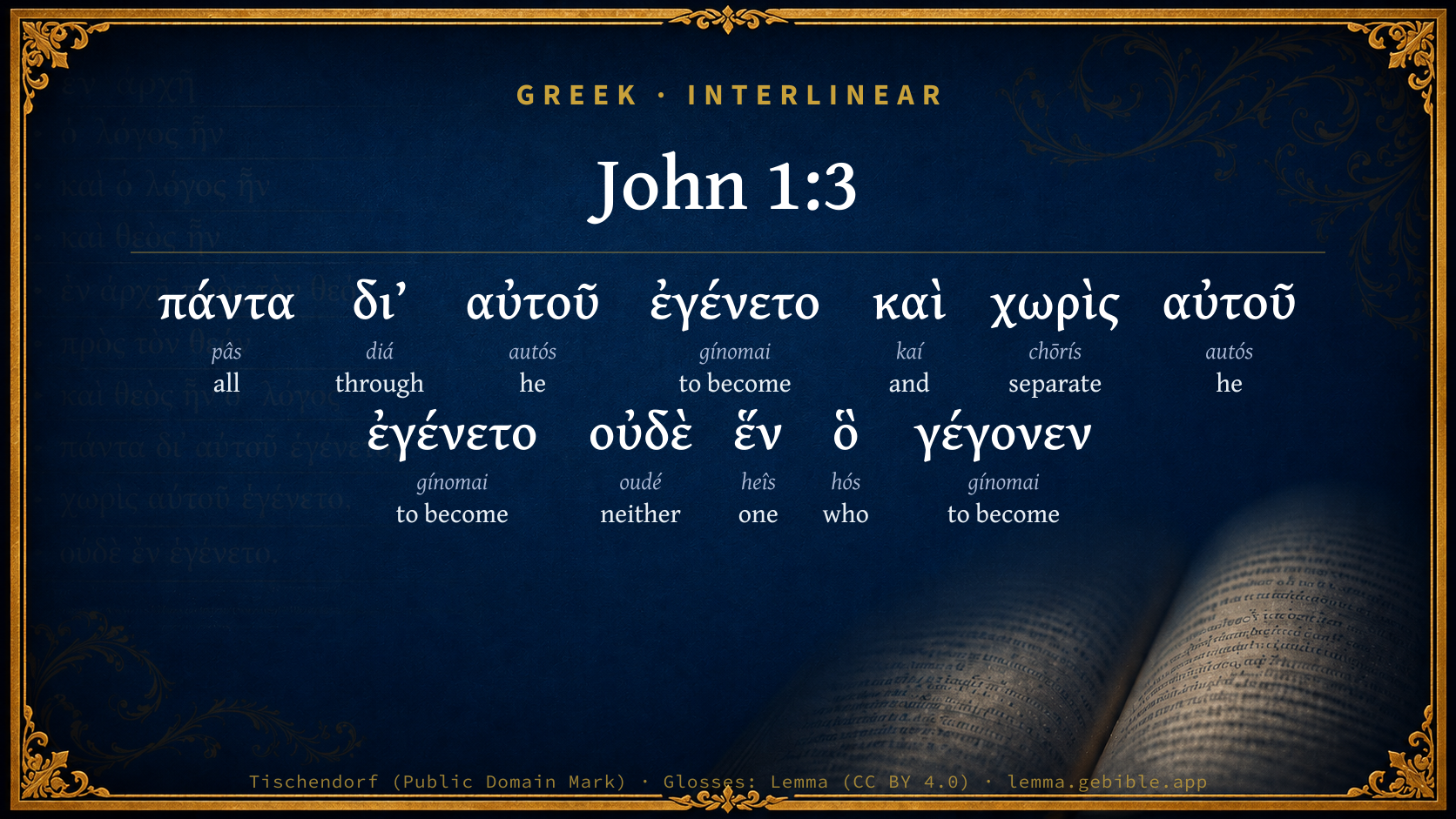
Download image
Cite this verse

John 1:3 (World English Bible). Public Domain. Lemma interlinear Bible study tool, https://lemma.gebible.app/v/john/1/3.

Show BibTeX & RIS
BibTeX
RIS
English Translation
All things were made through him. Without him was not anything made that has been made.
World English Bible · Public Domain
Download a study sheet

One document with this verse’s original text, its word-by-word gloss line, the meaning frame, cross-references with their text, attributed commentary, and full source and license credits — printable, and it pastes into notes with its structure intact.

This verse Autodidact and up

Study sheet (.html) Plain text (.txt)

A passage Seminary Student

Up to 50 verses in one chapter. A passage sheet keeps up to 6 commentary sources and 12 cross-references per verse, in the order this page ranks them, and says so on the sheet whenever that leaves anything out. Ask for a single verse and you get the Autodidact verse sheet above.

Everything on this page stays free to read, with no account — the sheet is a download of what is already on screen, not access to it.

Want to remove ads? Support Godless Engineer
Compare translations 3

The same verse in 3 English versions, stacked beneath the original-language interlinear above. Click any original word for its lexicon entry.

Each is an independent rendering of the whole verse — the interlinear is not word-aligned to these translations.

Highlighted words mark where these versions differ — a whole-verse word diff, not a word-by-word alignment.

  • World English Bible Public Domain
    All things were made through him. Without him was not anything made that has been made.
  • King James Version Public Domain
    All things were made by him; and without him was not any thing made that was made.
  • unfoldingWord Literal Text CC BY-SA 4.0
    All things came into being through him, and without him came into being not one thing that has come into being.

unfoldingWord Literal Text — © unfoldingWord, licensed CC BY-SA 4.0. Word-aligned USFM3 via Door43 (git.door43.org/unfoldingWord/en_ult).

Versions to compare (up to 4)

3 of 4 selected

Show all 19 translations

Every available English version of this verse, each an independent rendering of the whole verse.

  • World English Bible Public Domain
    All things were made through him. Without him was not anything made that has been made.
  • Berean Standard Bible Public Domain
    Through Him all things were made, and without Him nothing was made that has been made.
  • Majority Standard Bible Public Domain
    Through Him all things were made, and without Him nothing was made that has been made.
  • King James Version Public Domain
    All things were made by him; and without him was not any thing made that was made.
  • American Standard Version (1901) Public Domain
    All things were made through him; and without him was not anything made that hath been made.
  • Revised Version (1885) Public Domain
    All things were made by him; and without him was not anything made that hath been made.
  • Geneva Bible (1599) Public Domain
    All things were made by it, and without it was made nothing that was made.
  • Douay-Rheims (1899) Public Domain
    All things were made by him: and without him was made nothing that was made.
  • Young's Literal Translation Public Domain
    all things through him did happen, and without him happened not even one thing that hath happened.
  • Literal Standard Version CC BY-SA 4.0
    all things happened through Him, and without Him not even one thing happened that has happened.
  • Unlocked Literal Bible CC BY-SA 4.0
    All things were made through him, and without him there was not one thing made that has been made.
  • unfoldingWord Literal Text CC BY-SA 4.0
    All things came into being through him, and without him came into being not one thing that has come into being.
  • Darby Bible Public Domain
    All things received being through him, and without him not one [thing] received being which has received being.
  • World Messianic Bible Public Domain
    All things were made through him. Without him, nothing was made that has been made.
  • Webster's Bible Public Domain
    All things were made by him; and without him was not any thing made that was made.
  • Free Bible Version CC BY-SA 4.0
    Everything came into being through him; nothing came into being without him.
  • Bible in Basic English Public Domain
    All things came into existence through him, and without him nothing was.
  • Text-Critical English NT CC BY 4.0
    All things were made through him, and nothing that was made was made without him.
  • Tyndale New Testament (1534) Public Domain
    All thinges were made by it and with out it was made nothinge that was made.

Literal Standard Version (2020), Covenant Press — licensed CC BY-SA 4.0. Text via the HelloAO Bible API (eBible.org). Unlocked Literal Bible (unfoldingWord) — licensed CC BY-SA 4.0. Text via the HelloAO Bible API (eBible.org). unfoldingWord Literal Text — © unfoldingWord, licensed CC BY-SA 4.0. Word-aligned USFM3 via Door43 (git.door43.org/unfoldingWord/en_ult). Free Bible Version, Dr. Jonathan Gallagher — licensed CC BY-SA 4.0. Text via the HelloAO Bible API (eBible.org).

Word by word

More ways to search: Search by grammar → Find every occurrence → Compare this word →

Practice this passage: Drill this verse → Learn its vocabulary →

About this verse

These counts appear in no published source. They are computed here, from the morphology-tagged text and Lemma’s own curated glosses. What Lemma adds →

12
words
9
distinct lemmas
Gospels
section

Shared distinctive vocabulary

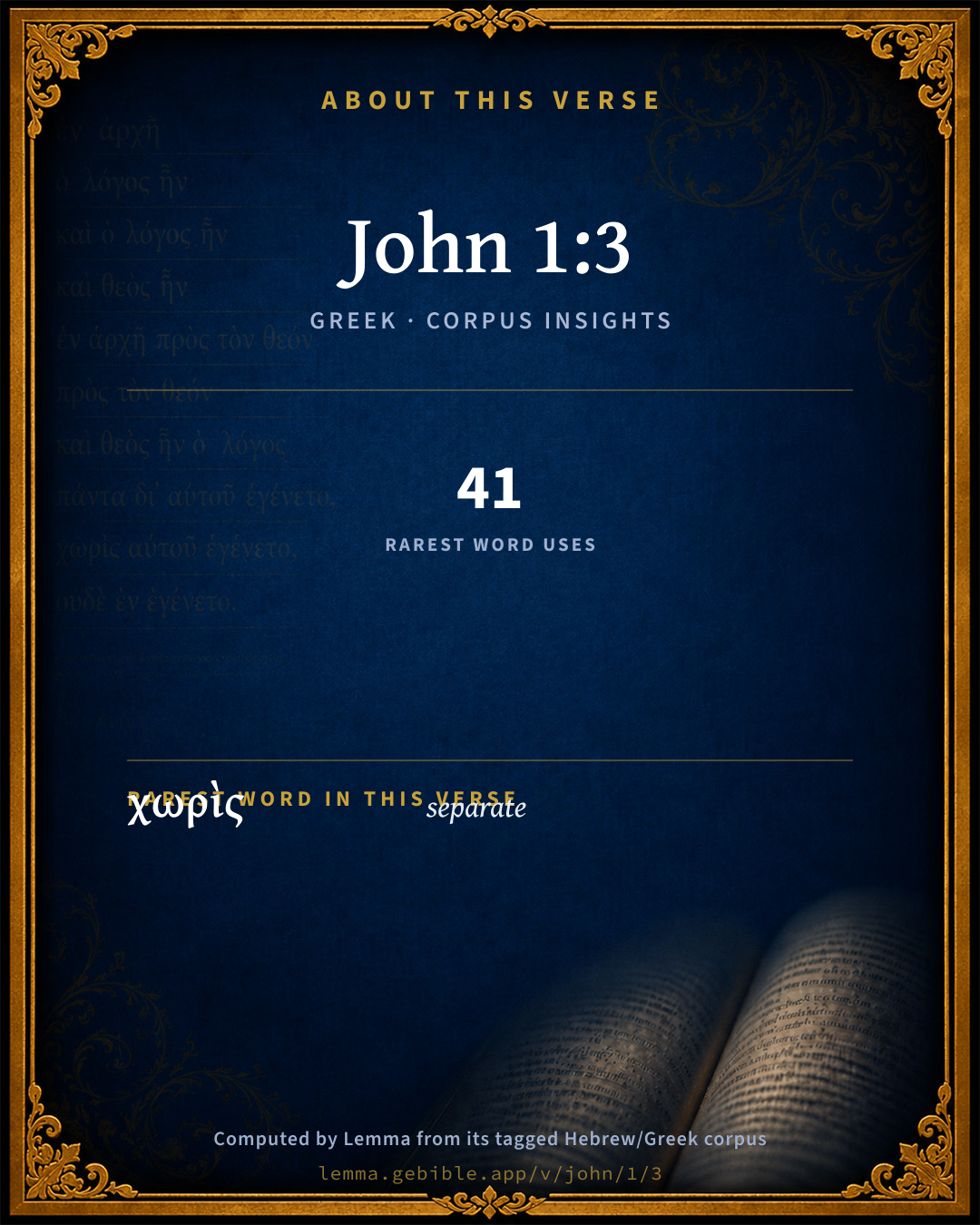
χωρὶς separate G5565 occurs in 38 verses of the Greek New Testament. Also found in:
Repetition

Words recur within this verse:

  • ἐγένετο to become G1096 ×3
  • αὐτοῦ he G846 ×2

Cross-references

15

Topical passages linked to John 1:3 in the Treasury of Scripture Knowledge — connected by theme and wording, ordered by reader-vote popularity; previews shown in the World English Bible.

  • Colossians 1:16–17 For by him were all things created, in the heavens and on the earth, things visible and things invisible, whether thrones or dominions or principalities or powers; all things have been created through him, and for him.
  • 1 Corinthians 8:6 yet to us there is one God, the Father, of whom are all things, and we for him; and one Lord, Jesus Christ, through whom are all things, and we live through him.
  • Revelation 4:11 "Worthy are you, our Lord and God, the Holy One, to receive the glory, the honor, and the power, for you created all things, and because of your desire they existed, and were created!"
  • Psalms 33:6 By Yahweh's word the heavens were made; All their host by the breath of his mouth.
  • Genesis 1:26 God said, "Let us make man in our image, after our likeness: and let them have dominion over the fish of the sea, and over the birds of the sky, and over the cattle, and over all the earth, and over every creeping thing that creeps on the earth."
  • John 1:10 He was in the world, and the world was made through him, and the world didn't recognize him.
  • Hebrews 1:2–3 has at the end of these days spoken to us by his Son, whom he appointed heir of all things, through whom also he made the worlds.
  • Isaiah 45:18 For thus says Yahweh who created the heavens, the God who formed the earth and made it, who established it and didn't create it a waste, who formed it to be inhabited: I am Yahweh; and there is no one else.
  • Isaiah 45:12 I have made the earth, and created man on it: I, even my hands, have stretched out the heavens; and all their host have I commanded.
  • Psalms 102:25 Of old, you laid the foundation of the earth. The heavens are the work of your hands.
  • Genesis 1:1 In the beginning God created the heavens and the earth.
  • Hebrews 3:3–4 For he has been counted worthy of more glory than Moses, inasmuch as he who built the house has more honor than the house.
  • Hebrews 1:10–12 And, "You, Lord, in the beginning, laid the foundation of the earth. The heavens are the works of your hands.
  • Ephesians 3:9 and to make all men see what is the administration of the mystery which for ages has been hidden in God, who created all things through Jesus Christ;
  • John 5:17–19 But Jesus answered them, "My Father is still working, so I am working, too."

Cross-references courtesy of OpenBible.info (CC BY 4.0).

Commentary

Notes on John 1:3 from classic Christian and Jewish commentators (each source and its license shown beneath its notes). The classic Christian expositions comment on the surrounding passage and are grouped to its opening verse, so a note may address several verses; the Jewish commentaries on the Tanakh (Rashi and others) are per-verse, so they appear only where the commentator wrote on this verse.

Lemma curates 59 commentaries, every one of them public domain or Creative Commons licensed, each selected and text-cleaned for this edition rather than reprinted as found. About our sources →

The Cambridge Bible for Schools and Colleges

gen. ed. J. J. S. Perowne

3. by him] Rather, through Him. The universe was created by the Father through the agency of the Son. Comp. 1Co_8:6; Col_1:16 (where see Lightfoot’s note); Rom_11:36; Heb_11:10. That no inferiority is necessarily implied by ‘through,’ as if the Son were a mere instrument, is shewn by 1Co_1:9, where the same construction is used of the Father, ‘through Whom ye were called, &c.’ Note the climax in what follows; the sphere contracts as the blessing enlarges: existence for everything; life for the vegetable and animal world; light for men.

without him, &c.] Better, apart from Him, &c. Comp. Joh_15:5. Antithetic parallelism; emphatic repetition by contradicting the opposite: frequent in Hebrew: one of the many instances of the Hebrew cast of S. John’s style. Comp. Joh_1:20, Joh_10:28; 1Jn_1:5; 1Jn_2:4; 1Jn_2:27-28; Psa_89:30-31; Psa_89:48, &c., &c.

not anything] No, not one; not even one: stronger than ‘nothing.’ Every single thing, however great, however small, throughout all the realms of space, came into being through Him. No event takes place without Him,—apart from His presence and power. Mat_10:29; Luk_12:6.

that was made] Better, that hath been made. The aorist refers to the fact of creation; the perfect to the permanent result of that fact. Contrast ‘was made’ and ‘hath been made’ here with ‘was’ in Joh_1:1-2. ‘Was made’ denotes the springing into life of what was once non-existent; ‘was’ denotes the perpetual pre-existence of the Word.

Some both ancient and modern writers would give the last part of Joh_1:3 to Joh_1:4, thus: That which hath been made in Him was life; i.e. those who were born again by union with Him felt His influence as life within them. It is very difficult to decide between the two punctuations. Tatian (Orat. ad Graecos, xix.) has ‘All things [were] by Him and without Him hath been made not even one thing.’ See on Joh_1:5.

The Cambridge Bible for Schools and Colleges (gen. ed. J. J. S. Perowne; Cambridge University Press, 1878–1918) — public domain. Text from a community e-Sword module.

The Biblical Illustrator

Joseph S. Exell

Joh_1:3

All things were made by Him

The Christian doctrine of creation

I.

THE PURIFICATION OF THE HEATHEN DOCTRINE: obviating the eternity of matter.

II. THE DEEPENING OF THE JEWISH DOCTRINE of the Shekinah: clearly pronouncing the personal life of love in God as it enters into the world.

III. THE GLORIFICATION OF THE SOUND DOCTRINE of scientific investigation: man the final cause of things; the God Man the final cause of man.

IV. THE VERDICT OF THE SPIRIT respecting the derivation of the world from a non-spiritual source: materialism. (Lange.)

The Christian features in all things

I. The CREATURELY instinct of dependence, as an impulse towards the upholding Word.

II. The NATURAL, SELF-UNFOLDING instinct, as the impulse towards freedom (Rom_8:1-39.).

III. The COSMICAL, WORLD-FORMING instinct, as an impulse towards unity.

IV. The SPIRITUAL instinct, as the impulse to rise in the service of the Spirit. (Lange.)

Christ the Creator

I. As He is the efficient cause of all.

II. As He is the pattern by which all were made.

III. As all things are created by the Godhead, and the Word was God. (Cornelius a Lapide.)

The universal creatorship of Christ

I. ASSOCIATES HIS NAME WITH ALL EXISTENCE, PAST AND PRESENT.

1. It furnishes the key to the dark problems of nature and providence.

2. It gives to science and Christianity a common foundation.

(1) Science reveals the eternal power and Godhead of the Word.

(2) Christianity the means of mercy to fallen man through the Word.

(3) Each a compartment of one great fabric reared to the glory of God. Science the outer court: admire and adore. Christianity the holy place: kneel, pray, praise (Heb_4:16).

II. AFFORDS TO FAITH THE GREATEST ASSURANCE AND ENCOURAGEMENT. His every word of grace is strong, etc.

III. INSPIRES THE HUMBLEST WITH CONFIDENCE. Christ cares for the humblest of His creatures (Psa_104:27; Mat_7:11).

IV. IRRADIATES THE FUTURE WITH A GLORIOUS HOPE (Rev_21:1; Rev_21:5). (Van Doren.)

The relation of Christ to the created universe

All things are

I. IN Him. All archetypal forms and sources of creative life eternally reside in Him.

II. BY Him. He is the one Producer and Sustainer of all created existence.

III. FOR Him. He is the end of created things. Living for Him the explanation and law of every creature. (Van Doren.)

The creative power of the Word

See 1Co_8:6; Col_1:16; Heb_1:2. Observe

1. God revealed Himself through His Son before the Incarnation.

2. To be a Creator the Word had to be God.

3. Matter is not eternal: the universe has an intelligent personality back of it, as architect, builder, and sustainer.

4. The stars are a manifestation of Christ, as well as the Bible: we see Him in natural as in revealed religion.

5. The Being who made all things is worthy of being trusted with the absolute work of making and sustaining our characters. (A. H. Moment.)

The universe a revelation of Christ

The creation of a single atom would have been a revelation of Him: how much more is this great universe! A man is always greater than his work; no architect, for example, ever put his whole self into the noblest building he designed; even so the Word is greater than the universe which He has called into being. Still, so far as it goes, it reveals Him to us. To the eye of childhood this world into which we are born is beautiful and strange, and marvellous past expression. Not less so to the intelligent and thoughtful manhood. If the romance is gone, as the summer dew from the grass at noon, the real wonder only becomes more overwhelming. (J. Culross, D. D.)

God in nature

To the infidel, Natures voices are but a Babel din. Trees rustle, and brooks babble, and winds blow; but there is no meaning in their sound. To the Christian, all speak of God; and if it were not for the dimness of the natural eye, he might see His host of angels at their ministry. The tree stretches out its arm, laden with fruit, like the arm of God. The morning sprinkles him with dew, as with holy water; and he is sung to sleep at evening with songs like the lullaby of earthly parents to their children. (H. W. Beecher.)

Divine designs open to us in creation

When I was in the galleries of Oxford, I saw many of the designs of Raphael and Michael Angelo. I looked upon them with reverence, and took up such of them as I was permitted to touch as one would take up a love token. It seemed to me these sketches brought me nearer the great masters than their finished pictures could have done, because therein I saw the minds processes as they were first born. They were the first salient points of the inspiration. Could I have brought them home with me, how rich I should have been! how envied for their possession! Now, there are open and free to us, every day of our lives, the designs of a greater than Raphael or Michael Angelo. God, of whom the noblest master is but a feeble imitator, is sketching and painting every hour the most wondrous pictures--not hoarded in any gallery, but spread in light and shadow round the whole earth, and glowing for us in the overhanging skies. (H. W. Beecher.)

The Creator must be Divine

To create, to call something out of nothing--be it a dying spark or a blazing sun, a dewdrop cradled in a lilys bosom, or the vast ocean in the hollow of Gods hand, mole-hill or mountain, the dancing motes of a sunbeam or the rolling planets of a system, a burning seraph or a feeble glow-worm, one of the ephemera that takes wing in the morning and is dead at night, or one of the angels that sang when our Lord was born; whatever be the thing created, the power to create is Gods, the act of creation His; and therefore, since Paul says that Jesus Christ created all things, he cannot mean to depose our Lord from the throne of Divinity, and lower Gods only begotten Son to the level of a created being. (T. Guthrie, D. D.)

Creation the work of God

Creation is the work of God: without Him was not anything made that was made. He only can create. The architect can rear a cathedral, the sculptor can cut forms of symmetry and grace from marble, the painter can depict life on his canvas, the machinist can construct engines that shall serve the nations; but not one of them can create. They work with materials already in existence. They bring existing things into new combinations; this is all. God alone can create. (D. Thomas, D. D.)

The greatness of the universe a testimony to the greatness of Christ

1. We look around us upon the infinite variety of productions which the earth brings forth--their use, their goodness, their beauty; we sweep the eye of imagination over ocean and continent, hill and plain, lake and stream, corn-land and forest, sahara and paradise; we mark the changes produced by day and night, and the succession of the seasons; we listen to the music of nature--the boom of ocean dashing on the shore, the wind in the forest, the tinkling of the hidden moorland rill; we think of the countless tribes of living and sentient beings that inhabit earth along with us; we think of man with his marvellous endowments; we think of the treasures of darkness and hidden riches of secret places; we listen to all that science can tell us of the subtle agencies that pervade creation and the laws which bind all beings together.

2. Then, standing on earth as on a promontory, we look upwards and outwards. Beneath the nether sky, with its cloud and scenery, and its sunrise and sunset hues of beauty, there are illimitable realms of space, studded with worlds moving harmoniously in close ravelled maze. These heavens were vast and glorious to the eye of the Chaldean gazer thousands of years ago; how have their vastness and glory grown to us since then! The globe which is our dwelling-place is one of the smallest planets wheeling round one of the lesser suns. It is conceivable that only our own little world might have hung solitary in immensity; but the space swept by the telescope teems with solar systems compared with which ours is insignificant. In the Milky Way alone are millions of suns, the nearest of which requires years to dart its light to us, though light travels two hundred thousand miles during the single vibration of a pendulum. In the presence of that immensity, our globe is but as a grain of sand on the seashore.

3. Leaving the realms of space, with the help of geology, let us look back on the realms of time. Since our world became the theatre of life, ages on ages have run their course, for the duration of which we have absolutely no measure. The universe in its vastness, wonder, and divine beauty, and in all the evolutions through which it has passed during countless ages, lay first of all in His mind--if one may say so--as the grand cathedral was in the brain of the architect ere its foundation-stone was laid; it took all that we see, and all that science discloses, and all that mystery still hides, to express

His creative idea. How great, then, must the Maker be! How wise, good, glorious! (J. Culross, D. D.)

Christs creative knowledge

A quaint countryman, telling of his thorough knowledge of the people of his vicinity, said boastfully, I know all these people as well as if Id made em. That statement of his covered a great deal of ground, whether it were true or were only a suggestion of a truth. No man can understand a complicated piece of mechanism like the man who made it. And there was never so complicated a piece of mechanism on earth as the average man or woman. At the best, every man or woman is a bundle of contradictions; and the closest human friend is puzzled at times over some new phase of those contradictions in his friend. Only He who made that puzzle can know its parts in all their relations and in all their workings. What a comfort in the thought that our Friend of friends knows us as well as if He made us; knows us because He did make us--for all things were made by Him. (H. C. Trumbull, D. D.)

Christs presence in His creation

He is not a Master who, like a carpenter or builder, when he has prepared a house or ship, leaves the house for its owner to dwell in, or commits the ship to the mariners that they may traverse the sea in it, and he himself goes whither he may. No; God the Father has begun and finished all things by His Word, and preserves it also continually by the same, and remains with His work until He wills that it shall no longer exist (Joh_5:13). As we were made by Him without our assistance, so also we cannot be preserved of ourselves. Thus here, were all to understand that all things created are preserved, in being otherwise they would not long remain created. (Luther.)

The confidence inspired by Christs creatorship

If without Christ nothing was made, then nothing made by Him can do any injury to His kingdom. Fear loves to make exceptions; it allows all else to be innocuous; only that one thing which is directly in view appears to threaten danger. This is met with the assurance that all things, without exception, were made by the Word; therefore every fear is unreasonable to Him who has the Word on His side. If to be made, and to be made by Him, are the same thing, there can be no enemy that is to be feared, either in heaven or in earth. (Hengstenberg.)

What was not, and what was made by Christ

Many, wrongly understanding without Him was nothing made, are wont to fancy that nothing is something. Sin, indeed, was not made by Him; and it is plain that sin is nothing, and men become nothing when they sin. An idol also was not made by the Word, and an idol is nothing. Therefore these things were not made by the Word; but whatever was made in a natural manner, whatever belongs to the creature, from an angel even unto a worm. What more excellent than an angel among created things? What lower than a worm? But an angel is fit for heaven, the worm for earth. He who created also arranged. If He had placed the worm in heaven, thou mightest have found fault; and if He had willed that angels should spring from decaying flesh, thou mightest have found fault. And yet God almost does this, and He is not to be found fault with. For all men born of the flesh, what are they but worms? And of these worms God makes angels. (Augustine.)

The Biblical Illustrator, edited by Joseph S. Exell (c. 1880s–1900s) — public domain. Text from a community e-Sword module.

Joseph Benson's Commentary

Joh 1:3. All things were made by him — All creatures, whether in heaven or on earth, the whole universe, and every being contained therein, animate or inanimate, intelligent or unintelligent. The Father spoke every thing into being by him, his Eternal Word. Thus, Psa 33:6, By the word of the Lord were the heavens made, &c. This, however, is not the only reason why the Son of God is termed the Word. “He is not only called so, because God at first created and still governs all things by him; but because, as men discover their minds to one another by the intervention of words, speech, or discourse, so God, by his Son, discovers his gracious designs to men in the fullest and clearest manner. All the various manifestations which he makes of himself, whether in the works of creation, providence, or redemption, all the revelations he has been pleased to give of his will, have been, and still are, conveyed to us through him, and therefore he is, by way of eminence, fitly styled here, the Word, and Rev 19:13, the Word of God.” — Macknight. Thus also Bishop Horne: (Sermons, vol. 1. pp. 199, 200:) “Should it be asked, why this person is styled the Word? the proper answer seems to be, that as a thought, or conception of the understanding, is brought forth and communicated in speech or discourse, so is the divine will made known by the WORD, who is the offspring and emanation of the eternal mind, an emanation pure and undivided, like that of light, which is the proper issue of the sun, and yet coeval with its parent orb; since the sun cannot be supposed, by the most exact and philosophical imagination, to exist a moment without emitting light; and were the one eternal, the other, though strictly and properly produced by it, would be as strictly and properly co-eternal with it. So true is the assertion of the Nicene fathers; so apt the instance subjoined for its illustration, God of God, light of light: in apostolical language, Απαυγασμα της δοξης και χαρακτηρ της υποστασεως, The brightness of his Father’s glory, and the express image of his person. And whether we consider our Lord under the idea of the WORD, or that of LIGHT, it will lead us to the same conclusion respecting his office. For, as no man can discover the mind of another, but by the word which proceedeth from him; as no man can see the sun, but by the light which itself emitteth, even so, No man knoweth the Father, save the Son, and he to whomsoever the Son will reveal him! It may not be improper to observe further here, that “the term λογος, Word, was in use among the ancient philosophers, who sometimes speak of a person under that appellation as the Maker of the universe. So Tertullian informs the Gentiles: ‘Apud vestros quoque sapientes λογον, id est, Sermonem atque Rationem, constat artificem videri universitatis.’ It appears that among your wise men, the λογος, that is, the Word and Reason, was considered as the Former of the universe. And Eusebius, in the eleventh book of his Evangelical Preparation, cites a passage from Amelius, a celebrated admirer and imitator of Plato, in which he speaks of the λογος as being eternal, and the Maker of all things. This, he says, was the opinion of Heraclitus, and then introduces the beginning of the gospel of St. John; concerning whom it seems he was wont to complain, that he had transferred into his book the sentiments of his master Plato. But it is not likely that our evangelist either borrowed from, or intended to copy after Plato. And since not only Plato, but Pythagoras and Zeno likewise, conversed with the Jews, it is not at all wonderful that we meet with something about a θειος λογος, or DIVINE WORD, in their writings. Nor, after all, might the philosopher and the apostle use the same term in the same acceptation. It is customary with the writers of the New Testament to express themselves as much as may be in the language of the Old, to which, therefore, we must have recourse for an explanation of their meaning, as the penmen of both, under the direction of one Spirit, used their terms in the same sense. Now, upon looking into the Old Testament, we find, that the Word of Jehovah is frequently and evidently the style of a person who is said to come, to be revealed, or manifested, and the like, as in the fifteenth chapter of Genesis, The word of Jehovah came unto Abraham in a vision, saying, Fear not, Abraham, &c. — Behold, the Word of the Lord came unto him, saying, This shall not be thine heir, and he brought him forth abroad. Thus again, (1 Samuel 3.,) Jehovah revealed himself to Samuel in Shiloh, by the Word of Jehovah. The same person is, at other times, characterized by the title, the Name of Jehovah, שׂם יהוה, as in Isa 30:27, Behold, the Name of Jehovah cometh from far, burning with his anger, &c. With regard to the nature of the person thus denominated, whoever shall duly consider the attributes, powers, and actions ascribed to him, will see reason to think of him, not as a created intelligence, but a person of the divine essence, possessed of all its incommunicable properties. And it may be noticed, that the Targums, or Chaldee paraphrasts, continually substitute the Word of Jehovah for Jehovah, ascribing divine characters to the person so named. And the ancient Grecizing Jews speak in the same style. Thus, in that excellent apocryphal book of Wisdom, (ix. 1,) O God, who hast made all things, εν λογω σου, by thy Word; and again in the passage which so wonderfully describes the horrors of that night, never to be forgotten by an Israelite, wherein the firstborn of the Egyptians were slain: While all things were in quiet silence, and that night was in the midst of her swift course, thine Almighty WORD (λογος) leaped down from heaven, out of thy royal throne, as a fierce man of war, into the midst of a land of destruction, and brought thy unfeigned commandment, as a sharp sword; and standing up filled all things with death; and it touched the heaven, but stood upon the earth, Joh 18:14.” Horne’s Discourses, disc. 7. vol. 1. pp. 194-197. And without him was not any thing made — Ουδε εν, not so much as any single thing having existence, whether among the nobler or the meaner works of God, was made without him. See the same truth attested and enlarged upon by Paul, Col 1:16. Now, “if all things were made by him, he cannot be himself of the number of the things that were made. He is superior, therefore, to every created being. Besides, it should be remembered, that in the Old Testament, the creation of the heavens and the earth is often mentioned as the prerogative of the true God, whereby he is distinguished from the heathen idols. The design of the evangelist in establishing so particularly and distinctly the dignity, but especially the divinity of Christ, was to raise in mankind the most profound veneration for him, and for all his instructions and actions. And, without doubt, he who is the Word of God, the interpreter of the divine counsels, and who is himself God, ought to be heard with the deepest attention, and obeyed with the most implicit submission.”

Joseph Benson's Commentary on the Old and New Testaments (1811–1818) — public domain. Text from a community e-Sword module.

Tyndale Open Study Notes

Tyndale Open Resources

1:3 The logos is God (1:1-2); all that God does, the logos likewise does. Throughout his Gospel, John rightly viewed Jesus’ actions as divine activity.

Tyndale Open Study Notes — © Tyndale Open Resources, licensed CC BY-SA 4.0. Text via the HelloAO Bible API.

Bengel's Gnomon

Johann Albrecht Bengel

Joh 1:3. Πάντα, all things) A large word, by which the world, i.e. the whole totality of things created is denoted, Joh 1:10. All things, which are outside of God, were made; and all things which were made, were made by the Logos. Now at last the Theologian is come from the Being [Esse] of the Word to the Being made [Fieri] of all things. In verses 1, 2, is described [His] state before the world was made; in Joh 1:3, in the making of the world; in Joh 1:4, in the time of man’s innocency; in Joh 1:5, in the time of man’s degeneracy.—δἰ αὐτοῦ, by Him) In opposition to without Him.—ἐγένετο, were made) That in some measure is earlier than the κτίσις, founding of all things, and evidently implies, as an inference, the making of all things out of nothing. Thus the all things sounds as if it were something earlier than the ὁ κόσμος, the world, wholly completed, and especially mankind; to which John comes down in the 9th and 10th verses.—καὶ χωρίς, and without) This sentence expresses something more than that immediately preceding. The Subject is, Not even one thing: The Predicate is, without Him was made, which was made. And the ὃ, which, is evidently used similarly to the ὃ, 1Co 15:10, By the grace of God I am what I am.—οὐδὲ ἕν, not even one thing) However superlatively excellent.—ὃ γέγονεν, which was made) “after its kind:” Gen 1:11; Gen 1:21; Gen 1:24. The Preterite γέγονεν [is in existence] implies something more absolute than the Aorist ἐγένετο [was brought into existence], though in Latin both are expressed by factum est. Those fancies, which Artemonius, p. 333, 402, etc., invents according to his own theories, have been refuted, together with the theories themselves.

Bengel's Gnomon of the New Testament — English translation (T&T Clark, Edinburgh, 1860) — public domain. Text from a community e-Sword module.

Meyer's Critical & Exegetical Commentary

Heinrich August Wilhelm Meyer

Joh_1:3. Πάντα] grande verbum, quo mundus, i.e. universitas rerum factarum denotatur, Joh_1:10, Bengel. Comp. Genesis 1; Col_1:16; Heb_1:2. Quite opposed to the context is the view of the Socinians: the moral creation is meant. Comp. rather Philo, de Cherub. I. 162, where the λόγος appears as the ὄργανον διʼ οὗ (comp. 1Co_8:6) κατεσκευάσθη (ὁκόσμος). The further speculations of Philo concerning the relation of the λόγος to the creation, which however are not to be imputed to John, see in Hoelemann, l.c. p. 36 ff. John might have written τὰ πάντα (with the article), as in 1Co_8:6 and Col_1:16, but he was not obliged to do so. Comp. Col_1:17, Joh_3:35. For his thought is all (unlimited), whereas τὰ πάντα would express the whole of what actually exists.

καὶ χωρὶς αὐτοῦ, κ.τ.λ.] an emphatic parallelismus antitheticus, often occurring in the classics (Dissen, ad Dem, de Cor. p. 228; Maetzner, ad Antiph. p. 157), in the N. T. throughout, and especially in John (Joh_1:20; Joh_10:28; 1Jn_2:4; 1Jn_2:27, al.). We are not to suppose that by this negative reference John meant to exclude (so Lücke, Olshausen, De Wette, Frommann, Maier, Baeumlein) the doctrine of a ὕλη having an extra-temporal existence (Philo, l.c.), because ἐγένετο and γέγονεν describe that which exists only since the creation, as having come into existence, and therefore ὕλη would not be included in the conception. John neither held nor desired to oppose the idea of the ὕλη; the antithesis has no polemical designnot even of an anti-gnostic kindto point out that the Logos is raised above the series of Aeons (Tholuck); for though the world of spirits is certainly included in the πάντα and the οὐδὲ ἕν, it is not specially designated (comp. Col_1:16). How the Valentinians had already referred it to the Aeons, see in Iren. Haer. i. 8. 5; Hilgenfeld, d. Ev. u. d. Briefe Joh. p. 32 ff.

οὐδὲ ἕν] ne unum quidem, i.e. prorsus nihil, more strongly emphatic than οὐδέν. Comp. 1Co_6:5; see Stallbaum, ad Plat. Sympos. p. 214 D; Kühner, ad Xen. Mem. i. 6. 2. As to the thing itself, comp. Philo, II. p. 225: διʼ οὗ σύμπας ὁ κόσμος ἐδημιουργεῖτο.

ὃ γέγονεν] Perfect: what has come into being, and now is. Comp. ἔκτισται, Col_1:16. This belongs to the emphatic fulness of the statement (Bornemann, Schol. in Luc. p. xxxvii.), and connects itself with what precedes. The very ancient connection of it with what follows (C. D. L. Verss., Clem. Al., Origen, and other Greeks, Heracleon, Ptolemaeus, Philos. Orig. v. 8, Latin Fathers, also Augustine, Wetst., Lachm., Weisse), by putting the comma after either γέγ. or αὐτῷ (so already the Valentinians),[76] is to be rejected, although it would harmonize with Johns manner of carrying forward the members of his sentences, whereby ex proximo membro sumitur gradus sequentis (Erasmus); but in other respects it would only be Johannean if the comma were placed after γέγ. (so also Lachm.). The ground of rejection lies not in the ambiguity of ζωή, which cannot surprise us in John, but in this, that the perfect γέγονεν, as implying continuance, would have logically required ἐστί instead of ἦν after ζωή; to ἦν not γέγονεν but ἐγένετο would have been appropriate, so that the sense would have been: what came into existence had in Him its ground or source of life.

[76] Whatever originated in Him (self) is life. The latter is said to be the Zoë, which with the Logos formed one Syzygy. Hilgenfeld regards this view as correct, in connection with the assumption of the later Gnostic origin of the Gospel. But the construction is false as regards the words, because neither ἐστί nor ἐγένετο stands in the passage; and false also as regards the thought, because, according to vv. 13, a principle of life cannot have first originated in the Logos, but must have existed from the very beginning. Even Bunsen (Hypol. II. 291, 357) erroneously preferred the punctuation of the Alexandrines and Gnostics.

Meyer — Critical and Exegetical Commentary on the New Testament — English translation by Peter Christie, edited by Frederick Crombie (T&T Clark, 1880) — public domain. Text from a community e-Sword module.

Expositor's Greek Testament

ed. W. Robertson Nicoll

Joh 1:3 . Πάντα διʼ αὐτοῦ ἐγένετο . The connection is obvious: the Word was with God in the beginning, but not as an idle, inefficacious existence, who only then for the first time put forth energy when He came into the world. On the contrary, He was the source of all activity and life. “All things were made by Him, and without Him was not even one thing made which was made.”

The double sentence, positive and negative, is characteristic of John and lends emphasis to the statement. πάντα , “grande verbum quo mundus, i.e. , universitas rerum factarum denotatur” (Bengel). The more accurate expression for “all things” taken as a whole and not severally is τὰ πάντα (Col 1:16 ) or τὸ πᾶν ; and, as the negative clause of this verse indicates, created things are here looked at in their variety and multiplicity. Cf. Marcus Aurelius, iv. 23, ὧ φύσις , ἐκ σοῦ πᾶντα , ἐν σοὶ πάντα , εἰς σέ σοί πάντα , εἰς σέ πάντα . διʼ αὐτοῦ . The Word was the Agent in creation. But it is to be observed that the same preposition is used of God in the same connection in Rom 11:36 , ὅτι ἐξ αὐτοῦ καὶ διʼ αὐτοῦ καὶ εἰς αὐτὸν τὰ πάντα ; and in Col 1:16 the same writer uses the same prepositions not of the Father but of the Son when he says: τὰ μάντα διʼ αὐτοῦ καὶ εἰς αὐτὸν ἔκτισται . In 1Co 8:6 Paul distinguishes between the Father as the primal source of all things and the Son as the actual Creator. (In Greek philosophy the problem was to ascertain by whom, of what, and in view of what the world was made; ὑφʼ οὗ , ἐξ οὗ , πρὸς ὅ . And Lücke quotes a significant sentence from Philo ( De Cherub. , 35): εὑρήσεις αἴτιον μὲν αὐτοῦ ( τοῦ κόσμου ) τὸν θεὸν , ὑφʼ οὗ γέγονεν · ὓλην δὲ τὰ τέσσαρα στοιχεῖα , ἐξ ὧν συνεκράθη · ὄργανον δὲ λόγον θεοῦ διʼ οὗ κατεσκευάσθη ·)

The Expositor's Greek Testament, edited by W. Robertson Nicoll (1897–1910) — public domain. Text from a community e-Sword module.

International Critical Commentary

3. πάντα (all things severally, as distinct from ὁ κόσμος, the totality of the universe, v. 10) διʼ αὐτοῦ ἐγένετο, “all things came into being (for creation is a becoming, as contrasted with the essential being of the Word) through Him.”

In the Hebrew story of creation, each successive stage is introduced by “And God said” (Gen 1:3). The Psalmist personifies in poetical fashion this creative word: “By the word of Yahweh were the heavens made” (Psa 33:6; cf. Psa 147:15, Isa 55:11). In later Judaism, this doctrine was consolidated into prose; cf., e.g., “Thou saidst, Let heaven and earth be made, and Thy Word perfected the work” (2 Esd. 6:38; cf. Wisd. 9:1). This was a Jewish belief which Philo developed in his own way and with much variety of application, sometimes inclining to the view that the λόγος was a mere passive instrument employed by God, at other times, under Greek influence, regarding it as the cosmic principle, the formative thought of God.1

3, 4. καὶ χωρὶς αὐτοῦ ἐγένετο οὐδὲ ἕν. This expresses negatively what has been said positively in the previous line, a common construction in Hebrew poetry (cf. Psa 18:36, Psa 18:37, Psa 18:39:9, etc). Jn. uses this device several times (e.g. 1:20, 3:16, 6:50, 1Jn 1:5, 1Jn 2:4). “Apart from Him nothing came into being.” The sentence excludes two false beliefs, both of which had currency, especially in Gnostic circles: (a) that matter is eternal, and (b) that angels or aeons had a share in the work of creation.

The interpretation of this passage during the first four centuries implies a period or full-stop at ἕν, whereas since Chrysostom the sentence has been generally taken as ending with ὃ γέγονεν: “apart from Him nothing came into being that did come into being.” ὃ γέγονεν, if we adopt the later view of the constr., is redundant and adds nothing to the sense But this kind of emphatic explicitness is quite in accordance with the style of Jn. It is also the case that Jn. favours ἐν with a dative at the beginning of a sentence, e.g. 13:35, 15:8, 16:26, 1Jn 2:4, 1Jn 2:3:10, 1Jn 2:16, 1Jn 2:19, 1Jn 2:4:2, so that to begin with ἐν αὐτῷ in v. 4 would be in his manner.

The early uncials, for the most part, have no punctuation, while the later manuscripts generally put the point after γέγονεν. But the evidence of MSS. as to punctuation depends upon the interpretations of the text with which scribes were familiar, and has no independent authority. In the present passage the Old Syriac,1 Latin, and Sahidic versions, as well as the Latin Vulgate, decidedly favour the placing of the point after ἕν, the O.L. b putting this beyond doubt by inserting autem in the next clause: “quod autem factum est, in eo uita est.” The interpretation which places the point after ἕν was adopted by Catholics and Gnostics alike in the early centuries; cf. Irenæus (Hær. II. ii. 4, III. viii. 3), Hippolytus (c. Noetum, 12), Origen (in Ioann. 36, etc.), Clem. Alex. (Pæd. i. II, Strom. vi. II), and, apparently, Tertullian (adv. Prax. 21). It is difficult to resist their witness to the construction of the Greek, provided that the next sentence as read by them yields an intelligible meaning.

Harris2 defends the construction “without Him was not anything made that was made,” by citing a passage from the Stoic Chrysippus which is alike redundant in form: Fate is “the λόγος according to which all things that have been made have been made, and all things that are being made are being made, and all things that are to be made will be made.”

The Word Issuing in Life and Light (Vv. 4, 5)

International Critical Commentary — older volumes (1896–1929), various authors — public domain. Text from a community e-Sword module.

Vincent's Word Studies in the New Testament

Marvin R. Vincent

All things [παντα] . Regarded severally. The reference is to the infinite detail of creation, rather than to creation as a whole, which is expressed by ta panta, the all (Col 1:16). For this reason John avoids the word kosmov, the world, which denotes the world as a great system. Hence Bengel, quoted by Meyer, is wrong in referring to kosmw (the world) of ver. 10 as a parallel.

Were made [εγενετο] . Literally, came into being, or became. Expressing the passage from nothingness into being, and the unfolding of a divine order. Compare. vv. 14, 17. Three words are used in the New Testament to express the act of creation : ktizein, to create (Rev 4:11.; Rev 10:6; Col 1:16); poiein, to make (Rev 14:7; Mr 10:6), both of which refer to the Creator; and gignesqai, to become, which refers to that which is created. In Mr 10:6, both words occur. "From the beginning of the creation [κτισεως] God made" [εποιησεν] . So in Eph 2:10 : "We are His workmanship [ποιημα] , created [κτισθεντες] in Christ Jesus." Here the distinction is between the absolute being expressed by hn (see on ver. 1), and the coming into being of creation [εγενετο] . The same contrast occurs in vv. 6, 9. "A man sent from God came into being" [εγενετο] ; "the true Light was" [ην] .

"The main conception of creation which is present in the writings of St. John is expressed by the first notice which he makes of it : All things came into being through the Word. This statement sets aside the notions of eternal matter and of inherent evil in matter. 'There was when' the world 'was not' (Joh 17:5, 24); and, by implication, all things as made were good. The agency of the Word, 'who was God, ' again excludes both the idea of a Creator essentially inferior to God, and the idea of an abstract Monotheism in which there is no living relation between the creature and the Creator; for as all things come into being 'through' the Word, so they are supported 'in' Him (Joh 1:3; compare Col 1:16 sq.; Heb 1:3). And yet more, the use of the term ejgeneto, came into being, as distinguished from ejktisqh, were created, suggests the thought that creation is to be regarded (according to our apprehension) as a manifestation of a divine law of love. Thus creation (all things came into being through Him) answers to the Incarnation (the Word became flesh). All the unfolding and infolding of finite being to the last issue lies in the fulfillment of His will who is love" (Westcott, on 1Jo 2:17).

By Him [δι αυτου] . Literally, through him. The preposition dia is generally used to denote the working of God through some secondary agency, as dia tou profhtou, through the prophet (Mt 1:22, on which see note). 11 It is the preposition by which the relation of Christ to creation is usually expressed (see 1Co 8:6; Col 1:16; Heb 1:2), though it is occasionally used of the Father (Heb 2:10; Rom 11:36, and Gal 1:1, where it is used of both). Hence, as Godet remarks, it "does not lower the Word to the rank of a simple instrument," but merely implies a different relation to creation on the part of the Father and the Son.

Without [χωρις] . Literally, apart from. Compare Joh 14:5.

Was not anything made that was made [εγενετο ουδε εν ο γεγονεν] . Many authorities place the period after en, and join oJ genonen with what follows, rendering, "without Him was not anything made. That which hath been made was life in Him." 12 Made [εγενετο] , as before, came into being.

Not anything [ουδε εν] . Literally, not even one thing. Compare on panta (all things) at the beginning of this verse.

That was made [ο γεγονεν] . Rev., more correctly, that hath been made, observing the force of the perfect tense as distinguished from the aorist [εγενετο] . The latter tense points back to the work of creation considered as a definite act or series of acts in the beginning of time. The perfect tense indicates the continuance of things created; so that the full idea is, that which hath been made and exists. The combination of a positive and negative clause (compare ver. 20) is characteristic of John's style, as also of James'. See note on "wanting nothing," Jas 1:4.

Marvin R. Vincent, Word Studies in the New Testament (1887–1900) — public domain. Text from a community e-Sword/MySword module.

Godet's Commentaries

Frédéric Louis Godet

[See also the "General Considerations on the Prologue" in the comments of Joh 1:18.]

Vv. 3. “All things were made through Him, and not one of the things which exist was made without Him.”

The work of creation was the first act of the divine revelation ad extra. The preposition διά, through, does not lower the Logos to the rank of a mere instrument. For this preposition is often applied to God Himself (Rom 11:36; Gal 1:1; Heb 2:10). Nevertheless it has as its object to reserve the place of God beside and above the Logos. This same relation is explained and more completely developed by Paul, 1Co 8:6 : “We have but one God, the Fatherfrom whom (ἐκ) are all things, and we are for him (εἰς); and one Lord, Jesus Christ, through (διά) whom are all things, and we are through him.” So, then, no being has come into existence without having passed through the intelligence and will of the Logos. But, also, the Logos derives everything from the Father, and refers everything to the Father. This is what is at once indicated by διά, through, which leaves room for ἐκ with relation to the Father.

The word πάντα, all things, differs from τὰ πάντα all the things, in that the second phrase can designate a particular totality which must be determined according to the context (comp. 2Co 5:18), while the first indicates the most unlimited universality.—The term γίνεσθαι, to become, forms a contrast with εἰναι, to be, in Joh 1:1-2; it indicates the passage from nothing to existence, as opposed to eternal existence; comp. the same contrast, Joh 8:58 : Before Abraham became, I am.

The second proposition repeats in a negative form the idea which is affirmatively stated in the first. This mode of expression is frequently found in John, especially in the first Epistle; it is intended to exclude any exception. The reading οὐδέν, nothing, instead of οὐδὲ ἕν, not even one thing, is not sufficiently supported. It is, undoubtedly, connected with the explanation which places a period immediately after this word ἕν (see on Joh 1:4).

Some modern writers, Lucke, Olshausen, de Wette, Baumlein, suppose that by this expression: Not even one thing, John meant to set aside the Platonic idea of eternal matter (ὕλη). But eternal matter would not be a ἕν, one thing; it would be the foundation of everything. It is no less arbitrary to claim, as has been claimed, that in this passage the apostle aims to make the world proceed from an eternally pre-existing matter. Where in the text is the slightest trace of such an idea to be found? Far from holding that a blind principle, such as matter, co-operated in the existence of the universe, John means to say, on the contrary, that every existence comes from that intelligent and free being whom he has for this reason designated by the name Word. There is not an insect, not a blade of grass, which does not bear the trace of this divine intervention, the seal of this wisdom.—“The foundation of the universe,” as Lange says, “is luminous.” It is the Word!

We have, in the translation, joined the last words of the Greek phrase: ὅ γέγονεν (which exists) to Joh 1:3, and not, as many interpreters, to Joh 1:4 (see on that verse). These words seem, it is true, to mak a useless repetition in connection with the verb ἐγένετο (became). This apparent repetition has been explained by a redundancy peculiar to the style of John. But it must not be forgotten that the Greek perfect is, in reality, a present, and that the sense of ο’ γέγονεν is consequently, not: nothing of what has come to be, has come to be without Him; but nothing of what subsists, of what now is (γέγονε), came to be (ἐγένετο) without Him. There is here, therefore, neither redundance nor tautology. The apostle here has nothing to do with theological speculation; his aim is practical. He has in view the redemptive work (Joh 1:14); he wishes to make it understood that He who is become our Saviour is nothing less than the divine and personal being who was associated with God in the work of creation. But the Word has not been the organ of God simply for bringing all beings from nothing into existence; it is He, also, who, when the world is once created, remains the principle of its conservation, and of its ulterior development, both physical and moral.

Frédéric Louis Godet — Commentaries on Luke, John, Romans, and 1 Corinthians — English translation (T&T Clark, Edinburgh, 1870s–1890s) — public domain. Text from a community e-Sword module.

Geneva Bible (1599)

Geneva Bible translators

Paul expoundeth this place, Col. 1:15 and 16.

Of all those things which were made, nothing was made without him.

The son of God declareth that same his everlasting Godhead, both by the creating of all things, and also by the preserving of them, and especially by the excellent gifts of reason and understanding, wherewith he that beautified man above all other creatures.

That is, as the Father did work, so did the Son work with him: for he was fellow worker with him.

Geneva Bible (1599) marginal notes — public domain. Text via Bolls.life.

Jamieson, Fausset & Brown

Robert Jamieson, A. R. Fausset & David Brown

All things, &c.--all things absolutely (as is evident from Joh 1:10; Co1 8:6; Col 1:16-17; but put beyond question by what follows).

without Him was not any thing--not one thing.

made--brought into being.

that was made--This is a denial of the eternity and non-creation of matter, which was held by the whole thinking world outside of Judaism and Christianity: or rather, its proper creation was never so much as dreamt of save by the children of revealed religion.

Jamieson, Fausset & Brown — Commentary Critical and Explanatory on the Whole Bible (1871) — public domain (CC PDM 1.0). Text via the HelloAO Bible API.

Adam Clarke's Commentary

Verse 3. All things were made by him] That is, by this Logos. In Ge 1:1, GOD is said to have created all things: in this verse, Christ is said to have created all things: the same unerring Spirit spoke in Moses and in the evangelists: therefore Christ and the Father are ONE. To say that Christ made all things by a delegated power from God is absurd; because the thing is impossible. Creation means causing that to exist that had no previous being: this is evidently a work which can be effected only by omnipotence. Now, God cannot delegate his omnipotence to another: were this possible, he to whom this omnipotence was delegated would, in consequence, become GOD; and he from whom it was delegated would cease to be such: for it is impossible that there should be two omnipotent beings.

On these important passages I find that many eminently learned men differ from me: it seems they cannot be of my opinion, and I feel I cannot be of theirs. May He, who is the Light and the Truth, guide them and me into all truth!

Adam Clarke's Commentary on the Bible (1810–1826) — public domain. Text from a community e-Sword/MySword module.

John Calvin's Commentaries

3. All things were made by him. Having affirmed that the Speech is God, and having asserted his eternal essence, he now proves his Divinity from his works. And this is the practical knowledge, to which we ought to be chiefly accustomed; for the mere name of God attributed to Christ will affect us little, if our faith do not feel it to be such by experience. In reference to the Son of God, he makes an assertion which strictly and properly applies to his person. Sometimes, indeed, Paul simply declares that all things are by God, (Romans 11:36) but whenever the Son is compared with the Father, he is usually distinguished by this mark. Accordingly, the ordinary mode of expression is here employed, that the Father made all things by the Son, and that all things are by God through the Son. Now the design of the Evangelist is, as I have already said, to show that no sooner was the world created than the Speech of God came forth into external operation; for having formerly been incomprehensible in his essence, he then became publicly known by the effect of his power. There are some, indeed, even among philosophers, who make God to be the Master-builder of the world in such a manner as to ascribe to him intelligence in framing this work. So far they are in the right, for they agree with Scripture; but as they immediately fly off into frivolous speculations, there is no reason why we should eagerly desire to have their testimonies; but, on the contrary, we ought to be satisfied with this inspired declaration, well knowing that it conveys far more than our mind is able to comprehend.

And without him was not any thing made that was made. Though there is a variety of readings in this passage, yet for my own part, I have no hesitation in taking it continuously thus: not any thing was made that was made; and in this almost all the Greek manuscripts, or at least those of them which are most approved, are found to agree; besides, the sense requires it. Those who separate the words, which was made, from the preceding clause, so as to connect them with the following one, bring out a forced sense: what was made was in him life; that is, lived, or was sustained in life. But they will never show that this mode of expression is, in any instance, applied to creatures. Augustine, who is excessively addicted to the philosophy of Plato, is carried along, according to custom, to the doctrine of ideas; that before God made the world, he had the form of the whole building conceived in his mind; and so the life of those things which did not yet exist was in Christ, because the creation of the world was appointed in him. But how widely different this is From the intention of the Evangelist we shall immediately see.

I now return to the former clause. This is not a faulty redundancy, (περιττολογία) as it appears to be; for as Satan endeavors, by every possible method, to take any thing from Christ, the Evangelist intended to declare expressly, that of those things which have been made there is no exception whatever.

John Calvin's Commentaries (1540-1563) — public domain. Text from the Calvin Translation Society English edition (1840s-50s) via the Christian Classics Ethereal Library (ccel.org). Calvin's coverage is partial (roughly two-thirds of the Bible); uncommented books and verses are honest gaps, never fabricated. The 19th-century editor's footnotes and remarks are omitted so the notes are faithfully Calvin's own voice.

Ellicott's Commentary for English Readers

(3) From the person of the Word we are guided to think of His creative work. The first chapter of Genesis is still present to the mind, but a fuller meaning can now be given to its words. All things came into existence by means of the pre-existent Word, and of all the things that now exist none came into being apart from Him.

All things.—The words express in the grandeur of an unthinkable array of units what is expressed in totality by “the world” in Joh_1:10. The completion of the thought by the negative statement of the opposite brings sharply before us the infinitely little in contrast with the infinitely great. Of all these units not one is by its vastness beyond, or by its insignificance beneath His creative will. For the relation of the Word to the Father in the work of creation, comp. Note on Col_1:15-16.

For the form of this verse, which is technically known as antithetic parallelism, comp. Joh_5:20; Joh_5:23; Joh_8:23; Joh_10:27-28; 1Jn_2:4; 1Jn_2:27, et al. It is found not unfrequently in other parts of the New Testament, but it is a characteristic of St. John’s Hebrew style. Its occurrence in the poetry of the Old Testament, e.g., in the Psalms (Psa_89:30-31, et al.) will be familiar to all.

A Bible Commentary for English Readers, edited by Charles John Ellicott (1878–1897) — public domain. Text from a community e-Sword module.

Trapp's Complete Commentary

John Trapp

3 All things were made by him; and without him was not any thing made that was made.

Ver. 3. All things were made by him] So he was not idle with the Father (though he were his darling, sporting always before him, Pro 8:30), but by him, as by a principal efficient and co-agent with the Father and the Holy Ghost, all things were made; as some shadow and obscure representation of his wisdom, power, goodness, &c., seen in the creature, as the sun is seen in water, or as letters refracted in a pair of spectacles are beheld by a dim eye. We can see but God’s back parts, and live; we need see no more, that we may live, Exo 33:23.

And without him was nothing made] This is added for the more certainty: it being usual with the Hebrews, thus by negation to confirm what they have before affirmed, where they would assure that the thing is so indeed; as Psa 92:15; Joh 7:18.

John Trapp, A Commentary or Exposition upon All the Books of the Old and New Testament (1647–1656) — public domain. Text from a community e-Sword module.

Albert Barnes' Notes on the Bible

All things - The universe. The expression cannot be limited to any part of the universe. It appropriately expresses everything which exists - all the vast masses of material worlds, and all the animals and things, great or small, that compose those worlds. See Rev 4:11; Heb 1:2; Col 1:16.

Were made - The original word is from the verb “to be,” and signifies “were” by him; but it expresses the idea of creation here. It does not alter the sense whether it is said “‘were’ by him,” or “were ‘created’ by him.” The word is often used in the sense of “creating,” or forming from nothing. See Jam 3:9; and Gen 2:4; Isa 48:7; in the Septuagint.

By him - In this place it is affirmed that “creation” was effected by “the Word,” or the Son of God. In Gen 1:1, it is said that the Being who created the heavens and the earth was God. In Psa 102:25-28, this work is ascribed to Yahweh. The “Word,” or the Son of God, is therefore appropriately called “God.” The work of “creation” is uniformly ascribed in the Scriptures to the Second Person of the Trinity. See Col 1:16; Heb 1:2, Heb 1:10. By this is meant, evidently, that he was the agent, or the efficient cause, by which the universe was made. There is no higher proof of omnipotence than the work of creation; and, hence, God often appeals to that work to prove that he is the true God, in opposition to idols. See Isa 40:18-28; Jer 10:3-16; Psa 24:2; Psa 39:11; Pro 3:19. It is absurd to say that God can invest a creature with omnipotence. If He can make a creature omnipotent, He can make him omniscient, and can in the same way make him omnipresent, and infinitely wise and good; that is, He can invest a creature with all His own attributes, or make another being like Himself, or, which is the same thing, there could be two Gods, or as many Gods as He should choose to make. But this is absurd! The Being, therefore, that “created” all things must be divine; and, since this work is ascribed to Jesus Christ, and as it is uniformly in the Scriptures declared to be the work of God, Jesus Christ is therefore equal with the Father.

Without him - Without his agency; his notice; the exertion of his power. Compare Mat 10:29. This is a strong way of speaking, designed to confirm, beyond the possibility of doubt, what he had just said. He says, therefore, in general, that all things were made by Christ. In this part of the verse he shuts out all doubt, and affirms that there was “no exception;” that there was not a single thing, however minute or unimportant, which was not made by him. In this way, he confirms what he said in the first verse. Christ was not merely called God, but he did the works of God, and therefore the name is used in its proper sense as implying supreme divinity. To this same test Jesus himself appealed as proving that he was divine. Joh 10:37, “if I do not the works of my Father, believe me not.” Joh 5:17, “my Father worketh hitherto, and I work.”

Albert Barnes' Notes on the Bible (1834–1885) — public domain. Text from a community e-Sword/MySword module.

Haydock's Catholic Bible Commentary

All things were made by him,[2] and without him was made nothing that was made. These words teach us, that all created being, visible or invisible on earth, every thing that ever was made, or began to be, were made, produced, and created by this eternal word, or by the Son of God. The same is truly said of the Holy Ghost; all creatures being equally produced, created, and preserved by the three divine Persons as, by their proper, principal, and efficient cause, in the same manner, and by the same action: not by the Son, in any manner inferior to the Father; nor as if the Son produced things only ministerially, and acted only as the minister, and instrument of the Father, as the Arians pretended. In this sublime mystery of one God and three distinct Persons, if we consider the eternal processions, and personal proprieties, the Father is the first Person, but not by any priority of time, or of dignity; all the three divine Persons being eternal, or co-eternal, equal in all perfections, being one in nature, in substance, in power, in majesty: in a word, one and the same God. The Father in no other sense is called the first Person, but because he proceeds from none, or from no other person: and the eternal Son is the second Person begotten, and proceeding from him, the Father, from all eternity, proceeds now, and shall proceed from him for all eternity; as we believe that the third divine Person, the Holy Ghost, always proceeded without any beginning, doth now proceed, and shall proceed for ever, both from the Father and the Son. But when we consider and speak of any creatures, of any thing that was made, or had a beginning, all things were equally created in time, and are equally preserved, no less by the Son, and by the Holy Ghost, than by the Father. For this reason St. John tells us again in this chapter, (ver. 10.) that the world was made by the word. And our Saviour himself (John v. 19.) tells us, that whatsoever the Father doth, these things also in like manner, or in the same manner, the Son doth. Again the apostle, (Hebrews i. ver. 2.) speaking of the Son, says, the world was made by him: and in the same chapter, (ver. 10.) he applies to the Son these words, (Psalm ci. 26.) And thou, O Lord, in the beginning didst found the earth: and the heavens are the works of thy hands, &c. To omit other places, St. Paul again, writing to the Colossians, (Chap. i. ver. 16, 17.) and speaking of God’s beloved Son, as may be seen in that chapter, says, that in him all things were created, visible and invisible---all things were created in him, and by him, or, as it is in the Greek, unto him, and for him; to shew that the Son was not only the efficient cause, the Maker and Creator of all things, but also the last end of all. Which is also confirmed by the following words: And he is before all, and all things subsist in him, or consist in him; as in the Rheims and Protestant translations. I have, therefore, in this third verse, translated, all things were made by him, with all English translations and paraphrases, whether made by Catholics or Protestants; and not all things were made through him, lest through should seem to carry with it a different and a diminishing signification; or as if, in the creation of the world, the eternal word, or the Son of God, produced things only ministerially, and, in a manner, inferior to the Father, as the Arians and Eunomians pretended; against whom, on this account, wrote St. Basil, lib. de spiritu Sto. St. John Chrysostom, and St. Cyril, on this very verse; where they expressly undertake to shew that the Greek text in this verse no ways favours these heretics. The Arians, and now the Socinians, who deny the Son to be true God, or that the word God applies as properly to him as to the Father, but would have him called God, that is, a nominal god, in an inferior and improper sense; as when Moses called the goa of Pharao; (Exodus vii. 1.) or as men in authority are called gods; (Psalm lxxxi. 6.) pretend, after Origen, to find another difference in the Greek text; as if, when mention is made of the Father, he is styled the God; but that the Son is only called God, or a God. This objection St. John Chrysostom, St. Cyril, and others, have shewn to be groundless: that pretended significant Greek article being several times omitted, when the word God is applied to God the Father; and being found in other places, when the Son of God is called God. See this objection fully and clearly answered by the author of a short book, published in the year 1729, against Dr. Clark and Mr. Whiston, p. 64, and seq. (Witham) --- Were made, &c. Mauduit here represents the word: ---"1. As a cause, or principle, acting extraneously from himself upon the void space, in order to give a being to all creatures:" whereas there was no void space before the creation. Ante omnia Deus erat solus, ipse sibe et mundus et locus, et omnia. (Tertullian, lib. cont. Prax. chap. v.) And St. Augustine in Psalm cxxii. says: antequam faceret Deus Sanctos, ubi habitabat? In se habitabat, apud se habitabat. --- The creation of all things, visible and invisible, was the work of the whole blessed Trinity; but the Scriptures generally attribute it to the word; because wisdom, reason, and intelligence, which are the attributes of the Son, are displayed most in it. (Calmet) --- What wonderful tergiversations the Arians used to avoid the evidence of this text, we see in St. Augustine, lib. iii. de doct. Christ. chap. 2; even such as modern dissenters do, to avoid the evidence of This is my Body, concerning the blessed Eucharist. (Bristow)

===============================

[BIBLIOGRAPHY]

Omnia per ipsum facta sunt: Greek: panta di autou egeneto: all things were made by him. Let not any one pretend that Greek: di autou, in this verse signifies no more than, that all creatures were made by the Word, or Son of God, ministerially as if he was only the instrument of the eternal Father, the chief and principal cause of all things; of whom the apostle says, Greek: ex ou ta panta, ex ipso omnia. --- Origen unless perhaps his writings were corrupted by the Arians, seems to have given occasion to this Greek: leptalogia, as St. Basil calls it, to groundless quibbling and squabbling about the sense of the prepositions; when he tells us, (tom. ii, in Joan. p. 55. Ed. Huetii.) the Greek: di ou never has the first place, but always the second place, meaning as to dignity: Greek: oudepote ten proten choran echei to di ou deuteran de aei. It is like many other false and unwarrantable assertions in Origen; as when we find in the same commentary on St. John, that he says only God the Father is called Greek: o Theos. Origen may perhaps be excused as to what he writes about Greek: di ou and Greek: ex ou, as if he spoke only with a regard to the divine processions in God, in which the Father is the first person, from whom proceeds even the eternal Son, the second person. But whatever Origen thought, or meant, whom St. Epiphanius calls the father of Arius, whose works, as then extant, were condemned in the fifth General Council; it appears that the Arians, in particular Aetius, of the Eunomian sect, pretended that Greek: ex ou had always a more eminent signification, and was only applied to the Father; the Father, said he, being the true God, the only principal efficient cause of all things; and Greek: di ou was applied to the word, or Son of God, who was not the same true God, to signify his interior and ministerial production, as he was the instrument of the Father. Aetius, without regard to other places in the Scripture, as we read in St. Basil, (lib. de Sp. S. chap. ii. p. 293. Ed Morelli. an. 1637) produced these words of the apostle: (1 Corinthians viii. 6.) Greek: eis Theos, pater, ex ou ta panta ... kai eis kurios, Iesous Christos; di ou panta: unus Deus, Pater, ex quo omnia, ... et unus Dominus Jesus Christus; per quem omnia. He concluded from hence, that as the prepositions were different, so were the natures and substance of the Father and of the Son. --- But that no settled and certain rule can be built on these prepositions, and that Greek: di ou, in this third verse of the first chapter of St. John, has no diminishing signification, so that the Son was equally the proper and principal efficient cause of all things that were made and created, we have the authority of the greatest doctors, and the most learned and exact writers of the Greek Church, who knew both the doctrine of the Catholic Church, and the rules and use of the Greek tongue. --- St. Basil (lib. de Spir. S. chap. iii. et seq.) ridicules this Greek: leptologian, which, he says, had its origin from the vain and profane philosophy of the heathen writers, about the difference of causes. He denies that there is any fixed rule; and brings examples, in which Greek: di ou is applied to the Father, and Greek: ex ou to the Son. --- St. Gregory of Nazianzus denies this difference, (Orat. xxxvii, p. 604. Ed. Morelli. Parisiis, ann. 1630) and affirms that Greek: ex ou, and Greek: di ou, in this verse, has no diminishing nor inferior signification: Greek: ei de to di ou nomizeis elattoseos einai, &c. --- St. Cyril of Alexandria, (lib. i. in Joan. p. 48.) makes the very same remark, and with the like examples. His words are: Quod si existiment (Ariani) per quem, Greek: di ou, substantiam ejus (Filii) de æqualitate cum Patre dejicere, ita ut minister sit potius quam creator, ad se redeant insaui, &c. --- St. Ambrose, a doctor of the Latin Church, (lib. ii. de Sp. S. 10. p. 212. 213. Ed. Par. an. 1586.) confutes, with St. Basil, the groundless and pretended differences of ex quo and per quem. --- I shall only here produce that one passage in Romans, (Chap. xi. 36.) which St. Basil and St. Ambrose make use of, where we read: ex ipso, et per ipsum, et in ipso sunt omnia, (Greek: ex autou, kai di autou, kai eis auton ta panta) et in ipsum omnia. Now either we expound all the three parts of this sentence, as spoken of the Son, our Lord Jesus Christ, (as both St. Basil and St. Ambrose understand them) and then Greek: ex ou is applied to the Son; or we understand them of the Father, and Greek: di ou is applied to the first Person: or, in fine, as St. Augustine observes, (lib. i. de Trin. chap. 6.) we interpret them in such a manner, that the first part be understood of the Father, the second of the Son, the third of the Holy Ghost; and then the words that immediately follow in the singular number, to him be glory for ever, shew that all the three Persons are but one in nature, one God; and to all, and to each of the three Persons, the whole sentence belongs. --- Had I not already said more than may seem necessary on these words, I might add all the Greek bishops in the council of Florence, when they came to an union with the Latin bishops about the procession of the Holy Ghost. After may passages had been quoted out of the ancient Fathers, some of which had said that the Holy Ghost proceeded from the Father and the Son, Greek: ek tou patros, kai ek tou uiou, many others had asserted that he proceeded Greek: ek tou Patros dia tou uiou; Bessarion, the learned Grecian bishop, in a long oration, (Sess. 25.) shewed that Greek: di uiou was the same as Greek: ek tou uiou. The Fathers, said he, shew, Greek: deiknusin isodunamousan te ek ten dia. See tom. xiii. Conc. Lab. p. 435. All the others allowed this to be true, as the emperor John Paleologus observed. (p. 487.) And the patriarch of Constantinople, when he was about to subscribe, declared the same: Greek: esti to dia tou uiou, tauton to ek tou uiou. Can any one imagine that none of these learned Grecians should know the force and use of these two prepositions, in their own language?

George Leo Haydock (1774–1849), Haydock's Catholic Family Bible and Commentary, 1859 edition — public domain. Excludes Psalms (Douay-Rheims chapter numbering differs from Protestant) and Deuterocanonical books (Catholic canon only).

Matthew Poole's English Annotations

All things were made by him: the Divine nature and eternal existence of the Lord Christ, is evident from his efficiency in the creation of the world: what the evangelist here calleth all things, the apostle to the Hebrews, Heb 1:2, calleth the worlds; and St. Paul, Col 1:16, calleth, all things that are in heaven and earth, visible and invisible; Moses calls, the heaven and the earth, Gen 1:1. These were all made by the Word; not as an instrumental cause, but as a principal efficient cause; for though it be true, that the preposition δια is sometimes used to signify an instrumental cause; yet it is as true, that it is often used to signify the principal efficient cause; as Joh 6:57; Act 3:16; Rom 5:5; 11:36; Eph 4:6, and in many other texts: it here only denotes the order of the working of the holy Trinity.

Without him was not any thing made that was made; nothing that was made, neither the heavens nor the earth, neither things visible nor invisible, were made without him. There is nothing more ordinary in holy writ, than after the laying down a universal proposition, (where no synecdoche is used), to add also a universal negative for the confirmation of it: so Rom 3:12, There is none that doeth good; then is added, no, not one; Lam 2:2, and in many other texts. The term without him, doth not exclude the efficiency either of the First, or Third Person in the Trinity, in the creation of all things; the Father created the world by the Son, his Word; and the creation of the world is attributed to the Spirit, Gen 1:1; Job 33:4; Psa 33:6.

Matthew Poole's English Annotations on the Holy Bible (1683–1685) — public domain. Text from a community e-Sword/MySword module.

Whedon's Commentary on the Bible

Daniel D. Whedon

3-5. Our Evangelist traces in beautiful climax the ascending stages of the creative work of the Logos; namely, as producing existence, life, consciousness, natural, moral, and spiritual.

3. All things were made by him—Rather, all things became, or came into existence, by him. The sublime opposite of nothingness.

Without… anything—All that from nothing rose, rose not without him. There may be things in their own nature strictly eternal and uncreated, such as space and number; such as the antithesis of right and wrong. Such things the Logos made not; but made all things which were made in accordance with these eternal natures.

Daniel D. Whedon (gen. ed.), Commentary on the Old and New Testaments (1874–1909) — public domain. Text from a community e-Sword module.

The Pulpit Commentary

Vers. 3, 4. (2) The creation of all things through the Logos, as the instrument of the eternal counsel and activity of God.

All things (Panta , not ta panta) taken one by one, rather than all things regarded in their totality things," i.e. all beings and elements of things visible or invisible, in heaven, earth, and under the earth, (see Col_1:16, etc.) came into being through him, through the Logos, who was in the beginning with God, and was God. The Logos is the organ or instrument by which everything, one by one, was made. Two other words are used in the New Testament to denote "creation ktizein , used in Rev_4:11 and Col_1:16, a word indicating the mind and act of the Creator; and poiein , which, as in Mar_10:6, points generally to the thing made. The parts of the verb gignesyai indicate the progress of the work, the process of some creative order, the occurrence of some event in the evolution of Divine providence. This word does not by one solitary expression dogmatically convey the creative act, but the fact of the "becoming," from, it may be, the region of pure thought to that of existence, or from non-observation into prominence, or from an inchoate to a perfect development, or from nothing to something. The context must determine the fulness of its meaning. Occasionally, as in Joh_8:58, it is powerfully contrasted with existence: "Before Abraham was had come into being I am." The context here does not allow us to affirm that St. John repudiated the prior existence of the ulh , stuff, of which panta were made. He does not affirm nor deny such a prior existency or condition, but by referring the universe in all its parts and items to the Logos, he absolutely ignores the Platonic notion of eternal matter. He could scarcely be ignorant of the speculation as it entered into the Philonic interpretation and formed the basis of the Gnostic speculations which were beginning to infest the early Church. By giving, however, a Divine origin and instrument to the "becoming" of panta, and strengthening his statement by the negative coassurance, he absolutely excludes the dualism of Philo and of Gnostic tendency. In asserting that the Logos is he or that through whom all things were made, the writer does not lower the dignity of the Logos by regarding him merely as the organon of the Father, because the same preposition is used of the relation of the Father to the world or to his servants. (Rom_11:36 Gal_1:1 Heb_2:10) Elsewhere St. Paul powerfully affirms the same application of dia (1Co_8:6) to Christ"s part in the Creation, reserving for the One God, the Father, the preposition ek . From God and by or through God are all things, still "all things" derive their existence "through" the activity, the will, the thought, of the Logos. "The sphere contracts as the blessing enlarges query, "intensifies: existence for everything; life for vegetable and animal world; light for men" (Plummer). The same idea is made more explicit by the negative form in which it is restated: and without him that is, independently of his cooperation and volition (cf. Joh_15:5) not evenone thing came into being. The ulh could hardly be spoken of as "one thing," seeing, according to the theory, it was not a unit as opposed to a multiplicity, but the condition of all things. The egeneto would drive harder against any recognition of the ulh than would the en . There is not the faintest approach to any supposition on John"s part of the existence of such a primeval entity or eternal reality. The gegonen gives the student of the text and of the meaning grave difficulty. From very early times the Alexandrine Fathers and numerous uncial manuscripts, and an immense group of quotations and versions, unquestionably close the sentence we have just considered with egeneto oude en , and consider the ogegonen as the subject of the following clause, translating it either, That which has come into being in him was life; or, that which has come into being was (or is) life in him for one manuscript, a, has rendered the text more grammatical by reading esti instead of hn . This, adopting the supposed early punctuation, Tregelles and Westcott and Hort have introduced into the text; but R.T. has coincided with T.R. Dr. Westcott has an elaborate note affirming the deep thought involved in the "ancient punctuation," to the effect that the ogegonen refers, not merely to the original creation, egeneto , but to the continued existence of that which has come into being. Of this, it is said, it derives its life, has its life in the Logos, and that this idea is expressed in a profounder way than by saying ecei zwhn ; that it was life (before it was called into being, or became) in him. This profound and mysterious statement is affirmed by Dr. Moulton and Dr. Westcott to find different but clear expression in Rev_4:11, "Thou art worthy, our Lord and our God, to receive glory, etc.; for thou didst create all things, and for thy pleasure they were hsan , the reading preferred by Tisehendorf (8th edit.) and Westcott and Herr, instead of eisi , "they are and were created." Dr. Westcott thinks that "life" here represents "the Divine element in creation, that in virtue of which things "are" each according to the fulness of its being." What has been created represents the eternal thought, the life that it had in the Logos before the world was. Unless one were compelled to take this thought by the exigencies of the textual criticism, we should hesitate to affirm that this can be the author"s intention. To us the common punctuation is far more satisfactory m meaning: Apart from him there came into existence not one thing which has come into existence. This, in its grand comprehensiveness and individualizing of every molecule and every force, brings the mind of the reader down from eternity to time, from the creation to the preservation and providence of the world, and it prepares the way for the great assertion of the following verse.

Vers. 3-5. Jesus Christ in relation to creation.

The apostle next shows the relation between the finite and the infinite, the Divine and the human.

I THE WORD MADE FLESH. "All things were made by him." Therefore he must be God. "He that built all things is God". (Heb_3:4) This creation has a double aspect.

1. He made the worlds, tie made matter.

(1) Therefore it is implied that matter exists. The existence of an external world has always been an article in the creed of men.

(2) It has not existed always, as the Gnostics and so many philosophers say. Its atoms have all the character of "a manufactured article." Science can tell us nothing of the time of its creation.

(3) There is a Person great enough to create matter and form the worlds. He did not share, with angels, in the work of creation; for "without him was not anything made that was made." Neither was the world made by evil spirits, as the Gnostics said.

(4) This is not, therefore, a fatherless world.

(5) The ultimate fact, therefore, is not force, or any unknown power, hut a Person, wise and mighty, who created all things.

(6) Let Christians rejoice that the worlds are the handiwork of their Elder Brother.

2. He made man, who is the crown of creation; for "in him was life.

II THE WORD IS THE LIFE OF THE WORLD. "In him was life." The Word is Life in its widest signification the life of the body, the life of the soul, the life of the spirit. The world (including man), which is represented here as made by him, is also represented as in him as the Source of its continued preservation. "After having been the root of the tree, the Logos was also its sap." "For in him we live, and move, and have our being". (Act_17:28) There is a perfect development of existence in virtue of his being our Life.

III THE RELATION OF THE LIFE TO THE LIGHT. "And the Life was the Light of men.

1. This refers to the period orphans innocence in Paradise, as the next clause to the fact of his fall.

2. Life developed in the form of light. It is peculiar to no being on earth but man.

(1) The light did not spring directly from the Word, but was an emanation of the life that man received from the Word.

(2) The light is not

(a) intellectual knowledge simply,

(b) nor holiness, but

(c) the light of good through the medium of life.

There was a steady Shining of the light in man"s conscience and intellect and heart at his creation.

(3) It was the light of the whole race of man, not that of the Jews only.

(4) May there not be an allusion, in the use of the two terms "life" and "light," to the tree of life and the tree of knowledge in Paradise?

IV THE CONFLICT BETWEEN LIGHT AND DARKNESS. "And the Light shineth in darkness; and the darkness apprehended it not." This points to the period of the fall of man. Life and light suggest the contrasted ideas of death and darkness.

1. Light and darkness exist side by side in the spiritual world. In the natural world, light expels the darkness, or darkness expels the light. The Light has always been shining, either in nature, providence, or revelation. Christ has never left himself without a witness. The Sun of Righteousness is still shining in darkness. Light is really "come into the world.

2. The darkness neither apprehended nor overcame the light. The light still shines, with an ever-widening border, as the darkness is being chased back. The darkness has not overpowered the light. But it has not any the better understood it or assimilated it. "This is the condemnation, that light is come into the world, and men loved darkness rather than light, because their deeds were evil."

The Pulpit Commentary (1880–1919), ed. H.D.M. Spence-Jones & Joseph S. Exell — public domain. Text from a community e-Sword module.

John Wesley's Explanatory Notes

All things beside God were made, and all things which were made, were made by the Word. In the first and second verse is described the state of things before the creation: verse 3, In the creation: verse 4, In the time of man's innocency: verse 5, In the time of man's corruption.

John Wesley, Explanatory Notes Upon the Whole Bible (1754–1765) — public domain. Text via the GEBible commentary corpus.

Burkitt's Expository Notes on the New Testament

William Burkitt

Observe here, The argument which St. John uses to prove Christ to be God; it is taken from the work of creation. He that made all things, is truly and really God; but Christ made all things, and nothing was made without him; therefore is Christ truly and really God.

Here observe, 1. An affirmation of as large and vast an extent as the whole world. All things were made by him; not this or that particular being, but all created beings received their existence and being from Christ.

Observe, 2. That to prevent the least imagination of any thing’s having another author than Christ, here is the most positive and particular negation that can be: that without him was not any thing made that was made; not without him as an instrument, but without him as an agent, Christ being a co-worker with the Father and the Spirit in the work of creation. He was an Author of the creation, not an instrument in creating.

Learn thence, that Christ, as God, being the Creator and Maker of all things himself, is excluded from being a creature, or any thing that was made.

William Burkitt's Expository Notes on the New Testament (1700–1703) — public domain. Text from a community e-Sword module.

Cambridge Greek Testament for Schools and Colleges

3. πάντα. Less definite and more comprehensive than τὰ πάντα, which we find 1Co 8:6; Col 1:16; Rom 11:36; Heb 2:10; texts which should all be compared. See Lightfoot on Col 1:16.

δι’ αὐτοῦ. The Universe is created ὑπὸ τοῦ πατρὸς διὰ τοῦ υἱοῦ, by the Father through the agency of the Son. See the texts just quoted.

ἐγένετο. Comp. the frequent ἐγένετο in Genesis 1. Note the climax: the sphere contracts as the blessing enlarges: existence for everything, life for the vegetable and animal world, light for men.

χωρὶς αὐτοῦ κ.τ.λ. Emphatic repetition by contradicting the opposite of what has been stated: frequent in Hebrew. Cf. Joh 5:20, Joh 3:16, Joh 10:5; Joh 10:18, Joh 18:20, Joh 20:27; 1Jn 1:5-6; 1Jn 2:4; 1Jn 2:10-11; 1Jn 2:27-28; Rev 2:13; Rev 3:9; Psa 89:30-31; Psa 89:48, &c. &c. One of many instances of the Hebrew cast of S. John’s style. The technical name is ‘antithetic parallelism.’

οὐδὲ ἕν. No, not one; not even one: stronger than οὐδέν. Every single thing, however great, however small, throughout all the realms of space, came into being through Him. No event in the Universe takes place without Him,—apart from His presence and power. Mat 10:29; Luk 12:6. “Such a belief undoubtedly carries us into great depths and heights … It gives solemnity and awfulness to the investigations of science. It forbids trifling in them. It stimulates courage and hope in them. It makes all superstitious dread of them sinful” (Maurice).

ὃ γέγονεν. That hath been made. The A.V. makes no distinction between the aorist and the perfect: ἐγένετο refers to the moment and fact of creation; γέγονεν to the permanent result of that fact. Everything that has reached existence must have passed through the Will of the Λόγος: He is the Way to life. We find the same thought in the Vedas; ‘the Word of Brahm has begotten all.’

Contrast both ἐγένετο and γέγονεν with ἦν in Joh 1:1-2. The former denote the springing into life of what had once been non-existent; the latter denotes the perpetual pre-existence of the Eternal Word.

Most early Christian writers and some modern critics put a full stop at οὐδὲ ἕν, and join ὃ γέγονεν to what follows, thus; That which hath been made in Him was life; i.e. those who were born again by union with the Word felt His influence as life within them. This seems harsh and not quite in harmony with the context; but it has an overwhelming amount of support from the oldest versions and MSS. Tatian (Orat. ad Graecos XIX.) has πάντα ὑπ’ αὐτοῦ καὶ χωρὶς αὐτοῦ γέγονεν οὐδὲ ἕν. See last note on Joh 1:5.

Cambridge Greek Testament for Schools and Colleges (Cambridge University Press, 1896; 21 vols, various authors incl. Carr, Maclear, Plummer, Farrar, Lumby, Moule, M. R. James, Simcox) — public domain. Text from a community e-Sword module.

Alford’s Greek Testament

Henry Alford

3.] πάντα = τὰ Πάντα (1Co 8:6: Col 1:16), = ὁ κόσμος, ver. 10. This parallelism of itself refutes the Socinian interpretation of πάντα, ‘all Christian graces and virtues,’ ‘the whole moral world.’ But the history of the term λόγος forbids such an explanation entirely. For Philo (i. 162) says εὑρήσεις αἴτιον μὲν αὐτοῦ (τοῦ κόσμου) τὸν θεόν, ὑφʼ οὗ γέγονεν· ὕλην δέ, τὰ τέσσαρα στοιχεῖα, ἐξ ὧν συνεκράθη· ὄργανον δέ, λόγον θεοῦ, διʼ οὗ κατεσκευάσθη: see also Col 1:16, and Heb 1:2. Olshausen observes, that we never read in Scripture that ‘Christ made the world;’ but ‘the Father made the world διὰ the Son,’ or ‘the world was made ὑπό the Father, and διὰ the Son:’ because the Son never works of Himself, but always as the revelation of the Father; His work is the Father’s will, and the Father has no Will, except the Son, who is all His will (ἐν ᾧ εὐδόκησεν). The Christian Fathers rightly therefore rejected the semi-Arian formula, ‘The Son was begotten by an act of the Father’s will;’ for He is that Will Himself.

καὶ χωρ. αὐτ.] This addition is not merely a Hebraistic parallelism, but a distinct denial of the eternity and uncreatedness of matter as held by the Gnostics. They set matter, as a separate existence, over against God, and made it the origin of evil:—but John excludes any such notion. Nothing was made without Him (the λόγος); all matter, and implicitly evil itself, in the deep and inscrutable purposes of creation (for it οὐκ ἦν ἐν τῇ ἀρχῇ ἀλλὰ γέγονεν), διʼ αὐτοῦ ἐγένετο.

The punctuation at the end of the verse is uncertain, if we regard solely manuscript authority, but rests on the sense of the passage, which is rendered weak, and inconsistent with analogy, by placing the period after οὐδὲ ἕν:—weak, because in that case we must render ‘That which was made by Him was life (i.e. having life), and that life was the light of men;’ but how was that life, i.e. that living creation which was made by Him, the light of men?—inconsistent with grammatical analogy, for John never uses γενέσθαι ἐν for ‘to be made by.’ [But , who adopts this punctuation, renders the passage thus: ‘that which was made, therein was life.’] Besides which, John’s usage of beginning a sentence with ἐν and a demonstrative pron. should have its weight: cf. ch. 13:35; 15:8; 16:26: 1Jn 2:3, 1Jn 2:4, 1Jn 2:5; 1Jn_3:(8), 10, 16, 19, 24; 4:2 al. fr. Compare also ἐν τούτῳ ἡ ἀλήθεια οὐκ ἔστιν, 1Jn 2:4,—ἁμαρτία ἐν αὐτῷ οὐκ ἔστιν, ib. 3:5. I have determined therefore for the ordinary punctuation. It is said to have been first adopted owing to an abuse of the passage by the Macedonian heretics, who maintained that if the exclusion was complete, the Holy Spirit can also not have been without His creating power, i.e. was created by Him. But this would be refuted without including ὃ γέγονεν, for the Holy Spirit ἦν, not ἐγένετο.

Henry Alford, The Greek Testament (1849–1861) — public domain. Text from a community e-Sword module.

Lesson kit

Teaching starters — assembled from the data on this page, not authored interpretation. Every prompt links to the verse data it draws on. Edit before teaching.

John, in the Gospels, opens this verse with 12 words (9 distinct Greek lemmas). Its most distinctive word is chōrís (“separate”). A historical commentator’s framing appears above. Read the whole chapter for the surrounding context.

Discussion questions

  1. The word chōrís carries the sense “separate.” How does it shape the verse?
  2. How does Matthew 13:34, which shares the word «separate», read alongside this verse?
  3. What does the repetition of “to become” (3× in this one verse) do in this verse?
  4. These translations render this verse differently; the difference is in the English rendering, not the original. What questions does that raise?
  5. Compare how The Cambridge Bible for Schools and Colleges and The Biblical Illustrator read this verse. Where do they agree or differ?

Things to notice

  • These translations choose different wording for 12 words in this verse.
  • “to become” occurs 3× in this single verse.
  • 9 distinct Greek lemmas span 12 words in this verse.

Reading settings

Reading text

Shown beneath each verse's original-language words.

Old Testament
Old Testament edition

Read the OT as the Masoretic Hebrew (MT) or the Greek Septuagint (LXX).

English shown for the Greek Septuagint (in the Hebrew ↔ Greek comparison).

Comparing translations? Open the Compare panel on any verse page to stack up to four side by side.