Acts 2:27

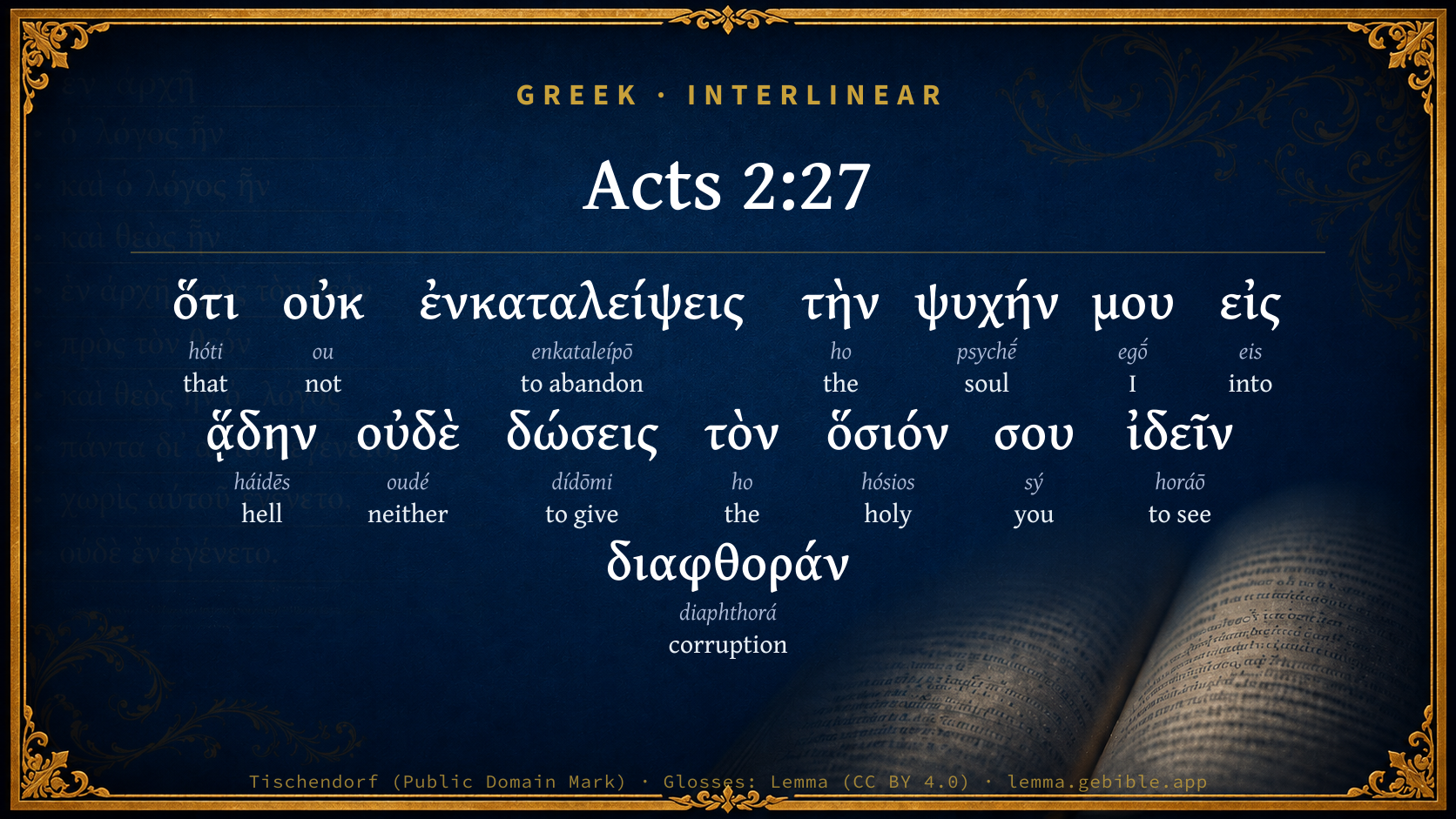
Greek (Tischendorf 8th ed.) Acts 2:27 appears in the Greek New Testament. The text above is from the Tischendorf 8th edition. Each word links to its Strong’s number and a concise gloss. Click any word for its full Thayer’s Greek Lexicon entry.
Download image
Cite this verse

Acts 2:27 (World English Bible). Public Domain. Lemma interlinear Bible study tool, https://lemma.gebible.app/v/acts/2/27.

Show BibTeX & RIS
BibTeX
RIS
English Translation
Because you will not leave my soul in Hades, Neither will you allow your Holy One to see decay.
World English Bible · Public Domain
Highlights
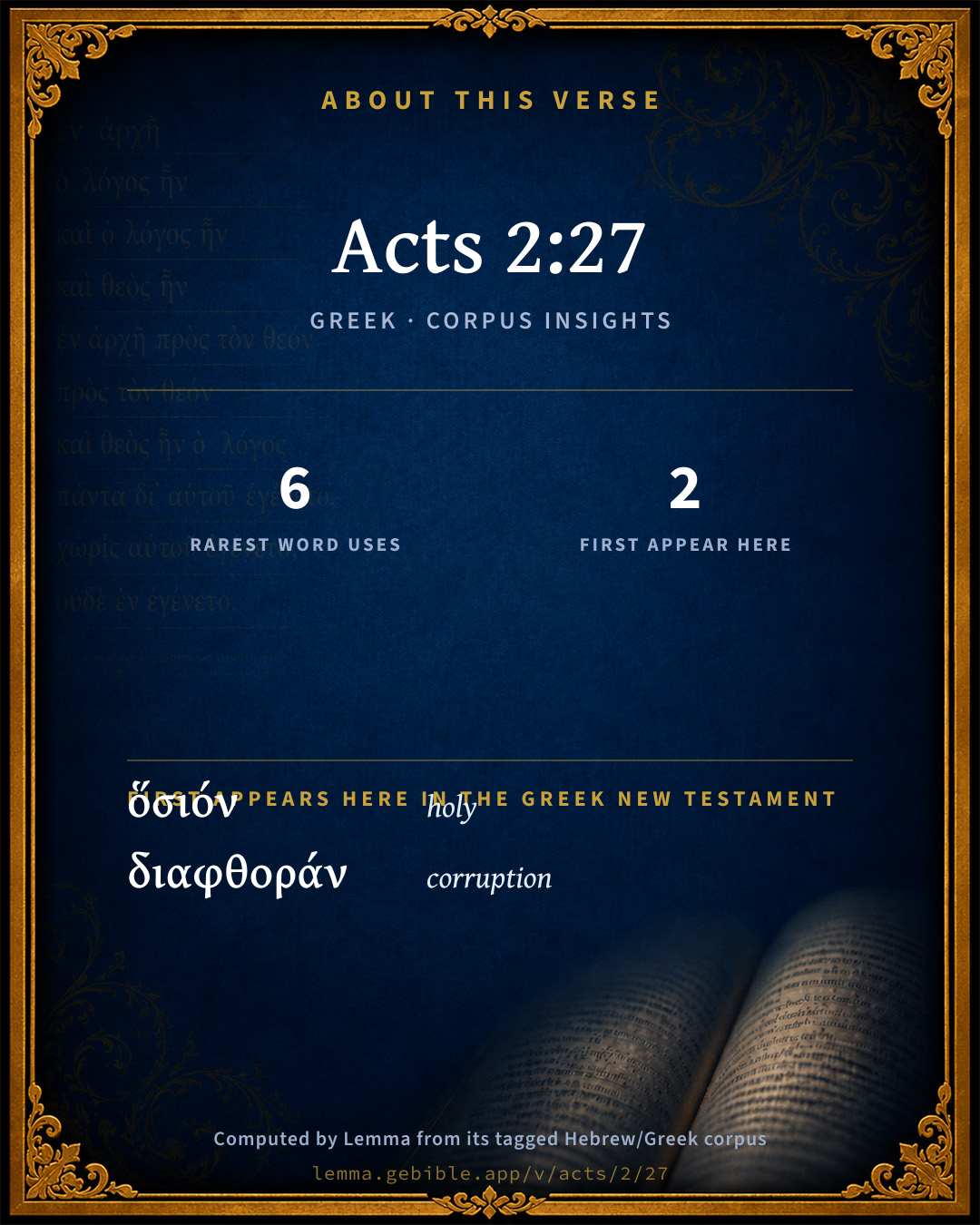
  • 2 first appearances in the Greek New Testament
Full analysis ↓
Download a study sheet

One document with this verse’s original text, its word-by-word gloss line, the meaning frame, cross-references with their text, attributed commentary, and full source and license credits — printable, and it pastes into notes with its structure intact.

This verse Autodidact and up

Study sheet (.html) Plain text (.txt)

A passage Seminary Student

Up to 50 verses in one chapter. A passage sheet keeps up to 6 commentary sources and 12 cross-references per verse, in the order this page ranks them, and says so on the sheet whenever that leaves anything out. Ask for a single verse and you get the Autodidact verse sheet above.

Everything on this page stays free to read, with no account — the sheet is a download of what is already on screen, not access to it.

Want to remove ads? Support Godless Engineer
Compare translations 3

The same verse in 3 English versions, stacked beneath the original-language interlinear above. Click any original word for its lexicon entry.

Each is an independent rendering of the whole verse — the interlinear is not word-aligned to these translations.

Highlighted words mark where these versions differ — a whole-verse word diff, not a word-by-word alignment.

  • World English Bible Public Domain
    Because you will not leave my soul in Hades, Neither will you allow your Holy One to see decay.
  • King James Version Public Domain
    Because thou wilt not leave my soul in hell, neither wilt thou suffer thine Holy One to see corruption.
  • unfoldingWord Literal Text CC BY-SA 4.0
    For you will not abandon my soul to Hades, nor will you allow your Holy One to see decay.

unfoldingWord Literal Text — © unfoldingWord, licensed CC BY-SA 4.0. Word-aligned USFM3 via Door43 (git.door43.org/unfoldingWord/en_ult).

Versions to compare (up to 4)

3 of 4 selected

Show all 19 translations

Every available English version of this verse, each an independent rendering of the whole verse.

  • World English Bible Public Domain
    Because you will not leave my soul in Hades, Neither will you allow your Holy One to see decay.
  • Berean Standard Bible Public Domain
    because You will not abandon my soul to Hades, nor will You let Your Holy One see decay.
  • Majority Standard Bible Public Domain
    because You will not abandon my soul to Hades, nor will You let Your Holy One see decay.
  • King James Version Public Domain
    Because thou wilt not leave my soul in hell, neither wilt thou suffer thine Holy One to see corruption.
  • American Standard Version (1901) Public Domain
    Because thou wilt not leave my soul unto Hades, Neither wilt thou give thy Holy One to see corruption.
  • Revised Version (1885) Public Domain
    Because thou wilt not leave my soul in Hades, Neither wilt thou give thy Holy One to see corruption.
  • Geneva Bible (1599) Public Domain
    Because thou wilt not leaue my soule in graue, neither wilt suffer thine Holy one to see corruption.
  • Douay-Rheims (1899) Public Domain
    Because thou wilt not leave my soul in hell, nor suffer thy Holy One to see corruption.
  • Young's Literal Translation Public Domain
    because Thou wilt not leave my soul to hades, nor wilt Thou give Thy Kind One to see corruption;
  • Literal Standard Version CC BY-SA 4.0
    Because You will not leave my soul to Hades, || Nor will You give Your Holy One to see corruption;
  • Unlocked Literal Bible CC BY-SA 4.0
    For you will not abandon my soul to Hades, neither will you allow your Holy One to see decay.
  • unfoldingWord Literal Text CC BY-SA 4.0
    For you will not abandon my soul to Hades, nor will you allow your Holy One to see decay.
  • Darby Bible Public Domain
    for thou wilt not leave my soul in hades, nor wilt thou give thy gracious one to see corruption.
  • World Messianic Bible Public Domain
    because you will not leave my soul in Sheol, neither will you allow your Holy One to see decay.
  • Webster's Bible Public Domain
    Because thou wilt not leave my soul in hell, neither wilt thou suffer thy Holy One to see corruption:
  • Free Bible Version CC BY-SA 4.0
    For you will not abandon me in the grave, nor will you allow your Holy One to experience decay.
  • Bible in Basic English Public Domain
    For you will not let my soul be in hell and you will not give up your Holy One to destruction.
  • Text-Critical English NT CC BY 4.0
    For yoʋ will not abandon my soul to Hades, nor will yoʋ let yoʋr Holy One see corruption.
  • Tyndale New Testament (1534) Public Domain
    because thou wilt not leve my soul in hell nether wilt suffre thyne holye to se corrupcion.

Literal Standard Version (2020), Covenant Press — licensed CC BY-SA 4.0. Text via the HelloAO Bible API (eBible.org). Unlocked Literal Bible (unfoldingWord) — licensed CC BY-SA 4.0. Text via the HelloAO Bible API (eBible.org). unfoldingWord Literal Text — © unfoldingWord, licensed CC BY-SA 4.0. Word-aligned USFM3 via Door43 (git.door43.org/unfoldingWord/en_ult). Free Bible Version, Dr. Jonathan Gallagher — licensed CC BY-SA 4.0. Text via the HelloAO Bible API (eBible.org).

Word by word

More ways to search: Search by grammar → Find every occurrence → Compare this word →

Practice this passage: Drill this verse → Learn its vocabulary →

διαφθοράν
diaphthorá
G1312
“corruption”
Noun, Accusative, Singular, Feminine
Part of Speech
Noun
Case
Accusative
Number
Singular
Gender
Feminine
Full Thayer's Definition

Origin: from G1311

TDNT: 10:33,1

1. corruption, destruction 2. in the NT that destruction which is effected by the decay of the body after death
  1. ὅτι hóti G3754 “that” Conjunction
  2. οὐκ ou G3756 “not” Particle, Negative
  3. ἐνκαταλείψεις enkataleípō G1459 “to abandon” Verb, Future, Active, Indicative, 2nd person, Singular
  4. τὴν ho G3588 “the” Article, Accusative, Singular, Feminine
  5. ψυχήν psychḗ G5590 “soul” Noun, Accusative, Singular, Feminine
  6. μου egṓ G1473 “I” Personal pronoun, 1st person, Genitive, Singular
  7. εἰς eis G1519 “into” Preposition
  8. ᾅδην háidēs G86 “hell” Noun, Accusative, Singular, Masculine
  9. οὐδὲ oudé G3761 “neither” Conjunction, Negative
  10. δώσεις dídōmi G1325 “to give” Verb, Future, Active, Indicative, 2nd person, Singular
  11. τὸν ho G3588 “the” Article, Accusative, Singular, Masculine
  12. ὅσιόν hósios G3741 “holy” Adjective, Accusative, Singular, Masculine
  13. σου sý G4771 “you” Personal pronoun, 2nd person, Genitive, Singular
  14. ἰδεῖν horáō G3708 “to see” Verb, Aorist, Active, Infinitive

About this verse

These counts appear in no published source. They are computed here, from the morphology-tagged text and Lemma’s own curated glosses. What Lemma adds →

15
words
14
distinct lemmas
Acts
section

Notable vocabulary

The rarest word here is διαφθοράν corruption G1312 — appearing just 6 times in the whole Greek New Testament.

First appearance in Scripture

These words make their first canonical appearance in the Greek New Testament here:

  • ὅσιόν holy G3741
  • διαφθοράν corruption G1312

Shared distinctive vocabulary

διαφθοράν corruption G1312 occurs in 6 verses of the Greek New Testament. Also found in:

Repetition

A word recurs within this verse:

Cross-references

23

Topical passages linked to Acts 2:27 in the Treasury of Scripture Knowledge — connected by theme and wording, ordered by reader-vote popularity; previews shown in the World English Bible.

  • Psalms 16:10 For you will not leave my soul in Sheol, Neither will you allow your holy one to see corruption.
  • Acts 2:31 he foreseeing this spoke about the resurrection of the Christ, that neither was his soul left in Hades, nor did his flesh see decay.
  • Revelation 1:18 and the Living one. I was dead, and behold, I am alive forevermore. Amen. I have the keys of Death and of Hades.
  • Revelation 20:13 The sea gave up the dead who were in it. Death and Hades gave up the dead who were in them. They were judged, each one according to his works.
  • Psalms 86:13 For your loving kindness is great toward me. You have delivered my soul from the lowest Sheol.
  • John 11:39 Jesus said, "Take away the stone." Martha, the sister of him who was dead, said to him, "Lord, by this time there is a stench, for he has been dead four days."
  • 1 Corinthians 15:52 in a moment, in the twinkling of an eye, at the last trumpet. For the trumpet will sound, and the dead will be raised incorruptible, and we will be changed.
  • 1 Corinthians 15:55 "Death, where is your sting? Hades, where is your victory?"
  • Job 19:25–27 But as for me, I know that my Redeemer lives. In the end, he will stand upon the earth.
  • Luke 4:34 saying, "Ah! what have we to do with you, Jesus of Nazareth? Have you come to destroy us? I know you who you are: the Holy One of God!"
  • 1 John 2:20 You have an anointing from the Holy One, and you know the truth.
  • Revelation 3:7 "To the angel of the assembly in Philadelphia write: "He who is holy, he who is true, he who has the key of David, he who opens and no one can shut, and who shuts and no one opens, says these things:
  • Psalms 49:15 But God will redeem my soul from the power of Sheol, For he will receive me. Selah.
  • Psalms 89:19 Then you spoke in vision to your saints, And said, "I have bestowed strength on the warrior. I have exalted a young man from the people.
  • Psalms 116:3 The cords of death surrounded me, The pains of Sheol got a hold of me. I found trouble and sorrow.
  • Jonah 2:6 I went down to the bottoms of the mountains. The earth barred me in forever: Yet have you brought up my life from the pit, Yahweh my God.
  • Matthew 11:23 You, Capernaum, who are exalted to Heaven, you will go down to Hades. For if the mighty works had been done in Sodom which were done in you, it would have remained until this day.
  • Mark 1:24 saying, "Ha! What do we have to do with you, Jesus, you Nazarene? Have you come to destroy us? I know you who you are: the Holy One of God!"
  • Luke 1:35 The angel answered her, "The Holy Spirit will come on you, and the power of the Most High will overshadow you. Therefore also the holy one who is born from you will be called the Son of God.
  • Acts 13:27–37 For those who dwell in Jerusalem, and their rulers, because they didn't know him, nor the voices of the prophets which are read every Sabbath, fulfilled them by condemning him.
  • Luke 16:23 In Hades, he lifted up his eyes, being in torment, and saw Abraham far off, and Lazarus at his bosom.
  • Acts 3:14 But you denied the Holy and Righteous One, and asked for a murderer to be granted to you,
  • Acts 4:27 For truly, in this city against your holy servant, Jesus, whom you anointed, both Herod and Pontius Pilate, with the Gentiles and the people of Israel, were gathered together

Cross-references courtesy of OpenBible.info (CC BY 4.0).

Commentary

Notes on Acts 2:27 from classic Christian and Jewish commentators (each source and its license shown beneath its notes). The classic Christian expositions comment on the surrounding passage and are grouped to its opening verse, so a note may address several verses; the Jewish commentaries on the Tanakh (Rashi and others) are per-verse, so they appear only where the commentator wrote on this verse.

Lemma curates 59 commentaries, every one of them public domain or Creative Commons licensed, each selected and text-cleaned for this edition rather than reprinted as found. About our sources →

Tyndale Open Study Notes

Tyndale Open Resources

2:27 among the dead: See study note on Matt 11:23.

Tyndale Open Study Notes — © Tyndale Open Resources, licensed CC BY-SA 4.0. Text via the HelloAO Bible API.

Bengel's Gnomon

Johann Albrecht Bengel

Act 2:27. Τὴν ψυχήν μου, My soul) i.e. Myself, as regards the soul. The subsequent sentence refers to the body.—εἰς ᾄδου) viz. τόπον: ᾅδης is as it were the sepulchre of souls. לשאול LXX. translate εἰς ᾅδην: עזב with ì occurs in Lev 19:10, Psa 49:11, Job 39:14. He was in Hades: he was not left in Hades.—τὸν ὃσιόν σου, Thy Holy One) The Hebrew has, Thy Gracious One. Christ is the One in whom all the Father’s good pleasure rests.

Bengel's Gnomon of the New Testament — English translation (T&T Clark, Edinburgh, 1860) — public domain. Text from a community e-Sword module.

Meyer's Critical & Exegetical Commentary

Heinrich August Wilhelm Meyer

Act_2:27. What now the Psalmist further says according to the historical sense: For Thou wilt not leave my soul to Hades (i.e. Thou wilt not suffer me to die in my present life-peril), and wilt not give Thy Holy One (according to the Ketîbh of the original: Thy holy ones, the plural of category, comp. Hupfeld in loc.) to see corruptionis by Peter, as spoken εἰς Χριστόν, taken in accordance with the prophetical meaning historically fulfilled in Him: Thou wilt not forsake my soul in Hades (after it shall have come thither; see Kühner, § 622; Buttm. neut. Gr. p. 287 [E. T. 333]), but by the resurrection wilt again deliver it,[130] and wilt not suffer Thy Holy One (the Messiah) to share corruption, i.e. according to the connection of the sense as fulfilled, putrefaction (comp. Act_13:34 ff.).[131] Instead of ΔΙΑΦΘΟΡΆΝ, the original has שַׁחַת, a pit, which, however, Peter, with the LXX., understood as διαφθορά, and accordingly has derived it not from שׁוּחַ, but from שָׁחַת, διαφθείρω; comp. Job_17:14.

On δώσεις, comp. Act_10:40. The meaning is: Thou wilt not cause, that, etc. Often so also in classical writers from Homer onward. As to ἰδεῖν in the sense of experiencing, comp. on Luk_2:26.

[130] This passage is a dictum probans for the abode of the soul of Christ in Hades, but it contains no dogmatic statement concerning the descensus ad inferos in the sense of the church. Comp. Güder, Lehre von d. Erscheinung Christi unter d. Todten, p. 30; Weiss, Petrin. Lehrbegr. p. 233 f.

[131] After this passage, compared with ver. 31, no further discussion is needed to show how unreasonably it has been taken for granted (see especially Holsten, z. Ev. d. Paul. u. Petr. p. 128 ff.) that the early church conceived the resurrection of Christ as a μετάβασις εἰς ἕτερον σῶμα, entirely independent of the dead body of our Lord. How much are the evangelical narratives of the appearances of the risen Christ, in which the identity of His body has stress so variously laid on it, at variance with this opinion! Comp. Act_10:41.

Meyer — Critical and Exegetical Commentary on the New Testament — English translation by Peter Christie, edited by Frederick Crombie (T&T Clark, 1880) — public domain. Text from a community e-Sword module.

Expositor's Greek Testament

ed. W. Robertson Nicoll

Act 2:27 . In LXX and N.T. rightly εἰς ᾅδην . W.H [127] ; cf. also Briggs, Messianic Prophecies , p. 24; although in T.R. as usually in Attic, εἰς ᾅδου , sc. , δόμον . Blass regards as simply usurping in the common dialect the place of ἐν , but we can scarcely explain the force of the preposition here in this way. ἐγκαταλείψεις used of utter abandonment, cf. Psa 22:1 ( cf. 2Ti 4:10 ; 2Ti 4:16 ). εἰς ᾅδην : whilst it is true that the Psalmist “says nothing about what shall happen to him after death” (Perowne), he expresses his conviction that his soul would not be given up to the land of gloom and forgetfulness, the abode of the dead, dark and cheerless, with which the Psalmist cannot associate the thought of life and light (see also on Act 2:31 ). οὐδὲ δώσεις : in R.V. (O.T.) the word “suffer” is retained, but in R.V. (N.T.) we find “thou wilt not give,” the Hebrew נתן being used in this sense to permit, to suffer, to let, like δίδωμι and dare , Viteau, Le Grec du N. T. , p. 156 (1893). τὸν ὅσιόν σου : the Hebrew Châsîd which is thus sometimes translated in the LXX (Vulgate, Sanctus ) is often rendered “thy beloved one,” and the word denotes not only one who is godly and pious, but also one who is the object of Jehovah’s loving-kindness. The word might well be used of Him, Who was not only the Holy One of God, but ὁ ἀγαπητὸς υἱός , “the beloved Son”. On the word Châsîd see Kirkpatrick, Psalms , Appendix, p. 221. ἰδεῖν διαφθοράν : “corruption” or “the pit,” margin R.V. (O.T.), but in the N.T. simply “corruption” (A. and R.V.), Vulgate, corruptio . In the LXX the Hebrew שַׁחַת is often rendered διαφθορά , “corruption,” as if derived from שָׁחַת διαφθείρειν , “to corrupt”; not, however, in the sense of corruption, putridity, but of destruction. The derivation however is probably from שׁוּחַ , to sink down, hence it means a pit, and sometimes a sepulchre, a grave, Psa 30:10 ; Psalm 55:24, so here “to see the grave,” i.e. , to die and be buried, cf. Psa 49:10 (see Robinson’s Gesenius , p. 1053, note, twenty-sixth edition). Dr. Robertson Smith maintains that there are two Hebrew words the same in form but different in origin, one masculine = putrefaction or corruption , the other feminine = the deep or the pit . So far he agrees with the note in Gesenius, u. s. , that the word διαφθορά should here be rendered by the latter, the pit , but he takes the rendering, the deep or the pit , as an epithet not of the grave but of Sheol or Hades (see Expositor , p. 354, 1876, the whole paper on “The Sixteenth Psalm,” by Dr. R. Smith, should be consulted, and p. 354 compared with the note in Gesenius ), and this view certainly seems to fit in better with the parallelism.

[127] Westcott and Hort’s The New Testament in Greek: Critical Text and Notes.

The Expositor's Greek Testament, edited by W. Robertson Nicoll (1897–1910) — public domain. Text from a community e-Sword module.

Geneva Bible (1599)

Geneva Bible translators

Thou wilt not suffer me to remain in grave.

Geneva Bible (1599) marginal notes — public domain. Text via Bolls.life.

Jamieson, Fausset & Brown

Robert Jamieson, A. R. Fausset & David Brown

wilt not leave my soul in hell--in its disembodied state (see on Luk 16:23).

neither . . . suffer thine Holy One to see corruption--in the grave.

Jamieson, Fausset & Brown — Commentary Critical and Explanatory on the Whole Bible (1871) — public domain (CC PDM 1.0). Text via the HelloAO Bible API.

Adam Clarke's Commentary

Verse 27. Thou wilt not leave my soul in hell] εις αιδου, in hades, that is, the state of separate spirits, or the state of the dead. Hades was a general term among the Greek writers, by which they expressed this state; and this HADES was Tartarus to the wicked, and Elysium to the good. See the explanation of the word in the notes, See Clarke on Mt 11:23.

To see corruption.] Dust thou art, and unto dust thou shalt return, was a sentence pronounced on man after the fall: therefore this sentence could be executed on none but those who were fallen; but Jesus, being conceived without sin, neither partook of human corruption, nor was involved in the condemnation of fallen human nature; consequently, it was impossible for his body to see corruption; and it could not have undergone the temporary death, to which it was not naturally liable, had it not been for the purpose of making an atonement. It was therefore impossible that the human nature of our Lord could be subject to corruption: for though it was possible that the soul and it might be separated for a time, yet, as it had not sinned, it was not liable to dissolution; and its immortality was the necessary consequence of its being pure from transgression.

Adam Clarke's Commentary on the Bible (1810–1826) — public domain. Text from a community e-Sword/MySword module.

John Calvin's Commentaries

27. Because thou shalt not leave To leave the soul in hell is to suffer the same to be oppressed with destruction. There be two words used in this place, both which do signify the grave amongst the Hebricians. Because שאול, doth signify to require, I suppose it is called סול, because death is insatiable; whence also cometh that translation, Hell hath enlarged her soul. Again, they set open their mouth like hell. And because the latter שחת, is derived and set for corruption, or consumption, that quality is to be considered, as David meant to note the same. Those things which are disputed in this place by divers, concerning the descending of Christ into hell, are in my judgment superfluous; because they are far from the intent and purpose of the prophet. For the word anima, or soul, doth not so much signify the spirit being of an immortal essence as the life itself. For when a man is dead, and lieth in the grave, the grave is said to rule over his life. Whereas the Grecians translate it holy, it is in Hebrew חסת, which doth properly signify meek, or gentle, but Luke did not much regard this, because it doth not much appertain unto the present purpose. Furthermore, gentleness and meekness is so often commended in the faithful, because it behoveth them to imitate and resemble the nature of their Father.

John Calvin's Commentaries (1540-1563) — public domain. Text from the Calvin Translation Society English edition (1840s-50s) via the Christian Classics Ethereal Library (ccel.org). Calvin's coverage is partial (roughly two-thirds of the Bible); uncommented books and verses are honest gaps, never fabricated. The 19th-century editor's footnotes and remarks are omitted so the notes are faithfully Calvin's own voice.

Ellicott's Commentary for English Readers

(27) Thou wilt not leave my soul in hell.—Literally, in Hades. (See Note on Mat_11:23.) As interpreted by St. Peter’s words in his Epistle (1Pe_3:19), the words conveyed to his mind the thought which has been embodied in the article of the “Descent into Hell,” or Hades, in the Apostle’s Creed. The death of Christ was an actual death, and while the body was laid in the grave, the soul passed into the world of the dead, the Sheol of the Hebrews, the Hades of the Greeks, to carry on there the redemptive work which had been begun on earth. (Comp. Act_13:34-37, and Eph_4:9.) Here again we have an interesting coincidence with St. Peter’s language (1Pe_3:19), as to the work of Christ in preaching to the “spirits in prison.”

Neither wilt thou suffer thine Holy One to see corruption.—The word for “holy” is different from that commonly so rendered, and conveys the idea of personal piety and godliness rather than consecration. As the Psalmist used the words, we may think of them as expressing the confidence that he himself, as loving, and beloved of, God, would be delivered from destruction, both now and hereafter. St. Peter had learnt to interpret the words as having received a higher fulfilment. Christ was, in this sense, as well as in that expressed by the other word, “the Holy One” of God (Mar_1:24; Luk_4:34). In Heb_7:26; Rev_15:4; Rev_16:5, this very word is applied to Christ. The Hebrew text of Psa_16:10 presents the various reading of “the holy ones,” as if referring to the “saints that are upon the earth,” of Act_2:3. The LXX., which St. Peter follows, gives the singular, which is indeed essential to his argument, and this is also the reading of the Masoretic text. The Greek word for “corruption” ranges in its meaning from “decay” to “destruction.” The Hebrew to which it answers is primarily the “pit” of the grave, and not “corruption,” or “wasting away.”

A Bible Commentary for English Readers, edited by Charles John Ellicott (1878–1897) — public domain. Text from a community e-Sword module.

The Cambridge Bible for Schools and Colleges

gen. ed. J. J. S. Perowne

27. in hell] The Greek word here and in Act_2:31 is Hades, and signifies the unseen world.

neither wilt thou suffer] Lit. give.

thine Holy One] The Hebrew word in the Psalm contains the idea of beloved, as well as godly or holy. Our A. V. represents the Greek.

The Cambridge Bible for Schools and Colleges (gen. ed. J. J. S. Perowne; Cambridge University Press, 1878–1918) — public domain. Text from a community e-Sword module.

John Gill's Exposition

Because thou wilt not leave my soul in hell,.... This is an apostrophe, or an address to his Father, who he believed would not leave his soul, as separate from his body, in Hades, in the invisible world of souls, in the place where the souls of departed saints are, but would quickly return it to its body, and reunite them; or else, that he would not leave his dead body, for so sometimes signifies; see Lev 19:28 in the grave; which is no unusual sense of see Gen 42:38 that is, so long as to be corrupted and putrefy, as the next clause shows:

neither wilt thou suffer thine Holy One to see corruption. The character of an "Holy One" well agrees with Christ, both as God, or with respect to his divine nature, holiness being a perfection in it, and in which he is glorious; and as man, he being holy in his nature, harmless in his life and conversation: all his doctrines were pure and holy, and so were all his works; and all his administrations in the discharge of every of his office; and he is the efficient cause and lain of all the holiness of his people; they are sanctified in him, and by him, and have all their sanctification from him. The word may be rendered, "thy merciful", or "bountiful one"; and such Christ is, a merciful, as well as faithful high priest; and who has shown great compassion both to the bodies and souls of men, and has been very beneficent and liberal in the distributions of his grace and goodness. Now, though he died, and was laid in the grave, and buried, yet God would not suffer him to lie there so long as to be corrupted and putrefied, which is the sense of seeing corruption: and so the Jews themselves explain the last clause of the preceding verse, in connection with this, "my flesh shall rest in hope", that no worm or maggot should have power over it, or corrupt it,

"Seven fathers (they say (x)) dwell in eternal glory, and there is no , "worm or maggot", rules over them; and these are they, Abraham, Isaac, and Jacob, and Moses, and Aaron, and Amram their father; and there are that say also David, as it is said, Psa 16:1, "therefore my heart is glad, and my glory rejoiceth, my flesh also shall rest in hope".

And which sense also is mentioned by one of their commentators of note (y), who thus paraphrases the words:

"whilst I am alive it shall rest safely, for thou wilt deliver me from all hurt; and in the mystical sense, or according to the Midrash, after death; intimating, that no maggot or worm should have power over him;

which was not true of David, but is of the Messiah,

(x) Massecheth Derech Eretz Zuta, c. 1. fol. 19. 1. (y) Kimchi in Psal. xvi. 9.

John Gill's Exposition of the Whole Bible (1746–1763) — public domain (CC PDM 1.0). Text via the HelloAO Bible API.

Trapp's Complete Commentary

John Trapp

27 Because thou wilt not leave my soul in hell, neither wilt thou suffer thine Holy One to see corruption.

Ver. 27. My soul in hell] That is, my body in the grave. So Rev 20:13. Death and hell, i.e. the grave, are cast into the burning lake. To the three degrees of our Saviour’s humiliation, are answerable the three degrees of his exaltation: to his death, his resurrection; to his burial, his ascension; to his abode a while in the grave, his sitting at the right hand of his heavenly Father.

John Trapp, A Commentary or Exposition upon All the Books of the Old and New Testament (1647–1656) — public domain. Text from a community e-Sword module.

Albert Barnes' Notes on the Bible

Thou wilt not leave my soul - The word “soul,” with us, means “the thinking, the immortal part of man,” and is applied to it whether existing in connection with the body or separate from it. The Hebrew word translated “soul” here, נפשׁ nephesh, however, may mean “spirit, mind, life,” and may denote here nothing more than “me” or “myself.” It means, properly, “breath”; then “life,” or “the vital principle, a living being”; then “the soul, the spirit, the thinking part.” Instances where it is put for the individual himself, meaning “me” or “myself” may be seen in Psa 11:1; Psa 35:3, Psa 35:7; Job 9:21. There is no clear instance in which it is applied to the soul in its separate state, or disjoined from the body. In this place it must be explained in part by the meaning of the word hell. If that means grave, then this word probably means “me”; thou wilt not leave me in the grave. The meaning probably is, “Thou wilt not leave me in Sheol, neither,” etc. The word “leave” here means, “Thou wilt not resign me to, or wilt not give me over to it, to be held under its power.”

In hell - - εἰς ᾅδου eis Hadou. The word “hell,” in English, now commonly denotes “the place of the future eternal punishment of the wicked.” This sense it has acquired by long usage. It is a Saxon word, derived from helan, “to cover,” and denotes literally “a covered or deep place” (Webster); then “the dark and dismal abode of departed spirits”; and then “the place of torment.” As the word is used now by us, it by no means expresses the force of the original; and if with this idea we read a passage like the one before us, it would convey an erroneous meaning altogether, although formerly the English word perhaps expressed no more than the original. The Greek word “Hades” means literally “a place devoid of light; a dark, obscure abode”; and in Greek writers was applied to the dark and obscure regions where disembodied spirits were supposed to dwell. It occurs only eleven times in the New Testament. In this place it is the translation of the Hebrew שׁאול Sheowl.

In Rev 20:13-14, it is connected with death: “And death and hell (Hades) delivered up the dead which were in them”; “And death and hell (Hades) were cast into the lake of fire.” See also Rev 6:8; Rev 1:18, “I have the keys of hell and death.” In 1Co 15:55 it means the grave: “O grave (Hades), where is thy victory?” In Mat 11:23 it means a deep, profound place, opposed to an exalted one; a condition of calamity and degradation, opposed to former great prosperity: “Thou, Capernaum, which art exalted to heaven, shalt be thrust down to hell” (Hades). In Luk 16:23 it is applied to the place where the rich man was after death, in a state of punishment: “In hell (Hades) he lifted up his eyes, being in torments.” In this place it is connected with the idea of suffering, and undoubtedly denotes a place of punishment. The Septuagint has used this word commonly to translate the word שׁאול Shèowl.

Once it is used as a translation of the phrase “the stones of the pit” Isa 14:19; twice to express silence, particularly the silence of the grave Psa 94:17; Psa 115:17; once to express the Hebrew for “the shadow of death” Job 38:17; and sixty times to translate the word Sheol. It is remarkable that it is never used in the Old Testament to denote the word קבר qeber, which properly denotes “a grave or sepulchre.” The idea which was conveyed by the word Sheol, or Hades, was not properly a grave or sepulchre, but that dark, unknown state, including the grave, which constituted the dominions of the dead. What idea the Hebrews had of the future world it is now difficult to explain, and is not necessary in the case before us. The word originally denoting simply “the state of the dead, the insatiable demands of the grave,” came at last to be extended in its meaning, in proportion as they received new revelations or formed new opinions about the future world. Perhaps the following may be the process of thought by which the word came to have the special meanings which it is found to have in the Old Testament:

(1) The word “death” and the grave קבר qeber would express the abode of a deceased body in the earth.

(2) Man has a soul, a thinking principle, and the inquiry must arise, What will be its state? Will it die also? The Hebrews never appear to have believed that. Will it ascend to heaven at once? On that subject they had at first no knowledge. Will it go at once to a place of happiness or of torment? Of that, also, they had no information at first Yet they supposed it would live; and the word שׁאול Sheowl expressed just this state - the dark, unknown regions of the dead; the abode of spirits, whether good or bad; the residence of departed people, whether fixed in a permanent habitation, or whether wandering about. As they were ignorant of the size and spherical structure of the earth, they seem to have supposed this region to be situated in the earth, far below us, and hence, it is put in opposition to heaven, Psa 139:8, “If I ascend up into heaven, thou art there; if I make my bed in hell (Sheol), behold, thou art there”; Amo 9:2. The most common use of the word is, therefore, to express those dark regions, the lower world, the region of ghosts, etc. Instances of this, almost without number, might be given. See a most striking and sublime instance of this in Isa 14:9; “Hell from beneath is moved to meet thee,” etc.; where the assembled dead are represented as being agitated in all their vast regions at the death of the King of Babylon.

(3) The inquiry could not but arise whether all these beings were happy. This point revelation decided; and it was decided in the O d Testament. Yet this word would better express the state of the wicked dead than the righteous. It conveyed the idea of darkness, gloom, wandering; the idea of a sad and unfixed abode, unlike heaven. Hence, the word sometimes expresses the idea of a place of punishment: Psa 9:17, “The wicked shall be turned into hell,” etc.; Pro 15:11; Pro 23:14; Pro 27:20; Job 26:6. While, therefore, the word does not mean properly a grave or a sepulchre, it does mean often “the state of the dead,” without designating whether in happiness or woe, but implying the continued existence of the soul. In this sense it is often used in the Old Testament, where the Hebrew word is Sheol, and the Greek Hades: Gen 37:35, “I will go down into the grave, unto my son, mourning” I will go down to the dead, to death, to my son, still there existing; Gen 42:38; Gen 44:29, “He shall bring down my gray hairs with sorrow to the grave; Num 16:30, Num 16:33; 1Ki 2:6, 1Ki 2:9; etc. etc. in the place before us, therefore, the meaning is simply, thou wilt not leave me among the dead. This conveys all the idea. It does not mean literally the grave or the sepulchre; that relates only to the body. This expression refers to the deceased Messiah. Thou wilt not leave him among the dead; thou wilt raise him up. It is from this passage, perhaps, aided by two others (Rom 10:7, and 1Pe 3:19), that the doctrine originated that Christ “descended,” as it is expressed in the Creed, “into hell”; and many have invented strange opinions about his going among lost spirits. The doctrine of the Roman Catholic Church has been that he went to purgatory, to deliver the spirits confined there. But if the interpretation now given be correct, then it will follow:

That nothing is affirmed here about the destination of the human soul of Christ after his death. That he went to the region of the dead is implied, but nothing further. It may be remarked that the Scriptures affirm nothing about the state of his soul in that time which intervened between his death and resurrection. The only intimation which occurs on the subject is such as to leave us to suppose that he was in a state of happiness. To the dying thief he said, “This day shalt thou be with me in paradise.” When Jesus died, he said, “It is finished”; and he doubtless meant by that that his sufferings and toils for man’s redemption were at an end. All suppositions of any toils or pains after his death are fables, and without the slightest warrant in the New Testament.

Thine Holy One - The word in the Hebrew which is translated here “Holy One” properly denotes “One who is tenderly and piously devoted to another,” and corresponds to the expression used in the New Testament, “my beloved Son.” It is also used, as it is here by the Septuagint and by Peter, to denote “One that is holy, that is set apart to God.” In this sense it is applied to Christ, either as being set apart to this office, or as so pure as to make it proper to designate him by way of eminence the Holy One, or the Holy One of God. It is several times used as the wellknown designation of the Messiah: Mar 1:24, “I know thee who thou art, the Holy One of God”; Luk 4:34; Act 3:14, “But ye denied the Holy One, and the just,” etc. See also Luk 1:35, “That holy thing that is born of thee shall be called the Son of God.”

To see corruption - To see corruption is to experience it, to be made partakers of it. The Hebrews often expressed the idea of experiencing anything by the use of words pertaining to the senses, as, to taste of death, to see death, etc. Corruption here means putrefaction in the grave. The word which is used in the Psalm, שׁחת shachath, is thus used in Job 17:14, “I have said to corruption, thou art my father,” etc. The Greek word used here properly denotes this. Thus, it is used in Act 13:34-37. This meaning would be properly suggested by the Hebrew word, and thus the ancient versions understood it. The meaning implied in the expression is, that he of whom the Psalm was written should be restored to life again; and this meaning Peter proceeds to show that the words must have.

Albert Barnes' Notes on the Bible (1834–1885) — public domain. Text from a community e-Sword/MySword module.

Haydock's Catholic Bible Commentary

Thou wilt not leave[3] my soul in hell. This is also the Protestant translation; and the manner in which Beza translates it, is both very false and ridiculous, thou shalt not leave my carcass in the grave. For allowing that the Latin and Greek word, which is here translated hell, may signify sometimes, the grave; yet no excuse can be made for putting carcass, where the Greek, as well as Latin, signifies the soul. And for the doctrine of Christ’s descending into hell, even the learned Dr. Pearson on the Creed, observes with Catholics, that the article of the creed, wherein we say, he descended into hell, cannot be the same as to say, his body descended into the grave, because in the foregoing words we profess that he was dead and buried. (Witham) --- Beza plainly confesseth that he translateth the text thus: Thou shalt not leave my carcass in the grave, against the doctrine of purgatory, and Christ’s descending into hell, although he alloweth, that most of the ancient Fathers were in that error. Thus opposing himself to plain Scripture and to the ancient Fathers, perverting the former, and contemning the latter, to overthrow an article of the apostles’ creed. (He descended into hell. New Test. in 1556.)

===============================

[BIBLIOGRAPHY]

My soul in hell. Animam meam in Inferno, Greek: ten psuchen mou eis adou.

====================

George Leo Haydock (1774–1849), Haydock's Catholic Family Bible and Commentary, 1859 edition — public domain. Excludes Psalms (Douay-Rheims chapter numbering differs from Protestant) and Deuterocanonical books (Catholic canon only).

Matthew Poole's English Annotations

My soul; that is, me: the soul is put for the person, as Rom 13:1, Let every soul be subject; and sometimes for a dead body, as Lev 19:28; Num 5:2, and in divers other places, גפשׁ that signifies a soul, is so used.

In hell; the word αδης is put either for the grave, or for the place of the damned. Being these words are alleged as a proof of Christ’s resurrection, and that our Saviour’s soul was certainly in paradise, where he promised to the penitent thief that he should be with him, it seems rather to be meant of the grave, which, according to this prophecy, could not hold our blessed Saviour’s body so long as that it should corrupt in it. If David by his soul here did mean our Saviour, because he was as it were the soul of his soul, and life of his life, it shows how he did, and how we ought to value him.

Thine Holy One; as being anointed, sanctified, and sent by God.

Matthew Poole's English Annotations on the Holy Bible (1683–1685) — public domain. Text from a community e-Sword/MySword module.

Whedon's Commentary on the Bible

Daniel D. Whedon

27. Hell—The place of departed spirits, Hades. (See notes on Luk_16:23,)

Thine Holy One—A term which David under inspiration would hardly apply to himself simply.

Corruption—Rationalists have denied that the Hebrew word used by David signifies corruption; but they are refuted on this point by Hengstenberg. As he well remarks, corruption refers to the body, as Hades refers to the soul. Good proof that in both David’s and Peter’s theology body and soul are different things, and may exist apart.

Daniel D. Whedon (gen. ed.), Commentary on the Old and New Testaments (1874–1909) — public domain. Text from a community e-Sword module.

The Pulpit Commentary

Hades for hell, A.V.; give thy Holy One for suffer thine Holy One, A.V., surely not so good a rendering. Hades. The "hell" of the A.V. is the exact English representative of adhv. The article in the Creed, "He descended into hell," is based upon this text especially, the other two alleged in support of it (Eph_4:9; 1Pe_3:18, 1Pe_3:19) being less conclusive (see Pearson on the Creed, art. 5.). It is a pity to lose the word "hell" in its true meaning. Corruption; Greek diafqroran, Hebrew tjv. The Hebrew word always means a pit (from jWv); but the LXX here render it diafqora, as if from tjv; (in Pihel, to destroy, waste; in Hophal and Niphal, to be corrupted, spoilt, to rot). In the A.V. it is rendered corruption, here and in Job_17:14, where it answers to "the worms," in the parallel clause. It is very probable that the LXX are right. Nothing is more common than for Hebrew verbs to take the meaning of verbs with similar radicals. Holy One. So the LXX and the Keri of the Hebrew text. But the Cethib has Holy Ones in the plural. It is obvious that the singular, Holy One, agrees far better with the singulars which precede and follow it my heart, my glory, my flesh, my soul, thou wilt show me than the plural, which is entirely out of place. The two clauses takentogether show the full liberation of Christ from the dominion of death that of his human soul from bell, and that of his body from the grave before it saw corruption. (comp. Act_13:34-37)

The Pulpit Commentary (1880–1919), ed. H.D.M. Spence-Jones & Joseph S. Exell — public domain. Text from a community e-Sword module.

John Wesley's Explanatory Notes

Thou wilt not leave my soul in hades - The invisible world. But it does not appear, that ever our Lord went into hell. His soul, when it was separated from the body, did not go thither, but to paradise, Luke xxiii, 43. The meaning is, Thou wilt not leave my soul in its separate state, nor suffer my body to be corrupted.

John Wesley, Explanatory Notes Upon the Whole Bible (1754–1765) — public domain. Text via the GEBible commentary corpus.

Scofield Reference Notes

C. I. Scofield

hell

Hades. (See Scofield "Luk 16:23").

The Scofield Reference Bible (1917 edition), notes by C. I. Scofield — public domain. Text from a community e-Sword module.

Godbey's Commentary on the New Testament

William B. Godbey

27. “Because thou wilt not leave my soul in Hades neither wilt thou suffer thy Holy One to see corruption.” We have two words used by the Holy Ghost and translated “Hell” in E. V., i. e., “Hades,” which in R. V. is not translated, but transferred very correctly to our language, while the other word Gehenna in R. V. is constantly and correctly “Hell.” The difference between the two is simply that of genus and species, Hades being a generic word simply meaning the “unseen world,” from Alpha, “not,” and aidoo to “see.” Hence Hades, the unseen, includes both heaven and hell. We have this illustrated in Luke 16, where the rich man and Lazarus are in the same world, actually enjoying conversational proximity. But Dives is tormented by the flame of fire. Hence he is in hell properly so called; while Lazarus is in that intermediate Paradise called Abraham’s bosom, because it was the receptacle of all the spiritual children of Abraham, i. e., the Old Testament saints, saved in the Abrahamic covenant and there detained in a state of felicitous captivity (Eph 4:8) till the Abrahamic covenant was sealed and ratified by the blood of Christ The dying thief went to this paradise the very day of the crucifixion, (Luk 23:43), notwithstanding certain wicked heretics have had the audacity to even change the punctuation of the Greek in this passage in order to sustain the most senseless of all heresies which even brutalizes you by taking away your immortal soul. As our Savior assured the women in the garden that He had not yet ascended into heaven, though He had already, pursuant to His prediction on the cross, met the saved thief in paradise, i. e., in Abraham’s bosom (Luke 16), the intermediate paradise of the old dispensation, where the saints enjoyed unmingled bliss, awaiting the great redemption on Calvary, and their risen and glorified Lord to lead them all into heaven, throwing wide the pearly portals evermore to stand ajar while angels welcome every saint into the New Jerusalem, the city of God, the home of the angels and glorified saints.

1Pe 3:19 : “Being put to death in the flesh and quickened in the spirit, by which going, he proclaimed to the spirits in prison.”

This is the pillar of popery and modern theories of a second probation for sinners after they die in sin. It is radically and literally untrue as manipulated by those heretics. The capital S in “Spirit” in E. V. was put there by the translators, because they thought it meant the Holy Spirit, which is incorrect, as this construction would break up the antithesis with “flesh.” The simple meaning is that while our Savior’s body was put to death, His human spirit, not the Holy Ghost, was quickened by the Holy Ghost, so that His human spirit leaving His dead body on the cross [poor soul- sleepers even deny that Jesus had a soul] went down to the intermediate world and proclaimed to the lost millions of hell. The E. V. erroneously translates ekeeruxen, which simply means “proclaim as a herald,” “preach,” thus leading the people to believe that Jesus preached the gospel to the disembodied sinners in hell. The word which means to preach the gospel is not in this passage, but it simply means to proclaim as a royal herald. What did our Savior proclaim to the inmates of Hades? He proclaimed His own victory, gloriously and eternally won on the cross of Calvary. The devil had been after Him to kill Him all His life, vainly congratulating himself that if he could kill the man Jesus, the final victory would perch on his black banner, and he would have nothing to do but add this world to hell and reign forever without a rival. While the devil is paradoxically intellectual, his spirit is black as the midnight of hell, uncheered by a solitary ray. Hence he leaped to the conclusion that if he could kill the man Jesus, the last battle was fought and the final victory won. Therefore hell roared with shouts over the arrest of Jesus in Gethsemane, cheered and enthused more and more by the successive reports of His condemnation by Caiaphas, Herod and Pilate, meanwhile the black couriers constantly arrive from Calvary, reporting the bloody culmination of their hellish enterprise. Finally, Satan, sitting on his ebon throne in the center of the pandemonium, has ordered ten thousand tall demons to subscribe in glowing capitals, “Victory,” on the black walls all round the palace of damnation. Demoniacal hands have half written the word. Suddenly thunderclaps and lightnings flash from the opening portals of the pandemonium appalling all the inmates of the bottomless pit. Lo! Hark! Who comes there? It is none other than the human soul of Jesus. He has left His dead body on the cross and now walks into hell, the herald of his own victory won on Calvary. He proclaims in the face of all devils hell’s eternal defeat and the redemption of the world. With the tread of a conqueror He walks round the pandemonium, with His Own hands pulling down the trophies of four thousand years of successful warfare and treading them beneath His triumphant feet. The tall peers of the pit wail on all sides, acknowledge Him conqueror and beg Him to depart. He now approaches Satan, the King of Darkness, sitting on his ebon throne in the center of the pandemonium; seizing him by the throat and dragging him down, puts His foot upon his neck, thus verifying the first promise made by Jehovah to Adam and Eve in fallen Paradise: “The seed of the woman shall bruise the serpent’s head.” Having proclaimed His victory in hell, He now crosses that abyss impassable to finite beings, but not to Him, intervening between the flaming hell of Dives and the Abraham’s bosom of Lazarus (Luk 16:26), and there, pursuant to His promise on the cross, meets the thief before midnight, while it is yet Friday, the Crucifixion Day. As the thief died under the old dispensation, he went to that intermediate paradise, i. e., Abraham’s bosom, the jubilant rendezvous of all the souls saved under the Abrahamic covenant in the former dispensation, there in joyful anticipation to await the verification of the covenant by the blood of Calvary. The thief runs to meet Him with a tremendous shout, Father Abraham, Isaac, Jacob, Job, Jeremiah, Isaiah, Ezekiel, Daniel, the Hebrew children and all the mighty hosts of Old Testament saints rend the firmament with triumphant shouts congratulating King Jesus on the victory won. Now the good old Jewish Sabbath sets in, the most wonderful they had seen in four thousand years. Oh! what an ovation! Golden harps are impoverished in the attempted proclamation. The first day of the week supervenes at midnight, eternally commemorated by the abolishment of the intermediate paradise, the emancipation of all the captives (Eph 4:8), and the resurrection of our glorious Lord. Here begins that wonderful ascension (Eph 4:9), when our Lord “descended into the lower parts of the earth” [which never did mean the grave], the Savior leading the way with the patriarchs and prophets on His right and on His left, followed by the mighty hosts of Old Testament saints, jubilant and ecstatic, reaching the sepulcher at day- dawn, calling His body into life and re-entering it; meanwhile the sacramental host, all invisible because they are disembodied spirits, accompanying our risen Lord the forty days of His abiding with His disciples, and ascending with Him from Mt. Olivet, constituting the mighty trophy of His victory, whom He leads into the heavenly metropolis and presents before the Father. David’s prophetic eye in Psalms 24 caught a glimpse of this wonderful scene, while our Lord, accompanied by the mighty hosts of Old Testament saints, sweeps through trackless ether, passing rolling worlds, glowing suns, wheeling spheres, and flaming comets, finally draws nigh the celestial gates, saluted by seraphic voices:

“Lift up your heads, O ye gates; and be ye lifted up, ye everlasting doors, and let the King of Glory come in.” “Who is this King of Glory?” “he Lord, mighty to save and strong to deliver.”

The pearly gates fly high and swing wide, multiplied millions of celestial seraphs shout long and loud, “Welcome home, welcome home, welcome home, O King of Glory, Conqueror of Mt. Calvary. Heaven is stirred with such an ovation as archangels never knew, infinitely eclipsing the tremendous shout of the sons of God at creation’s birth. Amid the jubilant congratulations of angelic millions, the triumphal procession, led by King Jesus, moves through the city and halts before the great white throne, “Father, here am I, and the children thou hast given me.” Now Abraham mounts a celestial pinnacle and testifies, followed by the thrilling witnesses to the wonders of redeeming grace, while multiplied millions of unfallen angels listen spell bound. Since our Lord has led the way, heaven is now accessible to every disembodied saint, nothing to do but die, and sweep with a shout into glory.

William B. Godbey, Commentary on the New Testament (1896–1900) — public domain. Text from a community e-Sword module.

McGarvey & Pendleton's Commentaries

J. W. McGarvey

See notes on verse 25

J. W. McGarvey (with Philip Y. Pendleton), Commentaries on the New Testament (The Fourfold Gospel, 1914; Acts; and the epistles) — public domain. Text from a community e-Sword/MySword module.

The People's New Testament

B. W. Johnson

27. Not leave my soul in hell. In hades, the unseen abode of the dead. The meaning is that he would not remain under the power of death. David did not speak this of himself, but of the Son of David. See verse 29. Thy Holy One. The Lord Jesus. The promised Messiah.

B. W. Johnson's The People's New Testament with Notes (1889–1891) — public domain. Electronic text from the Christian Classics Ethereal Library (CCEL) ThML edition.

unfoldingWord translationNotes

Door43 World Missions Community

Connecting Statement:

Peter finishes quoting David.

General Information:

Since Peter says that David said these words about Jesus, the words "my," "Holy One," and "me" refer to Jesus and the words "you" and "your" refer to God.

neither will you allow your Holy One to see decay

The Messiah, Jesus, refers to himself with the words "your Holy One." AT: "neither will you allow me, your Holy One, to see decay" (See: First, Second, or Third Person)

to see decay

Here the word "see" means to experience something. The word "decay" refers to the decomposition of his body after death. AT: "to decay" (See: Assumed Knowledge and Implicit Information)

the ways of life

"the ways that lead to life"

full of gladness with your face

Here the word "face" refers to the presence of God. AT: "very glad when I see you" or "very glad when I am in your presence" (See: Metonymy)

gladness

joy, happiness

translationWords

soul

Hades

holy

Holy One

reveal

life

unfoldingWord translationNotes — © Distant Shores Media and the Door43 World Missions Community, licensed CC BY-SA 4.0. Source: git.door43.org/Door43/en_tn.

Cambridge Greek Testament for Schools and Colleges

27. εἰς ᾅδην, in Hades, i.e. in the unseen world. So too in Act 2:31 where we have the more usual expression εἰς ᾅδου (understanding δόμον), but in the Psalm from which quotation is made, the best text of the LXX. gives the accusative there too.

δώσεις, Thou wilt suffer [lit. give].

τὸν ὅσιόν σου, Thy Holy One. The Hebrew word in the Psalm conveys the idea of beloved, as well as godly or pious.

Cambridge Greek Testament for Schools and Colleges (Cambridge University Press, 1896; 21 vols, various authors incl. Carr, Maclear, Plummer, Farrar, Lumby, Moule, M. R. James, Simcox) — public domain. Text from a community e-Sword module.

Alford’s Greek Testament

Henry Alford

27. διαφθοράν] Heb. שַׁחַת, ‘corruption,’ from שָׁחַת, corrupit,—or ‘the pit,’ from שׁוּחַ, subsidere. De Wette maintains the last to be the only right rendering: but the Lexicons give both, as above, and Meyer and Stier defend the other.

Henry Alford, The Greek Testament (1849–1861) — public domain. Text from a community e-Sword module.

Vincent's Word Studies in the New Testament

Marvin R. Vincent

Leave [εγκαταλειψεις] . Lit., leave behind.

Suffer [δωσεις] . Lit., give.

Marvin R. Vincent, Word Studies in the New Testament (1887–1900) — public domain. Text from a community e-Sword/MySword module.

Lesson kit

Teaching starters — assembled from the data on this page, not authored interpretation. Every prompt links to the verse data it draws on. Edit before teaching.

Acts, in the Acts, opens this verse with 15 words (14 distinct Greek lemmas). Its most distinctive word is diaphthorá (“corruption”). A historical commentator’s framing appears above. Read the whole chapter for the surrounding context.

Discussion questions

  1. The word diaphthorá carries the sense “corruption.” How does it shape the verse?
  2. 2 words here appear for the first time in Scripture. What is being introduced at this debut?
  3. Acts 2:31 shares the word «corruption» with this verse. How do the two illuminate each other?
  4. “the” occurs 2× in this one verse. What is the effect of the repetition?
  5. These translations render this verse differently. What is at stake in choosing one wording over another?
  6. Reading how Tyndale Open Study Notes and Bengel's Gnomon read this verse, where do the two commentators agree and where do they part?

Things to notice

  • 2 words make their first canonical appearance in Scripture here.
  • These translations choose different wording for 13 words in this verse.
  • “the” occurs 2× in this single verse.
  • 14 distinct Greek lemmas span 15 words in this verse.

Reading settings

Reading text

Shown beneath each verse's original-language words.

Old Testament
Old Testament edition

Read the OT as the Masoretic Hebrew (MT) or the Greek Septuagint (LXX).

English shown for the Greek Septuagint (in the Hebrew ↔ Greek comparison).

Comparing translations? Open the Compare panel on any verse page to stack up to four side by side.