

Deuteronomy 1:37

Hebrew (Westminster Leningrad Codex) Deuteronomy 1:37 appears in the Hebrew Old Testament. The text above is from the Westminster Leningrad Codex. Each word links to its Strong’s number, a concise gloss, and parsing drawn from the Open Scriptures Hebrew Bible morphology. Click any word for its full Brown-Driver-Briggs (BDB) entry.
Download image
Cite this verse

Deuteronomy 1:37 (World English Bible). Public Domain. Lemma interlinear Bible study tool, https://lemma.gebible.app/v/deuteronomy/1/37.

Show BibTeX & RIS
BibTeX
RIS
English Translation
Also Yahweh was angry with me for your sakes, saying, You also shall not go in there:
World English Bible · Public Domain
Highlights
  • 1 first appearance in the Hebrew Bible
Full analysis ↓
Download a study sheet

One document with this verse’s original text, its word-by-word gloss line, the meaning frame, cross-references with their text, attributed commentary, and full source and license credits — printable, and it pastes into notes with its structure intact.

This verse Autodidact and up

Study sheet (.html) Plain text (.txt)

A passage Seminary Student

Up to 50 verses in one chapter. A passage sheet keeps up to 6 commentary sources and 12 cross-references per verse, in the order this page ranks them, and says so on the sheet whenever that leaves anything out. Ask for a single verse and you get the Autodidact verse sheet above.

Everything on this page stays free to read, with no account — the sheet is a download of what is already on screen, not access to it.

Want to remove ads? Support Godless Engineer
Compare translations 3

The same verse in 3 English versions, stacked beneath the original-language interlinear above. Click any original word for its lexicon entry.

Each is an independent rendering of the whole verse — the interlinear is not word-aligned to these translations.

Highlighted words mark where these versions differ — a whole-verse word diff, not a word-by-word alignment.

  • World English Bible Public Domain
    Also Yahweh was angry with me for your sakes, saying, You also shall not go in there:
  • King James Version Public Domain
    Also the LORD was angry with me for your sakes, saying, Thou also shalt not go in thither.
  • unfoldingWord Literal Text CC BY-SA 4.0
    Also Yahweh was angry with me because of you, saying, ‘You also will not go in there;

unfoldingWord Literal Text — © unfoldingWord, licensed CC BY-SA 4.0. Word-aligned USFM3 via Door43 (git.door43.org/unfoldingWord/en_ult).

Versions to compare (up to 4)

3 of 4 selected

Show all 18 translations

Every available English version of this verse, each an independent rendering of the whole verse.

  • World English Bible Public Domain
    Also Yahweh was angry with me for your sakes, saying, You also shall not go in there:
  • Berean Standard Bible Public Domain
    The LORD was also angry with me on your account, and He said, “Not even you shall enter the land.
  • Majority Standard Bible Public Domain
    The LORD was also angry with me on your account, and He said, “Not even you shall enter the land.
  • King James Version Public Domain
    Also the LORD was angry with me for your sakes, saying, Thou also shalt not go in thither.
  • American Standard Version (1901) Public Domain
    Also Jehovah was angry with me for your sakes, saying, Thou also shalt not go in thither:
  • Revised Version (1885) Public Domain
    Also the LORD was angry with me for your sakes, saying, Thou also shalt not go in thither:
  • Geneva Bible (1599) Public Domain
    Also the Lord was angry with me for your sakes, saying, Thou also shalt not goe in thither,
  • Douay-Rheims (1899) Public Domain
    Not one of the men of this wicked generation shall see the good land, which I promised with an oath to your fathers:
  • Young's Literal Translation Public Domain
    `Also with me hath Jehovah been angry for your sake, saying, Also, thou dost not go in thither;
  • Literal Standard Version CC BY-SA 4.0
    Moreover, YHWH has been angry with me for your sake, saying, Indeed, you do not go in there;
  • Unlocked Literal Bible CC BY-SA 4.0
    Also Yahweh was angry with me because of you, saying, 'You also will not go in there;
  • unfoldingWord Literal Text CC BY-SA 4.0
    Also Yahweh was angry with me because of you, saying, ‘You also will not go in there;
  • Darby Bible Public Domain
    Also Jehovah was angry with me on your account, saying, Thou also shalt not go in thither.
  • World Messianic Bible Public Domain
    Also the LORD was angry with me for your sakes, saying, “You also shall not go in there.
  • Webster's Bible Public Domain
    Also the LORD was angry with me for your sakes, saying, Thou also shalt not go in thither.
  • Free Bible Version CC BY-SA 4.0
    The Lord also got angry with me because of you. He told me, “Even you won't enter the country.
  • Bible in Basic English Public Domain
    And, in addition, the Lord was angry with me because of you, saying, You yourself will not go into it:
  • JPS Tanakh (1917) Public Domain
    Also the LORD was angry with me for your sakes, saying: Thou also shalt not go in thither;

Literal Standard Version (2020), Covenant Press — licensed CC BY-SA 4.0. Text via the HelloAO Bible API (eBible.org). Unlocked Literal Bible (unfoldingWord) — licensed CC BY-SA 4.0. Text via the HelloAO Bible API (eBible.org). unfoldingWord Literal Text — © unfoldingWord, licensed CC BY-SA 4.0. Word-aligned USFM3 via Door43 (git.door43.org/unfoldingWord/en_ult). Free Bible Version, Dr. Jonathan Gallagher — licensed CC BY-SA 4.0. Text via the HelloAO Bible API (eBible.org).

Word by word

More ways to search: Search by grammar → Find every occurrence → Compare this word →

Practice this passage: Drill this verse → Learn its vocabulary →

בִּגְלַלְכֶ֖ם
gâlâl
H1558
“in/at · on account of · your”
Preposition + Noun, Common, Masculine, Singular, Construct + Suffix, Personal, 2nd Person, Masculine, Plural
Part of Speech
Preposition + Noun
Type
Common
Gender
Masculine
Number
Singular
State
Construct
Full BDB Definition

Origin: from H1556

TWOT: 352

on account of, for the sake of
  1. גַּם gam H1571 “also” Particle, Accusative
  2. הִתְאַנַּ֣ף ʼânaph H599 “to be angry” Verb, Hithpael, Perfect, 3rd Person, Masculine, Singular
  3. יְהוָ֔ה Yᵉhôvâh H3068 “LORD” Noun, Proper
  4. לֵאמֹ֑ר ʼâmar H559 “to say” Preposition + Verb, Qal, Infinitive Construct
  5. גַּם gam H1571 “also” Particle, Accusative
  6. אַתָּ֖ה ʼattâh H859 “you” Pronoun, Personal, 2nd Person, Masculine, Singular
  7. לֹא lôʼ H3808 “not” Particle, Negative
  8. תָבֹ֥א bôwʼ H935 “to enter” Verb, Qal, Imperfect, 2nd Person, Masculine, Singular
  9. שָֽׁם shâm H8033 “there” Adverb

About this verse

These counts appear in no published source. They are computed here, from the morphology-tagged text and Lemma’s own curated glosses. What Lemma adds →

11
words
9
distinct lemmas
Pentateuch
section

Notable vocabulary

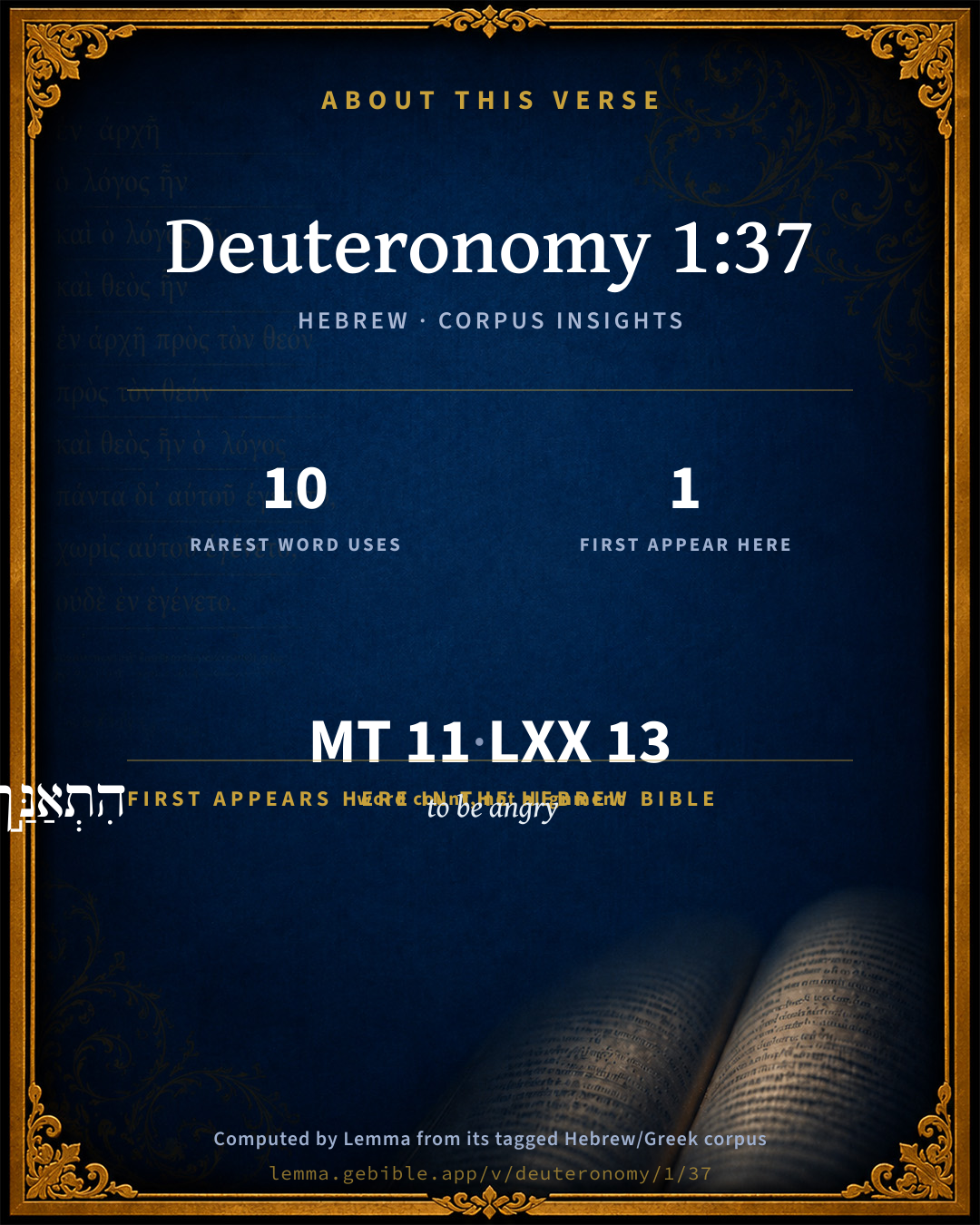
The rarest word here is בִּגְלַלְכֶ֖ם on account of H1558 — appearing just 10 times in the whole Hebrew Bible.

First appearance in Scripture

This word makes its first canonical appearance in the Hebrew Bible here:

  • הִתְאַנַּ֣ף to be angry H599

Shared distinctive vocabulary

בִּגְלַלְכֶ֖ם on account of H1558 occurs in 10 verses of the Hebrew Bible. Also found in:

Grammatical profile

  • 3 verbs
  • 2 nouns
  • 1 pronoun
  • 1 preposition
  • 1 adverb
  • 3 particles

Verb forms

  • הִתְאַנַּ֣ף Hithpael · Perfect
  • לֵאמֹ֑ר Qal · Infinitive Construct
  • תָבֹ֥א Qal · Imperfect

Repetition

A word recurs within this verse — often emphatic in Hebrew:

  • גַּם also H1571 ×2

Hebrew & Septuagint length

In English translation the verse runs 17 words from the Hebrew and 19 from the Septuagint (LXX English) — closely comparable.

A rough comparison of the two English renderings, which tokenize alike — not a word-level alignment.

Word counts can differ between the Hebrew and the Greek without any difference in meaning — e.g. the Hebrew direct-object marker אֵת has no separate Greek word, and Greek often adds the article ὁ.

In the original languages it is 11 Hebrew tokens and 13 Greek tokens — but the two are counted differently (Hebrew bundles its prefixes and suffixes into one token; the Greek is in lemma form), so that isn’t a like-for-like length.

Cross-references

6

Topical passages linked to Deuteronomy 1:37 in the Treasury of Scripture Knowledge — connected by theme and wording, ordered by reader-vote popularity; previews shown in the World English Bible.

  • Numbers 20:12 Yahweh said to Moses and Aaron, Because you didn't believe in me, to sanctify me in the eyes of the children of Israel, therefore you shall not bring this assembly into the land which I have given them.
  • Deuteronomy 4:21 Furthermore Yahweh was angry with me for your sakes, and swore that I should not go over the Jordan, and that I should not go in to that good land, which Yahweh your God gives you for an inheritance:
  • Deuteronomy 34:4 Yahweh said to him, This is the land which I swore to Abraham, to Isaac, and to Jacob, saying, I will give it to your seed: I have caused you to see it with your eyes, but you shall not go over there.
  • Numbers 27:13–14 When you have seen it, you also shall be gathered to your people, as Aaron your brother was gathered;
  • Psalms 106:32–33 They angered him also at the waters of Meribah, So that Moses was troubled for their sakes;
  • Deuteronomy 3:23–26 I begged Yahweh at that time, saying,

Cross-references courtesy of OpenBible.info (CC BY 4.0).

Hebrew and Greek witnesses Masoretic Hebrew ↔ Greek Septuagint

The same verse in the two great witnesses to the Old Testament, shown verse-for-verse.

These are two independent witnesses, not word-aligned to each other, and the Septuagint is shown in lemma (dictionary) form.

Hebrew Deuteronomy 1:37 Masoretic · Westminster Leningrad Codex

גַּם בִּי֙ הִתְאַנַּ֣ף יְהוָ֔ה בִּגְלַלְכֶ֖ם לֵאמֹ֑ר גַּם אַתָּ֖ה לֹא תָבֹ֥א שָֽׁם

Also Yahweh was angry with me for your sakes, saying, You also shall not go in there:

World English Bible · Public Domain

Greek LXX Deuteronomy 1:37 Septuagint · lemma form

καί ἐγώ θυμόω κύριος διά σύ λέγω οὐδέ σύ οὐ μή εἰςἔρχομαι ἐκεῖ

And the Lord was angry with me for your sake, saying, Neither shall you by any means enter therein.

LXX2012 (modern English Septuagint) · Public Domain

Hebrew: Westminster Leningrad Codex (CC BY 4.0). Greek: Septuagint (public domain); English from LXX2012 (modern English Septuagint) (Public Domain). How the Septuagint differs from the Hebrew →

Targum (Aramaic paraphrase)

2

The Targum is the ancient Jewish Aramaic paraphrase of the Hebrew Scriptures — an interpretive translation, not the Hebrew text itself. Onkelos (literal) and Pseudo-Jonathan (expansive) render the Torah, and Jonathan the Prophets. Coverage is partial: where no permissively-licensed English translation exists for a verse, only the Aramaic is shown. This is verse-level text, not a word-by-word alignment to the Hebrew.

  1. Targum Onkelos Torah (Genesis–Deuteronomy)
    אַף עֲלַי הֲוָה רְגַז מִן קֳדָם יְיָ בְּדִילְכוֹן לְמֵימָר אַף אַתְּ לָא תֵיעוֹל תַּמָן

    (no public-domain English translation for this verse)

    Targum Onkelos — Aramaic: “Onkelos Genesis” (public domain); “Onkelos Exodus” (public domain); “Onkelos Leviticus” (public domain); “Onkelos Numbers” (public domain); “Onkelos Deuteronomy” (public domain). English: “Sefaria Community Translation” (CC0 1.0 (public-domain dedication)); “J.W. Etheridge. The Targums of Onkelos and Jonathan Ben Uzziel on the Pentateuch. London: Longmans, Green, 1862” (public domain). Text via Sefaria.

  2. Targum Pseudo-Jonathan Torah (Genesis–Deuteronomy)
    אוּף עָלַי הֲוָה רְגַז מִן קֳדָם יְיָ מְטוּלְכוֹן לְמֵימָר אוּף אַנְתְּ לָא תֵיעוּל לְתַמָּן

    Against me also was there displeasure before the Lord on your account, saying, Thou too art not to go in thither;

    Targum Pseudo-Jonathan — Aramaic: “Targum Jonathan on Genesis” (public domain); “Targum Jonathan on Exodus” (public domain); “Targum Jonathan on Leviticus” (public domain); “Targum Jonathan on Numbers” (public domain); “Targum Jonathan on Deuteronomy” (public domain). English: “The Targum of Jonathan ben Uzziel, trans. J. W. Etheridge, London, 1862” (public domain). Text via Sefaria.

Commentary

Notes on Deuteronomy 1:37 from classic Christian and Jewish commentators (each source and its license shown beneath its notes). The classic Christian expositions comment on the surrounding passage and are grouped to its opening verse, so a note may address several verses; the Jewish commentaries on the Tanakh (Rashi and others) are per-verse, so they appear only where the commentator wrote on this verse.

Lemma curates 59 commentaries, every one of them public domain or Creative Commons licensed, each selected and text-cleaned for this edition rather than reprinted as found. About our sources →

The Cambridge Bible for Schools and Colleges

gen. ed. J. J. S. Perowne

37. Also the Lord was angry with me for your sakes] The Heb. order is more emphatic, also with me was Jehovah angry—hith’annaph, peculiar in the Pent. to D, and to its passages in the Pl. address, here, Deu_4:21, Deu_9:8; Deu_9:20—for your sakes, bigelalekem. So in different terms Deu_3:26, was angry, yith‘abber, for your sakes, lema‘anekem; and Deu_4:21, hith’annaph and ’al dibrêkem.

Thou also shalt not go in thither] Heb. even thou or for thy part thou, etc.

Further Note to Deu_1:36-38. Because Moses has just been described as seeking to turn the people from their sin, Deu_1:29 ff., and it is therefore unreasonable to include him in their punishment; because Deu_1:37-38 needlessly anticipate Deu_3:26; Deu_3:28 and Deu_4:21; and because Deu_1:39 in whole or part follows suitably on Deu_1:36; therefore Deu_1:37-38 are taken by many (Dillm., W. R. Smith, Steuern., Berth, etc.) as a later addition to the text. And indeed the beginning of Deu_1:39 shows that the original has been disturbed by an editorial hand (see below). Steuern. would also omit Deu_1:36 on the ground that Kaleb has not been previously mentioned in this survey. But Kaleb is mentioned in JE on which this survey otherwise depends. In whatever way these textual questions may be decided, the parallel passages Deu_3:26 ff. and Deu_4:21 confirm the fact of a D tradition or statement that Jehovah was angry with Moses for the people’s sake. This can only mean, their guilt was great enough to include the very leader who had done his best to dissuade them from their disaffection! Now neither JE nor P gives any hint of so remarkable a judgement. On the contrary, P accounts for the exclusion of Moses by his own sin in striking the rock at Ḳadesh 37 years after this disaffection of Israel, Num_21:10 ff; Num_27:13 f.; Deu_32:50 f. The most reasonable explanation of such discrepancies is that they are discrepancies not of fact but or opinion. The earliest tradition, JE, merely held the facts that Kaleb survived and that Moses died on the eve of the possession of the Promised Land. The problem, which arose from this contrast of fortune, the deuteronomic writers solved by the statement that Moses was included in the guilt of the people when, startled by the report of the spies, they refused to invade Canaan from the S. in the second year of the wandering; and this agrees with the deuteronomic principle of the ethical solidarity of Israel. But the later priestly writer or writers, under the influence of the idea, first emphasized in the time of Jeremiah and Ezekiel (Jer_31:29 f., Ezekiel 18), that every man died because of his own sin, found a solution for the problem in Moses’ own guilt in presumptuously striking the rock at Ḳadesh, 37 years later. In this double engagement, from two different standpoints, with so difficult a problem, note the strong evidence that the survival of Kaleb and the death of Moses before Israel’s entrance to the Land were regarded as irremoveable elements of the early tradition.

The Cambridge Bible for Schools and Colleges (gen. ed. J. J. S. Perowne; Cambridge University Press, 1878–1918) — public domain. Text from a community e-Sword module.

Trapp's Complete Commentary

John Trapp

Deu 1:37 Also the LORD was angry with me for your sakes, saying, Thou also shalt not go in thither.

Ver. 37. The Lord was angry with me.] The saint’s afflictions proceed oft from love displeased, from love offended. "Fury is not in God." {Isa 27:4}

John Trapp, A Commentary or Exposition upon All the Books of the Old and New Testament (1647–1656) — public domain. Text from a community e-Sword module.

Tyndale Open Study Notes

Tyndale Open Resources

1:37 God was angry with me because of you: In his frustration against rebellious Israel, Moses had disobeyed God by striking the rock rather than merely speaking to it (Num 20:10-13).

Tyndale Open Study Notes — © Tyndale Open Resources, licensed CC BY-SA 4.0. Text via the HelloAO Bible API.

Jamieson, Fausset & Brown

Robert Jamieson, A. R. Fausset & David Brown

Also the Lord was angry with me for your sakes--This statement seems to indicate that it was on this occasion Moses was condemned to share the fate of the people. But we know that it was several years afterwards that Moses betrayed an unhappy spirit of distrust at the waters of strife (Psa 106:32-33). This verse must be considered therefore as a parenthesis.

Jamieson, Fausset & Brown — Commentary Critical and Explanatory on the Whole Bible (1871) — public domain (CC PDM 1.0). Text via the HelloAO Bible API.

Adam Clarke's Commentary

Verse 37. The Lord was angry with me] See on Clarke "Nu 20:12", &c., where a particular account is given of the sin of Moses.

Adam Clarke's Commentary on the Bible (1810–1826) — public domain. Text from a community e-Sword/MySword module.

Ellicott's Commentary for English Readers

(37) Also the Lord was angry with me for your sakes.—Here, again, Moses combines his own rejection. an event of the fortieth year of the exodus, with the rejection of the people in the second year. The reason was the same—unbelief. “Because ye believed me not” was the reason given to Moses in Num_20:12. “Ye did not believe the Lord your God” is the reason for the rejection of the people, given above in Deu_1:32. As the spies presumed to investigate the route and order of the conquest, a matter of Divine guidance, so Moses presumed to alter the prescribed order for the miracle in Kadesh. Like transgressions incurred like penalties. The fault for which the people had suffered could not be overlooked in the leader. (See also Notes on Deu_3:23-28; Deu_32:49.) This and Deu_1:38 should be taken as a parenthesis.

A Bible Commentary for English Readers, edited by Charles John Ellicott (1878–1897) — public domain. Text from a community e-Sword module.

John Gill's Exposition

Also the Lord was angry with me for your sakes,.... Not at the same time, though, as some think, at the same place, near thirty eight years afterwards, they provoking him to speak unadvisedly with his lips; see Num 20:10,

saying, thou shalt not go in thither: into the land of Canaan; and though he greatly importuned it, he could not prevail; see Deu 3:25.

John Gill's Exposition of the Whole Bible (1746–1763) — public domain (CC PDM 1.0). Text via the HelloAO Bible API.

Albert Barnes' Notes on the Bible

The sentence on Moses was not passed when the people rebelled during their first encampment at Kadesh, but some 37 years later, when they had re-assembled in the same neighborhood at Meribah (see the Num 20:13 note). He alludes to it here as having happened not many months previously, bearing on the facts which were for his purpose in pricking the conscience of the people.

Albert Barnes' Notes on the Bible (1834–1885) — public domain. Text from a community e-Sword/MySword module.

Haydock's Catholic Bible Commentary

Neither, &c. Hebrew simply, "The Lord was also angry with me on your account," &c. Moses had been so long witness to the rebellions of the Hebrews, that at last he gave way to a certain diffidence, when he was ordered by God to give them water out of the rock. He was afraid the Lord would not bear any longer with their repeated acts of ingratitude, nor work a miracle on this occasion, chap. iii. 26., and Numbers xx. 12. (Haydock) --- He had also consented to the sending of the 12 spies imprudently. (Du Hamel) (Ver. 23.)

George Leo Haydock (1774–1849), Haydock's Catholic Family Bible and Commentary, 1859 edition — public domain. Excludes Psalms (Douay-Rheims chapter numbering differs from Protestant) and Deuterocanonical books (Catholic canon only).

Matthew Poole's English Annotations

For your sakes; upon occasion of your wickedness and perverseness, by which you provoked me to speak unadvisedly, Psa 106:32,33.

Matthew Poole's English Annotations on the Holy Bible (1683–1685) — public domain. Text from a community e-Sword/MySword module.

Whedon's Commentary on the Bible

Daniel D. Whedon

37. Also the Lord was angry with me for your sakes — The occasion here referred to was during the second stay at Kadesh. Looking back over the forty years of wandering, after speaking of the rebellion of the people which excluded them from entering the land, how natural that Moses should also mention the occasion of his own exclusion. “Moses,” says Keil, “did not intend to teach the people history and chronology, but to set before them the holiness of the judgments of God.” By using the expression for your sakes we are not to understand that he seeks to exculpate himself, for in Deu_32:48-51, his sin is related. Compare Psa_106:32-33 : “They angered him also at the waters of strife, so that it went ill with Moses for their sake: because they provoked his spirit, so that he spake unadvisedly with his lips.”

Daniel D. Whedon (gen. ed.), Commentary on the Old and New Testaments (1874–1909) — public domain. Text from a community e-Sword module.

The Pulpit Commentary

The Lord was angry with me also for your sakes, saying, Thou also shalt not go in thither. This must be regarded as parenthetical, for what he here refers to in regard to himself occurred, not at the time of the rebellion at Kadesh, but at the time of the second arrival of the people at that place, many years later. This parenthetical reference to himself was probably thrown in by Moses for the purpose of preparing for what he was about to say respecting Joshua, in whom the people were to find a leader after he himself was gone. It may be noted also that Moses distinguishes between the anger of the Lord against him, and the wrath which broke forth upon the people a distinction which is aptly preserved in the Authorized Version by the words "was wroth" (pxq;) and "was angry" (pna). For your sakes; rather, because of you, on accent of you. The Hebrew word (llg) comes from a root meaning to roll, and signifies primarily a turn in events, a circumstance, an occasion or reason. Moses reminds the Israelites that the misconduct of the people was what led to God"s being angry also with him. (see Num_20:7, etc.; comp. Psa_106:32, Psa_106:33)

The Pulpit Commentary (1880–1919), ed. H.D.M. Spence-Jones & Joseph S. Exell — public domain. Text from a community e-Sword module.

John Wesley's Explanatory Notes

For your sakes - Upon occasion of your wickedness and perverseness, by which you provoked me to speak unadvisedly.

John Wesley, Explanatory Notes Upon the Whole Bible (1754–1765) — public domain. Text via the GEBible commentary corpus.

unfoldingWord translationNotes

Door43 World Missions Community

General Information:

Moses continues reminding the people of Israel what the previous generation of Israelites did.

Yahweh was angry with me because of you

This refers to when Moses disobeyed what Yahweh told him to do because Moses was angry with the people of Israel. (See: Assumed Knowledge and Implicit Information)

Nun

This is the name of Joshua's father. (See: How to Translate Names)

who stands before you

Why Joshua stands before Moses can be stated clearly. AT: "who stands before you as your servant" or "who helps you" (See: Assumed Knowledge and Implicit Information)

translationWords

Yahweh

anger

Joshua

courage

Israel

inherit

unfoldingWord translationNotes — © Distant Shores Media and the Door43 World Missions Community, licensed CC BY-SA 4.0. Source: git.door43.org/Door43/en_tn.

Rashi

Rabbi Shlomo Yitzchaki (Rashi)

התאנף means HE WAS FILLED WITH ANGER.

Rashi on the Tanakh — English translations: “The Judaica Press complete Tanach with Rashi, translated by A. J. Rosenberg” (CC BY 4.0); “Pentateuch with Rashi's commentary by M. Rosenbaum and A.M. Silbermann, 1929-1934” (public domain); “The Metsudah Tanach series, Lakewood, N.J” (CC BY 4.0); and “The Book of Joshua, Metsudah Publications, 1997” (CC BY 4.0). Text via Sefaria.

Ramban (Nachmanides)

Rabbi Moshe ben Nachman (Ramban / Nachmanides)

ALSO THE ETERNAL WAS ANGRY WITH ME, FOR YOUR SAKES. He is stating: “Behold, the sin you committed then in the affair of the spies withheld from you the good Land, and yet you continued to sin another time [i.e., at the waters of Meribah] until you prevented me as well, from crossing [the Jordan].” For Moses wanted to mention simultaneously that the punishment of all who were prevented from passing into the Land, was caused by their sins. Also in order to mention here the matter of Joshua, that he would cross over because he followed G-d wholeheartedly as did his colleague [Caleb], and, therefore, he will yet deserve to cause the second generation to inherit the Land, because Moses was punished and it was decreed upon him that he was not to cross [the Jordan]. Thus Moses mentioned the whole affair [of the spies] except for the death by plague of the spies themselves., Verse 37. Nor did he mention the slander [of the spies that the Land eateth up the inhabitants thereof], for he would not speak of the shame of individuals. Instead he reproved the multitude all of whom sinned and all of whom were punished.The meaning of the expression for your sakes [Also the Eternal was angry with me, ‘for your sakes’] is that the children of Israel strove with the Eternal etc., 20:13. [at the waters of Meribah], and all this happened because of your quarrel. Or [the expression for your sakes] may allude to the fact that the anger [of G-d] with Moses and Aaron was because — when they hit the rock twice, Verse 11. in front of the people [instead of speaking to it] and did not do as they were commanded — the people were critical of it., Verse 1 (towards end). This is the purport of His words, because ye sanctified Me not in the midst of the children of Israel, meaning that the punishment came [not because the sin itself was so grievous, but] because it happened in the midst of the children of Israel that the Glory was not sanctified before their eyes. Thus the Rabbis have also said in the Sifre: 340. “Because ye trespassed against Me. — you caused [the people] to trespass. Because ye sanctified Me not — you caused that I not be sanctified. Because ye rebelled against My commandment — you caused [the people] to rebel against My commandment.” The Rabbis [in the Sifre] thus interpreted all these expressions as transitional to Israel, [meaning, Moses and Aaron had really not sinned in the affair of the rock, but since their action was misconstrued by the people causing the people to sin, Moses and Aaron were punished]. I have already explained the subject., Verse 1 (towards end).

Ramban (Nachmanides) on the Tanakh — English translation: “Commentary on the Torah by Ramban (Nachmanides). Translated and annotated by Charles B. Chavel. New York, Shilo Pub. House, 1971-1976” (CC BY 4.0). Text via Sefaria.

Lesson kit

Teaching starters — assembled from the data on this page, not authored interpretation. Every prompt links to the verse data it draws on. Edit before teaching.

Deuteronomy, in the Pentateuch, opens this verse with 11 words (9 distinct Hebrew lemmas). Its most distinctive word is gâlâl (“on account of”). A historical commentator’s framing appears above. Read the whole chapter for the surrounding context.

Discussion questions

  1. What does “on account of” (gâlâl) contribute to the verse as a whole?
  2. The word “to be angry” first appears here in Scripture. What is being introduced at this debut?
  3. Genesis 12:13 shares the word «on account of» with this verse. How do the two illuminate each other?
  4. “also” occurs 2× in this one verse. What is the effect of the repetition?
  5. These translations render this verse differently. What is at stake in choosing one wording over another?
  6. The verb «הִתְאַנַּ֣ף» is Hithpael Perfect. How does its form color the action?
  7. Reading how The Cambridge Bible for Schools and Colleges and Trapp's Complete Commentary read this verse, where do the two commentators agree and where do they part?

Things to notice

Reading settings

Reading text

Shown beneath each verse's original-language words.

Old Testament
Old Testament edition

Read the OT as the Masoretic Hebrew (MT) or the Greek Septuagint (LXX).

English shown for the Greek Septuagint (in the Hebrew ↔ Greek comparison).

Comparing translations? Open the Compare panel on any verse page to stack up to four side by side.