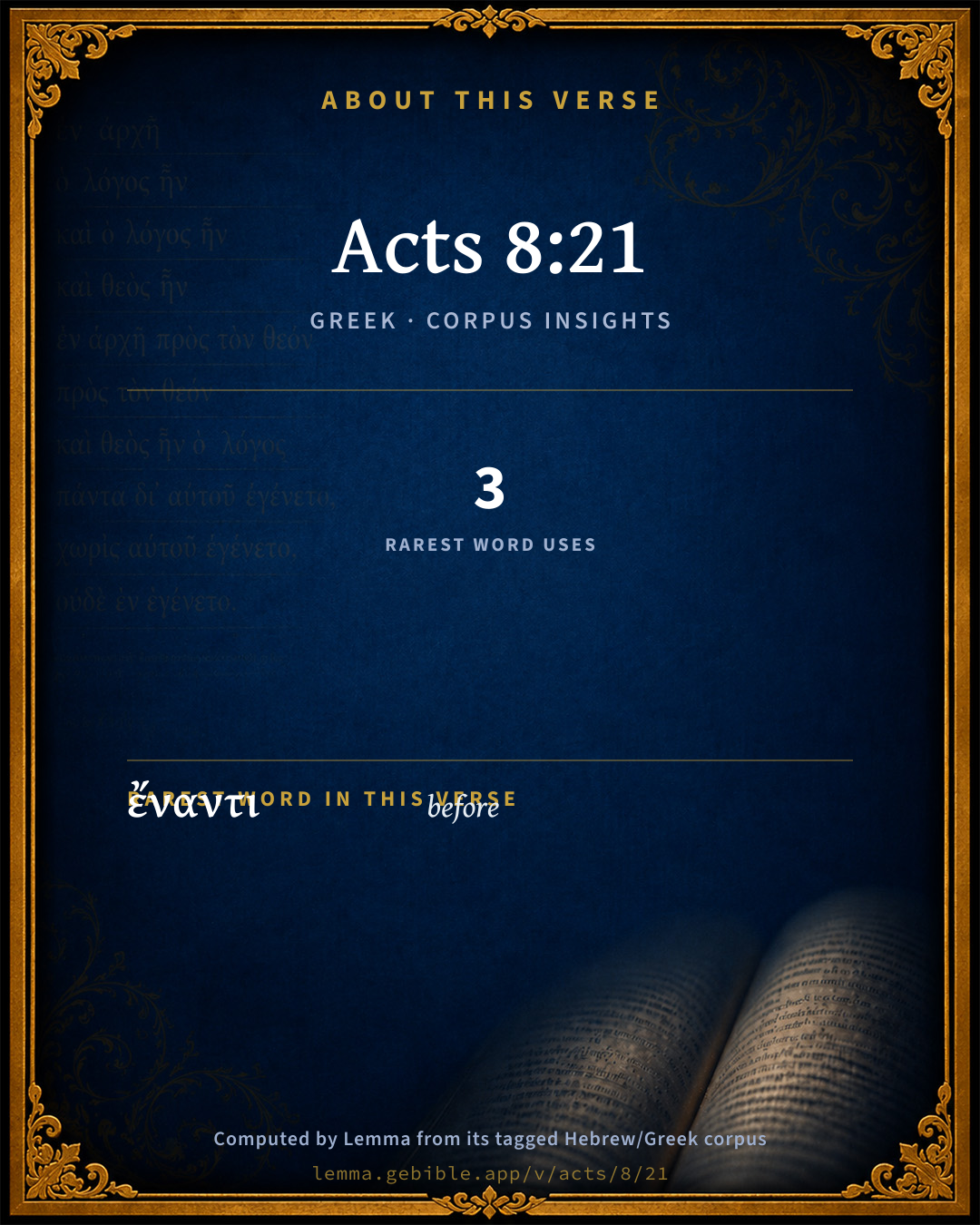
Acts 8:21

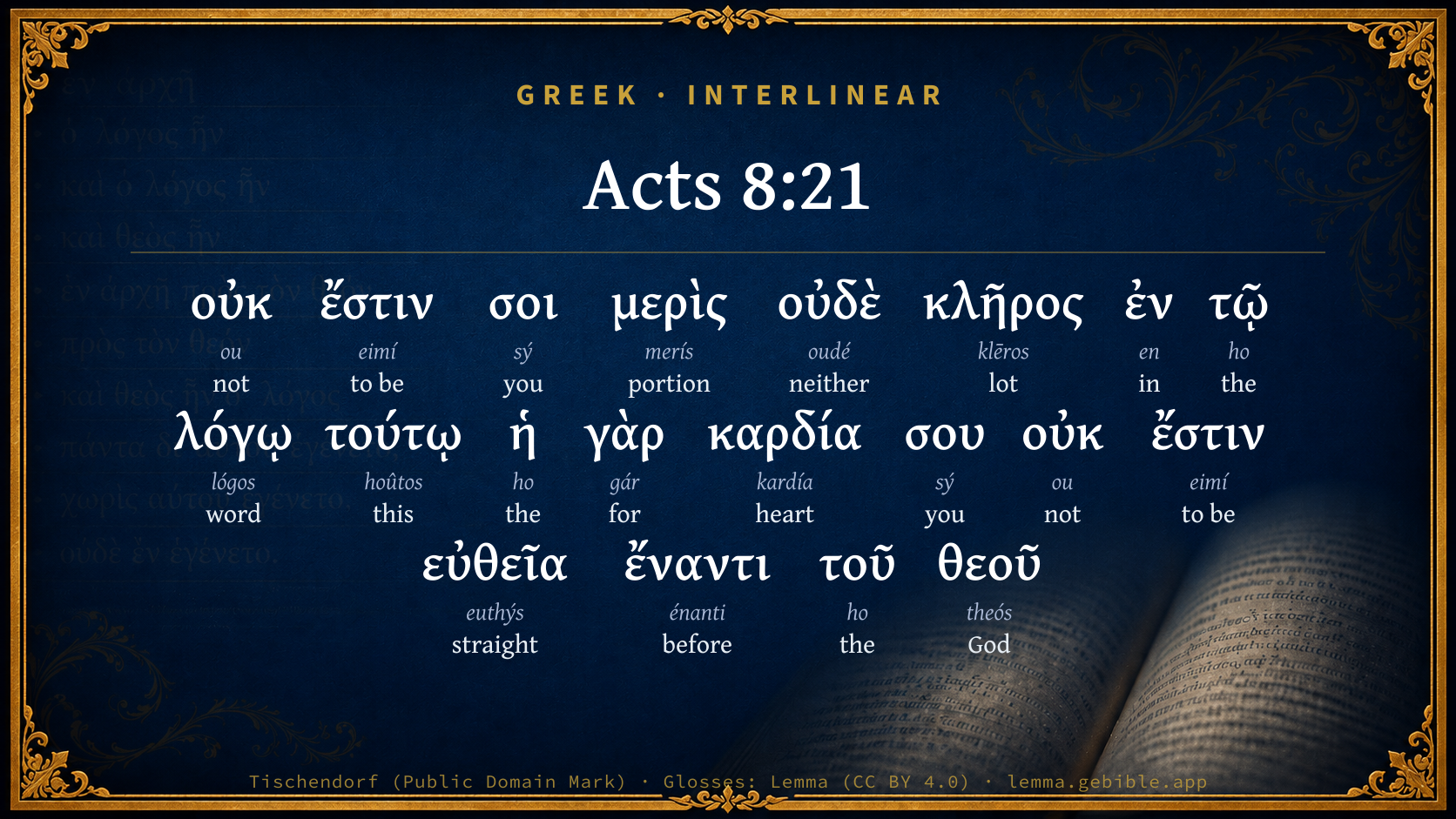
Greek (Tischendorf 8th ed.) Acts 8:21 appears in the Greek New Testament. The text above is from the Tischendorf 8th edition. Each word links to its Strong’s number and a concise gloss. Click any word for its full Thayer’s Greek Lexicon entry.
Download image
Cite this verse

Acts 8:21 (World English Bible). Public Domain. Lemma interlinear Bible study tool, https://lemma.gebible.app/v/acts/8/21.

Show BibTeX & RIS
BibTeX
RIS
English Translation
You have neither part nor lot in this matter, for your heart isn't right before God.
World English Bible · Public Domain
Download a study sheet

One document with this verse’s original text, its word-by-word gloss line, the meaning frame, cross-references with their text, attributed commentary, and full source and license credits — printable, and it pastes into notes with its structure intact.

This verse Autodidact and up

Study sheet (.html) Plain text (.txt)

A passage Seminary Student

Up to 50 verses in one chapter. A passage sheet keeps up to 6 commentary sources and 12 cross-references per verse, in the order this page ranks them, and says so on the sheet whenever that leaves anything out. Ask for a single verse and you get the Autodidact verse sheet above.

Everything on this page stays free to read, with no account — the sheet is a download of what is already on screen, not access to it.

Want to remove ads? Support Godless Engineer
Compare translations 3

The same verse in 3 English versions, stacked beneath the original-language interlinear above. Click any original word for its lexicon entry.

Each is an independent rendering of the whole verse — the interlinear is not word-aligned to these translations.

Highlighted words mark where these versions differ — a whole-verse word diff, not a word-by-word alignment.

  • World English Bible Public Domain
    You have neither part nor lot in this matter, for your heart isn't right before God.
  • King James Version Public Domain
    Thou hast neither part nor lot in this matter: for thy heart is not right in the sight of God.
  • unfoldingWord Literal Text CC BY-SA 4.0
    No part or share in this matter is to you, because your heart is not right before God.

unfoldingWord Literal Text — © unfoldingWord, licensed CC BY-SA 4.0. Word-aligned USFM3 via Door43 (git.door43.org/unfoldingWord/en_ult).

Versions to compare (up to 4)

3 of 4 selected

Show all 19 translations

Every available English version of this verse, each an independent rendering of the whole verse.

  • World English Bible Public Domain
    You have neither part nor lot in this matter, for your heart isn't right before God.
  • Berean Standard Bible Public Domain
    You have no part or share in our ministry, because your heart is not right before God.
  • Majority Standard Bible Public Domain
    You have no part or share in our ministry, because your heart is not right in the sight of God.
  • King James Version Public Domain
    Thou hast neither part nor lot in this matter: for thy heart is not right in the sight of God.
  • American Standard Version (1901) Public Domain
    Thou hast neither part nor lot in this matter: for thy heart is not right before God.
  • Revised Version (1885) Public Domain
    Thou hast neither part nor lot in this matter: for thy heart is not right before God.
  • Geneva Bible (1599) Public Domain
    Thou hast neither part nor fellowship in this businesse: for thine heart is not right in the sight of God.
  • Douay-Rheims (1899) Public Domain
    Thou hast no part nor lot in this matter. For thy heart is not right in the sight of God.
  • Young's Literal Translation Public Domain
    thou hast neither part nor lot in this thing, for thy heart is not right before God;
  • Literal Standard Version CC BY-SA 4.0
    you have neither part nor lot in this thing, for your heart is not right before God;
  • Unlocked Literal Bible CC BY-SA 4.0
    You have no part or share in this matter, because your heart is not right with God.
  • unfoldingWord Literal Text CC BY-SA 4.0
    No part or share in this matter is to you, because your heart is not right before God.
  • Darby Bible Public Domain
    Thou hast neither part nor lot in this matter, for thy heart is not upright before God.
  • World Messianic Bible Public Domain
    You have neither part nor lot in this matter, for your heart isn’t right before God.
  • Webster's Bible Public Domain
    Thou hast neither part nor lot in this matter: for thy heart is not right in the sight of God.
  • Free Bible Version CC BY-SA 4.0
    “You're not part of any of this. None of this work belongs to you, because in God's eyes your attitude is totally wrong.
  • Bible in Basic English Public Domain
    You have no part in this business, because your heart is not right before God.
  • Text-Critical English NT CC BY 4.0
    Yoʋ have no share or portion in this matter, for yoʋr heart is not right before God.
  • Tyndale New Testament (1534) Public Domain
    Thou hast nether parte nor felloushippe in this busines. For thy hert is not ryght in the syght of God.

Literal Standard Version (2020), Covenant Press — licensed CC BY-SA 4.0. Text via the HelloAO Bible API (eBible.org). Unlocked Literal Bible (unfoldingWord) — licensed CC BY-SA 4.0. Text via the HelloAO Bible API (eBible.org). unfoldingWord Literal Text — © unfoldingWord, licensed CC BY-SA 4.0. Word-aligned USFM3 via Door43 (git.door43.org/unfoldingWord/en_ult). Free Bible Version, Dr. Jonathan Gallagher — licensed CC BY-SA 4.0. Text via the HelloAO Bible API (eBible.org).

Word by word

More ways to search: Search by grammar → Find every occurrence → Compare this word →

Practice this passage: Drill this verse → Learn its vocabulary →

ἔναντι
énanti
  1. οὐκ ou G3756 “not” Particle, Negative
  2. ἔστιν eimí G1510 “to be” Verb, Present, Active, Indicative, 3rd person, Singular
  3. σοι sý G4771 “you” Personal pronoun, 2nd person, Dative, Singular
  4. μερὶς merís G3310 “portion” Noun, Nominative, Singular, Feminine
  5. οὐδὲ oudé G3761 “neither” Conjunction, Negative
  6. κλῆρος klēros G2819 “lot” Noun, Nominative, Singular, Masculine
  7. ἐν en G1722 “in” Preposition
  8. τῷ ho G3588 “the” Article, Dative, Singular, Masculine
  9. λόγῳ lógos G3056 “word” Noun, Dative, Singular, Masculine
  10. τούτῳ hoûtos G3778 “this” Demonstrative pronoun, Dative, Singular, Masculine
  11. ἡ ho G3588 “the” Article, Nominative, Singular, Feminine
  12. γὰρ gár G1063 “for” Conjunction
  13. καρδία kardía G2588 “heart” Noun, Nominative, Singular, Feminine
  14. σου sý G4771 “you” Personal pronoun, 2nd person, Genitive, Singular
  15. οὐκ ou G3756 “not” Particle, Negative
  16. ἔστιν eimí G1510 “to be” Verb, Present, Active, Indicative, 3rd person, Singular
  17. εὐθεῖα euthýs G2117 “straight” Adjective, Nominative, Singular, Feminine
  18. τοῦ ho G3588 “the” Article, Genitive, Singular, Masculine
  19. θεοῦ theós G2316 “God” Noun, Genitive, Singular, Masculine

About this verse

These counts appear in no published source. They are computed here, from the morphology-tagged text and Lemma’s own curated glosses. What Lemma adds →

20
words
15
distinct lemmas
Acts
section

Notable vocabulary

The rarest word here is ἔναντι before G1725 — appearing just 3 times in the whole Greek New Testament.

Shared distinctive vocabulary

ἔναντι before G1725 occurs in 3 verses of the Greek New Testament. Also found in:

Repetition

Words recur within this verse:

Cross-references

12

Topical passages linked to Acts 8:21 in the Treasury of Scripture Knowledge — connected by theme and wording, ordered by reader-vote popularity; previews shown in the World English Bible.

  • Hebrews 4:13 There is no creature that is hidden from his sight, but all things are naked and laid open before the eyes of him with whom we have to do.
  • Psalms 36:1 An oracle is within my heart about the disobedience of the wicked: "There is no fear of God before his eyes."
  • Matthew 6:22–24 "The lamp of the body is the eye. If therefore your eye is sound, your whole body will be full of light.
  • John 21:17 He said to him the third time, "Simon, son of Jonah, do you have affection for me?" Peter was grieved because he asked him the third time, "Do you have affection for me?" He said to him, "Lord, you know everything. You know that I have affection for you." Jesus said to him, "Feed my sheep.
  • 2 Chronicles 25:2 He did that which was right in the eyes of Yahweh, but not with a perfect heart.
  • Revelation 2:23 I will kill her children with Death, and all the assemblies will know that I am he who searches the minds and hearts. I will give to each one of you according to your deeds.
  • Revelation 22:19 If anyone takes away from the words of the book of this prophecy, may God take away his part from the tree of life, and out of the holy city, which are written in this book.
  • Joshua 22:25 for Yahweh has made the Jordan a border between us and you, you children of Reuben and children of Gad; you have no portion in Yahweh: so might your children make our children cease from fearing Yahweh.
  • Psalms 78:36–37 But they flattered him with their mouth, And lied to him with their tongue.
  • Habakkuk 2:4 Behold, his soul is puffed up. It is not upright in him, but the righteous will live by his faith.
  • Revelation 20:6 Blessed and holy is he who has part in the first resurrection. Over these, the second death has no power, but they will be priests of God and of Christ, and will reign with him one thousand years.
  • Ezekiel 14:3 Son of man, these men have taken their idols into their heart, and put the stumbling block of their iniquity before their face: should I be inquired of at all by them?

Cross-references courtesy of OpenBible.info (CC BY 4.0).

Commentary

Notes on Acts 8:21 from classic Christian and Jewish commentators (each source and its license shown beneath its notes). The classic Christian expositions comment on the surrounding passage and are grouped to its opening verse, so a note may address several verses; the Jewish commentaries on the Tanakh (Rashi and others) are per-verse, so they appear only where the commentator wrote on this verse.

Lemma curates 59 commentaries, every one of them public domain or Creative Commons licensed, each selected and text-cleaned for this edition rather than reprinted as found. About our sources →

MacLaren's Expositions of Holy Scripture

Alexander MacLaren

Acts

SIMON THE SORCERER

Act 8:21.

The era of the birth of Christianity was one of fermenting opinion and decaying faith. Then, as now, men’s minds were seething and unsettled, and that unrest which is the precursor of great changes in intellectual and spiritual habitudes affected the civilised world. Such a period is ever one of predisposition to superstition. The one true bond which unites God and man being obscured, and to the consciousness of many snapped, men’s minds become the prey of visionary terrors. Demand creates supply, and the magician and miracle-worker, the possessor of mysterious ways into the Unknown, is never far off at such a time. Partly deceived and partly deceiving, he is as sure a sign of the lack of profound religious conviction and of the presence of unsatisfied religious aspirations in men’s souls, as the stormy petrel or the floating seaweed is of a tempest on the seas.

So we find the early preachers of Christianity coming into frequent contact with pretenders to magical powers. Sadly enough, they were mostly Jews, who prostituted their clearer knowledge to personal ends, and having tacked on to it some theosophic rubbish which they had learned from Alexandria, or mysticism which had filtered to them from the East, or magic arts from Phrygia, went forth, the only missionaries that Judaism sent out, to bewilder and torture men’s minds. What a fall from Israel’s destination, and what a lesson for the stewards of the ‘oracles of God’!

Of such a sort were Elymas, the sorcerer whom Paul found squatting at the ear of the Roman Governor of Cyprus; the magicians at Ephesus; the vagabond Jews exorcists, who with profitable eclecticism, as they thought, tried to add the name of Jesus as one more spell to their conjurations; and, finally, this Simon the sorcerer. Established in Samaria, he had been juggling and conjuring and seeing visions, and professing to be a great mysterious personality, and had more than permitted the half-heathen Samaritans, who seem to have had more religious susceptibility and less religious knowledge than the Jews, and so were a prepared field for all such pretenders, to think of him as in some sense an incarnation of God, and perhaps to set him up as a rival or caricature of Him who in the neighbouring Judaea was being spoken of as the power of God, God manifest in the flesh.

To the city thus moved comes no Apostle, but a Christian man who begins to preach, and by miracles and teaching draws many souls to Christ.

The story of Simon Magus in his attitude to the Gospel is a very striking and instructive one. It presents for our purpose now mainly three points to which I proceed to refer.

I. An instance of a wholly unreal, because inoperative, faith.

‘He believed,’ says the narrative, and believing was baptized. It is worth noting, in passing, how the profession of faith without anything more was considered by the Early Church sufficient. But obviously his was no true faith. The event showed that it was not.

What was it which made his faith thus unreal?

It rested wholly on the miracles and signs; he ‘wondered’ when he saw them. Of course, miracles were meant to lead to faith; but if they did not lead on to a deeper sense of one’s own evil and need, and so to a spiritual apprehension, then they were of no use.

The very beginning of the story points to the one bond that unites to God, as being the sense of need and the acceptance with heart and will of the testimony of Jesus Christ. Such a disposition is shown in the Samaritans, who make a contrast with Simon in that they believed Philip preaching, while Simon believed him working miracles. The true place of miracles is to attract attention, to prepare to listen to the word. They are only introductory. A faith may be founded on them, but, on the other hand, the impressions which they produce may be evanescent. How subordinate then, their place at the most! And the one thing which avails is a living contact of heart and soul with Jesus Christ.

Again, Simon’s belief was purely an affair of the understanding. We are not to suppose, I think, that he merely believed in Philip as a miracle-worker; he must have had some notion about Philip’s Master, and we know that it was belief in Jesus as the Christ that qualified in the Apostolic age for baptism. So it is reasonable to suppose that he had so much of head knowledge. But it was only head knowledge. There was in it no penitence, no self-abandonment, no fruit in holy desires; or in other words, there was no heart. It was credence, but not trust.

Now it does not matter how much or how little you know about Jesus Christ. It does not matter how you have come to that knowledge. It does not matter though you have received Christian ordinances as Simon had. If your faith is not a living power, leading to love and self-surrender, it is really nought. And here, on its earliest conflict with heathen magic, the gospel proclaims by the mouth of the Apostle what is true as to all formalists and nominal Christians: ‘Thou hast neither part nor lot in this matter, for thy heart is not right.’ One thing only unites to God-a faith which cleanses the heart, a faith which lays hold on Christ with will and conscience, a faith which, resting on penitent acknowledgment of sin, trusts wholly to His great mercy.

II. An instance of the constant tendency to corrupt Christianity with heathen superstition.

The Apostles’ bestowal of the Holy Ghost, which was evidently accompanied by visible signs, had excited Simon’s desire for so useful an aid to his conjuring, and he offers to buy the power, judging of them by himself, and betraying that what he was ready to buy he was also intending to sell.

The offer to buy has been taken as his great sin. Surely it was but the outcome of a greater. It was not only what he offered, but what he desired, that was wrong. He wanted that on ‘whomsoever I lay hands, he may receive the Holy Ghost.’ That preposterous wish was quite as bad as, and was the root of, his absurd offer to bribe Peter. Bribe Peter, indeed! Some of Peter’s successors would have been amenable to such considerations, but not the horny-handed fisherman who had once said, ‘Silver and gold have I none.’

Peter’s answer, especially the words of my text, puts the Christian principle in sharp antagonism to the heathen one.

Simon regards what is sacred and spiritual purely as part of his stock-in-trade, contributing to his prestige. He offers to buy it. And the foundation of all his errors is that he regards spiritual gifts as capable of being received and exercised apart altogether from moral qualifications. He does not think at all of what is involved in the very name, ‘the Holy Ghost.’

Now, on the other hand, Peter’s answer lays down broadly and sharply the opposite truth, the Christian principle that a heart right in the sight of God is the indispensable qualification for all possession of spiritual power, or of any of the blessings which Jesus gives.

How the heart is made right, and what constitutes righteousness is another matter. That leads to the doctrine of repentance and faith.

The one thing that makes such participation impossible is being and continuing in ‘the gall of bitterness, and the bond of iniquity.’ Or, to put it into more modern words, all the blessings of the Gospel are a gift of God, and are bestowed only on moral conditions. Faith which leads to love and personal submission to the will of God makes a man a Christian. Therefore, outward ordinances are only of use as they help a man to that personal act.

Therefore, no other man or body of men can do it for us, or come between us and God.

And in confirmation, notice how Peter here speaks of forgiveness. His words do not sound as if he thought that he held the power of absolution, but he tells Simon to go to God who alone can forgive, and refers Simon’s fate to God’s mercy.

These tendencies, which Simon expresses so baldly, are in us all, and are continually reappearing. How far much of what calls itself Christianity has drifted from Peter’s principle laid down here, that moral and spiritual qualifications are the only ones which avail for securing ‘part or lot in the matter’ of Christ’s gifts received for, and bestowed on, men! How much which really rests on the opposite principle, that these gifts can be imparted by men who are supposed to possess them, apart altogether from the state of heart of the would-be recipient, we see around us to-day! Simony is said to be the securing ecclesiastical promotion by purchase. But it is much rather the belief that ‘the gift of God can be purchased with’ anything but personal faith in Jesus, the Giver and the Gift. The effects of it are patent among us. Ceremonies usurp the place of faith. A priesthood is exalted. The universal Christian prerogative of individual access to God is obscured. Christianity is turned into a kind of magic.

III. An instance of the worthlessness of partial convictions.

Simon was but slightly moved by Peter’s stern rebuke. He paid no heed to the exhortation to pray for forgiveness and to repent of his wickedness, but still remained in substantially his old error, in that he accredited Peter with power, and asked him to pray for him, as if the Apostle’s prayer would have some special access to God which his, though he were penitent, could not have. Further, he showed no sense of sin. All that he wished was that ‘none of the things which ye have spoken come upon me.’

How useless are convictions which go no deeper down than Simon’s did!

What became of him we do not know. But there are old ecclesiastical traditions about him which represent him as a bitter enemy in future of the Apostle. And Josephus has a story of a Simon who played a degrading part between Felix and Drusilla, and who is thought by some to have been he. But in any case, we have no reason to believe that he ever followed Peter’s counsel or prayed to God for forgiveness. So he stands for us as one more tragic example of a man, once ‘not far from the kingdom of God’ and drifting ever further away from it, because, at the fateful moment, he would not enter in. It is hard to bring such a man as near again as he once was. Let us learn that the one key which opens the treasury of God’s blessings, stored for us all in Jesus, is our own personal faith, and let us beware of shutting our ears and our hearts against the merciful rebukes that convict us of ‘this our wickedness,’ and point us to the ‘Lamb of God which taketh away the sin of the world,’ and therefore our sin.

Alexander MacLaren, Expositions of Holy Scripture (1904–1910) — public domain. Text from a community e-Sword module.

Bengel's Gnomon

Johann Albrecht Bengel

Act 8:21. Οὐκ ἔστι σοι μερὶς, οὐδὲ κλῆρος) thou hast no part by purchase, nor lot freely or gratuitously. Μερὶς and χλῆρος are also joined, Deu 18:1; Isa 57:6, with which comp. Psa 16:5.—ἐν τῷ λόγῳ τούτῳ, in this word) in this matter, of which thou hast spoken. The purity of religion admits of no foreign (adulterated) admixture with it.—γὰρ, for) In a minister and partaker of the Gospel the heart ought to be right. The heart is the citadel of good and of bad.—οὐκ ἔστιν εὐθεῖα, is not right) that is, is very much distorted. [Rectitude of heart does not admit the mixture of spiritual intentions with temporal.—V. g.]

Bengel's Gnomon of the New Testament — English translation (T&T Clark, Edinburgh, 1860) — public domain. Text from a community e-Sword module.

Expositor's Greek Testament

ed. W. Robertson Nicoll

Act 8:21 . μερὶς οὐδὲ κλῆρος , cf. Deu 12:2 ; Deu 14:27 ; Deu 14:29 ; Deu 18:1 , Isa 57:6 , and instances in Wetstein, see on Act 1:17 . λόγῳ τούτῳ : both A. and R.V. “in this matter,” i.e. , in the power of communicating the Holy Spirit, but Grotius, Neander, Hackett, Blass, Rendall and others refer it to the Gospel, i.e. , the word of God which the Apostles preached, and in the blessings of which the Apostles had a share. λόγος is frequently used in classical Greek of that de quo agitur (see instances in Wendt). Grimm, sub v. , compares the use of the noun in classical Greek, like ῥῆμα , the thing spoken of, the subject or matter of the λόγος , Herod., i., 21, etc. ἡ γὰρ καρδία … εὐθεῖα , cf. LXX, Psa 7:10 , Psa 10:3 , Psa 35:10 , Psa 72:1 , 77:37, etc., where the adjective is used, as often in classical Greek, of moral uprightness ( cf. εὐθύτης in LXX, and Psalms of Solomon , Act 2:15 , ἐν εὐθύτητι καρδίας ), so also in Act 13:10 , where the word is used by St. Paul on a similar occasion in rebuking Elymas; only found once in the Epistles, where it is again used by St. Peter, 2Pe 2:15 .

The Expositor's Greek Testament, edited by W. Robertson Nicoll (1897–1910) — public domain. Text from a community e-Sword module.

Geneva Bible (1599)

Geneva Bible translators

In this doctrine which I preach.

Is not upright in deed, and without dissembling.

Geneva Bible (1599) marginal notes — public domain. Text via Bolls.life.

Jamieson, Fausset & Brown

Robert Jamieson, A. R. Fausset & David Brown

Thou hast neither part nor lot . . . thy heart is not fight, &c.--This is the fidelity of a minister of Christ to one deceiving himself in a very awful manner.

Jamieson, Fausset & Brown — Commentary Critical and Explanatory on the Whole Bible (1871) — public domain (CC PDM 1.0). Text via the HelloAO Bible API.

Adam Clarke's Commentary

Verse 21. Thou hast neither part nor lot in this matter] Thou hast no part among the faithful, and no lot in this ministry. That the word κληρος, which we translate lot, is to be understood as implying a spiritual portion, office, c., see proved in the note on Nu 26:55.

Thy heart is not right] It is not through motives of purity, benevolence, or love to the souls of men, that thou desirest to be enabled to confer the Holy Ghost it is through pride, vain glory, and love of money: thou wouldest now give a little money that thou mightest, by thy new gift, gain much.

Adam Clarke's Commentary on the Bible (1810–1826) — public domain. Text from a community e-Sword/MySword module.

John Calvin's Commentaries

21. Thou hast no part. Some do frame this sentence otherwise, that Simon is not partaker of grace, because he setteth a price thereof. But the other reading which we have followed is more usual, to wit, that that reason be joined to the former member. And surely it is better to knit the two sentences together, thus, Thy money perish with thee, because thou thinkest that the inestimable gift of the Spirit can be bought with money. Whereas the old interpreter had put, in this word; Erasmus translated it more fitly, in this business; for Peter’s meaning is, that that sacrilegious person hath nothing to do in all that administration, who doth wickedly profane the same.

Furthermore both the Papists, and also the old divines, have disputed much concerning simony; but that which the Papists call simony doth not agree with Simon’s fact. Simon would have bought the grace of the Spirit with money; the Papists apply the crime of simony unto their idle revenues; and yet I speak not this that I may extenuate those horrible sins which reign at this day in Popery, in buying and selling spiritual promotions. Now, this wickedness is filthy enough of itself, in that they hold such a mart in the Church of God. And in the mean season, we must note the true definition of simony, to wit, that it is a wicked buying and selling of the gifts of the Spirit, or some other such like thing, whilst that a man abuseth them unto ambition or other corruptions. Though I confess that all those imitate Simon who strive to attain unto the government of the Church by unlawful means; which thing we see committed at this day without shame, as if it were lawful; and we can scarce find one priest in all Popery which is not manifestly a simoniacal person in this respect; because none can put up his head amongst them, but he must creep in by indirect means. Although we must confess, (which thing even children see, to our great shame,) that this vice is too common even amongst the false professors of the gospel.

But let us remember, first, to the end we may be free from the infection of Simon, that the gifts of the Spirit are not gotten with money, but that they are given of the free and mere goodness of God, and that for the edifying of the Church; that is, that every man may study to help his brethren according to the measure of his ability; that every man may bestow that about the common good of the Church which he hath received; and that the excellency of no man may hinder, but that Christ may excel all. Notwithstanding, it may seem a marvelous matter, that Peter excludeth Simon from being a partaker of the Spirit, as concerning special gifts; because his heart is not right before God. For the wickedness of Judas did not let him from having the gifts of the Spirit in great measure; neither had the gifts of the Spirit been so corrupted amongst the Corinthians, if their heart had been right in the sight of God. Therefore that reason which Peter allegeth seemeth insufficient; because many men excel oftentimes in the gifts of the Spirit, who have an unclean heart. But, first of all, there followeth no absurdity, if God give such graces to men which are unworthy thereof. Secondly, Peter prescribeth no general rule in this place, but because the Church alone is for the most part made partaker of the gifts of the Spirit, he pronounceth that Simon, who is a stranger to Christ, is unworthy to have the same graces given him, (which are bestowed upon the faithful,) as if he were one of God’s household. Moreover, he had blasphemed those gifts whereof he is deprived.

John Calvin's Commentaries (1540-1563) — public domain. Text from the Calvin Translation Society English edition (1840s-50s) via the Christian Classics Ethereal Library (ccel.org). Calvin's coverage is partial (roughly two-thirds of the Bible); uncommented books and verses are honest gaps, never fabricated. The 19th-century editor's footnotes and remarks are omitted so the notes are faithfully Calvin's own voice.

Ellicott's Commentary for English Readers

(21) Neither part nor lot.—A like, though not an identical, combination of the two words meets us in Col_1:12. On the latter, see Notes on Act_1:17; Act_1:25. It is, perhaps, used here in its secondary sense. Simon had no inheritance in the spiritual gifts nor in the spiritual offices of the Church. The power attached to the apostleship was not a thing for traffic.

Thy heart is not right in the sight of God.—“Straight” or “right” is used, as in Mat_3:3, Mar_1:3, for “straightforward,” not in the secondary sense of “being as it ought to be.” The word is not of frequent occurrence in the New Testament, but, like so many of the spoken words of St. Peter, meets us again as coming from his pen (2Pe_2:15).

A Bible Commentary for English Readers, edited by Charles John Ellicott (1878–1897) — public domain. Text from a community e-Sword module.

The Cambridge Bible for Schools and Colleges

gen. ed. J. J. S. Perowne

21. Thou hast neither part nor lot in this matter (or word)] By the word “lot” the thought is carried back to the election of Matthias (Act_1:26). In that case the choice had been left to the “Lord who knows the hearts of all men,” but Simon’s character is patent to all; “his heart was not right with God.” If the literal rendering, “in this word,” be adopted, the reference is to Act_8:14, where it is said, “Samaria had received the word of God.”

The Cambridge Bible for Schools and Colleges (gen. ed. J. J. S. Perowne; Cambridge University Press, 1878–1918) — public domain. Text from a community e-Sword module.

John Gill's Exposition

Repent therefore of this thy wickedness,.... For a great piece of wickedness it was, to offer money for the gift of the Holy Ghost, and to imagine, that could be purchased with money; and what made the wickedness still greater was, the evil design he had in this, to advance himself in opposition to Christ and his apostles, as he afterwards did; and when the apostle puts him upon repentance, his view is to show the heinousness of his crime, the need he stood in of repentance, and that without it, his case must be miserable:

and pray God, if perhaps the thought of thine heart may be forgiven thee; though he was in a state of nature, the apostle exhorts him to the duty of prayer; for prayer is a natural duty, and binding upon all men, though none but a spiritual man can perform it in a spiritual way: and though this sin of Simon's was a very heinous one, and came very near unto, and looked very much like the sin against the Holy Ghost, yet it was not the unpardonable one; it might be pardoned by the grace of God, and through the blood of Christ; and therefore Peter, who wished his salvation and not his damnation, put him upon prayer for it; which was possible, though difficult, but not certain: the apostle says not this, as doubting; if it was a case wholly to be despaired of, then he would not have directed him to the means; and yet the wickedness was so horribly great, and he in such a wretched hardened state, that there was no great hope or expectation of his repentance, and so of the application of pardon to him: however, this advice was not given ironically: Peter was too grave and serious to speak sarcastically, or break a jest upon a man in such circumstances; whom no doubt he heartily pitied, though he abhorred his sin: the Syriac version renders it, "the deceit of thine heart": and the Ethiopic version, "the evil thought of thine heart"; and such it was.

John Gill's Exposition of the Whole Bible (1746–1763) — public domain (CC PDM 1.0). Text via the HelloAO Bible API.

Trapp's Complete Commentary

John Trapp

21 Thou hast neither part nor lot in this matter: for thy heart is not right in the sight of God.

Ver. 21. Thou hast neither part nor lot] Neque pars, neque sors, no manner of interest in this faith, much less in this sacred office of preaching, and laying hands upon others. ( Dictio proverbialis.) The Jews boast, that in Portugal and Spain they have millions of their race to whom they give complete dispensation to counterfeit Christianity, even to the degree of priesthood; and that none are discovered but some hot spirits, whose zeal cannot temporize. Are not these perfect Simoniacs?

John Trapp, A Commentary or Exposition upon All the Books of the Old and New Testament (1647–1656) — public domain. Text from a community e-Sword module.

Albert Barnes' Notes on the Bible

Neither part - You have no “portion” of the grace of God; that is, you are destitute of it altogether. This word commonly denotes the “part” of an inheritance which falls to one when it is divided.

Nor lot - This word means properly a portion which “falls” to one when an estate, or when spoil in war is divided into portions, according to the number of those who are to be partakers, and the part of each one is determined by “lot.” The two words denote “emphatically” that he was in no sense a partaker of the favor of God.

In this matter - Greek: in this “word”; that is, thing. That which is referred to here is the religion of Christ. Simon was not a Christian. It is remarkable that Peter judged him so soon, and when he had seen but “one” act of his. But it was an act which satisfied him that he was a stranger to religion. One act may sometimes bring out the “whole character”; it may evince the “governing” motives; it may show traits of character utterly “inconsistent” with true religion; and then it is as certain a criterion as any long series of acts.

Thy heart - Your “affections,” or “governing motives”; your principle of conduct. Comp, 2Ki 10:15. You love gold and popularity, and not the gospel for what it is. There is no evidence here that Peter saw this in a miraculous manner, or by any supernatural influence. It was apparent and plain that Simon was not influenced by the pure, disinterested motives of the gospel, but by the love of power and of the world.

In the sight of God - That is, God sees or judges that your heart is not sincere and pure. No external profession is acceptable without the heart. Reader, is your heart right with God? Are your motives pure; and does “God” see there the exercise of holy, sincere, and benevolent affections toward him? God “knows” the motives; and with unerring certainty he will judge, and with unerring justice he will fix our doom according to the affections of the heart.

Albert Barnes' Notes on the Bible (1834–1885) — public domain. Text from a community e-Sword/MySword module.

Haydock's Catholic Bible Commentary

Nor lot in this matter. Literally, in this saying. (Witham)

George Leo Haydock (1774–1849), Haydock's Catholic Family Bible and Commentary, 1859 edition — public domain. Excludes Psalms (Douay-Rheims chapter numbering differs from Protestant) and Deuterocanonical books (Catholic canon only).

Matthew Poole's English Annotations

Neither part nor lot in this matter; no inheritance or share in such a thing as this, to wit, either in the receiving or conferring the Holy Ghost; or in that eternal life which we preach; thou hast no part in it, neither art thou fit to be a minister of it.

Thy heart is not right in the sight of God: the apostle had the gift of discerning of spirits, which is mentioned 1Co 12:10; which might cause the execration in the foregoing verse, and in divers other places of Scripture, 2Ti 4:14.

Matthew Poole's English Annotations on the Holy Bible (1683–1685) — public domain. Text from a community e-Sword/MySword module.

The Pulpit Commentary

Before God for in the sight of God, A.V. Thou hast neither part nor lot. The "covetous shall not inherit the kingdom of God" (1Co_6:10; comp. Psa_10:3; Luk_16:14; 1Ti_3:3) The phrase, ejn tw logw toutw, rendered in this matter, seems to be more fitly rendered in the margin, "in this Word," i.e. the Word of life, the Word of salvation, which we preach. (see Act_5:20 Act_10:36 Act_13:26)

The Pulpit Commentary (1880–1919), ed. H.D.M. Spence-Jones & Joseph S. Exell — public domain. Text from a community e-Sword module.

John Wesley's Explanatory Notes

Thou hast neither part - By purchase, nor lot - Given gratis, in this matter - This gift of God. For thy heart is not right before God - Probably St. Peter discerned this long before he had declared it; although it does not appear that God gave to any of the apostles a universal power of discerning the hearts of all they conversed with; any more than a universal power of healing all the sick they came near. This we are sure St. Paul had not; though he was not inferior to the chief of the apostles. Otherwise he would not have suffered the illness of Epaphroditus to have brought him so near to death, Phil. ii, 25-27; nor have left so useful a fellow labourer as Trophimus sick at Miletus, 2 Tim. iv, 20.

John Wesley, Explanatory Notes Upon the Whole Bible (1754–1765) — public domain. Text via the GEBible commentary corpus.

McGarvey & Pendleton's Commentaries

J. W. McGarvey

See notes on verse 20

J. W. McGarvey (with Philip Y. Pendleton), Commentaries on the New Testament (The Fourfold Gospel, 1914; Acts; and the epistles) — public domain. Text from a community e-Sword/MySword module.

Cambridge Greek Testament for Schools and Colleges

21. μερὶς οὐδὲ κλῆρος. These two words are constantly found together in the LXX. of Deuteronomy where the Levites are spoken of, who had no inheritance or possession in the land of Canaan. Thus Deu 12:12 ὁ Λευίτης, ὅτι οὐκ ἔστιν αὐτῷ μερὶς οὐδὲ κλῆρος μεθ’ ὑμῶν. So Deu 14:27; Deu 14:29; Deu 18:1.

ἐν τῷ λόγῳ τούτῳ, in this matter. Or, more literally, ‘in this word’; and if that rendering be taken, the reference will be to the λόγον θεοῦ mentioned in Act 8:14.

ἡ γὰρ καρδία σου οὐκ ἔστιν εὐθεῖα, for thy heart is not right, &c. This expression or its equivalent (εὐθὺς τῇ καρδίᾳ) is very common in the LXX. of the Psalms, as Psa 7:10; Psa 10:2; Psa 31:11, &c. The passage which most nearly accords with this verse is Psa 78:37, ἡ δὲ καρδία αὐτῶν οὐκ εὐθεῖα μετ’ αὐτοῦ.

Cambridge Greek Testament for Schools and Colleges (Cambridge University Press, 1896; 21 vols, various authors incl. Carr, Maclear, Plummer, Farrar, Lumby, Moule, M. R. James, Simcox) — public domain. Text from a community e-Sword module.

Alford’s Greek Testament

Henry Alford

21. μερὶς … κλῆρος] synonymous: the first lit., the second fig. (see ref.), but not without reference perhaps to the κληρονομία of the kingdom of God, the κλ. ἄφθαρτος, 1Pe 1:4.

τῷ λόγ. τούτ.] The matter now spoken of,—‘to which I now allude.’

εὐθεῖα] Hardly, ‘right before God,’ E. V., but thy heart is not right,—sincere, single-meaning,—in God’s presence, ‘as God sees it:’ i.e., ‘seen as it really is, by God, is not in earnest in its seeking after the gospel, but seeks it with unworthy ends in view.’

Henry Alford, The Greek Testament (1849–1861) — public domain. Text from a community e-Sword module.

Vincent's Word Studies in the New Testament

Marvin R. Vincent

Part nor lot. Lot expresses the same idea as part, but figuratively. Matter [λογω] . The matter of which we are talking : the subject of discourse, as Luk 1:4; Act 14:6.

Right [ευθεια] . Lit., straight.

Marvin R. Vincent, Word Studies in the New Testament (1887–1900) — public domain. Text from a community e-Sword/MySword module.

Lesson kit

Teaching starters — assembled from the data on this page, not authored interpretation. Every prompt links to the verse data it draws on. Edit before teaching.

Acts, in the Acts, opens this verse with 20 words (15 distinct Greek lemmas). Its most distinctive word is énanti (“before”). A historical commentator’s framing appears above. Read the whole chapter for the surrounding context.

Discussion questions

  1. The word énanti carries the sense “before.” How does it shape the verse?
  2. Luke 1:8 shares the word «before» with this verse. How do the two illuminate each other?
  3. “to be” occurs 2× in this one verse. What is the effect of the repetition?
  4. The translations on this page render this verse differently — a whole-verse word diff, not a word-by-word alignment. What might account for the different wordings?
  5. Reading how MacLaren's Expositions of Holy Scripture and Bengel's Gnomon read this verse, where do the two commentators agree and where do they part?

Things to notice

  • These translations choose different wording for 9 words in this verse.
  • “to be” occurs 2× in this single verse.
  • 15 distinct Greek lemmas span 20 words in this verse.

Reading settings

Reading text

Shown beneath each verse's original-language words.

Old Testament
Old Testament edition

Read the OT as the Masoretic Hebrew (MT) or the Greek Septuagint (LXX).

English shown for the Greek Septuagint (in the Hebrew ↔ Greek comparison).

Comparing translations? Open the Compare panel on any verse page to stack up to four side by side.