Numbers 23:19

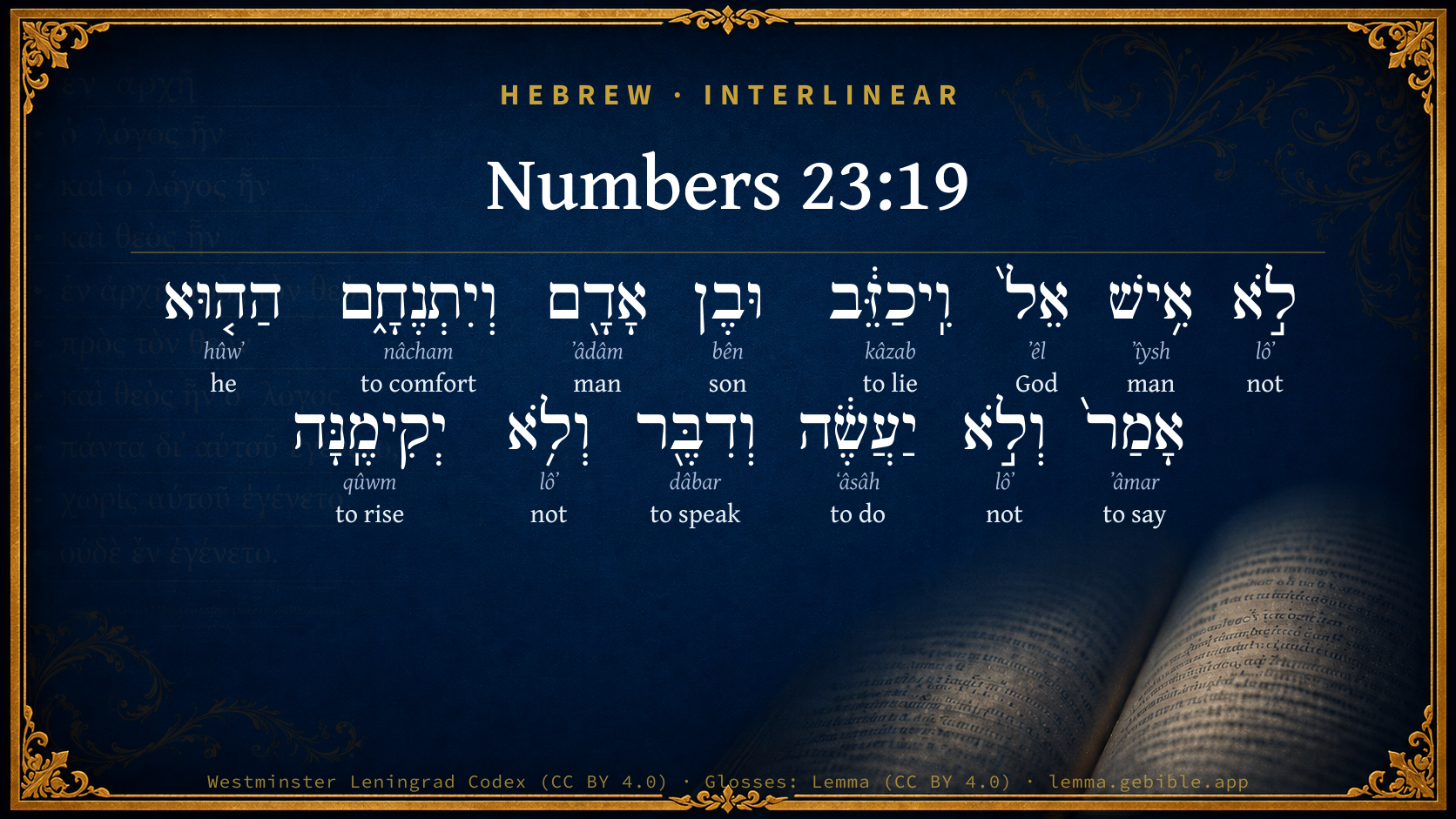
Hebrew (Westminster Leningrad Codex) Numbers 23:19 appears in the Hebrew Old Testament. The text above is from the Westminster Leningrad Codex. Each word links to its Strong’s number, a concise gloss, and parsing drawn from the Open Scriptures Hebrew Bible morphology. Click any word for its full Brown-Driver-Briggs (BDB) entry.
Download image
Cite this verse

Numbers 23:19 (World English Bible). Public Domain. Lemma interlinear Bible study tool, https://lemma.gebible.app/v/numbers/23/19.

Show BibTeX & RIS
BibTeX
RIS
English Translation
God is not a man, that he should lie, Neither the son of man, that he should repent: Has he said, and will he not do it? Or has he spoken, and will he not make it good?
World English Bible · Public Domain
Highlights
  • 1 first appearance in the Hebrew Bible
Full analysis ↓
Download a study sheet

One document with this verse’s original text, its word-by-word gloss line, the meaning frame, cross-references with their text, attributed commentary, and full source and license credits — printable, and it pastes into notes with its structure intact.

This verse Autodidact and up

Study sheet (.html) Plain text (.txt)

A passage Seminary Student

Up to 50 verses in one chapter. A passage sheet keeps up to 6 commentary sources and 12 cross-references per verse, in the order this page ranks them, and says so on the sheet whenever that leaves anything out. Ask for a single verse and you get the Autodidact verse sheet above.

Everything on this page stays free to read, with no account — the sheet is a download of what is already on screen, not access to it.

Want to remove ads? Support Godless Engineer
Compare translations 3

The same verse in 3 English versions, stacked beneath the original-language interlinear above. Click any original word for its lexicon entry.

Each is an independent rendering of the whole verse — the interlinear is not word-aligned to these translations.

Highlighted words mark where these versions differ — a whole-verse word diff, not a word-by-word alignment.

  • World English Bible Public Domain
    God is not a man, that he should lie, Neither the son of man, that he should repent: Has he said, and will he not do it? Or has he spoken, and will he not make it good?
  • King James Version Public Domain
    God is not a man, that he should lie; neither the son of man, that he should repent: hath he said, and shall he not do it? or hath he spoken, and shall he not make it good?
  • unfoldingWord Literal Text CC BY-SA 4.0
    God is not a man that he should lie, or a son of man that he should change his mind. Has he said and will not do? Or has he spoken and will not make it arise?

unfoldingWord Literal Text — © unfoldingWord, licensed CC BY-SA 4.0. Word-aligned USFM3 via Door43 (git.door43.org/unfoldingWord/en_ult).

Versions to compare (up to 4)

3 of 4 selected

Show all 18 translations

Every available English version of this verse, each an independent rendering of the whole verse.

  • World English Bible Public Domain
    God is not a man, that he should lie, Neither the son of man, that he should repent: Has he said, and will he not do it? Or has he spoken, and will he not make it good?
  • Berean Standard Bible Public Domain
    God is not a man, that He should lie, or a son of man, that He should change His mind. Does He speak and not act? Does He promise and not fulfill?
  • Majority Standard Bible Public Domain
    God is not a man, that He should lie, or a son of man, that He should change His mind. Does He speak and not act? Does He promise and not fulfill?
  • King James Version Public Domain
    God is not a man, that he should lie; neither the son of man, that he should repent: hath he said, and shall he not do it? or hath he spoken, and shall he not make it good?
  • American Standard Version (1901) Public Domain
    God is not a man, that he should lie, Neither the son of man, that he should repent: Hath he said, and will he not do it? Or hath he spoken, and will he not make it good?
  • Revised Version (1885) Public Domain
    God is not a man, that he should lie; Neither the son of man, that he should repent: Hath he said, and shall he not do it? Or hath he spoken, and shall he not make it good?
  • Geneva Bible (1599) Public Domain
    God is not as man, that he should lie, neither as the sonne of man that he shoulde repent: hath he sayde and shall he not do it? and hath he spoken, and shall he not accomplish it?
  • Douay-Rheims (1899) Public Domain
    God is not a man, that he should lie, nor as the son of man, that he should be changed. Hath he said then, and will he not do? hath he spoken, and will he not fulfil?
  • Young's Literal Translation Public Domain
    God `is' not a man -- and lieth, And a son of man -- and repenteth! Hath He said -- and doth He not do `it'? And spoken -- and doth He not confirm it?
  • Literal Standard Version CC BY-SA 4.0
    God [is] not a man—and lies, || And a son of man—and relents! Has He said—and He does not do [it]? And spoken—and He does not confirm it?
  • Unlocked Literal Bible CC BY-SA 4.0
    God is not a man, that he should lie, Or a human being, that he should change his mind. Has he promised anything without doing it? Has he said he would do something without carrying it out?
  • unfoldingWord Literal Text CC BY-SA 4.0
    God is not a man that he should lie, or a son of man that he should change his mind. Has he said and will not do? Or has he spoken and will not make it arise?
  • Darby Bible Public Domain
    ùGod is not a man, that he should lie; neither a son of man, that he should repent. Shall he say and not do? and shall he speak and not make it good?
  • World Messianic Bible Public Domain
    God is not a man, that he should lie, nor a son of man, that he should repent. Has he said, and he won’t do it? Or has he spoken, and he won’t make it good?
  • Webster's Bible Public Domain
    God is not a man, that he should lie; neither the son of man, that he should repent: hath he said, and shall he not do it? or hath he spoke, and shall he not make it good?
  • Free Bible Version CC BY-SA 4.0
    God isn't a human being who would lie. He's not a mere mortal who changes his mind. Does he say he's going to do something but doesn't? Does he make promises he doesn't carry out?
  • Bible in Basic English Public Domain
    God is not a man, to say what is false; or the son of man, that his purpose may be changed: what he has said, will he not do? and will he not give effect to the words of his mouth?
  • JPS Tanakh (1917) Public Domain
    God is not a man, that He should lie; neither the son of man, that He should repent: when He hath said, will He not do it? or when He hath spoken, will He not make it good?

Literal Standard Version (2020), Covenant Press — licensed CC BY-SA 4.0. Text via the HelloAO Bible API (eBible.org). Unlocked Literal Bible (unfoldingWord) — licensed CC BY-SA 4.0. Text via the HelloAO Bible API (eBible.org). unfoldingWord Literal Text — © unfoldingWord, licensed CC BY-SA 4.0. Word-aligned USFM3 via Door43 (git.door43.org/unfoldingWord/en_ult). Free Bible Version, Dr. Jonathan Gallagher — licensed CC BY-SA 4.0. Text via the HelloAO Bible API (eBible.org).

Word by word

More ways to search: Search by grammar → Find every occurrence → Compare this word →

Practice this passage: Drill this verse → Learn its vocabulary →

וִֽיכַזֵּ֔ב
kâzab
H3576
“and · to lie”
Conjunction + Verb, Piel, Imperfect, 3rd Person, Masculine, Singular
Part of Speech
Conjunction + Verb
Stem
Piel
Form
Imperfect
Person
3rd Person
Gender
Masculine
Number
Singular
Full BDB Definition

Origin: a primitive root

TWOT: 970

to lie, tell a lie, be a liar, be found a liar, be in vain, fail - (Qal) liar (participle) - (Niphal) to be proven to be lying - (Piel) - to lie, tell a lie, tell a lie with, deceive - to disappoint, fail - (Hiphil) to make a liar, prove to be a liar
  1. לֹ֣א lôʼ H3808 “not” Particle, Negative
  2. אִ֥ישׁ ʼîysh H376 “man” Noun, Common, Masculine, Singular, Absolute
  3. אֵל֙ ʼêl H410 “God” Noun, Common, Masculine, Singular, Absolute
  4. וּבֶן bên H1121 “and · son of” Conjunction + Noun, Common, Masculine, Singular, Construct
  5. אָדָ֖ם ʼâdâm H120 “man” Noun, Common, Masculine, Singular, Absolute
  6. וְיִתְנֶחָ֑ם nâcham H5162 “and · to comfort” Conjunction + Verb, Hithpael, Imperfect, 3rd Person, Masculine, Singular
  7. הַה֤וּא hûwʼ H1931 “the · he” Particle, Definite Article + Pronoun, Personal, 3rd Person, Masculine, Singular
  8. אָמַר֙ ʼâmar H559 “to say” Verb, Qal, Perfect, 3rd Person, Masculine, Singular
  9. וְלֹ֣א lôʼ H3808 “and · not” Conjunction + Particle, Negative
  10. יַעֲשֶׂ֔ה ʻâsâh H6213 “to do” Verb, Qal, Imperfect, 3rd Person, Masculine, Singular
  11. וְדִבֶּ֖ר dâbar H1696 “and · to speak” Conjunction + Verb, Piel, Perfect, 3rd Person, Masculine, Singular
  12. וְלֹ֥א lôʼ H3808 “and · not” Conjunction + Particle, Negative
  13. יְקִימֶֽנָּה qûwm H6965 “to rise · her” Verb, Hiphil, Imperfect, 3rd Person, Masculine, Singular + Suffix, Personal, 3rd Person, Feminine, Singular

About this verse

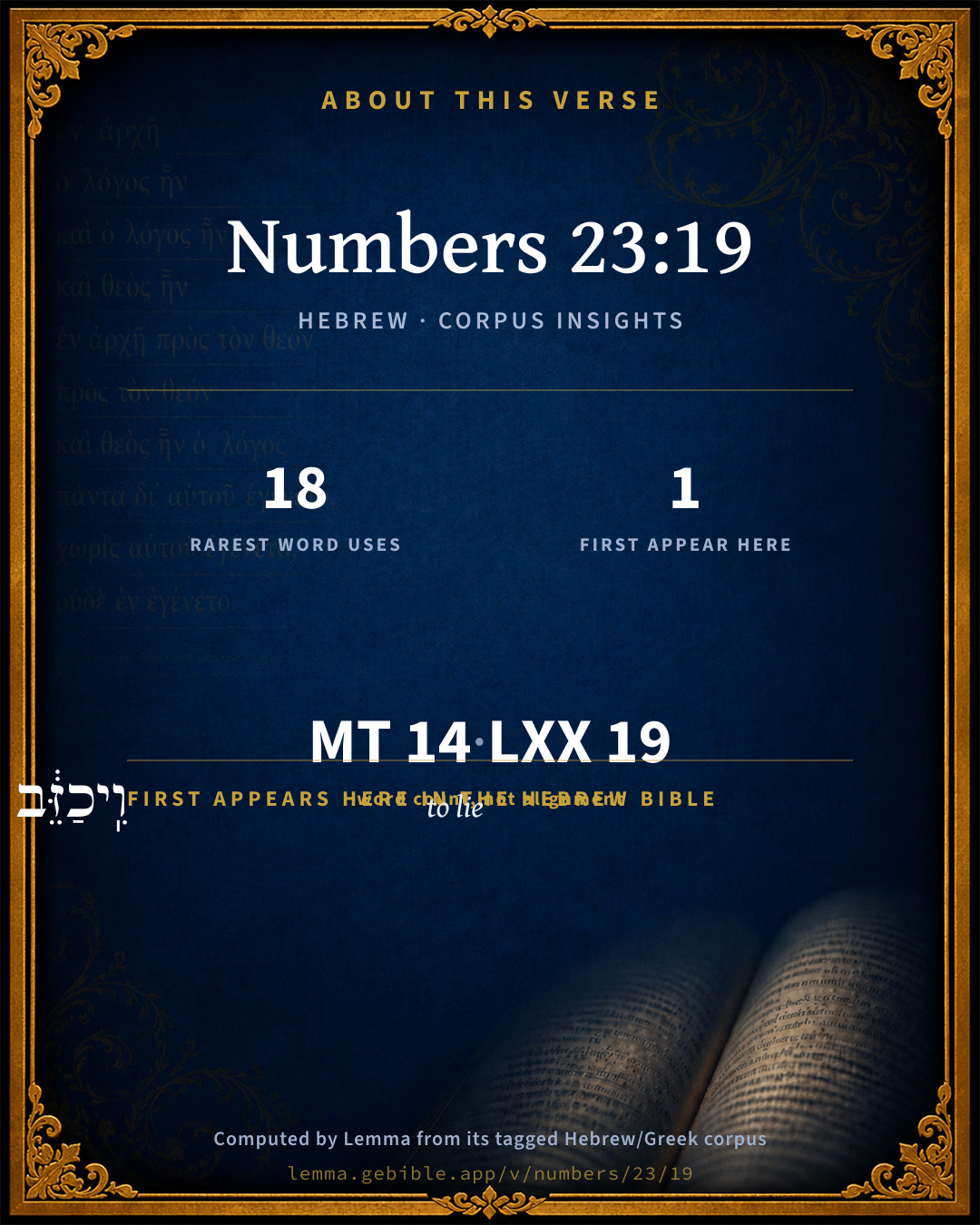
These counts appear in no published source. They are computed here, from the morphology-tagged text and Lemma’s own curated glosses. What Lemma adds →

14
words
12
distinct lemmas
Pentateuch
section

Notable vocabulary

The rarest word here is וִֽיכַזֵּ֔ב to lie H3576 — appearing just 18 times in the whole Hebrew Bible.

First appearance in Scripture

This word makes its first canonical appearance in the Hebrew Bible here:

  • וִֽיכַזֵּ֔ב to lie H3576

Shared distinctive vocabulary

וִֽיכַזֵּ֔ב to lie H3576 occurs in 18 verses of the Hebrew Bible. Also found in:

Grammatical profile

  • 6 verbs
  • 4 nouns
  • 1 pronoun
  • 3 particles

Verb forms

  • וִֽיכַזֵּ֔ב Piel · Imperfect
  • וְיִתְנֶחָ֑ם Hithpael · Imperfect
  • אָמַר֙ Qal · Perfect
  • יַעֲשֶׂ֔ה Qal · Imperfect
  • וְדִבֶּ֖ר Piel · Perfect
  • יְקִימֶֽנָּה Hiphil · Imperfect

Repetition

A word recurs within this verse — often emphatic in Hebrew:

Hebrew & Septuagint length

In English translation the verse runs 38 words from the Hebrew and 31 from the Septuagint (LXX English) — closely comparable.

A rough comparison of the two English renderings, which tokenize alike — not a word-level alignment.

Word counts can differ between the Hebrew and the Greek without any difference in meaning — e.g. the Hebrew direct-object marker אֵת has no separate Greek word, and Greek often adds the article ὁ.

In the original languages it is 14 Hebrew tokens and 19 Greek tokens — but the two are counted differently (Hebrew bundles its prefixes and suffixes into one token; the Greek is in lemma form), so that isn’t a like-for-like length.

Cross-references

12

Topical passages linked to Numbers 23:19 in the Treasury of Scripture Knowledge — connected by theme and wording, ordered by reader-vote popularity; previews shown in the World English Bible.

  • 1 Samuel 15:29 Also the Strength of Israel will not lie nor repent; for he is not a man, that he should repent.
  • James 1:17 Every good gift and every perfect gift is from above, coming down from the Father of lights, with whom can be no variation, nor turning shadow.
  • Malachi 3:6 "For I, Yahweh, don't change; therefore you, sons of Jacob, are not consumed.
  • Hebrews 6:18 that by two immutable things, in which it is impossible for God to lie, we may have a strong encouragement, who have fled for refuge to take hold of the hope set before us.
  • Titus 1:2 in hope of eternal life, which God, who can't lie, promised before eternal times;
  • Luke 21:33 Heaven and earth will pass away, but my words will by no means pass away.
  • Romans 11:29 For the gifts and the calling of God are irrevocable.
  • Habakkuk 2:3 For the vision is yet for the appointed time, and it hurries toward the end, and won't prove false. Though it takes time, wait for it; because it will surely come. It won't delay.
  • Psalms 89:35 Once have I sworn by my holiness, I will not lie to David.
  • Hosea 11:9 I will not execute the fierceness of my anger. I will not return to destroy Ephraim: For I am God, and not man; the Holy One in the midst of you; And I will not come in wrath.
  • Micah 7:20 You will give truth to Jacob, and mercy to Abraham, As you have sworn to our fathers from the days of old.
  • 1 Chronicles 17:17 This was a small thing in your eyes, God; but you have spoken of your servant's house for a great while to come, and have regarded me according to the estate of a man of high degree, Yahweh God.

Cross-references courtesy of OpenBible.info (CC BY 4.0).

Hebrew and Greek witnesses Masoretic Hebrew ↔ Greek Septuagint

The same verse in the two great witnesses to the Old Testament, shown verse-for-verse.

These are two independent witnesses, not word-aligned to each other, and the Septuagint is shown in lemma (dictionary) form.

Hebrew Numbers 23:19 Masoretic · Westminster Leningrad Codex

לֹ֣א אִ֥ישׁ אֵל֙ וִֽיכַזֵּ֔ב וּבֶן אָדָ֖ם וְיִתְנֶחָ֑ם הַה֤וּא אָמַר֙ וְלֹ֣א יַעֲשֶׂ֔ה וְדִבֶּ֖ר וְלֹ֥א יְקִימֶֽנָּה

God is not a man, that he should lie, Neither the son of man, that he should repent: Has he said, and will he not do it? Or has he spoken, and will he not make it good?

World English Bible · Public Domain

Greek LXX Numbers 23:19 Septuagint · lemma form

οὐ ὡς ἄνθρωπος ὁ θεός διαἀρτάω οὐδέ ὡς υἱός ἄνθρωπος ἀποεἰλέω αὐτός εἶπον οὐ ποιέω λαλέω καί οὐ ἐνμένω

God is not as man to waver, nor as the son of man to be threatened; shall he say and not perform? shall he speak and not keep to his word?

LXX2012 (modern English Septuagint) · Public Domain

On this verse, Haydock's Catholic Bible Commentary discusses the Septuagint’s reading. Read the note in Commentary ↓

Hebrew: Westminster Leningrad Codex (CC BY 4.0). Greek: Septuagint (public domain); English from LXX2012 (modern English Septuagint) (Public Domain). How the Septuagint differs from the Hebrew →

Targum (Aramaic paraphrase)

2

The Targum is the ancient Jewish Aramaic paraphrase of the Hebrew Scriptures — an interpretive translation, not the Hebrew text itself. Onkelos (literal) and Pseudo-Jonathan (expansive) render the Torah, and Jonathan the Prophets. Coverage is partial: where no permissively-licensed English translation exists for a verse, only the Aramaic is shown. This is verse-level text, not a word-by-word alignment to the Hebrew.

  1. Targum Onkelos Torah (Genesis–Deuteronomy)
    לָא כְמִלֵי בְּנֵי אֱנָשָׁא מֵימַר אֱלָהָא בְּנֵי אֱנָשָׁא אָמְרִין וּמְכַדְבִין וְאַף לָא כְעוֹבָדֵי בְּנֵי בִּשְׂרָא דְאִינוּן גָזְרִין לְמֶעְבַּד וְתַיְבִין וּמִתְמַלְכִין דְהוּא אָמַר וְעָבֵיד וְכָל מֵימְרֵהּ מִתְקַיָם

    (no public-domain English translation for this verse)

    Targum Onkelos — Aramaic: “Onkelos Genesis” (public domain); “Onkelos Exodus” (public domain); “Onkelos Leviticus” (public domain); “Onkelos Numbers” (public domain); “Onkelos Deuteronomy” (public domain). English: “Sefaria Community Translation” (CC0 1.0 (public-domain dedication)); “J.W. Etheridge. The Targums of Onkelos and Jonathan Ben Uzziel on the Pentateuch. London: Longmans, Green, 1862” (public domain). Text via Sefaria.

  2. Targum Pseudo-Jonathan Torah (Genesis–Deuteronomy)
    לָא כְמִילֵי בַּר נַשׁ מֵימַר אֱלָהָא חַי וְקַיָם רִבּוֹן כָּל עָלְמַיָא יְיָ דְבַר נַשׁ אָמַר וּמְסָרֵב וְאוּף לָא דַמְיַין עוֹבָדוֹי לְעוֹבָדֵי בְּנֵי בִישְרָא דְמִתְמַלְכִין וְתַיְיבִין מִמַה דְגָזְרִין בְּרַם רִבּוֹן כָּל עָלְמַיָא יְיָ אָמַר לְאַסְגָאָה יַת עַמָא הָדֵין הֵי כְּכוֹכְבֵי שְׁמַיָא וּלְאַחֲסָנוֹתְהוֹן יַת אֲרַע כְּנַעֲנָאֵי הַאֶפְשַׁר דְאָמַר וְלָא יֶעֱבַד וּמַה דְמַלֵיל הַאֶפְשַׁר דְלָא יְקַיְימִינֵיהּ

    The Word of the living God is not as the words of men for the Lord, the Ruler of all worlds, is the unchangeable (but) man speaketh and denieth. Neither are His works like the works of the children of flesh, who consult, and then repent them of what they had decreed. But when the Lord of all worlds hath said, I will multiply this people as the stars of the heavens, and will give them to possess the land of the Kenaanites, is He not able to perform what He hath spoken? and what He hath said, can He not confirm it?

    Targum Pseudo-Jonathan — Aramaic: “Targum Jonathan on Genesis” (public domain); “Targum Jonathan on Exodus” (public domain); “Targum Jonathan on Leviticus” (public domain); “Targum Jonathan on Numbers” (public domain); “Targum Jonathan on Deuteronomy” (public domain). English: “The Targum of Jonathan ben Uzziel, trans. J. W. Etheridge, London, 1862” (public domain). Text via Sefaria.

Commentary

Notes on Numbers 23:19 from classic Christian and Jewish commentators (each source and its license shown beneath its notes). The classic Christian expositions comment on the surrounding passage and are grouped to its opening verse, so a note may address several verses; the Jewish commentaries on the Tanakh (Rashi and others) are per-verse, so they appear only where the commentator wrote on this verse.

Lemma curates 59 commentaries, every one of them public domain or Creative Commons licensed, each selected and text-cleaned for this edition rather than reprinted as found. About our sources →

Trapp's Complete Commentary

John Trapp

Num 23:19 God [is] not a man, that he should lie; neither the son of man, that he should repent: hath he said, and shall he not do [it]? or hath he spoken, and shall he not make it good?

Ver. 19. That he should repent.] When at any time God is said to repent, it is Mutatio rei, non Dei; effectus non affectus; facti non consilii: it is not a change of his will, but of his work.

John Trapp, A Commentary or Exposition upon All the Books of the Old and New Testament (1647–1656) — public domain. Text from a community e-Sword module.

The Biblical Illustrator

Joseph S. Exell

Num_23:19

God is not a man, that He should lie.

The unchangeable God

I. God is unchangeable. God cannot change; to suppose that He could change would be to suppose Him not Divine. A finite being may refuse to change, adhering rigidly to some purpose; but all the while that being is capable of change, there is n thing in his nature which makes it absolutely impossible that he should change. But it is so with God. We here speak of unchangeableness in regard of Gods dealings with His creatures, though of course it is also in Himself, in His essence, in His own property, that God is unchangeable; and it is an amazing and overwhelming contemplation, that of our Creator as in no respect capable of change, immutable because infinitely perfect.

II. The contrast between God and man. This unchangeableness is indispensable to the Creator, but incommunicable to the creature. It is indispensable to the Creator, forasmuch as the Creator must he in every respect infinite. But all change ends in addition or diminution: if anything be added, He was not infinite before; if anything be diminished, He is not infinite after. But if indispensable in the Creator, it is incommunicable to the creature. We say nothing against the powers of God, when we say that God could not have made an unchangeable creature. Must not that which is unchangeable be self-existent, and therefore eternal? That which has already had beginning, has already undergone change--the change from nothing to something, so that a creature, because not eternal, cannot be unchangeable. God alone is unchangeable, because God alone is eternal. It is self-evident that He cannot make an eternal creature, and therefore certain that He cannot make an unchangeable creature. The creature, then, is changing, the sun as well as the atom, the archangel no less than the worm (Psa_102:25-27). Was it only of the material fabric of the earth, with its many productions-of the firmament, with its majestic troop of stars, that the Psalmist asserted this? Nay, it is true of the intelligent creation as well as of the material. And spirits are immortal: sparks from the eternal fire, they shall never be quenched; but though immortal, they shall not be the same; indestructible, they shall be always on the march. Angel and man, they shall not, as we have already said, be ever at a stand. Stand! when there are new heights to be scaled, new depths to be fathomed? Nay, it were imperfection, it were wretchedness. It is the glory of the Creator that He never changes; it is the glory of the creature to be always changing. Eternity shall be one mighty progress to all except the Eternal. I am Jehovah, I change not, the Father of lights, with whom is no variableness, neither shadow of turning. (H. Melvill, B. D.)

The word of God unchangeable

1. God is not a man, that He should lie. Balaam knew how capable he himself was of deceit and falsehood, how liable to be changed by bribery from one course to another; and it is possible that he might have entertained such unworthy notions of the Almighty as to imagine Him also movable and uncertain. But God has no admixture of evil, no imperfection; nor can He be tempted with evil. Men have their own corrupt interests to serve; their own gain to study, their own gratification to seek: and when these things cannot be so readily compassed by integrity, recourse is often had to deceitful dealing. It may not always be that a mans word is actually broken; but there is very commonly, in the children of this world, some kind of double dealing to suit a carnal purpose. From all this, and from all approach to this, the Lord is purely free: He can neither deceive nor be deceived.

2. Neither the son of man, that He should repent, or change His purpose. Man is ignorant and short-sighted; often knows not what will be for the best: and the plan, which he bad contrived with his utmost skill, is not seldom injurious; and thus he is compelled to alter and relinquish. But God is all-wise: O the depth of the riches both of the wisdom and knowledge of God!

3. We may infer--

(1) That all the Divine judgments against sin and sinners will be infallibly executed. And--

(2) That every promise of God to His people will, in due season, be abundantly accomplished.

1. The imminent danger of sin, and the certain ruin from it, if persisted in, are by no means believed and perceived, as they ought to be. The Almighty has declared, throughout His word of truth, that He is a God of holiness; and that in unholiness, in disobedience, in unrepented guilt, no man can be accepted, no man can approach Him.

2. And, blessed be the holy name of God, the gracious promises of mercy to His faithful and obedient servants are not less frequent than the threatenings of wrath upon the impenitent and forgetful. (J. Slade, M. A.)

The unchangeableness of Jehovah

I. Some men think that God will lie. God has told us, with strong and repeated asseverations, that we must be born again (Joh_3:7); but this is totally disbelieved by--

1. The profane. They persuade themselves that such strictness in religion, as is implied in the new birth, is not necessary; and that they shall go to heaven in their own way.

2. The self-righteous. These consider regeneration as a dream of weak enthusiasts, and are satisfied with the form of godliness, without ever experiencing the power of it.

3. The hypocritical professors of religion. These, having changed their creed, together with their outward conduct, fancy themselves Christians, notwithstanding their faith n either overcomes the world, nor works by love, nor purifies their hearts. That all these persons think God will lie, is evident beyond a doubt; for if they really believed that old things must pass away and all things become new (2Co_5:17), before they can enter into the kingdom of heaven, they would feel concerned to know whether any such change had taken place in them; nor would they be satisfied till they had a Scriptural evidence that they were indeed new creatures in Christ Jesus.

II. Others fear he may lie. This is common with persons--

1. Under conviction of sin. When men are deeply convinced of sin, they find it exceedingly difficult to rest simply on the promises of the Gospel; such as Joh_6:37; Isa_1:18; Isa_55:1.

2. Under temptation or desertion. God has declared that He will not suffer His people to be tempted above what they are able to bear (1Co_10:13). But when they come into temptation, they are apt to say, as David, I shall one day perish, &c. (1Sa_27:1).

III. But God neither will nor can lie.

1. He will not lie.

(1) Let us hear the testimonies of those who have tried Him. Moses (Deu_32:4); Joshua (Jos_23:14); Samuel (1Sa_15:29).

(2) Let us attend to Gods own assertions and appeals (Isa_5:4; Isa_49:19). Would He ever venture to speak thus strongly on His own behalf if His creatures could make good their accusations against Him?

(3) Let us look to matter of fact. Are not His past actions so many types and pledges of what He will hereafter perform? (2Pe_2:4-9; Jud_1:7).

2. He cannot lie. Truth is as essential to the Divine nature as goodness, wisdom, power, or any other attribute; so that He can as easily cease to be good, or wise, or powerful, as He can suffer one jot or tittle of His word to fail. (C. Simeon, M. A.)

The Lord is unchangeably true in all His ways, words, and works

His decrees are immutable and irrevocable, and without shadow of turning (Psa_105:7-8; Psa_105:10). To this purpose the apostle saith, The gifts and calling of God are without repentance (Rom_11:29). By all these places we see that God is unchangeable in His mercy and goodness toward His Church and children. The reasons follow to be considered.

1. First, He is not like unto man, His ways are not like mans ways, nor His thoughts like unto mans thoughts; but as far as heaven is distant from the earth, so far are the works of God from ours. We know by experience the changeable nature of man. He is constant to-day, he changeth to-morrow. He loveth one day, and hateth another.

2. Secondly, His love and mercy to His people is not changeable as the moon, unconstant as the wind, floating as the sea, uncertain as the weather, but stable as the earth that cannot be moved out of his place, and steadfast as Mount Sion that remaineth for ever. This will plainly appear unto us if we consider the similitudes whereby it is expressed. His love is like to the covenant of waters, and as sure as the promise that He made to Noah, that the waters should no more overflow the whole earth, as the prophet Isaiah teacheth, Isa_54:7-9.

3. Again, His goodness is as the ordinance of God, that hath set an order for summer and winter, for day and night, for seed-time and harvest, for cold and heat, which shall not be changed, therefore the Lord saith (Jer_31:35; Jer_33:20). Nay, His mercy is said to be more stable than the mountains (Isa_54:10).

Now let us come to the uses of this doctrine.

1. First, hereby we learn that God is to be preferred before all creatures.

2. Secondly, we may from hence assure ourselves that God will make us unchangeable like Himself, and we may rejoice in the comfort of thin His favour. For seeing His nature is unchangeable, He will make us in our men, sure partakers of immortality. This is a great comfort unto us in these days of sorrow, to consider that the time will come, when our state shall be changed, and we continue for ever without change. Here we are subject to many turnings and returnings, but after this life shall be no more place for changing; our happiness shall be unchangeable, and firmly established with God. This the prophet sets down (Psa_16:12).

3. Thirdly, it teacheth that it is time for us to repent and turn unto God. An unchangeable God, an unchangeable word. Let us be transformed into the obedience of it. It is not a leaden rule to bend every way to us. All our ways must be framed unto it. And when once we are turned to God, let us not return back again to our old ways, but persevere constant unto the end. The unchangeable God requireth an unchangeable servant.

4. Lastly, herein is great comfort offered to the servants of God, as on the other side horror to the wicked and disobedient. For seeing God is immutable, we may from hence take strong consolation by former examples of Gods dealing toward His children, and in all temptations build ourselves upon that blessed experience, as upon a sure foundation that can never fail us. (W. Attersoll.)

The Biblical Illustrator, edited by Joseph S. Exell (c. 1880s–1900s) — public domain. Text from a community e-Sword module.

Joseph Benson's Commentary

Num 23:19. That he should lie — Break his promise made to his people for their preservation and benediction. Neither the son of man that he should repent — Change his counsels or purposes, as men change theirs, either because they are not able to execute them, or because they are better informed, or their minds are changed by some unexpected occurrence, or by their passions, none of which things have place in God. When the inspired writers speak of God’s repenting, as Jer 18:8, and Amo 7:3-6, they are to be understood as speaking figuratively, and adapting their language to our apprehensions. They only mean that God changes the course of his providence toward mankind, according as he sees a change in their dispositions and actions. See note on Gen 6:6.

Joseph Benson's Commentary on the Old and New Testaments (1811–1818) — public domain. Text from a community e-Sword module.

Tyndale Open Study Notes

Tyndale Open Resources

23:19 Because of God’s reliable character, Balaam could do nothing but bless Israel.

Tyndale Open Study Notes — © Tyndale Open Resources, licensed CC BY-SA 4.0. Text via the HelloAO Bible API.

Geneva Bible (1599)

Geneva Bible translators

God’s enemies are compelled to confess that his government is just, constant, and without change or repentance.

Geneva Bible (1599) marginal notes — public domain. Text via Bolls.life.

Adam Clarke's Commentary

Verse 19. God is not a man, that he should lie] This seems to be spoken to correct the foregoing supposition of Balak that God could change his mind. Even the heathen would not allow that their supreme god could be caught in a falsity. Hence AESCHYLUS, in Prometh. vinct. 1068: -

Ψευδηγορειν γαρ ουκ επισταται στομα

Το Διον, αλλα παν επος τελει.

"The mouth of Jove knows not to frame a lie;

But every word finds full accomplishment."

Adam Clarke's Commentary on the Bible (1810–1826) — public domain. Text from a community e-Sword/MySword module.

Ellicott's Commentary for English Readers

(19) Neither the son of man, that he should repent.—The adoption of these words, with slight variation, by Samuel (1Sa_15:29) affords evidence of his familiarity with this portion of the Pentateuch.

A Bible Commentary for English Readers, edited by Charles John Ellicott (1878–1897) — public domain. Text from a community e-Sword module.

The Cambridge Bible for Schools and Colleges

gen. ed. J. J. S. Perowne

19. Neither a son of man] a mere mortal, with human caprices. It is the only occurrence of the expression that is certainly earlier than Ezekiel.

The Cambridge Bible for Schools and Colleges (gen. ed. J. J. S. Perowne; Cambridge University Press, 1878–1918) — public domain. Text from a community e-Sword module.

John Gill's Exposition

God is not a man, that he should lie,.... Man is a creature consisting of a body of flesh and blood, and of a soul, a created and finite spirit; but God, though he has the parts of an human body ascribed to him in a figurative sense, yet is not to be conceived of in a corporeal manner; and though he is a Spirit, yet eternal, immense, and infinite; and much less is as a sinful man, who goes astray from the womb speaking lies; no, let God be true, and every man a liar: he is God, that cannot lie; his counsels of old are faithfulness and truth; his promises yea and amen in Christ; the Scriptures inspired by him are true, and the prophecies of them are punctually accomplished, particularly what he foretold of the people of Israel, and promised unto them; that they should be happy, and inherit the land of Canaan; that be would be true and faithful to them, and there could be no hope, by any means whatever, to make him false and unfaithful to his word: neither the son of man, that he should repent; repentance is found in men, who repent for what they have done, or change their minds, as to what they intended to do or set about; perceiving it to be wrong to do it, or that they are able to do it, some unforeseen thing turning up they were not aware of: but nothing of this kind belongs to God, or can befall him; he never changes his mind, alters his counsels, purposes, and decrees, and never varies in his affections to his people, nor makes void his choice of them, or covenant with them; and his calling of them by his grace, and his gifts of grace bestowed upon them, are without repentance: and particularly with respect to the people of Israel, there was no reason to hope or believe that God would change his purposes or promises respecting their outward happiness, and enjoyment of the land of Canaan; or that ever he would be prevailed upon to curse them, or admit them to be cursed, when he was determined, and had so peremptorily promised that he would bless them:

hath he said, and shall he not do it? or "hath he spoken, and shall he not make it good?" whether it be with regard to things temporal, spiritual, or eternal; for there is no variableness nor shadow of turning in his mind; he never forgets his word, he foresees all events, he is able to perform, and is true and faithful; and therefore whatever is gone out of his lips will never be altered, but will be most certainly fulfilled, Psa 89:34 Isa 14:24.

John Gill's Exposition of the Whole Bible (1746–1763) — public domain (CC PDM 1.0). Text via the HelloAO Bible API.

Haydock's Catholic Bible Commentary

Changed. Hebrew, "repent." Septuagint, "to be overawed by threats." Origen, "to be terrified." In the book of Judith, (viii. 15,) it is said, For God will not threaten like man, nor be inflamed to anger, like the son of man. (Calmet) --- Do. Will he suffer me to curse Israel, after he has once given me a decided prohibition? (Menochius)

George Leo Haydock (1774–1849), Haydock's Catholic Family Bible and Commentary, 1859 edition — public domain. Excludes Psalms (Douay-Rheims chapter numbering differs from Protestant) and Deuterocanonical books (Catholic canon only).

Matthew Poole's English Annotations

That he should lie, i.e. break his faith and promises made to his people for their preservation and benediction.

That he should repent, . e. change his counsels or purposes; which men do, either because they are not able to execute them, or because they are better informed and their minds changed by some unexpected occurrent, or by their lusts and passions, none of which have place in God. And therefore I plainly see that all our endeavours and repeated sacrifices are to no purpose, and can make no impression in God, nor induce him to curse those whom he hath purposed, and solemnly and frequently promised, to bless.

Shall he not do it? Is he like a man that oft speaks and promises what he either never intends, or cannot or will not perform?

Matthew Poole's English Annotations on the Holy Bible (1683–1685) — public domain. Text from a community e-Sword/MySword module.

Whedon's Commentary on the Bible

Daniel D. Whedon

19. God is not a man, that he should lie — The aim of Balak’s second sacrifice was to produce such a change in Jehovah as may be effected in the purposes of men. The king is informed that God is unchangeable, and so wholly unlike fickle men. The principles governing his acts toward man are unalterably fixed independent of what man will freely perform. Having announced that he will reward the righteous and punish the wicked, to reverse this decree would be to overturn his own throne of moral government.

That he should repent — “With regard to his own counsels God repents of nothing; but this does not prevent the repentance of God, understood as an anthropopathic expression, denoting the pain experienced by the love of God on account of the destruction of its creatures. Gen_6:6, note; Exo_32:14.” — Keil. Samuel refused Saul’s request in similar words when urged to revoke his rejection by Jehovah. 1Sa_15:29.

Daniel D. Whedon (gen. ed.), Commentary on the Old and New Testaments (1874–1909) — public domain. Text from a community e-Sword module.

John Wesley's Explanatory Notes

That he should lie - Break his promises made to his people for their preservation and benediction. Repent - Change his counsels or purposes; unless he see iniquity in Jacob.

John Wesley, Explanatory Notes Upon the Whole Bible (1754–1765) — public domain. Text via the GEBible commentary corpus.

Scofield Reference Notes

C. I. Scofield

repent

Scofield "Zec 8:14".

The Scofield Reference Bible (1917 edition), notes by C. I. Scofield — public domain. Text from a community e-Sword module.

unfoldingWord translationNotes

Door43 World Missions Community

Has he promised anything without doing it? Has he said he would do something without carrying it out?

Both of these questions mean the same thing and emphasize that God does what he says he will. These rhetorical questions can be translated as statements. AT: "He has never promised a thing without fulfilling what he promised. He has always done exactly what he said he would do." (See: Parallelism and Rhetorical Question)

I have been commanded to bless

This can be stated in active form. AT: "God has commanded me to bless the Israelites" (See: Active or Passive)

translationWords

God

mind

promise

command

bless

unfoldingWord translationNotes — © Distant Shores Media and the Door43 World Missions Community, licensed CC BY-SA 4.0. Source: git.door43.org/Door43/en_tn.

Rashi

Rabbi Shlomo Yitzchaki (Rashi)

לא איש וגו׳ [GOD IS] NOT A MAN [THAT HE SHOULD LIE] — He has already sworn to them that He will bring them thither and give them as a possession the land of the seven peoples, and you think to slay them in the wilderness?! (cf. Midrash Tanchuma, Vayera 13)

ההוא אמר וגו׳ — Read this in the form of a question: HATH HE SAID, [AND SHALL HE NOT DO IT]? — The rendering of ויתנחם in the Targum, ותיבין ומחמלכין, means, “[and not as the doings of mortals who decide to do things] and again reconsider” — to withdraw from them.

Rashi on the Tanakh — English translations: “The Judaica Press complete Tanach with Rashi, translated by A. J. Rosenberg” (CC BY 4.0); “Pentateuch with Rashi's commentary by M. Rosenbaum and A.M. Silbermann, 1929-1934” (public domain); “The Metsudah Tanach series, Lakewood, N.J” (CC BY 4.0); and “The Book of Joshua, Metsudah Publications, 1997” (CC BY 4.0). Text via Sefaria.

Lesson kit

Teaching starters — assembled from the data on this page, not authored interpretation. Every prompt links to the verse data it draws on. Edit before teaching.

Numbers, in the Pentateuch, opens this verse with 14 words (12 distinct Hebrew lemmas). Its most distinctive word is kâzab (“to lie”). A historical commentator’s framing appears above. Read the whole chapter for the surrounding context.

Discussion questions

  1. How does “to lie” (kâzab) shape what this verse is saying?
  2. This is the first place “to lie” appears in Scripture (first appears here). What does its debut here establish?
  3. How does Judges 16:10, which shares the word «to lie», read alongside this verse?
  4. What does the repetition of “not” (3× in this one verse) do in this verse?
  5. The translations on this page render this verse differently — a whole-verse word diff, not a word-by-word alignment. What might account for the different wordings?
  6. «וִֽיכַזֵּ֔ב» is a Piel Imperfect verb. How does that grammatical form shape the action described?
  7. Compare how Trapp's Complete Commentary and The Biblical Illustrator read this verse. Where do they agree or differ?

Things to notice

Reading settings

Reading text

Shown beneath each verse's original-language words.

Old Testament
Old Testament edition

Read the OT as the Masoretic Hebrew (MT) or the Greek Septuagint (LXX).

English shown for the Greek Septuagint (in the Hebrew ↔ Greek comparison).

Comparing translations? Open the Compare panel on any verse page to stack up to four side by side.