Numbers 31:49

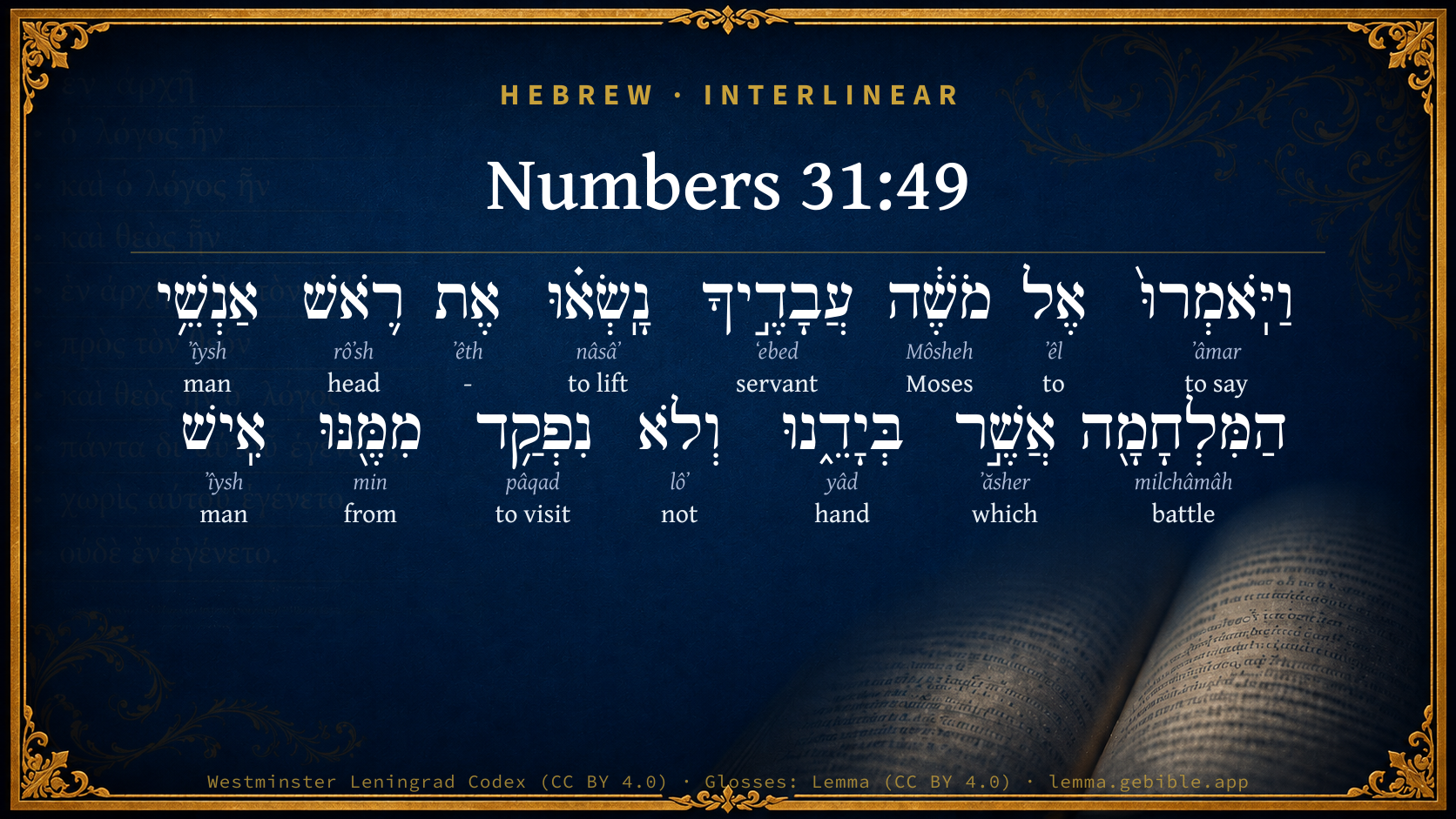
Hebrew (Westminster Leningrad Codex) Numbers 31:49 appears in the Hebrew Old Testament. The text above is from the Westminster Leningrad Codex. Each word links to its Strong’s number, a concise gloss, and parsing drawn from the Open Scriptures Hebrew Bible morphology. Click any word for its full Brown-Driver-Briggs (BDB) entry.
Download image
Cite this verse

Numbers 31:49 (World English Bible). Public Domain. Lemma interlinear Bible study tool, https://lemma.gebible.app/v/numbers/31/49.

Show BibTeX & RIS
BibTeX
RIS
English Translation
and they said to Moses, Your servants have taken the sum of the men of war who are under our charge, and there lacks not one man of us.
World English Bible · Public Domain
Download a study sheet

One document with this verse’s original text, its word-by-word gloss line, the meaning frame, cross-references with their text, attributed commentary, and full source and license credits — printable, and it pastes into notes with its structure intact.

This verse Autodidact and up

Study sheet (.html) Plain text (.txt)

A passage Seminary Student

Up to 50 verses in one chapter. A passage sheet keeps up to 6 commentary sources and 12 cross-references per verse, in the order this page ranks them, and says so on the sheet whenever that leaves anything out. Ask for a single verse and you get the Autodidact verse sheet above.

Everything on this page stays free to read, with no account — the sheet is a download of what is already on screen, not access to it.

Want to remove ads? Support Godless Engineer
Compare translations 3

The same verse in 3 English versions, stacked beneath the original-language interlinear above. Click any original word for its lexicon entry.

Each is an independent rendering of the whole verse — the interlinear is not word-aligned to these translations.

Highlighted words mark where these versions differ — a whole-verse word diff, not a word-by-word alignment.

  • World English Bible Public Domain
    and they said to Moses, Your servants have taken the sum of the men of war who are under our charge, and there lacks not one man of us.
  • King James Version Public Domain
    And they said unto Moses, Thy servants have taken the sum of the men of war which are under our charge, and there lacketh not one man of us.
  • unfoldingWord Literal Text CC BY-SA 4.0
    And they said to Moses, “Your servants have lifted up the heads of the men of the war who were in our hand, and not a man from us is missing.

unfoldingWord Literal Text — © unfoldingWord, licensed CC BY-SA 4.0. Word-aligned USFM3 via Door43 (git.door43.org/unfoldingWord/en_ult).

Versions to compare (up to 4)

3 of 4 selected

Show all 18 translations

Every available English version of this verse, each an independent rendering of the whole verse.

  • World English Bible Public Domain
    and they said to Moses, Your servants have taken the sum of the men of war who are under our charge, and there lacks not one man of us.
  • Berean Standard Bible Public Domain
    and said, “Your servants have counted the soldiers under our command, and not one of us is missing.
  • Majority Standard Bible Public Domain
    and said, “Your servants have counted the soldiers under our command, and not one of us is missing.
  • King James Version Public Domain
    And they said unto Moses, Thy servants have taken the sum of the men of war which are under our charge, and there lacketh not one man of us.
  • American Standard Version (1901) Public Domain
    and they said unto Moses, Thy servants have taken the sum of the men of war that are under our charge, and there lacketh not one man of us.
  • Revised Version (1885) Public Domain
    and they said unto Moses, Thy servants have taken the sum of the men of war which are under our charge, and there lacketh not one man of us.
  • Geneva Bible (1599) Public Domain
    And saide to Moses, Thy seruants haue taken the summe of the men of warre which are vnder our authoritie, and there lacketh not one man of vs.
  • Douay-Rheims (1899) Public Domain
    We thy servants have reckoned up the number of the fighting men, whom we had under our hand, and not so much as one was wanting.
  • Young's Literal Translation Public Domain
    and they say unto Moses, `Thy servants have taken up the sum of the men of war who `are' with us, and not a man of us hath been missed;
  • Literal Standard Version CC BY-SA 4.0
    and they say to Moses, “Your servants have taken up the sum of the men of war who [are] with us, and not a man of us has been missed;
  • Unlocked Literal Bible CC BY-SA 4.0
    They said to him, “Your servants have counted the soldiers who are under our command, and not one man is missing.
  • unfoldingWord Literal Text CC BY-SA 4.0
    And they said to Moses, “Your servants have lifted up the heads of the men of the war who were in our hand, and not a man from us is missing.
  • Darby Bible Public Domain
    and they said to Moses, Thy servants have taken the sum of the men of war who were under our hand, and there is not one man of us lacking.
  • World Messianic Bible Public Domain
    They said to Moses, “Your servants have taken the sum of the men of war who are under our command, and there lacks not one man of us.
  • Webster's Bible Public Domain
    And they said to Moses, Thy servants have taken the sum of the men of war who are under our charge, and there lacketh not one man of us.
  • Free Bible Version CC BY-SA 4.0
    and told him, “We, your servants, have checked the troops we command and not a single man is missing.
  • Bible in Basic English Public Domain
    And said to him, Your servants have taken note of the number of all the fighting-men under our orders, and every one is present;
  • JPS Tanakh (1917) Public Domain
    and they said unto Moses: 'Thy servants have taken the sum of the men of war that are under our charge, and there lacketh not one man of us.

Literal Standard Version (2020), Covenant Press — licensed CC BY-SA 4.0. Text via the HelloAO Bible API (eBible.org). Unlocked Literal Bible (unfoldingWord) — licensed CC BY-SA 4.0. Text via the HelloAO Bible API (eBible.org). unfoldingWord Literal Text — © unfoldingWord, licensed CC BY-SA 4.0. Word-aligned USFM3 via Door43 (git.door43.org/unfoldingWord/en_ult). Free Bible Version, Dr. Jonathan Gallagher — licensed CC BY-SA 4.0. Text via the HelloAO Bible API (eBible.org).

Word by word

More ways to search: Search by grammar → Find every occurrence → Compare this word →

Practice this passage: Drill this verse → Learn its vocabulary →

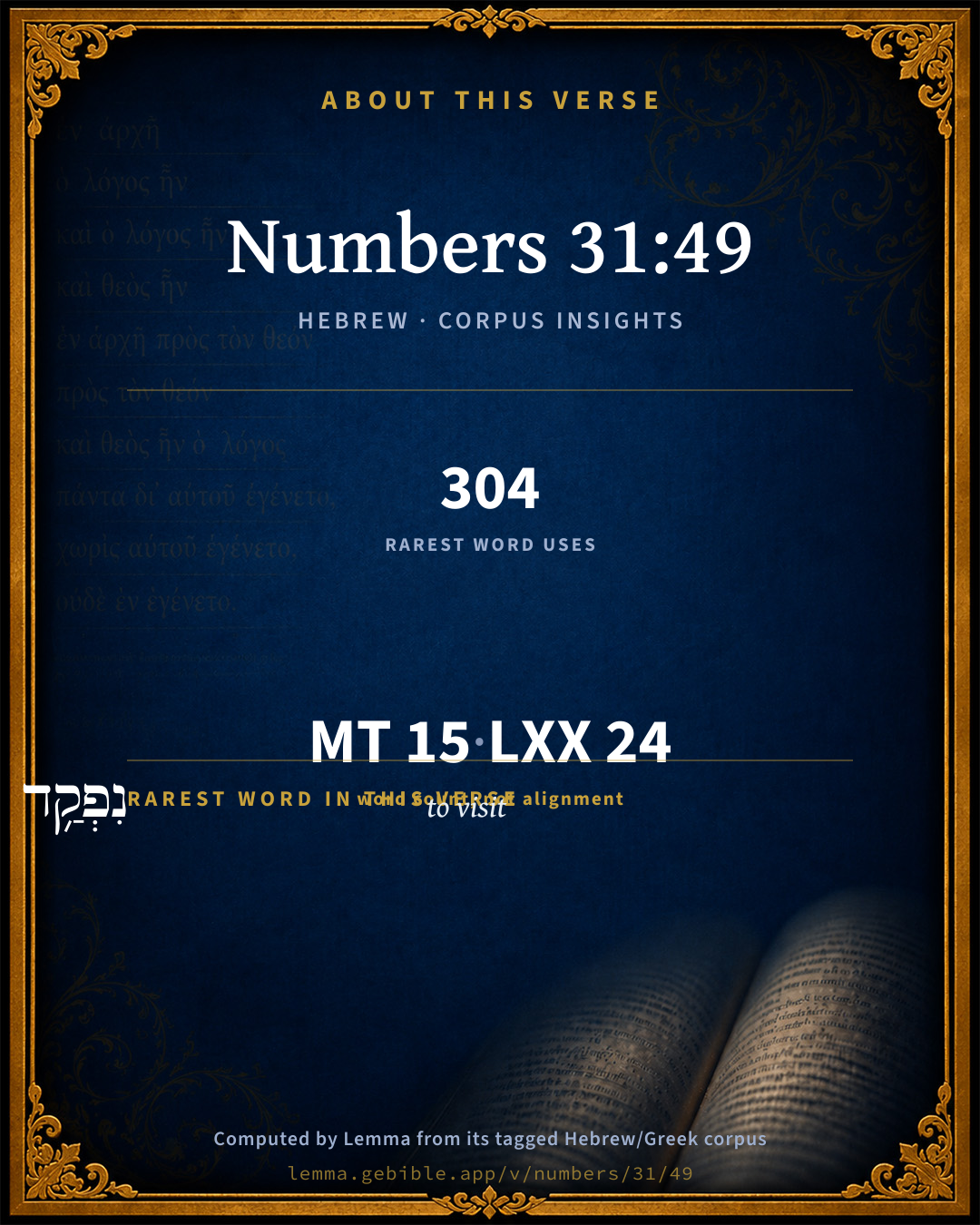
נִפְקַ֥ד
pâqad
H6485
“to visit”
Verb, Niphal, Perfect, 3rd Person, Masculine, Singular
Part of Speech
Verb
Stem
Niphal
Form
Perfect
Person
3rd Person
Gender
Masculine
Number
Singular
Full BDB Definition

Origin: a primitive root

TWOT: 1802

to attend to, muster, number, reckon, visit, punish, appoint, look after, care for (verb) - (Qal) - to pay attention to, observe - to attend to - to seek, look about for - to seek in vain, need, miss, lack - to visit - to visit upon, punish - to pass in review, muster, number - to appoint, assign, lay upon as a charge, deposit - (Niphal) - to be sought, be needed, be missed, be lacking - to be visited - to be visited upon - to be appointed - to be watched over - (Piel) to muster, call up - (Pual) to be passed in review, be caused to miss, be called, be called to account - (Hiphil) - to set over, make overseer, appoint an overseer - to commit, entrust, commit for care, deposit - (Hophal) - to be visited - to be deposited - to be made overseer, be entrusted - (Hithpael) numbered - (Hothpael) numbered - musterings, expenses (noun masculine plural abstract)

  1. וַיֹּֽאמְרוּ֙ ʼâmar H559 “and · to say” Conjunction + Verb, Qal, Sequential Imperfect, 3rd Person, Masculine, Plural
  2. אֶל ʼêl H413 “to” Preposition
  3. מֹשֶׁ֔ה Môsheh H4872 “Moses” Noun, Proper
  4. עֲבָדֶ֣יךָ ʻebed H5650 “servants · your” Noun, Common, Masculine, Plural, Construct + Suffix, Personal, 2nd Person, Masculine, Singular
  5. נָֽשְׂא֗וּ nâsâʼ H5375 “to lift” Verb, Qal, Perfect, 3rd Person, Common, Plural
  6. אֶת ʼêth H853 “-” Particle, Direct Object
  7. רֹ֛אשׁ rôʼsh H7218 “head of” Noun, Common, Masculine, Singular, Construct
  8. אַנְשֵׁ֥י ʼîysh H376 “men of” Noun, Common, Masculine, Plural, Construct
  9. הַמִּלְחָמָ֖ה milchâmâh H4421 “the · battle” Particle, Definite Article + Noun, Common, Feminine, Singular, Absolute
  10. אֲשֶׁ֣ר ʼăsher H834 “which” Particle, Relative
  11. בְּיָדֵ֑נוּ yâd H3027 “in/at · hand · our” Preposition + Noun, Common, Both, Singular, Construct + Suffix, Personal, 1st Person, Common, Plural
  12. וְלֹא lôʼ H3808 “and · not” Conjunction + Particle, Negative
  13. מִמֶּ֖נּוּ min H4480 “from · us” Preposition + Suffix, Personal, 1st Person, Common, Plural
  14. אִֽישׁ ʼîysh H376 “man” Noun, Common, Masculine, Singular, Absolute

About this verse

These counts appear in no published source. They are computed here, from the morphology-tagged text and Lemma’s own curated glosses. What Lemma adds →

15
words
14
distinct lemmas
Pentateuch
section

Grammatical profile

  • 3 verbs
  • 7 nouns
  • 2 prepositions
  • 3 particles

Verb forms

  • וַיֹּֽאמְרוּ֙ Qal · Sequential Imperfect
  • נָֽשְׂא֗וּ Qal · Perfect
  • נִפְקַ֥ד Niphal · Perfect

Repetition

A word recurs within this verse — often emphatic in Hebrew:

  • אַנְשֵׁ֥י man H376 ×2

Hebrew & Septuagint length

In English translation the verse runs 29 words from the Hebrew and 18 from the Septuagint (LXX English) — the Septuagint runs noticeably shorter here. See the side-by-side →

A rough comparison of the two English renderings, which tokenize alike — not a word-level alignment.

Word counts can differ between the Hebrew and the Greek without any difference in meaning — e.g. the Hebrew direct-object marker אֵת has no separate Greek word, and Greek often adds the article ὁ.

In the original languages it is 15 Hebrew tokens and 24 Greek tokens — but the two are counted differently (Hebrew bundles its prefixes and suffixes into one token; the Greek is in lemma form), so that isn’t a like-for-like length.

Cross-references

3

Topical passages linked to Numbers 31:49 in the Treasury of Scripture Knowledge — connected by theme and wording, ordered by reader-vote popularity; previews shown in the World English Bible.

  • 1 Samuel 30:18–19 David recovered all that the Amalekites had taken; and David rescued his two wives.
  • John 18:9 that the word might be fulfilled which he spoke, "Of those whom you have given me, I have lost none."
  • Psalms 72:14 He will redeem their soul from oppression and violence. Their blood will be precious in his sight.

Cross-references courtesy of OpenBible.info (CC BY 4.0).

Hebrew and Greek witnesses Masoretic Hebrew ↔ Greek Septuagint

The same verse in the two great witnesses to the Old Testament, shown verse-for-verse.

Here the Septuagint runs noticeably shorter than the Hebrew — LXX2012 (modern English Septuagint) 18 words vs World English Bible 29. A rough length comparison of the two English translations, not a word-level alignment — read both below.

These are two independent witnesses, not word-aligned to each other, and the Septuagint is shown in lemma (dictionary) form.

Hebrew Numbers 31:49 Masoretic · Westminster Leningrad Codex

וַיֹּֽאמְרוּ֙ אֶל מֹשֶׁ֔ה עֲבָדֶ֣יךָ נָֽשְׂא֗וּ אֶת רֹ֛אשׁ אַנְשֵׁ֥י הַמִּלְחָמָ֖ה אֲשֶׁ֣ר בְּיָדֵ֑נוּ וְלֹא נִפְקַ֥ד מִמֶּ֖נּוּ אִֽישׁ

and they said to Moses, Your servants have taken the sum of the men of war who are under our charge, and there lacks not one man of us.

World English Bible · Public Domain

Greek LXX Numbers 31:49 Septuagint · lemma form

καί εἶπον πρός μωυσῆς ὁ παῖς σύ λαμβάνω ὁ κεφάλαιον ὁ ἀνήρ ὁ πολεμιστής ὁ παρά ἐγώ καί οὐ διαφωνέω ἀπό αὐτός οὐδέ εἷς

Your servants have taken the sum of the men of war with us, and not one is missing.

LXX2012 (modern English Septuagint) · Public Domain

On this verse, Haydock's Catholic Bible Commentary discusses the Septuagint’s reading. Read the note in Commentary ↓

Hebrew: Westminster Leningrad Codex (CC BY 4.0). Greek: Septuagint (public domain); English from LXX2012 (modern English Septuagint) (Public Domain). How the Septuagint differs from the Hebrew →

Targum (Aramaic paraphrase)

2

The Targum is the ancient Jewish Aramaic paraphrase of the Hebrew Scriptures — an interpretive translation, not the Hebrew text itself. Onkelos (literal) and Pseudo-Jonathan (expansive) render the Torah, and Jonathan the Prophets. Coverage is partial: where no permissively-licensed English translation exists for a verse, only the Aramaic is shown. This is verse-level text, not a word-by-word alignment to the Hebrew.

  1. Targum Onkelos Torah (Genesis–Deuteronomy)
    וַאֲמָרוּ לְמשֶׁה עַבְדָיךְ קַבִּילוּ יָת חוּשְׁבַּן גַבְרֵי מְגִיחֵי קְרָבָא דִי עִמָנָא וְלָא שְׁגָא מִנָנָא אֱנָשׁ

    (no public-domain English translation for this verse)

    Targum Onkelos — Aramaic: “Onkelos Genesis” (public domain); “Onkelos Exodus” (public domain); “Onkelos Leviticus” (public domain); “Onkelos Numbers” (public domain); “Onkelos Deuteronomy” (public domain). English: “Sefaria Community Translation” (CC0 1.0 (public-domain dedication)); “J.W. Etheridge. The Targums of Onkelos and Jonathan Ben Uzziel on the Pentateuch. London: Longmans, Green, 1862” (public domain). Text via Sefaria.

  2. Targum Pseudo-Jonathan Torah (Genesis–Deuteronomy)
    וַאֲמָרוּ לְמשֶׁה עַבְדָךְ קַבִּילוּ יַת סְכוּם גוּבְרֵי מַגִיחֵי קְרָבָא דִי עִמָנָא וְלָא שָׁגָא מִינָנָא אֵינַשׁ

    and they said to Mosheh, Thy servants have taken the account of the men of war who have been with us, and not any of them are wanting.

    Targum Pseudo-Jonathan — Aramaic: “Targum Jonathan on Genesis” (public domain); “Targum Jonathan on Exodus” (public domain); “Targum Jonathan on Leviticus” (public domain); “Targum Jonathan on Numbers” (public domain); “Targum Jonathan on Deuteronomy” (public domain). English: “The Targum of Jonathan ben Uzziel, trans. J. W. Etheridge, London, 1862” (public domain). Text via Sefaria.

Commentary

Notes on Numbers 31:49 from classic Christian and Jewish commentators (each source and its license shown beneath its notes). The classic Christian expositions comment on the surrounding passage and are grouped to its opening verse, so a note may address several verses; the Jewish commentaries on the Tanakh (Rashi and others) are per-verse, so they appear only where the commentator wrote on this verse.

Lemma curates 59 commentaries, every one of them public domain or Creative Commons licensed, each selected and text-cleaned for this edition rather than reprinted as found. About our sources →

Trapp's Complete Commentary

John Trapp

Num 31:49 And they said unto Moses, Thy servants have taken the sum of the men of war which [are] under our charge, and there lacketh not one man of us.

Ver. 49. And there lacketh not one man of us.] A wonderful work of God; a whole nation cut off with no loss at all. "This was the Lord’s own doing, and it is marvellous in our eyes." {Psa 118:23} Surely, if the Grecians so thankfully acknowledged to their Jupiter that overthrow they gave to the Persians, by Themistocles, and called him Eλευθεριος, their deliverer, how much more might these Israelites celebrate the unparalleled goodness of their gracious God in this so unbloody a victory!

John Trapp, A Commentary or Exposition upon All the Books of the Old and New Testament (1647–1656) — public domain. Text from a community e-Sword module.

Geneva Bible (1599)

Geneva Bible translators

Hebrew, under our hands.

Geneva Bible (1599) marginal notes — public domain. Text via Bolls.life.

Ellicott's Commentary for English Readers

(49) There lacketh not one man of us.—It is obvious from the smallness of the number of the Israelitish warriors, as well as from the reference to those chiefs only of the Midianites who were the vassals of Sihon, and from the strength of the Midianitish nation in the time of Gideon (Judges 6-8), that the attack was made only upon that particular portion of the nation which had been concerned in the seduction of the Israelites to the worship of Baal Peor. The Midianites were probably attacked in an unprepared and defenceless state. After due allowance, however, has been made for all these circumstances, the fact that not a single Israelitish warrior perished can be satisfactorily explained only on the supposition that God vouchsafed to grant to His people miraculous aid and protection.

A Bible Commentary for English Readers, edited by Charles John Ellicott (1878–1897) — public domain. Text from a community e-Sword module.

The Cambridge Bible for Schools and Colleges

gen. ed. J. J. S. Perowne

49. The officers report the safe return of every single Israelite soldier. No element of success must be absent from the ideal picture of a sacred victory.

The Cambridge Bible for Schools and Colleges (gen. ed. J. J. S. Perowne; Cambridge University Press, 1878–1918) — public domain. Text from a community e-Sword module.

Albert Barnes' Notes on the Bible

There is no mention of any resistance on the part of the Midianites. The Israelites saw in this and in the preservation of all those engaged, proofs that the Lord had been with them in the work, and hence, the free-will oblation of Num 31:50.

Albert Barnes' Notes on the Bible (1834–1885) — public domain. Text from a community e-Sword/MySword module.

Haydock's Catholic Bible Commentary

Wanting. Septuagint, "all were unanimous," (Origen,) and "all answered to their names." Thus God was pleased to shew, that his Providence had directed the battle. (Haydock)

George Leo Haydock (1774–1849), Haydock's Catholic Family Bible and Commentary, 1859 edition — public domain. Excludes Psalms (Douay-Rheims chapter numbering differs from Protestant) and Deuterocanonical books (Catholic canon only).

Whedon's Commentary on the Bible

Daniel D. Whedon

THE FREEWILL THANK OFFERING TO JEHOVAH, Num_31:48-54.

49. There lacketh not one man — The supernatural element in this campaign is seen in this astonishing report of the officers of the army, that not a man of the twelve thousand who went forth to this war failed to answer to the roll call on their last review before entering the camp. It is remarkable that in all the record of Joshua’s conquest of Western Palestine there is no dead list, save in the case of the defeat before Ai, which was in consequence of unpunished sin in the camp. Joshua 7, notes.

Daniel D. Whedon (gen. ed.), Commentary on the Old and New Testaments (1874–1909) — public domain. Text from a community e-Sword module.

The Pulpit Commentary

There lacketh not one man of us. The officers naturally regarded this as a very wonderful circumstance; and so indeed it was, whether Midian made any resistance or not. It was, however, in strict keeping with the promises of that temporal dispensation. It would have been no satisfaction to the Israelite who fell upon the threshold of the promised land to know that victory remained with his comrades. His was not the courage of modern soldiers, who fling away their lives in blind confidence that some advantage will accrue thereby to the army at large; rather, he fought under the conviction that to each, as well as to all, life and victory were pledged upon condition of obedience and courage. In this ease no one was found unfaithful, and therefore no one was allowed to fall.

The Pulpit Commentary (1880–1919), ed. H.D.M. Spence-Jones & Joseph S. Exell — public domain. Text from a community e-Sword module.

Rashi

Rabbi Shlomo Yitzchaki (Rashi)

ולא נפקד means THERE IS NOT LACKING. Its translation in the Targum is לא שגא which, too, in the Aramaic language means “lacking”, just as the words (Genesis 31:39) אנכי אחטנה “I will make good the shortage”, are translated in the Targum by דהות שגיא ממנינא that which was lacking of the number (cf. Rashi on that verse), and so, too, is (I Samuel 20:18) “For thy seat יִפָּקֵד”, i.e., the place where you sat will lack the man who usually sat there. And similar is (I Samuel 20:15) “וַיִפָּקֵד the place of David” — his place lacked, and no man sat there.

Rashi on the Tanakh — English translations: “The Judaica Press complete Tanach with Rashi, translated by A. J. Rosenberg” (CC BY 4.0); “Pentateuch with Rashi's commentary by M. Rosenbaum and A.M. Silbermann, 1929-1934” (public domain); “The Metsudah Tanach series, Lakewood, N.J” (CC BY 4.0); and “The Book of Joshua, Metsudah Publications, 1997” (CC BY 4.0). Text via Sefaria.

Ramban (Nachmanides)

Rabbi Moshe ben Nachman (Ramban / Nachmanides)

THY SERVANTS HAVE TAKEN THE SUM OF THE MEN OF WAR THAT ARE UNDER OUR CHARGE, AND THERE LACKETH NOT ONE MAN OF US. [The meaning of this is]: “G-d has wrought a great salvation through us, for not one of all those men of war that were under our charge died, or was wounded by the sword so that he would be missing from the host; and therefore we want to bring the Eternal’s offering [to Him] Who saved us, to give before Him the atonement for our souls because He redeemed [us] from death, and in war from the power of the sword.” And our Rabbis have interpreted [the verse as follows]: “And there lacketh not one man — [going off] to commit a sin.” That is to say, they were continually under our charge, and not a single one of our brothers who were in the host went off to another place to commit a sin.” And Moses said to them: “If so, what is this offering for?” They replied, “To make atonement for our souls — sinful “thoughts of the heart.”

Ramban (Nachmanides) on the Tanakh — English translation: “Commentary on the Torah by Ramban (Nachmanides). Translated and annotated by Charles B. Chavel. New York, Shilo Pub. House, 1971-1976” (CC BY 4.0). Text via Sefaria.

Lesson kit

Teaching starters — assembled from the data on this page, not authored interpretation. Every prompt links to the verse data it draws on. Edit before teaching.

Numbers, in the Pentateuch, opens this verse with 15 words (14 distinct Hebrew lemmas). Its most distinctive word is pâqad (“to visit”). The Greek Septuagint runs shorter here. A historical commentator’s framing appears above. Read the whole chapter for the surrounding context.

Discussion questions

  1. The word pâqad carries the sense “to visit.” How does it shape the verse?
  2. How does 1 Samuel 30:18–19, which shares this passage’s theme, read alongside this verse?
  3. What does the repetition of “man” (2× in this one verse) do in this verse?
  4. The Septuagint runs shorter here than the Hebrew. What might account for the difference?
  5. These translations render this verse differently; the difference is in the English rendering, not the original. What questions does that raise?
  6. «וַיֹּֽאמְרוּ֙» is a Qal Sequential Imperfect verb. How does that grammatical form shape the action described?
  7. Compare how Trapp's Complete Commentary and Geneva Bible (1599) read this verse. Where do they agree or differ?

Things to notice

Reading settings

Reading text

Shown beneath each verse's original-language words.

Old Testament
Old Testament edition

Read the OT as the Masoretic Hebrew (MT) or the Greek Septuagint (LXX).

English shown for the Greek Septuagint (in the Hebrew ↔ Greek comparison).

Comparing translations? Open the Compare panel on any verse page to stack up to four side by side.