
Leviticus 25:11

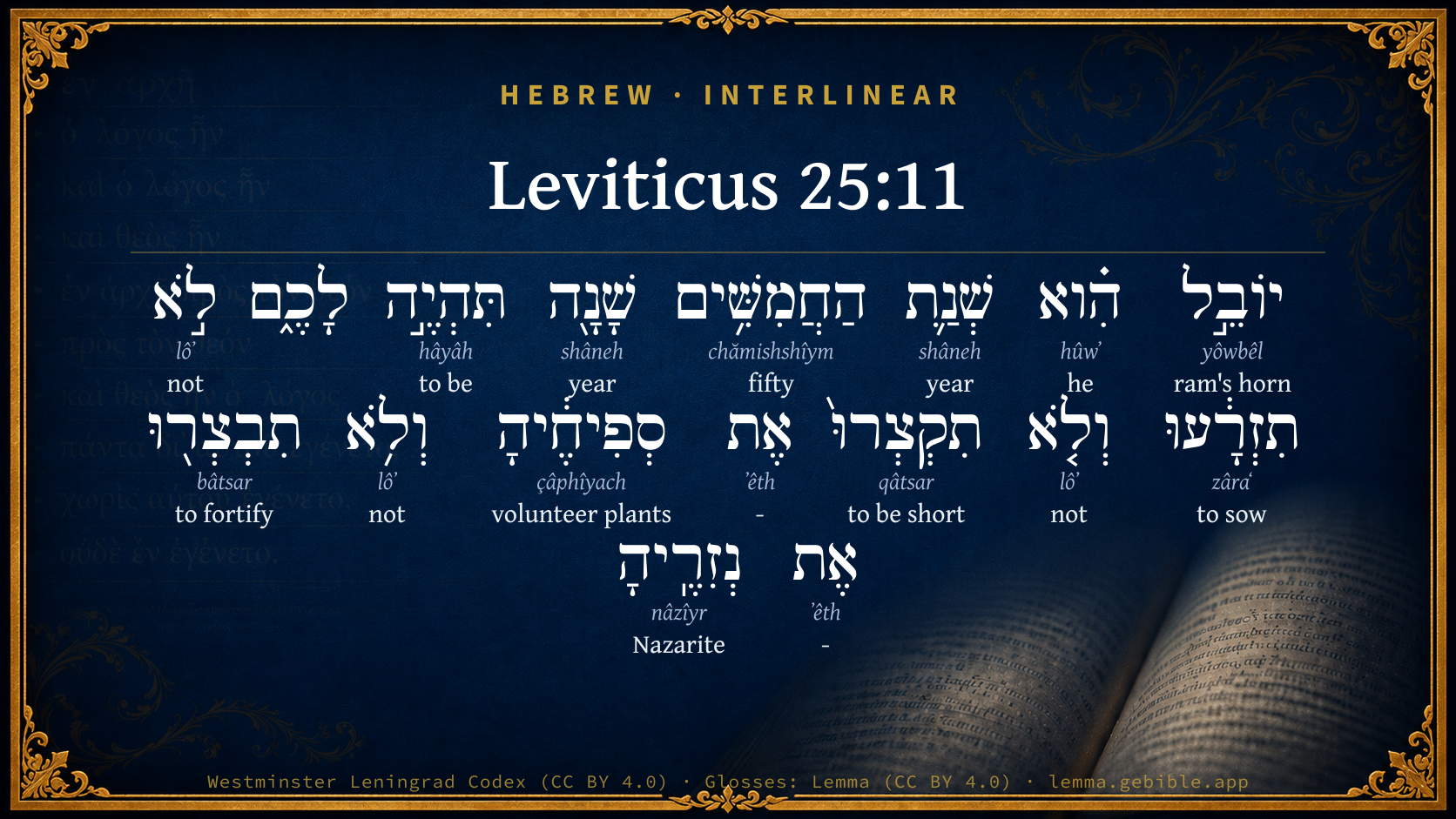
Hebrew (Westminster Leningrad Codex) Leviticus 25:11 appears in the Hebrew Old Testament. The text above is from the Westminster Leningrad Codex. Each word links to its Strong’s number, a concise gloss, and parsing drawn from the Open Scriptures Hebrew Bible morphology. Click any word for its full Brown-Driver-Briggs (BDB) entry.
Download image
Cite this verse

Leviticus 25:11 (World English Bible). Public Domain. Lemma interlinear Bible study tool, https://lemma.gebible.app/v/leviticus/25/11.

Show BibTeX & RIS
BibTeX
RIS
English Translation
That fiftieth year shall be a jubilee to you. In it you shall not sow, neither reap that which grows of itself, nor gather from the undressed vines.
World English Bible · Public Domain
Download a study sheet

One document with this verse’s original text, its word-by-word gloss line, the meaning frame, cross-references with their text, attributed commentary, and full source and license credits — printable, and it pastes into notes with its structure intact.

This verse Autodidact and up

Study sheet (.html) Plain text (.txt)

A passage Seminary Student

Up to 50 verses in one chapter. A passage sheet keeps up to 6 commentary sources and 12 cross-references per verse, in the order this page ranks them, and says so on the sheet whenever that leaves anything out. Ask for a single verse and you get the Autodidact verse sheet above.

Everything on this page stays free to read, with no account — the sheet is a download of what is already on screen, not access to it.

Want to remove ads? Support Godless Engineer
Compare translations 3

The same verse in 3 English versions, stacked beneath the original-language interlinear above. Click any original word for its lexicon entry.

Each is an independent rendering of the whole verse — the interlinear is not word-aligned to these translations.

Highlighted words mark where these versions differ — a whole-verse word diff, not a word-by-word alignment.

  • World English Bible Public Domain
    That fiftieth year shall be a jubilee to you. In it you shall not sow, neither reap that which grows of itself, nor gather from the undressed vines.
  • King James Version Public Domain
    A jubilee shall that fiftieth year be unto you: ye shall not sow, neither reap that which groweth of itself in it, nor gather the grapes in it of thy vine undressed.
  • unfoldingWord Literal Text CC BY-SA 4.0
    A Jubilee it shall be, the year, the fiftieth year, for you. You shall not sow, and you shall not reap its self-grown, and you shall not gather from its untrimmed.

unfoldingWord Literal Text — © unfoldingWord, licensed CC BY-SA 4.0. Word-aligned USFM3 via Door43 (git.door43.org/unfoldingWord/en_ult).

Versions to compare (up to 4)

3 of 4 selected

Show all 18 translations

Every available English version of this verse, each an independent rendering of the whole verse.

  • World English Bible Public Domain
    That fiftieth year shall be a jubilee to you. In it you shall not sow, neither reap that which grows of itself, nor gather from the undressed vines.
  • Berean Standard Bible Public Domain
    The fiftieth year will be a Jubilee for you; you are not to sow the land or reap its aftergrowth or harvest the untended vines.
  • Majority Standard Bible Public Domain
    The fiftieth year will be a Jubilee for you; you are not to sow the land or reap its aftergrowth or harvest the untended vines.
  • King James Version Public Domain
    A jubilee shall that fiftieth year be unto you: ye shall not sow, neither reap that which groweth of itself in it, nor gather the grapes in it of thy vine undressed.
  • American Standard Version (1901) Public Domain
    A jubilee shall that fiftieth year be unto you: ye shall not sow, neither reap that which groweth of itself in it, nor gather `the grapes' in it of the undressed vines.
  • Revised Version (1885) Public Domain
    A jubile shall that fiftieth year be unto you: ye shall not sow, neither reap that which groweth of itself in it, nor gather the grapes in it of the undressed vines.
  • Geneva Bible (1599) Public Domain
    This fiftieth yeere shalbe a yeere of Iubile vnto you: ye shall not sowe, neither reape that which groweth of it selfe, neither gather the grapes thereof, that are left vnlaboured.
  • Douay-Rheims (1899) Public Domain
    Because it is the jubilee and the fiftieth year. You shall not sow, nor reap the things that grow in the field of their own accord, neither shall you gather the firstfruits of the vines,
  • Young's Literal Translation Public Domain
    `A jubilee it `is', the fiftieth year, a year it is to you; ye sow not, nor reap its spontaneous growth, nor gather its separated things;
  • Literal Standard Version CC BY-SA 4.0
    It [is] a Jubilee, the fiftieth year, it is a year for you; you do not sow, nor reap its spontaneous growth, nor gather its separated things;
  • Unlocked Literal Bible CC BY-SA 4.0
    The fiftieth year will be a Jubilee for you. You must not plant or conduct an organized harvest. Eat whatever grows by itself, and gather the grapes that grow on the unpruned vines.
  • unfoldingWord Literal Text CC BY-SA 4.0
    A Jubilee it shall be, the year, the fiftieth year, for you. You shall not sow, and you shall not reap its self-grown, and you shall not gather from its untrimmed.
  • Darby Bible Public Domain
    a year of jubilee shall that fiftieth year be unto you: ye shall not sow, neither reap its aftergrowth, nor gather [the fruit of] its undressed vines.
  • World Messianic Bible Public Domain
    That fiftieth year shall be a jubilee to you. In it you shall not sow, neither reap that which grows of itself, nor gather from the undressed vines.
  • Webster's Bible Public Domain
    A jubilee shall that fiftieth year be to you: ye shall not sow, neither reap that which groweth of itself in it, nor gather the grapes in it of thy vine undressed.
  • Free Bible Version CC BY-SA 4.0
    The fiftieth year will be a Jubilee for you. Don't sow the land; don't harvest what may have grown up in your fields, or collect the grapes from your vineyards that you haven't cared for.
  • Bible in Basic English Public Domain
    Let this fiftieth year be the Jubilee: no seed may be planted, and that which comes to growth of itself may not be cut, and the grapes may not be taken from the uncared-for vines.
  • JPS Tanakh (1917) Public Domain
    A jubilee shall that fiftieth year be unto you; ye shall not sow, neither reap that which groweth of itself in it, nor gather the grapes in it of the undressed vines.

Literal Standard Version (2020), Covenant Press — licensed CC BY-SA 4.0. Text via the HelloAO Bible API (eBible.org). Unlocked Literal Bible (unfoldingWord) — licensed CC BY-SA 4.0. Text via the HelloAO Bible API (eBible.org). unfoldingWord Literal Text — © unfoldingWord, licensed CC BY-SA 4.0. Word-aligned USFM3 via Door43 (git.door43.org/unfoldingWord/en_ult). Free Bible Version, Dr. Jonathan Gallagher — licensed CC BY-SA 4.0. Text via the HelloAO Bible API (eBible.org).

Word by word

More ways to search: Search by grammar → Find every occurrence → Compare this word →

Practice this passage: Drill this verse → Learn its vocabulary →

סְפִיחֶ֔יהָ
çâphîyach
H5599
“volunteer plants · her”
Noun, Common, Masculine, Plural, Construct + Suffix, Personal, 3rd Person, Feminine, Singular
Part of Speech
Noun
Type
Common
Gender
Masculine
Number
Plural
State
Construct
Full BDB Definition

Origin: from H5596

TWOT: 1533a , 1533b

outpouring - growth from spilled kernels, after-growth, volunteer plants
  1. יוֹבֵ֣ל yôwbêl H3104 “ram's horn” Noun, Common, Masculine, Singular, Absolute
  2. הִ֗וא hûwʼ H1931 “he” Pronoun, Personal, 3rd Person, Feminine, Singular
  3. שְׁנַ֛ת shâneh H8141 “year of” Noun, Common, Feminine, Singular, Construct
  4. הַחֲמִשִּׁ֥ים chămishshîym H2572 “the · fifty” Particle, Definite Article + Adjective, Cardinal number, Both, Plural, Absolute
  5. שָׁנָ֖ה shâneh H8141 “year” Noun, Common, Feminine, Singular, Absolute
  6. תִּהְיֶ֣ה hâyâh H1961 “to be” Verb, Qal, Imperfect, 3rd Person, Feminine, Singular
  7. לֹ֣א lôʼ H3808 “not” Particle, Negative
  8. תִזְרָ֔עוּ zâraʻ H2232 “to sow” Verb, Qal, Imperfect, 2nd Person, Masculine, Plural
  9. וְלֹ֤א lôʼ H3808 “and · not” Conjunction + Particle, Negative
  10. תִקְצְרוּ֙ qâtsar H7114 “to be short” Verb, Qal, Imperfect, 2nd Person, Masculine, Plural
  11. אֶת ʼêth H853 “-” Particle, Direct Object
  12. וְלֹ֥א lôʼ H3808 “and · not” Conjunction + Particle, Negative
  13. תִבְצְר֖וּ bâtsar H1219 “to fortify” Verb, Qal, Imperfect, 2nd Person, Masculine, Plural
  14. אֶת ʼêth H853 “-” Particle, Direct Object
  15. נְזִרֶֽיהָ nâzîyr H5139 “Nazarites · her” Noun, Common, Masculine, Plural, Construct + Suffix, Personal, 3rd Person, Feminine, Singular

About this verse

These counts appear in no published source. They are computed here, from the morphology-tagged text and Lemma’s own curated glosses. What Lemma adds →

17
words
12
distinct lemmas
Pentateuch
section

Notable vocabulary

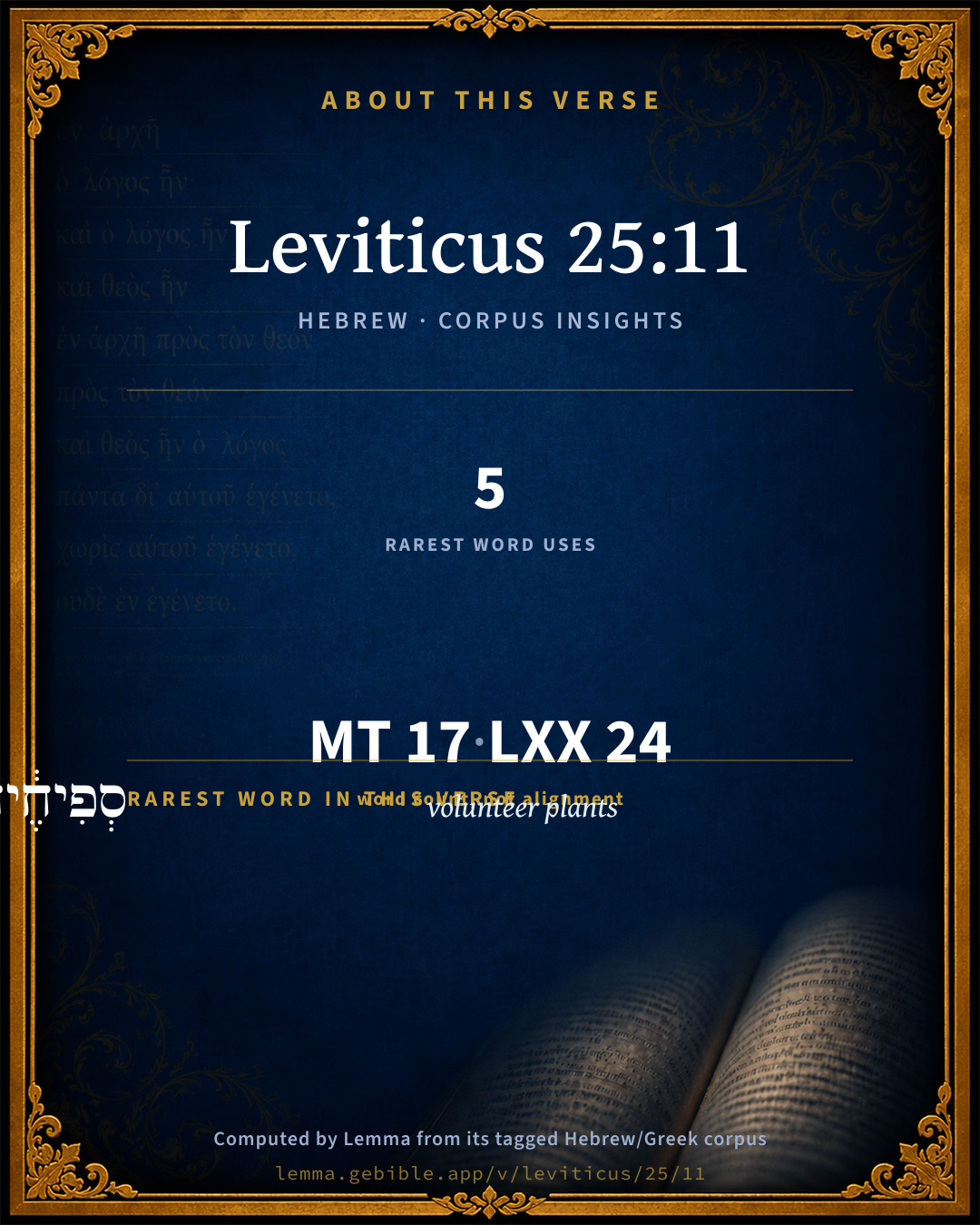
The rarest word here is סְפִיחֶ֔יהָ volunteer plants H5599 — appearing just 5 times in the whole Hebrew Bible.

Shared distinctive vocabulary

סְפִיחֶ֔יהָ volunteer plants H5599 occurs in 5 verses of the Hebrew Bible. Also found in:

Grammatical profile

  • 4 verbs
  • 5 nouns
  • 1 adjective
  • 1 pronoun
  • 1 preposition
  • 5 particles

Verb forms

  • תִּהְיֶ֣ה Qal · Imperfect
  • תִזְרָ֔עוּ Qal · Imperfect
  • תִקְצְרוּ֙ Qal · Imperfect
  • תִבְצְר֖וּ Qal · Imperfect

Repetition

Words recur within this verse — often emphatic in Hebrew:

  • שְׁנַ֛ת year H8141 ×2
  • לֹ֣א not H3808 ×3

Hebrew & Septuagint length

In English translation the verse runs 28 words from the Hebrew and 37 from the Septuagint (LXX English) — closely comparable.

A rough comparison of the two English renderings, which tokenize alike — not a word-level alignment.

Word counts can differ between the Hebrew and the Greek without any difference in meaning — e.g. the Hebrew direct-object marker אֵת has no separate Greek word, and Greek often adds the article ὁ.

In the original languages it is 17 Hebrew tokens and 24 Greek tokens — but the two are counted differently (Hebrew bundles its prefixes and suffixes into one token; the Greek is in lemma form), so that isn’t a like-for-like length.

Cross-references

2

Topical passages linked to Leviticus 25:11 in the Treasury of Scripture Knowledge — connected by theme and wording, ordered by reader-vote popularity; previews shown in the World English Bible.

  • Leviticus 25:4–5 but in the seventh year there shall be a Sabbath of solemn rest for the land, a Sabbath to Yahweh. You shall not sow your field or prune your vineyard.
  • Leviticus 27:17 If he dedicates his field from the Year of Jubilee, according to your valuation it shall stand.

Cross-references courtesy of OpenBible.info (CC BY 4.0).

Hebrew and Greek witnesses Masoretic Hebrew ↔ Greek Septuagint

The same verse in the two great witnesses to the Old Testament, shown verse-for-verse.

These are two independent witnesses, not word-aligned to each other, and the Septuagint is shown in lemma (dictionary) form.

Hebrew Leviticus 25:11 Masoretic · Westminster Leningrad Codex

יוֹבֵ֣ל הִ֗וא שְׁנַ֛ת הַחֲמִשִּׁ֥ים שָׁנָ֖ה תִּהְיֶ֣ה לָכֶ֑ם לֹ֣א תִזְרָ֔עוּ וְלֹ֤א תִקְצְרוּ֙ אֶת סְפִיחֶ֔יהָ וְלֹ֥א תִבְצְר֖וּ אֶת נְזִרֶֽיהָ

That fiftieth year shall be a jubilee to you. In it you shall not sow, neither reap that which grows of itself, nor gather from the undressed vines.

World English Bible · Public Domain

Greek LXX Leviticus 25:11 Septuagint · lemma form

ἄφεσις σημασία οὗτος ὁ ἔτος ὁ πεντηκοστός ἐνιαυτός εἰμί σύ οὐ σπείρω οὐδέ ἀμάω ὁ αὐτόματος ἀναβαίνω αὐτός καί οὐ τρυγάω ὁ ἁγιάζω αὐτός

This is a jubilee of release, the year shall be to you the fifties year: you⌃ shall not sow, nor reap the produce that comes of itself from the land, neither shall you⌃ gather its dedicated fruits.

LXX2012 (modern English Septuagint) · Public Domain

Hebrew: Westminster Leningrad Codex (CC BY 4.0). Greek: Septuagint (public domain); English from LXX2012 (modern English Septuagint) (Public Domain). How the Septuagint differs from the Hebrew →

Targum (Aramaic paraphrase)

2

The Targum is the ancient Jewish Aramaic paraphrase of the Hebrew Scriptures — an interpretive translation, not the Hebrew text itself. Onkelos (literal) and Pseudo-Jonathan (expansive) render the Torah, and Jonathan the Prophets. Coverage is partial: where no permissively-licensed English translation exists for a verse, only the Aramaic is shown. This is verse-level text, not a word-by-word alignment to the Hebrew.

  1. Targum Onkelos Torah (Genesis–Deuteronomy)
    יוֹבֵלָא הִיא שְׁנַת חַמְשִׁין שְׁנִין תְּהֵי לְכוֹן לָא תִזְרְעוּן וְלָא תַחְצְדוּן יַת כַּתָּהָא וְלָא תִקְטְפוּן יַת שִׁבְקָהָא

    (no public-domain English translation for this verse)

    Targum Onkelos — Aramaic: “Onkelos Genesis” (public domain); “Onkelos Exodus” (public domain); “Onkelos Leviticus” (public domain); “Onkelos Numbers” (public domain); “Onkelos Deuteronomy” (public domain). English: “Sefaria Community Translation” (CC0 1.0 (public-domain dedication)); “J.W. Etheridge. The Targums of Onkelos and Jonathan Ben Uzziel on the Pentateuch. London: Longmans, Green, 1862” (public domain). Text via Sefaria.

  2. Targum Pseudo-Jonathan Torah (Genesis–Deuteronomy)
    יוּבְלָא הִיא שְׁנַת חַמְשִׁין שְׁנִין תְּהֵי לְכוֹן לָא תִזְרְעוּן וְלָא תְחַצְדוּן בַּאֲוָותָהָא וְלָא תְקַטְפוּן יַת עִנְבֵי שְׁמִיטָהָא

    The year of Jubela shall that fiftieth be to you: ye shall not sow, nor reap the after crop, nor make vintages of the grapes which have been let alone.

    Targum Pseudo-Jonathan — Aramaic: “Targum Jonathan on Genesis” (public domain); “Targum Jonathan on Exodus” (public domain); “Targum Jonathan on Leviticus” (public domain); “Targum Jonathan on Numbers” (public domain); “Targum Jonathan on Deuteronomy” (public domain). English: “The Targum of Jonathan ben Uzziel, trans. J. W. Etheridge, London, 1862” (public domain). Text via Sefaria.

Commentary

Notes on Leviticus 25:11 from classic Christian and Jewish commentators (each source and its license shown beneath its notes). The classic Christian expositions comment on the surrounding passage and are grouped to its opening verse, so a note may address several verses; the Jewish commentaries on the Tanakh (Rashi and others) are per-verse, so they appear only where the commentator wrote on this verse.

Lemma curates 59 commentaries, every one of them public domain or Creative Commons licensed, each selected and text-cleaned for this edition rather than reprinted as found. About our sources →

Trapp's Complete Commentary

John Trapp

Lev 25:11 A jubile shall that fiftieth year be unto you: ye shall not sow, neither reap that which groweth of itself in it, nor gather [the grapes] in it of thy vine undressed.

Ver. 11. A jubilee shall that fiftieth year be.] Or, That jubilee shall be unto you the year of fifty years. This first Mosaical jubilee was in 1396 BC.

John Trapp, A Commentary or Exposition upon All the Books of the Old and New Testament (1647–1656) — public domain. Text from a community e-Sword module.

Tyndale Open Study Notes

Tyndale Open Resources

25:11-12 All the regulations of the Sabbath year also applied to the Year of Jubilee.

Tyndale Open Study Notes — © Tyndale Open Resources, licensed CC BY-SA 4.0. Text via the HelloAO Bible API.

Adam Clarke's Commentary

Verse 11. A jubilee shall that fiftieth year be] The literal meaning of the word jubilee, יובל yobel in Hebrew, and יוביל yobil in the Samaritan, has not been well ascertained. Josephus and the rabbins have caused many to err; the former says the word signifies liberty; Ελευθεριαν δε σημαινει τουνομα, Antiq., l. 3, cap. 12, edit. Haverc., vol. 1., p. 184; but the word liberty signifies rather the intention of the institution, than the meaning of the Hebrew term. The rabbins say it signifies a ram's horn, because the trumpets which were used in proclaiming this solemnity were made out of ram's horns. This meaning is adopted in a few places in our translation, but none of the ancient versions acknowledge this sense of the term, the Chaldee excepted. Some derive it from yabal, to bring, carry away, because the Israelites at this time carried away the right of repossessing their inheritances which had been forfeited or alienated. The most natural derivation is from הוביל hobil, to cause to bring back, or recall, because estates, c., which had been alienated, were then brought back to their primitive owners. This was a wise and excellent institution, but appears to have been little regarded by the Jews after the Babylonish captivity. Indeed, it is not mentioned under the second temple, and the observance must have ceased among the Jews when they were brought under a foreign yoke.

The jubilee seems to have been typical,

1. Of the great time of release, the Gospel dispensation, when all who believe in Christ Jesus are redeemed from the bondage of sin - repossess the favour and image of God, the only inheritance of the human soul, having all debts cancelled, and the right of inheritance restored. To this the prophet Isaiah seems to allude, Isa 26:13, and particularly Isa 61:1-3.

2. Of the general resurrection. "It is," says Mr. Parkhurst, "a lively prefiguration of the grand consummation of time, which will be introduced in like manner by the trump of God, 1Co 15:52, when the children and heirs of God shall be delivered from all their forfeitures, and restored to the eternal inheritance allotted to them by their Father and thenceforth rest from their labours, and be supported in life and happiness by what the field of God shall supply."

It is worthy of remark that the jubilee was not proclaimed till the tenth day of the seventh month, on the very day when the great annual atonement was made for the sins of the people; and does not this prove that the great liberty or redemption from thraldom, published under the Gospel, could not take place till the great Atonement, the sacrifice of the Lord Jesus, had been offered up? See Le 25:9.

Adam Clarke's Commentary on the Bible (1810–1826) — public domain. Text from a community e-Sword/MySword module.

Ellicott's Commentary for English Readers

(11) A jubile shall that fiftieth year be unto you.—According to the unanimous testimony of the authorities during the second Temple, including Philo (ii. 287-290) and Josephus (Antt. iii. 12, § 3), the jubile was observed every fiftieth year, as is plainly enjoined both in the verse before us and in Lev_25:10. As the forty-ninth year is the sabbatical year and the fiftieth year the jubile, there were two successive fallow years.

Ye shall not sow.—As the fiftieth year is jubile, and partakes of the nature of the sabbatical year, sowing and reaping are forbidden.

Neither reap that which groweth of itself in it.—That is, the spontaneous growth of this year is not to be made into a regular harvest and stored up. (See Lev_25:5.)

Vine undressed.—See Lev_25:5.

A Bible Commentary for English Readers, edited by Charles John Ellicott (1878–1897) — public domain. Text from a community e-Sword module.

John Gill's Exposition

A jubilee shall that fiftieth year be unto you,.... Which, clearly shows, that not the forty ninth year was the year of jubilee, as many learned men have asserted, chiefly induced by this reason, because two years would come together in which were no sowing reaping; but that God, that could cause the earth to forth fruit for three years, Lev 25:21; could make it bring forth enough for four years; and in order to make their sentiment agree with this passage, they are obliged to make the foregoing jubilee one of the fifty, and begin their account from thence; but this could not be done in the first account of the jubilee; of the name; see Gill on Lev 25:9,

ye shall not sow; in the year of jubilee, which shows also that this could not be the forty ninth year, which of course being a sabbatical year, there would be no sowing, reaping, &c. and so this law or instruction would be quite needless:

neither reap that which groweth of itself in it, nor gather the grapes in it of thy vine undressed; as in the sabbatical year; see Gill on Lev 25:5; the same with respect to these things being to be observed in the year of jubilee, as in that; and so Jarchi observes that the same that is said of the sabbatical year is said of the jubilee, two holy years being found next to one another, the forty ninth year the sabbatical year, and the fiftieth year the jubilee.

John Gill's Exposition of the Whole Bible (1746–1763) — public domain (CC PDM 1.0). Text via the HelloAO Bible API.

Matthew Poole's English Annotations

Though it come immediately after a seventh year, wherein also this was forbidden to you.

Matthew Poole's English Annotations on the Holy Bible (1683–1685) — public domain. Text from a community e-Sword/MySword module.

Whedon's Commentary on the Bible

Daniel D. Whedon

11. Ye shall not sow, neither reap — This prohibition makes the fiftieth year sabbatic, like the forty-ninth: the land being untilled two successive years. The sustenance of the people in this case is provided for by the threefold productiveness of the last secular year. See Lev_25:21.

Nor gather the grapes — It is probable that this applied only to the fields, and not to the gardens attached to the houses.

Daniel D. Whedon (gen. ed.), Commentary on the Old and New Testaments (1874–1909) — public domain. Text from a community e-Sword module.

The Pulpit Commentary

Vers. 11, 12. So far as the tillage of the land went, the jubilee year was to have the same effect as a sabbatical year.

The Pulpit Commentary (1880–1919), ed. H.D.M. Spence-Jones & Joseph S. Exell — public domain. Text from a community e-Sword module.

unfoldingWord translationNotes

Door43 World Missions Community

a Jubilee for you

"a year of restoration" or "a year for you to return the land." It can be stated clearly who they were returning the land to. AT: "a year for you to return the land to me" (See: Assumed Knowledge and Implicit Information)

You must eat the produce that grows by itself out of the fields

Yahweh did not allow the land owner to organize his workers and harvest the land as he did the other six years. However, he did allow individuals to go through the fields and eat what they find.

translationWords

harvest

grape

vine

holy

unfoldingWord translationNotes — © Distant Shores Media and the Door43 World Missions Community, licensed CC BY-SA 4.0. Source: git.door43.org/Door43/en_tn.

Rashi

Rabbi Shlomo Yitzchaki (Rashi)

יובל הוא שנת החמשים שנה IT IS A JUBILEE; THE FIFTIETH YEAR [SHALL BE UNTO YOU A PERIOD etc.] — Why is this statement made at all? Is it not identical with that made in v. 10? But because it is stated (v. 10) “and ye shall sanctify [the fiftieth year]” which implies that the year has to be sanctified at the beginning although the law of setting the slaves free applies only as from Yom Kippur, and consequently one might think that the holy character of the year is to be extended till the tenth of Tishri of the next year. Scripture therefore states here “a Jubilee is the fiftieth year” — but not any part of the fifty-first — just as is explained in Rosh Hashanah 8b and in Torat Cohanim (Sifra, Behar, Chapter 3 1).

את נזריה [YE SHALL NOT GATHER THE GRAPES] THAT ARE נזירים — i. e. the grapes which have been kept by you (cf. Rashi on v. 6: לכם לאכלה‎ שבת הארץ), but you may gather from those that had been declared free to all (cf. Rashi on v. 5: ‎‎לא תבצר). Just as this is stated with reference to the Sabbatical year so, too, is it stated with regard to the Jubilee (Sifra, Behar, Chapter 3 2). Thus there are two holy years one after the other: the forty-ninth year שמיטה, and the fiftieth,יובל‎‎.

Rashi on the Tanakh — English translations: “The Judaica Press complete Tanach with Rashi, translated by A. J. Rosenberg” (CC BY 4.0); “Pentateuch with Rashi's commentary by M. Rosenbaum and A.M. Silbermann, 1929-1934” (public domain); “The Metsudah Tanach series, Lakewood, N.J” (CC BY 4.0); and “The Book of Joshua, Metsudah Publications, 1997” (CC BY 4.0). Text via Sefaria.

Lesson kit

Teaching starters — assembled from the data on this page, not authored interpretation. Every prompt links to the verse data it draws on. Edit before teaching.

Leviticus, in the Pentateuch, opens this verse with 17 words (12 distinct Hebrew lemmas). Its most distinctive word is çâphîyach (“volunteer plants”). A historical commentator’s framing appears above. Read the whole chapter for the surrounding context.

Discussion questions

  1. The word çâphîyach carries the sense “volunteer plants.” How does it shape the verse?
  2. How does Leviticus 25:5, which shares the word «volunteer plants», read alongside this verse?
  3. What does the repetition of “year” (2× in this one verse) do in this verse?
  4. These translations render this verse differently. What is at stake in choosing one wording over another?
  5. «תִּהְיֶ֣ה» is a Qal Imperfect verb. How does that grammatical form shape the action described?
  6. Compare how Trapp's Complete Commentary and Tyndale Open Study Notes read this verse. Where do they agree or differ?

Things to notice

Reading settings

Reading text

Shown beneath each verse's original-language words.

Old Testament
Old Testament edition

Read the OT as the Masoretic Hebrew (MT) or the Greek Septuagint (LXX).

English shown for the Greek Septuagint (in the Hebrew ↔ Greek comparison).

Comparing translations? Open the Compare panel on any verse page to stack up to four side by side.